Nahum 1:2(v11)Yahweh is a jealous God and avenges. Yahweh avenges and is full of wrath. Yahweh takes vengeance on his adversaries, and he maintains wrath…
Nahum 1:6(v11)Who can stand before his indignation? Who can endure the fierceness of his anger? His wrath is poured out like fire, and the rocks are…
Acts 3:19(v12)“Repent therefore, and turn again, that your sins may be blotted out, so that there may come times of refreshing from the presence of the…
Matthew 3:10(v12)“Even now the ax lies at the root of the trees. Therefore every tree that doesn’t produce good fruit is cut down, and cast into the fire.
Psalms 7:8(v11)Yahweh administers judgment to the peoples. Judge me, Yahweh, according to my righteousness, and to my integrity that is in me.
Show all 33 cross-references
Isaiah 55:6-7(v12)Seek Yahweh while he may be found. Call on him while he is near. Let the wicked forsake his way, and the unrighteous man his thoughts. Let…
2 Thessalonians 1:6(v13)Since it is a righteous thing with God to repay affliction to those who afflict you,
Deuteronomy 32:41(v12)if I sharpen my glittering sword, my hand grasps it in judgment; I will take vengeance on my adversaries, and will repay those who hate me.
Psalms 94:15(v11)For judgment will return to righteousness. All the upright in heart shall follow it.
Habakkuk 3:13(v13)You went out for the salvation of your people, for the salvation of your anointed. You crushed the head of the land of wickedness. You…
Psalms 18:14(v13)He sent out his arrows, and scattered them; Yes, great lightning bolts, and routed them.
Psalms 45:5(v13)Your arrows are sharp. The nations fall under you, with arrows in the heart of the king’s enemies.
Psalms 50:6(v11)The heavens shall declare his righteousness, for God himself is judge.
Psalms 64:7(v13)But God will shoot at them. They will be suddenly struck down with an arrow.
Psalms 85:4(v12)Turn us, God of our salvation, and cause your indignation toward us to cease.
Psalms 140:12-13(v11)I know that Yahweh will maintain the cause of the afflicted, and justice for the needy. Surely the righteous will give thanks to your name.…
Ezekiel 18:30(v12)“Therefore I will judge you, house of Israel, everyone according to his ways,” says the Lord Yahweh. “Return, and turn yourselves from all…
Habakkuk 3:11(v13)The sun and moon stood still in the sky, at the light of your arrows as they went, at the shining of your glittering spear.
Revelation 6:10(v13)They cried with a loud voice, saying, “How long, Master, the holy and true, until you judge and avenge our blood on those who dwell on the…
Revelation 16:6(v13)For they poured out the blood of saints and prophets, and you have given them blood to drink. They deserve this.”
Deuteronomy 32:23(v13)“I will heap evils on them. I will spend my arrows on them.
Deuteronomy 32:42(v13)I will make my arrows drunk with blood. My sword shall devour flesh with the blood of the slain and the captives, from the head of the…
Job 6:4(v13)For the arrows of the Almighty are within me. My spirit drinks up their poison. The terrors of God set themselves in array against me.
Psalms 11:2(v13)For, behold, the wicked bend their bows. They set their arrows on the strings, that they may shoot in darkness at the upright in heart.
Psalms 64:3(v13)who sharpen their tongue like a sword, and aim their arrows, deadly words,
Psalms 144:6(v13)Throw out lightning, and scatter them. Send out your arrows, and rout them.
Isaiah 27:1(v12)In that day, Yahweh with his hard and great and strong sword will punish leviathan, the fleeing serpent, and leviathan the twisted serpent;…
Isaiah 34:5(v12)For my sword has drunk its fill in the sky. Behold, it will come down on Edom, and on the people of my curse, for judgment.
Jeremiah 31:18-19(v12)“I have surely heard Ephraim grieving thus, ‘You have chastised me, and I was chastised, as an untrained calf. Turn me, and I will be…
Lamentations 3:12-13(v13)He has bent his bow, and set me as a mark for the arrow. He has caused the shafts of his quiver to enter into my kidneys.
Ezekiel 21:9-11(v12)“Son of man, prophesy, and say, ‘Yahweh says: “A sword! A sword! It is sharpened, and also polished. It is sharpened that it may make a…
Ezekiel 21:23(v12)It will be to them as a false divination in their sight, who have sworn oaths to them; but he brings iniquity to memory, that they may be…
Ezekiel 33:11(v12)Tell them, ‘ “As I live,” says the Lord Yahweh, “I have no pleasure in the death of the wicked; but that the wicked turn from his way and…
Cross-references from openbible.info (CC BY 4.0)
Explain this passage (18 sources)
Historical commentary, presented as a primary source — not an endorsement.
John Calvin1540 · Public DomainOn vv11–1211 God judgeth the righteous etc. Others read, God…
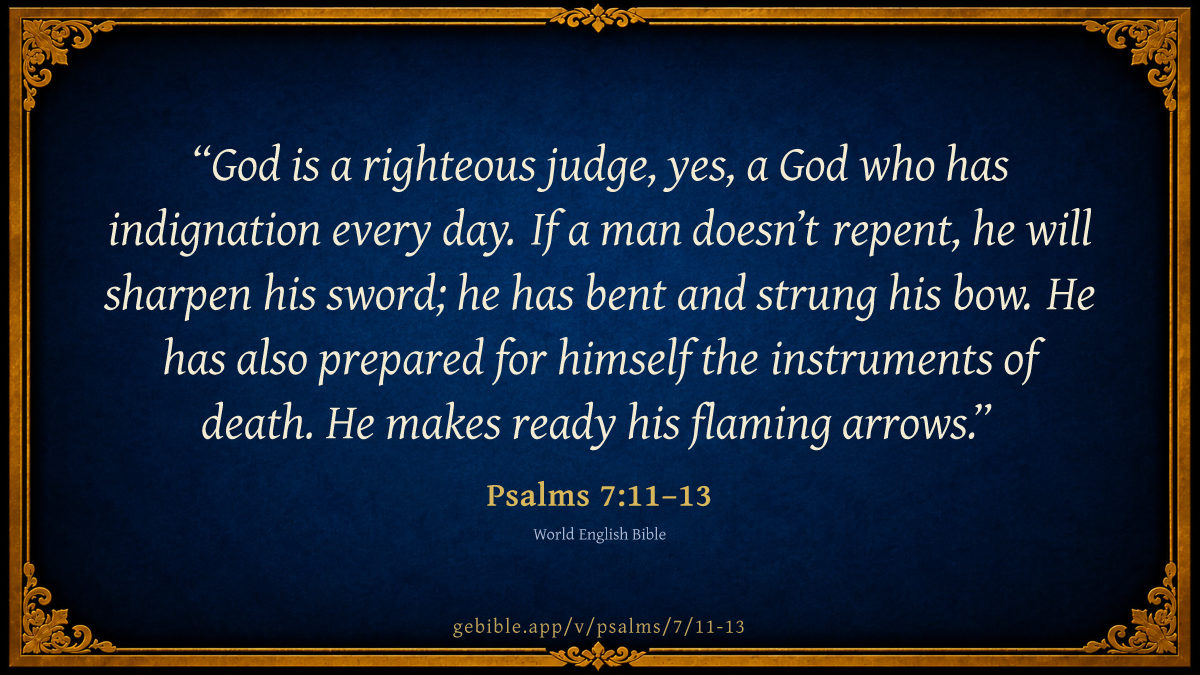
11 God judgeth the righteous etc. Others read, God is a righteous Judge, and God is angry every day. The words will certainly admit of this sense; but as the doctrine is fuller according to the first reading, I have preferred following it, as I see it is more approved of by the most learned divines, and, besides, it is more suitable to the subject which David is now considering. As Saul and his accomplices had, by their calumnious reports, so far succeeded in their wicked design as to have produced a general prejudice against David, so that he was condemned by almost the whole people, the holy man supports himself from this one consideration, that whatever may be the confusion of things in the world, God, notwithstanding, can easily discern between the righteous and the wicked. He, therefore, appeals from the false judgments of men to Him who can never be deceived. It may, however, be asked, How does the Psalmist represent God as judging every day, when we see him delaying punishment frequently for a long time? The sacred writings certainly most justly celebrate his long-suffering; but, although he exercises patience long, and does not immediately execute his judgments, yet, as no time passes, yea, not even a day, in which he does not furnish the clearest evidence that he discerns between the righteous and the wicked, notwithstanding the confusion of things in the world, it is certain that he never ceases to execute the office of a judge. All who will be at the trouble to open their eyes to behold the government of the world, will distinctly see that the patience of God is very different from approbation or connivance. Surely, then, his own people will confidently betake themselves to him every day.
John Calvin's Commentaries (1540-1563) — public domain. Text from the Calvin Translation Society English edition (1840s-50s) via the Christian Classics Ethereal Library (ccel.org). Calvin's coverage is partial (roughly two-thirds of the Bible); uncommented books and verses are honest gaps, never fabricated. The 19th-century editor's footnotes and remarks are omitted so the notes are faithfully Calvin's own voice.
Geneva Bible translators1599 · Public DomainOn vv11–12He doth continually call the wicked to repentance by…
He doth continually call the wicked to repentance by some signs of his judgments.
Geneva Bible (1599) marginal notes — public domain.
John Trapp1656 · Public DomainOn vv11–13Psa 7:11 God judgeth the righteous, and God is…
Psa 7:11 God judgeth the righteous, and God is angry [with the wicked] every day.
Ver. 11. God is angry with the wicked every day] Or, all day long; they are under the arrest of his wrath, and liable to the wrath to come. Children they are of wrath, because of disobedience. One rendereth it, God troubled them, sc. by laying continually some judgment or other upon them; and yet there is no cause to fear (as the heathen did of his Jupiter) that he should be exhausted, Si quoties peccent homines, &c.
John Trapp, A Commentary or Exposition upon All the Books of the Old and New Testament (1647–1656) — public domain. Text from a community e-Sword module.
Matthew Poole1685 · Public DomainOn vv11–13God judgeth, i.e. defendeth, or avengeth, or delivereth, as…
God judgeth, i.e. defendeth, or avengeth, or delivereth, as this word is oft used, as Deu 32:36; Psa 9:4; 10:18; 26:1, &c. To judge is properly to give sentence; which because it may be done either by absolving and acquitting from punishment, or by condemning and giving up to punishment, therefore it is sometimes used for the one and sometimes for the other, as the circumstances of the place determine it.
With the wicked; which though it may seem a bold supplement, yet is necessary, and easily fetched out of the next and following verses.
Read full note →
Every day; even then, when his providence seems to favour them and they are most secure and confident.
Matthew Poole's English Annotations on the Holy Bible (1683–1685) — public domain. Text from a community e-Sword/MySword module.
John Gill1763 · Public DomainOn vv11–13God judgeth the righteous,.... Not all that are thought…
God judgeth the righteous,.... Not all that are thought to be righteous, or think themselves to be so, are such; nor is any man naturally righteous, or of himself, nor by virtue of his obedience to the law of works; but such only are righteous who are made so by the obedience of Christ; these God governs and protects, avenges their injuries and defends their persons; some render the words, "God is a righteous Judge" (f); he is so now in the administrations of his government of the universe, and he will be so hereafter in the general judgment of the world;
and God is angry with the wicked every day; wicked men are daily sinning, and God is always the same in his nature, and has the same aversion to sin continually; and though he is not always making men examples of his wrath, yet his wrath is revealed from heaven against all unrighteousness of men; and there are frequent stances of it; and when he is silent he is still angry, and in his own time will stir up all his wrath, and rebuke in his hot displeasure.
Read full note →
(f) Vid. Aben Ezra & Abendana not. in Miclol. Yophi in loc. "Deus judex justus", V. L. Munster, Musculus, Montanus, Piscator, Gejerus, Michaelis; so Ainsworth.
John Gill's Exposition of the Whole Bible (1746–1763) — public domain (CC PDM 1.0). Text via the HelloAO Bible API.
John Wesley1765 · Public DomainOn vv11–13Every day - Even then, when his providence seems…
Every day - Even then, when his providence seems to favour them, and they are most secure and confident.
John Wesley, Explanatory Notes Upon the Whole Bible (1754–1765) — public domain. Text via the GEBible commentary corpus.
Adam Clarke1810 · Public DomainOn vv11–13Verse 11. God is angry with the wicked every…
Verse 11. God is angry with the wicked every day.] The Hebrew for this sentence is the following: ועל זעם בכל יום veel zoem becol yom; which, according to the points, is, And God is angry every day. Our translation seems to have been borrowed from the Chaldee, where the whole verse is as follows: אלהא דינא זכאה ובתקוף רגיז אל רשיעי כל יומא elaha daiyana zaccaah ubithkoph rageiz al reshiey col yoma: "God is a righteous Judge; and in strength he is angry against the wicked every day."
The VULGATE: Deus Judex justus, fortis, et patiens; numquid irascitur per sinpulos dies? "God is a Judge righteous, strong, and patient; will he be angry every day?"
Read full note →
The SEPTUAGINT: Ὁ Θεος Κριτης δικαιος, και ισχυρος, και μακροθυμος, μη οργην επαγων καθ' ἑκαστην ἡμεραν; "God is a righteous Judge, strong and longsuffering; not bringing forth his anger every day."
SYRIAC: "God is the Judge of righteousness; he is not angry every day."
The ARABIC is the same as the Septuagint.
The AETHIOPIC: "God is a just Judge, and strong and longsuffering; he will not bring forth tribulation daily."
COVERDALE: God is a righteous judge, and Gob is ever threateninge.
KING EDWARD'S Bible by Becke 1549, follows this reading.
CARDMARDEN: God is a righteous judge, [strong and patient] and God is provoked every day. Cardmarden has borrowed strong and patient from the Vulgate or Septuagint, but as he found nothing in the Hebrew to express them, he put the words in a smaller letter, and included them in brackets. This is followed by the prose version in our Prayer Book.
The GENEVAN version, printed by Barker, the king's printer, 1615, translates thus: "God judgeth the righteous, and him that contemneth God every day." On which there is this marginal note: "He doth continually call the wicked to repentance, by some signs of his judgments."
My ancient Scotico-English MS. Psalter only begins with the conclusion of this Psalm.
I have judged it of consequence to trace this verse through all the ancient versions in order to be able to ascertain what is the true reading, where the evidence on one side amounts to a positive affirmation, "God IS angry every day;" and, on the other side, to as positive a negation, "He is NOT angry every day." The mass of evidence supports the latter reading. The Chaldee first corrupted the text by making the addition, with the wicked, which our translators have followed, though they have put the words into italics, as not being in the Hebrew text. In the MSS. collated by Kennicott and De Rossi there is no various reading on this text.
The true sense may be restored thus: -
אל el, with the vowel point tsere, signifies GOD: אל al, the same letters, with the point pathach, signifies not. Several of the versions have read it in this way: "God judgeth the righteous, and is NOT angry every day." He is not always chiding, nor is he daily punishing, notwithstanding the continual wickedness of men: hence, the ideas of patience and longsuffering which several of the versions introduce. Were I to take any of the translations in preference to the above, I should feel most inclined to adopt that of Coverdale.
Adam Clarke's Commentary on the Bible (1810–1826) — public domain. Text from a community e-Sword/MySword module.
Joseph Benson1811 · Public DomainOn v12Psa 7:12-13. If he — The wicked man last…
Psa 7:12-13. If he — The wicked man last mentioned; turn not — From his wicked course; he — God; will whet his sword — Will prepare, and hasten, and speedily execute his judgments upon him. He hath bent his bow — Did I say, He will do it? nay, he hath already done it; his sword is drawn, his bow is bent, and the arrows are prepared and ready to be shot. The wrath of God may be slow, but it is always sure, and the sinner who is not converted by the vengeance inflicted on others, will himself, at length, be made an example of vengeance to others. He hath prepared for him — For the wicked; the instruments of death — That is, deadly weapons. He ordaineth — Designs or fits for this very use; his arrows against the persecutors — Of all sinners, persecutors are set up as the fairest marks of divine wrath. They set God at defiance, but cannot set themselves out of the reach of his judgments.
Joseph Benson's Commentary on the Old and New Testaments (1811–1818) — public domain. Text from a community e-Sword module.
Albert Barnes1834 · Public DomainOn vv11–13God judgeth the righteous - That is, he pronounces…
God judgeth the righteous - That is, he pronounces a just judgment on their behalf; he vindicates their character. It is true, in a general sense, that God judges all according to their character; but the particular idea here is, that God will do justice to the righteous; he will interpose to vindicate them, and he will treat them as they ought to be treated when assailed by their enemies, and when reproached and calumniated. The original phrase here is susceptible of two translations; either, “God is a righteous judge” or, “God is judging,” that is judges, “the righteous.” The sense is not materially varied, whichever translation is adopted. Our common version has probably expressed the true idea; and there the design of the writer is to contrast the manner in which God regards and treats the righteous, with the manner in which he regards and treats the wicked. The one he judges, that is, he does him justice; with the other he is angry every day.
And God is angry with the wicked - The phrase “with the wicked” is supplied by our translators, but not improperly, since the writer evidently intends to speak of these in contrast with the righteous. The words “God is angry” must, of course, be understood in a manner in accordance with the divine nature; and we are not to suppose that precisely the same passions, or the same feelings, are referred to when this language is used of God which is implied when it is used of people. It means that his nature, his laws, his government, his feelings, are all arrayed against the wicked; that he cannot regard the conduct of the wicked with favor; that he will punish them. While his judgment in regard to the righteous must be in their favor, it must just as certainly be against the wicked; while he will vindicate the one, he will cut off and punish the other. Of the truth of this in respect to the divine character there can be no doubt. Indeed, we could not honor a God - as we could honor no other being - who would deal with the righteous and the wicked alike, or who would have no respect to character in the treatment of others, and in his feelings toward them.
Read full note →
Every day - Continually; constantly; always. This is designed to quality the previous expression. It is not excitement. It is not temporary passion, such as we see in men. It is not sudden emotion, soon to be succeeded by a different feeling when the passion passes off. It is the steady and uniform attribute of his unchanging nature to be always opposed to the wicked - to all forms of sin; and in him, in this respect, there will be no change. The wicked will find him no more favorable to their character and course of life tomorrow than he is today; no more beyond the grave, than this side the tomb. What he is today he will be tomorrow and every day. Time will make no change in this respect, and the wicked can have no hope on the ground that the feeling of God toward sin and the sinner (as such) will ever be in any way different from what it is at the present moment. This is a fearful truth in regard to the sinner; and both aspects of the truth here stated should make the sinner tremble;
(a) that God is angry with him - that all His character, and all the principles of His govermnent and law, are and must be arrayed against him; and
(b) that in this respect there is to be no change; that if he continues to be wicked, as he is now, he will every day and always - this side the grave and beyond - find all the attributes of God engaged against him, and pledged to punish him.
God has no attribute that can take part with sin or the sinner.
Albert Barnes' Notes on the Bible (1834–1885) — public domain. Text from a community e-Sword/MySword module.
Robert Jamieson, A. R. Fausset & David Brown1871 · Public DomainOn vv11–13judgeth--as in Psa 7:8.
judgeth--as in Psa 7:8.
the wicked--Though not expressed, they are implied, for they alone are left as objects of anger.
Jamieson, Fausset & Brown — Commentary Critical and Explanatory on the Whole Bible (1871) — public domain (CC PDM 1.0). Text via the HelloAO Bible API.
Daniel D. Whedon1874 · Public DomainOn v1111-13. God judgeth—These verses present an earnest warning, not…
11-13. God judgeth—These verses present an earnest warning, not only to David’s wicked persecutors, but to all contemners of law and justice. The style is more impassioned, although of a didactic turn, and the imagery, apparently rude, is such as is suited to the barbarous and bloodthirsty spirits with whom he has to contend. The present participial form, God is judging, God is angry, shows that the wrath of God is already “revealed from heaven against all unrighteousness of men,” for their timely warning. Not, indeed, his ultimate punishment of sin, but his corrective, disciplinary judgment against it.
If he turn not—If the sinner, whoever he be, heed not these incipient and forewarning indications of displeasure. The conditional sentence proves that the present judgments against sin are corrective, and admonitory of what will follow if repentance do not supervene.
Read full note →
He will whet his sword—That is, will proceed to ultimate punishment. This, to the subject, is never corrective. The imagery is now wholly borrowed from the use of the deadly weapons of the warrior, not at all from the corrective and disciplinary methods of a parent or magistrate. Instruments of death, are not disciplinary, yet these are prepared for those who “turn not,” repent not: God is [now] ready to inflict punishment on the incorrigible.
Daniel D. Whedon (gen. ed.), Commentary on the Old and New Testaments (1874–1909) — public domain. Text from a community e-Sword module.
The Cambridge Bible for Schools and Colleges1878 · Public DomainOn vv11–1311. Render with R.V.;
11. Render with R.V.;
God (Elohim) is a righteous Judge,
Read full note →
Yea, a God (El) that hath indignation every day.
Whatever men may think (Psa_10:4; Psa_10:11; Psa_10:13), God’s judicial wrath against evil never rests. The addition strong and patient in P.B.V. is derived from the LXX through the Vulgate, strong being a rendering of El, and patient a gloss.
11–13. The theme of the judicial righteousness of God, in all its certainty and terribleness, is further developed.
The Cambridge Bible for Schools and Colleges (gen. ed. J. J. S. Perowne; Cambridge University Press, 1878–1918) — public domain. Text from a community e-Sword module.
Ellicott's Commentary for English Readers1878 · Public DomainOn vv11–13(11) God judgeth.—The two clauses answer to each other;…
(11) God judgeth.—The two clauses answer to each other; so the margin, “God is a righteous judge, and God avengeth every day.” LXX., “God is a just judge, and strong and longsuffering, not letting loose his anger every day.” Vulg., “Still is he not angry with the wicked?” Syriac, “God is the judge of righteousness. He is not angry every day.” It has been proposed to read véal—“and not”—instead of veél—“and God”—conformably to these versions, but unnecessarily.
A Bible Commentary for English Readers, edited by Charles John Ellicott (1878–1897) — public domain. Text from a community e-Sword module.
The Pulpit Commentary1880 · Public DomainOn vv11–13God judgeth the righteous; rather, God is a righteous…
God judgeth the righteous; rather, God is a righteous Judge. So Rosenmuller, Bishop Horsley, Dr. Kay, the "Speaker"s Commentary," and the Revised Version. And God is angry with the wicked every day. There is no need of inserting the words, "with the wicked," since, of course, it is with the wicked that God is angry. What the psalmist means to assert especially is that God"s anger continues against the wicked as long as their wickedness continues.
God"s righteous displeasure against sin is an abiding reality.
Read full note →
"God is a righteous Judger," Etc.(revised Version). Confidence in Divine... justice is one of. the deepest roots of religion. On this faith Abraham based his daring but humble intercession for the cities. (Gen_18:25) To this justice the psalmist, deeply wronged and falsely accused, makes impassioned appeal. This (and many other passages of) Scripture is grievously misjudged if read as the outpouring of personal revenge. David is perfectly willing to suffer, if he deserves it (vers. 4, 5). The enemies against whom (here and elsewhere) he appeals are not merely his private foes, but God"s enemies public rebels against law and truth, "workers of iniquity." "God is angry... every day." Q.d.: God"s righteous displeasure against sin is an abiding reality.
I CONSCIENCE PROVES THIS. Conscience is the echo within the soul of God"s voice, accusing or else excusing", (Rom_2:15) praising or blaming, saying always, "Thou shalt do right; thou shalt not do wrong." This voice may be dulled and silenced by the practice of sin, ("conscience scared," 1Ti_4:2) or perverted by false philosophy or false religious belief. But it is God"s witness, for all that. Note that praise and blame imply one another. If God had no holy wrath against wrong, he could have no delight in and approval of goodness.
II GOD"S CHARACTER PROVES THIS. The more benevolent any one is, the more odious cruelty is to him; the more truthful, the more he hates and despises lying lips; the more generous, the more he scorns meanness; the more just, the more indignant he is at injustice. So, summing up every morally good quality under "holiness," every immoral quality under "sin," the more we think of God as perfectly holy, the more we must infer his hatred of sin. It is "that abominable thing". (Jer_44:4)
III GOD"S LOVE PROVES IT. (See on Psa_5:4, Psa_5:5) Suppose a mother sees her child ill used, tortured, murdered; a son hears his parents foully slandered; a loyal soldier sees insult offered to his sovereign; a true patriot finds his country unjustly assailed; just proportionate to the warmth of love is the flame of righteous indignation. We do but maim and caricature Divine love if we deny God"s righteous anger against sin.
IV GOD"S DEALINGS PROVE IT. In point of fact, every day brings new examples new proof is needless that it is a righteous thing with God (2Th_1:6) to punish sin. In some cases the connection is obvious (e.g. disease from intemperance, gluttony, licentiousness), the road to ruin short and open; in others, it is slow and hidden (as the destruction of trust and respect by lying, of all that is noble and joyful in life by covetousness). We are all so bound up that the pure and innocent suffer through the vicious and unprincipled. But the main lessons of providence are plain. "Righteousness exalteth a nation;" "The wages of sin is death.
V THE GOSPEL OF SALVATION FROM SIN PROVES IT. The transcendent sufferings of the Son of God admit no rational explanation but that given in Scripture. "He hare our sins;" gave "his life a ransom". (1Pe_2:24 Mat_20:28; comp. Rom_3:25 2Co_5:21) Apart from this reason, the death of Jesus would he the darkest enigma in God"s providence; the most inexplicable, discouraging, and melancholy event in human history. Never forget that in not sparing his Son (Rom_8:32) the Father was, in truth, taking the burden of our sin on himself.
CONCLUSION. To treat sin lightly is to set our judgment up against God"s; to show ourselves out of sympathy with him and unlike him, and therefore incapable of communion with him here or of happiness in his presence hereafter.
The Pulpit Commentary (1880–1919), ed. H.D.M. Spence-Jones & Joseph S. Exell — public domain. Text from a community e-Sword module.
Charles H. Spurgeon1885 · Public DomainOn vv11–13Ver. 11. God judgeth the righteous, he hath not…
Ver. 11. God judgeth the righteous, he hath not given thee up to be condemned by the lips of persecutors. Thine enemies cannot sit on God's throne, nor blot thy name out of his book. Let them alone, then, for God will find time for his revenge.
God is angry with the wicked every day. He not only detests sin, but is angry with those who continue to indulge in it. We have no insensible and stolid God to deal with; he can be angry, nay, he is angry to-day and every day with you, ye ungodly and impenitent sinners. The best day that ever dawns on a sinner brings a curse with it. Sinners may have many feast days, but no safe days. From the beginning of the year even to its ending, there is not an hour in which God's oven is not hot, and burning in readiness for the wicked, who shall be as stubble.
Read full note →
Ver. 11. God judgeth the righteous, etc. Many learned disputes have arisen as to the meaning of this verse; and it must be confessed that its real import is by no means easily determined: without the words written in italics, which are not in the original, it will read thus, "God judgeth the righteous, and God is angry every day." The question still will be, is this a good rendering? To this question it may be replied, that there is strong evidence for a contrary one. AINSWORTH translates it, "God is a just judge; and God angrily threateneth every day." With this corresponds the reading of COVERDALE'S Bible, "God is a righteous judge, and God is ever threatening." In King Edward's Bible, of 1549, the reading is the same. But there is another class of critics who adopt quite a different view of the text, and apparently with much colour of argument. BISHOP HORSLEY read the verse, "God is a righteous judge, although he is not angry every day." In this rendering he seems to have followed most of the ancient versions. The VULGATE read it, "God is a judge, righteous, strong, and patient; will he be angry every day?" The SEPTUAGINT reads it, "God is a righteous judge, strong, and longsuffering; not bringing forth his anger every day." The SYRIAC has it, "God is the judge of righteousness; he is not angry every day." In this view of the text Dr. A. Clarke agrees, and expresses it as his opinion that the text was first corrupted by the CHALDEE. This learned divine proposes to restore the text thus, "(la), el, with the vowel point tseri, signifies God; (la), al, the same letters, with the point pathach, signifies not." There is by this view of the original no repetition of the divine name in the verse, so that it will simply read, as thus restored, "God is a righteous judge, and is NOT angry every day." The text at large, as is intimated in the VULGATE, SEPTUAGINT, and some other ancient versions, conveys a strong intimation of the longsuffering of God, whose hatred of sin is unchangeable, but whose anger against transgressors is marked by infinite patience, and does not burst forth in vengeance every day. John Morrison, in "An Exposition of the Book of Psalms," 1829.
Ver. 11. God is angry. The original expression here is very forcible. The true idea of it appears to be, to froth or foam at the mouth with indignation. Richard Mant, D.D., 1824.
Ver. 11-12. God hath set up his royal standard in defiance of all the sons and daughters of apostate Adam, who from his own mouth are proclaimed rebels and traitors to his crown and dignity; and as against such he hath taken the field, as with fire and sword, to be avenged on them. Yea, he gives the world sufficient testimony of his incensed wrath, by that of it which is revealed from heaven daily in the judgments executed upon sinners, and those many but of a span long, before they can show what nature they have by actual sin, yet crushed to death by God's righteous foot, only for the viperous kind of which they come. At every door where sin sets its foot, there the wrath of God meets us. Every faculty of soul, and member of body, are used as a weapon of unrighteousness against God; so every one hath its portion of wrath, even to the tip of the tongue. As man is sinful all over, so is he cursed all over. Inside and outside, soul and body, is written all with woes and curses, so close and full, that there is not room for another to interline, or add to what God hath written. William Gurnall.
Ver. 11-13. The idea of God's righteousness must have possessed great vigour to render such a representation possible. There are some excellent remarks upon the ground of it in Luther, who, however, too much overlooks the fact, that the psalmist presents before his eyes this form of an angry and avenging God, primarily with the view of strengthening by its consideration his own hope, and pays too little regard to the distinction between the psalmist, who only indirectly teaches what he described as part of his own inward experience, and the prophet: "The prophet takes a lesson from a coarse human similitude, in order that he might inspire terror unto the ungodly. For he speaks against stupid and hardened people, who would not apprehend the reality of a divine judgment, of which he had just spoken; but they might possibly be brought to consider this by greater earnestness on the part of man. Now, the prophet is not satisfied with thinking of the sword, but adds thereto the bow; even this does not satisfy him, but he describes how it is already stretched, and aim is taken, and the arrows are applied to it as here follows. So hard, stiff-necked and unabashed are the ungodly, that however many threatenings may be urged against them, they will still remain unmoved. But in these words he forcibly describes how God's anger presses hard upon the ungodly, though they will never understand this until they actually experience it. It is also to be remarked here, that we have had so frightful a threatening and indignation against the ungodly in no Psalm before this; neither has the Spirit of God attacked them with so many words. Then in the following verses, he also recounts their plans and purposes, shows how these shall not be in vain, but shall return again upon their own head. So that it clearly and manifestly appears that to all those who suffer wrong and reproach, as a matter of consolation, that God hates such revilers and slanderers above all other characters. E. W. Hengstenberg, in loc., 1845.
Ver. 11. The Judge, and the two persons upon their trial.
Ver. 11. (second clause). God's present, daily, constant, and vehement anger, against the wicked.
Charles H. Spurgeon's The Treasury of David (1869–1885) — public domain. Psalms only. Text from a community e-Sword/MySword module.
The Biblical Illustrator1887 · Public DomainOn vv11–13God is angry with the wicked every day.
Psa_7:11
God is angry with the wicked every day.
Read full note →
Gods anger against the wicked
I. Who are the wicked in the Scripture sense of the term? The Bible divides all the human race into two classes only--the righteous and the wicked. Those are righteous who have true faith in Christ, whose spirit is consecrated to God, who live a heavenly life on earth, and who have been renewed by the Holy Ghost. Their original selfishness is subdued and slain, and they live a new life through the ever-present grace of Christ Jesus. Right over against them in character are the wicked, who have not been renewed in heart; who live in selfishness, under the dominion of appetite in some of its forms,--and it matters not in which, out of all possible forms, it may be, but self is the great and only ultimate end of their life.
II. God is angry with the wicked. This is the testimony of God Himself This truth is also taught by reason. If God were not opposed to the wicked, He would be wicked Himself for not opposing them. Sinners know that God is angry with them, and ought to be. Else, why are they afraid to die?
III. The nature of this anger.
1. It is not a malicious anger. God never has a disposition to do any wrong in any way to any being.
2. His anger is not passion in the sense in which men are wont to exhibit passion in anger. Reason for the time is displaced, and passion reigns.
3. Gods anger cannot, be in any sense a selfish anger; for God is not selfish in the least degree. Positively, His anger against the wicked implies--
(1) An entire disapprobation of their conduct and character. He loathes the wicked with infinite loathing.
(2) He feels the strongest opposition of will to their character, as opposed to His own character.
(3) Strong opposition of feeling against sinners. In our attempts to conceive of the mental faculties of the Divine mind, we are under a sort of necessity of reasoning analogically from our own minds. As we have intellect, sensibility, and will, so has God. From our own minds we infer not only what the faculties of the Divine mind are, but also the laws under which they act.
(4) God is not angry merely against the sin abstracted from the sinner, but against the sinner himself The sin has no moral character apart from the sinner. It grieves and displeases God that a rational moral agent, under His government, should array himself against his own God and Father, against all that is right and just in the universe.
(5) The anger of God against the wicked implies all that properly belongs to anger when it exists with good reason.
IV. The reasons of Gods anger. Causeless anger is always sinful. God never Himself violates His own laws--founded as they are in infinite right and justice.
1. Wicked men are entirely unreasonable. God has given them intelligence and conscience; but they act in opposition to both. God has given them a pure and good law, yet this they recklessly violate. We know that, by a fixed law of our being, nothing can be a greater temptation to anger than to see persons act unreasonably. So when God looks at the unreasonable conduct of sinners, He feels the strongest indignation and displeasure.
2. The course of the wicked is utterly ruinous. No thanks to the sinner if his influence does not ruin the whole world. By the very laws of mind, the sin of any one man tends to influence other men to sin, and they spread far and wide the dreadful contagion of his example. What influence can be more potent than that of example?
3. God is so good and sinners are so wicked, He cannot help being angry at them. Since, in His wisdom and knowledge, He knows more fully than they do the great evil of sin, by so much the more is lie under obligation to be displeased with sin and angry at the sinner.
V. The degree of Gods anger against sin. It ought to be equal to the degree of their wickedness, and must be if God is what He should be. We judge of mens guilt by their light, and by their capacity for governing themselves by light and reason. Gods anger against sin is in proportion to the sinners guilt, estimated in view of the light he enjoys and sins against.
VI. The duration of Gods anger. It must continue as long as the wickedness itself continues. If they turn not, there can be no abatement, no cessation of His anger.
VII. The terrible condition of the sinner against whom God is angry. Look at the attributes of God. Think of the case of the sinners exposing himself to the indignation of the great and dreadful God. Look at His natural attributes. Power. Omniscience. Look at His holiness, and His mercy. Such is His nature, and such His character, that you have nothing to hope, but everything to fear. His dreadful anger against you must be expressed. Remarks:
1. God is much more opposed to sinners than Satan is.
2. If God were not angry, with sinners, He would not be worthy of confidence.
3. Gods anger with sinners is not inconsistent with His happiness.
4. Gods opposition to sinners is His glory.
5. Saints love God for His opposition to sinners, not excepting even His opposition to their own sins. This text is to be understood as it reads. Some have supposed that God is not really angry with sinners, but uses this language in accommodation to our understandings. This is an unwarrantable latitude of interpretation. In God there is a fixed eternal displeasure and opposition against all sinners because of their great guilt.
7. Gods anger against the sinner does not exclude love--real compassionate love, the love of well-wishing and good-willing.
8. It is plain that sinners do not realise Gods anger, though they know it. If they do both know and realise it, they manifest a degree of hardihood in iniquity which is dreadful. But the fact is, they keep the thought of Gods anger from their minds. (C. G. Finney.)
Gods anger with the wicked
Many think that God, in order to be perfectly benevolent, ought not to be angry at anything But the idea of a Supreme Ruler, who would not be displeased whenever wrong is done, would be the most frightful idea that ever could pass through the minds of any creatures whatever. This is certain, the God of this Bible is a God that hateth iniquity. What is the anger of God that rests upon the head of a sinning man? It is not hatred. It is not revenge, which implies a sense of injury and a feeling of ill-will, It is not implacable offence. What is it? It is hatred of a bad action, with displeasure against him who does that action. You can separate the doer from the action, so far that while you hate the action you shall not hate him that does it. But you cannot separate the doer so far, that if the action is a hateful one, and you feel rightly, you can hate the action, and yet feel favour towards him that does it. Gods displeasure against sin is the simple and inevitable result of Gods purity and Gods goodness, and is in itself the strict expression of justice. But it is a forbearing anger, and always ready to, forgive. It is no dead sentiment that will be inactive always. What duty, then, does this truth devolve on you and me? Repent; and cease to do evil; and turn unto thy God, saying, Hide Thy face from my sins, and blot out all mine iniquities. (W. Arthur.)
God angry with the wicked
Were any one of us to be completely in the power of some mysterious stranger and did we know that we had done that which would arouse his anger, how anxious we should be to know his purposes towards us. But men do not feel like this in regard to God, against whom they have sinned and in whose power they know they are. They are careless and confident as if all was well with them. But Scripture gives them no encouragement. Consider our text and think--
I. Of what the anger of God is. Anger is only right where there is that which can properly arouse it. Human anger is, generally, only selfish, and therefore sinful. But the anger of God is only that indignation which benevolence itself must feel toward the enemies of all good.
II. And this anger is on the wicked every day.
1. Scripture affirms this.
2. The holiness of God necessitates it. The righteous Lord loveth righteousness; He, therefore, must have anger towards its opposite: else He would be as destitute of affections as a statue. Holiness is repugnance to all moral impurity and deformity.
3. The justice of God and the tendency of sin. For the justice of God is His moral perfection directed to uphold His moral government. It is in this character that He is a jealous God.
III. Conclusion.
1. How false and dangerous to deny the reality of the Divine anger. Many do.
2. The wicked cannot have Gods favour while they continue in sin.
3. How changed the condition of the righteous.
4. How awful the situation of the stupid sinner. (M. W. Taylor, D. D.)
The Biblical Illustrator, edited by Joseph S. Exell (c. 1880s–1900s) — public domain. Text from a community e-Sword module.
unfoldingWord translationNotes2017 · CC BY-SA 4.0On v12God will sharpen his sword and will prepare his…
God will sharpen his sword and will prepare his bow for battle
In verses 12 and 13, David speaks of God deciding to punish the wicked as if God were a warrior preparing to fight against them with weapons. AT: "God will take action against him like a warrior who sharpens his sword and prepares his bow for battle" (See: Metaphor)
 GEBible — Godless Engineer's Bible App
John Calvin 1540 · Public Domain On vv11–12 11 God judgeth the righteous etc. Others read, God…
11 God judgeth the righteous etc. Others read, God is a righteous Judge, and God is angry every day. The words will certainly admit of this sense; but as the doctrine is fuller according to the first reading, I have preferred following it, as I see it is more approved of by the most learned divines, and, besides, it is more suitable to the subject which David is now considering. As Saul and his accomplices had, by their calumnious reports, so far succeeded in their wicked design as to have produced a general prejudice against David, so that he was condemned by almost the whole people, the holy man supports himself from this one consideration, that whatever may be the confusion of things in the world, God, notwithstanding, can easily discern between the righteous and the wicked. He, therefore, appeals from the false judgments of men to Him who can never be deceived. It may, however, be asked, How does the Psalmist represent God as judging every day, when we see him delaying punishment frequently for a long time? The sacred writings certainly most justly celebrate his long-suffering; but, although he exercises patience long, and does not immediately execute his judgments, yet, as no time passes, yea, not even a day, in which he does not furnish the clearest evidence that he discerns between the righteous and the wicked, notwithstanding the confusion of things in the world, it is certain that he never ceases to execute the office of a judge. All who will be at the trouble to open their eyes to behold the government of the world, will distinctly see that the patience of God is very different from approbation or connivance. Surely, then, his own people will confidently betake themselves to him every day.
John Calvin's Commentaries (1540-1563) — public domain. Text from the Calvin Translation Society English edition (1840s-50s) via the Christian Classics Ethereal Library (ccel.org). Calvin's coverage is partial (roughly two-thirds of the Bible); uncommented books and verses are honest gaps, never fabricated. The 19th-century editor's footnotes and remarks are omitted so the notes are faithfully Calvin's own voice.
Geneva Bible translators 1599 · Public Domain On vv11–12 He doth continually call the wicked to repentance by…
He doth continually call the wicked to repentance by some signs of his judgments.
Geneva Bible (1599) marginal notes — public domain.
John Trapp 1656 · Public Domain On vv11–13 Psa 7:11 God judgeth the righteous, and God is…
Psa 7:11 God judgeth the righteous, and God is angry [with the wicked] every day.
Ver. 11. God is angry with the wicked every day] Or, all day long; they are under the arrest of his wrath, and liable to the wrath to come. Children they are of wrath, because of disobedience. One rendereth it, God troubled them, sc. by laying continually some judgment or other upon them; and yet there is no cause to fear (as the heathen did of his Jupiter) that he should be exhausted, Si quoties peccent homines, &c.
John Trapp, A Commentary or Exposition upon All the Books of the Old and New Testament (1647–1656) — public domain. Text from a community e-Sword module.
Matthew Poole 1685 · Public Domain On vv11–13 God judgeth, i.e. defendeth, or avengeth, or delivereth, as…
God judgeth, i.e. defendeth, or avengeth, or delivereth, as this word is oft used, as Deu 32:36; Psa 9:4; 10:18; 26:1, &c. To judge is properly to give sentence; which because it may be done either by absolving and acquitting from punishment, or by condemning and giving up to punishment, therefore it is sometimes used for the one and sometimes for the other, as the circumstances of the place determine it.
With the wicked; which though it may seem a bold supplement, yet is necessary, and easily fetched out of the next and following verses.
Read full note →
Every day; even then, when his providence seems to favour them and they are most secure and confident.
Matthew Poole's English Annotations on the Holy Bible (1683–1685) — public domain. Text from a community e-Sword/MySword module.
John Gill 1763 · Public Domain On vv11–13 God judgeth the righteous,.... Not all that are thought…
God judgeth the righteous,.... Not all that are thought to be righteous, or think themselves to be so, are such; nor is any man naturally righteous, or of himself, nor by virtue of his obedience to the law of works; but such only are righteous who are made so by the obedience of Christ; these God governs and protects, avenges their injuries and defends their persons; some render the words, "God is a righteous Judge" (f); he is so now in the administrations of his government of the universe, and he will be so hereafter in the general judgment of the world;
and God is angry with the wicked every day; wicked men are daily sinning, and God is always the same in his nature, and has the same aversion to sin continually; and though he is not always making men examples of his wrath, yet his wrath is revealed from heaven against all unrighteousness of men; and there are frequent stances of it; and when he is silent he is still angry, and in his own time will stir up all his wrath, and rebuke in his hot displeasure.
Read full note →
(f) Vid. Aben Ezra & Abendana not. in Miclol. Yophi in loc. "Deus judex justus", V. L. Munster, Musculus, Montanus, Piscator, Gejerus, Michaelis; so Ainsworth.
John Gill's Exposition of the Whole Bible (1746–1763) — public domain (CC PDM 1.0). Text via the HelloAO Bible API.
John Wesley 1765 · Public Domain On vv11–13 Every day - Even then, when his providence seems…
Every day - Even then, when his providence seems to favour them, and they are most secure and confident.
John Wesley, Explanatory Notes Upon the Whole Bible (1754–1765) — public domain. Text via the GEBible commentary corpus.
Adam Clarke 1810 · Public Domain On vv11–13 Verse 11. God is angry with the wicked every…
Verse 11. God is angry with the wicked every day.] The Hebrew for this sentence is the following: ועל זעם בכל יום veel zoem becol yom; which, according to the points, is, And God is angry every day. Our translation seems to have been borrowed from the Chaldee, where the whole verse is as follows: אלהא דינא זכאה ובתקוף רגיז אל רשיעי כל יומא elaha daiyana zaccaah ubithkoph rageiz al reshiey col yoma: "God is a righteous Judge; and in strength he is angry against the wicked every day."
The VULGATE: Deus Judex justus, fortis, et patiens; numquid irascitur per sinpulos dies? "God is a Judge righteous, strong, and patient; will he be angry every day?"
Read full note →
The SEPTUAGINT: Ὁ Θεος Κριτης δικαιος, και ισχυρος, και μακροθυμος, μη οργην επαγων καθ' ἑκαστην ἡμεραν; "God is a righteous Judge, strong and longsuffering; not bringing forth his anger every day."
SYRIAC: "God is the Judge of righteousness; he is not angry every day."
The ARABIC is the same as the Septuagint.
The AETHIOPIC: "God is a just Judge, and strong and longsuffering; he will not bring forth tribulation daily."
COVERDALE: God is a righteous judge, and Gob is ever threateninge.
KING EDWARD'S Bible by Becke 1549, follows this reading.
CARDMARDEN: God is a righteous judge, [strong and patient] and God is provoked every day. Cardmarden has borrowed strong and patient from the Vulgate or Septuagint, but as he found nothing in the Hebrew to express them, he put the words in a smaller letter, and included them in brackets. This is followed by the prose version in our Prayer Book.
The GENEVAN version, printed by Barker, the king's printer, 1615, translates thus: "God judgeth the righteous, and him that contemneth God every day." On which there is this marginal note: "He doth continually call the wicked to repentance, by some signs of his judgments."
My ancient Scotico-English MS. Psalter only begins with the conclusion of this Psalm.
I have judged it of consequence to trace this verse through all the ancient versions in order to be able to ascertain what is the true reading, where the evidence on one side amounts to a positive affirmation, "God IS angry every day;" and, on the other side, to as positive a negation, "He is NOT angry every day." The mass of evidence supports the latter reading. The Chaldee first corrupted the text by making the addition, with the wicked, which our translators have followed, though they have put the words into italics, as not being in the Hebrew text. In the MSS. collated by Kennicott and De Rossi there is no various reading on this text.
The true sense may be restored thus: -
אל el, with the vowel point tsere, signifies GOD: אל al, the same letters, with the point pathach, signifies not. Several of the versions have read it in this way: "God judgeth the righteous, and is NOT angry every day." He is not always chiding, nor is he daily punishing, notwithstanding the continual wickedness of men: hence, the ideas of patience and longsuffering which several of the versions introduce. Were I to take any of the translations in preference to the above, I should feel most inclined to adopt that of Coverdale.
Adam Clarke's Commentary on the Bible (1810–1826) — public domain. Text from a community e-Sword/MySword module.
Joseph Benson 1811 · Public Domain On v12 Psa 7:12-13. If he — The wicked man last…
Psa 7:12-13. If he — The wicked man last mentioned; turn not — From his wicked course; he — God; will whet his sword — Will prepare, and hasten, and speedily execute his judgments upon him. He hath bent his bow — Did I say, He will do it? nay, he hath already done it; his sword is drawn, his bow is bent, and the arrows are prepared and ready to be shot. The wrath of God may be slow, but it is always sure, and the sinner who is not converted by the vengeance inflicted on others, will himself, at length, be made an example of vengeance to others. He hath prepared for him — For the wicked; the instruments of death — That is, deadly weapons. He ordaineth — Designs or fits for this very use; his arrows against the persecutors — Of all sinners, persecutors are set up as the fairest marks of divine wrath. They set God at defiance, but cannot set themselves out of the reach of his judgments.
Joseph Benson's Commentary on the Old and New Testaments (1811–1818) — public domain. Text from a community e-Sword module.
Albert Barnes 1834 · Public Domain On vv11–13 God judgeth the righteous - That is, he pronounces…
God judgeth the righteous - That is, he pronounces a just judgment on their behalf; he vindicates their character. It is true, in a general sense, that God judges all according to their character; but the particular idea here is, that God will do justice to the righteous; he will interpose to vindicate them, and he will treat them as they ought to be treated when assailed by their enemies, and when reproached and calumniated. The original phrase here is susceptible of two translations; either, “God is a righteous judge” or, “God is judging,” that is judges, “the righteous.” The sense is not materially varied, whichever translation is adopted. Our common version has probably expressed the true idea; and there the design of the writer is to contrast the manner in which God regards and treats the righteous, with the manner in which he regards and treats the wicked. The one he judges, that is, he does him justice; with the other he is angry every day.
And God is angry with the wicked - The phrase “with the wicked” is supplied by our translators, but not improperly, since the writer evidently intends to speak of these in contrast with the righteous. The words “God is angry” must, of course, be understood in a manner in accordance with the divine nature; and we are not to suppose that precisely the same passions, or the same feelings, are referred to when this language is used of God which is implied when it is used of people. It means that his nature, his laws, his government, his feelings, are all arrayed against the wicked; that he cannot regard the conduct of the wicked with favor; that he will punish them. While his judgment in regard to the righteous must be in their favor, it must just as certainly be against the wicked; while he will vindicate the one, he will cut off and punish the other. Of the truth of this in respect to the divine character there can be no doubt. Indeed, we could not honor a God - as we could honor no other being - who would deal with the righteous and the wicked alike, or who would have no respect to character in the treatment of others, and in his feelings toward them.
Read full note →
Every day - Continually; constantly; always. This is designed to quality the previous expression. It is not excitement. It is not temporary passion, such as we see in men. It is not sudden emotion, soon to be succeeded by a different feeling when the passion passes off. It is the steady and uniform attribute of his unchanging nature to be always opposed to the wicked - to all forms of sin; and in him, in this respect, there will be no change. The wicked will find him no more favorable to their character and course of life tomorrow than he is today; no more beyond the grave, than this side the tomb. What he is today he will be tomorrow and every day. Time will make no change in this respect, and the wicked can have no hope on the ground that the feeling of God toward sin and the sinner (as such) will ever be in any way different from what it is at the present moment. This is a fearful truth in regard to the sinner; and both aspects of the truth here stated should make the sinner tremble;
(a) that God is angry with him - that all His character, and all the principles of His govermnent and law, are and must be arrayed against him; and
(b) that in this respect there is to be no change; that if he continues to be wicked, as he is now, he will every day and always - this side the grave and beyond - find all the attributes of God engaged against him, and pledged to punish him.
God has no attribute that can take part with sin or the sinner.
Albert Barnes' Notes on the Bible (1834–1885) — public domain. Text from a community e-Sword/MySword module.
Robert Jamieson, A. R. Fausset & David Brown 1871 · Public Domain On vv11–13 judgeth--as in Psa 7:8.
judgeth--as in Psa 7:8.
the wicked--Though not expressed, they are implied, for they alone are left as objects of anger.
Jamieson, Fausset & Brown — Commentary Critical and Explanatory on the Whole Bible (1871) — public domain (CC PDM 1.0). Text via the HelloAO Bible API.
Daniel D. Whedon 1874 · Public Domain On v11 11-13. God judgeth—These verses present an earnest warning, not…
11-13. God judgeth—These verses present an earnest warning, not only to David’s wicked persecutors, but to all contemners of law and justice. The style is more impassioned, although of a didactic turn, and the imagery, apparently rude, is such as is suited to the barbarous and bloodthirsty spirits with whom he has to contend. The present participial form, God is judging, God is angry, shows that the wrath of God is already “revealed from heaven against all unrighteousness of men,” for their timely warning. Not, indeed, his ultimate punishment of sin, but his corrective, disciplinary judgment against it.
If he turn not—If the sinner, whoever he be, heed not these incipient and forewarning indications of displeasure. The conditional sentence proves that the present judgments against sin are corrective, and admonitory of what will follow if repentance do not supervene.
Read full note →
He will whet his sword—That is, will proceed to ultimate punishment. This, to the subject, is never corrective. The imagery is now wholly borrowed from the use of the deadly weapons of the warrior, not at all from the corrective and disciplinary methods of a parent or magistrate. Instruments of death, are not disciplinary, yet these are prepared for those who “turn not,” repent not: God is [now] ready to inflict punishment on the incorrigible.
Daniel D. Whedon (gen. ed.), Commentary on the Old and New Testaments (1874–1909) — public domain. Text from a community e-Sword module.
The Cambridge Bible for Schools and Colleges 1878 · Public Domain On vv11–13 11. Render with R.V.;
11. Render with R.V.;
God (Elohim) is a righteous Judge,
Read full note →
Yea, a God (El) that hath indignation every day.
Whatever men may think (Psa_10:4; Psa_10:11; Psa_10:13), God’s judicial wrath against evil never rests. The addition strong and patient in P.B.V. is derived from the LXX through the Vulgate, strong being a rendering of El, and patient a gloss.
11–13. The theme of the judicial righteousness of God, in all its certainty and terribleness, is further developed.
The Cambridge Bible for Schools and Colleges (gen. ed. J. J. S. Perowne; Cambridge University Press, 1878–1918) — public domain. Text from a community e-Sword module.
Ellicott's Commentary for English Readers 1878 · Public Domain On vv11–13 (11) God judgeth.—The two clauses answer to each other;…
(11) God judgeth.—The two clauses answer to each other; so the margin, “God is a righteous judge, and God avengeth every day.” LXX., “God is a just judge, and strong and longsuffering, not letting loose his anger every day.” Vulg., “Still is he not angry with the wicked?” Syriac, “God is the judge of righteousness. He is not angry every day.” It has been proposed to read véal—“and not”—instead of veél—“and God”—conformably to these versions, but unnecessarily.
A Bible Commentary for English Readers, edited by Charles John Ellicott (1878–1897) — public domain. Text from a community e-Sword module.
The Pulpit Commentary 1880 · Public Domain On vv11–13 God judgeth the righteous; rather, God is a righteous…
God judgeth the righteous; rather, God is a righteous Judge. So Rosenmuller, Bishop Horsley, Dr. Kay, the "Speaker"s Commentary," and the Revised Version. And God is angry with the wicked every day. There is no need of inserting the words, "with the wicked," since, of course, it is with the wicked that God is angry. What the psalmist means to assert especially is that God"s anger continues against the wicked as long as their wickedness continues.
God"s righteous displeasure against sin is an abiding reality.
Read full note →
"God is a righteous Judger," Etc.(revised Version). Confidence in Divine... justice is one of. the deepest roots of religion. On this faith Abraham based his daring but humble intercession for the cities. (Gen_18:25) To this justice the psalmist, deeply wronged and falsely accused, makes impassioned appeal. This (and many other passages of) Scripture is grievously misjudged if read as the outpouring of personal revenge. David is perfectly willing to suffer, if he deserves it (vers. 4, 5). The enemies against whom (here and elsewhere) he appeals are not merely his private foes, but God"s enemies public rebels against law and truth, "workers of iniquity." "God is angry... every day." Q.d.: God"s righteous displeasure against sin is an abiding reality.
I CONSCIENCE PROVES THIS. Conscience is the echo within the soul of God"s voice, accusing or else excusing", (Rom_2:15) praising or blaming, saying always, "Thou shalt do right; thou shalt not do wrong." This voice may be dulled and silenced by the practice of sin, ("conscience scared," 1Ti_4:2) or perverted by false philosophy or false religious belief. But it is God"s witness, for all that. Note that praise and blame imply one another. If God had no holy wrath against wrong, he could have no delight in and approval of goodness.
II GOD"S CHARACTER PROVES THIS. The more benevolent any one is, the more odious cruelty is to him; the more truthful, the more he hates and despises lying lips; the more generous, the more he scorns meanness; the more just, the more indignant he is at injustice. So, summing up every morally good quality under "holiness," every immoral quality under "sin," the more we think of God as perfectly holy, the more we must infer his hatred of sin. It is "that abominable thing". (Jer_44:4)
III GOD"S LOVE PROVES IT. (See on Psa_5:4, Psa_5:5) Suppose a mother sees her child ill used, tortured, murdered; a son hears his parents foully slandered; a loyal soldier sees insult offered to his sovereign; a true patriot finds his country unjustly assailed; just proportionate to the warmth of love is the flame of righteous indignation. We do but maim and caricature Divine love if we deny God"s righteous anger against sin.
IV GOD"S DEALINGS PROVE IT. In point of fact, every day brings new examples new proof is needless that it is a righteous thing with God (2Th_1:6) to punish sin. In some cases the connection is obvious (e.g. disease from intemperance, gluttony, licentiousness), the road to ruin short and open; in others, it is slow and hidden (as the destruction of trust and respect by lying, of all that is noble and joyful in life by covetousness). We are all so bound up that the pure and innocent suffer through the vicious and unprincipled. But the main lessons of providence are plain. "Righteousness exalteth a nation;" "The wages of sin is death.
V THE GOSPEL OF SALVATION FROM SIN PROVES IT. The transcendent sufferings of the Son of God admit no rational explanation but that given in Scripture. "He hare our sins;" gave "his life a ransom". (1Pe_2:24 Mat_20:28; comp. Rom_3:25 2Co_5:21) Apart from this reason, the death of Jesus would he the darkest enigma in God"s providence; the most inexplicable, discouraging, and melancholy event in human history. Never forget that in not sparing his Son (Rom_8:32) the Father was, in truth, taking the burden of our sin on himself.
CONCLUSION. To treat sin lightly is to set our judgment up against God"s; to show ourselves out of sympathy with him and unlike him, and therefore incapable of communion with him here or of happiness in his presence hereafter.
The Pulpit Commentary (1880–1919), ed. H.D.M. Spence-Jones & Joseph S. Exell — public domain. Text from a community e-Sword module.
Charles H. Spurgeon 1885 · Public Domain On vv11–13 Ver. 11. God judgeth the righteous, he hath not…
Ver. 11. God judgeth the righteous, he hath not given thee up to be condemned by the lips of persecutors. Thine enemies cannot sit on God's throne, nor blot thy name out of his book. Let them alone, then, for God will find time for his revenge.
God is angry with the wicked every day. He not only detests sin, but is angry with those who continue to indulge in it. We have no insensible and stolid God to deal with; he can be angry, nay, he is angry to-day and every day with you, ye ungodly and impenitent sinners. The best day that ever dawns on a sinner brings a curse with it. Sinners may have many feast days, but no safe days. From the beginning of the year even to its ending, there is not an hour in which God's oven is not hot, and burning in readiness for the wicked, who shall be as stubble.
Read full note →
Ver. 11. God judgeth the righteous, etc. Many learned disputes have arisen as to the meaning of this verse; and it must be confessed that its real import is by no means easily determined: without the words written in italics, which are not in the original, it will read thus, "God judgeth the righteous, and God is angry every day." The question still will be, is this a good rendering? To this question it may be replied, that there is strong evidence for a contrary one. AINSWORTH translates it, "God is a just judge; and God angrily threateneth every day." With this corresponds the reading of COVERDALE'S Bible, "God is a righteous judge, and God is ever threatening." In King Edward's Bible, of 1549, the reading is the same. But there is another class of critics who adopt quite a different view of the text, and apparently with much colour of argument. BISHOP HORSLEY read the verse, "God is a righteous judge, although he is not angry every day." In this rendering he seems to have followed most of the ancient versions. The VULGATE read it, "God is a judge, righteous, strong, and patient; will he be angry every day?" The SEPTUAGINT reads it, "God is a righteous judge, strong, and longsuffering; not bringing forth his anger every day." The SYRIAC has it, "God is the judge of righteousness; he is not angry every day." In this view of the text Dr. A. Clarke agrees, and expresses it as his opinion that the text was first corrupted by the CHALDEE. This learned divine proposes to restore the text thus, "(la), el, with the vowel point tseri, signifies God; (la), al, the same letters, with the point pathach, signifies not." There is by this view of the original no repetition of the divine name in the verse, so that it will simply read, as thus restored, "God is a righteous judge, and is NOT angry every day." The text at large, as is intimated in the VULGATE, SEPTUAGINT, and some other ancient versions, conveys a strong intimation of the longsuffering of God, whose hatred of sin is unchangeable, but whose anger against transgressors is marked by infinite patience, and does not burst forth in vengeance every day. John Morrison, in "An Exposition of the Book of Psalms," 1829.
Ver. 11. God is angry. The original expression here is very forcible. The true idea of it appears to be, to froth or foam at the mouth with indignation. Richard Mant, D.D., 1824.
Ver. 11-12. God hath set up his royal standard in defiance of all the sons and daughters of apostate Adam, who from his own mouth are proclaimed rebels and traitors to his crown and dignity; and as against such he hath taken the field, as with fire and sword, to be avenged on them. Yea, he gives the world sufficient testimony of his incensed wrath, by that of it which is revealed from heaven daily in the judgments executed upon sinners, and those many but of a span long, before they can show what nature they have by actual sin, yet crushed to death by God's righteous foot, only for the viperous kind of which they come. At every door where sin sets its foot, there the wrath of God meets us. Every faculty of soul, and member of body, are used as a weapon of unrighteousness against God; so every one hath its portion of wrath, even to the tip of the tongue. As man is sinful all over, so is he cursed all over. Inside and outside, soul and body, is written all with woes and curses, so close and full, that there is not room for another to interline, or add to what God hath written. William Gurnall.
Ver. 11-13. The idea of God's righteousness must have possessed great vigour to render such a representation possible. There are some excellent remarks upon the ground of it in Luther, who, however, too much overlooks the fact, that the psalmist presents before his eyes this form of an angry and avenging God, primarily with the view of strengthening by its consideration his own hope, and pays too little regard to the distinction between the psalmist, who only indirectly teaches what he described as part of his own inward experience, and the prophet: "The prophet takes a lesson from a coarse human similitude, in order that he might inspire terror unto the ungodly. For he speaks against stupid and hardened people, who would not apprehend the reality of a divine judgment, of which he had just spoken; but they might possibly be brought to consider this by greater earnestness on the part of man. Now, the prophet is not satisfied with thinking of the sword, but adds thereto the bow; even this does not satisfy him, but he describes how it is already stretched, and aim is taken, and the arrows are applied to it as here follows. So hard, stiff-necked and unabashed are the ungodly, that however many threatenings may be urged against them, they will still remain unmoved. But in these words he forcibly describes how God's anger presses hard upon the ungodly, though they will never understand this until they actually experience it. It is also to be remarked here, that we have had so frightful a threatening and indignation against the ungodly in no Psalm before this; neither has the Spirit of God attacked them with so many words. Then in the following verses, he also recounts their plans and purposes, shows how these shall not be in vain, but shall return again upon their own head. So that it clearly and manifestly appears that to all those who suffer wrong and reproach, as a matter of consolation, that God hates such revilers and slanderers above all other characters. E. W. Hengstenberg, in loc., 1845.
Ver. 11. The Judge, and the two persons upon their trial.
Ver. 11. (second clause). God's present, daily, constant, and vehement anger, against the wicked.
Charles H. Spurgeon's The Treasury of David (1869–1885) — public domain. Psalms only. Text from a community e-Sword/MySword module.
The Biblical Illustrator 1887 · Public Domain On vv11–13 God is angry with the wicked every day.
Psa_7:11
God is angry with the wicked every day.
Read full note →
Gods anger against the wicked
I. Who are the wicked in the Scripture sense of the term? The Bible divides all the human race into two classes only--the righteous and the wicked. Those are righteous who have true faith in Christ, whose spirit is consecrated to God, who live a heavenly life on earth, and who have been renewed by the Holy Ghost. Their original selfishness is subdued and slain, and they live a new life through the ever-present grace of Christ Jesus. Right over against them in character are the wicked, who have not been renewed in heart; who live in selfishness, under the dominion of appetite in some of its forms,--and it matters not in which, out of all possible forms, it may be, but self is the great and only ultimate end of their life.
II. God is angry with the wicked. This is the testimony of God Himself This truth is also taught by reason. If God were not opposed to the wicked, He would be wicked Himself for not opposing them. Sinners know that God is angry with them, and ought to be. Else, why are they afraid to die?
III. The nature of this anger.
1. It is not a malicious anger. God never has a disposition to do any wrong in any way to any being.
2. His anger is not passion in the sense in which men are wont to exhibit passion in anger. Reason for the time is displaced, and passion reigns.
3. Gods anger cannot, be in any sense a selfish anger; for God is not selfish in the least degree. Positively, His anger against the wicked implies--
(1) An entire disapprobation of their conduct and character. He loathes the wicked with infinite loathing.
(2) He feels the strongest opposition of will to their character, as opposed to His own character.
(3) Strong opposition of feeling against sinners. In our attempts to conceive of the mental faculties of the Divine mind, we are under a sort of necessity of reasoning analogically from our own minds. As we have intellect, sensibility, and will, so has God. From our own minds we infer not only what the faculties of the Divine mind are, but also the laws under which they act.
(4) God is not angry merely against the sin abstracted from the sinner, but against the sinner himself The sin has no moral character apart from the sinner. It grieves and displeases God that a rational moral agent, under His government, should array himself against his own God and Father, against all that is right and just in the universe.
(5) The anger of God against the wicked implies all that properly belongs to anger when it exists with good reason.
IV. The reasons of Gods anger. Causeless anger is always sinful. God never Himself violates His own laws--founded as they are in infinite right and justice.
1. Wicked men are entirely unreasonable. God has given them intelligence and conscience; but they act in opposition to both. God has given them a pure and good law, yet this they recklessly violate. We know that, by a fixed law of our being, nothing can be a greater temptation to anger than to see persons act unreasonably. So when God looks at the unreasonable conduct of sinners, He feels the strongest indignation and displeasure.
2. The course of the wicked is utterly ruinous. No thanks to the sinner if his influence does not ruin the whole world. By the very laws of mind, the sin of any one man tends to influence other men to sin, and they spread far and wide the dreadful contagion of his example. What influence can be more potent than that of example?
3. God is so good and sinners are so wicked, He cannot help being angry at them. Since, in His wisdom and knowledge, He knows more fully than they do the great evil of sin, by so much the more is lie under obligation to be displeased with sin and angry at the sinner.
V. The degree of Gods anger against sin. It ought to be equal to the degree of their wickedness, and must be if God is what He should be. We judge of mens guilt by their light, and by their capacity for governing themselves by light and reason. Gods anger against sin is in proportion to the sinners guilt, estimated in view of the light he enjoys and sins against.
VI. The duration of Gods anger. It must continue as long as the wickedness itself continues. If they turn not, there can be no abatement, no cessation of His anger.
VII. The terrible condition of the sinner against whom God is angry. Look at the attributes of God. Think of the case of the sinners exposing himself to the indignation of the great and dreadful God. Look at His natural attributes. Power. Omniscience. Look at His holiness, and His mercy. Such is His nature, and such His character, that you have nothing to hope, but everything to fear. His dreadful anger against you must be expressed. Remarks:
1. God is much more opposed to sinners than Satan is.
2. If God were not angry, with sinners, He would not be worthy of confidence.
3. Gods anger with sinners is not inconsistent with His happiness.
4. Gods opposition to sinners is His glory.
5. Saints love God for His opposition to sinners, not excepting even His opposition to their own sins. This text is to be understood as it reads. Some have supposed that God is not really angry with sinners, but uses this language in accommodation to our understandings. This is an unwarrantable latitude of interpretation. In God there is a fixed eternal displeasure and opposition against all sinners because of their great guilt.
7. Gods anger against the sinner does not exclude love--real compassionate love, the love of well-wishing and good-willing.
8. It is plain that sinners do not realise Gods anger, though they know it. If they do both know and realise it, they manifest a degree of hardihood in iniquity which is dreadful. But the fact is, they keep the thought of Gods anger from their minds. (C. G. Finney.)
Gods anger with the wicked
Many think that God, in order to be perfectly benevolent, ought not to be angry at anything But the idea of a Supreme Ruler, who would not be displeased whenever wrong is done, would be the most frightful idea that ever could pass through the minds of any creatures whatever. This is certain, the God of this Bible is a God that hateth iniquity. What is the anger of God that rests upon the head of a sinning man? It is not hatred. It is not revenge, which implies a sense of injury and a feeling of ill-will, It is not implacable offence. What is it? It is hatred of a bad action, with displeasure against him who does that action. You can separate the doer from the action, so far that while you hate the action you shall not hate him that does it. But you cannot separate the doer so far, that if the action is a hateful one, and you feel rightly, you can hate the action, and yet feel favour towards him that does it. Gods displeasure against sin is the simple and inevitable result of Gods purity and Gods goodness, and is in itself the strict expression of justice. But it is a forbearing anger, and always ready to, forgive. It is no dead sentiment that will be inactive always. What duty, then, does this truth devolve on you and me? Repent; and cease to do evil; and turn unto thy God, saying, Hide Thy face from my sins, and blot out all mine iniquities. (W. Arthur.)
God angry with the wicked
Were any one of us to be completely in the power of some mysterious stranger and did we know that we had done that which would arouse his anger, how anxious we should be to know his purposes towards us. But men do not feel like this in regard to God, against whom they have sinned and in whose power they know they are. They are careless and confident as if all was well with them. But Scripture gives them no encouragement. Consider our text and think--
I. Of what the anger of God is. Anger is only right where there is that which can properly arouse it. Human anger is, generally, only selfish, and therefore sinful. But the anger of God is only that indignation which benevolence itself must feel toward the enemies of all good.
II. And this anger is on the wicked every day.
1. Scripture affirms this.
2. The holiness of God necessitates it. The righteous Lord loveth righteousness; He, therefore, must have anger towards its opposite: else He would be as destitute of affections as a statue. Holiness is repugnance to all moral impurity and deformity.
3. The justice of God and the tendency of sin. For the justice of God is His moral perfection directed to uphold His moral government. It is in this character that He is a jealous God.
III. Conclusion.
1. How false and dangerous to deny the reality of the Divine anger. Many do.
2. The wicked cannot have Gods favour while they continue in sin.
3. How changed the condition of the righteous.
4. How awful the situation of the stupid sinner. (M. W. Taylor, D. D.)
The Biblical Illustrator, edited by Joseph S. Exell (c. 1880s–1900s) — public domain. Text from a community e-Sword module.
unfoldingWord translationNotes 2017 · CC BY-SA 4.0 On v12 God will sharpen his sword and will prepare his…
God will sharpen his sword and will prepare his bow for battle
In verses 12 and 13, David speaks of God deciding to punish the wicked as if God were a warrior preparing to fight against them with weapons. AT: "God will take action against him like a warrior who sharpens his sword and prepares his bow for battle" (See: Metaphor)
Read full note →
translationWords
repent
sword
bow and arrow
unfoldingWord translationNotes — © Distant Shores Media and the Door43 World Missions Community, licensed CC BY-SA 4.0. Source: git.door43.org/Door43/en_tn.
Tyndale Open Study Notes 2022 · CC BY-SA 4.0 On vv11–12 7:11 The honest Lord cannot be bought or bribed,…
7:11 The honest Lord cannot be bought or bribed, nor does he abuse his power (9:4; cp. 82:1-8).
Tyndale Open Study Notes — © Tyndale Open Resources, licensed CC BY-SA 4.0. Text via the HelloAO Bible API.