Job 4:8(v15)According to what I have seen, those who plow iniquity, and sow trouble, reap the same.
Job 15:35(v14)They conceive mischief, and produce iniquity. Their heart prepares deceit.”
Psalms 141:10(v15)Let the wicked fall together into their own nets while I pass by.
James 1:15(v14)Then the lust, when it has conceived, bears sin. The sin, when it is full grown, produces death.
Proverbs 26:27(v15)Whoever digs a pit shall fall into it. Whoever rolls a stone, it will come back on him.
Show all 31 cross-references
Esther 9:25(v16)but when this became known to the king, he commanded by letters that his wicked plan, which he had planned against the Jews, should return…
Isaiah 33:11(v14)You will conceive chaff. You will give birth to stubble. Your breath is a fire that will devour you.
Psalms 10:2(v15)In arrogance, the wicked hunt down the weak. They are caught in the schemes that they devise.
Psalms 35:7-8(v15)For without cause they have hidden their net in a pit for me. Without cause they have dug a pit for my soul. Let destruction come on him…
Ecclesiastes 10:8-9(v15)He who digs a pit may fall into it; and whoever breaks through a wall may be bitten by a snake. Whoever carves out stones may be injured by…
Job 15:20(v14)the wicked man writhes in pain all his days, even the number of years that are laid up for the oppressor.
Psalms 9:15-16(v15)The nations have sunk down in the pit that they made. In the net which they hid, their own foot is taken. Yahweh has made himself known. He…
Psalms 37:12-13(v16)The wicked plots against the just, and gnashes at him with his teeth. The Lord will laugh at him, for he sees that his day is coming.
Psalms 57:6(v15)They have prepared a net for my steps. My soul is bowed down. They dig a pit before me. They fall into the middle of it themselves.
Isaiah 59:4-5(v14)No one sues in righteousness, and no one pleads in truth. They trust in vanity, and speak lies. They conceive mischief, and give birth to…
1 Kings 2:32(v16)Yahweh will return his blood on his own head, because he fell on two men more righteous and better than he, and killed them with the sword,…
Esther 7:10(v15)So they hanged Haman on the gallows that he had prepared for Mordecai. Then the king’s wrath was pacified.
1 Samuel 24:12-13(v16)May Yahweh judge between me and you, and may Yahweh avenge me of you; but my hand will not be on you. As the proverb of the ancients says,…
1 Samuel 26:10(v16)David said, “As Yahweh lives, Yahweh will strike him; or his day shall come to die; or he shall go down into battle and perish.
1 Samuel 28:19(v16)Moreover Yahweh will deliver Israel also with you into the hand of the Philistines; and tomorrow you and your sons will be with me. Yahweh…
1 Samuel 31:3-4(v16)The battle went hard against Saul, and the archers overtook him; and he was greatly distressed by reason of the archers. Then Saul said to…
Psalms 36:12(v16)There the workers of iniquity are fallen. They are thrust down, and shall not be able to rise.
Psalms 140:9-10(v15)As for the head of those who surround me, let the mischief of their own lips cover them. Let burning coals fall on them. Let them be thrown…
Proverbs 5:22(v15)The evil deeds of the wicked ensnare him. The cords of his sin hold him firmly.
Jeremiah 18:20(v15)Should evil be recompensed for good? For they have dug a pit for my soul. Remember how I stood before you to speak good for them, to turn…
1 Samuel 23:9(v16)David knew that Saul was devising mischief against him; and he said to Abiathar the priest, “Bring the ephod here.”
Psalms 36:4(v16)He plots iniquity on his bed. He sets himself in a way that is not good. He doesn’t abhor evil.
Psalms 94:13(v15)that you may give him rest from the days of adversity, until the pit is dug for the wicked.
Psalms 119:85(v15)The proud have dug pits for me, contrary to your law.
Malachi 2:3-5(v16)Behold, I will rebuke your offspring, and will spread dung on your faces, even the dung of your feasts; and you will be taken away with it.…
Job 6:27(v15)Yes, you would even cast lots for the fatherless, and make merchandise of your friend.
Cross-references from openbible.info (CC BY 4.0)
Explain this passage (18 sources)
Historical commentary, presented as a primary source — not an endorsement.
John Calvin1540 · Public DomainOn vv14–1514 Behold, he shall travail David has hitherto shown…
14 Behold, he shall travail David has hitherto shown how great and formidable the danger was which was near him. In this verse, laughing to scorn the presumptuous and foolish attempts of Saul, and his magnificent preparations, he declares that they had failed of accomplishing their object. “Disant que tout cela est alle en fumee.” — Fr. “Saying that the whole ended in smoke.”
“Pource que Dieu l’a frustre de son attente et renverse toutes ces meschantes entreprises.”—Fr.
Read full note →
“Pour toutes violences et outrages.”—Fr.
“C’est a dire, se decoyvent et ne viendront a bout de ce qu’ils couvent en leurs coeurs.”—Fr.
John Calvin's Commentaries (1540-1563) — public domain. Text from the Calvin Translation Society English edition (1840s-50s) via the Christian Classics Ethereal Library (ccel.org). Calvin's coverage is partial (roughly two-thirds of the Bible); uncommented books and verses are honest gaps, never fabricated. The 19th-century editor's footnotes and remarks are omitted so the notes are faithfully Calvin's own voice.
Geneva Bible translators1599 · Public DomainOn v14Isa. 59:4; Job 15:35
Isa. 59:4; Job 15:35
Geneva Bible (1599) marginal notes — public domain.
John Trapp1656 · Public DomainOn vv14–16Psa 7:14 Behold, he travaileth with iniquity, and hath…
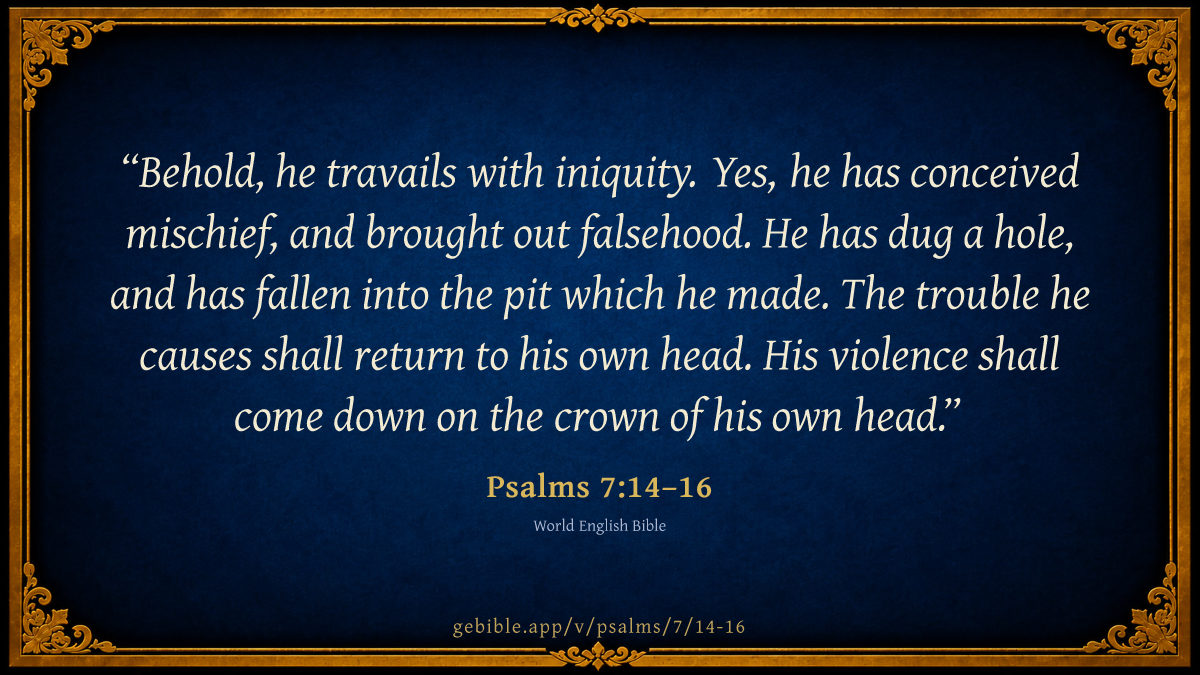
Psa 7:14 Behold, he travaileth with iniquity, and hath conceived mischief, and brought forth falsehood.
Ver. 14. Behold, he travaileth with iniquity] Heb. he shall travail, or he continually travaileth; he taketh as great pains to go to hell as a travailing woman doth to be delivered.
Read full note →
And hath conceived mischief] See Job 15:35, {See Trapp on "Job 15:35"}
And brought forth falsehood] Or, a lie, that is, a disappointment. See Isa 26:18. The Jews have a proverb, Quicquid genuit mendacium, dispellit maledictio (R. Solomon).
John Trapp, A Commentary or Exposition upon All the Books of the Old and New Testament (1647–1656) — public domain. Text from a community e-Sword module.
Matthew Poole1685 · Public DomainOn vv14–16He, i.e. the wicked, as is undeniably manifest from…
He, i.e. the wicked, as is undeniably manifest from the matter and context.
Conceived mischief, and brought forth falsehood: this metaphor noteth his deep design, and continued course, and vigorous endeavours for the doing of mischief, and his restlessness and pain till he have accomplished it.
Matthew Poole's English Annotations on the Holy Bible (1683–1685) — public domain. Text from a community e-Sword/MySword module.
John Gill1763 · Public DomainOn vv14–16Behold, he travaileth with iniquity,.... Is full of it,…
Behold, he travaileth with iniquity,.... Is full of it, and big with it, as a woman with child, and eagerly desires to bring it forth, and is in pain till he commits it;
and hath conceived mischief; that which is injurious to God and the perfections of his nature, a transgression of his law, and an affront to his justice and holiness, is doing wrong to fellow creatures, and harm to themselves, either to their name and credit, or to their substance and estates, or to their bodies and souls, and it may be to them all; and yet this they conceive, they devise it in their hearts, and form schemes how to bring it to pass, and which they do with great freedom, deliberation, and pleasure;
Read full note →
and brought forth falsehood; or "vanity" (k), or a vain thing, as the same word is rendered in Job 15:35; no fruit at all, but wind, or stubble, Isa 26:17; that which deceives does not answer the expectation, but the contrary to it; the sense is, that wicked men having devised mischievous things against the saints, they are big with expectations of success, and strive to bring their purposes to bear, but are miserably disappointed, for it all ends in vanity and vexation of spirit to themselves.
(k) "rem inanem", so some in Vatablus; "vanitatem", Gejerum.
John Gill's Exposition of the Whole Bible (1746–1763) — public domain (CC PDM 1.0). Text via the HelloAO Bible API.
John Wesley1765 · Public DomainOn v14Travelleth - This metaphor denotes his deep design, and…
Travelleth - This metaphor denotes his deep design, and vigourous endeavours for doing mischief, and his restlessness and pain 'till he have accomplished it.
John Wesley, Explanatory Notes Upon the Whole Bible (1754–1765) — public domain. Text via the GEBible commentary corpus.
Adam Clarke1810 · Public DomainOn vv14–16Verse 14. He travaileth with iniquity] All these terms…
Verse 14. He travaileth with iniquity] All these terms show the pitch of envy, wrath, and malevolence, to which Saul had carried his opposition against David. He conceived mischief; he travailed with iniquity; he brought forth falsehood-all his expectations were blasted.
Adam Clarke's Commentary on the Bible (1810–1826) — public domain. Text from a community e-Sword/MySword module.
Joseph Benson1811 · Public DomainOn vv14–15Psa 7:14. Behold, he — That is, the wicked,…
Psa 7:14. Behold, he — That is, the wicked, travaileth with iniquity, &c. — This metaphor denotes his deep design and vigorous endeavours for doing mischief; and his restlessness and pain till he have accomplished it. “When an evil thought,” says Dr. Horne, “is instilled into the heart of man, then the seed of the wicked one is sown; by admitting, retaining, and cherishing the diabolical suggestion in his mind he ‘conceiveth’ a purpose of mischief; when that purpose is gradually formed and matured for the birth, he ‘travaileth with iniquity;’ at length, by carrying it into action, he
‘bringeth forth falsehood.’ The purity of the soul, like that of the body, from whence the image is borrowed, must be preserved by keeping out of the way of temptation.”
Joseph Benson's Commentary on the Old and New Testaments (1811–1818) — public domain. Text from a community e-Sword module.
Albert Barnes1834 · Public DomainOn vv14–16Behold, he travaileth with iniquity - The wicked man…
Behold, he travaileth with iniquity - The wicked man does. The allusion here is to the pains and throes of child-birth; and the idea is, that the wicked man labors or struggles, even with great pain, to accomplish his purposes of iniquity. All his efforts, purposes, plans, are for the promotion of evil.
And hath conceived mischief - That is, he hath formed a scheme of mischief. The allusion here is common when speaking of forming a plan of evil.
Read full note →
And brought forth falsehood - The birth is falsehood; that is, self-deception, or disappointment. It does not mean that falsehood was his aim or purpose, or that he had merely accomplished a lie; but the idea is, that after all his efforts and pains, after having formed his scheme, and labored hard (as if in the pangs of child-birth) to bring it forth, it was abortive. He would be disappointed, and would fail at last. This idea is expressed more distinctly in the following verse, and the design of the whole is to say that any plan or purpose of wickedness must be in the end a failure, since God is a righteous Judge, and will vindicate His own cause.
Albert Barnes' Notes on the Bible (1834–1885) — public domain. Text from a community e-Sword/MySword module.
Robert Jamieson, A. R. Fausset & David Brown1871 · Public DomainOn vv14–15The first clause expresses the general idea that wicked…
The first clause expresses the general idea that wicked men labor to do evil, the others carry out the figure fully.
Jamieson, Fausset & Brown — Commentary Critical and Explanatory on the Whole Bible (1871) — public domain (CC PDM 1.0). Text via the HelloAO Bible API.
Daniel D. Whedon1874 · Public DomainOn v1414-17. He travaileth—Literally, he shall bring forth with pain.…
14-17. He travaileth—Literally, he shall bring forth with pain. The dark hearted Cush of the title now re-appears. He brings forth in his conduct, with agony, what he had already conceived in his heart. Both his character and punishment are described, and he shall reap as his reward what he hath sown. Psa_7:15-16. These are eternal truths in ethics and in the moral government.
Pit—An allusion to the mode of catching wild animals.
Read full note →
Fallen into the ditch which he made—Here is the lex talionis—the most literal form of retributive justice. When will men learn there is “a God that judgeth in the earth?” Psa_58:11. The closing verse of the psalm is a spontaneous outbreak of praise to God for his righteous dealings with men.
Daniel D. Whedon (gen. ed.), Commentary on the Old and New Testaments (1874–1909) — public domain. Text from a community e-Sword module.
The Cambridge Bible for Schools and Colleges1878 · Public DomainOn vv14–1614. Render the second line,
14. Render the second line,
Yea he conceiveth mischief and bringeth forth falsehood.
Read full note →
Words of studied ambiguity are chosen, ironically describing the action of the wicked man in its intention and its result. The ‘iniquity’ (lit. worthlessness: see on Psa_5:5) which he laboriously plans is destined to prove vanity and failure: the ‘mischief’ which he conceives for others issues in calamity for himself: the resultant ‘falsehood’ deceives not others but himself. Cp. for the figure, Job_15:35; Isa_33:11; Isa_59:4.
14–16. The punishment of the wicked described from another point of view as the natural result of his own actions. He falls into the snare which he laid for others.
The Cambridge Bible for Schools and Colleges (gen. ed. J. J. S. Perowne; Cambridge University Press, 1878–1918) — public domain. Text from a community e-Sword module.
Ellicott's Commentary for English Readers1878 · Public DomainOn vv14–15(14) Behold, he travaileth.—The poet’s thought recurs to the…
(14) Behold, he travaileth.—The poet’s thought recurs to the calumniator, whose sin has deserved all this Divine wrath, and he sees the truth that God’s judgments are not arbitrary, but follow naturally on sin as its consequence. The verb “travaileth” gives the general figure, which is elaborated in the two clauses which describe the stages of conception and pregnancy. (For the image, comp. Job_15:35.)
A Bible Commentary for English Readers, edited by Charles John Ellicott (1878–1897) — public domain. Text from a community e-Sword module.
The Pulpit Commentary1880 · Public DomainOn vv14–16Behold, he travaileth with iniquity, and hath conceived mischief,…
Behold, he travaileth with iniquity, and hath conceived mischief, and brought forth falsehood. (comp. Job_15:35 Isa_59:4) The "falsehood" intended is probably the bringing of false charges against David (see vers. 3-5).
The Pulpit Commentary (1880–1919), ed. H.D.M. Spence-Jones & Joseph S. Exell — public domain. Text from a community e-Sword module.
Charles H. Spurgeon1885 · Public DomainOn vv14–16Ver. 14. In three graphic pictures we see the…
Ver. 14. In three graphic pictures we see the slanderer's history. A woman in travail furnishes the first metaphor.
He travaileth with iniquity. He is full of it, pained until he can carry it out, he longs to work his will, he is full of pangs until his evil intent is executed.
Read full note →
He hath conceived mischief. This is the original of his base design. The devil has had doings with him, and the virus of evil is in him. And now behold the progeny of this unhallowed conception. The child is worthy of its father, his name of old was,"the father of lies," and the birth doth not belie the parent, for
he brought forth falsehood. Thus, one figure is carried out to perfection; the Psalmist now illustrates his meaning by another, taken from the stratagems of the hunter.
Ver. 14. Behold he travaileth with iniquity, etc. The words express the conception, birth, carriage and miscarriage, of a plot against David. In which you may consider:(1.) What his enemies did. (2.) What God did. (3.) What we all should do: his enemies' intention, God's prevention, and our duty; his enemies' intention, he travaileth with iniquity, and conceiveth mischief; God's prevention, he brought forth a lie; our duty, Behold ... Observe the aggravation of the sin, he conceiveth. He was not put upon it, or forced into it: it was voluntary. The more liberty we have not to sin, makes our sin the greater. He did not this in passion, but in cold blood. The less will, less sin. Richard Sibbs.
Ver. 14. He travaileth with iniquity, and hath conceived mischief. All note that conceiving is before travailing, but here travailing, as a woman in labour, goeth first; the reason whereof is, that the wicked are so hotly set upon the evil which they maliciously intend, that they would be immediately acting of it if they could tell how, even before they have conceived by what means; but in fine they bring forth but a lie, that is, they find that their own hearts lied to them, when they promised good success, but they had evil. For their haste to perpetrate mischief is intimated in the word rendered "persecutors" (Ps 7:13), which properly signifieth ardentes, burning; that is, with a desire to do mischiefand this admits of no delay. A notable common-place, both setting forth the evil case of the wicked, especially attempting anything against the righteous, to move them to repentancefor thou hast God for thine enemy warring against thee, whose force thou canst not resistand the greedy desire of the wicked to be evil, but their conception shall all prove abortive. J. Mayer, in loc.
Ver. 14. And hath brought forth falsehood. Every sin is a lie.
Augustine.
Ver. 14. "Earth's entertainments are like those of Jael.
Her left hand brings me milk, her right, a nail."
Thomas Fuller.
Ver. 14-15. They have digged a pit for usand that low, unto helland are fallen into it themselves.
"No juster law can be devised or made, Than that sin's agents fall by their own trade."
The order of hell proceeds with the same degrees; though it give a greater portion, yet still a just proportion, of torment. These wretched guests were too busy with the waters of sin; behold, now they are in the depth of a pit, "where no water is." Dives, that wasted so many tuns of wine, cannot now procure water, not a pot of water, not a handful of water, not a drop of water, to cool his tongue. Desideravit guttam, qui non dedit micam. (Augustine Hom. 7) A just recompense! He would not give a crumb; he shall not have a drop. Bread hath no smaller fragment than a crumb, water no less fraction than a drop. As he denied the least comfort to Lazarus living, so Lazarus shall not bring him the least comfort dead. Thus the pain for sin answers the pleasure of sin ... Thus damnable sins shall have semblable punishments; and as Augustine of the tongue, so we may say of any member ... If it will not serve God in action, it shall serve him in passion. Thomas Adams.
Ver. 14-16. Illustrate by three figures the devices and defeat of persecutors.
Charles H. Spurgeon's The Treasury of David (1869–1885) — public domain. Psalms only. Text from a community e-Sword/MySword module.
The Biblical Illustrator1887 · Public DomainOn vv14–15Behold, he travaileth with iniquity.
Psa_7:14-16
Behold, he travaileth with iniquity.
Read full note →
The enemies of the Church
1. That all the labour of wicked men against the Church is but labour in vain in respect of their own intent and expectation.
2. That the labour of wicked men is turned clean contrary to their own intent and expectation. These things are set down in metaphor and in express speech. Doctrine: The wicked counsels and enterprises of the enemies of the Church are not only vain in respect of others, but mischievous against themselves. God scattereth the devices of the crafty, so as they cannot accomplish what they enterprise.
The misery of the enemies of the Church may be seen in four particulars.
1. All their pain and labour is for their own destruction.
2. That they live in perpetual peril of destruction.
3. That unexpected destruction comes when they expect the sweet fruit of all their labour.
4. That the mischief plotted against the greatest enemies recoils upon themselves, as a gun overcharged and recoiling. There is little cause why Gods people should envy the prosperity of their enemies, or study for revenge. They should rather pity them, and pray for them, so many as are curable, for their last dish will mar all the feast. Little do they know what they are doing. They are twisting a cord to hang themselves. They are digging a pit, but the earth falls on them, and smashes them to pieces. (T. Taylor, D. D.)
The saints sagety in evil times
These words express the conception, birth, carriage, and miscarriage of a plot against David. In which consider--
I. What his enemies did. This is likened to a bodily conception, for the mind hath such as well as the body. The seed of it was some wicked thought cast in by Satan, the understanding was the womb to conceive, the will to consent. From first to last, from the conception to the bringing forth, they intended the destruction of David, but brought forth their own ruin.
1. And how great was their sin? It was voluntary and with delight, and it was spiritual and artificial--there was much art and cunning in it: they were very diligent in it, for it was a curious web. Judas is awake when Peter is asleep. And, which is worst of all, they were so well pleased with the bent of their own brain that they travailed of it. The more the soul dwells on any sinful plot, the more estrangement there is from God. The more deliberate in sin, the more the soul is pleased with it. Many seek out the delight of sin before they act, as Esau pleased himself by thinking, the day of mourning for his father would come, wherein he might be revenged of his brother.
2. But by whom and against whom was this plotting? By children of the Church, not uncircumcised Philistines; and that opposition is the bitterest of all.
3. And it was against David, a man after Gods own heart. Envy hath an ill eye. It cannot look on goodness without grief. And this plot was cunningly carried. First, they kill his good name, that so slander may make way for violence. Satan is a liar first, and then a murderer. See what David did. Innocency was his best apology. He saw God in the wrongs he suffered. We need not be ashamed to learn some things of our very enemies. If they be so set on evil, why not we on good? I am sure we serve a better Master. True love is full of inventions; it will be devising of good things.
II. What God did. Now I come to their miscarriage. They brought forth a lie, God defeated them.
1. How this was done. By disappointing them. They fell into danger of their own contriving, and into the same danger that they plotted for another. Compare the history of Haman and Mordecai. Why does God do this? First, in regard to Himself. He will be known to be God only wise. Secondly, in regard of His tender care over His children, who are the apple of His eye. Another reason is, the virulence of the enemies whose fierceness turns to Gods praise (Psa_9:16). And Gods children will give Him no rest. They prevail on Him by importunity.
3. But it will be objected that wicked men do prevail over the children of God. Tully could say, The gods show how much they esteem the Jewish nation, by suffering so often to be conquered. Where, then, is the bringing forth of a lie? I answer, when they do prevail it is but one part only, not the whole. Over mens lives, but not their spirits. A true Christian conquers when he is conquered. Our enemies shall do no more nor less than God wills: their mischievous attempts fail in the end; for did ever any harden themselves against God and prosper long? The greatest torment of the damned spirit is that God turns all his plots for the good of those he hates most.
III. What we all should do. We are bidden behold.
1. The subtlety, malice, and restless endeavour of the enemies of goodness, and their bootless enterprise, they bring forth a lie.
2. But especially the mercy of God to His children, and how He confounds their enemies. (R. Sibbes.)
The Biblical Illustrator, edited by Joseph S. Exell (c. 1880s–1900s) — public domain. Text from a community e-Sword module.
unfoldingWord translationNotes2017 · CC BY-SA 4.0On v14one who is pregnant with wickedness ... conceives destructive…
one who is pregnant with wickedness ... conceives destructive plans ... gives birth to harmful lies
David speaks of the things that a wicked person does as if the person were pregnant and wickedness was the baby. AT: "the wicked person. He makes plans to destroy people and produces harmful lies" (See: Metaphor)
Read full note →
His own destructive plans return to his own head, for his violence comes down on his own head
Destruction and violence are spoken of as if they hit a person's head or fall down on it. AT: "His own destructive plans destroy him, for his violence attacks him" or "When he plans to destroy others, others destroy him; when he attacks others, others attack him" (See: Metaphor)

John Calvin 1540 · Public Domain On vv14–15 14 Behold, he shall travail David has hitherto shown…
14 Behold, he shall travail David has hitherto shown how great and formidable the danger was which was near him. In this verse, laughing to scorn the presumptuous and foolish attempts of Saul, and his magnificent preparations, he declares that they had failed of accomplishing their object. “Disant que tout cela est alle en fumee.” — Fr. “Saying that the whole ended in smoke.”
“Pource que Dieu l’a frustre de son attente et renverse toutes ces meschantes entreprises.”—Fr.
Read full note →
“Pour toutes violences et outrages.”—Fr.
“C’est a dire, se decoyvent et ne viendront a bout de ce qu’ils couvent en leurs coeurs.”—Fr.
John Calvin's Commentaries (1540-1563) — public domain. Text from the Calvin Translation Society English edition (1840s-50s) via the Christian Classics Ethereal Library (ccel.org). Calvin's coverage is partial (roughly two-thirds of the Bible); uncommented books and verses are honest gaps, never fabricated. The 19th-century editor's footnotes and remarks are omitted so the notes are faithfully Calvin's own voice.
Geneva Bible translators 1599 · Public Domain On v14 Isa. 59:4; Job 15:35
Isa. 59:4; Job 15:35
Geneva Bible (1599) marginal notes — public domain.
John Trapp 1656 · Public Domain On vv14–16 Psa 7:14 Behold, he travaileth with iniquity, and hath…
Psa 7:14 Behold, he travaileth with iniquity, and hath conceived mischief, and brought forth falsehood.
Ver. 14. Behold, he travaileth with iniquity] Heb. he shall travail, or he continually travaileth; he taketh as great pains to go to hell as a travailing woman doth to be delivered.
Read full note →
And hath conceived mischief] See Job 15:35, {See Trapp on "Job 15:35"}
And brought forth falsehood] Or, a lie, that is, a disappointment. See Isa 26:18. The Jews have a proverb, Quicquid genuit mendacium, dispellit maledictio (R. Solomon).
John Trapp, A Commentary or Exposition upon All the Books of the Old and New Testament (1647–1656) — public domain. Text from a community e-Sword module.
Matthew Poole 1685 · Public Domain On vv14–16 He, i.e. the wicked, as is undeniably manifest from…
He, i.e. the wicked, as is undeniably manifest from the matter and context.
Conceived mischief, and brought forth falsehood: this metaphor noteth his deep design, and continued course, and vigorous endeavours for the doing of mischief, and his restlessness and pain till he have accomplished it.
Matthew Poole's English Annotations on the Holy Bible (1683–1685) — public domain. Text from a community e-Sword/MySword module.
John Gill 1763 · Public Domain On vv14–16 Behold, he travaileth with iniquity,.... Is full of it,…
Behold, he travaileth with iniquity,.... Is full of it, and big with it, as a woman with child, and eagerly desires to bring it forth, and is in pain till he commits it;
and hath conceived mischief; that which is injurious to God and the perfections of his nature, a transgression of his law, and an affront to his justice and holiness, is doing wrong to fellow creatures, and harm to themselves, either to their name and credit, or to their substance and estates, or to their bodies and souls, and it may be to them all; and yet this they conceive, they devise it in their hearts, and form schemes how to bring it to pass, and which they do with great freedom, deliberation, and pleasure;
Read full note →
and brought forth falsehood; or "vanity" (k), or a vain thing, as the same word is rendered in Job 15:35; no fruit at all, but wind, or stubble, Isa 26:17; that which deceives does not answer the expectation, but the contrary to it; the sense is, that wicked men having devised mischievous things against the saints, they are big with expectations of success, and strive to bring their purposes to bear, but are miserably disappointed, for it all ends in vanity and vexation of spirit to themselves.
(k) "rem inanem", so some in Vatablus; "vanitatem", Gejerum.
John Gill's Exposition of the Whole Bible (1746–1763) — public domain (CC PDM 1.0). Text via the HelloAO Bible API.
John Wesley 1765 · Public Domain On v14 Travelleth - This metaphor denotes his deep design, and…
Travelleth - This metaphor denotes his deep design, and vigourous endeavours for doing mischief, and his restlessness and pain 'till he have accomplished it.
John Wesley, Explanatory Notes Upon the Whole Bible (1754–1765) — public domain. Text via the GEBible commentary corpus.
Adam Clarke 1810 · Public Domain On vv14–16 Verse 14. He travaileth with iniquity] All these terms…
Verse 14. He travaileth with iniquity] All these terms show the pitch of envy, wrath, and malevolence, to which Saul had carried his opposition against David. He conceived mischief; he travailed with iniquity; he brought forth falsehood-all his expectations were blasted.
Adam Clarke's Commentary on the Bible (1810–1826) — public domain. Text from a community e-Sword/MySword module.
Joseph Benson 1811 · Public Domain On vv14–15 Psa 7:14. Behold, he — That is, the wicked,…
Psa 7:14. Behold, he — That is, the wicked, travaileth with iniquity, &c. — This metaphor denotes his deep design and vigorous endeavours for doing mischief; and his restlessness and pain till he have accomplished it. “When an evil thought,” says Dr. Horne, “is instilled into the heart of man, then the seed of the wicked one is sown; by admitting, retaining, and cherishing the diabolical suggestion in his mind he ‘conceiveth’ a purpose of mischief; when that purpose is gradually formed and matured for the birth, he ‘travaileth with iniquity;’ at length, by carrying it into action, he
‘bringeth forth falsehood.’ The purity of the soul, like that of the body, from whence the image is borrowed, must be preserved by keeping out of the way of temptation.”
Joseph Benson's Commentary on the Old and New Testaments (1811–1818) — public domain. Text from a community e-Sword module.
Albert Barnes 1834 · Public Domain On vv14–16 Behold, he travaileth with iniquity - The wicked man…
Behold, he travaileth with iniquity - The wicked man does. The allusion here is to the pains and throes of child-birth; and the idea is, that the wicked man labors or struggles, even with great pain, to accomplish his purposes of iniquity. All his efforts, purposes, plans, are for the promotion of evil.
And hath conceived mischief - That is, he hath formed a scheme of mischief. The allusion here is common when speaking of forming a plan of evil.
Read full note →
And brought forth falsehood - The birth is falsehood; that is, self-deception, or disappointment. It does not mean that falsehood was his aim or purpose, or that he had merely accomplished a lie; but the idea is, that after all his efforts and pains, after having formed his scheme, and labored hard (as if in the pangs of child-birth) to bring it forth, it was abortive. He would be disappointed, and would fail at last. This idea is expressed more distinctly in the following verse, and the design of the whole is to say that any plan or purpose of wickedness must be in the end a failure, since God is a righteous Judge, and will vindicate His own cause.
Albert Barnes' Notes on the Bible (1834–1885) — public domain. Text from a community e-Sword/MySword module.
Robert Jamieson, A. R. Fausset & David Brown 1871 · Public Domain On vv14–15 The first clause expresses the general idea that wicked…
The first clause expresses the general idea that wicked men labor to do evil, the others carry out the figure fully.
Jamieson, Fausset & Brown — Commentary Critical and Explanatory on the Whole Bible (1871) — public domain (CC PDM 1.0). Text via the HelloAO Bible API.
Daniel D. Whedon 1874 · Public Domain On v14 14-17. He travaileth—Literally, he shall bring forth with pain.…
14-17. He travaileth—Literally, he shall bring forth with pain. The dark hearted Cush of the title now re-appears. He brings forth in his conduct, with agony, what he had already conceived in his heart. Both his character and punishment are described, and he shall reap as his reward what he hath sown. Psa_7:15-16. These are eternal truths in ethics and in the moral government.
Pit—An allusion to the mode of catching wild animals.
Read full note →
Fallen into the ditch which he made—Here is the lex talionis—the most literal form of retributive justice. When will men learn there is “a God that judgeth in the earth?” Psa_58:11. The closing verse of the psalm is a spontaneous outbreak of praise to God for his righteous dealings with men.
Daniel D. Whedon (gen. ed.), Commentary on the Old and New Testaments (1874–1909) — public domain. Text from a community e-Sword module.
The Cambridge Bible for Schools and Colleges 1878 · Public Domain On vv14–16 14. Render the second line,
14. Render the second line,
Yea he conceiveth mischief and bringeth forth falsehood.
Read full note →
Words of studied ambiguity are chosen, ironically describing the action of the wicked man in its intention and its result. The ‘iniquity’ (lit. worthlessness: see on Psa_5:5) which he laboriously plans is destined to prove vanity and failure: the ‘mischief’ which he conceives for others issues in calamity for himself: the resultant ‘falsehood’ deceives not others but himself. Cp. for the figure, Job_15:35; Isa_33:11; Isa_59:4.
14–16. The punishment of the wicked described from another point of view as the natural result of his own actions. He falls into the snare which he laid for others.
The Cambridge Bible for Schools and Colleges (gen. ed. J. J. S. Perowne; Cambridge University Press, 1878–1918) — public domain. Text from a community e-Sword module.
Ellicott's Commentary for English Readers 1878 · Public Domain On vv14–15 (14) Behold, he travaileth.—The poet’s thought recurs to the…
(14) Behold, he travaileth.—The poet’s thought recurs to the calumniator, whose sin has deserved all this Divine wrath, and he sees the truth that God’s judgments are not arbitrary, but follow naturally on sin as its consequence. The verb “travaileth” gives the general figure, which is elaborated in the two clauses which describe the stages of conception and pregnancy. (For the image, comp. Job_15:35.)
A Bible Commentary for English Readers, edited by Charles John Ellicott (1878–1897) — public domain. Text from a community e-Sword module.
The Pulpit Commentary 1880 · Public Domain On vv14–16 Behold, he travaileth with iniquity, and hath conceived mischief,…
Behold, he travaileth with iniquity, and hath conceived mischief, and brought forth falsehood. (comp. Job_15:35 Isa_59:4) The "falsehood" intended is probably the bringing of false charges against David (see vers. 3-5).
The Pulpit Commentary (1880–1919), ed. H.D.M. Spence-Jones & Joseph S. Exell — public domain. Text from a community e-Sword module.
Charles H. Spurgeon 1885 · Public Domain On vv14–16 Ver. 14. In three graphic pictures we see the…
Ver. 14. In three graphic pictures we see the slanderer's history. A woman in travail furnishes the first metaphor.
He travaileth with iniquity. He is full of it, pained until he can carry it out, he longs to work his will, he is full of pangs until his evil intent is executed.
Read full note →
He hath conceived mischief. This is the original of his base design. The devil has had doings with him, and the virus of evil is in him. And now behold the progeny of this unhallowed conception. The child is worthy of its father, his name of old was,"the father of lies," and the birth doth not belie the parent, for
he brought forth falsehood. Thus, one figure is carried out to perfection; the Psalmist now illustrates his meaning by another, taken from the stratagems of the hunter.
Ver. 14. Behold he travaileth with iniquity, etc. The words express the conception, birth, carriage and miscarriage, of a plot against David. In which you may consider:(1.) What his enemies did. (2.) What God did. (3.) What we all should do: his enemies' intention, God's prevention, and our duty; his enemies' intention, he travaileth with iniquity, and conceiveth mischief; God's prevention, he brought forth a lie; our duty, Behold ... Observe the aggravation of the sin, he conceiveth. He was not put upon it, or forced into it: it was voluntary. The more liberty we have not to sin, makes our sin the greater. He did not this in passion, but in cold blood. The less will, less sin. Richard Sibbs.
Ver. 14. He travaileth with iniquity, and hath conceived mischief. All note that conceiving is before travailing, but here travailing, as a woman in labour, goeth first; the reason whereof is, that the wicked are so hotly set upon the evil which they maliciously intend, that they would be immediately acting of it if they could tell how, even before they have conceived by what means; but in fine they bring forth but a lie, that is, they find that their own hearts lied to them, when they promised good success, but they had evil. For their haste to perpetrate mischief is intimated in the word rendered "persecutors" (Ps 7:13), which properly signifieth ardentes, burning; that is, with a desire to do mischiefand this admits of no delay. A notable common-place, both setting forth the evil case of the wicked, especially attempting anything against the righteous, to move them to repentancefor thou hast God for thine enemy warring against thee, whose force thou canst not resistand the greedy desire of the wicked to be evil, but their conception shall all prove abortive. J. Mayer, in loc.
Ver. 14. And hath brought forth falsehood. Every sin is a lie.
Augustine.
Ver. 14. "Earth's entertainments are like those of Jael.
Her left hand brings me milk, her right, a nail."
Thomas Fuller.
Ver. 14-15. They have digged a pit for usand that low, unto helland are fallen into it themselves.
"No juster law can be devised or made, Than that sin's agents fall by their own trade."
The order of hell proceeds with the same degrees; though it give a greater portion, yet still a just proportion, of torment. These wretched guests were too busy with the waters of sin; behold, now they are in the depth of a pit, "where no water is." Dives, that wasted so many tuns of wine, cannot now procure water, not a pot of water, not a handful of water, not a drop of water, to cool his tongue. Desideravit guttam, qui non dedit micam. (Augustine Hom. 7) A just recompense! He would not give a crumb; he shall not have a drop. Bread hath no smaller fragment than a crumb, water no less fraction than a drop. As he denied the least comfort to Lazarus living, so Lazarus shall not bring him the least comfort dead. Thus the pain for sin answers the pleasure of sin ... Thus damnable sins shall have semblable punishments; and as Augustine of the tongue, so we may say of any member ... If it will not serve God in action, it shall serve him in passion. Thomas Adams.
Ver. 14-16. Illustrate by three figures the devices and defeat of persecutors.
Charles H. Spurgeon's The Treasury of David (1869–1885) — public domain. Psalms only. Text from a community e-Sword/MySword module.
The Biblical Illustrator 1887 · Public Domain On vv14–15 Behold, he travaileth with iniquity.
Psa_7:14-16
Behold, he travaileth with iniquity.
Read full note →
The enemies of the Church
1. That all the labour of wicked men against the Church is but labour in vain in respect of their own intent and expectation.
2. That the labour of wicked men is turned clean contrary to their own intent and expectation. These things are set down in metaphor and in express speech. Doctrine: The wicked counsels and enterprises of the enemies of the Church are not only vain in respect of others, but mischievous against themselves. God scattereth the devices of the crafty, so as they cannot accomplish what they enterprise.
The misery of the enemies of the Church may be seen in four particulars.
1. All their pain and labour is for their own destruction.
2. That they live in perpetual peril of destruction.
3. That unexpected destruction comes when they expect the sweet fruit of all their labour.
4. That the mischief plotted against the greatest enemies recoils upon themselves, as a gun overcharged and recoiling. There is little cause why Gods people should envy the prosperity of their enemies, or study for revenge. They should rather pity them, and pray for them, so many as are curable, for their last dish will mar all the feast. Little do they know what they are doing. They are twisting a cord to hang themselves. They are digging a pit, but the earth falls on them, and smashes them to pieces. (T. Taylor, D. D.)
The saints sagety in evil times
These words express the conception, birth, carriage, and miscarriage of a plot against David. In which consider--
I. What his enemies did. This is likened to a bodily conception, for the mind hath such as well as the body. The seed of it was some wicked thought cast in by Satan, the understanding was the womb to conceive, the will to consent. From first to last, from the conception to the bringing forth, they intended the destruction of David, but brought forth their own ruin.
1. And how great was their sin? It was voluntary and with delight, and it was spiritual and artificial--there was much art and cunning in it: they were very diligent in it, for it was a curious web. Judas is awake when Peter is asleep. And, which is worst of all, they were so well pleased with the bent of their own brain that they travailed of it. The more the soul dwells on any sinful plot, the more estrangement there is from God. The more deliberate in sin, the more the soul is pleased with it. Many seek out the delight of sin before they act, as Esau pleased himself by thinking, the day of mourning for his father would come, wherein he might be revenged of his brother.
2. But by whom and against whom was this plotting? By children of the Church, not uncircumcised Philistines; and that opposition is the bitterest of all.
3. And it was against David, a man after Gods own heart. Envy hath an ill eye. It cannot look on goodness without grief. And this plot was cunningly carried. First, they kill his good name, that so slander may make way for violence. Satan is a liar first, and then a murderer. See what David did. Innocency was his best apology. He saw God in the wrongs he suffered. We need not be ashamed to learn some things of our very enemies. If they be so set on evil, why not we on good? I am sure we serve a better Master. True love is full of inventions; it will be devising of good things.
II. What God did. Now I come to their miscarriage. They brought forth a lie, God defeated them.
1. How this was done. By disappointing them. They fell into danger of their own contriving, and into the same danger that they plotted for another. Compare the history of Haman and Mordecai. Why does God do this? First, in regard to Himself. He will be known to be God only wise. Secondly, in regard of His tender care over His children, who are the apple of His eye. Another reason is, the virulence of the enemies whose fierceness turns to Gods praise (Psa_9:16). And Gods children will give Him no rest. They prevail on Him by importunity.
3. But it will be objected that wicked men do prevail over the children of God. Tully could say, The gods show how much they esteem the Jewish nation, by suffering so often to be conquered. Where, then, is the bringing forth of a lie? I answer, when they do prevail it is but one part only, not the whole. Over mens lives, but not their spirits. A true Christian conquers when he is conquered. Our enemies shall do no more nor less than God wills: their mischievous attempts fail in the end; for did ever any harden themselves against God and prosper long? The greatest torment of the damned spirit is that God turns all his plots for the good of those he hates most.
III. What we all should do. We are bidden behold.
1. The subtlety, malice, and restless endeavour of the enemies of goodness, and their bootless enterprise, they bring forth a lie.
2. But especially the mercy of God to His children, and how He confounds their enemies. (R. Sibbes.)
The Biblical Illustrator, edited by Joseph S. Exell (c. 1880s–1900s) — public domain. Text from a community e-Sword module.
unfoldingWord translationNotes 2017 · CC BY-SA 4.0 On v14 one who is pregnant with wickedness ... conceives destructive…
one who is pregnant with wickedness ... conceives destructive plans ... gives birth to harmful lies
David speaks of the things that a wicked person does as if the person were pregnant and wickedness was the baby. AT: "the wicked person. He makes plans to destroy people and produces harmful lies" (See: Metaphor)
Read full note →
His own destructive plans return to his own head, for his violence comes down on his own head
Destruction and violence are spoken of as if they hit a person's head or fall down on it. AT: "His own destructive plans destroy him, for his violence attacks him" or "When he plans to destroy others, others destroy him; when he attacks others, others attack him" (See: Metaphor)
translationWords
head
just
praise
unfoldingWord translationNotes — © Distant Shores Media and the Door43 World Missions Community, licensed CC BY-SA 4.0. Source: git.door43.org/Door43/en_tn.
Tyndale Open Study Notes 2022 · CC BY-SA 4.0 On v14 7:14 Evil begins with small words or steps, and…
7:14 Evil begins with small words or steps, and gives birth to increasingly worse deeds as time goes on (see Isa 59:4-5).
Tyndale Open Study Notes — © Tyndale Open Resources, licensed CC BY-SA 4.0. Text via the HelloAO Bible API.