Psalms 68:29(v10)Because of your temple at Jerusalem, kings shall bring presents to you.
Isaiah 60:6(v10)A multitude of camels will cover you, the dromedaries of Midian and Ephah. All from Sheba will come. They will bring gold and frankincense,…
Isaiah 49:7(vv10–11)Yahweh, the Redeemer of Israel, and his Holy One, says to him whom man despises, to him whom the nation abhors, to a servant of rulers:…
Psalms 86:9(v11)All nations you have made will come and worship before you, Lord. They shall glorify your name.
1 Kings 10:1(v10)When the queen of Sheba heard of the fame of Solomon concerning Yahweh’s name, she came to test him with hard questions.
Show all 28 cross-references
Psalms 45:12(v10)The daughter of Tyre comes with a gift. The rich among the people entreat your favor.
Revelation 11:15(v11)The seventh angel sounded, and great voices in heaven followed, saying, “The kingdom of the world has become the Kingdom of our Lord, and…
2 Chronicles 9:21(v10)For the king had ships that went to Tarshish with Huram’s servants. Once every three years, the ships of Tarshish came bringing gold,…
Isaiah 49:22-23(v11)The Lord Yahweh says, “Behold, I will lift up my hand to the nations, and lift up my banner to the peoples. They shall bring your sons in…
Isaiah 60:9(v10)Surely the islands will wait for me, and the ships of Tarshish first, to bring your sons from far, their silver and their gold with them,…
Revelation 17:14(v11)These will war against the Lamb, and the Lamb will overcome them, for he is Lord of lords, and King of kings, and those who are with him…
Genesis 10:7(v10)The sons of Cush were: Seba, Havilah, Sabtah, Raamah, and Sabteca. The sons of Raamah were: Sheba and Dedan.
Psalms 138:4-5(v11)All the kings of the earth will give you thanks, Yahweh, for they have heard the words of your mouth. Yes, they will sing of the ways of…
Isaiah 54:5(v11)For your Maker is your husband; Yahweh of Armies is his name. The Holy One of Israel is your Redeemer. He will be called the God of the…
Revelation 20:1-6(v11)I saw an angel coming down out of heaven, having the key of the abyss and a great chain in his hand. He seized the dragon, the old serpent,…
Revelation 21:24(v11)The nations will walk in its light. The kings of the earth bring the glory and honor of the nations into it.
Revelation 21:26(v11)and they shall bring the glory and the honor of the nations into it so that they may enter.
1 Kings 10:10(v10)She gave the king one hundred twenty talents of gold, and a very great quantity of spices, and precious stones. Never again was there such…
1 Kings 10:25(v10)Year after year, every man brought his tribute, vessels of silver, vessels of gold, clothing, armor, spices, horses, and mules.
Psalms 2:10-12(v11)Now therefore be wise, you kings. Be instructed, you judges of the earth. Serve Yahweh with fear, and rejoice with trembling. Give sincere…
Isaiah 11:9(v11)They will not hurt nor destroy in all my holy mountain; for the earth will be full of the knowledge of Yahweh, as the waters cover the sea.
Isaiah 42:4(v10)He will not fail nor be discouraged, until he has set justice in the earth, and the islands wait for his law.”
Isaiah 42:10(v10)Sing to Yahweh a new song, and his praise from the end of the earth, you who go down to the sea, and all that is therein, the islands and…
Isaiah 43:3(v10)For I am Yahweh your God, the Holy One of Israel, your Savior. I have given Egypt as your ransom, Ethiopia and Seba in your place.
Isaiah 43:6(v10)I will tell the north, ‘Give them up!’ and tell the south, ‘Don’t hold them back! Bring my sons from far away, and my daughters from the…
Isaiah 60:3(v10)Nations will come to your light, and kings to the brightness of your rising.
Matthew 2:11(v10)They came into the house and saw the young child with Mary, his mother, and they fell down and worshiped him. Opening their treasures, they…
Romans 11:25(v11)For I don’t desire you to be ignorant, brothers, of this mystery, so that you won’t be wise in your own conceits, that a partial hardening…
28 distinct cross-references across this passage (29 total citations).
Cross-references from openbible.info (CC BY 4.0)
Explain this passage (16 sources)
Historical commentary, presented as a primary source — not an endorsement.
John Calvin1540 · Public DomainOn vv10–1110. The kings of Tarshish and of the isles…
10. The kings of Tarshish and of the isles shall bring presents. The Psalmist still continues, as in the preceding verse, to speak of the extent of the kingdom. The Hebrews apply the appellation of Tarshish to the whole coast, which looks towards Cilicia. By the isles, therefore, is denoted the whole coast of the Mediterranean Sea, from Cilicia to Greece. As the Jews, contenting themselves with the commodities of their own country, did not undertake voyages to distant countries, like other nations; God having expressly required them to confine themselves within the limits of their own country, that they might not be corrupted by the manners of strangers; they were accustomed, in consequence of this, to apply the appellation of isles to those countries which were on the other side of the sea. I indeed admit that Cyprus, Crete, and other islands, are comprehended under this name; but I also maintain that it applies to all the territories which were situated beyond the Mediterranean Sea. By the words מנחה, minchah, a present, and אשכר, eshcar, a gift, must be understood any tribute or custom, and not voluntary offerings; for it is vanquished enemies, and the mark or token of their subjection, which are spoken of. These terms appear to be used intentionally in this place, in order to mitigate the odium attached to such a mark of subjugation; as if the inspired writer indirectly reproved subjects, if they defrauded their kings of their revenues. By שבא, Sheba, some think Arabia is intended, and by שבא, Seba, Ethiopia. Some, however, by the first word understand all that part of the Gulf of Arabia which lies towards Africa; and by the second, which is written with the letter ס, samech, the country of Sabea, the more pleasant and fruitful country. This opinion is probably the more correct of the two. It is unnecessary here to remark how foolishly this passage has been wrested in the Church of Rome. They chant this verse as referring to the philosophers or wise men who came to worship Christ; as if, indeed, it were in their power of philosophers to make kings all upon a sudden; and in addition to this, to change the quarters of the world, to make of the east the south or the west.
John Calvin's Commentaries (1540-1563) — public domain. Text from the Calvin Translation Society English edition (1840s-50s) via the Christian Classics Ethereal Library (ccel.org). Calvin's coverage is partial (roughly two-thirds of the Bible); uncommented books and verses are honest gaps, never fabricated. The 19th-century editor's footnotes and remarks are omitted so the notes are faithfully Calvin's own voice.
Geneva Bible translators1599 · Public DomainOn v10Of Cilicia, and of all other countries, beyond the…
Of Cilicia, and of all other countries, beyond the sea, which he meaneth by the isles.
That is, of Arabia that rich country, whereof Sheba was a part bordering upon Ethiopia.
Geneva Bible (1599) marginal notes — public domain.
John Trapp1656 · Public DomainOn vv10–11Psa 72:10 The kings of Tarshish and of the…
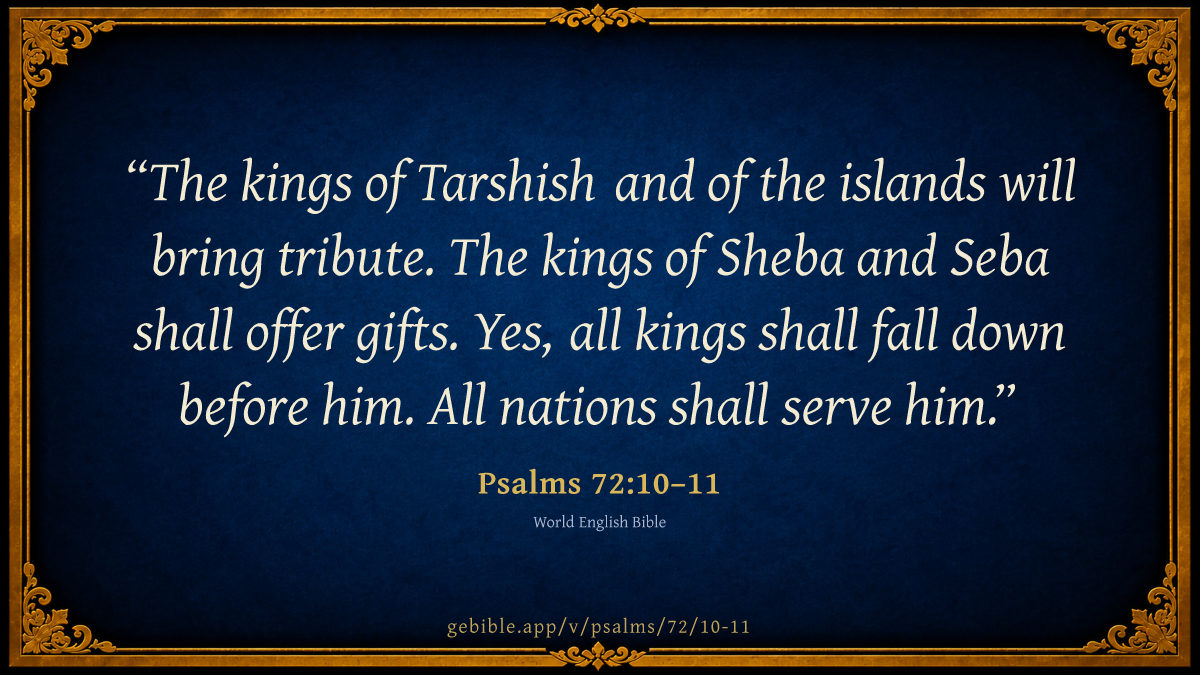
Psa 72:10 The kings of Tarshish and of the isles shall bring presents: the kings of Sheba and Seba shall offer gifts.
Ver. 10. The kings of Tarshish, and of the isles] i.e. All the kings of the earth, which being encompassed with the ocean, is therefore by the old geographers called a great island. Judaea, though part of the continent, is called an isle, Isa 20:6, because separated from other countries; with whom God would have his people to have as little to do as might be, that they might not be corrupted with foreign fashions. This was accomplished partly in Solomon; see 1Ki 4:21; 1Ki 4:34; 1Ki 10:25; perfectly it is, and shall be in Christ: De Solomone certum est, de Christo certius, saith Kimchi; all the kingdoms of the earth shall one day be his kingdoms; he shall be the universal Monarch, and he alone.
John Trapp, A Commentary or Exposition upon All the Books of the Old and New Testament (1647–1656) — public domain. Text from a community e-Sword module.
Matthew Poole1685 · Public DomainOn vv10–11Of Tarshish and of the isles; or, of the…
Of Tarshish and of the isles; or, of the sea (as Tarshish is understood, 1Ki 22:48; Psa 48:7) and (or, that is; for that conjunction is oft used exegetically) of the isles, i.e. of remote countries, to which they used to go from Canaan by sea; all which are frequently called isles in Scripture, as hath been noted before. The kings that rule by sea (where Solomon had no great power) or by land.
Sheba and Seba; two Arabian countries; unless the one be Arabia, and the other Ethiopia beyond Egypt.
Matthew Poole's English Annotations on the Holy Bible (1683–1685) — public domain. Text from a community e-Sword/MySword module.
John Gill1763 · Public DomainOn vv10–11The kings of Tarshish and of the isles shall…
The kings of Tarshish and of the isles shall bring presents,.... Tarshish either signifies the sea, as it is sometimes rendered in the Targum; and then the sense is, the kings of the sea, that is, of the islands of the sea, as it follows, shall be subject to the kingdom of Christ; and, as a token of it, bring presents to him, as the Moabites and Syrians did to David, and as several nations and kings did to Solomon, Sa2 8:2; or it designs a large country inhabited by the Celtae (b), and so is distinct from the islands; and then the sense is, that kings, both of the continent, and of the islands of the sea, shall do homage to the Messiah;
and the kings of Sheba and Seba shall offer gifts; the Septuagint, Vulgate Latin, Ethiopic, and Arabic versions, render it, "the kings of the Arabians and Saba"; and so Apollinarius, the Arabians, and Sabeans, these being places in Arabia Felix and Petraea (c): this will be fulfilled when the kings of the earth shall bring their honour and glory into the New Jerusalem, Rev 21:24. This, and the preceding verse, are interpreted of the Messiah by the ancient Jews (d); who say (e), that all the gifts that Jacob their father gave to Esau, the nations of the world shall return them to the King Messiah in time to come, according to the sense of these words; where it is not written "they shall bring"; but (f), "they shall return presents".
Read full note →
(b) Hiller. Onomast. p. 944. (c) Hiller. ibid. p. 165, 920. (d) Zohar in Gen. fol. 71. 1. (e) Bereshit Rabba, s. 78. fol. 69. 1. Bemidbar Rabba, s. 13. fol. 210. (f) "Redire facient, vel reddant", Muis.
John Gill's Exposition of the Whole Bible (1746–1763) — public domain (CC PDM 1.0). Text via the HelloAO Bible API.
John Wesley1765 · Public DomainOn vv10–11The sea - Of remote countries, to which they…
The sea - Of remote countries, to which they used to go from Canaan by sea; which are frequently called isles in scripture; the kings that rule by sea or by land.
John Wesley, Explanatory Notes Upon the Whole Bible (1754–1765) — public domain. Text via the GEBible commentary corpus.
Adam Clarke1810 · Public DomainOn vv10–11Verse 10. The kings of Tarshish and of the…
Verse 10. The kings of Tarshish and of the isles shalt bring presents] Though Solomon did not reign over Cilicia, of which Tarsus was the capital, yet he might receive gifts, not in the sense of tribute; for מנחה minchah, the word here used, signifies a gratitude or friendly offering.
The kings of Sheba and Seba] Both countries of Arabia. From the former came the queen of Sheba, to hear the wisdom of Solomon. And she brought exceeding great presents or gifts, but not in the way of tribute, for Solomon had no jurisdiction in her country. And certainly many sovereigns, to obtain his friendship, sent him various presents of the choicest produce of their respective countries; and no doubt he did with them as with the queen of Sheba, gave them gifts in return. Hence the word אשכר eshcar is used, which signifies "a compensative present, made on account of benefits received."
Adam Clarke's Commentary on the Bible (1810–1826) — public domain. Text from a community e-Sword/MySword module.
Joseph Benson1811 · Public DomainOn v10Psa 72:10-11. The kings of Tarshish and of the…
Psa 72:10-11. The kings of Tarshish and of the isles — That is, of remote countries, to which they used to go from Canaan by sea, all which are frequently called isles in Scripture. The kings that ruled by sea or by land. The kings of Sheba and Seba — Two countries of Arabia; unless the one be a part of Arabia and the other of Ethiopia, beyond Egypt. Yea, all nations shall serve him — This cannot be affirmed, with any shadow of truth, of Solomon, but was, or will be, unquestionably verified in Christ, who is, and will show himself to be, King of kings, and Lord of lords, and will be universally acknowledged, obeyed, and worshipped by all the kings and nations of the earth.
Joseph Benson's Commentary on the Old and New Testaments (1811–1818) — public domain. Text from a community e-Sword module.
Albert Barnes1834 · Public DomainOn vv10–11The kings of Tarshish - On the situation of…
The kings of Tarshish - On the situation of Tarshish, see the notes at Isa 2:16. Compare Psa 48:7. The word seems to be used here to denote any distant region abounding with riches.
And of the isles ... - Representing also distant lands; or lands beyond the seas. The word “islands” among the Hebrews commonly denoted distant seacoasts, particularly those of the Mediterranean. See the notes at Isa 41:1.
Read full note →
The kings of Sheba and Seba - places in Arabia. On the word “Sheba,” see the notes at Isa 60:6. On the word “Seba,” see the notes at Isa 43:3.
Shall offer gifts - See the notes at Psa 45:12. Compare Isa 60:5-7, Isa 60:13-17.
Albert Barnes' Notes on the Bible (1834–1885) — public domain. Text from a community e-Sword/MySword module.
Daniel D. Whedon1874 · Public DomainOn vv10–1110. Tarshish—Its location is not known, but is supposed…
10. Tarshish—Its location is not known, but is supposed to be the same as Tartessus, a colony and trading point of the Phoenicians, situated in the south of Spain, the most distant point west of Palestine known to the ancients.
The isles—The countries lying beyond the sea with regard to Palestine, particularly the countries bordering the Mediterranean on the north.
Read full note →
Sheba—Same as Arabia Felix, or Yemen, on the southern coast of Arabia. The Septuagint reads, “The kings of the Arabians.”
Seba— Ethiopia, strictly the old and rich kingdom of Meroe. If the description of Psa_72:8, “From the river to the ends of the earth,” is to be understood of all the world lying east of the Euphrates, then “Tartessus” and “the isles” may represent all nations west of Palestine and the “wilderness,” (Arabia,)
(Psa_72:9,) as “Sheba” and “Seba” may those lying south and south-west, the whole constituting a description as comprehensive of the whole world as the Hebrew knowledge of geography could poetically give.
Daniel D. Whedon (gen. ed.), Commentary on the Old and New Testaments (1874–1909) — public domain. Text from a community e-Sword module.
The Cambridge Bible for Schools and Colleges1878 · Public DomainOn vv10–1110. Let the kings … bring presents, or, as…
10. Let the kings … bring presents, or, as R.V. marg., render tribute, the word implying that they are rendering what is due to him. Tarshish was the wealthy Phoenician colony of Tartessus in southern Spain: the isles or rather the coastlands are those of the Mediterranean generally. Sheba was south-eastern Arabia (Arabia Felix), famous for its wealth and commerce; hence P.B.V., following LXX and Vulg., gives Arabia: Seba, mentioned in Gen_10:7 among Cushite peoples and coupled with Egypt and Ethiopia in Isa_43:3; Isa_45:14, is generally supposed to be the kingdom of Meroe in Ethiopia, but may denote a Cushite state on the Arabian Gulf. The most remote and the most wealthy nations unite in honouring the righteous king.
The Cambridge Bible for Schools and Colleges (gen. ed. J. J. S. Perowne; Cambridge University Press, 1878–1918) — public domain. Text from a community e-Sword module.
Ellicott's Commentary for English Readers1878 · Public DomainOn vv10–11(10) Tarshish.—The question of the identity of this place…
(10) Tarshish.—The question of the identity of this place (or district) with the “Tartessus” of the Greeks is too long for a note. (See Jon_1:3.) But plainly the mention here of “the isles,” i.e., islands and coasts of the Mediterranean (comp. Dan_11:18; Isa_11:11), is in favour of the identity.
Bring presents.—Literally, return presents, but not in the sense of an interchange of royal gifts (as 1Ki_10:13) but of “payment of tribute.” The expression is illustrated by the words “revenue,” “custom-house returns,” &c. (Comp. the Latin, reditus.)
Read full note →
Sheba.—The Joktanic kingdom, embracing the greater part of Yemen or Arabia Felix, and so here representing Arabia, (the LXX. and Vulg. have “kings of Arabians”) while “Seba” (or “Saba”), which was Cushite, and was by Josephus (A. J., 2:10, s. 2), identified with “Meroë,” represents Africa. (See Gen_10:7; Gen_10:28, and Smith’s Bible Dictionary, articles “Sheba” and “Seba.”)
A Bible Commentary for English Readers, edited by Charles John Ellicott (1878–1897) — public domain. Text from a community e-Sword module.
The Pulpit Commentary1880 · Public DomainOn vv10–11The kings of Tarshish and of the isles shall…
The kings of Tarshish and of the isles shall bring presents. "Tarshish" here is probably Tartessus in Spain, so well known to the Israelites in the days of Solomon. (1Ki_10:22 2Ch_9:21) According to Herodotus, Tartessus, when it first became known to the Greeks, was governed by kings (Herod., 1:163). By "the isles" are to be understood the coasts and islands of the Mediterranean generally. All these have, at one time or another, paid homage to Christ. The kings of Sheba and Seba shall offer gifts. "Sheba" and "Seba" are distinguished by the writer of Genesis, (Gen_10:7) and appear not even to have been very near the one to the other. Sheba was in Southeastern Arabia, and was known to the Greeks and Romans as the country of the Sabaeans (Diod. Sic., 3:45; Strabo, 16:4, Pliny, "Hist. Nat.," 6:23). Saba was in Africa, on the Middle Nile, and the Sebaeans ( are closely connected by Isaiah with Ethiopia and Egypt. (Isa_43:3 Isa_45:14)
The Pulpit Commentary (1880–1919), ed. H.D.M. Spence-Jones & Joseph S. Exell — public domain. Text from a community e-Sword module.
Charles H. Spurgeon1885 · Public DomainOn vv10–11Ver. 10. The kings of Tarshish and of the…
Ver. 10. The kings of Tarshish and of the isles shall bring presents. Trade shall be made subservient to the purposes of mediatorial rule; merchant princes, both far and near, shall joyfully contribute of their wealth to his throne. Seafaring places are good centres from which to spread the gospel; and seafaring men often make earnest heralds of the cross. Tarshish of old was so far away, that to the eastern mind it was lost in its remoteness, and seemed to be upon the verge of the universe; even so far as imagination itself can travel, shall the Son of David rule; across the blue sea shall his sceptre be stretched; the white cliffs of Britain already own him, the gems of the Southern Sea glitter for him, even Iceland's heart is warm with his love. Madagascar leaps to receive him; and if there be isles of the equatorial seas whose spices have as yet not been presented to him, even there shall he receive a revenue of glory. He has made many an islet to become a Holy Isle, and hence, a true Formosa.
The kings of Sheba and Seba shall offer gifts. Agriculture and pasturage shall contribute their share. Foreign princes from inland regions, as yet unexplored, shall own the all embracing monarchy of the King of kings; they shall be prompt to pay their reverential tribute. Religious offerings shall they bring, for their King is their God. Then shall Arabia Felix be happy indeed, and the Fortunate Isles be more than fortunate. Observe, that true religion leads to generous giving; we are not taxed in Christ's dominions, but we are delighted to offer freely to him. It will be a great day when kings will do this: the poor widow has long ago been before them, it is time that they followed; their subjects would be sure to imitate the royal example. This free will offering is all Christ and his church desire; they want no forced levies and distraints, let all men give of their own free will, kings as well as commoners; alas! the rule has been for kings to give their subjects' property to the church, and a wretched church has received this robbery for a burnt offering; it shall not be thus when Jesus more openly assumes the throne.
Read full note →
Ver. 10. Tarshish was an old, celebrated, opulent, cultivated, commercial city, which carried on trade in the Mediterranean, and with the seaports of Syria, especially Tyre and Joppa, and that it most probably lay on the extreme west of that sea. Was there, then, in ancient times, any city in these parts which corresponded with these clearly ascertained facts? There was. Such was Tartessus in Spain, said to have been a Phoenician colony; a fact which of itself would account for its intimate connection with Palestine and the Biblical narratives. As to the exact spot where Tartessis (so written originally) lay, authorities are not agreed, as the city had ceased to exist when geography began to receive attention; but it was not far from the Straits of Gibraltar, and near the mouth of the Guadalquivir, consequently at no great distance from the famous Granada of later days. The reader, however, must enlarge his notion beyond that of a mere city, which, how great soever, would scarcely correspond with the ideas of magnitude, affluence, and power, that the Scriptures suggest. The name, which is of Phoenician origin, seems to denote the district of south western Spain, comprising the several colonies which Tyre planted in that country, and so being equivalent to what we might designate Phoenician Spain. We are not, however, convinced that the opposite coast of Africa was not included, so that the word would denote to an inhabitant of Palestine the extreme western parts of the world. J. R. Beard, in "A Cyclopaedia of Biblical Literature." 1866.
Ver. 10. The isles. Myya, only in the Psalter besides, Ps 97:1, where, and uniformly, so rendered. The word, however, denotes all habitable land as opposed to water (see Ge 10:5, where first it occurs, with Isa 42:15), and so "maritime land, whether the sea coast of continent or island" (Gesenius); especially the countries washed by the Mediterranean, and the remote coasts to the west of Palestine. So in the parallel prophecy, Isa 60:9 11:11 41: 1-2 Isa 42:10-12 49:1, etc. Accordingly, "The isles shall wait for his law, "(Isa 42:4) is expounded in Mt 12:22 --"In Him shall the Gentiles trust." William DeBurgh.
Ver. 10. Sheba and Seba. There appear to have been two nations living in the same region, viz., Southern Arabia. One of these was descended from Cush, the son of Ham, and the other from Joktan, a descendant of Shem. These two people were often antagonistic in interests, despite the similarity of their names, but their divisions would be healed, and unitedly they would offer tribute to the Great King. It is an Arab proverb, "divided as the Sabaeans, "but Christ makes them one. "The Greek geographers usually couple Abyssinia with Yemen, in Arabia, and invariably represent the Abyssinian as an Arab or Sabaean race. Modern travellers, also, unanimously agree in recognising the Arab type among those Abyssinian populations which do not belong to the African stock." That the Sabaean nations were wealthy is clear from the Greek historian Agatharchides. "The Sabaeans, "says he, "have in their houses an incredible number of vases and utensils of all sorts, of gold and silver, beds and tripods of silver, and all the furniture of astonishing richness. Their buildings have porticoes with columns sheathed with gold, or surmounted by capitals of silver. On the friezes, ornaments, and the framework of the doors, they place plates of gold encrusted with precious stones. They spend immense sums in adorning these edifices, employing gold, silver, ivory, and precious stones, and materials of the greatest value." They appear, also, to have acquired great wealth by trading, both with India and Africa, their peninsula lying between those two regions. Rich would be their gifts if Lenormant and Chevallier's description of their commerce be correct. "The principal importations from India were gold, tin, precious stones, ivory, sandalwood, spices, pepper, cinnamon, and cotton. Besides these articles, the storehouses of southern Arabia received the products of the opposite coast of Africa, procured by the Sabaeans in the active coasting trade they carried on with this not far distant land, where Mosyton (now Ras Abourgabeh) was the principal port. These were, besides the spices that gave name to that coast, ebony, ostrich feathers, and more gold and ivory. With the addition of the products of the soil of southern Arabia itself, incense, myrrh, laudanum, precious stones, such as onyx and agates, lastly, aloes from the island of Socotra, and pearls from the fisheries of the Gulf of Ormus, we shall have the list of the articles comprised in the trade of this country with Egypt, and with those Asiatic countries bordering on the Mediterranean; and at the same time, by considering this activity of such a traffic." "Poor as God's people usually are, the era will surely arrive when the richest of the rich will count it all joy to lay their treasures at Jesus' feet." C. H. S.
Ver. 10. Christian finance; voluntary but abundant are the gifts presented to Jesus.
Psalms 72:11*
Charles H. Spurgeon's The Treasury of David (1869–1885) — public domain. Psalms only. Text from a community e-Sword/MySword module.
unfoldingWord translationNotes2017 · CC BY-SA 4.0On v11fall down before him
fall down before him
"bow down before him" or "honor him as their king"
Read full note →
all nations
Here the word "nations" represents the people who live in the nations. AT: "the people who live in every nation" (See: Metonymy)
Tyndale Open Study Notes2022 · CC BY-SA 4.0On vv10–1172:10 The western kings of Tarshish came from a…
72:10 The western kings of Tarshish came from a major colony in the western basin of the Mediterranean. The eastern kings of Sheba came from an area in southern Arabia, home of the queen of Sheba (1 Kgs 10). • Seba was probably located somewhere south of Egypt, perhaps on the western shore of the Red Sea across from Sheba. • The gifts offered to the king represented a tribute and a token of submission.
 GEBible — Godless Engineer's Bible App
John Calvin 1540 · Public Domain On vv10–11 10. The kings of Tarshish and of the isles…
10. The kings of Tarshish and of the isles shall bring presents. The Psalmist still continues, as in the preceding verse, to speak of the extent of the kingdom. The Hebrews apply the appellation of Tarshish to the whole coast, which looks towards Cilicia. By the isles, therefore, is denoted the whole coast of the Mediterranean Sea, from Cilicia to Greece. As the Jews, contenting themselves with the commodities of their own country, did not undertake voyages to distant countries, like other nations; God having expressly required them to confine themselves within the limits of their own country, that they might not be corrupted by the manners of strangers; they were accustomed, in consequence of this, to apply the appellation of isles to those countries which were on the other side of the sea. I indeed admit that Cyprus, Crete, and other islands, are comprehended under this name; but I also maintain that it applies to all the territories which were situated beyond the Mediterranean Sea. By the words מנחה, minchah, a present, and אשכר, eshcar, a gift, must be understood any tribute or custom, and not voluntary offerings; for it is vanquished enemies, and the mark or token of their subjection, which are spoken of. These terms appear to be used intentionally in this place, in order to mitigate the odium attached to such a mark of subjugation; as if the inspired writer indirectly reproved subjects, if they defrauded their kings of their revenues. By שבא, Sheba, some think Arabia is intended, and by שבא, Seba, Ethiopia. Some, however, by the first word understand all that part of the Gulf of Arabia which lies towards Africa; and by the second, which is written with the letter ס, samech, the country of Sabea, the more pleasant and fruitful country. This opinion is probably the more correct of the two. It is unnecessary here to remark how foolishly this passage has been wrested in the Church of Rome. They chant this verse as referring to the philosophers or wise men who came to worship Christ; as if, indeed, it were in their power of philosophers to make kings all upon a sudden; and in addition to this, to change the quarters of the world, to make of the east the south or the west.
John Calvin's Commentaries (1540-1563) — public domain. Text from the Calvin Translation Society English edition (1840s-50s) via the Christian Classics Ethereal Library (ccel.org). Calvin's coverage is partial (roughly two-thirds of the Bible); uncommented books and verses are honest gaps, never fabricated. The 19th-century editor's footnotes and remarks are omitted so the notes are faithfully Calvin's own voice.
Geneva Bible translators 1599 · Public Domain On v10 Of Cilicia, and of all other countries, beyond the…
Of Cilicia, and of all other countries, beyond the sea, which he meaneth by the isles.
That is, of Arabia that rich country, whereof Sheba was a part bordering upon Ethiopia.
Geneva Bible (1599) marginal notes — public domain.
John Trapp 1656 · Public Domain On vv10–11 Psa 72:10 The kings of Tarshish and of the…
Psa 72:10 The kings of Tarshish and of the isles shall bring presents: the kings of Sheba and Seba shall offer gifts.
Ver. 10. The kings of Tarshish, and of the isles] i.e. All the kings of the earth, which being encompassed with the ocean, is therefore by the old geographers called a great island. Judaea, though part of the continent, is called an isle, Isa 20:6, because separated from other countries; with whom God would have his people to have as little to do as might be, that they might not be corrupted with foreign fashions. This was accomplished partly in Solomon; see 1Ki 4:21; 1Ki 4:34; 1Ki 10:25; perfectly it is, and shall be in Christ: De Solomone certum est, de Christo certius, saith Kimchi; all the kingdoms of the earth shall one day be his kingdoms; he shall be the universal Monarch, and he alone.
John Trapp, A Commentary or Exposition upon All the Books of the Old and New Testament (1647–1656) — public domain. Text from a community e-Sword module.
Matthew Poole 1685 · Public Domain On vv10–11 Of Tarshish and of the isles; or, of the…
Of Tarshish and of the isles; or, of the sea (as Tarshish is understood, 1Ki 22:48; Psa 48:7) and (or, that is; for that conjunction is oft used exegetically) of the isles, i.e. of remote countries, to which they used to go from Canaan by sea; all which are frequently called isles in Scripture, as hath been noted before. The kings that rule by sea (where Solomon had no great power) or by land.
Sheba and Seba; two Arabian countries; unless the one be Arabia, and the other Ethiopia beyond Egypt.
Matthew Poole's English Annotations on the Holy Bible (1683–1685) — public domain. Text from a community e-Sword/MySword module.
John Gill 1763 · Public Domain On vv10–11 The kings of Tarshish and of the isles shall…
The kings of Tarshish and of the isles shall bring presents,.... Tarshish either signifies the sea, as it is sometimes rendered in the Targum; and then the sense is, the kings of the sea, that is, of the islands of the sea, as it follows, shall be subject to the kingdom of Christ; and, as a token of it, bring presents to him, as the Moabites and Syrians did to David, and as several nations and kings did to Solomon, Sa2 8:2; or it designs a large country inhabited by the Celtae (b), and so is distinct from the islands; and then the sense is, that kings, both of the continent, and of the islands of the sea, shall do homage to the Messiah;
and the kings of Sheba and Seba shall offer gifts; the Septuagint, Vulgate Latin, Ethiopic, and Arabic versions, render it, "the kings of the Arabians and Saba"; and so Apollinarius, the Arabians, and Sabeans, these being places in Arabia Felix and Petraea (c): this will be fulfilled when the kings of the earth shall bring their honour and glory into the New Jerusalem, Rev 21:24. This, and the preceding verse, are interpreted of the Messiah by the ancient Jews (d); who say (e), that all the gifts that Jacob their father gave to Esau, the nations of the world shall return them to the King Messiah in time to come, according to the sense of these words; where it is not written "they shall bring"; but (f), "they shall return presents".
Read full note →
(b) Hiller. Onomast. p. 944. (c) Hiller. ibid. p. 165, 920. (d) Zohar in Gen. fol. 71. 1. (e) Bereshit Rabba, s. 78. fol. 69. 1. Bemidbar Rabba, s. 13. fol. 210. (f) "Redire facient, vel reddant", Muis.
John Gill's Exposition of the Whole Bible (1746–1763) — public domain (CC PDM 1.0). Text via the HelloAO Bible API.
John Wesley 1765 · Public Domain On vv10–11 The sea - Of remote countries, to which they…
The sea - Of remote countries, to which they used to go from Canaan by sea; which are frequently called isles in scripture; the kings that rule by sea or by land.
John Wesley, Explanatory Notes Upon the Whole Bible (1754–1765) — public domain. Text via the GEBible commentary corpus.
Adam Clarke 1810 · Public Domain On vv10–11 Verse 10. The kings of Tarshish and of the…
Verse 10. The kings of Tarshish and of the isles shalt bring presents] Though Solomon did not reign over Cilicia, of which Tarsus was the capital, yet he might receive gifts, not in the sense of tribute; for מנחה minchah, the word here used, signifies a gratitude or friendly offering.
The kings of Sheba and Seba] Both countries of Arabia. From the former came the queen of Sheba, to hear the wisdom of Solomon. And she brought exceeding great presents or gifts, but not in the way of tribute, for Solomon had no jurisdiction in her country. And certainly many sovereigns, to obtain his friendship, sent him various presents of the choicest produce of their respective countries; and no doubt he did with them as with the queen of Sheba, gave them gifts in return. Hence the word אשכר eshcar is used, which signifies "a compensative present, made on account of benefits received."
Adam Clarke's Commentary on the Bible (1810–1826) — public domain. Text from a community e-Sword/MySword module.
Joseph Benson 1811 · Public Domain On v10 Psa 72:10-11. The kings of Tarshish and of the…
Psa 72:10-11. The kings of Tarshish and of the isles — That is, of remote countries, to which they used to go from Canaan by sea, all which are frequently called isles in Scripture. The kings that ruled by sea or by land. The kings of Sheba and Seba — Two countries of Arabia; unless the one be a part of Arabia and the other of Ethiopia, beyond Egypt. Yea, all nations shall serve him — This cannot be affirmed, with any shadow of truth, of Solomon, but was, or will be, unquestionably verified in Christ, who is, and will show himself to be, King of kings, and Lord of lords, and will be universally acknowledged, obeyed, and worshipped by all the kings and nations of the earth.
Joseph Benson's Commentary on the Old and New Testaments (1811–1818) — public domain. Text from a community e-Sword module.
Albert Barnes 1834 · Public Domain On vv10–11 The kings of Tarshish - On the situation of…
The kings of Tarshish - On the situation of Tarshish, see the notes at Isa 2:16. Compare Psa 48:7. The word seems to be used here to denote any distant region abounding with riches.
And of the isles ... - Representing also distant lands; or lands beyond the seas. The word “islands” among the Hebrews commonly denoted distant seacoasts, particularly those of the Mediterranean. See the notes at Isa 41:1.
Read full note →
The kings of Sheba and Seba - places in Arabia. On the word “Sheba,” see the notes at Isa 60:6. On the word “Seba,” see the notes at Isa 43:3.
Shall offer gifts - See the notes at Psa 45:12. Compare Isa 60:5-7, Isa 60:13-17.
Albert Barnes' Notes on the Bible (1834–1885) — public domain. Text from a community e-Sword/MySword module.
Daniel D. Whedon 1874 · Public Domain On vv10–11 10. Tarshish—Its location is not known, but is supposed…
10. Tarshish—Its location is not known, but is supposed to be the same as Tartessus, a colony and trading point of the Phoenicians, situated in the south of Spain, the most distant point west of Palestine known to the ancients.
The isles—The countries lying beyond the sea with regard to Palestine, particularly the countries bordering the Mediterranean on the north.
Read full note →
Sheba—Same as Arabia Felix, or Yemen, on the southern coast of Arabia. The Septuagint reads, “The kings of the Arabians.”
Seba— Ethiopia, strictly the old and rich kingdom of Meroe. If the description of Psa_72:8, “From the river to the ends of the earth,” is to be understood of all the world lying east of the Euphrates, then “Tartessus” and “the isles” may represent all nations west of Palestine and the “wilderness,” (Arabia,)
(Psa_72:9,) as “Sheba” and “Seba” may those lying south and south-west, the whole constituting a description as comprehensive of the whole world as the Hebrew knowledge of geography could poetically give.
Daniel D. Whedon (gen. ed.), Commentary on the Old and New Testaments (1874–1909) — public domain. Text from a community e-Sword module.
The Cambridge Bible for Schools and Colleges 1878 · Public Domain On vv10–11 10. Let the kings … bring presents, or, as…
10. Let the kings … bring presents, or, as R.V. marg., render tribute, the word implying that they are rendering what is due to him. Tarshish was the wealthy Phoenician colony of Tartessus in southern Spain: the isles or rather the coastlands are those of the Mediterranean generally. Sheba was south-eastern Arabia (Arabia Felix), famous for its wealth and commerce; hence P.B.V., following LXX and Vulg., gives Arabia: Seba, mentioned in Gen_10:7 among Cushite peoples and coupled with Egypt and Ethiopia in Isa_43:3; Isa_45:14, is generally supposed to be the kingdom of Meroe in Ethiopia, but may denote a Cushite state on the Arabian Gulf. The most remote and the most wealthy nations unite in honouring the righteous king.
The Cambridge Bible for Schools and Colleges (gen. ed. J. J. S. Perowne; Cambridge University Press, 1878–1918) — public domain. Text from a community e-Sword module.
Ellicott's Commentary for English Readers 1878 · Public Domain On vv10–11 (10) Tarshish.—The question of the identity of this place…
(10) Tarshish.—The question of the identity of this place (or district) with the “Tartessus” of the Greeks is too long for a note. (See Jon_1:3.) But plainly the mention here of “the isles,” i.e., islands and coasts of the Mediterranean (comp. Dan_11:18; Isa_11:11), is in favour of the identity.
Bring presents.—Literally, return presents, but not in the sense of an interchange of royal gifts (as 1Ki_10:13) but of “payment of tribute.” The expression is illustrated by the words “revenue,” “custom-house returns,” &c. (Comp. the Latin, reditus.)
Read full note →
Sheba.—The Joktanic kingdom, embracing the greater part of Yemen or Arabia Felix, and so here representing Arabia, (the LXX. and Vulg. have “kings of Arabians”) while “Seba” (or “Saba”), which was Cushite, and was by Josephus (A. J., 2:10, s. 2), identified with “Meroë,” represents Africa. (See Gen_10:7; Gen_10:28, and Smith’s Bible Dictionary, articles “Sheba” and “Seba.”)
A Bible Commentary for English Readers, edited by Charles John Ellicott (1878–1897) — public domain. Text from a community e-Sword module.
The Pulpit Commentary 1880 · Public Domain On vv10–11 The kings of Tarshish and of the isles shall…
The kings of Tarshish and of the isles shall bring presents. "Tarshish" here is probably Tartessus in Spain, so well known to the Israelites in the days of Solomon. (1Ki_10:22 2Ch_9:21) According to Herodotus, Tartessus, when it first became known to the Greeks, was governed by kings (Herod., 1:163). By "the isles" are to be understood the coasts and islands of the Mediterranean generally. All these have, at one time or another, paid homage to Christ. The kings of Sheba and Seba shall offer gifts. "Sheba" and "Seba" are distinguished by the writer of Genesis, (Gen_10:7) and appear not even to have been very near the one to the other. Sheba was in Southeastern Arabia, and was known to the Greeks and Romans as the country of the Sabaeans (Diod. Sic., 3:45; Strabo, 16:4, Pliny, "Hist. Nat.," 6:23). Saba was in Africa, on the Middle Nile, and the Sebaeans ( are closely connected by Isaiah with Ethiopia and Egypt. (Isa_43:3 Isa_45:14)
The Pulpit Commentary (1880–1919), ed. H.D.M. Spence-Jones & Joseph S. Exell — public domain. Text from a community e-Sword module.
Charles H. Spurgeon 1885 · Public Domain On vv10–11 Ver. 10. The kings of Tarshish and of the…
Ver. 10. The kings of Tarshish and of the isles shall bring presents. Trade shall be made subservient to the purposes of mediatorial rule; merchant princes, both far and near, shall joyfully contribute of their wealth to his throne. Seafaring places are good centres from which to spread the gospel; and seafaring men often make earnest heralds of the cross. Tarshish of old was so far away, that to the eastern mind it was lost in its remoteness, and seemed to be upon the verge of the universe; even so far as imagination itself can travel, shall the Son of David rule; across the blue sea shall his sceptre be stretched; the white cliffs of Britain already own him, the gems of the Southern Sea glitter for him, even Iceland's heart is warm with his love. Madagascar leaps to receive him; and if there be isles of the equatorial seas whose spices have as yet not been presented to him, even there shall he receive a revenue of glory. He has made many an islet to become a Holy Isle, and hence, a true Formosa.
The kings of Sheba and Seba shall offer gifts. Agriculture and pasturage shall contribute their share. Foreign princes from inland regions, as yet unexplored, shall own the all embracing monarchy of the King of kings; they shall be prompt to pay their reverential tribute. Religious offerings shall they bring, for their King is their God. Then shall Arabia Felix be happy indeed, and the Fortunate Isles be more than fortunate. Observe, that true religion leads to generous giving; we are not taxed in Christ's dominions, but we are delighted to offer freely to him. It will be a great day when kings will do this: the poor widow has long ago been before them, it is time that they followed; their subjects would be sure to imitate the royal example. This free will offering is all Christ and his church desire; they want no forced levies and distraints, let all men give of their own free will, kings as well as commoners; alas! the rule has been for kings to give their subjects' property to the church, and a wretched church has received this robbery for a burnt offering; it shall not be thus when Jesus more openly assumes the throne.
Read full note →
Ver. 10. Tarshish was an old, celebrated, opulent, cultivated, commercial city, which carried on trade in the Mediterranean, and with the seaports of Syria, especially Tyre and Joppa, and that it most probably lay on the extreme west of that sea. Was there, then, in ancient times, any city in these parts which corresponded with these clearly ascertained facts? There was. Such was Tartessus in Spain, said to have been a Phoenician colony; a fact which of itself would account for its intimate connection with Palestine and the Biblical narratives. As to the exact spot where Tartessis (so written originally) lay, authorities are not agreed, as the city had ceased to exist when geography began to receive attention; but it was not far from the Straits of Gibraltar, and near the mouth of the Guadalquivir, consequently at no great distance from the famous Granada of later days. The reader, however, must enlarge his notion beyond that of a mere city, which, how great soever, would scarcely correspond with the ideas of magnitude, affluence, and power, that the Scriptures suggest. The name, which is of Phoenician origin, seems to denote the district of south western Spain, comprising the several colonies which Tyre planted in that country, and so being equivalent to what we might designate Phoenician Spain. We are not, however, convinced that the opposite coast of Africa was not included, so that the word would denote to an inhabitant of Palestine the extreme western parts of the world. J. R. Beard, in "A Cyclopaedia of Biblical Literature." 1866.
Ver. 10. The isles. Myya, only in the Psalter besides, Ps 97:1, where, and uniformly, so rendered. The word, however, denotes all habitable land as opposed to water (see Ge 10:5, where first it occurs, with Isa 42:15), and so "maritime land, whether the sea coast of continent or island" (Gesenius); especially the countries washed by the Mediterranean, and the remote coasts to the west of Palestine. So in the parallel prophecy, Isa 60:9 11:11 41: 1-2 Isa 42:10-12 49:1, etc. Accordingly, "The isles shall wait for his law, "(Isa 42:4) is expounded in Mt 12:22 --"In Him shall the Gentiles trust." William DeBurgh.
Ver. 10. Sheba and Seba. There appear to have been two nations living in the same region, viz., Southern Arabia. One of these was descended from Cush, the son of Ham, and the other from Joktan, a descendant of Shem. These two people were often antagonistic in interests, despite the similarity of their names, but their divisions would be healed, and unitedly they would offer tribute to the Great King. It is an Arab proverb, "divided as the Sabaeans, "but Christ makes them one. "The Greek geographers usually couple Abyssinia with Yemen, in Arabia, and invariably represent the Abyssinian as an Arab or Sabaean race. Modern travellers, also, unanimously agree in recognising the Arab type among those Abyssinian populations which do not belong to the African stock." That the Sabaean nations were wealthy is clear from the Greek historian Agatharchides. "The Sabaeans, "says he, "have in their houses an incredible number of vases and utensils of all sorts, of gold and silver, beds and tripods of silver, and all the furniture of astonishing richness. Their buildings have porticoes with columns sheathed with gold, or surmounted by capitals of silver. On the friezes, ornaments, and the framework of the doors, they place plates of gold encrusted with precious stones. They spend immense sums in adorning these edifices, employing gold, silver, ivory, and precious stones, and materials of the greatest value." They appear, also, to have acquired great wealth by trading, both with India and Africa, their peninsula lying between those two regions. Rich would be their gifts if Lenormant and Chevallier's description of their commerce be correct. "The principal importations from India were gold, tin, precious stones, ivory, sandalwood, spices, pepper, cinnamon, and cotton. Besides these articles, the storehouses of southern Arabia received the products of the opposite coast of Africa, procured by the Sabaeans in the active coasting trade they carried on with this not far distant land, where Mosyton (now Ras Abourgabeh) was the principal port. These were, besides the spices that gave name to that coast, ebony, ostrich feathers, and more gold and ivory. With the addition of the products of the soil of southern Arabia itself, incense, myrrh, laudanum, precious stones, such as onyx and agates, lastly, aloes from the island of Socotra, and pearls from the fisheries of the Gulf of Ormus, we shall have the list of the articles comprised in the trade of this country with Egypt, and with those Asiatic countries bordering on the Mediterranean; and at the same time, by considering this activity of such a traffic." "Poor as God's people usually are, the era will surely arrive when the richest of the rich will count it all joy to lay their treasures at Jesus' feet." C. H. S.
Ver. 10. Christian finance; voluntary but abundant are the gifts presented to Jesus.
Psalms 72:11*
Charles H. Spurgeon's The Treasury of David (1869–1885) — public domain. Psalms only. Text from a community e-Sword/MySword module.
unfoldingWord translationNotes 2017 · CC BY-SA 4.0 On v11 fall down before him
fall down before him
"bow down before him" or "honor him as their king"
Read full note →
all nations
Here the word "nations" represents the people who live in the nations. AT: "the people who live in every nation" (See: Metonymy)
no other helper
"no one else to help him"
translationWords
nation
servant
cry
unfoldingWord translationNotes — © Distant Shores Media and the Door43 World Missions Community, licensed CC BY-SA 4.0. Source: git.door43.org/Door43/en_tn.
Tyndale Open Study Notes 2022 · CC BY-SA 4.0 On vv10–11 72:10 The western kings of Tarshish came from a…
72:10 The western kings of Tarshish came from a major colony in the western basin of the Mediterranean. The eastern kings of Sheba came from an area in southern Arabia, home of the queen of Sheba (1 Kgs 10). • Seba was probably located somewhere south of Egypt, perhaps on the western shore of the Red Sea across from Sheba. • The gifts offered to the king represented a tribute and a token of submission.
Tyndale Open Study Notes — © Tyndale Open Resources, licensed CC BY-SA 4.0. Text via the HelloAO Bible API.