
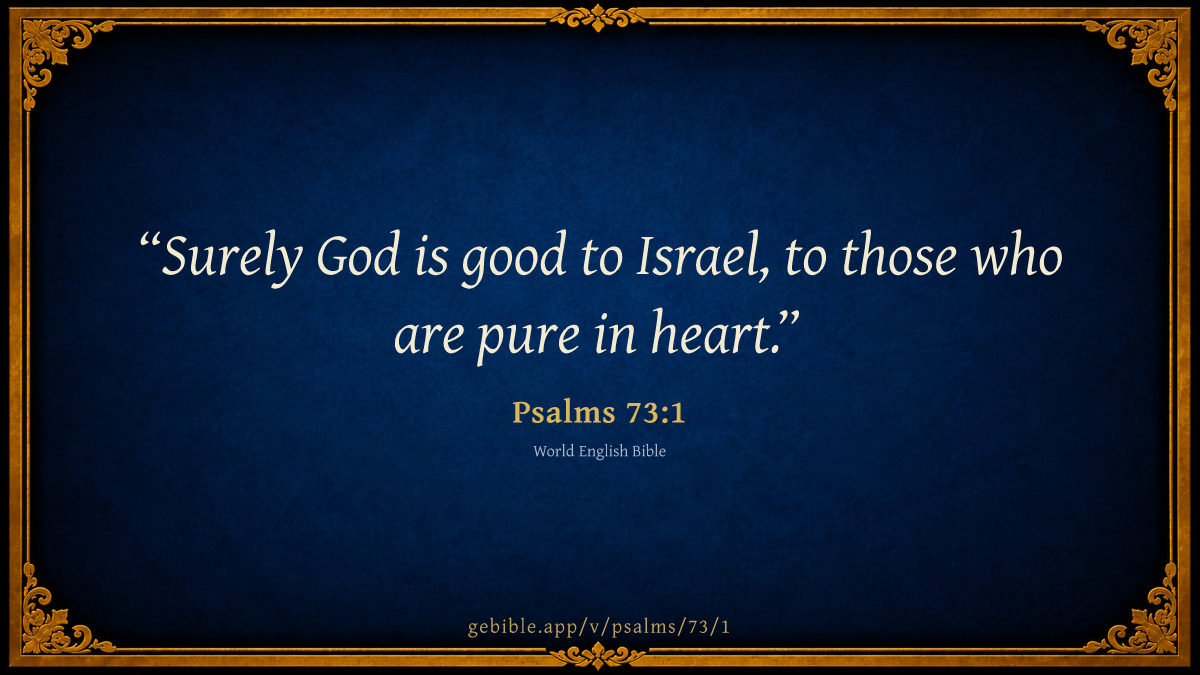
Surely God is good to Israel, to those who are pure in heart.
Parallel Translations
-
Surely God is good to Israel, to those who are pure in heart.
-
Truly God is good to Israel, even to such as are of a clean heart.
-
BOOK III A Psalm of Asaph. Surely God is good to Israel, even to such as are pure in heart.
Cross-references (24)
Passages linked to Psalms 73:1 in the Treasury of Scripture Knowledge, ordered by reader-vote popularity; verse text shown in World English Bible.
- Matthew 5:8 Blessed are the pure in heart, for they shall see God.
- Psalms 51:10 Create in me a clean heart, O God. Renew a right spirit within me.
- Psalms 84:11 For Yahweh God is a sun and a shield. Yahweh will give grace and glory. He withholds no good thing from those who walk blamelessly.
- Luke 12:32 Don’t be afraid, little flock, for it is your Father’s good pleasure to give you the Kingdom.
- James 4:8 Draw near to God, and he will draw near to you. Cleanse your hands, you sinners. Purify your hearts, you double-minded.
- John 1:47 Jesus saw Nathanael coming to him, and said about him, “Behold, an Israelite indeed, in whom is no deceit!”
- Romans 2:28-29 For he is not a Jew who is one outwardly, neither is that circumcision which is outward in the flesh; but he is a Jew who is one inwardly, and circumcision is that of the heart, in the spirit not in the letter; whose praise is not from men, but from God.
- 1 Chronicles 25:1-6 Moreover, David and the captains of the army set apart for the service certain of the sons of Asaph, and of Heman, and of Jeduthun, who were to prophesy with harps, with stringed instruments, and with cymbals. The number of those who did the work according to their service was: of the sons of Asaph: Zaccur, Joseph, Nethaniah, and Asharelah. The sons of Asaph were under the hand of Asaph, who prophesied at the order of the king. Of Jeduthun, the sons of Jeduthun: Gedaliah, Zeri, Jeshaiah, Shimei, Hashabiah, and Mattithiah, six, under the hands of their father Jeduthun, who prophesied in giving thanks and praising Yahweh with the harp. Of Heman, the sons of Heman: Bukkiah, Mattaniah, Uzziel, Shebuel, Jerimoth, Hananiah, Hanani, Eliathah, Giddalti, Romamti-Ezer, Joshbekashah, Mallothi, Hothir, and Mahazioth. All these were the sons of Heman the king’s seer in the words of God, to lift up the horn. God gave to Heman fourteen sons and three daughters. All these were under the hands of their father for song in Yahweh’s house, with cymbals, stringed instruments, and harps, for the service of God’s house: Asaph, Jeduthun, and Heman being under the order of the king.
- 2 Chronicles 29:30 Moreover Hezekiah the king and the princes commanded the Levites to sing praises to Yahweh with the words of David, and of Asaph the seer. They sang praises with gladness, and they bowed their heads and worshiped.
- Psalms 24:4 He who has clean hands and a pure heart; who has not lifted up his soul to falsehood, and has not sworn deceitfully.
- Psalms 50:1 The Mighty One, God, Yahweh, speaks, and calls the earth from sunrise to sunset.
- Psalms 83:1 God, don’t keep silent. Don’t keep silent, and don’t be still, God.
- Jeremiah 4:14 Jerusalem, wash your heart from wickedness, that you may be saved. How long will your evil thoughts lodge within you?
- Romans 4:16 For this cause it is of faith, that it may be according to grace, to the end that the promise may be sure to all the offspring, not to that only which is of the law, but to that also which is of the faith of Abraham, who is the father of us all.
- Titus 3:5 not by works of righteousness which we did ourselves, but according to his mercy, he saved us through the washing of regeneration and renewing by the Holy Spirit,
- 1 Chronicles 6:39 His brother Asaph, who stood on his right hand, even Asaph the son of Berechiah, the son of Shimea,
- 1 Chronicles 15:17 So the Levites appointed Heman the son of Joel; and of his brothers, Asaph the son of Berechiah; and of the sons of Merari their brothers, Ethan the son of Kushaiah;
- 1 Chronicles 16:7 Then on that day David first ordained to give thanks to Yahweh, by the hand of Asaph and his brothers.
- 1 Chronicles 16:37 So he left Asaph and his brothers there before the ark of Yahweh’s covenant, to minister before the ark continually, as every day’s work required;
- Psalms 2:6 “Yet I have set my King on my holy hill of Zion.”
- Psalms 42:11 Why are you in despair, my soul? Why are you disturbed within me? Hope in God! For I shall still praise him, the saving help of my countenance, and my God.
- Psalms 73:18–74:1 Surely you set them in slippery places. You throw them down to destruction. How they are suddenly destroyed! They are completely swept away with terrors. As a dream when one wakes up, so, Lord, when you awake, you will despise their fantasies. For my soul was grieved. I was embittered in my heart. I was so senseless and ignorant. I was a brute beast before you. Nevertheless, I am continually with you. You have held my right hand. You will guide me with your counsel, and afterward receive me to glory. Whom do I have in heaven? There is no one on earth whom I desire besides you. My flesh and my heart fails, but God is the strength of my heart and my portion forever. For, behold, those who are far from you shall perish. You have destroyed all those who are unfaithful to you. But it is good for me to come close to God. I have made the Lord Yahweh my refuge, that I may tell of all your works. God, why have you rejected us forever? Why does your anger smolder against the sheep of your pasture?
- Isaiah 63:7-9 I will tell of the loving kindnesses of Yahweh and the praises of Yahweh, according to all that Yahweh has given to us, and the great goodness toward the house of Israel, which he has given to them according to his mercies, and according to the multitude of his loving kindnesses. For he said, “Surely, they are my people, children who will not deal falsely;” so he became their Savior. In all their affliction he was afflicted, and the angel of his presence saved them. In his love and in his pity he redeemed them. He bore them, and carried them all the days of old.
- Romans 9:6-7 But it is not as though the word of God has come to nothing. For they are not all Israel that are of Israel. Neither, because they are Abraham’s offspring, are they all children. But, “your offspring will be accounted as from Isaac.”
Cross-references from openbible.info (CC BY 4.0)
Explain this verse (27 sources)
Historical commentary, presented as a primary source — not an endorsement.
Private notes
Saved on this device only — never synced or sent anywhere.
John Calvin 1540 · Public Domain As to the author of this psalm, I am…
As to the author of this psalm, I am not disposed to contend very strongly, although I think it probable that the name of Asaph was prefixed to it because the charge of singing it was committed to him, while the name of David, its author, was omitted, just as it is usual for us, when things are well known of themselves, not to be at the trouble of stating them. How much profit we may derive from meditation upon the doctrine contained in this psalm, it is easy to discover from the example of the prophet, who, although he had been exercised in no ordinary degree in true godliness, yet had great difficulty in keeping his footing, while reeling to and fro on the slippery ground on which he found himself placed. Nay, he acknowledges that, before he returned to such soundness of mind as enabled him to form a just judgment of the things which occasioned his trial, he had fallen into a state of almost brutish stupidity. As to ourselves, experience shows how slight impressions we have of the providence of God. We no doubt all agree in admitting that the world is governed by the hand of God; but were this truth deeply rooted in our hearts, our faith would be distinguished by far greater steadiness and perseverance in surmounting the temptations with which we are assailed in adversity. But when the smallest temptation which we meet with dislodges this doctrine from our minds, it is manifest that we have not yet been truly and in good earnest convinced of its truth.
Besides, Satan has numberless artifices by which he dazzles our eyes and bewilders the mind; and then the confusion of things which prevails in the world produces so thick a mist, as to render it difficult for us to see through it, and to come to the conclusion that God governs and extends his care to things here below. The ungodly for the most part triumph; and although they deliberately stir up God to anger and provoke his vengeance, yet from his sparing them, it seems as if they had done nothing amiss in deriding him, and that they will never be called to account for it. On the other hand, the righteous, pinched with poverty, oppressed with many troubles, harassed by multiplied wrongs, and covered with shame and reproach, groan and sigh: and in proportion to the earnestness with which they exert themselves in endeavoring to do good to all men, is the liberty which the wicked have the effrontery to take in abusing their patience. When such is the state of matters, where shall we find the person who is not sometimes tempted and importuned by the unholy suggestion, that the affairs of the world roll on at random, and as we say, are governed by chance? This unhallowed imagination has doubtless obtained complete possession of the minds of the unbelieving, who are not illuminated by the Spirit of God, and thereby led to elevate their thoughts to the contemplation of eternal life. Accordingly, we see the reason why Solomon declares, that since “all things come alike to all, and there is one event to the righteous and to the wicked,” the hearts of the sons of men are full of impiety and contempt of God, (Ecclesiastes 9:2, 3;) — the reason is, because they do not consider that things apparently so disordered are under the direction and government of God.
Read full note →
Some of the heathen philosophers discoursed upon, and maintained the doctrine of a Divine Providence; but it was evident from experience that they had notwithstanding no real and thorough persuasion of its truth; for when things fell out contrary to their expectation, they openly disavowed what they had previously professed. Of this we have a memorable example in Brutus. We can hardly conceive of a man surpassing him in courage, and all who intimately knew him bore testimony to his distinguished wisdom. Being of the sect of the Stoic philosophers, he spake many excellent things in commendation of the power and providence of God; and yet when at length vanquished by Antony, he cried out, that whatever he had believed concerning virtue had no foundation in truth, but was the mere invention of men, and that all the pains taken to live honestly and virtuously was only so much lost labor, since fortune rules over all the affairs of mankind. Thus this personage, who was distinguished for heroic courage, and an example of wonderful resolution, in renouncing virtue, and under the name of it cursing God, shamefully fell away. Hence it is manifest, how the sentiments of the ungodly fluctuate with the fluctuation of events. And how can it be expected that the heathen, who are not regenerated by the Spirit of God, should be able to resist such powerful and violent assaults, when even God’s own people have need of the special assistance of his grace to prevent the same temptation from prevailing in their hearts, and when they are sometimes shaken by it and ready to fall; even as David here confesses, that his steps had well nigh slipped? But let us now proceed to the consideration of the words of the psalm.
1. Yet God is good to Israel. The adverb אך, ach, does not here imply a simple affirmation certainly, as it often does in other places, but is taken adversatively for yet, notwithstanding, or some similar word. David opens the psalm abruptly; and from this we learn, what is worthy of particular notice, that before he broke forth into this language, his mind had been agitated with many doubts and conflicting suggestions. As a brave and valiant champion, he had been exercised in very painful struggles and temptations; but, after long and arduous exertion, he at length succeeded in shaking off all perverse imaginations, and came to the conclusion that yet God is gracious to his servants, and the faithful guardian of their welfare. Thus these words contain a tacit contrast between the unhallowed imaginations suggested to him by Satan, and the testimony in favor of true religion with which he now strengthens himself, denouncing, as it were, the judgment of the flesh, in giving place to misgiving thoughts with respect to the providence of God. We see then how emphatic is this exclamation of the Psalmist. He does not ascend into the chair to dispute after the manner of the philosophers, and to deliver his discourse in a style of studied oratory; but, as if he had escaped from hell, he proclaims, with a loud voice, and with impassioned feeling, that he had obtained the victory. To teach us by his own example the difficulty and arduousness of the conflict, he opens, so to speak, his heart and bowels, and would have us to understand something more than is expressed by the words which he employs. The amount of his language is, that although God, to the eye of sense and reason, may seem to neglect his servants, yet he always embraces them with his favor. He celebrates the providence of God, especially as it is extended towards genuine saints; to show them, not only that they are governed by God in common with other creatures, but that he watches over their welfare with special care, even as the master of a family carefully provides for and attends to his own household. God, it is true, governs the whole world; but he is graciously pleased to take a more close and peculiar inspection of his Church, which he has undertaken to maintain and defend.
This is the reason why the prophet speaks expressly of Israel; and why immediately after he limits this name to those who are right of heart; which is a kind of correction of the first sentence; for many proudly lay claim to the name of Israel, as if they constituted the chief members of the Church, while they are but Ishmaelites and Edomites. David, therefore, with the view of blotting out from the catalogue of the godly all the degenerate children of Abraham, acknowledges none to belong to Israel but such as purely and uprightly worship God; as if he had said, “When I declare that God is good to his Israel, I do not mean all those who, resting contented with a mere external profession, bear the name of Israelites, to which they have no just title; but I speak of the spiritual children of Abraham, who consecrate themselves to God with sincere affection of heart.” Some explain the first clause, God is good to Israel, as referring to his chosen people; and the second clause, to those who are right of heart, as referring to strangers, to whom God would be gracious, provided they walked in true uprightness. But this is a frigid and forced interpretation. It is better to adhere to that which I have stated. David, in commending the goodness of God towards the chosen people and the Church, was under the necessity of cutting off from their number many hypocrites who had apostatised from the service of God, and were, therefore, unworthy of enjoying his fatherly favor. To his words corresponds the language of Christ to Nathanael, (John 1:47,) “Behold an Israelite indeed, in whom is no guile!” As the fear of God among the Jews was at that time well nigh extinguished, and there remained among them almost nothing else but the “circumcision made with hands,” that is to say, outward circumcision, Christ, to discriminate between the true children of Abraham and hypocrites, lays it down as a distinguishing characteristic of the former, that they are free from guile. And assuredly in the service of God, no qualification is more indispensable than uprightness of heart.
John Calvin's Commentaries (1540-1563) — public domain. Text from the Calvin Translation Society English edition (1840s-50s) via the Christian Classics Ethereal Library (ccel.org). Calvin's coverage is partial (roughly two-thirds of the Bible); uncommented books and verses are honest gaps, never fabricated. The 19th-century editor's footnotes and remarks are omitted so the notes are faithfully Calvin's own voice.
Geneva Bible translators 1599 · Public Domain As it were between hope and despair he bursteth…
As it were between hope and despair he bursteth forth into this affection, being assured that God would continue his favor toward such as were godly indeed, and not hypocrites.
Geneva Bible (1599) marginal notes — public domain.
John Trapp 1656 · Public Domain Psa 73:1 « A Psalm of Asaph. » Truly…
Psa 73:1 « A Psalm of Asaph. » Truly God [is] good to Israel, [even] to such as are of a clean heart.
A Psalm of Asaph] Who was not only an excellent musician, but a prophet also, an orator, and a poet; not unlike (for his style) to Horace, or Persius. This, and the ten next psalms, that bear this name in the front, consist of complaints for the most part, and sad matters.
Read full note →
Ver. 1. Truly God is good to Israel] Or, yet God is, &c. Thus the psalmist beginneth abruptly after a sore conflict; throwing off the devil and his fiery darts, wherewith his heart for a while had been wounded. It is best to break off temptations of corrupt and carnal reasonings, and to silence doubts and disputes, lest we be foiled. He shoots (saith Greenham) with Satan in his own bow who thinks by disputing and reasoning to put him off.
To such as are of a clean heart] Such as are Israelites indeed, and not hypocrites and dissemblers. For "as for such as turn aside unto their crooked ways, the Lord shall lead them forth with the workers of iniquity" (as malefactors are led forth to execution); "but peace shall be upon Israel," Psa 125:5, "upon the Israel of God," Gal 6:16.
John Trapp, A Commentary or Exposition upon All the Books of the Old and New Testament (1647–1656) — public domain. Text from a community e-Sword module.
Matthew Poole 1685 · Public Domain Truly; or, nevertheless. The beginning is abrupt and sufficiently…
Truly; or, nevertheless. The beginning is abrupt and sufficiently intimates that he had a great conflict within himself about this matter, and that many doubts and objections were raised in his mind concerning it. But at last he breaks forth like the sun out of a cloud, and having by God’s grace silenced and conquered his scruples, he lays down this following conclusion.
God is good to Israel; though he may sometimes seem negligent of, and harsh and severe to, his people, yet, if all things be considered, it is most certain, and another day will be made manifest, that God is really and superlatively good, i.e. most kind and bountiful, and a true friend to them, and that they are most happy in him, and have no reason to envy sinners their present and seeming felicity.
Read full note →
To such as are of a clean heart; to all true Israelites, who love God with their whole heart, and serve him in spirit, and truth, and uprightness. See Joh 4:23; Rom 2:28,29. So this clause limits the former, and takes off a great part of the force of the objection, even all that concerns the calamities which befell the profane or false-hearted Israelites, which were vastly the greatest number of that people.
Matthew Poole's English Annotations on the Holy Bible (1683–1685) — public domain. Text from a community e-Sword/MySword module.
Matthew Henry 1710 · Public Domain This psalm begins somewhat abruptly: Yet God is good…
This psalm begins somewhat abruptly: Yet God is good to Israel (so the margin reads it); he had been thinking of the prosperity of the wicked; while he was thus musing the fire burned, and at last he spoke by way of check to himself for what he had been thinking of. "However it be, yet God is good." Though wicked people receive many of the gifts of his providential bounty, yet we must own that he is, in a peculiar manner, good to Israel; they have favours from him which others have not.
The psalmist designs an account of a temptation he was strongly assaulted with - to envy the prosperity of the wicked, a common temptation, which has tried the graces of many of the saints. Now in this account,
Read full note →
I. He lays down, in the first place, that great principle which he is resolved to abide by and not to quit while he was parleying with this temptation, Psa 73:1. Job, when he was entering into such a temptation, fixed for his principle the omniscience of God: Times are not hidden from the Almighty, Job 24:1. Jeremiah's principle is the justice of God: Righteous art thou, O God! when I plead with thee, Jer 12:1. Habakkuk's principle is the holiness of God: Thou art of purer eyes than to behold iniquity, Hab 1:13. The psalmist's, here, is the goodness of God. These are truths which cannot be shaken and which we must resolve to live and die by. Though we may not be able to reconcile all the disposals of Providence with them, we must believe they are reconcilable. Note, Good thoughts of God will fortify us against many of Satan's temptations. Truly God is good; he had had many thoughts in his mind concerning the providences of God, but this word, at last, settled him: "For all this, God is good, good to Israel, even to those that are of a clean heart." Note, 1. Those are the Israel of God that are of a clean heart, purified by the blood of Christ, cleansed from the pollutions of sin, and entirely devoted to the glory of God. An upright heart is a clean heart; cleanness is truth in the inward part. 2. God, who is good to all, is in a special manner good to his church and people, as he was to Israel of old. God was good to Israel in redeeming them out of Egypt, taking them into covenant with himself, giving them his laws and ordinances, and in the various providences that related to them; he is, in like manner, good to all those that are of a clean heart, and, whatever happens, we must not think otherwise.
II. He comes now to relate the shock that was given to his faith in God's distinguishing goodness to Israel by a strong temptation to envy the prosperity of the wicked, and therefore to think that the Israel of God are no happier than other people and that God is no kinder to them than to others.
1. He speaks of it as a very narrow escape that he had not been quite foiled and overthrown by this temptation (Psa 73:2): "But as for me, though I was so well satisfied in the goodness of God to Israel, yet my feet were almost gone (the tempter had almost tripped up my heels), my steps had well-nigh slipped (I had like to have quitted my religion, and given up all my expectations of benefit by it); for I was envious at the foolish." Note, 1. The faith even of strong believers may sometimes be sorely shaken and ready to fail them. There are storms that will try the firmest anchors. 2. Those that shall never be quite undone are sometimes very near it, and, in their own apprehension, as good as gone. Many a precious soul, that shall live for ever, had once a very narrow turn for its life; almost and well-nigh ruined, but a step between it and fatal apostasy, and yet snatched as a brand out of the burning, which will for ever magnify the riches of divine grace in the nations of those that are saved. Now,
2. Let us take notice of the process of the psalmist's temptation, what he was tempted with and tempted to.
(1.) He observed that foolish wicked people have sometimes a very great share of outward prosperity. He saw, with grief, the prosperity of the wicked, Psa 73:3. Wicked people are really foolish people, and act against reason and their true interest, and yet every stander-by sees their prosperity. [1.] They seem to have the least share of the troubles and calamities of this life (Psa 73:5): They are not in the troubles of other men, even of wise and good men, neither are they plagued like other men, but seem as if by some special privilege they were exempted from the common lot of sorrows. If they meet with some little trouble, it is nothing to what others endure that are less sinners and yet greater sufferers. [2.] They seem to have the greatest share of the comforts of this life. They live at ease, and bathe themselves in pleasures, so that their eyes stand out with fatness, Psa 73:7. See what the excess of pleasure is; the moderate use of it enlightens the eyes, but those that indulge themselves inordinately in the delights of sense have their eyes ready to start out of their heads. Epicures are really their own tormentors, by putting a force upon nature, while they pretend to gratify it. And well may those feed themselves to the full who have more than heart could wish, more than they themselves ever thought of or expected to be masters of. They have, at least, more than a humble, quiet, contented heart could wish, yet not so much as they themselves wish for. There are many who have a great deal of this life in their hands, but nothing of the other life in their hearts. They are ungodly, live without the fear and worship of God, and yet they prosper and get on in the world, and not only are rich, but increase in riches, Psa 73:12. They are looked upon as thriving men; while others have much ado to keep what they have, they are still adding more, more honour, power, pleasure, by increasing in riches. They are the prosperous of the age, so some read it. [3.] Their end seems to be peace. This is mentioned first, as the most strange of all, for peace in death was every thought to be the peculiar privilege of the godly (Psa 37:37), yet, to outward appearance, it is often the lot of the ungodly (Psa 73:4): There are no bands in their death. They are not taken off by a violent death; they are foolish, and yet die not as fools die; for their hands are not bound nor their feet put into fetters, Sa2 3:33, Sa2 3:34. They are not taken off by an untimely death, like the fruit forced from the tree before it is ripe, but are left to hang on, till, through old age, they gently drop of themselves. They do not die of sore and painful diseases: There are no pangs, no agonies, in their death, but their strength is firm to the last, so that they scarcely feel themselves die. They are of those who die in their full strength, being wholly at ease and quiet, not of those that die in the bitterness of their souls and never eat with pleasure, Job 21:23, Job 21:25. Nay, they are not bound by the terrors of conscience in their dying moments; they are not frightened either with the remembrance of their sins or the prospect of their misery, but die securely. We cannot judge of men's state on the other side death either by the manner of their death or the frame of their spirits in dying. Men may die like lambs, and yet have their place with the goats.
(2.) He observed that they made a very bad use of their outward prosperity and were hardened by it in their wickedness, which very much strengthened the temptation he was in to fret at it. If it had done them any good, if it had made them less provoking to God or less oppressive to man, it would never have vexed him; but it had quite a contrary effect upon them. [1.] It made them very proud and haughty. Because they live at ease, pride compasses them as a chain, Psa 73:6. They show themselves (to all that see them) to be puffed up with their prosperity, as men show their ornaments. The pride of Israel testifies to his face, Hos 5:5; Isa 3:9. Pride ties on their chain, or necklace; so Dr. Hammond reads it. It is no harm to wear a chain or necklace; but when pride ties it on, when it is worn to gratify a vain mind, it ceases to be an ornament. It is not so much what the dress or apparel is (though we have rules for that, Ti1 2:9) as what principle ties it on and with what spirit it is worn. And, as the pride of sinners appears in their dress, so it does in their talk: They speak loftily (Psa 73:8); they affect great swelling words of vanity (Pe2 2:18), bragging of themselves and disdaining all about them. Out of the abundance of the pride that is in their heart they speak big. [1.] It made them oppressive to their poor neighbours (Psa 73:6): Violence covers them as a garment. What they have got by fraud and oppression they keep and increase by the same wicked methods, and care not what injury they do to others, nor what violence they use, so they may but enrich and aggrandize themselves. They are corrupt, like the giants, the sinners of the old world, when the earth was filled with violence, Gen 6:11, Gen 6:13. They care not what mischief they do, either for mischief-sake or for their own advantage-sake. They speak wickedly concerning oppression; they oppress, and justify themselves in it. Those that speak well of sin speak wickedly of it. They are corrupt, that is, dissolved in pleasures and every thing that is luxurious (so some), and then they deride and speak maliciously; they care not whom they wound with the poisoned darts of calumny; from on high they speak oppression. [3.] It made them very insolent in their demeanour towards both God and man (Psa 73:9): They set their mouth against the heavens, putting contempt upon God himself and his honour, bidding defiance to him and his power and justice. They cannot reach the heavens with their hands, to shake God's throne, else they would; but they show their ill-will by setting their mouth against the heavens. Their tongue also walks through the earth, and they take liberty to abuse all that come in their way. No man's greatness or goodness can secure him from the scourge of the virulent tongue. They take a pride and pleasure in bantering all mankind; they are pests of the country, for they neither fear God nor regard man. [4.] In all this they were very atheistical and profane. They could not have been thus wicked if they had not learned to say (Psa 73:11), How doth God know? And is there knowledge in the Most High? So far were they from desiring the knowledge of God, who gave them all the good things they had and would have taught them to use them well, that they were not willing to believe God had any knowledge of them, that he took any notice of their wickedness or would ever call them to an account. As if, because he is Most High, he could not or would not see them, Job 22:12, Job 22:13. Whereas because he is Most High therefore he can, and will, take cognizance of all the children of men and of all they do, or say, or think. What an affront is it to the God of infinite knowledge, from whom all knowledge is, to ask, Is there knowledge in him? Well may he say (Psa 73:12), Behold, these are the ungodly.
(3.) He observed that while wicked men thus prospered in their impiety, and were made more impious by their prosperity, good people were in great affliction, and he himself in particular, which very much strengthened the temptation he was in to quarrel with Providence. [1.] He looked abroad and saw many of God's people greatly at a loss (Psa 73:10): "Because the wicked are so very daring therefore his people return hither; they are at the same pause, the same plunge, that I am at; they know not what to say to it any more than I do, and the rather because waters of a full cup are wrung out to them; they are not only made to drink, and to drink deeply, of the bitter cup of affliction, but to drink all. Care is taken that they lose not a drop of that unpleasant potion; the waters are wrung out unto them, that they may have the dregs of the cup. They pour out abundance of tears when they hear wicked people blaspheme God and speak profanely," as David did, Psa 119:136. These are the waters wrung out to them. [2.] He looked at home, and felt himself under the continual frowns of Providence, while the wicked were sunning themselves in its smiles (Psa 73:14): "For my part," says he, "all the day long have I been plagued with one affliction or another, and chastened every morning, as duly as the morning comes." His afflictions were great - he was chastened and plagued; the returns of them were constant, every morning with the morning, and they continued, without intermission, all the day long. This he thought was very hard, that, when those who blasphemed God were in prosperity, he that worshipped God was under such great affliction. He spoke feelingly when he spoke of his own troubles; there is no disputing against sense, except by faith.
(4.) From all this arose a very strong temptation to cast off his religion. [1.] Some that observed the prosperity of the wicked, especially comparing it with the afflictions of the righteous, were tempted to deny a providence and to think that God had forsaken the earth. In this sense some take Psa 73:11. There are those, even among God's professing people, that say, "How does God know? Surely all things are left to blind fortune, and not disposed of by an all-seeing God." Some of the heathen, upon such a remark as this, have asked, Quis putet esse deos? - Who will believe that there are gods? [2.] Though the psalmist's feet were not so far gone as to question God's omniscience, yet he was tempted to question the benefit of religion, and to say (Psa 73:13), Verily, I have cleansed my heart in vain, and have, to no purpose, washed my hands in innocency. See here what it is to be religious; it is to cleanse our hearts, in the first place, by repentance and regeneration, and then to wash our hands in innocency by a universal reformation of our lives. It is not in vain to do this, not in vain to serve God and keep his ordinances; but good men have been sometimes tempted to say, "It is in vain," and "Religion is a thing that there is nothing to be got by," because they see wicked people in prosperity. But, however the thing may appear now, when the pure in heart, those blessed ones, shall see God (Mat 5:8), they will not say that they cleansed their hearts in vain.
Matthew Henry's Commentary on the Whole Bible (1708–1710) — public domain (CC PDM 1.0). Text via the HelloAO Bible API.
John Gill 1763 · Public Domain Truly God is good to Israel,.... To Israel, literally…
Truly God is good to Israel,.... To Israel, literally understood; in choosing them to be his people above all people on earth; in bringing them into a good land; in favouring them with many external privileges, civil and religious; in giving them his word, statutes, and ordinances, as he did not to other nations: or, spiritually understood, the Israel whom God has chosen, redeemed, and called by his special grace; verily of a truth, God is good to these; there is abundant proof and evidence of it; See Gill on Psa 34:8,
or "only" God is good to such; though he is good to all in a providential way, yet only to his chosen and redeemed ones in a way of special favour; the goodness others share is but a shadow of goodness, in comparison of what they do and shall partake of; they are blessed with blessings indeed, and are only blessed; so this particle is rendered in Psa 62:2, or "but", or "notwithstanding" (b), God is good, &c. that is, though he suffers the wicked to prosper, and his own people much afflicted, yet he is good to them; he supports them under their afflictions, and makes all to work for their good; gives them grace here, and glory hereafter;
Read full note →
even to such as are of a clean heart; this character excludes the carnal Israelites, who were pure in their own eyes, but not cleansed from their filthiness, and describes the true Israel of God, and explains who are meant by them, such as are pure in heart, inwardly Jews, Israelites indeed, in whom there is no guile; this is not natural to men, their hearts are by nature unclean, nor is it in their power to make them clean: this is God's work, he only can create a clean heart, and renew a right spirit; which is done by the sanctifying influences of his grace, and by the sprinkling of the blood of Jesus, and thus purifying their heart's by faith; yet so as not to be free from all impurity of spirit, but as to have a conscience purged from the guilt of sin, and to have the heart sincere and upright towards God.
(a) Sept. "Asaph ipsi", Pagninus, Montanus; "Asapho", Gejerus; so Ainsworth. (b) "attamen", Tigurine version, Piscator, Gussetius, Michaelis.
John Gill's Exposition of the Whole Bible (1746–1763) — public domain (CC PDM 1.0). Text via the HelloAO Bible API.
John Wesley 1765 · Public Domain It is probable, Asaph was the author of this…
It is probable, Asaph was the author of this psalm; for we read of the words of David and the words of Asaph the seer, which were used in praising God in Hezekiah's time, 2 Chron. xxix, 30. He begins with laying down a general principle, ver. 1. Confesses his temptation to envy the wicked, ver. 2-14. Tells how he gained the victory over it, and advantage by it, ver. 15-28. A psalm of Asaph.
A clean heart - To all true Israelites, who love God, and serve him in spirit and truth.
John Wesley, Explanatory Notes Upon the Whole Bible (1754–1765) — public domain. Text via the GEBible commentary corpus.
Adam Clarke 1810 · Public Domain The psalmist speaks of God's goodness to his people,…
PSALM LXXIII
The psalmist speaks of God's goodness to his people, 1;
Read full note →
shows how much he was stumbled at the prosperity of the wicked,
and describes their state, 2-12;
details the process of the temptation, and the pain he suffered
in consequence, 13-16;
shows how he was delivered, and the dismal reverse of the state
of the once prosperous ungodly man, by which his own false
views were corrected, 17-22;
his great confidence in God, and the good consequences of it,
23-28.
NOTES ON PSALM LXXIII
THIS is the commencement of the THIRD BOOK of the Psalter; and the Psalm before us has for title, A Psalm of Asaph; or, as the margin has it, A Psalm for Asaph. The title in the Hebrew is מזמור לאסף mizmor leasaph; "A Psalm of Asaph:" and it is likely that this Asaph was the composer of it; that he lived under the Babylonish captivity; and that he published this Psalm to console the Israelites under bondage, who were greatly tried to find themselves in such outward distress and misery, while a people much more wicked and corrupt than they, were in great prosperity, and held them in bondage.
Verse 1. Truly God is good to Israel] Captives as they were, they still had many blessings from God; and they had promises of deliverance, which must be fulfilled in due time.
Such as are of a clean heart.] Those who have a clean heart must have inward happiness: and, because they resemble God, they can never be forsaken by him.
Adam Clarke's Commentary on the Bible (1810–1826) — public domain. Text from a community e-Sword/MySword module.
Joseph Benson 1811 · Public Domain Psa 73:1. Truly, or nevertheless, &c. — The beginning…
Psa 73:1. Truly, or nevertheless, &c. — The beginning is abrupt, and sufficiently intimates that he had a great conflict within himself about the matter here spoken of, and that many doubts and objections were raised in his mind concerning it. But, at last, light and satisfaction broke forth upon him, like the sun from under a cloud, and overcame and silenced his scruples, in consequence of which he lays down this conclusion. God is good to Israel — Though he may sometimes seem negligent of, and harsh and severe toward, his people; yet, if all things be considered, it is most certain, and hereafter will be made manifest, that he is really and superlatively good, that is, most kind and bountiful, and a true friend to them, and that they are most happy in possessing his favour, and have no reason to envy sinners their present and seeming felicity. Even to such as are of a clean heart — To all true Israelites, who love God with their whole hearts, and serve him in spirit, in truth, and uprightness: see Joh 4:23; Rom 2:28-29. So this clause limits the former, and takes off a great part of the force of the objection, indeed the whole of that which was drawn from the calamities which befell the hypocritical and half-hearted Israelites, who were vastly the greater number of that people.
Joseph Benson's Commentary on the Old and New Testaments (1811–1818) — public domain. Text from a community e-Sword module.
Albert Barnes 1834 · Public Domain Truly God is good to Israel - That is,…
Truly God is good to Israel - That is, to his people; to the righteous; to those who serve him. That is, God is the “real” friend of the righteous. He has not forgotten them. He does not abandon them. He is not indifferent to them. He is not the friend of wicked people; and the administration of his government is not in favor of wickedness. After all that seems to indicate this, after all that troubles the mind in regard to his dealings, it is a truth that God is the friend of righteousness, and not of wickedness, and that there is advantage in his service. To see the force of what is said here by the psalmist we must realize that the train of thought in the psalm had passed through his mind, and that his perplexities had been relieved in the manner specified in the psalm. The margin here is “yet;” “yet God is good to Israel.” This word “yet” would, in this place, be a happy translation. The psalmist then would be represented as having been engaged in meditating on the subject and in looking at all its perplexities, and then he says, “Yet God is good; notwithstanding all the difficulties in the case, it is nevertheless true that he is the friend of his people - the friend of righteousness.”
Even to such as are of a clean heart - Margin, as in Hebrew, “clean of heart.” See Psa 73:13. The reference is to those who are truly righteous, for all true righteousness has its seat in the heart. See Psa 51:10.
Albert Barnes' Notes on the Bible (1834–1885) — public domain. Text from a community e-Sword/MySword module.
Lange's Commentary on the Holy Scriptures 1864 · Public Domain Psalms 73-89
THE PSALTER
THIRD BOOK
Read full note →
Psalms 73-89
_______________
Psalms 73
A Psalm of Asaph
1 Truly God is good to Israel,
Even to such as are of a clean heart.
2 But as for me, my feet were almost gone;
My steps had well nigh slipped.
3 For I was envious at the foolish,
When I saw the prosperity of the wicked.
4 For there are no bands in their death:
But their strength is firm.
5 They are not in trouble as other men;
Neither are they plagued like other men.
6 Therefore pride compasseth them about as a chain;
Violence covereth them as a garment.
7 Their eyes stand out with fatness:
They have more than heart could wish.
8 They are corrupt, and speak wickedly concerning oppression:
They speak loftily.
9 They set their mouth against the heavens,
And their tongue walketh through the earth.
10 Therefore his people return hither:
And waters of a full cup are wrung out to them.
11 And they say, How doth God know?
And is there knowledge in the Most High?
12 Behold, these are the ungodly,
Who prosper in the world; they increase in riches.
13 Verily I have cleansed my heart in vain,
And washed my hands in innocency.
14 For all the day long have I been plagued,
And chastened every morning.
15 If I say, I will speak thus;
Behold, I should offend against the generation of thy children.
16 When I thought to know this,
It was too painful for me;
17 Until I went into the sanctuary of God;
Then understood I their end.
18 Surely thou didst set them in slippery places:
Thou castedst them down into destruction.
19 How are they brought into desolation, as in a moment!
They are utterly consumed with terrors.
20 As a dream when one awaketh;
So, O Lord, when thou awakest, thou shalt despise their image.
21 Thus my heart was grieved,
And I was pricked in my reins.
22 So foolish was I, and ignorant:
I was as a beast before thee.
23 Nevertheless I am continually with thee:
Thou hast holden me by my right hand.
24 Thou shalt guide me with thy counsel.
And afterward receive me to glory.
25 Whom have I in heaven but thee?
And there is none upon earth that I desire besides thee.
26 My flesh and my heart faileth:
But God is the strength of my heart, and my portion for ever.
27 For, lo, they that are far from thee shall perish:
Thou hast destroyed all them that go a whoring from thee.
28 But it is good for me to draw near to God:
I have put my trust in the Lord God,
That I may declare all thy works.
EXEGETICAL AND CRITICAL
Contents and Composition.—The firm acknowledgment that God is nothing but good to those who are truly His people (Psa_73:1), was to the Psalmist the fruit of a victory gained by his faith over personal temptations (Psa_73:2). These temptations had arisen from vexation at the temporal prosperity of the ungodly (Psa_73:3-5), and at their presumptuous conduct (Psa_73:6-9). Many were hereby influenced to attach themselves to that class of men, because they could not reconcile the prosperity of the wicked and the sufferings of the righteous with the doctrine of God’s providence (Psa_73:10-14). The Psalmist escaped the danger of becoming recreant himself, and a seducer of others, which might have resulted from such doubts, not by means of his own reflections upon the difficult problem of the course of human affairs, but by the observance of the duties of religion, by which he was led to the contemplation of the final lot of the ungodly (Psa_73:15-17). This afforded him a view of their sudden and complete destruction by the judgments of God (Psa_73:18-20), and of the utter absurdity of his former indignation (Psa_73:21-22). Now he becomes strengthened by communion with God, who leads him in safety and to glory (Psa_73:23-24), who is his only true and lasting good (Psa_73:25-26), and shall remain his saving refuge and the object of his endless praise.
The same problems are discussed here which are presented in Psalms 37, 49, and in the Book of Job; but the solution given here is the most profound. (Comp. Hupfeld in the Deutsche Zeitschrift für christl. Wissen und Leben, 1850, No. 235). [The relative position assigned to the Book of Job by Dr. Moll and most of the commentators upon this Psalm is hardly just. It must be remembered that that record of trial and doubt and victory constitutes the Book of Old Testament revelation which was to deal particularly with this special department of the mysteries of Providence. And it therefore presents the question in its inexhaustible variety of aspects, sounding the depths, not of transient doubts and perplexities, but of a crushing personal realization of the utmost consequences of a conflict waged by a righteous man against the unrestrained power and devices of Satan. Now the view of the Book which finds a relative inferiority in its solution, proceeds from considering the discourses, which occupy much the largest space, as being intended to express all its teachings. The chief place is necessarily given to the record of the struggle, and when the solution is given there results what Psalms 37 pictures, a fulness of outward prosperity. But it was not this for which Job chiefly longed. And when he received the vindication of his righteousness, even though accompanied by the rebuke for his presuming attempt to sit in judgment upon the ways of God, he could feel that in the favor of God was his life, as its withdrawal had seemed to him worse than death. The real distinction would seem to be not that the solution in this Psalm is the more profound, but that while in the Book of Job the expression of the feeling of confidence and triumph is kept out of view, it is here joyously given forth. This is the distinguishing excellence of this Psalm, for which it must ever retain its place in the heart of the doubting and comforted believer.—J. F. M.]
From these facts we cannot infer with certainty a composition at a late period, especially as the mode in which the subject is presented is throughout peculiar. It is also just as unsafe to infer from the recurrence in Psa_74:3 of the rare word, meaning ruins, employed in Psa_73:18, that these two Psalms were of contemporaneous origin. The same remark applies to the inference of a later origin drawn from the occurrence of Archaic and Aramaic word-forms. It bears much more heavily against such a conclusion that the ancient translators failed to understand many expressions throughout the Psalm, and in some instances gave such absurd interpretations that the correct exposition only begins with Kimchi. This would be inexplicable, if the Psalm were not composed before the time of Antiochus Epiphanes, 175 B. C. (Hitzig). There was, it is true, at that time a relapse of whole bodies of the Jewish nation to heathenism (1Ma_1:11 f.), on one occasion under the cooperation of a high-priest (2Ma_4:9 ff.). But leaving out of consideration all such apostasies as that which the prophet Hosea, among others, denounces and characterizes as whoredom [see Psa_73:27], it is evident that Psa_73:1 introduces a contrast, not between Israel and heathen nations, but between two classes in Israel itself. [Alexander: “There is not the slightest ground for doubting the correctness of the title, which ascribes the composition of the Psalm to Asaph, the cotemporary of David and his chief musician, and himself, moreover, an inspired Psalmist. This last fact, which is a matter of recorded history, together with the fact that when only one name is mentioned in the title of a Psalm, it is uniformly that of the writer, may suffice to set aside the supposition that Asaph is only named as the performer.”—J. F. M.]. On Asaph see the Introd. § 2. Paul Gerhard’s hymn: Sei Wohlgemuth, O Christenseel, is an imitation of this Psalm.
Psa_73:1. Only good is God [E. V.: Truly God is good, etc.].—The rendering: kind (De W.) is too restricted for טוֹב, even if modified into a substantive: kindness (Hitzig), although this is more suitable than the notion expressed by the simple adjective (Sept., Calvin). The explanation: the true happiness and good (Stier), is in so far correct as it raises the conception above its usual restriction to the sphere of the purely ethical, which is also admirably accomplished in Luther’s freer translation: nevertheless Israel has God as his consolation. It introduces, however, into the neuter a definiteness which is too concrete. The essential thought is not affected if אַךְ is taken adversatively=yet, nevertheless (most of the ancient translators and Tholuck); or affirmatively=yea, surely (Köster, De Wette, Hupfeld, Delitzsch); or restrictively=only, nothing but (most of the modern expositors). But the application of the “only” to Israel (Aben Ezra) is wrong. [An allegation has been based by many upon such passages as Psa_73:1 and Hab_1:13 (where see Delitzsch) that the Old Testament writers were in the habit of describing Israel, as a nation, as righteous, and the heathen as sinners. For the disproof of this charge see in the Appendix to Hengstenberg’s Coram, on the Psalms, the treatise on the Doctrine of Sin, as appearing in the Psalms.—J.F.M.]
Psa_73:4. We read, with Ewald and all the recent expositors except Stier, Hengstenberg and Hupfeld, לָמוּ תָּם, and therefore attach the former word to the first part of the verse, and the latter to the second. For this slight change of לְמוֹתָם affords a sense which is suitable throughout; while the received reading would mean: they have no torments in dying (Sept., Kimchi), which does not agree with Psa_73:18 f. Again, difficulties that can scarcely be set aside are involved in any of the following translations: they have no torments with regard to death, that is, no fear of death (Targum, Symmachus, the older Rabbins); or: they have no sufferings causing death, diseases, and the like infirmities (Kimchi, Calvin, Hengstenberg); or: they have no torments until their death (Isaaki, Stier, Hupfeld).—The explanation “paunch” for the word אוּל, has come through the medium of the Arabic. The word is also taken by some (Kimchi, Calvin, Hengst., Hupfeld) in its usual signification, “power, strength.” By the older translators (Symmachus, Isaaki) it is confounded with אוּלָם, to which is to be traced the erroneous translation: strong as a palace (Luther). [The author’s translation would be: For they have no torments: their paunch (body) is vigorous and well-fed (stout).—J. F. M.]
Psa_73:6. It is not abundant fulness (Geier, J. H. Michaelis, Hengst.) that is described; still less is it the daily habit of life (Kimchi), but an ostentatious and vain-glorious exhibition. [The opinion of Hengstenberg has been here misstated. He agrees very nearly with Dr. Moll himself. He says: “The reason which led the Psalmist to speak of pride as a neck ornament of the wicked, for the purpose of expressing the thought that they are wholly beset with it, was in all probability the fact that it was their manner of carrying their neck that chiefly exhibited their pride.” He refers to Ps. 3:16; Job_15:26.—J. F. M.]
Psa_73:7. Many since Schnurrer read עֲונֵמו instead of עֵינֵמוֹ, basing this upon the Septuagint, the Syriac Version, and Zec_5:6; Hos_10:10. The meaning then would be: their pride comes forth or proceeds from their fat. Their fat then represents either: their affluence (Schnurrer, Doederlein), or better, as in Psa_17:10 : their gross, insensible heart, their soul smeared, as it were, with grease (Hitzig, Böttcher, Olshausen, Hupfeld, Delitzsch). Comp. Mat_15:18 f. The following half of the verse does not mean that they are transgressors, i.e. impious in their thoughts (Geier and others). Nor does it mean that their success surpasses all their expectations (Isaaki, Kimchi, Calvin), or exceeds all human precedent (Rabbins cited in Calvin). But the meaning is, that the imaginations of their hearts, the illusions of their unbounded self-esteem (Delitzsch), have revealed themselves. Yet it does not imply that this is done through the medium of the eyes (Clericus), or the mouth, in allusion to the succeeding verse (Delitzsch), but without any more precise indication and without any restriction, by passing from inward feeling to outward expression. [The explanation of the clause here given seems the mo9t natural. Alexander prefers this, as also do Perowne and Wordsworth. Fausset prefers the translation: they pass over (exceed) the imaginations of their hearts, thus agreeing with E. V.—J. F. M.]
[The first clause of Psa_73:8 is rendered in the English Version: they are corrupt. This rendering of יָמִיקוּ occurs in all the ancient versions except those of Symmachus (καταμωκώμενοι) and Jerome (irriserunt), which are undoubtedly correct, and with which most of the modern translators agree.
The old rendering has assumed a verb, cognate with מָקַק, and taken intransitively: to melt, run down, be corrupt. Geier, however, gives it the causative sense, to cause to melt, i.e., others by their oppression. Fausset adduces in favor of this the occurrence of “oppression” in the next clause, and thinks that there may be a parallelism. But in the first place, if a parallelism is desired it is afforded in the “speaking,” which in fact is the subject of the whole verse. Then, as to the true meaning of the word, the cognate languages seem to settle the question, as the corresponding words in Arabic, Syriac, and Chaldee (in the two latter, with a causative form like the Hebrew) have the meaning: to deride, to mock. The true rendering then seems to be: they will scoff.—J. F. M.]
Psa_73:9. The subject of this verse is probably not blasphemies against heaven, i.e., against God (Targum, Isaaki, Geier, Delitzsch, who refers to Judges 16) and evil speaking on earth and through the country (Aben Ezra, Geier, J. H. Michaelis). Rather the description of their speaking down from on high (Psa_73:8), as though they had ascended into heaven (Isa_14:13), which is manifested in arrogant self-assumption, is here continued. The tongue thus appears as the unruly evil, meddling with everything, Jam_3:8, (Luther, Calvin).
Psa_73:10. “therefore” refers to these two causes, the prosperity and the conduct of the wicked, whose example draws over to their party those who may be called in more senses than one, “His people,” and causes them to apostatize from God. The received reading יָשִׁיב would give the rendering: he causes to turn, and יָשׁוּב (Jerome, the Rabbins, and almost all the expositors) would mean: he turns. So עַמּוֹ (all the Codices) would mean: His people, and עַמִּי (Sept., J. D. Michaelis, Dathe): My people. But these variations affect the sense but slightly, and are to be explained partly from the natural confounding of ו and י, and partly from the attempt to avoid, or to explain as intermediary, the unexpected introduction and immediate disappearance of a singular subject instead of the usual plural. To refer the suffix to God (Calvin, Rosenmueller, Stier, Maurer) is not justified by the context. Still this attempt at an explanation may suggest to us that the rendering: (his, or): their rabble (Luther and others) is too restricted and does not agree with Psa_73:13, and that it is rather the faithless Israelites who are spoken of; that, therefore, both parties, the seducers and the seduced, the wicked and their hangers-on (Psa_10:4; Psa_14:1; Psa_36:2; Psa_49:14; Isa_46:12) had constituted one and the same people, before they had banded together to form this multitude.
The meaning of the second clause of the verse, however, does not mean that they run to them in large numbers, comparing them to the running of water (Luther) or that they are absorbed by them in large numbers (Sachs). Nor must we translate: full water (i.e., an overflow, as a figure of sensual prosperity) is found for them (the ancient translators, Geier, and others). For יִמָּצוּ does not come from מָצָא to find, but from מָצָה to drain, Psa_75:9; Isa_51:19 Eze_23:34. But it does not refer to a cup of tears or a cup of sorrow, Psa_80:6 (Kimchi), which has made the pious unfaithful, but to the eagerness with which they either grasp at success and its enjoyments (Hengst., Hupfeld), or catch at the maxims of the ungodly, (Job_15:16) thoughts and words of discontent (Ewald, Delitzsch, Hltzig). [The translation of the author, therefore, is: Therefore his people turn hither, and water in abundance is drained by them. With this Perowne substantially agrees. Alexander prefers to retain the causative reading, and takes the cup to mean draughts of bitterness. He renders: Therefore he brings back his people hither, and waters of fulness are wrung out to (or drained by) them. This he explains thus: God still suffers or requires His people to survey the painful spectacle, and drain the bitter draught presented by the undisturbed prosperity of the wicked. But in all the explanations based on the causative reading the words must be strained in order to get a natural and appropriate sense.—J. F. M.]
Psa_73:11-14. The question in Psa_73:11 is ironical, and includes its own denial, Job_22:13. They first deny God’s actual knowledge, and then His attribute of omniscience (Delitzsch). In the bitter: behold! (Stier) they draw attention to the apparently manifest proofs of the truth of the denial. We are not, however, especially since the article is absent, to translate: behold! they are the ungodly (Luther) This would rather suit the supposition that in Psa_73:12 the poet’s reflections begin. אֵלֶּה is then to be taken as equivalent to tales (Geier) as in Job_18:21. Comp. Job_8:19; Isa_56:11; and to be understood as describing either their moral character (Hupfeld) or their condition before presented (Hengstenberg). Many arguments may be adduced in support of this assumption, but none convincing. It is doubtful whether in Psa_73:12 b the security refers to the pleasant (Hupfeld) and undisturbed (Hitzig) situation of the man who apparently is always prosperous (the versions and the Rabbins), or to his sense of it as being free from care (Ewald, Delitzsch).—With Psa_73:13 compare Pro_20:9; Pro_26:6; with Psa_73:14, Job_7:18.
[The correct interpretation and mutual relations of Psa_73:12-14, have been the subject of various conflicting opinions. There appears to be no necessity for assuming that they are utterances of some third party, a suffering righteous man. This view seems to have been suggested by the difficulties presented by the apparently forced connection of the section with the verses preceding and following. Either of the other and more common solutions would meet the difficulties better. The view which regards these verses as the former words of the Psalmist himself, is maintained by Hengstenberg, Hupfeld, and most of the English commentators. This opinion seems to have in its favor Psa_73:15, “if I said: I should speak thus, etc.” and the exclamation in Psa_73:12, which would naturally introduce such a discourse. But the best interpretation, in my view, is that to which Dr. Moll gives his sanction, as also do Ewald and Delitzsch, and to which Perowne inclines. It puts these words into the mouth of one who had apostatized, selected as a representative of those who speak in Psa_73:11. The words employed in Psa_73:15, where the Psalmist’s reflections accordingly begin, are thus best accounted for. He would naturally contrast his position not with that of the avowed and veteran sinners, but with those who had experienced temptations like his, and had succumbed to them. As he listens to their words in which they point to the growing prosperity of the “wicked,” and recall their own profitless innocence in former days, which gained for them nothing but wounds and stripes, he seas the results of the very temptation that had entered deeply into his own soul. But what if he were to speak thus!
The following translation of Psa_73:10-15 will thus form a consistent whole:
Therefore His people turn hither.
And waters of abundance are drunk deep by them.
And they say: How has God known it?
And is there knowledge in the Most High?
See! these are the “wicked !”
And, at their ease forever, they have increased their wealth.
(One of them speaks).
Only in vain did I purify my heart.
And wash my hands in innocence.
And I was being smitten every day.
And my chastisement (came) every morning
(The Psalmist).
If I had said: I will utter such words,
Behold! I would have trangressed against the family of thy children—J. F. M.]
The transition to the first person is to be explained by the fact that individual feelings and personal experiences are now to be presented. To place these words in the mouth of the Psalmist would not agree with our explanation of Psa_73:15. If we were, however, to consider them as his earlier utterances, and translate Psa_73:15 : If I said, “I will count up, how often, behold! I betrayed the family of thy children,” the Psalmist would then admit the commission of deeds which go far beyond what he had confessed in Psa_73:2. He rather declares what would happen if he were to make the language of those who had been misled his own. כְּמוֹ elsewhere usually equivalent to “as,” is here taken most simply as our adverb “so,” (most of the versions and translators, comp. Gesenius, Thesaurus). And we are not obliged to change the reading into כֵן (Dathe); or in order to obtain the sense: sicut illi (Syriac version, Targum), to assume that הֶם (Böttcher) or אֵלֶּה (Olshausen) has possibly fallen out, and supply it (Aben Ezra, Isaaki); or to point כָּמוֹ (Geier, Rosenmueller); or disregarding the accents to annex the הנה which follows and read כְּמוֹ הֵנָּה, sicut illa, severba (Saadias, de Dieu, Döderlein, Ewald).
The generation of thy children (Psa_73:15) is here the whole body of those in whom the relation of sonship, which God has constituted between Himself and Israel, had been spiritually realized,—the true family (Psa_14:5) the Israel of God (Psa_73:1) the name of a distinct class, as in Deu_14:1; Hos_2:1 (Delitzsch).
Psa_73:17. The sacred things of God are not God’s righteous plans and leadings, nor the secrets of His government of the world (Gesenius, De Wette, Olshausen, Maurer, Ewald, Hitzig); nor God’s righteous deeds, Psa_77:14, but the holy places, where He dwells and makes Himself known, Ps. 68:36. But these are not heaven, as the end and reward of earthly tribulation (Kimchi, Böttcher) but the Temple. It is not, however, viewed as the place of the oracle (Calvin), or as the place where illumination and instruction are received through the medium of God’s Word, (Luther), by means of the teaching of priests and prophets (Aben Ezra), or by means of its typical regulations and service, (Stier, following the older expositors), or as a place of devotion (Delitzsch) where the heart enters into the presence of God (Hengst.) It. is probably viewed as the seat of the Judge and Ruler of the world (Psa_3:5; Psalms 11; Psa_14:7; Psa_20:3; Psa_20:7, etc.), consequently as the central point (penetralia) of God’s government (Hupfeld); from which that government can be best surveyed, and where the only authentic information concerning its problems is to be obtained. It has been supposed that by marking their “end,” the Poet expresses his intention to keep looking for the eventual temporal ruin of the ungodly, and that, this will in the meantime be his consolation until he shall penetrate into the Divine mysteries, while he will, for the present, continue his severe mental toil. So Köster, Olshausen, and Baur (on De Wette). But this does not agree with Psa_73:4; Psa_73:12 f. He is speaking of a spiritual attentive contemplation of God’s judgment (Calvin) in connection with his entering into His holy place. Through this, light has already fallen upon the problem, which is insoluble by the unaided labor of human thought.
Psa_73:18. The construction of שִׁית with ל means really: Thou gavest them their position on slippery places, without needing to supply an accusative (J. H. Michaelis, Hengstenberg). [Hengstenberg hardly says that an accusative is to be supplied. He says “the object is to be taken from the verb.” As I understand him, he means precisely the same as Moll, that is, that שׁית means: to appoint a position, so that the object is included in the verb.—J. F. M.] To understand the slippery places of the blessings (Rabb.) which have ruined them, is certainly too restricted and special. Yet the mere allusion to the perils which God has placed in their path (Hupfeld) allows the reference to the special circumstances of those who have been ruined by prosperity and success in every pursuit, to fall unduly into the back-ground. This would be avoided if we could translate with Hitzig: Thou, by artifice, only settest snares for them. Instead of “to ruins,” we can translate according to another derivation: into illusions (Döderlein, Rosenmueller, Ewald), or: by surprise, (Hitzig).
Psa_73:20. The parallelism shows that בָּעיר does not mean: in the city, that is, openly, on the scene where his deeds were committed (Hengst., with most of the ancient translators and expositors), but that it is equivalent to בְּהָעִיר (Kimchi, Calvin and the modern expositors), that is, in the waking, not that of the dead, whose shade is terrified away (Böttcher); but that of God when He arises to judgment, Psa_78:65.
Verse 22. בְּהֵמוֹת is not to be taken as a plural of majesty, but as the name of the Nilehorse (Job_40:15), Egyptian p-ehe-mou equivalent to water-ox. [The Egyptian compound here cited was probably assimilated to an existing Hebrew word on its introduction into the latter language, as was the usual custom. Now, why was not the singular בְּהֵמַה used, which bears a closer resemblance to the Egyptian? Probably because there was a descriptive word already in use, “a beast of beasts,” Behemoth, and this just suited the hippopotamus, on account of its great size and strength. But these are not to us, nor were they to the Hebrews, the most prominent characteristic of the “beast” nature (witness בער), and a large development of other striking qualities, would entitle to the same distinction. It would surely be much more natural for the Psalmist, in view of his folly and degradation, to say that he was “a very beast” before God, than to say that he was a “Behemoth.” On the ideas which lie at the basis of the pluralis majestatis see Green, Heb. Gr., § 201, 2, and Hengstenberg’s Beiträge, II. 257 ff.—J. F. M.]
Psa_73:24. Afterwards Into glory.—אחר is not here, as in Zec_2:12, a preposition, but an adverb, as in Jdg_19:5; Hos_3:5. כָּבוֹד denotes here not the soul (Hasse), as in Psa_16:9, according to poetical usage. And it is scarcely an adjective: glorious (see Hoffman). It would be better to take it in an adverbial and general sense: with honor (Luther, Delitzsch). But it is best to consider it as the accusative of the end striven after (Hupfeld), namely, the glory of God (Psa_8:6), into which the Psalmist hopes to be taken up, Gen_5:24; Psa_49:16. This thought is weakened by the translation: Thou wilt lead me, or, bear me along, to the goal of honor (Ewald, Hitzig). It is quite misrepresented by the rendering: Thou bearest me after honor, that is, in its train (Hengst.). The rendering: at last Thou like glory wilt receive me (Klostermann), is artificial. It is, to be sure, only since Grotius, that we find in some expositors the limitation of these words to the earthly life. Yet the germ (Wurzel) of the belief in unending personal communion with God is here not so fully developed as most suppose it to be.
Psa_73:26 is by Hitzig understood to express the ardent longing (Psa_84:3; Job_19:27) after God (Psa_42:2—The Vulgate, after the Septuagint, has at the end the addition: In the gates of the daughter of Zion.
DOCTRINAL AND ETHICAL
1. The confession that God stands towards His covenant people, that is, towards its true members, in the relation of the One who is exclusively good, is, the fruit of a true and living faith in Him, ripened in the heat of temptation. For when the temporal prosperity of so many is seen to be disproportioned to their moral conduct, there is not only excited in the mind of the observer disquietude, vexation and anger, but a complete clashing of the feelings is also the result. On the one hand there is suggested a contradiction between such facts observed and the promises of God, Deuteronomy 28.; and on the other hand, the opposition makes itself felt, between the requirements of God and the corresponding sinful inclinations arising from the consideration of such facts.
2. With the growing prosperity of the wicked not only do their carnal security and their presumption increase with it, but their impiety reaches such a height that they act as though they themselves were God. And the pious man, when he sees them as if exempted from the usual lot of mortals (Job_14:1 ff.), easily falls, through his anger at such a condition of things, into a false heat, in which envy as well as impatience is aroused. It becomes difficult for him to remain unshaken in his belief in the Divine government, and hold fast to the truth impressed upon him from his youth. He begins to doubt and thus begins to waver. Yet before he falls he is saved by resorting to God’s holy place. This separates him from the faithless herd who have lent their ear to seduction, and strengthens him while he holds communion with God, which raises his view above the world and all that it exhibits, and sets him at rest as to those problems of the course of its affairs, which his unaided reflection could not avail to solve.
3. Viewed in relation to the end, the prosperity of the ungodly is clearly shown to be only an appearance, and the fabric of a vision, vanishing before, the terrible reality, when God arises to judgment. It is made manifest also that it is absurd and unreasonable in the highest degree, for us to allow ourselves to be irritated and deceived by such a show of prosperity. We thus learn, too, that everything depends upon our recognizing God as our true and everlasting good, upon our seeking, holding fast to, and proclaiming Him as such. For he whose life is bound up in the Person of the Eternal can never perish, but must only rise from one height to another until he becomes a partaker of the glory of God.
[Hengstenberg: The recompense on this side the grave should, according to the design of God, remain as an object of faith. Here also God conceals Himself, in order that He may be found by those who seek Him. That this is so seldom done, even by the well-disposed, that even they are so much inclined to look upon the righteousness of God as inoperative in this life, is a melancholy proof of the degeneracy of the Church and of the lamentable prevalence of infidelity.—J.F. M.]
HOMILETICAL AND PRACTICAL
The apparent prosperity of the ungodly and the real good of the pious.—The most difficult enigma which life presents: 1. Wherein it consists; 2. Why it is so difficult; 3. How it is solved.—True piety is not a matter of enjoyment of temporal prosperity, but of the acquisition of the eternal good.—That we may win our way victoriously through the trials of our faith, through the sorrows of life and through the allurements of the world, we have need to resort assiduously and devoutly to God’s holy place.—God’s dealings with us correspond to His promises, but we must know how to wait for them, and for this we have need of patience and faith.—If we would not fall into folly and sin in our contemplation of the course of human affairs, we must attach importance not to temporal prosperity but to eternal good, not to the progress of earthly life but to its end, not to the judgments of men but to the decision of God.—Even the pious man may totter and slide, but he is secure against falling as long as he holds fast to God’s house, to His hand and to His salvation.—Prosperity and adversity have opposite effects upon the pious and the ungodly.—Doubt of God’s Providence, in its folly and in its peril.—The power and the impotence of the ungodly.—The confessions of the pious over their temptations, doubts and trials.—The wicked as a people contrasted with the children of God as a family.—Earthly prosperity is no more an infallible sign of God’s favor than temporal suffering is a proof of the Divine wrath.—God’s nearness the hope, help and safety of the righteous.—The temporal and eternal reward.—We must not only trust in God’s government, we must yield ourselves also to His guidance; then we will ever have occasion to praise Him.
Augustine: The reward which God bestows is Himself. O blessedness! O unspeakable bliss! God is my portion. And how long? Forever.—Starke: He who has God, has the highest wisdom, everlasting consolation, the true rest and the most blessed delight and joy of the heart.—Murmuring, which corrupts the heart, must be banished from it, else we can have no consolation in God.—In our contemplation of the wonderful ways of God, He calls out to us: blessed is he whosoever shall not be offended in me.—Affliction often passes by the palaces of the rich, because they are not worthy of so great a blessing; instead of improving it, they would misuse it; whereas it visits the poor and becomes their salvation.—When a man allows himself to become haughty and insolent by his prosperity, then there results from so great a blessing a real misfortune.—The most sinful things are commonly the first to receive applause among men; what wonder is it then, if men seek to excuse them, yea, even to make them pass for virtues?—How rarely can men accommodate themselves to great blessings! How often they become a spring whence issues a whole flood of crimes against God, their neighbors and themselves!—The powerful, who are withal ungodly, often fancy that the world was made for them alone. So long as they themselves are in abundance therein, they care not though others starve and die.—Wealthy transgressors have applause and a great following in the world, and serve often to lead men astray.—He who denies the Omniscience and Providence of God has denied the faith and is worse than an infidel.—The conclusion: God takes no care for him who has much affliction in the world! Entirely false; for all who would live godly must suffer persecution.—He who begins to talk like the world, will soon become accustomed to act like the world.—He who wishes to be better off than the upright and pious are, finds fault with the order of things instituted by God and loses the benefits of Christ’s kingdom of suffering.—Worldly prosperity is slippery ice, on which one easily falls.—If men do not learn from God’s word to consider the end of the ungodly, it is not to be wondered at that they themselves bring grievous torments into their own hearts.—A much smaller number of mankind would be brought to lament their folly, and ignorance of it, and their madness, along with their disbelief in it, if God were not able and willing to show compassion.—The child of God does not know the righteous though concealed design of God in all and each of His dispensations; yet he does know in the general His blessed counsel, and is fully assured of His Fatherly purpose to bring everything to a happy issue.—Everything must be injurious and offensive to us, unless we have God also.—To cling to God gives everlasting peace; to cleave to the world brings endless sorrow: therefore choose the former.
Osiander: The old Adam murmurs sometimes against God’s work and plan; but we must still it by assiduous meditation upon God’s word.—Menzel: Good fortune imparts confidence, but it also produces presumption.—Renschel: The children of God have also flesh and blood, and the flesh and the spirit contend against each other; but he who clings fast to God has the victory in the Spirit.—Frisch: It fares not with men according to human ideas, but according to the word of God.—Arndt: God allows the ungodly to go free like the wild beast; but the hunter will pursue them some time.—Guenther: The worldly prosperity of the wicked is only dangerous ground with pits and falls.—Tholuck: We all confess it to be the most indubitable article of our faith that God governs the world, but how different would our assurance of this be in time, of trouble if we believed it implicitly—When our faith becomes sight then all the dreams of the ungodly are found to be empty bubbles.—Richter (Hausbibel): By reflecting upon the glorious deeds, ways and purposes of God, the faithful find consolation and enlightenment in all trials and perplexities.—Vaihinger: He who envies the prosperity of the ungodly, has not yet gained a clear view of God.—Umbreit: Distance from God and nearness to Him determine the woe or the weal of men, their ruin or their final triumph.—Schaubach (1 Sunday after Trinity): We know from God’s word, that the world passes away and the first thereof: therefore let not the lust of the world allure us. —Diedrich: We owe it to the teaching of God Himself if we can trust His providence. This faith is the fruit of all learning and conflict in God’s kingdom.—Taube: The victory of faith, which struggles through severe doubts with regard to God’s government of the world, to a blessed and simple trust in God.—Nitzsch: The deepest-laid foundation of Christian contentment: 1. Wherein it consists; 2. How it is laid deeper and deeper in us; 3. By what kind of behaviour we testify our possession of it.
[Matth. Henry: Job, when he was entering into temptation, fixed for his principle the omniscience of God, Psa_24:1.—Jeremiah’s principle is the justice of God, Psa_12:1.—Habakkuk’s principle is the holiness of God, Hab_1:15.—The Psalmist’s here is the goodness of God; these are truths which cannot be shaken, and which we must resolve to live and die by. Though we may not be able to reconcile all the disposals of Providence with them, we must believe that they are reconcilable. Good thoughts of God will justify us against many of Satan’s temptations.—Many a precious soul that will live forever had once a very narrow turn for its life, almost, and well-nigh ruined, but a step between it and fatal apostasy, and yet snatched as a brand from the burning, that shall forever magnify the riches of Divine grace, in the nations of those that are saved.—If we make God’s glory in us the end we aim at, He will make our glory with Him the end we shall be forever happy in.—Bp. Horne: Lord Jesus, who hast so graciously promised to be our portion in the next world, prevent us from choosing any other in this.—Scott: We do not gain a complete victory over the enemy unless his buffetings prove the occasion of our deeper humiliation before God.—Barnes: I am continually with thee. Well may we marvel when we reflect in our thoughts about God, that He has not risen against us in His anger, and banished us from His presence forever.—J. F. M.]
Lange's Commentary on the Holy Scriptures (Critical, Doctrinal, and Homiletical), ed. John Peter Lange, English translation edited by Philip Schaff (1864–1880) — public domain. Text from a community e-Sword module.
Daniel D. Whedon 1874 · Public Domain 1. Truly God is good to Israel—The psalmist has…
1. Truly God is good to Israel—The psalmist has now passed through his temptation, and, being reassured, can “set to his seal [set his seal to it] that God is true.” Joh_3:33. The “truly,” certainly, here, is his amen or verily to the divine dealings, which now he perceives are “good,” not only in the sense of benevolence, but of moral fitness. This had been the point of his wavering. “Good to Israel,” here, indicates that he is not speaking on his own behalf merely, as reciting only a personal experience, but as the spokesman of the nation. It was God’s dealing with the nation that had stumbled him, which now he acknowledges “good.” The Hebrew word here rendered “good” is a broad term, and signifies the quality of perfect moral excellence.
A clean heart—The pure of heart. Such was Israel by profession, and the really pure should receive the promise.
Daniel D. Whedon (gen. ed.), Commentary on the Old and New Testaments (1874–1909) — public domain. Text from a community e-Sword module.
The Cambridge Bible for Schools and Colleges 1878 · Public Domain 1. Truly] It is possible to render with R.V.…
1. Truly] It is possible to render with R.V. marg., Only good is God. Though He permits His people to suffer, He is wholly loving-kindness toward them. Cp. Lam_3:25. But it is preferable to render with R.V. text, Surely. The particle ak in this connexion expresses the idea Nay but after all.
such as are of a clean heart] R.V., such as are pure in heart. ‘Israel’ is thus defined as the true Israel of God. To them, in spite of all appearances to the contrary, He manifests His goodness (Exo_33:19). Purity of heart and life is the condition of admission to His presence (Psa_24:4 ff.), of ‘seeing God’ (Mat_5:8).
Read full note →
1, 2. The Psalmist begins by stating the conclusion to which he had been led through the trial of his faith.
1–14. Faith tried by the sight of the prosperity of the wicked.
The Cambridge Bible for Schools and Colleges (gen. ed. J. J. S. Perowne; Cambridge University Press, 1878–1918) — public domain. Text from a community e-Sword module.
Ellicott's Commentary for English Readers 1878 · Public Domain (1) Truly.—See Note, Psa_62:2. This particle often, like the…
(1) Truly.—See Note, Psa_62:2. This particle often, like the Latin at, introduces a rejoinder to some supposed statement.
Dryden’s lines express the feeling of this opening—
Read full note →
“Yet sure the gods are good! I would fain think so,
If they would give me leave!
But virtue in distress, and vice in triumph,
Make atheists of mankind.”
The question arises whether the second clause of the verse limits, or only repeats, the first. No doubt in theory God was understood to be good to Israel generally, but the very subject of the psalm seems to require a limitation here. The poet sees that a moral correspondence with their profession is necessary, even in the chosen people—the truth which St. Paul stated with such insistance, “For they are not all Israel which are of Israel.”
A Bible Commentary for English Readers, edited by Charles John Ellicott (1878–1897) — public domain. Text from a community e-Sword module.
The Pulpit Commentary 1880 · Public Domain THIS is the first of the "Psalms of Asaph,"…
THIS is the first of the "Psalms of Asaph," whereof the present book contains eleven. They are characterized by a preponderating use of the name "Elohim" over that of" Jehovah," by a great calmness and solemnity of tone, and by a pervading melancholy. The present psalm has for its subject the well worn problem of the prosperity of the wicked. (Job_21:7-15 Psa_37:1-38 Jer_12:1-3, etc.) The writer has been troubled with respect to it, and has well nigh fallen away from God in consequence (ver. 2); but, after a severe struggle (vers. 13-16), his eyes have been enlightened on the subject, and he has found an explanation which is satisfactory to him (vers. 17-20). He contrasts his former state of perplexity and danger with his present satisfaction and security (vers. 21-24); and concludes by expressing an unqualified trust in the ultimate salvation of the righteous and destruction of the wicked.
Metrically, the psalm seems to fall into eight stanzas; the first and last of two verses each, the remaining six each of four verses.
Read full note →
Truly God is good to Israel; i.e. verily, in spite of appearances to the contrary, which had for a time made the writer doubt. It is suggested that the triumph of Absalom may have been the circumstance that shook Asaph"s faith. Even to such as are of a clean heart; i.e. to the pious in Israel, who are the true Israel. God is really on their side, though he may seem for a time to favour the wicked. (On the need of a pure heart, see Psa_24:4)
HOMILIES BY S. CONWAY Vers. 1-28. The grievous conflict of the flesh and the Spirit, and the glorious conquest of the Spirit at the last.
I THE BEGINNING OF THE PSALM. In this he ingeniously pointeth at those rocks against which he was like to have split his soul.
II THE MIDDLE OF THE PSALM. In this he candidly confesseth his ignorance and folly to have been the chiefest foundation of his fault.
III THE END OF THE PSALM. In this he gratefully kisseth that hand which led him out of the labyrinth.
Such is the clear and accurate summing up of the contents of this psalm by an old Puritan divine. Should any of us, unhappily, find our own portraiture in the conduct told of at the beginning, may it not be long ere the middle and the end of the psalm portray us equally well! S.C.
Vers. 1-28. Asaph"s trial and deliverance.
Asaph was greatly tempted, as this psalm plainly shows. It does not matter whether he speaks of himself or, as is likely, of some other servant of God. Consider
I HIS TEMPTATION.
1. It was a very terrible one. (See ver. 2, "My feet were almost gone," etc.) How honest the Bible is! It tells the whole truth about men, and good men, too. It shows them tempted, and all but overcome.
2. It arose from his seeing" the prosperity of the wicked. " A sight, to Old Testament saints, very hard to bear. For they had not our knowledge of the life eternal. Ver. 24 is no disproof of this statement. For had it meant, as we so commonly take it to mean, the being received to the future "glory" of God"s redeemed in heaven, how was it that so large a portion of the Jews in our Lord"s time did not believe in any future life at all, and that our Lord had to turn to the (to us) apparently irrelevant declaration, "I am the God of Abraham, of Isaac," etc., when, if the common interpretation be right, there was this and other plain Scriptures like it to appeal to? Hence, and for yet other reasons, we hold that the Old Testament saints had not the knowledge of the future life and the recompenses that should be accorded them. Therefore to them the sight of what seemed to be injustice such as the prosperity of the wicked and the adversity of the good was especially painful; for they knew of no remedy.
3. And it wrought him much harm. He became envious and bitter, vers. 4-14 are one long protest and complaint against God; and sullen a beast before thee;" and miserable was too painful for me." And it all but overthrew him (ver. 2). Such was Asaph"s trial.
II OURS IS THE SAME TODAY. We see just what Asaph did; and we are tempted to say, as many do say, "The fear of God is not the beginning of wisdom, nor, indeed, wisdom at all;" and so they will have nothing to do with it. But our excuse is far less than that of Asaph, since clearer light and fuller knowledge are ours. Nevertheless, the facts of life do lead to unbelief, if we look only at them. Men feel that right ought to prevail. When we were children, we were told that it would. But very often, so far as we can see, it does not. We look at nature, and it appears utterly immoral, because cruel, relentless, unforgiving, murderous to the weak, favouring only the strong. We read history, and bow often it records only the triumph of the wicked and the abasement of the good! Society, also, is ordered on anything but a morally righteous basis. And do we not everywhere see the innocent suffering for the guilty, involved in their sin, and bearing their doom? It is not merely the suffering, though so great, that gives rise to unbelief in God, but the seeming injustice of its allotment. And hence, today, the drear cynicism and unbelief of the Book of Ecclesiastes tells the thought of not a few. But note
III SOME SURE SAFEGUARDS AGAINST THIS TEMPTATION. See how Asaph found deliverance, and came at length to the conclusion which he avows in the opening verse of this psalm.
1. He held his tongue did not talk about his doubts, but kept them to himself, so far as men were concerned (ver. 15).
2. He laid them all before God. (Ver. 17) He "went into the sanctuary." He prayed, but did not argue. And the result was that he came to see facts in their true light; that the ungodly man"s wealth meant but so many "slippery places." Death for him was "destructions" and its certain prospect caused him to be "utterly consumed with terrors;" and even at his best he was "despised" of the Lord (vers. 19, 20). Thus Asaph"s envy was turned into pity, as well it might be.
3. He realized the love of God. He gained this by honest confession of the sin of which God had convicted him (vers. 21, 22). Also by calling to mind the love which God had shown him (ver. 23); the care exercised over him; and the sure prospect of blessedness set before him. Thus there came a great rush of love in his heart toward God (ver. 25); and the settled persuasion both of the misery of being far from God (ver. 27), and of the blessedness of drawing near to him (ver. 28). Thus the mist and darkness cleared away, as, on the mount of communion with God, they ever will. S.C.
HOMILIES BY C. SHORT Vers. 1-28. The solution of a great problem.
The question here is Why should good men suffer, and bad men prosper, when the Law had said that God was a righteous Judge, meting out to men in this world the due recompense of their deeds? The course of things should perfectly reflect the righteousness of God. The psalmist struggles for a solution of this problem. The first verse contains the conclusion he had arrived at.
I HIS DANGER. Expressed in the second, thirteenth, and twenty-second verses.
1. The example and sophistries of the wicked had nearly wrought his own downfall. His feet had been tempted by their prosperity to forsake the ways of righteousness, and he had almost fallen into their infidelity.
2. His faith in righteousness had been nearly lost. (Ver. 13) In vain had he cleansed his inward and outward life at least, he was tempted to think so for a time.
3. Others had been induced to follow the example of the wicked. (Ver. 10) "Therefore turn his people after them, and at the full stream (of their prosperity) would slake their thirst" (Perowne).
II THE CAUSE OF HIS DANGER. (Vers. 4-9)
1. The wicked and atheistic seemed prosperous and happy. They had no trouble, no sorrows that hasten their death ("bands"). They are proud and violent, oppressive and defiant of the heavens. All these are hasty and superficial estimates of the experience of the wicked.
2. He himself was troubled and chastened continually. (Ver. 14) He who had been at such pains to cleanse his heart and hands. This was mystery that bewildered him.
3. But he restrains the utterance of his doubts to others. (Ver. 15) He forebore to shake the faith of others, and cause them to stumble.
III REASSURANCE BY THE RECOVERY OF HIS FAITH. (Vers. 17-28)
1. He found the solution in the light of Gods presence. (Ver. 17) The sanctuary was the symbol of God"s presence. Hitherto he had studied the matter only in the light of human experience; now in the light of God"s righteous character.
2. Their prosperity would come to a sudden end. (Vers. 18-20)
3. Communion with God is the realization of our highest destiny, not any unknown good. (Vers. 23-28) S.
The Pulpit Commentary (1880–1919), ed. H.D.M. Spence-Jones & Joseph S. Exell — public domain. Text from a community e-Sword module.
Charles H. Spurgeon 1885 · Public Domain A Psalm of Asaph. This is the second Psalm…
A Psalm of Asaph. This is the second Psalm ascribed to Asaph, and the first of eleven consecutive Psalms bearing the name of this eminent singer. Some writers are not sure that Asaph wrote them, but incline to the belief that David was the author, and Asaph the person to whom they were dedicated, that he might sing them when in his turn he became the chief musician. But though our own heart turns in the same direction, facts must be heard; and we find in 2Ch 29:30, that Hezekiah commanded the Levites to sing "the words of David and of Asaph the seer; "and, moreover, in Ne 12:46, David and Asaph are mentioned together, as distinct from "the chief of the singers, "and as it would seem, as joint authors of psalmody. We may, therefore, admit Asaph to be the author of some, if not all, of the twelve Psalms ascribed to him. Often a great star which seems to be but one to the eyes of ordinary observers, turns out upon closer inspection to be of a binary character; so here the Psalms of David are those of Asaph too. The great sun of David has a satellite in the moon of Asaph. By reading our notes on Psalm Fifty, in Volume 2, the reader will glean a little more concerning this man of God.
Curiously enough this Seventy-third Psalm corresponds in subject with the Thirty-seventh: it will help the memory of the young to notice the reversed figures. The theme is that ancient stumbling block of good men, which Job's friends could not get over; viz. --the present prosperity of wicked men and the sorrows of the godly. Heathen philosophers have puzzled themselves about this, while to believers it has too often been a temptation.
Read full note →
In Ps 73:1 the psalmist declares his confidence in God, and, as it were, plants his foot on a rock while he recounts his inward conflict. From Ps 73:2-14 he states his temptation; then, from Ps 73:15-17 he is embarrassed as how to act, but ultimately finds deliverance from his dilemma. He describes with awe the fate of the ungodly in Ps 73:18-20, condemns his own folly and adores the grace of God, Ps 73:21-24, and concludes by renewing his allegiance to his God, whom he takes afresh to be his portion and delight.
Ver. 1. Truly, or, more correctly, only, God is good to Israel. He is only good, nothing else but good to his own covenanted ones. He cannot act unjustly, or unkindly to them; his goodness to them is beyond dispute, and without mixture.
Even to such as are of a clean heart. These are the true Israel, not the ceremonially clean but the really so; those who are clean in the inward parts, pure in the vital mainspring of action. To such he is, and must be, goodness itself. The writer does not doubt this, but lays it down as his firm conviction. It is well to make sure of what we do know, for this will be good anchor hold for us when we are molested by those mysterious storms which arise from things which we do not understand. Whatever may or may not be the truth about mysterious and inscrutable things, there are certainties somewhere; experience has placed some tangible facts within our grasp; let us, then, cling to these, and they will prevent our being carried away by those hurricanes of infidelity which still come from the wilderness, and, like whirlwinds, smite the four corners of our house and threaten to overthrow it. O my God, however perplexed I may be, let me never think ill of thee. If I cannot understand thee, let me never cease to believe in thee. It must be so, it cannot be otherwise, thou art good to those whom thou hast made good; and where thou hast renewed the heart thou wilt not leave it to its enemies.
Whole Psalm. The Seventy-third Psalm is a very striking record of the mental struggle which an eminently pious Jew underwent, when he contemplated the respective conditions of the righteous and the wicked. Fresh from the conflict, he somewhat abruptly opens the Psalm with the confident enunciation of the truth of which victory over doubt had now made him more and more intelligently sure than ever, that God is good to Israel, even to such as are of a clean heart. And then he relates the most fatal shock which his faith has received, when he contrasted the prosperity of the wicked, who, though they proudly contemned God and man, prospered in the world and increased in riches, with his own lot, who, though he had cleansed his heart and washed his hands in innocency, had been plagued all the day long and chastened every morning. The place where his doubts were removed and his tottering faith reestablished, was the sanctuary of God. God himself was the teacher. What, then, did he teach? By what divinely imparted considerations was the psalmist reassured? Whatever is the proper rendering of Ps 73:4; whether, There are no sorrows (tending) to their death, or, There are no sorrows until their death, --their whole life to the very last is one unchequered course of happiness--that verse conveys to us the psalmist's mistaken estimate of the prosperity of the wicked, before he went unto the sanctuary of God. The true estimate, at which he afterwards arrived, is found in Ps 73:18-20. Now, admitting (what, by the way, is somewhat difficult of belief, inasmuch as the sudden and fearful temporal destruction of all or even the most prosperous, cannot be made out) that the end of these men means only and always their end in this world, we come to the conclusion that, in the case of the wicked, this Psalm does not plainly and undeniably teach that punishment awaits them after death; but only that, in estimating their condition, it is necessary, in order to vindicate the justice of God, to take in their whole career, and set over against their great prosperity the sudden and fearful reverses and destruction which they frequently encounter. But, in turning to the other side of the comparison, the case of the righteous, we are not met by the thought, that as the prosperity of the wicked is but the preparation for their ruin, the raising higher the tower that the fall may be the greater, so the adversity of the godly is but an introduction to worldly wealth and honour. That though is not foreign to the Old Testament writers. "Evildoers shall be cut off; "writes one of them, "but those who wait upon the Lord, they shall inherit the earth. For yet a little while, and the wicked shall not be: yea, thou shalt diligently consider his place, and it shall not be. But the meek shall inherit the earth; and shall delight themselves in the abundance of peace." Ps 37:9-11. But it is not so much as hinted at here. The daily chastening may continue, flesh and heart may fail, but God is good to Israel notwithstanding: he is their portion, their guide, their help while they live, and he will take them to his glorious presence when they die. Nevertheless I am continually with thee: thou hast holden me by my right hand. Thou shalt guide me with thy counsel, and afterward receive me to glory. The New Testament has nothing higher or more spiritual than this. The reference of the last clause to happiness after death is, I believe, generally acknowledged by Jewish commentators. They left it to the candour of Christian expositors to doubt or deny it. Thomas Thompson Perowne, in "The Essential Coherence of the Old and New Testaments." 1858.
Whole Psalm. In Psalm Seventy-three the soul looks out, and reasons on what it sees there; namely, successful wickedness and suffering righteousness. What is the conclusion? "I have cleansed my heart in vain." So much for looking about. In Psalm Seventy-seven the soul looks in, and reasons on what it finds there. What is the conclusion? "Hath God forgotten to be gracious?" So much for looking in. Where, then, should we look? Look up, straight up, and believe what you see there. What will be the conclusion? You will understand the "end" of man, and trace the "way" of God. From "Things New and Old, a Monthly Magazine." 1858.
Whole Psalm. In this Psalm, the psalmist (Asaph) relates the great difficulty which existed in his own mind, from the consideration of the wicked. He observes (Ps 73:2-3), As for me, my feet were almost gone; my steps had well nigh slipped. For I was envious at the foolish, when I saw the prosperity of the wicked. In the fourth and following verses he informs us what, in the wicked, was his temptation. In the first place, he observed, that they were prosperous, and all things went well with them. He then observed their behaviour in their prosperity, and the use which they made of it; and that God, notwithstanding such abuse, continued their prosperity. Then he tells us by what means he was helped out of this difficulty, viz., by going into the sanctuary (Ps 73:16-17), and proceeds to inform us what considerations they were which helped him, viz., --
1. The consideration of the miserable end of wicked men. However they prosper for the present, yet they come to a woeful end at last (Ps 73:18-20).
2. The consideration of the blessed end of the saints. Although the saints, while they live, may be afflicted, yet they come to a happy end at last (Ps 73:21-24).
3. The consideration that the godly have a much better portion than the wicked, even though they have no other portion but God; as in Ps 73:25-26.
Though the wicked are in prosperity, and are not in trouble as other men; yet the godly, though in affliction, are in a state infinitely better, because they have God for their portion. They need desire nothing else: he that hath God hath all. Thus the psalmist professes the sense and apprehension which he had of things: Whom have I in heaven but thee? and there is none upon earth that I desire beside thee. In the twenty-fourth verse the psalmist takes notice how the saints are happy in God, both when they are in this world and also when they are taken to another. They are blessed in God in this world, in that he guides them by his counsel; and when he takes them out of it they are still happy, in that he receives them to glory. This probably led him to declare that he desired no other portion, either in this world or in that to come, either in heaven or upon earth. Jonathan Edwards.
Ver. 1. Truly: it's but a particle; but the smallest filings of gold are gathered up. Little pearls are of great price. And this small particle is not of small use, being rightly applied and improved. First, take it (as our translators gave it us) as a note of asseveration. Truly. It's a word of faith, opposite to the psalmist's sense and Satan's injections. Whatsoever sense sees or feels, whatsoever Satan insinuates and says; yet precious faith with confidence asserts, Truly, verily God is good. He is not only good in word, but in deed also. Not only seemingly good, but certainly good. Secondly, consider it as an adversative particle, Yet, so our old translation. Ainsworth renders it, yet surely; taking in the former and this together. And then the sense runs thus: How ill soever things go in the world, how ill soever it fares with God's church and people amongst men, yet God is good to Israel. Thirdly, some conceive that the word carries admiration. Oh, how good is God to Israel. Where expressions and apprehensions fail, there the psalmist takes up God's providence with admiration. Oh, how wonderfully, how transcendently good is God to Israel! This yet (as I conceive) hath a threefold reference to the body of the Psalm. For as interpreters observe, though these words are set in the beginning, yet they suggest the conclusion of the psalmist's conflict. And the psalmist seems to begin somewhat abruptly. Yet God is good. But having filled his thoughts with his former follies and fears, and now seeing himself in a safe condition both for the present and the future, he is full of confidence and comfort; and that which was the strongest and chiefest in his heart now breaks our first: Yet God is good.
1. This yet relates unto his sufferings, Ps 73:14: All the day long have I been plagued, and chastened every morning. Notwithstanding the variety and frequency of the saint's sufferings, yet God is good. Though sorrow salutes them every morning at their first awaking, and trouble attends them to bed at night, yet God is good. Though temptations many and terrible make batteries and breeches upon their spirits, yet God is good to Israel.
2. This yet reflects upon his sinning, the fretting and wrangling of his distempered heart (Ps 73:2-3, 21). Though sinful motions do mutiny in the soul against God's wise administration, though there be foolish, proud quarrelling with divine providence, and inexcusable distrust of his faithful promises; though fretfulness at others prosperity and discontent at their own adversity, yet God is good. Israel's sinful distempers cause not the Almighty to change the course of his accustomed goodness. While corruptions are kept from breaking out into scandal, while the soul contends against them, and is humbled for them (as the psalmist was), this conclusion must be maintained: yet God is good.
3. This yet looks back upon his misgivings. There had been distrustful despondency upon the good man's heart. For from both the premises (viz., his sufferings and sinning) he had inferred this conclusion, Ps 73:13, Verily I have cleansed my heart in vain, and washed my hands in innocency. As if he had said, "I have kept fasts, observed Sabbaths, heard sermons, made prayers, received sacraments, given alms, avoided sins, resisted temptations, withstood lusts, appeared for Christ and his cause and servants in vain": yea, his heart had added an asseveration (verily) to this faithless opinion, but now he is of another mind: Yet God is good. The administrations of God are not according to the sad surmises of his people's misgiving hearts. For, though they through diffidence are apt to give up their holy labours as lost, and all their conscientious care and carriage as utterly cast away; yet God is good to Israel. Simeon Ash, in a Sermon entitled "God's Incomparable Goodness unto Israel." 1647.
Ver. 1. David opens the Psalm abruptly, and from this we learn what is worthy of particular notice, that, before he broke forth into this language, his mind had been agitated with many doubts and conflicting suggestions. As a brave and valiant champion, he had been exercised in very painful struggles and temptations; but, after long and arduous exertion, he at length succeeded in shaking off all perverse imaginations, and came to the conclusion that yet God is gracious to his servants, and the faithful guardian of their welfare. Thus these words contain a tacit contrast between the unhallowed imaginations suggested to him by Satan, and the testimony in favour of true religion with which he now strengthens himself, denouncing, as it were, the judgment of the flesh, in giving place to misgiving thoughts with respect to the providence of God. We see, then, how emphatic is this exclamation of the psalmist. He does not ascend into the chair to dispute after the manner of the philosophers, and to deliver his discourse in a style of studied oratory; but as if he had escaped from hell, he proclaims with a loud voice, and with impassioned feeling, that he had obtained the victory. John Calvin.
Ver. 1. (first clause).
Yet sure the gods are good: I would think so,
If they would give me leave!
But virtue in distress, and vice in triumph,
Make atheists of mankind. Dryden.
Ver. 1. God is good. There is a beauty in the name appropriated by the Saxon nations to the Deity, unequalled except by his most reverential Hebrew appellation. They called him "GOD, "which is literally "THE GOOD." The same word thus signifying the Deity, and his most endearing quality. Turner.
Ver. 1. God is good. Let the devil and his instruments say what they will to the contrary, I will never believe them; I have said it before, and I see no reason to reverse my sentence: Truly God is good. Though sometimes he may hide his face for awhile, yet he doth that in faithfulness and love; there is kindness in his very scourges, and love bound up in his rods; he is good to Israel: do but mark it first or last: "The true Israelite, in whom there is no guile, shall be refreshed by his Saviour." The Israelite that wrestles with tears with God, and values his love above the whole world, that will not be put off without his Father's blessing, shall have it with a witness: "He shall reap in joy though he may at present sow in tears. Even to such as are of a clean heart." The false hearted hypocrite, indeed, that gives God only his tongue and lip, cap and knee, but reserves his heart and love for sin and the world, that hath much of compliment, but nothing of affection and reality, why let such a one never expect, while in such a state, to taste those reviving comforts that I have been treating of; while he drives such a trade, he must not expect God's company. James Janeway. 1636-1674.
Ver. 1. Even to such as are of a clean heart. Purity of heart is the characteristic note of God's people. Heart purity denominates us the Israel of God; it makes us of Israel indeed; "but all are not Israel which are of Israel." Ro 9:6. Purity of heart is the jewel which is hung only upon the elect. As chastity distinguishes a virtuous woman from an harlot, so the true saint is distinguished from the hypocrite by his heart purity. This is like the nobleman's star or garter, which is a peculiar ensign of honour, differing him from the vulgar; when the bright star of purity shineth in a Christian's heart it doth distinguish him from the formal professor...
God is good to the pure in heart. We all desire that God should be good to us; it is the sick man's prayer: "The Lord be good to me." But how is God good to them? Two ways.
1. To them that are pure all things are sanctified, Tit 1:15: "To the pure all things are pure; " estate is sanctified, relations are sanctified; as the temple did sanctify the gold and the altar did sanctify the offering. To the unclean nothing is clean; their table is a snare, their temple devotion a sin. There is a curse entailed upon a wicked man (De 28:16), but holiness removeth the curse, and cuts off the entail: "to the pure all things are pure."
2. The clean hearted have all things work for their good. Ro 8:28. Mercies and afflictions shall turn to their good; the most poisonous drugs shall be medicinal; the most cross providence shall carry on the design of their salvation. Who, then, would not be clean on heart? Thomas Watson.
Whole Psalm. It containeth the godly man's trial, in the former part of it, and his triumph, in the latter part of it. We have,
I. The grievous conflict between the flesh and the
spirit, to the 15th verse.
II. The glorious conquest of the spirit over the flesh, to
the end. G. Swinnock.
Whole Psalm.
I. The cause of his distemper.
II. The cure of it.
III. The psalmist's carriage after it. G. Swinnock.
Ver. 1. The true Israel, the great blessing, and the sureness of it: or, the proposition of the text expounded, enforced, and applied.
Ver. 1. (first clause). Israel's receipts from God are,
I. For quantity, the greatest;
II. For variety, the choicest;
III. For quality, the sweetest;
IV. For security, the surest;
V. For duration, the most lasting. Simeon Ash.
Certain Comfortable Expositions of the Constant Martyr of Christ JOHN HOOPER, Bishop of Gloucester and Worcester, 1555, written in the time of his Tribulation and Imprisonment, upon the Twenty-third, Sixty-second, Seventy-third, and Seventy-seventh Psalm of the prophet David. (In Parker Society's publications, and also in the "British Reformers" series of the Religious Tract Society.)
David Restored; or, And Antidote against the Prosperity of the Wicked and the Afflictions of the Just, shewing the different ends of both. In a most seasonable discourse upon the Seventy-third Psalm. By the Right Reverend Father in God EDWARD PARRY. Late Lord Bishop of Killaloe. 1660.
Psalms 73:2*
Charles H. Spurgeon's The Treasury of David (1869–1885) — public domain. Psalms only. Text from a community e-Sword/MySword module.
The Biblical Illustrator 1887 · Public Domain Truly God is good to Israel, even to such…
Psa_73:1-28
Truly God is good to Israel, even to such as are of a clean heart.
Read full note →
The trouble of Asaph
In human biographies men are wont to cover up their heroes imperfections. They see no reason why they should be recalled, but many why they should not. And in religious biographies what evident exaggeration there often is. But this can never be said of the lives of the men told of in the Bible. They are evidently men like ourselves. They have known our misery, passed through our struggles, and often, like us, have had to bow their heads in repentance. By this single trait I recognize the book of God. Nothing but the guidance of the Spirit of truth could have held back these writers from glorifying their national heroes. Now, this psalm tells of one who undoubtedly was a believe, but nevertheless passed through doubt and knew all its bitterness. See--
I. What made asaph doubt. It was the sorrow Of those who feared God combined with the prosperity of the wicked. The spectacle of this world is a great school for unbelief, and makes more unbelievers than all the books of atheists. Instinctively we believe in the God of holiness and love; but when we look out into the world we cannot find Him. Fatality is what we see. In nature, for it cares neither for our prayers nor our tears. In history, for if now and then there seems to be a providential law therein, more often there is no trace of anything of the kind See the fate of those vast empires which for ever have passed away. In life: was not the old prophet deceived when he said he had never seen the righteous forsaken? How often our prayers are not heard. Fatalism is what the world teaches every hour. Antiquity was fatalistic, and so are our chief thinkers of to-day. What problems are brought before us by the sorrows that befall the godly. Poverty, sickness, injustice--this most unendurable of all.
II. What saved him from his doubt.
1. He believed in God, the God of his race and people. He came--and it is a blessed thing to come--of a holy race.
2. But he could not explain these problems. Human reason cannot. There are the mysteries, insoluble, of affliction; yet more of sin; and of the future life. Science has no answer for them.
3. But Asaph went into the sanctuary of God, and then he understood the end, the purpose of God in all this which the future alone, and not the short-lived present, can unfold. Now, Asaph saw Gods purpose in regard to the wicked, and his tone changed from bitterness to pity, as he thought of the slippery places in which they stood, and of the destruction which was their end. How all changes to our eyes when we consider things from Gods point of view. And he saw Gods purpose in regard to those who wait on Him and fear Him. Even now consolation, sweetness, peace are theirs. The meanest calling is invested with grandeur when God is served in it. Without doubt the struggles of Gods people have been terrible. But consider their end--Nevertheless I am continually with thee. Asaph has come out of the sanctuary, and his face is beaming; his tears are effaced. His look is brightened by a divine hope, and it is a song of thanks which comes from his lips. And so shall it be with all them whose trust is in Asaphs God. (E. Bersier.)
The Asaph psalms
Here in the beginning of the third book of the Psalter we have eleven psalms which are grouped together as being Asaphs psalms. Those psalms have very much of a common character and a common style; they are the production of some oriental Bacon, of some Tacitus of grace. They are obscure if you will, they are oracular, they are sententious, they are occasionally, it must be admitted, sublime. And, first of all, Asaphs was no affected scepticism; Asaph was a real doubter. In a certain sense he may be looked upon as the St. Thomas of the Old Testament, but the doubt of St. Thomas, as we all know, was about a fact and about a dogma which underlay that fact--the resurrection of Jesus Christ from the dead--the doubt of Asaph was about the moral truth of the government of God, for the cause of his doubt about the goodness of God was the inequality of human society, the fatal injustice as it appears to some in the distribution of the good things of this life. It was the base and mean character of many of those who are the most tremendous winners in what seems to be the ignoble lottery sometimes of a successful life. These men did not repeatedly hear the summons of the grim sergeant, Death; they were not repeatedly dragged by chains; there are no bands in their death; that oppressive burden that lies on the rest of our suffering humanity--they seem for a time clean outside of it; they are not in trouble as other men. And then there comes the deterioration of character, the encompassing pride, being robed with violence; the fulfilment of the words of that fierce satire, Their eyes stand out with fatness, they have more than their hearts can wish. There are hearts and hearts, and they have all, more than all, that hearts like theirs can wish for. Now, the means of removing Asaphs doubt we find to have been these four.
1. In the first place, there was his own spiritual life. If these haunting doubts about the goodness and the justice of God were real, if there was no good God in the heaven above, then his whole spiritual life was worthless. Well might he say in the thirteenth verse, if it were so, Verily I have cleansed my heart in vain, and washed my hands in innocency.
2. And the second means of the removal of this doubt was the spiritual life of the children of God--If I say I will speak thus, behold I should offend against the generation of Thy children--he would be doing wrong to them, he would be breaking faith with the saints of God, who had lived this life upon earth and who had passed into the home beyond with this full faith.
3. Then a third means of removing this doubt we find in the closing part of the psalm (Psa_73:23-28). The spiritual life is also an eternal life, an eternal life in God and with God. Now, this psalm might almost be marked as the great psalm of the Hebrew Summum Bonum, The Highest Good. We are told by St. Augustine that the ancient classical philosophy had worked out no less than two hundred and eighty-eight different views or solutions of the Summum Bonum, the highest good of man. It was, we have been told on great authority, a sort of scholastic theology of the Pagans, but here is Asaphs view of the Summum Bonum, hero is the view of all the saints of God. How nobly the psalm begins! The prophet had long been encompassed about with the shadows of darkness and doubt. At last he looks upward and he says, And yet, after all, God is good to Israel, even to those who are of a clean heart; and as the psalm begins so it ends: It is good for me to draw nigh unto God. Take this in, take in the eternal life with God in the home above, take in that and no doubt will arise about the distribution of Gods good things, and we shall say with the psalmist: So foolish was I and ignorant, I was as a beast before Thee.
4. And then the fourth means was this--it was a revelation in the sanctuary: When I thought upon this, it was too painful for me, until I went into the sanctuary of God. All of us who love the Psalter have critical friends who tell us not to be too mystical in our views, not to think of Christ or Heaven in the psalms; but when they comment upon this verse they begin to turn mystical and say, Think of some inward sanctuary in your mind, think of some place where you may be alone with God; to which I only reply, My literal friend, you must be literal here at all events. The word unquestionably means the outward sanctuary of God, the visible sanctuary built up upon Mount Zion, the place upon which men walked with human feet, and listened with human ears. This was where Asaph learned to find the solution of his difficulty. (A. Alexander.)
A perplexing problem, and satisfactory solution
I. A perplexing problem. We live under the government of God, and His government extends to all persons, and all interests in every life. This is a fundamental fact. From what we know of the character of God as good and just, and seeing that He has power to carry out all His decisions, we might expect that in every instance virtue would be rewarded and vies would be punished. But, in observing the circumstances of men, this expectation is falsified. For a time, at least, some of the wicked prosper, and some of the righteous do not prosper, until bad men say, and good men are tempted to say in their depression and doubt, surely the sympathy of the Divine Ruler must be on the side of vies, the reins of government must have fallen out of His hands, and what ought to be an orderly creation is simply a chaos. Why is the life of many a good man embittered by the wickedness of his son, whilst the ungodly father in some instances is surrounded by the best children? Why is the breadwinner taken away when the family seem to need most the strength of his arm, the intelligence of his mind, and the influence of his example? Why is it that some of the beautiful and noble, full of intellectual and Christian promise, are out off in youth, whilst not a few of the stained and mean are allowed to drag their ignominy through a long, stained and dishonoured life? Why is it that sunshine and sorrow seem in so many eases to follow no rule of effort or desert? Ah! those are some of the dark riddles, the strange perplexities, of which many a life is full. Here we are confronted with a business problem. Now, nothing is more clear than that in worldly affairs the battle is not always to the strong. Whatever we may say in our conceit, worldly success does not always reflect commercial genius. It is surprising indeed with how little brains some business men succeed. They ought to succeed in business, for they exhaust themselves in the one supreme and strenuous effort of money-making, and have no time or taste for anything else. Some of the most shallow and superficial men I have met are men of this mould. Beecher said of such: They resemble a pyramid, which is broad where it touches the ground, but grows narrower as it reaches the sky. In saying this I do not wish it to be understood that the righteous man is less fit and likely to succeed in temporal affairs than the unrighteous. No, religion helps a man to get on in the world. Other things being equal in the man, that man who is honest, industrious and persevering is more likely to succeed than his neighbour, who may have the same natural ability, but no Christian principle. Undoubtedly religion quickens and expands the whole man, and fertilizes the wide area of life. A man who is formed, reformed, and informed by religion will do far more effectual work than the same man without religion. Another fact must also be borne in mind. Some good men, whom we like to hear sing and pray in the sanctuary, are not strong and smart at the receipt of customs. Business is not their forte. They are estimable men in their home and Church relations, but they lack the keenness, suspicion, alertness, push, and enterprise so greatly necessary in these days of keen competition and quick movement. One can easily see why some easy, confiding, unsuspicious men who do not adapt themselves to certain changed conditions in business do not succeed. The wonder would be if they did. But baying said this, we all know worthy men who comply with the conditions Of worldly success, and are even then disadvantaged, kept down and back by the greedy, avaricious worldlings, with whom they do not and cannot compete in certain questionable and wicked practices. Some are too delicately fibred, too considerate of justice, generosity, handsome behaviour, too Scripturally conscientious to chord in practice with those who do not scruple at lying advertisements, fictitious capital, adulterated articles. And so they secretly and silently suffer in mind and state. They are beaten and baffled, not simply by the greedy and gigantic monopolies, which appear to be the order of the day, but by the positive wrong-doing of the unscrupulous, who will have gain by means fair or foul. And so it is in my pastoral round, I have seen the good man--a struggling tradesman fretting because of evil-doers, envious against the workers of iniquity.
1. It tries his trust. It is easy to trust God when the cup runneth over. But it is very hard for a man with an ill-stocked larder, and an ill-furnished wardrobe, to lean his whole weight upon God.
2. It proves his zeal. Money is a defence. The rich man is protected by earthworks against much that beats pitilessly and cruelly upon the poor man.
3. It tests his humility. To retrench the pleasant superfluities of life, to abridge his sphere of usefulness, to curtail his gifts, to live in a smaller house, to miss his name from the subscription list, to rank among the unfortunates and be quiet--all this goes against the grain of a spirited, mettled man, who, although poor, is still a man of desire and ambition.
4. It taxes patience. Baffled and utterly bewildered, there are sad moments when the tempted Christian says he cannot understand the Divine dealings with him.
II. A satisfactory solution. For a moment Asaphs conscience wavered, for a time giddiness seized him. How is it he did not fall into the abyss? Asaph believed in God. He could not after all believe in chance. That was the saving thought. Like a ship swinging at anchor, he swayed about by the ebb and the flow of the tide, but he did not drift from his moorings. What was it that wrought the vast change in the psalmist? It was going into the house of God. This is the Divinely-appointed place where God graciously answers those who are perplexed and pained, and who kneel, saying, Speak, Lord, for Thy servant heareth. The judicial faculty to weigh things, to take a calm survey of the entire situation, needs stillness and retreat. It is here, in the sanctuary, we see the relationship of this brief and broken life on earth to the wide, boundless kingdom of the eternal. Wait calmly until the clouds roll by. Said Dr. Dixon, It is in the nature of a cloud to pass away. Possess your soul in patience, and, amid the sweet silences and kindling visions of the sanctuary, you shall change your murmur to a psalm. Revelation reconciles, if it does not explain, by telling us that there is a magnificent future, veiled, but certain, for which present inequalities and seeming injustices are the necessary, the suitable, the merciful preparation. You are now moving in the twilight, but it is the morning twilight, to be followed by the glory of eternity, when all these tangled things shall be smoothed out, and the vexed things of earth made plain in the light of heaven. (G. Woodcock.)
The goodness of God to Israel
I. The description given of the people of God.
1. Their name.
2. Their character.
II. The considerations by which their interest in the Divine love may be proved.
1. By His Son He has saved them from hell.
2. By His Spirit He purifies them from sin.
3. By His providence He guides and guards them on earth.
4. At their death He receives them to heaven.
Lessons:
1. If the goodness of God to the true Israel be thus great, how great should be their confidence in Him, and the love with which they love Him in return!
2. Let the sinner so come and share with the Israel of God in the blessing described in the text. (Evangelical Preacher.)
Bad men in good circumstances, and a good man in a bad temper
I. Bad men in good circumstances. The bad men are described as the foolish and the wicked. Folly and wickedness are convertible terms. Sin is folly. Man sinning is man violating all the laws of reason, all the principles of true policy. Such are the bad characters before us, and they are found in good circumstances, they are in great prosperity. The material heavens shine on them, the earth yields up her fruit to gratify their every taste and to supply their every want. Providence pours into their lap those gifts which it denied the Son of God Himself.
II. A good man in a bad temper. Asaph, the supposed writer of this psalm, acknowledges that he was envious of these bad men who were living in good circumstances.
1. He was in an envious temper.
(1) Now, envy is ever a bad thing. It is ever the attribute of selfishness, and selfishness is the root of wrong.
(2) Nor could envy well appear in a more unreasonable aspect. He was envious at the wicked. This is truly irrational. Poor godless wretches, what have they of which the good should be envious?
2. He was in a murmuring temper (Psa_73:18).
(1) A right act. Cleansing the heart and washing the hands means the cultivation of personal holiness; and this is certainly a right work for man. It implies--
(1) The consciousness of personal defilement.
(2) The possession of a cleansing element.
(3) The effort of personal application. Moral evil is the defilement; Christianity is the cleansing element; and practical faith is the personal application.
3. A wrong opinion. The writer thought that it was in vain. Three facts show that this is a great mistake:
(1) That moral holiness involves its own reward.
(2) That moral holiness is promoted by temporal adversity.
(3) That moral holiness will meet with its perfect recompense hereafter.
No; this cleansing the heart is no vain work. No engagement is so real and profitable. Every fresh practical idea of God is a rising in the scale of being and of bliss; every conquest over sense, appetite, and sin, is a widening and strengthening of our spiritual sovereignty; every devout sentiment, earnest resolve, and generous sacrifice attunes our hearts to higher music. (Homilist.)
The Biblical Illustrator, edited by Joseph S. Exell (c. 1880s–1900s) — public domain. Text from a community e-Sword module.
The Expositor's Bible 1887 · Public Domain Psalms 73
Psalms 73
THE perennial problem of reconciling Gods moral government with observed facts is grappled with in this psalm, as in Psalms 37, and 49. It tells how the prosperity of the godless, in apparent flat contradiction of Divine promises, had all but swept the psalmist from his faith, and how he was led, through doubt and struggle, to closer communion with God, in which he learned, not only the evanescence of the external well-being which had so perplexed him, but the eternity of the true blessedness belonging to the godly. His solution of the problem is in part that of the two psalms just mentioned, but it surpasses them in its clear recognition that the portion of the righteous, which makes their lot supremely blessed, is no mere earthly prosperity, but God Himself, and in its pointing to "glory" which comes afterwards, as one element in the solution of the problem.
Read full note →
The psalm falls into two divisions, in the first of which (Psa_73:1-14) the psalmist tells of his doubts, and, in the second (Psa_73:15-28), of his victory over them. The body of the psalm is divided into groups of four verses, and it has an introduction and conclusion of two verses each.
The introduction (Psa_73:1-2) asserts, with an accent of assurance, the conviction which the psalmist had all but lost, and therefore had the more truly won. The initial word "Surely" is an indication of his past struggle, when the truth that God was good to Israel had seemed so questionable. "This I have learned by doubts; this I now hold as most sure; this I proclaim, impugn it who list, and seem to contradict it what may." The decisiveness of the psalmists conviction does not lead him to exaggeration. He does not commit himself to the thesis that outward prosperity attends Israel. That God is good to those who truly bear that name is certain; but how He shows His goodness, and who these are, the psalmist has, by his struggles, learned to conceive of in a more spiritual fashion than before. That goodness may be plainly seen in sorrows, and it is only sealed to those who are what the name of Israel imports-"pure in heart." That such are blessed in possessing God, and that neither are any other blessed, nor is there any other blessedness, are the lessons which the singer has brought with him from the darkness, and by which the ancient faith of the wellbeing of the righteous is set on surer foundations than before.
The avowal of conquered doubts follows on this clear note of certitude. There is a tinge of shame in the emphatic "I" of Psa_73:2, and in the broken construction and the change of subject to "my feet" and "my steps." The psalmist looks back to that dreary time, and sees more clearly than he did, while he was caught in the toils of perplexity and doubt, how narrow had been his escape from casting away his confidence. He shudders as he remembers it; but he can do so now from the vantage ground of tried and regained faith. How eloquently the order of thought in these two verses speaks of the complete triumph over doubt!
In the first quatrain of verses, the prosperity of the godless, which had been the psalmists stumbling block, is described. Two things are specified-physical health, and exemption from calamity. The former is the theme of Psa_73:4. Its first clause is doubtful. The word rendered "bands" only occurs here and in Isa_58:6. It literally means bands, but may pass into the figurative signification of pains, and is sometimes by some taken in that meaning here, and the whole clause as asserting that the wicked have painless and peaceful deaths. But such a declaration is impossible in the face of Psa_73:18-19, which assert the very opposite, and would be out of place at this point of the psalm, which is here occupied with the lives, not the deaths, of the ungodly. Hupfeld translates "They are without pains even until their deaths"; but that rendering puts an unusual sense on the preposition "to," which is not "till." A very plausible conjecture alters the division of words, splitting the one which means "to their death" (lmotham) into two (lamo tam), of which the former is attached to the preceding words ("there are no pains to them" =" they have no pains"), and the latter to the following clause ("sound and well nourished is," etc.). This suggestion is adopted by Ewald and most modern commentators, and has much in its favour. If the existing text is retained, the rendering above seems best. It describes the prosperous worldling as free from troubles or diseases, which would be like chains on a captive, by which he is dragged to execution. It thus gives a parallel to the next clause, which describes their bodies (lit., belly) as stalwart. Psa_73:5 carries on the description, and paints the wickeds exemption from trouble. The first clause is literally, "In the trouble of man they are not." The word for man here is that which connotes frailty and mortality, while in the next clause it is the generic term "Adam." Thus the prosperous worldlings appeared to the psalmist in his times of scepticism, as possessing charmed lives, which were free from all the ills that came from frailty and mortality, and, as like superior beings, lifted above the universal lot. But what did their exemption do for them? Its effects might have taught the doubter that the prosperity at which his faith staggered was no blessing, for it only inflated its recipients with pride, and urged them on to high-handed acts. Very graphically does Psa_73:6 paint them as having the former for their necklace, and the latter for their robe. A proud man carries a stiff neck and a high head. Hence the picture in Psa_73:6 of "pride" as wreathed about their necks as a chain or necklace. High-handed violence is their garment, according to the familiar metaphor by which a mans characteristics are likened to his dress, the garb of his soul. The double meaning of "habit," and the connection between "custom" and "costume," suggests the same figure. As the clothing wraps the body and is visible to the world, so insolent violence, masterfulness enforced by material weapons and contemptuous of others rights, characterised these men, who had never learned gentleness in the school of suffering. Tricked out with a necklace of pride and a robe of violence, they strutted among men, and thought themselves far above the herd, and secure from the touch of trouble.
The next group of verses (Psa_73:7-10) "further describes the unfeeling insolence begotten of unbroken prosperity, and the crowd of hangers on, admirers, and imitators attendant on the successful wicked. "Out of fat their eye flashes" gives a graphic picture of the fierce glare of insolent eyes, set in well-fed faces. But graphic as it is, it scarcely fits the context so well as does a proposed amended reading, which by a very small change in the word rendered "their eye" yields the meaning "their iniquity" and takes "fat" as equivalent to a fat, that is, an obstinate, self-confident, or unfeeling heart. "From an unfeeling heart their iniquity comes forth" makes a perfect parallel with the second clause of the verse rightly rendered. "the imaginations of their heart overflow"; and both clauses paint the arrogant tempers and bearing of the worldlings. Psa_73:8 deals with the manifestation of these in speech. Well-to-do wickedness delights in making suffering goodness a butt for its coarse jeers. It does not need much wit to do that. Clumsy jests are easy, and poverty is fair game for vulgar wealths ridicule. But there is a dash of ferocity in such laughter, and such jests pass quickly into earnest, and wicked oppression. "As from on high they speak,"-fancying themselves set on a pedestal above the common masses. The LXX, followed by many moderns, attaches "oppression" to the second clause, which makes the verse more symmetrical; but the existing division of clauses yields an appropriate sense.
The description of arrogant speech is carried on in Psa_73:9, which has been variously understood, as referring in a to blasphemy against God ("they set against the heavens their mouth"), and in b to slander against men; or, as in a, continuing the thought of Psa_73:8 b, and designating their words as spoken as if from heaven itself, and in b ascribing to their words sovereign power among men. But it is better to regard "heaven" and "earth" as the ordinary designation of the whole visible frame of things, and to take the verse as describing the self-sufficiency which gives its opinions and lays down the law about everything, and on the other hand, the currency and influence which are accorded by the popular voice to the dicta of prosperous worldlings.
That thought prepares the way for the enigmatic verse which follows. There are several obscure points in it. First, the verb in the Hebrew text means turns (transitive), which the Hebrew margin corrects into returns (intransitive). With the former reading, "his people" is the object of the verb, and the implied subject is the prosperous wicked man, the change to the singular "he" from the plural "they" of the preceding clauses being not unusual in Hebrew. With the latter reading, "his people" is the subject. The next question is to whom the "people" are conceived as belonging. It is, at first sight, natural to think of the frequent Scripture expression, and to take the "his" as referring to God, and the phrase to mean the true Israel. But the meaning seems rather to be the mob of parasites and hangers on, who servilely follow the successful sinner, in hope of some crumbs from his table. "Thither" means "to himself," and the whole describes how such a one as the man whose portrait has just been drawn is sure to attract a retinue of dependants, who say as he says, and would fain be what he is. The last clause describes the share of these parasites in their patrons prosperity. "Waters of abundance"-i.e., abundant waters-may be an emblem of the pernicious principles of the wicked, which their followers swallow greedily; but it is more probably a figure for fulness of material good, which rewards the humiliation of servile adherents to the prosperous worldling.
The next group (Psa_73:11-14) begins with an utterance of unbelief or doubt, but it is difficult to reach certainty as to the speakers. It is very natural to refer the "they" to the last-mentioned persons-namely, the people who have been led to attach themselves to the prosperous sinners, and who, by the example of these, are led to question the reality of Gods acquaintance with and moral government of human affairs. The question is, as often, in reality a denial. But "they" may have a more general sense, equivalent to our own colloquial use of it for an indefinite multitude. "They say"-that is, "the common opinion and rumour is." So here, the meaning may be, that the sight of such flushed and flourishing wickedness diffuses widespread and deep-going doubts of Gods knowledge, and makes many infidels.
Ewald, Delitzsch, and others take all the verses of this group as spoken by the followers of the ungodly; and, unquestionably, that view avoids the difficulty of allotting the parts to different unnamed interlocutors. But it raises difficulties of another kind-as, for instance, those of supposing that these adulators should roundly call their patrons wicked, and that an apostate should profess that he has cleansed his heart. The same objections do not hold against the view that these four verses are the utterance, not of the wicked rich man or his coterie of admirers, but of the wider number whose faith has been shaken. There is nothing in the verses which would be unnatural on such lips.
Psa_73:11 would then be a question anxiously raised by faith that was beginning to reel; Psa_73:12 would be a statement of the anomalous fact which staggered it; and Psa_73:13-14 the complaint of the afflicted godly. The psalmists repudiation of a share in such incipient scepticism would begin with Psa_73:15. There is much in favour of this view of the speakers, but against it is the psalmists acknowledgment, in Psa_73:2, that his own confidence in Gods moral government had been shaken, of which there is no further trace in the psalm, unless Psa_73:13-14, express the conclusion which he had been tempted to draw, and which. as he proceeds to say, he had fought down. If these two verses are ascribed to him, Psa_73:12 is best regarded as a summary of the whole preceding part, and only Psa_73:11 as the utterance either of the prosperous sinner and his adherents (in which case it is a question which means denial), or as that of troubled faith (in which case it is a question that would fain be an affirmation, but has been forced unwillingly to regard the very pillars of the universe as trembling).
Psa_73:15-18 tell how the psalmist strove with and finally conquered his doubts, and saw enough of the great arc of the Divine dealings, to be sure that the anomaly, which had exercised his faith, was capable of complete reconciliation with the righteousness of Providence. It is instructive to note that he silenced his doubts, out of regard to "the generation of Thy children"-that is, to the true Israel, the pure in heart. He was tempted to speak as others did not fear to speak, impugning Gods justice and proclaiming the uselessness of purity; but he locked his lips, lest his words should prove him untrue to the consideration which he owed to meek and simple hearts, who knew nothing of the speculative difficulties torturing him. He does not say that his speaking would have been sin against God. It would not have been so, if, in speaking, he had longed for confirmation of his wavering faith. But whatever the motive of his words, they might have shaken some lowly believers. Therefore be resolved on silence. Like all wise and devout men, he swallowed his own smoke, and let the process of doubting go on to its end of certainty, one way or another, before he spoke. This psalm, in which he tells how he overcame them, is his first acknowledgment that he had had these temptations to cast away his confidence. Fermentation should be done in the dark. When the process is finished, and the product is clear, it is fit to be produced and drank. Certitudes are meant to be uttered; doubts are meant to be struggled with. The psalmist has set an example which many men need to ponder today. It is easy, and it is also cruel, to raise questions which the proposer is not ready to answer.
Silent brooding over his problem did not bring light, as Psa_73:16 tells us. The more he thought over it, the more insoluble did it seem to him. There are chambers which the key of thinking will not open. Unwelcome as the lesson is, we have to learn that every lock will not yield to even prolonged and strenuous investigation. The lamp of the Understanding throws its beams far, but there are depths of darkness too deep and dark for them; and they are wisest who know its limits and do not try to use it in regions where it is useless.
But faith finds a path where speculation discerns none. The psalmist "went into the sanctuary (literally sanctuaries) of God," and there light streamed in on him, in which he saw light. Not mere entrance into the place of worship, but closer approach to the God who dwelt there, cleared away the mists. Communion with God solves many problems which thinking leaves unresolved. The eye which has gazed on God is purged for much vision besides. The disproportion between the deserts and fortunes of good and bad men assumes an altogether different aspect when contemplated in the light of present communion with Him, which brings a blessedness that makes earthly prosperity seem dross, and earthly burdens seem feathers. Such communion, in its seclusion from worldly agitations, enables a man to take calmer, saner views of life, and in its enduring blessedness reveals more clearly the transiency of the creatural good which deceives men with the figment of its permanence. The lesson which the psalmist learned in the solemn stillness of the sanctuary was the end of ungodly prosperity. That changes the aspect of the envied position of the prosperous sinner, for his very prosperity is seen to contribute to his downfall, as well as to make that downfall more tragic by contrast. His sure footing, exempt as he seemed from the troubles and ills that flesh is heir to, was really on a treacherous slope, like smooth sheets of rock on a mountainside. To stand on them is to slide down to hideous ruin.
The theme of the end of the prosperous sinners is continued in the next group (Psa_73:19-22). In Psa_73:19 the psalmist seems as if standing an amazed spectator of the crash, which tumbles into chaos the solid-seeming fabric of their insolent prosperity. An exclamation breaks from his lips as he looks. And then destruction is foretold for all such, under the solemn and magnificent image of Psa_73:20. God has seemed to sleep, letting evil run its course; but He "rouses Himself"-that is, comes forth in judicial acts-and as a dreamer remembers his dream, which seemed so real, and smiles at its imaginary terrors or joys, so He will "despise" them, as no more solid nor lasting than phantasms of the night. The end contemplated by the psalmist is not necessarily death, but any sudden overthrow, of which there are many in the experience of the godless. Life is full of such awakings of God, both in regard to individuals and nations, which, if a man duly regards, he will find the problem of the psalm less insoluble than at first it appears. But if there are lives which, being without goodness, are also without chastisement, Death comes at last to such as Gods awaking, and a very awful dissipating of earthly prosperity into a shadowy nothing.
The psalmist has no revelation here of future retribution. His vindication of Gods justice is not based on that, but simply on the transiency of worldly prosperity, and on its dangerous character. It is "a slippery place," and it is sure to come to an end. It is obvious that there are many other considerations which have to be taken into account, in order to a complete solution of the problem of the psalm. But the psalmists solution goes far to lighten the painful perplexity of it; and if we add his succeeding thoughts as to the elements of true blessedness, we have solution enough for peaceful acquiescence, if not for entire understanding. The psalmists way of finding an answer is even more valuable than the answer which he found. They who dwell in the secret place of the Most High can look on the riddle of this painful world with equanimity, and be content to leave it half unsolved.
Psa_73:21-22 are generally taken as one sentence, and translated as by Delitzsch "if my heart should grow bitterI should be brutish" etc; or as by Hupfeld, "When my heart grew bitterthen I was as a beast," etc.; but they are better regarded as the psalmists penitent explanation of his struggle. "Unbelieving thoughts had fermented in his mind, and a pang of passionate discontent had pierced his inmost being. But the higher self blames the lower self for such folly" (Cheyne, in loc.). His recognition that his doubts had their source, not in defect in Gods providence, but in his own ignorance and hasty irritation, which took offence without cause, prepares him for the sweet, clear note of purely spiritual aspiration and fruition which follows in the next strophe.
He had all but lost his hold of God; but though his feet had almost gone astray, his hand had been grasped by God, and that strong hold had kept him from utterly falling. The pledge of continual communion with God is not our own vacillating, wayward hearts, but Gods gentle, strong clasp, which will not let us go. Thus conscious of constant fellowship, and feeling thrillingly Gods touch in his inmost spirit, the psalmist rises to a height of joyous assurance, far above doubts and perplexities caused by the unequal distribution of earths trivial good. For him, all life will be illumined by Gods counsel, which will guide him as a shepherd leads his sheep, and which he will obey as a sheep follows his shepherd. How small the delights of the prosperous men seem now! And can there be an end to that sweet alliance, such as smites earthly good? There are blessings which bear in themselves assurance of their own undyingness; and this psalmist, who had nothing to say of the future retribution falling on the sinner whose delights were confined to earth, feels that death cannot put a period to a union so blessed and spiritual as was his with God. To him, "afterwards" was irradiated with light from present blessedness; and a solemnly joyful conviction springs in his soul, which he casts into words that glance at the story of Enochs translation, from which "take" is quoted. {cf. Psa_49:16} Whether we translate "with glory" or "to glory," there can be no question that the psalmist is looking beyond life on earth to dwelling with God in glory. We have in this utterance, the expression of the conviction, inseparable from any true, deep communion with God, that such communion can never be at the mercy of Death. The real proof of a life beyond the grave is the resurrection of Jesus; and the pledge of it is present enjoyment of fellowship with God.
Such thoughts lift the psalmist to a height from which earths troubles show small, and as they diminish, the perplexity arising from their distribution diminishes in proportion. They fade away altogether, when he feels how rich he is in possessing God. Surely the very summit of devotional rapture is reached in the immortal words which follow! Heaven without God were a waste to this man. With God, he needs not nor desires anything on earth. If the impossible should be actual, and heart as well as flesh should fail, his naked self would be clothed and rich, steadfast and secure, as long as he had God; and he is so closely knit to God, that he knows that he will not lose Him though he dies, but have Him for his very own forever. What care need he have how earths vain goods come and go? Whatever outward calamities or poverty may be his lot, there is no riddle in that Divine government which thus enriches the devout heart; and the richest ungodly man is poor, because he shuts himself out from the one all-sufficient and enduring wealth.
A final pair of verses, answering to the introductory pair, gathers up the double truth, which the psalmist has learned to grasp more firmly by occasion of his doubts. To be absent from God is to perish. Distance from Him is separation from life. Drawing near to Him is the only good; and the psalmist has deliberately chosen it as his good, let worldly prosperity come or go as it list, or, rather, as God shall choose. By the effort of his own volition he has made God his refuge, and, safe in Him, he can bear the sorrows of the godly, and look unenvying on the fleeting prosperity of sinners, while, with insight drawn from communion, he can recount with faith and praise all Gods works, and find in none of them a stumbling block, nor fail to find in any of them material for a song of thankfulness.
William Robertson Nicoll, ed., The Expositor's Bible (London: Hodder & Stoughton, 1887–1910) — public domain. 65 of 66 books (1 Corinthians is not separately keyed, as that volume carries no machine-parseable verse references); section-level commentary keyed to the opening verse. Introductory and overview sections not keyed to a specific passage are excluded.
The Preacher's Complete Homiletical Commentary 1892 · Public Domain Superscription.—“A Psalm of Asaph,” or, as in the margin,…
INTRODUCTION
Superscription.—“A Psalm of Asaph,” or, as in the margin, “for Asaph.” See introduction to Psalms 50.
Read full note →
Subject.—The mental difficulties arising from the contemplation of the temporal prosperity of the wicked and the adversity of the righteous under the government of God. “The Psalm is very nearly related to the 37 and 49, as far as its contents are concerned. Amyraldus took quite a correct view as to what distinguishes it from these Psalms, and forms its individual physiognomy. ‘In Psalms 37 the prophet merely shows how believers ought to conduct themselves when they perceive the prosperity of the ungodly: he himself did not stumble at it. But here Asaph, though a great and pious man, acknowledges that the providence of God in this respect did sometimes appear to him mysterious, and that he felt great difficulty in justifying it. Yea, from the beginning of this Psalm we see how he merged out of the deep thoughts into which his spirit, agitated and vexed by doubts, had sunk, until, in the end, better views obtained the ascendancy.… He has adopted this method in order that believers might contemplate, as in a picture, the conflict to which at times they are exposed, and might see what weapons they have to seise against the assaults of the flesh.’ ”—Hengstenberg.
THE GOOD MAN’S CONFIDENCE OF GOD’S GOODNESS TO HIS PEOPLE
(Psa_73:1.)
I. He indicates the character of God’s people.
“Israel, … such as are of a clean heart.” The Psalmist held that “they were not all Israel which were of Israel; neither because they were the seed of Abraham were they all children.” He speaks not of those who were Israelites merely according to the flesh, but of those who in spirit and principle and conduct were “Israelites indeed.” The true Israelite was clean not only ceremonially, but also spiritually. So now the people of God are not those who merely claim to be “the elect” of God, or those who merely “profess and call themselves Christians,” or those who merely say unto Jesus Christ, “Lord, Lord;” but those who “do the will of the Father which is in heaven.” God requires of His people “truth in the inward parts.”
1. Man’s heart by nature it impure.
2. God has provided means for the purification of man’s heart. (Isa_1:18; Zec_13:1; 1Jn_1:7-9.)
3. God requires man to avail himself of these means. (Isa_1:16; 1Th_4:7; Heb_12:14.)
4. The true people of God are complying with this requirement.
II. He asserts God’s special goodness to His people.
“God is good to all, and His tender mercies are over all His works;” but He is especially good to His own people. This may be seen in that,—
1. He over-rules all circumstances and events for their well-being. “Mercies and afflictions shall turn to their good; the most poisonous drugs shall be medicinal; the most cross providence shall carry on the design of their salvation.” “All things work together for good to them that love God.”
2. He guides and sustains them in this life (Psa_73:23-24). “In the cloudy and dark day” He leads them wisely and safely, and when life’s “burden seems greater than their strength can bear,” He makes His grace to abound unto them.
3. He Himself is their everlasting portion and joy (Psa_73:25-26). His presence breathes peace within them even amidst outward agitation and conflict, fills their heart with supernal music even amidst the most hoarse and tumultuous voices of the world, and so enriches their being that they feel that they have all things in Him.
4. He will receive them into ever-increasing glory (Psa_73:24). The fulness of life and treasure, of joy and blessedness, which is reserved in heaven for them, is unspeakably great. “Truly God is good to Israel.” This Asaph had once doubted, sadly and painfully doubted. Now he doubts it no longer, but asserts it with the clear accent of deep conviction. He is confident that God is thus good to Israel,—
1. Notwithstanding all appearances tending to an opposite conclusion (Psa_73:3-14.)
2. Notwithstanding his own dark doubts (Psa_73:3; Psa_73:11; Psa_73:13).
3. As may be proved satisfactorily to men of sincere heart by many considerations, e.g., (α) Our ignorance (Psa_73:22). We see only a small part of His ways. (β) The brevity of the prosperity of the wicked (Psa_73:18-19). (γ) The vast superiority of the portion of the good man (Psa_73:23-26). It is superior in its nature, duration, &c.
THE TEMPORAL PROSPERITY OF THE WICKED
(Psa_73:2-14.)
I. The temporal prosperity of the wicked is sometimes clearly manifest.
1. In their exemption from trouble. “They are not in trouble as other men, neither are they plagued like other men.” It is not unfrequently the case that men who are living selfish and sinful lives appear enjoy to complete immunity from the sufferings and trials to which the great majority of men are subjected. It almost seems as though there had been some special interposition of Providence in their favour, warding away from them “the ills that flesh is heir to.” They are the most ill-deserving, yet they have the best portion. To unaided human reason this is an inexplicable anomaly; but to the meek believer “there ariseth light in the darkness.” There are stones which are so common that no lapidary will attempt to cut or polish them into brilliance and beauty. There are others which they manipulate with fond care and patient enthusiasm. “Whom the Lord loveth He chasteneth,” &c.
2. In the gratification of their desires. “Their eyes stand out with fatness; they have more than heart could wish.” Their luxury and self-indulgence are so great that they are manifest in their countenance, and especially in their eyes. The face, that index of the soul, proclaims to all observers the nature of their portion and its plenteousness. They “fare sumptuously every day.” The crumbs which fall from their table would be a feast in the eyes of many a poor saint. “Their wishes are gratified, and more; their very greediness is exceeded; they call for water, and the world gives them milk; they ask for hundreds, and thousands are lavished at their feet.”
3. In the increase of their possessions. They “prosper in the world; they increase in riches.” They are like the rich man whose grounds brought forth so plentifully that he had not where to bestow his fruits and goods. Their harvests are not injured by blight or mildew or storm; their vessels are not wrecked at sea; their business is not ruined by losses or the failures of other men. Swiftly and surely “they increase in riches.” Such was the temporal prosperity of the wicked which met the eye, and arrested the attention, and troubled the soul of the Psalmist. It was unmistakably great and manifest.
II. The temporal prosperity of the wicked is sometimes continued even to the very end of life.
It might have been thought that as they drew near to the end of life their peace and pleasure would have been exchanged for anxiety and pain; and that their death would be marked by remorse and dread. But “there are no bands in their death; but their strength is firm,” Their prosperity apparently endures to the very last moment of their life in this world. They have lived in pleasure, and they die in peace. Their spiritual sensibilities are so blunted that death and eternity make no impression upon them. Or their hearts have become “hardened through the deceitfulness of sin.” Or they delude themselves with false hopes, and “believe a lie.”
III. The temporal prosperity of the wicked has an injurious effect upon their character.
1. It generates pride. “Pride compasseth them about as a chain; … they speak loftily.” Their temporal prosperity awoke in them no feeling of gratitude, no humble sense of want of desert; but a conceited notion and feeling that they were incomparably superior to other men. When prosperity humbles us with the feeling of our unworthiness it is truly a blessing; when it leads us to ask, “What shall I render unto the Lord for all His benefits to me?” it is enriching our souls. But when by reason of it we are inflated with presumption and pride it becomes to us a great curse. How vain and mistaken is pride of wealth even in the man of greatest possessions!
2. It generates tyranny and violence. “Violence covereth them as a garment; … they speak wickedly concerning oppression.” Their own prosperity, which should have made them generous and kind to the unfortunate, made them violent and tyrannical. Violence was their habit; they wore it as a garment. They oppressed the poor, and, so far from feeling ashamed of themselves for so doing, or having any misgivings as to their conduct, they boasted of it, they gloried in it. They were tyrannical, and paraded their tyranny. They were cruel, and exulted in their cruelty. Such conduct reveals the meanness and cowardice of their nature, and stamps them as belonging to the basest and blackest of the race of evil-doers.
3. It generates blasphemy. “They set their mouth against the heavens, and their tongue walketh through the earth.” So far are they from acknowledging God as the Author of their prosperity that they speak against Him. They are so puffed up that they imagine themselves independent of God and masters of the world; and they blaspheme His name. Surely such sinners—proud, oppressive, violent, blasphemous sinners—are ripening for destruction. Sure as there is justice in the universe, sooner or later it must smite them, unless they turn from their evil way. They are “treasuring up wrath against the day of wrath.” The temporal prosperity of these men is not to blame for their wickedness. In the nature of prosperity itself there is nothing fitted to deprave human character. On the other hand, it has often been the means of great spiritual blessing. Nor in granting such prosperity does God design the corruption or hardening of human hearts. All His designs aim at human blessedness. It is the depraved heart of man that perverts the blessing of temporal prosperity and educes so much evil from it. Sinful man can pervert the bread of life into rankest poison, and even “turn the grace of God into lasciviousness.”
IV. The temporal prosperity of the wicked is a great trial to the people of God.
1. It generates painful doubts concerning Him. As they reflect upon the prosperity of these wicked men they say, “How doth God know? and is there knowledge in the most High?” Can it be that God sees all this prosperity and all this wickedness, and yet allows it? If He knew these apparently great anomalies which perplex and distress His people, would He not prevent them? It is difficult at times for a thoughtful mind to believe in the omniscience of an Almighty and righteous and good God. And the contemplation of good men suffering, and outrageously wicked men triumphing, frequently occasions such doubt.
2. It generates doubts as to the value of religion. Asaph felt that he had “cleansed his heart” in vain, and “washed his hands in innocency” in vain. It seemed to him that it was of no use that he had striven after purity in his inner and outer life.
3. Occasions great sorrow to them. “His people return hither, and waters of a full cup are wrung out to them.” They returned again and again to the contemplation of this subject, and as often as they returned they would drink deep draughts of sorrow. The mysteries of Providence are sometimes painful to believers; and when faith is sorely tried in any matter that pertains to God, great is the grief of His people. Asaph was frequently and greatly afflicted. “All the day long he was plagued, and chastened every morning;” while the proud rebels were exulting in their prosperity.
4. Imperils their spiritual safety. The Psalmist felt that his “feet were almost gone, his steps had well-nigh slipped.” His faith almost failed him in his great trial; unbelief was almost victorious.
CONCLUSION.—
1. Let those who are prospering temporally learn to grasp their blessings with a grateful hand, and to dispense them with a generous hand, lest they become a curse to them.
2. Let the proud sinner humble himself penitently before God and sue for mercy ere it is too late.
3. Let the perplexed saint learn with patience to wait till God explains the mysteries of His government. “What I do thou knowest not now; but thou shalt know hereafter.”
CRISES IN THE SPIRITUAL LIFE
(Psa_73:2.)
Considering these crises as illustrated by this of Asaph’s, we remark—
I. That they are sometimes occasioned by the providence of God. It was so in the case before us. Nearly every thoughtful person has felt the difficulty which perplexed the Psalmist. So also when useful and valued lives are cut off in the midst of their days, while hoary-headed sinners are left cumbering the ground, or afflicted saints who long for release are left to linger here in pain;—or when generous and diligently prosecuted plans of usefulness end in apparent failure, while selfish and evil projects succeed, our faith in the government of God is sorely shaken. Ah! there are times when the working out of the arrangements of Providence leads us to cry out, “How doth God know?” &c. At such times nothing seems real, everything eludes our grasp, we can obtain no sure footing, &c.
These crises of the inner life are sometimes occasioned by temptations in business, or in society, or in solitude; the temptation is real, has great influence over us, we are on the point of yielding, our “feet are almost gone,” &c.
II. That they are painful to the soul. Asaph tried to overcome his doubts and fears, but his speculations were all baffled, his reason was overmatched, and his heart was pained. His greatest suffering was in this, that he was “perplexed in reference to his God.” To a true man doubt as to God’s character and government is ever a distressing thing. Only fools glory in doubting, criticising, and denying the great truths which are the stay of human hearts. He who parades his doubts has never experienced true faith, and his doubts are unreal or he could not parade them. Such sham doubts never cause any spiritual crises. The doubts of a living soul are faith in conflict with difficulties, faith fighting against such aspects and interpretations of life, and against such arguments that threaten her life. Such struggles of faith are always painful. To the sincere soul to doubt God’s wisdom, righteousness, and love, is unspeakable anguish.
III. That they are surmounted in communion with God. In drawing near to God the Psalmist received such revelations as strengthened his faith and hope, and such inspirations as gave calmness and joy to his heart (Psa_73:17). In fellowship with God mental difficulties vanish, temptations lose their power, spiritual perils cease. “The meek will He guide in judgment,” &c. “The secret of the Lord is with them that fear Him,” &c. “Such as are of a clean heart” will surely pass victoriously from the darkness and pain of doubt into the light and joy of assured confidence.
“Perplext in faith, but pure in deeds,
At last he beats his music out.”
Take your doubts to God, tell Him of your temptations, hide yourself in Him in the time of danger, and you will come out of every trial and crisis of your inner life more than conqueror.
Our subject urges the importance of—
1. Watchfulness, lest we fall.
2. Maintaining purity of heart and righteousness of life. Integrity, truthfulness, love, are ever right and beautiful. In the densest mental darkness cleave to these things. “If any man will do His will he shall know of the doctrine,” &c.
3. Seeking fellowship with the best and highest, especially with God Himself. If trouble, and doubt, and pain send us “into the sanctuary of God” to seek help, they will prove blessings in disguise. If the great trials of our spiritual life are the means of bringing us nearer to the heart of God, they will turn out to be our greatest blessings.
THE VALUE OF DYING EXPERIENCES
(Psa_73:4.)
The calm deaths of the wicked perplexed the Psalmist. They not only lived in pleasure; they also died with ease. Let us consider The Value of Dying Experiences—
I. The calm death of the wicked is no proof of Divine support. Such calmness may arise from—
1. Unconcern. Their spiritual susceptibilities may be so blunted, and their spiritual faculties so enervated, that they have no lively apprehensions of the spiritual and eternal state though they are so near to it. “Conscience may be cold and dead, so that when the man comes to die he is utterly callous to the unseen things of God’s other world, and his friends say that he died like a lamb.” “Like brutes they live, like brutes they die.” Such a death may be quiet, but it is unspeakably terrible. Such unconcern is more deplorable than wild alarm. Think of the man when the unconcern is broken!
2. Hardihood. “Careless persons become case-hardened, and continue presumptuously secure even to the last.” There have been persons so hardened in profanity and crime that they have determined, to quote their own words, “to die game.” Lord Byron asked, “ ‘Shall I sue for mercy?’ After a long pause he added, ‘Come, come, no weakness, let’s be a man to the last’ ”
3. False and presumptuous hopes in Divine mercy. We have known persons who have neglected God and His service all their life, and who, when remonstrated with have said, “God is merciful; if when we come to die we ask Him to save us, He will do so.” And in such a state they have died. But theirs was not Christian faith or hope, but sinful presumption. And they encouraged the presumption until they accepted the delusion as reality, and believed the lie to be true (Pro_11:7).
II. Shrinking and fear on the part of the righteous as they approach death are no proof that the divine support is withdrawn.
In the last hours, pain and a sense of the solemnity of the great change may be a sore trial to the child of God. Our Lord Himself as He drew near to death cried out in mysterious and awful anguish of spirit. We need not then be surprised if His humble followers cry out as they draw near to the awful bourn.—This point is admirably illustrated in Christian and Hopeful passing through the river of death, in Bunyan’s Pilgrim’s Progress.
III. The most precious religious testimonies of the dying are poor compared with the testimony of a useful and godly life.
I would not in the least undervalue the testimonies of dying men to the truth of Christianity, or to the faithfulness of God, or to the preciousness of Christ. To loving friends and relatives such testimonies are unspeakably precious. Some of these testimonies are held as a sacred possession by the Christian Church at large. (See an excellent collection of them in The Dict. of Illus. Prose, Dickinson.) But we hold that they are not to be compared with the testimony of the life. What are a few dying words, however beautiful and precious, to years of holy living and useful working? Moreover, the mental state of the dying is often affected by the nature of the disease, or by the medicines administered.
1. Learn to estimate truly the worth of death-bed scenes and testimonies. A quiet death is no more a proof of God’s favour than a life of temporal prosperity.
2. Learn to live devoutly and righteously, because so to live is the will of God.
A GREAT NECESSITY OF ALL MEN AND A GREAT MISTAKE OF SOME MEN
(Psa_73:13.)
I. A great necessity of all men. Purity of heart and life. “My heart,” my inner life “my hands”, my outer life. Heart and hands represent spirit and conduct. Asaph had sincerely striven after purity in both. His words imply—
1. Consciousness of impurity in heart and life.
2. Knowledge of a cleansing element or influence (Isa_1:18; Zec_13:1; Heb_9:13-14; 1Jn_1:7; 1Jn_1:9).
3. Personal application of this element or influence. (Isa_1:16; Rev_7:14.)
II. A great mistake of some men. “In vain.” In this Asaph was mistaken; for,
1. In itself purity is better than impurity.
2. The desire and effort to attain purity enrich and strengthen the soul.
3. The reward of purity is spiritual, not material, and is largely realised in the present.
4. The reward of purity is to a great extent in the future.
THE TRANSITION OF A TROUBLED SOUL FROM CONFLICT TO VICTORY
(Psa_73:15-17.)
The passage of the Poet from doubt to confidence as here set before us was marked by—
I. Thoughtful consideration of others.
Asaph felt that, if he published his inward doubts, and made known the dark suggestions which occurred to him, and the painful experiences through which he passed, he would be acting wrongly towards God’s people. All his trouble he kept to himself, lest by making it known he should injure the children of God. Doubtless there are times when we may and even ought to speak of our mental perplexities. We may speak of them with a view of obtaining help to overcome them. To those who, by reason of large spiritual experience, or patient and devout study, or eminent piety, are able to assist us in solving the enigmas which perplex us, we may advantageously speak of our difficulties and doubts. We may speak of them with the view of affording help to others who may be engaged in the conflict. If we have overcome our difficulties and have entered into rest, the story of our battle and victory may nerve the heart of some brother who is fighting a similar battle. If we know such an one let us tell him of the trial of our faith, and how we overcame, and “what God hath done for our soul.” But we may not speak of them to those who are strangers to such questionings. Untold mischief may be the result if we do. We have no right to infect others with the doubts which distress us. And without this kindly consideration of others, which the Psalmist exercised, we shall not be likely to attain the victory over our own doubts. Let us be ever ready to speak wise and helpful words, which may tend to increase men’s faith and hope; but let us bear our own pain in silence rather than obtain relief by communicating our doubts to those who are strangers to such experiences, and thereby injuring them perhaps irremediably.
“O thou that after toil and storm
Mayst seem to have reach’d a purer air,
Whose faith has centre everywhere,
Nor cares to fix itself to form;
“Leave thou thy sister when she prays,
Her early Heaven, her happy views;
Nor thou with shadow’d hint confuse
A life that leads melodious days.”
—Tennyson.
II. Personal effort for himself.
According to Psa_73:16, the Psalmist made earnest efforts to overcome his mental difficulties, but without success. He looked at the subject in many aspects, he approached it from various directions, he considered carefully the respective portions of it, he reasoned with himself concerning it; but he could not overcome his doubts. His perplexities remained in full force. The enigma still confronted him, sphinx-like and distressing. Human reason is unable to fully understand the workings of Divine Providence. Its mysteries and seeming anomalies arouse many inquiries to which we are utterly unable to give any satisfactory response. We think to know this, but it is too painful for us. Nor is this surprising, when we consider—
1. Our proneness to error. We are liable to err in judgment Our moral imperfections prevent us from obtaining clear views of spiritual truth. At times bodily suffering and mental distress lead us to meditate almost exclusively upon the pain and travail of life; we close our eyes to its brightness and beauty and joy. In all ages mankind has exhibited an extraordinary willingness to “follow cunningly-devised fables;” and even sincere truth-seekers have often wandered into strange districts of error and untruth.
2. The vast disparity between the student and the subject of investigation. We strive to comprehend “eternal Providence, and justify the ways of God to man;” and “we are but of yesterday, and know nothing, because our days upon the earth are as a shadow.” The great plan of God’s government is so vast and complicated, it has already been in operation so long, it is destined to continue to operate so long, and the span of its operations is so wide that we can only see a very small portion of its working. In our endeavour to interpret His way and work we are speedily baffled and bewildered, while He calmly carries forward the development of His great plans and purposes, leaving us to work and wait with patience the unfolding of their significance. We see “parts of His ways; but how little a portion is heard of Him? but the thunder of His power who can understand?” “Where wast thou when I laid the foundations of the earth? declare if thou hast understanding.” “O the depths of the riches both of the wisdom and knowledge of God! how unsearchable are His judgments, and His ways past finding out!”
3. The Divine reserve. Many things are intentionally hidden from us by God. “Secret things belong unto the Lord our God.” “Clouds and darkness are round about Him.” “His way is in the sea, and His path in the great waters, and His footsteps are not known.” Mystery is educational. It excites to inquiry and investigation. It promotes humility and reverence. Mystery is merciful. If the secret things were revealed to us the knowledge may be overwhelming. “I have yet many things to say unto you, but ye cannot bear them now.”
III. Approach unto God.
“The Psalmist goes here with the feet of his heart into the sanctuary, draws near to God, and gets from this clear fountain the insight which natural reason could not give him.” He sought fellowship with God, and in that fellowship he obtained the help which he needed. He entered the holy place of Divine communion, and there received such intelligence and inspiration as brought confidence and peace to his soul.
1. Light was imparted to him. The sinner’s portion and the saint’s heritage appeared to him in new and different aspects. He saw the perils which surround the wicked, and the fearful end which awaits them. He saw also the strong “right hand” that upholds, the infallible “counsel” that guides, and the exceeding “glory” that awaits the good; and he felt the vast superiority of the saint’s portion. God’s revelation in providence should be studied in the light which proceeds from His revelation in His Word.
2. His faith was increased. In communion with God Asaph saw clearly his own insufficiency and God’s all-sufficiency, and his faith grew strong. As he contemplated the revelations of the future which he received in the sanctuary of God his confidence waxed strong and triumphant. Communion with God imparts assurance and peace to the soul. In His presence doubt expires.
3. His heart was strengthened. He felt no longer pained and powerless, but strong and joyful. His troubled and almost-despairing wail has given place to a hymn of rest and gladness; for “God is the Rock of his heart, and his portion for ever.”
CONCLUSION.—
1. Let those who boast themselves in the strength of their reason learn how insufficient it is to comprehend the ways of God.
2. Let the perplexed and troubled child of God learn to seek help in communion with his Father—God.
3. Let us all cultivate a large and loyal trust in the providence of God. He doeth all things well.
“I’m apt to think, the man
That could surround the sum of things, and spy
The heart of God and secrets of His empire,
Would speak but love; with him the bright result
Would change the hue of intermediate scenes,
And make one thing of all theology.”
—Gambold.
THE PRESENT POSITION AND FUTURE PROSPECTS OF THE WICKED AS SEEN BY THE SPIRITUALLY ENLIGHTENED MAN
(Psa_73:18-20.)
I. Their present position is perilous.
“Surely Thou didst set them in slippery places.” The prosperity of the wicked is not a stable, abiding thing. Riches frequently “make themselves wings; they fly away as an eagle toward heaven.” All temporal prosperity and wealth must be laid down at death. When the rich man “dieth he shall carry nothing away.” In the grave all are equal. The poor wretch who died homeless and penniless is no poorer there than “kings and counsellors of the earth, which built desolate places for themselves, or princes that had gold and filled their houses with silver.” And even while their wealth and pleasure continue, wicked men stand in slippery places; no solid rock supports them; they have no firm footing; their very wealth may prove the occasion of their overthrow; their self-indulgence and luxury may lead to their utter and painful ruin. Surely their position is not an enviable one. Better far is it to travel our life-journey upon a rugged and thorny road so that it be safe and lead to a blessed destiny, than to walk as on velvet lawns amid the odours of sweetest flowers, in constant peril, and with certain and fearful destruction awaiting us in the end.
II. Their future prospects are terrible.
Destruction lies before them as their portion in the next world. In this life prosperity, in the next perdition. In this life purple and fine linen and sumptuous fare; in the next the robe of flame, and not even a drop of water to allay their burning thirst.
1. Their destruction will be complete. “Thou castedst them down into destruction. How are they brought into desolation as in a moment! they are utterly consumed with terrors.” Notwithstanding their wealth, and pomp, and power, justice smites them sternly and ruinously. They are “punished with everlasting destruction from the presence of the Lord and the glory of His power.”
2. Their destruction will be sudden. “In a moment.” “When they shall say, peace and safety; then sudden destruction cometh upon them, as travail upon a woman with child, and they shall not escape.” In the midst of their prosperity, when their cup of pleasure is fullest, and their power greatest, and their sense of security most confirmed, they are smitten down into destruction and cast into hell.
“They fall as falls the oak—
At once, and blasted by the thunder stroke.”
3. Their destruction is effected by God. “Thou castedst them down into destruction.” Not by chance does their ruin come upon them, but “as a destruction from the Almighty.” God comes forth in judgment against them to punish them for their corruption and pride, their oppression and violence, their presumption and blasphemy. There is justice in the universe; under God’s government evildoers are punished. Though the execution of the sentence may be long delayed, it will take place in due time. Sinners must either be saved by God in His mercy, or be destroyed by Him in His justice.
4. Their destruction will make manifest the unreality of their former prosperity. Ungodly men who have their portion in this life are asleep and dreaming as regards the realities of the great spiritual world. To them truth, righteousness, love, their own souls, and the great God, are very unreal and shadowy. Their temporal possessions, pleasures, and powers, they regard as realities grand and precious. But their dreams will come to an end. A great awakening is at hand for them. When awakened by God their estimate of things will be completely reversed. What were once their realities will have passed away from them as shadows; while the grand verities which once they set aside as myths and fables will be clear to them in all their reality and importance. They will “awake to shame and everlasting contempt.” “As a dream when one awaketh; so, O Lord, in the awaking, Thou shalt despise their image.” Who can fathom the abyss of sin and degradation which he has sounded whom God despises? To be despised by God—how unutterably dreadful!
CONCLUSION.—
1. Let the wicked take warning and turn from their evil way. The “Lord is good, and ready to forgive, and plenteous in mercy to all them that call upon” Him.
2. Let the child of God never more envy the wicked their temporal prosperity.
THE LIFE OF UNGODLY MEN A DREAM
(Psa_73:20.)
Human life on the earth has been compared to a Pilgrimage (Gen_47:9).—To a Race (1Co_9:24).—To a Battle (1Ti_6:12).—To a Stewardship (Mat_25:14-30)—and to a Dream, as in our text.
There is much in the present life of every good man that is very dreamlike.
“We are such stuff as dreams are made of,
And our little life is rounded by a sleep.”
In relation to spiritual and eternal verities the impressions of earnest godly men are but dim and dreamy as compared with the verities themselves. But our text represents the life of ungodly men as a dream. Let us notice some points of analogy between the two—
I. Unreality. In dreams the mind is in a world of illusions, a world of fiction. Such is the life of the wicked, who have their portion in this world. See this in their ideas of pleasure, wealth, and usefulness. How false! See it especially in the things upon which their heart was set, as mentioned by Asaph, viz., temporal prosperity and worldly possessions.
1. They are evanescent. Wealth, rank, power, are often lost. They must all be laid down at death.
2. By their very nature they are not permanent things. Worldly power is essentially a shifting thing; worldly rank an adventitious thing; material wealth an unstable transitory thing.
3. The only permanent realities to spiritual beings must be spiritual. Truth, righteousness, love, the human soul, God, are real and abiding. But men call the shadows realities, &c.
II. Brevity. Dreams are very short. In our dreams we seem to live for hours, days, weeks, even in a few minutes. And, at the longest, how brief is this life of ours here!
1. When viewed with respect to the work to be done by us in it. Think of the work to be done by us in ourselves and for ourselves, and of the work we have to do for others. Unspeakably momentous issues depend upon our life in this world.
2. When contrasted with eternity. This present life is a mere “twinkling of an eye” when placed by the side of eternity. Yet men live as though it would last for ever. Surely they are dreaming; their life is a dream.
III. Termination. Dreaming is not a permanent state. Every dream has its ending. So is it with the dream of an ungodly life. There are two awakenings, one or other of which must arouse every sinful dreamer to realities.
1. Some awake in response to the call of Divine love. God says to them, “Awake thou that sleepest,” &c. They hear and obey, and are as it were in a new world. “Old things have passed away; all things have become new.” To them now “life is real, life is earnest.” They are converted. They have awoke to reality and blessedness.
2. Some awake only when aroused by the thunder peals of judgment. There is no refusing to listen to that call. They awake to—
(α.) Disappointment. Their realities have vanished; their hope expires; their trust becomes their confusion.
(β.) Destitution. The things in which they rested all fail them now. Their fancied wealth is all gone. Now they know themselves to be “wretched, and miserable, and poor,” &c.
(γ.) Shame and Distress. “Thou shalt despise their image.” Think of “their end.… Thou castedst them down into,” &c.
Are you awake? Or are you asleep and dreaming? God calls to you, “Awake thou that sleepest,” &c. “Awake to righteousness,” &c. Listen and obey. AWAKE NOW.
THE ATTITUDE OF A VICTORIOUS SOUL
(Psa_73:21-28.)
Having considered the severe spiritual conflict of the Psalmist, and the transition from conflict to victory, and his estimate of the portion of the wicked after he had been spiritually enlightened, we now proceed to notice the attitude of his soul in victory. This was marked by two main features.
I. Deep self-abasement.
Having completely mastered his difficulties and come out of the battle more than conqueror, we listen to his voice, and hear no tone of self-applause, no sound of boasting, but rather a humble confession of his folly and ignorance. “So foolish was I, and ignorant: I was as a beast for thee.” He felt deeply his own ignorance and folly, especially in this that he had considered human life in relation to the Providence of God as a beast might have done, and that in the presence of God. He looked only at the things which are seen and temporal, at the things of sense, like the beasts that perish. The things which are unseen and eternal, the spiritual things, the things which relate to a future state, he took no account of. In the light which he has received he sees how grievous was his mistake, and humbles himself before God on account thereof. Pride and spiritual enlightenment are incompatible. They cannot co-exist. When we are at a distance from God, and walking in darkness, we may conceitedly criticise His ways, and rashly pronounce judgment upon His doings. But let a man enter into the sanctuary of God and there commune with Him, and his soul will be humbled, his pride and presumption perish, and in self-abasement he will bow before God. Criticism now gives place to worship. Presumption is changed into adoration.
“The more Thy glories strike mine eyes
The humbler I shall lie.”
The victorious soul is profoundly humble, and cries, “Not unto us, not unto us, but unto Thy name give glory.” It is the revelation of the abounding grace of God that produces the deepest humility in us, and the manifestation of His glory that prostrates us in lowliest self-abasement.
II. Sublime Confidence in God.
The Psalmist had a glorious assurance of—
1. The constant presence of God. “I am continually with Thee.” He says this not as an assertion of His faithfulness to God, but of God’s faithfulness to him, notwithstanding his ignorance, and folly, and unbelief. Evermore God besets us behind and before, and lays His hand upon us for good. We may wander from Him, but He does not abandon us. In our sorrow and blinded by our tears we may see in Him nothing more than an unsympathetic “gardener,” but it is He Himself continually with us, and waiting to bless us. Our unworthiness does not drive Him away from us. Through all the dark wanderings of our doubting and perplexed souls He accompanies us. And when we seek for Him, lo! He is at hand to help us, and to “compass us about with songs of deliverance.”
2. The unfailing support of God. “Thou hast holden me by my right hand.” As for the Psalmist, his “feet were almost gone, his steps had well-nigh slipped,” and he would have fallen had not God upheld him. In the trying journey when the little, weak hand of the child can no longer retain its hold upon the father, the father feels the relaxing grasp, and with his strong hand holds the little, weak one, and so leads and supports the dear child in safety. And so the heavenly Father supports us, His weak and erring children. Blessed be His name! “Fear thou not; for I am with thee: be not dismayed; for I am thy God: I will strengthen thee; yea, I will help thee; yea, I will uphold thee with,” &c. “When thou passest through the waters, I will be with thee,” &c. “As thy days, so shall thy strength be.” The promises of His Holy Word, and the experience of His people, and especially His own character, give to us most encouraging assurance of His unfailing support. He will never forsake even the most imperfect of His people.
3. The infallible guidance of God. Asaph had tried his own counsel, and found it folly. He had made experiment of his own knowledge, and discovered it to be ignorance as of a beast. Now, with unfaltering confidence, He turns to the Divine counsel for guidance. He is willing that God should determine His destiny, that He should choose the path by which that destiny shall be reached, and he is confident that the destiny will be a glorious one. He who is guided through life by God—
(1) Will never go astray. He cannot err. “His understanding is infinite.” He is perfectly acquainted with the traveller, and knows well every step of the road.
(2) Will enjoy the highest companionship. “He Himself shall be with them, walking in the way, and the foolish shall not err therein.” Our hearts burn within us while He walks with us by the way, and opens to us the Scriptures. This companionship is—(α) Enlightening. (β) Strengthening. (γ) Transforming. “We are changed into the same image.”
(3) Will be conducted to Divine honours. “Afterward receive me to glory.” Oh, that “afterwards”! What surprises of joy and blessedness God has for us in the endless “afterwards”!
4. The all-sufficiency of God. Asaph cannot sufficiently exalt the Lord his God. He regards Him as—
(1) Superior to every other good that he possessed or desired. “Whom have I in heaven, but Thee? and there is none upon earth that I desire beside Thee.” In heaven, with all its high and holy, its wise and strong intelligences, he had no helper and saviour but God. And upon earth he had found no one who could satisfy the necessities and longings of the soul like God. Deep within each one of us there is the consciousness of guilt, we long for pardon. He alone has authority to say unto us, “Thy sins are forgiven thee; go in peace.” There are times when we are oppressed with the consciousness of moral weakness, we feel unable to live holily and labour usefully, we long for help. He alone can say, “My grace is sufficient for thee.” We feel our mortality, yet shrink from death, we long deeply and intensely for immortal and blessed lift. He alone can say, “He that liveth and believeth in Me shall never die.” Our hearts are made to love and to be loved, we long for the love of some perfect being who will accept our affection and reciprocate it, in whom we realise the fulfilment of our highest ideal of excellence, and who will abide with us for ever. He, and He alone, can satisfy this longing. He loves us with an infinite love, He craves our love. He is the supremely Beautiful, the All-perfect One, and He is eternal. “Whom have I in heaven but Thee?” &c.
(2) Adequate to the soul’s needs when all other resources fail. “My flesh and my heart faileth; but God is the strength,” &c. He looks onward to the time of his dissolution, feels by anticipation the exhaustion of his physical powers, and his heart, the seat of vitality, failing him, and all human aids of no avail, and he is confident that even then he would find in his God all that he needed. “When other helpers fail and comforts flee,” and our heart faints and fails, He will be “the Rock of our heart and our portion for ever.” His resources are adequate to all our needs. In all the unknown possibilities of our future no want can occur to us which He will not be able to supply. And His love is as great as His resources. Both are infinite.
5. The righteousness of the government of God (Psa_73:27-28). Of this he has not now the shadow of a doubt. Those who depart from God depart from life, and light, and blessedness. They “shall perish.” God will “destroy them.” Those who draw near to God shall find it good so to do. In His presence and fellowship there are life and “fulness of joy.” Of all this he is confident. He speaks with the clear accent of strong conviction. He is so assured that all God’s ways and works are just and right that he will declare them to others. Draw near to God, my brother, and His smile will banish all your darkness, and brighten and beautify your life. Heartily trust Him, and you will have occasion joyously to praise Him.
CONCLUSION.—
1. How gloriously victorious are they whose confidence in God is strong.
2. How blessed are they who have God for their portion.
THE GOOD MAN’S PRESENT, PAST, AND FUTURE
(Psa_73:23-24.)
What the Psalmist says of himself in these words merits much consideration. Observe—
I. His present experience. “I am continually with Thee.” Every good man is with his God—in a way of communion, in a way of affection, in a way of delight, in a way of desire, and in a way of service.
II. His retrospective testimony. “Thou hast holden me by my right hand.” His experience has been realised by God’s people in every age; from them, therefore, his acknowledgment is due, and by them it will be readily made.
III. His prospective consolation. This is twofold, and respects what God secures to him in this life. How necessary is guidance considering our various difficulties and dangers. And it is proper always, from a consciousness that God alone can guide us, to ask of Him the guidance of His Word, of His Spirit, and of His Providence.
What God secures to him in the life to come. Glory is that to which we may look forward, as the consummation of our bliss; and in the expectation of this, we may rejoice, even as if we were already in possession of it
Let us, then, be stirred up to humble inquiry, and to devout adoration.—W. Sleigh.
DEPARTING FROM GOD
(Psa_73:27.)
Distance from God.
I. What it is. “Go a whoring from Thee.” Alienation from Him—
1. Of fidelity.
2. Of affection.
3. Of worship.
II. What it leads to. Ruin, destruction.
1. Certain. “Thou hast destroyed.”
2. Complete. “Perish, … destroyed.”
DRAWING NIGH TO GOD
(Psa_73:28.)
“It is good for me to draw near to God.”
God is not far from any one of us. He is everywhere present. But to draw near to Him is to endeavour to realise His presence with us, to feel Him near, to commune with Him.
I. How may we draw near to God.
1. By devoutly reading His Word.
2. By meditation on Him.
3. By prayer to Him.
4. By praise of Him.
5. By imitating Him in life and work.
II. When should we draw near to God. We should at all times live near to Him. But there are times when we should specially seek His helpful Presence.
1. In time of painful doubt.
2. In time of suffering.
3. In time of gladness we should draw near to Him with our gratitude.
4. When entering upon and toiling in difficult enterprises.
III. The advantages of drawing near to God. By so doing,
1. Faith is increased.
2. Suffering is removed, or more grace is given to the sufferer, and the suffering is sanctified.
3. Gladness is hallowed and increased.
4. Wisdom and strength are imparted for difficult duties.
THE GOOD MAN’S ACCESS, TRUST, AND TESTIMONY
(Psa_73:28.)
I. The blessedness of the good man’s access to God.
II. The strength of the good man’s trust in God.
III. The clearness of the good man’s testimony for God.
All doubt is gone. With confident, glad, and grateful heart, he longs to “declare all His works.”
The Preacher's Complete Homiletical Commentary (gen. ed. Joseph S. Exell; Funk & Wagnalls, c. 1892) — public domain (pre-1929). A full-Bible homiletical/sermon-outline anthology covering 65 of 66 books (2 John is absent from the source module). Text from a community e-Sword module.
The Sermon Bible 1900 · Public Domain I. How forgetfulness of God leads us to chafe…
Psa 73:13
Notice
Read full note →
I. How forgetfulness of God leads us to chafe under the painful dispensations of human life. It is an honest confession which we find in the third verse: "I was envious at the foolish, when I saw the prosperity of the wicked." It is the actual stress of life, contact with all its hard and trying realities, that tests our faith. Can we bear to "see" the prosperity of the wicked while we are ourselves in adversity? (1) Notice how envy grows into self-righteousness. The words, "Verily I have cleansed my heart in vain," etc., suggest one who is pretty well satisfied with himself if he has nothing to reproach himself with, who is content to be free from blame, with very little thought of a higher life to which God is calling him, a life of patience and faith, a life of entire dependence upon God. (2) Mark, again, the flippant self-satisfaction, the deep distrust of God, which breathes in vers. 10-14. The suggestion is, "We good men ought not to be treated thus; we are not being dealt with righteously." Asaph is startled when he has put his thought into words, and says, "If I say, I will speak thus, behold, I should offend against the generation of Thy children." God does not judge men in the hasty way in which we judge them. His counsel takes in other ends than merely to make the righteous happy and the unrighteous unhappy. He has a purpose in His forbearance with the guilty: He endures with much longsuffering and does them good continually that He may bring them to Himself. He has a purpose in the painful discipline He often appoints the godly: to make them purer, holier, stronger men.
II. Some considerations which may help us to trust that God is good in ordaining for us the painful dispensations of human life, (1) Perhaps we could not have borne prosperity. When Asaph went into the sanctuary of God and saw the end of the wicked, he learned that they had been "set in slippery places," that the pride which compassed them about as a chain, that their having more than heart could wish, had but sealed them up against the day of desolation and the terrors that should utterly consume them. And then there opens upon him an awful vision of what prosperity might have done for him. Trembling as at an awful peril he has just escaped, he gives himself to God’s guidance: "Thou shalt guide me with Thy counsel, and afterward receive me to glory." (2) We cannot accept as final the answer which was given to Asaph; the Gospel reveals to us a sublimer truth. The end of the wicked, he saw, was their destruction; their restoration is the end for which we are taught to hope and labour. Think how hopeless would be their restoration if all the suffering of life were apportioned to them, and the righteous were never troubled. It is the grace of God that restores the ungodly, not His punishments. (3) Enter again the sanctuary, and look on Christ. Who will not choose to be with Christ in humiliation and distress? God has better things to give His children than prosperity. It is better to be brave than rich; patience is better than comfort. (4) Nor can we understand the meaning of life at all while we are thinking only of ourselves. God would have us take our part in the restoring of the wicked to Himself. The lessons that we learn in our endurance give us a power over men that nothing else can give.
A. Mackennal, Christ’s Healing Touch, p. 72.
Reference: Psa 73:15, Psa 73:16.—W. Baird, Hallowing of our Common Life, p. 54.
Psa 73:16-17
The rectifying influence of the sanctuary.
There has been some little difference of opinion among expositors as to the precise reference of the word here translated "sanctuary." Literally it means "the holies" of God, and so it may be taken either as the holy things or the holy places of God. In the mouth of one belonging to the old dispensation the primary reference of the term must be to the Temple, which was the earthly residence of God and the place where He communed with His people. Thus understood, the main drift and teaching of the Psalm as a whole is that in approaching God through the recognised channels of access unto Him, and in appropriating Him to himself, Asaph found the antidote which neutralised the poison of the insidious temptation by which he had been almost destroyed.
I. Consider the rectifying influence of the sanctuary as it bears upon the standards of judgment commonly in use among men. During the week the consciences of the best of us have been more or less affected by things immediately around us, so that we are in danger of making serious mistakes in our life’s voyage; but in the sanctuary Christ comes to us and gives us our "true bearings," as they are in the standard of His word. (1) Take the case of wealth. Christ shows that it is not the great thing to be sought, but at the best only a means which may be made conducive to the furtherance of that end. To be rich toward God—that is the true aim of life. (2) Look at the Saviour’s standard of greatness. To those who are filled with the love of greatness the Lord preaches the greatness of love, and to those who are enamoured of the service which authority commands He reveals the influence which service ultimately secures. (3) Take the matter of success, and see how Christ in the sanctuary rectifies the views of men regarding that. Success in His view is the drinking of the cup which He drank of and the being baptized with the baptism wherewith He was baptized; and one may attain that while yet, in a worldly point of view, he may be so poor as to have nowhere to lay his head.
II. Look at the rectifying influence of the sanctuary on the perspective of life. As we draw near to God in Christ we learn to give its relative value to each province of our lives and to keep each in its own place. The Sabbath is a weekly day of review, and as we meet Christ in the sanctuary everything in our conduct is contemplated in its relation to Him.
III. Note, finally, the rectifying influence of the sanctuary on the estimate which we form of the relative importance of things present and things to come. In the toil and trouble of daily life we are too apt to forget the issues which hang upon our existence here; but in the sanctuary, when we get near to Christ, we have heaven also brought nigh to us, and as we catch a glimpse of its glories our afflictions dwindle into insignificance, while we are fired by the joy that is set before us to make more strenuous efforts to overcome the evil that is in us and to endure the hardships that may come upon us.
W. M. Taylor, Contrary Winds, and Other Sermons, p. 325.
Reference: Psa 73:16, Psa 73:17.—Bishop Alexander, Contemporary Pulpit, vol. vii., p. 341.
Psa 73:17
I. What "the sanctuary" was into which David thus opportunely went, it is not very easy to decide. Perhaps the expression "sanctuary" meant the whole precincts of the tabernacle or Temple. Or, more likely still, it relates not to place at all, but to a certain frame of mind, or inner access of heart to God, of which the sanctuary was the emblem and type.
II. The thoughts which the word "sanctuary" would bring to the mind of a Jew were (1) the idea of separation—being alone with God, unworldly, a thing dedicated; (2) stillness—removal from the rush and the noise of life, and the conflict of opinions, and the strife of tongues; (3) holiness—a reflection of God being on every side; (4) refuge—a place of safety, where no avenger’s step could ever tread, and no hurt could ever come; (5) the communion of saints—where God’s people are; (6) consultation—where God’s mind is revealed to those who seek it, either by intervention of priestly office, or by direct influence, specially communicated to those who are worshipping in spirit and in truth.
III. To every believer Christ is the sanctuary of God; in Christ the whole Deity enshrines itself; and he does not know yet what it is to go into the sanctuary who does not know what it is to run into Jesus, into the wounded side of that cleft Rock, and there shut in, into peace and holiness, to feel in sanctuary.
IV. We need the sanctuary (1) because we want calmness. The judicial functions of the mind want retreat. (2) It is in times of holy retirement that God is pleased to manifest Himself to His people, as He does not to the world.
J. Vaughan, Fifty Sermons, 7th series, p. 104.
Reference: Psa 73:17, Psa 73:18.—Spurgeon, Sermons, vol. viii., No. 486. Psa 73:22.—Ibid., Morning by Morning, p. 210.
Psa 73:22-24
I. Consider the character and condition of this man at first, and before he was turned to the Lord: "So foolish was I, and ignorant: I was as a beast before Thee." He acted the fool because he did not know the truth, and he missed the truth because he acted the fool.
II. After describing his former alienation, the penitent next proclaims his present nearness and peace: "Nevertheless I am continually with Thee." "I was as a beast, but I am with Thee." Species do not interchange, but the transformations which are unknown in the sphere of nature are accomplished in the region of grace. The man has become new. His soul had been in abeyance; he had been as a beast in relation to God. But his original nature had been restored; the image of his Maker had been impressed upon his being. Loving, living communion has recommenced between the offspring, man, and his Father God.
III. Consider the cause and manner of this great deliverance: "Thou hast holden me by my right hand." (1) He ascribes his deliverance to God: "Thou hast holden me." (2) Above, there is an everlasting arm outstretched; below, a willing people gladly grasp it. The picture represents a father leading his strayed child home. The child is not dragged; he is led.
IV. The course through life which the penitent now expects to keep: "Thou shalt guide me with Thy counsel." In this man’s esteem salvation implies holiness. (1) Deliverance from condemnation carries with it turning from sin. (2) The rule of life for the reconciled is the word of God: "Thy counsel." (3) Reconciled and renewed though he be, and walking in the light, he cannot yet be left to himself: "Thou shalt guide me." He needs and gets the present, permanent, personal care of the Father at every stage, every step, of his pilgrimage.
V. The issue of all in eternity: "And afterward receive me to glory." It is not, I shall make my way in, but "Thou shalt receive me." It does not imply any preternatural knowledge of heaven, but a spiritual communion with the Friend of sinners, who is already there. Unless the kingdom of God be within you here, you shall not be within the kingdom of God yonder.
W. Arnot, The Anchor of the Soul, and Other Sermons, p. 212.
References: Psa 73:22-25.—Spurgeon, Sermons, vol. viii., No. 467. Psa 73:23.—Ibid., Morning by Morning, p. 211. Psa 73:24.—H. M. Butler, Harrow Sermons, 1st series, p. 356; J. H. Evans, Thursday Penny Pulpit, vol. iv., p. 73; Preacher’s Monthly, vol. iii., p. 277, and vol. iv., p. 65; R. D. B. Rawnsley, Sermons in Country Churches, 2nd series, p. 179; H. W. Beecher, Christian World Pulpit, vol. xv., p. 388. Psa 73:24-26, H. F. Burder, Sermons, p. 449. Psa 73:25.—E. Garbett, Experiences of the Inner Life, p. 169; A. Scott, Christian World Pulpit, vol. xi., p. 319; Bishop Woodford, Occasional Sermons, vol. ii, p. 247.
Psa 73:25-26
I. God is the Christian’s inheritance as the light of his intellect.
II. God is the Christian’s inheritance as the refuge of his conscience.
III. God is the Christian’s inheritance as the rest of his soul. He gives the soul (1) security; (2) happiness; (3) support in the hour of death.
W. M. Punshon, Pulpit Orations, 2nd series, No. 4.
Psa 73:26
I. Life and immortality, we are told, were brought to light by the Gospel. But the immortality of the soul was not first taught and believed when our Lord confuted Sadducean unbelief, or when He consoled His faint-hearted disciples on the eve of His Passion. The doctrine of immortality runs through the Bible. It underlies the history of the creation and the fall of man. It is involved in the statement that man was created originally in the image of God.
II. The authority of our Lord Jesus Christ, Divine and infallible, is the true and sufficient basis of this doctrine in the Christian soul.
III. In contemporary literature the word "immortality" is clung to with a desperate tenacity which proves how, in spite of their theories, men shrink from resigning themselves to the naked idea of absolute annihilation. Some believe in the immortality of matter, others in that of force, others in that of thought, and others in that of moral effort.
IV. The only immortality which can aspire permanently to interest and influence mankind must assert that the life of the soul in perpetuity is an objective fact, altogether independent of our mental conceptions, nay even of our moral activities. A real immortality is an objective fact; it is also the immortality of a personal life.
V. The words of the text are in all ages the exulting voice of the conviction, of the instinct, of the sense, of immortality in the servants of God. He upholds them in being, and His eternity is to be the measure of their own endless life.
H. P. Liddon, University Sermons, 1st series, p. 107.
Psa 73:28
The experience of ordinary life gives proof that "nearness" is not a geographical fact. You may live positively close to a man, and yet for every real purpose of neighbourhood—for any sympathy which may be formed, or any benefit which may accrue—you may still be as wide asunder as the poles; while oceans may separate heart from heart which nevertheless live in one another’s life, and reflect each the every hue which passes over the other’s breast. So certain is it that distance and nearness are moral things, founded upon moral principles, and leading up to moral consequences.
I. What then is nearness to God? (1) It is to be in Christ. The Apostles never separate nearness to God from an interest in the Lord Jesus Christ. God sees nothing near to Himself till He first sees it in His dear Son. (2) The nearness to God thus formed in Christ goes on to further results. There comes a felt presence always growing out of that sense of union with the Lord Jesus Christ. The Christian is a man always walking in the shade of a mighty, invisible Being that is with him everywhere. (3) Nearness generates resemblance. To be near God in His being is to be near Him in His image.
II. How is this nearness to God to be attained? (1) You must place yourselves under the attractive influences of Divine grace. The drawing principle, which is to bring God and you near, resides not in you, but in God. (2) Your own will must accompany the Divine compulsion. (3) You must be diligent in using the means of grace, those blessed opportunities when God and souls draw near.
J. Vaughan, Fifty Sermons, 8th series, p. 157.
I. This is a text worth the notice of everybody. Who is there that does not wish for good? All of us are seeking after what we consider to be good for us. Only too many of us make a mistake as to what is really good for us. Some people fancy that the great good of this life is money; so they long for it, work for it, slave for it, and perhaps get it, only to find, after all, that it is not such a satisfying good as they thought. Others think that pleasure is the one thing desirable; so they pursue pleasure by every means in their power, often sacrificing their health and property for it, and then find that it is not worth the trouble they have spent upon it.
II. The text tells us of something which really is good: "It is good to draw near to God." There are several ways of drawing near to God, but there is one way which will occur to your minds before others. That way is prayer. God asks His children to come to Him in prayer, to pour out their thoughts and wants to Him, not because He is ignorant of them, but because He desires to attach us all to Him as His loving, faithful children. He wants prayer from us, but He wants something more: He wants our confidence, our faith, our trust. Therefore, while He always listens to our prayer, He does not always answer it at once, nor always in the way which we may desire. The best way is to draw near to God in prayer, and then leave Him to do what He knows to be best for us.
III. An old writer very quaintly compares this text to a whetstone. A whetstone is used for sharpening knives and other cutting instruments. Prayer sharpens our desires after good, and brings us often to the throne of God’s grace.
G. Litting, Thirty Children’s Sermons, p. 147.
References: Psa 73:28.—Spurgeon, Sermons, vol. vi., No. 288, vol. xv., No. 879, and vol. xxvii., No. 1629; J. W. Lance, Christian World Pulpit, vol. xvi., p. 200; H. W. Beecher, Ibid., vol. xx., p. 284. J. Budgen, Parochial Sermons, vol. ii., p. 271.
Psalm 73
First, there is in this Psalm a description of the prosperity of the wicked, and of that hauteur and pride which they in their prosperity manifested, then of the afflictions of the godly, operating in the Psalmist, and he supposed in others, as a temptation. In ver. 21 we have the recovery, and the thoughts of the recovery.
I. The first-fruit of the Divine deliverance is self-loathing. "Truly Thou art good," and I was ignorant; I ought to have known that always.
II. The second fruit is gratitude to Him who had guided him: "Thou hast holden me by my right hand."
III. From the experience of past blessings, the experience of this great vouchsafed deliverance, he rises to hope: "Thou shalt guide me with Thy counsel, and afterward receive me to glory."
IV. The next step is wondering adoration: "Whom have I in heaven but Thee?"
V. He sums up the Psalm by an act of faith: "I have put my trust in the Lord God, that I may declare all Thy works." His faith reposed in God not only for what God would do for him, but for what God would graciously employ him for doing, and fit him to do in some good measure.
J. Duncan, The Pulpit and Communion Table, p. 236.
This Psalm is the work of a believer, and yet it is the expression of a soul who has passed through doubt and experienced all its bitterness.
I. Consider what made Asaph doubt. Asaph had seen the course of this world: he had seen the prosperity of the wicked; he had seen those who feared God suffering in desertion and in despair. His soul was troubled; and in a gloomy hour he called in question the righteousness, the wisdom, and also the action of God. The spectacle of this world is a great school for unbelief, a school which makes more impious people than all the books of atheists. If we contemplate the world, our gaze wavers, for we seek in vain there for that law of love and of righteousness which, it seems to us, God should have marked on all His works. As children, we believed we should find it there, for a science had been made for our use. History for us was a drama of which God was the living Hero: if the righteous suffered, it was a transitory trial and soon to be explained; if the wicked triumphed, it was the dazzling flash of a day. Later on our view was enlarged, and God had receded from us. Between Him and us was raised the immense, inexorable wall of fatality. (1) Fatality in nature, for its smile is deceptive; and when we have seen it shine on a grave in presence of which our heart is torn, it appears to us implacable even in its very beauty. We study it, and everywhere we find a savage law in it, the law of destruction, which pursues its silent work each day and each minute. (2) Fatality in history. Progress? Where is it in the old world? What plan is there in the history of those races who are sinking today, dragged down by an incurable barbarism, in those lucky strokes of force, in those startling immoralities, which success strengthens and sanctions? Is it consoling to tell us that the blood of the righteous is a fruitful seed? Over how many countries has it not flowed, leaving only the barrenness of the desert! (3) Fatality in life. Even here the moral law wavers and is often effaced. There is no need to be a philosopher in order to encounter the problems of life; trial, sooner or later, places them before us. For some it is the trial of poverty, for others the trial of ailment; but what excites excessively all these doubts is injustice.
II. For a moment Asaph’s conscience wavered; for a moment giddiness seized him. How is it that he did not fall into the abyss? Asaph believed in God. He could not believe in chance, for in his people’s language there is not even a word to designate chance. Asaph tried to deny God and His action in the world. "I was tempted to say it," he exclaimed, "but I felt that in saying it I should be unbelieving, and should offend against the generation of Thy children." I should offend against my race—that is the thought which withheld him.
III. Notice how God enlightened and strengthened Asaph. In the sanctuary of God light was waiting for him. There he learned "the end of those men." Asaph saw the end of the designs of God. His eyes were opened, and he altered his language. Gratitude has succeeded to his murmuring; instead of the trials beneath whose weight he succumbed, he has seen, he sees always better, the favours which are eternally his inheritance. "Thou hast holden me by my right hand. Thou shalt guide me with Thy counsel, and afterwards receive me to glory."
E. Bersier, Sermons, vol. i., p. 165.
The Sermon Bible, ed. William Robertson Nicoll (1888–1900) — public domain. Text from a community e-Sword module.
F. W. Grant 1903 · Public Domain Consistency of divine holiness with the sufferings of the…
Consistency of divine holiness with the sufferings of the righteous.
A psalm of Asaph.
Read full note →
1. The question raised in the 73rd psalm is stated in the first three verses, "Truly God is good to Israel," the psalmist affirms; and then adds that, (according to the holiness of the divine nature,) this is "to the pure in heart." That is the truth; but it is not always easy to realize and maintain. He had not found it so: his feet had well-nigh gone, his steps slipped. The prosperity of the wicked, of which they had boasted, had moved him to envy of them; and the ways of God had darkened with him; as their lot seemed bright.
2. Indeed, to his eyes they seemed not merely no worse off than other men; much more than this, they were exceptionally peaceful and secure. Death threw no shadow over their lives. They were strong, comfortable and well-fed. The travail which besets the lives of men who are mortal because of sin, and accessible to all that that implies, did not trouble them. The strokes with which all mankind are smitten seemed not to fall upon them. Their circumstances justified apparently their boastings.
3. Yet this blessing blessed not: it only confirmed them in their evil. Pride they displayed, as if it were an ornament upon their necks, erect with self-consciousness. Their violence sought no concealment, but was like the garment upon them, manifest to all. Their insolent eyes stood out with fatness.
They exceeded even their own imaginations of success. And this put them beyond bounds, making them scoff at the idea of being checked in the malicious thoughts they vented in violent words, as if above all other men: "they set their mouth in heaven," so lofty are they; "and their tongue goeth through the earth," as if they had possession of it all, -though this infatuation only made manifest their emptiness.
4. It was not only them whom their prosperity intoxicated. The effect of it was that people fell to them from among the professing people of God, who, encouraged by it, gave themselves up to license. For, they argued, how can God know? how can the Most High have any knowledge? Are not these confessedly the "wicked," whom He denounces? and yet, see how they live at ease, and their wealth increases? Of what use, then, is it to have cleansed my heart, and washed my hands in innocency, to live a life under the constant stroke of God, chastised every morning?
5. Alas, men might speak thus, who never knew what it was, really to be with Him! But if I joined them in this speech, says the psalmist, what injustice would I not be doing to the generation of Thy children! He speaks of Israel according to their birthright, for God had said, "Israel is my son, even my first-born," and the apostasy of others only leads to the realization that "they are not all Israel, that are of Israel;" therefore to the appropriation of this to a true remnant, though the Christian "Spirit of adoption" has not come.
He cannot go with these apostates; and yet his soul is in conflict. For a Jew with his covenanted blessings and the legal curses upon iniquity, hard indeed would it be, to understand this flourishing of the wicked, while the godly suffer, -a state of things not always simple to the Christian, who is taught to take up his cross and follow Christ. But if he does not understand, he draws nearer to God that he may do so. In the sanctuary of His presence the secret is disclosed: he sees the end that is coming for the wicked. The "smooth places" in which God sets them are not signs either of His favor or of His indifference. They are the prelude to an awful fall, which comes as in a moment, and they are brought to an end, consumed with terrors. Their prosperity, while it deceives them, is but the image of a dream; vanishing when men awake; -is but this, when the Lord arises and shows it as their folly and shame.
6. The psalmist turns from this to deplore his own folly in his having been so moved as he had been by this short-lived triumph. He owns it as the ignorance of a beast who leaves out God. After all, he cannot, in the face of faith’s record through all generations, take the circumstances of the life here as giving cause to doubt that God is with him: circumstances which would plead against the "generation of His children" in every age. And that one thing realized, that after all God is with him, is the controlling circumstance: it may well stand in the place of all other good. Is it not this also which will account for chastening and humiliation, the fruit of the holiness of Him who has come to walk with this poor creature of His? But support cannot be wanting either, in such a case; and so he owns: "But I am continually with Thee; Thou hast holden my right hand." From this the whole future may be certainly predicted; for God can be fully reckoned upon. The way will be with Him, and the end too with Himself: "Thou wilt guide me with Thy counsel; and afterwards in glory* Thou wilt receive me." The face to face vision of God has been for faith necessarily, in every generation and under every dispensation, the end -short of which complete satisfaction cannot be found. The cry in the Psalms from end to end is after God. After Him the soul longs and pants, as the hart after the water-brooks. Its question is continually: "When shall I come and appear before God?" Here this is quietly contemplated with the reassured confidence which is the end of all faith’s exercises at all times. Here is the abiding joy, the source of all that can be: "whom have I in heaven but Thee? and there is none upon earth that I desire beside Thee! "Nature may fail, but this failing strength only reveals the might of that "strength," which "is made perfect in weakness." "God is the rock of my heart, the foundation upon which it builds, and my portion forever."
{*It is to be acknowledged that the simplest translation of the text here would be" "after [the] glory Thou wilt receive me." The difficulty is as to the meaning of this. For though the acceptance and blessing of Israel as a nation will be when the Lord appears" and not before" yet the psalm is so individual in its character that it seems hard to apply it in this way. I do not discuss the point however" but leave it to the judgment of the reader with this acknowledgment. The translation" as given above" is accepted with slight modifications by Hebraists generally, the words in question being both treated as adverbial forms. As so translated" the national hope of Israel is not lost in what has larger meaning.}
7. The last two verses sum up finally the contrasted results for the righteous and the wicked: the way of independence which ends in destruction; the way of dependence, in which already the goodness of drawing near to God is tasted; and in confidence, the ready tongue declares His works.
F. W. Grant, The Numerical Bible (4th ed., 1903) — public domain. Text from a community e-Sword module.
J. R. Dummelow 1909 · Public Domain Book 3
Book 3
There are two groups of Pss. in this book, Psalms 73-83 being Psalms of Asaph, and Psalms 84-88 (except 86) Psalms of the Sons of Korah. The likeness of the title of Psalms 89 to that of Psalms 88 suggests that it belongs to the same group. The Sons of Asaph and the Sons of Korah were guilds of singers connected with the second Temple (2Ch_20:19; Ezr_2:41; Neh_7:44), and these groups of Pss. belong to collections made by them for the Temple services.
Read full note →
The Psalms of Asaph, though of different dates, are of a similar character, having many features in common. They are national and historical Pss., setting forth God's working in history, expressing national wants, and suggesting lessons from the past for use in the future. These Pss. have a definite doctrine of God. On the one hand, He is the Shepherd of Israel (Psa_80:1), and the people are the sheep of His pasture (Psa_74:1; Psa_77:20; Psa_79:13). This idea is frequently suggested, and it is elaborated at length in Psalms 78. On the other hand, God is the Judge (Psa_75:7), defending Israel against enemies (Psa_76:3-6), executing His judgments against the wicked (Psa_76:8-9), and also administering justice to the poor and defending them from oppressors (Psa_82:2-4). Another feature of these Pss. is the way in which history is used for instruction, admonition, and encouragement. Psalms 78 is a lesson of comfort and courage from the past experiences of the nation (cp. Psa_77:11; Psa_80:8-10; Psa_81:7, Psa_81:10; Psa_83:9, Psa_83:11).
The Psalms of the Sons of Korah are largely devoted to the exaltation of the Temple worship. Those who dwell in its courts are blessed (Psa_84:4); a day spent there is better than a thousand elsewhere (Psa_84:10). Jerusalem is the favourite place of God (Psa_87:2); to be born there is a high privilege (Psa_87:5); and a special blessing attends those who have it (Psa_87:6).
The problem of the prosperity of the wicked presses upon all the Psalmists, and the author of Psalms 73 dwells upon it. Only religion enables him to bear the burden that oppresses him (Psa_73:17); but when comforted by the thought of God's presence and healed by communion with Him, he is able to persevere in faith and hope.
Psalms 89 is frequently referred to in NT., e.g. Act_13:22 (Psa_89:20), 2Th_1:10 (Psa_89:7), Rev_1:5 (Psa_89:27 and Psa_89:37); while Psa_78:2 is applied in Mat_13:35 to Christ's teaching by parables.
The Pss. of Asaph, like those of Book 2, are 'Elohistic': the Korahite Pss. are 'Jehovistic,' like those of Books 1, 4, and 5 (see Intro, to Book 2).
This, like Psalms 37, 49, and the book of Job, deals with the perplexing problempresented to thoughtful minds by the prosperity of the wicked and the sufferings of the righteous. The Psalmist has been deeply exercised by this question (Psa_73:2-14), and after struggling with doubt (Psa_73:15-16) has learned in the sanctuary of God to understand the end of the wicked (Psa_73:17-20), and to repent of his own unbelieving thoughts (Psa_73:21-22). He has found rest in the conviction that the only true and lasting blessedness lies in the fellowship of God—a fellowship which ensures present guidance and future welcome (Psa_73:23-24), which is the object of his supreme desire (Psa_73:25), and which is independent of all possible change (Psa_73:26). Separation from God is destruction (Psa_73:27). Nearness to God is happiness (Psa_73:28). There is no indication in the Ps. as to its date, except the allusion in Psa_73:17 to the existence of the Temple.
Title.—See Intro, to Book 3.
1. The conclusion reached by faith precedes the account of the struggle with doubt. Of a clean heart] a spiritual rather than a merely national conception of Israel.
3. Foolish] RV 'arrogant.'
4. Most scholars read, 'For they have no torments; sound and stalwart is their body.'
6. Compasseth.. chain] RV 'is as a chain about their neck,' in the sense of an ornament: see Pro_1:9.
7. Render, 'Their iniquity cometh forth from the heart: the imaginations of their mind overflow.'
8. RV 'They scoff, and in wickedness utter oppression.'
9. Against] RV 'in,' a description of pride.
10. His people] the followers and imitators of the wicked man. Return hither] better, 'turn hither,' after the wicked man's example. Wrung out to (RV 'by') them] rather, 'are supped up by them.' They drink in the wicked man's principles, or share in his prosperity: see PBV.
12-14 are best understood as the utterance of the Psalmist's doubts.
15. Say] RV 'had said.' Should offend against] RV 'had dealt treacherously with.' Thy chudren] God's true people, of whom the Psalmist was one, and to whom he felt that he dare not be disloyal. This thought is a practical refutation of doubt, even before the theoretical answer is found.
16. To know] RV 'how I might, know.'
17. Then.. end] RV 'and considered their latter end.' Difficulties are resolved and the soul strengthened against the temptations of doubt in the presence and communion of God, as enjoyed in His sanctuary.
20. When thou awakest] better, 'when Thou stirrest up Thyself.' Their image] not themselves. The end of the wicked is nothingness. It is only a shadow of them that survives for God to contemplate.
22. Foolish] RV 'brutish.'
23. Thou hast holden, etc.] Though the grasp of faith on God may waver, fellowship with Him depends most of all on His grasp of His people.
24. The experience of God's fellowship contains in itself a promise that it will continue and become closer. This thought plainly leads to belief in immortality.
26. My flesh and my heart] both the outer and the inner man. Though both of these should perish, something would yet remain in eternal union with God.
27. Whoring] a familiar OT. figure for departure from God.
J. R. Dummelow, A Commentary on the Holy Bible (Macmillan, 1909) — public domain. Text from a community e-Sword module.
C. I. Scofield 1917 · Public Domain Lit. to be ended, i.e. in complete answer. 2Sa…
ended
Lit. to be ended, i.e. in complete answer. 2Sa 23:1-4.
The Scofield Reference Bible (1917 edition), notes by C. I. Scofield — public domain. Text from a community e-Sword module.
Arno C. Gaebelein 1922 · Public Domain III. THE LEVITICUS SECTION: BOOK THREE: Psalm 73-89
III. THE LEVITICUS SECTION: BOOK THREE: Psalm 73-89
The third division of the book of Psalms corresponds in character to the third book of the Pentateuch, the book of Leviticus. That is the book of the Sanctuary, of Holiness. And this section, which is the shortest, also has the same character. Each Psalm brings the sanctuary of Israel in view, with the same prophetic-dispensational character as in the first two books. The Companion Bible gives the following division of the 17 Psalms: Psalm 73-89, The Sanctuary in Relation to Jehovah.
Read full note →
Psalms of Asaph Concerning the Sanctuary (73-77)
Psalm 73
The Problem of the Suffering of the Righteous
1. The perplexity (Psa 73:1-9)
2. Departure from God (Psa 73:10-14)
3. The sanctuary and the solution (Psa 73:15-28)
Eleven Psalms by Asaph open this Leviticus section. The clean heart is mentioned at once, and the assurance that truly God is good unto Israel and to those of clean heart. But here is the old question, the wicked prosper in spite of all their pride, their violence and corruption, while the righteous suffer. The prosperity of the wicked had an evil effect too upon the people, who departed from God. And Asaph’s steps had well nigh slipped, as some said, “Verily I cleaned my heart in vain and washed my hands in innocency.” Then he turns to the sanctuary and finds the solution. In the light of God and His holiness he sees their end. Desolation is coming upon them in a moment, they are utterly consumed with terrors. Then having had the vision of the sanctuary he grieves over his foolishness, like a beast which does not know God. But could there be more beautiful words than those in Psa 73:23-26! Read and enjoy them. But the experience of Asaph will be the experience of the godly remnant.
Arno C. Gaebelein, The Annotated Bible (1913–1922) — public domain. Text from a community e-Sword module.
Paul E. Kretzmann 1924 · Public Domain Comfort and Warning Concerning the Offense Given by the…
Comfort and Warning Concerning the Offense Given by the Good Fortune of the Godless.
A psalm of Asaph, one of the choirmasters of David, 1Ch 6:39; 1Ch 25:2.
Read full note →
A Reflection upon the Apparent Good Fortune of the Wicked
v. 1. Truly, God is good to Israel, only good, nothing but kindness and mercy, even to such as are of a clean heart, for all members of the spiritual Israel have their hearts cleansed by faith, so that they are honest and straightforward in all their dealings with the Lord. This is the poet’s comfort in spite of the description of the apparent happiness of the unbelievers which now follows.
v. 2. But as for me, his own person being set forward emphatically as an example, my feet were almost gone, almost he had stumbled and tottered; my steps had well-nigh slipped, he had been in great danger of losing his faith and giving way to doubt.
v. 3. For I was envious at the foolish, filled with anger at the proud boasting of the ungodly, when I saw the prosperity of the wicked, when he noted the fact that they were living in peace, that nothing bothered them, that they enjoyed everything their hearts desired, and made it a point to tell everybody about it.
v. 4. For there are no bands in their death, they are not plagued with sufferings which make them weary unto death; but their strength is firm, well nourished is their paunch, fatness being considered a sign of healthy strength, of stout vigor.
v. 5. They are not in trouble as other men, they do not experience the misery of the ordinary mortal; neither are they plagued like other men, they are not bothered with so many inconveniences, they do not run up against so many difficulties; they find ways and means to avert disaster.
v. 6. Therefore, because of their apparent immunity against life’s usual troubles, pride compasseth them about as a chain, they lift up their necks proudly, they exhibit their pride like an ornament; v. lence covereth them as a garment, their whole nature is cruel and ruthless.
v. 7. Their eyes stand out with fatness, this again being a picture of vigor due to prosperity; they have more than heart could wish, literally, "are revealed the imaginations of their hearts," that is, their proud thoughts appear in their speech and in their acts.
v. 8. They are corrupt, given to mockery in their speech, and speak wickedly concerning oppression, in their ungodliness they speak oppression, they plan to keep the upper hand over the believers; scoffing at the idea of trust in God, they oppress all such as hold this trust. They speak loftily, down from the height of their pride, with nothing but contempt for the hopelessly old-fashioned believers.
v. 9. They set their mouth against the heavens, to blaspheme God, and their tongue walketh through the earth, with arrogant haughtiness, with meddlesome slander. Note: It is a composite picture which the psalmist draws in this paragraph, his object being not to portray the actions of each individual ungodly person, but to represent one wicked person as speaking for the mass of unbelievers on earth.
v. 10. Therefore his people return hither, the multitude of the godless ever rallying round such an arrogant declaimer of blasphemies and slanders; and waters of a full cup are wrung out to them, prosperity being drained by them as they eagerly grasp at success and its enjoyments, or, further multitudes being gulped down by them, those who are duped by them joining with the seducers in their blasphemous speeches and conduct.
v. 11. And they say, How doth God know? And is there knowledge in the Most High? They try to deceive themselves and others into the belief that God pays no attention to their wickedness in its various manifestations. They despise the wisdom of God in His eternal Word and arrogantly substitute the so-called assured results of scientific research.
v. 12. Behold, these are the ungodly, as here briefly characterized they are found at all times, who prosper in the world, boasting of their success; they increase in riches, they possess everything which this world has to offer; they believe that they are secure forever, without a care to disturb their happiness.
Paul E. Kretzmann, Popular Commentary of the Bible (1921–1924) — public domain. Text from a community e-Sword module.
unfoldingWord translationNotes 2017 · CC BY-SA 4.0 General Information:
General Information:
Parallelism is common in Hebrew poetry. (See: Poetry and Parallelism)
Read full note →
A psalm of Asaph
"This is a psalm that Asaph wrote." See how this is translated in Psalms 53:1.
my feet almost slipped; my feet almost slipped out from under me
The psalmist speaks of being unable to trust God and wanting to sin as if he had almost fallen while walking on a slippery path. AT: "I almost stopped trusting in God; I was almost guilty of committing a great sin against him" (See: Metaphor)
I was envious of the arrogant
"I envied the arrogant" or "I did not want arrogant people to have the good things that they had"
the arrogant
The adjective "arrogant" can be translated as a noun phrase. AT: "arrogant people" (See: Nominal Adjectives)
the prosperity of the wicked
The word "prosperity" can be translated as a verb. AT: "how the wicked have so many good things" (See: Abstract Nouns)
the wicked
The adjective "wicked" can be translated as a noun phrase. AT: "wicked people" (See: Nominal Adjectives)
translationWords
psalm
Asaph
God
good
Israel
pure
heart
envy
arrogant
evil
unfoldingWord translationNotes — © Distant Shores Media and the Door43 World Missions Community, licensed CC BY-SA 4.0. Source: git.door43.org/Door43/en_tn.
Tyndale Open Study Notes 2022 · CC BY-SA 4.0 Pss 73–75 The apparent prosperity of the wicked (Ps…
Pss 73–75 The apparent prosperity of the wicked (Ps 73) and God’s apparent rejection of his people (Ps 74) raise questions about his justice. God is sovereign over the whole world, and he determines the time for judgment (Ps 75).
Ps 73 This wisdom psalm examines the injustice of the prosperity of the wicked. The psalmist affirms that God is good to the godly but his own experience differs (73:2-12). Nearly overcome by his doubts (73:13-16), the psalmist meets the Lord in the sanctuary and gains a perspective that stretches beyond his life and renews his confidence in God (73:17-26). His disturbing doubts stir a greater passion for truth. He knows that he can trust God and that God will rescue him (73:27-28).
Read full note →
73:title Asaph was a Levitical singer appointed by David (1 Chr 6:39); his descendants were singers and instrumentalists (1 Chr 15:16-17). Many of the psalms of Asaph (Pss 50, 73–83) were probably written by Asaph’s descendants at a later time in Israel’s history (e.g., Ps 74).
73:1 People whose hearts are pure are renewed by God’s Spirit (51:10), commit themselves to lives of godliness, keep away from anything that is sinful, and enjoy God’s presence (see 24:3-4).
Tyndale Open Study Notes — © Tyndale Open Resources, licensed CC BY-SA 4.0. Text via the HelloAO Bible API.