Numbers 20:11(v20)Moses lifted up his hand, and struck the rock with his rod twice, and water came out abundantly. The congregation and their livestock drank.
Numbers 21:5(v19)The people spoke against God and against Moses: “Why have you brought us up out of Egypt to die in the wilderness? For there is no bread,…
Numbers 11:4(v19)The mixed multitude that was among them lusted exceedingly; and the children of Israel also wept again, and said, “Who will give us meat to…
Hebrews 3:18-19(v22)To whom did he swear that they wouldn’t enter into his rest, but to those who were disobedient? We see that they weren’t able to enter in…
Exodus 16:3(v19)and the children of Israel said to them, “We wish that we had died by Yahweh’s hand in the land of Egypt, when we sat by the meat pots,…
Show all 32 cross-references
Jude 1:5(vv21–22)Now I desire to remind you, though you already know this, that the Lord, having saved a people out of the land of Egypt, afterward…
Exodus 16:8-10(v19)Moses said, “Now Yahweh will give you meat to eat in the evening, and in the morning bread to satisfy you, because Yahweh hears your…
Numbers 11:1-3(v21)The people were complaining in the ears of Yahweh. When Yahweh heard it, his anger burned; and Yahweh’s fire burned among them, and…
Numbers 11:21-23(v20)Moses said, “The people, among whom I am, are six hundred thousand men on foot; and you have said, ‘I will give them meat, that they may…
Deuteronomy 1:32(v22)Yet in this thing you didn’t believe Yahweh your God,
Psalms 23:5(v19)You prepare a table before me in the presence of my enemies. You anoint my head with oil. My cup runs over.
1 Corinthians 10:11(v21)Now all these things happened to them by way of example, and they were written for our admonition, on whom the ends of the ages have come.
Hebrews 3:12(v22)Beware, brothers, lest perhaps there might be in any one of you an evil heart of unbelief, in falling away from the living God;
Hebrews 11:6(v22)Without faith it is impossible to be well pleasing to him, for he who comes to God must believe that he exists, and that he is a rewarder…
Genesis 18:12-14(v20)Sarah laughed within herself, saying, “After I have grown old will I have pleasure, my lord being old also?” Yahweh said to Abraham, “Why…
Numbers 11:13(v19)Where could I get meat to give all these people? For they weep before me, saying, ‘Give us meat, that we may eat.’
Numbers 20:3(v19)The people quarreled with Moses, and spoke, saying, “We wish that we had died when our brothers died before Yahweh!
Psalms 78:41(v20)They turned again and tempted God, and provoked the Holy One of Israel.
Psalms 106:24(v22)Yes, they despised the pleasant land. They didn’t believe his word,
Isaiah 7:9(v22)The head of Ephraim is Samaria, and the head of Samaria is Remaliah’s son. If you will not believe, surely you shall not be established.’ ”
1 John 5:10(v22)He who believes in the Son of God has the testimony in himself. He who doesn’t believe God has made him a liar, because he has not believed…
Exodus 17:6-7(v20)Behold, I will stand before you there on the rock in Horeb. You shall strike the rock, and water will come out of it, that the people may…
Numbers 11:18(v20)“Say to the people, ‘Sanctify yourselves in preparation for tomorrow, and you will eat meat; for you have wept in the ears of Yahweh,…
Job 34:37(v19)For he adds rebellion to his sin. He claps his hands among us, and multiplies his words against God.”
Numbers 11:10(v21)Moses heard the people weeping throughout their families, every man at the door of his tent; and Yahweh’s anger burned greatly; and Moses…
Deuteronomy 32:22(v21)For a fire is kindled in my anger, that burns to the lowest Sheol, devours the earth with its increase, and sets the foundations of the…
2 Chronicles 32:19(v19)They spoke of the God of Jerusalem as of the gods of the peoples of the earth, which are the work of men’s hands.
Psalms 78:31(v21)when the anger of God went up against them, killed some of their fattest, and struck down the young men of Israel.
Romans 9:20(v19)But indeed, O man, who are you to reply against God? Will the thing formed ask him who formed it, “Why did you make me like this?”
1 Corinthians 10:5(v21)However with most of them, God was not well pleased, for they were overthrown in the wilderness.
Revelation 13:6(v19)He opened his mouth for blasphemy against God, to blaspheme his name, and his dwelling, those who dwell in heaven.
32 distinct cross-references across this passage (33 total citations).
Cross-references from openbible.info (CC BY 4.0)
Explain this passage (17 sources)
Historical commentary, presented as a primary source — not an endorsement.
John Calvin1540 · Public DomainOn vv19, 2119. And they spake against God. The prophet had…
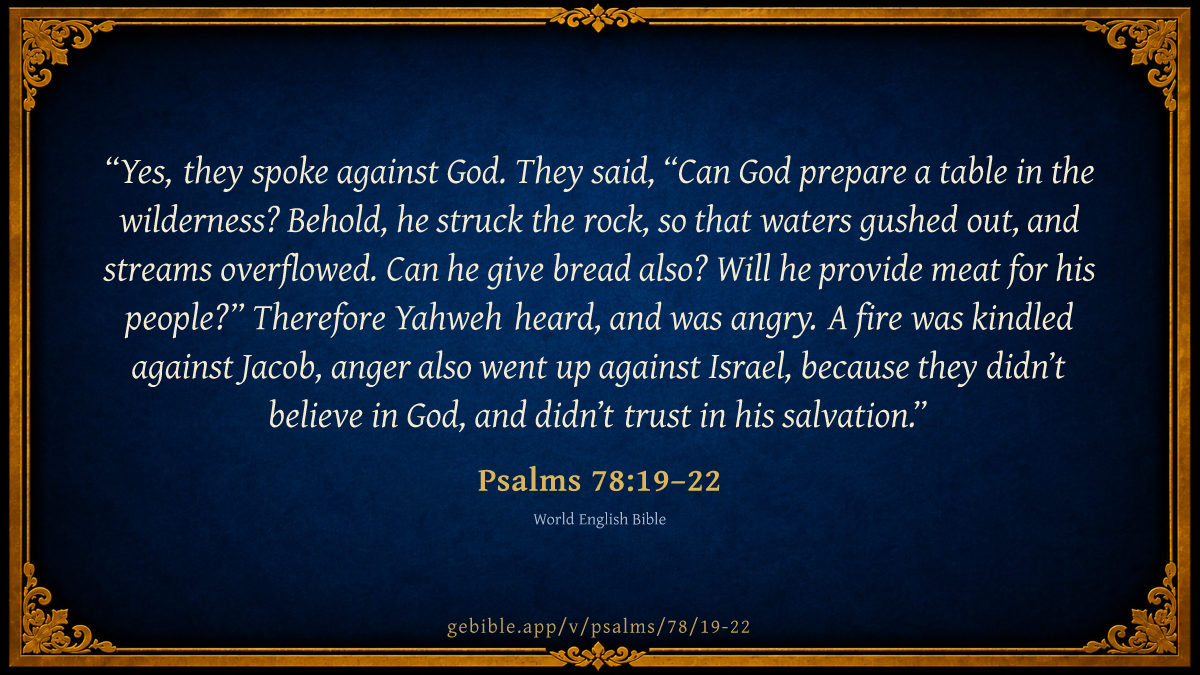
19. And they spake against God. The prophet had said that they tempted God in their heart; and now he adds, that they were not ashamed openly to utter with their impure and blasphemous tongues, the impiety which they had inwardly conceived. From this, it is the more abundantly manifest that malignity and wickedness had taken entire possession of their hearts. Thus we see how lust conceives sin, when it is admitted into the soul with unhallowed consent. Afterwards the sin develops itself farther, even as we see the Israelites proceeding to such a length of profane wantonness, as to call in question the power of God, as if they made no account of it, any farther than as it ministered to their lust. By the table prepared which is spoken of, is to be understood the dainty food, which was their ordinary fare in Egypt. A single dish did not satisfy their appetite. They were not contented unless they could gratify themselves with great abundance and variety. When it is said in the following verse, Behold! God smote the rock, and the waters gushed out, etc., this, I have no doubt, is the language of bitter irony, with which the prophet taunts their unblushing insolence. It is not very likely that they spake in this manner; but he relates, as it were, with their mouth, or in their person, the things which took place before their eyes.
John Calvin's Commentaries (1540-1563) — public domain. Text from the Calvin Translation Society English edition (1840s-50s) via the Christian Classics Ethereal Library (ccel.org). Calvin's coverage is partial (roughly two-thirds of the Bible); uncommented books and verses are honest gaps, never fabricated. The 19th-century editor's footnotes and remarks are omitted so the notes are faithfully Calvin's own voice.
Geneva Bible translators1599 · Public DomainOn vv19, 22Thus when we give place to sin, we are…
Thus when we give place to sin, we are moved to doubt of God’s power, except he will always be ready to serve our lust.
Geneva Bible (1599) marginal notes — public domain.
John Trapp1656 · Public DomainOn vv19–22Psa 78:19 Yea, they spake against God; they said,…
Psa 78:19 Yea, they spake against God; they said, Can God furnish a table in the wilderness?
Ver. 19. Yea, they stake against God] Their villanous and foul thoughts blistered and brake out at their lips.
Read full note →
Can God furnish a table?] This was a blasphemous question. God can do more than he will; but whatsoever he will do shall be done, and nothing can hinder it. "Lord, if thou wilt, thou canst make me clean," said he in the Gospel. And this was better than that of the other, who said, "If thou canst do any thing, help us," Mar 9:22
John Trapp, A Commentary or Exposition upon All the Books of the Old and New Testament (1647–1656) — public domain. Text from a community e-Sword module.
Matthew Poole1685 · Public DomainOn vv20–22The waters gushed out; which, all things consider seems…
The waters gushed out; which, all things consider seems not so wonderful, since fountains of water something break forth unexpectedly from or through rocks. But it is far more difficult to give us bread and flesh, which we know not whether he can do. Or at least we have just cause to doubt of his good will to us, who hath made a a penurious provision for us, and denies us these common blessings of bread and flesh, which he gives to the was of men.
Matthew Poole's English Annotations on the Holy Bible (1683–1685) — public domain. Text from a community e-Sword/MySword module.
John Gill1763 · Public DomainOn vv19–22Behold, he smote the rock, that the waters gushed…
Behold, he smote the rock, that the waters gushed out, and the streams overflowed,.... This they allow was done by him, for these are their words continued; suggesting, that though the waters did gush out upon smiting the rock, yet they might have been in the caverns of it before, and had remained there a long time, and might have come out of themselves; and therefore this was no such great matter, and might easily be accounted for:
but can he give bread also? solid, substantial bread, and not like this light bread, the manna, as they called it, Num 21:5, can he give us bread of corn, in a wilderness which is not a place of seed, where no corn grows? can he do this? this would show his power indeed:
Read full note →
can he provide flesh for his people? for so great a multitude, and in a place where no cattle are? let him do this, and we will believe his power; or else the words intimate that the smiting of the rock, and the waters flowing in such large streams, were an instance of his power, and therefore he that could do the one could do the other; he that could bring such large quantities of water out of a rock could give them solid bread and suitable flesh, and fulness of both; and should he not do so, they must conclude that he bore no good will to them, and had no love and kindness for them.
John Gill's Exposition of the Whole Bible (1746–1763) — public domain (CC PDM 1.0). Text via the HelloAO Bible API.
John Wesley1765 · Public DomainOn v22Trusted not - That he both could, and would…
Trusted not - That he both could, and would save them from the famine which they feared.
John Wesley, Explanatory Notes Upon the Whole Bible (1754–1765) — public domain. Text via the GEBible commentary corpus.
Adam Clarke1810 · Public DomainOn v22Verse 22. They believed not in God] After all…
Verse 22. They believed not in God] After all the miracles they had seen, they were not convinced that there was a Supreme Being! and, consequently, they did not trust in his salvation - did not expect the glorious rest which he had promised them. Their descendants in the present day are precisely in this state. Multitudes of them disbelieve the Divine origin of their law, and have given up all hopes of a Messiah.
Adam Clarke's Commentary on the Bible (1810–1826) — public domain. Text from a community e-Sword/MySword module.
Joseph Benson1811 · Public DomainOn v21Psa 78:21-22. The Lord heard, and was wroth —…
Psa 78:21-22. The Lord heard, and was wroth — Such rude and insolent language highly incensed the Divine Majesty. So a fire was kindled against Jacob — He sent lightning from heaven to consume those whom he had before cherished, Num 11:1. Or, the expression may be taken figuratively for the fire of God’s anger, as it follows. Observe, reader, God is a witness to all our murmurings and distrusts: he hears them, and is much displeased with them. To unbelievers our God is himself a consuming fire, and those that will not confide in the power of his mercy shall feel the power of his indignation, and be made to confess that it is a fearful thing to fall into his hands. Because they believed not in God — Because, by this their distrust and murmuring, it appeared that they did not give credit to the revelation God had made of himself to them: for they durst not commit themselves to his care, nor venture themselves in his hands; and trusted not in his salvation — That he could and would save them from the famine and destruction which they feared; they trusted not in the salvation he had begun to work for them; for, if they had, they would not thus have questioned its progress. Mark well, reader, those cannot be said to trust in God’s salvation as their felicity at last, who cannot find in their hearts to trust in his providence for food convenient in the way to it.
Joseph Benson's Commentary on the Old and New Testaments (1811–1818) — public domain. Text from a community e-Sword module.
Albert Barnes1834 · Public DomainOn vv19–22Yea, they spake against God - That is, in…
Yea, they spake against God - That is, in the manner which is immediately specified - by calling in question his power, or his ability to provide for them in the wilderness. See Num 11:4.
They said, Can God furnish a table in the wilderness? - In the desert. The word rendered “furnish” is in the margin “order.” It means to arrange; to set in order; and here to arrange and provide for, as at a feast. The precise words used by the complaining Hebrews are not quoted here, but the substance of what they said is retained. The idea is, that what they spake was “equivalent” to saying that God could not prepare a table for them; that is, provide for them, in the desert.
Albert Barnes' Notes on the Bible (1834–1885) — public domain. Text from a community e-Sword/MySword module.
Daniel D. Whedon1874 · Public DomainOn vv19–2019. They spake against God—And, in reply, “the wrath…
19. They spake against God—And, in reply, “the wrath of God arose against them.” Psa_78:21.
Can God furnish a table— “For one single meat could not content them, unless they might delight themselves in manifold plenty and variety.”—Calvin.
Daniel D. Whedon (gen. ed.), Commentary on the Old and New Testaments (1874–1909) — public domain. Text from a community e-Sword module.
The Cambridge Bible for Schools and Colleges1878 · Public DomainOn vv19–2219. Can God furnish] R.V., Can God prepare?
19. Can God furnish] R.V., Can God prepare?
The Cambridge Bible for Schools and Colleges (gen. ed. J. J. S. Perowne; Cambridge University Press, 1878–1918) — public domain. Text from a community e-Sword module.
Ellicott's Commentary for English Readers1878 · Public DomainOn vv19, 21(19, 20) A comparison of these verses with the…
(19, 20) A comparison of these verses with the references in the margin shows how the ancient narratives fared under poetical treatment.
Furnish a table.—Comp. Psa_23:5, Note
Read full note →
Gushed out.—Comp. Psa_105:41.
A Bible Commentary for English Readers, edited by Charles John Ellicott (1878–1897) — public domain. Text from a community e-Sword module.
The Pulpit Commentary1880 · Public DomainOn vv19, 21, 22Yea, they spake against God; they said, Can God…
Yea, they spake against God; they said, Can God furnish a table in the wilderness?. (see Num_11:4) But the psalmist either feels himself at liberty to expand the account given in the Pentateuch, or has a further knowledge of the real feelings of the people, which has come to him by tradition (compare the comment on ver. 12).
Behold, he smote the rock, that the waters gushed out, and the streams (literally, the torrent courses) overflowed; can he give bread also? can he provide flesh for his people? These were probably the people"s thoughts rather than their words. An "evil heart of unbelief" underlay their clamours and their murmurings. They doubted God"s power to relieve their wants, notwithstanding all the proofs that they had had of his omnipotence.
The Pulpit Commentary (1880–1919), ed. H.D.M. Spence-Jones & Joseph S. Exell — public domain. Text from a community e-Sword module.
Charles H. Spurgeon1885 · Public DomainOn vv19–22Ver. 19. From this verse we learn that unbelief…
Ver. 19. From this verse we learn that unbelief of God is a slander against him.
Yea, they spake against God. But how? The answer is,
Read full note →
They said, Can God furnish a table in the wilderness? To question the ability of one who is manifestly Almighty, is to speak against him. These people were base enough to say that although their God had given them bread and water, yet he could not properly order or furnish a table. He could give them coarse food, but could not prepare a feast properly arranged, so they were ungrateful enough to declare. As if the manna was a mere makeshift, and the flowing rock stream a temporary expedient, they ask to have a regularly furnished table, such as they had been accustomed to in Egypt. Alas, how have we also quarrelled with our mercies, and querulously pined for some imaginary good, counting our actual enjoyments to be nothing because they did not happen to be exactly conformed to our foolish fancies. They who will not be content will speak against providence even when it daily loadeth them with benefits.
Ver. 19. It is particularly to be observed, that the sin of which the children of Israel were on this occasion guilty, was not in wishing for bread and water, but in thinking for one moment, that after the Lord had brought them out of Egypt, he would suffer them, for the lack of any needful thing, to come short of Canaan. It was no sin to be hungry and thirsty; it was a necessity of their nature. There is nothing living that does not desire and require food: when we do not we are dead, and that they did so was no sin. Their sin was to doubt either that God could or would support them in the wilderness, or allow those who followed his leading to lack any good thing. This was their sin. It is just the same with the Christian now. These Israelites did not more literally require a supply of daily food for their bodies, than does the Christian for his soul. Not to do so is a sign of death, and the living soul would soon die without it. And so far from its being a sin, our Lord has pronounced that man blessed who hungers and thirsts after righteousness, adding the most precious promise, that all such shall be satisfied. But it is a sin, and a very great sin, should this food not be perceptibly, and to the evidence of our senses, immediately supplied, to murmur and be fearful. It was for the trial of their faith that these things happened to the Israelites, as do the trials of all Christians in all ages: and it is "after we have suffered a while" that we may expect to be established, strengthened, settled. Brownlow North, in "Ourselves. A Picture sketched from the History of the Children of Israel." (1865.)
Ver. 19-20. After all their experience, they doubted the divine omnipotence, as if it were to be regarded as nothing, when it refused to gratify their lusts. Unbelief is so deeply rooted in the human heart, that when God performs miracles on earth, unbelief doubts whether he can perform them in heaven, and when he does them in heaven, whether he can do them on earth? Augustus F. Tholuck.
Ver. 19. Unbelief a slander of God.
Psalms 78:20*
Ver. 19-20. See Psalms on "Ps 78:19" for further information.
Charles H. Spurgeon's The Treasury of David (1869–1885) — public domain. Psalms only. Text from a community e-Sword/MySword module.
The Biblical Illustrator1887 · Public DomainOn vv19–21Can God furnish a table in the wilderness?
Psa_78:19
Can God furnish a table in the wilderness?
Read full note →
A table in the wilderness
Here is--
I. A base ingratitude. He had done so, and they had participated in the banquet.
II. A miserable scepticism. Can He do it? He who peopled immensity with innumerable worlds and systems, etc. What an insane and imbecile scepticism is this! not worth argument.
III. A. living rebellion. The question shows that rebellion was a rampant spirit within them. (Homilist.)
The resources of God
I. The nature and import of the question. It is not the language of faith, but of doubt, distrust and unbelief.
II. The resources of God.
1. As the God of Nature. The heavens declare the glory of God, etc.
2. As the God of providence. To the Christian believer this doctrine is an unmixed source of Divine consolation. He believes that the same providing mind which bestowed the unspeakable gift is engaged to supply his daily bread.
3. As the God of grace--enlightening, preventing, convincing, justifying, sanctifying and comforting and strengthening grace.
III. A God infinite in His resources, as He is able, is also willing to communicate His blessings to His needy creatures. He is a sun of brightness and a sea of fulness.
IV. There is as much wisdom, mercy and goodness in what He withholds as in what He gives. The state of probation allotted to the Christian is of a mixed character. The brightest clay has the pillar of a cloud, and the darkest night a pillar of fire. The unmixed wine of the kingdom is reserved for the kingdom. The withheld mercies of our God are frequently blessings in disguise, so disguised that only the eye of faith can see through it. (W. B. Browne.)
The Biblical Illustrator, edited by Joseph S. Exell (c. 1880s–1900s) — public domain. Text from a community e-Sword module.
C. I. Scofield1917 · Public DomainOn v22(See Scofield "Psa 2:12")
trusted
(See Scofield "Psa 2:12")
The Scofield Reference Bible (1917 edition), notes by C. I. Scofield — public domain. Text from a community e-Sword module.
unfoldingWord translationNotes2017 · CC BY-SA 4.0On vv19, 21They spoke
They spoke
the Israelites spoke
Read full note →
Can God really lay out a table for us in the wilderness?
This can be translated as a statement. AT: "We do not believe that God can really lay out a table for us in the wilderness!" or "God, prove to us that you can really lay out a table for us in the wilderness!" (See: Rhetorical Question)
lay out a table
The idiom "lay out a table" means to prepare a table for a meal. Here the word "table" is a metonym for the food on the table. AT: "provide us with food" (See: Idiom and Metonymy)
waters gushed out
much water came out quickly
But can he give bread also? Will he provide meat for his people?
The people are laughing at God to insult him with these questions. AT: "But we will not believe that he can give us bread also or provide meat for his people until we see him do it." (See: Rhetorical Question)
bread ... meat
food from plants or food from animals. Though this is a merism for all kinds of food, it is best to translate it literally if possible. (See: Rhetorical Question)

John Calvin 1540 · Public Domain On vv19, 21 19. And they spake against God. The prophet had…
19. And they spake against God. The prophet had said that they tempted God in their heart; and now he adds, that they were not ashamed openly to utter with their impure and blasphemous tongues, the impiety which they had inwardly conceived. From this, it is the more abundantly manifest that malignity and wickedness had taken entire possession of their hearts. Thus we see how lust conceives sin, when it is admitted into the soul with unhallowed consent. Afterwards the sin develops itself farther, even as we see the Israelites proceeding to such a length of profane wantonness, as to call in question the power of God, as if they made no account of it, any farther than as it ministered to their lust. By the table prepared which is spoken of, is to be understood the dainty food, which was their ordinary fare in Egypt. A single dish did not satisfy their appetite. They were not contented unless they could gratify themselves with great abundance and variety. When it is said in the following verse, Behold! God smote the rock, and the waters gushed out, etc., this, I have no doubt, is the language of bitter irony, with which the prophet taunts their unblushing insolence. It is not very likely that they spake in this manner; but he relates, as it were, with their mouth, or in their person, the things which took place before their eyes.
John Calvin's Commentaries (1540-1563) — public domain. Text from the Calvin Translation Society English edition (1840s-50s) via the Christian Classics Ethereal Library (ccel.org). Calvin's coverage is partial (roughly two-thirds of the Bible); uncommented books and verses are honest gaps, never fabricated. The 19th-century editor's footnotes and remarks are omitted so the notes are faithfully Calvin's own voice.
Geneva Bible translators 1599 · Public Domain On vv19, 22 Thus when we give place to sin, we are…
Thus when we give place to sin, we are moved to doubt of God’s power, except he will always be ready to serve our lust.
Geneva Bible (1599) marginal notes — public domain.
John Trapp 1656 · Public Domain On vv19–22 Psa 78:19 Yea, they spake against God; they said,…
Psa 78:19 Yea, they spake against God; they said, Can God furnish a table in the wilderness?
Ver. 19. Yea, they stake against God] Their villanous and foul thoughts blistered and brake out at their lips.
Read full note →
Can God furnish a table?] This was a blasphemous question. God can do more than he will; but whatsoever he will do shall be done, and nothing can hinder it. "Lord, if thou wilt, thou canst make me clean," said he in the Gospel. And this was better than that of the other, who said, "If thou canst do any thing, help us," Mar 9:22
John Trapp, A Commentary or Exposition upon All the Books of the Old and New Testament (1647–1656) — public domain. Text from a community e-Sword module.
Matthew Poole 1685 · Public Domain On vv20–22 The waters gushed out; which, all things consider seems…
The waters gushed out; which, all things consider seems not so wonderful, since fountains of water something break forth unexpectedly from or through rocks. But it is far more difficult to give us bread and flesh, which we know not whether he can do. Or at least we have just cause to doubt of his good will to us, who hath made a a penurious provision for us, and denies us these common blessings of bread and flesh, which he gives to the was of men.
Matthew Poole's English Annotations on the Holy Bible (1683–1685) — public domain. Text from a community e-Sword/MySword module.
John Gill 1763 · Public Domain On vv19–22 Behold, he smote the rock, that the waters gushed…
Behold, he smote the rock, that the waters gushed out, and the streams overflowed,.... This they allow was done by him, for these are their words continued; suggesting, that though the waters did gush out upon smiting the rock, yet they might have been in the caverns of it before, and had remained there a long time, and might have come out of themselves; and therefore this was no such great matter, and might easily be accounted for:
but can he give bread also? solid, substantial bread, and not like this light bread, the manna, as they called it, Num 21:5, can he give us bread of corn, in a wilderness which is not a place of seed, where no corn grows? can he do this? this would show his power indeed:
Read full note →
can he provide flesh for his people? for so great a multitude, and in a place where no cattle are? let him do this, and we will believe his power; or else the words intimate that the smiting of the rock, and the waters flowing in such large streams, were an instance of his power, and therefore he that could do the one could do the other; he that could bring such large quantities of water out of a rock could give them solid bread and suitable flesh, and fulness of both; and should he not do so, they must conclude that he bore no good will to them, and had no love and kindness for them.
John Gill's Exposition of the Whole Bible (1746–1763) — public domain (CC PDM 1.0). Text via the HelloAO Bible API.
John Wesley 1765 · Public Domain On v22 Trusted not - That he both could, and would…
Trusted not - That he both could, and would save them from the famine which they feared.
John Wesley, Explanatory Notes Upon the Whole Bible (1754–1765) — public domain. Text via the GEBible commentary corpus.
Adam Clarke 1810 · Public Domain On v22 Verse 22. They believed not in God] After all…
Verse 22. They believed not in God] After all the miracles they had seen, they were not convinced that there was a Supreme Being! and, consequently, they did not trust in his salvation - did not expect the glorious rest which he had promised them. Their descendants in the present day are precisely in this state. Multitudes of them disbelieve the Divine origin of their law, and have given up all hopes of a Messiah.
Adam Clarke's Commentary on the Bible (1810–1826) — public domain. Text from a community e-Sword/MySword module.
Joseph Benson 1811 · Public Domain On v21 Psa 78:21-22. The Lord heard, and was wroth —…
Psa 78:21-22. The Lord heard, and was wroth — Such rude and insolent language highly incensed the Divine Majesty. So a fire was kindled against Jacob — He sent lightning from heaven to consume those whom he had before cherished, Num 11:1. Or, the expression may be taken figuratively for the fire of God’s anger, as it follows. Observe, reader, God is a witness to all our murmurings and distrusts: he hears them, and is much displeased with them. To unbelievers our God is himself a consuming fire, and those that will not confide in the power of his mercy shall feel the power of his indignation, and be made to confess that it is a fearful thing to fall into his hands. Because they believed not in God — Because, by this their distrust and murmuring, it appeared that they did not give credit to the revelation God had made of himself to them: for they durst not commit themselves to his care, nor venture themselves in his hands; and trusted not in his salvation — That he could and would save them from the famine and destruction which they feared; they trusted not in the salvation he had begun to work for them; for, if they had, they would not thus have questioned its progress. Mark well, reader, those cannot be said to trust in God’s salvation as their felicity at last, who cannot find in their hearts to trust in his providence for food convenient in the way to it.
Joseph Benson's Commentary on the Old and New Testaments (1811–1818) — public domain. Text from a community e-Sword module.
Albert Barnes 1834 · Public Domain On vv19–22 Yea, they spake against God - That is, in…
Yea, they spake against God - That is, in the manner which is immediately specified - by calling in question his power, or his ability to provide for them in the wilderness. See Num 11:4.
They said, Can God furnish a table in the wilderness? - In the desert. The word rendered “furnish” is in the margin “order.” It means to arrange; to set in order; and here to arrange and provide for, as at a feast. The precise words used by the complaining Hebrews are not quoted here, but the substance of what they said is retained. The idea is, that what they spake was “equivalent” to saying that God could not prepare a table for them; that is, provide for them, in the desert.
Albert Barnes' Notes on the Bible (1834–1885) — public domain. Text from a community e-Sword/MySword module.
Daniel D. Whedon 1874 · Public Domain On vv19–20 19. They spake against God—And, in reply, “the wrath…
19. They spake against God—And, in reply, “the wrath of God arose against them.” Psa_78:21.
Can God furnish a table— “For one single meat could not content them, unless they might delight themselves in manifold plenty and variety.”—Calvin.
Daniel D. Whedon (gen. ed.), Commentary on the Old and New Testaments (1874–1909) — public domain. Text from a community e-Sword module.
The Cambridge Bible for Schools and Colleges 1878 · Public Domain On vv19–22 19. Can God furnish] R.V., Can God prepare?
19. Can God furnish] R.V., Can God prepare?
The Cambridge Bible for Schools and Colleges (gen. ed. J. J. S. Perowne; Cambridge University Press, 1878–1918) — public domain. Text from a community e-Sword module.
Ellicott's Commentary for English Readers 1878 · Public Domain On vv19, 21 (19, 20) A comparison of these verses with the…
(19, 20) A comparison of these verses with the references in the margin shows how the ancient narratives fared under poetical treatment.
Furnish a table.—Comp. Psa_23:5, Note
Read full note →
Gushed out.—Comp. Psa_105:41.
A Bible Commentary for English Readers, edited by Charles John Ellicott (1878–1897) — public domain. Text from a community e-Sword module.
The Pulpit Commentary 1880 · Public Domain On vv19, 21, 22 Yea, they spake against God; they said, Can God…
Yea, they spake against God; they said, Can God furnish a table in the wilderness?. (see Num_11:4) But the psalmist either feels himself at liberty to expand the account given in the Pentateuch, or has a further knowledge of the real feelings of the people, which has come to him by tradition (compare the comment on ver. 12).
Behold, he smote the rock, that the waters gushed out, and the streams (literally, the torrent courses) overflowed; can he give bread also? can he provide flesh for his people? These were probably the people"s thoughts rather than their words. An "evil heart of unbelief" underlay their clamours and their murmurings. They doubted God"s power to relieve their wants, notwithstanding all the proofs that they had had of his omnipotence.
The Pulpit Commentary (1880–1919), ed. H.D.M. Spence-Jones & Joseph S. Exell — public domain. Text from a community e-Sword module.
Charles H. Spurgeon 1885 · Public Domain On vv19–22 Ver. 19. From this verse we learn that unbelief…
Ver. 19. From this verse we learn that unbelief of God is a slander against him.
Yea, they spake against God. But how? The answer is,
Read full note →
They said, Can God furnish a table in the wilderness? To question the ability of one who is manifestly Almighty, is to speak against him. These people were base enough to say that although their God had given them bread and water, yet he could not properly order or furnish a table. He could give them coarse food, but could not prepare a feast properly arranged, so they were ungrateful enough to declare. As if the manna was a mere makeshift, and the flowing rock stream a temporary expedient, they ask to have a regularly furnished table, such as they had been accustomed to in Egypt. Alas, how have we also quarrelled with our mercies, and querulously pined for some imaginary good, counting our actual enjoyments to be nothing because they did not happen to be exactly conformed to our foolish fancies. They who will not be content will speak against providence even when it daily loadeth them with benefits.
Ver. 19. It is particularly to be observed, that the sin of which the children of Israel were on this occasion guilty, was not in wishing for bread and water, but in thinking for one moment, that after the Lord had brought them out of Egypt, he would suffer them, for the lack of any needful thing, to come short of Canaan. It was no sin to be hungry and thirsty; it was a necessity of their nature. There is nothing living that does not desire and require food: when we do not we are dead, and that they did so was no sin. Their sin was to doubt either that God could or would support them in the wilderness, or allow those who followed his leading to lack any good thing. This was their sin. It is just the same with the Christian now. These Israelites did not more literally require a supply of daily food for their bodies, than does the Christian for his soul. Not to do so is a sign of death, and the living soul would soon die without it. And so far from its being a sin, our Lord has pronounced that man blessed who hungers and thirsts after righteousness, adding the most precious promise, that all such shall be satisfied. But it is a sin, and a very great sin, should this food not be perceptibly, and to the evidence of our senses, immediately supplied, to murmur and be fearful. It was for the trial of their faith that these things happened to the Israelites, as do the trials of all Christians in all ages: and it is "after we have suffered a while" that we may expect to be established, strengthened, settled. Brownlow North, in "Ourselves. A Picture sketched from the History of the Children of Israel." (1865.)
Ver. 19-20. After all their experience, they doubted the divine omnipotence, as if it were to be regarded as nothing, when it refused to gratify their lusts. Unbelief is so deeply rooted in the human heart, that when God performs miracles on earth, unbelief doubts whether he can perform them in heaven, and when he does them in heaven, whether he can do them on earth? Augustus F. Tholuck.
Ver. 19. Unbelief a slander of God.
Psalms 78:20*
Ver. 19-20. See Psalms on "Ps 78:19" for further information.
Charles H. Spurgeon's The Treasury of David (1869–1885) — public domain. Psalms only. Text from a community e-Sword/MySword module.
The Biblical Illustrator 1887 · Public Domain On vv19–21 Can God furnish a table in the wilderness?
Psa_78:19
Can God furnish a table in the wilderness?
Read full note →
A table in the wilderness
Here is--
I. A base ingratitude. He had done so, and they had participated in the banquet.
II. A miserable scepticism. Can He do it? He who peopled immensity with innumerable worlds and systems, etc. What an insane and imbecile scepticism is this! not worth argument.
III. A. living rebellion. The question shows that rebellion was a rampant spirit within them. (Homilist.)
The resources of God
I. The nature and import of the question. It is not the language of faith, but of doubt, distrust and unbelief.
II. The resources of God.
1. As the God of Nature. The heavens declare the glory of God, etc.
2. As the God of providence. To the Christian believer this doctrine is an unmixed source of Divine consolation. He believes that the same providing mind which bestowed the unspeakable gift is engaged to supply his daily bread.
3. As the God of grace--enlightening, preventing, convincing, justifying, sanctifying and comforting and strengthening grace.
III. A God infinite in His resources, as He is able, is also willing to communicate His blessings to His needy creatures. He is a sun of brightness and a sea of fulness.
IV. There is as much wisdom, mercy and goodness in what He withholds as in what He gives. The state of probation allotted to the Christian is of a mixed character. The brightest clay has the pillar of a cloud, and the darkest night a pillar of fire. The unmixed wine of the kingdom is reserved for the kingdom. The withheld mercies of our God are frequently blessings in disguise, so disguised that only the eye of faith can see through it. (W. B. Browne.)
The Biblical Illustrator, edited by Joseph S. Exell (c. 1880s–1900s) — public domain. Text from a community e-Sword module.
C. I. Scofield 1917 · Public Domain On v22 (See Scofield "Psa 2:12")
trusted
(See Scofield "Psa 2:12")
The Scofield Reference Bible (1917 edition), notes by C. I. Scofield — public domain. Text from a community e-Sword module.
unfoldingWord translationNotes 2017 · CC BY-SA 4.0 On vv19, 21 They spoke
They spoke
the Israelites spoke
Read full note →
Can God really lay out a table for us in the wilderness?
This can be translated as a statement. AT: "We do not believe that God can really lay out a table for us in the wilderness!" or "God, prove to us that you can really lay out a table for us in the wilderness!" (See: Rhetorical Question)
lay out a table
The idiom "lay out a table" means to prepare a table for a meal. Here the word "table" is a metonym for the food on the table. AT: "provide us with food" (See: Idiom and Metonymy)
waters gushed out
much water came out quickly
But can he give bread also? Will he provide meat for his people?
The people are laughing at God to insult him with these questions. AT: "But we will not believe that he can give us bread also or provide meat for his people until we see him do it." (See: Rhetorical Question)
bread ... meat
food from plants or food from animals. Though this is a merism for all kinds of food, it is best to translate it literally if possible. (See: Rhetorical Question)
translationWords
God
bread
people of God
unfoldingWord translationNotes — © Distant Shores Media and the Door43 World Missions Community, licensed CC BY-SA 4.0. Source: git.door43.org/Door43/en_tn.