Questions where the Bible appears to say two different things, with the passages on each side set together.
What is God's name?The Hebrew Bible gives God several different "names" and in some cases insists that a particular one is THE name.
Who is the Lord of this world?The Hebrew Bible repeatedly affirms YHWH as sovereign over all the kingdoms and the whole earth, but several New Testament passages — most notably the Temptati…
Exodus 6:3(v18)I appeared to Abraham, to Isaac, and to Jacob, as God Almighty; but by my name Yahweh I was not known to them.
Psalms 59:13(v18)Consume them in wrath. Consume them, and they will be no more. Let them know that God rules in Jacob, to the ends of the earth.
2 Kings 19:19(v18)Now therefore, Yahweh our God, save us, I beg you, out of his hand, that all the kingdoms of the earth may know that you, Yahweh, are God…
Psalms 97:9(v18)For you, Yahweh, are most high above all the earth. You are exalted far above all gods.
Jeremiah 16:21(v18)“Therefore behold, I will cause them to know, this once I will cause them to know my hand and my might. Then they will know that my name is…
Show all 25 cross-references
Ezekiel 38:23(v18)I will magnify myself, and sanctify myself, and I will make myself known in the eyes of many nations. Then they will know that I am…
Psalms 35:4(v17)Let those who seek after my soul be disappointed and brought to dishonor. Let those who plot my ruin be turned back and confounded.
Isaiah 42:8(v18)“I am Yahweh. That is my name. I will not give my glory to another, nor my praise to engraved images.
Ezekiel 30:19(v18)Thus I will execute judgments on Egypt. Then they will know that I am Yahweh.” ’ ”
Daniel 4:32(v18)You shall be driven from men; and your dwelling shall be with the animals of the field. You shall be made to eat grass as oxen. Seven times…
1 Kings 18:37(v18)Hear me, Yahweh, hear me, that this people may know that you, Yahweh, are God, and that you have turned their heart back again.”
Psalms 92:8(v18)But you, Yahweh, are on high forever more.
Isaiah 54:5(v18)For your Maker is your husband; Yahweh of Armies is his name. The Holy One of Israel is your Redeemer. He will be called the God of the…
Micah 4:13(v18)Arise and thresh, daughter of Zion; for I will make your horn iron, and I will make your hoofs bronze; and you will beat in pieces many…
Psalms 109:29(vv16–17)Let my adversaries be clothed with dishonor. Let them cover themselves with their own shame as with a robe.
Genesis 22:14(v18)Abraham called the name of that place “Yahweh Will Provide”. As it is said to this day, “On Yahweh’s mountain, it will be provided.”
Psalms 6:10(v16)May all my enemies be ashamed and dismayed. They shall turn back, they shall be disgraced suddenly.
Psalms 9:2(v18)I will be glad and rejoice in you. I will sing praise to your name, O Most High.
Psalms 9:19-20(v16)Arise, Yahweh! Don’t let man prevail. Let the nations be judged in your sight. Put them in fear, Yahweh. Let the nations know that they are…
Psalms 35:26(v17)Let them be disappointed and confounded together who rejoice at my calamity. Let them be clothed with shame and dishonor who magnify…
Psalms 40:14-15(v17)Let them be disappointed and confounded together who seek after my soul to destroy it. Let them be turned backward and brought to dishonor…
Job 10:15(v16)If I am wicked, woe to me. If I am righteous, I still will not lift up my head, being filled with disgrace, and conscious of my affliction.
Psalms 9:16(v18)Yahweh has made himself known. He has executed judgment. The wicked is snared by the work of his own hands.
Psalms 34:5(v16)They looked to him, and were radiant. Their faces shall never be covered with shame.
Psalms 132:18(v16)I will clothe his enemies with shame, but on himself, his crown will shine.”
25 distinct cross-references across this passage (26 total citations).
Cross-references from openbible.info (CC BY 4.0)
Explain this passage (16 sources)
Historical commentary, presented as a primary source — not an endorsement.
John Calvin1540 · Public DomainOn v1818. And let them know that thou art, thy…
18. And let them know that thou art, thy name Jehovah. It is not the saving knowledge of God which is here spoken of, but that acknowledgement of him which his irresistible power extorts from the wicked. It is not simply said that they will know that there is a God; but a special kind of knowledge is laid down, it being intimated that the heathen who before held the true religion in contempt, would at length perceive that the God who made himself known in the Law, and who was worshipped in Judea, was the only true God. Still, however, it must be remembered, that the knowledge spoken of is only that which is of an evanescent character, having neither root nor the living juice to nourish it; for the wicked will not submit to God willingly and cordially, but are drawn by compulsion to yield a counterfeit obedience, or, being restrained by him, dare not break forth into open outrage. This, then, is an experimental recognition of God which penetrates not to the heart, but is extorted from them by force and necessity. The pronoun אתה, atah, thou, is emphatic, implying a tacit contrast between the God of Israel and all the false gods which were the product of men’s invention. The prayer amounts to this: Lord, make them to know that the idols which they have fabricated for themselves are no gods, and in fact are nothing. The despisers of God may indeed shun the light, and at one time may overcast themselves with clouds, while at another their may plunge into the deep and thick shades of darkness; but He pursues them, and draws them forth to the knowledge of himself, which they would fain bury in ignorance. And as the world indiscriminately and disgracefully applies his sacred name to its own trifling inventions, this profanation is corrected when it is added, thy name Jehovah. This implies that being, or really to be, is in the strict sense applicable to God alone; for although unbelievers may attempt to tear his glory to pieces, he continues perfect and unchanged. The contrast of which I have spoken, must be kept in mind by the reader. A nation has never existed so barbarous as not to have worshipped some deity; but every country forged particular gods for itself. And although the Moabites, the Edomites, and the rest of these nations, admitted that some power and authority belonged to the God of Israel, yet they conceived that this power and authority did not extend beyond the boundaries of Judea. Thus the king of Syria called him, “the God of the hills,” (1 Kings 20:23.) This preposterous and absurd division of God’s glory, which men make, is disproved by one word, and all the superstitions which at that time prevailed in the world are overthrown, when the Prophet attributes to the God of Israel, as well the essence of Deity as the name; for unless all the idols of the heathen are completely abolished, he will not obtain, alone and unshared, the name of Jehovah. Accordingly, it is added, Thou alone art the Most High over all the earth; a statement which is worthy of our most careful attention. The superstitious commonly think it enough to leave God his name, that is to say, two or three syllables; and in the meantime they fritter away his power, as if his majesty were contained in an empty title. Let us then remember that God does not receive that honor among men to which he is entitled, if he is not allowed to possess his own inherent sovereignty, and if his glory is obscured by setting up other objects against him with antagonist claims.
John Calvin's Commentaries (1540-1563) — public domain. Text from the Calvin Translation Society English edition (1840s-50s) via the Christian Classics Ethereal Library (ccel.org). Calvin's coverage is partial (roughly two-thirds of the Bible); uncommented books and verses are honest gaps, never fabricated. The 19th-century editor's footnotes and remarks are omitted so the notes are faithfully Calvin's own voice.
Geneva Bible translators1599 · Public DomainOn vv16, 18That is, be compelled by thy plagues to confess…
That is, be compelled by thy plagues to confess thy power.
Geneva Bible (1599) marginal notes — public domain.
John Trapp1656 · Public DomainOn vv16–18Psa 83:16 Fill their faces with shame; that they…
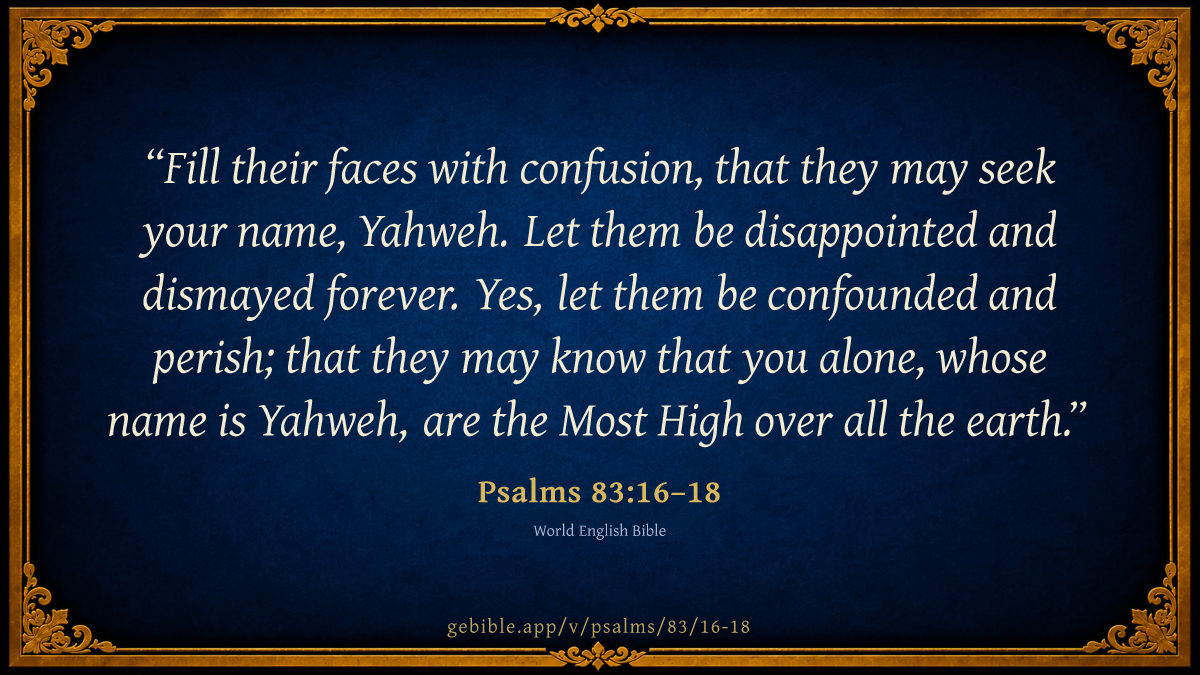
Psa 83:16 Fill their faces with shame; that they may seek thy name, O LORD.
Ver. 16. Fill their faces with shame] By confounding their confidences, and blasting their designs. They promised themselves a triumph, but let them have the canvas.
Read full note →
That they may seek thy name, O Lord] Ut inviti cogantur quis sit tam potens Iehovah rogitare , that they may even in despite of their heads be compelled to inquire after thee. It is storied of Sennacherib, that, after the destruction of his huge army at Jerusalem, demanding of some about him what might be the reason that the irresistible God of heaven so favoured the Jewish nation, as he had found by sad experience? answer was given, that Abraham, from whom they descended, sacrificed unto him his only son, which purchased this protection to his posterity. If that will win him, saith he, I will spare him two of my sons, to procure him to be on my side; which Sharezer and Adrammelech, his sons, hearing of, prevented their own deaths by his (Bib. Castal. Tabul.).
John Trapp, A Commentary or Exposition upon All the Books of the Old and New Testament (1647–1656) — public domain. Text from a community e-Sword module.
Matthew Poole1685 · Public DomainOn vv16–18That being disappointed of their hopes, and discerning the…
That being disappointed of their hopes, and discerning the impotency of their idols, they may own and worship thee as the only true God.
Matthew Poole's English Annotations on the Holy Bible (1683–1685) — public domain. Text from a community e-Sword/MySword module.
John Gill1763 · Public DomainOn vv16–18Fill their faces with shame,.... For their sins, or…
Fill their faces with shame,.... For their sins, or rather through disappointment, not being able to put their desperate and deep laid schemes into execution: or "with lightness" (o); instead of a weight of honour and glory upon them, let them be despised. R. Joseph Kimchi renders it, "fill their faces with fire"; let their faces be as if they were on fire, as men's faces are, who are put to an exceeding great blush, or are most sadly confounded and ashamed:
that they may seek thy name, O Lord; not they themselves, who are filled with shame; for it is imprecated, that they be ashamed, and troubled for ever, and so as to perish, Psa 83:17 but others; for the words may be supplied, as in Psa 83:18 "that men may seek thy name, or that thy name may be sought": the judgments of God upon wicked men are sometimes the means of arousing others, and putting them upon seeking the Lord, his face, and his favour; that God would be merciful to them, pardon their iniquities, avert judgments from them, and preserve them from threatened calamities; and this is a good end, when answered; see Isa 26:9.
Read full note →
(o) Heb. "levitate", Piscator; so Ainsworth.
John Gill's Exposition of the Whole Bible (1746–1763) — public domain (CC PDM 1.0). Text via the HelloAO Bible API.
John Wesley1765 · Public DomainOn v16May seek - May own and worship thee as…
May seek - May own and worship thee as the only true God.
John Wesley, Explanatory Notes Upon the Whole Bible (1754–1765) — public domain. Text via the GEBible commentary corpus.
Adam Clarke1810 · Public DomainOn vv16–18Verse 16. That they may seek thy name] Let…
Verse 16. That they may seek thy name] Let them be confounded in all their attempts on Israel; and see, so manifestly, that thou hast done it, that they may invoke thy name, and be converted to thee.
Adam Clarke's Commentary on the Bible (1810–1826) — public domain. Text from a community e-Sword/MySword module.
Joseph Benson1811 · Public DomainOn v16Psa 83:16-18. Fill, &c., that they may seek thy…
Psa 83:16-18. Fill, &c., that they may seek thy name — That, being disappointed of their hopes, and discerning the impotence of their idols, they may own and worship thee as the only true God. Let them be put to shame and perish — But those of them that will not humble themselves before thee, let them be utterly destroyed. That men may know — Or, that they may know, namely, by dear-bought experience, even by their own ruin, what they would not know by information for their own good; that thou art the Most High — The most high God, and the God, not only of thy people Israel, as the heathen fancy, and as their gods are supposed to be confined to their particular and several territories, but the God and governor of all the nations and parts of the earth.
Joseph Benson's Commentary on the Old and New Testaments (1811–1818) — public domain. Text from a community e-Sword module.
Albert Barnes1834 · Public DomainOn vv16–18Fill their faces with shame - As those who…
Fill their faces with shame - As those who are disappointed and foiled in their plans - such disappointment and confusion commonly manifesting itself in the face. The prayer here is, that their enemies might be so baffled in their designs - that they might be made so to feel how vain and hopeless were all their plans - that there might be such a manifest interposition of God in the case, as that they should be led to see that Yahweh reigned; that it was in vain to contend with him, and that his people were under his protection.
That they may seek thy name, O Lord - That they may be led to seek thee. This explains the drift and design of the whole prayer in the psalm. It is not a malignant prayer for the destruction of their enemies; it is not a wish that they might be made to suffer; but it is a prayer that the divine dealing might be such as to lead them to the acknowledgment of the true God. It is a benevolent thing to desire that men may be brought to the knowledge of the true God, though it be through the discomfiture of their own plans, by defeat, or by suffering. Anything that leads people to an acquaintance with God, and results in securing his friendship and favor, is a gain, and will be cause of thankfulness in the end.
Albert Barnes' Notes on the Bible (1834–1885) — public domain. Text from a community e-Sword/MySword module.
Daniel D. Whedon1874 · Public DomainOn vv16–1816. That they may seek thy name—Or, And they…
16. That they may seek thy name—Or, And they shall seek thy name. They will never inquire after the true God until their false dependencies are swept away, and this latter can be effected only by judgments which, like the plagues of Egypt, are above the arm of flesh to avert. The seeking after God, here, is that which is forced by the pressure of judgments, but the ulterior, true seeking, is anticipated as a possible and desired result.
Daniel D. Whedon (gen. ed.), Commentary on the Old and New Testaments (1874–1909) — public domain. Text from a community e-Sword module.
The Cambridge Bible for Schools and Colleges1878 · Public DomainOn vv16–1816. Fill their faces with shame] Or, disgrace. Let…
16. Fill their faces with shame] Or, disgrace. Let them be disgraced by defeat and disappointed in their project. But this is only as the means to the higher end, that they may seek Jehovah’s name, recognising in Israel’s God the God of revelation, and submitting themselves to His Will.
The Cambridge Bible for Schools and Colleges (gen. ed. J. J. S. Perowne; Cambridge University Press, 1878–1918) — public domain. Text from a community e-Sword module.
Ellicott's Commentary for English Readers1878 · Public DomainOn v16(16) Thy name, O Lord.—Rather, thy name (which is)…
(16) Thy name, O Lord.—Rather, thy name (which is) Jehovah. The nations were to seek Him not only as God, but as Jehovah God of Israel. This is proved by Psa_83:18. No doubt the thought uppermost in the verse is the submission of the heathen to Jehovah’s power. But we may, looking back, read in it a nobler wish and a grander hope—the prophetic hope of a union of nations in a belief in the common fatherhood of God.
A Bible Commentary for English Readers, edited by Charles John Ellicott (1878–1897) — public domain. Text from a community e-Sword module.
The Pulpit Commentary1880 · Public DomainOn vv16–18Fill their faces with shame; i.e. cause their enterprise…
Fill their faces with shame; i.e. cause their enterprise to fail, and so bring them to shame and confusion of face. That they may seek thy Name, O Lord. A merciful purpose lies behind the greater number of Divine visitations. They are intended to scourge men into submission, and cause them to turn to God. The psalmist, being in full sympathy with God, desires that his merciful intentions may have effect.
The issue of Divine judgments on the wicked.
Read full note →
"That they may seek thy Name, O Lord." This is a very remarkable qualifying of our idea that psalmists prayed in a revengeful spirit for the destruction of the national enemies. In truth, their supreme idea was the glorifying of God, and they asked for judgments because through judgments would come the honouring of God"s Name; and, in this honouring, the higher blessing for the foes themselves. Here the psalmist prays, "Fill their faces with shame;" but he sees in their humiliation the hope that they will be drawn to God.
I WE MAY PRAY FOR THE HUMILIATION OF OUR ENEMIES.
II WE MAY NOT PRAY IN VIEW MERELY OF THEIR SUFFERING.
III WE MAY PRAY, IF WE DESIRE THEIR LASTING GOOD THROUGH THEIR HUMILIATION.
IV WE MAY PRAY, IF WE SET. BEFORE OURSELVES THE GLORY OF GOD IN THEIR RECOVERY.
It is a sign of triumph over hateful and revengeful feelings if we can pray God to deal with our enemies in the wisdom of his righteous love. It is not befitting that the Christian should ever think of judgments and punishments as merely destructive. To him all judgment is remedial, all punishment is corrective. God will get honour to his Name out of all his dealings. It should be shown that the "forever" and the "perish" of ver. 17 are to be treated as poetical terms. Or ver. 16 may be regarded as the better view, which the psalmist was hardly able to keep to. Ver. 17 falls back upon the harsher view of God"s dealing with his foes. Christianity willingly lets pass the harsher view, and sets ever more prominently before us the better and more hopeful view. "Speaker"s Commentary" on ver. 16 says, "This is a feeling altogether peculiar to God"s people." The object of all the judgments which the true prophet desires is to bring all nations into subjection to God. Their calamities will be converted into blessings, unless they persist in rebellion. R.T.
The Pulpit Commentary (1880–1919), ed. H.D.M. Spence-Jones & Joseph S. Exell — public domain. Text from a community e-Sword module.
Charles H. Spurgeon1885 · Public DomainOn vv16–18Ver. 16. Fill their faces with shame; that they…
Ver. 16. Fill their faces with shame; that they may seek thy name, O Lord. Shame has often weaned men from their idols, and set them upon seeking the Lord. If this was not the happy result, in the present instance, with the Lord's enemies, yet it would be so with his people who were so prone to err. They would be humbled by his mercy, and ashamed of themselves because of his grace; and then they would with sincerity return to the earnest worship of Jehovah their God, who had delivered them.
None.
Read full note →
Ver. 16. A prayer for the Pope and his priests.
Psalms 83:17*
Charles H. Spurgeon's The Treasury of David (1869–1885) — public domain. Psalms only. Text from a community e-Sword/MySword module.
The Biblical Illustrator1887 · Public DomainOn vv16, 18Fill their faces with shame; that they may seek…
Psa_83:16
Fill their faces with shame; that they may seek Thy name, O Lord.
Read full note →
Shame leading to salvation
I. Ungodly men have good cause to be ashamed--
1. Because of the wrong they are doing to their Maker. You pride yourself upon your uprightness and integrity; but must God alone, then, be made to Suffer through your injustice? Out of all beings, must He alone who made all other beings be the only one to be neglected?
2. There are many ungodly men who ought to be ashamed because they are acting in opposition to light and knowledge, contrary to their conscience, and against their better judgments.
3. Because of their postponements of what they know to be right.
4. Because of their violation of vows which they have made.
5. Because of their not loving the Lord Jesus Christ, and not trusting such a Saviour as He is.
6. A man ought to be ashamed who will not even think of these things.
II. Now, concerning these ungodly people, let me show you that shame is a very desirable thing if it drives them to God. Hence the prayer, Fill their faces with shame, that they may seek thy name, O Lord.
1. Sometimes shame attends the breaking up of self-righteousness.
2. I have known this shame to operate in some when they have done wrong, and have lost the repute they enjoyed among their fellow-creatures.
3. So have I seen failure driving a man to the strong for strength.
4. I have also known men brought to Christ with shame of another sort, shame of mental error leading to a humble faith.
III. The Lord is willing now to receive those who are ashamed of themselves.
1. You are the sort of man to come to Christ, because, first, you have the greatest need of Him. In the time of famine, we give the meal away first to the most hungry family.
2. If you are ashamed of yourself, you are the man to come to Christ, because you will make no bargains with Him. You will say, Save me, Lord, at any price, and in any way!
3. And you are the man who will give Him all the glory if you are saved. (C. H. Spurgeon.)
The Biblical Illustrator, edited by Joseph S. Exell (c. 1880s–1900s) — public domain. Text from a community e-Sword module.
unfoldingWord translationNotes2017 · CC BY-SA 4.0On vv16, 18Fill their faces with shame
Fill their faces with shame
Here "faces" represents the whole person. AT: "Make them very ashamed" (See: Synecdoche)
Read full note →
they might seek your name
Here "name" represents God's power. God's enemies acknowledging that God is powerful is spoken of as if they are seeking to find Yahweh. AT: "they might acknowledge that you are powerful" (See: Metonymy and Metaphor)
seek your name
Possible meanings are 1) God's enemies admit that God is powerful or 2) God's enemies are asking God for help or 3) God's enemies start to worship and obey him.
May they be put to shame and be terrified forever
This can be stated in active form. AT: "Make them ashamed and terrified forever" (See: Active or Passive)

John Calvin 1540 · Public Domain On v18 18. And let them know that thou art, thy…
18. And let them know that thou art, thy name Jehovah. It is not the saving knowledge of God which is here spoken of, but that acknowledgement of him which his irresistible power extorts from the wicked. It is not simply said that they will know that there is a God; but a special kind of knowledge is laid down, it being intimated that the heathen who before held the true religion in contempt, would at length perceive that the God who made himself known in the Law, and who was worshipped in Judea, was the only true God. Still, however, it must be remembered, that the knowledge spoken of is only that which is of an evanescent character, having neither root nor the living juice to nourish it; for the wicked will not submit to God willingly and cordially, but are drawn by compulsion to yield a counterfeit obedience, or, being restrained by him, dare not break forth into open outrage. This, then, is an experimental recognition of God which penetrates not to the heart, but is extorted from them by force and necessity. The pronoun אתה, atah, thou, is emphatic, implying a tacit contrast between the God of Israel and all the false gods which were the product of men’s invention. The prayer amounts to this: Lord, make them to know that the idols which they have fabricated for themselves are no gods, and in fact are nothing. The despisers of God may indeed shun the light, and at one time may overcast themselves with clouds, while at another their may plunge into the deep and thick shades of darkness; but He pursues them, and draws them forth to the knowledge of himself, which they would fain bury in ignorance. And as the world indiscriminately and disgracefully applies his sacred name to its own trifling inventions, this profanation is corrected when it is added, thy name Jehovah. This implies that being, or really to be, is in the strict sense applicable to God alone; for although unbelievers may attempt to tear his glory to pieces, he continues perfect and unchanged. The contrast of which I have spoken, must be kept in mind by the reader. A nation has never existed so barbarous as not to have worshipped some deity; but every country forged particular gods for itself. And although the Moabites, the Edomites, and the rest of these nations, admitted that some power and authority belonged to the God of Israel, yet they conceived that this power and authority did not extend beyond the boundaries of Judea. Thus the king of Syria called him, “the God of the hills,” (1 Kings 20:23.) This preposterous and absurd division of God’s glory, which men make, is disproved by one word, and all the superstitions which at that time prevailed in the world are overthrown, when the Prophet attributes to the God of Israel, as well the essence of Deity as the name; for unless all the idols of the heathen are completely abolished, he will not obtain, alone and unshared, the name of Jehovah. Accordingly, it is added, Thou alone art the Most High over all the earth; a statement which is worthy of our most careful attention. The superstitious commonly think it enough to leave God his name, that is to say, two or three syllables; and in the meantime they fritter away his power, as if his majesty were contained in an empty title. Let us then remember that God does not receive that honor among men to which he is entitled, if he is not allowed to possess his own inherent sovereignty, and if his glory is obscured by setting up other objects against him with antagonist claims.
John Calvin's Commentaries (1540-1563) — public domain. Text from the Calvin Translation Society English edition (1840s-50s) via the Christian Classics Ethereal Library (ccel.org). Calvin's coverage is partial (roughly two-thirds of the Bible); uncommented books and verses are honest gaps, never fabricated. The 19th-century editor's footnotes and remarks are omitted so the notes are faithfully Calvin's own voice.
Geneva Bible translators 1599 · Public Domain On vv16, 18 That is, be compelled by thy plagues to confess…
That is, be compelled by thy plagues to confess thy power.
Geneva Bible (1599) marginal notes — public domain.
John Trapp 1656 · Public Domain On vv16–18 Psa 83:16 Fill their faces with shame; that they…
Psa 83:16 Fill their faces with shame; that they may seek thy name, O LORD.
Ver. 16. Fill their faces with shame] By confounding their confidences, and blasting their designs. They promised themselves a triumph, but let them have the canvas.
Read full note →
That they may seek thy name, O Lord] Ut inviti cogantur quis sit tam potens Iehovah rogitare , that they may even in despite of their heads be compelled to inquire after thee. It is storied of Sennacherib, that, after the destruction of his huge army at Jerusalem, demanding of some about him what might be the reason that the irresistible God of heaven so favoured the Jewish nation, as he had found by sad experience? answer was given, that Abraham, from whom they descended, sacrificed unto him his only son, which purchased this protection to his posterity. If that will win him, saith he, I will spare him two of my sons, to procure him to be on my side; which Sharezer and Adrammelech, his sons, hearing of, prevented their own deaths by his (Bib. Castal. Tabul.).
John Trapp, A Commentary or Exposition upon All the Books of the Old and New Testament (1647–1656) — public domain. Text from a community e-Sword module.
Matthew Poole 1685 · Public Domain On vv16–18 That being disappointed of their hopes, and discerning the…
That being disappointed of their hopes, and discerning the impotency of their idols, they may own and worship thee as the only true God.
Matthew Poole's English Annotations on the Holy Bible (1683–1685) — public domain. Text from a community e-Sword/MySword module.
John Gill 1763 · Public Domain On vv16–18 Fill their faces with shame,.... For their sins, or…
Fill their faces with shame,.... For their sins, or rather through disappointment, not being able to put their desperate and deep laid schemes into execution: or "with lightness" (o); instead of a weight of honour and glory upon them, let them be despised. R. Joseph Kimchi renders it, "fill their faces with fire"; let their faces be as if they were on fire, as men's faces are, who are put to an exceeding great blush, or are most sadly confounded and ashamed:
that they may seek thy name, O Lord; not they themselves, who are filled with shame; for it is imprecated, that they be ashamed, and troubled for ever, and so as to perish, Psa 83:17 but others; for the words may be supplied, as in Psa 83:18 "that men may seek thy name, or that thy name may be sought": the judgments of God upon wicked men are sometimes the means of arousing others, and putting them upon seeking the Lord, his face, and his favour; that God would be merciful to them, pardon their iniquities, avert judgments from them, and preserve them from threatened calamities; and this is a good end, when answered; see Isa 26:9.
Read full note →
(o) Heb. "levitate", Piscator; so Ainsworth.
John Gill's Exposition of the Whole Bible (1746–1763) — public domain (CC PDM 1.0). Text via the HelloAO Bible API.
John Wesley 1765 · Public Domain On v16 May seek - May own and worship thee as…
May seek - May own and worship thee as the only true God.
John Wesley, Explanatory Notes Upon the Whole Bible (1754–1765) — public domain. Text via the GEBible commentary corpus.
Adam Clarke 1810 · Public Domain On vv16–18 Verse 16. That they may seek thy name] Let…
Verse 16. That they may seek thy name] Let them be confounded in all their attempts on Israel; and see, so manifestly, that thou hast done it, that they may invoke thy name, and be converted to thee.
Adam Clarke's Commentary on the Bible (1810–1826) — public domain. Text from a community e-Sword/MySword module.
Joseph Benson 1811 · Public Domain On v16 Psa 83:16-18. Fill, &c., that they may seek thy…
Psa 83:16-18. Fill, &c., that they may seek thy name — That, being disappointed of their hopes, and discerning the impotence of their idols, they may own and worship thee as the only true God. Let them be put to shame and perish — But those of them that will not humble themselves before thee, let them be utterly destroyed. That men may know — Or, that they may know, namely, by dear-bought experience, even by their own ruin, what they would not know by information for their own good; that thou art the Most High — The most high God, and the God, not only of thy people Israel, as the heathen fancy, and as their gods are supposed to be confined to their particular and several territories, but the God and governor of all the nations and parts of the earth.
Joseph Benson's Commentary on the Old and New Testaments (1811–1818) — public domain. Text from a community e-Sword module.
Albert Barnes 1834 · Public Domain On vv16–18 Fill their faces with shame - As those who…
Fill their faces with shame - As those who are disappointed and foiled in their plans - such disappointment and confusion commonly manifesting itself in the face. The prayer here is, that their enemies might be so baffled in their designs - that they might be made so to feel how vain and hopeless were all their plans - that there might be such a manifest interposition of God in the case, as that they should be led to see that Yahweh reigned; that it was in vain to contend with him, and that his people were under his protection.
That they may seek thy name, O Lord - That they may be led to seek thee. This explains the drift and design of the whole prayer in the psalm. It is not a malignant prayer for the destruction of their enemies; it is not a wish that they might be made to suffer; but it is a prayer that the divine dealing might be such as to lead them to the acknowledgment of the true God. It is a benevolent thing to desire that men may be brought to the knowledge of the true God, though it be through the discomfiture of their own plans, by defeat, or by suffering. Anything that leads people to an acquaintance with God, and results in securing his friendship and favor, is a gain, and will be cause of thankfulness in the end.
Albert Barnes' Notes on the Bible (1834–1885) — public domain. Text from a community e-Sword/MySword module.
Daniel D. Whedon 1874 · Public Domain On vv16–18 16. That they may seek thy name—Or, And they…
16. That they may seek thy name—Or, And they shall seek thy name. They will never inquire after the true God until their false dependencies are swept away, and this latter can be effected only by judgments which, like the plagues of Egypt, are above the arm of flesh to avert. The seeking after God, here, is that which is forced by the pressure of judgments, but the ulterior, true seeking, is anticipated as a possible and desired result.
Daniel D. Whedon (gen. ed.), Commentary on the Old and New Testaments (1874–1909) — public domain. Text from a community e-Sword module.
The Cambridge Bible for Schools and Colleges 1878 · Public Domain On vv16–18 16. Fill their faces with shame] Or, disgrace. Let…
16. Fill their faces with shame] Or, disgrace. Let them be disgraced by defeat and disappointed in their project. But this is only as the means to the higher end, that they may seek Jehovah’s name, recognising in Israel’s God the God of revelation, and submitting themselves to His Will.
The Cambridge Bible for Schools and Colleges (gen. ed. J. J. S. Perowne; Cambridge University Press, 1878–1918) — public domain. Text from a community e-Sword module.
Ellicott's Commentary for English Readers 1878 · Public Domain On v16 (16) Thy name, O Lord.—Rather, thy name (which is)…
(16) Thy name, O Lord.—Rather, thy name (which is) Jehovah. The nations were to seek Him not only as God, but as Jehovah God of Israel. This is proved by Psa_83:18. No doubt the thought uppermost in the verse is the submission of the heathen to Jehovah’s power. But we may, looking back, read in it a nobler wish and a grander hope—the prophetic hope of a union of nations in a belief in the common fatherhood of God.
A Bible Commentary for English Readers, edited by Charles John Ellicott (1878–1897) — public domain. Text from a community e-Sword module.
The Pulpit Commentary 1880 · Public Domain On vv16–18 Fill their faces with shame; i.e. cause their enterprise…
Fill their faces with shame; i.e. cause their enterprise to fail, and so bring them to shame and confusion of face. That they may seek thy Name, O Lord. A merciful purpose lies behind the greater number of Divine visitations. They are intended to scourge men into submission, and cause them to turn to God. The psalmist, being in full sympathy with God, desires that his merciful intentions may have effect.
The issue of Divine judgments on the wicked.
Read full note →
"That they may seek thy Name, O Lord." This is a very remarkable qualifying of our idea that psalmists prayed in a revengeful spirit for the destruction of the national enemies. In truth, their supreme idea was the glorifying of God, and they asked for judgments because through judgments would come the honouring of God"s Name; and, in this honouring, the higher blessing for the foes themselves. Here the psalmist prays, "Fill their faces with shame;" but he sees in their humiliation the hope that they will be drawn to God.
I WE MAY PRAY FOR THE HUMILIATION OF OUR ENEMIES.
II WE MAY NOT PRAY IN VIEW MERELY OF THEIR SUFFERING.
III WE MAY PRAY, IF WE DESIRE THEIR LASTING GOOD THROUGH THEIR HUMILIATION.
IV WE MAY PRAY, IF WE SET. BEFORE OURSELVES THE GLORY OF GOD IN THEIR RECOVERY.
It is a sign of triumph over hateful and revengeful feelings if we can pray God to deal with our enemies in the wisdom of his righteous love. It is not befitting that the Christian should ever think of judgments and punishments as merely destructive. To him all judgment is remedial, all punishment is corrective. God will get honour to his Name out of all his dealings. It should be shown that the "forever" and the "perish" of ver. 17 are to be treated as poetical terms. Or ver. 16 may be regarded as the better view, which the psalmist was hardly able to keep to. Ver. 17 falls back upon the harsher view of God"s dealing with his foes. Christianity willingly lets pass the harsher view, and sets ever more prominently before us the better and more hopeful view. "Speaker"s Commentary" on ver. 16 says, "This is a feeling altogether peculiar to God"s people." The object of all the judgments which the true prophet desires is to bring all nations into subjection to God. Their calamities will be converted into blessings, unless they persist in rebellion. R.T.
The Pulpit Commentary (1880–1919), ed. H.D.M. Spence-Jones & Joseph S. Exell — public domain. Text from a community e-Sword module.
Charles H. Spurgeon 1885 · Public Domain On vv16–18 Ver. 16. Fill their faces with shame; that they…
Ver. 16. Fill their faces with shame; that they may seek thy name, O Lord. Shame has often weaned men from their idols, and set them upon seeking the Lord. If this was not the happy result, in the present instance, with the Lord's enemies, yet it would be so with his people who were so prone to err. They would be humbled by his mercy, and ashamed of themselves because of his grace; and then they would with sincerity return to the earnest worship of Jehovah their God, who had delivered them.
None.
Read full note →
Ver. 16. A prayer for the Pope and his priests.
Psalms 83:17*
Charles H. Spurgeon's The Treasury of David (1869–1885) — public domain. Psalms only. Text from a community e-Sword/MySword module.
The Biblical Illustrator 1887 · Public Domain On vv16, 18 Fill their faces with shame; that they may seek…
Psa_83:16
Fill their faces with shame; that they may seek Thy name, O Lord.
Read full note →
Shame leading to salvation
I. Ungodly men have good cause to be ashamed--
1. Because of the wrong they are doing to their Maker. You pride yourself upon your uprightness and integrity; but must God alone, then, be made to Suffer through your injustice? Out of all beings, must He alone who made all other beings be the only one to be neglected?
2. There are many ungodly men who ought to be ashamed because they are acting in opposition to light and knowledge, contrary to their conscience, and against their better judgments.
3. Because of their postponements of what they know to be right.
4. Because of their violation of vows which they have made.
5. Because of their not loving the Lord Jesus Christ, and not trusting such a Saviour as He is.
6. A man ought to be ashamed who will not even think of these things.
II. Now, concerning these ungodly people, let me show you that shame is a very desirable thing if it drives them to God. Hence the prayer, Fill their faces with shame, that they may seek thy name, O Lord.
1. Sometimes shame attends the breaking up of self-righteousness.
2. I have known this shame to operate in some when they have done wrong, and have lost the repute they enjoyed among their fellow-creatures.
3. So have I seen failure driving a man to the strong for strength.
4. I have also known men brought to Christ with shame of another sort, shame of mental error leading to a humble faith.
III. The Lord is willing now to receive those who are ashamed of themselves.
1. You are the sort of man to come to Christ, because, first, you have the greatest need of Him. In the time of famine, we give the meal away first to the most hungry family.
2. If you are ashamed of yourself, you are the man to come to Christ, because you will make no bargains with Him. You will say, Save me, Lord, at any price, and in any way!
3. And you are the man who will give Him all the glory if you are saved. (C. H. Spurgeon.)
The Biblical Illustrator, edited by Joseph S. Exell (c. 1880s–1900s) — public domain. Text from a community e-Sword module.
unfoldingWord translationNotes 2017 · CC BY-SA 4.0 On vv16, 18 Fill their faces with shame
Fill their faces with shame
Here "faces" represents the whole person. AT: "Make them very ashamed" (See: Synecdoche)
Read full note →
they might seek your name
Here "name" represents God's power. God's enemies acknowledging that God is powerful is spoken of as if they are seeking to find Yahweh. AT: "they might acknowledge that you are powerful" (See: Metonymy and Metaphor)
seek your name
Possible meanings are 1) God's enemies admit that God is powerful or 2) God's enemies are asking God for help or 3) God's enemies start to worship and obey him.
May they be put to shame and be terrified forever
This can be stated in active form. AT: "Make them ashamed and terrified forever" (See: Active or Passive)
may they perish in disgrace
"may they die while they are ashamed"
translationWords
face
shame
name
Yahweh
terror
eternity
perish
disgrace
unfoldingWord translationNotes — © Distant Shores Media and the Door43 World Missions Community, licensed CC BY-SA 4.0. Source: git.door43.org/Door43/en_tn.