Judges 7:25(v11)They took the two princes of Midian, Oreb and Zeeb. They killed Oreb at Oreb’s rock, and Zeeb they killed at Zeeb’s wine press, as they…
Zephaniah 1:17(v10)I will bring distress on men, that they will walk like blind men, because they have sinned against Yahweh, and their blood will be poured…
Joshua 17:11(v10)Manasseh had three heights in Issachar, in Asher Beth Shean and its towns, and Ibleam and its towns, and the inhabitants of Dor and its…
Judges 4:15-24(v9)Yahweh confused Sisera, all his chariots, and all his army, with the edge of the sword before Barak. Sisera abandoned his chariot and fled…
Judges 5:21(v9)The river Kishon swept them away, that ancient river, the river Kishon. My soul, march on with strength.
Show all 15 cross-references
Judges 8:12-21(v11)Zebah and Zalmunna fled and he pursued them. He took the two kings of Midian, Zebah and Zalmunna, and confused all the army. Gideon the son…
1 Samuel 28:7(v10)Then Saul said to his servants, “Seek for me a woman who has a familiar spirit, that I may go to her, and inquire of her.” His servants…
Isaiah 9:4(v9)For the yoke of his burden, and the staff of his shoulder, the rod of his oppressor, you have broken as in the day of Midian.
Numbers 31:7-8(v9)They fought against Midian, as Yahweh commanded Moses. They killed every male. They killed the kings of Midian with the rest of their…
Judges 4:7(v9)I will draw to you, to the river Kishon, Sisera, the captain of Jabin’s army, with his chariots and his multitude; and I will deliver him…
Judges 7:1-25(v9)Then Jerubbaal, who is Gideon, and all the people who were with him, rose up early and encamped beside the spring of Harod. Midian’s camp…
2 Kings 9:37(v10)and the body of Jezebel will be as dung on the face of the field on Jezreel’s land, so that they won’t say, “This is Jezebel.” ’ ”
Isaiah 10:26(v9)Yahweh of Armies will stir up a scourge against him, as in the slaughter of Midian at the rock of Oreb. His rod will be over the sea, and…
Jeremiah 8:2(v10)They will spread them before the sun, the moon, and all the army of the sky, which they have loved, which they have served, after which…
Jeremiah 16:4(v10)“They will die grievous deaths. They will not be lamented, neither will they be buried. They will be as dung on the surface of the ground.…
Cross-references from openbible.info (CC BY 4.0)
Explain this passage (16 sources)
Historical commentary, presented as a primary source — not an endorsement.
John Calvin1540 · Public DomainOn v99. Do to them as to the Midianites. The…
9. Do to them as to the Midianites. The faithful, having complained of the very grievous oppressions to which they were subjected, with the view of inducing God the more readily to succor them, now call to their remembrance the many occasions on which he had afforded relief to his people, when brought into the most desperate circumstances. From this, it is an obvious inference, that God wisely delays his aid to his servants under oppression, that when they seem to be reduced to the last extremity, he may appear in a miraculous manner for their succor. The prophet, in this verse, mingles together two histories. Strict accuracy would have required him to have said in one connected sentence, Do to them as to the Midianites at the brook Kishon. But he inserts in the middle of this sentence, the slaughter of Jabin and Sisera. It was, however, of no great importance to distinguish particularly between the two histories. He considered it enough for his purpose, to bring to the remembrance of himself and other pious Jews, the miracles which God in the days of old had so often wrought in delivering his people. The great object aimed at is to show, that God, who had so often put his enemies to flight, and rescued his poor trembling sheep out of the jaws of wolves, was not now without the power of effecting the same deliverance. The wonderful manner in which he succoured his people by the hand of Gideon is well known: Judges 6 and 7; It might have seemed altogether ridiculous for Gideon to venture to engage in battle against a very powerful army, with no greater a number of men of war than three hundred, and these, be it observed, such as had been in a state of bondage during their whole lives, and whom the mere look of their lords might have thrown into consternation. And yet, it came to pass, that the Midianites perished by turning their swords against each other. The same goodness God displayed in the slaughter of Sisera and king Jabin, Judges 4:13. Barak, under the conduct of a woman, Deborah, discomfited them both, when, with a small handful of soldiers, he intrepidly gave battle to their mighty host. And Sisera, the general of the army, did not die bravely on the field of battle, but was smitten by the hand of a woman after he had retired to some hiding-place. That the faithful may not be overwhelmed with terror and fall into despair, they seasonably fortify themselves with these examples of deliverance, by which God had shown that in himself alone there resides a sufficiency of power to defend his people, whenever, destitute of the resources of human aid, they should betake themselves to him. From that astonishing and unwonted mode of granting deliverance, they came to the conclusion, that he is a wonderful worker in preserving his Church; in order to encourage themselves to entertain the fullest confidence, that in his breath alone they would have sufficient strength to overthrow all their enemies. Nor is it only in this passage that the slaughter of the Midianites is related for this purpose. Isaiah also (Isaiah 9:4) introduces it for confirming the truth of the Church’s restitution: “For thou hast broken the yoke of his burden, and the staff of his shoulder, the rod of his oppressor, as in the day of Midian.” When it is stated that they became manure for the earth, the expression may be explained as meaning, either, first, that their carcases lay rotting upon the earth; or, secondly, that they were trampled under foot as manure. This latter exposition is the most appropriate; but I do not reject the former. The reason why it is said, They perished at Endor, it is somewhat difficult to ascertain. The name, Endor, is to be found in Joshua 17:11; and it is probable, that the army of king Jabin was destroyed there. The opinion entertained by some, that Endor is here used as an appellative, conveying the idea that their discomfiture was open and visible to the eye, is what I cannot approve.
John Calvin's Commentaries (1540-1563) — public domain. Text from the Calvin Translation Society English edition (1840s-50s) via the Christian Classics Ethereal Library (ccel.org). Calvin's coverage is partial (roughly two-thirds of the Bible); uncommented books and verses are honest gaps, never fabricated. The 19th-century editor's footnotes and remarks are omitted so the notes are faithfully Calvin's own voice.
Geneva Bible translators1599 · Public DomainOn vv9–10By these examples they were confirmed, that God would…
By these examples they were confirmed, that God would not suffer his people to be utterly destroyed, Judg. 7:21 and 4:15.
Geneva Bible (1599) marginal notes — public domain.
John Trapp1656 · Public DomainOn vv9–11Psa 83:9 Do unto them as [unto] the Midianites;…
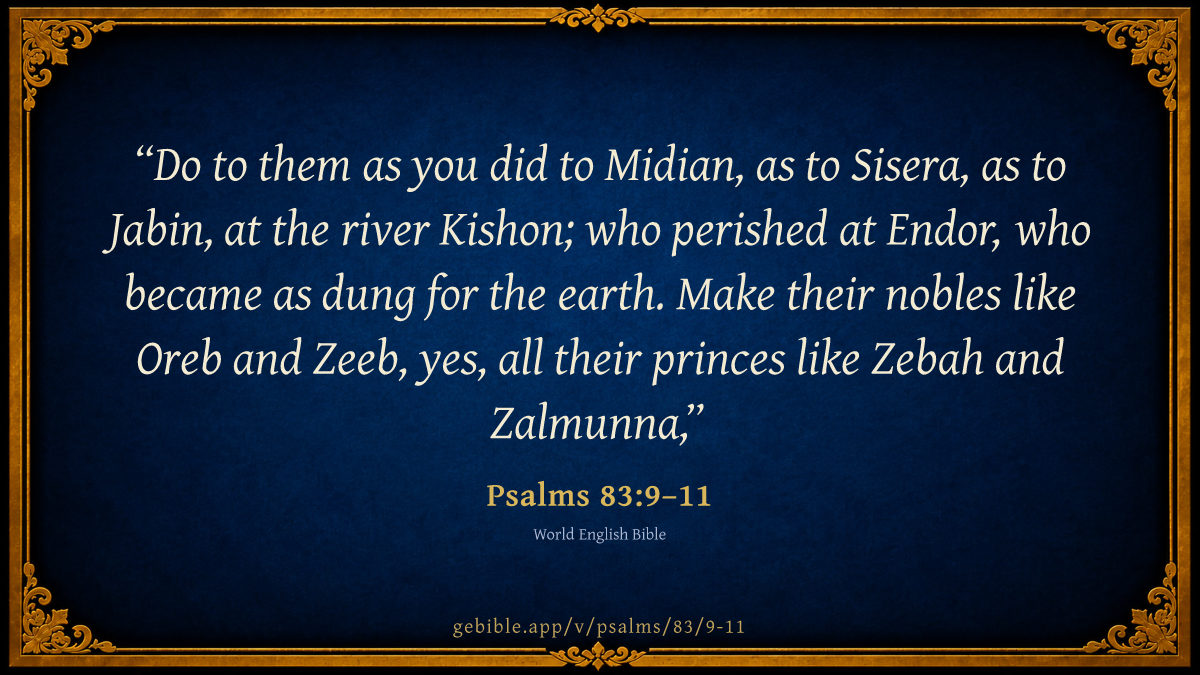
Psa 83:9 Do unto them as [unto] the Midianites; as [to] Sisera, as [to] Jabin, at the brook of Kison:
Ver. 9. Do unto them as unto the Midianites] And how that was, see Jdg 6:1-40; Jdg 7:1-25; Jdg 8:1-21. Preces sunt bombardae et instrumenta bellica Christianorum saith Luther.
John Trapp, A Commentary or Exposition upon All the Books of the Old and New Testament (1647–1656) — public domain. Text from a community e-Sword module.
Matthew Poole1685 · Public DomainOn v10Which perished at En-dor: either,
Which perished at En-dor: either,
1. The Midianites. Or rather,
Read full note →
2. Jabin and Sisera, who were overthrown near Taanach and Megiddo, Jdg 5:19, nigh unto which places was this En-dor, as appears from Jos 17:11.
They became as dung for the earth; they were trodden under foot, and their carcasses left unburied. Compare 2Ki 9:37; Jer 8:2; 16:4.
Matthew Poole's English Annotations on the Holy Bible (1683–1685) — public domain. Text from a community e-Sword/MySword module.
Matthew Henry1710 · Public DomainOn v9The psalmist here, in the name of the church,…
The psalmist here, in the name of the church, prays for the destruction of those confederate forces, and, in God's name, foretels it; for this prayer that it might be so amounts to a prophecy that it shall be so, and this prophecy reaches to all the enemies of the gospel-church; whoever they be that oppose the kingdom of Christ, here they may read their doom. The prayer is, in short, that these enemies, who were confederate against Israel, might be defeated in all their attempts, and that they might prove their own ruin, and so God's Israel might be preserved and perpetuated. Now this is here illustrated,
I. By some precedents. Let that be their punishment which has been the fate of others who have formerly set themselves against God's Israel. The defeat and discomfiture of former combinations may be pleaded in prayer to God and improved for the encouragement of our own faith and hope, because God is the same still that ever he was, the same to his people and the same against his and their enemies; with him is no variableness. 1. He prays that their armies might be destroyed as the armies of former enemies had been (Psa 83:9, Psa 83:10): Do to them as to the Midianites; let them be routed by their own fears, for so the Midianites were, more than by Gideon's 300 men. Do to them as to the army under the command of Sisera (who was general under Jabin king of Canaan) which God discomfited (Jdg 4:15) at the brook Kishon, near to which was Endor. They became as dung on the earth; their dead bodies were thrown like dung laid in heaps, or spread, to fatten the ground; they were trodden to dirt by Barak's small but victorious army; and this was fitly made a precedent here, because Deborah made it so to aftertimes when it was fresh. Jdg 5:31, So let all thy enemies perish, O Lord! that is, So they shall perish. 2. He prays that their leaders might be destroyed as they had been formerly. The common people would not have been so mischievous if their princes had not set them on, and therefore they are particularly prayed against, Psa 83:11, Psa 83:12. Observe, (1.) What their malice was against the Israel of God. They said, Let us take to ourselves the houses of God in possession (Psa 83:12), the pleasant places of God (so the word is), by which we may understand the land of Canaan, which was a pleasant land and was Immanuel's land, or the temple, which was indeed God's pleasant place (Isa 64:11), or (as Dr. Hammond suggests) the pleasant pastures, which these Arabians, who traded in cattle, did in a particular manner seek after. The princes and nobles aimed to enrich themselves by this war; and their armies must be made as dung for the earth, to serve their covetousness and their ambition. (2.) What their lot should be. They shall be made like Oreb and Zeeb (two princes of the Midianites, who, when their forces were routed, were taken in their flight by the Ephraimites and slain, Jdg 7:25), and like Zeba and Zalmunna, whom Gideon himself slew, Jdg 8:21. "Let these enemies of ours be made as easy a prey to us as they were to the conquerors then." We may not prescribe to God, but we may pray to God that he will deal with the enemies of his church in our days as he did with those in the days of our fathers.
Read full note →
II. He illustrates it by some similitudes, and prays, 1. That God would make them like a wheel (Psa 83:13), that they might be in continual motion, unquiet, unsettled, and giddy in all their counsels and resolves, that they might roll down easily and speedily to their own ruin. Or, as some think, that they might be broken by the judgments of God, as the corn is broken, or beaten out, by the wheel which was then used in threshing. Thus, when a wise king scatters the wicked, he is said to bring the wheel over them, Pro 20:26. Those that trust in God have their hearts fixed; those that fight against him are unfixed, like a wheel. 2. That they might be chased as stubble, or chaff, before the fierce wind. "The wheel, though it continually turn round, is fixed on its own axis; but let them have no more fixation than the light stubble has, which the wind hurries away, and nobody desires to save it, but is willing it should go," Psa 1:4. Thus shall the wicked be driven away in his wickedness, and chased out of the world. 3. That they might be consumed, as wood by the fire, or as briers and thorns, as fern or furze, upon the mountains, by the flames, Psa 83:14. When the stubble is driven by the wind it will rest, at last, under some hedge, in some ditch or other; but he prays that they might not only be driven away as stubble, but burnt up as stubble. And this will be the end of wicked men (Heb 6:8) and particularly of all the enemies of God's church. The application of these comparisons we have (Psa 83:15): So persecute them with thy tempest, persecute them to their utter ruin, and make them afraid with thy storm. See how sinners are made miserable; the storm of God's wrath raises terrors in their own hearts, and so they are made completely miserable. God can deal with the proudest and most daring sinner that has bidden defiance to his justice, and can make him afraid as a grasshopper. It is the torment of devils that they tremble.
III. He illustrates it by the good consequences of their confusion, Psa 83:16-18. He prays here that God, having filled their hearts with terror, would thereby fill their faces with shame, that they might be ashamed of their enmity to the people of God (Isa 26:11), ashamed of their folly in acting both against Omnipotence itself and their own true interest. They did what they could to put God's people to shame, but the shame will at length return upon themselves. Now, 1. The beginning of this shame might be a means of their conversion: "Let them be broken and baffled in their attempts, that they may seek thy name, O Lord! Let them be put to a stand, that they may have both leisure and reason to pause a little, and consider who it is that they are fighting against and what an unequal match they are for him, and may therefore humble and submit themselves and desire conditions of peace. Let them be made to fear thy name, and perhaps that will bring them to seek thy name." Note, That which we should earnestly desire and beg of God for our enemies and persecutors is that God would bring them to repentance, and we should desire their abasement in order to this, no other confusion to them than what may be a step towards their conversion. 2. If it did not prove a means of their conversion, the perfecting of it would redound greatly to the honour of God. If they will not be ashamed and repent, let them be put to shame and perish; if they will not be troubled and turned, which would soon put an end to all their trouble, a happy end, let them be troubled for ever, and never have peace: this will be for God's glory (Psa 83:18), that other men may know and own, if they themselves will not, that thou, whose name alone is JEHOVAH (that incommunicable, though not ineffable name) art the Most High over all the earth. God's triumphs over his and his church's enemies will be incontestable proofs, (1.) That he is, according to his name JEHOVAH, a self-existent self-sufficient Being, that has all power and perfection in himself. (2.) That he is the most high God, sovereign Lord of all, above all gods, above all kings, above all that exalt themselves and pretend to be high. (3.) That he is so, not only over the land of Israel, but over all the earth, even those nations of the earth that do not know him or own him; for his kingdom rules over all. These are great and unquestionable truths, but men will hardly be persuaded to know and believe them; therefore the psalmist prays that the destruction of some might be the conviction of others. The final ruin of all God's enemies, in the great day, will be the effectual proof of this, before angels and men, when the everlasting shame and contempt to which sinners shall rise (Dan 12:2) shall redound to the everlasting honour and praise of that God to whom vengeance belongs.
Matthew Henry's Commentary on the Whole Bible (1708–1710) — public domain (CC PDM 1.0). Text via the HelloAO Bible API.
John Gill1763 · Public DomainOn vv9–11Do unto them as unto the Midianites,.... In the…
Do unto them as unto the Midianites,.... In the times of Gideon, who destroyed one another, trod in whose destruction the hand of the Lord was very visible, Jdg 7:20, and much in the same manner was the confederate army of the Moabites, Ammonites, and others, destroyed in the times of Jehoshaphat, Ch2 20:20,
as to Sisera, as to Jabin: Jabin was a king of Canaan, who oppressed Israel, and Sisera was his general; the latter was slain by a woman, Jael, the wife of Heber; and the former the hand of Israel prevailed against, until they destroyed him, Jdg 4:2, the great victory which they obtained over them was
Read full note →
at the brook of Kison, or "Kishon", Jdg 4:7 with this compare Ch2 20:16.
John Gill's Exposition of the Whole Bible (1746–1763) — public domain (CC PDM 1.0). Text via the HelloAO Bible API.
Adam Clarke1810 · Public DomainOn vv9–11Verse 9. Do unto them as unto the Midianites]…
Verse 9. Do unto them as unto the Midianites] Who were utterly defeated by Gideon, Jdg 7:21-22.
As to Sisera] Captain of the army of Jabin, king of Canaan, who was totally defeated by Deborah and Barak, near Mount Tabor, by the river Kishon; and himself, after having fled from the battle, slain by Jael, the wife of Heber, the Kenite. See Jdg 4:15, &c.
Adam Clarke's Commentary on the Bible (1810–1826) — public domain. Text from a community e-Sword/MySword module.
Joseph Benson1811 · Public DomainOn v10Psa 83:10-12. Which perished at En-dor — Either, 1st,…
Psa 83:10-12. Which perished at En-dor — Either, 1st, The Midianites; or rather, Jabin and Sisera, who were overthrown at Taanach and Megiddo, (Jdg 5:19,) nigh unto which places was this En-dor, as appears from Jos 17:11. They became as dung upon the earth — They were trodden under foot, and their carcasses left unburied. Who said, Let us take to ourselves the houses of God — The houses and lands of the Israelites, which their God, as they say, gave them in Canaan; but to which they have no rightful title. This was formerly objected by the Ammonites, as we see Jdg 11:13, and the Ammonites were a chief party in this war. So they seem to call them houses of God by way of irony and derision.
Joseph Benson's Commentary on the Old and New Testaments (1811–1818) — public domain. Text from a community e-Sword module.
Albert Barnes1834 · Public DomainOn vv9–11Do unto them as unto the Midianites - That…
Do unto them as unto the Midianites - That is, Let them be overthrown and destroyed as the Midianites were. The reference here is to the complete overthrow of the Midianites, as related in Num. 31.
As to Sisera - The captain or commander of the army of Jabin, king of Canaan. He was conquered by the Hebrew armies under the direction of the prophetess Deborah, by the instrumentality of Barak Jdg 4:4, Jdg 4:6,Jdg 4:14-15, and was slain by Jael, the wife of Heber the Kenite, Jdg 4:17-21.
Read full note →
As to Jabin - The king of Canaan, in whose service Sisera was.
At the brook of Kison - Jdg 4:13. This is a stream which rises near Mount Tabor, and empties itself into the Bay of Ptolemais. In Jdg 5:21, in the song of Deborah on occasion of this victory, it is mentioned as “that ancient river, the river Kishon;” that is, it was a stream which was well known; which had been referred to in ancient tales and poetry; not a newly discovered river, but a river whose name and locality were familiar to all.
Albert Barnes' Notes on the Bible (1834–1885) — public domain. Text from a community e-Sword/MySword module.
Daniel D. Whedon1874 · Public DomainOn vv9–119. Do unto them—The thing they proposed to do…
9. Do unto them—The thing they proposed to do to Judah is imprecated on them. The issue of the war was the question of national existence. Let God arbitrate, and give this boon only to the innocent party.
As… the Midianite—See Judges 7.
Read full note →
Sisera—Jdg_4:22.
Jabin—Jdg_4:23-24.
Kishon—The battle was at the River Kishon, on the great plain of Esdraelon, where the army under the generalship of Sisera was routed, which lost for him his life, and for Jabin, the king, his kingdom.
Daniel D. Whedon (gen. ed.), Commentary on the Old and New Testaments (1874–1909) — public domain. Text from a community e-Sword module.
The Cambridge Bible for Schools and Colleges1878 · Public DomainOn vv9–119. Do thou unto them as unto Midian;
9. Do thou unto them as unto Midian;
As unto Sisera, as unto Jabin, at the torrent of Kishon.
Read full note →
The victory of Gideon over the confederate forces of the Midianites, Amalekites, and Arabians (Judges 7, 8) is referred to by Isaiah as a typical triumph (Isa_9:4; Isa_10:26). They fell, like Jehoshaphat’s enemies (2Ch_20:23), by one another’s hands. For the rout of the Canaanites see Judges 4, 5. The storm-swollen torrent of the Kishon contributed to the victory (Jdg_5:21).
9–12. Prayer for their destruction as the Canaanites were destroyed by Deborah and Barak, and the Midianites by Gideon.
The Cambridge Bible for Schools and Colleges (gen. ed. J. J. S. Perowne; Cambridge University Press, 1878–1918) — public domain. Text from a community e-Sword module.
Ellicott's Commentary for English Readers1878 · Public DomainOn vv9–10(9-12) For the historical allusion see references in margin.…
(9-12) For the historical allusion see references in margin. The splendid victories of Barak and Gideon were the constant theme of poets and prophets when trying to encourage their own generation by the examples of the past. (See Isa_9:4; Isa_10:26; Hab_3:7.)
A Bible Commentary for English Readers, edited by Charles John Ellicott (1878–1897) — public domain. Text from a community e-Sword module.
The Pulpit Commentary1880 · Public DomainOn vv9–11Do unto them as unto the Midianites. The allusion…
Do unto them as unto the Midianites. The allusion is probably to the discomfiture of the Midianites by Gideon. (Jud 7:19-25 8:1-12) As to Sisera, as to Jabin, at the brook of Kison. (see Jud_1:4:5)
The Pulpit Commentary (1880–1919), ed. H.D.M. Spence-Jones & Joseph S. Exell — public domain. Text from a community e-Sword module.
Charles H. Spurgeon1885 · Public DomainOn vv9–11Ver. 9. Do unto them as unto the Midianites.…
Ver. 9. Do unto them as unto the Midianites. Faith delights to light upon precedents, and quote them before the Lord; in the present instance, Asaph found a very appropriate one, for the nations in both cases were very much the same, and the plight of the Israelites very similar. Yet Midian perished, and the psalmist trusted that Israel's present foes would meet with the like overthrow from the hand of the Lord.
As to Sisera, as to Jabin, at the brook of Kison. The hosts were swept away by the suddenly swollen torrent, and utterly perished; which was a second instance of divine vengeance upon confederated enemies of Israel. When God wills it, a brook can be as deadly as a sea. Kishon was as terrible to Jabin as was the Red Sea to Pharaoh. How easily can the Lord smite the enemies of his people. God of Gideon and of Barak, wilt thou not again avenge thine heritage of their bloodthirsty foes?
Read full note →
Ver. 9. Do unto them as unto the Midianites. That is, dash their heads together, make their policies to cross one another. Walter Cradock.
Ver. 9. The brook of Kison. The river Kishon traverses the plain (of Esdraelon) and terminates in the Bay of Acre or Akka. This is the stream regarding which it is written, after Barak and Deborah had gained their victory over Sisera, "The river of Kishon swept them away, that ancient river, the river Kishon. O my soul, thou hast trodden down strength." Although it is now no insignificant stream, yet it needs heavy rains to make it really considerable in magnitude: it is very unequal in size, and seems to be only temporary in its character. At any rate, when Robinson passed its head waters in midsummer, he found the channels all dry, and they had been so for a whole year. On the other hand, in the winter the waters are often exceedingly abundant; particularly in the northern and southern chief tributaries; so that, in 1799, at the time of the French invasion, many of the vanquished Turks perished in the floods which swept down from Deburieh, and which inundated the plain. It was a scene like that described in Judges 5 regarding the fate of Sisera's hosts. Carl Ritter (1779-1859), in "The Comparative Geography of Palestine and the Sinaitic Peninsula." Translated by William L. Gage. 1866.
None.
Psalms 83:10*
Charles H. Spurgeon's The Treasury of David (1869–1885) — public domain. Psalms only. Text from a community e-Sword/MySword module.
unfoldingWord translationNotes2017 · CC BY-SA 4.0On vv9, 11Do to them ... for the earth
Do to them ... for the earth
The writer is asking God to defeat Israel's enemies as he has done in the past. (See: Assumed Knowledge and Implicit Information)
Read full note →
did to Midian
Here "Midian" represents the people of Midian. AT: "did to the Midianites" (See: Metonymy)
Sisera ... Jabin
These are names of men. Jabin was king of Hazor. Sisera was the commander of Jabin's army. (See: How to Translate Names)
Kishon River
This is the name of a river in northern Israel. (See: How to Translate Names)
Endor
This is the name of a town in northern Israel. (See: How to Translate Names)
became like manure for the earth
This means the bodies of Sisera and Jabin were not buried but were left to rot. (See: Simile)
Tyndale Open Study Notes2022 · CC BY-SA 4.0On v983:9-18 The psalmist prays that God will miraculously destroy…
83:9-18 The psalmist prays that God will miraculously destroy the new coalition as he did three other enemies; doing so would bring him glory.
83:9-11 The Midianites, ruled by Zebah and Zalmunna and led by Oreb and Zeeb, were Israel’s enemy in the days of Gideon (Judg 7:1–8:5). Barak’s coalition defeated Sisera and Jabin (Judg 4).
 GEBible — Godless Engineer's Bible App
John Calvin 1540 · Public Domain On v9 9. Do to them as to the Midianites. The…
9. Do to them as to the Midianites. The faithful, having complained of the very grievous oppressions to which they were subjected, with the view of inducing God the more readily to succor them, now call to their remembrance the many occasions on which he had afforded relief to his people, when brought into the most desperate circumstances. From this, it is an obvious inference, that God wisely delays his aid to his servants under oppression, that when they seem to be reduced to the last extremity, he may appear in a miraculous manner for their succor. The prophet, in this verse, mingles together two histories. Strict accuracy would have required him to have said in one connected sentence, Do to them as to the Midianites at the brook Kishon. But he inserts in the middle of this sentence, the slaughter of Jabin and Sisera. It was, however, of no great importance to distinguish particularly between the two histories. He considered it enough for his purpose, to bring to the remembrance of himself and other pious Jews, the miracles which God in the days of old had so often wrought in delivering his people. The great object aimed at is to show, that God, who had so often put his enemies to flight, and rescued his poor trembling sheep out of the jaws of wolves, was not now without the power of effecting the same deliverance. The wonderful manner in which he succoured his people by the hand of Gideon is well known: Judges 6 and 7; It might have seemed altogether ridiculous for Gideon to venture to engage in battle against a very powerful army, with no greater a number of men of war than three hundred, and these, be it observed, such as had been in a state of bondage during their whole lives, and whom the mere look of their lords might have thrown into consternation. And yet, it came to pass, that the Midianites perished by turning their swords against each other. The same goodness God displayed in the slaughter of Sisera and king Jabin, Judges 4:13. Barak, under the conduct of a woman, Deborah, discomfited them both, when, with a small handful of soldiers, he intrepidly gave battle to their mighty host. And Sisera, the general of the army, did not die bravely on the field of battle, but was smitten by the hand of a woman after he had retired to some hiding-place. That the faithful may not be overwhelmed with terror and fall into despair, they seasonably fortify themselves with these examples of deliverance, by which God had shown that in himself alone there resides a sufficiency of power to defend his people, whenever, destitute of the resources of human aid, they should betake themselves to him. From that astonishing and unwonted mode of granting deliverance, they came to the conclusion, that he is a wonderful worker in preserving his Church; in order to encourage themselves to entertain the fullest confidence, that in his breath alone they would have sufficient strength to overthrow all their enemies. Nor is it only in this passage that the slaughter of the Midianites is related for this purpose. Isaiah also (Isaiah 9:4) introduces it for confirming the truth of the Church’s restitution: “For thou hast broken the yoke of his burden, and the staff of his shoulder, the rod of his oppressor, as in the day of Midian.” When it is stated that they became manure for the earth, the expression may be explained as meaning, either, first, that their carcases lay rotting upon the earth; or, secondly, that they were trampled under foot as manure. This latter exposition is the most appropriate; but I do not reject the former. The reason why it is said, They perished at Endor, it is somewhat difficult to ascertain. The name, Endor, is to be found in Joshua 17:11; and it is probable, that the army of king Jabin was destroyed there. The opinion entertained by some, that Endor is here used as an appellative, conveying the idea that their discomfiture was open and visible to the eye, is what I cannot approve.
John Calvin's Commentaries (1540-1563) — public domain. Text from the Calvin Translation Society English edition (1840s-50s) via the Christian Classics Ethereal Library (ccel.org). Calvin's coverage is partial (roughly two-thirds of the Bible); uncommented books and verses are honest gaps, never fabricated. The 19th-century editor's footnotes and remarks are omitted so the notes are faithfully Calvin's own voice.
Geneva Bible translators 1599 · Public Domain On vv9–10 By these examples they were confirmed, that God would…
By these examples they were confirmed, that God would not suffer his people to be utterly destroyed, Judg. 7:21 and 4:15.
Geneva Bible (1599) marginal notes — public domain.
John Trapp 1656 · Public Domain On vv9–11 Psa 83:9 Do unto them as [unto] the Midianites;…
Psa 83:9 Do unto them as [unto] the Midianites; as [to] Sisera, as [to] Jabin, at the brook of Kison:
Ver. 9. Do unto them as unto the Midianites] And how that was, see Jdg 6:1-40; Jdg 7:1-25; Jdg 8:1-21. Preces sunt bombardae et instrumenta bellica Christianorum saith Luther.
John Trapp, A Commentary or Exposition upon All the Books of the Old and New Testament (1647–1656) — public domain. Text from a community e-Sword module.
Matthew Poole 1685 · Public Domain On v10 Which perished at En-dor: either,
Which perished at En-dor: either,
1. The Midianites. Or rather,
Read full note →
2. Jabin and Sisera, who were overthrown near Taanach and Megiddo, Jdg 5:19, nigh unto which places was this En-dor, as appears from Jos 17:11.
They became as dung for the earth; they were trodden under foot, and their carcasses left unburied. Compare 2Ki 9:37; Jer 8:2; 16:4.
Matthew Poole's English Annotations on the Holy Bible (1683–1685) — public domain. Text from a community e-Sword/MySword module.
Matthew Henry 1710 · Public Domain On v9 The psalmist here, in the name of the church,…
The psalmist here, in the name of the church, prays for the destruction of those confederate forces, and, in God's name, foretels it; for this prayer that it might be so amounts to a prophecy that it shall be so, and this prophecy reaches to all the enemies of the gospel-church; whoever they be that oppose the kingdom of Christ, here they may read their doom. The prayer is, in short, that these enemies, who were confederate against Israel, might be defeated in all their attempts, and that they might prove their own ruin, and so God's Israel might be preserved and perpetuated. Now this is here illustrated,
I. By some precedents. Let that be their punishment which has been the fate of others who have formerly set themselves against God's Israel. The defeat and discomfiture of former combinations may be pleaded in prayer to God and improved for the encouragement of our own faith and hope, because God is the same still that ever he was, the same to his people and the same against his and their enemies; with him is no variableness. 1. He prays that their armies might be destroyed as the armies of former enemies had been (Psa 83:9, Psa 83:10): Do to them as to the Midianites; let them be routed by their own fears, for so the Midianites were, more than by Gideon's 300 men. Do to them as to the army under the command of Sisera (who was general under Jabin king of Canaan) which God discomfited (Jdg 4:15) at the brook Kishon, near to which was Endor. They became as dung on the earth; their dead bodies were thrown like dung laid in heaps, or spread, to fatten the ground; they were trodden to dirt by Barak's small but victorious army; and this was fitly made a precedent here, because Deborah made it so to aftertimes when it was fresh. Jdg 5:31, So let all thy enemies perish, O Lord! that is, So they shall perish. 2. He prays that their leaders might be destroyed as they had been formerly. The common people would not have been so mischievous if their princes had not set them on, and therefore they are particularly prayed against, Psa 83:11, Psa 83:12. Observe, (1.) What their malice was against the Israel of God. They said, Let us take to ourselves the houses of God in possession (Psa 83:12), the pleasant places of God (so the word is), by which we may understand the land of Canaan, which was a pleasant land and was Immanuel's land, or the temple, which was indeed God's pleasant place (Isa 64:11), or (as Dr. Hammond suggests) the pleasant pastures, which these Arabians, who traded in cattle, did in a particular manner seek after. The princes and nobles aimed to enrich themselves by this war; and their armies must be made as dung for the earth, to serve their covetousness and their ambition. (2.) What their lot should be. They shall be made like Oreb and Zeeb (two princes of the Midianites, who, when their forces were routed, were taken in their flight by the Ephraimites and slain, Jdg 7:25), and like Zeba and Zalmunna, whom Gideon himself slew, Jdg 8:21. "Let these enemies of ours be made as easy a prey to us as they were to the conquerors then." We may not prescribe to God, but we may pray to God that he will deal with the enemies of his church in our days as he did with those in the days of our fathers.
Read full note →
II. He illustrates it by some similitudes, and prays, 1. That God would make them like a wheel (Psa 83:13), that they might be in continual motion, unquiet, unsettled, and giddy in all their counsels and resolves, that they might roll down easily and speedily to their own ruin. Or, as some think, that they might be broken by the judgments of God, as the corn is broken, or beaten out, by the wheel which was then used in threshing. Thus, when a wise king scatters the wicked, he is said to bring the wheel over them, Pro 20:26. Those that trust in God have their hearts fixed; those that fight against him are unfixed, like a wheel. 2. That they might be chased as stubble, or chaff, before the fierce wind. "The wheel, though it continually turn round, is fixed on its own axis; but let them have no more fixation than the light stubble has, which the wind hurries away, and nobody desires to save it, but is willing it should go," Psa 1:4. Thus shall the wicked be driven away in his wickedness, and chased out of the world. 3. That they might be consumed, as wood by the fire, or as briers and thorns, as fern or furze, upon the mountains, by the flames, Psa 83:14. When the stubble is driven by the wind it will rest, at last, under some hedge, in some ditch or other; but he prays that they might not only be driven away as stubble, but burnt up as stubble. And this will be the end of wicked men (Heb 6:8) and particularly of all the enemies of God's church. The application of these comparisons we have (Psa 83:15): So persecute them with thy tempest, persecute them to their utter ruin, and make them afraid with thy storm. See how sinners are made miserable; the storm of God's wrath raises terrors in their own hearts, and so they are made completely miserable. God can deal with the proudest and most daring sinner that has bidden defiance to his justice, and can make him afraid as a grasshopper. It is the torment of devils that they tremble.
III. He illustrates it by the good consequences of their confusion, Psa 83:16-18. He prays here that God, having filled their hearts with terror, would thereby fill their faces with shame, that they might be ashamed of their enmity to the people of God (Isa 26:11), ashamed of their folly in acting both against Omnipotence itself and their own true interest. They did what they could to put God's people to shame, but the shame will at length return upon themselves. Now, 1. The beginning of this shame might be a means of their conversion: "Let them be broken and baffled in their attempts, that they may seek thy name, O Lord! Let them be put to a stand, that they may have both leisure and reason to pause a little, and consider who it is that they are fighting against and what an unequal match they are for him, and may therefore humble and submit themselves and desire conditions of peace. Let them be made to fear thy name, and perhaps that will bring them to seek thy name." Note, That which we should earnestly desire and beg of God for our enemies and persecutors is that God would bring them to repentance, and we should desire their abasement in order to this, no other confusion to them than what may be a step towards their conversion. 2. If it did not prove a means of their conversion, the perfecting of it would redound greatly to the honour of God. If they will not be ashamed and repent, let them be put to shame and perish; if they will not be troubled and turned, which would soon put an end to all their trouble, a happy end, let them be troubled for ever, and never have peace: this will be for God's glory (Psa 83:18), that other men may know and own, if they themselves will not, that thou, whose name alone is JEHOVAH (that incommunicable, though not ineffable name) art the Most High over all the earth. God's triumphs over his and his church's enemies will be incontestable proofs, (1.) That he is, according to his name JEHOVAH, a self-existent self-sufficient Being, that has all power and perfection in himself. (2.) That he is the most high God, sovereign Lord of all, above all gods, above all kings, above all that exalt themselves and pretend to be high. (3.) That he is so, not only over the land of Israel, but over all the earth, even those nations of the earth that do not know him or own him; for his kingdom rules over all. These are great and unquestionable truths, but men will hardly be persuaded to know and believe them; therefore the psalmist prays that the destruction of some might be the conviction of others. The final ruin of all God's enemies, in the great day, will be the effectual proof of this, before angels and men, when the everlasting shame and contempt to which sinners shall rise (Dan 12:2) shall redound to the everlasting honour and praise of that God to whom vengeance belongs.
Matthew Henry's Commentary on the Whole Bible (1708–1710) — public domain (CC PDM 1.0). Text via the HelloAO Bible API.
John Gill 1763 · Public Domain On vv9–11 Do unto them as unto the Midianites,.... In the…
Do unto them as unto the Midianites,.... In the times of Gideon, who destroyed one another, trod in whose destruction the hand of the Lord was very visible, Jdg 7:20, and much in the same manner was the confederate army of the Moabites, Ammonites, and others, destroyed in the times of Jehoshaphat, Ch2 20:20,
as to Sisera, as to Jabin: Jabin was a king of Canaan, who oppressed Israel, and Sisera was his general; the latter was slain by a woman, Jael, the wife of Heber; and the former the hand of Israel prevailed against, until they destroyed him, Jdg 4:2, the great victory which they obtained over them was
Read full note →
at the brook of Kison, or "Kishon", Jdg 4:7 with this compare Ch2 20:16.
John Gill's Exposition of the Whole Bible (1746–1763) — public domain (CC PDM 1.0). Text via the HelloAO Bible API.
Adam Clarke 1810 · Public Domain On vv9–11 Verse 9. Do unto them as unto the Midianites]…
Verse 9. Do unto them as unto the Midianites] Who were utterly defeated by Gideon, Jdg 7:21-22.
As to Sisera] Captain of the army of Jabin, king of Canaan, who was totally defeated by Deborah and Barak, near Mount Tabor, by the river Kishon; and himself, after having fled from the battle, slain by Jael, the wife of Heber, the Kenite. See Jdg 4:15, &c.
Adam Clarke's Commentary on the Bible (1810–1826) — public domain. Text from a community e-Sword/MySword module.
Joseph Benson 1811 · Public Domain On v10 Psa 83:10-12. Which perished at En-dor — Either, 1st,…
Psa 83:10-12. Which perished at En-dor — Either, 1st, The Midianites; or rather, Jabin and Sisera, who were overthrown at Taanach and Megiddo, (Jdg 5:19,) nigh unto which places was this En-dor, as appears from Jos 17:11. They became as dung upon the earth — They were trodden under foot, and their carcasses left unburied. Who said, Let us take to ourselves the houses of God — The houses and lands of the Israelites, which their God, as they say, gave them in Canaan; but to which they have no rightful title. This was formerly objected by the Ammonites, as we see Jdg 11:13, and the Ammonites were a chief party in this war. So they seem to call them houses of God by way of irony and derision.
Joseph Benson's Commentary on the Old and New Testaments (1811–1818) — public domain. Text from a community e-Sword module.
Albert Barnes 1834 · Public Domain On vv9–11 Do unto them as unto the Midianites - That…
Do unto them as unto the Midianites - That is, Let them be overthrown and destroyed as the Midianites were. The reference here is to the complete overthrow of the Midianites, as related in Num. 31.
As to Sisera - The captain or commander of the army of Jabin, king of Canaan. He was conquered by the Hebrew armies under the direction of the prophetess Deborah, by the instrumentality of Barak Jdg 4:4, Jdg 4:6,Jdg 4:14-15, and was slain by Jael, the wife of Heber the Kenite, Jdg 4:17-21.
Read full note →
As to Jabin - The king of Canaan, in whose service Sisera was.
At the brook of Kison - Jdg 4:13. This is a stream which rises near Mount Tabor, and empties itself into the Bay of Ptolemais. In Jdg 5:21, in the song of Deborah on occasion of this victory, it is mentioned as “that ancient river, the river Kishon;” that is, it was a stream which was well known; which had been referred to in ancient tales and poetry; not a newly discovered river, but a river whose name and locality were familiar to all.
Albert Barnes' Notes on the Bible (1834–1885) — public domain. Text from a community e-Sword/MySword module.
Daniel D. Whedon 1874 · Public Domain On vv9–11 9. Do unto them—The thing they proposed to do…
9. Do unto them—The thing they proposed to do to Judah is imprecated on them. The issue of the war was the question of national existence. Let God arbitrate, and give this boon only to the innocent party.
As… the Midianite—See Judges 7.
Read full note →
Sisera—Jdg_4:22.
Jabin—Jdg_4:23-24.
Kishon—The battle was at the River Kishon, on the great plain of Esdraelon, where the army under the generalship of Sisera was routed, which lost for him his life, and for Jabin, the king, his kingdom.
Daniel D. Whedon (gen. ed.), Commentary on the Old and New Testaments (1874–1909) — public domain. Text from a community e-Sword module.
The Cambridge Bible for Schools and Colleges 1878 · Public Domain On vv9–11 9. Do thou unto them as unto Midian;
9. Do thou unto them as unto Midian;
As unto Sisera, as unto Jabin, at the torrent of Kishon.
Read full note →
The victory of Gideon over the confederate forces of the Midianites, Amalekites, and Arabians (Judges 7, 8) is referred to by Isaiah as a typical triumph (Isa_9:4; Isa_10:26). They fell, like Jehoshaphat’s enemies (2Ch_20:23), by one another’s hands. For the rout of the Canaanites see Judges 4, 5. The storm-swollen torrent of the Kishon contributed to the victory (Jdg_5:21).
9–12. Prayer for their destruction as the Canaanites were destroyed by Deborah and Barak, and the Midianites by Gideon.
The Cambridge Bible for Schools and Colleges (gen. ed. J. J. S. Perowne; Cambridge University Press, 1878–1918) — public domain. Text from a community e-Sword module.
Ellicott's Commentary for English Readers 1878 · Public Domain On vv9–10 (9-12) For the historical allusion see references in margin.…
(9-12) For the historical allusion see references in margin. The splendid victories of Barak and Gideon were the constant theme of poets and prophets when trying to encourage their own generation by the examples of the past. (See Isa_9:4; Isa_10:26; Hab_3:7.)
A Bible Commentary for English Readers, edited by Charles John Ellicott (1878–1897) — public domain. Text from a community e-Sword module.
The Pulpit Commentary 1880 · Public Domain On vv9–11 Do unto them as unto the Midianites. The allusion…
Do unto them as unto the Midianites. The allusion is probably to the discomfiture of the Midianites by Gideon. (Jud 7:19-25 8:1-12) As to Sisera, as to Jabin, at the brook of Kison. (see Jud_1:4:5)
The Pulpit Commentary (1880–1919), ed. H.D.M. Spence-Jones & Joseph S. Exell — public domain. Text from a community e-Sword module.
Charles H. Spurgeon 1885 · Public Domain On vv9–11 Ver. 9. Do unto them as unto the Midianites.…
Ver. 9. Do unto them as unto the Midianites. Faith delights to light upon precedents, and quote them before the Lord; in the present instance, Asaph found a very appropriate one, for the nations in both cases were very much the same, and the plight of the Israelites very similar. Yet Midian perished, and the psalmist trusted that Israel's present foes would meet with the like overthrow from the hand of the Lord.
As to Sisera, as to Jabin, at the brook of Kison. The hosts were swept away by the suddenly swollen torrent, and utterly perished; which was a second instance of divine vengeance upon confederated enemies of Israel. When God wills it, a brook can be as deadly as a sea. Kishon was as terrible to Jabin as was the Red Sea to Pharaoh. How easily can the Lord smite the enemies of his people. God of Gideon and of Barak, wilt thou not again avenge thine heritage of their bloodthirsty foes?
Read full note →
Ver. 9. Do unto them as unto the Midianites. That is, dash their heads together, make their policies to cross one another. Walter Cradock.
Ver. 9. The brook of Kison. The river Kishon traverses the plain (of Esdraelon) and terminates in the Bay of Acre or Akka. This is the stream regarding which it is written, after Barak and Deborah had gained their victory over Sisera, "The river of Kishon swept them away, that ancient river, the river Kishon. O my soul, thou hast trodden down strength." Although it is now no insignificant stream, yet it needs heavy rains to make it really considerable in magnitude: it is very unequal in size, and seems to be only temporary in its character. At any rate, when Robinson passed its head waters in midsummer, he found the channels all dry, and they had been so for a whole year. On the other hand, in the winter the waters are often exceedingly abundant; particularly in the northern and southern chief tributaries; so that, in 1799, at the time of the French invasion, many of the vanquished Turks perished in the floods which swept down from Deburieh, and which inundated the plain. It was a scene like that described in Judges 5 regarding the fate of Sisera's hosts. Carl Ritter (1779-1859), in "The Comparative Geography of Palestine and the Sinaitic Peninsula." Translated by William L. Gage. 1866.
None.
Psalms 83:10*
Charles H. Spurgeon's The Treasury of David (1869–1885) — public domain. Psalms only. Text from a community e-Sword/MySword module.
unfoldingWord translationNotes 2017 · CC BY-SA 4.0 On vv9, 11 Do to them ... for the earth
Do to them ... for the earth
The writer is asking God to defeat Israel's enemies as he has done in the past. (See: Assumed Knowledge and Implicit Information)
Read full note →
did to Midian
Here "Midian" represents the people of Midian. AT: "did to the Midianites" (See: Metonymy)
Sisera ... Jabin
These are names of men. Jabin was king of Hazor. Sisera was the commander of Jabin's army. (See: How to Translate Names)
Kishon River
This is the name of a river in northern Israel. (See: How to Translate Names)
Endor
This is the name of a town in northern Israel. (See: How to Translate Names)
became like manure for the earth
This means the bodies of Sisera and Jabin were not buried but were left to rot. (See: Simile)
translationWords
Midian
perish
dung
unfoldingWord translationNotes — © Distant Shores Media and the Door43 World Missions Community, licensed CC BY-SA 4.0. Source: git.door43.org/Door43/en_tn.
Tyndale Open Study Notes 2022 · CC BY-SA 4.0 On v9 83:9-18 The psalmist prays that God will miraculously destroy…
83:9-18 The psalmist prays that God will miraculously destroy the new coalition as he did three other enemies; doing so would bring him glory.
83:9-11 The Midianites, ruled by Zebah and Zalmunna and led by Oreb and Zeeb, were Israel’s enemy in the days of Gideon (Judg 7:1–8:5). Barak’s coalition defeated Sisera and Jabin (Judg 4).
Tyndale Open Study Notes — © Tyndale Open Resources, licensed CC BY-SA 4.0. Text via the HelloAO Bible API.