
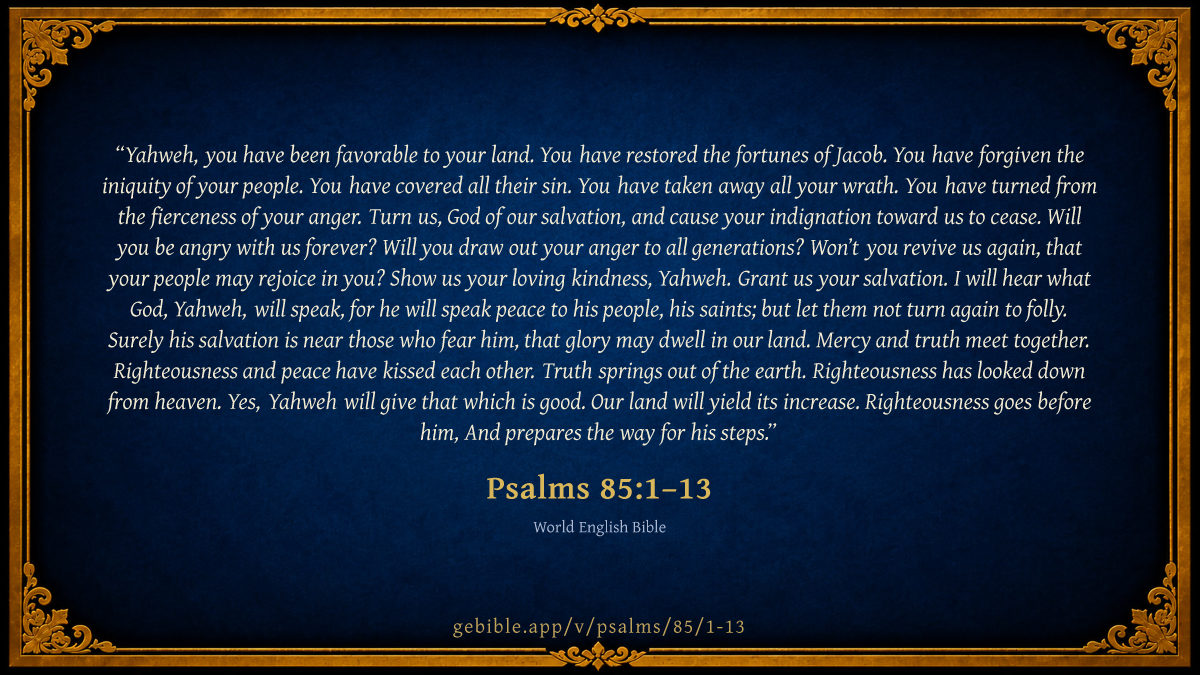
Yahweh, you have been favorable to your land. You have restored the fortunes of Jacob.
You have forgiven the iniquity of your people. You have covered all their sin.
You have taken away all your wrath. You have turned from the fierceness of your anger.
Turn us, God of our salvation, and cause your indignation toward us to cease.
Will you be angry with us forever? Will you draw out your anger to all generations?
Won’t you revive us again, that your people may rejoice in you?
Show us your loving kindness, Yahweh. Grant us your salvation.
I will hear what God, Yahweh, will speak, for he will speak peace to his people, his saints; but let them not turn again to folly.
Surely his salvation is near those who fear him, that glory may dwell in our land.
Mercy and truth meet together. Righteousness and peace have kissed each other.
Truth springs out of the earth. Righteousness has looked down from heaven.
Yes, Yahweh will give that which is good. Our land will yield its increase.
Righteousness goes before him, And prepares the way for his steps.
John Calvin 1540 · Public Domain On vv1, 2, 4, 5, 6, 7, 8, 9, 10, 12, 13 1 O Jehovah! thou hast been favorable to thy…
1 O Jehovah! thou hast been favorable to thy land. Those who translate these words in the future tense, in my opinion, mar their meaning. This psalm, it is probable, was endited to be sung by the people when they were persecuted by the cruel tyranny of Antiochus; and from the deliverance wrought for them in the past, they were encouraged to expect in the future, fresh and continued tokens of the divine favor, — God having thereby testified, that their sins, however numerous and aggravated, could not efface from his memory the remembrance of his covenant, so as to render him inexorable towards the children of Abraham, and deaf to their prayers. Had they not previously experienced such remarkable proofs of the divine goodness, they must necessarily have been overwhelmed with the load of their present afflictions, especially when so long protracted. The cause of their deliverance from captivity they attribute to the free love with which God had embraced the land which he had chosen for himself. Whence it follows, that the course of his favor was unintermitted; and the faithful also were inspired with confidence in prayer, by the reflection that, mindful of his choice, he had shown himself merciful to his own land. We have elsewhere had occasion to remark, that nothing contributes more effectually to encourage us to come to the throne of grace, than the remembrance of God’s former benefits. Our faith would immediately succumb under adversity, and sorrow would choke our hearts, were we not taught to believe from the experience of the past, that he is inclined compassionately to hear the prayers of his servants, and always affords them succor when the exigencies of their circumstances require it; especially as there remains at all times the same reason for continuing his goodness. Thus the prophet happily applies to believers of his own day, the benefits which God in old time bestowed upon their fathers, because both they and their fathers were called to the hope of the same inheritance.
John Calvin's Commentaries (1540-1563) — public domain. Text from the Calvin Translation Society English edition (1840s-50s) via the Christian Classics Ethereal Library (ccel.org). Calvin's coverage is partial (roughly two-thirds of the Bible); uncommented books and verses are honest gaps, never fabricated. The 19th-century editor's footnotes and remarks are omitted so the notes are faithfully Calvin's own voice.
Geneva Bible translators 1599 · Public Domain On vv1, 2, 3, 5, 7, 8, 11, 13 They confess that God’s free mercy was the cause…
They confess that God’s free mercy was the cause of their deliverance, because he loved the land which he had chosen.
Geneva Bible (1599) marginal notes — public domain.
John Trapp 1656 · Public Domain On vv1–13 Psa 85:1 « To the chief Musician, A Psalm…
Psa 85:1 « To the chief Musician, A Psalm for the sons of Korah. » LORD, thou hast been favourable unto thy land: thou hast brought back the captivity of Jacob.
Ver. 1. Lord, thou hast been favourable, &c.] God’s free grace and favour is fitly premised, as the fountain and mother of all the following mercies. This is that other book, Rev 20:12, that hath our names in it, and our pardon.
Read full note →
Thou hast brought back the captivity of Jacob] Of old from Egypt, and alate from the Philistines; who, after Saul’s death, miserably tyrannized over Israel, till David delivered them. Some hold that this psalm was composed at the end of the Babylonish captivity; others conceive it may be a prayer for the conversion of the Gentiles, who are brought in speaking, the whole psalm throughout.
John Trapp, A Commentary or Exposition upon All the Books of the Old and New Testament (1647–1656) — public domain. Text from a community e-Sword module.
Matthew Poole 1685 · Public Domain On vv1, 2, 3, 4, 6, 7, 8, 9, 10, 11, 12, 13 Unto thy land, i.e. unto thy people, in removing…
Unto thy land, i.e. unto thy people, in removing the sad effects of thy displeasure.
The captivity; the captives, as the word is used, Psa 14:7; 68:18, and elsewhere.
Matthew Poole's English Annotations on the Holy Bible (1683–1685) — public domain. Text from a community e-Sword/MySword module.
Matthew Henry 1710 · Public Domain On vv1, 8 The church, in affliction and distress, is here, by…
The church, in affliction and distress, is here, by direction from God, making her application to God. So ready is God to hear and answer the prayers of his people that by his Spirit in the word, and in the heart, he indites their petitions and puts words into their mouths. The people of God, in a very low and weak condition, are here taught how to address themselves to God.
I. They are to acknowledge with thankfulness the great things God had done for them (Psa 85:1-3): "Thou has done so and so for us and our fathers." Note, The sense of present afflictions should not drown the remembrance of former mercies; but, even when we are brought very low, we must call to remembrance past experiences of God's goodness, which we must take notice of with thankfulness, to his praise. They speak of it here with pleasure, 1. That God had shown himself propitious to their land, and had smiled upon it as his own: "Thou hast been favourable to thy land, as thine, with distinguishing favours." Note, The favour of God is the spring-head of all good, and the fountain of happiness, to nations, as well as to particular persons. It was by the favour of God that Israel got and kept possession of Canaan (Psa 44:3); and, if he had not continued very favourable to them, they would have been ruined many a time. 2. That he had rescued them out of the hands of their enemies and restored them to their liberty: "Thou hast brought back the captivity of Jacob, and settled those in their own land again that had been driven out and were strangers in a strange land, prisoners in the land of their oppressors." The captivity of Jacob, though it may continue long, will be brought back in due time. 3. That he had not dealt with them according to the desert of their provocations (Psa 85:2): "Thou hast forgiven the iniquity of thy people, and not punished them as in justice thou mightest. Thou hast covered all their sin." When God forgives sin he covers it; and, when he covers the sin of his people, he covers it all. The bringing back of their captivity was then an instance of God's favour to them, when it was accompanied with the pardon of their iniquity. 4. That he had not continued his anger against them so far, and so long, as they had reason to fear (Psa 85:3): "Having covered all their sin, thou hast taken away all thy wrath;" for when sin is set aside God's anger ceases; God is pacified if we are purified. See what the pardon of sin is: Thou hast forgiven the iniquity of thy people, that is, "Thou hast turned thy anger from waxing hot, so as to consume us in the flame of it. In compassion to us thou hast not stirred up all thy wrath, but, when an intercessor has stood before thee in the gap, thou hast turned away thy anger."
Read full note →
II. They are taught to pray to God for grace and mercy, in reference to their present distress; this is inferred from the former: "Thou hast done well for our fathers; do well for us, for we are the children of the same covenant." 1. They pray for converting grace: "Turn us, O God of our salvation! in order to the turning of our captivity; turn us from iniquity; turn us to thyself and to our duty; turn us, and we shall be turned." All those whom God will save sooner or later he will turn. If no conversion, no salvation. 2. They pray for the removal of the tokens of God's displeasure which they were under: "Cause thine anger towards us to cease, as thou didst many a time cause it to cease in the days of our fathers, when thou didst take away thy wrath from them." Observe the method, "First turn us to thee, and then cause thy anger to turn from us." When we are reconciled to God, then, and not till then, we may expect the comfort of his being reconciled to us. 3. They pray for the manifestation of God's good-will to them (Psa 85:7): "Show us thy mercy, O Lord! show thyself merciful to us; not only have mercy on us, but let us have the comfortable evidences of that mercy; let us know that thou hast mercy on us and mercy in store for us." 4. They pray that God would, graciously to them and gloriously to himself, appear on their behalf: "Grant us thy salvation; grant it by thy promise, and then, no doubt, thou wilt work it by thy providence." Note, The vessels of God's mercy are the heirs of his salvation; he shows mercy to those to whom he grants salvation; for salvation is of mere mercy.
III. They are taught humbly to expostulate with God concerning their present troubles, Psa 85:5, Psa 85:6. Here observe, 1. What they dread and deprecate: "Wilt thou be angry with us for ever? We are undone if thou art, but we hope thou wilt not. Wilt thou draw out thy anger unto all generations? No; thou art gracious, slow to anger, and swift to show mercy, and wilt not contend for ever. Thou wast not angry with our fathers for ever, but didst soon turn thyself from the fierceness of thy wrath; why then wilt thou be angry with us for ever? Are not thy mercies and compassions as plentiful and powerful as ever they were? Impenitent sinners God will be angry with for ever; for what is hell but the wrath of God drawn out unto endless generations? But shall a hell upon earth be the lot of thy people?" 2. What they desire and hope for: "Wilt thou not revive us again (Psa 85:6), revive us with comforts spoken to us, revive us with deliverances wrought for us? Thou hast been favourable to thy land formerly, and that revived it; wilt thou not again be favourable, and so revive it again?" God had granted to the children of the captivity some reviving in their bondage, Ezr 9:8. Their return out of Babylon was as life from the dead, Eze 37:11, Eze 37:12. Now, Lord (say they), wilt thou not revive us again, and put thy hand again the second time to gather us in? Isa 11:11; Psa 126:1, Psa 126:4. Revive thy work in the midst of the years, Hab 3:2. "Revive us again," (1.) "That thy people may rejoice; and so we shall have the comfort of it," Psa 14:7. Give them life, that they may have joy. (2.) "That they may rejoice in thee; and so thou wilt have the glory of it." If God be the fountain of all our mercies, he must be the centre of all our joys.
Matthew Henry's Commentary on the Whole Bible (1708–1710) — public domain (CC PDM 1.0). Text via the HelloAO Bible API.
John Gill 1763 · Public Domain On vv1–13 Lord, thou hast been favourable unto thy land,.... The…
Lord, thou hast been favourable unto thy land,.... The land of Canaan, which the Lord chose for the people of Israel, and put them into the possession of it; and where he himself chose to dwell, and had a sanctuary built for him; and therefore though the whole earth is his, yet this was his land and inheritance in a peculiar manner, as it is called, Jer 16:18, the inhabitants of it are meant, to whom the Lord was favourable, or whom he graciously accepted, and was well pleased with and delighted in, as appears by his choosing them above all people to be his people; by bringing them out of Egyptian bondage, by leading them through the Red sea and wilderness, by feeding and protecting them there; and by bringing them into the land of Canaan, a land flowing with milk and honey, and settling them in it; and by many temporal blessings, and also spiritual ones, as his word and ordinances; but especially by sending his own Son, the Messiah and Saviour, unto them; and which perhaps is what is here principally intended:
thou hast brought back the captivity of Jacob; or, "the captives" (m) of Jacob; in a temporal sense, both out of Egypt, and out of Babylon; and in a spiritual sense from sin, Satan, and the law; the special people of God often go by the name of Jacob, and these are captives to the above mentioned; and redemption by Christ is a deliverance of them from their captivity, or a bringing of it back, for he has led captivity captive; and in consequence of this they are put into a state of freedom, liberty is proclaimed to these captives, and they are delivered, and all as the fruit and effect of divine favour.
Read full note →
(m) "captivam turbam", Junius & Tremellius; i. e. "captivos", Gejerus, Michaelis.
John Gill's Exposition of the Whole Bible (1746–1763) — public domain (CC PDM 1.0). Text via the HelloAO Bible API.
John Wesley 1765 · Public Domain On vv1, 4, 6, 8, 9, 10, 11, 13 A recital of past, and prayer for present mercy,…
A recital of past, and prayer for present mercy, ver. 1-7. A prediction of a favourable answer, ver. 8-13. To the chief musician, A psalm for the sons of Korah.
Captivity - The captives.
John Wesley, Explanatory Notes Upon the Whole Bible (1754–1765) — public domain. Text via the GEBible commentary corpus.
Adam Clarke 1810 · Public Domain On vv1–13 Thanksgiving to God for restoration to the Divine favour,…
PSALM LXXXV
Thanksgiving to God for restoration to the Divine favour, 1-3;
Read full note →
prayer for farther mercies, 4-7;
the psalmist waits for a gracious answer in full confidence of
receiving it, 8.
He receives the assurance of the greatest blessings, and exults
in the prospect, 9-13.
NOTES ON PSALM LXXXV
The title of this Psalm we have seen before, Ps 42:1. As to the time, it seems to have been written during, or even after, the return from the Babylonish captivity. In the three first verses the psalmist acknowledges the goodness of God in bringing the people back to their own land; he next prays to God to restore them to their ancient prosperity. In the spirit of prophecy, he waits on God, and hears him promise to do it; and then exults in the prospect of so great a good. The whole Psalm seems also to have a reference to the redemption of the world by Jesus Christ.
Verse 1. Lord, thou hast been favourable] Literally, Thou hast been well pleased with thy land.
Thou hast brought back the captivity] This seems to fix the time of the Psalm to be after the return of the Jews from Babylon.
Adam Clarke's Commentary on the Bible (1810–1826) — public domain. Text from a community e-Sword/MySword module.
Joseph Benson 1811 · Public Domain On vv1, 4, 6, 8, 9, 10, 11, 12 Psa 85:1-3. Lord, thou hast been favourable unto thy…
Psa 85:1-3. Lord, thou hast been favourable unto thy land — That is, unto thy people, in removing the sad effects of thy displeasure. Thou hast brought back the captivity of Jacob — The captives, as that word is used Psa 14:7; Psa 68:18, and elsewhere. Thou hast covered all their sin — So as not to impute it to them, or to continue the punishment which thou didst inflict upon them for it. Thou hast taken away all thy wrath — Those calamities which were the effects of thy just wrath conceived against us.
Joseph Benson's Commentary on the Old and New Testaments (1811–1818) — public domain. Text from a community e-Sword module.
Albert Barnes 1834 · Public Domain On vv1–13 Lord, thou hast been favorable unto thy land -…
Lord, thou hast been favorable unto thy land - Margin, “well pleased with.” The idea is that he had been kind or propitious to the nation; to wit, on some former occasion. So Luther, (vormals) “formerly.” The reference is to some previous period in their history, when he had exercised his power in their behalf.
Thou hast brought back the captivity of Jacob - That is, at the time referred to. It is not necessary to suppose that the allusion is to the period immediately preceding the time when the psalm was composed, but it may have been any period in their history. Nor is it necessary to suppose that the people had been removed from their land at the time, for all that would be necessary to suppose in interpreting the language would be that the land had been invaded, even though the inhabitants still remained in it.
Albert Barnes' Notes on the Bible (1834–1885) — public domain. Text from a community e-Sword/MySword module.
Lange's Commentary on the Holy Scriptures 1864 · Public Domain On v1 Psalms 85
Psalms 85
To the chief Musician, A Psalm for the sons of Korah
Read full note →
2 Lord, thou hast been favorable unto thy land:
Thou hast brought back the captivity of Jacob.
3 Thou hast forgiven the iniquity of thy people;
Thou hast covered all their sin. Selah.
4 Thou hast taken away all thy wrath:
Thou hast turned thyself from the fierceness of thine anger.
5 Turn us, O God of our salvation,
And cause thine anger toward us to cease.
6 Wilt thou be angry with us for ever?
Wilt thou draw out thine anger to all generations?
7 Wilt thou not revive us again:
That thy people may rejoice in thee?
8 Shew us thy mercy, O Lord,
And grant us thy salvation.
9 I will hear what God the Lord will speak:
For he will speak peace unto his people, and to his saints:
But let them not turn again to folly.
10 Surely his salvation is nigh them that fear him;
That glory may dwell in our land.
11 Mercy and truth are met together;
Righteousness and peace have kissed each other.
12 Truth shall spring out of the earth;
And righteousness shall look down from heaven.
13 Yea, the Lord shall give that which is good;
And our land shall yield her increase.
14 Righteousness shall go before him;
And shall set us in the way of his steps.
EXEGETICAL AND CRITICAL
Contents and Composition. After a retrospect of the former mercy bestowed upon the people, (Psa_85:2-4), there is uttered a prayer for a renewed manifestation of the same mercy during present sufferings from the anger of God (Psa_85:5-8). The intention is then announced of listening with gladness to God’s pledge of peace to His people, because its fulfilment in their deliverance was certain to those who really feared Him (Psa_85:9-10). This fulfilment with its wealth of blessings is finally described in strains of poetic rapture (Psa_85:11-13), which bear a great resemblance to Isa. 39:16f.; Isa_45:8; Isa_59:14. We receive an impression from the Psalm which compels us to assign its composition to the period succeeding the return from the Exile. There is no sufficient ground for connecting it with the peace concluded with Antiochus III (Hitzig). It is more than doubtful whether we are justified in inferring from Psa_85:13 a season of the year long before harvest. The assumption is altogether arbitrary that the first part contains the prayer of the Church, and the second a hymn of exhortation and promise by the priests in response (Ewald, Olshausen, De Wette). The construction of the perfects in Psa_85:2-4 as pluperfects (Ewald, Olshausen, Baur) is unnecessary. [These commentators suppose the reference to be to a period long past, and hence their view of the force of these verbs.—J. F. M.] The opinion is unfounded, that Psa_85:5 f. recall the former prayer of the people (Hitzig), or that they contain that of those who remained still in exile as distinguished from those who had returned (Venema). If the whole psalm be viewed as prophetic (the older commentators) or as having no historical back-ground (Hengst., Clauss.), the exposition is modified accordingly. The expressions indicate a national judgment, not in conception as in Psa_14:7, but in reality; and Psa_85:9 b, hints that the present misfortunes of the people were the deserved consequences of their folly (Delitzsch). This idea is lost in the text of the Sept. where we have the rendering: and to those who turn their hearts to Him. [This rendering is due to a wrong conception of the word כִּסְלָה and to a false construction of the clause. This word was supposed to be capable of the same meaning as the form כֶּסֶל which once means inward parts.—Most of the English commentators agree with the view defended above. Dr. Alexander does not feel justified in referring it to any particular period He says: “The idea that the benefit acknowledged was deliverance from the Babylonish exile has arisen from a false interpretation of the last clause of Psa_85:1, the true sense of which may be illustrated from Psa_14:7. Captivity is a common figure for distress and God’s revisiting the captives for relief from it.” And again: “It seems to be appropriate to every case in which the fulfilment of the promise in Lev_26:3-13 was suspended.”—J. F. M.].
Psa_85:11 ff. Mercy and truth are met together (præterite), and therefore appear as united and co-operating harmoniously, in consequence of God’s glory or majesty again dwelling in the land when the people should become converted to His fear. It is opposed to the context to change the compassion and truth of God into the human virtues of “kindness” and “faithfulness” (Hupfeld), or “ love and faithfulness,” (Hitzig). So also is the change of glory into “ honor ” (most). A like harmony exists between righteousness and peace, of which it is said literally that they are joined together. [It is more correct to say that it is said literally: they have kissed each other, the word being onomatopoetic, and then to present the idea of union as conveyed by that figure.—J. F. M.] They do not appear here as gifts of God, and consequences of His mercy and truth (most). Still less are they represented as human righteousness and earthly peace (Hitzig), but as heavenly attributes in their Divine union. They are rightly personified in this sense, and represented frequently in works of art as angels or messengers of God kissing each other (comp. Piper’s evangel. Kalender, 1859, p. 24 ff., 1867, p. 63). It is this righteousness thus united with peace which the Psalmist beholds as looking down from heaven well-pleased with the land, in which God’s glory dwells, and from which it causes to spring forth from Divine seeds united truth and mercy. In the next verse the dealings of the Covenant God answer to this looking down, and the grateful conduct of the nation to the merciful dealings of God. The fruit of the land, therefore, according to the context, cannot be the fruit of harvest (Hitzig) but the blessed results of reconciliation, that righteousness which walks before God and follows in His train when He manifests His presence in the land. This sense is found in the words, whether we render the last clause: and set (their steps) upon the way of His steps (Olshausen, Delitzsch in his first edition), or: make His steps a way, that is, walk in His footsteps (Hupfeld), or: conform to the ways of His steps (Ewald), or: mark, regard attentively the way of His steps (Delitzsch now), or: designate, make known the way of His steps (Hitzig). It is, at all events, wrong to translate: make their steps a way (Hengst.), or sets its steps upon the way that is, sets out upon the way, has its course, is really and truly, (most of the older expositors until De Wette). For the suffix in פְעָמָיו must refer to God, on account of the parallelism with לְפָנָיו. [The rendering of Hupfeld is probably the correct one, representing the most natural construction of the words. The apocopated form mingles an aspiration with the declaration, and does not justify us, as Perowne supposes, in giving to the whole verse the force of a desire.—J. F. M.]
DOCTRINAL AND ETHICAL
1. God does not only forgive the special sins of individuals, He blots out also the common transgressions of a whole people, and removes their common guilt in the dispensation of His mercy. This gracious dealing does not, however, make provision for the future transgression of the same people. But the compassion before experienced encourages to prayer for a repeated turning away of His anger, and strengthens the hope of renewed blessing. And therefore must God’s people be mindful of the one when they are reminded of the other, and make both subserve the building up of the Church.
2. But, in order to realize this aim, it is above all necessary, that they be intent upon hearing what God says. For this purpose they do not require any new revelation from Him, but can resort to His words, familiar as they have so long been to His people, and expound and apply them for the instruction and consolation and warning and exhortation of themselves and others. For His word as a testimony to His truth not only agrees in all its parts with itself, it satisfies also the needs of His people, and answers perfectly the purposes of God. For it reveals His thoughts of salvation and peace, and announces their actual fulfilment in the world by the advent of righteousness, which it shows to be caused not merely by His general dispensation of favor and mercy, but specially by His glory dwelling upon earth. And thus the history of revelation becomes a history of redemption, and all of a Messianic character.
HOMILETICAL AND PRACTICAL
It is good to hear the word of God, but His people must also govern their lives thereby.—We cannot meditate upon the mercy of God, without being reminded of the sins of ourselves and others; may both of them urge us to true penitence and to lively faith!—In spite of all the tokens of God’s mercy, sin has not yet disappeared from the world; but mercy is still stronger than sin.—The well-being of a nation is derived from the dwelling of God’s glory in it.—God has thoughts of peace in relation to His people, and fulfils them in conformity with His truth, but always in harmony with His righteousness.—Many ask to be spared from the anger of God, and most dread the consequences of sin, but salvation is high only to those who fear God.—God must bless the land if it is to yield its fruit; but the best fruits are those of righteousness, which are pleasing to God, and are the results of His working.—Whatever we have on earth that is good comes down from heaven.
Starke: The nearer men are to repentance the nearer are they to mercy; but the further away they are from conversion, the less do they receive of this treasure.—God’s mercy makes a joyful heart.—Honor paid to God results from His fear, and is largely increased by surpassing tokens of His help.—Righteousness is a fair ornament in a land, and a strong pillar upholding the government, the country, and the people; but righteousness and peace must stand together.—Frisch: God’s anger and displeasure will be averted in accordance with the conditions laid down by Himself, if men seek first in Him the grace of conversion, and not till then the alleviation and removal of punishment.—Tholuck: The sense of mercy must ever be as abiding as the feeling of guilt is deep.
Guenther: Let us learn at last what promotes the peace of a country, and cease seeking in the clouds and in the soil the causes of death and public calamities, and discern above the clouds the chastening hand of God, who visits in His merciful anger for our conversion the sins which are committed upon earth by His human children.—Taube: The cry of faith in distress is prompted by a knowledge of the former mercy of God towards His people; the look of faith and hope is inspired by listening to His word.—Detlefsen: Let us honor our God (1) by humble gratitude for His help, (2) by firm reliance upon His promises, (3) by a pious walk before Him.
[Scott: Having spoken unto the Lord in prayer we should compose ourselves to hear Him speak to us by His word; and to expect an answer by His Spirit or in His providence. He will certainly speak peace to His people whom He has separated and sanctified to Himself.
Barnes: Those who have been afflicted and restored should feel themselves exhorted not to return to their former course of life, (1) by their obligations to their Benefactor, (2) by the remembrance of their own solemn vows when in affliction, (3) by the assurance that if they do return to their sin and folly, heavier judgments will come upon them.—J. F. M.]
Lange's Commentary on the Holy Scriptures (Critical, Doctrinal, and Homiletical), ed. John Peter Lange, English translation edited by Philip Schaff (1864–1880) — public domain. Text from a community e-Sword module.
Daniel D. Whedon 1874 · Public Domain On vv1, 2, 3, 4, 5, 6, 8, 9, 10, 11, 12, 13 1. Thou hast been favourable unto thy land—The first…
1. Thou hast been favourable unto thy land—The first three verses are an acknowledgment of national restoration. The six verbs in those verses are in the past tense, but it is the recent past. “Favourable,” here, is generic, the particulars follow. “Thy land” refers to Lev_25:23, “The land is mine;” hence no title in fee simple could be given from one to another.
Brought back the captivity—Turned the captivity; brought back the captives, a description which could apply only to the restoration under Zerubbabel. Ezr_1:2-4. It does not necessarily imply that the exiles had already reached their own land but that they were set free by Cyrus.
Read full note →
Probably, however, the first colony had already reached Palestine. Ezr_2:1; Ezr_2:64
Daniel D. Whedon (gen. ed.), Commentary on the Old and New Testaments (1874–1909) — public domain. Text from a community e-Sword module.
The Cambridge Bible for Schools and Colleges 1878 · Public Domain On vv1–13 1. thou hast been favourable] Thou art propitiated: once…
1. thou hast been favourable] Thou art propitiated: once more Thou graciously acceptest Thy people, and receivest them back into Thy favour. The ban of Jer_14:10; Jer_14:12 is removed. Cp. Psa_77:7; Psa_106:4; Hag_1:8.
thou hast brought back the captivity of Jacob] Or, as R.V. marg., returned to. But more probably the phrase means, thou hast turned the fortune of Jacob. See note on Psa_53:6. Here doubtless the restoration of the nation from the Babylonian exile is meant.
Read full note →
1–3. God has forgiven and restored His people.
The Cambridge Bible for Schools and Colleges (gen. ed. J. J. S. Perowne; Cambridge University Press, 1878–1918) — public domain. Text from a community e-Sword module.
Ellicott's Commentary for English Readers 1878 · Public Domain On vv1, 2, 4, 8, 9, 10, 11, 13 (1) Thou hast brought back.—See Psa_14:7; Psa_68:18. The expression…
(1) Thou hast brought back.—See Psa_14:7; Psa_68:18. The expression might only imply generally a return to a state of former prosperity, as in Job_42:10, but the context directs us to refer especially to the return from exile. (See Introduction.)
A Bible Commentary for English Readers, edited by Charles John Ellicott (1878–1897) — public domain. Text from a community e-Sword module.
The Pulpit Commentary 1880 · Public Domain On vv1–13 THIS is a psalm written after a signal display…
THIS is a psalm written after a signal display of God"s mercy towards Israel, but when there was still much wanting to make the condition of the people altogether satisfactory. It consists of a thanksgiving for the deliverance vouch-safed (vers. 1-3); a prayer for further and more complete restoration to favour (vers. 4-7); and a joyful anticipation of the granting of the prayer, and of the bestowal on Israel, ultimately, of all temporal and spiritual blessings (vers. 8-13). There are no such distinct and definite allusions in the psalm as to tie it down to any particular date; but, on the whole, it would seem to suit best either the time of Zerubbabel (Ezr 3 Ezr 4) or that of Ezra and Nehemiah. (Ezr 9 Ezr 10 Ne 2-6)
Vers. 1-3. The thanksgiving. God is thanked for two things especially:
Read full note →
(1) for having granted his people forgiveness of their sins (vers. 2, 3); and
(2) for having, partially at any rate, removed his chastening hand from them, and given them a return of prosperity (ver. 1).
Lord, thou hast been favourable unto thy land; or, "thou art become gracious" (Kay, Cheyne) a preceding time during which God was not gracious is implied. (comp. Psa_77:7-9) Thou hast brought back the captivity of Jacob. It is most natural to understand this of the return from the Babylonian captivity; but possible that some lighter affliction may be intended, since twbv is used, metaphorically, for calamities short of actual captivity. (see the comment on Job_42:10)
HOMILIES BY S. CONWAY Vers. 1-13. Temporal mercies of little avail without such as are spiritual.
There had been great outward mercies (see vers. 1-3). Probably the wonderful deliverance of Judah, Jerusalem, and Hezekiah from the threatened might of Assyria was the occasion of this burst of thanksgiving. But the psalmist it may have been Isaiah himself whilst grateful, indeed, for God"s deliverance, as he well might be, was nevertheless sore distressed at the spiritual condition of his countrymen (see Isaiah"s denunciations of the wickedness of his people, Ps 1 and passim). There needed, therefore, to be an inward conversion as well as an outward deliverance such as they had experienced. And until this spiritual reformation was brought about, the anger of God rested on them still. Hence the prayer, "Revive us again," etc. In this psalm we have
I THANKFUL ACKNOWLEDGMENT OF MERCIES RECEIVED, (Vers. 1-3)
II EARNEST PRAYERS FOR YET GREATER ONES, (Vers. 4-7)
III CONFIDENT BELIEF THAT THE LORD WILL ANSWER, (Ver. 8)
IV JOYFUL ANTICIPATION OF THE BLESSINGS THE LORD WILL GIVE. (Vers. 9-13) S.C.
HOMILIES BY R. TUCK Ver. 1. Recognition of national mercies.
This psalm belongs to the "sons of Korah," and we can hardly be wrong in associating it with the early years of the restoration from the Babylonish captivity. "The psalm shows that union of thankfulness for restoration, of sense of present distress and weakness, and of bright Messianic hope, which is especially characteristic of the writings of this period." "It opens with an acknowledgment of God"s goodness and mercy in the national restoration, in terms which could hardly apply to any other event." Plumptre connects the psalm with the Assyrian distress in the time of Hezekiah. Other writers, among whom may be named Spurgeon, insist on the Davidic authorship, and connect it with distress from the Philistines. There is one grave peril attending the separation of Christianity into small sections. The national relations of God are likely to be underestimated, and the merely local relations of God to individual experience, and to the experience of small communities, overestimated. While fully recognizing that God bears close and saving relations to the individual, it may yet be properly urged that he bears relation to each nation, is at the heart of its calamities and of its triumphs, working for the nation now as truly as for the nation of Israel in the olden time. God is in history. But this means that God is in history while the history is in the making. And God should be discerned in political struggles, in social movements, in philanthropic enterprises, in national deliverances. To many persons the national thanksgiving for the recovery of the Prince of Wales from imperilling illness, was a delightful proof of the readiness of the English people to respond when God"s hand in the bestowment of national mercies is pointed out to them. Two things may be illustrated and impressed.
I RECOGNIZING NATIONAL MERCIES IS A NATIONAL DUTY. Apply to ordinary mercies, such as are illustrated by the yearly harvest. Then the national heart turns to God; and a national voice of thanksgiving is uplifted to him. Apply to special mercies, such as:
1. Preservation from, or removal of, epidemic disease.
2. Mastery of elements of social disturbance.
3. Hopeful changes of political relationships.
4. Victory for the national army.
5. Removal of difficulties that put the national peace in peril.
II HELPING THE NATION TO RECOGNIZE ITS MERCIES IS THE DUTY OF THE NATIONAL LEADERS. More especially of those who believe in God, and are consecrated to the work of rendering witness for him. Mistake is often made by limiting the work of God"s ministers to the "spiritual" and "personal" parts of their work. Every true minister is a leader of his people in recognizing God"s work in the nation, and in renewing national thanksgiving and trust. R.T.
The Pulpit Commentary (1880–1919), ed. H.D.M. Spence-Jones & Joseph S. Exell — public domain. Text from a community e-Sword module.
Charles H. Spurgeon 1885 · Public Domain On vv1–13 Title. To the Chief Musician, A Psalm for the…
Title. To the Chief Musician, A Psalm for the sons of Korah. There is no need to repeat our observations upon a title which is of so frequent occurrence; the reader is referred to notes placed in the headings of preceding psalms. Yet it may not be out of place to quote Ne 12:46. In the days of David and Asaph of old there were chief of the singers, and songs of praise and thanksgiving unto God.
Object and Occasion. It is the prayer of a patriot for his afflicted country, in which he pleads the Lord's former mercies, and by faith foresees brighter days. We believe that David wrote it, but many question that assertion. Certain interpreters appear to grudge the psalmist David the authorship of any of the psalms, and refer the sacred songs by wholesale to the times of Hezekiah, Josiah, the Captivity, and the Maccabees. It is remarkable that, as a rule, the more sceptical a writer is, the more resolute is he to have done with David; while the purely evangelic annotators are for the most part content to leave the royal poet in the chair of authorship. The charms of a new theory also operate greatly upon writers who would have nothing at all to say if they did not invent a novel hypothesis, and twist the language of the psalm in order to justify it. The present psalm has of course been referred to the Captivity, the critics could not resist the temptation to do that, though, for our part we see no need to do so: it is true a captivity is mentioned in Ps 85:1, but that does not necessitate the nation's having been carried away into exile, since Job's captivity was turned, and yet he had never left his native land: moreover, the text speaks of the captivity of Jacob as brought back, but had it referred to the Babylonian emigration, it would have spoken of Judah; for Jacob or Israel, as such, did not return. The first verse in speaking of "the land" proves that the author was not an exile. Our own belief is that David penned this national hymn when the land was oppressed by the Philistines, and in the spirit of prophecy he foretold the peaceful years of his own reign and the repose of the rule of Solomon, the psalm having all along an inner sense of which Jesus and his salvation are the key. The presence of Jesus the Saviour reconciles earth and heaven, and secures to us the golden age, the balmy days of universal peace.
Read full note →
Divisions. In Ps 85:1-4 the poet sings of the Lord's former mercies and begs him to remember his people; from Ps 85:5-7 he pleads the cause of afflicted Israel; and then, having listened to the sacred oracle in Ps 85:8, he publishes joyfully the tidings of future good, Ps 85:9-13.
Ver. 1. LORD, thou hast been favourable unto thy land. The self existent, all sufficient JEHOVAH is addressed: by that name he revealed himself to Moses when his people were in bondage, by that name he is here pleaded with. It is wise to dwell upon that view of the divine character which arouses the sweetest memories of his love. Sweeter still is that dear name of "Our Father, "with which Christians have learned to commence their prayers. The psalmist speaks of Canaan as the Lord's land, for he chose it for his people, conveyed it to them by covenant, conquered it by his power, and dwelt in it in mercy; it was meet therefore that he should smile upon a land so peculiarly his own. It is most wise to plead the Lord's union of interest with ourselves, to lash our little boat as it were close to his great barque, and experience a sacred community in the tossings of the storm. It is our land that is devastated, but O Jehovah, it is also thy land. The psalmist dwells upon the Lord's favour to the chosen land, which he had shewed in a thousand ways. God's past doings are prophetic of what he will do; hence the encouraging argument"Thou hast been favourable unto thy land, "therefore deal graciously with it again. Many a time had foes been baffled, pestilence stayed, famine averted, and deliverance vouchsafed, because of the Lord's favour; that same favourable regard is therefore again invoked. With an immutable God this is powerful reasoning; it is because he changes not that we are not consumed, and know we never shall be if he has once been favourable to us. From this example of prayer let us learn how to order our cause before God. It is clear that Israel was not in exile, or the prayer before us would not have referred to the land but to the nation.
Thou hast brought back the captivity of Jacob. When down trodden and oppressed through their sins, the Ever merciful One had looked upon them, changed their sad condition, chased away the invaders, and given to his people rest: this he had done not once, nor twice, but times without number. Many a time have we also been brought into soul captivity by our backslidings, but we have not been left therein; the God who brought Jacob back from Padanaram to his father's house, has restored us to the enjoyment of holy fellowship; will he not do the like again? Let us appeal to him with Jacob like wrestlings, beseeching him to be favourable, or sovereignly gracious to us notwithstanding all our provocations of his love. Let declining churches remember their former history, and with holy confidence plead with the Lord to turn their captivity yet again.
Whole Psalm. This beautiful psalm, like some others, has come down to us without name or date; the production of some unknown poetic genius, touched, purified, and exalted by the fire of celestial inspiration; a precious relic of that golden age, when the Hebrew music was instinct with a spirit such as never breathed on Greece or Rome. It is interesting to reflect on the anonymous origin of some of the psalms; to remember how largely the church of God is indebted to some nameless worthies who wrote for us hymns and spiritual songs, full of richer strains than were ever poured forth by the most illustrious of pagan name. These holy men are passed away, they have left no record of their history; but they have bequeathed legacies of rich, varied, and inspired sentiments, which will render the church debtors to them to the end of time. John Stoughton. 1852.
Whole Psalm. This Psalm may be thus divided: Ps 85:1-3, express the thanks of the people for their return from captivity; Ps 85:4-6, their prayer for their own reformation; in Ps 85:7, they pray for the coming of Messiah; Ps 85:8 contains the words of the High priest, with God's Gracious answer; which answer is followed by the grateful acclamation of the people, to the end of the Psalm. To prepare for this interpretation, let us observe, how very strangely the words are expressed at presentI will hear what God the Lord will say: FOR he shall speak peace unto his people. But surely, God could not be consulted, because it was unnecessary; nor could the High priest possibly say, that he would ask of God, because he knew what God would answer; especially, as we have now a question to God proposed, and yet no answer from God given at all. Under these difficulties we are happily relieved; since it appears, on satisfactory authorities, that, instead of the particle rendered for, the word here originally signified in or by me, which slight variation removes the obscurity, and restores that very light which has long been wanted. The people having prayed for the speedy arrival of their great salvation; the High priest says, (as it should be here expressed), I will hear what the Almighty sayeth. Jehovah, BY ME sayeth, PEACE unto his people, even unto his saints: but let them not turn again to folly. Whereupon, as the Jews understood peace to comprehend every blessing, and of course their greatest blessing, they at once acknowledged the certainty of this salvation, the glory of their landthey proclaim it as nigh at handand then, in rapture truly prophetical, they see this glory as actually arrived, as already dwelling in Judeathey behold God in fulfilling most strictly what he had promised most graciouslythey see therefore the mercy of God, and the truth of God met togetherthey see that scheme perfected, in which the righteousness (i.e. the justice) of God harmonizes with the peace (i.e. the happiness) of man; so that righteousness and peace salute each other with the tenderest affection. In short, they see TRUTH flourishing out of the earth; i.e. they see him, who is the way, the truth, and the life, born here on earth; and they even see the righteousness, or justice of God, looking down from heaven, as being well pleased. Ps 85:12 is at present translated so unhappily, that it is quite despoiled of all its genuine glory. For, could the prophet, after all the rapturous things said before, coldly say here, that God would give what was good and that Judea should have a plentiful harvest? No: consistency and good sense forbid it; and truth confirms their protest against it. The words here express the reasons of all the preceding energies, and properly signifyYea, Jehovah granteth THE BLESSING; and our land granteth HER OFFSPRING. And what can be the blessing what, amidst these sublime images, can be Judea's offspring but HE, and HE only, who was the blessing of all lands in general, and the glory of Judea in particular? And what says the verse following? Righteousness goeth before HIMcertainly, not before the fruit of the earth but certainly before that illustrious person, even the MESSIAH. Righteousness goeth before HIM, and directeth his goings in the way. As to the word rendered the blessing, and applied to the redemption; the same word is so used by Jeremiah, thus: Behold, the days come, that I will perform that good thing (the blessing) which I have promised... at that time will I cause to grow up unto David the Branch of righteousness (Jer 33:14-15). And as to the Messiah being here described, partly as springing up from the earth; so says Isaiah: "In that day shall the branch of the Lord be beautiful and glorious; and the fruits of the earth shall be excellent and comely." But this evangelical prophet, in another place, has the very same complication of images with that found in the psalm before us. For Isaiah also has the heavens, with their righteousness; and the earth, with its salvation: "Drop down, ye heavens from above, and let the skies pour down righteousness: let the earth open, and let them bring forth salvation." But, "let them bring forth" who, or what can be here meant by them, but the heavens and the earth? It is heaven and earth which are here represented as bringing forth, and introducing the Saviour of the world. For what else can be here meant as brought forth by them? What, but HE alone; who, deriving his divine nature from heaven, and his human from the earth was (what no other being ever was) both GOD and MAN. Benjamin Kennicott.
Ver. 1. Thy land. The land of Jehovah the poet calls it, in order to point out the close relation of God to it, and to the people thereof, and so confirm the favour of God towards it. For this land God has chosen as the dwelling place of his people, true religion, and his own presence; this also in his own time He himself had trodden in the person of his Son, and in it He first gathered and founded his Church. Venema.
Ver. 1. The captivity of Jacob. All true believers are the sons of Jacob, and the seed of Abraham; as well as the believing Gentiles, who are the sons of Jacob according to the Spirit, as the believing Jews the sons of Jacob according to the flesh; and the Church of these true Jacobins and Israelites is the land of the Lord, and the captivity here mentioned is bondage under sin. In this captivity Satan is the gaoler, the flesh is our prison, ungodly lusts are the manacles, a bad conscience the tormentor, all of them against us; only Christ is Emmanuel, God with us; he turneth away the captivity of Jacob in forgiving all his offences, and in covering all his sins. Abraham Wright.
Ver. 1. There is,
I. Captivity.
1. Of the people of God.
2. Although they are the people of God.
3. Because they are the people of God. You only have I known, etc. II. Restoration from Captivity: Thou hast brought back, etc.
1. The fact.
2. The Author: Thou: by thine own power; in thine own manner; at thine own time. III. The cause of the Restoration; the favour of God: Thou hast been favourable.
1. On account of favour past: "Thou hast."
2. On account of favour in reserve.
In an old quarto volume of 788 pages, containing Expositions of several passages of Scripture, is a short Exposition of this Psalm (pp. 452-64) entitled "A Taste of the Breathings, Pantings, Waitings, and Hopes of Israel after the true Saviour, and his effectual Redemption." There is no Author's name, but some previous owner has written "John Pennington" on the title page: date 1656.
Psalms 85:2*
Charles H. Spurgeon's The Treasury of David (1869–1885) — public domain. Psalms only. Text from a community e-Sword/MySword module.
The Biblical Illustrator 1887 · Public Domain On vv1, 6, 8, 9, 10, 11, 13 Lord, Thou hast been favourable unto Thy land.
Psa_85:1-13
Lord, Thou hast been favourable unto Thy land.
Read full note →
A psalm of deliverance; songs and sighs
A part of the nation had returned, but to a ruined city, a fallen temple, and a mourning land, where they were surrounded by jealous and powerful enemies. Discouragement had laid hold on the feeble company, enthusiasm had ebbed away, and heart as well as faith had been lost. This psalm accurately reflects such a state of things, and is reasonably taken as one of the earliest post-exilic psalms.
1. The first portion presents one great fact in three aspects, and traces it to Jehovah. The restored Israel had been sent back by the conqueror as a piece of policy, but it was God who had done it, all the same. The blessed fact is joyously announced in Psa_85:1, and the yet more blessed fact of forgiveness, of which it is a token, in Psa_85:2. The word rendered forgiven implies that sin is regarded as a weight, which God lifts off from the pressed-down sinner; while that for covered regards it as a hideous stain, which He hides. Our sins weigh us down, and are rank, and smell to heaven. Verse 8 ventures still deeper into the sacred recesses of the Divine nature, and traces the forgiveness to a change in Gods disposition. His wrath has been drawn in, as, if we may say so, some creature armed with a sting retracts it into its sheath.
2. God turns from His anger, therefore Israel returns to the land. But the singer feels the incompleteness of the restoration, and the bitter consciousness suddenly changes joyous strains to a plaintive minor in the second part (Psa_85:4-7). Turn us, in Psa_85:4, looks back to brought back in Psa_85:1, and is the same word in the Hebrew. The restoration is but partially accomplished. Similarly the petitions of Psa_85:5 look back to Psa_85:8, and pray that Gods wrath may indeed pass utterly away. The prayers are grounded on what God has done. He does not deliver by halves. He is not partially reconciled. The remembrance of the bright beginning heartens the assurance of a completion. God never leaves off till He has done. If He seems to have but half withdrawn His anger, it is because we have but half forsaken our sins.
3. The third portion brings solid hopes, based on Gods promises, to bear on present discouragements. In Psa_85:8 the psalmist, like Habakkuk (Hab_2:1), encourages himself to listen to what God will speak, 2 will hear, or, rather, Let me hear. Faithful prayer will always be followed by faithful waiting for response. God will not be silent when His servant appeals to Him, but, though no voice breaks the silence, a sweet assurance, coming from Him, will rise in the depths of the soul, and tell the suppliant that He will speak peace to His people, and warn them not to turn to other helps, which is folly. The peace which He speaks means chiefly peace with Himself, and then well-being of all kinds, the sure results of a right relation with God. But that peace is shivered by any sin, like the reflection of the blue heaven in a still lake when a gust of wind ruffles its surface. Verses 9-13 are the report, in the psalmists own words, of what his listening ear had heard God say. First comes the assurance that Gods salvation, the whole fulness of His delivering grace, both in regard to outward and inward evils, is nigh them that fear Him. They, and only they, who keep far away from foolish confidence in impotent helps and helpers shall be enriched. That is the inmost meaning of Gods word to the singer and to us all. The acceptance of Gods salvation purifies our hearts to be temples, and is the condition of His dwelling with us. The lovely personification of verses 10-13 have passed into Christian poetry and art, but are not rightly understood when taken, as they often are, to describe the harmonious meeting, in Christs work, of apparently opposing attributes. Mercy and faithfulness blend together in all Gods dealings with His people, and righteousness and peace are inseparable in His peoples experience. These four radiant angels dwell for ever with those who are Gods children. In verse 11 we have a beautiful inversion of the two pairs of personifications, of each of which only one member appears. Truth, or faithfulness, came into view in verse 10 as a Divine attribute, but is now regarded as a human virtue, springing out of the earth; that is, produced among men. They who have received into their hearts the blessed assurance and results of Gods faithfulness will imitate it in their own lives. Conversely, righteousness, which in verse10 was a human excellence, here appears as looking from heaven like a gracious angel smiling on the faithfulness which springs from earth. Thus heaven and earth are united, and humanity becomes a reflection of the Divine. Verse 12 presents the same idea in its most general form. God gives good of all sorts, and, thus fructified, earth shall yield her increase. Without sunshine there are no harvests. God gives before He asks. We must receive from Him before we can tender the fruit of our lives to Him. In verse 18 the idea of Divine attributes aa the parents of human virtues is again expressed by a different metaphor. Righteousness is represented doubly, as both a herald going before Gods march in the world, and as following Him. It makes His footsteps a way for us to walk in. Mans perfection lies in his imitating God. Jesus has left us an example that we should follow His steps. (A. Maclaren, D. D.)
Genuine piety
This psalm present to us genuine piety in three aspects.
I. Acknowledging the mercies of the past.
1. Restoration to their country. Thou hast brought back, etc. He brought them from Egypt and from Babylon.
2. Absolution of their sins. Thou hast forgiven, etc. When sin is forgiven it is covered; it does not reappear any more in producing suffering and anguish. Its guilt and power (not its memory) are crushed.
3. The cessation of penal afflictions. Thou hast turned thyself, etc. Genuine piety can recount such blessings in the past as these, and even of a higher order. The presence of present afflictions should not drown the remembrance of former mercies.
II. Deploring the evils of the present.
1. The sense of estrangement from God. Turn us, O God of our salvation. Departure from God is our ruin, return is our salvation. The separation between man and his Maker arises, not from His turning from man, but from the turning of man from Him.
2. The sense of the displeasure of their Maker. Wilt Thou be angry with us for ever? This really means, Wilt Thou afflict us for ever; shall we be ever in suffering? Gods anger is not passion, but antagonism to wrong.
3. The sense of deadness. Wilt Thou not revive us again? etc. They had been politically dead (Eze_27:1-36.), and they were religiously dead. Such are some of the evils they deprecate in this psalm; and for their removal they now implore their God.
III. Anticipating the good of the future. I will hear what God the Lord will speak. Piety here fastens its eye on several blessings in the future.
1. Divine peace. He will speak peace unto His people. He will one day speak peace--national, religious, spiritual, peace to all mankind.
2. Moral unity. Mercy and truth are met together, etc. These moral forces, ever since the introduction of sin, have been working, not only separately, but antagonistically; and this has been one of the great sources of human misery; but in the future they will coalesce, unite.
3. Spiritual prosperity. Truth shall spring out of the earth, etc. From the hearts of men truth shall spring as from its native soil, and it shall grow in stately beauty and affluent fruitage. And righteousness shall look down from heaven, delighted with the scene. (Homilist.)
The responsibility of favoured nations
It is true that the God of nations has His special calling and election for each of the races of mankind. To quote Bishop Westcott: History on a large scale is the revelation of the will of God; and in the history of the greatest nations we may expect to find the will of God for them. They are themselves the record and the retribution of their past, and the prophecy of their future. We Englishmen must be blind and thankless, indeed, if we fail to recognize Gods ordination in our own history, Gods warnings and promises in our fortunes. Surely He has been favourable unto this land of ours, until every acre of it is holy ground. To us also God has granted prophets, and captains, and reformers in long succession to bring back our captivity, until freedom means more in England to-day than it means anywhere else in the world. And upon us, too, God has laid the burden of a duty and destiny which we still only half discern. He has given us a charge which we can never fulfil abroad except as we become faithful to our vocation at home. To realize the very hand of the living God laid on our nation to-day humbles us into awe and seriousness and searchings of heart. The proud vision of Empire fades into a solemn sense of the Divine Imperator who ordains our inheritance for us; because the kingdom, and the power, and the glory are His own. (F. H. Darlow.)
The Biblical Illustrator, edited by Joseph S. Exell (c. 1880s–1900s) — public domain. Text from a community e-Sword module.
The Expositor's Bible 1887 · Public Domain On v1 Psalms 85
Psalms 85
THE outstanding peculiarity of this psalm is its sudden transitions of feeling. Beginning with exuberant thanksgiving for restoration of the nation (Psa_85:1-3), it passes, without intermediate gradations, to complaints of Gods continued wrath and entreaties for restoration (Psa_85:4-7). and then as suddenly rises to joyous assurance of inward and outward blessings. The condition of the exiles returned from Babylon best corresponds to such conflicting emotions. The book of Nehemiah supplies precisely such a background as fits the psalm. A part of the nation had returned indeed, but to a ruined city, a fallen Temple, and a mourning land, where they were surrounded by jealous and powerful enemies. Discouragement had laid hold on the feeble company; enthusiasm had ebbed away; the harsh realities of their enterprise had stripped off its imaginative charm; and the mass of the returned settlers had lost heart as well as devout faith. The psalm accurately reflects such a state of circumstances and feelings, and may, with some certitude, be assigned, as it is by most commentators, to the period of return from exile.
Read full note →
It falls into three parts, of increasing length, -the first, of three verses (Psa_85:1-3), recounts Gods acts of mercy already received; the second, of four verses (Psa_85:4-7), is a plaintive prayer in view of still remaining national afflictions; and the third, of six verses (Psa_85:8-13), a glad report by the psalmist of the Divine promises which his waiting ear had heard, and which might well quicken the most faint hearted into triumphant hope.
In the first strophe one great fact is presented in a threefold aspect, and traced wholly to Jehovah. "Thou hast turned back the captivity of Jacob." That expression is sometimes used in a figurative sense for any restoration of prosperity, but is here to be taken literally. Now, as at first, the restored Israel, like their ancestors under Joshua, had not won the land by their own arm, but "because God had a favour unto them," and had given them favour in the eyes of those who carried them captive. The restoration of the Jews, seen from the conquerors point of view, was a piece of state policy, but from that of the devout Israelite was the result of Gods working upon the heart of the new ruler of Babylon. The fact is stated in Psa_85:1; a yet more blessed fact, of which it is most blessed as being a token, is declared in Psa_85:2.
The psalmist knows that captivity had been chastisement, the issue of national sin. Therefore he is sure that restoration is the sign of forgiveness. His thoughts are running in the same line as in Isa_40:2 where the proclamation, to Jerusalem that her iniquity is pardoned is connected with the assurance that her hard service is accomplished. He uses two significant words for pardon, both of which occur in Psalms 32. In Psa_85:2 a sin is regarded as a weight pressing down the nation, which Gods mercy lifts off and takes away; in Psa_85:2 b it is conceived of as a hideous stain or foulness, which His mercy hides, so that it is no longer an offence to heaven. Psa_85:3 ventures still deeper into the sacred recesses of the Divine nature, and traces the forgiveness, which in act had produced so happy a change in Israels position, to its source in a change in Gods disposition. "Thou hast drawn in all Thy wrath," as a man does his breath, or, if the comparison may be ventured, as some creature armed with a sting retracts it into its sheath. "Thou hast turned Thyself from the glow of Thine anger" gives the same idea under another metaphor. The word "turn" has a singular fascination for this psalmist. He uses it five times (Psa_85:1, Psa_85:3, Psa_85:4, Psa_85:6 -lit., wilt Thou not turn, quicken us?-and Psa_85:8). Gods turning from His anger is the reason for Israels returning from captivity.
The abruptness of the transition from joyous thanksgiving to the sad minor of lamentation and supplication is striking, but most natural, if the psalmist was one of the band of returning exiles, surrounded by the ruins of a happier past, and appalled by the magnitude of the work before them, the slenderness of their resources, and the fierce hostility of their neighbours. The prayer of Psa_85:4, "Turn us," is best taken as using the word in the same sense as in Psa_85:1, where God is said to have "turned" the captivity of Jacob. What was there regarded as accomplished is here conceived of as still to be done. That is, the restoration was incomplete, as we know that it was, both in regard to the bulk of the nation, who still remained in exile, and in regard to the depressed condition of the small part of it which had gone back to Palestine. In like manner the petitions of Psa_85:5 look back to Psa_85:3, and pray that the anger which there had been spoken of as passed may indeed utterly cease. The partial restoration of the people implied, in the psalmists view, a diminution rather than a cessation of Gods punitive wrath, and he beseeches Him to complete that which He had begun.
The relation of the first to the second strophe is not only that of contrast, but the prayers of the latter are founded upon the facts of the former, which constitute both grounds for the suppliants hope of answer and pleas with God. He cannot mean to deliver by halves. The mercies received are incomplete; and His work must be perfect. He cannot be partially reconciled, nor have meant to bring His people back to the land, and then leave them to misery. So the contrast between the bright dawning of the return and its clouded day is not wholly depressing; for the remembrance of what has been heartens for the assurance that what is shall not always be, but will be followed by a future more correspondent to Gods purpose as shown in that past. When we are tempted to gloomy thoughts by the palpable incongruities between Gods ideals and mans realisation of them, we may take a hint from this psalmist, and, instead of concluding that the ideal was a phantasm, argue with ourselves that the incomplete actual will one day give way to the perfect embodiment. God leaves no work unfinished. He never leaves off till He has done. His beginnings guarantee congruous endings. He does not half withdraw His anger; and, if He seems to do so, it is only because men have but half turned from their sins. This psalm is rich in teaching as to the right way of regarding the incompleteness of great movements, which, in their incipient stages, were evidently of God. It instructs us to keep the Divine intervention which started them clearly in view; to make the shortcomings, which mar them, a subject of lowly prayer; and to be sure that all which He begins He will finish, and that the end will fully correspond to the promise of the beginning. A "day of the Lord" which rose in brightness may cloud over as its hours roll, but "at eventide it shall be light," and none of the morning promise will be unfulfilled.
The third strophe (Psa_85:8-13) brings solid hopes, based upon Divine promises, to bear on present discouragements. In Psa_85:8 the psalmist, like Habakkuk, {Hab_2:1} encourages himself to listen to what God will speak. The word "I will hear" expresses resolve or desire, and might be rendered Let me hear, or I would hear. Faithful prayer will always be followed by patient and faithful waiting for response from God. God will not be silent, when His servant appeals to Him with recognition of His past mercies, joined with longing that these may be perfected. No voice will break the silence of the heavens; but, in the depths of the waiting soul, there will spring a sweet assurance which comes from God, and is really His answer to prayer, telling the suppliant that "He will speak peace to His people," and warning them not to turn away from Him to other helps, which is folly. "His favoured ones" seems here to be meant as coextensive with "His people." Israel is regarded as having entered into covenant relations with God; and the designation is the pledge that what God speaks will be "peace." That word is to be taken in its widest sense, as meaning, first and chiefly, peace with Him, who has "turned Himself from His anger"; and then, generally, well-being of all kinds, outward and inward, as a consequence of that rectified relation with God.
The warning of Psa_85:8 c is thought by some to be out of place, and an emendation has been suggested, which requires little change in the Hebrew-namely, "to those who have turned their hearts towards Him." This reading is supported by the LXX; but the warning is perfectly appropriate, and carries a large truth-that the condition of Gods speaking of peace is our firm adherence to Him. Once more the psalmist uses his favourite word "turn." God had turned the captivity; He had turned Himself from His anger; the psalmist had prayed Him to turn or restore the people, and to turn and revive them, and now He warns against turning them again to folly. There is always danger of relapse in those who have experienced Gods delivering mercy. There is a blessed turning, when they are brought from the far-off land to dwell near God. But there is a possible fatal turning away from the Voice that speaks peace, and the Arm that brings salvation, to the old distance and bondage. Strange that any ears, which have heard the sweetness of His still small Voice whispering Peace should wish to stray where it cannot be heard! Strange that. the warning should ever be required, and tragic that it should so often be despised!
After the introductory Psa_85:8, the substance of what Jehovah spoke to the psalmist is proclaimed in the singers own words. The first assurance which the psalmist drew from the Divine word was that Gods salvation, the whole fulness of His delivering grace both in regard to external and in inward evils, is ever near to them that fear Him. "Salvation" here is to be taken in its widest sense. It means, negatively, deliverance from all possible evils, outward and inward; and, positively, endowment with all possible good, both for body and spirit. With such fulness of complete blessings, they, and they only, who keep near to God, and refuse to turn aside to foolish confidences, shall be enriched. That is the inmost meaning of what God said to the psalmist; and it is said to all. And that salvation being thus possessed, it would be possible for "glory"-i.e., the manifest presence of God, as in the Shechinah-to tabernacle in the land. The condition of Gods dwelling with men is their acceptance of His salvation. That purifies hearts to be temples.
The lovely personifications in Psa_85:10-13 have passed into Christian poetry and art, but are not clearly apprehended when they are taken to describe the harmonious meeting and cooperation, in Christs great work, of apparently opposing attributes of the Divine nature. No such thoughts are in the psalmists mind. Lovingkindness and Faithfulness or Troth are constantly associated in Scripture as Divine attributes. Righteousness and Peace are as constantly united, as belonging to the perfection of human character. Psa_85:10 seems to refer to the manifestation of Gods Lovingkindness and Faithfulness in its first clause, and to the exhibition of His peoples virtues and consequent happiness in its second. In all Gods dealings for His people, His Lovingkindness blends with Faithfulness. In all His peoples experience Righteousness and Peace are inseparable.
The point of the assurance in Psa_85:10 is that heaven and earth are blended in permanent amity, These four radiant angels "dwell in the land." Then, in Psa_85:11, there comes a beautiful inversion of the two pairs of personifications, of each of which one member only reappears. Troth or Faithfulness, which in Psa_85:10 came into view principally as a Divine attribute, in Psa_85:11 is conceived of as a human virtue. It "springs out of the earth"-that is is produced among men. All human virtue is an echo of the Divine, and they who have received into their hearts the blessed results of Gods Faithfulness will bring forth in their lives fruits like it in kind. Similarly, Righteousness, which in Psa_85:10 was mainly viewed as a human excellence, here appears as dwelling in and looking down from heaven, like a gracious angel smiling on the abundance of Faithfulness which springs from earth. Thus "the bridal of the earth and sky" is set forth in these verses.
The same idea is further presented in Psa_85:12, in its most general, form. God gives that which is good, both outward and inward blessings, and, thus fructified by bestowments from above, earth yields her increase. His gifts precede mens returns. Without sunshine and rain there are no harvests. More widely still, God gives first before He asks. He does not gather where He has not strawed, nor reap what He has not sown. Nor does He only sow, but He "blesses the springing thereof"; and to Him should the harvest be rendered. He gives before we can give. Isa_45:8 is closely parallel, representing in like manner the cooperation ofheaven and earth, in the new world of Messianic times.
In Psa_85:13 the thought of the blending of heaven and earth, or of Divine attributes as being the foundation and parents of their human analogues, is still more vividly expressed. Righteousness, which in Psa_85:10 was regarded as exercised by men, and in Psa_85:11 as looking down from heaven, is now represented both as a herald preceding Gods royal progress, and as following in His footsteps. The last clause is rendered in different ways, which all have the same general sense. Probably the rendering above is best: "Righteousness shall make His footsteps a way"-that is, for men to "walk in. All Gods workings among men, which are poetically conceived as His way, have stamped on them Righteousness. That strong angel goes before Him to clear a path for Him, and trace the course which He shall take. That is the imaginative expression of the truth-that absolute. inflexible Righteousness guides all the Divine acts. But the same Righteousness, which precedes, also follows Him, and points His footsteps as the way for us. The incongruity of this double position of Gods herald makes the force of the thought greater. It is the poetical embodiment of the truth, that the perfection of mans character and conduct lies in his being an "imitator of God," and that, however different in degree, our righteousness must be based on His. What a wonderful thought that is, that the union between heaven and earth is so close that Gods path is our way! How deep into the foundation of ethics the psalmists glowing vision pierces! How blessed the assurance that Gods Righteousness is revealed from heaven to make men righteous!
Our psalm needs the completion, which tells of that gospel in which "the Righteousness of God from faith is revealed for faith." In Jesus the "glory" has tabernacled among men. He has brought heaven and earth together. In Him Gods Lovingkindness and Faithfulness have become denizens of earth, as never before. In Him heaven has emptied its choicest good on earth. Through Him our barrenness and weeds are changed into harvests of love, praise, and service. In Him the Righteousness of God is brought near; and, trusting in Him, each of us may tread in His footsteps, and have His Righteousness fulfilled in us "who walk, not after the flesh, but after the spirit."
William Robertson Nicoll, ed., The Expositor's Bible (London: Hodder & Stoughton, 1887–1910) — public domain. 65 of 66 books (1 Corinthians is not separately keyed, as that volume carries no machine-parseable verse references); section-level commentary keyed to the opening verse. Introductory and overview sections not keyed to a specific passage are excluded.
The Preacher's Complete Homiletical Commentary 1892 · Public Domain On v1 Superscription.—“To the chief Musician.” See Introduction to Psalms 57.…
INTRODUCTION
Superscription.—“To the chief Musician.” See Introduction to Psalms 57. “A Psalm for the sons of Korah. “See Introduction to Psalms 42.
Read full note →
“There seems,” says Perowne, “every reason to conclude that this Psalm was written after the return of the exiles from the Babylonish captivity. It opens with an acknowledgment of God’s goodness and mercy in the national restoration, in terms which could hardly apply to any other event. But it passes immediately to earnest entreaty for deliverance from the pressure of existing evils, in language which almost contradicts the previous acknowledgment. First, we hear the grateful confession, ‘Thou hast turned the captivity of Jacob;’ and then we have the prayer, ‘Turn us, O God of our salvation.’ If the third verse contains the joyful announcement, ‘Thou hast withdrawn all Thy wrath,’ &c., the fifth pleads as if no such assurance had been given: ‘Wilt Thou for ever be angry with us?’ &c. The most probable way of explaining this conflict of opposing feelings is by referring the Psalm to the circumstances mentioned by Nehemiah (Neh_1:8).… The 126th Psalm is conceived in a some-what similar strain.”
A GRATEFUL RECOLLECTION
(Psa_85:1-3.)
I. Of national deliverance. “Lord, Thou hast been favourable unto Thy land; Thou hast brought back the captivity of Jacob.” Thus the Psalmist acknowledges the goodness of God in the restoration of His people from the Babylonish captivity. At the very beginning of the Psalm the poet expresses the identity of God’s interest and theirs. “Thy land.” God had chosen this land to be the dwelling-place of His people. He had driven out the heathen from it, and established His worship in it. This intimacy of relation to it is named evidently with a view of obtaining further manifestations of His favour towards it. It is well when we can realise and plead in our prayers the identity of God’s interest and ours. When we are devoted to His work, and seek the accomplishment of His purposes, and aim at His glory, when we live for Him, we may plead with Him in our distresses that His favour shown to us will promote His own cause. The Psalmist traces their deliverance to the favour of God. All their happiness and prosperity flowed to them from His goodness. We may regard their distress as illustrating the troubles into which we are brought by reason of our unfaithfulness to God. Our backslidings of heart have been many, and our consequent spiritual darkness and distress great, yet God in His favour has restored to us the light and help of His countenance. It was a happy and helpful thing for the Jews in their present troubles, that they were so wealthy in recollections of great blessings from God in past times. Such recollections would—
1. Inspire them with hope.
2. Encourage them in prayer.
3. Incite them to effort.
II. Of the removal of the Divine anger. “Thou hast taken away all Thy wrath; Thou hast turned Thyself from the fierceness of Thine anger.” The captivity was regarded as a sign of the Divine wrath; and their restoration as a sign that that wrath no longer burned against them. God is angry with His people when they sin against Him. His wrath ever burns against sin. He longs to save sinners from their sin. Sin is the “abominable thing which He hates.” The Psalmist gratefully recollects past seasons in which God had turned away His anger from them. The recollection of those seasons would encourage the Hebrews in pleading with Him to remove His displeasure from them. What He had formerly done He would probably do again.
III. Of the bestowal of forgiveness. “Thou hast forgiven the iniquity of Thy people; Thou hast covered all their sin.” Not only had He removed His anger from them, but had forgiven the sin which caused His anger, and restored unto them His favour. The forgiven soul has the assurance that God will not charge his sins against him. The Bible is rich in declarations of the readiness of God to pardon all who penitently seek Him. (See Psa_130:4; Isa_55:7; Jer_33:8; 1Jn_1:9.) The expressions used by the Psalmist indicate the completeness of God’s forgiveness. “Thou hast forgiven,” borne away, “the sins of Thy people.” There is doubtless a reference to the scape-goat which was sent out into the wilderness bearing the sins of the people, and never more returned. “Thou hast covered all their sin.” It is all hidden away. It is all completely hidden away. “Though your sins be as scarlet, they shall be as white as snow; though they be red like crimson, they shall be as wool.” “Thou hast cast all my sins behind Thy back.” “I, even I, am He that blotteth out thy transgressions for Mine own sake, and will not remember thy sins.” “Thou wilt cast all their sins into the depths of the sea.” The recollection of God’s former forgivenesses encouraged the Psalmist to pray for His forgiving mercy at this time. He is unchangeable. What He has done for His penitent people in times past, He will do for them again if they approach Him in penitence.
CONCLUSION.—We have grateful memories like these of the Psalmist. Let them have their due and proper effect upon us. They should inspire us with—
1. Humility. “He hath not dealt with us after our sins, nor rewarded us according to our iniquities.” What if He had? What, but utter ruin?
2. Gratitude. “What shall I render unto the Lord for all His benefits towards me?”
3. Confidence. “This God is our God for ever and ever: He will be our guide unto death.”
AN EARNEST SUPPLICATION
(Psa_85:4-7.)
The prayer presented to God in these verses is for His deliverance of His people from the affliction or distress from which they were suffering at this time. The deliverance which is implored is represented in several aspects; but let us notice—
I. That with a view to their salvation the people pray for repentance. “Turn us, O God of our salvation.” This petition indicates a right understanding of the state of the case, and augurs well for the success of their prayer. They had turned themselves to folly and sin, and now they pray that God would turn them from their sin, and grant them true repentance. The first and chief thing for the erring tribes of Israel was that they might be turned from sin unto God. It would have been in vain if they had prayed for the removal of the Divine anger apart from this change in themselves. The beginning of their distresses was in themselves, and in order to their complete restoration there must be a change in themselves. This is true as regards the salvation of the soul. If there is no conversion, no turning of the soul from sin unto God, there is no salvation. The Psalmist, speaking for the people, asks God to turn them. It needs the power of Divine grace to convert a soul. Salvation both in its origin and completion is the work of God. Yet when a soul turns to God in prayer, and prays for repentance, it is a sign that its salvation has already begun.
The deliverance which is implored is represented—
II. As a cessation of God’s anger. “Cause Thine anger toward us to cease. Wilt Thou be angry with us for ever!” &c. They rightly regarded their distresses as a sign of the Divine anger because of their sins. And they plead with God that He would remove that anger from them. Mark with what force they plead. “Wilt Thou be angry with us for ever?”. Is there no boundary to Thy wrath? Is the flame of Thy fury unquenchable? His anger had continued so long that it almost seemed to them as though it would never cease. “Wilt Thou be angry with us for ever?” It is true that we have sinned against Thee, and merited Thy displeasure; yet we are Thy people, and the sheep of Thy pasture. Thus they appeal to His compassion towards His own, as an argument for the removal of His wrath. “Wilt Thou be angry with us for ever?” God had made Himself known to them as “The Lord God, merciful and gracious, longsuffering, and abundant in goodness and truth, keeping mercy for thousands, forgiving iniquity, transgression, and sin;” and could He be angry with them for ever? The idea seems opposed to His own revelation of Himself. And, blessed be His name! His anger ceases as soon as any person or any people turn from their evil ways in penitence to Him. “I will not execute the fierceness of Mine anger, I will not return to destroy Ephraim; for I am God, and not man; the Holy One of Israel in the midst of thee.”
III. As a manifestation of His mercy. “Show us Thy mercy, O Lord.” They sought salvation from their troubles or calamities as a favour from the hand of God. They felt that they did not deserve it, could not ask for it on any ground of merit, so they seek it as a mercy from God. Mercy is the disposition whereby God is inclined to succour those who are in misery, and to pardon those who have offended. It is to the mercy of our God that we look for salvation. It is to His mercy that we are indebted for the countless blessings of life. Archbishop Tillotson has well said: “Consider how many evils and miseries that every day we are exposed to, by His preventing mercy are hindered, or, when they were coming upon us, stopped or turned another way. How oft our punishment has He deferred by His forbearing mercy; or, when it was necessary for our chastisement, mitigated and made light! How oft we have been supported in our afflictions by His comforting mercy, and visited with the light of His countenance, in the exigencies of our soul and the gloominess of despair! How oft we have been supplied by His relieving mercy in our wants; and, when there was no hand to succour, and no soul to pity us, His arm has been stretched out to lift us from the mire and clay, and, by a providential train of events, brought about our sustenance and support! And, above all, how daily, how hourly, how minutely we offend against Him; and yet, by the power of His pardoning mercy, we are still alive! For, considering the multitude and heinousness of our provocation, ‘it is of His mercy alone that we are not consumed, and because His compassions fail not. Whoso is wise will ponder these things, and he will understand the loving kindness of the Lord.’ ”
IV. As a quickening. “Wilt Thou not revive us again?” Their condition was like that of our world in winter The earth is cold, the winds are bleak, the trees are bare and show no signs of life, the flowers are all withered and gone, the fruits of field and garden are all gathered; death seems to reign on all hands. But how the scene changes with the advent of spring. All things seem to burst into a new life of wondrous wealth and beauty. The people pray that they in like manner may be quickened from their state of desolation into a state of life and prosperity. “Revive us with comforts spoken to us, revive us with deliverances wrought for us.” This prayer for revival is one which we, both as individuals and as churches, need to present frequently to God. The petition implies—
1. The presence of life. Where there is utter death it is folly to talk of revival.
2. The decline of life. The healthfulness and vigour have departed. Life’s pulse beats feebly.
3. The desire for the renewal of the freshness and power of life. Where this desire is strong, decline will soon be superseded by growth, and barrenness be changed to fruitfulness.
4. The conviction that God only can impart such renewal. A true revival cannot be “got up” by any man, or any number of men. “O Lord, revive Thy work.”
V. As a means to their joy in God. “That Thy people may rejoice in Thee.”
1. Their revival would be a joy to them. The removal of their distress and the return of prosperity would make glad their hearts.
2. Their joy would be in God. “When God changeth the cheer of His people, their joy should not be in the gift, but in the Giver.” “If God be the fountain of all our mercies, He must be the centre of all our joys.”
3. God willed their joy. Of this they were persuaded, or they would not have pleaded for deliverance on this ground, that it would give them joy. God takes pleasure in the joy of His people. “Let the Lord be magnified, which hath pleasure in the prosperity of His servant.” He is eternally and infinitely blessed, and He delights in the blessedness of His people. Our songs of gladness are more pleasing to His ear than any sighs of sadness can possibly be. (a) “There is always joy in a revival of religion. Nothing is so much fitted to make a people happy; nothing diffuses so much joy (comp. Act_8:8). (ß) This is particularly joy in God. It is because He comes near; because He manifests His mercy; because He shows His power and His grace.”—Barnes
Such, then, are the aspects in which their salvation is viewed in this prayer to God.
CONCLUSION.—Our subject addresses itself to individuals and churches in which vitality has declined, and depression exists.
1. Here is encouragement for you. Our God is the “God of our salvation.” His mercy is infinite. His salvation is “unto the uttermost.” He is both able and willing to raise you from your low estate into health and prosperity.
2. Here is example for you. In earnest supplication take your case unto Him. First seek to be made right yourselves, and then to be made happy. First pray, “Turn us, O God of our salvation,” and then, “Wilt Thou not revive us again, that Thy people may rejoice in Thee?” And His salvation will not tarry, and His joy will not be withheld.
THE REVIVAL OF RELIGION
(Psa_85:6.)
Many Christians have come to have a distaste for the word “revival” when used with reference to religious work. There has been so much exaggeration, so much fanatical excitement, and so much transient profession, that I cannot wonder at the revulsion which many sober-minded Christians feel when they hear the very word “revival.” All “got-up” revivals are bad. You cannot organise a true revival; you cannot treat spiritual influences as fixed quantities. As a matter of fact, there have been extraordinary visitations of Divine influence; there have been seasons when the Holy Ghost has made the earthquake, the fire, the rending wind, and the stormy tempest His ministers, and when men have been shaken with a wholesome fear, not knowing the way, yet feeling the nearness of the Lord. There have been great birthdays in the Church, when prodigals have come back to sonship, when shepherds have returned with recovered flocks, and the dead have risen to immortal life. There have, too, been times when the people have realised with special vividness the personality and life-giving power of the Holy Ghost; when they have had the keys of interpretation wherewith to unlock the boundless treasures of the Divine Word; when prayer was as the speech of love that never wearies; when the Sabbath shed its sacred glory over all the days of the week; when God’s house shone with heavenly lustre, and all life throbbed in joyful harmony with the purposes of God. Cannot such delights be more permanently secured? At the same time, we are not constituted for constant rapture; we have to contend with the deceitfulness of the flesh; we have to fight and suffer upon the earth, &c. Still there is danger that we may be content with low attainments. There is a steady and penetrating glow of piety, there is a fervour of love, there is an animated intelligence, a zealous affection, a godly yearning for personal progress and social evangelisation, which, when found together, make up a life of delight in God, and blessed service for men. To promote this realisation I ask your attention to a few suggestions.
I. As individual Christians, and as churches of Jesus Christ, we need to be very clear in our doctrinal foundations. Let us get a distinct idea of the principal points in the Christian faith. Beginning with the doctrine of sin, let us strive after God’s view of it. To Him sin is infinitely hateful; He cannot tolerate it with the least degree of allowance; it troubles His otherwise perfect and happy universe; it despoils human nature; it is the cause of death and the source of hell. To under-estimate the heinousness of sin is to put ourselves out of the line of God’s view; to understand sin is to understand redemption. Sin interprets the cross; sin shows what is meant by God’s love. Have we, as individuals and churches, lost the true notion of sin? Is it no longer infinitely abominable to us? Is it toned down to something almost indistinguishable? We cannot be right in our relation to Jesus Christ until we regard sin with unutterable repugnance.
Out of a true knowledge of sin will come a true appreciation of Jesus Christ as the Saviour. I could sum up my creed in a sentence, yet that sentence contains more than all the libraries in the world: I BELIEVE IN JESUS CHRIST, THE SON OF GOD! My heart hungers for Him, my sin cries out for His mercy, my sorrow yearns for His coming; and when He does come He speaks just the word that my soul needs; He understands me; He knows me altogether; He can get down into the low, dark pit into which sin has thrown me; He draws me to His cross; He hides my sins in His sacrifice; He shows me how God can be honoured, yet the sinner forgiven; He destroys the devil, and puts within me the Holy Ghost; He so fills me with life that death has no longer any terror with which to affright me.
If we lay firmly hold of these two points, viz., the sinfulness of sin and the work of Jesus Christ, we shall come to know what is meant by what I have ventured to call the glow of piety. Only the liberated slave can know the joy of freedom—only the recovered leper can appreciate fully the blessing of health.… Do we know sin in its essential, unchangeable loathsomeness? Do we love Jesus Christ as the only, the Almighty, and the ever-blessed Saviour? Then, out of this should come an intense fervour of piety. We should have strength here.
II. We must have a public ministry which it faithful to the spirit and demands of Jesus Christ. All Christian ministers are called to be faithful to Jesus Christ in seeking the salvation of men.… We must not throw off the old words—Repentance, Faith, Salvation—and the things that they signify must be the very life-blood of our ministry. In any genuine revival of interest in Christianity there must be a revived interest in a preached Gospel. The sanctuary will be thronged, and the thronging listeners will be justly impatient of everything that does not bear immediately and intensely upon the salvation of men.… Then must we be made to feel that the doctrines of the Gospel are humbling doctrines; that they smite down our natural pride and self-trustfulness; that they kill before they make alive; that out of our utter impoverishment and nothingness they bring all that is distinctive and enduring in Christian manhood.… I am confirmed in the opinion that we should devote ourselves with increasing earnestness to seeking the salvation of men when I look at the character of our general congregations. We address the public, not a select few; we speak to men whose whole time is engrossed in worldly engagements; we speak to the poor, the unlearned, the sorrowing; we address the young, the careless, the worldly; and to such there is nothing that can be preached that will so instantly touch the heart as the glorious Gospel of the blessed God.… Whilst there will be this full and bold proclamation of evangelical doctrine in the pulpit, there will be a system of teaching proceeding more privately. Some men have a peculiar gift in biblical teaching, and those men should be encouraged to pursue their laborious but most necessary vocation. The preacher and teacher should be fellow-labourers. The preacher should collect men into great companies, arrest their attention by earnest and convincing statements of Christian truth, and then pass them on, so to speak, to the critical and patient teacher. Thus the man of God will become thoroughly furnished; having received deep instruction, he will be able to give a reason for the faith and hope that are in him, and he will be strong to resist the importunities of those who are driven about by every wind of doctrine.
III. There is one feature in our public Christian life which I should like to see more fully brought out—I mean the bearing of individual testimony on behalf of Jesus Christ. By no means seek to supplant what is known as the regular ministry, but supplement it; and at all costs destroy the impression that nobody has a good word to say for Christianity except its paid teachers.… Why should not the banker, the great merchant, and the eminent lawyer say publicly what God has done for their souls?—Dr. Parker. Abridged from The City Temple.
AN ENCOURAGING ANTICIPATION
(Psa_85:8-13.)
The Psalmist, as the representative of the people, having reviewed God’s former mercies to them, and urged their prayer for salvation from their present distresses, resolves to listen for the Divine response to their supplication. “I will hear what God the Lord will speak.” He becomes silent, that he may hear the voice of God. His anxiety and fervour of prayer are stilled, and he seeks to attain that state of spiritual attention that shall catch the first whisper of the Divine voice, and of spiritual receptiveness that shall secure the first instalment of the Divine blessing. Having spoken to God, it becomes us to listen for His reply. The Psalmist expected an answer from God, and therefore he waited and listened for it. In this he is at once a rebuke and an example to us. A rebuke, inasmuch as we have so frequently offered our prayer without any real thought of its being answered. We have not waited God’s reply, because we did not expect Him to reply. An example. When we pray let our prayer be real; let us honour God by our confidence, and then, like the Psalmist, we shall expect and listen for His voice in reply to us.
The Psalmist is confident that God will grant a favourable answer to their prayer. “He will speak peace unto His people.” Thus, in general, does he speak of the response which he expected from God. God’s reply would be such as would impart to them outward peace in deliverance from their troubles, and inward peace in the communications of His grace. And now the Psalmist, with some particularity, sets forth his anticipations as to God’s answer to their prayers. Consider—
I. The blessing anticipated. Several particulars are mentioned by the poet.
1. Deliverance from their distresses. “His salvation is nigh them that fear Him.” His hand was “nigh” to help them; and their deliverance would be effected speedily. Such was the confident anticipation of the distressed people. And surely every tried and oppressed child of God now may feel equally confident that, in answer to prayer, He will speedily appear bringing salvation with Him.
2. Exaltation to honour. “That glory may dwell in our land.” The glory of the Divine presence and worship. God’s presence would be manifested in their salvation; and, being delivered from the evils under which they groaned, they would render to Him a more hearty and more constant worship. The glory of national prosperity. “Our land shall yield her increase.” Husbandry should be diligently prosecuted, and God’s blessing would come down upon the land in sun and shower; and fruitful seasons and abundant harvests would be the result. There should be an increase of worship and of spiritual prosperity, and an increase of work and of material prosperity. And in their spiritual peace and temporal happiness, their glory as the people of God would be manifest, and His glory as the God of His people would be manifest also.
3. Prevalence of moral excellence. “Mercy and truth are met together; righteousness and peace have kissed. Truth shall spring out of the earth; and righteousness shall look down from heaven.” “This may be understood,” says Matthew Henry, and we think correctly, “of the reformation of the people and of the government, in the administration of which all those graces should be conspicuous and commanding. The rulers and ruled shall all be merciful and true, righteous and peaceable. When there is no truth or mercy all goes to ruin (Isa_59:14-15; Hos_4:1); but when these meet in the management of all affairs, when these give aim, when these give law, when there is such plenty of truth that it sprouts up like the grass of the earth, and of righteousness that it is showered down like rain from heaven, then things go well. When in every congress mercy and truth meet, in every embrace righteousness and peace kiss, and common honesty is indeed common, then glory dwells in a land, as the sin of reigning dishonesty is a reproach to any people.” In support of this interpretation of these verses we remark—
(1.) The absence of these moral qualities had often led to disastrous results in the history of Israel.
(2.) The prevalence of these moral qualities would follow the fulfilment of their petition, “Turn us, O God of our salvation.”
(3.) The prevalence of these moral qualities is conducive in a great degree to social and commercial prosperity.
(4.) The prevalence of these moral qualities is the securest bulwark and the brightest glory of any nation. This was indeed a bright and cheering anticipation of the poet and the people.
II. The character of those for whom the blessing is anticipated. Certain marked features in the character of the people who should receive this blessing are indicated.
1. Consecration to God. “His people, His saints.” They were a people called of God, and consecrated to God. They were subject to His will, and sanctified by His grace.
2. Veneration of God. “Them that fear Him.” “Salvation is far from the wicked,” but it is “nigh them that” regard God with sincere and becoming reverence.
3. Obedience to God. “Righteousness shall go before Him, and shall set us in the way of His steps.” The idea of the last clause appears to be that the effect of the coming of the Lord for their salvation would be to dispose men to tread in His footsteps, to be imitators and followers of Him in respect of righteousness. The blessings of salvation are for the obedient. “The new salvation rests throughout upon the foundation of the new obedience.” Hence the warning, “Let them not turn again to folly;” for if they did, their prosperity would vanish, and their distresses would return again. The same is true of the blessings of the Gospel. Our Lord saves His people “from their sins,” not in their sins. We must walk “in the way of His steps,” if we would share His blessedness.
CONCLUSION.—What is the salvation for which we are looking? Is it deliverance from a hell of material torment, and the enjoyment of a heaven of self-indulgence? Then the ideas of the ancient Jews were more advanced and spiritual than ours. The salvation of a state is not in its great armaments, or its vast wealth; but in the prevalence of “mercy and truth, righteousness and peace.” The salvation of individuals is in their conformity with the will of God, in reverencing Him, in consecration to Him. If these things are realised in us, great will be our blessedness.
THE SPEAKER, THE LISTENER, THE PEACE
(Psa_85:8.)
Let us meditate on this verse under the following heads:—
I. The listener. “I will hear,” says the writer of this Psalm. He speaks as a listener, as one whose ears are open. “He that hath ears to hear, let him hear.” This is our true attitude into which we come at conversion. God said, “Hear, and your soul shall live;” He “opened our ears to hear as the learned,” i.e., as “one who is under teaching.” So we began to listen; and, in listening, found life. Such is to be our life; a life of listening; not to man, nor self, nor the world, but to God. As creatures, listening is our proper attitude, much more as sinners. Let the willing ear be ours. How much we lose by the closed ear!
II. The Speaker. “God the Lord;” God, even Jehovah. Other speakers may win the ear of the multitude, but it is to God the Lord that the saint listens. His voice is powerful. Its tones are penetrating; its words attractive. God speaks as one entitled to be heard, expecting to be heard. He speaks with authority, waiting for our obedience to the heavenly voice. To less than such a speaker we do not feel constrained to listen, but to Him we must. He speaks, we cannot but hear.
III. The message. “He will speak peace to His people.” He is the God of peace; “He maketh peace in His high places.” Peace is the substance of the message that has all along been carried to us; peace to him that is afar off, and to him that is nigh; peace in heaven; peace on earth; peace between man and God; the peace of pardon, the peace of reconciliation; the peace that passeth all understanding—peace through the blood of the cross, through Him who is our peace. It might have been wrath, nay, ought to have been wrath; but it is not wrath, only peace; for He is long-suffering and slow to wrath; nay, God is love!
IV. The confidence. The Psalmist knows what He is to expect from such a God. Before the peace comes, he knows that it is coming; for he knows the God to whom he is called upon to listen. This is the confidence which he has in Him. He does not listen uncertainly, as not knowing what will come forth. He has heard of this God before—of what He does and speaks—and he opens his ear in happy confidence. He is sure that no wrath will come, only love, only peace. This God is the God of salvation—the God who gave His Son. Shall He not then speak peace?
V. The issue. “Let them not return to folly;” or, and “they shall not return to folly.” He does not say, Let them not turn to folly, and then He will speak peace to them; but He will speak peace first, and then they shall not return to folly. This is God’s order; the true and Divine order; the reverse of man’s. It is not first holiness and then peace, but first peace and then holiness. The root of all holiness is peace with God. Till the clouds are rolled away and the sun shines out, we cannot be warmed and enlightened. Till the frost is gone, and the ice dissolved, the river cannot flow on and water the fields. Christ did not say, Go, and sin no more, and I will not condemn thee; but, “Neither do I condemn thee; go, and sin no more.” … The first step to a holy life is being at peace with God.… This great point between us and God once settled, we are free to devote our undivided energies to the work of progress; not till then.
A saint, then, is one who has listened to God; who has heard the words of peace from His lips; who has believed them; who has been reconciled; and who knows that he is so. Therefore he seeks to be holy. He hates his former folly. He does not return to it. He does not make his free pardon a reason for returning to it.
Brethren, be consistent. Show that the peace you have received is a holy peace.—H. Bonar, D.D. Abridged from Light and Truth.
The Preacher's Complete Homiletical Commentary (gen. ed. Joseph S. Exell; Funk & Wagnalls, c. 1892) — public domain (pre-1929). A full-Bible homiletical/sermon-outline anthology covering 65 of 66 books (2 John is absent from the source module). Text from a community e-Sword module.
The Sermon Bible 1900 · Public Domain On v1 I. As individual Christians and as Churches of Jesus…
Psa 85:6
I. As individual Christians and as Churches of Jesus Christ, we need to be very clear in our doctrinal foundations. Beginning with the doctrine of sin, let us strive after God’s view of it. Out of a true knowledge of sin will come a true appreciation of Jesus Christ as the Saviour. If we lay firmly hold of these two points—the sinfulness of sin and the work of Jesus Christ—we shall come to know what is meant by the glow of piety.
Read full note →
II. We must have a public ministry which is faithful to the spirit and demands of Jesus Christ. All Christian ministers are called to be faithful to Jesus Christ in seeking the salvation of men. We have a great positive work to do. We have affirmative truths to teach. We have to cast out devils, not by controversy, but by Divinely revealed and authoritative truths.
III. There is one feature in our public Christianlife that should be more fully brought out: the bearing of individual testimony on behalf of Jesus Christ.
Parker, City Temple, 1870, p. 25.
Reference: Psa 85:6.—Preacher’s Monthly, vol. iii., p. 357.
Psa 85:8
I. The death of sin is mostly a gradual process, a thing going on for a long time, and not beginning or ending in one sharp, single struggle. Yet neither is it true that it goes on quite evenly. On the contrary, it has its sharper seasons and its gentler ones. It has times when it destroys much of the principle of sin within us; it has times also when it does little more than hold its ground, and the struggle seems suspended.
II. The process of the death of sin has in it nothing horrible, nothing exciting; the imagination may not be struck by it: and yet it is of an interest really far deeper than the death of the body, and an interest which we may all presently realise. It works quietly and invisibly to the eyes of others, but most perceptibly and most truly to him who is undergoing it.
III. Many struggle successfully against one marked fault, but fly back from the prospect of having to overcome a whole sinful nature and having to become made anew after God’s image. So it is but too often, but so it is not always. Let us suppose that we bear the sight of our general sinfulness not with a cowardly despair, but with a Christian resolution; then indeed begins the struggle which may be truly called the death of sin. Then our old nature begins to die sensibly, in no part without pain.
T. Arnold, Sermons, vol. v., p. 139.
It is not too much to say that whoever will resolve to listen as David listened will hear what David heard. Only determine, "I will hear what God the Lord will speak," and "He will speak peace." God never disappoints a really attentive hearer.
I. God has always something to say to us. We only miss it either because we do not believe that He is going to speak, or because we are not quiet enough. This is frequently the reason of a sickness or a deep sorrow. God has something to say to us. He makes a calm, He settles the rush of life, that He may speak. The Shepherd draws the hurdles closer that His sheep, being nearer to Him, may the better hear the Shepherd’s voice.
II. There are few of us who do not know what these times are when God has come very near. They are very critical times; great issues hang upon them: they will weigh heavily in the balances of "the great account of life." From these high-wrought feelings there will be a reaction. The moment you become earnest for good, Satan will become earnest to stop you. He who had read life better than almost any man who ever lived saw the need of the caution, "He will speak peace unto His people, and to His saints: but let them not turn again to folly."
III. The expression, "turn again to folly," may mean one of three things. Either all sin is folly, or you may understand by it the particular sin of those who return to the vanities of the world, or you may take it to imply that a relapse into what is wrong has such a distorting influence on the mind, and so perverts the judgment and darkens the intellect, that both by natural consequence and judicial retribution the condition of a person who goes on in sin after the strivings of the Holy Ghost and after the manifestations of God’s peace becomes emphatically "folly."
IV. Peace, the peace of Christ, is a delicate plant. Do not expose it. Do not trifle with it, but lay it up in your heart’s closest affections. Watch it. Deal tenderly with it. It is your life.
J. Vaughan, Fifty Sermons, 10th series, p. 210.
Reference: Psa 85:8.—R. Lee, Sermons, p. 57.
Psa 85:10
Strict regard for rule is of the essence of righteousness. It is by the revelation of law that God awakens in us the sentiment of righteousness; by His undeviating adherence to law that sentiment is stimulated and confirmed. The essence of tenderness is regard for persons. Love contemplates the wants of living beings, and seeks to supply them. God is righteous; He is moved and controlled by regard for what is right. God is love; He is moved and swayed by regard for all His creatures. It is God’s object to bring us to the joyful discovery, wherein we rest for time and for eternity, that His regard for right and His regard for us are at one; that tenderness and righteousness are in harmony; that all the opposition is in our ignorance, our perverted feeling; that the strictest rule is the truest tenderness. Consider some of the ways in which God reveals this to us.
I. Parental rule is one of these ways. The government of every pious household is in measure a revelation of the government of God. We have all a child’s hold on God’s affections, all a child’s need of discipline and correction, all a child’s power to grieve Him; and He has all a father’s kind determination to train us in right.
II. The tenderness of God’s strict rule is revealed to us again in the experience of life. We find that the dearest love may mislead and ruin; unregulated affection is a shameful and destructive thing. Regard for right is the truest personal regard. God would shield men from woes unnumbered, and therefore has He made His laws so severe and certain, and therefore does He subdue us to His laws.
III. This revelation, again, is granted in prayer. One of the great ends of prayer is to reveal to us the tenderness of God. The order of human life, with its partings and its pains, the law by which we suffer, appears to us in a new aspect. God’s mercy is seen not in interfering for our sakes with the order of His providence; that order is itself most merciful. God’s tenderness is revealed not in saving us from tribulation, but in saving us by tribulation.
IV. The tenderness of God’s strict law is revealed to us in the Gospel of Christ. It is personal regard for man which we see pre-eminently in Jesus, yet who so much as He makes us feel the constraining bond of righteousness? He delivers men from the penalties of law; but it is to awaken in them a reverence for it, deeper and more solemn than any experience of penalty can be. He frees them from its pains by transforming its painfulness into an entire devotion to it. There dawns upon us the overwhelming conception that surrounding law is surrounding love; that law is the highest expression of love.
V. The closing verses of the Psalm declare the blessed effects of this discovery in a true and. fruitful, in a trusting, an intelligent and obedient life, in a life hallowed by God’s smile and crowned with His constant benediction.
A. Mackennal, Christ’s Healing Touch, p. 57.
Reference: Psa 85:10, Psa 85:11.—Clergyman’s Magazine, vol. xviii., p. 143.
Psa 85:10-13
These four verses are a fourfold picture of how heaven and earth ought to blend and harmonise.
I. Take the first verse: "Mercy and truth are met together," etc. We have here the heavenly twin sisters, and the earthly pair that corresponds. Mercy and Truth, two radiant angels, like virgins in some solemn choric dance, linked hand in hand, issue from the sanctuary and move amongst the dim haunts of men, making "a sunshine in a shady place;" and to them there come forth, linked in a sweet embrace, another pair, whose lives depend on the lives of their elder and heavenly sisters: Righteousness and Peace. (1) In man’s experience righteousness and peace cannot be rent apart. (2) Righteousness and her twin sister Peace only come in the measure in which the mercy and the truth of God are received into thankful hearts.
II. In the eleventh verse—"Truth shall spring out of the earth, and righteousness shall look down from heaven"—we have God responding to man’s truth. (1) Man’s truth shall begin to grow and blossom in answer, as it were, to God’s truth that came down upon it. (2) Righteousness shall look down from heaven, not in its judicial aspect merely, but as the perfect moral purity that belongs to the Divine nature, which shall bend down a loving eye upon the men beneath and mark the springings of any imperfect good and thankfulness in our hearts.
III. Then there is the third aspect of the ideal relation between earth and heaven set forth in the next verse: "Yea, the Lord shall give that which is good; and our land shall yield her increase;" that is to say, man responding to God’s gift. The great truth is here developed that earthly fruitfulness is possible only by the reception of heavenly gifts.
IV. The last phase of the fourfold representation of the ideal relation between earth and heaven is, "Righteousness shall go before Him, and shall set us in the way of His steps;" that is to say, God teaching man to walk in His footsteps. Man may walk in God’s ways, not only in the ways that please Him, but in the ways that are like Him. "Be ye therefore perfect, even as your Father which is in heaven is perfect."
A. Maclaren, A Year’s Ministry, 1st series, p. 15.
The Sermon Bible, ed. William Robertson Nicoll (1888–1900) — public domain. Text from a community e-Sword module.
F. W. Grant 1903 · Public Domain On v1 "Things that accompany salvation."
"Things that accompany salvation."
To the chief musician: a psalm of the sons of Korah.
Read full note →
We now find in the other psalm of this couplet the attributes of God united in the salvation of His people. Personally, Christ is not seen in it, but we know well that it is only through the work of Christ that this can be. It is, as we see everywhere, by putting the psalms together that the full character of each becomes apparent. The heading of the psalm may well be, in the words of the epistle to the Hebrews, "things which accompany salvation." The glory of God displayed in it is indeed the great, the unspeakable blessing which it brings, and which is its practical power in the reconciliation of the soul to God.
1. The connection of the first section with that which follows it has been a difficulty to many. How can the psalmist say, "Thou hast taken away all Thy wrath," and then almost immediately cry out, "cause Thy wrath toward us to cease"? One might escape this by saying in the first case "hadst," instead of "hast." But I apprehend that this is not the real way of understanding it. Nor is it to be explained by what is not uncommon in the psalms, -the first three verses giving the full blessing, from which the psalmist returns to the sorrow which preceded it. I believe the true explanation is that he is pleading rather that the blessing which has in fact come, may be abiding, -in view of the former seasons of refreshment and deliverance which had again and again passed away in returning gloom and distress, -returning displeasure for repeated departure from God. Now, he asks, let this go on no more: let the anger vanish forever, and the goodness shown remain at last. And this is a prayer which is answered, for the blessed time of which the angel spake to Daniel is now at hand, "to finish the transgression and to make an end of sins, and to make reconciliation for iniquity, and to bring in everlasting righteousness" (Dan 9:24). It is for Israel, as in this prophecy, that these blessings are now to be accomplished.
Jehovah is praised, then; for showing favor to the land, and bringing back the captivity of Jacob. The name used (Jacob) may indeed remind us of the grace of God, but it may speak no less of the untrustworthiness of the people. But now their iniquity is put all away, their sin all covered. The blessing is in the changed relation of Jehovah Himself, whose anger is passed away; a blessing indeed, for in His favor is life -eternal life.
2. Upon this the psalmist appeals to Him whom he owns as the God of their salvation, and beseeches that they may be truly returned to Him, so that His wrath may cease and rise no more. Shall there be, he asks, the perpetual recurrence (so I read it), generation after generation; of the judgment that sleeps but to come forth with renewed energy again? Wilt Thou not turn and revive us, so that Thy people shall by their joy in Thee be kept from straying -from the sin that provokes Thine anger thus?
3. Then he encourages himself with the assurance of mercy and blessing that ate indeed come to abide. He prays that the loving-kindness of the Unchangeable One may be shown them; and immediately comforts himself with the conviction that it is indeed salvation that He will grant to them. He waits for what the God of power, the Eternal, shall speak, anticipating that it shall be peace to His people, -to those brought to respond to His grace, -and which will prevent them from turning to folly any more. He realizes that salvation is nigh, with that which it means when fully wrought for Israel, the glory of God returned to its ancient home, and now to abide there. This is essentially also what redemption means for all the subjects of it -God no longer at a distance, but come nigh. Nought but sin could put practical distance from Him who "is not far from every one of us."
4. The fourth section; as such, marks what follows as the experience which makes good -or is to make good -all that heart can desire or think in the way of blessing. Here we find, therefore, first of all, that concord of the divine attributes displayed, which is the assurance of stability for that with which it is connected. Loving-kindness is first and ruling, one may say, and yet without setting aside, -rather, maintaining with full emphasis the demands of truth. Righteousness is absolute, and yet in full and loving consent with peace towards man: they kiss each other. There was that, evidently, which had hindered, and kept them apart; but it is removed, and that which was ever in God’s heart toward men is free to show itself. We cannot but realize in this the work of the cross, though divine government has acted also in the judgment of the rebellious and impenitent. Phinehas has again, as it were, done his zealous work, and in this way made atonement to offended holiness (Num 25:11-13,
notes). Here then is the foundation laid of permanent blessing. Truth is seen in the fulfilment of glorious promise, as well as in the execution of necessary judgment. Righteousness is not only consistent with, but insures the blessing of those who as sinners take refuge in the sacrifice for sin.
Thus salvation is actually found by them: for heaven and earth, God and man; are now in real and stable relationship and correspondence. Truth springs out of the earth, -man owning God, and owning, too, his own need and sin; while righteousness -for him still otherwise impossible -looks down from heaven: for Christ is the only righteousness for man at any time. Thus Israel is truly converted and saved. She is with God according to the indefectible terms of the new covenant; and all is indeed divinely secure.
Fruitfulness follows as to the land. The curse is removed from it: "Jehovah giveth that which is good; and our land shall give its increase." And ways of righteousness are found among His people, respondent to the perfect rule of Him who now reigns over them in righteousness.
F. W. Grant, The Numerical Bible (4th ed., 1903) — public domain. Text from a community e-Sword module.
Alexander MacLaren 1905 · Public Domain On v10 Psa 85:10 - Psa 85:13.
Psalms
‘THE BRIDAL OF THE EARTH AND SKY’
Read full note →
Psa 85:10 - Psa 85:13.
This is a lovely and highly imaginative picture of the reconciliation and reunion of God and man, ‘the bridal of the earth and sky.’
The Poet-Psalmist, who seems to have belonged to the times immediately after the return from the Exile, in strong faith sees before him a vision of a perfectly harmonious co-operation and relation between God and man. He is not prophesying directly of Messianic times. The vision hangs before him, with no definite note of time upon it. He hopes it may be fulfilled in his own day; he is sure it will, if only, as he says, his countrymen ‘turn not again to folly.’ At all events, it will be fulfilled in that far-off time to which the heart of every prophet turned with longing. But, more than that, there is no reason why it should not be fulfilled with every man, at any moment. It is the ideal, to use modern language, of the relations between heaven and earth. Only that the Psalmist believed that, as sure as there was a God in heaven, who is likewise a God working in the midst of the earth, the ideal might become, and would become, a reality.
So, then, I take it, these four verses all set forth substantially the same thought, but with slightly different modifications and applications. They are a four-fold picture of how heaven and earth ought to blend and harmonise. This four-fold representation of the one thought is what I purpose to consider now.
I. To begin with, then, take the first verse:-’Mercy and Truth are met together, Righteousness and Peace have kissed each other.’ We have here the heavenly twin-sisters, and the earthly pair that correspond.
‘Mercy and Truth are met together’-that is one personification; ‘Righteousness and Peace have kissed each other’ is another. It is difficult to say whether these four great qualities are here regarded as all belonging to God, or as all belonging to man, or as all common both to God and man. The first explanation is the most familiar one, but I confess that, looking at the context, where we find throughout an interpenetration and play of reciprocal action as between earth and heaven, I am disposed to think of the first pair as sisters from the heavens, and the second pair as the earthly sisters that correspond to them. Mercy and Truth-two radiant angels, like virgins in some solemn choric dance, linked hand in hand, issue from the sanctuary and move amongst the dim haunts of men making ‘a sunshine in a shady place,’ and to them there come forth, linked in a sweet embrace, another pair, Righteousness and Peace, whose lives depend on the lives of their elder and heavenly sisters. And so these four, the pair of heavenly origin, and the answering pair that have sprung into being at their coming upon earth;-these four, banded in perfect accord, move together, blessing and light-giving, amongst the sons of men. Mercy and Truth are the divine-Righteousness and Peace the earthly.
Let me dwell upon these two couples briefly. ‘Mercy and Truth are met together’ means this, that these two qualities are found braided and linked inseparably in all that God does with mankind; that these two springs are the double fountains from which the great stream of the ‘river of the water of life,’ the forthcoming and the manifestation of God, takes its rise.
‘Mercy and Truth.’ What are the meanings of the two words? Mercy is love that stoops, love that departs from the strict lines of desert and retribution. Mercy is Love that is kind when Justice might make it otherwise. Mercy is Love that condescends to that which is far beneath. Thus the ‘Mercy’ of the Old Testament covers almost the same ground as the ‘Grace’ of the New Testament. And Truth blends with Mercy; that is to say-Truth in a somewhat narrower than its widest sense, meaning mainly God’s fidelity to every obligation under which He has come, God’s faithfulness to promise, God’s fidelity to His past, God’s fidelity, in His actions, to His own character, which is meant by that great word, ‘He sware by Himself!’
Thus the sentiment of mercy, the tender grace and gentleness of that condescending love, has impressed upon it the seal of permanence when we say: ‘Grace and Truth, Mercy and Faithfulness, are met together.’ No longer is love mere sentiment, which may be capricious and may be transient. We can reckon on it, we know the law of its being. The love is lifted up above the suspicion of being arbitrary, or of ever changing or fluctuating. We do not know all the limits of the orbit, but we know enough to calculate it for all practical purposes. God has committed Himself to us, He has limited Himself by the obligations of His own past. We have a right to turn to Him, and say; ‘Be what Thou art, and continue to be to us what Thou hast been unto past ages,’ and He responds to the appeal. For Mercy and Truth, tender, gracious, stooping, forgiving love, and inviolable faithfulness that can never be otherwise, these blend in all His works, ‘that by two immutable things, wherein it was impossible for God to lie, we might have a strong consolation.’
Again, dear brethren! let me remind you that these two are the ideal two, which as far as God’s will and wish are concerned, are the only two that would mark any of His dealings with men. When He is, if I may so say, left free to do as He would, and is not forced to His ‘strange act’ of punishment by my sin and yours, these, and these only, are the characteristics of His dealings. Nor let us forget-’We beheld His glory, the glory as of the Only Begotten of the Father, full of grace and truth.’ The Psalmist’s vision was fulfilled in Jesus Christ, in whom these sweet twin characteristics, that are linked inseparably in all the works of God, are welded together into one in the living personality of Him who is all the Father’s grace embodied; and is ‘the Way and the Truth and the Life.’
Turn now to the other side of the first aspect of the union of God and man, ‘Mercy and Truth are met together’; these are the heavenly twins. ‘Righteousness and Peace have kissed each other’-these are the earthly sisters who sprang into being to meet them.
Of course I know that these words are very often applied, by way of illustration, to the great work of Jesus Christ upon the Cross, which is supposed to have reconciled, if not contradictory, at least divergently working sides of the divine character and government. And we all know how beautifully the phrase has often been employed by eloquent preachers, and how beautifully it has been often illustrated by devout painters.
But beautiful as the adaptation is, I think it is an adaptation, and not the real meaning of the words, for this reason, if for no other, that Righteousness and Peace are not in the Old Testament regarded as opposites, but as harmonious and inseparable. And so I take it that here we have distinctly the picture of what happens upon earth when Mercy and Truth that come down from Heaven are accepted and recognised-then Righteousness and Peace kiss each other.
Or, to put away the metaphor, here are two thoughts, first that in men’s experience and life Righteousness and Peace cannot be rent apart. The only secret of tranquillity is to be good. He who is, first of all, ‘King of Righteousness’ is ‘after that also King of Salem, which is King of Peace.’ ‘The effect of righteousness shall be peace,’ as Isaiah, the brother in spirit of this Psalmist, says; and on the other hand, as the same prophet says, ‘The wicked is like a troubled sea that cannot rest, whose waters cast up mire and dirt; there is no peace, saith my God, to the wicked,’ but where affections are pure, and the life is worthy, where goodness is loved in the heart, and followed even imperfectly in the daily practice, there the ocean is quiet, and ‘birds of peace sit brooding on the charmed wave.’ The one secret of tranquillity is first to trust in the Lord and then to do good. Righteousness and Peace kiss each other.
The other thought here is that Righteousness and her twin sister, Peace, only come in the measure in which the mercy and the truth of God are received into thankful hearts. My brother! have you taken that Mercy and that Truth into your soul, and are you trying to reach peace in the only way by which any human being can ever reach it-through the path of righteousness, self-suppression, and consecration to Him?
II. Now, take the next phase of this union and cooperation of earth and heaven, which is given here in the 11th verse-’Truth shall spring out of the earth, and Righteousness shall look down from heaven.’ That is, to put it into other words-God responding to man’s truth.
Notice that in this verse one member from each of the two pairs that have been spoken about in the previous verse is detached from its companion, and they are joined so as to form for a moment a new pair. Truth is taken from the first couple; Righteousness from the second, and a third couple is thus formed.
And notice, further, that each takes the place that had belonged to the other. The heavenly Truth becomes a child of earth; and the earthly Righteousness ascends ‘to look down from heaven.’ The process of the previous verse in effect is reversed. ‘Truth shall spring out of the earth, Righteousness shall look down from heaven’; that is to say-man’s Truth shall begin to grow and blossom in answer, as it were, to God’s Truth that came down upon it. Which being translated into other words is this: where a man’s heart has welcomed the Mercy and the Truth of God there will spring up in that heart, not only the Righteousness and Peace, of which the previous verse is speaking, but specifically a faithfulness not all unlike the faithfulness which it grasps. If we have a God immutable and unchangeable to build upon, let us build upon Him immutability and unchangeableness. If we have a Rock on which to build our confidence, let us see that the confidence which we build upon it is rocklike too. If we have a God that cannot lie, let us grasp His faithful word with an affiance that cannot falter. If we have a Truth in the heavens, absolute and immutable, on which to anchor our hopes, let us see to it that our hopes, anchored thereon, are sure and steadfast. What a shame it would be that we should bring the vacillations and fluctuations of our own insincerities and changeableness to the solemn, fixed unalterableness of that divine Word! We ought to be faithful, for we build upon a faithful God.
And then the other side of this second picture is ‘Righteousness shall look down from heaven,’ not in its judicial aspect merely, but as the perfect moral purity that belongs to the divine Nature, which shall bend down a loving eye upon the men beneath, and mark the springings of any imperfect good and thankfulness in our hearts; joyous as the husbandman beholds the springing of his crops in the fields that he has sown.
God delights when He sees the first faint flush of green which marks the springing of the good seed in the else barren hearts of men. No good, no beauty of character, no meek rapture of faith, no aspiration Godwards is ever wasted and lost, for His eye rests upon it. As heaven, with its myriad stars, bends over the lowly earth, and in the midnight when no human eye beholds, sees all, so God sees the hidden confidence, the unseen ‘Truth’ that springs to meet His faithful Word. The flowers that grow in the pastures of the wilderness, or away upon the wild prairies, or that hide in the clefts of the inaccessible mountains, do not ‘waste their sweetness on the desert air,’ for God sees them.
It may be an encouragement and quickening to us to remember that wherever the tiniest little bit of Truth springs upon the earth, the loving eye-not the eye of a great Taskmaster-but the eye of the Brother, Christ, which is the eye of God, looks down. ‘Wherefore we labour, that whether present or absent, we may be well-pleasing unto Him.’
III. And then the third aspect of this ideal relation between earth and heaven, the converse of the one we have just now been speaking of, is set forth in the next verse: ‘Yea, the Lord shall give that which is good and our land shall yield her increase.’ That is to say, Man is here responding to God’s gift.
You see that the order of things is reversed in this verse, and that it recurs to the order with which we originally started. ‘The Lord shall give that which is good.’ In the figure that refers to all the skyey influence of dew, rain, sunshine, passing breezes, and still ripening autumn days; in the reality it refers to all the motives, powers, impulses, helps, furtherances by which He makes it possible for us to serve Him and love Him, and bring forth fruits of righteousness.
And so the thought which has already been hinted at is here more fully developed and dwelt upon, this great truth that earthly fruitfulness is possible only by the reception of heavenly gifts. As sure as every leaf that grows is mainly water that the plant has got from the clouds, and carbon that it has got out of the atmosphere, so surely will all our good be mainly drawn from heaven and heaven’s gifts. As certainly as every lump of coal that you put upon your fire contains in itself sunbeams that have been locked up for all these millenniums that have passed since it waved green in the forest, so certainly does every good deed embody in itself gifts from above. No man is pure except by impartation; and every good gift and every perfect gift cometh from the Father of Lights.
So let us learn the lesson of absolute dependence for all purity, virtue, and righteousness on His bestowment, and come to Him and ask Him ever more to fill our emptiness with His own gracious fulness and to lead us to be what He commands and would have us to be.
And then there is the other lesson out of this phase of the ideal relation between earth and heaven, the lesson of what we ought to do with our gifts. ‘The earth yields her increase,’ by laying hold of the good which the Lord gives, and by means of that received good quickening all the germs. Ah, dear brethren! wasted opportunities, neglected moments, uncultivated talents, gifts that are not stirred up, rain and dew and sunshine, all poured upon us and no increase-is not that the story of much of all our lives, and of the whole of some lives? Are we like Eastern lands where the trees have been felled, and the great irrigation works and tanks have been allowed to fall into disrepair, and so when the bountiful treasure of the rains comes, all that it does is to swell for half a day the discoloured stream that carries away some more of the arable land; and when the sunshine comes, with its swift, warm powers, all that it does is to bleach the stones and scorch the barren sand? ‘The earth which drinketh in the rain that cometh oft upon it, and yieldeth herbs meet for them by whom it is dressed, receiveth the blessing of God.’ Is it true about you that the earth yieldeth her increase, as it is certainly true that ‘the Lord giveth that which is good’?
IV. And now the last thing which is here, the last phase of the fourfold representation of the ideal relation between earth and heaven is, ‘Righteousness shall go before Him and shall set us in the way of His steps.’ That is to say, God teaches man to walk in His footsteps.
There is some difficulty about the meaning of the last clause of this verse, but I think that having regard to the whole context and to that idea of the interpenetration of the heavenly with the human which we have seen running through it, the reading in our English Bible gives substantially, though somewhat freely, the meaning. The clause might literally be rendered ‘make His footsteps for a way,’ which comes to substantially the same thing as is expressed in our English Bible. Righteousness, God’s moral perfectness, is set forth here in a twofold phase. First it is a herald going before Him and preparing His path. The Psalmist in these words draws tighter than ever the bond between God and man. It is not only that God sends His messengers to the world, nor only that His loving eye looks down upon it, nor only ‘that He gives that which is good’; but it is that the whole heaven, as it were, lowers itself to touch earth, that God comes down to dwell and walk among men. The Psalmist’s mind is filled with the thought of a present God who moves amongst mankind, and has His ‘footsteps’ on earth. This herald Righteousness prepares God’s path, which is just to say that all His dealings with mankind-which, as we have seen, have Mercy and Faithfulness for their signature and stamp-are rooted and based in perfect Rectitude.
The second phase of the operation of Righteousness is that that majestic herald, the divine purity which moves before Him, and ‘prepares in the desert a highway for the Lord,’-that that very same Righteousness comes and takes my feeble hand, and will lead my tottering footsteps into God’s path, and teach me to walk, planting my little foot where He planted His. The highest of all thoughts of the ideal relation between earth and heaven, that of likeness between God and man, is trembling on the Psalmist’s lips. Men may walk in God’s ways-not only in ways that please Him, but in ways that are like His. ‘Be ye therefore perfect, even as your Father which is in heaven is perfect.’
And the likeness can only be a likeness in moral qualities-a likeness in goodness, a likeness in purity, a likeness in aversion from evil, for His other attributes and characteristics are His peculiar property; and no human brow can wear the crown that He wears. But though His mercy can but, from afar off, be copied by us, the righteousness that moves before Him, and engineers God’s path through the wilderness of the world, will come behind Him and nurselike lay hold of our feeble arms and teach us to go in the way God would have us to walk.
Ah, brethren! that is the crown and climax of the harmony between God and man, that His mercy and His truth, His gifts and His grace have all led us up to this: that we take His righteousness as our pattern, and try in our poor lives to reproduce its wondrous beauty. Do not forget that a great deal more than the Psalmist dreamed of, you Christian men and women possess, in the Christ ‘who of God is made unto us Righteousness,’ in whom heaven and earth are joined for ever, in whom man and God are knit in strictest bonds of indissoluble friendship; and who, having prepared a path for God in His mighty mission and by His sacrifice on the Cross, comes to us, and as the Incarnate Righteousness, will lead us in the paths of God, leaving us an Example, that ‘we should follow in His steps.’
Alexander MacLaren, Expositions of Holy Scripture (1904–1910) — public domain. Text from a community e-Sword module.
J. R. Dummelow 1909 · Public Domain On v1 This Ps. looks back upon the mercy which God…
This Ps. looks back upon the mercy which God has shown to His people in bringing them back from captivity (Psa_85:1-3), entreats Him to remove the displeasure that has again fallen on them, and to deliver them f6rom present troubles (Psa_85:4-7), and ends with a hopeful picture of the blessings that will follow the answering of the prayer (Psa_85:8-13). It evidently belongs to a time soon after the return from the Babylonian exile—either the days of discouragement before the building of the second Temple (Ezr_4:4-5, Ezr_4:24; Haggai 1 Zec_1:12-21), or the period of Nehemiah (Neh_1:3). The Ps. is one of those for Christmas Day.
2. Selah] see on Psa_3:4.
Read full note →
9. That glory may dwell] The reference is to the Shechinah, the symbol of God's presence.
10, 11. Mercy.. truth, etc.] These characteristics, which are thus personified, are, first of all, attributes of God, but they are also to be reflected in the lives of His people. This is shown by the mention of earth as well as heaven in v.
11. 12. Material prosperity will accompany spiritual blessings.
13. Set us.. steps] RV 'make his footsteps a way to walk in.'
J. R. Dummelow, A Commentary on the Holy Bible (Macmillan, 1909) — public domain. Text from a community e-Sword module.
C. I. Scofield 1917 · Public Domain On v9 (See Scofield "Psa 19:9").
fear
(See Scofield "Psa 19:9").
The Scofield Reference Bible (1917 edition), notes by C. I. Scofield — public domain. Text from a community e-Sword module.
Arno C. Gaebelein 1922 · Public Domain On v1 Psalm 85
Psalm 85
All Promised Blessings Realized
Read full note →
1. What grace has done (Psa 85:1-3)
2. Prayer for the fulfilment (Psa 85:4-9)
3. Righteousness and peace (Psa 85:10-13)
What will come to Israel when Christ returns to be their King is blessedly made known in the opening verses of this other Korah Psalm. Favour will rest upon the land; the captivity of Jacob is brought back, their iniquity is forgiven and their sin covered; His wrath is turned away. Hence they pray that all this may speedily be accomplished as it surely will in the days when heaven will send Him back. Then He will speak peace to His people and His saints and glory will dwell in the land, even their land (Psa 85:8-9). Then righteousness and peace will kiss each other and truth shall spring out of the earth.
Arno C. Gaebelein, The Annotated Bible (1913–1922) — public domain. Text from a community e-Sword module.
Paul E. Kretzmann 1924 · Public Domain On v1 A Prayer for the Welfare of the Country.
A Prayer for the Welfare of the Country.
To the chief musician, for use in liturgical worship, a psalm for the sons of Korah, an inspired singer of this family praying to God for renewed blessings and rejoicing in the certainty of their being given.
Read full note →
v. 1. Lord, Thou hast been favorable unto Thy land, showing His merciful kindness to the land of Canaan, the inheritance of Israel; Thou hast brought back the captivity of Jacob, the deliverance not only out of the serfdom of Egypt being meant, but also out of the many tribulations which had come upon the Lord’s people till the time of David.
v. 2. Thou hast forgiven the iniquity of Thy people, the entire history of Israel recounting this fact, Thou hast covered all their sin, this being the essence of the forgiveness of sins, not to ignore them, but to cover them. Selah.
v. 3. Thou hast taken away all Thy wrath, withdrawing it, strong as the provocation continued; Thou hast turned Thyself from the fierceness of Thine anger, He still had occasion to let it burn against Israel, but had now caused it to retreat, no longer to be active.
v. 4. Turn us, out of the captivity of sin and misery with which Israel was surrounded, O God of our salvation, who alone can give full deliverance from all bodily and spiritual tribulation, and cause Thine anger toward us to cease, bringing it to naught, withdrawing it entirely.
v. 5. Wilt Thou be angry with us forever? Psa 79:5. Wilt Thou draw out Thine anger to all generations? prolonging it from generation to generation.
v. 6. Wilt Thou not revive us again, giving them back the true enjoyment of life, in the assurance of His grace and in the power for sanctification flowing from His strength, that Thy people may rejoice in Thee?
v. 7. Show us Thy mercy, O Lord, letting them see and enjoy it, and grant us Thy salvation, the idea of merit being excluded altogether.
v. 8. I will hear what God the Lord will speak; for He will speak peace unto His people, the obstruction of their sins being removed, a cessation of enmity was made possible, and to His saints, that is, the godly, the believers in Him; but let them not turn again to folly, since deliberate sinning would once more provoke the anger of the Lord.
v. 9. Surely His salvation is nigh them that fear Him, the believers always having a feeling of reverence for the Lord of their salvation, that glory may dwell in our land, being at home once more, where it had become a stranger, once more giving to the believer the honor of being called the sons of God.
v. 10. Mercy and truth are met together, grace and faithfulness meeting as friends and operating in harmony; righteousness and peace have kissed each other, the cooperation of these virtues making for the welfare of the land.
v. 11. Truth, the covenant faithfulness following the return of God’s merciful kindness upon the land of Israel, shall spring out of the earth, as a fruit of God’s love; and righteousness shall look down from heaven, promising to God’s children the richness of His imputed grace.
v. 12. Yea, the Lord shall give that which is good, which brings true happiness to the country; and our land shall yield her increase, His blessings being apparent in both temporal and spiritual benefits.
v. 13. Righteousness shall go before Him, as the herald proclaiming His coming; and shall set us in the way of His steps, following Him closely and carefully, so that it is once more generally known and observed throughout the land. In this way the Lord turns to the prayer of His saints, refreshing them after the experience of so much tribulation on their part, giving them hours of gladness before His face.
Paul E. Kretzmann, Popular Commentary of the Bible (1921–1924) — public domain. Text from a community e-Sword module.
unfoldingWord translationNotes 2017 · CC BY-SA 4.0 On vv1, 3, 6, 8, 10, 12 General Information:
General Information:
Parallelism is common in Hebrew poetry. (See: Poetry and Parallelism)
Read full note →
For the chief musician
"This is for the director of music to use in worship."
A psalm of the sons of Korah
"This is a psalm that the sons of Korah wrote."
you have showed favor to your land
Here "land" represents the nation and people of Israel. (See: Metonymy)
well-being
This refers to a person being happy, healthy and prosperous.
of Jacob
Here "Jacob" represents Jacob's descendents, the Israelites. (See: Synecdoche)
you have covered all their sin
Here sin that is forgiven is spoken of as if it were covered so that it can not be seen. AT: "you have deliberately forgotten their sin" (See: Metaphor)
their sin
This writer thought of himself as belonging to God's people. AT: "our sin"
Selah
This may be a musical term that tells people how to sing or play their instruments here. Some translations write the Hebrew word, and some translations do not include it. See how you translated this in Psalms 3:2. (See: Copy or Borrow Words)
translationWords
psalm
son
Korah
Yahweh
favor
restore
Jacob
forgive
sin
people of God
selah
unfoldingWord translationNotes — © Distant Shores Media and the Door43 World Missions Community, licensed CC BY-SA 4.0. Source: git.door43.org/Door43/en_tn.
Tyndale Open Study Notes 2022 · CC BY-SA 4.0 On vv1, 2, 6, 8, 10, 13 Ps 85 The psalmist leads the postexilic community in…
Ps 85 The psalmist leads the postexilic community in lament and prayer for full redemption. He ponders God’s past rescue of Israel from exile (85:1-3), longs for greater evidence of God’s goodness, and leads the community in prayer for full restoration (85:4-7). God responds with a message of peace (85:8-9), and the psalm concludes with a lyrical outburst at the grandeur of God’s salvation (85:10-13).
85:1-5 Though the psalmist gratefully acknowledges God’s goodness, he also asks God whether his wrath will last forever.
Read full note →
85:1 God restored the fortunes of Israel by bringing the nation back from exile (see 14:7; 126:1).
Tyndale Open Study Notes — © Tyndale Open Resources, licensed CC BY-SA 4.0. Text via the HelloAO Bible API.