
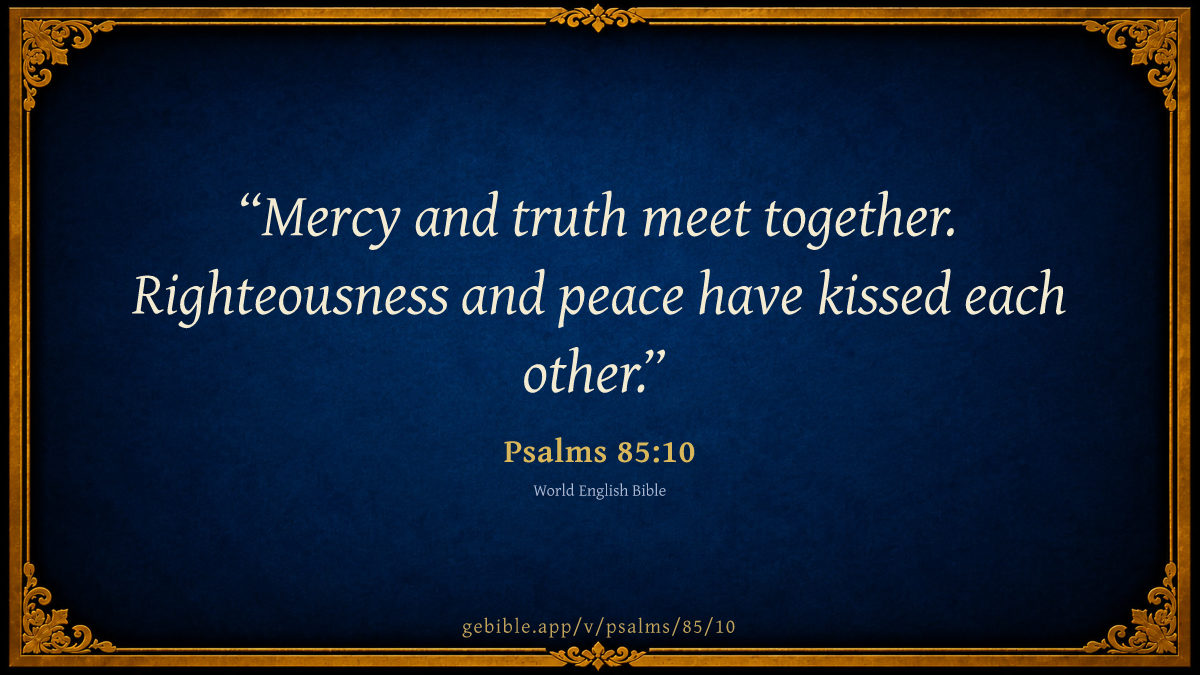
Mercy and truth meet together. Righteousness and peace have kissed each other.
Parallel Translations
-
Mercy and truth meet together. Righteousness and peace have kissed each other.
-
Mercy and truth are met together; righteousness and peace have kissed each other.
-
(85-11) Mercy and truth are met together; righteousness and peace have kissed each other.
Cross-references (16)
Passages linked to Psalms 85:10 in the Treasury of Scripture Knowledge, ordered by reader-vote popularity; verse text shown in World English Bible.
- Proverbs 3:3 Don’t let kindness and truth forsake you. Bind them around your neck. Write them on the tablet of your heart.
- Psalms 89:14 Righteousness and justice are the foundation of your throne. Loving kindness and truth go before your face.
- Psalms 100:5 For Yahweh is good. His loving kindness endures forever, his faithfulness to all generations.
- Isaiah 32:16-18 Then justice will dwell in the wilderness; and righteousness will remain in the fruitful field. The work of righteousness will be peace, and the effect of righteousness, quietness and confidence forever. My people will live in a peaceful habitation, in safe dwellings, and in quiet resting places,
- John 1:17 For the law was given through Moses. Grace and truth were realized through Jesus Christ.
- Psalms 72:3 The mountains shall bring prosperity to the people. The hills bring the fruit of righteousness.
- Romans 5:21 that as sin reigned in death, even so grace might reign through righteousness to eternal life through Jesus Christ our Lord.
- Isaiah 45:24 They will say of me, ‘There is righteousness and strength only in Yahweh.’ ” Even to him will men come. All those who raged against him will be disappointed.
- Micah 7:20 You will give truth to Jacob, and mercy to Abraham, as you have sworn to our fathers from the days of old.
- Romans 3:25-26 whom God sent to be an atoning sacrifice, through faith in his blood, for a demonstration of his righteousness through the passing over of prior sins, in God’s forbearance; to demonstrate his righteousness at this present time; that he might himself be just, and the justifier of him who has faith in Jesus.
- Hebrews 7:2 to whom also Abraham divided a tenth part of all (being first, by interpretation, “king of righteousness”, and then also “king of Salem”, which means “king of peace”,
- Exodus 34:6-7 Yahweh passed by before him, and proclaimed, “Yahweh! Yahweh, a merciful and gracious God, slow to anger, and abundant in loving kindness and truth, keeping loving kindness for thousands, forgiving iniquity and disobedience and sin; and who will by no means clear the guilty, visiting the iniquity of the fathers on the children, and on the children’s children, on the third and on the fourth generation.”
- Luke 1:54-55 He has given help to Israel, his servant, that he might remember mercy, as he spoke to our fathers, to Abraham and his offspring forever.”
- Romans 5:1 Being therefore justified by faith, we have peace with God through our Lord Jesus Christ;
- Jeremiah 23:5-6 “Behold, the days come,” says Yahweh, “that I will raise to David a righteous Branch, and he will reign as king and deal wisely, and will execute justice and righteousness in the land. In his days Judah will be saved, and Israel will dwell safely. This is his name by which he will be called: Yahweh our righteousness.
- Luke 2:14 “Glory to God in the highest, on earth peace, good will toward men.”
Cross-references from openbible.info (CC BY 4.0)
Explain this verse (17 sources)
Historical commentary, presented as a primary source — not an endorsement.
Private notes
Saved on this device only — never synced or sent anywhere.
John Calvin 1540 · Public Domain 10. Mercy and truth shall meet together. Here the…
10. Mercy and truth shall meet together. Here the verbs are in the past tense; but it is evident from the scope of the passage, that they should be translated into the future. I cordially embrace the opinion which is held by many, that we have here a prophecy concerning the kingdom of Christ. There is no doubt, that the faithful lifted up their eyes to Him, when their faith had need of encouragement and support in reference to the restoration of the Church; and especially after their return from Babylon. Meanwhile, the design of the prophet is, to show how bountifully God deals with his Church, after he is reconciled to her. The fruits which he represents as springing from this reconciliation are, first, that mercy and truth meet together; and, secondly, that righteousness and peace embrace each other From these words, Augustine deduces a beautiful sentiment, and one fraught with the sweetest consolation, That the mercy of God is the origin and source of all his promises, from whence issues the righteousness which is offered to us by the gospel, while from that righteousness proceeds the peace which we obtain by faith, when God justifies us freely. According to him, righteousness is represented as looking down from heaven, because it is the free gift of God, and not acquired by the merit of works; and that it comes from heaven, because it is not to be found among men, who are by nature utterly destitute of it. He also explains truth springing out of the earth as meaning, that God affords the most incontestable evidence of his faithfulness, in fulfilling what he has promised. But as we ought rather to seek after the solid truth, than exercise our ingenuity in searching out refined interpretations, let us rest contented with the natural meaning of the passage, which is, that mercy, truth, peace, and righteousness, will form the grand and ennobling distinction of the kingdom of Christ. The prophet does not proclaim the praises of men, but commends the grace which he had before hoped for, and supplicated from God only; thus teaching us to regard it as an undoubted truth, that all these blessings flow from God. By the figure synecdoche, some parts being put for the whole, there is described in these four words all the ingredients of true happiness. When cruelty rages with impunity, when truth is extinguished, when righteousness is oppressed and trampled under foot, and when all things are embroiled in confusion, were it not better that the world should be brought to an end, than that such a state of things should continue? Whence it follows, that nothing can contribute more effectually to the promotion of a happy life, than that these four virtues should flourish and rule supreme. The reign of Christ, in other parts of Scripture, is adorned with almost similar encomiums. If, however, any one would rather understand mercy and truth as referring to God, I have no disposition to enter into dispute with him. The springing of truth out of the earth, and the looking down of righteousness from heaven, without doubt imply, that truth and righteousness will be universally diffused, as well above as beneath, so as to fill both heaven and earth. It is not meant to attribute something different to each of them, but to affirm in general, that there will be no corner of the earth where these qualities do not flourish.
John Calvin's Commentaries (1540-1563) — public domain. Text from the Calvin Translation Society English edition (1840s-50s) via the Christian Classics Ethereal Library (ccel.org). Calvin's coverage is partial (roughly two-thirds of the Bible); uncommented books and verses are honest gaps, never fabricated. The 19th-century editor's footnotes and remarks are omitted so the notes are faithfully Calvin's own voice.
John Trapp 1656 · Public Domain Psa 85:10 Mercy and truth are met together; righteousness…
Psa 85:10 Mercy and truth are met together; righteousness and peace have kissed [each other].
Ver. 10. Mercy and truth are met together] As in God (his mercy is ever bounded by his truth), so in all his people, there is a sweet conjunction and concatenation of graces, 2Pe 1:5; and this is an effect of Christ’s kingdom in men’s hearts, Rom 14:17, Iam fides et pax, et honor pudorque Priscus, et neglecta redire virtus Audet; apparetque beata pleno Copia cornu (Horat.).
Read full note →
Righteousness and peace have kissed each other] Have friendly saluted, in allusion to the manner of the Eastern nations. See Isa 32:17 Psa 119:105.
John Trapp, A Commentary or Exposition upon All the Books of the Old and New Testament (1647–1656) — public domain. Text from a community e-Sword module.
Matthew Poole 1685 · Public Domain This is to be understood, either,
This is to be understood, either,
1. Of these graces or virtues in men. So the sense is, When that blessed time shall come, those virtues which now seem to be banished from human societies shall be restored, and there shall be a happy conjunction of mercy, or benignity; truth, or veracity;
Read full note →
righteousness, or faithfulness; and peace, or peaceableness and concord. Or rather,
2. Of the blessings of God, of which the whole context speaks. And the sense is, That great work of redemption by Christ shall clearly manifest and demonstrate God’s mercy in redeeming his people of Israel, and in the calling and conversion of the Gentiles; his
truth, in fulfilling that great promise of the sending of his Son, which is the foundation of all the rest; his righteousness, in punishing sin or unrighteousness in his Son, and in conferring righteousness upon guilty and lost creatures; and his peace, or reconciliation to sinners, and that peace of conscience which attends upon it.
Kissed each other; as friends use to do when they meet. See Exo 4:27; 18:7. So this is another expression of the same thing.
Matthew Poole's English Annotations on the Holy Bible (1683–1685) — public domain. Text from a community e-Sword/MySword module.
John Gill 1763 · Public Domain Mercy and truth are met together,.... Or "grace and…
Mercy and truth are met together,.... Or "grace and truth" (p), which are in Christ, and come by him; and so may be said to meet in him, the glorious Person, the Author of salvation, before mentioned, Joh 1:14, these may be considered as perfections in God, displayed in salvation by Christ: "mercy" is the original of it; it is owing to that that the dayspring from on high visited us, or glory dwelt in our land, or Christ was sent and came to work salvation for us; it was pity to the lost human race which moved God to send him, and him to come, who is the merciful as well as faithful High Priest, and who in his love and pity redeemed us; and though there was no mercy shown to him, he not being spared in the least, yet there was to us; and which appears in the whole of our salvation, and in every part of it, in our regeneration, pardon, and eternal life; see Luk 1:72, Pe1 1:3 or "grace", the exceeding riches of which are shown forth in the kindness of God to us, through Christ; and to which our salvation, in whole and in part, is to be attributed, Eph 2:7, "truth" may signify the veracity and faithfulness of God, in his promises and threatenings: his promises have their true and full accomplishment in Christ, Luk 1:72 so have his threatenings of death to sinful men, he being the surety for them, Gen 2:17 and so mercy is shown to man, and God is true to his word:
righteousness and peace have kissed each other; as friends at meeting used to do: "righteousness" may intend the essential justice of God, which will not admit of the pardon and justification of a sinner, without a satisfaction; wherefore Christ was set forth to be the propitiation for sin, to declare and manifest the righteousness of God, his strict justice; that he might be just, and appear to be so, when he is the justifier of him that believes in Jesus; and Christ's blood being shed, and his sacrifice offered up, he is just and faithful to forgive sin, and cleanse from all unrighteousness, Exo 34:6, Rom 3:25 and thus the law being magnified, and made honourable by the obedience and sufferings of Christ, an everlasting righteousness being brought in, and justice entirely satisfied, there is "peace" on earth, and good will to men: peace with God is made by Christ the peacemaker, and so the glory of divine justice is secured and peace with God for men obtained, in a way consistent with it, Luk 2:14 and Christ's righteousness being imputed and applied to men, and received by faith, produces a conscience peace, an inward peace of mind, which passeth all understanding, Rom 5:1.
Read full note →
(p) "gratia et veritas", Cocceius, Gejerus, Michaelis.
John Gill's Exposition of the Whole Bible (1746–1763) — public domain (CC PDM 1.0). Text via the HelloAO Bible API.
John Wesley 1765 · Public Domain Kissed - That great work of redemption by Christ,…
Kissed - That great work of redemption by Christ, shall clearly manifest God's mercy in redeeming his people Israel, and in the conversion of the Gentiles; his truth in fulfilling that great promise of sending his son, his righteousness in punishing sin, on his son, and in conferring righteousness upon guilty and lost creatures; and his peace or reconciliation to sinners, and that peace of conscience which attends upon it.
John Wesley, Explanatory Notes Upon the Whole Bible (1754–1765) — public domain. Text via the GEBible commentary corpus.
Adam Clarke 1810 · Public Domain Verse 10. Mercy and truth are met together] It…
Verse 10. Mercy and truth are met together] It would be more simple to translate the original,-
חסד ואמת נפגשו
Read full note →
צדק ושלום נשקו
Chesed veemeth niphgashu;
Tsedek veshalom nashaku,--
"Mercy and truth have met on the way
Righteousness and peace have embraced."
This is a remarkable text, and much has been said on it: but there is a beauty in it which, I think, has not been noticed.
Mercy and peace are on one side; truth and righteousness on the other. Truth requires righteousness; mercy calls for peace.
They meet together on the way; one going to make inquisition for sin, the other to plead for reconciliation. Having met, their differences on certain considerations, not here particularly mentioned, are adjusted; and their mutual claims are blended together in one common interest; on which peace and righteousness immediately embrace. Thus, righteousness is given to truth, and peace is given to mercy.
Now, Where did these meet? In Christ Jesus.
When were they reconciled? When he poured out his life on Calvary.
Adam Clarke's Commentary on the Bible (1810–1826) — public domain. Text from a community e-Sword/MySword module.
Joseph Benson 1811 · Public Domain Psa 85:10. Mercy and truth are met together, &c.…
Psa 85:10. Mercy and truth are met together, &c. — When that blessed time shall come, those virtues which now seem to be banished from human society shall be restored, and there shall be a happy union of mercy, or benignity, with truth, or veracity, and fidelity; of righteousness, or justice and equity, with peace, or peaceableness and concord. But the passage is rather to be understood of blessings from God, than of graces or virtues in man; of which blessings the whole context speaks. And then the sense is, that the great work of redemption and salvation by Christ shall clearly manifest and demonstrate God’s mercy in redeeming his people Israel, and in the calling and conversion of the Gentiles, his truth in fulfilling his promises, especially the great promise of the Messiah to come in the flesh, which was the foundation of all the other promises; his righteousness in punishing sin in the surety of sinners, of making his Son a sin-offering for us, and in conferring righteousness upon guilty and lost creatures; and his peace, or reconciliation, to penitent, believing sinners, and that peace of conscience which attends upon it. “Thus these four divine attributes, parted at the fall of Adam, met again at the birth of Christ. Mercy was ever inclined to serve man, and peace could not be his enemy; but truth exacted the performance of God’s threat, The soul that sinneth it shall die; and righteousness could not but give to every one his due. Jehovah must be true in all his ways, and righteous in all his works. Now there is no religion upon earth, except the Christian, which can satisfy the demands of all these claimants, and restore a union between them; which can show how God’s word can be true, and his work just, and the sinner, notwithstanding, find mercy and obtain peace. But a God incarnate reconciled all things in heaven and earth.” — Horne.
Joseph Benson's Commentary on the Old and New Testaments (1811–1818) — public domain. Text from a community e-Sword module.
Albert Barnes 1834 · Public Domain Mercy and truth are met together - That is,…
Mercy and truth are met together - That is, in the divine dealings referred to in the psalm. There has been a blending of mercy and truth in those dealings; or, both have been manifested; truth, in the divine statements, threatenings, and promises; and mercy, in forgiving sin, and in sparing the people. There is no necessary contradiction between truth and mercy; that is, the one does not necessarily conflict with the other, though the one seems to conflict with the other when punishment is threatened for crime, and yet mercy is shown to the offender - that is, where the punishment is not inflicted, and the offender is treated as if he had not sinned. In this respect, the great difficulty in all human governments has been to maintain both; to be true to the threatening of the law, and at the same time to pardon the guilty. Human governments have never been able to reconcile the two.
If punishment is inflicted up to the full measure of the threatening, there is no manifestation of mercy; if mercy is shown, there is a departure from justice, or a declaration that the threatenings of the law are not, in all cases, to be inflicted: that is, there is, to that extent, an abandonment of justice. Human governments have always felt the need, in their practical operations, of some device like an atonement, by which the two might be blended, and both secured. Such a method of reconciliation or of securing both objects - truth, in the fulfillment of the threat, and mercy toward the offender - has never been (and could not be) acted on in a human administration. It is only in the divine government that this has been accomplished, where a true and perfect regard has been paid to truth in the threatening, and to mercy toward the guilty by an atonement. It is true, indeed, that this passage does not refer to the atonement made by the Redeemer, but there can scarcely be found a better illustration of that work than occurs in the language used here. Compare the notes at Rom 3:26. See also my work on the “atonement,” chapters ii., iii.
Read full note →
Righteousness - In the maintenance of law, or the manifestation of justice. That is, in this case, God had shown his justice in bringing these calamities on the people for their sins. In the work of the Redeemer this was done by his being “wounded for our transgressions, and bruised for our iniquities;” by the fact that “the chastisement of our peace was upon him,” and that “the Lord laid on him the iniquity of us all.” Isa 53:5-6. “And peace.” Pardon; mercy; restoration to favor. In the case of the Hebrew people this was done by his removing the calamities which their sins had brought upon them, and by his returning favor. In the work of redemption, it was done by the pardon of sin, and by reconciliation to God.
Have kissed each other - As friends and lovers do; as they do who have been long separated; as they do who, after having been alienated and estranged, are made friends again. In like manner, there seemed to be an alienation - an estrangement - a state of hostility - between righteousness and mercy, between justice and pardon, but they have been now united as separated and alienated friends are, and have embraced each other as such friends do; that is, they blend together in beautiful harmony.
Albert Barnes' Notes on the Bible (1834–1885) — public domain. Text from a community e-Sword/MySword module.
Daniel D. Whedon 1874 · Public Domain 10. Mercy and truth are met together—The “mercy” of…
10. Mercy and truth are met together—The “mercy” of God can never operate apart from his “truth”—they are inseparable. See Psa_25:10; Psa_40:11; Psa_61:7.
Righteousness and peace have kissed each other—Their agreement and public manifestation have been simultaneous. “Peace,” which is the essence of the answer sought, (Psa_85:8,) is now made to appear in its eternal union with “righteousness.” The harmony of the divine attributes in the moral government is thus declared. In moral government, and in redemption, “mercy” and “peace” can never be granted but upon the grounds of “truth” and “righteousness.” Men must abjure all sin, and aim to fulfil all righteousness by a holy life and obedient walk with God, if they would be approved of him. From Psa_85:10, throughout, the psalmist unfolds the answer of his prayer as faith already receives it.
Daniel D. Whedon (gen. ed.), Commentary on the Old and New Testaments (1874–1909) — public domain. Text from a community e-Sword module.
The Cambridge Bible for Schools and Colleges 1878 · Public Domain 10. Does this verse speak of the divine attributes…
10. Does this verse speak of the divine attributes which conspire together in the work of salvation, or of the human virtues which will characterise the new community? Primarily of the former. God’s lovingkindness and truth—the love which moved Him to enter into covenant with Israel, and the faithfulness which binds Him to be true to His covenant—meet in Israel’s redemption. Righteousness and peace greet one another with joyous welcome. Jehovah is a righteous God and therefore a Saviour (Isa_45:21). Because salvation is His eternal purpose and He cannot change His purpose, therefore He reconciles His people to Himself. For lovingkindness and truth as attributes of God—often as here almost personified as ministering angels—see Exo_34:6; Psa_25:10; Psa_40:11; Psa_57:3; Psa_57:10; Psa_61:7; Psa_86:15; Psa_89:14; Psa_115:1; Psa_138:2; Mic_7:20. For the connexion of ‘righteousness’ with salvation see on Psa_65:5, and note the frequency of this thought in Isaiah 40 ff.
While however divine attributes are primarily meant, the corresponding human virtues (Pro_3:3; Isa_32:16 f.) need not be excluded. The restored community will reflect the attributes of God to which it owes its existence. Cp. Hos_2:19-20; Zec_8:8; Zec_8:16; Zec_8:19. This thought is more clearly brought out in the next verse.
The Cambridge Bible for Schools and Colleges (gen. ed. J. J. S. Perowne; Cambridge University Press, 1878–1918) — public domain. Text from a community e-Sword module.
Ellicott's Commentary for English Readers 1878 · Public Domain (10) Met together.—The word is used of those who…
(10) Met together.—The word is used of those who should be friends, but whom circumstances have sundered (Pro_22:2).
A Bible Commentary for English Readers, edited by Charles John Ellicott (1878–1897) — public domain. Text from a community e-Sword module.
The Pulpit Commentary 1880 · Public Domain Mercy and truth are met together. God"s mercy and…
Mercy and truth are met together. God"s mercy and God"s truth are reconciled and brought into harmony. The psalmist does not say probably does not know how, He accepts the fact of the reconciliation, which is revealed to him (ver. 8) by faith, and boldly announces it. The explanation was reserved for the coming and teaching of Christ. Righteousness and peace have kissed each other. "Righteousness" and "peace" are synonymous with "mercy" and "truth." Here they are personified as angels in human form" (Cheyne).
Our foes become our friends.
Read full note →
It is difficult, indeed impossible, to say what was the actual thought of the writer when he penned the words of our text; for they are true in several ways. He represents mercy and truth as going in different directions, and with opposite intent, but they meet, and are brought into harmony as though at variance before. And it is the same with righteousness and peace; there seemed no common course of action open to them; they must be opposed; but, lo! they embrace, and all discord ceases between them. Now, where is such union of opposites to be seen? And we answer
I IN GOD. In the wisdom of God when devising our salvation. Christ is the Wisdom of God, because in him, whilst mercy has full scope, nevertheless, the Law is magnified and made honourable. There was no compromise, no tampering with the holy Law of God, although God did so love the world as to save it. (Joh_3:16) Love reigns, yet the Law is fulfilled as it never was or could be before, and is magnified in infinitely higher way than if in vindication of God"s broken Law the whole human race bad been forever condemned. (cf. Rom_8:4) All this was shadowed forth by the tables of the Law being placed within the ark of the covenant, on which rested the mercy seat, and whereon was sprinkled the atoning blood. (1Jn_2:2) Thus in God those attributes which seemed to be and were hostile to us, and those which alone seemed our friends, met together, were reconciled, and, as it were, kissed each other.
II IN MAN. Probably this was the thought of the psalmist. He is exulting in the anticipation of the regenerated moral life of God"s people when his salvation should come to them; cruelty and inhumanity should give way to mercy, and truth between man and man should replace their too common falsehood and lies; righteousness, justice, fair dealing, should prevail instead of fraud and wickedness, and peace should banish war. "Earth should be carpeted with truth as with fair flowers, and be canopied over by righteousness as with the beautiful sky, or as by night with the glorious stars." Men should "serve God in holiness and righteousness without fear, all the days of their life.
III IN CHRIST. The text may be taken, has been so, as descriptive of the holy and beautiful life of our Lord of him "who did no sin, neither was guile found in his mouth." In him, as in no other, those contrasted qualities of our humanity, which in us are generally so ill balanced, found perfect equipoise and harmony. The Divine symmetry and fair proportions of the holy life, "the breadth, and length, and depth, and height", (Eph_3:18) were seen in all their beauty. He was "the perfect Man, Christ Jesus," the lovely Image on which the saints gazed with perpetual, adoring rapture, and grew towards whilst they gazed, and so became the saints, the holy ones, they were. Yes, in him our text was indeed fulfilled. And
IV IN GRACE. (See 1Co_1:30) What is the true Christian but one who has known in his own experience the power of the perfect Christ? Some believe in a Christ whom they have fashioned to themselves, as all fondness and compassion and pity, who will not be stern with any one. Others conceive of him only as an awful Judge, launching out the thunderbolts of his wrath against wretched, sinful men. But the grace which saves is that told of Titus. (Tit_2:11-14) Grace includes mercy and truth, righteousness and peace. S.C.
The Pulpit Commentary (1880–1919), ed. H.D.M. Spence-Jones & Joseph S. Exell — public domain. Text from a community e-Sword module.
Charles H. Spurgeon 1885 · Public Domain Ver. 10. Mercy and truth are met together. In…
Ver. 10. Mercy and truth are met together. In answer to prayer, the exulting psalmist sees the attributes of God confederating to bless the once afflicted nation. Mercy comes hand in hand with Truth to fulfil the faithful promise of their gracious God; the people recognise at once the grace and the veracity of Jehovah, he is to them neither a tyrant nor a deceiver.
Righteousness and peace have kissed each other. The Lord whose just severity inflicted the smart, now in pity sends peace to bind up the wound. The people being now made willing to forsake their sins, and to follow after righteousness, find peace granted to them at once. "The war drum throbbed no longer, and the battle flags were furled; " for idolatry was forsaken, and Jehovah was adored. This appears to be the immediate and primary meaning of these verses; but the inner sense is Christ Jesus, the reconciling Word. In him, the attributes of God unite in glad unanimity in the salvation of guilty men, they meet and embrace in such a manner as else were inconceivable either to our just fears or to our enlightened hopes. God is as true as if he had fulfilled every letter of his threatenings, as righteous as if he had never spoken peace to a sinner's conscience; his love in undiminished splendour shines forth, but no other of his ever blessed characteristics is eclipsed thereby. It is the custom of modern thinkers(?) to make sport of this representation of the result of our Lord's substitutionary atonement; but had they ever been themselves made to feel the weight of sin upon a spiritually awakened conscience, they would cease from their vain ridicule. Their doctrine of atonement has well been described by Dr. Duncan as the admission "that the Lord Jesus Christ did something or other, which somehow or other, was in some way or other connected with man's salvation." This is their substitute for substitution. Our facts are infinitely superior to their dreams, and yet they sneer. It is but natural that natural men should do so. We cannot expect animals to set much store by the discoveries of science, neither can we hope to see unspiritual men rightly estimate the solution of spiritual problemsthey are far above and out of their sight. Meanwhile it remains for those who rejoice in the great reconciliation to continue both to wonder and adore.
Read full note →
Ver. 10. Mercy and truth; righteousness and peace. Note, four virtues stand out prominently in the incarnation; namely, mercy, truth, righteousness and peace, or love producing peace. These were like four steps of the throne of Christ, or four princes standing near and accompanying Him.
1. On the right hand, is mercy presenting the olive.
2. On the left, truth holding the white lily.
3. Before Him walks justice bearing the balance.
4. Peace follows Him, having a cornucopiae full of flowers, and scattering the flowers around. Le Blanc.
Ver. 10. Mercy and truth; righteousness and peace. These four divine attributes parted at the fall of Adam, and met again at the birth of Christ. Mercy was ever inclined to save man, and Peace could not be his enemy; but Truth extracted the performance of God's threat, "The soul that sinneth, it shall die; "and Righteousness could not but give to every one his due, Jehovah must be true in all his ways, and righteous in all his works. Now there is no religion on earth, except the Christian, which can satisfy the demands of all these claimants, and restore an union between them; which can show how God's word can be true, and his work just, and the sinner, notwithstanding, find mercy, and obtain peace. George Horne.
Ver. 10. This is a remarkable text, and much has been said on it; but there is a beauty in it which, I think, has not been noticed. Mercy and peace are on one side; truth and righteousness on the other. Truth requires righteousness; mercy calls for peace. They meet together on the way; one going to make inquisition for sin, the other to plead for reconciliation. Having met, their differences on certain considerations, not here particularly mentioned, are adjusted; and their mutual claims blended together in one common interest; on which peace and righteousness immediately embrace. Thus, righteousness is given to truth, and peace is given to mercy. Now, where did these meet? In Christ Jesus. When were they reconciled? When he poured out his life on Calvary. Adam Clarke.
Ver. 10. Mercy and truth are met together.
1. They meet together in God; for all the paths of the Lord are mercy and truth, Ps 25:9; mercy in making, and truth in keeping his promise to his people. Paul saith, Jesus Christ was a minister of the circumcision to the truth of God, to confirm the promises made unto the fathers, and that the Gentiles might glorify God for his mercy. Ro 15:8. God promised his Son unto the Jews, and he gave him in the fulness of time to be both a light to the Gentiles, and glory to his people Israel; herein shewing his mercy more principally to the Gentiles, his truth unto the Jews, and so his mercy and truth embraced each other so that he made both people but one, to wit, one flock, in one sheepfold, under one shepherd. If we take truth and righteousness for God's justice in punishing, mercy and peace for his graciousness in pardoning; yet as they meet together in all his ways unto such as keep his covenant and his testimonies. For as the mercies of the wicked are full of cruelty, so the very judgments of God upon his servants are full of mercy. In his wrath he remembers pity; punishing a little, that he may pardon a great deal; destroying the flesh only to save the spirit, 1Co 5:5. Misericordiae est aliquando subtrahere misericordiam. It was good for Joseph that he was a captive; good for Naaman that he was a leper; good for Bartimaeus that he was blind, and for David that he was in trouble. Bradford thanked God more of his prison, than of any parlour or pleasure. All things are for the best unto the faithful, and so God's mercy and truth are met together; righteousness and peace have kissed each other, his mercy being just, and his justice being merciful; but God in giving his only Son unto the world, more abundantly shewed his mercy and justice kissing one another. His justice that every soul that sins should die; but his mercy desires not the death of a sinner. Eze 33:11...
2. Righteousness and peace meet together in man; so Augustine expounds it: an unjust man is full of quarrels, like Ishmael, "every man's hand is against him, and his hand against every man; "but he who is righteous, and giveth every man his due, shall have peace, so much as is possible with all men, especially with his own self and soul. Righteousness and peace are so near, so dear, that thou canst not have the one without the other.
3. Righteousness and peace meet in Christ, God's man; for by these two, some divines understand the Old Testament and the New. The Law doth exact justice, requiring of a malefactor "eye for eye, tooth for tooth, hand for hand, foot for foot; "but the Gospel is full of mercy and peace, saying unto the sinner, who truly repenteth him of his sins, and unfeignedly believes the word of promise, "Son, be of good comfort, thy sins are forgiven thee; ""Daughter be of good cheer, thy faith hath made thee whole; ""Go thy way, they belief hath saved thee; ""Behold, thou art now made whole, sin no more." These two testaments meet together in Christ, as in their proper centre, they kissed each other on this (Christmas) day, because the gospel performed what the law promised. John Boys.
Ver. 10. When our Lord spake that parable of the prodigal son, and represented the Father as seeing his child afar off in his misery, and how he had compassion on him, and ran and fell on his neck and kissed him, one cannot but feel what a touching and tender illustration he has given of this most exquisite passage of his own word: Mercy and truth are met together; righteousness and peace have kissed each other. Barton Bouchier.
Ver. 10-11. Mercy and Peace if they had met, or Truth and Righteousness, either of the two, it had not been strange. But for these that seem to be in opposition to do it, that makes this meeting marvellous in our eyes. Will you stay a little and take a view of the parties? Four they are. These four,
1. Mercy, and
2. Truth,
3. Righteousness, and
4. Peace. Which quaternion at the first sight divides itself into two and two. Mercy and Peace, they two pair well; they be collectanae, as Bernard saith of them in one place, `bed fellows, 'sleep together; collectanae, as in another place, `sucked one milk, one breast' both. And as these two, so the other two; Truth and Righteousness seem to be of one complexion and disposition, and commonly take part together. Of these Mercy seems to favour us; and Peace no enemy to us or to any (seeing we must speak of them as of persons); mild and gentle persons both. For Righteousness I know not well what to say: gestat gladium, (bears the sword), and I fear non frustra (not in vain). Nor of Truth, who is vera and severa, `severe' too otherwhile. These I doubt are not like affected. The reason of my doubt. One of them, Righteousness, it is told here for great news, that she but "looked down hitherwards from heaven." Before then she would not have done that. A great sign it is of heart burning, when one will not do so much as look at anothernot endure his sight. We cannot promise ourselves much of her. No, nor of Truth. One was so bold in a place to say, omnis homo mendax (Ro 3:4), and feared no challenge for it. By that it seems all stands not well with her neither. So then two for us, two against us. For their order. Mercy is first, and Peace last. With both ends we shall do well enough. God send us to do but so with the midst! Yet this is not amiss that they which favour us less are in the midst; hemmed in on both sides, closed about with those that wish us well; and they between us and them. On the one side, Mercy before; on the other, Peace behind another; that in this double meeting Mercy sorts not herself, goes not to Righteousness; nor Righteousness to her, but to Peace. A kind of cross meeting, as it were, there isthe better hope of accord. Mercy and Righteousness have no symbolizing quality at all, no hope of them; but Truth with Mercy hath. There is truth as well in the promise of Mercy as in the threat of justice. Lancelot Andrewes.
Ver. 10.
I. The attributes displayed in man's salvation.
1. Mercy in the promise.
2. Truth in its fulfilment.
3. Righteousness in the manner of its fulfilment.
4. Peace in its results. II. These attributes harmonized in man's salvation.
1. How? Met togetherkissed each other.
2. Why? Each on its own account. All on each others' account.
3. Where? Met and kissed, (1.) In the covenant. (2.) At the incarnation. (3.) At the cross. (4.) At the conversion of every sinner. (5.) At the completion of the saints in heaven. G. R.
Ver. 10. The Pulpit, vol. 28, 1836, contains a sermon by R. W. Sibthorpe, in which the preacher,
I. Considers the harmony of the divine perfections in
the redemption of a sinner.
II. The wisdom of the divine dealings in the calling
and guidance of the believer; so that mercy, truth,
etc., each becomes in turn conspicuous in our
experience.
III. The completeness of the divine image in the
sanctified soul, so that the perfected saint
abounds in mercy and truth, is filled with peace, and
is conformed to his righteous Lord.
Psalms 85:11*
Ver. 10-11. See Psalms on "Ps 85:10" for further information.
Charles H. Spurgeon's The Treasury of David (1869–1885) — public domain. Psalms only. Text from a community e-Sword/MySword module.
The Biblical Illustrator 1887 · Public Domain Mercy and truth are met together; righteousness and peace…
Psa_85:10-13
Mercy and truth are met together; righteousness and peace have kissed each other.
Read full note →
The bridal of the earth and sky
This is a lovely and highly imaginative picture of the reconciliation and reunion of God and man. The poet psalmist, who seems to have belonged to the times immediately after the return from the exile, in strong faith sees before him a vision of a perfectly harmonious co-operation and relation between God and man. He is not prophesying directly of Messianic times.
1. The heavenly twin sisters, and the earthly pair that corresponds. Mercy and truth are met together--that is one personification; Righteousness and peace have kissed each other is another. It is difficult to say whether these four great qualities are to be regarded as all belonging to God, or as all belonging to man, or as all common both to God and man. I am disposed to think of the first pair as sisters from the heavens, and the second pair as the earthly sisters that correspond with them. Mercy and truth are met together means this: That these two qualities are found braided and linked inseparably in all that God does with mankind. Mercy is love that stoops, love that departs from the strict lines of desert and retribution. And truth blends with mercy. That is to say, truth in a somewhat narrower than its widest sense, meaning mainly Gods fidelity to every obligation under which He has come. Gods faithfulness to promise, Gods fidelity to His past, Gods fidelity in His actions, to His own character, which is meant by that great Word, He sware by Himself. Love is thus lifted up above the suspicion of being arbitrary, or of ever changing or fluctuating. In the second two, Righteousness and peace have kissed each other, we have the picture of what happens upon earth when mercy and truth that come down from heaven are accepted and recognized. To put away metaphor, here are two thoughts.
(1) That in mens experience and life righteousness and peace cannot be rent apart. The only secret of tranquillity is to be good.
(2) Righteousness and her sister, Peace, only come in the measure in which the mercy and the truth of God are received into thankful hearts.
2. God responding to mans truth. Truth shall spring out of the earth, and righteousness shall look down from heaven. Where a mans heart has welcomed the mercy and the truth of God, there shall spring up in that heart, not only the righteousness and peace, of which the previous verse is speaking, but specifically a faithfulness not all unlike the faithfulness which it grasps. Righteousness looks down, not in its judicial aspect merely, but as the perfect moral purity that belongs to the Divine nature. No good, no beauty of character, no meek rapture of faith, no aspiration Godwards, is ever wasted and lost, for His eye rests upon it.
3. Man responding to Gods gift. Yea, the Lord shall give that which is good, and our land shall yield her increase. Earthly fruitfulness is only possible by the reception of heavenly gifts. The earth yields her increase by laying hold of the good which the Lord gives, and by reason of that received good quickening all the germs.
4. God teaching man to walk in His footsteps. Righteousness shall go before Him and set us in the way of His steps. The psalmist here draws tighter than ever the bond between God and man. Man may walk in Gods ways--not only in the ways that please Him, but in the ways that are like Him, and the likeness can only be a likeness in moral quality. (A. Maclaren, D. D.)
A blessed coalition
I. Here is a coalition of the most blessed qualities. Mercy, a modification of love, love commiserating: truth, which means reality, eternally antagonistic to all shams and hypocrisies; righteousness, the immutable law of the moral universe, to which all must bow sooner or later; peace, not insensibility, inaction, or stagnation, but the moral repose of souls centred in God. These are the moral qualities here specified; and more precious are they a thousand times than all the gems of ocean, or orbs of immensity.
II. Here is a coalition of blessed qualities that have been separated. In all human history, ever since the introduction of sin, these blessed qualities have been working separately and even antagonistically. There has been mercy without truth, and peace of a certain kind, without righteousness. They have not worked together either in communities or in individuals, hence the constant agitations and struggles in all human life.
III. Here is a coalition of qualities blessed in their reunion. Mercy and truth are met together; righteousness and peace have kissed each other. These celestial sisters come together and embrace one another with delight. Blessed is this union! Let them be united in our hearts and conduct! (Homilist.)
Divine perfections united to save sinners
In the restoration of the Church by Jesus Christ, the glorious attributes of the great Jehovah conspire together for the redemption and salvation of sinners. And although the perfections of God, mentioned in the text, may be represented as opposed to each other, yet in the covenant of grace they all agree. Observe the uncommonness of such a meeting: two opposites in two pairs, meeting together. The unanimity of such a meeting; that contraries should shake hands and kiss each other.
I. That the perfections of Jehovah do harmonize in their respective claims concerning the salvation of the Church.
1. Mercy pleads for the guilty Church (Psa_86:15).
2. Truth stands up for Gods faithfulness against sin (Gen_2:17).
3. Righteousness or justice comes and claims execution (1Jn_3:4; Rom_12:9).
4. Peace pleads for a mediator (Job_33:24; Isa_9:6; Gal_4:4).
II. The time and place of this friendly meeting.
1. The place of assembly was in Christ (Col_1:19; 2Co_5:19).
(1) Mercy is vouchsafed to the soul deserving of eternal death, through the mediation of Christ.
(2) Truth or faithfulness stands engaged for the soul through Him, being upheld by Him, through the atonement.
(3) Righteousness or justice is satisfied in him, and pleads for an everlasting release.
(4) Peace flows into the soul of the believer, as proof of the unanimity of the meeting.
2. Some of the various meetings called by these parties.
(1) At the eternal council-table of covenant love (Eph_1:5).
(2) In the garden of Eden after the fall (Gen_3:15).
(3) At Bethlehem at our Saviours advent (Luk_2:11):
(4) On Mount Calvary (Heb_12:2),
III. The manner of their meeting in the souls salvation.
1. A wonderful meeting (1Ti_3:16).
2. A joyous meeting (Isa_53:10).
3. A holy meeting (Jer_2:2; Jer_2:8).
4. A happy meeting (Eph_1:8).
5. A free meeting (2Ti_1:9).
6. An unexpected meeting to us (Rom_11:33).
7. An inseparable meeting (Heb_13:8).
IV. The glorious purpose for which they met.
1. To promote Jehovahs glory (Eph_1:6).
2. To disunite some unhappy meetings (Isa_28:18).
3. To unite opposite characters (1Co_1:7; Joh_17:21).
4. To unite opposite nations in one body (Eph_2:16).
5. To unite opposite covenants of works and grace (Rom_10:4).
6. To bring the Church to glory (Heb_2:10). (T. B. Baker)
The tenderness of Gods rule
We commonly think of Gods righteousness as contrary to His mercy; we supplicate His regard for us, personally, to qualify His regard for right. How hard it is to recognize that law is the minister of love, and love the fulfilling of law! Let us now consider some of the ways in which He reveals this to us.
I. Parental rule is one of these ways. The government of every pious household is, in measure, a revelation of the government of God. Men are but children of a larger growth. We call ourselves the children of God, and this is much more than a merely endearing name. We have all a childs hold on Gods affections, all a childs need of discipline and correction, all s childs power to grieve Him; and He has all a Fathers kind determination to train us in right.
II. The tenderness of Gods strict rule is revealed to us again in the experience of life. It is hard to say whether most injury is done by over-strictness or by over-indulgence. Regard for right is the truest personal regard. God would shield men from woes unnumbered, from confusion of an unregulated will, from the conflict of passion, from the loathing that follows self-indulgence; and, therefore, has He made His laws so severe and certain, and, therefore, does He subdue us to His laws. Truth is not opposed to mercy; where there is no righteousness love works destruction. The experience of life prepares us to turn in gladness to our God, in gladness to rest in the rule of Him in whom we see that mercy and truth are met together, etc.
III. This revelation, again, is granted in prayer. We mourn under some appointment of life, thinking God is punishing us in it for our sins; as we pray to Him, we learn that we are not being punished, but chastened. We ask that Gods anger may be taken away and we forgiven; we see that we are already forgiven, and that what we thought was anger was only the fidelity of love.
IV. The tenderness of Gods strict law is revealed to us in the Gospel of Christ. It is personal regard for man which we see pre-eminently in Jesus; yet who so much as He makes us feel the constraining bond of righteousness? He is filled with human sympathy; in the fulness of His pity He makes their sorrows, and their shame, and their struggles His own; but the influence of His associations is to make men feel more and more that they cannot escape the rule of God. He delivers them from the penalties of law; but it is to awaken in them a reverence for it, deeper and more solemn than any experience of penalty can be. He frees them from its pains by transforming its painfulness into an entire devotion to it. He shows them that personal regard is not at variance with regard for right; for the Father, who loved the Son, did not out of regard for Him turn aside from strictest law.
V. The closing verses declare the blessed effects of this discovery in a true and fruitful, in a trusting, an intelligent and obedient life; in a life hallowed by Gods smile and crowned with His constant benediction. (A. Mackennal, D. D.)
Rigorousness and clemency in Gods procedure with man
The words truth, righteousness, and judgment in these passages we shall take to represent the stern, the inflexible, and severe in Gods dealing with men; and the words mercy and peace to represent the mild and the clement.
I. In Gods procedure with man these principles are found in harmonious co-operation.
1. We see these two principles harmoniously operating in Gods dealing with us through the phenomena of nature. In the earthquake and the tornado, in the fierce lightnings and the rolling thunders, in the raging oceans and the furious winds, we feel ourselves confronted with the stern, the rigorous, and the terrible; but in the serene and the sunny we feel ourselves in the presence of the mild and the lenient. Both in nature work together, they kiss each other, and bring about the good ordained.
2. We see these two principles harmoniously operating in Gods dealing with us through the events of human history. When we read the history of our race--its wars, famines, pestilences, and innumerable calamities--we are brought before the severe and awful in God; whilst in the happiness of tribes, the prosperity of nations, and the gradual advancement of the race, we see the merciful and the kind; but both principles co-operate, the rigorous and the clement. They meet and kiss each other. They are in a blessed partnership in their endeavours to make humanity what God would have it be.
3. We see these two principles harmoniously operating in Gods dealing with us through the circumstances of individual life. In the various afflictions, physical, intellectual, and social, which every man has, God in the sterner aspects of His character appears before us; whilst in the pleasures and enjoyments of our life He faces us in an aspect tender and kind. But both principles co-operate. Our light afflictions, which are but for a moment, etc.
4. We see these two principles harmoniously operating in Gods dealing with us through the means of redemptive Providence. In the life of Christ, God seems in one aspect terribly righteous, on the other side infinitely merciful, but the two are one; they meet, kiss, and co-operate in making a perfect Saviour. It is so in the redemptive training of men for everlasting blessedness. First, law comes to the man with its flashing light and terrible thunder, rousing conscience, and kindling the terrible fames of remorse, and the Divine One seems rigorous and awful. Then comes the assurance of forgiveness, the centralizing the affections in infinite love, and ell in God seems tender and merciful. But the two principles meet together and co-operate in bringing about the same blessed result, viz., the training of the soul for a higher life.
II. Though these principles harmoniously co-operate in Gods procedure with man, one is ever in the ascendant. Mercy rejoiceth against judgment.
1. In the phenomena of nature you see more of the clement than the stern. The mild, and not the rigorous, is the queen of nature; storms and earthquakes, thunderings and lightnings are but the exceptions; sunny days, serene earth, and calm atmospheres are the rule.
2. In the events of human history you see more of the clement than the stern. History, it is true, records bloody wars, blasting pestilences, and writhing famines, but these after all are only exceptions in Gods dispensations with mankind; peace, health, and plenty, have been the rule.
3. In the circumstances of individual life you see more of the element than the stern. It is true we have our afflictions and our sorrows, but these are exceptions. As a rule, the existence of most men is that of health and judgment; goodness and mercy follow us. Mercy rejoiceth against judgment, in our experience.
4. In the means of redemptive Providence you see more of the clement than the stern. In the Christian life there have been the pains connected with conviction, repentance, and conversion; but these are in the initial stages of the Christian life; succeeding stages are generally calm, and often jubilant, and the end everlasting life. (Homilist.)
Mercy and truth meeting together
There is always truth enough in the world, but it is merciless truth. Men are quick enough to see the faults and sins of their neighbours. If truth is merely fault-finding, then there is plenty of it everywhere. No man ever commits a sin but some one sees it and points it out. But cold, hard truth never convinces; it only provokes; It hardens instead of converting. It seems like injustice, cruelty, wrong. Truth without love has, therefore, virtually the effect of falsehood. It is often said that men are seldom converted by argument or controversy. This is because controversy is so apt to be carried on in a spirit of coldness and hatred, rather than love. There is also enough love in the world, if love means only kind feelings, weak good-will, which is too full of sympathy to see the faults of others and point them out, which will concede or suppress truth for the sake of peace. No. Love which has no truth in it is not love, but real enmity. To treat a bad man as if he were not bad, is a cruel kindness. It puts darkness for light, and light for darkness; bitter for sweet, and sweet for bitter. It confounds moral distinctions. It encourages the man who might be cured by vigorous remedies to go on from bad to worse till he is incurable. It is not easy to unite these great forces, for they are polar forces and antagonist. A truthful man tends always to be too hard; a loving man tends to be too soft and yielding. This conflict between truth and love is sometimes presented to us as a problem in ethics. If a robber asks me which way his victim has gone, shall I tell a lie and deceive him or not? Shall I tell a lie to an insane person or a sick person for his good? Is it right ever to deceive? These questions, when put in abstract form, cannot always be answered. But the practical answer comes to us if we have learned to live in truth and love. When these are united in our character, they will not be divided in our speech or our action. We shall not tell any lies from good nature, but we shall be taught in the hour of exigency what to do and say. The promise of Jesus will be fulfilled: Take no thought what ye shall say, for it will be given you in that hour what ye ought to say. If we live in the whole a united life, we shall not act partially or in a one-sided way. The Lord will help us in each exigency to say and do the right thing, not sacrificing truth to love or love to truth. Life often teaches us that way which logic fails to find. The only live work, too, is that which has both truth and love in it. We must love our work, to do it well; We must also believe in it, to do it well. The lowest drudgery becomes a fine art when we put our mind and heart into it: a fine art becomes mere drudgery when we practise it only to make money or get reputation out of it. Work is very hard when we do it only because we must; it is very easy when we have faith in it and love it. (J. F. Clarke.)
True peace is inseparable from righteousness
Peace may be sought two ways. One way is as Gideon sought it when he built his altar in Ophrah, naming it, God send peace, yet sought this peace that he loved as he was ordered to seek it, and the peace was sent in Gods way. The country was in quietness forty years in the days of Gideon. And the other way of making peace is as Menahem sought it when he gave the King of Assyria a thousand talents of silver, that his hand might be with him. That is, you may either win your peace or buy it--win it by resistance to evil; buy it by compromise with evil No peace is ever in store for any of us, but that which we shall win by victory over shame or sin-victory over the sin that oppresses, as well as over that which corrupts. (John Ruskin.)
The Biblical Illustrator, edited by Joseph S. Exell (c. 1880s–1900s) — public domain. Text from a community e-Sword module.
Alexander MacLaren 1905 · Public Domain Psa 85:10 - Psa 85:13.
Psalms
‘THE BRIDAL OF THE EARTH AND SKY’
Read full note →
Psa 85:10 - Psa 85:13.
This is a lovely and highly imaginative picture of the reconciliation and reunion of God and man, ‘the bridal of the earth and sky.’
The Poet-Psalmist, who seems to have belonged to the times immediately after the return from the Exile, in strong faith sees before him a vision of a perfectly harmonious co-operation and relation between God and man. He is not prophesying directly of Messianic times. The vision hangs before him, with no definite note of time upon it. He hopes it may be fulfilled in his own day; he is sure it will, if only, as he says, his countrymen ‘turn not again to folly.’ At all events, it will be fulfilled in that far-off time to which the heart of every prophet turned with longing. But, more than that, there is no reason why it should not be fulfilled with every man, at any moment. It is the ideal, to use modern language, of the relations between heaven and earth. Only that the Psalmist believed that, as sure as there was a God in heaven, who is likewise a God working in the midst of the earth, the ideal might become, and would become, a reality.
So, then, I take it, these four verses all set forth substantially the same thought, but with slightly different modifications and applications. They are a four-fold picture of how heaven and earth ought to blend and harmonise. This four-fold representation of the one thought is what I purpose to consider now.
I. To begin with, then, take the first verse:-’Mercy and Truth are met together, Righteousness and Peace have kissed each other.’ We have here the heavenly twin-sisters, and the earthly pair that correspond.
‘Mercy and Truth are met together’-that is one personification; ‘Righteousness and Peace have kissed each other’ is another. It is difficult to say whether these four great qualities are here regarded as all belonging to God, or as all belonging to man, or as all common both to God and man. The first explanation is the most familiar one, but I confess that, looking at the context, where we find throughout an interpenetration and play of reciprocal action as between earth and heaven, I am disposed to think of the first pair as sisters from the heavens, and the second pair as the earthly sisters that correspond to them. Mercy and Truth-two radiant angels, like virgins in some solemn choric dance, linked hand in hand, issue from the sanctuary and move amongst the dim haunts of men making ‘a sunshine in a shady place,’ and to them there come forth, linked in a sweet embrace, another pair, Righteousness and Peace, whose lives depend on the lives of their elder and heavenly sisters. And so these four, the pair of heavenly origin, and the answering pair that have sprung into being at their coming upon earth;-these four, banded in perfect accord, move together, blessing and light-giving, amongst the sons of men. Mercy and Truth are the divine-Righteousness and Peace the earthly.
Let me dwell upon these two couples briefly. ‘Mercy and Truth are met together’ means this, that these two qualities are found braided and linked inseparably in all that God does with mankind; that these two springs are the double fountains from which the great stream of the ‘river of the water of life,’ the forthcoming and the manifestation of God, takes its rise.
‘Mercy and Truth.’ What are the meanings of the two words? Mercy is love that stoops, love that departs from the strict lines of desert and retribution. Mercy is Love that is kind when Justice might make it otherwise. Mercy is Love that condescends to that which is far beneath. Thus the ‘Mercy’ of the Old Testament covers almost the same ground as the ‘Grace’ of the New Testament. And Truth blends with Mercy; that is to say-Truth in a somewhat narrower than its widest sense, meaning mainly God’s fidelity to every obligation under which He has come, God’s faithfulness to promise, God’s fidelity to His past, God’s fidelity, in His actions, to His own character, which is meant by that great word, ‘He sware by Himself!’
Thus the sentiment of mercy, the tender grace and gentleness of that condescending love, has impressed upon it the seal of permanence when we say: ‘Grace and Truth, Mercy and Faithfulness, are met together.’ No longer is love mere sentiment, which may be capricious and may be transient. We can reckon on it, we know the law of its being. The love is lifted up above the suspicion of being arbitrary, or of ever changing or fluctuating. We do not know all the limits of the orbit, but we know enough to calculate it for all practical purposes. God has committed Himself to us, He has limited Himself by the obligations of His own past. We have a right to turn to Him, and say; ‘Be what Thou art, and continue to be to us what Thou hast been unto past ages,’ and He responds to the appeal. For Mercy and Truth, tender, gracious, stooping, forgiving love, and inviolable faithfulness that can never be otherwise, these blend in all His works, ‘that by two immutable things, wherein it was impossible for God to lie, we might have a strong consolation.’
Again, dear brethren! let me remind you that these two are the ideal two, which as far as God’s will and wish are concerned, are the only two that would mark any of His dealings with men. When He is, if I may so say, left free to do as He would, and is not forced to His ‘strange act’ of punishment by my sin and yours, these, and these only, are the characteristics of His dealings. Nor let us forget-’We beheld His glory, the glory as of the Only Begotten of the Father, full of grace and truth.’ The Psalmist’s vision was fulfilled in Jesus Christ, in whom these sweet twin characteristics, that are linked inseparably in all the works of God, are welded together into one in the living personality of Him who is all the Father’s grace embodied; and is ‘the Way and the Truth and the Life.’
Turn now to the other side of the first aspect of the union of God and man, ‘Mercy and Truth are met together’; these are the heavenly twins. ‘Righteousness and Peace have kissed each other’-these are the earthly sisters who sprang into being to meet them.
Of course I know that these words are very often applied, by way of illustration, to the great work of Jesus Christ upon the Cross, which is supposed to have reconciled, if not contradictory, at least divergently working sides of the divine character and government. And we all know how beautifully the phrase has often been employed by eloquent preachers, and how beautifully it has been often illustrated by devout painters.
But beautiful as the adaptation is, I think it is an adaptation, and not the real meaning of the words, for this reason, if for no other, that Righteousness and Peace are not in the Old Testament regarded as opposites, but as harmonious and inseparable. And so I take it that here we have distinctly the picture of what happens upon earth when Mercy and Truth that come down from Heaven are accepted and recognised-then Righteousness and Peace kiss each other.
Or, to put away the metaphor, here are two thoughts, first that in men’s experience and life Righteousness and Peace cannot be rent apart. The only secret of tranquillity is to be good. He who is, first of all, ‘King of Righteousness’ is ‘after that also King of Salem, which is King of Peace.’ ‘The effect of righteousness shall be peace,’ as Isaiah, the brother in spirit of this Psalmist, says; and on the other hand, as the same prophet says, ‘The wicked is like a troubled sea that cannot rest, whose waters cast up mire and dirt; there is no peace, saith my God, to the wicked,’ but where affections are pure, and the life is worthy, where goodness is loved in the heart, and followed even imperfectly in the daily practice, there the ocean is quiet, and ‘birds of peace sit brooding on the charmed wave.’ The one secret of tranquillity is first to trust in the Lord and then to do good. Righteousness and Peace kiss each other.
The other thought here is that Righteousness and her twin sister, Peace, only come in the measure in which the mercy and the truth of God are received into thankful hearts. My brother! have you taken that Mercy and that Truth into your soul, and are you trying to reach peace in the only way by which any human being can ever reach it-through the path of righteousness, self-suppression, and consecration to Him?
II. Now, take the next phase of this union and cooperation of earth and heaven, which is given here in the 11th verse-’Truth shall spring out of the earth, and Righteousness shall look down from heaven.’ That is, to put it into other words-God responding to man’s truth.
Notice that in this verse one member from each of the two pairs that have been spoken about in the previous verse is detached from its companion, and they are joined so as to form for a moment a new pair. Truth is taken from the first couple; Righteousness from the second, and a third couple is thus formed.
And notice, further, that each takes the place that had belonged to the other. The heavenly Truth becomes a child of earth; and the earthly Righteousness ascends ‘to look down from heaven.’ The process of the previous verse in effect is reversed. ‘Truth shall spring out of the earth, Righteousness shall look down from heaven’; that is to say-man’s Truth shall begin to grow and blossom in answer, as it were, to God’s Truth that came down upon it. Which being translated into other words is this: where a man’s heart has welcomed the Mercy and the Truth of God there will spring up in that heart, not only the Righteousness and Peace, of which the previous verse is speaking, but specifically a faithfulness not all unlike the faithfulness which it grasps. If we have a God immutable and unchangeable to build upon, let us build upon Him immutability and unchangeableness. If we have a Rock on which to build our confidence, let us see that the confidence which we build upon it is rocklike too. If we have a God that cannot lie, let us grasp His faithful word with an affiance that cannot falter. If we have a Truth in the heavens, absolute and immutable, on which to anchor our hopes, let us see to it that our hopes, anchored thereon, are sure and steadfast. What a shame it would be that we should bring the vacillations and fluctuations of our own insincerities and changeableness to the solemn, fixed unalterableness of that divine Word! We ought to be faithful, for we build upon a faithful God.
And then the other side of this second picture is ‘Righteousness shall look down from heaven,’ not in its judicial aspect merely, but as the perfect moral purity that belongs to the divine Nature, which shall bend down a loving eye upon the men beneath, and mark the springings of any imperfect good and thankfulness in our hearts; joyous as the husbandman beholds the springing of his crops in the fields that he has sown.
God delights when He sees the first faint flush of green which marks the springing of the good seed in the else barren hearts of men. No good, no beauty of character, no meek rapture of faith, no aspiration Godwards is ever wasted and lost, for His eye rests upon it. As heaven, with its myriad stars, bends over the lowly earth, and in the midnight when no human eye beholds, sees all, so God sees the hidden confidence, the unseen ‘Truth’ that springs to meet His faithful Word. The flowers that grow in the pastures of the wilderness, or away upon the wild prairies, or that hide in the clefts of the inaccessible mountains, do not ‘waste their sweetness on the desert air,’ for God sees them.
It may be an encouragement and quickening to us to remember that wherever the tiniest little bit of Truth springs upon the earth, the loving eye-not the eye of a great Taskmaster-but the eye of the Brother, Christ, which is the eye of God, looks down. ‘Wherefore we labour, that whether present or absent, we may be well-pleasing unto Him.’
III. And then the third aspect of this ideal relation between earth and heaven, the converse of the one we have just now been speaking of, is set forth in the next verse: ‘Yea, the Lord shall give that which is good and our land shall yield her increase.’ That is to say, Man is here responding to God’s gift.
You see that the order of things is reversed in this verse, and that it recurs to the order with which we originally started. ‘The Lord shall give that which is good.’ In the figure that refers to all the skyey influence of dew, rain, sunshine, passing breezes, and still ripening autumn days; in the reality it refers to all the motives, powers, impulses, helps, furtherances by which He makes it possible for us to serve Him and love Him, and bring forth fruits of righteousness.
And so the thought which has already been hinted at is here more fully developed and dwelt upon, this great truth that earthly fruitfulness is possible only by the reception of heavenly gifts. As sure as every leaf that grows is mainly water that the plant has got from the clouds, and carbon that it has got out of the atmosphere, so surely will all our good be mainly drawn from heaven and heaven’s gifts. As certainly as every lump of coal that you put upon your fire contains in itself sunbeams that have been locked up for all these millenniums that have passed since it waved green in the forest, so certainly does every good deed embody in itself gifts from above. No man is pure except by impartation; and every good gift and every perfect gift cometh from the Father of Lights.
So let us learn the lesson of absolute dependence for all purity, virtue, and righteousness on His bestowment, and come to Him and ask Him ever more to fill our emptiness with His own gracious fulness and to lead us to be what He commands and would have us to be.
And then there is the other lesson out of this phase of the ideal relation between earth and heaven, the lesson of what we ought to do with our gifts. ‘The earth yields her increase,’ by laying hold of the good which the Lord gives, and by means of that received good quickening all the germs. Ah, dear brethren! wasted opportunities, neglected moments, uncultivated talents, gifts that are not stirred up, rain and dew and sunshine, all poured upon us and no increase-is not that the story of much of all our lives, and of the whole of some lives? Are we like Eastern lands where the trees have been felled, and the great irrigation works and tanks have been allowed to fall into disrepair, and so when the bountiful treasure of the rains comes, all that it does is to swell for half a day the discoloured stream that carries away some more of the arable land; and when the sunshine comes, with its swift, warm powers, all that it does is to bleach the stones and scorch the barren sand? ‘The earth which drinketh in the rain that cometh oft upon it, and yieldeth herbs meet for them by whom it is dressed, receiveth the blessing of God.’ Is it true about you that the earth yieldeth her increase, as it is certainly true that ‘the Lord giveth that which is good’?
IV. And now the last thing which is here, the last phase of the fourfold representation of the ideal relation between earth and heaven is, ‘Righteousness shall go before Him and shall set us in the way of His steps.’ That is to say, God teaches man to walk in His footsteps.
There is some difficulty about the meaning of the last clause of this verse, but I think that having regard to the whole context and to that idea of the interpenetration of the heavenly with the human which we have seen running through it, the reading in our English Bible gives substantially, though somewhat freely, the meaning. The clause might literally be rendered ‘make His footsteps for a way,’ which comes to substantially the same thing as is expressed in our English Bible. Righteousness, God’s moral perfectness, is set forth here in a twofold phase. First it is a herald going before Him and preparing His path. The Psalmist in these words draws tighter than ever the bond between God and man. It is not only that God sends His messengers to the world, nor only that His loving eye looks down upon it, nor only ‘that He gives that which is good’; but it is that the whole heaven, as it were, lowers itself to touch earth, that God comes down to dwell and walk among men. The Psalmist’s mind is filled with the thought of a present God who moves amongst mankind, and has His ‘footsteps’ on earth. This herald Righteousness prepares God’s path, which is just to say that all His dealings with mankind-which, as we have seen, have Mercy and Faithfulness for their signature and stamp-are rooted and based in perfect Rectitude.
The second phase of the operation of Righteousness is that that majestic herald, the divine purity which moves before Him, and ‘prepares in the desert a highway for the Lord,’-that that very same Righteousness comes and takes my feeble hand, and will lead my tottering footsteps into God’s path, and teach me to walk, planting my little foot where He planted His. The highest of all thoughts of the ideal relation between earth and heaven, that of likeness between God and man, is trembling on the Psalmist’s lips. Men may walk in God’s ways-not only in ways that please Him, but in ways that are like His. ‘Be ye therefore perfect, even as your Father which is in heaven is perfect.’
And the likeness can only be a likeness in moral qualities-a likeness in goodness, a likeness in purity, a likeness in aversion from evil, for His other attributes and characteristics are His peculiar property; and no human brow can wear the crown that He wears. But though His mercy can but, from afar off, be copied by us, the righteousness that moves before Him, and engineers God’s path through the wilderness of the world, will come behind Him and nurselike lay hold of our feeble arms and teach us to go in the way God would have us to walk.
Ah, brethren! that is the crown and climax of the harmony between God and man, that His mercy and His truth, His gifts and His grace have all led us up to this: that we take His righteousness as our pattern, and try in our poor lives to reproduce its wondrous beauty. Do not forget that a great deal more than the Psalmist dreamed of, you Christian men and women possess, in the Christ ‘who of God is made unto us Righteousness,’ in whom heaven and earth are joined for ever, in whom man and God are knit in strictest bonds of indissoluble friendship; and who, having prepared a path for God in His mighty mission and by His sacrifice on the Cross, comes to us, and as the Incarnate Righteousness, will lead us in the paths of God, leaving us an Example, that ‘we should follow in His steps.’
Alexander MacLaren, Expositions of Holy Scripture (1904–1910) — public domain. Text from a community e-Sword module.
unfoldingWord translationNotes 2017 · CC BY-SA 4.0 Covenant faithfulness and trustworthiness have met together
Covenant faithfulness and trustworthiness have met together
The abstract nouns "faithfulness" and "trustworthiness" are spoken of as if they were persons who meet together. Possible meanings are 1) God has been faithful because of his covenant and has done what he promised to do. AT: "God has been faithful to his covenant and has proven that he is worthy of people trusting him" or 2) God has been faithful because of his covenant and the people have responded by being faithful to him. AT: "God has been faithful to his covenant and people have responded by trusting him" (See: Abstract Nouns and Personification)
Read full note →
have met together ... have kissed each other
Most likely the speaker is describing a time in the future when God causes the people to prosper again. AT: "will meet together ... will kiss each other"
righteousness and peace have kissed each other
Possible meanings are 1) the people will do what is right and God will cause the people to live in peace or 2) God will do what is right and will cause the people to live in peace. Either way righteousness and peace are abstract nouns and are spoken of as if they were persons who kiss each other. (See: Abstract Nouns and Personification)
kissed each other
This was a common way for friends to greet each other.
Trustworthiness springs up from the ground
The people on earth being faithful to God is spoken of as if trustworthiness were a plant growing out of the ground. The abstract noun "trustworthiness" can be stated as "loyal." AT: "Here on earth, we will be loyal to God" (See: Metaphor and Abstract Nouns)
righteousness looks down from the sky
The word "righteousness" is an abstract noun, and it is spoken of as a person looking down as God does. AT: "God will look on us from heaven and will act justly towards us" (See: Abstract Nouns and Personification)
translationWords
covenant faithfulness
trust
righteous
peace
kiss
heaven
unfoldingWord translationNotes — © Distant Shores Media and the Door43 World Missions Community, licensed CC BY-SA 4.0. Source: git.door43.org/Door43/en_tn.
Tyndale Open Study Notes 2022 · CC BY-SA 4.0 85:10-13 In the glorious world of renewal and salvation,…
85:10-13 In the glorious world of renewal and salvation, all the qualities of God’s care—love, truth, righteousness, and peace—come together and transform the created order into something new (see Isa 32:15-20).
Tyndale Open Study Notes — © Tyndale Open Resources, licensed CC BY-SA 4.0. Text via the HelloAO Bible API.