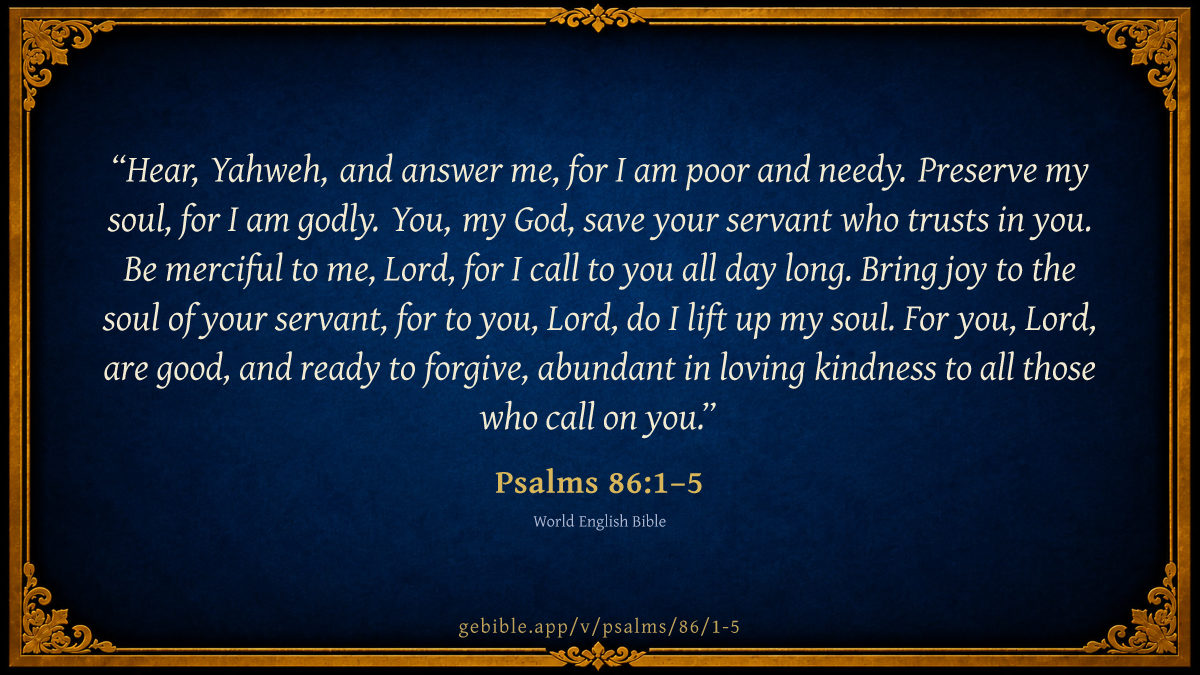
Questions where the Bible appears to say two different things, with the passages on each side set together.
Is God merciful?Dozens of texts describe YHWH as merciful, gracious, slow to anger, abundant in loyalty — Exodus 34:6, Deut 4:31, the Psalms, the prophets, the New Testament l…
Psalms 145:8-9(v5)Yahweh is gracious, merciful, slow to anger, and of great loving kindness. Yahweh is good to all. His tender mercies are over all his works.
Joel 2:13(v5)Tear your heart, and not your garments, and turn to Yahweh, your God; for he is gracious and merciful, slow to anger, and abundant in…
Exodus 34:6(v5)Yahweh passed by before him, and proclaimed, “Yahweh! Yahweh, a merciful and gracious God, slow to anger, and abundant in loving kindness…
Psalms 31:2(v1)Bow down your ear to me. Deliver me speedily. Be to me a strong rock, a house of defense to save me.
Psalms 40:17(v1)But I am poor and needy. May the Lord think about me. You are my help and my deliverer. Don’t delay, my God.
Show all 87 cross-references
Nehemiah 9:17(v5)and refused to obey. They weren’t mindful of your wonders that you did among them, but hardened their neck, and in their rebellion…
Psalms 103:8(v5)Yahweh is merciful and gracious, slow to anger, and abundant in loving kindness.
Daniel 9:18(v1)My God, turn your ear, and hear. Open your eyes, and see our desolations, and the city which is called by your name; for we do not present…
Psalms 57:1(v3)Be merciful to me, God, be merciful to me, for my soul takes refuge in you. Yes, in the shadow of your wings, I will take refuge, until…
Psalms 88:9(v3)My eyes are dim from grief. I have called on you daily, Yahweh. I have spread out my hands to you.
Matthew 5:3(v1)“Blessed are the poor in spirit, for theirs is the Kingdom of Heaven.
Psalms 34:6(v1)This poor man cried, and Yahweh heard him, and saved him out of all his troubles.
Psalms 143:8(v4)Cause me to hear your loving kindness in the morning, for I trust in you. Cause me to know the way in which I should walk, for I lift up my…
Ephesians 6:18(v3)with all prayer and requests, praying at all times in the Spirit, and being watchful to this end in all perseverance and requests for all…
Acts 2:21(v5)It will be that whoever will call on the name of the Lord will be saved.’
James 1:9-10(v1)But let the brother in humble circumstances glory in his high position; and the rich, in that he is made humble, because like the flower in…
James 2:5(v1)Listen, my beloved brothers. Didn’t God choose those who are poor in this world to be rich in faith, and heirs of the Kingdom which he…
Psalms 25:5(v3)Guide me in your truth, and teach me, For you are the God of my salvation, I wait for you all day long.
Psalms 25:8(v5)Good and upright is Yahweh, therefore he will instruct sinners in the way.
Psalms 145:18(v5)Yahweh is near to all those who call on him, to all who call on him in truth.
Luke 4:18(v1)“The Spirit of the Lord is on me, because he has anointed me to preach good news to the poor. He has sent me to heal the broken hearted, to…
1 John 4:8-9(v5)He who doesn’t love doesn’t know God, for God is love. By this God’s love was revealed in us, that God has sent his one and only Son into…
Psalms 4:1(v3)Answer me when I call, God of my righteousness. Give me relief from my distress. Have mercy on me, and hear my prayer.
Psalms 4:3(v2)But know that Yahweh has set apart for himself him who is godly: Yahweh will hear when I call to him.
Psalms 25:2(v2)My God, I have trusted in you. Don’t let me be shamed. Don’t let my enemies triumph over me.
Psalms 55:17(v3)Evening, morning, and at noon, I will cry out in distress. He will hear my voice.
Psalms 56:1(v3)Be merciful to me, God, for man wants to swallow me up. All day long, he attacks and oppresses me.
Psalms 86:15(v5)But you, Lord, are a merciful and gracious God, slow to anger, and abundant in loving kindness and truth.
Isaiah 66:13-14(v4)As one whom his mother comforts, so I will comfort you. You will be comforted in Jerusalem.” You will see it, and your heart shall rejoice,…
Ezekiel 36:37(v5)“ ‘The Lord Yahweh says: “For this, moreover, I will be inquired of by the house of Israel, to do it for them: I will increase them with…
Luke 2:37(v3)and she had been a widow for about eighty-four years), who didn’t depart from the temple, worshiping with fastings and petitions night and…
Ephesians 1:6-8(v5)to the praise of the glory of his grace, by which he freely gave us favor in the Beloved, in whom we have our redemption through his blood,…
Psalms 13:5(v2)But I trust in your loving kindness. My heart rejoices in your salvation.
Psalms 17:6(v1)I have called on you, for you will answer me, God. Turn your ear to me. Hear my speech.
Psalms 18:19(v2)He brought me out also into a large place. He delivered me, because he delighted in me.
Psalms 31:1(v2)In you, Yahweh, I take refuge. Let me never be disappointed. Deliver me in your righteousness.
Psalms 51:12(v4)Restore to me the joy of your salvation. Uphold me with a willing spirit.
Psalms 102:17(v1)He has responded to the prayer of the destitute, and has not despised their prayer.
Psalms 119:22(v1)Take reproach and contempt away from me, for I have kept your statutes.
Psalms 119:94(v2)I am yours. Save me, for I have sought your precepts.
Psalms 130:7(v5)Israel, hope in Yahweh, for there is loving kindness with Yahweh. Abundant redemption is with him.
Psalms 142:1(v1)I cry with my voice to Yahweh. With my voice, I ask Yahweh for mercy.
Isaiah 26:3-4(v2)You will keep whoever’s mind is steadfast in perfect peace, because he trusts in you. Trust in Yahweh forever; for in Yah, Yahweh, is an…
Isaiah 37:17(v1)Turn your ear, Yahweh, and hear. Open your eyes, Yahweh, and behold. Hear all of the words of Sennacherib, who has sent to defy the living…
Isaiah 66:2(v1)For my hand has made all these things, and so all these things came to be,” says Yahweh: “but I will look to this man, even to he who is…
Micah 7:18(v5)Who is a God like you, who pardons iniquity, and passes over the disobedience of the remnant of his heritage? He doesn’t retain his anger…
Luke 11:8-13(v3)I tell you, although he will not rise and give it to him because he is his friend, yet because of his persistence, he will get up and give…
Luke 18:7(v3)Won’t God avenge his chosen ones who are crying out to him day and night, and yet he exercises patience with them?
John 17:11(v2)I am no more in the world, but these are in the world, and I am coming to you. Holy Father, keep them through your name which you have…
Romans 10:12-13(v5)For there is no distinction between Jew and Greek; for the same Lord is Lord of all, and is rich to all who call on him. For, “Whoever will…
Psalms 10:14(v1)But you do see trouble and grief. You consider it to take it into your hand. You help the victim and the fatherless.
Psalms 16:1(v2)Preserve me, God, for I take refuge in you.
Psalms 62:8(v4)Trust in him at all times, you people. Pour out your heart before him. God is a refuge for us.
Psalms 72:12-14(v1)For he will deliver the needy when he cries; the poor, who has no helper. He will have pity on the poor and needy. He will save the souls…
Psalms 102:1(v1)Hear my prayer, Yahweh! Let my cry come to you.
Psalms 119:68(v5)You are good, and do good. Teach me your statutes.
Psalms 140:12(v1)I know that Yahweh will maintain the cause of the afflicted, and justice for the needy.
Isaiah 61:3(v4)to provide for those who mourn in Zion, to give to them a garland for ashes, the oil of joy for mourning, the garment of praise for the…
Jeremiah 33:3(v5)‘Call to me, and I will answer you, and will show you great and difficult things, which you don’t know.’
Ezekiel 36:33(v5)“ ‘The Lord Yahweh says: “In the day that I cleanse you from all your iniquities, I will cause the cities to be inhabited and the waste…
Daniel 9:9(v5)To the Lord our God belong mercies and forgiveness; for we have rebelled against him.
Luke 11:9-10(v5)“I tell you, keep asking, and it will be given you. Keep seeking, and you will find. Keep knocking, and it will be opened to you. For…
John 4:10(v5)Jesus answered her, “If you knew the gift of God, and who it is who says to you, ‘Give me a drink,’ you would have asked him, and he would…
Romans 5:20-21(v5)The law came in that the trespass might abound; but where sin abounded, grace abounded more exceedingly; that as sin reigned in death, even…
Deuteronomy 7:7-8(v2)Yahweh didn’t set his love on you nor choose you, because you were more in number than any people; for you were the fewest of all peoples;…
1 Samuel 2:9(v2)He will keep the feet of his holy ones, but the wicked will be put to silence in darkness; for no man will prevail by strength.
Psalms 31:14(v2)But I trust in you, Yahweh. I said, “You are my God.”
Psalms 36:7(v5)How precious is your loving kindness, God! The children of men take refuge under the shadow of your wings.
Psalms 37:28(v2)For Yahweh loves justice, and doesn’t forsake his saints. They are preserved forever, but the children of the wicked shall be cut off.
Psalms 50:5(v2)“Gather my saints together to me, those who have made a covenant with me by sacrifice.”
Psalms 69:16(v5)Answer me, Yahweh, for your loving kindness is good. According to the multitude of your tender mercies, turn to me.
Psalms 119:124-125(v2)Deal with your servant according to your loving kindness. Teach me your statutes. I am your servant. Give me understanding, that I may know…
Psalms 130:4(v5)But there is forgiveness with you, therefore you are feared.
Psalms 143:12(v2)In your loving kindness, cut off my enemies, and destroy all those who afflict my soul, For I am your servant.
Isaiah 55:7(v5)Let the wicked forsake his way, and the unrighteous man his thoughts. Let him return to Yahweh, and he will have mercy on him, to our God,…
Isaiah 65:18(v4)But be glad and rejoice forever in that which I create; for, behold, I create Jerusalem to be a delight, and her people a joy.
Jonah 4:2(v5)He prayed to Yahweh, and said, “Please, Yahweh, wasn’t this what I said when I was still in my own country? Therefore I hurried to flee to…
John 10:27-29(v2)My sheep hear my voice, and I know them, and they follow me. I give eternal life to them. They will never perish, and no one will snatch…
John 12:26(v2)If anyone serves me, let him follow me. Where I am, there my servant will also be. If anyone serves me, the Father will honor him.
Romans 9:18(v2)So then, he has mercy on whom he desires, and he hardens whom he desires.
Romans 9:23-24(v2)and that he might make known the riches of his glory on vessels of mercy, which he prepared beforehand for glory, us, whom he also called,…
Romans 15:12-13(v2)Again, Isaiah says, “There will be the root of Jesse, he who arises to rule over the Gentiles; in him the Gentiles will hope.” Now may the…
Ephesians 1:12-13(v2)to the end that we should be to the praise of his glory, we who had before hoped in Christ. In him you also, having heard the word of the…
Psalms 52:1(v5)Why do you boast of mischief, mighty man? God’s loving kindness endures continually.
Ephesians 2:4(v5)But God, being rich in mercy, for his great love with which he loved us,
1 Peter 5:3-5(v2)not as lording it over those entrusted to you, but making yourselves examples to the flock. When the chief Shepherd is revealed, you will…
Cross-references from openbible.info (CC BY 4.0)
Explain this passage (28 sources)
Historical commentary, presented as a primary source — not an endorsement.
John Calvin1540 · Public DomainOn vv1, 2, 3, 51. Incline thy ear, O Jehovah! Neither the inscription…
1. Incline thy ear, O Jehovah! Neither the inscription nor the contents of this psalm enable us to conclude with certainty what dangers David here complains of; but the psalm in all probability refers to that period of his life when he was persecuted by Saul, and describes the train of thought which then occupied his mind, although it may not have been written until after his restoration to a state of outward peace and tranquillity, when he enjoyed greater leisure. He does not without cause allege before God the oppressions which he endured as a plea for obtaining the divine favor; for nothing is more suitable to the nature of God than to succor the afflicted: and the more severely any one is oppressed, and the more destitute he is of the resources of human aid, the more inclined is God graciously to help him. That despair therefore may not overwhelm our minds under our greatest afflictions, let us support ourselves from the consideration that the Holy Spirit has dictated this prayer for the poor and the afflicted.
John Calvin's Commentaries (1540-1563) — public domain. Text from the Calvin Translation Society English edition (1840s-50s) via the Christian Classics Ethereal Library (ccel.org). Calvin's coverage is partial (roughly two-thirds of the Bible); uncommented books and verses are honest gaps, never fabricated. The 19th-century editor's footnotes and remarks are omitted so the notes are faithfully Calvin's own voice.
Geneva Bible translators1599 · Public DomainOn vv1, 2, 3, 5David persecuted of Saul, thus prayed, leaving the same…
David persecuted of Saul, thus prayed, leaving the same to the Church as a monument, how to seek redress against their miseries.
Geneva Bible (1599) marginal notes — public domain.
John Trapp1656 · Public DomainOn vv1–5Psa 86:1 « A Prayer of David. » Bow…
Psa 86:1 « A Prayer of David. » Bow down thine ear, O LORD, hear me: for I [am] poor and needy.
A prayer] Left for a form, for a help to devotion, as was also Psa 102:1 title.
Read full note →
Ver. 1. Bow down thine ear, O Lord] As the careful Physician doth to his feeble patient; so Basil glosseth here.
For I am poor and needy] Having nothing to live on but what my friends privately send me, or what I can get by plundering from the Lord’s enemies, 1Sa 30:26.
John Trapp, A Commentary or Exposition upon All the Books of the Old and New Testament (1647–1656) — public domain. Text from a community e-Sword module.
Matthew Poole1685 · Public DomainOn vv1, 2, 4, 5Forsaken and persecuted by men, and utterly unable to…
Forsaken and persecuted by men, and utterly unable to save myself, and therefore a very proper object for thy power and goodness to work upon.
Matthew Poole's English Annotations on the Holy Bible (1683–1685) — public domain. Text from a community e-Sword/MySword module.
Matthew Henry1710 · Public DomainOn v1This psalm was published under the title of a…
This psalm was published under the title of a prayer of David; not as if David sung all his prayers, but into some of his songs he inserted prayers; for a psalm will admit the expressions of any pious and devout affections. But it is observable how very plain the language of this psalm is, and how little there is in it of poetic flights or figures, in comparison with some other psalms; for the flourishes of wit are not the proper ornaments of prayer. Now here we may observe,
I. The petitions he puts up to God. It is true, prayer accidentally may preach, but it is most fit that (as it is in this prayer) every passage should be directed to God, for such is the nature of prayer as it is here described (Psa 86:4): Unto thee, O Lord! do I lift up my soul, as he had said Psa 25:1. In all the parts of prayer the soul must ascend upon the wings of faith and holy desire, and be lifted up to God, to meet the communications of his grace, and in an expectation raised very high of great things from him. 1. He begs that God would give a gracious audience to his prayers (Psa 86:1): Bow down thy ear, O Lord! hear me. When God hears our prayers it is fitly said that he bows down his ear to them, for it is admirable condescension in God that he is pleased to take notice of such mean creatures as we are and such defective prayers as ours are. He repeats this again (Psa 86:6): "Give ear, O Lord! unto my prayer, a favourable ear, though it be whispered, though it be stammered; attend to the voice of my supplications." Not that God needs to have his affection stirred up by any thing that we can say; but thus we must express our desire of his favour. The Son of David spoke it with assurance and pleasure (Joh 11:41, Joh 11:42), Father, I thank thee that thou hast heard me; and I know that thou hearest me always. 2. He begs that God would take him under his special protection, and so be the author of his salvation (Psa 86:2): Preserve my soul; save thy servant. It was David's soul that was God's servant; for those only serve God acceptably that serve him with their spirits. David's concern is about his soul; if we understand it of his natural life, it teaches us that the best self-preservation is to commit ourselves to God's keeping and by faith and prayer to make our Creator our preserver. But it may be understood of his spiritual life, the life of the soul as distinct from the body: "Preserve my soul from that one evil and dangerous thing to souls, even from sin; preserve my soul, and so save me." All those whom God will save he preserves, and will preserve them to his heavenly kingdom. 3. He begs that God would look upon him with an eye of pity and compassion (Psa 86:3): Be merciful to me, O Lord! It is mercy in God to pardon our sins and to help us out of our distresses; both these are included in this prayer, God be merciful to me. "Men show no mercy; we ourselves deserve no mercy, but, Lord, for mercy-sake, be merciful unto me." 4. He begs that God would fill him with inward comfort (Psa 86:4): Rejoice the soul of thy servant. It is God only that can put gladness into the heart and make the soul to rejoice, and then, and not till then, the joy is full; and, as it is the duty of those who are God's servants to serve him with gladness, so it is their privilege to be filled with joy and peace in believing, and they may in faith pray, not only that God will preserve their souls, but that he will rejoice their souls, and the joy of the Lord will be their strength. Observe, When he prays, Rejoice my soul, he adds, For unto thee do I lift up my soul. Then we may expect comfort from God when we take care to keep up our communion with God: prayer is the nurse of spiritual joy.
Read full note →
II. The pleas with which he enforces these petitions. 1. He pleads his relation to God and interest in him: "Thou art my God, to whom I have devoted myself, and on whom I depend, and I am thy servant (Psa 86:2), in subjection to thee, and therefore looking for protection from thee." 2. He pleads his distress: "Hear me, for I am poor and needy, therefore I want thy help, therefore none else will hear me." God is the poor man's King, whose glory it is to save the souls of the needy; those who are poor in spirit, who see themselves empty and necessitous, are most welcome to the God of all grace. 3. He pleads God's good will towards all that seek him (Psa 86:5): "To thee do I lift up my soul in desire and expectation; for thou, Lord, art good;" and whither should beggars go but to the door of the good house-keeper? The goodness of God's nature is a great encouragement to us in all our addresses to him. His goodness appears in two things, giving and forgiving. (1.) He is a sin-pardoning God; not only he can forgive, but he is ready to forgive, more ready to forgive than we are to repent. I said, I will confess, and thou forgavest, Psa 32:5. (2.) He is a prayer-hearing God; he is plenteous in mercy, very full, and very free, both rich and liberal unto all those that call upon him; he has wherewithal to supply all their needs and is openhanded in granting that supply. 4. He pleads God's good work in himself, by which he had qualified him for the tokens of his favour. Three things were wrought in him by divine grace, which he looked upon as earnests of all good: - (1.) A conformity to God (Psa 86:2): I am holy, therefore preserve my soul; for those whom the Spirit sanctifies he will preserve. He does not say this in pride and vain glory, but with humble thankfulness to God. I am one whom thou favourest (so the margin reads it), whom thou hast set apart for thyself. If God has begun a good work of grace in us, we must own that the time was a time of love. Then was I in his eyes as one that found favour, and whom God hath taken into his favour he will take under his protection. All his saints are in thy hand, Deu 33:3. Observe, I am needy (Psa 86:1), yet I am holy (Psa 86:2), holy and yet needy, poor in the world, but rich in faith. Those who preserve their purity in their greatest poverty may assure themselves that God will preserve their comforts, will preserve their souls. (2.) A confidence in God: Save thy servant that trusteth in thee. Those that are holy must nevertheless not trust in themselves, nor in their own righteousness, but only in God and his grace. Those that trust in God may expect salvation from him. (3.) A disposition to communion with God. He hopes God will answer his prayers, because he had inclined him to pray. [1.] To be constant in prayer: I cry unto thee daily, and all the day, Psa 86:3. It is thus our duty to pray always, without ceasing, and to continue instant in prayer; and then we may hope to have our prayers heard which we make in the time of trouble, if we have made conscience of the duty at other times, at all times. It is comfortable if an affliction finds the wheels of prayer a-going, and that hey are not then to be set a-going. [2.] To be inward with God in prayer, to lift up his soul to him, Psa 86:4. Then we may hope that God will meet us with his mercies, when we in our prayers send forth our souls as it were to meet him. [3.] To be in a special manner earnest with God in prayer when he was in affliction (Psa 86:7): "In the day of my trouble, whatever others do, I will call upon thee, and commit my case to thee, for thou wilt hear and answer me, and I shall not seek in vain, as those did who cried, O Baal! hear us; but there was no voice, nor any that regarded," Kg1 18:29.
Matthew Henry's Commentary on the Whole Bible (1708–1710) — public domain (CC PDM 1.0). Text via the HelloAO Bible API.
John Gill1763 · Public DomainOn vv1–5Bow down thine ear, O Lord, hear me,.... This…
Bow down thine ear, O Lord, hear me,.... This is spoken of God after the manner of men, who, when they listen and attentively hearken to what is said to them, stoop and bow the head, and incline the ear; and it denotes condescension in the Lord, who humbles himself as to look upon men, so to bow down the ear and hearken to them: this favour is granted to the saints, to whom he is a God hearing and answering prayer, and which Christ, as man and Mediator, enjoyed; see Heb 5:7,
for I am poor and needy; weak and feeble, destitute and distressed, and so wanted help and assistance; and which carries in it an argument or reason enforcing the above petition; for the Lord has a regard to the poor and needy; see Psa 6:2. This may be understood literally, it being the common case of the people of God, who are generally the poor and needy of this world, whom God chooses, calls, and makes his own; and so was David when he fled from Saul, being often in want of temporal mercies, as appears by his application to Ahimelech and Nabal for food; and having nothing, as Kimchi observes, to support him, but what his friends, and the men of Judah, privately helped him to; and the character well agrees with Christ, whose case this was; see Co2 8:9. Moreover, it may be taken in a spiritual sense; all men are poor and needy, though not sensible of it; good men are poor in spirit, are sensible of their spiritual poverty, and apply to the Lord, and to the throne of his grace, for the supply of their need; and such an one was David, even when he was king of Israel, as well as at this time, Psa 40:17, and may be applied to Christ; especially when destitute of his Father's gracious presence, and was forsaken by him and all his friends, Mat 27:46.
John Gill's Exposition of the Whole Bible (1746–1763) — public domain (CC PDM 1.0). Text via the HelloAO Bible API.
John Wesley1765 · Public DomainOn vv1–2David prays for the favour and blessing of God,…
David prays for the favour and blessing of God, ver. 1-6. Expresses confidence in him, by praise mingled with prayer, ver. 7-17. A prayer of David.
John Wesley, Explanatory Notes Upon the Whole Bible (1754–1765) — public domain. Text via the GEBible commentary corpus.
Adam Clarke1810 · Public DomainOn vv1–5The psalmist prays to God for support, from a…
PSALM LXXXVI
The psalmist prays to God for support, from a conviction that
Read full note →
he is merciful, good, ready to forgive, and that there is none
like him, 1-8;
all nations shall bow before him because of his wondrous works,
9, 10;
he prays to be instructed, and promises to praise God for his
great mercy, 11-13;
describes his enemies, and appeals to God, 14-16;
begs a token for God, that his enemies may be confounded, 17.
NOTES ON PSALM LXXXVI
The title attributes this Psalm to David; and in this all the Versions agree: but in its structure it is the same with those attributed to the sons of Korah; and was probably made during the captivity. It is a very suitable prayer for a person labouring under affliction from persecution or calumny.
Verse 1. Bow down thine ear] Spoken after the manner of men: I am so low, and so weak, that, unless thou stoop to me, my voice cannot reach thee.
Poor and needy.] I am afflicted, and destitute of the necessaries of life.
Adam Clarke's Commentary on the Bible (1810–1826) — public domain. Text from a community e-Sword/MySword module.
Joseph Benson1811 · Public DomainOn vv1, 2, 4Psa 86:1. Bow down thine ear, O Lord —…
Psa 86:1. Bow down thine ear, O Lord — When God hears our prayers he is fifty said to bow down his ear to them, for it is great condescension in him even to take notice of such mean creatures as we are, and much more to hear our defective and unworthy prayers. For I am poor and needy — Forsaken and persecuted by men, and utterly unable to save myself, and therefore a proper object; in behalf of whom thy power and goodness may be exerted. Observe, reader, “All prayer is founded on a sense of our own wants, and God’s ability to supply them. In the sight of his Maker every sinner is poor and needy; and he must become so in his own, that his petitions may be regarded; he must pray with the humility and importunity of a starving beggar, at the gate of heaven, if he expect the great King to bow down his ear and hear him.” — Horne.
Joseph Benson's Commentary on the Old and New Testaments (1811–1818) — public domain. Text from a community e-Sword module.
Albert Barnes1834 · Public DomainOn vv1–5Bow down thine ear, O Lord, hear me -…
Bow down thine ear, O Lord, hear me - See the notes at Psa 5:1.
For I am poor and needy - This is the reason here assigned why God should hear him. It is not a plea of merit. It is not that there was any claim on God in the fact that he was a poor and needy man - a sinner helpless and dependent, or that it would be any injustice if God should not hear, for a sinner has no claim to favor; but it is that this was a condition in which the aid of God was needed, and in which it was proper or appropriate for God to hear prayer, and to render help. We may always make our helplessness, our weakness, our poverty, our need, a ground of appeal to God; not as a claim of justice, but as a case in which he will glorify himself by a gracious interposition. It is also to be remarked that it is a matter of unspeakable thankfulness that the “poor and needy” may call upon God; that they will be as welcome as any class of people; that there is no condition of poverty and want so low that we are debarred from the privilege of approaching One who has infinite resources, and who is as willing to help as he is able.
Albert Barnes' Notes on the Bible (1834–1885) — public domain. Text from a community e-Sword/MySword module.
Lange's Commentary on the Holy Scriptures1864 · Public DomainOn v1Psalms 86
Psalms 86
A Prayer of David
Read full note →
1 Bow down thine ear, O Lord, hear me:
For I am poor and needy.
2 Preserve my soul; for I am holy:
O thou my God, save thy servant that trusteth in thee.
3 Be merciful unto me, O Lord:
For I cry unto thee daily.
4 Rejoice the soul of thy servant:
For unto thee, O Lord, do I lift up my soul.
5 For thou, Lord, art good, and ready to forgive;
And plenteous in mercy unto all them that call upon thee.
6 Give ear, O Lord, unto my prayer;
And attend to the voice of my supplications.
7 In the day of my trouble I will call upon thee:
For thou wilt answer me.
8 Among the gods there is none like unto thee, O Lord;
Neither are there any works like unto thy works.
9 All nations whom thou hast made
Shall come and worship before thee, O Lord;
And shall glorify thy name.
10 For thou art great, and doest wondrous things:
Thou art God alone.
11 Teach me thy way, O Lord;
I will walk in thy truth:
Unite my heart to fear thy name.
12 I will praise thee, O Lord my God, with all my heart:
And I will glorify thy name for evermore.
13 For great is thy mercy toward me:
And thou hast delivered my soul from the lowest hell.
14 O God, the proud are risen against me,
And the assemblies of violent men have sought after my soul;
And have not set thee before them.
15 But thou, O Lord, art a God full of compassion, and gracious,
Long-suffering, and plenteous in mercy and truth.
16 O turn unto me, and have mercy upon me;
Give thy strength unto thy servant,
And save the son of thine handmaid.
17 Shew me a token for good;
That they which hate me may see it, and be ashamed:
Because thou, Lord, hast holpen me, and comforted me.
EXEGETICAL AND CRITICAL
Contents and Composition.—We have first presented to us in this Psalm a succession of invocations and entreaties to God, supporting themselves on one hand upon the need of the suppliant and His covenant relation, and on the other upon God’s compassion and accessibility (Psa_86:1-7). There next follows the joyful acknowledgment of God’s incomparable exaltation, to which as well as to His power the heathen will submit themselves (Psa_86:8-10). Then comes a prayer for direction in the way of God, which the poet promises to follow out of lasting gratitude for the deliverance vouchsafed to him, (Psa_86:11-13). Finally we have an entreaty preceded by a complaint against godless enemies, spared by God’s patience (Psa_86:14-15), which implores help for the offerer, so that his haters may be ashamed and know that it is really God who has helped His pious servant (Psa_86:16-17).
The whole Psalm gives the impression of a pretty late composition. Familiar expressions and phrases from the words of the Law, the Psalms, and the Prophets, loosely connected, are found throughout, and yet not altogether without evidences of a peculiar treatment. It is remarkable that in Psa_86:14, in the passage taken literally from Psa_54:5, זֵדִים is found instead of זָרִים, and yet the acknowledgment of God in the nations of the world as the Supreme God is spoken of in Psa_86:9. It is quite uncertain to what event the deliverance mentioned in Psa_86:13 refers. We have no grounds afforded us for supposing the return from exile (Olshausen), or for connecting the verse with 2Ma_13:21, (Hitzig), not to mention the deliverance of David from the plans contrived by Saul (Köster and Clauss last), since we have no reason to assume that David was consoled by the Korahites by a Psalm constructed out of his own words (Hengstenberg). It is even questionable whether it was a past event, and whether the præterite, though not to be taken as prophetic præterite, and therefore as future (De Wette), may yet not be regarded as conveying an optative sense, and therefore be rendered by the imperfect, (Ewald, Baur). It is to be remarked that the appellation of God, Adonai, is here used seven times, and three times in Psalms 130. It seems, however, too rash an opinion to consider this circumstance as indicating a tendency to a later adonaic style of Psalm-poetry, in imitation of the Elohim Psalms (Delitzsch).
[The superscription of this Psalm presents a curious phenomenon. It ascribes the authorship to David, being the only instance in the whole of the Fourth Book. It occurs also in the midst of a group of Psalms of the sons of Korah. The opinion that David himself was the composer is now almost universally abandoned. But is it necessary to assume that it was composed in David’s lifetime? Hengstenberg, who maintains rightly the originality of the superscription, feels bound to maintain that it was. But he is willing to depart from the literal application of the language, as he supposes that it was composed by the sons of Korah for David’s benefit. The character of the Psalm suggests that we may use the same freedom of interpretation in another direction. For the looseness of connection and the liturgical rather than poetical form, as Delitzsch has remarked, seem to bespeak a late origin. It may be called “a prayer of David” because it expresses the spirit of a number of his Psalms which are of a predominantly supplicatory character, and are indicated by the same title תְּפִלָּה, and chiefly, because his sayings constitute a large portion of it. Among English commentators Perowne abandons the idea of a Davidic composition, and maintains a late date. Alexander appears undecided, though he considers the circumstances described suitable to David’s frequent situations of suffering. Wordsworth thinks that a Psalm of David is inserted in the midst of the Korahite ones, to confirm the equal authority of the latter.—J. F. M.]
Psa_86:2-12. I am holy.—The expression has reference to the covenant-relation (Hupf.) and not to piety as a virtue. The accusation that the Psalmist makes a boast of the latter (De Wette) is unfounded. Geier already has had occasion to combat it, and translated: beneficiarius; and the Dutch Bible: gunstgenoot. [In Psa_86:3, כָּל־חַיֹּום is capable of being translated either: daily, as E. V. has it, or: all the day, as it is given in the margin. The latter as indicating a depth of need which the former fails to do is to be preferred. On Psa_86:9 Alexander says: “The common relation of Jehovah to all men as their Maker shall be one day universally acknowledged, not in word merely, but in act, the most expressive part of worship, involving a recognition of the previous display of God’s perfections, in the language of Scripture, His name. This prospective view of the conversion of the world to its Maker, shows how far the Old Testament writers were from cherishing or countenancing the contracted nationality of the later and the less enlightened Jews. Comp. Psa_22:27-28; Psa_45:12; Psa_45:16; Psa_47:9; and Jer_16:19; Zep_2:11; Zec_14:9; Zec_14:16.”—J. F. M.] The expression: unite my heart, in Psa_86:11, is peculiar. It is equivalent to: unite all my powers and impel them towards one object (Calvin, Geier, and others). It is the whole, undivided heart which is demanded in connection with love in Deu_6:5; Deu_10:12, and in connection with the fear of God it appears here and in Jer_32:29, as לֵב אֶחָד. The contrast is exhibited in Jam_4:8. It is a less tenable explanation which understands a heart one with God (J. H. Michaelis following older expositors). The whole heart is also mentioned in connection with thanksgiving in Psa_86:12. The translation of the Vulgate: lætetur (after Sept., Syr.) rests upon a false derivation from חָרָה.
Psa_86:13 ff. The underworld [E. V.: lowest hell] is employed as in Deu_32:22, to denote the world beneath in the bowels of the earth (Eze_31:14 f.), under the earth, Exo_20:4, comp. Php_2:10, not as the lowest (Sept., Vulg.) or deepest (Köster, Ewald). There is nothing to indicate any allusion to different degrees of descent. Deliverance from a position in which life was endangered is the subject of the verse.—Son of thine handmaid may allude to the servants born in the house, Gen_14:14; Gen_17:12; Exo_23:12 (Geier, Olshausen, Hitzig, Delitzsch) so that the Psalmist does not describe himself as the servant of God in general (Hupfeld), but as being born into this relation.—Token for good in Psa_86:17 is not a miracle which the Psalmist implores in order to effect his deliverance (De Wette, Olsh.), but an evidence of the Divine favor (Geier, Hengst., Delitzsch, Hupfeld), a token of good intentions, not: for good fortune, or: “that it will be well with me,” (Luther), but one from which it will be clear that God purposes good with regard to him. [Hengstenberg: “What the Psalmist speaks of, according to the preceding context and the conclusion of the Psalm, is simply help and comfort, by which all his enemies may see that it is not without good ground that he calls God his God.”—J. F.M.]
DOCTRINAL AND ETHICAL
1. The hope that our prayers will be heard by God is grounded partly on our misery and helplessness (Ps. 35:10; 37:14; 40:18; 74:21); partly upon our covenant relation to Him. With regard to the latter, we have not only been able to receive most competent testimony of the goodness and placability of God (Exo_34:6), of His incomparable exaltation (Exo_15:11), and of His power (Deu_3:24), but have also made actual proof of the truth of these declarations, and of the credibility of these attestations.
2. A true servant of this Almighty Lord not merely bears in his heart the hope that many yet in the world will be converted to Him (Psa_22:18; Jer_16:19), but, as included in the terms of the covenant of grace (Psa_4:4; Psa_16:10), he labors earnestly for his own sanctification. He prays therefore especially for direction in the ways of God (Psa_25:4; Psa_25:8; Psa_25:12; Psa_27:11), and for strength to enable him to walk in conformity therewith. And in this he includes a prayer for a heart single to God’s fear, so that the whole heart may be yielded up in true gratitude. The help implored and received thus gains a significance beyond his own experience, and becomes a token for others also.
HOMILETICAL AND PRACTICAL
It is well for men to complain to God of their distress; it is better to confess their own inability to relieve it; it is best for them to rely upon God’s mercy, and to entreat mighty proofs of His goodness.—Believers must not become presumptuous or secure on account of their covenant relation, but find in it reason both for humility and for reliance upon God.—Let him who knows God ever learn of Him, and let him who loves God please Him better day by day. The more deeply true piety is stamped upon our own lives, the more distinctly is it made a token for others.—It is of no consequence to us, that our enemies are put to shame, unless they, at the same time, give glory to God.—How little do we regulate our conduct in view of the incomparable power, goodness, and faithfulness of God!
Starke: The righteous have to suffer much, therefore they must pray much.—How useful is affliction! It forces us to pray; it excites us to ardent importunity in our prayers; it supports and strengthens faith.—The anguish of guilt and the sense of God’s anger are a deep hell, from which none but God can rescue us.—There is need of great self-denial in refraining from asking a sign from God for our own sakes, which would be to tempt God; but we must ask for the sake of God’s glory.
Osiander: As it is the duty of the servant to obey his master, so is it the part of the master to defend and protect his servant.—Arndt: When God does not lead and conduct men they wander, and God has His own peculiar way.—Frisch: The more thou givest God the honor, and showest thy reliance upon Him, the readier will he be to help thee.—Richter (Hausbibel): The best and most indispensable token of mercy which a believer can have is the witness and seal of the Holy Spirit. But God also vouchsafes to them a special token, namely, deliverance from the snares of the world, so that even unbelievers themselves must acknowledge: God is with them!
Lange's Commentary on the Holy Scriptures (Critical, Doctrinal, and Homiletical), ed. John Peter Lange, English translation edited by Philip Schaff (1864–1880) — public domain. Text from a community e-Sword module.
Daniel D. Whedon1874 · Public DomainOn vv1, 2, 4, 51. Poor—With the adsignification of lowly, poor in spirit,…
1. Poor—With the adsignification of lowly, poor in spirit, as Zec_9:9; Psa_9:12; Mat_5:3.
Needy—Afflicted. Humility and suffering appeal to the mercy of God.
Daniel D. Whedon (gen. ed.), Commentary on the Old and New Testaments (1874–1909) — public domain. Text from a community e-Sword module.
The Cambridge Bible for Schools and Colleges1878 · Public DomainOn vv1–51. Bow down &c.] A common form of invocation.…
1. Bow down &c.] A common form of invocation. Cp. Psa_17:6; Psa_31:1; Isa_37:17; &c. hear me] Answer me (Psa_55:2).
for I am poor and needy] Or, afflicted and needy: and therefore one of those whom God has specially promised to help (Psa_12:5). From Psa_40:17 (= Psa_70:5): cp. Psa_109:22.
Read full note →
1–5. A series of petitions, each supported by the ground on which the Psalmist pleads for a hearing.
The Cambridge Bible for Schools and Colleges (gen. ed. J. J. S. Perowne; Cambridge University Press, 1878–1918) — public domain. Text from a community e-Sword module.
Ellicott's Commentary for English Readers1878 · Public DomainOn vv2, 5(2) For I am holy.—Rather, in order to reproduce…
(2) For I am holy.—Rather, in order to reproduce the feeling, for I am one of the chosen ones; one of Thy saints, &c. He pleads the covenant relation as a claim to the blessing. (See, on chasid, Note, Psa_1:5.)
A Bible Commentary for English Readers, edited by Charles John Ellicott (1878–1897) — public domain. Text from a community e-Sword module.
The Pulpit Commentary1880 · Public DomainOn vv1–5THIS is the prayer of an afflicted and humble…
THIS is the prayer of an afflicted and humble soul in a time of persecution (ver. 14), intermixed with outbursts of praise (vers. 5, 8-10, 15) and thankfulness (vers. 12, 13). It is assigned in the title to David, and contains nothing, either in matter or style, to make the ascription unlikely. Still, most modern critics regard the psalm as probably of a later date, and consider it the work of a less gifted psalmist than David. If not the production of a "great original mind," the psalm is nevertheless one of singular sweetness and beauty.
Metrically, it seems to divide itself, like Psalm 85., into three strophes, two shorter, and one longer, the former being of five verses each, and the latter of seven.
Read full note →
Vers. 1-5. Prayer, the predominant note of the entire psalm, holds almost exclusive possession of the first strophe, only passing into praise when the last verse is reached, where the petitioner reminds God of his loving kindness and readiness to forgive.
Bow down thine ear, O Lord, hear me. (comp. Psa_31:2 Pro_22:17) For I am poor and needy; or, "I am afflicted and in misery." Poverty in the ordinary sense is scarcely intended.
HOMILIES BY S. CONWAY Vers. 1-5. The psalmist"s prayers and pleas.
We do not know for certain the author, the date, or the circumstances of this psalm; nor for its ministry of help to us is it needful that we should. It is the fervent utterance of a devout and believing but distressed soul. Consider
I THE PRAYERS. Even in these few verses we note:
1. How numerous they are! "Bow down thine ear;" "Preserve my soul; Save me;" "Be merciful unto me;" "Rejoice the soul of thy servant.
2. How substantially the same! Repetitions need not be "vain repetitions;" they are often the reverse of vain; indeed, in many moods of our soul, they are indispensable. The soul is slow and sluggish; its vis inertiae hard to be overcome, and it is found by many that repetition, "saying the same words," is a great help in arousing thought and fixing the mind on the sacred duty before it.
3. But varied inform. This is also very helpful in prayer. Stereotyped forms, unless we be very watchful, will flow over the mind and never arouse a solitary thought. It is good, therefore, to compel the mind to express itself in varied form; for so our prayer is likely to be both more real and more helpful.
4. And progressive in meaning. The psalmist begins with simply entreating God to hear him, to give him audience; then he asks for his chief need to be supplied, and that he may be delivered, saved; then, that his unworthiness may be overlooked, that God would be merciful to him; and lastly, that the Lord would rejoice his soul, not merely preserve and save him, but more give him joy. It is ever an upward advance, as our prayer should be.
5. And confident in trust. The opening petition is one of the many proofs that prior to the Incarnation the saints of God had come to the full conviction of the humanity of God. This cry that God would "bow down" his "ear" is one of those anthropomorphic, as they are called, expressions, of which the Old Testament is so full. How often do we read of the eyes, feet, hand, face, ear, of God! They are not mere figures; but they tell of the recognized truth that God was as we are apart from our weakness, limitation, and sin. And the psalmist has laid hold of this truth, and it is his encouragement as he pours forth his prayer. Thus in a very real sense the prayers of the Jewish Church were, as are ours, offered through Jesus Christ our Lord. They, as do we, came to the Father by him; for "no man cometh unto the Father but by me," said our Lord, nor otherwise have any ever come.
II THE PLEAS URGED. They are full of power, and in them, as in the prayers they support, there is variety and advance in thought.
1. His deep need. (Ver. 1) Unless this be felt, there will never be real prayer.
2. His relationship to God. (Ver. 2) "For I am one whom thou lovest." This, the rendering of the margin, is preferable to the text either of the Authorized Version, which is, "I am holy," or of the Revised Version, which is, "I am godly." It avoids the self-righteous tone which seems inseparable from these readings, and declares his confidence begotten by favours received from God in the past.
3. His trust.
4. His continued prayer. He had waited on the Lord, confident that his trust would be sustained.
5. The declared Name of God. (Ver. 5) He who believingly urges that cannot fail of the Divine aid according to his need. S.C.
HOMILIES BY R. TUCK Ver. 1. Man"s claims on God.
Historical associations for this psalm cannot be fixed with any confidence. It may be a fragment of David"s which was enlarged and adapted, in a later age, to liturgical purposes. Its fragmentary character must strike every careful reader. It is suitable for any pious soul that is in distress, and is a fitting utterance for our burdened hearts. The point before us now is, that the pious soul feels it has claims on God, and may plead those claims in prayer before him. Right ideas of the sovereignty of the Divine mercy can be held along with clear convictions of man"s claims on God, if only we keep fully before us that the claims are wholly based on relations in which God has been pleased to set himself. If he condescends, in his infinite love, to enter into covenant with his people, then we may recognize that he puts himself into the limitations and obligations of the pledges he takes. If we are faithful to our pledge in covenant, we can claim that God should be faithful to his pledge in the covenant. This is in part the feeling of the psalmist; and if associated with a due dependence, humility, and submission, it is a right and worthy feeling. A child has claims on his father; and if he does so in a childlike spirit, he may plead those claims before his father. It has been wisely said of our text, "This is not the highest ground that can be taken in pressing for an answer to our prayer, but it is a ground which God suffers us to take.
I THE PLEAS BY WHICH THE PSALMIST"S PRAYER IS URGED. Notice that they concern the psalmist himself, and the conditions in which he is placed. It may seem unworthy thus to speak of himself; but if a man is to be sincere, he must say the truth about himself; and no harm comes when he says it out to God, because we cannot be boastful before him. In vers. 1-3 we find four descriptions of the psalmist himself, made into pleas.
1. He is poor. This may refer to circumstances, but more probably it is a word for humble mindedness; the feeling of the man who wants God because he knows he cannot help himself.
2. He is needy. Which may mean in distress, or may express an actual longing for, and crying for, God"s help.
3. He is holy; which simply means, "one of thy saints;" "one who is in the full covenant relations with thee;" "one whom thou favourest;" "one whose habit of life is piety." If this is true of us, it need not be a wrong thing to say so.
4. Trustful and prayerful. Actually reliant; honouring God by a full confidence. And God surely responds to all who put their trust in him.
II THE PRAYER WHICH THE PLEAS ARE EMPLOYED TO URGE. For Divine help.
1. Bow down to the poor.
2. Preserve the godly.
3. Save the trustful.
4. Be merciful to him who cries.
The requests for precisely adapted grace. R.T.
The Pulpit Commentary (1880–1919), ed. H.D.M. Spence-Jones & Joseph S. Exell — public domain. Text from a community e-Sword module.
Charles H. Spurgeon1885 · Public DomainOn vv1–5A Prayer of David. We have here one of…
A Prayer of David. We have here one of the five psalms entitled Tephillahs or prayers. This psalm consists of praise as well as prayer, but it is in all parts so directly addressed to God that it is most fitly called "a prayer." A prayer is none the less but all the more a prayer because veins of praise run through it. This psalm would seem to have been specially known as David's prayer; even as the ninetieth is "the prayer of Moses." David composed it, and no doubt often expressed himself in similar language; both the matter and the wording are suitable to his varied circumstances and expressive of the different characteristics of his mind. In many respects it resembles Ps 17:1-15, which bears the same title, but in other aspects it is very different; the prayers of a good man have a family likeness, but they vary as much as they agree. We may learn from the present psalm that the great saints of old were accustomed to pray very much in the same fashion as we do; believers in all ages are of one genus. The name of God occurs very frequently in this psalm, sometimes it is Jehovah, but more commomly Adonai, which it is believed by many learned scholars was written by the Jewish transcribers instead of the sublimer title, because their superstitious dread led them to do so: we, labouring under no such tormenting fear, rejoice in Jehovah, our God. It is singular that those who were so afraid of their God, that they dared not write his name, had yet so little godly fear, that they dared to alter his word.
The psalm is irregular in its construction but may be divided into three portions, each ending with a note of gratitude or of confidence: we shall therefore read from Ps 86:1-7, and then, (after another pause at the end of Ps 86:13), we will continue to the end.
Read full note →
Ver. 1. Bow down thine ear, O Lord, hear me. In condescension to my littleness, and in pity to my weakness, "bow down thine ear, O Lord." When our prayers are lowly by reason of our humility, or feeble by reason of our sickness, or without wing by reason of our despondency, the Lord will bow down to them, the infinitely exalted Jehovah will have respect unto them. Faith, when she has the loftiest name of God on her tongue, and calls him Jehovah, yet dares to ask from him the most tender and condescending acts of love. Great as he is he loves his children to be bold with him.
For I am poor and needy doubly a son of poverty, because, first, poor and without supply for my needs, and next needy, and so full of wants, though unable to supply them. Our distress is a forcible reason for our being heard by the Lord God, merciful, and gracious, for misery is ever the master argument with mercy. Such reasoning as this would never be adopted by a proud man, and when we hear it repeated in the public congregation by those great ones of the earth who count the peasantry to be little better than the earth they tread upon, it sounds like a mockery of the Most High. Of all despicable sinners those are the worst who use the language of spiritual poverty while they think themselves to be rich and increased in goods.
Title. The prophet David has penned two psalms, which he has eminently appropriated to himself as his own: the one is styled David's prayer, though many other psalms are prayersit is Ps 86:1-17; the other David's praise, Ps 145:1-21. The first his tephilla, the latter his tehilla; in each of these he makes a solemn rehearsal of the very words of Moses, in Ex 34:6-7. In Ps 86:1-17 he brings them in as they were a support unto his faith in his distresses from sins and miseries, to which use he puts them, Ps 86:3-4 6-7. And again, Ps 86:16-17, he makes a plea of these words by way of prayer. In Ps 145:1-21, he brings them in as they are an elogium or celebration of the glorious nature and excellencies of God, to excite the sons of men to love and praise him. Thomas Goodwin.
Title. This Psalm was published under the title of A Prayer of David; not as if David sung all his prayers, but into some of his songs he inserted prayers; for a psalm will admit the expression of any pious and devout affections. But it is observable how very plain the language of this psalm is, and how little there is in it of poetical flights or figures, in comparison with some other psalms; for the flourishes of wit are not the proper ornaments of prayer. Matthew Henry.
Title. There was much, very much, of God's peculiar character, his glorious name, brought to view in the close of the last Psalm. This may account for its being followed by another, A Prayer of David, almost equally full of the character of Jehovah. The key note of this Psalm is Jehovah's name. Andrew A. Bonar.
Whole Psalm. Christ prays throughout the whole of this Psalm. All the words are spoken exclusively by Christ, who is both God and man. Psalt. Cassiodori, 1491.
Whole Psalm. In this Psalm Christ the Son of God and Son of Man, one God with the Father, one man with men, to whom we pray as God, prays in the form of a servant. For he prays for us, and he prays in us, and he is prayed to by us. He prays for us as our Priest. He prays in us as our Head. He is prayed to by us as our God. Psalt. Pet. Lombard. 1474.
Ver. 1. Bow down thine ear, O Lord. As the careful physician doth to his feeble patient: so Basil glosseth here. John Trapp.
Ver. 1-4. Poor, holy, trusteth, I cry. The petitioner is first described as poor, then holy, next trusting, after that crying, finally, lifted up to God. And each epithet has its fitting verb; bow down to the poor, preserve the holy, save the trusting, be merciful to him who cries, rejoice the lifted up. It is the whole gamut of love from the Incarnation to the Ascension; it tells us that Christ's humiliation will be our glory and joy. Neale and Littledale's Commentary.
Ver. 1.
1. A singular requestthat the Lord should bow his ear.
2. A singular plea"I am poor and needy."
3. The singular grace of God will answer the request, because singular grace has made the petitioner feel his need.
Psalms 86:2*
Charles H. Spurgeon's The Treasury of David (1869–1885) — public domain. Psalms only. Text from a community e-Sword/MySword module.
The Biblical Illustrator1887 · Public DomainOn vv1, 4Bow down Thine ear, O Lord, hear me: for…
Psa_86:1-17
Bow down Thine ear, O Lord, hear me: for I am poor and needy.
Read full note →
Man and the great God
I. Man in a variety of aspects.
1. What every man is. Poor and needy. Morally this is the case with every man. He is poor (Rev_3:17). And needy. What does he need? Knowledge, pardon, purity, power.
2. What every man requires. Be merciful unto me, O Lord. The wages of sin is death. He must throw himself on mercy; mercy is his only ground of hope.
3. What every man should be.
(1) Pious. For I am holy.
(2) Trustful That trusteth in Thee. He is infinitely trustworthy.
(3) Incessantly prayerful I cry unto Thee daily, or all the day. We should pray without ceasing. True prayer is not a service but a spirit.
4. What every man should believe. For Thou, Lord, art good, etc.
(1) God is essentially good--the primal font of all goodness.
(2) Forgivingly good. Ready to forgive. Many men esteemed good have not sufficient goodness in them to forgive. Forgiving goodness is goodness in its highest manifestation.
(3) Abundantly good. Plenteous in mercy, etc. No sinner need despair.
5. What every man should do.
(1) He should seek a knowledge of the Divine will, in order to obey it. Teach me Thy way, etc. Lord, what wilt Thou have me to do? This should be the great question in every mans life.
(2) He should strive for unity of heart, in order to praise God for evermore. Unite my heart, etc.
II. God in a variety of aspects.
1. He is infinitely incomparable.
(1) Incomparable in being. Among the gods there is none like unto thee, O Lord. Angels that excel in strength, etc. But what are they to God?
(2) Incomparable in works. Neither are there any works like unto Thy works.
2. He is universally attractive. All nations whom Thou hast made shall come and worship, etc. Glorious prediction this.
3. He is transcendently great. For Thou art great, etc. (Isa_44:6). All nations before Him are as nothing.
4. He is unspeakably kind (Psa_86:15). (Homilist.)
A pattern of prayer
Earnest reiteration is not vain repetition. Christ used many repetitions, as does the psalmist. This is a pattern of prayer in its invocations, petitions and pleas.
I. The invocations. The appeals to the Divine Name.
1. The significance of invocation, not a mere formality, but the basis of all prayer.
(1) Names expressing certain aspects of Divine character.
(2) The use we make of these names.
(a) Thought. We think of God under this aspect.
(b) Confidence. We avow our faith in Him.
(c) Appeal. We remind God of what He has declared Himself to be.
2. The invocations in this prayer. Note the frequent and varied use of the Divine names. These are made the ground of confidence.
(1) Jehovah--a name with two-fold meaning.
(a) The word itself. Eternal, underived existence.
(b) Its history. The seal of the covenant, i.e. the eternal God entering into covenant relations with man.
(2) My God.
(a) God implies fulness of power.
(b) My God. The Godhead appropriated, i.e. Almighty strength, claimed by human need.
(3) Lord, not here meaning Jehovah, but the God of authority and dominion.
II. The petitions--a progress in thought and desire.
1. The introductory petition.
(1) Loving regard. Bow down Thine ear.
(2) A mighty answer. Hearing means answering.
2. Deliverance under a three-fold aspect.
(1) Protection--preserve my soul.
(2) Safety.
(3) Mercy. The source of both. The first two emphasize the psalmists peril. The last his unworthiness. No word as to the manner of deliverance. He leaves all that to God.
3. The crowning blessing. Gladness as the result of all these. Rejoice the soul of Thy servant.
III. The pleas. The arguments of prayer. The reasons why God should bless.
1. Mans necessities. I am poor and needy.
(1) Circumstances borne down by outward calamity.
(2) Character, destitute of inward resources. These constitute a prevailing plea with God.
2. Mans relations and desires towards God.
(1) Divine favour. I am holy. I am favoured by God.
(2) Possession. Thy servant. The Lord cares for the slave.
(3) Confidence. That trusteth in Thee.
(4) Supplication. I cry unto Thee daily.
(5) Aspiration. Unto Thee do I lift up my soul.
3. Gods own character. For Thou, Lord, art good and ready to forgive. This the mightiest plea of all. We can add to these pleas the name of Christ. (A. Maclaren, D. D.)
Assurances that God will hear prayer
The most of these supplications may be found in other parts of Scripture as promises from God. Only so far as an articulate Divine word carries my faith has my faith right to go. In the crooked alleys of Venice, there is a thin thread of red stone, inlaid in the pavement or wall, which guides through all the devious turnings to the Piazza in the centre where the great church stands. As long as we have the red line of promise on the path, faith may follow it, and it will come to the Temple. Where the line stops it is presumption and not faith that takes up the running. Gods promises are sunbeams flung down upon us. True prayer catches them on its mirror, and signals them back to God. We are emboldened to say, Bow down Thine ear, because He hath said, I will hear. We are encouraged to cry, Be merciful, because we have our foot upon the promise that He will be. (A. Maclaren, D. D.)
The Biblical Illustrator, edited by Joseph S. Exell (c. 1880s–1900s) — public domain. Text from a community e-Sword module.
The Expositor's Bible1887 · Public DomainOn v1Psalms 86
Psalms 86
THIS psalm is little more than a mosaic of quotations and familiar phrases of petition. But it is none the less individual, nor is the psalmist less heavily burdened, or less truly beseeching and trustful, because he casts his prayer into well-worn words. God does not give "originality" to every devout man; and He does not require it as a condition of accepted prayer. Humble souls, who find in more richly endowed mens words the best expression of their own needs, may be encouraged by such a psalm. Critics may think little of it, as a mere cento: but God does not refuse to bow His ear, though He is asked to do so in borrowed words. A prayer full of quotations may be heartfelt, and then it will be heard and answered. This psalmist has not only shown his intimate acquaintance with earlier devotional words, but he has woven his garland with much quiet beauty, and has blended its flowers into a harmony of colour all his own.
Read full note →
There is no fully developed strophical arrangement, but there is a discernible flow of thought, and the psalm may be regarded as falling into three parts.
The first of these (Psa_86:1-5) is a series of petitions, each supported by a plea. The petitions are the well-worn ones which spring from universal need, and there is a certain sequence in them. They begin with "Bow down Thine ear," the first of a suppliants desires, which, as it were, clears the way for those which follow. Trusting that he will not ask in vain, the psalmist then prays that God would "keep" his soul as a watchful guardian or sentry does, and that, as the result of such care, he may be saved from impending perils. Nor do his desires limit themselves to deliverance. They rise to more inward and select manifestations of Gods heart of tenderness, for the prayer "Be gracious" asks for such, and so goes deeper into the blessedness of the devout life than the preceding. And the crown of all these requests is "Rejoice the soul of Thy servant," with the joy which flows from experience of outward deliverance and of inward whispers of Gods grace, heard in the silent depths of communion with Him. It matters not that every petition has parallels in other psalms, which this singer is quoting. His desires are none the less his, because they have been shared by a company of devout souls before him. His expression of them is none the less his, because his very words have been uttered by others. There is rest in thus associating oneself with an innumerable multitude who have "cried to God and been lightened." The petition in Psa_86:1 is like that in Psa_55:2. Psa_86:2 sounds like a reminiscence of Psa_25:20; Psa_86:3 closely resembles Psa_57:1.
The pleas on which the petitions are grounded are also beautifully wreathed together. First, the psalmist asks to be heard because he is afflicted and poor. {compare Psa_11:17} Our need is a valid plea with a faithful God. The sense of it drives us to Him; and our recognition of poverty and want must underlie all faithful appeal to Him. The second plea is capable of two interpretations. The psalmist says that he is Chasid; and that word is by some commentators taken to mean one who exercises, and by others one who is the subject of, Chesed-i.e., lovingkindness. As has been already remarked on Psa_4:3, the passive meaning-i.e., one to whom Gods lovingkindness is shown-is preferable. Here it is distinctly better than the other. The psalmist is not presenting his own character as a plea, but urging Gods gracious relation to him, which, once entered on, pledges God to unchanging continuance in manifesting His lovingkindness. But though the psalmist does not plead his character, he does, in the subsequent pleas, present his faith, his daily and day-long prayers, and his lifting of his desires, aspirations, and whole self above the trivialities of earth to set them on God. These are valid pleas with Him. It cannot be that trust fixed on Him should be disappointed, nor that cries perpetually rising to His ears should be unanswered, nor that a soul stretching its tendrils heavenward should fail to find the strong stay, round which it can cling and climb. God owns the force of such appeals, and delights to be moved to answer, by the spreading before Him of His servants faith and longings.
But all the psalmists other pleas are merged at last in that one contained in Psa_86:5, where he gazes on the revealed Name of God, and thinks of Him as He had been described of old, and as this suppliant delights to set to his seal that he has found. Him to be-good and placable, and rich in lovingkindness. God is His own motive, and Faith can find nothing mightier to urge with God, nor any surer answer to its own doubts to urge with itself, than the unfolding of all that lies in the Name of the Lord. These pleas, like the petitions which they support, are largely echoes of older words. "Afflicted and poor" comes, as just noticed, from Psa_40:17. The designation of "one whom God favours" is from Psa_4:3, "Unto Thee do I lift up my soul" is taken verbatim from Psa_25:1. The explication of the contents of the Name of the Lord, like the fuller one in Psa_86:15, is based upon Exo_34:6.
Psa_86:6-13 may be taken together, as the prayer proper, to which Psa_86:1-5 are introductory. In them there is first, a repetition of the cry for help, and of the declaration of need (Psa_86:6-7); then a joyful contemplation of Gods unapproachable majesty and works, which insure the ultimate recognition of His Name by all nations (Psa_86:8-10); then a profoundly and tenderly spiritual prayer for guidance and consecration-wants more pressing still than outward deliverance (Psa_86:11); and, finally, as in so many psalms, anticipatory thanksgivings for deliverance yet future, but conceived of as present by vivid faith.
Echoes of earlier psalms sound through the whole; but the general impression is not that of imitation, but of genuine personal need and devotion. Psa_86:7 is like Psa_17:6 and other passages; Psa_86:8 a is from Exo_15:11; Psa_86:8 b is modelled on Deu_3:24; Psa_86:9, on Psa_22:27; Psa_86:11 a, - on Psa_27:11; Psa_86:11 b, on Psa_26:3; "Sheol beneath" is from Deu_32:22. But, withal, there are unity and progress in this cento of citations. The psalmist begins with reiterating his cry that God would hear, and in Psa_86:7 advances to the assurance that He will. Then in Psa_86:8-10 he turns from all his other pleas to dwell on his final one (Psa_86:5) of the Divine character. As, in the former verse, he had rested his calm hope on Gods willingness to help. so now he strengthens himself, in assurance of art answer, by the thought of Gods unmatched power, the unique majesty of His works and His sole Divinity. Psa_86:8 might seem to assert only Jehovahs supremacy above other gods of the heathen; but Psa_86:10 shows that the psalmist speaks the language of pure Monotheism. Most naturally the prophetic assurance that all nations shall come and worship Him is deduced from His sovereign power and incomparableness. It cannot be that "the nations whom Thou hast made" shall forever remain ignorant of the hand that made them. Sooner or later that great character shall be seen by all men in its solitary elevation; and universal praise shall correspond to His sole Divinity.
The thought of Gods sovereign power carries the psalmist beyond remembrance of his immediate outward needs, and stirs higher desires in him. Hence spring the beautiful and spiritual petitions of Psa_86:11, which seek for clearer insight into Gods will concerning the psalmists conduct, breathe aspirations after a "walk" in that God-appointed way and in "Thy troth," and culminate in one of the sweetest and deepest prayers of the Psalter: "Unite my heart to fear Thy Name." There, at least, the psalmist speaks words borrowed from no other, but springing fresh from his hearts depths. Jer_32:39 is the nearest parallel, and the commandment Deu_6:5, to love God "with all thine heart," may have been in the psalmists mind; but the prayer is all his own. He has known the misery of a divided heart, the affections and purposes of which are drawn in manifold directions, and are arrayed in conflict against each other. There is no peace nor blessedness, neither is any nobility of life possible, without whole-hearted devotion to one great object; and there is no object capable of evoking such devotion or worthy to receive it, except Him who is "God alone." Divided love is no love. It must be "all in all, or not at all." With deep truth, the command to love God with all the heart is based upon his Unity-"Hear, O Israel: The Lord Thy God is one Lord; and thou shalt love the Lord thy God with all thine heart". {Deu_6:4-5} The very conception of religion requires that it should be exclusive, and should dominate the whole nature. It is only God who is great enough to fill and engage all our capacities. Only the mass of the central sun is weighty enough to make giant orbs its satellites, and to wheel them in their courses. There is no tranquility nor any power in lives frittered away on a thousand petty loves. The river that breaks into a multitude of channels is sucked up in the sand without reaching the ocean, and has no force in its current to scour away obstructions. Concentration makes strong men; consecration makes saints. "This one thing I do" is the motto of all who have done anything worthy. "Unite my heart to fear Thy Name" is the prayer of all whose devotion is worthy of its object, and is the source of joy and power to themselves. The psalmist asks for a heart made one with itself in the fear of God, and then vows that, with that united heart, he will praise his delivering God. As in many other psalms, he anticipates the answers to his prayers, and in Psa_86:13 speaks of Gods lovingkindness as freshly manifested to him, and of deliverance from the dismal depths of the unseen world, which threatened to swallow him up. It seems more in accordance with the usage in similar psalms to regard Psa_86:13 as thus recounting, with prophetic certainty, the coming deliverance as if it were accomplished, than to suppose that in it the psalmist is falling back on former instances of Gods rescuing grace.
In the closing part (Psa_86:14-17), the psalmist describes more precisely his danger. He is surrounded by a rabble rout of proud and violent men, whose enmity to him is, as in so many of the psalms of persecuted singers, a proof of their forgetfulness of God. Right against this rapid outline of his perils, he sets the grand unfolding of the character of God in Psa_86:15. It is still fuller than that in Psa_86:5, and like it, rests on Exodus 34. Such juxtaposition is all that is needed to show how little he has to fear from the hostile crew. On one hand are they in their insolence and masterfulness, eagerly hunting after his life; on the other is God with His infinite pity and lovingkindness. Happy are they who can discern high above dangers and foes the calm presence of the only God, and, with hearts undistracted and undismayed, can oppose to all that assails them the impenetrable shield of the Name of the Lord! It concerns our peaceful fronting of the darker facts of life, that we cultivate the habit of never looking at dangers or sorrows without seeing the helping God beside and above them.
The psalm ends with prayer for present help. If God is, as the psalmist has seen Him to be, "full of compassion and gracious," it is no presumptuous petition that the streams of these perfections should be made to flow towards a needy suppliant. "Be gracious to me" asks that the light which pours through the universe, may fall on one heart, which is surrounded by earth-born darkness. As in the introductory verses, so in the closing petitions, the psalmist grounds his prayer principally on Gods manifested character, and secondarily on his own relation to God. Thus in Psa_86:16 he pleads that he is Gods servant, and "the son of Thy handmaid". {compare Psa_116:16} That expression does not imply any special piety in the psalmists mother, but pleads his hereditary relation as servant to God, or, in other words, his belonging by birth to Israel, as a reason for his prayers being heard. His last petition for "a sign" does not necessarily mean a miracle, but a clear manifestation of Gods favour, which might be as unmistakably shown by an everyday event as by a supernatural intervention. To the devout heart, all common things are from God, and bear witness for Him. Even blind eyes and hard hearts may be led to see and feel that God is the helper and comforter of humble souls who trust in Him. A heart that is made at peace with itself by the fear of God, and has but one dominant purpose and desire, will long for Gods mercies, not only because they have a bearing on its own outward well-being, but because they will demonstrate that it is no vain thing to wait on the Lord, and may lead some, who cherished enmity to Gods servant and alienation from Himself, to learn the sweetness of His Name and the security of trust in Him.
William Robertson Nicoll, ed., The Expositor's Bible (London: Hodder & Stoughton, 1887–1910) — public domain. 65 of 66 books (1 Corinthians is not separately keyed, as that volume carries no machine-parseable verse references); section-level commentary keyed to the opening verse. Introductory and overview sections not keyed to a specific passage are excluded.
The Preacher's Complete Homiletical Commentary1892 · Public DomainOn v1Superscription.—“A Prayer of David.” Although this Psalm is not…
INTRODUCTION
Superscription.—“A Prayer of David.” Although this Psalm is not placed with the great body of David’s Psalms (1–70), there is no sufficient ground for disputing his authorship of it.
Read full note →
Occasion.—Barnes says, “The occasion on which it was composed is unknown, but it has been commonly supposed that it was written in the time of the persecution under Saul.” But the opinion of Hengstenberg, that it was written during the dangers to which David was exposed by reason of the rebellion of Absalom, seems to us better supported by the evidence which the Psalm itself affords. Amid the dangers to which he is now exposed, the Psalmist calls to mind for his encouragement a remarkable deliverance which God had formerly granted to him (Psa_86:13). May it not have been that the former deliverance was from Saul, and his present danger from Absalom! Still we cannot with certainty determine the occasion of its composition.
THE GOODNESS OF GOD AN ENCOURAGEMENT TO SEEK HIM
(Psa_86:1-5.)
The “Prayer of David” runs through the whole Psalm, but as the Psalm is too long and suggestive for treatment in one homily, we purpose dividing it by the grounds on which for his encouragement the Psalmist bases his prayer. Let us consider—
I. The petitions of the suppliant. The Psalmist prays—
1. For audience. “Bow down Thine ear, O Lord, hear me.” The petition seems to include—
(1.) Divine condescension. Being sensible of his unworthiness of the regard of God, he prays Him to “bow down” His ear to his prayer.
(2.) Divine attention. “Hear me.” It is not a petition that God would simply hear the prayer of the Psalmist, but that He would hear him favourably, that He would hear and bless him.
2. For protection. “Preserve my soul, … save Thy servant.” David was at this time exposed to danger, his very life was in peril; he prays that God would protect his life, and deliver him from his enemies. If God protect us we are invulnerable. Saul could not harm David, though he sought by every means in his power to do so, because the Lord was his shield. And Absalom and his rebel army were equally powerless against him, because God defended him. All the hosts of hell with their allies upon earth, even when led by their subtle and mighty prince, cannot really harm the child of God who has sought the protection of his Father.
3. For mercy. “Be merciful unto me, O Lord.” Implied in this petition is the conscious unworthiness of the suppliant. David seeks the protection and deliverance of God, not as a right, but as a favour. He presented to God not a claim, but a humble supplication. He addressed himself not to the Divine justice, but to the Divine mercy. “Be gracious unto me, O God.” In all our need it is to the mercy of the Lord we must look.
4. For joy. “Rejoice the soul of Thy servant.” If God should deliver His servant from danger his heart would greatly rejoice. And such were the circumstances of the Psalmist at this time that God only could deliver him from his foes and fill him with gladness. Salvation is a joyous thing. It is the Christian’s privilege to “rejoice in the Lord alway.”
II. The pleas of the suppliant. The Psalmist pleads—
1. His necessity. “For I am poor and needy.” Oppression and poverty are the principal meanings of the words used by the Psalmist in this plea. David pleads that he was bowed down by trouble, as he asks God to “bow down” and hear him, and that he was necessitous, as he asks God to help him. Or we may regard his plea in this way, he was “poor,” i.e., without supply, he was “needy,” i.e., full of wants; therefore he must look away from himself, above himself for satisfaction. Man’s necessity does not give him any claim upon God’s bounty. But human misery always moves Divine mercy. And when we humbly and sincerely plead our poverty with God, He will enrich us with the treasures of His grace. “When I am weak, then am I strong.”
2. His consecration. “For I am holy.” Margin: “one whom Thou favourest.” Hengstenberg: “for I am pious.” Calvin: “for I am meek.” Perowne: “one whom Thou lovest.” He was pious, not profane. He was the “servant” of God. Twice he pleads that fact; and as we are sure that he would not plead “for I am holy” in any boastful or self-righteous spirit, we conclude that his consecration to God is one of his pleas. He was the servant of God, and therefore in asking God to save him, he was asking Him to save His own. If we in the strength of grace have consecrated ourselves to God, we may plead that fact with Him in our prayers. He has never forsaken His faithful servants.
3. His confidence. “Thy servant that trusteth in Thee.” He has pledged Himself to save those who put their trust in Him. By trusting Him we really place our salvation in His hands. Can He fail? Is His power inadequate? His workings in nature, in human history, and in the conversion of souls proclaim it as great and wonderful as ever. Is His willingness diminished? “The mountains shall depart, and the hills be removed; but My kindness shall not depart from thee, neither shall the covenant of My peace be removed, saith the Lord that hath mercy on thee.” Our trust in God is a mighty plea in our prayers to Him.
4. His importunity. “I cry unto Thee daily.” Margin: “all the day,”—continually. His prayer was importunate. “Unto Thee, O Lord, do I lift up my soul.” These words show that his prayer was earnest, hearty, sincere. He did not merely lift up his hands unto God, but he lifted up his heart also. Prayers which are characterised like this by heartiness, importunity, and faith, when presented by God’s devoted but needy servants, are certain to result in gracious replies from heaven.
III. The encouragement of the suppliant. “For Thou, Lord, art good and ready to forgive; and plenteous in mercy to all them that call upon Thee.” Here are—
1. Goodness for man as a dependent and needy creature. “Thou, Lord, art good.” In Himself “God is good.” He is perfect in holiness and in grace. He is also “good to all, and His tender mercies are over all His works.” He delights in His works, and in dealing bountifully with His creatures. He, the infinitely and ever blessed God, hath assured us that “it is more blessed to give than to receive;” and He is the infinite Giver. Being and well-being, life and joy, He gives abundantly. Here then is encouragement to seek Him in prayer in every time of need.
2. Mercy for man as a sinful creature. “Ready to forgive, and plenteous in mercy.” “Goodness is the disposition to communicate happiness. Mercy is a modification of goodness. Goodness is the genus, mercy the species. The fruits of goodness are enjoyed by holy and happy creatures. The fruits of mercy, by the guilty and miserable. Mercy with relation to an offender is a disposition to forgive. Mercy in reference to a sufferer is a disposition to relieve.” Here then is our encouragement We are sinful and ill-deserving, but He is merciful and pardons. We are wretched, but He is merciful and succours.
3. Mercy in great abundance and dispensed freely. He is “ready to forgive, and plenteous in mercy unto all them that call upon Him.” “With the Lord there is mercy, and with Him is plenteous redemption.” “He delighteth in mercy.” Like Himself His mercy is inexhaustible, infinite. And it is bestowed freely “unto all them that call upon Him.” “Ask, and ye shall receive.” Unless we are prepared to receive the mercy of God as a free gift, we cannot receive it at all. Here then is encouragement to seek God in our times of need. His mercy is unspeakably greater than our sin and misery, and He waits “ready” to bestow it freely “unto all them that call upon Him.”
CONCLUSION.—In the great goodness and mercy of our God there is encouragement for each and for all of us to seek Him in time of need. We are poor and needy, but the riches of His grace are unsearchable and free. We are sinful and sorrowful, but He is plenteous in mercy and ready to forgive. His love is infinite.
In Him let us trust and rejoice.
THE SUPREMACY OF GOD AN ENCOURAGEMENT TO SEEK HIM
(Psa_86:6-10.)
In that portion of the Psalm which we have already considered the Psalmist encouraged himself by the willingness of God to help him; in this he encourages himself by the ability of God to help him. In that the goodness and mercy of God were the ground of his prayer for deliverance; in this the power and glory of God constitute that ground. Let us consider—
I. The supremacy of God. The Psalmist sets forth two aspects of this supremacy. He represents God as supreme—
1. In Himself. “Among the gods there is none like unto Thee, O Lord. Thou art God alone.” The Psalmist refers to the false deities worshipped by the heathen, and he says that none of them are like Jehovah in power and goodness. In might and majesty, in grace and glory, God is supreme. He only is God. It has been well said by Bishop Wilkins, “If God be an infinitely-perfect Being, it is impossible to imagine two such beings at the same time, because they must have several perfections, or the same. If the former, neither of them can be God, because neither of them has all possible perfections. If they have both equal perfections, neither of them can be absolutely perfect, because it is not so great to have the same equal perfections in common with another, as to be superior to all others.” There can be but one Supreme Being.
2. In His doings. “There are no works like unto Thy works. Thou art great and doest wondrous things.” God’s works in creation are wonderful in the wisdom and power which they manifest. And in His providence there had often been remarkable displays of His skill in making the designs of the enemies of His people promote their interests, and of His power in overthrowing His foes and saving them that trust in Him. All His works praise Him and proclaim His sole supremacy. But the doing of God which most encouraged the Psalmist was His hearing of prayer. “Thou wilt answer me.” It is the great glory of God that He who created the heavens and bringeth out their host by number, also regardeth the faint breathings of penitence and the softest whispers of prayer. He hears and attends to all the prayers that rise to Him. He is “the proper object of worship everywhere alike, and at all times. This is a thought,” says Dr. Wardlaw, “not less pregnant with interest than it is with wonder. When you are desirous to present a petition in person to a fellow-creature, you require to leave your place, and to find your way to the nearer or more distant spot where he is. But whatever request you have to present to God, you need not move from the spot you occupy. Never. Wherever you chance to be He is there. This is true, not of you alone, but of all alike. He listens to the prayers and the praises of His people that are poured into His ear at the same instant, in every place and every language. And, at the same instant, too, He is listening to the songs of the ‘ten thousand times ten thousand, and thousands of thousands’ which arise to Him around His seraph-circled throne in the heavens; and to the addresses which are offered to Him from all the worlds with which the fields of immensity are replenished. And to all these He bends His ear, with the most perfect discrimination, and at the same time with the most perfect ease, without the slightest approach to anything like difficulty or effort. And there is no mixing up of one thing with another; of any of the particulars of one case with those of another. Each case, in all its details, is as distinctly heard and recorded as if there had been no other to which to attend.” In this we have a marvellous exhibition of the supremacy of God.
II. The effects of that supremacy. Two are mentioned—
1. All nations shall worship God. “All nations whom Thou hast made shall come and worship before Thee, O Lord; and shall glorify Thy name.” The nations of the earth are represented as created by God. He “hath made of one blood all nations of men for to dwell on all the face of the earth.” All nations have a common origin. God is the Creator-Father of all men. Human brotherhood is a great fact, however man may disregard it. The king and the beggar have a common origin. The oppression of one man by another, or one class of men by another, is a crime in the sight of the common Maker of us all. The nations shall all come and worship God. “All kings shall fall down before Him: all nations shall serve Him.… All nations shall call Him blessed.” It is thought by some that the prediction of the text was partially fulfilled in the great number of proselytes to the Jewish religion during the reigns of David and Solomon. But its complete fulfilment is certainly yet in the future. The triumphs of Christianity are spreading. A bright future is before our world and race. God is supreme over all, and the time is coming on apace when His supremacy shall be loyally and enthusiastically acknowledged by all nations.
2. The troubled soul shall trust in Him. The supremacy of God encouraged the distressed Psalmist to seek Him. Such will ever be the effect of that supremacy when it is rightly understood. God is supremely good, supremely beneficent, and, while enthroned high over all things, He stoops to listen to the feeblest prayer. He is both able and willing to succour the distressed, and help the needy, and comfort the sorrowful.
“His love is as great as His power,
And knows neither measure nor end.”
There is every encouragement presented to the suppliant soul in drawing near to God. Oh, ye impoverished ones, come and be enriched out of His fulness. Burdened and anxious ones, come and cast yourselves with your weight of cares upon Him who careth for you. Sinful and sorrowing ones, come in faith to God, and He will forgive your sins, and soothe or sanctify all your sorrows.
CONCLUSION.—
1. Seeing that God is supreme, let us reverence Him, serve Him. “Give unto the Lord the glory due unto His name; worship the Lord in the beauty of holiness.”
2. Seeing that He is so compassionate to the troubled, let them seek His help and comfort. From the highest throne in glory He will listen to your cry and hasten to your help. “Casting all your care upon Him, for He careth for you.” “Call upon Me in the day of trouble; I will deliver thee, and thou shalt glorify Me.”
3. Seeing that there is so sure a prospect of His universal worship, let us rejoice in spirit, and hopefully pray and work for its realisation. “The earth shall be full of the knowledge of the Lord, as the waters cover the sea.” “The kingdoms of this world shall become the kingdoms of our Lord, and of His Christ; and He shall reign for ever and ever.”
THE DAY OF TROUBLE
(Psa_86:7.)
We have here—
I. A period with which all men are acquainted. “The day of trouble.” Trouble is a common experience amongst men in this world. We are troubled by physical infirmities, pains, and diseases; by perplexities, cares, and losses in business; by the unfaithfulness of professed friends; by the bereavements of death; by spiritual distresses and conflicts.
1. The individual character of trouble. “My trouble.” Our troubles often arise partly from peculiarities in our circumstances and temperament and disposition. The same events very differently affect different persons. The sorrows of no two persons are exactly alike. “The heart knoweth his own bitterness.” “Every man must bear his own burden.”
2. The limited duration of trouble. “The day of my trouble.” Through the mercy of God our troubles are short-lived. There is more of gladness than of gloom in the world. In the case of the great majority of persons suffering is the exception, not the rule of life. Courage, troubled heart, the day of thy trouble will soon be over, and happy months of peace shall be thine. Even if the whole of this earthly life were dark and sad it is but as a day when contrasted with the glad, and bright, and endless ruture.
II. A resolve which all men should make. “I will call upon Thee.” The Psalmist did not stoically endure his distresses. He was keenly sensible of their painfulness. Nor did he impiously rebel against God by reason of them. That, not to mention its sinfulness, would only have made the matter worse. But by prayer he took his trouble to God. We should do the same with ours. And we should do so humbly. It may be that our trouble is a consequence of some sin or sins of ours. Sin is the fruitful parent of suffering. Therefore we should call upon God with humble and penitent hearts. We should call upon Him submissively. While our object in seeking Him is to obtain relief from trouble, let us leave it to Him to impart that relief as He may choose. He may relieve us by removing the trouble. He may continue the trouble, but relieve us by imparting more grace to us that we may bear it. “Not my will, but Thine be done.”
III. A result which all men may anticipate. “Thou wilt answer me.” The Psalmist was confident that God would hear and answer his prayer. “He that cometh to God must believe that He is, and that He is a rewarder of them that diligently seek Him.” “Thou wilt answer me”—
1. Because Thou hast promised to do so. “Call upon Me in the day of trouble; I will deliver thee.” “All things, whatsoever ye shall ask in prayer, believing, ye shall receive,” &c. “Ask, and ye shall receive,” &c.
2. Because Thou hast done so. Jacob prayed, and God answered and blessed him (Genesis 32) Isaiah and Hezekiah prayed, and the Lord answered and cut off 185,000 Assyrians in one night (1 Kings 19; 1 Chronicles 29) “Elias was a man subject to like passions as we are, and he prayed earnestly,” &c. (Jas_5:17-18). The early Christians prayed instantly and earnestly, and the Lord answered, and by an angel delivered Peter out of prison (Acts 12 et al). What He has done, He will do again.
3. Because of what Thou art. Thou art omniscient, and therefore knowest our need; omnipotent, and therefore canst help us; “good, and plenteous in mercy,” and therefore wilt take pleasure in relieving us, &c.
Trembling and troubled hearts seek the Lord in believing prayer; and He will calm and cheer, soothe and strengthen you.
THE FORMER MERCIES OF GOD AN ENCOURAGEMET TO SEEK HIM
(Psa_86:11-17.)
In this division of the Psalm we have—
I. A grateful recollection of former mercies. “Great is Thy mercy toward me; and Thou hast delivered my soul from the lowest hell.” The word translated “hell” is “sheol,” in the Greek “Hades.” “Thou hast delivered my soul,” or life, “out of deep sheol,” is a poetical way of saying that God had delivered the Psalmist out of extreme dangers or deep distresses. The allusion is very probably to the repeated and remarkable deliverances vouchsafed to David in the time when Saul persecuted him and sought his life. During that persecution there were times when David despaired of his life, feeling that it was vain to hope to escape from the cunning and strength that were put forth against him. Yet God had graciously and marvellously preserved him safely. He regarded this deliverance as a Divine “mercy.” He knew that he had no claim upon the protection of God. He felt that he had not deserved the great favours which God had bestowed upon him. The Christian may use these words in a spiritual sense. “Great is Thy mercy toward me; and Thou hast delivered my soul from the lowest hell.” When God in mercy saves a soul He saves it from sin, death, and hell. This recollection of past mercy was an encouragement to the Psalmist in his present distress. It would keep before his mind—
1. God’s ability to deliver him. He had saved him in former times, therefore He, the unchangeable One, could save him now.
2. God’s willingness to save him.
“His love in time past
Forbids me to think,” &c.
Memories like this of the Psalmist’s are amongst the most helpful and precious of all our possessions.
II. An earnest prayer for deliverance from present danger. The great object of the prayer was that the Psalmist might be delivered from the enemies that were aiming at his life. “O God, the proud are risen against me, and the assemblies of violent men have sought after my soul, and have not set Thee before them.… Save the son of Thine handmaid.” The foes from whom he sought deliverance were “proud.” They were men of haughty spirit and daring ambition, who would despise the welfare or the right of others if they stood in the way of the accomplishment of their projects. They were “violent. “They wrought out their plans by force. They were fierce and cruel, caring not what violence they used in accomplishing their ambitious designs. They were united. Hengstenberg translates—“The band of the violent.” And Barnes says—“The word assembly here means merely that they were banded together; what was done was the result of a conspiracy or combination.” They were irreligious. They had not set God before them. They did not fear Him, or respect His law. His threatenings they despised; His presence and observation they disregarded. What evils might not be expected from enemies such as these? From such enemies David prays for deliverance. “Save the son of Thine handmaid.” In his prayer be sets forth the desired deliverance—
1. As a mercy. “O turn unto me, and have mercy upon me.” He asks that God would favourably regard him, pity him, and relieve him.
2. As a communication of Divine power. “Give Thy strength unto Thy servant.” He regarded his case as requiring nothing less than the strength of God to meet it. And he asks that he may be enabled to act as if he were nerved with the very power of God.
3. As found in obedience to the Divine will. “Teach me Thy way, O Lord; I will walk in Thy truth; unite my heart to fear Thy name.” The Psalmist felt that if deliverance were to come to him, he must be found in the way of the Divine precepts, walking with God, and serving Him with undivided heart. It cannot be too earnestly insisted upon, that, if we would be saved, we must be found walking in the way which God prescribes for us. “Narrow is the way which leadeth unto life.” Nor can we insist too earnestly upon the necessity of whole-heartedness in the service of God. “A double-minded man is unstable in all his ways.” In the Christian life and work we need fixedness of purpose and concentration of effort if we would succeed. “Unite my heart to fear Thy name.” “This one thing I do,” &c.
4. As calculated to produce a favourable impression. To the Psalmist himself his deliverance would be a “token for good,” a clear and unmistakable sign of the favour of God. To the enemies of the Psalmist his deliverance would be a rebuke. By it their purposes would be defeated, their schemes frustrated, and themselves humbled and shamed. Thus David prays to God for deliverance, and encourages himself in so doing, by thinking of the goodness and faithfulness of God. Having mentioned the haughtiness and violence, the unity and irreligiousness of his foes, he says, “But Thou, O Lord, art a God full of compassion, and gracious, long-suffering, and plenteous in mercy and truth.” The Psalmist felt that he had nothing but evil to expect from his enemies. And from so gracious a God, he, though unworthy, could expect nothing but good. (We have already looked at “The goodness of God as an encouragement to seek Him”—Psa_86:1-5.)
III. A devout resolution to serve God. The Psalmist resolves to serve God—
1. By obedience. “I will walk in Thy truth;” i.e., I will conform my life to Thy will. The truth of God should not only be held by us as sentiment, or doctrine, or fact; but should also be practised by us. We should translate our creed into our conduct. We should seek not only to hold the truth, but also to live the truth; not only to know the will of God, but also to do His will. The “doer of the work shall be blessed in his doing.”
2. By worship. “I will praise Thee, O Lord my God, with all my heart; and I will glorify Thy name for evermore.” The poet resolves to worship God heartily. “With all my heart.” When God united his heart he would pour it all out in worship to Him. His undivided affection and adoration he would give to God. Such hearty worship is acceptable unto God. He would worship God eternally—“for evermore.” While he had any being he would praise God. In time and through eternity he would glorify Him.
CONCLUSION.—
1. Learn the value of sacred memories. How greatly David was encouraged by his recollections of past mercies! Such memories should be monitors, reminding us of our weakness, &c. Such memories should be inspirers, telling us of Divine strength, goodness, &c. He who does not use wisely the memories of the past is not living as he ought in the present, and is ill-furnished for the changes and trials of the future.
2. The obligations imposed by Divine mercies. Goodness calls for gratitude. New favours demand new songs. Our obligations to God are ever increasing. “I will praise Thee, O Lord my God, with all my heart; and I will glorify Thy name for evermore.”
THE DIVINE WAY FOR MAN
(Psa_86:11.)
I. The Divine way for man indicated by God. “Teach me Thy way, O Lord.”
1. There is a Divine way in which man should walk. “Thy way.” The way prescribed by Him in His holy Word. The way of obedience to His precepts. The way which our Lord Jesus Christ trod.
2. God must indicate that way to man. “Teach me.” “The original meaning of the Hebrew word is to point out, or mark the way.” The way is clearly revealed in the sacred Scriptures; but man’s moral perceptions are not clear, his moral judgment is warped by sin; hence his need of the direction of God. He must indicate to man the true way of human life.
II. The Divine way for man trod by man. “I will walk in Thy truth.” It is the way of Divine truth which God points out, and which the Psalmist resolves to walk in. To walk in God’s truth implies—
1. Harmony with the truth. “To walk in the truth of God signifies to be always mindful of it.” “Walking, in the Scripture, takes in the whole of our conversation or conduct.” The whole life in accord with the Divine mind and will.
2. Progress in the truth. The Psalmist resolves to walk, not to stand, in God’s truth. Walking implies advancement. The godly soul “follows on to know the Lord.” We must advance in two things: in knowledge of the truth, and in practice of the truth:
III. The need of integrity of heart to tread the Divine way for man. “Unite my heart to fear Thy name.” We use the word integrity in its literal meaning.
1. There is a great tendency in human nature to division of heart. There are many rival claimants for our affections; and the heart itself has lost its true centre.
2. Integrity of heart is essential to enable us to tread the Divine way. “A double-minded man is unstable in all his ways.” Unless we are whole-hearted we shall speedily wander from the way, or faint by the way. God demands our undivided affection and our complete devotion. Only by hearty and concentrated effort can we secure the prize. “One thing I do, forgetting,” &c.
3. God alone can impart to us integrity of heart in the Divine way. The bias of the unrenewed heart is averse from Divine things. None but God can harmonise our powers and affections in His service. He will thus unite the hearts of all who sincerely seek Him.
“Let earth no more my heart divide;
With Christ may I be crucified,
To Thee with my whole soul aspire;
Dead to the world and all its toys,
Its idle pomp and fading joys,
Be Thou alone my one desire.”
—C. Wesley.
The Preacher's Complete Homiletical Commentary (gen. ed. Joseph S. Exell; Funk & Wagnalls, c. 1892) — public domain (pre-1929). A full-Bible homiletical/sermon-outline anthology covering 65 of 66 books (2 John is absent from the source module). Text from a community e-Sword module.
The Sermon Bible1900 · Public DomainOn v1Psa 86:1-5
Psa 86:1-5
The fulness and variety of these petitions deserve careful consideration.
Read full note →
Notice:—
I. The invocations. Five times in these verses of the text does the Psalmist invoke God, and that by three several names: "Jehovah," "my God," "Lord." (1) "Jehovah." The word implies eternal, timeless being, underived self-existence. It was given as the seal of the covenant, as the ground of the great deliverance from Egyptian bondage. The national existence rested upon it. The vitality of Israel was guaranteed by the eternity of Israel’s God. (2) "My God." The word implies the abundance and fulness of power, and so may be found, and often is found, on the lips of heathens. It contemplates the almightiness rather than the moral attributes or covenant relations of God as the ground of our hopes. This general conception becomes special on the Psalmist’s lips by the little word which he prefixes to it: "my God." (3) The word "Lord" is not, as a mere English reader might suppose, the same word as that which is rendered Lord" in the first verse. That is "Jehovah." This means just what our English word "lord" means: it conveys the general idea of authority and dominion.
II. The petitions which these verses give us. They are all substantially the same, and yet they so vary as to suggest how familiar all the aspects of the deliverance that the Psalmist desired were to him. (1) There is, first, the cry that God would hear, the basis of all that follows. Then there is a threefold description of the process of deliverance: "preserve," "save," "be merciful." Then there is a longing for that which comes after the help, a consequence of the hearing: "Make the soul of Thy servant glad."
III. The pleas on which these petitions are based. (1) The Psalmist pleads his necessities. He is "poor and needy," borne down by the pressure of outward calamity, and destitute of inward resources. (2) He pleads his relation to God and his longing for communion with Him. "I am holy." The word simply means "one who is a recipient or object of mercy." The plea is drawn, not from the righteousness of the man, but from the mercy of God. (3) Finally, because our necessities and our desires derive their force as pleas from God’s own character, he urges that as his last and mightiest appeal. The name of God is the ground of all our hope, and the motive for all His mercy.
A. Maclaren, Sermons Preached in Manchester, 3rd series, p. 257.
In this passage we are looking at one of God’s saints in the holiest of all, in the immediate presence of his God and King.
I. The first thought that strikes us is, David takes his right place. He says, "Bow down," as though he would say, "I am a worm, and no man." I cannot claim an audience. If Thou wouldst hear, Thou must bow down Thine ear, as a tender Father, to catch what Thy frail child has to say.
II. Look at the "fors" of the passage. There are five. (1) "For I am poor and needy." If we come to God at all, we must come as beggars. There are two words in the Greek language which indicate poverty. One indicates respectable poverty, the poverty of a man in humble circumstances, who is working hard to get his bread. The other signifies "beggary," the state of the man who has got nothing, who is utterly bankrupt. In describing the particular kind of poverty-stricken people He receives, our Lord uses the word to indicate abject bankruptcy; and unless we come into the Divine presence in the position of paupers, we cannot get the blessing. (2) Notice the second "for:" "Preserve my soul, for I am holy." The first "for" is the "for" of the bankrupt; the second is the "for" of the saint. There is no contradiction here: in my own moral character a poor beggar, grovelling in the dust; in God’s own Divine purpose something nobler than the bright spirits that stand around His throne, heir of God and joint heir with Christ, bound to the everlasting Deity by indissoluble bonds. (3) "Be merciful unto me, O Lord, for I cry unto Thee daily." This third "for" points out to us what is to be the law of our life. If we want to be kept in constant safety, we must be calling unto Him "daily." (4) "Rejoice the soul of Thy servant, for unto Thee, O Lord, do I lift up my soul." The Psalmist begins by asking the Lord to "bow down His ear unto him," but he goes on till he gets to such a point of believing expectation that he dares to lift up his soul into the presence of God. It is lifted up in order that it may become a partaker of God’s joy. God is the centre of eternal joy. "At Thy right hand there are pleasures for evermore.’ (5) "For Thou, Lord, art good and ready to forgive, and plenteous in mercy unto all them that call upon Thee." We are so poor in our mercy. The richness of God’s mercy lies in this point: the Lord never gives a mercy till He has taken care that it shall be a real mercy. His favours shall only be received by those who will take them in His own way, and thus the blessing is doubled.
W. Hay Aitken, Mission Sermons, 1st series, p. 220.
Reference: Psa 86:3.— G. Brooks, Outlines of Sermons, p. 248.
Psa 86:9
This Psalm is not usually numbered, but it might well be, amongst the penitential psalms. Its pensiveness is that of contrition. From the Divine attributes which it accentuates, and from its expressions, as well as from the tone that runs through it, we see a tender conscience, healed and lowly, sensible of fault, rejoicing in forgiveness. The Psalmist dwells on God’s mercy, on His longsuffering, on His readiness to forgive, as only they dwell who have the broken and contrite heart.
I. Observe that wherever you find contrition you find a light peculiarly its own, an unusual brightness, a lofty hope; a vision of God amazing in its clearness, and a vision of man remarkable for its brightness and its faith. We cannot by searching find out God, but we can by trusting.
II. Observe the hope which is expressed in the text, "All nations whom Thou hast made shall come and worship before Thee.’ It is a great dream; it is a dream of universal religion—one creed for every variety of man, in all conditions, in all stages of civilisation; one vision of God to charm them; one song of praise and triumph rising over all mankind. Concerning this hope, we remark: (1) that all the holy have cherished it; (2) that it has been marvellously realised in the history of the world in the past; (3) that it is a consummation devoutly to be wished. (4) Think what might have been accomplished already if the Church had done her work.
III. Notice the lessons which these things enforce. (1) Let us repent of our despair and believe in the truth of God; (2) let us repent of the little we have done to speed forward the work; (3) let us labour at home and abroad, expecting not failure, but the thirty-fold, the sixty-fold, the hundred-fold, promised by our Lord.
R. Glover, Christian World Pulpit, vol. xxvii., p. 260.
Psa 86:11
In the expressions "teach," "fear," "walk," we have religion presented to us in the three aspects of knowledge, feeling, and conduct; in other words, religion in the head, in the heart, and in the feet. Religion affects the whole circle of man’s activity. As knowledge, it illumines his intellect or guides his thinking in relation to those matters of which religion takes cognisance; as feeling, it awakens right promptings within him in relation to those matters; as conduct, it furnishes rules for his doing.
I. Religion as a matter of knowledge, a process of instruction. "Teach me Thy way, O Lord." (1) The Teacher: "the Lord." Religious illumination comes from God, the Father of lights. He graciously assumes the character of Teacher to men in the way of salvation. To this end He has provided for them a great lesson-book, none other than the Bible. When we read this book, we sit, in effect, like Mary of old, at the feet of the Divine Teacher to learn "His way." (2) The learner: man. Man displays the first essential of a true learner: a keen desire for his lesson. The scholar casts himself at the feet of his Divine Teacher, and entreats to be taught. Meekness and fear—that is, docility and reverence—are qualities in the pupil which unlock the secrets of the Divine heart.
II. Religion in the heart, or religion as a matter of feeling. Religion here has made its way from the head into the heart; from the light of knowledge it has become the warmth of emotion. The particular emotion into which the knowledge develops is fear. (1) This is not fear in the sense of terror or dismay, but love. It is heart-fear, not conscience-fear. It is the child-disposition, sweet, trustful, and penetrated with holy, subduing reverence. (2) The condition of its development. The essential condition of this beautiful disposition is a heart at peace with all its passions, in thorough harmony with God.
III. Religion in the life, or as a matter of conduct. Divine truth is first light in relation to men; this truth or light received into the hearts of men becomes converted into love; and this love becomes a mighty propelling force, impelling them irresistibly along the line of truth and righteousness.
A. J. Parry, Phases of Christian Truth, p. 158.
Psa 86:11
This prayer begins with a general request, and then points it to a particular object: "Unite my heart"—make it one; and for what?—"to fear Thy name."
I. "Unite my heart." Who that knows the fickleness and inconsistency of the human character, of his own character, will not join in this prayer? Anything is better for a man than a distracted, unharmonised, inconsistent character. To spend precious time in counteracting and crossing out ourselves is more than any of us can afford in this short life, in which so much is to be done. One very prevailing form of this inconsistency is a trifling, wavering, inconstant spirit, the standing idle in the marketplace of the world of a man who has not yet found his vineyard to work in, or who, having found it, is weary of the work. It is very often incident to youth and inexperience. With the young especially one of the first conditions of unity of heart is a humble and conscientious adoption of opinions. Do not entangle yourselves, in the battle before you, with armour which you have not proved. Better defence to you will be the simple sling and stone of one conviction tried by your own experience than all the panoply of Saul.
II. While on this matter, it seems in the course of our subject to put in a warning against two mistaken lines of conduct which we see around us: (1) a listless apathy to the formation and expression of opinion; a carrying out of an idea that a man may be consistent by being nothing. It is not thus that we pray that our hearts may be united. Better even be inconsistent among the energies of life than faultless, because motionless, in the slumbers of death. (2) The other alternative is that of cherishing an artificial consistency, for mere consistency’s sake. It is lamentable to see men punctiliously upholding an accredited opinion which we have reason to know they do not themselves hold. It is by such men and such lives that mighty systems of wrong have grown up under the semblance of right; it is in spite of such men that the God of truth has broken these systems to pieces one after another, and has strewn the history of His world with the wrecks of these fair-seeming fabrics.
III. "Unite my heart to fear Thy name." If we would be consistent men, God must be first in everything. (1) If this is so, the first consequence will be that our motives will be consistent. The fear of God will abide as a purifying influence in the very centre of our springs of action, His eye ever looking on us, His benefits ever constraining us. (2) Union of the heart in God’s fear will save us from grievous or fatal inconsistency in opinion. He whose heart is united to fear his God, though not exempt from other men’s failings, is saved from other men’s recklessness, and has a tenderer and a safer conscience in the matter of forming and holding opinion.
H. Alford, Quebec Chapel Sermons, vol. iii., p. 256.
Psa 86:17
I. "Show me a token for good." The want thus expressed is a spiritual want; the prayer therefore is for spiritual relief. It is a token of love to his soul, a token of spiritual and eternal good, for which the Psalmist prays.
II. Suppose that some particular tendency of our evil nature has long held us in bondage, and that we are conscious of what the Apostle calls "a sin which easily besets us." What in such a case would be the right use of the words before us? Surely they should suggest to us an earnest prayer to God to show us one of His special tokens, to encourage our weak faith, to animate our feeble efforts, by a season of unwonted success—I mean by enabling us but for once so to overcome our sin, that we may see for ourselves how near help really is, and how surely He hears our prayers.
III. It may be said indeed, and said truly, that such tokens ought not to be needed. We must beware of perverting the text so as to suppose that our Christian faith is to be built upon so unstable a foundation as the impressions and feelings of our own minds, or that our struggles with evil can safely be postponed until some such special help be vouchsafed to us.
IV. The time, and the manner, and the degree of our comfort in spiritual things, as in earthly, must be left implicitly at God’s disposal. While this is remembered and confessed, the prayer of the Psalmist is safe and wise. What God desires is that we should seek our happiness in Him; and then He sets no bounds to prayer or expectation.
C. J. Vaughan, Harrow Sermons, 2nd series, p. 223
Psa 86:17
I. Look, first, at Divine help. "Thou, Lord, hast holpen me!" (1) It is in the very nature and disposition of God to give help. (2) Sin is a hindrance to our reception of Divine help, but for the removal of this obstacle God has made a large provision in the redemption which He has provided. (3) God’s ability to help is perfect, and His resources unlimited, almighty. (4) God helps by various agencies; and these are chosen by His own wisdom, superintended by His own eye, and made efficient by His own power. (5) God helps us individually. (6) God helps us perfectly and efficiently.
II. Look, next, at godly consolation. "Thou hast comforted me." (1) God comforts by the undergrowth of small alleviations in trouble. (2) God comforts by calling our attention to some solace present with us which we have overlooked. (3) God comforts us by revelations of a bright future. (4) God comforts us in trouble, and He comforts us by taking away trouble. (5) God comforts us by the direct action of His mind Upon our mind; by His word, especially by His word of promise; and by our fellow-men, especially by our fellow-Christians. (6) God comforts us by drawing us near to Himself. (7) God gives help and comfort from the sanctuary.
S. Martin, Comfort in Trouble, p. 120.
References: Psa 86:17.—Spurgeon, Sermons, vol. xxvi., No. 1559. Psa 87:2.—G. Brooks, Outlines of Sermons, p. 249. Psa 87:3.—A. M. Fairbairn, The City of God, p. 349. Psa 87:6.—Spurgeon, Sermons, vol. vii., No. 382. Psalm 87—A. B. Bruce, Expositor, 1st series, vol. x., p. 134.
The Sermon Bible, ed. William Robertson Nicoll (1888–1900) — public domain. Text from a community e-Sword module.
F. W. Grant1903 · Public DomainOn v1A prayer of David.
Adonai.
A prayer of David.
Read full note →
The eighty-sixth psalm has, however, peculiar difficulties which we must now consider. As already said, its theme may be said to be Adonai, the Lord. The servant’s path is, of course, the owning of God as such; and Adonai is here found seven times, which of course must have its significance where, as in Scripture, all is significant. The only other psalm in which we find it as often -and indeed, the very same number of times, is the sixty-eighth; but there "God" is found so often (thirty times), and other names of God, as Almighty, Jah, Jehovah, as quite to prevent its having there the same proportionate value. Here Jehovah is found four times, and God only four; a very small number compared with the frequency of these in general.
Adonai is then the theme of the speaker: the servant proclaims his Lord. But who, then; is this servant? A glance at the title might seem to give us the answer; indeed, must, one would say, have some significance in this respect. It is "a prayer of David," imbedded between Korahite psalms, and the only psalm ascribed to him in the third book. We immediately, necessarily, think of David’s more than royal Antitype, and expect to find Christ’s voice throughout the psalm.
But here there is at once great and apparently insuperable difficulty. The eleventh verse, as it stands in the Hebrew, "unite my heart to fear Thy Name," could never have been the prayer of our Lord, whatever His humiliation. The Septuagint, Syriac and Vulgate indeed, by the help of another punctuation, substitute for this, "my heart shall rejoice": but this is rejected in general, and would only partially relieve the difficulty. The fifth verse bases the confidence of the suppliant towards God on His being "good and ready to forgive," for which again the Septuagint uses the vaguer term "gentle," but the verb in Hebrew is always -as far as Scripture is concerned -"to forgive, remit." The fifteenth verse again seems to take similar ground.
Thus it would seem that only indirectly could this be the "prayer of (the antitypical) David" -His as being the fruit of His work in those whom He leads in the path in which He Himself has alone been perfect. But in this way the title may be a necessary supplementary note of interpretation as to the psalm; just as we have seen "on the Gittith" to be to the three psalms to which it is prefixed (Psa 8:1-9; Psa 81:1-16; Psa 84:1-12). Only in this way also does the connection with the next psalm become fully clear, as we shall see.*
{*There is also a beautiful connection with the latter half of Isaiah, where from Isa 40:1-31; Isa 41:1-29; Isa 42:1-25; Isa 43:1-28; Isa 44:1-28; Isa 45:1-25; Isa 46:1-13; Isa 47:1-15; Isa 48:1-22 Israel is seen as the servant, and unfaithful; then from Isa 49:1-26; Isa 50:1-11; Isa 51:1-23; Isa 52:1-15; Isa 53:1-12; Isa 54:1-17; Isa 55:1-13; Isa 56:1-12; Isa 57:1-21; Isa 58:1-14; Isa 59:1-21; Isa 60:1-22 Christ is the perfect Servant, and standing under the load of the sins of others; and finally, from Isa 61:1-11; Isa 62:1-12; Isa 63:1-19; Isa 64:1-12; Isa 65:1-25; Isa 66:1-24." the remnant are now seen and accepted as the servants.}
1. In the opening section, the psalmist takes his place with Jehovah as poor and needy, but godly, not unmindful of his creature-relation to Him in whom he believes and whom he serves. This is his plea for help and preservation. The want of originality in the psalm has been noticed by many. "Familiar expressions and phrases from the Law, the Psalms, and the Prophets," says Moll, "loosely connected [?], are found throughout." "But," adds Delitzsch, "although for the most part flowing on only in the language of prayer borrowed from earlier periods, this psalm is not without unmistakable significance and beauty."
If, however, it be the expression of a faith which, wherever it is found, brings the soul into this relation to God as the obedient servant of His will, how striking is it that it should be thus a harmony of many voices and of different periods in one connected whole! Its very want of originality is in this way itself in remarkable accordance with what it is intended to convey to us. And the argument that it cannot be really a psalm of David, because "the writer cannot be compared for poetic capability with David," turns the other way when we think of the spiritual meaning of the harmonizing of such scattered utterances of the people of God by One -the true David -who Himself has trodden in His perfection ("Beginner and Finisher of faith") the whole of this path! How the apparent blemishes of Scripture, when we see the real meaning of them; become themselves witnesses to its absolute inspiration!
2. In the second section we find the help needed -the education of faith, we may perhaps say, by continual exercise. When God brought His people out of Egypt and into training for the land, He brought them into the wilderness, and made them thus for everything dependent upon Himself: and this is still His way; for these things are our types. So now with the psalmist: grace is needed in answer to calls that go up to Him all the day. And joy in Him one serves is that which alone can give strength for all the daily wear and tear of contact with a world such as this. "Rejoice in the Lord alway" is the apostle’s rule and admonition: and we with our eyes lifted up to Him whom we have learned to call that, have reason indeed for this that the psalmist could not know. The path we are upon is the same path He traveled to the throne; and upon the Throne He is who knows all the need of the way we travel.
Apart from this, what a comfort is it to have a path known to be God’s path for us, a path we travel in obedience simply, so that consequences are all His, and He may be trusted for them. The roughest path, if known to be His, can never lack a song.
But we are frail indeed, who walk in it. How blessed, then; to have our refuge in One who is "good and ready to forgive, and full of loving-kindness to all that call upon" Him! With this need may be faced, and (if we have faith for it) gloried in; that means constant proving of the living God; and when with trial the assurance increases: "I will call upon Thee: for Thou wilt answer me."
3. Thus the song arises: the need and its answer both make God alone glorious, and destroy all other trusts, vain as the senseless gods of the heathen. "There is none among the gods like Thee, Lord: and there is nothing like Thy works." Thus he foresees that of necessity the world must be brought to realize this: "All nations whom Thou hast made shall come and worship before Thee, Lord, and glorify Thy Name." This is truest prophecy, what the knowledge of God in this practical way ensures. The time has been long protracted indeed; and even yet the end (so long after the prophet’s time) may seem as far off as ever; and yet it shall, it must be, true: the Lord Himself hasten it, as He will.
4. Now we have the path itself with its trials and experiences, in which these principles are practically realized. First of all, the sufficiency for it, which is in God alone: this is but the application of what has been already said; but it is the necessary foundation on which alone a life with God can be based. And our utter dependence upon Him is expressed in the next verse, in which with the full purpose of heart to walk in His truth the psalmist confesses his need, not only of instruction as to the way, the one way which is Jehovah’s, but also of his own deliverance from the infirmity which nevertheless yields so to distraction: "unite my heart," he says, "to fear Thy Name." This is indeed what is everywhere the great lack among the people of God. How much of our lives is, not spent in positive evil, but frittered away and lost in countless petty diversions which spoil effectually the positiveness of their testimony for God! How few can say with the apostle, "This
one thing I do!" We are on the road -not, at least, intentionally off it -but we stop to chase butterflies among the flowers, and make no serious progress. How Satan must wonder when he sees us turn away from the "kingdoms of the world and the glory of them" when realized as his temptation, and yet yield ourselves with scarce a thought to endless trifles, lighter than the thistle-down which the child spends all his strength for, and we laugh at him. Would we examine our lives carefully in such an interest as this, how should we realize the multitude of needless anxieties, of self-imagined duties, of permitted relaxations, of "innocent" trifles, which incessantly divert us from that in which alone there is profit! How few, perhaps, would care to face such an examination of the day by day unwritten history of their lives!
"We must not be legal": with such an excuse, how we pass over the "little things" which come in everywhere unchallenged by reason of their littleness. "We must not make religion too severe": and so we take off our armor on the battle-field. "We must not have a morbid conscience": and so we forget to exercise ourselves, that we may have one void of offence toward God and man. Concentration of purpose is what most of all the devil dreads for us as Christians, and the air is full of whispered plausibilities and lullabies to deprive us of this. Thus Christ Himself as "all" for us is looked at as somewhat not to be too seriously taken; the glorious sunshine is to be helped to be brighter by men’s taper-lights; or carefully shaded from eyes too infirm to enjoy it in its brightness or too continuously.
How perfect a lesson there is for us here in the Lord’s words as to the vine-branch and abiding in Him (Joh 15:1-27)! The branch abides in the vine without intermission: a moment’s intermission would be fatal to it. And "as the branch cannot bear fruit except it abide in the vine, no more can ye," says He, "except ye abide in Me."
But then for what are we to abide in Him? The whole purpose of the vine is fruit; and this is what rules in the ways of the husbandman with it. He prunes unsparingly, that he may have fruit: one might think, to look at him, that he was making but a wreck of the whole plant. What harm in all this wood and leaf that he is paring away? In itself none; and yet in relation to its fruit-bearing, very much. Not the parasites that destroy it from without can do it much more harm than just these fruitless stems and this exuberant foliage. The precious sap is drawn off by them by which the fruit is to be filled out and perfected; and, if they are spared, not simply will there be less fruit, but (worse than all) the whole character of that which is produced is deteriorated. And so with the toleration of much that is merely evil in its power to draw off and scatter the energies which should be yielding fruit for Him and are not. It is the "one thing I do" that as a principle characterizes the whole man, and marks him out as Christ’s, glorifies Christ in him. It means seriously "Christ is all." It proclaims Him the sunshine of life, not shadow; and sunshine is what the fruit needs. It says that for progress every moment of life is valuable, saves the life from dilettanteism and superficiality, makes Christ Lord, not casual adviser: no wonder that in the servant’s psalm we should find, as nowhere else in them; this prayer, "Unite my heart to fear Thy Name."
And no wonder that this spirit declares itself directly as the spirit of praise which indeed it is: praise from the whole life. "I will praise Thee, O Lord my God, with my whole heart; and I will glorify Thy Name for ever." Who doubts that the life of that man of one idea, Paul, was a sunny life? Who can afford to pity him because of its vicissitudes? With his feet fast in the stocks in the inner prison; he will be singing, just at midnight, his praises to God. That life of his began under the glory of an opened heaven, with a vision which shut out all other brightness, and became to him in place of all other. Such a life we perhaps may find in all its fulness nowhere else among mere men: but covet it, we may, and reach out after it, and see how much God will deny us of it; whether, rather, we do not ourselves limit and cut ourselves off from it, by the poorest, saddest, most insane and disastrous form of self-denial that can be found.
"With my whole heart," and "for ever"! These are two things very closely connected: just as the seed that roots itself deeply in the earth becomes the enduring plant. Let the whole soul be thus taken up for God, vantage-ground is not given to the thorns and weeds to spring up and choke the early promise.
The voice of experience is heard in the next verse: "For Thy loving-kindness is great towards me; and Thou hast delivered my soul from the nether Sheol." Thus with confidence can he appeal now to God when the insolent are risen up against him and the assembly of the violent seek after his soul. "They have not," he says, set Thee before them:" thus they are meet for Divine judgment.
5. The closing section shows the grounds of the soul’s confidence in God as present with him; which are, first of all, in what God Himself is, and then in the relation subsisting with Him. "Thou, Lord, art the Mighty One, merciful and gracious, slow to anger, and abundant in loving-kindness and truth." This is God’s own testimony to Himself (Exo 34:6), upon the giving of the law the second time; but it is the testimony to the grace which came in to modify the law as far as practicable, while the legal element, which could not after all be modified by it so as to be effectual for man’s salvation; is omitted. This shows how faith could penetrate the disguise in which love veiled itself, and find it, even while under the shadows of that dispensation. Here then is its resource and rest.
But there is also relationship, though it be not yet the full joyous relationship into which the gospel brings. It is that rather which the whole psalm contemplates: "give Thy strength unto Thy servant, and save" -not Thy son, but -"the son of Thy handmaid." This was what the law was, typically, the Hagar, who though but the nurse and instructress of the children of God, taught them to call her mother. But faith, that taught the Syrophenician woman to make her argument out of the very term of reproach, and to plead for the crumbs which even the "dogs" might be permitted, teaches the speaker here to urge the very servant position which was his as a child of the dispensation; as it were, -by God’s appointment, not his own. He yet, in the confession of helplessness could fall back upon strength not his own; and find it: not of course to make good a self-righteous claim; but the very opposite: "Turn to me and be gracious unto me: give Thy strength unto Thy servant, and save the son of Thy handmaid." All is perfect lowliness and self-distrust.
But the Lord must appear for him, and appoint him a token for good. It is a necessary result of this position of servant merely, which has in it no absolute assurance of abiding favor (as the servant’s has none, Joh 8:35), that one in it should be more dependent upon manifest interventions and assurances of an outward character. Our "token for good" is once for all the sign of the cross, and by this we recognize the divine favor towards us. although the living God is of course, as fully to be counted on as ever. The enemies can only recognize the interventions. Jehovah’s "help and comfort" have been provided for us in a manner which makes them as unchangeably to be relied on; as that immutable nature of which it is the expression.
F. W. Grant, The Numerical Bible (4th ed., 1903) — public domain. Text from a community e-Sword module.
Alexander MacLaren1905 · Public DomainOn v1Psa 86:1 - Psa 86:5.
Psalms
A SHEAF OF PRAYER ARROWS
Read full note →
Psa 86:1 - Psa 86:5.
We have here a sheaf of arrows out of a good man’s quiver, shot into heaven. This series of supplications is remarkable in more than one respect. They all mean substantially the same thing, but the Psalmist turns the one blessing round in all sorts of ways, so great does it seem to him, and so earnest is his desire to possess it. They are almost all quotations from earlier psalms, just as our prayers are often words of Scripture, hallowed by many associations, and uniting us with the men of old who cried unto God and were answered.
The structure of the petitions is remarkably uniform. In each there are a prayer and a plea, and in most of them a direct invocation of God. So I have thought that, if we put them all together now, we may get some lessons as to the invocations, the petitions, and the pleas of true prayer; or, in other words, we may be taught how to lay hold of God, what to ask from Him, and how to be sure of an answer.
I. First, the lesson as to how to lay hold upon God.
The divine names in this psalm are very frequent and significant, and the order in which they are used is evidently intentional. We have the great covenant name of Jehovah set in the very first verse, and in the last verse; as if to bind the whole together with a golden circlet. And then, in addition, it appears once in each of the other two sections of the psalm, with which we have nothing to do at present. Then we have, further, the name of God employed in each of the sections; and further, the name of Lord, which is not the same as Jehovah, but implies the simple idea of superiority and authority. In each portion of the psalm, then, we see the writer laying his hand, as it were, upon these three names-’Jehovah,’ ‘my God,’ ‘Lord’-and in all of them finding grounds for his confidence and reasons for his cry.
Nothing in our prayers is often more hollow and unreal than the formal repetitions of the syllables of that divine name, often but to fill a pause in our thoughts. But to ‘call upon the Name of the Lord’ means, first and foremost, to bring before our minds the aspects of His great and infinite character, which are gathered together into the Name by which we address Him. So when we say ‘Jehovah!’ ‘Lord!’ what we ought to mean is this, that we are gazing upon that majestic, glorious thought of Being, self-derived, self-motived, self-ruled, the being of Him whose Name can only be, ‘I am that I am.’ Of all other creatures the name is, ‘I am that I have been made,’ or ‘I am that I became,’ but of Him the Name is, ‘I am that I am.’ Nowhere outside of Himself is the reason for His being, nor the law that shapes it, nor the aim to which it tends. And this infinite, changeless Rock is laid for our confidence, Jehovah the Eternal, the Self-subsisting, Self-sufficing One.
There is more than that thought in this wondrous Name, for it not only expresses the timeless, unlimited, and changeless being of God, but also the truth that He has entered into what He deigns to call a Covenant with us men. The name Jehovah is the seal of that ancient Covenant, of which, though the form has vanished, the essence abides for ever, and God has thereby bound Himself to us by promises that cannot be abrogated. So that when we say, ‘O Lord!’ we summon up before ourselves, and grasp as the grounds of our confidence, and we humbly present before Him as the motives, if we may so call them, for His action, His own infinite being and His covenanted grace.
Then, further, our psalm invokes ‘my God.’ That names implies in itself, simply, the notion of power to be reverenced. But when we add to it that little word ‘my,’ we rise to the wonderful thought that the creature can claim an individual relation to Him, and in some profound sense a possession there. The tiny mica flake claims kindred with the Alpine peak from which it fell. The poor, puny hand, that can grasp so little of the material and temporal, can grasp all of God that it needs.
Then, there is the other name, ‘Lord,’ which simply expresses illimitable sovereignty, power over all circumstances, creatures, orders of being, worlds, and cycles of ages. Wherever He is He rules, and therefore my prayer can be answered by Him. When a child cries ‘Mother!’ it is more than all other petitions. A dear name may be a caress when it comes from loving lips. If we are the kind of Christians that we ought to be, there will be nothing sweeter to us than to whisper to ourselves, and to say to Him, ‘Abba! Father!’ See to it that your calling on the Name of the Lord is not formal, but the true apprehension, by a believing mind and a loving heart, of the ineffable and manifold sweetnesses which are hived in His manifold names.
II. Now, secondly, we have here a lesson as to what we should ask.
The petitions of our text, of course, only cover a part of the whole field of prayer. The Psalmist is praying in the midst of some unknown trouble, and his petitions are manifold in form, though in substance, as I have said, they may all be reduced to one. Let me run over them very briefly. ‘Bow down Thine ear and hear me.’ That is not simply the invocation of the omniscience of a God, but an appeal for loving, attentive regard to the desires of His poor servant. The hearing is not merely the perception in the divine mind of what the creature desires, but it is the answer in fact, or the granting of the petition. The best illustration of what the Psalmist desires here may be found in another psalm, where another Psalmist tells us his experience and says, ‘My cry came unto His ears, and the earth shook and trembled.’ You put a spoonful of water into a hydraulic press at the one end, and you get a force that squeezes tons together at the other. Here there is a poor, thin stream of the voice of a sorrowful man at the one end, and there is an earthquake at the other. That is what ‘hearing’ and ‘bowing down the ear’ means.
Then the prayers go on to three petitions, which may be all regarded as diverse acts of deliverance or of help. ‘Preserve my soul.’ The word expresses the guardianship with which a garrison keeps a fortress. It is the Hebrew equivalent of the word employed by Paul-’The peace of God shall keep your hearts and minds in Christ Jesus.’ The thought is that of a defenceless man or thing round which some strong protection is cast. And the desire expressed by it is that in the midst of sorrow, whatever it is, the soul may be guarded from evil. Then, the next petition-’Save Thy servant’-goes a step further, and not only asks to be kept safe in the midst of sorrows, but to be delivered out of them. And then the next petition-’Be merciful unto me, O Lord!’-craves that the favour which comes down to inferiors, and is bestowed upon those who might deserve something far otherwise, may manifest itself, in such acts of strengthening, or help, or deliverance, as divine wisdom may see fit. And then the last petition is-’Rejoice the soul of Thy servant.’ The series begins with ‘hearing,’ passes through ‘preserving,’ ‘saving,’ showing ‘mercy,’ and comes at last to ‘rejoice the soul’ that has been so harassed and troubled. Gladness is God’s purpose for us all; joy we all have a right to claim from Him. It is the intended issue of every sorrow, and it can only be had when we cleave to Him, and pass through the troubles of life with continual dependence on and aspiration towards Himself.
So these are the petitions massed together, and out of them let me take two or three lessons. First, then, let us learn to make all wishes and annoyances material of prayer. This man was harassed by some trouble, the nature of which we do not know; and although the latter portion of his psalm rises into loftier regions of spiritual desire, here, in the first part of it, he is wrestling with his afflicting circumstances, whatever they were, and he has no hesitation in spreading them all out before God and asking for His delivering help. Wishes that are not turned into prayers irritate, disturb, unsettle. Wishes that are turned into prayers are calmed and made blessed. Stanley and his men lived for weeks upon a poisonous root, which, if eaten crude, brought all manner of diseases, but, steeped in running water, had all the acrid juices washed out of it, and became wholesome food. If you steep your wishes in the stream of prayer the poison will pass out of them. Some of them will be suppressed, all of them will be hallowed, and all of them will be calmed. Troubles, great or small, should be turned into prayers. Breath spent in sighs is wasted; turned into prayers it will swell our sails. If a man does not pray ‘without ceasing,’ there is room for doubt whether he ever prays at all. What would you think of a traveller who had a valuable cordial of which he only tasted a drop in the morning and another in the evening; or who had a sure staff on which to lean which he only employed at distant intervals on the weary march, and that only for a short time? Let us turn all that we want into petitions, and all that annoys us let us spread before God.
Learn, further, that earnest reiteration is not vain repetition. ‘Use not vain repetitions as the heathen do, for they think they shall be heard for their much speaking,’ said the Master. But the same Master ‘went away from them and prayed the third time, using the same words.’ As long as we have not consciously received the blessing, it is no vain reiteration if we renew our prayers that it may come upon our heads. The man who asks for a thing once, and then gets up from his knees and goes away, and does not notice whether he gets the answer or not, does not pray. The man who truly desires anything from God cannot be satisfied with one languid request for it. But as the heart contracts with a sense of need, and expands with a faith in God’s sufficiency, it will drive the same blood of prayer over and over again through the same veins; and life will be wholesome and strong.
Then learn, further, to limit wishes and petitions within the bounds of God’s promises. The most of these supplications of our text may be found in other parts of Scripture, as promises from God. Only so far as an articulate divine word carries my faith has my faith the right to go. In the crooked alleys of Venice there is a thin thread of red stone, inlaid in the pavement or wall, which guides through all the devious turnings to the Piazza, in the centre, where the great church stands. As long as we have the red line of promise on our path, faith may follow it and will come to the Temple. Where the line stops it is presumption, and not faith, that takes up the running. God’s promises are sunbeams flung down upon us. True prayer catches them on its mirror, and signals them back to God. We are emboldened to say, ‘Bow down Thine ear!’ because He has said, ‘I will hear.’ We are encouraged to cry, ‘Be merciful!’ because we have our foot upon the promise that He will be; and all that we can ask of Him is, ‘Do for us what Thou hast said; be to us what Thou art.’
The final lesson is, Leave God to settle how He answers your prayer. The Psalmist prayed for preservation, for safety, for joy; but he did not venture to prescribe to God how these blessings were to be ministered to him. He does not ask that the trouble may be taken away. That is as it may be; it may be better that it shall be left. But he asks that in it he shall not be allowed to sink, and that, however the waves may run high, they shall not be allowed to swamp his poor little cockle-shell of a boat. This is the true inmost essence of prayer-not that we should prescribe to Him how to answer our desires, but that we should leave all that in His hands. The Apostle Paul said, in his last letter, with triumphant confidence, that he knew that God would ‘deliver him and save him into His everlasting kingdom.’ And he knew, at the same time, that his course was ended, and that there was nothing for him now but the crown. How was he ‘saved into the kingdom’ and ‘delivered from the mouth of the lion’? The sword that struck off the wearied head that had thought so long for God’s Church was the instrument of the deliverance and the means of the salvation. For us it may be that a sharper sorrow may be the answer to the prayer, ‘Preserve Thy servant.’ It may be that God’s ‘bowing down His ear’ and answering us when we cry shall be to pass us through a mill that has finer rollers, to crush still more the bruised corn. But the end and the meaning of it all will be to ‘rejoice the soul of the servant’ with a deeper joy at last.
III. Finally, mark the lesson which we have here as to the pleas that are to be urged, or the conditions on which prayer is answered.
‘I am poor and needy,’ or, as perhaps the words more accurately mean, ‘afflicted and poor.’ The first condition is the sense of need. God’s highest blessings cannot be given except to the men who know they want them. The self-righteous man cannot receive the righteousness of Christ. The man who has little or no consciousness of sin is not capable of receiving pardon. God cannot put His fulness into our emptiness if we conceit ourselves to be filled and in need of nothing. We must know ourselves to be ‘poor and naked and blind and miserable’ ere He can make us rich, and clothe us, and enlighten our eyes, and flood our souls with His own gladness. Our needs are dumb appeals to Him; and in regard to all outward and lower things, they bind Him to supply us, because they themselves have been created by Him. He that hears the raven’s croak satisfies the necessities that He has ordained in man and beast. But, for all the best blessings of His providence and of His love, the first steps towards receiving them are the knowledge that we need them and the desire that we should possess them.
Then the Psalmist goes on to put another class of pleas derived from his relation to God. These are mainly two-’I am holy,’ and ‘Thy servant that trusteth in Thee.’ Now, with regard to that first word ‘holy,’ according to our modern understanding of the expression it by no means sets forth the Psalmist’s idea. It has an unpleasant smack of self-righteousness, too, which is by no means to be found in the original. But the word employed is a very remarkable and pregnant one. It really carries with it, in germ, the great teaching of the Apostle John. ‘We love Him because He first loved us.’ It means one who, being loved and favoured by God, answers the divine love with his own love. And the Psalmist is not pleading any righteousness of his own, but declaring that he, touched by the divine love, answers that love, and looks up; not as if thereby he deserved the response that he seeks, but as knowing that it is impossible but that the waiting heart should thus be blessed. They who love God are sure that the answer to their desires will come fluttering down upon their heads, and fold its white wings and nestle in their hearts. Christian people are a great deal too much afraid of saying, ‘I love God.’ They rob themselves of much peace and power thereby. We should be less chary of so saying if we thought more about God’s love to us, and poked less into our own conduct.
Again, the Psalmist brings this plea-’Thy servant that trusteth in Thee.’ He does not say, ‘I deserve to be answered because I trust,’ but ‘because I trust I am sure that I shall be answered’; for it is absurd to suppose that God will look down from heaven on a soul that is depending upon Him, and will let that soul’s confidence be put to shame. Dear friend! if your heart is resting upon God, be sure of this, that anything is possible rather than that you should not get from Him the blessings that you need.
The Psalmist gathers together all his pleas which refer to himself into two final clauses-’I cry unto Thee daily,’ ‘I lift up my soul unto Thee’-which, taken together, express the constant effort of a devout heart after communion with God. To withdraw my heart from the low levels of earth, and to bear it up into communion with God, is the sure way to get what I desire, because then God Himself will be my chief desire, and ‘they who seek the Lord shall not want any good.’
But the true and prevailing plea is not in our needs, desires, or dispositions, but in God’s own character, as revealed by His words and acts, and grasped by our faith. Therefore the Psalmist ends by passing from thoughts of self to thoughts of God, and builds at last on the sure foundation which underlies all his other ‘fors’ and gives them all their force-’For Thou, Lord, art good, and ready to forgive, and plenteous in mercy unto all them that call upon Thee.’
Brethren! turn all your wishes and all your annoyances into prayers. If a wish is not fit to be prayed about, it is not fit to be cherished. If a care is too small to be made a prayer, it is too small to be made a burden. Be frank with God as God is frank with you, and go to His throne, keeping back nothing of your desires or of your troubles. To carry them there will take the poison and the pain out of wasps’ stings, and out of else fatal wounds. We have a Name to trust to, tenderer and deeper than those which evoked the Psalmist’s triumphant confidence. Let us see to it that, as the basis of our faith is firmer, our faith be stronger than his. We have a plea to urge, more persuasive and mighty than those which he pressed on God and gathered to his own heart. ‘For Christ’s sake’ includes all that he pled, and stretches beyond it. If we come to God through Him who declares His name to us, we shall not draw near to the Throne with self-willed desires, nor leave it with empty hands. ‘If ye ask anything in My Name, I will do it.’
Alexander MacLaren, Expositions of Holy Scripture (1904–1910) — public domain. Text from a community e-Sword module.
J. R. Dummelow1909 · Public DomainOn v1This is a Psalm of general supplication for help…
This is a Psalm of general supplication for help in trouble, and breathes a devout spirit of gratitude and confidence towards God. Specially remarkable is the hope of Psa_86:9 that God will be universally worshipped. The Ps. is made up of quotations from other Pss. and portions of the OT., and is to be dated after the return from the exile.
1. Hear] RV 'answer.' Poor and needy] see Psa_40:17; Psa_70:5.
Read full note →
2. Preserve my soul, etc.] see Psa_25:20. Holy] RV 'godly'; rather, 'one whom thou favourest.'
3. Daily] RV 'all the day long.'
4. See Psa_25:1.
7. See Psa_50:15.
8. See Exo_15:11; Deu_3:24.
9. See Psa_22:27-31.
11. See Psa_26:3; Psa_27:11. Unite my heart] deliver me from divided purposes and affections.
13. The lowest hell] RM 'Sheol beneath,' the state of the dead: see Psa_56:13.
14. See Psa_54:3.
Assemblies] RV 'congregation': see Psa_22:16.
15. See Exo_34:6.
16. See Psa_25:16.
The son of thine handmaid] another phrase for 'thy servant': see Psa_116:16.
J. R. Dummelow, A Commentary on the Holy Bible (Macmillan, 1909) — public domain. Text from a community e-Sword module.
C. I. Scofield1917 · Public DomainOn v2(See Scofield "Psa 2:12").
trusteth
(See Scofield "Psa 2:12").
The Scofield Reference Bible (1917 edition), notes by C. I. Scofield — public domain. Text from a community e-Sword module.
Arno C. Gaebelein1922 · Public DomainOn v1Psalm 86
Psalm 86
A Prayer
Read full note →
1. The prayer of the poor and needy one (Psa 86:1-9)
2. The praise of His Name (Psa 86:10-17)
This Psalm has for an inscription “A prayer of David.” We can hear in it the voice of the Son of David, our Lord, pleading in the place of humiliation, and also the pleadings of the remnant saints. The prophetic element enters in with Psa 86:9. “All nations whom Thou hast made shall come and worship before thee O Lord.” This will be the glorious result of His humiliation. Into the many and precious details of this Psalm we cannot enter. The name of the Lord (Adonai) is found seven times in this Psalm.
Arno C. Gaebelein, The Annotated Bible (1913–1922) — public domain. Text from a community e-Sword module.
Paul E. Kretzmann1924 · Public DomainOn v1David’s Prayer in the Midst of Persecution.
David’s Prayer in the Midst of Persecution.
A prayer of David, the only hymn by the great king and prophet which was included by the collectors in this book of the psalter. We find here the same terms and phrases which are so familiar from the other psalms of David, particularly those written during the period of persecution.
Read full note →
v. 1. Bow down Thine ear, in the attitude of the very closest attention, O Lord, hear me; for I am poor and needy. Cf Psa 40:17.
v. 2. Preserve my soul, in the midst of persecution and suffering; for I am holy, a saint of God, under His favor. O Thou, my God, save Thy servant that trusteth in Thee, clinging to Jehovah with the full confidence of his heart. Note the expression of faith in the emphatic "my God. "
v. 3. Be merciful unto me, O Lord, all claim of merit and worthiness being set aside by the psalmist; for I cry unto Thee daily, pleading for Jehovah’s grace all day long.
v. 4. Rejoice the soul of Thy servant, filling it with happy exultation; for unto Thee, O Lord, do I lift up my soul, raising it to the All-powerful in importunate and confident pleading. The reason for this bold approach is now given.
v. 5. For Thou, Lord, art good, and ready to forgive, willing, not to ignore, but to remit sins; and plenteous in mercy, abundant in grace, unto all them that call upon Thee, in the true worship of the heart.
v. 6. Give ear, O Lord, unto my prayer, the psalmist returning once more to his opening petition, and attend to the voice of my supplications, literally, "of my urgent pleading. "
v. 7. In the day of my trouble I will call upon Thee, that is, in every time of deep need; for Thou wilt answer me, this confidence being the necessary concomitant of a right prayer.
v. 8. Among the gods, those designated with this honoring name by the ignorant heathen, there is none like unto Thee, O Lord, Jehovah being the only true God; neither are there any works, no matter what miracles are by the heathen falsely ascribed to their idols, like unto Thy works.
v. 9. All nations whom Thou hast made shall come and worship before Thee, O Lord, the prophet, in this vision, seeing representatives of every people on earth bowing before Messiah’s throne; and shall glorify Thy name, praising the true God as He has revealed Himself, chiefly in His Word. The universality of the one true, the revealed religion, now known as the Christian religion, is here plainly taught.
v. 10. For Thou art great and doest wondrous things, the only miracles really worthy of the name being those performed by Jehovah; Thou art God alone. This being the case, the psalmist longs to be more closely united with God by the bands of faith.
v. 11. Teach me Thy way, O Lord, pointing out how the believer may arrange his entire life in conformity with the will of Jehovah; I will walk in Thy truth, in line with the faithfulness of the covenant God; unite my heart to fear Thy name, uniting all the believer’s powers to give the Lord his whole, undivided heart in showing Him reverence by a life of sanctification.
v. 12. I will praise Thee, O Lord, my God, the All-powerful, with all my heart; and I will glorify Thy name forevermore, praising and proclaiming the perfections of God’s essence and attributes as revealed in His Word.
v. 13. For great is Thy mercy, God’s unmerited favor, toward me, and Thou hast delivered my soul from the lowest hell, from the lowest regions of the realm of death, said of the extremely perilous situation in which David had found himself on account of the persecution of his enemies.
v. 14. O God, the proud, insolent, arrogant persons, are risen against me, and the assemblies of violent men, a band of tyrants, have sought after my soul, to take his life, and have not set Thee before them, purposely ignoring Jehovah’s attributes and His holy will, lest they be kept from their wickedness.
v. 15. But Thou, O Lord, art a God full of compassion, as contrasted with the cruelty, insolence, and violence of the enemies, and gracious, long suffering, and plenteous in mercy and truth, as He Himself had testified when passing before the face of Moses, Exo 34:6.
v. 16. O turn unto me, with His face full of divine favor, and have mercy upon me; give Thy strength, the divine power being the source of all the believer’s strength, unto Thy servant, and save the son of Thine handmaid, born into the inheritance of the children of God, possessing the blessings of the true worship of Jehovah from his birth.
v. 17. Show me a token for good, an evidence of divine favor, a special measure of His blessings, that they which hate me may see it and be ashamed, covered with shame on account of the favor of the Lord so manifestly resting upon the faithful; because Thou, Lord, hast holpen me and comforted me. The same help and comfort on the part of God may freely be asked by all believers, for He is truly the God of everyone who puts his faith in Him.
Paul E. Kretzmann, Popular Commentary of the Bible (1921–1924) — public domain. Text from a community e-Sword module.
unfoldingWord translationNotes2017 · CC BY-SA 4.0On vv1, 3, 5General Information:
General Information:
Parallelism is common in Hebrew poetry. (See: Poetry and Parallelism)
Read full note →
poor and oppressed
"weak and needy"
save your servant
David refers to himself as "your servant," that is, God's servant. AT: "save me, your servant" (See: First, Second, or Third Person)
Tyndale Open Study Notes2022 · CC BY-SA 4.0On vv1, 5Ps 86 The psalmist invokes God’s help and praises…
Ps 86 The psalmist invokes God’s help and praises his character in a lament prompted by the presence of evil (86:14, 17). All people will worship the gracious and almighty God (86:8-10). To this end, the poet commits himself to a lifestyle of ethical integrity (86:11) and praising the Lord (86:12-13). The last stanza contrasts the qualities of evil people with those of the Lord (86:14-17).
86:title This is the only psalm connected with David in Book Three.
Read full note →
86:1-4 God’s devoted servant prays for mercy. The psalmist sees himself as a member of the covenant community and as a citizen of the world.
John Calvin 1540 · Public Domain On vv1, 2, 3, 5 1. Incline thy ear, O Jehovah! Neither the inscription…
1. Incline thy ear, O Jehovah! Neither the inscription nor the contents of this psalm enable us to conclude with certainty what dangers David here complains of; but the psalm in all probability refers to that period of his life when he was persecuted by Saul, and describes the train of thought which then occupied his mind, although it may not have been written until after his restoration to a state of outward peace and tranquillity, when he enjoyed greater leisure. He does not without cause allege before God the oppressions which he endured as a plea for obtaining the divine favor; for nothing is more suitable to the nature of God than to succor the afflicted: and the more severely any one is oppressed, and the more destitute he is of the resources of human aid, the more inclined is God graciously to help him. That despair therefore may not overwhelm our minds under our greatest afflictions, let us support ourselves from the consideration that the Holy Spirit has dictated this prayer for the poor and the afflicted.
John Calvin's Commentaries (1540-1563) — public domain. Text from the Calvin Translation Society English edition (1840s-50s) via the Christian Classics Ethereal Library (ccel.org). Calvin's coverage is partial (roughly two-thirds of the Bible); uncommented books and verses are honest gaps, never fabricated. The 19th-century editor's footnotes and remarks are omitted so the notes are faithfully Calvin's own voice.
Geneva Bible translators 1599 · Public Domain On vv1, 2, 3, 5 David persecuted of Saul, thus prayed, leaving the same…
David persecuted of Saul, thus prayed, leaving the same to the Church as a monument, how to seek redress against their miseries.
Geneva Bible (1599) marginal notes — public domain.
John Trapp 1656 · Public Domain On vv1–5 Psa 86:1 « A Prayer of David. » Bow…
Psa 86:1 « A Prayer of David. » Bow down thine ear, O LORD, hear me: for I [am] poor and needy.
A prayer] Left for a form, for a help to devotion, as was also Psa 102:1 title.
Read full note →
Ver. 1. Bow down thine ear, O Lord] As the careful Physician doth to his feeble patient; so Basil glosseth here.
For I am poor and needy] Having nothing to live on but what my friends privately send me, or what I can get by plundering from the Lord’s enemies, 1Sa 30:26.
John Trapp, A Commentary or Exposition upon All the Books of the Old and New Testament (1647–1656) — public domain. Text from a community e-Sword module.
Matthew Poole 1685 · Public Domain On vv1, 2, 4, 5 Forsaken and persecuted by men, and utterly unable to…
Forsaken and persecuted by men, and utterly unable to save myself, and therefore a very proper object for thy power and goodness to work upon.
Matthew Poole's English Annotations on the Holy Bible (1683–1685) — public domain. Text from a community e-Sword/MySword module.
Matthew Henry 1710 · Public Domain On v1 This psalm was published under the title of a…
This psalm was published under the title of a prayer of David; not as if David sung all his prayers, but into some of his songs he inserted prayers; for a psalm will admit the expressions of any pious and devout affections. But it is observable how very plain the language of this psalm is, and how little there is in it of poetic flights or figures, in comparison with some other psalms; for the flourishes of wit are not the proper ornaments of prayer. Now here we may observe,
I. The petitions he puts up to God. It is true, prayer accidentally may preach, but it is most fit that (as it is in this prayer) every passage should be directed to God, for such is the nature of prayer as it is here described (Psa 86:4): Unto thee, O Lord! do I lift up my soul, as he had said Psa 25:1. In all the parts of prayer the soul must ascend upon the wings of faith and holy desire, and be lifted up to God, to meet the communications of his grace, and in an expectation raised very high of great things from him. 1. He begs that God would give a gracious audience to his prayers (Psa 86:1): Bow down thy ear, O Lord! hear me. When God hears our prayers it is fitly said that he bows down his ear to them, for it is admirable condescension in God that he is pleased to take notice of such mean creatures as we are and such defective prayers as ours are. He repeats this again (Psa 86:6): "Give ear, O Lord! unto my prayer, a favourable ear, though it be whispered, though it be stammered; attend to the voice of my supplications." Not that God needs to have his affection stirred up by any thing that we can say; but thus we must express our desire of his favour. The Son of David spoke it with assurance and pleasure (Joh 11:41, Joh 11:42), Father, I thank thee that thou hast heard me; and I know that thou hearest me always. 2. He begs that God would take him under his special protection, and so be the author of his salvation (Psa 86:2): Preserve my soul; save thy servant. It was David's soul that was God's servant; for those only serve God acceptably that serve him with their spirits. David's concern is about his soul; if we understand it of his natural life, it teaches us that the best self-preservation is to commit ourselves to God's keeping and by faith and prayer to make our Creator our preserver. But it may be understood of his spiritual life, the life of the soul as distinct from the body: "Preserve my soul from that one evil and dangerous thing to souls, even from sin; preserve my soul, and so save me." All those whom God will save he preserves, and will preserve them to his heavenly kingdom. 3. He begs that God would look upon him with an eye of pity and compassion (Psa 86:3): Be merciful to me, O Lord! It is mercy in God to pardon our sins and to help us out of our distresses; both these are included in this prayer, God be merciful to me. "Men show no mercy; we ourselves deserve no mercy, but, Lord, for mercy-sake, be merciful unto me." 4. He begs that God would fill him with inward comfort (Psa 86:4): Rejoice the soul of thy servant. It is God only that can put gladness into the heart and make the soul to rejoice, and then, and not till then, the joy is full; and, as it is the duty of those who are God's servants to serve him with gladness, so it is their privilege to be filled with joy and peace in believing, and they may in faith pray, not only that God will preserve their souls, but that he will rejoice their souls, and the joy of the Lord will be their strength. Observe, When he prays, Rejoice my soul, he adds, For unto thee do I lift up my soul. Then we may expect comfort from God when we take care to keep up our communion with God: prayer is the nurse of spiritual joy.
Read full note →
II. The pleas with which he enforces these petitions. 1. He pleads his relation to God and interest in him: "Thou art my God, to whom I have devoted myself, and on whom I depend, and I am thy servant (Psa 86:2), in subjection to thee, and therefore looking for protection from thee." 2. He pleads his distress: "Hear me, for I am poor and needy, therefore I want thy help, therefore none else will hear me." God is the poor man's King, whose glory it is to save the souls of the needy; those who are poor in spirit, who see themselves empty and necessitous, are most welcome to the God of all grace. 3. He pleads God's good will towards all that seek him (Psa 86:5): "To thee do I lift up my soul in desire and expectation; for thou, Lord, art good;" and whither should beggars go but to the door of the good house-keeper? The goodness of God's nature is a great encouragement to us in all our addresses to him. His goodness appears in two things, giving and forgiving. (1.) He is a sin-pardoning God; not only he can forgive, but he is ready to forgive, more ready to forgive than we are to repent. I said, I will confess, and thou forgavest, Psa 32:5. (2.) He is a prayer-hearing God; he is plenteous in mercy, very full, and very free, both rich and liberal unto all those that call upon him; he has wherewithal to supply all their needs and is openhanded in granting that supply. 4. He pleads God's good work in himself, by which he had qualified him for the tokens of his favour. Three things were wrought in him by divine grace, which he looked upon as earnests of all good: - (1.) A conformity to God (Psa 86:2): I am holy, therefore preserve my soul; for those whom the Spirit sanctifies he will preserve. He does not say this in pride and vain glory, but with humble thankfulness to God. I am one whom thou favourest (so the margin reads it), whom thou hast set apart for thyself. If God has begun a good work of grace in us, we must own that the time was a time of love. Then was I in his eyes as one that found favour, and whom God hath taken into his favour he will take under his protection. All his saints are in thy hand, Deu 33:3. Observe, I am needy (Psa 86:1), yet I am holy (Psa 86:2), holy and yet needy, poor in the world, but rich in faith. Those who preserve their purity in their greatest poverty may assure themselves that God will preserve their comforts, will preserve their souls. (2.) A confidence in God: Save thy servant that trusteth in thee. Those that are holy must nevertheless not trust in themselves, nor in their own righteousness, but only in God and his grace. Those that trust in God may expect salvation from him. (3.) A disposition to communion with God. He hopes God will answer his prayers, because he had inclined him to pray. [1.] To be constant in prayer: I cry unto thee daily, and all the day, Psa 86:3. It is thus our duty to pray always, without ceasing, and to continue instant in prayer; and then we may hope to have our prayers heard which we make in the time of trouble, if we have made conscience of the duty at other times, at all times. It is comfortable if an affliction finds the wheels of prayer a-going, and that hey are not then to be set a-going. [2.] To be inward with God in prayer, to lift up his soul to him, Psa 86:4. Then we may hope that God will meet us with his mercies, when we in our prayers send forth our souls as it were to meet him. [3.] To be in a special manner earnest with God in prayer when he was in affliction (Psa 86:7): "In the day of my trouble, whatever others do, I will call upon thee, and commit my case to thee, for thou wilt hear and answer me, and I shall not seek in vain, as those did who cried, O Baal! hear us; but there was no voice, nor any that regarded," Kg1 18:29.
Matthew Henry's Commentary on the Whole Bible (1708–1710) — public domain (CC PDM 1.0). Text via the HelloAO Bible API.
John Gill 1763 · Public Domain On vv1–5 Bow down thine ear, O Lord, hear me,.... This…
Bow down thine ear, O Lord, hear me,.... This is spoken of God after the manner of men, who, when they listen and attentively hearken to what is said to them, stoop and bow the head, and incline the ear; and it denotes condescension in the Lord, who humbles himself as to look upon men, so to bow down the ear and hearken to them: this favour is granted to the saints, to whom he is a God hearing and answering prayer, and which Christ, as man and Mediator, enjoyed; see Heb 5:7,
for I am poor and needy; weak and feeble, destitute and distressed, and so wanted help and assistance; and which carries in it an argument or reason enforcing the above petition; for the Lord has a regard to the poor and needy; see Psa 6:2. This may be understood literally, it being the common case of the people of God, who are generally the poor and needy of this world, whom God chooses, calls, and makes his own; and so was David when he fled from Saul, being often in want of temporal mercies, as appears by his application to Ahimelech and Nabal for food; and having nothing, as Kimchi observes, to support him, but what his friends, and the men of Judah, privately helped him to; and the character well agrees with Christ, whose case this was; see Co2 8:9. Moreover, it may be taken in a spiritual sense; all men are poor and needy, though not sensible of it; good men are poor in spirit, are sensible of their spiritual poverty, and apply to the Lord, and to the throne of his grace, for the supply of their need; and such an one was David, even when he was king of Israel, as well as at this time, Psa 40:17, and may be applied to Christ; especially when destitute of his Father's gracious presence, and was forsaken by him and all his friends, Mat 27:46.
John Gill's Exposition of the Whole Bible (1746–1763) — public domain (CC PDM 1.0). Text via the HelloAO Bible API.
John Wesley 1765 · Public Domain On vv1–2 David prays for the favour and blessing of God,…
David prays for the favour and blessing of God, ver. 1-6. Expresses confidence in him, by praise mingled with prayer, ver. 7-17. A prayer of David.
John Wesley, Explanatory Notes Upon the Whole Bible (1754–1765) — public domain. Text via the GEBible commentary corpus.
Adam Clarke 1810 · Public Domain On vv1–5 The psalmist prays to God for support, from a…
PSALM LXXXVI
The psalmist prays to God for support, from a conviction that
Read full note →
he is merciful, good, ready to forgive, and that there is none
like him, 1-8;
all nations shall bow before him because of his wondrous works,
9, 10;
he prays to be instructed, and promises to praise God for his
great mercy, 11-13;
describes his enemies, and appeals to God, 14-16;
begs a token for God, that his enemies may be confounded, 17.
NOTES ON PSALM LXXXVI
The title attributes this Psalm to David; and in this all the Versions agree: but in its structure it is the same with those attributed to the sons of Korah; and was probably made during the captivity. It is a very suitable prayer for a person labouring under affliction from persecution or calumny.
Verse 1. Bow down thine ear] Spoken after the manner of men: I am so low, and so weak, that, unless thou stoop to me, my voice cannot reach thee.
Poor and needy.] I am afflicted, and destitute of the necessaries of life.
Adam Clarke's Commentary on the Bible (1810–1826) — public domain. Text from a community e-Sword/MySword module.
Joseph Benson 1811 · Public Domain On vv1, 2, 4 Psa 86:1. Bow down thine ear, O Lord —…
Psa 86:1. Bow down thine ear, O Lord — When God hears our prayers he is fifty said to bow down his ear to them, for it is great condescension in him even to take notice of such mean creatures as we are, and much more to hear our defective and unworthy prayers. For I am poor and needy — Forsaken and persecuted by men, and utterly unable to save myself, and therefore a proper object; in behalf of whom thy power and goodness may be exerted. Observe, reader, “All prayer is founded on a sense of our own wants, and God’s ability to supply them. In the sight of his Maker every sinner is poor and needy; and he must become so in his own, that his petitions may be regarded; he must pray with the humility and importunity of a starving beggar, at the gate of heaven, if he expect the great King to bow down his ear and hear him.” — Horne.
Joseph Benson's Commentary on the Old and New Testaments (1811–1818) — public domain. Text from a community e-Sword module.
Albert Barnes 1834 · Public Domain On vv1–5 Bow down thine ear, O Lord, hear me -…
Bow down thine ear, O Lord, hear me - See the notes at Psa 5:1.
For I am poor and needy - This is the reason here assigned why God should hear him. It is not a plea of merit. It is not that there was any claim on God in the fact that he was a poor and needy man - a sinner helpless and dependent, or that it would be any injustice if God should not hear, for a sinner has no claim to favor; but it is that this was a condition in which the aid of God was needed, and in which it was proper or appropriate for God to hear prayer, and to render help. We may always make our helplessness, our weakness, our poverty, our need, a ground of appeal to God; not as a claim of justice, but as a case in which he will glorify himself by a gracious interposition. It is also to be remarked that it is a matter of unspeakable thankfulness that the “poor and needy” may call upon God; that they will be as welcome as any class of people; that there is no condition of poverty and want so low that we are debarred from the privilege of approaching One who has infinite resources, and who is as willing to help as he is able.
Albert Barnes' Notes on the Bible (1834–1885) — public domain. Text from a community e-Sword/MySword module.
Lange's Commentary on the Holy Scriptures 1864 · Public Domain On v1 Psalms 86
Psalms 86
A Prayer of David
Read full note →
1 Bow down thine ear, O Lord, hear me:
For I am poor and needy.
2 Preserve my soul; for I am holy:
O thou my God, save thy servant that trusteth in thee.
3 Be merciful unto me, O Lord:
For I cry unto thee daily.
4 Rejoice the soul of thy servant:
For unto thee, O Lord, do I lift up my soul.
5 For thou, Lord, art good, and ready to forgive;
And plenteous in mercy unto all them that call upon thee.
6 Give ear, O Lord, unto my prayer;
And attend to the voice of my supplications.
7 In the day of my trouble I will call upon thee:
For thou wilt answer me.
8 Among the gods there is none like unto thee, O Lord;
Neither are there any works like unto thy works.
9 All nations whom thou hast made
Shall come and worship before thee, O Lord;
And shall glorify thy name.
10 For thou art great, and doest wondrous things:
Thou art God alone.
11 Teach me thy way, O Lord;
I will walk in thy truth:
Unite my heart to fear thy name.
12 I will praise thee, O Lord my God, with all my heart:
And I will glorify thy name for evermore.
13 For great is thy mercy toward me:
And thou hast delivered my soul from the lowest hell.
14 O God, the proud are risen against me,
And the assemblies of violent men have sought after my soul;
And have not set thee before them.
15 But thou, O Lord, art a God full of compassion, and gracious,
Long-suffering, and plenteous in mercy and truth.
16 O turn unto me, and have mercy upon me;
Give thy strength unto thy servant,
And save the son of thine handmaid.
17 Shew me a token for good;
That they which hate me may see it, and be ashamed:
Because thou, Lord, hast holpen me, and comforted me.
EXEGETICAL AND CRITICAL
Contents and Composition.—We have first presented to us in this Psalm a succession of invocations and entreaties to God, supporting themselves on one hand upon the need of the suppliant and His covenant relation, and on the other upon God’s compassion and accessibility (Psa_86:1-7). There next follows the joyful acknowledgment of God’s incomparable exaltation, to which as well as to His power the heathen will submit themselves (Psa_86:8-10). Then comes a prayer for direction in the way of God, which the poet promises to follow out of lasting gratitude for the deliverance vouchsafed to him, (Psa_86:11-13). Finally we have an entreaty preceded by a complaint against godless enemies, spared by God’s patience (Psa_86:14-15), which implores help for the offerer, so that his haters may be ashamed and know that it is really God who has helped His pious servant (Psa_86:16-17).
The whole Psalm gives the impression of a pretty late composition. Familiar expressions and phrases from the words of the Law, the Psalms, and the Prophets, loosely connected, are found throughout, and yet not altogether without evidences of a peculiar treatment. It is remarkable that in Psa_86:14, in the passage taken literally from Psa_54:5, זֵדִים is found instead of זָרִים, and yet the acknowledgment of God in the nations of the world as the Supreme God is spoken of in Psa_86:9. It is quite uncertain to what event the deliverance mentioned in Psa_86:13 refers. We have no grounds afforded us for supposing the return from exile (Olshausen), or for connecting the verse with 2Ma_13:21, (Hitzig), not to mention the deliverance of David from the plans contrived by Saul (Köster and Clauss last), since we have no reason to assume that David was consoled by the Korahites by a Psalm constructed out of his own words (Hengstenberg). It is even questionable whether it was a past event, and whether the præterite, though not to be taken as prophetic præterite, and therefore as future (De Wette), may yet not be regarded as conveying an optative sense, and therefore be rendered by the imperfect, (Ewald, Baur). It is to be remarked that the appellation of God, Adonai, is here used seven times, and three times in Psalms 130. It seems, however, too rash an opinion to consider this circumstance as indicating a tendency to a later adonaic style of Psalm-poetry, in imitation of the Elohim Psalms (Delitzsch).
[The superscription of this Psalm presents a curious phenomenon. It ascribes the authorship to David, being the only instance in the whole of the Fourth Book. It occurs also in the midst of a group of Psalms of the sons of Korah. The opinion that David himself was the composer is now almost universally abandoned. But is it necessary to assume that it was composed in David’s lifetime? Hengstenberg, who maintains rightly the originality of the superscription, feels bound to maintain that it was. But he is willing to depart from the literal application of the language, as he supposes that it was composed by the sons of Korah for David’s benefit. The character of the Psalm suggests that we may use the same freedom of interpretation in another direction. For the looseness of connection and the liturgical rather than poetical form, as Delitzsch has remarked, seem to bespeak a late origin. It may be called “a prayer of David” because it expresses the spirit of a number of his Psalms which are of a predominantly supplicatory character, and are indicated by the same title תְּפִלָּה, and chiefly, because his sayings constitute a large portion of it. Among English commentators Perowne abandons the idea of a Davidic composition, and maintains a late date. Alexander appears undecided, though he considers the circumstances described suitable to David’s frequent situations of suffering. Wordsworth thinks that a Psalm of David is inserted in the midst of the Korahite ones, to confirm the equal authority of the latter.—J. F. M.]
Psa_86:2-12. I am holy.—The expression has reference to the covenant-relation (Hupf.) and not to piety as a virtue. The accusation that the Psalmist makes a boast of the latter (De Wette) is unfounded. Geier already has had occasion to combat it, and translated: beneficiarius; and the Dutch Bible: gunstgenoot. [In Psa_86:3, כָּל־חַיֹּום is capable of being translated either: daily, as E. V. has it, or: all the day, as it is given in the margin. The latter as indicating a depth of need which the former fails to do is to be preferred. On Psa_86:9 Alexander says: “The common relation of Jehovah to all men as their Maker shall be one day universally acknowledged, not in word merely, but in act, the most expressive part of worship, involving a recognition of the previous display of God’s perfections, in the language of Scripture, His name. This prospective view of the conversion of the world to its Maker, shows how far the Old Testament writers were from cherishing or countenancing the contracted nationality of the later and the less enlightened Jews. Comp. Psa_22:27-28; Psa_45:12; Psa_45:16; Psa_47:9; and Jer_16:19; Zep_2:11; Zec_14:9; Zec_14:16.”—J. F. M.] The expression: unite my heart, in Psa_86:11, is peculiar. It is equivalent to: unite all my powers and impel them towards one object (Calvin, Geier, and others). It is the whole, undivided heart which is demanded in connection with love in Deu_6:5; Deu_10:12, and in connection with the fear of God it appears here and in Jer_32:29, as לֵב אֶחָד. The contrast is exhibited in Jam_4:8. It is a less tenable explanation which understands a heart one with God (J. H. Michaelis following older expositors). The whole heart is also mentioned in connection with thanksgiving in Psa_86:12. The translation of the Vulgate: lætetur (after Sept., Syr.) rests upon a false derivation from חָרָה.
Psa_86:13 ff. The underworld [E. V.: lowest hell] is employed as in Deu_32:22, to denote the world beneath in the bowels of the earth (Eze_31:14 f.), under the earth, Exo_20:4, comp. Php_2:10, not as the lowest (Sept., Vulg.) or deepest (Köster, Ewald). There is nothing to indicate any allusion to different degrees of descent. Deliverance from a position in which life was endangered is the subject of the verse.—Son of thine handmaid may allude to the servants born in the house, Gen_14:14; Gen_17:12; Exo_23:12 (Geier, Olshausen, Hitzig, Delitzsch) so that the Psalmist does not describe himself as the servant of God in general (Hupfeld), but as being born into this relation.—Token for good in Psa_86:17 is not a miracle which the Psalmist implores in order to effect his deliverance (De Wette, Olsh.), but an evidence of the Divine favor (Geier, Hengst., Delitzsch, Hupfeld), a token of good intentions, not: for good fortune, or: “that it will be well with me,” (Luther), but one from which it will be clear that God purposes good with regard to him. [Hengstenberg: “What the Psalmist speaks of, according to the preceding context and the conclusion of the Psalm, is simply help and comfort, by which all his enemies may see that it is not without good ground that he calls God his God.”—J. F.M.]
DOCTRINAL AND ETHICAL
1. The hope that our prayers will be heard by God is grounded partly on our misery and helplessness (Ps. 35:10; 37:14; 40:18; 74:21); partly upon our covenant relation to Him. With regard to the latter, we have not only been able to receive most competent testimony of the goodness and placability of God (Exo_34:6), of His incomparable exaltation (Exo_15:11), and of His power (Deu_3:24), but have also made actual proof of the truth of these declarations, and of the credibility of these attestations.
2. A true servant of this Almighty Lord not merely bears in his heart the hope that many yet in the world will be converted to Him (Psa_22:18; Jer_16:19), but, as included in the terms of the covenant of grace (Psa_4:4; Psa_16:10), he labors earnestly for his own sanctification. He prays therefore especially for direction in the ways of God (Psa_25:4; Psa_25:8; Psa_25:12; Psa_27:11), and for strength to enable him to walk in conformity therewith. And in this he includes a prayer for a heart single to God’s fear, so that the whole heart may be yielded up in true gratitude. The help implored and received thus gains a significance beyond his own experience, and becomes a token for others also.
HOMILETICAL AND PRACTICAL
It is well for men to complain to God of their distress; it is better to confess their own inability to relieve it; it is best for them to rely upon God’s mercy, and to entreat mighty proofs of His goodness.—Believers must not become presumptuous or secure on account of their covenant relation, but find in it reason both for humility and for reliance upon God.—Let him who knows God ever learn of Him, and let him who loves God please Him better day by day. The more deeply true piety is stamped upon our own lives, the more distinctly is it made a token for others.—It is of no consequence to us, that our enemies are put to shame, unless they, at the same time, give glory to God.—How little do we regulate our conduct in view of the incomparable power, goodness, and faithfulness of God!
Starke: The righteous have to suffer much, therefore they must pray much.—How useful is affliction! It forces us to pray; it excites us to ardent importunity in our prayers; it supports and strengthens faith.—The anguish of guilt and the sense of God’s anger are a deep hell, from which none but God can rescue us.—There is need of great self-denial in refraining from asking a sign from God for our own sakes, which would be to tempt God; but we must ask for the sake of God’s glory.
Osiander: As it is the duty of the servant to obey his master, so is it the part of the master to defend and protect his servant.—Arndt: When God does not lead and conduct men they wander, and God has His own peculiar way.—Frisch: The more thou givest God the honor, and showest thy reliance upon Him, the readier will he be to help thee.—Richter (Hausbibel): The best and most indispensable token of mercy which a believer can have is the witness and seal of the Holy Spirit. But God also vouchsafes to them a special token, namely, deliverance from the snares of the world, so that even unbelievers themselves must acknowledge: God is with them!
Lange's Commentary on the Holy Scriptures (Critical, Doctrinal, and Homiletical), ed. John Peter Lange, English translation edited by Philip Schaff (1864–1880) — public domain. Text from a community e-Sword module.
Daniel D. Whedon 1874 · Public Domain On vv1, 2, 4, 5 1. Poor—With the adsignification of lowly, poor in spirit,…
1. Poor—With the adsignification of lowly, poor in spirit, as Zec_9:9; Psa_9:12; Mat_5:3.
Needy—Afflicted. Humility and suffering appeal to the mercy of God.
Daniel D. Whedon (gen. ed.), Commentary on the Old and New Testaments (1874–1909) — public domain. Text from a community e-Sword module.
The Cambridge Bible for Schools and Colleges 1878 · Public Domain On vv1–5 1. Bow down &c.] A common form of invocation.…
1. Bow down &c.] A common form of invocation. Cp. Psa_17:6; Psa_31:1; Isa_37:17; &c. hear me] Answer me (Psa_55:2).
for I am poor and needy] Or, afflicted and needy: and therefore one of those whom God has specially promised to help (Psa_12:5). From Psa_40:17 (= Psa_70:5): cp. Psa_109:22.
Read full note →
1–5. A series of petitions, each supported by the ground on which the Psalmist pleads for a hearing.
The Cambridge Bible for Schools and Colleges (gen. ed. J. J. S. Perowne; Cambridge University Press, 1878–1918) — public domain. Text from a community e-Sword module.
Ellicott's Commentary for English Readers 1878 · Public Domain On vv2, 5 (2) For I am holy.—Rather, in order to reproduce…
(2) For I am holy.—Rather, in order to reproduce the feeling, for I am one of the chosen ones; one of Thy saints, &c. He pleads the covenant relation as a claim to the blessing. (See, on chasid, Note, Psa_1:5.)
A Bible Commentary for English Readers, edited by Charles John Ellicott (1878–1897) — public domain. Text from a community e-Sword module.
The Pulpit Commentary 1880 · Public Domain On vv1–5 THIS is the prayer of an afflicted and humble…
THIS is the prayer of an afflicted and humble soul in a time of persecution (ver. 14), intermixed with outbursts of praise (vers. 5, 8-10, 15) and thankfulness (vers. 12, 13). It is assigned in the title to David, and contains nothing, either in matter or style, to make the ascription unlikely. Still, most modern critics regard the psalm as probably of a later date, and consider it the work of a less gifted psalmist than David. If not the production of a "great original mind," the psalm is nevertheless one of singular sweetness and beauty.
Metrically, it seems to divide itself, like Psalm 85., into three strophes, two shorter, and one longer, the former being of five verses each, and the latter of seven.
Read full note →
Vers. 1-5. Prayer, the predominant note of the entire psalm, holds almost exclusive possession of the first strophe, only passing into praise when the last verse is reached, where the petitioner reminds God of his loving kindness and readiness to forgive.
Bow down thine ear, O Lord, hear me. (comp. Psa_31:2 Pro_22:17) For I am poor and needy; or, "I am afflicted and in misery." Poverty in the ordinary sense is scarcely intended.
HOMILIES BY S. CONWAY Vers. 1-5. The psalmist"s prayers and pleas.
We do not know for certain the author, the date, or the circumstances of this psalm; nor for its ministry of help to us is it needful that we should. It is the fervent utterance of a devout and believing but distressed soul. Consider
I THE PRAYERS. Even in these few verses we note:
1. How numerous they are! "Bow down thine ear;" "Preserve my soul; Save me;" "Be merciful unto me;" "Rejoice the soul of thy servant.
2. How substantially the same! Repetitions need not be "vain repetitions;" they are often the reverse of vain; indeed, in many moods of our soul, they are indispensable. The soul is slow and sluggish; its vis inertiae hard to be overcome, and it is found by many that repetition, "saying the same words," is a great help in arousing thought and fixing the mind on the sacred duty before it.
3. But varied inform. This is also very helpful in prayer. Stereotyped forms, unless we be very watchful, will flow over the mind and never arouse a solitary thought. It is good, therefore, to compel the mind to express itself in varied form; for so our prayer is likely to be both more real and more helpful.
4. And progressive in meaning. The psalmist begins with simply entreating God to hear him, to give him audience; then he asks for his chief need to be supplied, and that he may be delivered, saved; then, that his unworthiness may be overlooked, that God would be merciful to him; and lastly, that the Lord would rejoice his soul, not merely preserve and save him, but more give him joy. It is ever an upward advance, as our prayer should be.
5. And confident in trust. The opening petition is one of the many proofs that prior to the Incarnation the saints of God had come to the full conviction of the humanity of God. This cry that God would "bow down" his "ear" is one of those anthropomorphic, as they are called, expressions, of which the Old Testament is so full. How often do we read of the eyes, feet, hand, face, ear, of God! They are not mere figures; but they tell of the recognized truth that God was as we are apart from our weakness, limitation, and sin. And the psalmist has laid hold of this truth, and it is his encouragement as he pours forth his prayer. Thus in a very real sense the prayers of the Jewish Church were, as are ours, offered through Jesus Christ our Lord. They, as do we, came to the Father by him; for "no man cometh unto the Father but by me," said our Lord, nor otherwise have any ever come.
II THE PLEAS URGED. They are full of power, and in them, as in the prayers they support, there is variety and advance in thought.
1. His deep need. (Ver. 1) Unless this be felt, there will never be real prayer.
2. His relationship to God. (Ver. 2) "For I am one whom thou lovest." This, the rendering of the margin, is preferable to the text either of the Authorized Version, which is, "I am holy," or of the Revised Version, which is, "I am godly." It avoids the self-righteous tone which seems inseparable from these readings, and declares his confidence begotten by favours received from God in the past.
3. His trust.
4. His continued prayer. He had waited on the Lord, confident that his trust would be sustained.
5. The declared Name of God. (Ver. 5) He who believingly urges that cannot fail of the Divine aid according to his need. S.C.
HOMILIES BY R. TUCK Ver. 1. Man"s claims on God.
Historical associations for this psalm cannot be fixed with any confidence. It may be a fragment of David"s which was enlarged and adapted, in a later age, to liturgical purposes. Its fragmentary character must strike every careful reader. It is suitable for any pious soul that is in distress, and is a fitting utterance for our burdened hearts. The point before us now is, that the pious soul feels it has claims on God, and may plead those claims in prayer before him. Right ideas of the sovereignty of the Divine mercy can be held along with clear convictions of man"s claims on God, if only we keep fully before us that the claims are wholly based on relations in which God has been pleased to set himself. If he condescends, in his infinite love, to enter into covenant with his people, then we may recognize that he puts himself into the limitations and obligations of the pledges he takes. If we are faithful to our pledge in covenant, we can claim that God should be faithful to his pledge in the covenant. This is in part the feeling of the psalmist; and if associated with a due dependence, humility, and submission, it is a right and worthy feeling. A child has claims on his father; and if he does so in a childlike spirit, he may plead those claims before his father. It has been wisely said of our text, "This is not the highest ground that can be taken in pressing for an answer to our prayer, but it is a ground which God suffers us to take.
I THE PLEAS BY WHICH THE PSALMIST"S PRAYER IS URGED. Notice that they concern the psalmist himself, and the conditions in which he is placed. It may seem unworthy thus to speak of himself; but if a man is to be sincere, he must say the truth about himself; and no harm comes when he says it out to God, because we cannot be boastful before him. In vers. 1-3 we find four descriptions of the psalmist himself, made into pleas.
1. He is poor. This may refer to circumstances, but more probably it is a word for humble mindedness; the feeling of the man who wants God because he knows he cannot help himself.
2. He is needy. Which may mean in distress, or may express an actual longing for, and crying for, God"s help.
3. He is holy; which simply means, "one of thy saints;" "one who is in the full covenant relations with thee;" "one whom thou favourest;" "one whose habit of life is piety." If this is true of us, it need not be a wrong thing to say so.
4. Trustful and prayerful. Actually reliant; honouring God by a full confidence. And God surely responds to all who put their trust in him.
II THE PRAYER WHICH THE PLEAS ARE EMPLOYED TO URGE. For Divine help.
1. Bow down to the poor.
2. Preserve the godly.
3. Save the trustful.
4. Be merciful to him who cries.
The requests for precisely adapted grace. R.T.
The Pulpit Commentary (1880–1919), ed. H.D.M. Spence-Jones & Joseph S. Exell — public domain. Text from a community e-Sword module.
Charles H. Spurgeon 1885 · Public Domain On vv1–5 A Prayer of David. We have here one of…
A Prayer of David. We have here one of the five psalms entitled Tephillahs or prayers. This psalm consists of praise as well as prayer, but it is in all parts so directly addressed to God that it is most fitly called "a prayer." A prayer is none the less but all the more a prayer because veins of praise run through it. This psalm would seem to have been specially known as David's prayer; even as the ninetieth is "the prayer of Moses." David composed it, and no doubt often expressed himself in similar language; both the matter and the wording are suitable to his varied circumstances and expressive of the different characteristics of his mind. In many respects it resembles Ps 17:1-15, which bears the same title, but in other aspects it is very different; the prayers of a good man have a family likeness, but they vary as much as they agree. We may learn from the present psalm that the great saints of old were accustomed to pray very much in the same fashion as we do; believers in all ages are of one genus. The name of God occurs very frequently in this psalm, sometimes it is Jehovah, but more commomly Adonai, which it is believed by many learned scholars was written by the Jewish transcribers instead of the sublimer title, because their superstitious dread led them to do so: we, labouring under no such tormenting fear, rejoice in Jehovah, our God. It is singular that those who were so afraid of their God, that they dared not write his name, had yet so little godly fear, that they dared to alter his word.
The psalm is irregular in its construction but may be divided into three portions, each ending with a note of gratitude or of confidence: we shall therefore read from Ps 86:1-7, and then, (after another pause at the end of Ps 86:13), we will continue to the end.
Read full note →
Ver. 1. Bow down thine ear, O Lord, hear me. In condescension to my littleness, and in pity to my weakness, "bow down thine ear, O Lord." When our prayers are lowly by reason of our humility, or feeble by reason of our sickness, or without wing by reason of our despondency, the Lord will bow down to them, the infinitely exalted Jehovah will have respect unto them. Faith, when she has the loftiest name of God on her tongue, and calls him Jehovah, yet dares to ask from him the most tender and condescending acts of love. Great as he is he loves his children to be bold with him.
For I am poor and needy doubly a son of poverty, because, first, poor and without supply for my needs, and next needy, and so full of wants, though unable to supply them. Our distress is a forcible reason for our being heard by the Lord God, merciful, and gracious, for misery is ever the master argument with mercy. Such reasoning as this would never be adopted by a proud man, and when we hear it repeated in the public congregation by those great ones of the earth who count the peasantry to be little better than the earth they tread upon, it sounds like a mockery of the Most High. Of all despicable sinners those are the worst who use the language of spiritual poverty while they think themselves to be rich and increased in goods.
Title. The prophet David has penned two psalms, which he has eminently appropriated to himself as his own: the one is styled David's prayer, though many other psalms are prayersit is Ps 86:1-17; the other David's praise, Ps 145:1-21. The first his tephilla, the latter his tehilla; in each of these he makes a solemn rehearsal of the very words of Moses, in Ex 34:6-7. In Ps 86:1-17 he brings them in as they were a support unto his faith in his distresses from sins and miseries, to which use he puts them, Ps 86:3-4 6-7. And again, Ps 86:16-17, he makes a plea of these words by way of prayer. In Ps 145:1-21, he brings them in as they are an elogium or celebration of the glorious nature and excellencies of God, to excite the sons of men to love and praise him. Thomas Goodwin.
Title. This Psalm was published under the title of A Prayer of David; not as if David sung all his prayers, but into some of his songs he inserted prayers; for a psalm will admit the expression of any pious and devout affections. But it is observable how very plain the language of this psalm is, and how little there is in it of poetical flights or figures, in comparison with some other psalms; for the flourishes of wit are not the proper ornaments of prayer. Matthew Henry.
Title. There was much, very much, of God's peculiar character, his glorious name, brought to view in the close of the last Psalm. This may account for its being followed by another, A Prayer of David, almost equally full of the character of Jehovah. The key note of this Psalm is Jehovah's name. Andrew A. Bonar.
Whole Psalm. Christ prays throughout the whole of this Psalm. All the words are spoken exclusively by Christ, who is both God and man. Psalt. Cassiodori, 1491.
Whole Psalm. In this Psalm Christ the Son of God and Son of Man, one God with the Father, one man with men, to whom we pray as God, prays in the form of a servant. For he prays for us, and he prays in us, and he is prayed to by us. He prays for us as our Priest. He prays in us as our Head. He is prayed to by us as our God. Psalt. Pet. Lombard. 1474.
Ver. 1. Bow down thine ear, O Lord. As the careful physician doth to his feeble patient: so Basil glosseth here. John Trapp.
Ver. 1-4. Poor, holy, trusteth, I cry. The petitioner is first described as poor, then holy, next trusting, after that crying, finally, lifted up to God. And each epithet has its fitting verb; bow down to the poor, preserve the holy, save the trusting, be merciful to him who cries, rejoice the lifted up. It is the whole gamut of love from the Incarnation to the Ascension; it tells us that Christ's humiliation will be our glory and joy. Neale and Littledale's Commentary.
Ver. 1.
1. A singular requestthat the Lord should bow his ear.
2. A singular plea"I am poor and needy."
3. The singular grace of God will answer the request, because singular grace has made the petitioner feel his need.
Psalms 86:2*
Charles H. Spurgeon's The Treasury of David (1869–1885) — public domain. Psalms only. Text from a community e-Sword/MySword module.
The Biblical Illustrator 1887 · Public Domain On vv1, 4 Bow down Thine ear, O Lord, hear me: for…
Psa_86:1-17
Bow down Thine ear, O Lord, hear me: for I am poor and needy.
Read full note →
Man and the great God
I. Man in a variety of aspects.
1. What every man is. Poor and needy. Morally this is the case with every man. He is poor (Rev_3:17). And needy. What does he need? Knowledge, pardon, purity, power.
2. What every man requires. Be merciful unto me, O Lord. The wages of sin is death. He must throw himself on mercy; mercy is his only ground of hope.
3. What every man should be.
(1) Pious. For I am holy.
(2) Trustful That trusteth in Thee. He is infinitely trustworthy.
(3) Incessantly prayerful I cry unto Thee daily, or all the day. We should pray without ceasing. True prayer is not a service but a spirit.
4. What every man should believe. For Thou, Lord, art good, etc.
(1) God is essentially good--the primal font of all goodness.
(2) Forgivingly good. Ready to forgive. Many men esteemed good have not sufficient goodness in them to forgive. Forgiving goodness is goodness in its highest manifestation.
(3) Abundantly good. Plenteous in mercy, etc. No sinner need despair.
5. What every man should do.
(1) He should seek a knowledge of the Divine will, in order to obey it. Teach me Thy way, etc. Lord, what wilt Thou have me to do? This should be the great question in every mans life.
(2) He should strive for unity of heart, in order to praise God for evermore. Unite my heart, etc.
II. God in a variety of aspects.
1. He is infinitely incomparable.
(1) Incomparable in being. Among the gods there is none like unto thee, O Lord. Angels that excel in strength, etc. But what are they to God?
(2) Incomparable in works. Neither are there any works like unto Thy works.
2. He is universally attractive. All nations whom Thou hast made shall come and worship, etc. Glorious prediction this.
3. He is transcendently great. For Thou art great, etc. (Isa_44:6). All nations before Him are as nothing.
4. He is unspeakably kind (Psa_86:15). (Homilist.)
A pattern of prayer
Earnest reiteration is not vain repetition. Christ used many repetitions, as does the psalmist. This is a pattern of prayer in its invocations, petitions and pleas.
I. The invocations. The appeals to the Divine Name.
1. The significance of invocation, not a mere formality, but the basis of all prayer.
(1) Names expressing certain aspects of Divine character.
(2) The use we make of these names.
(a) Thought. We think of God under this aspect.
(b) Confidence. We avow our faith in Him.
(c) Appeal. We remind God of what He has declared Himself to be.
2. The invocations in this prayer. Note the frequent and varied use of the Divine names. These are made the ground of confidence.
(1) Jehovah--a name with two-fold meaning.
(a) The word itself. Eternal, underived existence.
(b) Its history. The seal of the covenant, i.e. the eternal God entering into covenant relations with man.
(2) My God.
(a) God implies fulness of power.
(b) My God. The Godhead appropriated, i.e. Almighty strength, claimed by human need.
(3) Lord, not here meaning Jehovah, but the God of authority and dominion.
II. The petitions--a progress in thought and desire.
1. The introductory petition.
(1) Loving regard. Bow down Thine ear.
(2) A mighty answer. Hearing means answering.
2. Deliverance under a three-fold aspect.
(1) Protection--preserve my soul.
(2) Safety.
(3) Mercy. The source of both. The first two emphasize the psalmists peril. The last his unworthiness. No word as to the manner of deliverance. He leaves all that to God.
3. The crowning blessing. Gladness as the result of all these. Rejoice the soul of Thy servant.
III. The pleas. The arguments of prayer. The reasons why God should bless.
1. Mans necessities. I am poor and needy.
(1) Circumstances borne down by outward calamity.
(2) Character, destitute of inward resources. These constitute a prevailing plea with God.
2. Mans relations and desires towards God.
(1) Divine favour. I am holy. I am favoured by God.
(2) Possession. Thy servant. The Lord cares for the slave.
(3) Confidence. That trusteth in Thee.
(4) Supplication. I cry unto Thee daily.
(5) Aspiration. Unto Thee do I lift up my soul.
3. Gods own character. For Thou, Lord, art good and ready to forgive. This the mightiest plea of all. We can add to these pleas the name of Christ. (A. Maclaren, D. D.)
Assurances that God will hear prayer
The most of these supplications may be found in other parts of Scripture as promises from God. Only so far as an articulate Divine word carries my faith has my faith right to go. In the crooked alleys of Venice, there is a thin thread of red stone, inlaid in the pavement or wall, which guides through all the devious turnings to the Piazza in the centre where the great church stands. As long as we have the red line of promise on the path, faith may follow it, and it will come to the Temple. Where the line stops it is presumption and not faith that takes up the running. Gods promises are sunbeams flung down upon us. True prayer catches them on its mirror, and signals them back to God. We are emboldened to say, Bow down Thine ear, because He hath said, I will hear. We are encouraged to cry, Be merciful, because we have our foot upon the promise that He will be. (A. Maclaren, D. D.)
The Biblical Illustrator, edited by Joseph S. Exell (c. 1880s–1900s) — public domain. Text from a community e-Sword module.
The Expositor's Bible 1887 · Public Domain On v1 Psalms 86
Psalms 86
THIS psalm is little more than a mosaic of quotations and familiar phrases of petition. But it is none the less individual, nor is the psalmist less heavily burdened, or less truly beseeching and trustful, because he casts his prayer into well-worn words. God does not give "originality" to every devout man; and He does not require it as a condition of accepted prayer. Humble souls, who find in more richly endowed mens words the best expression of their own needs, may be encouraged by such a psalm. Critics may think little of it, as a mere cento: but God does not refuse to bow His ear, though He is asked to do so in borrowed words. A prayer full of quotations may be heartfelt, and then it will be heard and answered. This psalmist has not only shown his intimate acquaintance with earlier devotional words, but he has woven his garland with much quiet beauty, and has blended its flowers into a harmony of colour all his own.
Read full note →
There is no fully developed strophical arrangement, but there is a discernible flow of thought, and the psalm may be regarded as falling into three parts.
The first of these (Psa_86:1-5) is a series of petitions, each supported by a plea. The petitions are the well-worn ones which spring from universal need, and there is a certain sequence in them. They begin with "Bow down Thine ear," the first of a suppliants desires, which, as it were, clears the way for those which follow. Trusting that he will not ask in vain, the psalmist then prays that God would "keep" his soul as a watchful guardian or sentry does, and that, as the result of such care, he may be saved from impending perils. Nor do his desires limit themselves to deliverance. They rise to more inward and select manifestations of Gods heart of tenderness, for the prayer "Be gracious" asks for such, and so goes deeper into the blessedness of the devout life than the preceding. And the crown of all these requests is "Rejoice the soul of Thy servant," with the joy which flows from experience of outward deliverance and of inward whispers of Gods grace, heard in the silent depths of communion with Him. It matters not that every petition has parallels in other psalms, which this singer is quoting. His desires are none the less his, because they have been shared by a company of devout souls before him. His expression of them is none the less his, because his very words have been uttered by others. There is rest in thus associating oneself with an innumerable multitude who have "cried to God and been lightened." The petition in Psa_86:1 is like that in Psa_55:2. Psa_86:2 sounds like a reminiscence of Psa_25:20; Psa_86:3 closely resembles Psa_57:1.
The pleas on which the petitions are grounded are also beautifully wreathed together. First, the psalmist asks to be heard because he is afflicted and poor. {compare Psa_11:17} Our need is a valid plea with a faithful God. The sense of it drives us to Him; and our recognition of poverty and want must underlie all faithful appeal to Him. The second plea is capable of two interpretations. The psalmist says that he is Chasid; and that word is by some commentators taken to mean one who exercises, and by others one who is the subject of, Chesed-i.e., lovingkindness. As has been already remarked on Psa_4:3, the passive meaning-i.e., one to whom Gods lovingkindness is shown-is preferable. Here it is distinctly better than the other. The psalmist is not presenting his own character as a plea, but urging Gods gracious relation to him, which, once entered on, pledges God to unchanging continuance in manifesting His lovingkindness. But though the psalmist does not plead his character, he does, in the subsequent pleas, present his faith, his daily and day-long prayers, and his lifting of his desires, aspirations, and whole self above the trivialities of earth to set them on God. These are valid pleas with Him. It cannot be that trust fixed on Him should be disappointed, nor that cries perpetually rising to His ears should be unanswered, nor that a soul stretching its tendrils heavenward should fail to find the strong stay, round which it can cling and climb. God owns the force of such appeals, and delights to be moved to answer, by the spreading before Him of His servants faith and longings.
But all the psalmists other pleas are merged at last in that one contained in Psa_86:5, where he gazes on the revealed Name of God, and thinks of Him as He had been described of old, and as this suppliant delights to set to his seal that he has found. Him to be-good and placable, and rich in lovingkindness. God is His own motive, and Faith can find nothing mightier to urge with God, nor any surer answer to its own doubts to urge with itself, than the unfolding of all that lies in the Name of the Lord. These pleas, like the petitions which they support, are largely echoes of older words. "Afflicted and poor" comes, as just noticed, from Psa_40:17. The designation of "one whom God favours" is from Psa_4:3, "Unto Thee do I lift up my soul" is taken verbatim from Psa_25:1. The explication of the contents of the Name of the Lord, like the fuller one in Psa_86:15, is based upon Exo_34:6.
Psa_86:6-13 may be taken together, as the prayer proper, to which Psa_86:1-5 are introductory. In them there is first, a repetition of the cry for help, and of the declaration of need (Psa_86:6-7); then a joyful contemplation of Gods unapproachable majesty and works, which insure the ultimate recognition of His Name by all nations (Psa_86:8-10); then a profoundly and tenderly spiritual prayer for guidance and consecration-wants more pressing still than outward deliverance (Psa_86:11); and, finally, as in so many psalms, anticipatory thanksgivings for deliverance yet future, but conceived of as present by vivid faith.
Echoes of earlier psalms sound through the whole; but the general impression is not that of imitation, but of genuine personal need and devotion. Psa_86:7 is like Psa_17:6 and other passages; Psa_86:8 a is from Exo_15:11; Psa_86:8 b is modelled on Deu_3:24; Psa_86:9, on Psa_22:27; Psa_86:11 a, - on Psa_27:11; Psa_86:11 b, on Psa_26:3; "Sheol beneath" is from Deu_32:22. But, withal, there are unity and progress in this cento of citations. The psalmist begins with reiterating his cry that God would hear, and in Psa_86:7 advances to the assurance that He will. Then in Psa_86:8-10 he turns from all his other pleas to dwell on his final one (Psa_86:5) of the Divine character. As, in the former verse, he had rested his calm hope on Gods willingness to help. so now he strengthens himself, in assurance of art answer, by the thought of Gods unmatched power, the unique majesty of His works and His sole Divinity. Psa_86:8 might seem to assert only Jehovahs supremacy above other gods of the heathen; but Psa_86:10 shows that the psalmist speaks the language of pure Monotheism. Most naturally the prophetic assurance that all nations shall come and worship Him is deduced from His sovereign power and incomparableness. It cannot be that "the nations whom Thou hast made" shall forever remain ignorant of the hand that made them. Sooner or later that great character shall be seen by all men in its solitary elevation; and universal praise shall correspond to His sole Divinity.
The thought of Gods sovereign power carries the psalmist beyond remembrance of his immediate outward needs, and stirs higher desires in him. Hence spring the beautiful and spiritual petitions of Psa_86:11, which seek for clearer insight into Gods will concerning the psalmists conduct, breathe aspirations after a "walk" in that God-appointed way and in "Thy troth," and culminate in one of the sweetest and deepest prayers of the Psalter: "Unite my heart to fear Thy Name." There, at least, the psalmist speaks words borrowed from no other, but springing fresh from his hearts depths. Jer_32:39 is the nearest parallel, and the commandment Deu_6:5, to love God "with all thine heart," may have been in the psalmists mind; but the prayer is all his own. He has known the misery of a divided heart, the affections and purposes of which are drawn in manifold directions, and are arrayed in conflict against each other. There is no peace nor blessedness, neither is any nobility of life possible, without whole-hearted devotion to one great object; and there is no object capable of evoking such devotion or worthy to receive it, except Him who is "God alone." Divided love is no love. It must be "all in all, or not at all." With deep truth, the command to love God with all the heart is based upon his Unity-"Hear, O Israel: The Lord Thy God is one Lord; and thou shalt love the Lord thy God with all thine heart". {Deu_6:4-5} The very conception of religion requires that it should be exclusive, and should dominate the whole nature. It is only God who is great enough to fill and engage all our capacities. Only the mass of the central sun is weighty enough to make giant orbs its satellites, and to wheel them in their courses. There is no tranquility nor any power in lives frittered away on a thousand petty loves. The river that breaks into a multitude of channels is sucked up in the sand without reaching the ocean, and has no force in its current to scour away obstructions. Concentration makes strong men; consecration makes saints. "This one thing I do" is the motto of all who have done anything worthy. "Unite my heart to fear Thy Name" is the prayer of all whose devotion is worthy of its object, and is the source of joy and power to themselves. The psalmist asks for a heart made one with itself in the fear of God, and then vows that, with that united heart, he will praise his delivering God. As in many other psalms, he anticipates the answers to his prayers, and in Psa_86:13 speaks of Gods lovingkindness as freshly manifested to him, and of deliverance from the dismal depths of the unseen world, which threatened to swallow him up. It seems more in accordance with the usage in similar psalms to regard Psa_86:13 as thus recounting, with prophetic certainty, the coming deliverance as if it were accomplished, than to suppose that in it the psalmist is falling back on former instances of Gods rescuing grace.
In the closing part (Psa_86:14-17), the psalmist describes more precisely his danger. He is surrounded by a rabble rout of proud and violent men, whose enmity to him is, as in so many of the psalms of persecuted singers, a proof of their forgetfulness of God. Right against this rapid outline of his perils, he sets the grand unfolding of the character of God in Psa_86:15. It is still fuller than that in Psa_86:5, and like it, rests on Exodus 34. Such juxtaposition is all that is needed to show how little he has to fear from the hostile crew. On one hand are they in their insolence and masterfulness, eagerly hunting after his life; on the other is God with His infinite pity and lovingkindness. Happy are they who can discern high above dangers and foes the calm presence of the only God, and, with hearts undistracted and undismayed, can oppose to all that assails them the impenetrable shield of the Name of the Lord! It concerns our peaceful fronting of the darker facts of life, that we cultivate the habit of never looking at dangers or sorrows without seeing the helping God beside and above them.
The psalm ends with prayer for present help. If God is, as the psalmist has seen Him to be, "full of compassion and gracious," it is no presumptuous petition that the streams of these perfections should be made to flow towards a needy suppliant. "Be gracious to me" asks that the light which pours through the universe, may fall on one heart, which is surrounded by earth-born darkness. As in the introductory verses, so in the closing petitions, the psalmist grounds his prayer principally on Gods manifested character, and secondarily on his own relation to God. Thus in Psa_86:16 he pleads that he is Gods servant, and "the son of Thy handmaid". {compare Psa_116:16} That expression does not imply any special piety in the psalmists mother, but pleads his hereditary relation as servant to God, or, in other words, his belonging by birth to Israel, as a reason for his prayers being heard. His last petition for "a sign" does not necessarily mean a miracle, but a clear manifestation of Gods favour, which might be as unmistakably shown by an everyday event as by a supernatural intervention. To the devout heart, all common things are from God, and bear witness for Him. Even blind eyes and hard hearts may be led to see and feel that God is the helper and comforter of humble souls who trust in Him. A heart that is made at peace with itself by the fear of God, and has but one dominant purpose and desire, will long for Gods mercies, not only because they have a bearing on its own outward well-being, but because they will demonstrate that it is no vain thing to wait on the Lord, and may lead some, who cherished enmity to Gods servant and alienation from Himself, to learn the sweetness of His Name and the security of trust in Him.
William Robertson Nicoll, ed., The Expositor's Bible (London: Hodder & Stoughton, 1887–1910) — public domain. 65 of 66 books (1 Corinthians is not separately keyed, as that volume carries no machine-parseable verse references); section-level commentary keyed to the opening verse. Introductory and overview sections not keyed to a specific passage are excluded.
The Preacher's Complete Homiletical Commentary 1892 · Public Domain On v1 Superscription.—“A Prayer of David.” Although this Psalm is not…
INTRODUCTION
Superscription.—“A Prayer of David.” Although this Psalm is not placed with the great body of David’s Psalms (1–70), there is no sufficient ground for disputing his authorship of it.
Read full note →
Occasion.—Barnes says, “The occasion on which it was composed is unknown, but it has been commonly supposed that it was written in the time of the persecution under Saul.” But the opinion of Hengstenberg, that it was written during the dangers to which David was exposed by reason of the rebellion of Absalom, seems to us better supported by the evidence which the Psalm itself affords. Amid the dangers to which he is now exposed, the Psalmist calls to mind for his encouragement a remarkable deliverance which God had formerly granted to him (Psa_86:13). May it not have been that the former deliverance was from Saul, and his present danger from Absalom! Still we cannot with certainty determine the occasion of its composition.
THE GOODNESS OF GOD AN ENCOURAGEMENT TO SEEK HIM
(Psa_86:1-5.)
The “Prayer of David” runs through the whole Psalm, but as the Psalm is too long and suggestive for treatment in one homily, we purpose dividing it by the grounds on which for his encouragement the Psalmist bases his prayer. Let us consider—
I. The petitions of the suppliant. The Psalmist prays—
1. For audience. “Bow down Thine ear, O Lord, hear me.” The petition seems to include—
(1.) Divine condescension. Being sensible of his unworthiness of the regard of God, he prays Him to “bow down” His ear to his prayer.
(2.) Divine attention. “Hear me.” It is not a petition that God would simply hear the prayer of the Psalmist, but that He would hear him favourably, that He would hear and bless him.
2. For protection. “Preserve my soul, … save Thy servant.” David was at this time exposed to danger, his very life was in peril; he prays that God would protect his life, and deliver him from his enemies. If God protect us we are invulnerable. Saul could not harm David, though he sought by every means in his power to do so, because the Lord was his shield. And Absalom and his rebel army were equally powerless against him, because God defended him. All the hosts of hell with their allies upon earth, even when led by their subtle and mighty prince, cannot really harm the child of God who has sought the protection of his Father.
3. For mercy. “Be merciful unto me, O Lord.” Implied in this petition is the conscious unworthiness of the suppliant. David seeks the protection and deliverance of God, not as a right, but as a favour. He presented to God not a claim, but a humble supplication. He addressed himself not to the Divine justice, but to the Divine mercy. “Be gracious unto me, O God.” In all our need it is to the mercy of the Lord we must look.
4. For joy. “Rejoice the soul of Thy servant.” If God should deliver His servant from danger his heart would greatly rejoice. And such were the circumstances of the Psalmist at this time that God only could deliver him from his foes and fill him with gladness. Salvation is a joyous thing. It is the Christian’s privilege to “rejoice in the Lord alway.”
II. The pleas of the suppliant. The Psalmist pleads—
1. His necessity. “For I am poor and needy.” Oppression and poverty are the principal meanings of the words used by the Psalmist in this plea. David pleads that he was bowed down by trouble, as he asks God to “bow down” and hear him, and that he was necessitous, as he asks God to help him. Or we may regard his plea in this way, he was “poor,” i.e., without supply, he was “needy,” i.e., full of wants; therefore he must look away from himself, above himself for satisfaction. Man’s necessity does not give him any claim upon God’s bounty. But human misery always moves Divine mercy. And when we humbly and sincerely plead our poverty with God, He will enrich us with the treasures of His grace. “When I am weak, then am I strong.”
2. His consecration. “For I am holy.” Margin: “one whom Thou favourest.” Hengstenberg: “for I am pious.” Calvin: “for I am meek.” Perowne: “one whom Thou lovest.” He was pious, not profane. He was the “servant” of God. Twice he pleads that fact; and as we are sure that he would not plead “for I am holy” in any boastful or self-righteous spirit, we conclude that his consecration to God is one of his pleas. He was the servant of God, and therefore in asking God to save him, he was asking Him to save His own. If we in the strength of grace have consecrated ourselves to God, we may plead that fact with Him in our prayers. He has never forsaken His faithful servants.
3. His confidence. “Thy servant that trusteth in Thee.” He has pledged Himself to save those who put their trust in Him. By trusting Him we really place our salvation in His hands. Can He fail? Is His power inadequate? His workings in nature, in human history, and in the conversion of souls proclaim it as great and wonderful as ever. Is His willingness diminished? “The mountains shall depart, and the hills be removed; but My kindness shall not depart from thee, neither shall the covenant of My peace be removed, saith the Lord that hath mercy on thee.” Our trust in God is a mighty plea in our prayers to Him.
4. His importunity. “I cry unto Thee daily.” Margin: “all the day,”—continually. His prayer was importunate. “Unto Thee, O Lord, do I lift up my soul.” These words show that his prayer was earnest, hearty, sincere. He did not merely lift up his hands unto God, but he lifted up his heart also. Prayers which are characterised like this by heartiness, importunity, and faith, when presented by God’s devoted but needy servants, are certain to result in gracious replies from heaven.
III. The encouragement of the suppliant. “For Thou, Lord, art good and ready to forgive; and plenteous in mercy to all them that call upon Thee.” Here are—
1. Goodness for man as a dependent and needy creature. “Thou, Lord, art good.” In Himself “God is good.” He is perfect in holiness and in grace. He is also “good to all, and His tender mercies are over all His works.” He delights in His works, and in dealing bountifully with His creatures. He, the infinitely and ever blessed God, hath assured us that “it is more blessed to give than to receive;” and He is the infinite Giver. Being and well-being, life and joy, He gives abundantly. Here then is encouragement to seek Him in prayer in every time of need.
2. Mercy for man as a sinful creature. “Ready to forgive, and plenteous in mercy.” “Goodness is the disposition to communicate happiness. Mercy is a modification of goodness. Goodness is the genus, mercy the species. The fruits of goodness are enjoyed by holy and happy creatures. The fruits of mercy, by the guilty and miserable. Mercy with relation to an offender is a disposition to forgive. Mercy in reference to a sufferer is a disposition to relieve.” Here then is our encouragement We are sinful and ill-deserving, but He is merciful and pardons. We are wretched, but He is merciful and succours.
3. Mercy in great abundance and dispensed freely. He is “ready to forgive, and plenteous in mercy unto all them that call upon Him.” “With the Lord there is mercy, and with Him is plenteous redemption.” “He delighteth in mercy.” Like Himself His mercy is inexhaustible, infinite. And it is bestowed freely “unto all them that call upon Him.” “Ask, and ye shall receive.” Unless we are prepared to receive the mercy of God as a free gift, we cannot receive it at all. Here then is encouragement to seek God in our times of need. His mercy is unspeakably greater than our sin and misery, and He waits “ready” to bestow it freely “unto all them that call upon Him.”
CONCLUSION.—In the great goodness and mercy of our God there is encouragement for each and for all of us to seek Him in time of need. We are poor and needy, but the riches of His grace are unsearchable and free. We are sinful and sorrowful, but He is plenteous in mercy and ready to forgive. His love is infinite.
In Him let us trust and rejoice.
THE SUPREMACY OF GOD AN ENCOURAGEMENT TO SEEK HIM
(Psa_86:6-10.)
In that portion of the Psalm which we have already considered the Psalmist encouraged himself by the willingness of God to help him; in this he encourages himself by the ability of God to help him. In that the goodness and mercy of God were the ground of his prayer for deliverance; in this the power and glory of God constitute that ground. Let us consider—
I. The supremacy of God. The Psalmist sets forth two aspects of this supremacy. He represents God as supreme—
1. In Himself. “Among the gods there is none like unto Thee, O Lord. Thou art God alone.” The Psalmist refers to the false deities worshipped by the heathen, and he says that none of them are like Jehovah in power and goodness. In might and majesty, in grace and glory, God is supreme. He only is God. It has been well said by Bishop Wilkins, “If God be an infinitely-perfect Being, it is impossible to imagine two such beings at the same time, because they must have several perfections, or the same. If the former, neither of them can be God, because neither of them has all possible perfections. If they have both equal perfections, neither of them can be absolutely perfect, because it is not so great to have the same equal perfections in common with another, as to be superior to all others.” There can be but one Supreme Being.
2. In His doings. “There are no works like unto Thy works. Thou art great and doest wondrous things.” God’s works in creation are wonderful in the wisdom and power which they manifest. And in His providence there had often been remarkable displays of His skill in making the designs of the enemies of His people promote their interests, and of His power in overthrowing His foes and saving them that trust in Him. All His works praise Him and proclaim His sole supremacy. But the doing of God which most encouraged the Psalmist was His hearing of prayer. “Thou wilt answer me.” It is the great glory of God that He who created the heavens and bringeth out their host by number, also regardeth the faint breathings of penitence and the softest whispers of prayer. He hears and attends to all the prayers that rise to Him. He is “the proper object of worship everywhere alike, and at all times. This is a thought,” says Dr. Wardlaw, “not less pregnant with interest than it is with wonder. When you are desirous to present a petition in person to a fellow-creature, you require to leave your place, and to find your way to the nearer or more distant spot where he is. But whatever request you have to present to God, you need not move from the spot you occupy. Never. Wherever you chance to be He is there. This is true, not of you alone, but of all alike. He listens to the prayers and the praises of His people that are poured into His ear at the same instant, in every place and every language. And, at the same instant, too, He is listening to the songs of the ‘ten thousand times ten thousand, and thousands of thousands’ which arise to Him around His seraph-circled throne in the heavens; and to the addresses which are offered to Him from all the worlds with which the fields of immensity are replenished. And to all these He bends His ear, with the most perfect discrimination, and at the same time with the most perfect ease, without the slightest approach to anything like difficulty or effort. And there is no mixing up of one thing with another; of any of the particulars of one case with those of another. Each case, in all its details, is as distinctly heard and recorded as if there had been no other to which to attend.” In this we have a marvellous exhibition of the supremacy of God.
II. The effects of that supremacy. Two are mentioned—
1. All nations shall worship God. “All nations whom Thou hast made shall come and worship before Thee, O Lord; and shall glorify Thy name.” The nations of the earth are represented as created by God. He “hath made of one blood all nations of men for to dwell on all the face of the earth.” All nations have a common origin. God is the Creator-Father of all men. Human brotherhood is a great fact, however man may disregard it. The king and the beggar have a common origin. The oppression of one man by another, or one class of men by another, is a crime in the sight of the common Maker of us all. The nations shall all come and worship God. “All kings shall fall down before Him: all nations shall serve Him.… All nations shall call Him blessed.” It is thought by some that the prediction of the text was partially fulfilled in the great number of proselytes to the Jewish religion during the reigns of David and Solomon. But its complete fulfilment is certainly yet in the future. The triumphs of Christianity are spreading. A bright future is before our world and race. God is supreme over all, and the time is coming on apace when His supremacy shall be loyally and enthusiastically acknowledged by all nations.
2. The troubled soul shall trust in Him. The supremacy of God encouraged the distressed Psalmist to seek Him. Such will ever be the effect of that supremacy when it is rightly understood. God is supremely good, supremely beneficent, and, while enthroned high over all things, He stoops to listen to the feeblest prayer. He is both able and willing to succour the distressed, and help the needy, and comfort the sorrowful.
“His love is as great as His power,
And knows neither measure nor end.”
There is every encouragement presented to the suppliant soul in drawing near to God. Oh, ye impoverished ones, come and be enriched out of His fulness. Burdened and anxious ones, come and cast yourselves with your weight of cares upon Him who careth for you. Sinful and sorrowing ones, come in faith to God, and He will forgive your sins, and soothe or sanctify all your sorrows.
CONCLUSION.—
1. Seeing that God is supreme, let us reverence Him, serve Him. “Give unto the Lord the glory due unto His name; worship the Lord in the beauty of holiness.”
2. Seeing that He is so compassionate to the troubled, let them seek His help and comfort. From the highest throne in glory He will listen to your cry and hasten to your help. “Casting all your care upon Him, for He careth for you.” “Call upon Me in the day of trouble; I will deliver thee, and thou shalt glorify Me.”
3. Seeing that there is so sure a prospect of His universal worship, let us rejoice in spirit, and hopefully pray and work for its realisation. “The earth shall be full of the knowledge of the Lord, as the waters cover the sea.” “The kingdoms of this world shall become the kingdoms of our Lord, and of His Christ; and He shall reign for ever and ever.”
THE DAY OF TROUBLE
(Psa_86:7.)
We have here—
I. A period with which all men are acquainted. “The day of trouble.” Trouble is a common experience amongst men in this world. We are troubled by physical infirmities, pains, and diseases; by perplexities, cares, and losses in business; by the unfaithfulness of professed friends; by the bereavements of death; by spiritual distresses and conflicts.
1. The individual character of trouble. “My trouble.” Our troubles often arise partly from peculiarities in our circumstances and temperament and disposition. The same events very differently affect different persons. The sorrows of no two persons are exactly alike. “The heart knoweth his own bitterness.” “Every man must bear his own burden.”
2. The limited duration of trouble. “The day of my trouble.” Through the mercy of God our troubles are short-lived. There is more of gladness than of gloom in the world. In the case of the great majority of persons suffering is the exception, not the rule of life. Courage, troubled heart, the day of thy trouble will soon be over, and happy months of peace shall be thine. Even if the whole of this earthly life were dark and sad it is but as a day when contrasted with the glad, and bright, and endless ruture.
II. A resolve which all men should make. “I will call upon Thee.” The Psalmist did not stoically endure his distresses. He was keenly sensible of their painfulness. Nor did he impiously rebel against God by reason of them. That, not to mention its sinfulness, would only have made the matter worse. But by prayer he took his trouble to God. We should do the same with ours. And we should do so humbly. It may be that our trouble is a consequence of some sin or sins of ours. Sin is the fruitful parent of suffering. Therefore we should call upon God with humble and penitent hearts. We should call upon Him submissively. While our object in seeking Him is to obtain relief from trouble, let us leave it to Him to impart that relief as He may choose. He may relieve us by removing the trouble. He may continue the trouble, but relieve us by imparting more grace to us that we may bear it. “Not my will, but Thine be done.”
III. A result which all men may anticipate. “Thou wilt answer me.” The Psalmist was confident that God would hear and answer his prayer. “He that cometh to God must believe that He is, and that He is a rewarder of them that diligently seek Him.” “Thou wilt answer me”—
1. Because Thou hast promised to do so. “Call upon Me in the day of trouble; I will deliver thee.” “All things, whatsoever ye shall ask in prayer, believing, ye shall receive,” &c. “Ask, and ye shall receive,” &c.
2. Because Thou hast done so. Jacob prayed, and God answered and blessed him (Genesis 32) Isaiah and Hezekiah prayed, and the Lord answered and cut off 185,000 Assyrians in one night (1 Kings 19; 1 Chronicles 29) “Elias was a man subject to like passions as we are, and he prayed earnestly,” &c. (Jas_5:17-18). The early Christians prayed instantly and earnestly, and the Lord answered, and by an angel delivered Peter out of prison (Acts 12 et al). What He has done, He will do again.
3. Because of what Thou art. Thou art omniscient, and therefore knowest our need; omnipotent, and therefore canst help us; “good, and plenteous in mercy,” and therefore wilt take pleasure in relieving us, &c.
Trembling and troubled hearts seek the Lord in believing prayer; and He will calm and cheer, soothe and strengthen you.
THE FORMER MERCIES OF GOD AN ENCOURAGEMET TO SEEK HIM
(Psa_86:11-17.)
In this division of the Psalm we have—
I. A grateful recollection of former mercies. “Great is Thy mercy toward me; and Thou hast delivered my soul from the lowest hell.” The word translated “hell” is “sheol,” in the Greek “Hades.” “Thou hast delivered my soul,” or life, “out of deep sheol,” is a poetical way of saying that God had delivered the Psalmist out of extreme dangers or deep distresses. The allusion is very probably to the repeated and remarkable deliverances vouchsafed to David in the time when Saul persecuted him and sought his life. During that persecution there were times when David despaired of his life, feeling that it was vain to hope to escape from the cunning and strength that were put forth against him. Yet God had graciously and marvellously preserved him safely. He regarded this deliverance as a Divine “mercy.” He knew that he had no claim upon the protection of God. He felt that he had not deserved the great favours which God had bestowed upon him. The Christian may use these words in a spiritual sense. “Great is Thy mercy toward me; and Thou hast delivered my soul from the lowest hell.” When God in mercy saves a soul He saves it from sin, death, and hell. This recollection of past mercy was an encouragement to the Psalmist in his present distress. It would keep before his mind—
1. God’s ability to deliver him. He had saved him in former times, therefore He, the unchangeable One, could save him now.
2. God’s willingness to save him.
“His love in time past
Forbids me to think,” &c.
Memories like this of the Psalmist’s are amongst the most helpful and precious of all our possessions.
II. An earnest prayer for deliverance from present danger. The great object of the prayer was that the Psalmist might be delivered from the enemies that were aiming at his life. “O God, the proud are risen against me, and the assemblies of violent men have sought after my soul, and have not set Thee before them.… Save the son of Thine handmaid.” The foes from whom he sought deliverance were “proud.” They were men of haughty spirit and daring ambition, who would despise the welfare or the right of others if they stood in the way of the accomplishment of their projects. They were “violent. “They wrought out their plans by force. They were fierce and cruel, caring not what violence they used in accomplishing their ambitious designs. They were united. Hengstenberg translates—“The band of the violent.” And Barnes says—“The word assembly here means merely that they were banded together; what was done was the result of a conspiracy or combination.” They were irreligious. They had not set God before them. They did not fear Him, or respect His law. His threatenings they despised; His presence and observation they disregarded. What evils might not be expected from enemies such as these? From such enemies David prays for deliverance. “Save the son of Thine handmaid.” In his prayer be sets forth the desired deliverance—
1. As a mercy. “O turn unto me, and have mercy upon me.” He asks that God would favourably regard him, pity him, and relieve him.
2. As a communication of Divine power. “Give Thy strength unto Thy servant.” He regarded his case as requiring nothing less than the strength of God to meet it. And he asks that he may be enabled to act as if he were nerved with the very power of God.
3. As found in obedience to the Divine will. “Teach me Thy way, O Lord; I will walk in Thy truth; unite my heart to fear Thy name.” The Psalmist felt that if deliverance were to come to him, he must be found in the way of the Divine precepts, walking with God, and serving Him with undivided heart. It cannot be too earnestly insisted upon, that, if we would be saved, we must be found walking in the way which God prescribes for us. “Narrow is the way which leadeth unto life.” Nor can we insist too earnestly upon the necessity of whole-heartedness in the service of God. “A double-minded man is unstable in all his ways.” In the Christian life and work we need fixedness of purpose and concentration of effort if we would succeed. “Unite my heart to fear Thy name.” “This one thing I do,” &c.
4. As calculated to produce a favourable impression. To the Psalmist himself his deliverance would be a “token for good,” a clear and unmistakable sign of the favour of God. To the enemies of the Psalmist his deliverance would be a rebuke. By it their purposes would be defeated, their schemes frustrated, and themselves humbled and shamed. Thus David prays to God for deliverance, and encourages himself in so doing, by thinking of the goodness and faithfulness of God. Having mentioned the haughtiness and violence, the unity and irreligiousness of his foes, he says, “But Thou, O Lord, art a God full of compassion, and gracious, long-suffering, and plenteous in mercy and truth.” The Psalmist felt that he had nothing but evil to expect from his enemies. And from so gracious a God, he, though unworthy, could expect nothing but good. (We have already looked at “The goodness of God as an encouragement to seek Him”—Psa_86:1-5.)
III. A devout resolution to serve God. The Psalmist resolves to serve God—
1. By obedience. “I will walk in Thy truth;” i.e., I will conform my life to Thy will. The truth of God should not only be held by us as sentiment, or doctrine, or fact; but should also be practised by us. We should translate our creed into our conduct. We should seek not only to hold the truth, but also to live the truth; not only to know the will of God, but also to do His will. The “doer of the work shall be blessed in his doing.”
2. By worship. “I will praise Thee, O Lord my God, with all my heart; and I will glorify Thy name for evermore.” The poet resolves to worship God heartily. “With all my heart.” When God united his heart he would pour it all out in worship to Him. His undivided affection and adoration he would give to God. Such hearty worship is acceptable unto God. He would worship God eternally—“for evermore.” While he had any being he would praise God. In time and through eternity he would glorify Him.
CONCLUSION.—
1. Learn the value of sacred memories. How greatly David was encouraged by his recollections of past mercies! Such memories should be monitors, reminding us of our weakness, &c. Such memories should be inspirers, telling us of Divine strength, goodness, &c. He who does not use wisely the memories of the past is not living as he ought in the present, and is ill-furnished for the changes and trials of the future.
2. The obligations imposed by Divine mercies. Goodness calls for gratitude. New favours demand new songs. Our obligations to God are ever increasing. “I will praise Thee, O Lord my God, with all my heart; and I will glorify Thy name for evermore.”
THE DIVINE WAY FOR MAN
(Psa_86:11.)
I. The Divine way for man indicated by God. “Teach me Thy way, O Lord.”
1. There is a Divine way in which man should walk. “Thy way.” The way prescribed by Him in His holy Word. The way of obedience to His precepts. The way which our Lord Jesus Christ trod.
2. God must indicate that way to man. “Teach me.” “The original meaning of the Hebrew word is to point out, or mark the way.” The way is clearly revealed in the sacred Scriptures; but man’s moral perceptions are not clear, his moral judgment is warped by sin; hence his need of the direction of God. He must indicate to man the true way of human life.
II. The Divine way for man trod by man. “I will walk in Thy truth.” It is the way of Divine truth which God points out, and which the Psalmist resolves to walk in. To walk in God’s truth implies—
1. Harmony with the truth. “To walk in the truth of God signifies to be always mindful of it.” “Walking, in the Scripture, takes in the whole of our conversation or conduct.” The whole life in accord with the Divine mind and will.
2. Progress in the truth. The Psalmist resolves to walk, not to stand, in God’s truth. Walking implies advancement. The godly soul “follows on to know the Lord.” We must advance in two things: in knowledge of the truth, and in practice of the truth:
III. The need of integrity of heart to tread the Divine way for man. “Unite my heart to fear Thy name.” We use the word integrity in its literal meaning.
1. There is a great tendency in human nature to division of heart. There are many rival claimants for our affections; and the heart itself has lost its true centre.
2. Integrity of heart is essential to enable us to tread the Divine way. “A double-minded man is unstable in all his ways.” Unless we are whole-hearted we shall speedily wander from the way, or faint by the way. God demands our undivided affection and our complete devotion. Only by hearty and concentrated effort can we secure the prize. “One thing I do, forgetting,” &c.
3. God alone can impart to us integrity of heart in the Divine way. The bias of the unrenewed heart is averse from Divine things. None but God can harmonise our powers and affections in His service. He will thus unite the hearts of all who sincerely seek Him.
“Let earth no more my heart divide;
With Christ may I be crucified,
To Thee with my whole soul aspire;
Dead to the world and all its toys,
Its idle pomp and fading joys,
Be Thou alone my one desire.”
—C. Wesley.
The Preacher's Complete Homiletical Commentary (gen. ed. Joseph S. Exell; Funk & Wagnalls, c. 1892) — public domain (pre-1929). A full-Bible homiletical/sermon-outline anthology covering 65 of 66 books (2 John is absent from the source module). Text from a community e-Sword module.
The Sermon Bible 1900 · Public Domain On v1 Psa 86:1-5
Psa 86:1-5
The fulness and variety of these petitions deserve careful consideration.
Read full note →
Notice:—
I. The invocations. Five times in these verses of the text does the Psalmist invoke God, and that by three several names: "Jehovah," "my God," "Lord." (1) "Jehovah." The word implies eternal, timeless being, underived self-existence. It was given as the seal of the covenant, as the ground of the great deliverance from Egyptian bondage. The national existence rested upon it. The vitality of Israel was guaranteed by the eternity of Israel’s God. (2) "My God." The word implies the abundance and fulness of power, and so may be found, and often is found, on the lips of heathens. It contemplates the almightiness rather than the moral attributes or covenant relations of God as the ground of our hopes. This general conception becomes special on the Psalmist’s lips by the little word which he prefixes to it: "my God." (3) The word "Lord" is not, as a mere English reader might suppose, the same word as that which is rendered Lord" in the first verse. That is "Jehovah." This means just what our English word "lord" means: it conveys the general idea of authority and dominion.
II. The petitions which these verses give us. They are all substantially the same, and yet they so vary as to suggest how familiar all the aspects of the deliverance that the Psalmist desired were to him. (1) There is, first, the cry that God would hear, the basis of all that follows. Then there is a threefold description of the process of deliverance: "preserve," "save," "be merciful." Then there is a longing for that which comes after the help, a consequence of the hearing: "Make the soul of Thy servant glad."
III. The pleas on which these petitions are based. (1) The Psalmist pleads his necessities. He is "poor and needy," borne down by the pressure of outward calamity, and destitute of inward resources. (2) He pleads his relation to God and his longing for communion with Him. "I am holy." The word simply means "one who is a recipient or object of mercy." The plea is drawn, not from the righteousness of the man, but from the mercy of God. (3) Finally, because our necessities and our desires derive their force as pleas from God’s own character, he urges that as his last and mightiest appeal. The name of God is the ground of all our hope, and the motive for all His mercy.
A. Maclaren, Sermons Preached in Manchester, 3rd series, p. 257.
In this passage we are looking at one of God’s saints in the holiest of all, in the immediate presence of his God and King.
I. The first thought that strikes us is, David takes his right place. He says, "Bow down," as though he would say, "I am a worm, and no man." I cannot claim an audience. If Thou wouldst hear, Thou must bow down Thine ear, as a tender Father, to catch what Thy frail child has to say.
II. Look at the "fors" of the passage. There are five. (1) "For I am poor and needy." If we come to God at all, we must come as beggars. There are two words in the Greek language which indicate poverty. One indicates respectable poverty, the poverty of a man in humble circumstances, who is working hard to get his bread. The other signifies "beggary," the state of the man who has got nothing, who is utterly bankrupt. In describing the particular kind of poverty-stricken people He receives, our Lord uses the word to indicate abject bankruptcy; and unless we come into the Divine presence in the position of paupers, we cannot get the blessing. (2) Notice the second "for:" "Preserve my soul, for I am holy." The first "for" is the "for" of the bankrupt; the second is the "for" of the saint. There is no contradiction here: in my own moral character a poor beggar, grovelling in the dust; in God’s own Divine purpose something nobler than the bright spirits that stand around His throne, heir of God and joint heir with Christ, bound to the everlasting Deity by indissoluble bonds. (3) "Be merciful unto me, O Lord, for I cry unto Thee daily." This third "for" points out to us what is to be the law of our life. If we want to be kept in constant safety, we must be calling unto Him "daily." (4) "Rejoice the soul of Thy servant, for unto Thee, O Lord, do I lift up my soul." The Psalmist begins by asking the Lord to "bow down His ear unto him," but he goes on till he gets to such a point of believing expectation that he dares to lift up his soul into the presence of God. It is lifted up in order that it may become a partaker of God’s joy. God is the centre of eternal joy. "At Thy right hand there are pleasures for evermore.’ (5) "For Thou, Lord, art good and ready to forgive, and plenteous in mercy unto all them that call upon Thee." We are so poor in our mercy. The richness of God’s mercy lies in this point: the Lord never gives a mercy till He has taken care that it shall be a real mercy. His favours shall only be received by those who will take them in His own way, and thus the blessing is doubled.
W. Hay Aitken, Mission Sermons, 1st series, p. 220.
Reference: Psa 86:3.— G. Brooks, Outlines of Sermons, p. 248.
Psa 86:9
This Psalm is not usually numbered, but it might well be, amongst the penitential psalms. Its pensiveness is that of contrition. From the Divine attributes which it accentuates, and from its expressions, as well as from the tone that runs through it, we see a tender conscience, healed and lowly, sensible of fault, rejoicing in forgiveness. The Psalmist dwells on God’s mercy, on His longsuffering, on His readiness to forgive, as only they dwell who have the broken and contrite heart.
I. Observe that wherever you find contrition you find a light peculiarly its own, an unusual brightness, a lofty hope; a vision of God amazing in its clearness, and a vision of man remarkable for its brightness and its faith. We cannot by searching find out God, but we can by trusting.
II. Observe the hope which is expressed in the text, "All nations whom Thou hast made shall come and worship before Thee.’ It is a great dream; it is a dream of universal religion—one creed for every variety of man, in all conditions, in all stages of civilisation; one vision of God to charm them; one song of praise and triumph rising over all mankind. Concerning this hope, we remark: (1) that all the holy have cherished it; (2) that it has been marvellously realised in the history of the world in the past; (3) that it is a consummation devoutly to be wished. (4) Think what might have been accomplished already if the Church had done her work.
III. Notice the lessons which these things enforce. (1) Let us repent of our despair and believe in the truth of God; (2) let us repent of the little we have done to speed forward the work; (3) let us labour at home and abroad, expecting not failure, but the thirty-fold, the sixty-fold, the hundred-fold, promised by our Lord.
R. Glover, Christian World Pulpit, vol. xxvii., p. 260.
Psa 86:11
In the expressions "teach," "fear," "walk," we have religion presented to us in the three aspects of knowledge, feeling, and conduct; in other words, religion in the head, in the heart, and in the feet. Religion affects the whole circle of man’s activity. As knowledge, it illumines his intellect or guides his thinking in relation to those matters of which religion takes cognisance; as feeling, it awakens right promptings within him in relation to those matters; as conduct, it furnishes rules for his doing.
I. Religion as a matter of knowledge, a process of instruction. "Teach me Thy way, O Lord." (1) The Teacher: "the Lord." Religious illumination comes from God, the Father of lights. He graciously assumes the character of Teacher to men in the way of salvation. To this end He has provided for them a great lesson-book, none other than the Bible. When we read this book, we sit, in effect, like Mary of old, at the feet of the Divine Teacher to learn "His way." (2) The learner: man. Man displays the first essential of a true learner: a keen desire for his lesson. The scholar casts himself at the feet of his Divine Teacher, and entreats to be taught. Meekness and fear—that is, docility and reverence—are qualities in the pupil which unlock the secrets of the Divine heart.
II. Religion in the heart, or religion as a matter of feeling. Religion here has made its way from the head into the heart; from the light of knowledge it has become the warmth of emotion. The particular emotion into which the knowledge develops is fear. (1) This is not fear in the sense of terror or dismay, but love. It is heart-fear, not conscience-fear. It is the child-disposition, sweet, trustful, and penetrated with holy, subduing reverence. (2) The condition of its development. The essential condition of this beautiful disposition is a heart at peace with all its passions, in thorough harmony with God.
III. Religion in the life, or as a matter of conduct. Divine truth is first light in relation to men; this truth or light received into the hearts of men becomes converted into love; and this love becomes a mighty propelling force, impelling them irresistibly along the line of truth and righteousness.
A. J. Parry, Phases of Christian Truth, p. 158.
Psa 86:11
This prayer begins with a general request, and then points it to a particular object: "Unite my heart"—make it one; and for what?—"to fear Thy name."
I. "Unite my heart." Who that knows the fickleness and inconsistency of the human character, of his own character, will not join in this prayer? Anything is better for a man than a distracted, unharmonised, inconsistent character. To spend precious time in counteracting and crossing out ourselves is more than any of us can afford in this short life, in which so much is to be done. One very prevailing form of this inconsistency is a trifling, wavering, inconstant spirit, the standing idle in the marketplace of the world of a man who has not yet found his vineyard to work in, or who, having found it, is weary of the work. It is very often incident to youth and inexperience. With the young especially one of the first conditions of unity of heart is a humble and conscientious adoption of opinions. Do not entangle yourselves, in the battle before you, with armour which you have not proved. Better defence to you will be the simple sling and stone of one conviction tried by your own experience than all the panoply of Saul.
II. While on this matter, it seems in the course of our subject to put in a warning against two mistaken lines of conduct which we see around us: (1) a listless apathy to the formation and expression of opinion; a carrying out of an idea that a man may be consistent by being nothing. It is not thus that we pray that our hearts may be united. Better even be inconsistent among the energies of life than faultless, because motionless, in the slumbers of death. (2) The other alternative is that of cherishing an artificial consistency, for mere consistency’s sake. It is lamentable to see men punctiliously upholding an accredited opinion which we have reason to know they do not themselves hold. It is by such men and such lives that mighty systems of wrong have grown up under the semblance of right; it is in spite of such men that the God of truth has broken these systems to pieces one after another, and has strewn the history of His world with the wrecks of these fair-seeming fabrics.
III. "Unite my heart to fear Thy name." If we would be consistent men, God must be first in everything. (1) If this is so, the first consequence will be that our motives will be consistent. The fear of God will abide as a purifying influence in the very centre of our springs of action, His eye ever looking on us, His benefits ever constraining us. (2) Union of the heart in God’s fear will save us from grievous or fatal inconsistency in opinion. He whose heart is united to fear his God, though not exempt from other men’s failings, is saved from other men’s recklessness, and has a tenderer and a safer conscience in the matter of forming and holding opinion.
H. Alford, Quebec Chapel Sermons, vol. iii., p. 256.
Psa 86:17
I. "Show me a token for good." The want thus expressed is a spiritual want; the prayer therefore is for spiritual relief. It is a token of love to his soul, a token of spiritual and eternal good, for which the Psalmist prays.
II. Suppose that some particular tendency of our evil nature has long held us in bondage, and that we are conscious of what the Apostle calls "a sin which easily besets us." What in such a case would be the right use of the words before us? Surely they should suggest to us an earnest prayer to God to show us one of His special tokens, to encourage our weak faith, to animate our feeble efforts, by a season of unwonted success—I mean by enabling us but for once so to overcome our sin, that we may see for ourselves how near help really is, and how surely He hears our prayers.
III. It may be said indeed, and said truly, that such tokens ought not to be needed. We must beware of perverting the text so as to suppose that our Christian faith is to be built upon so unstable a foundation as the impressions and feelings of our own minds, or that our struggles with evil can safely be postponed until some such special help be vouchsafed to us.
IV. The time, and the manner, and the degree of our comfort in spiritual things, as in earthly, must be left implicitly at God’s disposal. While this is remembered and confessed, the prayer of the Psalmist is safe and wise. What God desires is that we should seek our happiness in Him; and then He sets no bounds to prayer or expectation.
C. J. Vaughan, Harrow Sermons, 2nd series, p. 223
Psa 86:17
I. Look, first, at Divine help. "Thou, Lord, hast holpen me!" (1) It is in the very nature and disposition of God to give help. (2) Sin is a hindrance to our reception of Divine help, but for the removal of this obstacle God has made a large provision in the redemption which He has provided. (3) God’s ability to help is perfect, and His resources unlimited, almighty. (4) God helps by various agencies; and these are chosen by His own wisdom, superintended by His own eye, and made efficient by His own power. (5) God helps us individually. (6) God helps us perfectly and efficiently.
II. Look, next, at godly consolation. "Thou hast comforted me." (1) God comforts by the undergrowth of small alleviations in trouble. (2) God comforts by calling our attention to some solace present with us which we have overlooked. (3) God comforts us by revelations of a bright future. (4) God comforts us in trouble, and He comforts us by taking away trouble. (5) God comforts us by the direct action of His mind Upon our mind; by His word, especially by His word of promise; and by our fellow-men, especially by our fellow-Christians. (6) God comforts us by drawing us near to Himself. (7) God gives help and comfort from the sanctuary.
S. Martin, Comfort in Trouble, p. 120.
References: Psa 86:17.—Spurgeon, Sermons, vol. xxvi., No. 1559. Psa 87:2.—G. Brooks, Outlines of Sermons, p. 249. Psa 87:3.—A. M. Fairbairn, The City of God, p. 349. Psa 87:6.—Spurgeon, Sermons, vol. vii., No. 382. Psalm 87—A. B. Bruce, Expositor, 1st series, vol. x., p. 134.
The Sermon Bible, ed. William Robertson Nicoll (1888–1900) — public domain. Text from a community e-Sword module.
F. W. Grant 1903 · Public Domain On v1 A prayer of David.
Adonai.
A prayer of David.
Read full note →
The eighty-sixth psalm has, however, peculiar difficulties which we must now consider. As already said, its theme may be said to be Adonai, the Lord. The servant’s path is, of course, the owning of God as such; and Adonai is here found seven times, which of course must have its significance where, as in Scripture, all is significant. The only other psalm in which we find it as often -and indeed, the very same number of times, is the sixty-eighth; but there "God" is found so often (thirty times), and other names of God, as Almighty, Jah, Jehovah, as quite to prevent its having there the same proportionate value. Here Jehovah is found four times, and God only four; a very small number compared with the frequency of these in general.
Adonai is then the theme of the speaker: the servant proclaims his Lord. But who, then; is this servant? A glance at the title might seem to give us the answer; indeed, must, one would say, have some significance in this respect. It is "a prayer of David," imbedded between Korahite psalms, and the only psalm ascribed to him in the third book. We immediately, necessarily, think of David’s more than royal Antitype, and expect to find Christ’s voice throughout the psalm.
But here there is at once great and apparently insuperable difficulty. The eleventh verse, as it stands in the Hebrew, "unite my heart to fear Thy Name," could never have been the prayer of our Lord, whatever His humiliation. The Septuagint, Syriac and Vulgate indeed, by the help of another punctuation, substitute for this, "my heart shall rejoice": but this is rejected in general, and would only partially relieve the difficulty. The fifth verse bases the confidence of the suppliant towards God on His being "good and ready to forgive," for which again the Septuagint uses the vaguer term "gentle," but the verb in Hebrew is always -as far as Scripture is concerned -"to forgive, remit." The fifteenth verse again seems to take similar ground.
Thus it would seem that only indirectly could this be the "prayer of (the antitypical) David" -His as being the fruit of His work in those whom He leads in the path in which He Himself has alone been perfect. But in this way the title may be a necessary supplementary note of interpretation as to the psalm; just as we have seen "on the Gittith" to be to the three psalms to which it is prefixed (Psa 8:1-9; Psa 81:1-16; Psa 84:1-12). Only in this way also does the connection with the next psalm become fully clear, as we shall see.*
{*There is also a beautiful connection with the latter half of Isaiah, where from Isa 40:1-31; Isa 41:1-29; Isa 42:1-25; Isa 43:1-28; Isa 44:1-28; Isa 45:1-25; Isa 46:1-13; Isa 47:1-15; Isa 48:1-22 Israel is seen as the servant, and unfaithful; then from Isa 49:1-26; Isa 50:1-11; Isa 51:1-23; Isa 52:1-15; Isa 53:1-12; Isa 54:1-17; Isa 55:1-13; Isa 56:1-12; Isa 57:1-21; Isa 58:1-14; Isa 59:1-21; Isa 60:1-22 Christ is the perfect Servant, and standing under the load of the sins of others; and finally, from Isa 61:1-11; Isa 62:1-12; Isa 63:1-19; Isa 64:1-12; Isa 65:1-25; Isa 66:1-24." the remnant are now seen and accepted as the servants.}
1. In the opening section, the psalmist takes his place with Jehovah as poor and needy, but godly, not unmindful of his creature-relation to Him in whom he believes and whom he serves. This is his plea for help and preservation. The want of originality in the psalm has been noticed by many. "Familiar expressions and phrases from the Law, the Psalms, and the Prophets," says Moll, "loosely connected [?], are found throughout." "But," adds Delitzsch, "although for the most part flowing on only in the language of prayer borrowed from earlier periods, this psalm is not without unmistakable significance and beauty."
If, however, it be the expression of a faith which, wherever it is found, brings the soul into this relation to God as the obedient servant of His will, how striking is it that it should be thus a harmony of many voices and of different periods in one connected whole! Its very want of originality is in this way itself in remarkable accordance with what it is intended to convey to us. And the argument that it cannot be really a psalm of David, because "the writer cannot be compared for poetic capability with David," turns the other way when we think of the spiritual meaning of the harmonizing of such scattered utterances of the people of God by One -the true David -who Himself has trodden in His perfection ("Beginner and Finisher of faith") the whole of this path! How the apparent blemishes of Scripture, when we see the real meaning of them; become themselves witnesses to its absolute inspiration!
2. In the second section we find the help needed -the education of faith, we may perhaps say, by continual exercise. When God brought His people out of Egypt and into training for the land, He brought them into the wilderness, and made them thus for everything dependent upon Himself: and this is still His way; for these things are our types. So now with the psalmist: grace is needed in answer to calls that go up to Him all the day. And joy in Him one serves is that which alone can give strength for all the daily wear and tear of contact with a world such as this. "Rejoice in the Lord alway" is the apostle’s rule and admonition: and we with our eyes lifted up to Him whom we have learned to call that, have reason indeed for this that the psalmist could not know. The path we are upon is the same path He traveled to the throne; and upon the Throne He is who knows all the need of the way we travel.
Apart from this, what a comfort is it to have a path known to be God’s path for us, a path we travel in obedience simply, so that consequences are all His, and He may be trusted for them. The roughest path, if known to be His, can never lack a song.
But we are frail indeed, who walk in it. How blessed, then; to have our refuge in One who is "good and ready to forgive, and full of loving-kindness to all that call upon" Him! With this need may be faced, and (if we have faith for it) gloried in; that means constant proving of the living God; and when with trial the assurance increases: "I will call upon Thee: for Thou wilt answer me."
3. Thus the song arises: the need and its answer both make God alone glorious, and destroy all other trusts, vain as the senseless gods of the heathen. "There is none among the gods like Thee, Lord: and there is nothing like Thy works." Thus he foresees that of necessity the world must be brought to realize this: "All nations whom Thou hast made shall come and worship before Thee, Lord, and glorify Thy Name." This is truest prophecy, what the knowledge of God in this practical way ensures. The time has been long protracted indeed; and even yet the end (so long after the prophet’s time) may seem as far off as ever; and yet it shall, it must be, true: the Lord Himself hasten it, as He will.
4. Now we have the path itself with its trials and experiences, in which these principles are practically realized. First of all, the sufficiency for it, which is in God alone: this is but the application of what has been already said; but it is the necessary foundation on which alone a life with God can be based. And our utter dependence upon Him is expressed in the next verse, in which with the full purpose of heart to walk in His truth the psalmist confesses his need, not only of instruction as to the way, the one way which is Jehovah’s, but also of his own deliverance from the infirmity which nevertheless yields so to distraction: "unite my heart," he says, "to fear Thy Name." This is indeed what is everywhere the great lack among the people of God. How much of our lives is, not spent in positive evil, but frittered away and lost in countless petty diversions which spoil effectually the positiveness of their testimony for God! How few can say with the apostle, "This
one thing I do!" We are on the road -not, at least, intentionally off it -but we stop to chase butterflies among the flowers, and make no serious progress. How Satan must wonder when he sees us turn away from the "kingdoms of the world and the glory of them" when realized as his temptation, and yet yield ourselves with scarce a thought to endless trifles, lighter than the thistle-down which the child spends all his strength for, and we laugh at him. Would we examine our lives carefully in such an interest as this, how should we realize the multitude of needless anxieties, of self-imagined duties, of permitted relaxations, of "innocent" trifles, which incessantly divert us from that in which alone there is profit! How few, perhaps, would care to face such an examination of the day by day unwritten history of their lives!
"We must not be legal": with such an excuse, how we pass over the "little things" which come in everywhere unchallenged by reason of their littleness. "We must not make religion too severe": and so we take off our armor on the battle-field. "We must not have a morbid conscience": and so we forget to exercise ourselves, that we may have one void of offence toward God and man. Concentration of purpose is what most of all the devil dreads for us as Christians, and the air is full of whispered plausibilities and lullabies to deprive us of this. Thus Christ Himself as "all" for us is looked at as somewhat not to be too seriously taken; the glorious sunshine is to be helped to be brighter by men’s taper-lights; or carefully shaded from eyes too infirm to enjoy it in its brightness or too continuously.
How perfect a lesson there is for us here in the Lord’s words as to the vine-branch and abiding in Him (Joh 15:1-27)! The branch abides in the vine without intermission: a moment’s intermission would be fatal to it. And "as the branch cannot bear fruit except it abide in the vine, no more can ye," says He, "except ye abide in Me."
But then for what are we to abide in Him? The whole purpose of the vine is fruit; and this is what rules in the ways of the husbandman with it. He prunes unsparingly, that he may have fruit: one might think, to look at him, that he was making but a wreck of the whole plant. What harm in all this wood and leaf that he is paring away? In itself none; and yet in relation to its fruit-bearing, very much. Not the parasites that destroy it from without can do it much more harm than just these fruitless stems and this exuberant foliage. The precious sap is drawn off by them by which the fruit is to be filled out and perfected; and, if they are spared, not simply will there be less fruit, but (worse than all) the whole character of that which is produced is deteriorated. And so with the toleration of much that is merely evil in its power to draw off and scatter the energies which should be yielding fruit for Him and are not. It is the "one thing I do" that as a principle characterizes the whole man, and marks him out as Christ’s, glorifies Christ in him. It means seriously "Christ is all." It proclaims Him the sunshine of life, not shadow; and sunshine is what the fruit needs. It says that for progress every moment of life is valuable, saves the life from dilettanteism and superficiality, makes Christ Lord, not casual adviser: no wonder that in the servant’s psalm we should find, as nowhere else in them; this prayer, "Unite my heart to fear Thy Name."
And no wonder that this spirit declares itself directly as the spirit of praise which indeed it is: praise from the whole life. "I will praise Thee, O Lord my God, with my whole heart; and I will glorify Thy Name for ever." Who doubts that the life of that man of one idea, Paul, was a sunny life? Who can afford to pity him because of its vicissitudes? With his feet fast in the stocks in the inner prison; he will be singing, just at midnight, his praises to God. That life of his began under the glory of an opened heaven, with a vision which shut out all other brightness, and became to him in place of all other. Such a life we perhaps may find in all its fulness nowhere else among mere men: but covet it, we may, and reach out after it, and see how much God will deny us of it; whether, rather, we do not ourselves limit and cut ourselves off from it, by the poorest, saddest, most insane and disastrous form of self-denial that can be found.
"With my whole heart," and "for ever"! These are two things very closely connected: just as the seed that roots itself deeply in the earth becomes the enduring plant. Let the whole soul be thus taken up for God, vantage-ground is not given to the thorns and weeds to spring up and choke the early promise.
The voice of experience is heard in the next verse: "For Thy loving-kindness is great towards me; and Thou hast delivered my soul from the nether Sheol." Thus with confidence can he appeal now to God when the insolent are risen up against him and the assembly of the violent seek after his soul. "They have not," he says, set Thee before them:" thus they are meet for Divine judgment.
5. The closing section shows the grounds of the soul’s confidence in God as present with him; which are, first of all, in what God Himself is, and then in the relation subsisting with Him. "Thou, Lord, art the Mighty One, merciful and gracious, slow to anger, and abundant in loving-kindness and truth." This is God’s own testimony to Himself (Exo 34:6), upon the giving of the law the second time; but it is the testimony to the grace which came in to modify the law as far as practicable, while the legal element, which could not after all be modified by it so as to be effectual for man’s salvation; is omitted. This shows how faith could penetrate the disguise in which love veiled itself, and find it, even while under the shadows of that dispensation. Here then is its resource and rest.
But there is also relationship, though it be not yet the full joyous relationship into which the gospel brings. It is that rather which the whole psalm contemplates: "give Thy strength unto Thy servant, and save" -not Thy son, but -"the son of Thy handmaid." This was what the law was, typically, the Hagar, who though but the nurse and instructress of the children of God, taught them to call her mother. But faith, that taught the Syrophenician woman to make her argument out of the very term of reproach, and to plead for the crumbs which even the "dogs" might be permitted, teaches the speaker here to urge the very servant position which was his as a child of the dispensation; as it were, -by God’s appointment, not his own. He yet, in the confession of helplessness could fall back upon strength not his own; and find it: not of course to make good a self-righteous claim; but the very opposite: "Turn to me and be gracious unto me: give Thy strength unto Thy servant, and save the son of Thy handmaid." All is perfect lowliness and self-distrust.
But the Lord must appear for him, and appoint him a token for good. It is a necessary result of this position of servant merely, which has in it no absolute assurance of abiding favor (as the servant’s has none, Joh 8:35), that one in it should be more dependent upon manifest interventions and assurances of an outward character. Our "token for good" is once for all the sign of the cross, and by this we recognize the divine favor towards us. although the living God is of course, as fully to be counted on as ever. The enemies can only recognize the interventions. Jehovah’s "help and comfort" have been provided for us in a manner which makes them as unchangeably to be relied on; as that immutable nature of which it is the expression.
F. W. Grant, The Numerical Bible (4th ed., 1903) — public domain. Text from a community e-Sword module.
Alexander MacLaren 1905 · Public Domain On v1 Psa 86:1 - Psa 86:5.
Psalms
A SHEAF OF PRAYER ARROWS
Read full note →
Psa 86:1 - Psa 86:5.
We have here a sheaf of arrows out of a good man’s quiver, shot into heaven. This series of supplications is remarkable in more than one respect. They all mean substantially the same thing, but the Psalmist turns the one blessing round in all sorts of ways, so great does it seem to him, and so earnest is his desire to possess it. They are almost all quotations from earlier psalms, just as our prayers are often words of Scripture, hallowed by many associations, and uniting us with the men of old who cried unto God and were answered.
The structure of the petitions is remarkably uniform. In each there are a prayer and a plea, and in most of them a direct invocation of God. So I have thought that, if we put them all together now, we may get some lessons as to the invocations, the petitions, and the pleas of true prayer; or, in other words, we may be taught how to lay hold of God, what to ask from Him, and how to be sure of an answer.
I. First, the lesson as to how to lay hold upon God.
The divine names in this psalm are very frequent and significant, and the order in which they are used is evidently intentional. We have the great covenant name of Jehovah set in the very first verse, and in the last verse; as if to bind the whole together with a golden circlet. And then, in addition, it appears once in each of the other two sections of the psalm, with which we have nothing to do at present. Then we have, further, the name of God employed in each of the sections; and further, the name of Lord, which is not the same as Jehovah, but implies the simple idea of superiority and authority. In each portion of the psalm, then, we see the writer laying his hand, as it were, upon these three names-’Jehovah,’ ‘my God,’ ‘Lord’-and in all of them finding grounds for his confidence and reasons for his cry.
Nothing in our prayers is often more hollow and unreal than the formal repetitions of the syllables of that divine name, often but to fill a pause in our thoughts. But to ‘call upon the Name of the Lord’ means, first and foremost, to bring before our minds the aspects of His great and infinite character, which are gathered together into the Name by which we address Him. So when we say ‘Jehovah!’ ‘Lord!’ what we ought to mean is this, that we are gazing upon that majestic, glorious thought of Being, self-derived, self-motived, self-ruled, the being of Him whose Name can only be, ‘I am that I am.’ Of all other creatures the name is, ‘I am that I have been made,’ or ‘I am that I became,’ but of Him the Name is, ‘I am that I am.’ Nowhere outside of Himself is the reason for His being, nor the law that shapes it, nor the aim to which it tends. And this infinite, changeless Rock is laid for our confidence, Jehovah the Eternal, the Self-subsisting, Self-sufficing One.
There is more than that thought in this wondrous Name, for it not only expresses the timeless, unlimited, and changeless being of God, but also the truth that He has entered into what He deigns to call a Covenant with us men. The name Jehovah is the seal of that ancient Covenant, of which, though the form has vanished, the essence abides for ever, and God has thereby bound Himself to us by promises that cannot be abrogated. So that when we say, ‘O Lord!’ we summon up before ourselves, and grasp as the grounds of our confidence, and we humbly present before Him as the motives, if we may so call them, for His action, His own infinite being and His covenanted grace.
Then, further, our psalm invokes ‘my God.’ That names implies in itself, simply, the notion of power to be reverenced. But when we add to it that little word ‘my,’ we rise to the wonderful thought that the creature can claim an individual relation to Him, and in some profound sense a possession there. The tiny mica flake claims kindred with the Alpine peak from which it fell. The poor, puny hand, that can grasp so little of the material and temporal, can grasp all of God that it needs.
Then, there is the other name, ‘Lord,’ which simply expresses illimitable sovereignty, power over all circumstances, creatures, orders of being, worlds, and cycles of ages. Wherever He is He rules, and therefore my prayer can be answered by Him. When a child cries ‘Mother!’ it is more than all other petitions. A dear name may be a caress when it comes from loving lips. If we are the kind of Christians that we ought to be, there will be nothing sweeter to us than to whisper to ourselves, and to say to Him, ‘Abba! Father!’ See to it that your calling on the Name of the Lord is not formal, but the true apprehension, by a believing mind and a loving heart, of the ineffable and manifold sweetnesses which are hived in His manifold names.
II. Now, secondly, we have here a lesson as to what we should ask.
The petitions of our text, of course, only cover a part of the whole field of prayer. The Psalmist is praying in the midst of some unknown trouble, and his petitions are manifold in form, though in substance, as I have said, they may all be reduced to one. Let me run over them very briefly. ‘Bow down Thine ear and hear me.’ That is not simply the invocation of the omniscience of a God, but an appeal for loving, attentive regard to the desires of His poor servant. The hearing is not merely the perception in the divine mind of what the creature desires, but it is the answer in fact, or the granting of the petition. The best illustration of what the Psalmist desires here may be found in another psalm, where another Psalmist tells us his experience and says, ‘My cry came unto His ears, and the earth shook and trembled.’ You put a spoonful of water into a hydraulic press at the one end, and you get a force that squeezes tons together at the other. Here there is a poor, thin stream of the voice of a sorrowful man at the one end, and there is an earthquake at the other. That is what ‘hearing’ and ‘bowing down the ear’ means.
Then the prayers go on to three petitions, which may be all regarded as diverse acts of deliverance or of help. ‘Preserve my soul.’ The word expresses the guardianship with which a garrison keeps a fortress. It is the Hebrew equivalent of the word employed by Paul-’The peace of God shall keep your hearts and minds in Christ Jesus.’ The thought is that of a defenceless man or thing round which some strong protection is cast. And the desire expressed by it is that in the midst of sorrow, whatever it is, the soul may be guarded from evil. Then, the next petition-’Save Thy servant’-goes a step further, and not only asks to be kept safe in the midst of sorrows, but to be delivered out of them. And then the next petition-’Be merciful unto me, O Lord!’-craves that the favour which comes down to inferiors, and is bestowed upon those who might deserve something far otherwise, may manifest itself, in such acts of strengthening, or help, or deliverance, as divine wisdom may see fit. And then the last petition is-’Rejoice the soul of Thy servant.’ The series begins with ‘hearing,’ passes through ‘preserving,’ ‘saving,’ showing ‘mercy,’ and comes at last to ‘rejoice the soul’ that has been so harassed and troubled. Gladness is God’s purpose for us all; joy we all have a right to claim from Him. It is the intended issue of every sorrow, and it can only be had when we cleave to Him, and pass through the troubles of life with continual dependence on and aspiration towards Himself.
So these are the petitions massed together, and out of them let me take two or three lessons. First, then, let us learn to make all wishes and annoyances material of prayer. This man was harassed by some trouble, the nature of which we do not know; and although the latter portion of his psalm rises into loftier regions of spiritual desire, here, in the first part of it, he is wrestling with his afflicting circumstances, whatever they were, and he has no hesitation in spreading them all out before God and asking for His delivering help. Wishes that are not turned into prayers irritate, disturb, unsettle. Wishes that are turned into prayers are calmed and made blessed. Stanley and his men lived for weeks upon a poisonous root, which, if eaten crude, brought all manner of diseases, but, steeped in running water, had all the acrid juices washed out of it, and became wholesome food. If you steep your wishes in the stream of prayer the poison will pass out of them. Some of them will be suppressed, all of them will be hallowed, and all of them will be calmed. Troubles, great or small, should be turned into prayers. Breath spent in sighs is wasted; turned into prayers it will swell our sails. If a man does not pray ‘without ceasing,’ there is room for doubt whether he ever prays at all. What would you think of a traveller who had a valuable cordial of which he only tasted a drop in the morning and another in the evening; or who had a sure staff on which to lean which he only employed at distant intervals on the weary march, and that only for a short time? Let us turn all that we want into petitions, and all that annoys us let us spread before God.
Learn, further, that earnest reiteration is not vain repetition. ‘Use not vain repetitions as the heathen do, for they think they shall be heard for their much speaking,’ said the Master. But the same Master ‘went away from them and prayed the third time, using the same words.’ As long as we have not consciously received the blessing, it is no vain reiteration if we renew our prayers that it may come upon our heads. The man who asks for a thing once, and then gets up from his knees and goes away, and does not notice whether he gets the answer or not, does not pray. The man who truly desires anything from God cannot be satisfied with one languid request for it. But as the heart contracts with a sense of need, and expands with a faith in God’s sufficiency, it will drive the same blood of prayer over and over again through the same veins; and life will be wholesome and strong.
Then learn, further, to limit wishes and petitions within the bounds of God’s promises. The most of these supplications of our text may be found in other parts of Scripture, as promises from God. Only so far as an articulate divine word carries my faith has my faith the right to go. In the crooked alleys of Venice there is a thin thread of red stone, inlaid in the pavement or wall, which guides through all the devious turnings to the Piazza, in the centre, where the great church stands. As long as we have the red line of promise on our path, faith may follow it and will come to the Temple. Where the line stops it is presumption, and not faith, that takes up the running. God’s promises are sunbeams flung down upon us. True prayer catches them on its mirror, and signals them back to God. We are emboldened to say, ‘Bow down Thine ear!’ because He has said, ‘I will hear.’ We are encouraged to cry, ‘Be merciful!’ because we have our foot upon the promise that He will be; and all that we can ask of Him is, ‘Do for us what Thou hast said; be to us what Thou art.’
The final lesson is, Leave God to settle how He answers your prayer. The Psalmist prayed for preservation, for safety, for joy; but he did not venture to prescribe to God how these blessings were to be ministered to him. He does not ask that the trouble may be taken away. That is as it may be; it may be better that it shall be left. But he asks that in it he shall not be allowed to sink, and that, however the waves may run high, they shall not be allowed to swamp his poor little cockle-shell of a boat. This is the true inmost essence of prayer-not that we should prescribe to Him how to answer our desires, but that we should leave all that in His hands. The Apostle Paul said, in his last letter, with triumphant confidence, that he knew that God would ‘deliver him and save him into His everlasting kingdom.’ And he knew, at the same time, that his course was ended, and that there was nothing for him now but the crown. How was he ‘saved into the kingdom’ and ‘delivered from the mouth of the lion’? The sword that struck off the wearied head that had thought so long for God’s Church was the instrument of the deliverance and the means of the salvation. For us it may be that a sharper sorrow may be the answer to the prayer, ‘Preserve Thy servant.’ It may be that God’s ‘bowing down His ear’ and answering us when we cry shall be to pass us through a mill that has finer rollers, to crush still more the bruised corn. But the end and the meaning of it all will be to ‘rejoice the soul of the servant’ with a deeper joy at last.
III. Finally, mark the lesson which we have here as to the pleas that are to be urged, or the conditions on which prayer is answered.
‘I am poor and needy,’ or, as perhaps the words more accurately mean, ‘afflicted and poor.’ The first condition is the sense of need. God’s highest blessings cannot be given except to the men who know they want them. The self-righteous man cannot receive the righteousness of Christ. The man who has little or no consciousness of sin is not capable of receiving pardon. God cannot put His fulness into our emptiness if we conceit ourselves to be filled and in need of nothing. We must know ourselves to be ‘poor and naked and blind and miserable’ ere He can make us rich, and clothe us, and enlighten our eyes, and flood our souls with His own gladness. Our needs are dumb appeals to Him; and in regard to all outward and lower things, they bind Him to supply us, because they themselves have been created by Him. He that hears the raven’s croak satisfies the necessities that He has ordained in man and beast. But, for all the best blessings of His providence and of His love, the first steps towards receiving them are the knowledge that we need them and the desire that we should possess them.
Then the Psalmist goes on to put another class of pleas derived from his relation to God. These are mainly two-’I am holy,’ and ‘Thy servant that trusteth in Thee.’ Now, with regard to that first word ‘holy,’ according to our modern understanding of the expression it by no means sets forth the Psalmist’s idea. It has an unpleasant smack of self-righteousness, too, which is by no means to be found in the original. But the word employed is a very remarkable and pregnant one. It really carries with it, in germ, the great teaching of the Apostle John. ‘We love Him because He first loved us.’ It means one who, being loved and favoured by God, answers the divine love with his own love. And the Psalmist is not pleading any righteousness of his own, but declaring that he, touched by the divine love, answers that love, and looks up; not as if thereby he deserved the response that he seeks, but as knowing that it is impossible but that the waiting heart should thus be blessed. They who love God are sure that the answer to their desires will come fluttering down upon their heads, and fold its white wings and nestle in their hearts. Christian people are a great deal too much afraid of saying, ‘I love God.’ They rob themselves of much peace and power thereby. We should be less chary of so saying if we thought more about God’s love to us, and poked less into our own conduct.
Again, the Psalmist brings this plea-’Thy servant that trusteth in Thee.’ He does not say, ‘I deserve to be answered because I trust,’ but ‘because I trust I am sure that I shall be answered’; for it is absurd to suppose that God will look down from heaven on a soul that is depending upon Him, and will let that soul’s confidence be put to shame. Dear friend! if your heart is resting upon God, be sure of this, that anything is possible rather than that you should not get from Him the blessings that you need.
The Psalmist gathers together all his pleas which refer to himself into two final clauses-’I cry unto Thee daily,’ ‘I lift up my soul unto Thee’-which, taken together, express the constant effort of a devout heart after communion with God. To withdraw my heart from the low levels of earth, and to bear it up into communion with God, is the sure way to get what I desire, because then God Himself will be my chief desire, and ‘they who seek the Lord shall not want any good.’
But the true and prevailing plea is not in our needs, desires, or dispositions, but in God’s own character, as revealed by His words and acts, and grasped by our faith. Therefore the Psalmist ends by passing from thoughts of self to thoughts of God, and builds at last on the sure foundation which underlies all his other ‘fors’ and gives them all their force-’For Thou, Lord, art good, and ready to forgive, and plenteous in mercy unto all them that call upon Thee.’
Brethren! turn all your wishes and all your annoyances into prayers. If a wish is not fit to be prayed about, it is not fit to be cherished. If a care is too small to be made a prayer, it is too small to be made a burden. Be frank with God as God is frank with you, and go to His throne, keeping back nothing of your desires or of your troubles. To carry them there will take the poison and the pain out of wasps’ stings, and out of else fatal wounds. We have a Name to trust to, tenderer and deeper than those which evoked the Psalmist’s triumphant confidence. Let us see to it that, as the basis of our faith is firmer, our faith be stronger than his. We have a plea to urge, more persuasive and mighty than those which he pressed on God and gathered to his own heart. ‘For Christ’s sake’ includes all that he pled, and stretches beyond it. If we come to God through Him who declares His name to us, we shall not draw near to the Throne with self-willed desires, nor leave it with empty hands. ‘If ye ask anything in My Name, I will do it.’
Alexander MacLaren, Expositions of Holy Scripture (1904–1910) — public domain. Text from a community e-Sword module.
J. R. Dummelow 1909 · Public Domain On v1 This is a Psalm of general supplication for help…
This is a Psalm of general supplication for help in trouble, and breathes a devout spirit of gratitude and confidence towards God. Specially remarkable is the hope of Psa_86:9 that God will be universally worshipped. The Ps. is made up of quotations from other Pss. and portions of the OT., and is to be dated after the return from the exile.
1. Hear] RV 'answer.' Poor and needy] see Psa_40:17; Psa_70:5.
Read full note →
2. Preserve my soul, etc.] see Psa_25:20. Holy] RV 'godly'; rather, 'one whom thou favourest.'
3. Daily] RV 'all the day long.'
4. See Psa_25:1.
7. See Psa_50:15.
8. See Exo_15:11; Deu_3:24.
9. See Psa_22:27-31.
11. See Psa_26:3; Psa_27:11. Unite my heart] deliver me from divided purposes and affections.
13. The lowest hell] RM 'Sheol beneath,' the state of the dead: see Psa_56:13.
14. See Psa_54:3.
Assemblies] RV 'congregation': see Psa_22:16.
15. See Exo_34:6.
16. See Psa_25:16.
The son of thine handmaid] another phrase for 'thy servant': see Psa_116:16.
J. R. Dummelow, A Commentary on the Holy Bible (Macmillan, 1909) — public domain. Text from a community e-Sword module.
C. I. Scofield 1917 · Public Domain On v2 (See Scofield "Psa 2:12").
trusteth
(See Scofield "Psa 2:12").
The Scofield Reference Bible (1917 edition), notes by C. I. Scofield — public domain. Text from a community e-Sword module.
Arno C. Gaebelein 1922 · Public Domain On v1 Psalm 86
Psalm 86
A Prayer
Read full note →
1. The prayer of the poor and needy one (Psa 86:1-9)
2. The praise of His Name (Psa 86:10-17)
This Psalm has for an inscription “A prayer of David.” We can hear in it the voice of the Son of David, our Lord, pleading in the place of humiliation, and also the pleadings of the remnant saints. The prophetic element enters in with Psa 86:9. “All nations whom Thou hast made shall come and worship before thee O Lord.” This will be the glorious result of His humiliation. Into the many and precious details of this Psalm we cannot enter. The name of the Lord (Adonai) is found seven times in this Psalm.
Arno C. Gaebelein, The Annotated Bible (1913–1922) — public domain. Text from a community e-Sword module.
Paul E. Kretzmann 1924 · Public Domain On v1 David’s Prayer in the Midst of Persecution.
David’s Prayer in the Midst of Persecution.
A prayer of David, the only hymn by the great king and prophet which was included by the collectors in this book of the psalter. We find here the same terms and phrases which are so familiar from the other psalms of David, particularly those written during the period of persecution.
Read full note →
v. 1. Bow down Thine ear, in the attitude of the very closest attention, O Lord, hear me; for I am poor and needy. Cf Psa 40:17.
v. 2. Preserve my soul, in the midst of persecution and suffering; for I am holy, a saint of God, under His favor. O Thou, my God, save Thy servant that trusteth in Thee, clinging to Jehovah with the full confidence of his heart. Note the expression of faith in the emphatic "my God. "
v. 3. Be merciful unto me, O Lord, all claim of merit and worthiness being set aside by the psalmist; for I cry unto Thee daily, pleading for Jehovah’s grace all day long.
v. 4. Rejoice the soul of Thy servant, filling it with happy exultation; for unto Thee, O Lord, do I lift up my soul, raising it to the All-powerful in importunate and confident pleading. The reason for this bold approach is now given.
v. 5. For Thou, Lord, art good, and ready to forgive, willing, not to ignore, but to remit sins; and plenteous in mercy, abundant in grace, unto all them that call upon Thee, in the true worship of the heart.
v. 6. Give ear, O Lord, unto my prayer, the psalmist returning once more to his opening petition, and attend to the voice of my supplications, literally, "of my urgent pleading. "
v. 7. In the day of my trouble I will call upon Thee, that is, in every time of deep need; for Thou wilt answer me, this confidence being the necessary concomitant of a right prayer.
v. 8. Among the gods, those designated with this honoring name by the ignorant heathen, there is none like unto Thee, O Lord, Jehovah being the only true God; neither are there any works, no matter what miracles are by the heathen falsely ascribed to their idols, like unto Thy works.
v. 9. All nations whom Thou hast made shall come and worship before Thee, O Lord, the prophet, in this vision, seeing representatives of every people on earth bowing before Messiah’s throne; and shall glorify Thy name, praising the true God as He has revealed Himself, chiefly in His Word. The universality of the one true, the revealed religion, now known as the Christian religion, is here plainly taught.
v. 10. For Thou art great and doest wondrous things, the only miracles really worthy of the name being those performed by Jehovah; Thou art God alone. This being the case, the psalmist longs to be more closely united with God by the bands of faith.
v. 11. Teach me Thy way, O Lord, pointing out how the believer may arrange his entire life in conformity with the will of Jehovah; I will walk in Thy truth, in line with the faithfulness of the covenant God; unite my heart to fear Thy name, uniting all the believer’s powers to give the Lord his whole, undivided heart in showing Him reverence by a life of sanctification.
v. 12. I will praise Thee, O Lord, my God, the All-powerful, with all my heart; and I will glorify Thy name forevermore, praising and proclaiming the perfections of God’s essence and attributes as revealed in His Word.
v. 13. For great is Thy mercy, God’s unmerited favor, toward me, and Thou hast delivered my soul from the lowest hell, from the lowest regions of the realm of death, said of the extremely perilous situation in which David had found himself on account of the persecution of his enemies.
v. 14. O God, the proud, insolent, arrogant persons, are risen against me, and the assemblies of violent men, a band of tyrants, have sought after my soul, to take his life, and have not set Thee before them, purposely ignoring Jehovah’s attributes and His holy will, lest they be kept from their wickedness.
v. 15. But Thou, O Lord, art a God full of compassion, as contrasted with the cruelty, insolence, and violence of the enemies, and gracious, long suffering, and plenteous in mercy and truth, as He Himself had testified when passing before the face of Moses, Exo 34:6.
v. 16. O turn unto me, with His face full of divine favor, and have mercy upon me; give Thy strength, the divine power being the source of all the believer’s strength, unto Thy servant, and save the son of Thine handmaid, born into the inheritance of the children of God, possessing the blessings of the true worship of Jehovah from his birth.
v. 17. Show me a token for good, an evidence of divine favor, a special measure of His blessings, that they which hate me may see it and be ashamed, covered with shame on account of the favor of the Lord so manifestly resting upon the faithful; because Thou, Lord, hast holpen me and comforted me. The same help and comfort on the part of God may freely be asked by all believers, for He is truly the God of everyone who puts his faith in Him.
Paul E. Kretzmann, Popular Commentary of the Bible (1921–1924) — public domain. Text from a community e-Sword module.
unfoldingWord translationNotes 2017 · CC BY-SA 4.0 On vv1, 3, 5 General Information:
General Information:
Parallelism is common in Hebrew poetry. (See: Poetry and Parallelism)
Read full note →
poor and oppressed
"weak and needy"
save your servant
David refers to himself as "your servant," that is, God's servant. AT: "save me, your servant" (See: First, Second, or Third Person)
translationWords
pray
David
Yahweh
oppress
God
save
servant
trust
unfoldingWord translationNotes — © Distant Shores Media and the Door43 World Missions Community, licensed CC BY-SA 4.0. Source: git.door43.org/Door43/en_tn.
Tyndale Open Study Notes 2022 · CC BY-SA 4.0 On vv1, 5 Ps 86 The psalmist invokes God’s help and praises…
Ps 86 The psalmist invokes God’s help and praises his character in a lament prompted by the presence of evil (86:14, 17). All people will worship the gracious and almighty God (86:8-10). To this end, the poet commits himself to a lifestyle of ethical integrity (86:11) and praising the Lord (86:12-13). The last stanza contrasts the qualities of evil people with those of the Lord (86:14-17).
86:title This is the only psalm connected with David in Book Three.
Read full note →
86:1-4 God’s devoted servant prays for mercy. The psalmist sees himself as a member of the covenant community and as a citizen of the world.
Tyndale Open Study Notes — © Tyndale Open Resources, licensed CC BY-SA 4.0. Text via the HelloAO Bible API.