
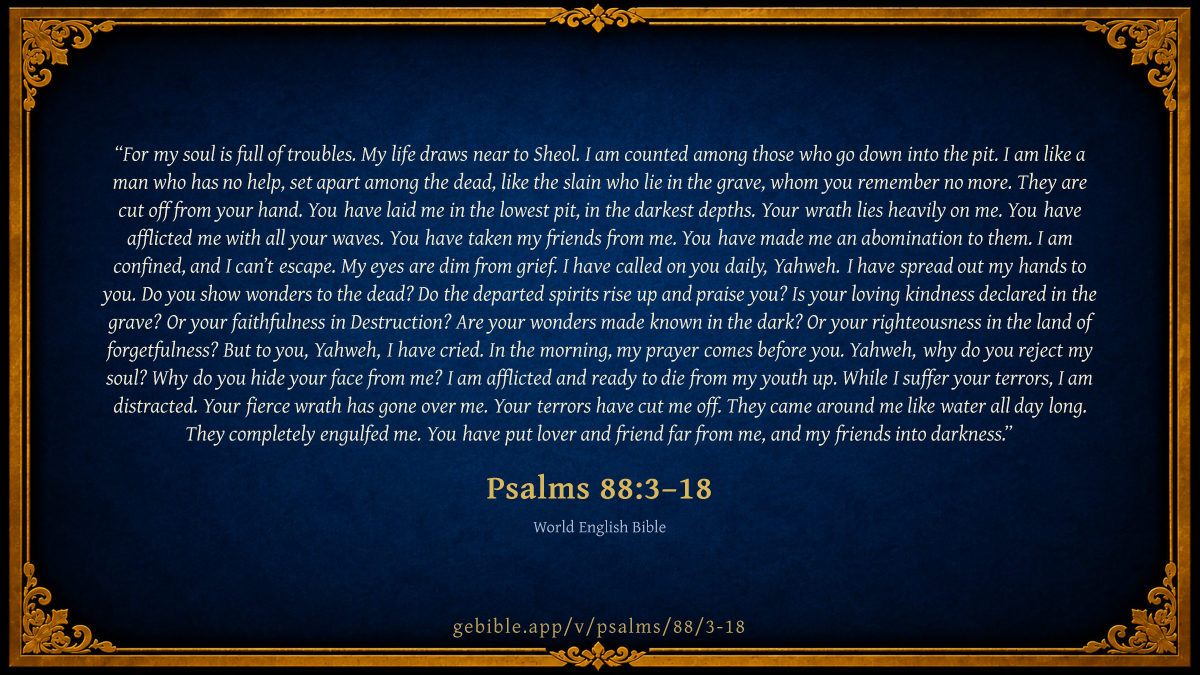
For my soul is full of troubles. My life draws near to Sheol.
I am counted among those who go down into the pit. I am like a man who has no help,
set apart among the dead, like the slain who lie in the grave, whom you remember no more. They are cut off from your hand.
You have laid me in the lowest pit, in the darkest depths.
Your wrath lies heavily on me. You have afflicted me with all your waves.
You have taken my friends from me. You have made me an abomination to them. I am confined, and I can’t escape.
My eyes are dim from grief. I have called on you daily, Yahweh. I have spread out my hands to you.
Do you show wonders to the dead? Do the departed spirits rise up and praise you?
Is your loving kindness declared in the grave? Or your faithfulness in Destruction?
Are your wonders made known in the dark? Or your righteousness in the land of forgetfulness?
But to you, Yahweh, I have cried. In the morning, my prayer comes before you.
Yahweh, why do you reject my soul? Why do you hide your face from me?
I am afflicted and ready to die from my youth up. While I suffer your terrors, I am distracted.
Your fierce wrath has gone over me. Your terrors have cut me off.
They came around me like water all day long. They completely engulfed me.
You have put lover and friend far from me, and my friends into darkness.
John Calvin 1540 · Public Domain On vv3, 5, 6, 7, 8, 9, 10, 11, 14, 15 3 For my soul is filled with troubles. These…
3 For my soul is filled with troubles. These words contain the excuse which the prophet pleads for the excess of his grief. They imply that his continued crying did not proceed from softness or effeminacy of spirit, but that from a due consideration of his condition, it would be found that the immense accumulation of miseries with which he was oppressed was such as might justly extort from him these lamentations. Nor does he speak of one kind of calamity only; but of calamities so heaped one upon another that his heart was filled with sorrow, till it could contain no more. He next particularly affirms that his life was not far from the grave. This idea he pursues and expresses in terms more significant in the following verse, where he complains that he was, as it were, dead. Although he breathed still among the living, yet the many deaths with which he was threatened on all sides were to him so many graves by which he expected to be swallowed up in a moment. And he seems to use the word גבר, geber, which is derived from גבר, gabar, he prevailed, or was strong, in preference to the word which simply signifies man, — the more emphatically to show that his distresses were so great and crushing as to have been sufficient to bring down the strongest man.
John Calvin's Commentaries (1540-1563) — public domain. Text from the Calvin Translation Society English edition (1840s-50s) via the Christian Classics Ethereal Library (ccel.org). Calvin's coverage is partial (roughly two-thirds of the Bible); uncommented books and verses are honest gaps, never fabricated. The 19th-century editor's footnotes and remarks are omitted so the notes are faithfully Calvin's own voice.
Geneva Bible translators 1599 · Public Domain On vv5, 7, 8, 9, 10, 12, 15, 18 That is, from thy providence and care, which is…
That is, from thy providence and care, which is meant according to the judgment of the flesh.
For he that is dead, is free from all cares and business of this life: and thus he saith, because he was unprofitable for all matters concerning man’s life, and as it were cut off from this world.
Geneva Bible (1599) marginal notes — public domain.
John Trapp 1656 · Public Domain On vv3–18 Psa 88:3 For my soul is full of troubles:…
Psa 88:3 For my soul is full of troubles: and my life draweth nigh unto the grave.
Ver. 3. For my soul is full of trouble] Hypotyposis hominis luctuosissime affecti. Here we have the lively picture of a man under bitter affliction. Extraordinary wise he was, and extraordinary troubles he had. None out of hell suffer more than God’s dearest children. This good man felt himself in the suburbs of hell, as it were.
Read full note →
And my life draweth nigh unto the grave] Or, unto hell. The same word signifieth both, because death is hell’s harbinger, and would be so to the elect, but for Christ.
John Trapp, A Commentary or Exposition upon All the Books of the Old and New Testament (1647–1656) — public domain. Text from a community e-Sword module.
Matthew Poole 1685 · Public Domain On vv3, 4, 5, 6, 7, 8, 9, 10, 11, 12, 13, 14, 15, 17, 18 My soul, properly so called; for that he was…
My soul, properly so called; for that he was under great troubles of mind from a sense of God’s wrath and departure from him, is evident from Psa 88:14-16.
Matthew Poole's English Annotations on the Holy Bible (1683–1685) — public domain. Text from a community e-Sword/MySword module.
Matthew Henry 1710 · Public Domain On v10 In these verses,
In these verses,
I. The psalmist expostulates with God concerning the present deplorable condition he was in (Psa 88:10-12): "Wilt thou do a miraculous work to the dead, and raise them to life again? Shall those that are dead and buried rise up to praise thee? No; they leave it to their children to rise up in their room to praise God; none expects that they should do it; and wherefore should they rise, wherefore should they live, but to praise God? The life we are born to at first, and the life we hope to rise to at last, must thus be spent. But shall thy lovingkindness to thy people be declared in the grave, either by those or to those that lie buried there? And thy faithfulness to thy promise, shall that be told in destruction? shall thy wonders be wrought in the dark, or known there, and thy righteousness in the grave, which is the land of forgetfulness, where men remember nothing, nor are themselves remembered? Departed souls may indeed know God's wonders and declare his faithfulness, justice, and lovingkindness; but deceased bodies cannot; they can neither receive God's favours in comfort nor return them in praise." Now we will not suppose these expostulations to be the language of despair, as if he thought God could not help him or would not, much less do they imply any disbelief of the resurrection of the dead at the last day; but he thus pleads with God for speedy relief: "Lord, thou art good, thou art faithful, thou art righteous; these attributes of thine will be made known in my deliverance, but, if it be not hastened, it will come too late; for I shall be dead and past relief, dead and not capable of receiving any comfort, very shortly." Job often pleaded thus, Job 7:8; Job 10:21.
Read full note →
II. He resolves to continue instant in prayer, and the more so because the deliverance was deferred (Psa 88:13): "Unto thee have I cried many a time, and found comfort in so doing, and therefore I will continue to do so; in the morning shall my prayer prevent thee." Note, Though our prayers be not answered immediately, yet we must not therefore give over praying, because the vision is for an appointed time, and at the end it shall speak and not lie. God delays the answer in order that he may try our patience and perseverance in prayer. He resolves to seek God early, in the morning, when his spirits were lively, and before the business of the day began to crowd in - in the morning, after he had been tossed with cares, and sorrowful thoughts in the silence and solitude of the night; but how could he say, My prayer shall prevent thee? Not as if he could wake sooner to pray than God to hear and answer; for he neither slumbers nor sleeps; but it intimates that he would be up earlier than ordinary to pray, would prevent (that is, go before) his usual hour of prayer. The greater our afflictions are the more solicitous and serious we should be in prayer. "My prayer shall present itself before thee, and be betimes with thee, and shall not stay for the encouragement of the beginning of mercy, but reach towards it with faith and expectation even before the day dawns." God often prevents our prayers and expectations with his mercies; let us prevent his mercies with our prayers and expectations.
III. He sets down what he will say to God in prayer. 1. He will humbly reason with God concerning the abject afflicted condition he was now in (Psa 88:14): "Lord, why castest thou off my soul? What is it that provokes thee to treat me as one abandoned? Show me wherefore thou contendest with me." He speaks it with wonder that God should cast off an old servant, should cast off one that was resolved not to cast him off: "No wonder men cast me off; but, Lord, why dost thou, whose gifts and callings are without repentance? Why hidest thou thy face, as one angry at me, that either hast no favour for me or wilt not let me know that thou hast?" Nothing grieves a child of God so much as God's hiding his face from him, nor is there any thing he so much dreads as God's casting off his soul. If the sun be clouded, that darkens the earth; but if the sun should abandon the earth, and quite cast it off, what a dungeon would it be! 2. He will humbly repeat the same complaints he had before made, until God have mercy on him. Two things he represents to God as his grievances: - (1.) That God was a terror to him: I suffer thy terrors, Psa 88:15. He had continual frightful apprehensions of the wrath of God against him for his sins and the consequences of that wrath. It terrified him to think of God, of falling into his hands and appearing before him to receive his doom from him. He perspired and trembled at the apprehension of God's displeasure against him, and the terror of his majesty. Note, Even those that are designed for God's favours may yet, for a time, suffer his terrors. The spirit of adoption is first a spirit of bondage to fear. Poor Job complained of the terrors of God setting themselves in array against him, Job 6:4. The psalmist here explains himself, and tells us what he means by God's terrors, even his fierce wrath. Let us see what dreadful impressions those terrors made upon him, and how deeply they wounded him. [1.] They had almost taken away his life: "I am so afflicted with them that I am ready to die, and" (as the word is) "to give up the ghost. Thy terrors have cut me off," Psa 88:16. What is hell, that eternal excision, by which damned sinners are for ever cut off from God and all happiness, but God's terrors fastening and preying upon their guilty consciences? [2.] They had almost taken away the use of his reason: When I suffer thy terrors I am distracted. This sad effect the terrors of the Lord have had upon many, and upon some good men, who have thereby been put quite out of the possession of their own souls, a most piteous case, and which ought to be looked upon with great compassion. [3.] This had continued long: From my youth up I suffer thy terrors. He had been from his childhood afflicted with melancholy, and trained up in sorrow under the discipline of that school. If we begin our days with trouble, and the days of our mourning have been prolonged a great while, let us not think it strange, but let tribulation work patience. It is observable the Heman, who became eminently wise and good, was afflicted and ready to die, and suffered God's terrors, from his youth up. Thus many have found it was good for them to bear the yoke in their youth, that sorrow has been much better for them than laughter would have been, and that being much afflicted, and often ready to die, when they were young, they have, by the grace of God, got such an habitual seriousness and weanedness from the world as have been of great use to them all their days. Sometimes those whom God designs for eminent services are prepared for them by exercises of this kind. [4.] His affliction was now extreme, and worse than ever. God's terrors now came round about him, so that from all sides he was assaulted with variety of troubles, and he had no comfortable gale from any point of the compass. They broke in upon him together like an inundation of water; and this daily, and all the day; so that he had no rest, no respite, not the lest breathing-time, no lucid intervals, nor any gleam of hope. Such was the calamitous state of a very wise and good man; he was so surrounded with terrors that he could find no place of shelter, nor lie any where under the wind. (2.) That no friend he had in the world was a comfort to him (Psa 88:18): Lover and friend hast thou put far from me; some are dead, others at a distance, and perhaps many unkind. Next to the comforts of religion are those of friendship and society; therefore to be friendless is (as to this life) almost to be comfortless; and to those who have had friends, but have lost them, the calamity is the more grievous. With this the psalmist here closes his complaint, as if this were that which completed his woe and gave the finishing stroke to the melancholy piece. If our friends are put far from us by scattering providences, nay, if by death our acquaintance are removed into darkness, we have reason to look upon it as a sore affliction, but must acknowledge and submit to the hand of God in it.
Matthew Henry's Commentary on the Whole Bible (1708–1710) — public domain (CC PDM 1.0). Text via the HelloAO Bible API.
John Gill 1763 · Public Domain On vv3–18 For my soul is full of troubles,.... Or "satiated…
For my soul is full of troubles,.... Or "satiated or glutted" (e) with them, as a stomach full of meat that can receive no more, to which the allusion is; having been fed with the bread of adversity and the water of affliction, so that he had his fill of trouble: every man is full of trouble, of one kind or another, Job 14:1 especially the saint, who besides his outward troubles has inward ones, arising from indwelling sin, the temptations of Satan, and divine desertions, which was now the case of the psalmist: this may be truly applied to Christ, who himself said, when in the garden, "my soul is exceeding sorrowful, even unto death", Mat 26:38, he was a man of sorrows all his days, but especially at that time, and when upon the cross, forsaken by his Father, and sustaining his wrath: "his soul" was then "filled with evil things" (f), as the words may be rendered:
innumerable evils compassed him about, Psa 40:12, the sins of his people, those evil things, were imputed to him; the iniquity of them all was laid upon him, as was also the evil of punishment for them; and then he found trouble and sorrow enough:
Read full note →
and my life draweth nigh unto the grave: a phrase expressive of a person's being just ready to die, Job 33:22 as the psalmist now thought he was, Psa 88:5, it is in the plural number "my lives" (g); and so may not only denote the danger he was in of his natural life, but of his spiritual and eternal life, which he might fear, being in darkness and desertion, would be lost, though they could not; yea, that he was near to "hell" itself, for so the word (h) may be rendered; for when the presence of God is withdrawn, and wrath let into the conscience, a person in his own apprehension seems to be in hell as it were, or near it; see Jon 2:2. This was true of Christ, when he was sorrowful unto death, and was brought to the dust of it, and under divine dereliction, and a sense of the wrath of God, as the surety of his people.
(e) "saturata", Pagninus, Montanus, Musculus, Junius & Tremellius, Piscator, Cocceius; "satiata", Tigurine version. (f) "in malis", Pagninus, Montanus; "malis", Junius & Tremellius, &c. (g) "vitae meae", Montanus, Michaelis. (h) "ad orcum", Cocceius; "inferno", Gejerus; "ad infernum", Michaelis; so Ainsworth.
John Gill's Exposition of the Whole Bible (1746–1763) — public domain (CC PDM 1.0). Text via the HelloAO Bible API.
John Wesley 1765 · Public Domain On vv4, 5, 7, 10, 12, 13, 17 Counted - l am given up by my friends…
Counted - l am given up by my friends for a lost man.
John Wesley, Explanatory Notes Upon the Whole Bible (1754–1765) — public domain. Text via the GEBible commentary corpus.
Adam Clarke 1810 · Public Domain On vv4, 5, 7, 8, 10, 11, 12, 13, 14, 15, 16, 17, 18 Verse 4. I am counted with them, c.] I…
Verse 4. I am counted with them, c.] I am as good as dead nearly destitute of life and hope.
Adam Clarke's Commentary on the Bible (1810–1826) — public domain. Text from a community e-Sword/MySword module.
Joseph Benson 1811 · Public Domain On vv5, 6, 8, 10, 13 Psa 88:5. Free among the dead — Well nigh…
Psa 88:5. Free among the dead — Well nigh discharged from the warfare of the present life, and entered, as a member, into the society of the dead; or, removed from all the affairs and conversation of men as if I were really dead. Like the slain, whom thou rememberest no more — Whom thou seemest wholly to neglect and to bury in oblivion. He speaks of these matters, not as they are in truth, for he knew very well that forgetfulness was not incident to God, and that God did remember all the dead, and would call them to an account; but only as to appearance, and the opinion of the world, and the things of this life. And they are cut off from thy hand — From the care and conduct of thy providence, which is to be understood as the former clause.
Joseph Benson's Commentary on the Old and New Testaments (1811–1818) — public domain. Text from a community e-Sword module.
Albert Barnes 1834 · Public Domain On vv3–18 For my soul is full of troubles - I…
For my soul is full of troubles - I am full of trouble. The word rendered as “full” means properly to satiate as with food; that is, when as much had been taken as could be. So he says here, that this trouble was as great as he could bear; he could sustain no more. He had reached the utmost point of endurance; he had no power to bear anymore.
And my life draweth nigh unto the grave - Hebrew, to Sheol. Compare the notes at Isa 14:9; notes at Job 10:21-22. It may mean here either the grave, or the abode of the dead. He was about to die. Unless he found relief he must go down to the abodes of the dead. The Hebrew word rendered life is in the plural number, as in Gen 2:7; Gen 3:14, Gen 3:17; Gen 6:17; Gen 7:15; et al. Why the plural was used as applicable to life cannot now be known with certainty. It may have been to accord with the fact that man has two kinds of life; the animal life - or life in common with the inferior creation; and intellectual, or higher life - the life of the soul. Compare the notes at 1Th 5:23. The meaning here is, that he was about to die; or that his life or lives approached that state when the grave closes over us; the extinction of the mere animal life; and the separation of the soul - the immortal part - from the body.
Albert Barnes' Notes on the Bible (1834–1885) — public domain. Text from a community e-Sword/MySword module.
Daniel D. Whedon 1874 · Public Domain On vv3–18 3. For my soul is full of troubles—Life can…
3. For my soul is full of troubles—Life can endure no more. From this to Psa_88:9, the author urges his great distress as an argument for the divine interposition.
My life draweth nigh unto the grave—My life reacheth to, or toucheth, sheol. This proximity to death is called “gates of death,” Psa_9:13; Psa_107:18
Daniel D. Whedon (gen. ed.), Commentary on the Old and New Testaments (1874–1909) — public domain. Text from a community e-Sword module.
The Cambridge Bible for Schools and Colleges 1878 · Public Domain On vv3–18 3. For &c.] He pleads the urgency of his…
3. For &c.] He pleads the urgency of his need as the ground for a hearing.
draweth nigh &c.] Hath drawn nigh unto Sheol, the gloomy nether world which is the abode of the departed. Cp. Psa_6:5; Psa_107:18.
The Cambridge Bible for Schools and Colleges (gen. ed. J. J. S. Perowne; Cambridge University Press, 1878–1918) — public domain. Text from a community e-Sword module.
Ellicott's Commentary for English Readers 1878 · Public Domain On vv3, 4, 5, 6, 7, 8, 9, 10, 11, 13, 14, 15, 16, 17, 18 (3) Grave.—Sheôl. Here, as in Psa_6:4-5; Psa_33:19; Isa_38:10-11, there…
(3) Grave.—Sheôl. Here, as in Psa_6:4-5; Psa_33:19; Isa_38:10-11, there comes into prominence the thought that death severs the covenant relation with God, and so presents an irresistible reason why prayer should be heard now before it is too late.
A Bible Commentary for English Readers, edited by Charles John Ellicott (1878–1897) — public domain. Text from a community e-Sword module.
The Pulpit Commentary 1880 · Public Domain On vv3–18 For my soul is full of troubles. (see Job_10:15)…
For my soul is full of troubles. (see Job_10:15) And my life draweth nigh unto the grave; literally, unto Sheol the place of departed spirits. (comp. Job_10:21, Job_10:22)
A soul full of troubles.
Read full note →
These plaints are such as could only be uttered by a diseased man diseased in body or diseased in mind. The man felt "satiated with evils." Hezekiah, suffering from his carbuncle, or Job, as he "scraped himself with his potsherd," might be expected to read life as drearily and despondingly as the psalmist did. "The psalm accumulates images to describe the pressure of trial upon the frailty of human nature." Look at some of the troubles.
I THE BREVITY OF HUMAN LIFE. That does not impress us so much when the aged are taken away, because we have become familiar with seventy as man"s allotted years; and the aged seem to have completed their time, and rounded off their lives. Nor does it impress us when young children die, because we have become familiar with the perils of infancy.
We feel it most when men are taken away in the "midst of their days." Hezekiah, smitten in the prime of life, wails over the brevity of life, saying, "I said, in the cutting off of my day, I shall go to the gates of the grave; I am deprived of the residue of my years. Mine age is departed, and is removed from me as a shepherd"s tent. I have cut off like a weaver my life." See the similar plaints of Job. The corrective of this trouble is to measure life by deeds, not by years. He lives long who does much.
II LOSS OF BODILY AND MENTAL STRENGTH. "I am as a man that hath no strength." Perhaps there is nothing harder for active-minded, energetic men to endure than conscious weakness. To many persons mental depression, resulting simply from lowered vitality, is the supreme distress. Yet in these days the human trial often takes this form. It is a triumph of grace to hold fast integrity even when the very mind is clouded with weakness, and "like a mist our vigour flees away," until all that remains to us is "a fragile form, fast hasting to decay." The corrective is to see that even weakness is in the list of God"s disciplinary agents.
III SEPARATION FROM ORDINARY DUTIES AND RELATIONS. From ver. 8 we gather that this was complicated by the fact that disease had taken offensive forms; and this brings to view the very marked and distressing features of Job"s disease. No one can fail. to feel it hard to retire from loved scenes and associations, and to loose out of hand loved duties. We think that no one can do them but ourselves, and no one can be to our friends what we were. The corrective is to remember that God may provide rest times for his servants; but he never bids them put their tools down, once for all, until he knows that their work is done; and then no truehearted man could wish to stay. It may come to be the form of our final struggle with self, that we are called to give up life"s duties and life"s relations at God"s bidding. There is possible triumph even over soul troubles. R.T.
The Pulpit Commentary (1880–1919), ed. H.D.M. Spence-Jones & Joseph S. Exell — public domain. Text from a community e-Sword module.
Charles H. Spurgeon 1885 · Public Domain On vv3–18 Ver. 3. For my soul is full of troubles.…
Ver. 3. For my soul is full of troubles. I am satiated and nauseated with them. Like a vessel full to the brim with vinegar, my heart is filled up with adversity till it can hold no more. He had his house full and his hands full of sorrow; but, worse than that, he had his heart full of it. Trouble in the soul is the soul of trouble. A little soul trouble is pitiful; what must it be to be sated with it? And how much worse still to have your prayers return empty when your soul remains full of grief.
And my life draweth nigh unto the grave. He felt as if he must die, indeed he thought himself half dead already. All his life was going, his spiritual life declined, his mental life decayed, his bodily life flickered; he was nearer dead than alive. Some of us can enter into this experience, for many a time have we traversed this valley of death shade, aye and dwelt in it by the month together. Really to die and be with Christ will be a gala day's enjoyment compared with our misery when a worse than physical death has cast its dreadful shadow over us. Death would be welcomed as a relief by those whose depressed spirits make their existence a living death. Are good men ever permitted to suffer thus? Indeed they are; and some of them are even all their life time subject to bondage. O Lord, Be pleased to set free thy prisoners of hope! Let, none of thy mourners imagine that a strange thing has happened unto him, but rather rejoice as he sees the footprints of brethren who have trodden this desert before.
Read full note →
Ver. 3. My soul is full of troubles. The Lord Jesus emptied himself of glory, that he might be full of trouble. His soul, which was free from human sin, was full of human troubles, that we who are full of sin might be free from trouble; his life drew nigh to the terrors of the unseen world, that we might not be its spoil and prey. "Plain Commentary."
Ver. 3. My soul is full of troubles. Hear into what a depth of spiritual distress three worthy servants of God in these later times were plunged and pressed down under the sense of God's anger for sin. Blessed Mistress Brettergh upon her last bed was horribly hemmed in with the sorrows of death; the very grief of hell laid hold upon her soul; a roaring wilderness of woe was within her, as she confessed of herself. She said, her sin had made her a prey to Satan; and wished that she had never been born, or that she had been made any other creature rather than a woman. She cried out many times, woe, woe, woe, etc.; a weak, a woeful, a wretched, a forsaken woman; with tears continually trickling from her eyes. Master Peacock, that man of God, in that his dreadful visitation and desertion, recounting some smaller sins, burst out in these words: "And for these", saith he, "I feel now a hell in my conscience." Upon other occasions he cried out, groaning most pitifully, "Oh me, wretch! Oh mine heart is miserable! Oh, oh, miserable and woeful! The burden of my sin lieth so heavy upon me, I doubt it will break my heart. Oh how woeful and miserable is my state that I am hunted by hell hounds!" When bystanders asked if he would pray, he answered, "I cannot". Suffer us, say they, to pray for you. "Take not", replied he, "the name of God in vain, by praying for a reprobate."
What grievous pangs, what sorrowful torments, what boiling heats of the fire of hell that blessed saint of God, John Glover, felt inwardly in his spirit, saith Foxe, no speech outwardly is able to express. Being young, saith he, I remember I was once or twice with him, whom partly by his talk I perceived, and partly by mine own eyes saw to be so worn and consumed by the space of five years, that neither almost any brooking of meat, quietness of sleep, pleasure of life, yea, and almost no kind of senses was left in him. Upon apprehension of some backsliding, he was so perplexed, that if he had been in the deepest pit of hell, he could almost have despaired no more of his salvation; in which intolerable griefs of mind, saith he, although he neither had, nor could have any joy of his meat, yet was he compelled to eat against his appetite, to the end to defer the time of his damnation so long as he might; thinking with himself, but that he must needs be thrown into hell, the breath being once out of his body. I dare not pass out of this point, lest some child of God should be here discouraged, before I tell you that every one of these three was at length blessedly recovered, and did rise most gloriously out of their several depths of most extreme spiritual misery, before their end.
Hear, therefore, Mistress Brettergh's triumphant songs and ravishments of spirit, after the return of her well beloved: "O Lord Jesus, dost thou pray for me? O blessed and sweet Saviour, how wonderful! How wonderful are thy mercies! Oh thy love is unspeakable, thou hast dealt so graciously with me! O my Lord and my God, blessed be thy name for evermore, which hast showed me the path of life. Thou didst, O Lord, hide thy face from me for a little season, but with everlasting mercy thou hast had compassion on me. And now, blessed Lord, thy comfortable presence is come; yea, Lord, thou hast had respect unto thine handmaid, and art come with fulness of joy, and abundance of consolation. O blessed be thy name, my Lord and my God. O the joys that I feel in my soul! They be wonderful. O Father, how merciful and marvellously gracious art thou unto me! yea, Lord, I feel thy mercy and I am assured of thy love; and so certain am I thereof, as Thou art the God of truth, even so sure do I know myself to be thine, O Lord my God, and this my soul knoweth right well. Blessed be the Lord that hath thus comforted me, and hath brought me now to a place more sweet unto me than the garden of Eden. Oh the joy, the delightsome joy that I feel! O praise the Lord for his mercies, and for this joy which my soul feels full well; praise his name forever more."
Hear with what heavenly calmness and sweet comforts Master Peacock's heart was refreshed and ravished when the storm was over: "Truly, my heart and soul", saith he, (when the tempest was something allayed) "have been far led and deeply troubled with temptations, and stings of conscience, but I thank God they are eased in good measure. Wherefore I desire that I be not branded with the note of a castaway or reprobate. Such questions, oppositions, and all tending thereto, I renounce. Concerning mine inconsiderate speeches in my temptation, I humbly and heartily ask mercy of God for them all." Afterward by little, and little, more light did arise in his heart, and he brake out into such speeches as these: "I do, God be praised, feel such comfort from that, what shall I call it?" "Agony", said one that stood by. "Nay", quoth he, "that is too little; that had I five hundred worlds, I could not make satisfaction for such an issue. Oh, the sea is not more full of water, nor the sun of light, than the Lord of mercy; yea, his mercies are ten thousand times more. What great cause have I to magnify the great goodness of God, that hath humbled such a wretched miscreant, and of so base condition, to an estate so glorious and stately. The Lord hath honoured me with his goodness! I am sure he hath provided a glorious kingdom for me. The joy that I feel in mine heart is incredible." For the third, (namely, John Glover) hear Mr. Foxe: "Though this good servant of God suffered many years so sharp temptations, and strong buffeting of Satan; yet the Lord, who graciously preserved him all the while, not only at last did rid him out of all discomfort, but also framed him thereby to such mortification of life, as the like lightly hath not been seen; in such sort, as he being like one placed in heaven already, and dead in this world both in word and meditation, led a life altogether celestial, abhorring in his mind all profane doings." Robert Bolton (1572-1631), in, "Instructions for a right Comforting afflicted Consciences."
Ver. 3. My life. The Hebrew word rendered life is in the plural number, as in Ge 2:7 3:14, 17 6:17 7:15 et al. Why the plural was used as applicable to life cannot now be known with certainty. It may have been to accord with the fact, that man has two kinds of life; the animal life, or life in common with the inferior creation; and intellectual, or higher life, the life of the soul. The meaning here is, that he was about to die; or that his life or lives approached that state when the grave closes over us; the extinction of the mere animal life; and the separation of the soulthe immortal partfrom the body. Albert Barnes.
Ver. 3. The grave. The word which is rendered "hell" in the Prayer Book translation, and "the grave" in the Bible version, and which is usually translated either as hell or the grave, is in the Hebrew lav and in the Greek "Hades." "Hades" signifies "the unseen world." The word "Sheol" is literally "the Devouring, or the Insatiable." (Compare Hab 2:5) "who enlargeth his desire as hell, and is as death, and cannot be satisfied"; and also (Pr 3:15-16.) "Sheol" seems to have presented itself to the thoughts of the ancient Hebrews as a gloomy, silent, inevitable, and mysterious abode, situated within the earth, whither the souls of the departed were compelled to repair and to dwell, upon their being separated from the body. (Isa 14:9-20). They believed that the spirits of all human kind were contained there in a state of waiting, and there especially dwelt the souls of the giants before the flood (1Pe 3:19-20), and of the great ones of old, the Rephaim, whom they pictured to themselves as fearful and gigantic spectres (Compare Pr 2:18). These ideas became modified and developed with the increasing clearness of divine teaching; and they divided the abode of the dead into different states of hope and comfort, which they called Abraham's bosom and paradise (Lu 16:22-23 23:43); and of misery and suffering, (Pr 3:1). Life and immortality were brought to light by the Saviour, and also judgment and Hellthe Gehenna of everlasting punishment, as distinguished from the Unseen World. (Compare Re 20:13-14). From these speculations of Jewish Rabbis respecting Sheol the church of Rome appears to have developed the doctrine of Purgatory. It should be added that it was a received opinion among the followers of Rabbinical teaching, that all of the seed of Abraham, though they would be dwellers in Sheol before the general resurrection, would finally escape the Gehenna of everlasting fire. The rich man (Lu 16:23) is in Hades in torments when he calls to Abraham his father. "Plain Commentary."
Ver. 3.
1. A good man is exposed to inward troubles.
(a) To soul troubles.
(b) To the soul full of troubles.
2. To outward troubles. "My life", etc.
(a) From outward persecutions.
(b) From inward griefs.
3. To both inward and outward troubles at the same time. "Soul full", etc., "and my life", etc. G.R.
Psalms 88:4*
Charles H. Spurgeon's The Treasury of David (1869–1885) — public domain. Psalms only. Text from a community e-Sword/MySword module.
The Biblical Illustrator 1887 · Public Domain On vv3, 5, 7, 8, 9, 10, 13, 14, 15, 18 For my soul is full of troubles, and my…
Psa_88:3
For my soul is full of troubles, and my life draweth nigh unto the grave.
Read full note →
Heman: a child of light walking in darkness
(with 1Ch_25:5):--A seer is just a man who sees. Other men also have eyes indeed, but, then, they do not see with their eyes as a seer sees. Now, Heman was a seer. Heman saw constantly a sight that to most men even in Israel was absolutely invisible. Heman saw, and saw nothing else, but his own soul.
1. My soul is full of troubles, says this great seer, speaking about himself. What led Heman to speak and to publish abroad this most melancholy of all the psalms we are not told. It was not Hemans actual sin, like Davids. Neither was this terrible trouble, like Davids, among his large family of sons and daughters. Heman had brought up his sons and daughters more successfully than David had done. For all Hemans children assisted their father in sacred song in the house of the Lord. At the same time Heman cannot take a happy fathers full joy cut of his talented and dutiful children because of the overwhelming trouble of his own soul. It is a terrible baptism into the matters of God to have a soul from his youth up so full of inconsolable troubles as that.
2. My soul is full of troubles, says Heman, till I am driven distracted. Every day we hear of men and women being driven distracted through love, and through fear, and through poverty, and through pain, and sometimes through ever-joy, and sometimes, it is said, through religion. It was thought by some that the Apostle Paul was quite distracted in his day through his too much thought and occupation about Divine things. But be not too much cast down. Comfort My people. Say to them, and assure them, that this is the beginning in them of the wisdom, and the truth, and the love, and the salvation of their God and Saviour Jesus Christ.
3. Now, with all that, this is not to be wondered at that Heman says next (Psa_88:18). Anything else but this is not to be expected from Heman. Heman makes it an additional complaint, but it is a simple and a necessary consequence of his troubled and distracted soul. Friends and lovers, the oldest, and the warmest, and the bests--they all have their several limits. Most men are made with little heart themselves, and they are not at home where there is much heart, and much exercise of heart. They flee in a fright from the heights and the depths of the high and deep heart. It needs a friend that sticketh closer than a brother to keep true to a man who has much heart, and who sees and feels with all his heart. Heman, besides being the Kings seer, was also an eminent type of Christ, both in the distracting troubles of his soul, and in the fewness and in the infidelity of his friends.
4. Now, all that, bad as it is, would have been easily borne had it been a sudden stroke and then for ever over. Had it been a great temptation, a great fall, a great repentance, a great forgiveness, and then the light of Gods countenance brighter than ever all Hemans after days. But Hemans yoke from his youth up has been of that terrible kind that it has eaten into his soul deeper and deeper with every advancing year. Had Heman lived after Pauls day he would have described himself in Pauls way. He would have said that the two-edged sword had become every year more and more spiritual, till it entered more and more deep every year into his soul.
5. There are these four uses out of all that.
(1) The first is to justify such a proceeding as to take a text like this for a Communion evening. What could be more comely in a worthy communicant, who has been stayed with flagons and comforted with apples all day than to say to the outcasts of Israel ere this day closes (Isa_43:1; Isa_43:25).
(2) And then for the use of all Heman-like, all distracted communicants--do not despair. Do not give way to distraction.
(3) Are you quite sure that this deep darkness of yours is quite unaccountable to you short of Gods sovereignty--short of His deep, hidden, Divine will? I doubt it, and I would have you doubt it. I would have you make sure that there is no other possible explanation of this darkness of His face. All the chances are that it is not Gods ways that are so distractingly dark, but your own.
(4) There is a singular use in Heman for ministers. When God is to make a very sinful man into a very able, and skilful, and experimental minister, He sends that man to the same school to which He sent Heman. Now, who can tell what God has laid up for you to do for Him and for mens souls when you are out of your probationer-ship of trouble and distraction, and are promoted to be a comforter of Gods troubled and distracted saints? He may have a second David, and far more, to comfort and to sanctify in the generation to come; and you may be ordained to be the Kings seer in the matters of God. Who can tell? Only, be you ready, for the stone that is fit for the wall is not left to lie in the ditch. (A. Whyte, D. D.)
Hemans elegy
Two Hemans attained eminence in Israel. One was a singer, the other was a sage (1Ch_15:16-22; 1Ch_25:5; 1Ki_4:31). The two facts which filled Hemans soul with trouble were by no means unusual facts. They were--
1. The growing infirmities, the frailties and Sicknesses, of age (verse7); and--
2. The loss of friends, or the supposed alienation of friends, which often accompanies age, especially when it is sick and weary of the world (Psa_88:8-18). These are common facts, but they are none the more welcome for being common when they come home to us personally. Our sage broods over them, resents them, as we all do at times, and laments his feebleness and isolation. Nay, as he traces all the facts and events of human life to the hand of God, he charges God with all the responsibility, all the pains and bitterness of them, and concludes that even this great Friend has forgotten him; or has turned against him. With all his wisdom he has been, as he confesses (Psa_88:5). Of a sceptical and misgiving temperament from his youth up. Two ways in which we may view the contents of the psalm--either making the best of them, or making the worst of them, in so far at least as they bear on the character and aim of the author of the psalm. We are not bound to adopt Hemans views, or even to sympathize with them. Much in the Bible was written for our warning and admonition. If we bring a generous spirit to the interpretation of this song, or elegy, we may recall the familiar maxim: In much wisdom is much sorrow. A thoughtful mind is a pensive mind. The more a man sees of human life, the more he feels how much there is in it which is wrong, foolish, base, disappointing, if not hopelessly corrupt and bad. So we shall begin to make excuse for Heman. Let us remember also that in much sorrow there is much discipline, and discipline by which a wise man should profit. Do you, do all men, resent the wrongs of time? Remember that resentment, then, as well as the wrongs which provoke it; and consider what a happy omen lies in the fact that men do hate and resent that which is wrong, and both love and demand that which is just and right. Those who decry mere human wisdom are very likely to conclude that Heman the sage was punished for his largeness and freedom of thought, that he was abandoned to the guidance of his own wisdom in order that he might learn how little it could do for him in the greatest emergencies of life, how little, therefore, it was worth. I see no reason to judge him thus harshly. I find much in this psalm to lead us to a more kindly judgment. But, doubtless, there are many among us to whom such a description would apply. (Samuel Cox, D. D.)
The Biblical Illustrator, edited by Joseph S. Exell (c. 1880s–1900s) — public domain. Text from a community e-Sword module.
C. I. Scofield 1917 · Public Domain On vv3, 10 Heb. "Sheol," (See Scofield "Hab 2:5").
grave
Heb. "Sheol," (See Scofield "Hab 2:5").
The Scofield Reference Bible (1917 edition), notes by C. I. Scofield — public domain. Text from a community e-Sword module.
unfoldingWord translationNotes 2017 · CC BY-SA 4.0 On vv3, 5, 7, 8, 9, 11, 13, 15, 17 For I am filled with troubles
For I am filled with troubles
The writer speaks of himself as if he were a container and troubles are the contents that fill the container. AT: "For I am very troubled" (See: Metaphor)
Read full note →
my life has reached Sheol
Here "life" represents the writer. And "Sheol" represents death. The writer speaks about himself possibly dying soon as if Sheol were a place and he has arrived at that place. AT: "I am about to die" (See: Metonymy and Metaphor)
People treat me like those who go down into the pit
The word "pit" means the same as "Sheol." The phrase "go down into the pit" represents dying. AT: "people treat me like I have already died" (See: Metonymy)
translationWords
trouble
life
Hades
pit
unfoldingWord translationNotes — © Distant Shores Media and the Door43 World Missions Community, licensed CC BY-SA 4.0. Source: git.door43.org/Door43/en_tn.
Tyndale Open Study Notes 2022 · CC BY-SA 4.0 On vv6, 8, 13, 18 88:6-7 In his first charge, the psalmist blames the…
88:6-7 In his first charge, the psalmist blames the Lord for his demise. God’s overpowering anger did not make sense. • The phrase the darkest depths implies the place of the dead (143:3; see Lam 3:6) or the depths of the sea (Pss 68:22; 69:1-2).
Tyndale Open Study Notes — © Tyndale Open Resources, licensed CC BY-SA 4.0. Text via the HelloAO Bible API.