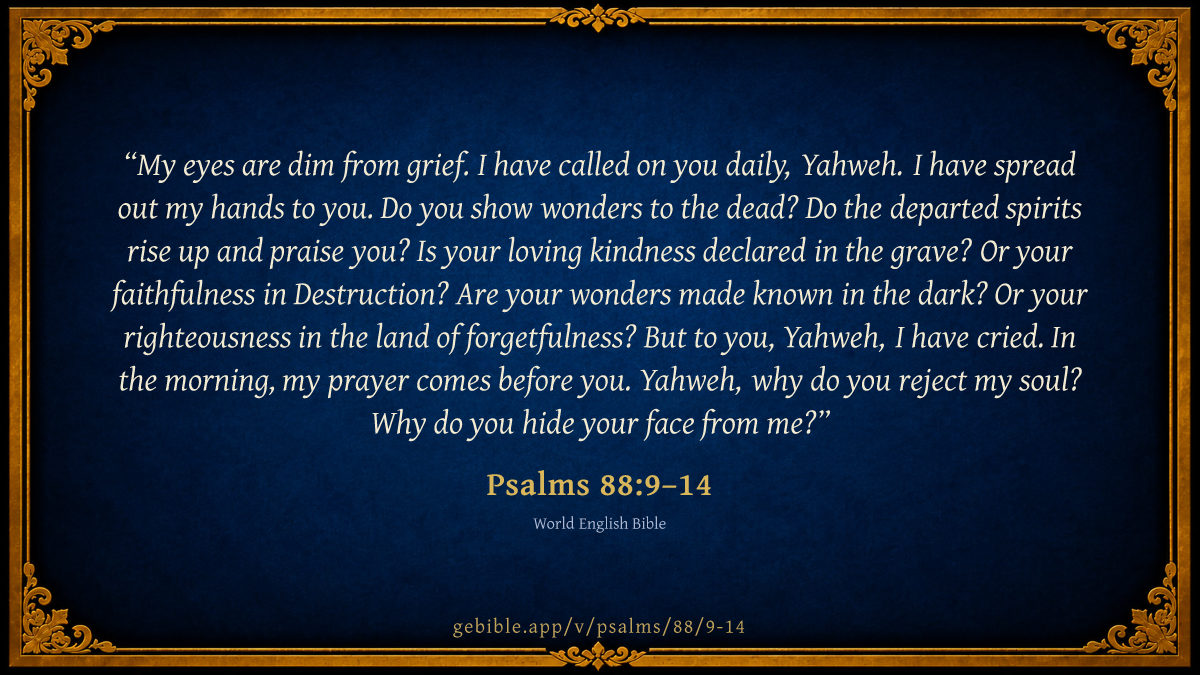
Questions where the Bible appears to say two different things, with the passages on each side set together.
Does God help in times of need?Multiple psalms and prophetic texts have Yahweh actively hiding his face, refusing to hear prayers, and abandoning those who cry out (Ps 10:1; 22:1; 88:14; Isa…
Psalms 5:3(v13)Yahweh, in the morning you will hear my voice. In the morning I will lay my requests before you, and will watch expectantly.
Mark 1:35(v13)Early in the morning, while it was still dark, he rose up and went out, and departed into a deserted place, and prayed there.
Psalms 30:2(v13)Yahweh my God, I cried to you, and you have healed me.
Job 11:13(v9)“If you set your heart aright, stretch out your hands toward him.
Psalms 6:5(v10)For in death there is no memory of you. In Sheol, who shall give you thanks?
Show all 57 cross-references
Job 13:24(v14)Why do you hide your face, and consider me your enemy?
Psalms 119:147-148(v13)I rise before dawn and cry for help. I put my hope in your words. My eyes stay open through the night watches, that I might meditate on…
Ecclesiastes 9:5(v12)For the living know that they will die, but the dead don’t know anything, neither do they have any more a reward; for their memory is…
Isaiah 26:19(v10)Your dead shall live. My dead bodies shall arise. Awake and sing, you who dwell in the dust; for your dew is like the dew of herbs, and the…
Psalms 13:1(v14)How long, Yahweh? Will you forget me forever? How long will you hide your face from me?
Psalms 30:9(v10)“What profit is there in my destruction, if I go down to the pit? Shall the dust praise you? Shall it declare your truth?
Psalms 38:10(v9)My heart throbs. My strength fails me. As for the light of my eyes, it has also left me.
Psalms 86:3(v9)Be merciful to me, Lord, for I call to you all day long.
Psalms 43:2(v14)For you are the God of my strength. Why have you rejected me? Why do I go mourning because of the oppression of the enemy?
Psalms 44:24(v14)Why do you hide your face, and forget our affliction and our oppression?
Psalms 143:6(v9)I spread out my hands to you. My soul thirsts for you, like a parched land.
Isaiah 38:18-19(v10)For Sheol can’t praise you. Death can’t celebrate you. Those who go down into the pit can’t hope for your truth. The living, the living, he…
Psalms 42:3(v9)My tears have been my food day and night, while they continually ask me, “Where is your God?”
Matthew 8:12(v12)but the children of the Kingdom will be thrown out into the outer darkness. There will be weeping and gnashing of teeth.”
1 Corinthians 15:52-57(v10)in a moment, in the twinkling of an eye, at the last trumpet. For the trumpet will sound and the dead will be raised incorruptible, and we…
Job 10:21-22(v12)before I go where I will not return from, to the land of darkness and of the shadow of death; the land dark as midnight, of the shadow of…
Job 14:7-12(v10)“For there is hope for a tree if it is cut down, that it will sprout again, that the tender branch of it will not cease. Though its root…
Job 16:20(v9)My friends scoff at me. My eyes pour out tears to God,
Job 17:7(v9)My eye also is dim by reason of sorrow. All my members are as a shadow.
Job 21:30(v11)that the evil man is reserved to the day of calamity, That they are led out to the day of wrath?
Job 26:6(v11)Sheol is naked before God, and Abaddon has no covering.
Psalms 6:7(v9)My eye wastes away because of grief. It grows old because of all my adversaries.
Psalms 31:12(v12)I am forgotten from their hearts like a dead man. I am like broken pottery.
Psalms 44:9(v14)But now you rejected us, and brought us to dishonor, and don’t go out with our armies.
Psalms 44:20(v9)If we have forgotten the name of our God, or spread out our hands to a strange god,
Psalms 55:17(v9)Evening, morning, and at noon, I will cry out in distress. He will hear my voice.
Psalms 55:23(v11)But you, God, will bring them down into the pit of destruction. Bloodthirsty and deceitful men shall not live out half their days, but I…
Psalms 68:31(v9)Princes shall come out of Egypt. Ethiopia shall hurry to stretch out her hands to God.
Psalms 69:17(v14)Don’t hide your face from your servant, for I am in distress. Answer me speedily!
Psalms 73:18(v11)Surely you set them in slippery places. You throw them down to destruction.
Psalms 77:7-9(v14)“Will the Lord reject us forever? Will he be favorable no more? Has his loving kindness vanished forever? Does his promise fail for…
Psalms 88:1(v9)Yahweh, the God of my salvation, I have cried day and night before you.
Psalms 88:5(v12)set apart among the dead, like the slain who lie in the grave, whom you remember no more. They are cut off from your hand.
Psalms 102:9(v9)For I have eaten ashes like bread, and mixed my drink with tears,
Psalms 115:17(v10)The dead don’t praise Yah, neither any who go down into silence;
Psalms 118:17(v10)I will not die, but live, and declare Yah’s works.
Psalms 143:3(v12)For the enemy pursues my soul. He has struck my life down to the ground. He has made me live in dark places, as those who have been long…
Proverbs 15:11(v11)Sheol and Abaddon are before Yahweh— how much more then the hearts of the children of men!
Ecclesiastes 2:16(v12)For of the wise man, even as of the fool, there is no memory forever, since in the days to come all will have been long forgotten. Indeed,…
Ecclesiastes 8:10(v12)So I saw the wicked buried. Indeed they came also from holiness. They went and were forgotten in the city where they did this. This also is…
Isaiah 8:22(v12)and look to the earth, and see distress, darkness, and the gloom of anguish. They will be driven into thick darkness.
Lamentations 3:48-49(v9)My eye runs down with streams of water, for the destruction of the daughter of my people. My eye pours down and doesn’t cease, without any…
Ezekiel 17:11(v9)Moreover Yahweh’s word came to me, saying,
Ezekiel 37:1-14(v10)Yahweh’s hand was on me, and he brought me out in Yahweh’s Spirit, and set me down in the middle of the valley; and it was full of bones.…
Matthew 7:13(v11)“Enter in by the narrow gate; for wide is the gate and broad is the way that leads to destruction, and many are those who enter in by it.
Matthew 27:46(v14)About the ninth hour Jesus cried with a loud voice, saying, “Eli, Eli, lima sabachthani?” That is, “My God, my God, why have you forsaken…
Mark 5:35-36(v10)While he was still speaking, people came from the synagogue ruler’s house saying, “Your daughter is dead. Why bother the Teacher any more?”…
Luke 7:12-16(v10)Now when he came near to the gate of the city, behold, one who was dead was carried out, the only son of his mother, and she was a widow.…
Romans 9:22(v11)What if God, willing to show his wrath and to make his power known, endured with much patience vessels of wrath prepared for destruction,
2 Peter 2:1(v11)But false prophets also arose among the people, as false teachers will also be among you, who will secretly bring in destructive heresies,…
Jude 1:13(v12)wild waves of the sea, foaming out their own shame; wandering stars, for whom the blackness of darkness has been reserved forever.
Cross-references from openbible.info (CC BY 4.0)
Explain this passage (19 sources)
Historical commentary, presented as a primary source — not an endorsement.
John Calvin1540 · Public DomainOn vv9, 10, 11, 149. My eye mourneth because of my affliction. To…
9. My eye mourneth because of my affliction. To prevent it from being supposed that he was iron-hearted, he again repeats that his afflictions were so severe and painful as to produce manifest traces of his sorrow, even in his countenance and eyes — a plain indication of the low condition to which he was reduced. But he, notwithstanding, testifies that he was not drawn away from God, like many who, secretly murmuring in their hearts, and, to use a proverbial expression, chafing upon the bit, have nothing farther from their thoughts than to disburden their cares into the bosom of God, in order to derive comfort from Him. In speaking of the stretching out of his hands, he puts the sign for the thing signified. I have elsewhere had an opportunity of explaining the import of this ceremony, which has been in common use in all ages.
John Calvin's Commentaries (1540-1563) — public domain. Text from the Calvin Translation Society English edition (1840s-50s) via the Christian Classics Ethereal Library (ccel.org). Calvin's coverage is partial (roughly two-thirds of the Bible); uncommented books and verses are honest gaps, never fabricated. The 19th-century editor's footnotes and remarks are omitted so the notes are faithfully Calvin's own voice.
Geneva Bible translators1599 · Public DomainOn vv9, 10, 12Mine eyes and face declare my sorrows.
Mine eyes and face declare my sorrows.
Geneva Bible (1599) marginal notes — public domain.
John Trapp1656 · Public DomainOn vv9–14Psa 88:9 Mine eye mourneth by reason of affliction:…
Psa 88:9 Mine eye mourneth by reason of affliction: LORD, I have called daily upon thee, I have stretched out my hands unto thee.
Ver. 9. Lord, I have called daily upon thee] Which he would not have done if he had cast away his confidence; for "how shall they call upon him in whom they have not believed?" Rom 10:14. The saints, when they want the sun, yet they have the daystar in their hearts.
John Trapp, A Commentary or Exposition upon All the Books of the Old and New Testament (1647–1656) — public domain. Text from a community e-Sword module.
Matthew Poole1685 · Public DomainOn vv9–14Understand, without effect; for thou dost not hear nor…
Understand, without effect; for thou dost not hear nor answer me.
Matthew Poole's English Annotations on the Holy Bible (1683–1685) — public domain. Text from a community e-Sword/MySword module.
Matthew Henry1710 · Public DomainOn v10In these verses,
In these verses,
I. The psalmist expostulates with God concerning the present deplorable condition he was in (Psa 88:10-12): "Wilt thou do a miraculous work to the dead, and raise them to life again? Shall those that are dead and buried rise up to praise thee? No; they leave it to their children to rise up in their room to praise God; none expects that they should do it; and wherefore should they rise, wherefore should they live, but to praise God? The life we are born to at first, and the life we hope to rise to at last, must thus be spent. But shall thy lovingkindness to thy people be declared in the grave, either by those or to those that lie buried there? And thy faithfulness to thy promise, shall that be told in destruction? shall thy wonders be wrought in the dark, or known there, and thy righteousness in the grave, which is the land of forgetfulness, where men remember nothing, nor are themselves remembered? Departed souls may indeed know God's wonders and declare his faithfulness, justice, and lovingkindness; but deceased bodies cannot; they can neither receive God's favours in comfort nor return them in praise." Now we will not suppose these expostulations to be the language of despair, as if he thought God could not help him or would not, much less do they imply any disbelief of the resurrection of the dead at the last day; but he thus pleads with God for speedy relief: "Lord, thou art good, thou art faithful, thou art righteous; these attributes of thine will be made known in my deliverance, but, if it be not hastened, it will come too late; for I shall be dead and past relief, dead and not capable of receiving any comfort, very shortly." Job often pleaded thus, Job 7:8; Job 10:21.
Read full note →
II. He resolves to continue instant in prayer, and the more so because the deliverance was deferred (Psa 88:13): "Unto thee have I cried many a time, and found comfort in so doing, and therefore I will continue to do so; in the morning shall my prayer prevent thee." Note, Though our prayers be not answered immediately, yet we must not therefore give over praying, because the vision is for an appointed time, and at the end it shall speak and not lie. God delays the answer in order that he may try our patience and perseverance in prayer. He resolves to seek God early, in the morning, when his spirits were lively, and before the business of the day began to crowd in - in the morning, after he had been tossed with cares, and sorrowful thoughts in the silence and solitude of the night; but how could he say, My prayer shall prevent thee? Not as if he could wake sooner to pray than God to hear and answer; for he neither slumbers nor sleeps; but it intimates that he would be up earlier than ordinary to pray, would prevent (that is, go before) his usual hour of prayer. The greater our afflictions are the more solicitous and serious we should be in prayer. "My prayer shall present itself before thee, and be betimes with thee, and shall not stay for the encouragement of the beginning of mercy, but reach towards it with faith and expectation even before the day dawns." God often prevents our prayers and expectations with his mercies; let us prevent his mercies with our prayers and expectations.
III. He sets down what he will say to God in prayer. 1. He will humbly reason with God concerning the abject afflicted condition he was now in (Psa 88:14): "Lord, why castest thou off my soul? What is it that provokes thee to treat me as one abandoned? Show me wherefore thou contendest with me." He speaks it with wonder that God should cast off an old servant, should cast off one that was resolved not to cast him off: "No wonder men cast me off; but, Lord, why dost thou, whose gifts and callings are without repentance? Why hidest thou thy face, as one angry at me, that either hast no favour for me or wilt not let me know that thou hast?" Nothing grieves a child of God so much as God's hiding his face from him, nor is there any thing he so much dreads as God's casting off his soul. If the sun be clouded, that darkens the earth; but if the sun should abandon the earth, and quite cast it off, what a dungeon would it be! 2. He will humbly repeat the same complaints he had before made, until God have mercy on him. Two things he represents to God as his grievances: - (1.) That God was a terror to him: I suffer thy terrors, Psa 88:15. He had continual frightful apprehensions of the wrath of God against him for his sins and the consequences of that wrath. It terrified him to think of God, of falling into his hands and appearing before him to receive his doom from him. He perspired and trembled at the apprehension of God's displeasure against him, and the terror of his majesty. Note, Even those that are designed for God's favours may yet, for a time, suffer his terrors. The spirit of adoption is first a spirit of bondage to fear. Poor Job complained of the terrors of God setting themselves in array against him, Job 6:4. The psalmist here explains himself, and tells us what he means by God's terrors, even his fierce wrath. Let us see what dreadful impressions those terrors made upon him, and how deeply they wounded him. [1.] They had almost taken away his life: "I am so afflicted with them that I am ready to die, and" (as the word is) "to give up the ghost. Thy terrors have cut me off," Psa 88:16. What is hell, that eternal excision, by which damned sinners are for ever cut off from God and all happiness, but God's terrors fastening and preying upon their guilty consciences? [2.] They had almost taken away the use of his reason: When I suffer thy terrors I am distracted. This sad effect the terrors of the Lord have had upon many, and upon some good men, who have thereby been put quite out of the possession of their own souls, a most piteous case, and which ought to be looked upon with great compassion. [3.] This had continued long: From my youth up I suffer thy terrors. He had been from his childhood afflicted with melancholy, and trained up in sorrow under the discipline of that school. If we begin our days with trouble, and the days of our mourning have been prolonged a great while, let us not think it strange, but let tribulation work patience. It is observable the Heman, who became eminently wise and good, was afflicted and ready to die, and suffered God's terrors, from his youth up. Thus many have found it was good for them to bear the yoke in their youth, that sorrow has been much better for them than laughter would have been, and that being much afflicted, and often ready to die, when they were young, they have, by the grace of God, got such an habitual seriousness and weanedness from the world as have been of great use to them all their days. Sometimes those whom God designs for eminent services are prepared for them by exercises of this kind. [4.] His affliction was now extreme, and worse than ever. God's terrors now came round about him, so that from all sides he was assaulted with variety of troubles, and he had no comfortable gale from any point of the compass. They broke in upon him together like an inundation of water; and this daily, and all the day; so that he had no rest, no respite, not the lest breathing-time, no lucid intervals, nor any gleam of hope. Such was the calamitous state of a very wise and good man; he was so surrounded with terrors that he could find no place of shelter, nor lie any where under the wind. (2.) That no friend he had in the world was a comfort to him (Psa 88:18): Lover and friend hast thou put far from me; some are dead, others at a distance, and perhaps many unkind. Next to the comforts of religion are those of friendship and society; therefore to be friendless is (as to this life) almost to be comfortless; and to those who have had friends, but have lost them, the calamity is the more grievous. With this the psalmist here closes his complaint, as if this were that which completed his woe and gave the finishing stroke to the melancholy piece. If our friends are put far from us by scattering providences, nay, if by death our acquaintance are removed into darkness, we have reason to look upon it as a sore affliction, but must acknowledge and submit to the hand of God in it.
Matthew Henry's Commentary on the Whole Bible (1708–1710) — public domain (CC PDM 1.0). Text via the HelloAO Bible API.
John Gill1763 · Public DomainOn vv9–14Mine eye mourneth by reason of affliction,.... Or dropped…
Mine eye mourneth by reason of affliction,.... Or dropped tears, as the Targum, by which grief was vented; see Psa 6:7.
Lord, I have called daily upon thee, I have stretched out my hands unto thee; in prayer, as the Targum adds, this being a prayer gesture: notwithstanding his troubles continued and increased, he did not leave off praying, though he was not immediately heard and answered, which is what is tacitly complained of, as in Psa 22:2. Christ, in his troubles in the garden, and on the cross, prayed for himself, for divine support and assistance, as man; for his friends, disciples, and apostles, and for all that should believe in him through them; and even for his enemies.
John Gill's Exposition of the Whole Bible (1746–1763) — public domain (CC PDM 1.0). Text via the HelloAO Bible API.
John Wesley1765 · Public DomainOn vv10, 12, 13Wonders - In raising them to life. To praise…
Wonders - In raising them to life. To praise thee - In this world?
John Wesley, Explanatory Notes Upon the Whole Bible (1754–1765) — public domain. Text via the GEBible commentary corpus.
Adam Clarke1810 · Public DomainOn vv10–14Verse 10. Wilt thou show wonders to the dead!]…
Verse 10. Wilt thou show wonders to the dead!] מתים methim, dead men.
Shall the dead] רפאים rephaim, "the manes or departed spirits."
Read full note →
Arise and praise thee?] Any more in this life? The interrogations in this and the two following verses imply the strongest negations.
Adam Clarke's Commentary on the Bible (1810–1826) — public domain. Text from a community e-Sword/MySword module.
Joseph Benson1811 · Public DomainOn vv10, 13Psa 88:10-12. Wilt thou show wonders to the dead?…
Psa 88:10-12. Wilt thou show wonders to the dead? — Namely, in raising them to life again in this world? No: I know thou wilt not. And therefore now hear and help me, or it will be too late. Shall the dead arise and praise thee? — Namely, among mortal men in this world? Shall thy lovingkindness be declared in the grave? &c. — I am not without hopes, that thou bearest a real good-will toward me, and wilt faithfully perform thy gracious promises made to me, and to all that love thee, and call upon thee in truth, but then this must be done speedily, or I shall be utterly incapable of receiving such a mercy. Shall thy wonders be known in the dark? — In the grave, which is called the land of darkness, Job 10:21-22. Thy righteousness in the land of forgetfulness? — The grave, so called, either, 1st, Because there men forget and neglect all the concerns of this life, being indeed but dead carcasses without any sense or remembrance. Or, rather, 2d, Because there men are forgotten even by their nearest relations.
Joseph Benson's Commentary on the Old and New Testaments (1811–1818) — public domain. Text from a community e-Sword module.
Albert Barnes1834 · Public DomainOn vv9–14Mine eye mourneth by reason of affliction - I…
Mine eye mourneth by reason of affliction - I weep; my eye pours out tears. Literally, My eye pines away, or decays. Compare Job 16:20, note; Isa 38:3, note; Psa 6:6, note.
Lord, I have called daily upon thee - That is, I have prayed earnestly and long, but I have received no answer.
Read full note →
I have stretched out my hands unto thee - I have spread out my hands in the attitude of prayer. The idea is that of earnest supplication.
Albert Barnes' Notes on the Bible (1834–1885) — public domain. Text from a community e-Sword/MySword module.
Daniel D. Whedon1874 · Public DomainOn vv9–149. Mine eye mourneth… I have called daily… I…
9. Mine eye mourneth… I have called daily… I have stretched out my hands—My eye, voice, and hands give expression daily of my suffering and peril, and plead for me. Thus far the psalmist’s prayer is grounded on his miserable state, but now he introduces another argument, and pleads that God will be glorified more in his salvation than in his death.
Daniel D. Whedon (gen. ed.), Commentary on the Old and New Testaments (1874–1909) — public domain. Text from a community e-Sword module.
The Cambridge Bible for Schools and Colleges1878 · Public DomainOn vv9–149. Mine eye mourneth] R.V. wasteth away. The sunken,…
9. Mine eye mourneth] R.V. wasteth away. The sunken, lacklustre eye is the sure sign of suffering. Cp. Psa_6:7; Psa_31:9; Job_17:7.
stretched out] R.V. spread forth, in the attitude of prayer. Cp. (though the word is different) Psa_44:20; Psa_143:6; Isa_1:15.
Read full note →
9–12. Again (cp. Psa_88:1) he pleads the constancy of his prayers. His strength is failing. He will soon be dead; and in the grave he will be beyond the reach of God’s love and faithfulness. Cp. Job_10:20 ff; Job_17:11 ff.
The Cambridge Bible for Schools and Colleges (gen. ed. J. J. S. Perowne; Cambridge University Press, 1878–1918) — public domain. Text from a community e-Sword module.
Ellicott's Commentary for English Readers1878 · Public DomainOn vv9, 10, 11, 13, 14(9) Mourneth.—Rather, fadeth, or pineth. So a Latin poet…
(9) Mourneth.—Rather, fadeth, or pineth. So a Latin poet of the effects of weeping:—
“Mæsta neque assiduo tabescere lumina fletu.
Read full note →
Cessarent, tristique imbre madere genæ.”
CATULLUS: xxviii. 55.
A Bible Commentary for English Readers, edited by Charles John Ellicott (1878–1897) — public domain. Text from a community e-Sword module.
The Pulpit Commentary1880 · Public DomainOn vv9–14Mine eye mourneth by reason of affliction; or, "mine…
Mine eye mourneth by reason of affliction; or, "mine eye hath grown feeble". (comp. Job_17:7) Lord, I have called daily upon thee; or, "all day." I have stretched out my hands unto thee. The attitude of earnest prayer. (comp. Job_11:13 Psa_68:31, etc.)
The Pulpit Commentary (1880–1919), ed. H.D.M. Spence-Jones & Joseph S. Exell — public domain. Text from a community e-Sword module.
Charles H. Spurgeon1885 · Public DomainOn vv9–14Ver. 9. Mine eye mourneth by reason of affliction.…
Ver. 9. Mine eye mourneth by reason of affliction. He wept his eyes out. He exhausted the lachrymal glands, he wore away the sight itself. Tears in showers are a blessing, and work our good; but in floods they become destructive and injurious.
Lord, I have called daily upon thee. His tears wetted his prayers, but did not damp then fervour. He prayed still, though no answer came to dry his eyes. Nothing can make a true believer cease praying; it is a part of his nature, and pray he must.
Read full note →
I have stretched out my hands unto thee. He used the appropriate posture of a supplicant, of his own accord; men need no posture maker, or master of the ceremonies, when they are eagerly pleading for mercy, nature suggests to them attitudes both natural and correct. As a little child stretches out its hands to its mother while it cries, so did this afflicted child of God. He prayed all over, his eyes wept, his voice cried, his hands were outstretched, and his heart broke. This was prayer indeed.
Ver. 9. Mine eye mourneth, ...I have called. Weeping must not hinder praying; we must sow in tears: "Mine eye mourns", but "I cry unto thee daily." Let prayers and tears go together, and they shall be accepted together: "I have heard thy prayers, I have seen thy tears." Matthew Henry.
Ver. 9. The first clause seems literally to mean the soreness and dimness of sight caused by excessive weeping, and is so taken by many of the commentators, and Lorinus aptly quotes a Latin poet, Catullus, in illustration:
Moesta neque assiduo tabescere lumina fletu
Cessarent.
Nor my sad eyes to pine with constant tears
Could cease. Neale's Commentary.
Ver. 9.
1. Sorrow before God, "Mine eye", etc.
2. Prayer to God, "have called", etc.
3. Waiting for God, "called daily".
4. Dependence on God, "I have stretched", etc. These hands can do nothing without thee. G.R.
Psalms 88:10*
Charles H. Spurgeon's The Treasury of David (1869–1885) — public domain. Psalms only. Text from a community e-Sword/MySword module.
The Biblical Illustrator1887 · Public DomainOn vv9, 10, 13, 14Mine eye mourneth by reason of affliction.
Psa_88:9
Mine eye mourneth by reason of affliction.
Read full note →
The godly man in trouble
1. Godliness doth not make men senseless of grief, nor doth it hinder tears or mourning, or any other effects of sorrow to be seen in their body.
2. Sorrow should neither hinder the godly to seek God, nor move them to seek their consolation elsewhere.
3. It is possible that a godly man may be instant daily with God, praying with tears for comfort, and yet not obtain for a long time, as this example doth teach.
4. As in serious prayer, specially in secret, the affections of the heart do utter themselves in the answerable gestures of the body, as well as in the voice and words of the mouth; so those gestures have their own speech unto God, no less than the words of the mouth have; as here, I have stretched out my hands unto Thee, is brought forth to express his submissive rendering up of himself unto God, and his dependence upon Him. (D. Dickson.)
I have called daily upon Thee.
The necessity for daily prayer
appears when we consider the consequences of neglecting it. Experience proves that a regular habit, at some fixed hour or hours, becomes a safeguard against forgetfulness, as well as an invaluable help to the constant practice of the presence of God, whereas those who say that they can pray at any time, end in praying very seldom, or never. And Mrs. Besant has testified that God fades out of the life of the man who forgets to pray. On the other hand, you may lose hold of many a Christian doctrine, but you have not lost your faith so long as the angels can say of you, Behold, he still prayeth. Distress teaches us to pray, and prayer dispels distress. One wedge displaces the other.
The Biblical Illustrator, edited by Joseph S. Exell (c. 1880s–1900s) — public domain. Text from a community e-Sword module.
C. I. Scofield1917 · Public DomainOn v10(See Scofield "Ecc 9:10").
dead
(See Scofield "Ecc 9:10").
The Scofield Reference Bible (1917 edition), notes by C. I. Scofield — public domain. Text from a community e-Sword module.
unfoldingWord translationNotes2017 · CC BY-SA 4.0On vv9, 11, 13My eyes grow weary from trouble
My eyes grow weary from trouble
Here "eyes" represents a person's ability to see. For his eyes to grow weary from trouble is a way of saying that he his troubles cause him to cry so much that it is hard for him to see. (See: Metonymy and Idiom)
Read full note →
I spread out my hands to you
"I lift up my hands to you." This is an action that shows that he totally depends on God. (See: Symbolic Action)
Will you do wonders for the dead?
The writer uses a question to emphasize that if God lets him die then God will no longer be able to do wonderful things for him. AT: "You do not do wonders for dead people." (See: Rhetorical Question)
Will those who have died rise and praise you?
The writer uses a question to emphasize that if God lets him die then he will not be able to praise God any longer. AT: "You know that those who have died will not stand up and praise you." (See: Rhetorical Question)
Tyndale Open Study Notes2022 · CC BY-SA 4.0On v1388:13-17 In his third charge, the psalmist accuses the…
88:13-17 In his third charge, the psalmist accuses the Lord of rejecting him. The force and apparent cruelty of the psalmist’s suffering overwhelm him.
John Calvin 1540 · Public Domain On vv9, 10, 11, 14 9. My eye mourneth because of my affliction. To…
9. My eye mourneth because of my affliction. To prevent it from being supposed that he was iron-hearted, he again repeats that his afflictions were so severe and painful as to produce manifest traces of his sorrow, even in his countenance and eyes — a plain indication of the low condition to which he was reduced. But he, notwithstanding, testifies that he was not drawn away from God, like many who, secretly murmuring in their hearts, and, to use a proverbial expression, chafing upon the bit, have nothing farther from their thoughts than to disburden their cares into the bosom of God, in order to derive comfort from Him. In speaking of the stretching out of his hands, he puts the sign for the thing signified. I have elsewhere had an opportunity of explaining the import of this ceremony, which has been in common use in all ages.
John Calvin's Commentaries (1540-1563) — public domain. Text from the Calvin Translation Society English edition (1840s-50s) via the Christian Classics Ethereal Library (ccel.org). Calvin's coverage is partial (roughly two-thirds of the Bible); uncommented books and verses are honest gaps, never fabricated. The 19th-century editor's footnotes and remarks are omitted so the notes are faithfully Calvin's own voice.
Geneva Bible translators 1599 · Public Domain On vv9, 10, 12 Mine eyes and face declare my sorrows.
Mine eyes and face declare my sorrows.
Geneva Bible (1599) marginal notes — public domain.
John Trapp 1656 · Public Domain On vv9–14 Psa 88:9 Mine eye mourneth by reason of affliction:…
Psa 88:9 Mine eye mourneth by reason of affliction: LORD, I have called daily upon thee, I have stretched out my hands unto thee.
Ver. 9. Lord, I have called daily upon thee] Which he would not have done if he had cast away his confidence; for "how shall they call upon him in whom they have not believed?" Rom 10:14. The saints, when they want the sun, yet they have the daystar in their hearts.
John Trapp, A Commentary or Exposition upon All the Books of the Old and New Testament (1647–1656) — public domain. Text from a community e-Sword module.
Matthew Poole 1685 · Public Domain On vv9–14 Understand, without effect; for thou dost not hear nor…
Understand, without effect; for thou dost not hear nor answer me.
Matthew Poole's English Annotations on the Holy Bible (1683–1685) — public domain. Text from a community e-Sword/MySword module.
Matthew Henry 1710 · Public Domain On v10 In these verses,
In these verses,
I. The psalmist expostulates with God concerning the present deplorable condition he was in (Psa 88:10-12): "Wilt thou do a miraculous work to the dead, and raise them to life again? Shall those that are dead and buried rise up to praise thee? No; they leave it to their children to rise up in their room to praise God; none expects that they should do it; and wherefore should they rise, wherefore should they live, but to praise God? The life we are born to at first, and the life we hope to rise to at last, must thus be spent. But shall thy lovingkindness to thy people be declared in the grave, either by those or to those that lie buried there? And thy faithfulness to thy promise, shall that be told in destruction? shall thy wonders be wrought in the dark, or known there, and thy righteousness in the grave, which is the land of forgetfulness, where men remember nothing, nor are themselves remembered? Departed souls may indeed know God's wonders and declare his faithfulness, justice, and lovingkindness; but deceased bodies cannot; they can neither receive God's favours in comfort nor return them in praise." Now we will not suppose these expostulations to be the language of despair, as if he thought God could not help him or would not, much less do they imply any disbelief of the resurrection of the dead at the last day; but he thus pleads with God for speedy relief: "Lord, thou art good, thou art faithful, thou art righteous; these attributes of thine will be made known in my deliverance, but, if it be not hastened, it will come too late; for I shall be dead and past relief, dead and not capable of receiving any comfort, very shortly." Job often pleaded thus, Job 7:8; Job 10:21.
Read full note →
II. He resolves to continue instant in prayer, and the more so because the deliverance was deferred (Psa 88:13): "Unto thee have I cried many a time, and found comfort in so doing, and therefore I will continue to do so; in the morning shall my prayer prevent thee." Note, Though our prayers be not answered immediately, yet we must not therefore give over praying, because the vision is for an appointed time, and at the end it shall speak and not lie. God delays the answer in order that he may try our patience and perseverance in prayer. He resolves to seek God early, in the morning, when his spirits were lively, and before the business of the day began to crowd in - in the morning, after he had been tossed with cares, and sorrowful thoughts in the silence and solitude of the night; but how could he say, My prayer shall prevent thee? Not as if he could wake sooner to pray than God to hear and answer; for he neither slumbers nor sleeps; but it intimates that he would be up earlier than ordinary to pray, would prevent (that is, go before) his usual hour of prayer. The greater our afflictions are the more solicitous and serious we should be in prayer. "My prayer shall present itself before thee, and be betimes with thee, and shall not stay for the encouragement of the beginning of mercy, but reach towards it with faith and expectation even before the day dawns." God often prevents our prayers and expectations with his mercies; let us prevent his mercies with our prayers and expectations.
III. He sets down what he will say to God in prayer. 1. He will humbly reason with God concerning the abject afflicted condition he was now in (Psa 88:14): "Lord, why castest thou off my soul? What is it that provokes thee to treat me as one abandoned? Show me wherefore thou contendest with me." He speaks it with wonder that God should cast off an old servant, should cast off one that was resolved not to cast him off: "No wonder men cast me off; but, Lord, why dost thou, whose gifts and callings are without repentance? Why hidest thou thy face, as one angry at me, that either hast no favour for me or wilt not let me know that thou hast?" Nothing grieves a child of God so much as God's hiding his face from him, nor is there any thing he so much dreads as God's casting off his soul. If the sun be clouded, that darkens the earth; but if the sun should abandon the earth, and quite cast it off, what a dungeon would it be! 2. He will humbly repeat the same complaints he had before made, until God have mercy on him. Two things he represents to God as his grievances: - (1.) That God was a terror to him: I suffer thy terrors, Psa 88:15. He had continual frightful apprehensions of the wrath of God against him for his sins and the consequences of that wrath. It terrified him to think of God, of falling into his hands and appearing before him to receive his doom from him. He perspired and trembled at the apprehension of God's displeasure against him, and the terror of his majesty. Note, Even those that are designed for God's favours may yet, for a time, suffer his terrors. The spirit of adoption is first a spirit of bondage to fear. Poor Job complained of the terrors of God setting themselves in array against him, Job 6:4. The psalmist here explains himself, and tells us what he means by God's terrors, even his fierce wrath. Let us see what dreadful impressions those terrors made upon him, and how deeply they wounded him. [1.] They had almost taken away his life: "I am so afflicted with them that I am ready to die, and" (as the word is) "to give up the ghost. Thy terrors have cut me off," Psa 88:16. What is hell, that eternal excision, by which damned sinners are for ever cut off from God and all happiness, but God's terrors fastening and preying upon their guilty consciences? [2.] They had almost taken away the use of his reason: When I suffer thy terrors I am distracted. This sad effect the terrors of the Lord have had upon many, and upon some good men, who have thereby been put quite out of the possession of their own souls, a most piteous case, and which ought to be looked upon with great compassion. [3.] This had continued long: From my youth up I suffer thy terrors. He had been from his childhood afflicted with melancholy, and trained up in sorrow under the discipline of that school. If we begin our days with trouble, and the days of our mourning have been prolonged a great while, let us not think it strange, but let tribulation work patience. It is observable the Heman, who became eminently wise and good, was afflicted and ready to die, and suffered God's terrors, from his youth up. Thus many have found it was good for them to bear the yoke in their youth, that sorrow has been much better for them than laughter would have been, and that being much afflicted, and often ready to die, when they were young, they have, by the grace of God, got such an habitual seriousness and weanedness from the world as have been of great use to them all their days. Sometimes those whom God designs for eminent services are prepared for them by exercises of this kind. [4.] His affliction was now extreme, and worse than ever. God's terrors now came round about him, so that from all sides he was assaulted with variety of troubles, and he had no comfortable gale from any point of the compass. They broke in upon him together like an inundation of water; and this daily, and all the day; so that he had no rest, no respite, not the lest breathing-time, no lucid intervals, nor any gleam of hope. Such was the calamitous state of a very wise and good man; he was so surrounded with terrors that he could find no place of shelter, nor lie any where under the wind. (2.) That no friend he had in the world was a comfort to him (Psa 88:18): Lover and friend hast thou put far from me; some are dead, others at a distance, and perhaps many unkind. Next to the comforts of religion are those of friendship and society; therefore to be friendless is (as to this life) almost to be comfortless; and to those who have had friends, but have lost them, the calamity is the more grievous. With this the psalmist here closes his complaint, as if this were that which completed his woe and gave the finishing stroke to the melancholy piece. If our friends are put far from us by scattering providences, nay, if by death our acquaintance are removed into darkness, we have reason to look upon it as a sore affliction, but must acknowledge and submit to the hand of God in it.
Matthew Henry's Commentary on the Whole Bible (1708–1710) — public domain (CC PDM 1.0). Text via the HelloAO Bible API.
John Gill 1763 · Public Domain On vv9–14 Mine eye mourneth by reason of affliction,.... Or dropped…
Mine eye mourneth by reason of affliction,.... Or dropped tears, as the Targum, by which grief was vented; see Psa 6:7.
Lord, I have called daily upon thee, I have stretched out my hands unto thee; in prayer, as the Targum adds, this being a prayer gesture: notwithstanding his troubles continued and increased, he did not leave off praying, though he was not immediately heard and answered, which is what is tacitly complained of, as in Psa 22:2. Christ, in his troubles in the garden, and on the cross, prayed for himself, for divine support and assistance, as man; for his friends, disciples, and apostles, and for all that should believe in him through them; and even for his enemies.
John Gill's Exposition of the Whole Bible (1746–1763) — public domain (CC PDM 1.0). Text via the HelloAO Bible API.
John Wesley 1765 · Public Domain On vv10, 12, 13 Wonders - In raising them to life. To praise…
Wonders - In raising them to life. To praise thee - In this world?
John Wesley, Explanatory Notes Upon the Whole Bible (1754–1765) — public domain. Text via the GEBible commentary corpus.
Adam Clarke 1810 · Public Domain On vv10–14 Verse 10. Wilt thou show wonders to the dead!]…
Verse 10. Wilt thou show wonders to the dead!] מתים methim, dead men.
Shall the dead] רפאים rephaim, "the manes or departed spirits."
Read full note →
Arise and praise thee?] Any more in this life? The interrogations in this and the two following verses imply the strongest negations.
Adam Clarke's Commentary on the Bible (1810–1826) — public domain. Text from a community e-Sword/MySword module.
Joseph Benson 1811 · Public Domain On vv10, 13 Psa 88:10-12. Wilt thou show wonders to the dead?…
Psa 88:10-12. Wilt thou show wonders to the dead? — Namely, in raising them to life again in this world? No: I know thou wilt not. And therefore now hear and help me, or it will be too late. Shall the dead arise and praise thee? — Namely, among mortal men in this world? Shall thy lovingkindness be declared in the grave? &c. — I am not without hopes, that thou bearest a real good-will toward me, and wilt faithfully perform thy gracious promises made to me, and to all that love thee, and call upon thee in truth, but then this must be done speedily, or I shall be utterly incapable of receiving such a mercy. Shall thy wonders be known in the dark? — In the grave, which is called the land of darkness, Job 10:21-22. Thy righteousness in the land of forgetfulness? — The grave, so called, either, 1st, Because there men forget and neglect all the concerns of this life, being indeed but dead carcasses without any sense or remembrance. Or, rather, 2d, Because there men are forgotten even by their nearest relations.
Joseph Benson's Commentary on the Old and New Testaments (1811–1818) — public domain. Text from a community e-Sword module.
Albert Barnes 1834 · Public Domain On vv9–14 Mine eye mourneth by reason of affliction - I…
Mine eye mourneth by reason of affliction - I weep; my eye pours out tears. Literally, My eye pines away, or decays. Compare Job 16:20, note; Isa 38:3, note; Psa 6:6, note.
Lord, I have called daily upon thee - That is, I have prayed earnestly and long, but I have received no answer.
Read full note →
I have stretched out my hands unto thee - I have spread out my hands in the attitude of prayer. The idea is that of earnest supplication.
Albert Barnes' Notes on the Bible (1834–1885) — public domain. Text from a community e-Sword/MySword module.
Daniel D. Whedon 1874 · Public Domain On vv9–14 9. Mine eye mourneth… I have called daily… I…
9. Mine eye mourneth… I have called daily… I have stretched out my hands—My eye, voice, and hands give expression daily of my suffering and peril, and plead for me. Thus far the psalmist’s prayer is grounded on his miserable state, but now he introduces another argument, and pleads that God will be glorified more in his salvation than in his death.
Daniel D. Whedon (gen. ed.), Commentary on the Old and New Testaments (1874–1909) — public domain. Text from a community e-Sword module.
The Cambridge Bible for Schools and Colleges 1878 · Public Domain On vv9–14 9. Mine eye mourneth] R.V. wasteth away. The sunken,…
9. Mine eye mourneth] R.V. wasteth away. The sunken, lacklustre eye is the sure sign of suffering. Cp. Psa_6:7; Psa_31:9; Job_17:7.
stretched out] R.V. spread forth, in the attitude of prayer. Cp. (though the word is different) Psa_44:20; Psa_143:6; Isa_1:15.
Read full note →
9–12. Again (cp. Psa_88:1) he pleads the constancy of his prayers. His strength is failing. He will soon be dead; and in the grave he will be beyond the reach of God’s love and faithfulness. Cp. Job_10:20 ff; Job_17:11 ff.
The Cambridge Bible for Schools and Colleges (gen. ed. J. J. S. Perowne; Cambridge University Press, 1878–1918) — public domain. Text from a community e-Sword module.
Ellicott's Commentary for English Readers 1878 · Public Domain On vv9, 10, 11, 13, 14 (9) Mourneth.—Rather, fadeth, or pineth. So a Latin poet…
(9) Mourneth.—Rather, fadeth, or pineth. So a Latin poet of the effects of weeping:—
“Mæsta neque assiduo tabescere lumina fletu.
Read full note →
Cessarent, tristique imbre madere genæ.”
CATULLUS: xxviii. 55.
A Bible Commentary for English Readers, edited by Charles John Ellicott (1878–1897) — public domain. Text from a community e-Sword module.
The Pulpit Commentary 1880 · Public Domain On vv9–14 Mine eye mourneth by reason of affliction; or, "mine…
Mine eye mourneth by reason of affliction; or, "mine eye hath grown feeble". (comp. Job_17:7) Lord, I have called daily upon thee; or, "all day." I have stretched out my hands unto thee. The attitude of earnest prayer. (comp. Job_11:13 Psa_68:31, etc.)
The Pulpit Commentary (1880–1919), ed. H.D.M. Spence-Jones & Joseph S. Exell — public domain. Text from a community e-Sword module.
Charles H. Spurgeon 1885 · Public Domain On vv9–14 Ver. 9. Mine eye mourneth by reason of affliction.…
Ver. 9. Mine eye mourneth by reason of affliction. He wept his eyes out. He exhausted the lachrymal glands, he wore away the sight itself. Tears in showers are a blessing, and work our good; but in floods they become destructive and injurious.
Lord, I have called daily upon thee. His tears wetted his prayers, but did not damp then fervour. He prayed still, though no answer came to dry his eyes. Nothing can make a true believer cease praying; it is a part of his nature, and pray he must.
Read full note →
I have stretched out my hands unto thee. He used the appropriate posture of a supplicant, of his own accord; men need no posture maker, or master of the ceremonies, when they are eagerly pleading for mercy, nature suggests to them attitudes both natural and correct. As a little child stretches out its hands to its mother while it cries, so did this afflicted child of God. He prayed all over, his eyes wept, his voice cried, his hands were outstretched, and his heart broke. This was prayer indeed.
Ver. 9. Mine eye mourneth, ...I have called. Weeping must not hinder praying; we must sow in tears: "Mine eye mourns", but "I cry unto thee daily." Let prayers and tears go together, and they shall be accepted together: "I have heard thy prayers, I have seen thy tears." Matthew Henry.
Ver. 9. The first clause seems literally to mean the soreness and dimness of sight caused by excessive weeping, and is so taken by many of the commentators, and Lorinus aptly quotes a Latin poet, Catullus, in illustration:
Moesta neque assiduo tabescere lumina fletu
Cessarent.
Nor my sad eyes to pine with constant tears
Could cease. Neale's Commentary.
Ver. 9.
1. Sorrow before God, "Mine eye", etc.
2. Prayer to God, "have called", etc.
3. Waiting for God, "called daily".
4. Dependence on God, "I have stretched", etc. These hands can do nothing without thee. G.R.
Psalms 88:10*
Charles H. Spurgeon's The Treasury of David (1869–1885) — public domain. Psalms only. Text from a community e-Sword/MySword module.
The Biblical Illustrator 1887 · Public Domain On vv9, 10, 13, 14 Mine eye mourneth by reason of affliction.
Psa_88:9
Mine eye mourneth by reason of affliction.
Read full note →
The godly man in trouble
1. Godliness doth not make men senseless of grief, nor doth it hinder tears or mourning, or any other effects of sorrow to be seen in their body.
2. Sorrow should neither hinder the godly to seek God, nor move them to seek their consolation elsewhere.
3. It is possible that a godly man may be instant daily with God, praying with tears for comfort, and yet not obtain for a long time, as this example doth teach.
4. As in serious prayer, specially in secret, the affections of the heart do utter themselves in the answerable gestures of the body, as well as in the voice and words of the mouth; so those gestures have their own speech unto God, no less than the words of the mouth have; as here, I have stretched out my hands unto Thee, is brought forth to express his submissive rendering up of himself unto God, and his dependence upon Him. (D. Dickson.)
I have called daily upon Thee.
The necessity for daily prayer
appears when we consider the consequences of neglecting it. Experience proves that a regular habit, at some fixed hour or hours, becomes a safeguard against forgetfulness, as well as an invaluable help to the constant practice of the presence of God, whereas those who say that they can pray at any time, end in praying very seldom, or never. And Mrs. Besant has testified that God fades out of the life of the man who forgets to pray. On the other hand, you may lose hold of many a Christian doctrine, but you have not lost your faith so long as the angels can say of you, Behold, he still prayeth. Distress teaches us to pray, and prayer dispels distress. One wedge displaces the other.
The Biblical Illustrator, edited by Joseph S. Exell (c. 1880s–1900s) — public domain. Text from a community e-Sword module.
C. I. Scofield 1917 · Public Domain On v10 (See Scofield "Ecc 9:10").
dead
(See Scofield "Ecc 9:10").
The Scofield Reference Bible (1917 edition), notes by C. I. Scofield — public domain. Text from a community e-Sword module.
unfoldingWord translationNotes 2017 · CC BY-SA 4.0 On vv9, 11, 13 My eyes grow weary from trouble
My eyes grow weary from trouble
Here "eyes" represents a person's ability to see. For his eyes to grow weary from trouble is a way of saying that he his troubles cause him to cry so much that it is hard for him to see. (See: Metonymy and Idiom)
Read full note →
I spread out my hands to you
"I lift up my hands to you." This is an action that shows that he totally depends on God. (See: Symbolic Action)
Will you do wonders for the dead?
The writer uses a question to emphasize that if God lets him die then God will no longer be able to do wonderful things for him. AT: "You do not do wonders for dead people." (See: Rhetorical Question)
Will those who have died rise and praise you?
The writer uses a question to emphasize that if God lets him die then he will not be able to praise God any longer. AT: "You know that those who have died will not stand up and praise you." (See: Rhetorical Question)
translationWords
trouble
call
Yahweh
hand
die
praise
selah
unfoldingWord translationNotes — © Distant Shores Media and the Door43 World Missions Community, licensed CC BY-SA 4.0. Source: git.door43.org/Door43/en_tn.
Tyndale Open Study Notes 2022 · CC BY-SA 4.0 On v13 88:13-17 In his third charge, the psalmist accuses the…
88:13-17 In his third charge, the psalmist accuses the Lord of rejecting him. The force and apparent cruelty of the psalmist’s suffering overwhelm him.
Tyndale Open Study Notes — © Tyndale Open Resources, licensed CC BY-SA 4.0. Text via the HelloAO Bible API.