1 Samuel 16:12-13(v20)He sent, and brought him in. Now he was ruddy, with a handsome face and good appearance. Yahweh said, “Arise! Anoint him, for this is he.”…
Isaiah 61:1-3(v20)The Lord Yahweh’s Spirit is on me, because Yahweh has anointed me to preach good news to the humble. He has sent me to bind up the broken…
1 Samuel 16:1(v20)Yahweh said to Samuel, “How long will you mourn for Saul, since I have rejected him from being king over Israel? Fill your horn with oil,…
2 Samuel 7:10(v22)I will appoint a place for my people Israel, and will plant them, that they may dwell in their own place, and be moved no more. The…
1 Chronicles 17:9(v22)I will appoint a place for my people Israel, and will plant them, that they may dwell in their own place, and be moved no more. The…
Show all 31 cross-references
John 3:34(v20)For he whom God has sent speaks the words of God; for God gives the Spirit without measure.
2 Samuel 7:9(v23)I have been with you wherever you went, and have cut off all your enemies from before you. I will make you a great name, like the name of…
Psalms 18:32-39(v21)the God who arms me with strength, and makes my way perfect? He makes my feet like deer’s feet, and sets me on my high places. He teaches…
Isaiah 42:1(v21)“Behold, my servant, whom I uphold, my chosen, in whom my soul delights: I have put my Spirit on him. He will bring justice to the nations.
Acts 13:22(v20)When he had removed him, he raised up David to be their king, to whom he also testified, ‘I have found David the son of Jesse, a man after…
Psalms 89:13(v21)You have a mighty arm. Your hand is strong, and your right hand is exalted.
Isaiah 41:10(v21)Don’t you be afraid, for I am with you. Don’t be dismayed, for I am your God. I will strengthen you. Yes, I will help you. Yes, I will…
Psalms 80:15-17(v21)the stock which your right hand planted, the branch that you made strong for yourself. It’s burned with fire. It’s cut down. They perish at…
Ezekiel 30:24-25(v21)I will strengthen the arms of the king of Babylon, and put my sword in his hand; but I will break the arms of Pharaoh, and he will groan…
2 Samuel 3:1(v23)Now there was long war between Saul’s house and David’s house. David grew stronger and stronger, but Saul’s house grew weaker and weaker.
2 Samuel 7:1(v23)When the king lived in his house, and Yahweh had given him rest from all his enemies all around,
2 Samuel 7:8-16(v21)Now therefore tell my servant David this, ‘Yahweh of Armies says, “I took you from the sheep pen, from following the sheep, to be prince…
2 Samuel 22:40-44(v23)For you have armed me with strength for the battle. You have subdued under me those who rose up against me. You have also made my enemies…
Psalms 18:40(v23)You have also made my enemies turn their backs to me, that I might cut off those who hate me.
Psalms 21:8-9(v23)Your hand will find out all of your enemies. Your right hand will find out those who hate you. You will make them as a fiery furnace in the…
Psalms 132:18(v23)I will clothe his enemies with shame, but on himself, his crown will shine.”
Isaiah 49:8(v21)Yahweh says, “I have answered you in an acceptable time. I have helped you in a day of salvation. I will preserve you and give you for a…
Zechariah 10:12(v21)I will strengthen them in Yahweh; and they will walk up and down in his name,” says Yahweh.
Matthew 4:1-10(v22)Then Jesus was led up by the Spirit into the wilderness to be tempted by the devil. When he had fasted forty days and forty nights, he was…
John 15:23(v23)He who hates me, hates my Father also.
John 17:12(v22)While I was with them in the world, I kept them in your name. I have kept those whom you have given me. None of them is lost except the son…
Psalms 2:1-6(v23)Why do the nations rage, and the peoples plot a vain thing? The kings of the earth take a stand, and the rulers take counsel together,…
Psalms 109:3–110:1(v23)They have also surrounded me with words of hatred, and fought against me without a cause. In return for my love, they are my adversaries;…
Luke 19:14(v23)But his citizens hated him, and sent an envoy after him, saying, ‘We don’t want this man to reign over us.’
Luke 19:27(v23)But bring those enemies of mine who didn’t want me to reign over them here, and kill them before me.’ ”
2 Thessalonians 2:3(v22)Let no one deceive you in any way. For it will not be, unless the rebellion comes first, and the man of sin is revealed, the son of…
Cross-references from openbible.info (CC BY 4.0)
Explain this passage (14 sources)
Historical commentary, presented as a primary source — not an endorsement.
John Calvin1540 · Public DomainOn vv20, 2220 I have found David my servant. The prophet…
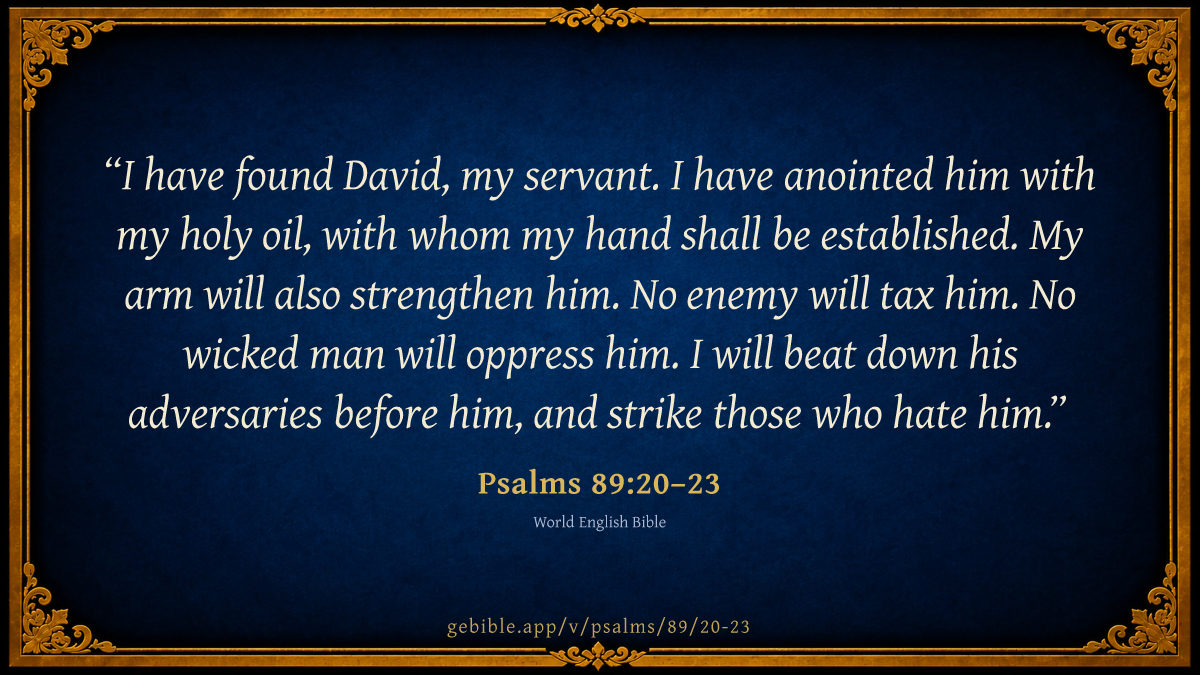
20 I have found David my servant. The prophet confirms the same proposition, That there was nothing of royalty in David, who owed all to the sovereignty of God in preventing him by his grace. Such is the import of the word found, as if God had said, When I took him to elevate him, this proceeded entirely from my free goodness. The name servant, therefore, does not denote any merit, but is to be referred to the divine call. It is as if God had said, that he confirmed and ratified by his authority the sovereign power of David; and if He approved it, its legitimacy is placed beyond all doubt. The second clause of the verse affords an additional confirmation of God’s free election: With my holy oil have I anointed him. This anointing, which was not the fruit of David’s own policy, but which he obtained contrary to all expectation, was the cause of his elevation to the estate of royalty. God then having of himself, and according to his mere good pleasure, anticipated David, that he might anoint him king by the hand of Samuel, he justly declares that he found him. It is afterwards added, that he will be the guardian and protector of this kingdom of which he was the founder; for it is not his usual way to abandon his works after having commenced them, but, on the contrary, to carry them forward by a continued process of improvement to their completion.
John Calvin's Commentaries (1540-1563) — public domain. Text from the Calvin Translation Society English edition (1840s-50s) via the Christian Classics Ethereal Library (ccel.org). Calvin's coverage is partial (roughly two-thirds of the Bible); uncommented books and verses are honest gaps, never fabricated. The 19th-century editor's footnotes and remarks are omitted so the notes are faithfully Calvin's own voice.
Geneva Bible translators1599 · Public DomainOn v23Though there shall be evermore enemies against God’s kingdom,…
Though there shall be evermore enemies against God’s kingdom, yet he promiseth to overcome them.
Geneva Bible (1599) marginal notes — public domain.
John Trapp1656 · Public DomainOn vv20–23Psa 89:20 I have found David my servant; with…
Psa 89:20 I have found David my servant; with my holy oil have I anointed him:
Ver. 20. I have found David] The Father seeketh such as worship him in spirit and in truth, Joh 4:23. The whole Trinity agreed upon Christ for a mediator.
Read full note →
With my holy oil have I anointed him] How Christ was appointed and anointed to the mediatorship. {See Trapp on "Psa 45:7"}
John Trapp, A Commentary or Exposition upon All the Books of the Old and New Testament (1647–1656) — public domain. Text from a community e-Sword module.
Matthew Poole1685 · Public DomainOn vv20–22I have found: this is spoken of God figuratively…
I have found: this is spoken of God figuratively after the manner of men, to imply the great scarcity of such persons, and the difficulty of finding them out.
With my holy oil; both. with material oil, 1Sa 16:13; 2Sa 5:3, and with the gifts and graces of my Holy Spirit, which are oft signified by oil or unction, as Psa 45:7, compared with Heb 1:9; Isa 61:3; 1Jo 2:20,27.
Matthew Poole's English Annotations on the Holy Bible (1683–1685) — public domain. Text from a community e-Sword/MySword module.
John Gill1763 · Public DomainOn vv20–23With whom my hand shall be established,.... A promise…
With whom my hand shall be established,.... A promise of God's gracious presence with Christ, as man and Mediator, which is his work; of a communication of grace and strength from him, to carry him through it; and of his supporting and upholding him under it; which hand of his power and grace would be always prepared and ready for him, as the word (a) signifies, and stable and firm with him, so that he should have success in it; the pleasure of the Lord should prosper in his hand; so the Targum,
"for my hands are prepared for his help;''
Read full note →
the Septuagint, Vulgate Latin, and all the eastern versions, "mine hand shall help him"; and which is confirmed in the next words: mine arm also shall strengthen him; in the human nature, subject to and encompassed with infirmities: this shows the greatness of the work of man's redemption, which no creature could effect; it required the arm and power of the Lord to be exerted, and by which Christ was made strong by the Lord, both for himself, and for the working out of salvation for us; which he did when he travelled in the greatness of his strength, standing up under the mighty weight of our sins, and the wrath of God; and yet failed not, nor was he discouraged, till his own arm brought salvation to him; see Psa 80:17.
(a) "parate erit", Musculus, Muis; so the Targum.
John Gill's Exposition of the Whole Bible (1746–1763) — public domain (CC PDM 1.0). Text via the HelloAO Bible API.
John Wesley1765 · Public DomainOn v22Exact - Not conquer him or make him tributary.
Exact - Not conquer him or make him tributary.
John Wesley, Explanatory Notes Upon the Whole Bible (1754–1765) — public domain. Text via the GEBible commentary corpus.
Adam Clarke1810 · Public DomainOn vv20, 22Verse 20. I have found David my servant] This…
Verse 20. I have found David my servant] This is the sum of what God had said in prophetic visions to his saints or holy persons, Samuel, Nathan, and Gad; see the parallel places in the margin. Here the psalmist begins to reason with God relative to David, his posterity, and the perpetuity of his kingdom; which promises appear now to have utterly failed, as the throne had been overturned, and all the people carried into captivity. But all these things may have reference to Christ and his kingdom; for we are assured that David was a type of the Messiah.
Adam Clarke's Commentary on the Bible (1810–1826) — public domain. Text from a community e-Sword/MySword module.
Albert Barnes1834 · Public DomainOn vv20–23I have found David my servant - That is,…
I have found David my servant - That is, I found him among the sheepfolds; in humble life. I saw there one who was qualified for the high office of being the ruler of the nation, and I designated, or set him apart, for that office. The idea is, that there was in him a precious qualification for this work, and that God had seen this, and, in accordance with this, had summoned him to his service.
With my holy oil have I anointed him - By the hand of Samuel. 1Sa 16:13. Oil was used in setting apart prophets, priests, and kings. It was poured upon the person - emblematic of the pouring out upon him of wisdom and grace from on high to qualify him for his office.
Albert Barnes' Notes on the Bible (1834–1885) — public domain. Text from a community e-Sword/MySword module.
Daniel D. Whedon1874 · Public DomainOn vv20–2220. Anointed him—The consecration of David with holy oil,…
20. Anointed him—The consecration of David with holy oil, by an acknowledged prophet of God, placed his title to the throne beyond all question. This was in accordance with the theocracy, and to this the people bowed. 1Sa_16:12-13
Daniel D. Whedon (gen. ed.), Commentary on the Old and New Testaments (1874–1909) — public domain. Text from a community e-Sword module.
The Cambridge Bible for Schools and Colleges1878 · Public DomainOn vv20–2320. I have found] Sought out and provided. Cp.…
20. I have found] Sought out and provided. Cp. 1Sa_13:14; 1Sa_16:1; Act_13:22. David my servant] See on Psa_78:70, and cp. 2Sa_3:18; 2Sa_7:5; 2Sa_7:8. have I anointed him] 1Sa_16:1; 1Sa_16:12 f.
The Cambridge Bible for Schools and Colleges (gen. ed. J. J. S. Perowne; Cambridge University Press, 1878–1918) — public domain. Text from a community e-Sword module.
Ellicott's Commentary for English Readers1878 · Public DomainOn vv22–23(22) Exact.—This meaning is possible, and is supported by…
(22) Exact.—This meaning is possible, and is supported by the LXX. and Vulgate, “shall not get profit.” There may be an allusion to Deu_15:6, but perhaps it is better to take the verb in the same sense as the Hebrew margin of Psa_55:15, “shall not surprise him;” Symmachus has, “lead him astray.”
A Bible Commentary for English Readers, edited by Charles John Ellicott (1878–1897) — public domain. Text from a community e-Sword module.
The Pulpit Commentary1880 · Public DomainOn vv20–23I have found David my servant. (comp. 1Sa_16:1 Act_13:22)…
I have found David my servant. (comp. 1Sa_16:1 Act_13:22) With my holy oil have I anointed him (see 1Sa_16:13)
"David my servant.
Read full note →
The text reads on, "With my holy oil have I anointed him, and right down to ver. 37 we have the repeated declarations of God"s favour towards him. Now, this has seemed to many a choice most strange, and sorely needing vindication. The statement concerning David that he was "a man after God"s own heart" (1Sa_13:14 Act_13:22) has perplexed not a few. And we unreservedly admit that
I GOD"S CHOICE OF DAVID DOES APPEAR STRANGE. For what a category of crimes his career as recorded in the Scriptures declares! In cold blood he slays two hundred Philistines. (1Sa_18:20-27) He leaves his wife Michal to face her father"s rage, when she had risked her own life to save his. (1Sa_19:11-17) He bids Jonathan lie to his father. (1Sa_20:5, 1Sa_20:6) He lies cruelly to Abimelech and the priests at Nob, and then left them to Saul"s vengeance. (1Sa_21:1, 2 22:9-19) He deceives Achish. (1Sa_21:10-15) He would, in revenge, have slain Nabal and all his house. (1Sa_25:2-38) He lies to King Achish, who had given him Ziklag, by pretending that he had fought against Judah; and, to conceal his lie, he cruelly slaughters the Geshurites and others. (1Sa 27) He takes terrible revenge on Amalek. (1Sa_30:1-17) Instead of punishing Joab, as he ought to have done, he utters terrible imprecations against him. (2Sa_3:28, 2Sa_3:29) He tortures the Ammonites. (2Sa_12:27-31) He deals cruelly with Mephibosheth, stripping him of all his property, and giving it to Ziba. (2Sa_16:1-4 2Sa_19:24-30) He violates his oath to Saul, that he would not slay his children; nevertheless, he afterwards gave them up to the Gibeonites, who hanged them. (1Sa_24:21 2Sa_21:1-9) And then his great sin in the matter of Uriah a sin in which no element of baseness, treachery, cruelty, and lust was wanting; and yet all the while he was a great psalm singer. (2Sa_11:2-17) He piously exhorts Solomon to walk in the ways of the Lord; and yet he himself kept his harem crowded with ever more women. (2Sa_5:13 1Ki_2:3) His terrible death bed charge to Solomon to slay Joab and Shimei. His imprecatory psalms. (see Ps 109) And we have no record of any great good deeds to set off against these other terrible ones. Yes; it must be admitted that the choice of David needs vindication. A loud professor of religion, and yet, etc.
II BUT IT CAN BE VINDICATED.
1. Because the expression so much complained of David"s being "a man offer God"s own heartrefers, not to his personal character, but to his official conduct. "He was called of God to restore the kingdom which Saul had destroyed, to subdue the Philistines, etc. These purposes he accomplished. So far he was a man after God"s own heart. His moral delinquencies are recorded that we may know where the Divine approbation stops short" (F.D. Maurice). But we confess we do not lay much stress upon this. 1Ki_15:1-5 does not bear it out. We prefer to vindicate the Divine choice of David in another manner.
2. He was worthy when the words were spoken of him, and for a long while after. Had he been always what he afterwards became, such high commendation would not have been given. Then:
3. He knew no better than to do as did all others. As to his life as an outlaw, a kind of Oriental Robin Hood, he was driven to it by the jealousy and hate of Saul; and as to his lies and stratagems, his ferocities and tortures, all such things were held lawful in his day; and, though they shock us as we read of them, they were held as altogether right by his contemporaries. We must distinguish between the vitia temporis and the vitia hominis (Farrar), and not condemn the man for not tying altogether different from and beyond the public sentiment of his age.
4. What he did know of right he mainly did. See his patriotism, his courage, his military ability, the salvation of his country from ruin. See his delight and his trust in God, and his deep penitence for his sin. And see the unbounded honour and love of his people which he won and kept. Is all this to go for nothing?
5. And remember how he was punished for his sins. In his family. His sons had seen their father indulge himself: why shouldn"t they? (Kingsley). And in his nature he was punished; Its bent and bias became horribly sensual. Indulgence increased the evil, and so came about the shameful tragedy of his adultery and Uriah"s murder. It was not a sudden fall, he had long been tending that way. And in his character. He never really recovered. He shuffles shamefully to his grave; his courage, his self-control, his nobleness, well nigh all gone. One is reminded of King LearVex not his ghost; oh, let him pass; He hates him, That would upon the rack of this rough world Stretch him out longer.
He dies a miserable and pitiful man, his last words being his charge to Solomon about Shimei: "His hoary head bring thou down to the grave with blood." Think of that as the last words of the David of the twenty-third psalm! What a melancholy failing away! There is no favouritism in God. If his children sin, they suffer, and that supremely. God loves them too much to let it be otherwise.
III AND IS FULL OF INSTRUCTION FOR OURSELVES. We learn:
1. Thankfulness that we are born in a more enlightened age; that there would be shame now where there was then no shame.
2. Strong religious feeling and profession are no certain safeguards against sin, but only heighten its guilt.
3. Repentance may be real, yet the results of sin not be recalled.
4. We dare never remit even for one day the waiting of our soul upon Godin watchfulness and prayer.
5. The judgments of God against our sin are his mercy to our soul.
6. He who forgave the contrite David forgives still. S.C.
HOMILIES BY R. TUCK Ver. 1. A singer in the dark.
The previous psalm was written by a man in the dark, who could pray, but could not sing. The writer of this psalm can both pray and sing, But there is an important difference between the "darknesses" of the two psalmists. Heman suffered from severe bodily afflictions, such as are often attended by severe mental depressions. Ethan was distressed by anxious public or national conditions, which concerned him in an official rather than in a personal way. His hope in God was not clouded by bodily weakness. In him faith could triumph over fear.
I ETHAN"S TIME OF DARKNESS. "Ethan was born in the time of David, but moulded chiefly by the influences, literary and religious, which characterized the age of Solomon." There is no reason for rejecting the ancient reference of this psalm to the reign of Rehoboam; to the breaking up of the Davidic kingdom; and to the humiliating invasion of Shishak, the Pharaoh of Egypt. Exactly what would then come to the mind of the pious man was that the Davidic covenant seemed to have failed; God was not fulflling the promise to establish David"s seed forever. "It was in the reigns of Rehoboam, when ten tribes had forsaken their allegiance to the Davidic dynasty, and the promise of the steadfastness of David"s throne seemed suddenly revoked, that the faithful worshippers would most readily recall the vision of Nathan, with its attendant promises, and wonder where were the former loving kindnesses which God sware unto David in his truth. Appropriate to this period is the apparent allusion to the raids of a foreign army." Distress that comes from public circumstances is rather intellectual than emotional, and the struggle cannot be so severe as when there is introduced the element of personal suffering. But they do invaluable service who can inspire the hope of a nation in its dark hours; for nations, too, "are saved by hope.
II ETHAN"S SONG IN THE TIME OF DARKNESS. A song of faith in a time of fear. A song of thankful memories in a time of present calamities. A song of joy in God himself, when God"s ways seemed "past finding out." A man can sing in the dark, however dark it may be, and whatever form the darkness may take, only if he has right thoughts of God, and can keep firm hold on God. Things may be perplexing; but if we know the doer of the things, and have full confidence in him, we can quietly wait until his issues can be unfolded. Our song stops when we lose the sense of God"s relation to our circumstances. Keep the relation, and we can always sing of God, and then we soon come to sing also of God"s ways. R.T.
The Pulpit Commentary (1880–1919), ed. H.D.M. Spence-Jones & Joseph S. Exell — public domain. Text from a community e-Sword module.
Charles H. Spurgeon1885 · Public DomainOn vv20–23Ver. 20. I have found David my servant. David…
Ver. 20. I have found David my servant. David was discovered by the Lord among the sheepfolds and recognised as a man of gracious spirit, full of faith and courage, and therefore fit to be leader in Israel.
With my holy oil have I anointed him. By the hand of Samuel, David was anointed to be king long before he ascended the throne. The verse must also be expounded of the Prince Emmanuel; he became the servant of the Lord for our sakes, the Father having found for us in his person a mighty deliverer, therefore upon him rested the Spirit without measure, to qualify him for all the offices of love to which he was set apart. We have not a Saviour self appointed and unqualified, but one sent of God and divinely endowed for his work. Our Saviour Jesus is also the Lord's Christ, or anointed. The oil with which he is anointed is God's own oil, and holy oil; he is divinely endowed with the Spirit of holiness.
Read full note →
Ver. 20. With my holy oil have I appointed him. As the literal David was thrice anointed king, once by Samuel in Jesse's house at Bethlehem: once at Hebron after the death of Saul, as king over Judah; and again at seven years' end, as ruler over all Israel: so also "God anointed Jesus of Nazareth with the Holy Ghost and with power" in his nativity at Bethlehem; a second time over his Church at his resurrection, when the tyrant who sought his life was overcome, and then only over the small "confederation" (which Hebron means) of his Jewish disciples; but a third time in his ascension to the heavenly Jerusalem, the Vision of Peace, where he, now crowned as King of Glory, was anointed over all heaven and earth, supreme over all the princes of God. He was thrice anointed in another sense also, once as Prophet, once as Priest, and once as King. Neale and Littledale.
Ver. 20-24. I have FOUND David, God exclaims. When sin brought death into the world, and annihilated the hopes of mankind from the first covenant, I the Almightyin my care for them, sought out a Redeemer. I sought for him in the Divine Nature; and I "found" him in My Only Son. I endowed him with ample powers, and I covenanted that, in the weakness of his Incarnation, my hand and arm should strengthen him. I declared that Satan the enemy should not exact upon him; nor should Judasthe son of wickedness be enabled to afflict him. The Jews, his foes, shall fall before him; they shall be smitten down in their rejection of hint; they shall perish from off their land, and be dispersed abroad among the nations. My truth shall be ever with him; and acting in my name and power, he shall be exalted and glorified amongst men. William Hill Tucker.
Ver. 20-21.
1. The Messiah would be of the seed of David. The true David.
2. He would be a servant of the Father. "My servant."
3. He would be consecrated to his office by God. "With my holy oil", etc.
4. He would perfectly fulfil it. "With whom my hand", etc.
5. He would be sustained in it by the Father. "Mine arm", etc.
Psalms 89:21*
Charles H. Spurgeon's The Treasury of David (1869–1885) — public domain. Psalms only. Text from a community e-Sword/MySword module.
Tyndale Open Study Notes2022 · CC BY-SA 4.0On v2089:20 I have anointed him: This is the verb…
89:20 I have anointed him: This is the verb from which anointed one (Hebrew mashiakh, “messiah”) is derived.

John Calvin 1540 · Public Domain On vv20, 22 20 I have found David my servant. The prophet…
20 I have found David my servant. The prophet confirms the same proposition, That there was nothing of royalty in David, who owed all to the sovereignty of God in preventing him by his grace. Such is the import of the word found, as if God had said, When I took him to elevate him, this proceeded entirely from my free goodness. The name servant, therefore, does not denote any merit, but is to be referred to the divine call. It is as if God had said, that he confirmed and ratified by his authority the sovereign power of David; and if He approved it, its legitimacy is placed beyond all doubt. The second clause of the verse affords an additional confirmation of God’s free election: With my holy oil have I anointed him. This anointing, which was not the fruit of David’s own policy, but which he obtained contrary to all expectation, was the cause of his elevation to the estate of royalty. God then having of himself, and according to his mere good pleasure, anticipated David, that he might anoint him king by the hand of Samuel, he justly declares that he found him. It is afterwards added, that he will be the guardian and protector of this kingdom of which he was the founder; for it is not his usual way to abandon his works after having commenced them, but, on the contrary, to carry them forward by a continued process of improvement to their completion.
John Calvin's Commentaries (1540-1563) — public domain. Text from the Calvin Translation Society English edition (1840s-50s) via the Christian Classics Ethereal Library (ccel.org). Calvin's coverage is partial (roughly two-thirds of the Bible); uncommented books and verses are honest gaps, never fabricated. The 19th-century editor's footnotes and remarks are omitted so the notes are faithfully Calvin's own voice.
Geneva Bible translators 1599 · Public Domain On v23 Though there shall be evermore enemies against God’s kingdom,…
Though there shall be evermore enemies against God’s kingdom, yet he promiseth to overcome them.
Geneva Bible (1599) marginal notes — public domain.
John Trapp 1656 · Public Domain On vv20–23 Psa 89:20 I have found David my servant; with…
Psa 89:20 I have found David my servant; with my holy oil have I anointed him:
Ver. 20. I have found David] The Father seeketh such as worship him in spirit and in truth, Joh 4:23. The whole Trinity agreed upon Christ for a mediator.
Read full note →
With my holy oil have I anointed him] How Christ was appointed and anointed to the mediatorship. {See Trapp on "Psa 45:7"}
John Trapp, A Commentary or Exposition upon All the Books of the Old and New Testament (1647–1656) — public domain. Text from a community e-Sword module.
Matthew Poole 1685 · Public Domain On vv20–22 I have found: this is spoken of God figuratively…
I have found: this is spoken of God figuratively after the manner of men, to imply the great scarcity of such persons, and the difficulty of finding them out.
With my holy oil; both. with material oil, 1Sa 16:13; 2Sa 5:3, and with the gifts and graces of my Holy Spirit, which are oft signified by oil or unction, as Psa 45:7, compared with Heb 1:9; Isa 61:3; 1Jo 2:20,27.
Matthew Poole's English Annotations on the Holy Bible (1683–1685) — public domain. Text from a community e-Sword/MySword module.
John Gill 1763 · Public Domain On vv20–23 With whom my hand shall be established,.... A promise…
With whom my hand shall be established,.... A promise of God's gracious presence with Christ, as man and Mediator, which is his work; of a communication of grace and strength from him, to carry him through it; and of his supporting and upholding him under it; which hand of his power and grace would be always prepared and ready for him, as the word (a) signifies, and stable and firm with him, so that he should have success in it; the pleasure of the Lord should prosper in his hand; so the Targum,
"for my hands are prepared for his help;''
Read full note →
the Septuagint, Vulgate Latin, and all the eastern versions, "mine hand shall help him"; and which is confirmed in the next words: mine arm also shall strengthen him; in the human nature, subject to and encompassed with infirmities: this shows the greatness of the work of man's redemption, which no creature could effect; it required the arm and power of the Lord to be exerted, and by which Christ was made strong by the Lord, both for himself, and for the working out of salvation for us; which he did when he travelled in the greatness of his strength, standing up under the mighty weight of our sins, and the wrath of God; and yet failed not, nor was he discouraged, till his own arm brought salvation to him; see Psa 80:17.
(a) "parate erit", Musculus, Muis; so the Targum.
John Gill's Exposition of the Whole Bible (1746–1763) — public domain (CC PDM 1.0). Text via the HelloAO Bible API.
John Wesley 1765 · Public Domain On v22 Exact - Not conquer him or make him tributary.
Exact - Not conquer him or make him tributary.
John Wesley, Explanatory Notes Upon the Whole Bible (1754–1765) — public domain. Text via the GEBible commentary corpus.
Adam Clarke 1810 · Public Domain On vv20, 22 Verse 20. I have found David my servant] This…
Verse 20. I have found David my servant] This is the sum of what God had said in prophetic visions to his saints or holy persons, Samuel, Nathan, and Gad; see the parallel places in the margin. Here the psalmist begins to reason with God relative to David, his posterity, and the perpetuity of his kingdom; which promises appear now to have utterly failed, as the throne had been overturned, and all the people carried into captivity. But all these things may have reference to Christ and his kingdom; for we are assured that David was a type of the Messiah.
Adam Clarke's Commentary on the Bible (1810–1826) — public domain. Text from a community e-Sword/MySword module.
Albert Barnes 1834 · Public Domain On vv20–23 I have found David my servant - That is,…
I have found David my servant - That is, I found him among the sheepfolds; in humble life. I saw there one who was qualified for the high office of being the ruler of the nation, and I designated, or set him apart, for that office. The idea is, that there was in him a precious qualification for this work, and that God had seen this, and, in accordance with this, had summoned him to his service.
With my holy oil have I anointed him - By the hand of Samuel. 1Sa 16:13. Oil was used in setting apart prophets, priests, and kings. It was poured upon the person - emblematic of the pouring out upon him of wisdom and grace from on high to qualify him for his office.
Albert Barnes' Notes on the Bible (1834–1885) — public domain. Text from a community e-Sword/MySword module.
Daniel D. Whedon 1874 · Public Domain On vv20–22 20. Anointed him—The consecration of David with holy oil,…
20. Anointed him—The consecration of David with holy oil, by an acknowledged prophet of God, placed his title to the throne beyond all question. This was in accordance with the theocracy, and to this the people bowed. 1Sa_16:12-13
Daniel D. Whedon (gen. ed.), Commentary on the Old and New Testaments (1874–1909) — public domain. Text from a community e-Sword module.
The Cambridge Bible for Schools and Colleges 1878 · Public Domain On vv20–23 20. I have found] Sought out and provided. Cp.…
20. I have found] Sought out and provided. Cp. 1Sa_13:14; 1Sa_16:1; Act_13:22. David my servant] See on Psa_78:70, and cp. 2Sa_3:18; 2Sa_7:5; 2Sa_7:8. have I anointed him] 1Sa_16:1; 1Sa_16:12 f.
The Cambridge Bible for Schools and Colleges (gen. ed. J. J. S. Perowne; Cambridge University Press, 1878–1918) — public domain. Text from a community e-Sword module.
Ellicott's Commentary for English Readers 1878 · Public Domain On vv22–23 (22) Exact.—This meaning is possible, and is supported by…
(22) Exact.—This meaning is possible, and is supported by the LXX. and Vulgate, “shall not get profit.” There may be an allusion to Deu_15:6, but perhaps it is better to take the verb in the same sense as the Hebrew margin of Psa_55:15, “shall not surprise him;” Symmachus has, “lead him astray.”
A Bible Commentary for English Readers, edited by Charles John Ellicott (1878–1897) — public domain. Text from a community e-Sword module.
The Pulpit Commentary 1880 · Public Domain On vv20–23 I have found David my servant. (comp. 1Sa_16:1 Act_13:22)…
I have found David my servant. (comp. 1Sa_16:1 Act_13:22) With my holy oil have I anointed him (see 1Sa_16:13)
"David my servant.
Read full note →
The text reads on, "With my holy oil have I anointed him, and right down to ver. 37 we have the repeated declarations of God"s favour towards him. Now, this has seemed to many a choice most strange, and sorely needing vindication. The statement concerning David that he was "a man after God"s own heart" (1Sa_13:14 Act_13:22) has perplexed not a few. And we unreservedly admit that
I GOD"S CHOICE OF DAVID DOES APPEAR STRANGE. For what a category of crimes his career as recorded in the Scriptures declares! In cold blood he slays two hundred Philistines. (1Sa_18:20-27) He leaves his wife Michal to face her father"s rage, when she had risked her own life to save his. (1Sa_19:11-17) He bids Jonathan lie to his father. (1Sa_20:5, 1Sa_20:6) He lies cruelly to Abimelech and the priests at Nob, and then left them to Saul"s vengeance. (1Sa_21:1, 2 22:9-19) He deceives Achish. (1Sa_21:10-15) He would, in revenge, have slain Nabal and all his house. (1Sa_25:2-38) He lies to King Achish, who had given him Ziklag, by pretending that he had fought against Judah; and, to conceal his lie, he cruelly slaughters the Geshurites and others. (1Sa 27) He takes terrible revenge on Amalek. (1Sa_30:1-17) Instead of punishing Joab, as he ought to have done, he utters terrible imprecations against him. (2Sa_3:28, 2Sa_3:29) He tortures the Ammonites. (2Sa_12:27-31) He deals cruelly with Mephibosheth, stripping him of all his property, and giving it to Ziba. (2Sa_16:1-4 2Sa_19:24-30) He violates his oath to Saul, that he would not slay his children; nevertheless, he afterwards gave them up to the Gibeonites, who hanged them. (1Sa_24:21 2Sa_21:1-9) And then his great sin in the matter of Uriah a sin in which no element of baseness, treachery, cruelty, and lust was wanting; and yet all the while he was a great psalm singer. (2Sa_11:2-17) He piously exhorts Solomon to walk in the ways of the Lord; and yet he himself kept his harem crowded with ever more women. (2Sa_5:13 1Ki_2:3) His terrible death bed charge to Solomon to slay Joab and Shimei. His imprecatory psalms. (see Ps 109) And we have no record of any great good deeds to set off against these other terrible ones. Yes; it must be admitted that the choice of David needs vindication. A loud professor of religion, and yet, etc.
II BUT IT CAN BE VINDICATED.
1. Because the expression so much complained of David"s being "a man offer God"s own heartrefers, not to his personal character, but to his official conduct. "He was called of God to restore the kingdom which Saul had destroyed, to subdue the Philistines, etc. These purposes he accomplished. So far he was a man after God"s own heart. His moral delinquencies are recorded that we may know where the Divine approbation stops short" (F.D. Maurice). But we confess we do not lay much stress upon this. 1Ki_15:1-5 does not bear it out. We prefer to vindicate the Divine choice of David in another manner.
2. He was worthy when the words were spoken of him, and for a long while after. Had he been always what he afterwards became, such high commendation would not have been given. Then:
3. He knew no better than to do as did all others. As to his life as an outlaw, a kind of Oriental Robin Hood, he was driven to it by the jealousy and hate of Saul; and as to his lies and stratagems, his ferocities and tortures, all such things were held lawful in his day; and, though they shock us as we read of them, they were held as altogether right by his contemporaries. We must distinguish between the vitia temporis and the vitia hominis (Farrar), and not condemn the man for not tying altogether different from and beyond the public sentiment of his age.
4. What he did know of right he mainly did. See his patriotism, his courage, his military ability, the salvation of his country from ruin. See his delight and his trust in God, and his deep penitence for his sin. And see the unbounded honour and love of his people which he won and kept. Is all this to go for nothing?
5. And remember how he was punished for his sins. In his family. His sons had seen their father indulge himself: why shouldn"t they? (Kingsley). And in his nature he was punished; Its bent and bias became horribly sensual. Indulgence increased the evil, and so came about the shameful tragedy of his adultery and Uriah"s murder. It was not a sudden fall, he had long been tending that way. And in his character. He never really recovered. He shuffles shamefully to his grave; his courage, his self-control, his nobleness, well nigh all gone. One is reminded of King LearVex not his ghost; oh, let him pass; He hates him, That would upon the rack of this rough world Stretch him out longer.
He dies a miserable and pitiful man, his last words being his charge to Solomon about Shimei: "His hoary head bring thou down to the grave with blood." Think of that as the last words of the David of the twenty-third psalm! What a melancholy failing away! There is no favouritism in God. If his children sin, they suffer, and that supremely. God loves them too much to let it be otherwise.
III AND IS FULL OF INSTRUCTION FOR OURSELVES. We learn:
1. Thankfulness that we are born in a more enlightened age; that there would be shame now where there was then no shame.
2. Strong religious feeling and profession are no certain safeguards against sin, but only heighten its guilt.
3. Repentance may be real, yet the results of sin not be recalled.
4. We dare never remit even for one day the waiting of our soul upon Godin watchfulness and prayer.
5. The judgments of God against our sin are his mercy to our soul.
6. He who forgave the contrite David forgives still. S.C.
HOMILIES BY R. TUCK Ver. 1. A singer in the dark.
The previous psalm was written by a man in the dark, who could pray, but could not sing. The writer of this psalm can both pray and sing, But there is an important difference between the "darknesses" of the two psalmists. Heman suffered from severe bodily afflictions, such as are often attended by severe mental depressions. Ethan was distressed by anxious public or national conditions, which concerned him in an official rather than in a personal way. His hope in God was not clouded by bodily weakness. In him faith could triumph over fear.
I ETHAN"S TIME OF DARKNESS. "Ethan was born in the time of David, but moulded chiefly by the influences, literary and religious, which characterized the age of Solomon." There is no reason for rejecting the ancient reference of this psalm to the reign of Rehoboam; to the breaking up of the Davidic kingdom; and to the humiliating invasion of Shishak, the Pharaoh of Egypt. Exactly what would then come to the mind of the pious man was that the Davidic covenant seemed to have failed; God was not fulflling the promise to establish David"s seed forever. "It was in the reigns of Rehoboam, when ten tribes had forsaken their allegiance to the Davidic dynasty, and the promise of the steadfastness of David"s throne seemed suddenly revoked, that the faithful worshippers would most readily recall the vision of Nathan, with its attendant promises, and wonder where were the former loving kindnesses which God sware unto David in his truth. Appropriate to this period is the apparent allusion to the raids of a foreign army." Distress that comes from public circumstances is rather intellectual than emotional, and the struggle cannot be so severe as when there is introduced the element of personal suffering. But they do invaluable service who can inspire the hope of a nation in its dark hours; for nations, too, "are saved by hope.
II ETHAN"S SONG IN THE TIME OF DARKNESS. A song of faith in a time of fear. A song of thankful memories in a time of present calamities. A song of joy in God himself, when God"s ways seemed "past finding out." A man can sing in the dark, however dark it may be, and whatever form the darkness may take, only if he has right thoughts of God, and can keep firm hold on God. Things may be perplexing; but if we know the doer of the things, and have full confidence in him, we can quietly wait until his issues can be unfolded. Our song stops when we lose the sense of God"s relation to our circumstances. Keep the relation, and we can always sing of God, and then we soon come to sing also of God"s ways. R.T.
The Pulpit Commentary (1880–1919), ed. H.D.M. Spence-Jones & Joseph S. Exell — public domain. Text from a community e-Sword module.
Charles H. Spurgeon 1885 · Public Domain On vv20–23 Ver. 20. I have found David my servant. David…
Ver. 20. I have found David my servant. David was discovered by the Lord among the sheepfolds and recognised as a man of gracious spirit, full of faith and courage, and therefore fit to be leader in Israel.
With my holy oil have I anointed him. By the hand of Samuel, David was anointed to be king long before he ascended the throne. The verse must also be expounded of the Prince Emmanuel; he became the servant of the Lord for our sakes, the Father having found for us in his person a mighty deliverer, therefore upon him rested the Spirit without measure, to qualify him for all the offices of love to which he was set apart. We have not a Saviour self appointed and unqualified, but one sent of God and divinely endowed for his work. Our Saviour Jesus is also the Lord's Christ, or anointed. The oil with which he is anointed is God's own oil, and holy oil; he is divinely endowed with the Spirit of holiness.
Read full note →
Ver. 20. With my holy oil have I appointed him. As the literal David was thrice anointed king, once by Samuel in Jesse's house at Bethlehem: once at Hebron after the death of Saul, as king over Judah; and again at seven years' end, as ruler over all Israel: so also "God anointed Jesus of Nazareth with the Holy Ghost and with power" in his nativity at Bethlehem; a second time over his Church at his resurrection, when the tyrant who sought his life was overcome, and then only over the small "confederation" (which Hebron means) of his Jewish disciples; but a third time in his ascension to the heavenly Jerusalem, the Vision of Peace, where he, now crowned as King of Glory, was anointed over all heaven and earth, supreme over all the princes of God. He was thrice anointed in another sense also, once as Prophet, once as Priest, and once as King. Neale and Littledale.
Ver. 20-24. I have FOUND David, God exclaims. When sin brought death into the world, and annihilated the hopes of mankind from the first covenant, I the Almightyin my care for them, sought out a Redeemer. I sought for him in the Divine Nature; and I "found" him in My Only Son. I endowed him with ample powers, and I covenanted that, in the weakness of his Incarnation, my hand and arm should strengthen him. I declared that Satan the enemy should not exact upon him; nor should Judasthe son of wickedness be enabled to afflict him. The Jews, his foes, shall fall before him; they shall be smitten down in their rejection of hint; they shall perish from off their land, and be dispersed abroad among the nations. My truth shall be ever with him; and acting in my name and power, he shall be exalted and glorified amongst men. William Hill Tucker.
Ver. 20-21.
1. The Messiah would be of the seed of David. The true David.
2. He would be a servant of the Father. "My servant."
3. He would be consecrated to his office by God. "With my holy oil", etc.
4. He would perfectly fulfil it. "With whom my hand", etc.
5. He would be sustained in it by the Father. "Mine arm", etc.
Psalms 89:21*
Charles H. Spurgeon's The Treasury of David (1869–1885) — public domain. Psalms only. Text from a community e-Sword/MySword module.
Tyndale Open Study Notes 2022 · CC BY-SA 4.0 On v20 89:20 I have anointed him: This is the verb…
89:20 I have anointed him: This is the verb from which anointed one (Hebrew mashiakh, “messiah”) is derived.
Tyndale Open Study Notes — © Tyndale Open Resources, licensed CC BY-SA 4.0. Text via the HelloAO Bible API.