Luke 4:10-11(v11)for it is written, ‘He will put his angels in charge of you, to guard you;’ and, ‘On their hands they will bear you up, lest perhaps you…
Psalms 34:7(v11)Yahweh’s angel encamps around those who fear him, and delivers them.
Hebrews 1:14(v11)Aren’t they all serving spirits, sent out to do service for the sake of those who will inherit salvation?
Proverbs 3:6(v11)In all your ways acknowledge him, and he will make your paths straight.
Matthew 4:6(vv11–12)and said to him, “If you are the Son of God, throw yourself down, for it is written, ‘He will command his angels concerning you,’ and, ‘On…
Show all 14 cross-references
Psalms 71:3(v11)Be to me a rock of refuge to which I may always go. Give the command to save me, for you are my rock and my fortress.
Isaiah 31:1(v11)Woe to those who go down to Egypt for help, and rely on horses, and trust in chariots because they are many, and in horsemen because they…
2 Kings 6:16-17(v11)He answered, “Don’t be afraid; for those who are with us are more than those who are with them.” Elisha prayed, and said, “Yahweh, please…
Psalms 37:24(v12)Though he stumble, he shall not fall, for Yahweh holds him up with his hand.
Proverbs 3:23(v12)Then you shall walk in your way securely. Your foot won’t stumble.
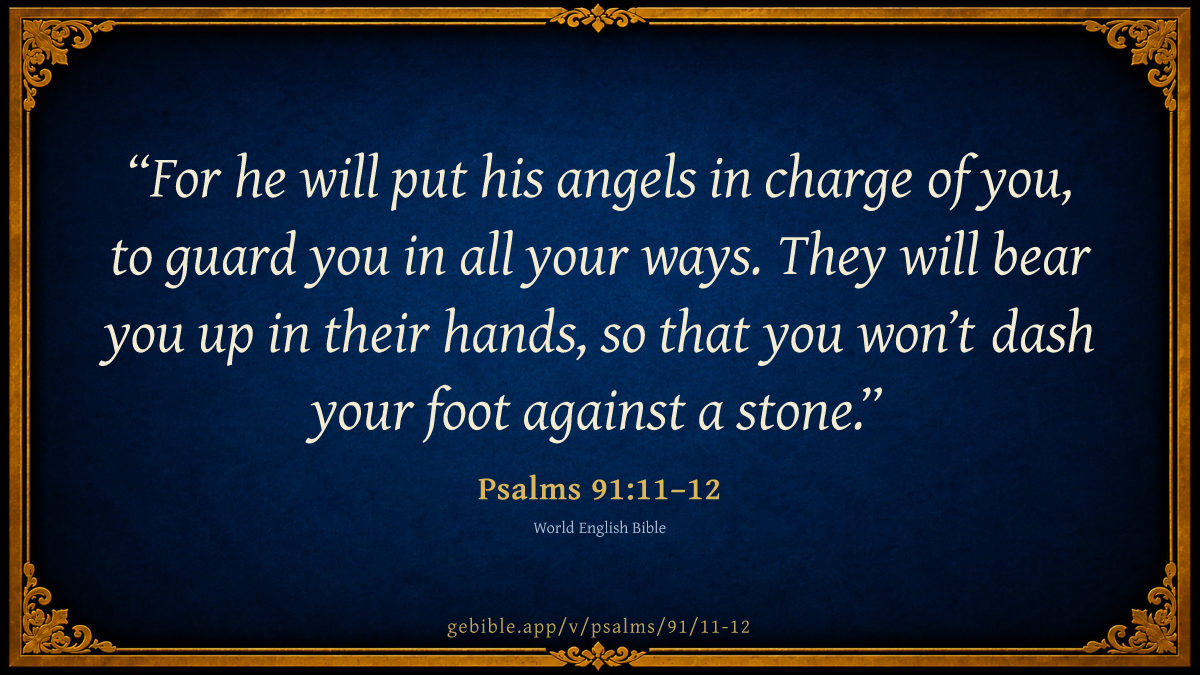
Luke 4:11(v12)and, ‘On their hands they will bear you up, lest perhaps you dash your foot against a stone.’ ”
Isaiah 63:9(v12)In all their affliction he was afflicted, and the angel of his presence saved them. In his love and in his pity he redeemed them. He bore…
Isaiah 46:3(v12)“Listen to me, house of Jacob, and all the remnant of the house of Israel, that have been carried from their birth, that have been carried…
Job 5:23(v12)For you will be allied with the stones of the field. The animals of the field will be at peace with you.
14 distinct cross-references across this passage (15 total citations).
Cross-references from openbible.info (CC BY 4.0)
Explain this passage (17 sources)
Historical commentary, presented as a primary source — not an endorsement.
John Calvin1540 · Public DomainOn vv11–1211 For he has given his angels charge concerning…
11 For he has given his angels charge concerning thee. This is added by the Psalmist expressly with the view of obviating any fears which might arise from our infirmity; so that we cannot fail to be struck with the benignant condescension of God in thus not only forgiving our diffidence, but proposing the means by which it may be best removed. Does he exhibit himself to us as a fortress and shield, proffer the shadow of his protection, make himself known to us as a habitation in which we may abide, and stretch out his wings for our defense — surely we are chargeable with the worst ingratitude if we are not satisfied with promises so abundantly full and satisfactory? If we tremble to think of his majesty, he presents himself to us under the lowly figure of the hen: if we are terrified at the power of our enemies, and the multitude of dangers by which we are beset, he reminds us of his own invincible power, which extinguishes every opposing force. When even all these attempts to encourage us have been tried, and he finds that we still linger and hesitate to approach him, or cast ourselves upon his sole and exclusive protection, he next makes mention of the angels, and proffers them as guardians of our safety. As an additional illustration of his indulgent mercy, and compassion for our weakness, he represents those whom he has ready for our defense as being a numerous host; he does not assign one solitary angel to each saint, but commissions the whole armies of heaven to keep watch over every individual believer. It is the individual believer whom the Psalmist addresses, as we read also Psalm 34:7 — that “angels encamp round about them that fear him.” We may learn from this that there is no truth in the idea that each saint has his own peculiar guardian angel; and it is of no little consequence to consider, that as our enemies are numerous, so also are the friends to whom our defense is intrusted. It were something, no doubt, to know that even one angel was set over us with this commission, but it adds weight to the promise when we are informed that the charge of our safety is committed to a numerous host, as Elisha was enabled, by a like consideration, to despise the great army of adversaries which was arrayed against him, (2 Kings 6:16.) Nor is this inconsistent with passages of Scripture, which seem to speak as if a distinct angel were assigned to each individual. It is evident that God employs his angels in different ways, setting one angel over several whole nations, and again several angels over one man. There is no necessity that we should be nice and scrupulous in inquiring into the exact manner in which they minister together for our safety; it is enough that, knowing from the authority of an apostle the fact of their being appointed ministers to us, we should rest satisfied of their being always intent upon their commission. We read elsewhere of their readiness to obey and execute the commands of God; and this must go to strengthen our faith, since their exertions are made use of by God for our defense.
The Psalmist, in the passage now before us, speaks of members of the Church generally; and yet the devil did not wrest the words when, in his temptation in the wilderness, he applied them particularly to Christ. It is true that he is constantly seeking to pervert and corrupt the truth of God; but, so far as general principles are concerned, he can put a specious gloss upon things, and is a sufficiently acute theologian. It is to be considered that when our whole human family were banished from the Divine favor, we ceased to have anything in common with the angels, and they to have any communication with us. It was Christ, and he only, who, by removing the ground of separation, reconciled the angels to us; this being his proper office, as the apostle observes, (Ephesians 1:10,) to gather together in one what had been dispersed both in heaven and on earth. This was represented to the holy patriarch Jacob under the figure of a ladder, (Genesis 28:12;) and, in allusion to our being united into one collective body with the angels, Christ said,
Read full note →
“Afterwards ye shall see the heavens opened, and the angels of God ascending and descending,” (John 1:51.)
The Psalmist adds, all your ways in the plural number, to convey to us more distinctly that wherever we go we may expect that the angels shall always extend their guardianship to us. The course of our life is subject to many windings and changes, and who can tell all the storms by which we are liable to be tossed? It was necessary, therefore, to know that the angels preside over all our particular actions and purposes, and thus to be assured of their safe-conduct in whatever quarter we might be called to move. This expression, however, your ways, was, in all likelihood, intended to enjoin upon us a due consideration and modesty, to warn us against tempting God by any rash step, and admonish us to confine ourselves within the bounds of our proper calling. For should we commit ourselves recklessly, and attempt things which the promise of God does not warrant us to undertake, aspiring at what is presumptuous, and opposed to the Divine will, we are not to expect that the angels will become ministers and helps to our temerity. Satan would appear to have craftily omitted this clause when he tempted Christ rashly to throw himself down from the temple.
John Calvin's Commentaries (1540-1563) — public domain. Text from the Calvin Translation Society English edition (1840s-50s) via the Christian Classics Ethereal Library (ccel.org). Calvin's coverage is partial (roughly two-thirds of the Bible); uncommented books and verses are honest gaps, never fabricated. The 19th-century editor's footnotes and remarks are omitted so the notes are faithfully Calvin's own voice.
Geneva Bible translators1599 · Public DomainOn v11God hath not appointed every man one Angel, but…
God hath not appointed every man one Angel, but many to be ministers of his providence to keep his, and defend them in their vocation, which is the way to walk in without tempting God.
Geneva Bible (1599) marginal notes — public domain.
John Trapp1656 · Public DomainOn vv11–12Psa 91:11 For he shall give his angels charge…
Psa 91:11 For he shall give his angels charge over thee, to keep thee in all thy ways.
Ver. 11. For he shall give his angels charge over thee] This guard of angels, many angels, yea, all, if need be, to secure every poor believer, how meanly soever he thinks of himself, or is esteemed by others, is no small privilege. See Mat 4:6. {See Trapp on "Mat 4:6"}
Read full note →
To keep thee in all thy ways] In all thy lawful and Christian undertakings; for no further doth God or his holy angels take charge of thee. If we keep not within God’s precincts, we cannot look for his protection. Wefts and strays fall to the Lord of the soil. The State secureth none that are abroad at undue hours, that travel not between sun and sun. Divines observe, that the devil, citing this text, Mat 4:6, left out these words on purpose, as not for his purpose; yet doth not our Saviour so much as upbraid him with this mutilation, nor yet tell him of that which followeth, Psa 91:13, "Thou shalt tread upon the lion and adder," &c., to teach us, in dealing with an adversary, not to lie at the catch, but answer to the thing, &c.
John Trapp, A Commentary or Exposition upon All the Books of the Old and New Testament (1647–1656) — public domain. Text from a community e-Sword module.
Matthew Poole1685 · Public DomainOn vv11–12His angels; those blessed, and powerful, and watchful spirits…
His angels; those blessed, and powerful, and watchful spirits whom God hath appointed to mind the affairs of this lower world, and to take care of the heirs of salvation, Heb 1:14.
In all thy ways; in the whole course of thy life, and in all thy lawful undertakings.
Matthew Poole's English Annotations on the Holy Bible (1683–1685) — public domain. Text from a community e-Sword/MySword module.
John Gill1763 · Public DomainOn vv11–12For he shall give his angels charge over thee,....…
For he shall give his angels charge over thee,.... Created spirits, so called, made by the Lord, and are at his command; who are ministering spirits to his people, who encamp about them, and are concerned in the preservation of them; they being committed to their care and charge by him who is Lord of heaven and earth: Satan applied this passage to Christ, Mat 4:6, nor did our Lord object to the application of it; and it can hardly be thought that he would have ventured to have done it, had he been aware that a misapplication might be objected; or that it was not the received sense of the place: what he is to be blamed for, in quoting it, was the wrong purpose for which he produced it, and for leaving out the next clause, which he saw was against his design;
to keep thee in all thy ways; in walking and travelling from place to place, as Providence calls and directs; and in all civil ways, in all lawful business and employment of life; in all spiritual ones, as the ways of God and religion: what Satan tempted Christ to was neither of these ways; it was not a natural way of going, nor the duty of his office, nor any of the ways of God.
John Gill's Exposition of the Whole Bible (1746–1763) — public domain (CC PDM 1.0). Text via the HelloAO Bible API.
John Wesley1765 · Public DomainOn v12Bear thee - Sustain or uphold thee in thy…
Bear thee - Sustain or uphold thee in thy goings, as we do a child.
John Wesley, Explanatory Notes Upon the Whole Bible (1754–1765) — public domain. Text via the GEBible commentary corpus.
Adam Clarke1810 · Public DomainOn vv11–12Verse 11. He shall give his angels charge over…
Verse 11. He shall give his angels charge over thee] Evil spirits may attempt to injure thee; but they shall not be able. The angels of God shall have an especial charge to accompany, defend, and preserve thee; and against their power, the influence of evil spirits cannot prevail. These will, when necessary, turn thy steps out of the way of danger; ward it off when it comes in thy ordinary path; suggest to thy mind prudent counsels, profitable designs, and pious purposes; and thus minister to thee as a child of God, and an heir of salvation.
To keep thee in all thy ways.] The path of duty is the way of safety. Thou canst not reasonably expect protection if thou walk not in the way of obedience. Thy ways are the paths of duty, which God's word and providence have marked out for thee. The way of sin is not thy way-thy duty, thy interest. Keep in thy own ways, not in those of sin, Satan, the world, and the flesh; and God will take care of thee.
Adam Clarke's Commentary on the Bible (1810–1826) — public domain. Text from a community e-Sword/MySword module.
Albert Barnes1834 · Public DomainOn vv11–12For he shall give his angels charge over thee…
For he shall give his angels charge over thee - literally, “He will give ‘command’ to his angels.” That is, he would instruct them, or appoint them for this purpose. This passage Psa 91:11-12 was applied to the Saviour by the tempter. Mat 4:6. See the notes at that passage. This, however, does not prove that it had an original reference to the Messiah, for even if we should suppose that Satan was a correct and reliable expounder of the Scriptures, all that the passage would prove as used by him would be, that the righteous, or those who were the friends of God, might rely confidently on his protection, and that Jesus, if he was of God, might do this as others might. On the sentiment in the passage, to wit, that God employs his angels to protect his people, see the notes at Psa 34:7; compare the notes at Heb 1:14.
To keep thee in all thy ways - To preserve thee wheresoever thou goest.
Albert Barnes' Notes on the Bible (1834–1885) — public domain. Text from a community e-Sword/MySword module.
Daniel D. Whedon1874 · Public DomainOn v1111. His angels charge over thee—The doctrine of angelic…
11. His angels charge over thee—The doctrine of angelic ministry to God’s children, or chosen ones, is everywhere recognised in the Bible.
Gen_28:12; Psa_34:7; Mat_18:10; Heb_1:14.
Read full note →
Keep thee in all thy ways—Preserve thee from the dangers which may beset thy daily life, in whatever path duty may call thee. Thus the path of duty becomes the path of safety. This passage was perversely quoted by the tempter to Christ to encourage him to presumption. Mat_4:6
Daniel D. Whedon (gen. ed.), Commentary on the Old and New Testaments (1874–1909) — public domain. Text from a community e-Sword module.
The Cambridge Bible for Schools and Colleges1878 · Public DomainOn vv11–1211. Cp. Gen_24:7; Gen_24:40; Exo_23:20 (“I send an angel…
11. Cp. Gen_24:7; Gen_24:40; Exo_23:20 (“I send an angel before thee to keep thee in the way”); Psa_34:7. This verse and the next were quoted by the Tempter (Mat_4:6; Luk_4:10-11). If the words are primarily addressed to Israel, there is a particular force in the citation. Israel was a type of Christ; had He not then the fullest right to claim for Himself the promises made to Israel?
The Cambridge Bible for Schools and Colleges (gen. ed. J. J. S. Perowne; Cambridge University Press, 1878–1918) — public domain. Text from a community e-Sword module.
Ellicott's Commentary for English Readers1878 · Public DomainOn vv11–12(11) Angels.—The idea of a special guardian angel for…
(11) Angels.—The idea of a special guardian angel for each individual has possibly been favoured by this verse, though it had its origin in heathen belief:
“By every man, as he is born, there stands
Read full note →
A spirit good, a holy guide of life.”
MENANDER.
Here, however, it is not one particular individual, but all who have fulfilled the conditions of Psa_91:9-10 who are the objects of angelic charge. (Comp. Psa_34:7.) (For the well-known quotation of this and Psa_91:12 in the Temptation, see Mat_4:6; Luk_4:10-11; with Notes in New Testament Commentary.)
A Bible Commentary for English Readers, edited by Charles John Ellicott (1878–1897) — public domain. Text from a community e-Sword module.
The Pulpit Commentary1880 · Public DomainOn vv11–12For he shall give his angels charge over thee,…
For he shall give his angels charge over thee, to keep thee in all thy ways. (comp. Psa_34:7) The faithful are under the constant care of angels, (Heb_1:14) who guide them and direct them perpetually. Satan made a crafty use of this promise when he tempted our Lord. (Mat_4:6 Luk_4:10, Luk_4:11) No doubt it applies to him preeminently, as the specially "Faithful One.
Ver. 11. The angels.
Read full note →
"He shall give his angels charge," etc. The restful spirit of absolute trust in God rises in this psalm to its loftiest height. It is a glorious commentary on Isa_26:3. The Divine answer at the close (vers. 14-16) shows how near the Lord is to the soul that trusts him. Compare, as an equally glorious New Testament parallel, Rom_8:31-39. St. Paul defies "angels and principalities" of evil to harm God"s children. Here holy angels are declared to be their watchful helpers and guardians.
I HIS ANGELS. Angels sustain a most close, happy, exalted relation to God, of nearness, love, service. (Psa_103:20 Luk_1:19 Rev_5:11)
II THEY ARE OUR FELLOW SUBJECTS AND FELLOW SERVANTS IN THE HEAVENLY KINGDOM OF OUR RISEN LORD. (1Pe_3:22 Rev_22:8, Rev_22:9) Jesus, who received their ministry on earth, (Mat_4:11 Luk_22:43) commands it now. (Rev_22:16)
III THEIR MIGHTY POWERS ARE WILLINGLY AND OBEDIENTLY EXERCISED IN MINISTERING TO THE WELFARE OF GOD"S CHILDREN. (Heb_1:14) Note: They minister to God for his children. Their power is inconceivably great. One angel was able to destroy Sodom and the other guilty cities. The same angel gently, though firmly, led Lot out. One angel smote the firstborn. (comp. Mat_28:2, 5 Act_11:7, etc.; Mat_26:53)
IV ANGELS ARE TO BE OUR FELLOW WORSHIPPERS AND ASSOCIATES IN THE ETERNAL HOME. (Luk_20:36 Heb_12:22)
REMARKS.
1. This case is minute as well as mighty (ver. 12). One false step may be fatal. Angels are examples of that thorough obedience which is "faithful in that which is least.
2. It is our Father"s care we are to recognize. He shall give his angels charge." All their power, wisdom, care, love, flow from him as their Source. His care and love are over each one of his children every moment. "Over thee to keep thee.
Vers. 11-13. "His angels.
The mention of them is introduced here in order to show how the blessed promise of ver. 10 is fulfilled. The angels are continually spoken of in Scripture. First of all, we read of them in connection with the story of Hagar, and from thence onward the pages of Holy Scripture make perpetual references to them. It, therefore, cannot but be important to us that we should understand, so far as we may, what is written concerning them. For we cannot think that their work and ministry are finished, and that now they have nothing to do with us, nor we with them. We feel sure that the reverse is the truth. True, there has been much of mere imagination in the representations that have been given of angels by poets, painters, and preachers alike. They have been the makers of men"s common ideas concerning the angels, and have caused not a little misunderstanding and loss thereby. But a careful study of the Scriptures will show that truth on this confessedly mysterious and difficult theme is both attainable and full of profit. Consider
I THE REALITY OF THE ANGELIC WORLD.
1. This the Scriptures plainly assert. They are spoken of there in clear and positive manner, as to their high dignity, their sanctity, power, blessedness, their heavenly home, their employments, vast numbers, and immortality. All this is told of the holy angels. But there are evil ones likewise, who are represented as serving under their prince, Satan, as the holy angels under God. They are evil, wretched, full of malignity, and reserved for everlasting punishment.
2. And this teaching is to be regarded as literally true. It is not, as some have said, an accommodation to the popular beliefs of the day.
3. Analogy also confirms this. Is not all life, from the lowest zoophyte up to the most gifted of the sons of men, one continual ascent? But why should the progression halt with man? Why should there not be an ascent beyond, as there is up to, ourselves? All analogy leads us to think there is, and to be on the look out and expectation for orders of beings that may span the vast distance that separates man from God. And the Bible confirms this.
II THEIR NATURE.
1. Who and what are they? Much has been assumed concerning them; as that they existed long before the creation of man; that they are altogether different in nature from man; that some of them kept not their first estate, etc.
2. But may it not be that angels are perfected men? The poet Young thus writes"Why doubt we, then, the glorious truth to sing? Angels are men of a superior kind; Angels are men in lighter habit clad, High o"er celestial mountains winged in flight, And men are angels loaded for an hour, Who wade this miry vale, and climb with pain And slippery step the bottom of the steep.
Why may not this be true? For there is no being higher in nature than man, except God himself. If angels be different from men, why, then, were men created at all? If, without all man"s toil and pain, beings existed who could render to God the love, worship, and service he desired, wherefore man"s much sorrow and misery? But if, on the other hand, it be true that there is no other entrance on the angelic state than by this weary life of ours, the mournful mystery of life has some light shed upon it. And angels are often called men, and appeared as such. And our Lord said that in the resurrection we shall be as angels; and in the Epistle to the Hebrews (Heb 12) we are said to have come to myriads of angels, and the following sentence shows that they are the same as "the Church of the Firstborn, and the spirits of just men made perfect." And the quotation by the writers of 2 Peter and Jude, from the same passage in the apocryphal and unauthoritative Book of Enoch, need not stand in the way of the reasonable and helpful belief we have been maintaining. Milton that mighty manufacturer of so much mischievous mistake is the real author of men"s common beliefs about the angelic world. And they who hold such beliefs lose much.
III THEIR OFFICE. They are said, in these verses:
1. To have charge of the people of God. "Are they not all ministering spirits sent forth," etc.?
2. They keep Gods servants in all their ways. Perhaps by suggesting thoughts, purposes, and resolves. But we do not certainly know. If we could see them at their work, we should be in peril of worshipping them, as St. John was.
3. They sustain them, upbear them, so that not alone by great ills, but by little ones, they shall be unhurt.
4. They give victorious power over all kinds of spiritual foes (ver. 13).
IV THE HELP THAT THESE TRUTHS RENDER.
1. The heavenly world and its employments become more real to us. We know that our work shall not be perpetual singing, but high, holy, blessed service.
2. The mystery of life is lightened. We see whither we are going, and wherefore here we have to suffer.
3. One chief pain of death is lessened. For we are not debarred from rendering service to those we leave behind. The thought that we can no more help our loved ones is one of the pains of death. But by this blessed teaching it is taken away. S.C.
Angel agencies.
For associations of "angels" with Moses and his times, we may recall the New Testament saying, that the "Law was given by the disposition of angels." Moses had associated angels with Abraham and Jacob; and when God proposed to withdraw his personal guidance of Israel, he offered Moses to send "an angel" before them. It was a common belief, even among the heathen, that human beings have each their guardian genius; but the psalmist here does not appear to refer to any such belief. We should obtain a worthier idea of the Bible representations of angels, if we regarded their sensible appearances as designed to illustrate God"s abiding, unseen spiritual agencies in the blessing of men. The term "angel" is properly applied to any and every agency God uses to do his work of keeping, guiding, comforting, or correcting men. God has redeeming angels, afflicting angels, destroying angels. "He maketh winds his angels, flaming fire his ministers.
I THE ANGEL CHARGE. Illustrate from the time of the destruction of the Egyptian firstborn. Then Israel in Goshen was in the charge of God"s angel. Or refer to the preservation of Moses, Aaron, Caleb, and Joshua in the times of sudden pestilence in the desert. These were in the angel charge. Or take the case of Elisha at Dothan, when, seemingly in the power of the Syrians, he was really safe in the angel charge. Or see Peter in prison, likely enough to follow James to his fate. He really was in the angel care and deliverance. Or take the case of the Covenanter, who, escaping from his foes, climbed into the hollow of an old tree, over the hole of which a spider at once spun a great web, which made the pursuers feel sure no one could have crept inside. That spider was God"s angel.
II THE CONDITIONS OF THE ANGEL CHARGE. These the tempter kept back when he urged Jesus to rely on, or rather presume on, the angel charge. He repressed the words, "Keep thee in all thy ways," which distinctly mean "a good man"s ways," "the ways a good man ought to be taking." "Only in the ways of God"s vocation, and with a view to progress in those ways, have we a right to the promise." If we want to do right, we may be sure of God"s angel help. We have no claim if we want to do wrong. R.T.
The Pulpit Commentary (1880–1919), ed. H.D.M. Spence-Jones & Joseph S. Exell — public domain. Text from a community e-Sword module.
Charles H. Spurgeon1885 · Public DomainOn vv11–12Ver. 11. For he shall give his angels charge…
Ver. 11. For he shall give his angels charge over thee. Not one guardian angel, as some fondly dream, but all the angels are here alluded to. They are the bodyguard of the princes of the blood imperial of heaven, and they have received commission from their Lord and ours to watch carefully over all the interests of the faithful. When men have a charge they become doubly careful, and therefore the angels are represented as bidden by God himself to see to it that the elect are secured. It is down in the marching orders of the hosts of heaven that they take special note of the people who dwell in God. It is not to be wondered at that the servants are bidden to be careful of the comfort of their Master's guests; and we may be quite sure that when they are specially charged by the Lord himself they will carefully discharge the duty imposed upon them.
To keep thee in all thy ways. To be a bodyguard, a garrison to the body, soul, and spirit of the saint. The limit of this protection "in all thy ways" is yet no limit to the heart which is right with God. It is not the way of the believer to go out of his way. He keeps in the way, and then the angels keep him. The protection here promised is exceeding broad as to place, for it refers to all our ways, and what do we wish for more? How angels thus keep us we cannot tell. Whether they repel demons, counteract spiritual plots, or even ward off the more subtle physical forces of disease, we do not know. Perhaps we shall one day stand amazed at the multiplied services which the unseen bands have rendered to us.
Read full note →
Ver. 11. He shall give his angels charge, etc. Charge; charge is a strict command, more than a bare command; as when you would have a servant do a business certainly and fully, you lay a charge upon him, I charge you that you do not neglect that business; you do not barely tell what he should do, prescribe him his work, but you charge him to do it. So says the Lord unto the angels: My servants or children, now they are in the plague and pestilence, O my angels, I change you stir not from their houses, I charge you, stir not from such an one's bedside; it is a charge, "He shall give his angels charge."
Further, he doth not only, and will not only charge his angel, but his angels; not one angel charged with the safety of his people, but many angels; for their better guard and security, "He shall give his angels charge." And again, "He will give his angels charge over thee to keep thee; "to keep thee;charge over thee and to keep thee; not only over the whole church of God, but over every particular member of the church of God; "He will give his angels charge over thee to keep thee; "this is his marvellous care. Well, but besides this, "He will give his angels charge to keep thee in all thy ways, "not in some of thy ways, but in all thy ways. As God's providence is particular in regard of our persons, so it is universal in regard of our ways. "He will give his angels charge over thee, to keep thee, "not in some but "in all thy ways."
But is this all? No: "They shall bear thee up in their hands, "as every servant desires and loves to take up the young heir, or the young master into his arms, so the angels. It is a great matter that the Lord promises to pitch his tents. "And the angels of the Lord shall pitch their tents round about them that fear him; "but here is more; the angels shall not only pitch their tents, be their guard, but their nurses, to bear them up in their hands; but why? "That thou dash not thy foot against a stone." When children begin to go, they are very apt to fall and get many a knock; to stumble at every little stone. Now there are many stones of stumbling that are in our way, and we are very apt to fall and miscarry; but such is the goodness of God, the providence of God, the goodness of his providence, that as he hath provided his angels to be our guard, in opposition to all our foreign enemies, so he hath provided his angels to be our nurses, in opposition to all our weaknesses and infirmities, that we get no hurt, that we miscarry not in the least.
But what need God make use of angels to protect his people, he is able to do it alone; and is it not for God's dishonour to make use of them for the protection of his people? No, it is for the honour of God, for the more honourable the servants are, the instruments are, that a king or prince doth use for the protecting of his people, the more honourable is that king or prince. Now, the angels, they are honourable creatures; frequently they are called gods; "Thou hast made him a little lower than the angels."... They are the fittest people in the world for this employment, fittest in regard of themselves, fittest in regard of the saints. They are fittest in regard of themselves, for First, they are an exceeding strong and potent people; who more fit to look to and care for the concerns of the saints and people of God, than those that are strong and potent? It is said of the angels in Ps 103:20 that they excel in strength. One angel you know destroyed a hundred and fourscore thousand of the host of Assyria in a night; as one constable will scare away twenty thieves, so one good angel invested with God's authority is able to drive away a thousand evil angels, devils: they are an exceeding strong and potent people. Second. As they are an exceeding strong and potent people, so they are a very knowing and a wise people; and who so fit to manage the affairs and concerns of the saints and people of God, and to protect and defend them, as a knowing and understanding people? You know what Joab said to David; "Thou art for wisdom as an angel of God." Says our Saviour, "No man knoweth that day and time, no, not the angels in heaven; "as if the angels in heaven knew every secret and were acquainted with every hidden thing: they are an exceeding knowing people, very prudent and very wise. Third. As they are an exceeding knowing and wise people, so they are also exceeding active and expeditious, quick in despatches. Who more fit to protect and defend the saints and people of God, than those that are active, expedite, and quick in their despatches? such are the angels. In the first of Ezekiel ye read that every one had four wings; why?, because of their great activity and expedition, and the quick despatch they make in all their affairs. Fourth. As they are an active and expeditious people, so they are a people very faithful both to God and man; in Ps 103:20-21 they are ready to do God's will, and not only ready to fulfil God's will, but they do it: "Bless the Lord all ye his angels that excel in strength (Ps 103:20), that do his commandments, hearkening unto the voice of his word. Bless ye the Lord, all ye his hosts, ye ministers of his that do his pleasure." They are very faithful; and who so fit to do the work, to attend and look to the concerns of the saints and people of God, as those that are faithful? Fifth. As they are an exceeding faithful people, so they are a people that are very loving to the saints and children of God, very loving; otherwise they were not fit to be their nurses: what is a nurse without love? They are loving to the saints. "Do it not, "(said the angel unto John), "I am thy fellow servant; "do not give divine worship to me, I am thy fellow servant; fellow servants are loving to one another; they are fellow servants with the saints... It is recorded of Alexander that being in great danger and to fight next day with his enemies, he slept very soundly the night before; and he being asked the reason thereof, said, Parmenio wakes; meaning a great and faithful captain of his; Parmenio wakes, says he. The angels are called watchmen, they watch and are faithful, therefore you may be secure, quiet, and at rest: trust in the Lord for ever, upon this account, in this day trust in the Lord.
If these things be so, then, friends, why should we not stoop to any work commanded, though it lie much beneath us? Do not you think that the attending upon a sick man, a man that hath a plague sore running upon him, is a work that lies much beneath angels? yet the angels do it because it is commanded, though much beneath them yet they stoop to it because it is commanded; and what though a work lie much beneath you, yet if it be commanded, why should you not stoop to it? You will say, Such an one is much beneath me, I will not lay my hand under his shoes, he is much beneath me; ah, but the angels lay their hands under your shoes, and the work they do for you is much beneath them: why should we not be like our attendants? This is angelical obedience; the angels do you many a kindness, and never look for thanks from you, they do many a kindness that you are not aware of: why are you delivered sometimes you know not how? here is a hand under a wing, the ministration of angels is the cause of it. But I say the work they stoop to for you is much beneath them, and therefore why should we not stoop to any work commanded, though it lie much beneath us? William Bridge.
Ver. 11. He shall give his angels charge over thee, etc. When Satan tempted Christ in the wilderness, he alleged but one sentence of Scripture for himself, Mt 4:6, and that Psalm out of which he borrowed it made so plain against him, that he was fain to pick here a word and there a word, and leave out that which went before, and skip in the midst, and omit that which came after, or else he had marred his cause. The Scripture is so holy, and pure, and true, that no word nor syllable thereof can make for the Devil, or for sinners, or for heretics: yet, as the devil alleged Scripture, though it made not for him, but against him, so do the libertines, and epicures, and heretics, as though they had learned at his school. Henry Smith.
Ver. 11. One angel armed with the power and glory of God is stronger than a whole country. Earthly princes are subject to many changes and great unsurety of life and estate. The reason is, their enemies may kill their watch, and corrupt their guard. But what men or kingdoms can touch the Church's watch? what angels of gold are able to corrupt the angels of God? and then how can that perish that is committed to keepers so mighty and faithful? Secondly, the charge of us is given to those ministering spirits by parcels, not in gross and piecemeal, not in a lump: our members in a book, our hairs by tale and number. For it is upon record, and, as it were, delivered to them in writing in one Psalm, They keep all our bones, Ps 34:20; in this, they keep our very foot, putting it in security (Ps 91:12); and elsewhere our whole man and every member. And can a charge so precisely and so particularly given and taken, be neglected? Thirdly, their manner of keeping us, as it is set down in the text, cannot but promise great assurance; for, is not the little child safe while the nurse carrieth it in her arms, or beareth it in her hands? So while these nurses so bear us, can we be ill danger? but our nurses on earth may fall; these nurses, the angels, cannot. Robert Horn.
Ver. 11. His angels. Taking the word angel in its literal meaning, messenger, we may look upon any agency which God employs to strengthen, protect, and help us, as his angel to us. Mary B.M. Duncan.
Ver. 11. To keep thee in all thy ways. How should those heavenly spirits bear that man in their arms, like nurses, upon earth living; or bear up his soul to heaven, like winged porters, when he dies, that refuseth the right way? They shall keep us in all our ways. Out of the way it is their charge to oppose us, as to preserve us in the way. Nor is this more a terror to the ungodly, than to the righteous a comfort. For if an angel would keep even a Balaam from sinning, how much more careful are all those glorious powers to prevent the miscarriages of God's children! From how many falls and bruises have they saved us! In how many inclinations to evil have they turned us, either by removing occasions, or by casting in secretly good motions! We sin too often, and should catch many more falls, if those holy guardians did not uphold us. Satan is ready to divert us, when we endeavour to do well; when to do ill, angels are as ready to prevent us. We are in Joshua the high priest's ease, with Satan on the one hand, on the other an angel, Zec 3:1: without this, our danger were greater than our defence, and we could neither stand nor rise. Thomas Adams.
Ver. 11. To keep thee in all thy ways. Their commission, large as it is, reaches no further: when you leave that, you lose your guard; but while you keep your way, angels, yea; the God of angels, will keep you. Do not so much fear losing your estate or your liberty or your lives, as losing your way, and leaving your way: fear that more than any tiring; nothing but sin exposes you to misery. So long as you keep your way, you shall keep other things; or if you lose any of them, you shall get what is better: though you may be sufferers for Christ, you shall not be losers by him. Samuel Sletter, (1704) in "Morning Exercises."
Ver. 11. In all thy ways Your ways are God's ways, your way is the way commanded by God. If you be out of God's ways, you are out of your own way: if you be in your way, the angels shall keep you, even in the time of a plague, and bear you up in their hands that you dash not your foot against a stone; but if you be out of your way, I will not insure your safety. When Balaam went upon the devil's errand an angel met him and scared his ass, and the ass ran his foot against the wall, dashed his foot against the wall. The promise is, "Thou shalt not dash thy foot against a stone; "but he was out of his way, and the angel met him and scared his ass, and his ass made him rush his leg against the wall. Jonah went out of his way when he ran away from God; God bade him go one way, and he went another. Well, what then were the angels with him for his protection; the very sea would not be quiet till he was thrown overboard: instead of angels to protect him, he had a whale to devour him. I confess indeed, through the free grace and mercy of God, the belly of destruction was made a chamber of preservation to him, but he was out of his way; and instead of an angel to keep him that he dash not his foot, his whole body was thrown overboard. Says Solomon, "As a bird from her nest, so is a man out of his place:" so long as the bird is in her nest it is free from the hawk, it is free from the birding piece, it is free from the nets and gins and snares as long as it is in its nest; but when the bird is off her nest then she is exposed to many dangers. So, so long as a man is in his way, in his place and in his way, he is well and under protection; but when a man is off his nest, out of his place and out of his way, then is he exposed to all dangers: but be but in your way and then you may assure yourselves of divine protection, and of the management thereof by the hands of angels. Oh who would not labour always to be in that way which God hath appointed him to be in? Why should we not always consider with ourselves and say, But am I in my way? Old Mr. Dod being upon the water and going out of one boat into another, slipped between them, and the first word he spake was this, "Am I in my way?" so we should always be saying, But am I in my way? am I in my way? I am now idling away my time, but am I in my way? Oh my soul, am I in my way? I am in my calling this day without prayer in the morning and reading the Scriptures; but am I in my way? Oh, my soul, am I in my way? I am now in such frothy company where I get no good, but hurt; but am I in my way? Ever consider this, Am I in my way? You may expect the Lord's protection and the angels' attendance, if you be in your way, but not else. William Bridge.
Ver. 11. We have the safeguard of the empire; not only the protection of the King, from which the wicked as outlaws are secluded; but also the keeping of angels, to whom he hath given a charge over us, to keep us in all h's ways. So nearly we participate of his Divine things, that we have his own guard royal to attend us. Thomas Adams.
Ver. 11. He shall give his angels charge over thee, etc.
And is there care in heaven, and is there love
In heavenly spirits to these creatures base,
That may compassion of their evils move?
There is, else much more wretched were the race
Of men than beasts. But oh, the exceeding grace
Of highest God, that loves his creatures so,
And all his works with mercy doth embrace,
That blessed angels he sends to and fro,
To serve us wicked men, to serve his wicked foe!
How oft do they their silver bowers leave,
To come to succour us that succour want!
How oft do they with golden pinions cleave
The flitting skies, like flying pursuivant,
Against foul fiends to aid us militant!
They for us fight, they watch and duly ward,
And their bright squadrons round about us plant;
And all for love and nothing for reward.
Oh, wily should heavenly God to man have such regard! Edmund Spenser, 1552-1599.
Ver. 11-12. It is observable that Scripture is the weapon that Satan doth desire to wield against Christ. In his other ways of dealing he was shy, and did but lay them in Christ's way, offering only the occasion, and leaving him to take them up; but in this he is more confident, and industriously pleads it, as a thing which he could better stand to and more confidently avouch. The care of his subtlety herein, lay in the misrepresentation and abuse of it, as may be seen in these particulars: (1) In that he urged this promise to promote a sinful thing, contrary to the general end of all Scripture, which was therefore written `that we sin not.' (2) But more especially in his clipping and mutilating of it. He industriously leaves out that part of it which doth limit and confine the promise of protection to lawful undertakings, such as this was not, and renders it as a general promise of absolute safety, be the action what it will. It is a citation from Ps 91:11-12, which there runs thus, He shall give his angels charge over thee, to keep thee in all thy ways. These last words, "in all thy ways, "which doth direct to a true understanding of God's intention in that promise, he deceitfully leaves out, as if they were needless and unnecessary parts of the promise, when indeed they were on purpose put there by the Spirit of God, to give a description of those persons and actions, unto whom, in such cases, the accomplishment of the promise might be expected; for albeit the word in the original, which is translated "ways" Mykrd doth signify any kind of way or action in the general, yet in this place it doth not; for then God were engaged to an absolute protection of men, not only when they unnecessarily thrust themselves into dangers, but in the most abominably sinful actions whatsoever, which would have been a direct contradiction to those many scriptures wherein God threatens to withdraw his hand and leave sinners to the danger of their iniquities; but it is evident that the sense of it is no more than this, `God is with you, while you are with him.' We have a paraphrase of this text, to this purpose, in Pr 3:23, "Then shalt thou walk in thy way safely, and thy foot shall not stumble:" where the condition of this safety, pointed to in the word "then, " which leads the promise, is expressly mentioned in the foregoing verses, "My son, let them" that is, the precepts of wisdom"not depart from thine eyes... Then" not upon other terms"shalt thou walk in thy way safely." The "ways" then in this promise cited by Satan, are the ways of duty, or the ways of our lawful callings. The fallacy of Satan in this dealing with Scripture is obvious, and Christ might have given this answer, as Bernard hath it, That God promises to keep him in his ways, but not in self created dangers, for that was not his way, but his ruin; or if a way, it was Satan's way, but not his. (3) To these two, some add another abuse, in a subtle concealment of the following verse in Ps 91:13: Thou shalt tread upon the lion and adder. This concerned Satan, whose cruelty and poisonous deceits were fitly represented by the lion and the adder, and there the promise is also explained to have a respect to Satan's temptations that isGod would so manage his protection, that his children should not be led into a snare. Richard Gilpin.
Ver. 11-12. There is, to my mind, a very remarkable coincidence of expression between the verses of this Psalm, about the office of God's angels, and that passage in Isaiah where Christ's sympathy and presence receive the same charge attributed to them without interposition. In Isa 63:9, we read, "In all their affliction he was afflicted, and the angel of his presence saved them." And again, "They shall bear thee up in their hands, lest thou dash thy foot against a stone, "compared with "And he bare them, and he carried them all the days of old." Christ in us, by sympathy with our nature Christ in us, by the indwelling of his Spirit in each individual heart thus he knows all our needs. Christ with us, in every step, all powerful to make all work for good, and with love and pity watching over our intereststhus his presence saves us, and all things are made his messengers to us. Mary B.M. Duncan.
Ver. 11-12. A "wrested" Scripture righted.
1. Satan's versionpresumptuousness.
2. The Holy Spirit's versiontrustfulness. Charles A. Davis.
Ver. 11-12.
1. The Ministry of Angels as employed by God. (a) Official: "he shall give, "etc. (b) Personal: "over thee." (c) Constant: "in all thy ways."
2. As enjoyed by man. (a) For preservation: "shall bear thee, "etc.; tenderly but effectually. (b) Under limitation. They cannot do the work of God, or of Christ, or of the Spirit, or of the word, or of ministers, for salvation; "are they not all ministering spirits, "etc. G. R.
Charles H. Spurgeon's The Treasury of David (1869–1885) — public domain. Psalms only. Text from a community e-Sword/MySword module.
The Biblical Illustrator1887 · Public DomainOn vv11–12For He shall give His angels charge over thee,…
Psa_91:11-13
For He shall give His angels charge over thee, to keep thee in all thy ways.
Read full note →
Gods angels helping good men on earth
I. God has angels at His command.
1. Spiritual existences.
2. Full of vitality.
3. Mighty in power.
4. Rich in knowledge.
5. Countless in number.
6. Vast in variety.
Spirits differ from spirits as plant from plant, star from star. They differ in nature, in the kind and measure of faculty. In experience. Some are older and more intelligent than others. In office. From Gabriel, who stands in the presence of God, down to that spirit next in degree to man. There are principalities and powers amongst them.
II. God employs His angels to help good men on earth.
1. Human life has many ways. There is the way of the boy, the way of the man, the way of the husband, the way of the father, the way of the merchant, the citizen, the statesman.
2. These ways are perilous. There are stumbling-stones at every step; temptations to infidelity, insensibility, dishonesty, falsehood, revenge, etc.
3. God sends His angels to help the good in all these ways. They impart--
(1) Sustaining power.
(2) Conquering power.
III. Conclusion. If angels are thus engaged in helping good men on earth, the following things may be inferred:--
1. That there must be some method by which they can communicate with man. What is this method? What is that which is the great sustaining and conquering power in man? Thought. Thought makes the man. May not angels have the power of suggesting thoughts--strengthening and all-conquering thoughts?
2. That the spiritual interests of man must be supremely important.
3. That it is consonant with the highest dignity to minister to the lowly.
4. That it is a profound disgrace to man that he should feel so little interest in the spiritual concerns of his brother. If angels are thus concerned for us, should we not be doubly so for ourselves?
5. That the humblest Christians may take courage. (Homilist.)
Angelic protection in appointed ways
I. There are ways which are not in the promise. All thy ways are mentioned; but some tracks are not to be followed by children of God, and are not their ways.
1. Ways of presumption. In these men court danger, and, as it were, defy God (Mat_4:6).
2. Ways of sin, dishonesty, lying, vice, worldly conformity, etc. We have no permit to bow in the house of Rimmon (Eph_5:12).
3. Ways of worldliness, selfishness, greed, ambition. The ways by which men seek personal aggrandizement are usually dark, and crooked, and are not of God (Pro_28:22; 1Ti_6:9).
4. Ways of pride, self-conceit, boastful promisings, pretended perfection, etc. Pride goeth before destruction.
5. Ways of will worship, wilfulness, obstinacy, fancy, day-dreaming absurd impulse, etc. (Jer_2:18).
6. Ways of erroneous doctrine, novel practice, fashionable ceremonial, flattering delusion, etc. (2Ti_3:5).
II. There are ways in which safety is guaranteed.
1. The way of humble faith in the Lord Jesus.
2. The way of obedience to Divine precepts.
3. The way of childlike trust in providential guidance.
4. The way of strict principle, and stern integrity.
5. The way of consecrated service, and seeking Gods glory.
6. The way of holy separation, and walking with God.
III. These ways lead us into varied conditions.
1. They are changeful and varied: all Thy ways.
2. They are sometimes stony with difficulty: foot against a stone.
3. They may be terrible with temptation.
4. They may be mysteriously trying. Devils may throng the path--only to be met by holy angels.
5. They are essentially safe, while the smooth and easy roads are perilous.
IV. But while walking in them all believers are secure.
1. The Lord Himself concerns Himself about them:--He shall give His angels charge over thee. He will personally command those holy beings to have an eye to His children.
2. Mysterious agencies protect them: angels bear them up in their hands, as nurses carry little children. Wonderful tenderness and power! Angels acting as servants to men!
3. All things are on their side, both visible and invisible. Command is laid on all to protect the saints (Psa_71:3).
4. Each one is personally watched over. Charge over thee to keep thee (Isa_42:6; Gen_28:15).
5. That watchfulness is perpetual--All thy ways (Psa_121:3-4).
6. This guard also confers honour. How noble a thing to have the courtiers of heaven for a corps de garde!
7. All this comes to them by Jesus, whose the angels are, and whom they serve (Isa_43:4).
V. Lessons.
1. See how the lowest employment is consistent with the highest enjoyment:--Keeping guard over the Lords stumbling children is no discredit to angels.
2. How cheerfully we should watch over others! How vigorously should we hold them up whenever it is in our power. To cast off a stumbling brother is not angelic, but the reverse.
3. How safe we ought to feel, how fully trustful we ought to be. Alexander slept soundly, for, said he, Parmenio wakes.
4. How holy we should be with such holy ones for watchers! Great privileges involve heavy responsibilities. (C. H. Spurgeon.)
The Biblical Illustrator, edited by Joseph S. Exell (c. 1880s–1900s) — public domain. Text from a community e-Sword module.
C. I. Scofield1917 · Public DomainOn v11(See Scofield "Heb 1:4").
angels
(See Scofield "Heb 1:4").
The Scofield Reference Bible (1917 edition), notes by C. I. Scofield — public domain. Text from a community e-Sword module.
unfoldingWord translationNotes2017 · CC BY-SA 4.0On v12They will lift you
They will lift you
"Yahweh's angels will lift you"
Read full note →
you will not hit your foot on a stone
The angels will protect not only the reader's foot but the rest of his body as well. The words "not ... hit your foot on a stone" is an exaggerated metonym to say that not even small bad things will happen. This should probably not be taken as a promise that no bad things will ever happen again. AT: "you will not even hit your foot on a stone" or "not even the smallest bad thing will happen to you" (See: Hyperbole and Generalization and Synecdoche and Metonymy)
You will crush lions and adders under your feet; you will trample on young lions and serpents
Where "hit your foot on a stone" is a minor problem, lions and snake are examples of great dangers. The psalmist speaks of lions and snakes as if they were small enough to be crushed under a person's foot. AT: "You will be able kill lions and adders as if they were small animals you could crush under your feet" (See: Metaphor)
Tyndale Open Study Notes2022 · CC BY-SA 4.0On v1191:11 he will order his angels: Satan cited these…
91:11 he will order his angels: Satan cited these words when he tempted Jesus (Matt 4:6; Luke 4:10-11), but God makes this promise for those who obey him (Ps 91:14), not for those who arrogantly test him (Matt 4:4, 7).
 GEBible — Godless Engineer's Bible App
John Calvin 1540 · Public Domain On vv11–12 11 For he has given his angels charge concerning…
11 For he has given his angels charge concerning thee. This is added by the Psalmist expressly with the view of obviating any fears which might arise from our infirmity; so that we cannot fail to be struck with the benignant condescension of God in thus not only forgiving our diffidence, but proposing the means by which it may be best removed. Does he exhibit himself to us as a fortress and shield, proffer the shadow of his protection, make himself known to us as a habitation in which we may abide, and stretch out his wings for our defense — surely we are chargeable with the worst ingratitude if we are not satisfied with promises so abundantly full and satisfactory? If we tremble to think of his majesty, he presents himself to us under the lowly figure of the hen: if we are terrified at the power of our enemies, and the multitude of dangers by which we are beset, he reminds us of his own invincible power, which extinguishes every opposing force. When even all these attempts to encourage us have been tried, and he finds that we still linger and hesitate to approach him, or cast ourselves upon his sole and exclusive protection, he next makes mention of the angels, and proffers them as guardians of our safety. As an additional illustration of his indulgent mercy, and compassion for our weakness, he represents those whom he has ready for our defense as being a numerous host; he does not assign one solitary angel to each saint, but commissions the whole armies of heaven to keep watch over every individual believer. It is the individual believer whom the Psalmist addresses, as we read also Psalm 34:7 — that “angels encamp round about them that fear him.” We may learn from this that there is no truth in the idea that each saint has his own peculiar guardian angel; and it is of no little consequence to consider, that as our enemies are numerous, so also are the friends to whom our defense is intrusted. It were something, no doubt, to know that even one angel was set over us with this commission, but it adds weight to the promise when we are informed that the charge of our safety is committed to a numerous host, as Elisha was enabled, by a like consideration, to despise the great army of adversaries which was arrayed against him, (2 Kings 6:16.) Nor is this inconsistent with passages of Scripture, which seem to speak as if a distinct angel were assigned to each individual. It is evident that God employs his angels in different ways, setting one angel over several whole nations, and again several angels over one man. There is no necessity that we should be nice and scrupulous in inquiring into the exact manner in which they minister together for our safety; it is enough that, knowing from the authority of an apostle the fact of their being appointed ministers to us, we should rest satisfied of their being always intent upon their commission. We read elsewhere of their readiness to obey and execute the commands of God; and this must go to strengthen our faith, since their exertions are made use of by God for our defense.
The Psalmist, in the passage now before us, speaks of members of the Church generally; and yet the devil did not wrest the words when, in his temptation in the wilderness, he applied them particularly to Christ. It is true that he is constantly seeking to pervert and corrupt the truth of God; but, so far as general principles are concerned, he can put a specious gloss upon things, and is a sufficiently acute theologian. It is to be considered that when our whole human family were banished from the Divine favor, we ceased to have anything in common with the angels, and they to have any communication with us. It was Christ, and he only, who, by removing the ground of separation, reconciled the angels to us; this being his proper office, as the apostle observes, (Ephesians 1:10,) to gather together in one what had been dispersed both in heaven and on earth. This was represented to the holy patriarch Jacob under the figure of a ladder, (Genesis 28:12;) and, in allusion to our being united into one collective body with the angels, Christ said,
Read full note →
“Afterwards ye shall see the heavens opened, and the angels of God ascending and descending,” (John 1:51.)
The Psalmist adds, all your ways in the plural number, to convey to us more distinctly that wherever we go we may expect that the angels shall always extend their guardianship to us. The course of our life is subject to many windings and changes, and who can tell all the storms by which we are liable to be tossed? It was necessary, therefore, to know that the angels preside over all our particular actions and purposes, and thus to be assured of their safe-conduct in whatever quarter we might be called to move. This expression, however, your ways, was, in all likelihood, intended to enjoin upon us a due consideration and modesty, to warn us against tempting God by any rash step, and admonish us to confine ourselves within the bounds of our proper calling. For should we commit ourselves recklessly, and attempt things which the promise of God does not warrant us to undertake, aspiring at what is presumptuous, and opposed to the Divine will, we are not to expect that the angels will become ministers and helps to our temerity. Satan would appear to have craftily omitted this clause when he tempted Christ rashly to throw himself down from the temple.
John Calvin's Commentaries (1540-1563) — public domain. Text from the Calvin Translation Society English edition (1840s-50s) via the Christian Classics Ethereal Library (ccel.org). Calvin's coverage is partial (roughly two-thirds of the Bible); uncommented books and verses are honest gaps, never fabricated. The 19th-century editor's footnotes and remarks are omitted so the notes are faithfully Calvin's own voice.
Geneva Bible translators 1599 · Public Domain On v11 God hath not appointed every man one Angel, but…
God hath not appointed every man one Angel, but many to be ministers of his providence to keep his, and defend them in their vocation, which is the way to walk in without tempting God.
Geneva Bible (1599) marginal notes — public domain.
John Trapp 1656 · Public Domain On vv11–12 Psa 91:11 For he shall give his angels charge…
Psa 91:11 For he shall give his angels charge over thee, to keep thee in all thy ways.
Ver. 11. For he shall give his angels charge over thee] This guard of angels, many angels, yea, all, if need be, to secure every poor believer, how meanly soever he thinks of himself, or is esteemed by others, is no small privilege. See Mat 4:6. {See Trapp on "Mat 4:6"}
Read full note →
To keep thee in all thy ways] In all thy lawful and Christian undertakings; for no further doth God or his holy angels take charge of thee. If we keep not within God’s precincts, we cannot look for his protection. Wefts and strays fall to the Lord of the soil. The State secureth none that are abroad at undue hours, that travel not between sun and sun. Divines observe, that the devil, citing this text, Mat 4:6, left out these words on purpose, as not for his purpose; yet doth not our Saviour so much as upbraid him with this mutilation, nor yet tell him of that which followeth, Psa 91:13, "Thou shalt tread upon the lion and adder," &c., to teach us, in dealing with an adversary, not to lie at the catch, but answer to the thing, &c.
John Trapp, A Commentary or Exposition upon All the Books of the Old and New Testament (1647–1656) — public domain. Text from a community e-Sword module.
Matthew Poole 1685 · Public Domain On vv11–12 His angels; those blessed, and powerful, and watchful spirits…
His angels; those blessed, and powerful, and watchful spirits whom God hath appointed to mind the affairs of this lower world, and to take care of the heirs of salvation, Heb 1:14.
In all thy ways; in the whole course of thy life, and in all thy lawful undertakings.
Matthew Poole's English Annotations on the Holy Bible (1683–1685) — public domain. Text from a community e-Sword/MySword module.
John Gill 1763 · Public Domain On vv11–12 For he shall give his angels charge over thee,....…
For he shall give his angels charge over thee,.... Created spirits, so called, made by the Lord, and are at his command; who are ministering spirits to his people, who encamp about them, and are concerned in the preservation of them; they being committed to their care and charge by him who is Lord of heaven and earth: Satan applied this passage to Christ, Mat 4:6, nor did our Lord object to the application of it; and it can hardly be thought that he would have ventured to have done it, had he been aware that a misapplication might be objected; or that it was not the received sense of the place: what he is to be blamed for, in quoting it, was the wrong purpose for which he produced it, and for leaving out the next clause, which he saw was against his design;
to keep thee in all thy ways; in walking and travelling from place to place, as Providence calls and directs; and in all civil ways, in all lawful business and employment of life; in all spiritual ones, as the ways of God and religion: what Satan tempted Christ to was neither of these ways; it was not a natural way of going, nor the duty of his office, nor any of the ways of God.
John Gill's Exposition of the Whole Bible (1746–1763) — public domain (CC PDM 1.0). Text via the HelloAO Bible API.
John Wesley 1765 · Public Domain On v12 Bear thee - Sustain or uphold thee in thy…
Bear thee - Sustain or uphold thee in thy goings, as we do a child.
John Wesley, Explanatory Notes Upon the Whole Bible (1754–1765) — public domain. Text via the GEBible commentary corpus.
Adam Clarke 1810 · Public Domain On vv11–12 Verse 11. He shall give his angels charge over…
Verse 11. He shall give his angels charge over thee] Evil spirits may attempt to injure thee; but they shall not be able. The angels of God shall have an especial charge to accompany, defend, and preserve thee; and against their power, the influence of evil spirits cannot prevail. These will, when necessary, turn thy steps out of the way of danger; ward it off when it comes in thy ordinary path; suggest to thy mind prudent counsels, profitable designs, and pious purposes; and thus minister to thee as a child of God, and an heir of salvation.
To keep thee in all thy ways.] The path of duty is the way of safety. Thou canst not reasonably expect protection if thou walk not in the way of obedience. Thy ways are the paths of duty, which God's word and providence have marked out for thee. The way of sin is not thy way-thy duty, thy interest. Keep in thy own ways, not in those of sin, Satan, the world, and the flesh; and God will take care of thee.
Adam Clarke's Commentary on the Bible (1810–1826) — public domain. Text from a community e-Sword/MySword module.
Albert Barnes 1834 · Public Domain On vv11–12 For he shall give his angels charge over thee…
For he shall give his angels charge over thee - literally, “He will give ‘command’ to his angels.” That is, he would instruct them, or appoint them for this purpose. This passage Psa 91:11-12 was applied to the Saviour by the tempter. Mat 4:6. See the notes at that passage. This, however, does not prove that it had an original reference to the Messiah, for even if we should suppose that Satan was a correct and reliable expounder of the Scriptures, all that the passage would prove as used by him would be, that the righteous, or those who were the friends of God, might rely confidently on his protection, and that Jesus, if he was of God, might do this as others might. On the sentiment in the passage, to wit, that God employs his angels to protect his people, see the notes at Psa 34:7; compare the notes at Heb 1:14.
To keep thee in all thy ways - To preserve thee wheresoever thou goest.
Albert Barnes' Notes on the Bible (1834–1885) — public domain. Text from a community e-Sword/MySword module.
Daniel D. Whedon 1874 · Public Domain On v11 11. His angels charge over thee—The doctrine of angelic…
11. His angels charge over thee—The doctrine of angelic ministry to God’s children, or chosen ones, is everywhere recognised in the Bible.
Gen_28:12; Psa_34:7; Mat_18:10; Heb_1:14.
Read full note →
Keep thee in all thy ways—Preserve thee from the dangers which may beset thy daily life, in whatever path duty may call thee. Thus the path of duty becomes the path of safety. This passage was perversely quoted by the tempter to Christ to encourage him to presumption. Mat_4:6
Daniel D. Whedon (gen. ed.), Commentary on the Old and New Testaments (1874–1909) — public domain. Text from a community e-Sword module.
The Cambridge Bible for Schools and Colleges 1878 · Public Domain On vv11–12 11. Cp. Gen_24:7; Gen_24:40; Exo_23:20 (“I send an angel…
11. Cp. Gen_24:7; Gen_24:40; Exo_23:20 (“I send an angel before thee to keep thee in the way”); Psa_34:7. This verse and the next were quoted by the Tempter (Mat_4:6; Luk_4:10-11). If the words are primarily addressed to Israel, there is a particular force in the citation. Israel was a type of Christ; had He not then the fullest right to claim for Himself the promises made to Israel?
The Cambridge Bible for Schools and Colleges (gen. ed. J. J. S. Perowne; Cambridge University Press, 1878–1918) — public domain. Text from a community e-Sword module.
Ellicott's Commentary for English Readers 1878 · Public Domain On vv11–12 (11) Angels.—The idea of a special guardian angel for…
(11) Angels.—The idea of a special guardian angel for each individual has possibly been favoured by this verse, though it had its origin in heathen belief:
“By every man, as he is born, there stands
Read full note →
A spirit good, a holy guide of life.”
MENANDER.
Here, however, it is not one particular individual, but all who have fulfilled the conditions of Psa_91:9-10 who are the objects of angelic charge. (Comp. Psa_34:7.) (For the well-known quotation of this and Psa_91:12 in the Temptation, see Mat_4:6; Luk_4:10-11; with Notes in New Testament Commentary.)
A Bible Commentary for English Readers, edited by Charles John Ellicott (1878–1897) — public domain. Text from a community e-Sword module.
The Pulpit Commentary 1880 · Public Domain On vv11–12 For he shall give his angels charge over thee,…
For he shall give his angels charge over thee, to keep thee in all thy ways. (comp. Psa_34:7) The faithful are under the constant care of angels, (Heb_1:14) who guide them and direct them perpetually. Satan made a crafty use of this promise when he tempted our Lord. (Mat_4:6 Luk_4:10, Luk_4:11) No doubt it applies to him preeminently, as the specially "Faithful One.
Ver. 11. The angels.
Read full note →
"He shall give his angels charge," etc. The restful spirit of absolute trust in God rises in this psalm to its loftiest height. It is a glorious commentary on Isa_26:3. The Divine answer at the close (vers. 14-16) shows how near the Lord is to the soul that trusts him. Compare, as an equally glorious New Testament parallel, Rom_8:31-39. St. Paul defies "angels and principalities" of evil to harm God"s children. Here holy angels are declared to be their watchful helpers and guardians.
I HIS ANGELS. Angels sustain a most close, happy, exalted relation to God, of nearness, love, service. (Psa_103:20 Luk_1:19 Rev_5:11)
II THEY ARE OUR FELLOW SUBJECTS AND FELLOW SERVANTS IN THE HEAVENLY KINGDOM OF OUR RISEN LORD. (1Pe_3:22 Rev_22:8, Rev_22:9) Jesus, who received their ministry on earth, (Mat_4:11 Luk_22:43) commands it now. (Rev_22:16)
III THEIR MIGHTY POWERS ARE WILLINGLY AND OBEDIENTLY EXERCISED IN MINISTERING TO THE WELFARE OF GOD"S CHILDREN. (Heb_1:14) Note: They minister to God for his children. Their power is inconceivably great. One angel was able to destroy Sodom and the other guilty cities. The same angel gently, though firmly, led Lot out. One angel smote the firstborn. (comp. Mat_28:2, 5 Act_11:7, etc.; Mat_26:53)
IV ANGELS ARE TO BE OUR FELLOW WORSHIPPERS AND ASSOCIATES IN THE ETERNAL HOME. (Luk_20:36 Heb_12:22)
REMARKS.
1. This case is minute as well as mighty (ver. 12). One false step may be fatal. Angels are examples of that thorough obedience which is "faithful in that which is least.
2. It is our Father"s care we are to recognize. He shall give his angels charge." All their power, wisdom, care, love, flow from him as their Source. His care and love are over each one of his children every moment. "Over thee to keep thee.
Vers. 11-13. "His angels.
The mention of them is introduced here in order to show how the blessed promise of ver. 10 is fulfilled. The angels are continually spoken of in Scripture. First of all, we read of them in connection with the story of Hagar, and from thence onward the pages of Holy Scripture make perpetual references to them. It, therefore, cannot but be important to us that we should understand, so far as we may, what is written concerning them. For we cannot think that their work and ministry are finished, and that now they have nothing to do with us, nor we with them. We feel sure that the reverse is the truth. True, there has been much of mere imagination in the representations that have been given of angels by poets, painters, and preachers alike. They have been the makers of men"s common ideas concerning the angels, and have caused not a little misunderstanding and loss thereby. But a careful study of the Scriptures will show that truth on this confessedly mysterious and difficult theme is both attainable and full of profit. Consider
I THE REALITY OF THE ANGELIC WORLD.
1. This the Scriptures plainly assert. They are spoken of there in clear and positive manner, as to their high dignity, their sanctity, power, blessedness, their heavenly home, their employments, vast numbers, and immortality. All this is told of the holy angels. But there are evil ones likewise, who are represented as serving under their prince, Satan, as the holy angels under God. They are evil, wretched, full of malignity, and reserved for everlasting punishment.
2. And this teaching is to be regarded as literally true. It is not, as some have said, an accommodation to the popular beliefs of the day.
3. Analogy also confirms this. Is not all life, from the lowest zoophyte up to the most gifted of the sons of men, one continual ascent? But why should the progression halt with man? Why should there not be an ascent beyond, as there is up to, ourselves? All analogy leads us to think there is, and to be on the look out and expectation for orders of beings that may span the vast distance that separates man from God. And the Bible confirms this.
II THEIR NATURE.
1. Who and what are they? Much has been assumed concerning them; as that they existed long before the creation of man; that they are altogether different in nature from man; that some of them kept not their first estate, etc.
2. But may it not be that angels are perfected men? The poet Young thus writes"Why doubt we, then, the glorious truth to sing? Angels are men of a superior kind; Angels are men in lighter habit clad, High o"er celestial mountains winged in flight, And men are angels loaded for an hour, Who wade this miry vale, and climb with pain And slippery step the bottom of the steep.
Why may not this be true? For there is no being higher in nature than man, except God himself. If angels be different from men, why, then, were men created at all? If, without all man"s toil and pain, beings existed who could render to God the love, worship, and service he desired, wherefore man"s much sorrow and misery? But if, on the other hand, it be true that there is no other entrance on the angelic state than by this weary life of ours, the mournful mystery of life has some light shed upon it. And angels are often called men, and appeared as such. And our Lord said that in the resurrection we shall be as angels; and in the Epistle to the Hebrews (Heb 12) we are said to have come to myriads of angels, and the following sentence shows that they are the same as "the Church of the Firstborn, and the spirits of just men made perfect." And the quotation by the writers of 2 Peter and Jude, from the same passage in the apocryphal and unauthoritative Book of Enoch, need not stand in the way of the reasonable and helpful belief we have been maintaining. Milton that mighty manufacturer of so much mischievous mistake is the real author of men"s common beliefs about the angelic world. And they who hold such beliefs lose much.
III THEIR OFFICE. They are said, in these verses:
1. To have charge of the people of God. "Are they not all ministering spirits sent forth," etc.?
2. They keep Gods servants in all their ways. Perhaps by suggesting thoughts, purposes, and resolves. But we do not certainly know. If we could see them at their work, we should be in peril of worshipping them, as St. John was.
3. They sustain them, upbear them, so that not alone by great ills, but by little ones, they shall be unhurt.
4. They give victorious power over all kinds of spiritual foes (ver. 13).
IV THE HELP THAT THESE TRUTHS RENDER.
1. The heavenly world and its employments become more real to us. We know that our work shall not be perpetual singing, but high, holy, blessed service.
2. The mystery of life is lightened. We see whither we are going, and wherefore here we have to suffer.
3. One chief pain of death is lessened. For we are not debarred from rendering service to those we leave behind. The thought that we can no more help our loved ones is one of the pains of death. But by this blessed teaching it is taken away. S.C.
Angel agencies.
For associations of "angels" with Moses and his times, we may recall the New Testament saying, that the "Law was given by the disposition of angels." Moses had associated angels with Abraham and Jacob; and when God proposed to withdraw his personal guidance of Israel, he offered Moses to send "an angel" before them. It was a common belief, even among the heathen, that human beings have each their guardian genius; but the psalmist here does not appear to refer to any such belief. We should obtain a worthier idea of the Bible representations of angels, if we regarded their sensible appearances as designed to illustrate God"s abiding, unseen spiritual agencies in the blessing of men. The term "angel" is properly applied to any and every agency God uses to do his work of keeping, guiding, comforting, or correcting men. God has redeeming angels, afflicting angels, destroying angels. "He maketh winds his angels, flaming fire his ministers.
I THE ANGEL CHARGE. Illustrate from the time of the destruction of the Egyptian firstborn. Then Israel in Goshen was in the charge of God"s angel. Or refer to the preservation of Moses, Aaron, Caleb, and Joshua in the times of sudden pestilence in the desert. These were in the angel charge. Or take the case of Elisha at Dothan, when, seemingly in the power of the Syrians, he was really safe in the angel charge. Or see Peter in prison, likely enough to follow James to his fate. He really was in the angel care and deliverance. Or take the case of the Covenanter, who, escaping from his foes, climbed into the hollow of an old tree, over the hole of which a spider at once spun a great web, which made the pursuers feel sure no one could have crept inside. That spider was God"s angel.
II THE CONDITIONS OF THE ANGEL CHARGE. These the tempter kept back when he urged Jesus to rely on, or rather presume on, the angel charge. He repressed the words, "Keep thee in all thy ways," which distinctly mean "a good man"s ways," "the ways a good man ought to be taking." "Only in the ways of God"s vocation, and with a view to progress in those ways, have we a right to the promise." If we want to do right, we may be sure of God"s angel help. We have no claim if we want to do wrong. R.T.
The Pulpit Commentary (1880–1919), ed. H.D.M. Spence-Jones & Joseph S. Exell — public domain. Text from a community e-Sword module.
Charles H. Spurgeon 1885 · Public Domain On vv11–12 Ver. 11. For he shall give his angels charge…
Ver. 11. For he shall give his angels charge over thee. Not one guardian angel, as some fondly dream, but all the angels are here alluded to. They are the bodyguard of the princes of the blood imperial of heaven, and they have received commission from their Lord and ours to watch carefully over all the interests of the faithful. When men have a charge they become doubly careful, and therefore the angels are represented as bidden by God himself to see to it that the elect are secured. It is down in the marching orders of the hosts of heaven that they take special note of the people who dwell in God. It is not to be wondered at that the servants are bidden to be careful of the comfort of their Master's guests; and we may be quite sure that when they are specially charged by the Lord himself they will carefully discharge the duty imposed upon them.
To keep thee in all thy ways. To be a bodyguard, a garrison to the body, soul, and spirit of the saint. The limit of this protection "in all thy ways" is yet no limit to the heart which is right with God. It is not the way of the believer to go out of his way. He keeps in the way, and then the angels keep him. The protection here promised is exceeding broad as to place, for it refers to all our ways, and what do we wish for more? How angels thus keep us we cannot tell. Whether they repel demons, counteract spiritual plots, or even ward off the more subtle physical forces of disease, we do not know. Perhaps we shall one day stand amazed at the multiplied services which the unseen bands have rendered to us.
Read full note →
Ver. 11. He shall give his angels charge, etc. Charge; charge is a strict command, more than a bare command; as when you would have a servant do a business certainly and fully, you lay a charge upon him, I charge you that you do not neglect that business; you do not barely tell what he should do, prescribe him his work, but you charge him to do it. So says the Lord unto the angels: My servants or children, now they are in the plague and pestilence, O my angels, I change you stir not from their houses, I charge you, stir not from such an one's bedside; it is a charge, "He shall give his angels charge."
Further, he doth not only, and will not only charge his angel, but his angels; not one angel charged with the safety of his people, but many angels; for their better guard and security, "He shall give his angels charge." And again, "He will give his angels charge over thee to keep thee; "to keep thee;charge over thee and to keep thee; not only over the whole church of God, but over every particular member of the church of God; "He will give his angels charge over thee to keep thee; "this is his marvellous care. Well, but besides this, "He will give his angels charge to keep thee in all thy ways, "not in some of thy ways, but in all thy ways. As God's providence is particular in regard of our persons, so it is universal in regard of our ways. "He will give his angels charge over thee, to keep thee, "not in some but "in all thy ways."
But is this all? No: "They shall bear thee up in their hands, "as every servant desires and loves to take up the young heir, or the young master into his arms, so the angels. It is a great matter that the Lord promises to pitch his tents. "And the angels of the Lord shall pitch their tents round about them that fear him; "but here is more; the angels shall not only pitch their tents, be their guard, but their nurses, to bear them up in their hands; but why? "That thou dash not thy foot against a stone." When children begin to go, they are very apt to fall and get many a knock; to stumble at every little stone. Now there are many stones of stumbling that are in our way, and we are very apt to fall and miscarry; but such is the goodness of God, the providence of God, the goodness of his providence, that as he hath provided his angels to be our guard, in opposition to all our foreign enemies, so he hath provided his angels to be our nurses, in opposition to all our weaknesses and infirmities, that we get no hurt, that we miscarry not in the least.
But what need God make use of angels to protect his people, he is able to do it alone; and is it not for God's dishonour to make use of them for the protection of his people? No, it is for the honour of God, for the more honourable the servants are, the instruments are, that a king or prince doth use for the protecting of his people, the more honourable is that king or prince. Now, the angels, they are honourable creatures; frequently they are called gods; "Thou hast made him a little lower than the angels."... They are the fittest people in the world for this employment, fittest in regard of themselves, fittest in regard of the saints. They are fittest in regard of themselves, for First, they are an exceeding strong and potent people; who more fit to look to and care for the concerns of the saints and people of God, than those that are strong and potent? It is said of the angels in Ps 103:20 that they excel in strength. One angel you know destroyed a hundred and fourscore thousand of the host of Assyria in a night; as one constable will scare away twenty thieves, so one good angel invested with God's authority is able to drive away a thousand evil angels, devils: they are an exceeding strong and potent people. Second. As they are an exceeding strong and potent people, so they are a very knowing and a wise people; and who so fit to manage the affairs and concerns of the saints and people of God, and to protect and defend them, as a knowing and understanding people? You know what Joab said to David; "Thou art for wisdom as an angel of God." Says our Saviour, "No man knoweth that day and time, no, not the angels in heaven; "as if the angels in heaven knew every secret and were acquainted with every hidden thing: they are an exceeding knowing people, very prudent and very wise. Third. As they are an exceeding knowing and wise people, so they are also exceeding active and expeditious, quick in despatches. Who more fit to protect and defend the saints and people of God, than those that are active, expedite, and quick in their despatches? such are the angels. In the first of Ezekiel ye read that every one had four wings; why?, because of their great activity and expedition, and the quick despatch they make in all their affairs. Fourth. As they are an active and expeditious people, so they are a people very faithful both to God and man; in Ps 103:20-21 they are ready to do God's will, and not only ready to fulfil God's will, but they do it: "Bless the Lord all ye his angels that excel in strength (Ps 103:20), that do his commandments, hearkening unto the voice of his word. Bless ye the Lord, all ye his hosts, ye ministers of his that do his pleasure." They are very faithful; and who so fit to do the work, to attend and look to the concerns of the saints and people of God, as those that are faithful? Fifth. As they are an exceeding faithful people, so they are a people that are very loving to the saints and children of God, very loving; otherwise they were not fit to be their nurses: what is a nurse without love? They are loving to the saints. "Do it not, "(said the angel unto John), "I am thy fellow servant; "do not give divine worship to me, I am thy fellow servant; fellow servants are loving to one another; they are fellow servants with the saints... It is recorded of Alexander that being in great danger and to fight next day with his enemies, he slept very soundly the night before; and he being asked the reason thereof, said, Parmenio wakes; meaning a great and faithful captain of his; Parmenio wakes, says he. The angels are called watchmen, they watch and are faithful, therefore you may be secure, quiet, and at rest: trust in the Lord for ever, upon this account, in this day trust in the Lord.
If these things be so, then, friends, why should we not stoop to any work commanded, though it lie much beneath us? Do not you think that the attending upon a sick man, a man that hath a plague sore running upon him, is a work that lies much beneath angels? yet the angels do it because it is commanded, though much beneath them yet they stoop to it because it is commanded; and what though a work lie much beneath you, yet if it be commanded, why should you not stoop to it? You will say, Such an one is much beneath me, I will not lay my hand under his shoes, he is much beneath me; ah, but the angels lay their hands under your shoes, and the work they do for you is much beneath them: why should we not be like our attendants? This is angelical obedience; the angels do you many a kindness, and never look for thanks from you, they do many a kindness that you are not aware of: why are you delivered sometimes you know not how? here is a hand under a wing, the ministration of angels is the cause of it. But I say the work they stoop to for you is much beneath them, and therefore why should we not stoop to any work commanded, though it lie much beneath us? William Bridge.
Ver. 11. He shall give his angels charge over thee, etc. When Satan tempted Christ in the wilderness, he alleged but one sentence of Scripture for himself, Mt 4:6, and that Psalm out of which he borrowed it made so plain against him, that he was fain to pick here a word and there a word, and leave out that which went before, and skip in the midst, and omit that which came after, or else he had marred his cause. The Scripture is so holy, and pure, and true, that no word nor syllable thereof can make for the Devil, or for sinners, or for heretics: yet, as the devil alleged Scripture, though it made not for him, but against him, so do the libertines, and epicures, and heretics, as though they had learned at his school. Henry Smith.
Ver. 11. One angel armed with the power and glory of God is stronger than a whole country. Earthly princes are subject to many changes and great unsurety of life and estate. The reason is, their enemies may kill their watch, and corrupt their guard. But what men or kingdoms can touch the Church's watch? what angels of gold are able to corrupt the angels of God? and then how can that perish that is committed to keepers so mighty and faithful? Secondly, the charge of us is given to those ministering spirits by parcels, not in gross and piecemeal, not in a lump: our members in a book, our hairs by tale and number. For it is upon record, and, as it were, delivered to them in writing in one Psalm, They keep all our bones, Ps 34:20; in this, they keep our very foot, putting it in security (Ps 91:12); and elsewhere our whole man and every member. And can a charge so precisely and so particularly given and taken, be neglected? Thirdly, their manner of keeping us, as it is set down in the text, cannot but promise great assurance; for, is not the little child safe while the nurse carrieth it in her arms, or beareth it in her hands? So while these nurses so bear us, can we be ill danger? but our nurses on earth may fall; these nurses, the angels, cannot. Robert Horn.
Ver. 11. His angels. Taking the word angel in its literal meaning, messenger, we may look upon any agency which God employs to strengthen, protect, and help us, as his angel to us. Mary B.M. Duncan.
Ver. 11. To keep thee in all thy ways. How should those heavenly spirits bear that man in their arms, like nurses, upon earth living; or bear up his soul to heaven, like winged porters, when he dies, that refuseth the right way? They shall keep us in all our ways. Out of the way it is their charge to oppose us, as to preserve us in the way. Nor is this more a terror to the ungodly, than to the righteous a comfort. For if an angel would keep even a Balaam from sinning, how much more careful are all those glorious powers to prevent the miscarriages of God's children! From how many falls and bruises have they saved us! In how many inclinations to evil have they turned us, either by removing occasions, or by casting in secretly good motions! We sin too often, and should catch many more falls, if those holy guardians did not uphold us. Satan is ready to divert us, when we endeavour to do well; when to do ill, angels are as ready to prevent us. We are in Joshua the high priest's ease, with Satan on the one hand, on the other an angel, Zec 3:1: without this, our danger were greater than our defence, and we could neither stand nor rise. Thomas Adams.
Ver. 11. To keep thee in all thy ways. Their commission, large as it is, reaches no further: when you leave that, you lose your guard; but while you keep your way, angels, yea; the God of angels, will keep you. Do not so much fear losing your estate or your liberty or your lives, as losing your way, and leaving your way: fear that more than any tiring; nothing but sin exposes you to misery. So long as you keep your way, you shall keep other things; or if you lose any of them, you shall get what is better: though you may be sufferers for Christ, you shall not be losers by him. Samuel Sletter, (1704) in "Morning Exercises."
Ver. 11. In all thy ways Your ways are God's ways, your way is the way commanded by God. If you be out of God's ways, you are out of your own way: if you be in your way, the angels shall keep you, even in the time of a plague, and bear you up in their hands that you dash not your foot against a stone; but if you be out of your way, I will not insure your safety. When Balaam went upon the devil's errand an angel met him and scared his ass, and the ass ran his foot against the wall, dashed his foot against the wall. The promise is, "Thou shalt not dash thy foot against a stone; "but he was out of his way, and the angel met him and scared his ass, and his ass made him rush his leg against the wall. Jonah went out of his way when he ran away from God; God bade him go one way, and he went another. Well, what then were the angels with him for his protection; the very sea would not be quiet till he was thrown overboard: instead of angels to protect him, he had a whale to devour him. I confess indeed, through the free grace and mercy of God, the belly of destruction was made a chamber of preservation to him, but he was out of his way; and instead of an angel to keep him that he dash not his foot, his whole body was thrown overboard. Says Solomon, "As a bird from her nest, so is a man out of his place:" so long as the bird is in her nest it is free from the hawk, it is free from the birding piece, it is free from the nets and gins and snares as long as it is in its nest; but when the bird is off her nest then she is exposed to many dangers. So, so long as a man is in his way, in his place and in his way, he is well and under protection; but when a man is off his nest, out of his place and out of his way, then is he exposed to all dangers: but be but in your way and then you may assure yourselves of divine protection, and of the management thereof by the hands of angels. Oh who would not labour always to be in that way which God hath appointed him to be in? Why should we not always consider with ourselves and say, But am I in my way? Old Mr. Dod being upon the water and going out of one boat into another, slipped between them, and the first word he spake was this, "Am I in my way?" so we should always be saying, But am I in my way? am I in my way? I am now idling away my time, but am I in my way? Oh my soul, am I in my way? I am in my calling this day without prayer in the morning and reading the Scriptures; but am I in my way? Oh, my soul, am I in my way? I am now in such frothy company where I get no good, but hurt; but am I in my way? Ever consider this, Am I in my way? You may expect the Lord's protection and the angels' attendance, if you be in your way, but not else. William Bridge.
Ver. 11. We have the safeguard of the empire; not only the protection of the King, from which the wicked as outlaws are secluded; but also the keeping of angels, to whom he hath given a charge over us, to keep us in all h's ways. So nearly we participate of his Divine things, that we have his own guard royal to attend us. Thomas Adams.
Ver. 11. He shall give his angels charge over thee, etc.
And is there care in heaven, and is there love
In heavenly spirits to these creatures base,
That may compassion of their evils move?
There is, else much more wretched were the race
Of men than beasts. But oh, the exceeding grace
Of highest God, that loves his creatures so,
And all his works with mercy doth embrace,
That blessed angels he sends to and fro,
To serve us wicked men, to serve his wicked foe!
How oft do they their silver bowers leave,
To come to succour us that succour want!
How oft do they with golden pinions cleave
The flitting skies, like flying pursuivant,
Against foul fiends to aid us militant!
They for us fight, they watch and duly ward,
And their bright squadrons round about us plant;
And all for love and nothing for reward.
Oh, wily should heavenly God to man have such regard! Edmund Spenser, 1552-1599.
Ver. 11-12. It is observable that Scripture is the weapon that Satan doth desire to wield against Christ. In his other ways of dealing he was shy, and did but lay them in Christ's way, offering only the occasion, and leaving him to take them up; but in this he is more confident, and industriously pleads it, as a thing which he could better stand to and more confidently avouch. The care of his subtlety herein, lay in the misrepresentation and abuse of it, as may be seen in these particulars: (1) In that he urged this promise to promote a sinful thing, contrary to the general end of all Scripture, which was therefore written `that we sin not.' (2) But more especially in his clipping and mutilating of it. He industriously leaves out that part of it which doth limit and confine the promise of protection to lawful undertakings, such as this was not, and renders it as a general promise of absolute safety, be the action what it will. It is a citation from Ps 91:11-12, which there runs thus, He shall give his angels charge over thee, to keep thee in all thy ways. These last words, "in all thy ways, "which doth direct to a true understanding of God's intention in that promise, he deceitfully leaves out, as if they were needless and unnecessary parts of the promise, when indeed they were on purpose put there by the Spirit of God, to give a description of those persons and actions, unto whom, in such cases, the accomplishment of the promise might be expected; for albeit the word in the original, which is translated "ways" Mykrd doth signify any kind of way or action in the general, yet in this place it doth not; for then God were engaged to an absolute protection of men, not only when they unnecessarily thrust themselves into dangers, but in the most abominably sinful actions whatsoever, which would have been a direct contradiction to those many scriptures wherein God threatens to withdraw his hand and leave sinners to the danger of their iniquities; but it is evident that the sense of it is no more than this, `God is with you, while you are with him.' We have a paraphrase of this text, to this purpose, in Pr 3:23, "Then shalt thou walk in thy way safely, and thy foot shall not stumble:" where the condition of this safety, pointed to in the word "then, " which leads the promise, is expressly mentioned in the foregoing verses, "My son, let them" that is, the precepts of wisdom"not depart from thine eyes... Then" not upon other terms"shalt thou walk in thy way safely." The "ways" then in this promise cited by Satan, are the ways of duty, or the ways of our lawful callings. The fallacy of Satan in this dealing with Scripture is obvious, and Christ might have given this answer, as Bernard hath it, That God promises to keep him in his ways, but not in self created dangers, for that was not his way, but his ruin; or if a way, it was Satan's way, but not his. (3) To these two, some add another abuse, in a subtle concealment of the following verse in Ps 91:13: Thou shalt tread upon the lion and adder. This concerned Satan, whose cruelty and poisonous deceits were fitly represented by the lion and the adder, and there the promise is also explained to have a respect to Satan's temptations that isGod would so manage his protection, that his children should not be led into a snare. Richard Gilpin.
Ver. 11-12. There is, to my mind, a very remarkable coincidence of expression between the verses of this Psalm, about the office of God's angels, and that passage in Isaiah where Christ's sympathy and presence receive the same charge attributed to them without interposition. In Isa 63:9, we read, "In all their affliction he was afflicted, and the angel of his presence saved them." And again, "They shall bear thee up in their hands, lest thou dash thy foot against a stone, "compared with "And he bare them, and he carried them all the days of old." Christ in us, by sympathy with our nature Christ in us, by the indwelling of his Spirit in each individual heart thus he knows all our needs. Christ with us, in every step, all powerful to make all work for good, and with love and pity watching over our intereststhus his presence saves us, and all things are made his messengers to us. Mary B.M. Duncan.
Ver. 11-12. A "wrested" Scripture righted.
1. Satan's versionpresumptuousness.
2. The Holy Spirit's versiontrustfulness. Charles A. Davis.
Ver. 11-12.
1. The Ministry of Angels as employed by God. (a) Official: "he shall give, "etc. (b) Personal: "over thee." (c) Constant: "in all thy ways."
2. As enjoyed by man. (a) For preservation: "shall bear thee, "etc.; tenderly but effectually. (b) Under limitation. They cannot do the work of God, or of Christ, or of the Spirit, or of the word, or of ministers, for salvation; "are they not all ministering spirits, "etc. G. R.
Charles H. Spurgeon's The Treasury of David (1869–1885) — public domain. Psalms only. Text from a community e-Sword/MySword module.
The Biblical Illustrator 1887 · Public Domain On vv11–12 For He shall give His angels charge over thee,…
Psa_91:11-13
For He shall give His angels charge over thee, to keep thee in all thy ways.
Read full note →
Gods angels helping good men on earth
I. God has angels at His command.
1. Spiritual existences.
2. Full of vitality.
3. Mighty in power.
4. Rich in knowledge.
5. Countless in number.
6. Vast in variety.
Spirits differ from spirits as plant from plant, star from star. They differ in nature, in the kind and measure of faculty. In experience. Some are older and more intelligent than others. In office. From Gabriel, who stands in the presence of God, down to that spirit next in degree to man. There are principalities and powers amongst them.
II. God employs His angels to help good men on earth.
1. Human life has many ways. There is the way of the boy, the way of the man, the way of the husband, the way of the father, the way of the merchant, the citizen, the statesman.
2. These ways are perilous. There are stumbling-stones at every step; temptations to infidelity, insensibility, dishonesty, falsehood, revenge, etc.
3. God sends His angels to help the good in all these ways. They impart--
(1) Sustaining power.
(2) Conquering power.
III. Conclusion. If angels are thus engaged in helping good men on earth, the following things may be inferred:--
1. That there must be some method by which they can communicate with man. What is this method? What is that which is the great sustaining and conquering power in man? Thought. Thought makes the man. May not angels have the power of suggesting thoughts--strengthening and all-conquering thoughts?
2. That the spiritual interests of man must be supremely important.
3. That it is consonant with the highest dignity to minister to the lowly.
4. That it is a profound disgrace to man that he should feel so little interest in the spiritual concerns of his brother. If angels are thus concerned for us, should we not be doubly so for ourselves?
5. That the humblest Christians may take courage. (Homilist.)
Angelic protection in appointed ways
I. There are ways which are not in the promise. All thy ways are mentioned; but some tracks are not to be followed by children of God, and are not their ways.
1. Ways of presumption. In these men court danger, and, as it were, defy God (Mat_4:6).
2. Ways of sin, dishonesty, lying, vice, worldly conformity, etc. We have no permit to bow in the house of Rimmon (Eph_5:12).
3. Ways of worldliness, selfishness, greed, ambition. The ways by which men seek personal aggrandizement are usually dark, and crooked, and are not of God (Pro_28:22; 1Ti_6:9).
4. Ways of pride, self-conceit, boastful promisings, pretended perfection, etc. Pride goeth before destruction.
5. Ways of will worship, wilfulness, obstinacy, fancy, day-dreaming absurd impulse, etc. (Jer_2:18).
6. Ways of erroneous doctrine, novel practice, fashionable ceremonial, flattering delusion, etc. (2Ti_3:5).
II. There are ways in which safety is guaranteed.
1. The way of humble faith in the Lord Jesus.
2. The way of obedience to Divine precepts.
3. The way of childlike trust in providential guidance.
4. The way of strict principle, and stern integrity.
5. The way of consecrated service, and seeking Gods glory.
6. The way of holy separation, and walking with God.
III. These ways lead us into varied conditions.
1. They are changeful and varied: all Thy ways.
2. They are sometimes stony with difficulty: foot against a stone.
3. They may be terrible with temptation.
4. They may be mysteriously trying. Devils may throng the path--only to be met by holy angels.
5. They are essentially safe, while the smooth and easy roads are perilous.
IV. But while walking in them all believers are secure.
1. The Lord Himself concerns Himself about them:--He shall give His angels charge over thee. He will personally command those holy beings to have an eye to His children.
2. Mysterious agencies protect them: angels bear them up in their hands, as nurses carry little children. Wonderful tenderness and power! Angels acting as servants to men!
3. All things are on their side, both visible and invisible. Command is laid on all to protect the saints (Psa_71:3).
4. Each one is personally watched over. Charge over thee to keep thee (Isa_42:6; Gen_28:15).
5. That watchfulness is perpetual--All thy ways (Psa_121:3-4).
6. This guard also confers honour. How noble a thing to have the courtiers of heaven for a corps de garde!
7. All this comes to them by Jesus, whose the angels are, and whom they serve (Isa_43:4).
V. Lessons.
1. See how the lowest employment is consistent with the highest enjoyment:--Keeping guard over the Lords stumbling children is no discredit to angels.
2. How cheerfully we should watch over others! How vigorously should we hold them up whenever it is in our power. To cast off a stumbling brother is not angelic, but the reverse.
3. How safe we ought to feel, how fully trustful we ought to be. Alexander slept soundly, for, said he, Parmenio wakes.
4. How holy we should be with such holy ones for watchers! Great privileges involve heavy responsibilities. (C. H. Spurgeon.)
The Biblical Illustrator, edited by Joseph S. Exell (c. 1880s–1900s) — public domain. Text from a community e-Sword module.
C. I. Scofield 1917 · Public Domain On v11 (See Scofield "Heb 1:4").
angels
(See Scofield "Heb 1:4").
The Scofield Reference Bible (1917 edition), notes by C. I. Scofield — public domain. Text from a community e-Sword module.
unfoldingWord translationNotes 2017 · CC BY-SA 4.0 On v12 They will lift you
They will lift you
"Yahweh's angels will lift you"
Read full note →
you will not hit your foot on a stone
The angels will protect not only the reader's foot but the rest of his body as well. The words "not ... hit your foot on a stone" is an exaggerated metonym to say that not even small bad things will happen. This should probably not be taken as a promise that no bad things will ever happen again. AT: "you will not even hit your foot on a stone" or "not even the smallest bad thing will happen to you" (See: Hyperbole and Generalization and Synecdoche and Metonymy)
You will crush lions and adders under your feet; you will trample on young lions and serpents
Where "hit your foot on a stone" is a minor problem, lions and snake are examples of great dangers. The psalmist speaks of lions and snakes as if they were small enough to be crushed under a person's foot. AT: "You will be able kill lions and adders as if they were small animals you could crush under your feet" (See: Metaphor)
adders
types of poisonous snake.
trample
crush by walking heavily on
translationWords
hand
stone
lions
serpent
unfoldingWord translationNotes — © Distant Shores Media and the Door43 World Missions Community, licensed CC BY-SA 4.0. Source: git.door43.org/Door43/en_tn.
Tyndale Open Study Notes 2022 · CC BY-SA 4.0 On v11 91:11 he will order his angels: Satan cited these…
91:11 he will order his angels: Satan cited these words when he tempted Jesus (Matt 4:6; Luke 4:10-11), but God makes this promise for those who obey him (Ps 91:14), not for those who arrogantly test him (Matt 4:4, 7).
Tyndale Open Study Notes — © Tyndale Open Resources, licensed CC BY-SA 4.0. Text via the HelloAO Bible API.