Luke 4:10-11(v11)for it is written, ‘He will put his angels in charge of you, to guard you;’ and, ‘On their hands they will bear you up, lest perhaps you…
Psalms 34:7(v11)Yahweh’s angel encamps around those who fear him, and delivers them.
Proverbs 12:21(v10)No mischief shall happen to the righteous, but the wicked shall be filled with evil.
Psalms 121:7(v10)Yahweh will keep you from all evil. He will keep your soul.
Hebrews 1:14(v11)Aren’t they all serving spirits, sent out to do service for the sake of those who will inherit salvation?
Show all 23 cross-references
Deuteronomy 7:15(v10)Yahweh will take away from you all sickness; and he will put none of the evil diseases of Egypt, which you know, on you, but will lay them…
Proverbs 3:6(v11)In all your ways acknowledge him, and he will make your paths straight.
Psalms 71:3(vv9, 11)Be to me a rock of refuge to which I may always go. Give the command to save me, for you are my rock and my fortress.
Romans 8:25(v10)But if we hope for that which we don’t see, we wait for it with patience.
Job 5:24(v10)You will know that your tent is in peace. You will visit your fold, and will miss nothing.
Matthew 4:6(vv11–12)and said to him, “If you are the Son of God, throw yourself down, for it is written, ‘He will command his angels concerning you,’ and, ‘On…
Psalms 90:1(v9)Lord, you have been our dwelling place for all generations.
Psalms 91:1-2(v9)He who dwells in the secret place of the Most High will rest in the shadow of the Almighty. I will say of Yahweh, “He is my refuge and my…
Psalms 142:4-5(v9)Look on my right, and see; for there is no one who is concerned for me. Refuge has fled from me. No one cares for my soul. I cried to you,…
Isaiah 31:1(v11)Woe to those who go down to Egypt for help, and rely on horses, and trust in chariots because they are many, and in horsemen because they…
2 Kings 6:16-17(v11)He answered, “Don’t be afraid; for those who are with us are more than those who are with them.” Elisha prayed, and said, “Yahweh, please…
Psalms 37:24(v12)Though he stumble, he shall not fall, for Yahweh holds him up with his hand.
Psalms 146:5-6(v9)Happy is he who has the God of Jacob for his help, whose hope is in Yahweh, his God: who made heaven and earth, the sea, and all that is in…
Proverbs 3:23(v12)Then you shall walk in your way securely. Your foot won’t stumble.
Luke 4:11(v12)and, ‘On their hands they will bear you up, lest perhaps you dash your foot against a stone.’ ”
Isaiah 63:9(v12)In all their affliction he was afflicted, and the angel of his presence saved them. In his love and in his pity he redeemed them. He bore…
Isaiah 46:3(v12)“Listen to me, house of Jacob, and all the remnant of the house of Israel, that have been carried from their birth, that have been carried…
Job 5:23(v12)For you will be allied with the stones of the field. The animals of the field will be at peace with you.
23 distinct cross-references across this passage (25 total citations).
Cross-references from openbible.info (CC BY 4.0)
Explain this passage (20 sources)
Historical commentary, presented as a primary source — not an endorsement.
John Calvin1540 · Public DomainOn vv9, 11, 129 Because thou, Jehovah, art my protection. He dwells…
9 Because thou, Jehovah, art my protection. He dwells at this length in commendation of the providence of God, as knowing how slow men naturally are to resort to God in a right manner; and how much they need to be stimulated to this duty, and to be driven from those false and worldly refuges in which they confide. There is a change of person frequently throughout this psalm: thus, in the first verse, he addresses God, and afterwards addresses himself. God he styles his protection, — in this manner, by his own example, recommending others to have recourse to God as their help. So, afterwards, he addresses himself, that he may be the better persuaded of the sincerity of his inward affection. The true method of testing our faith is to turn our thoughts inward upon ourselves, and, when no human eye sees us, to search our own spirits. If, not content with having to do with God only, we turn our eyes to men, it is almost impossible to prevent pride from insinuating itself into the room of faith. He speaks of accounting God to be his house or refuge, because he defends us from every evil, as in Psalm 90:1. This verse may be considered as connected with that which follows, and as stating the cause or reason of what is there asserted; for it is added, There shall no evil befall thee. And how are coming evils averted, but just by our resting with confidence in the protection of God? Troubles, it is true, of various kinds assail the believer as well as others, but the Psalmist means that God stands between him and the violence of every assault, so as to preserve him from being overwhelmed. The Divine guardianship is represented as extending to the whole household of the righteous; and we know that God comprehends under his love the children of such as he has adopted into his fatherly favor. Or, perhaps, the term may be taken in its simpler sense, and nothing more be intended than that those who choose God for their refuge will dwell safely in their houses.
John Calvin's Commentaries (1540-1563) — public domain. Text from the Calvin Translation Society English edition (1840s-50s) via the Christian Classics Ethereal Library (ccel.org). Calvin's coverage is partial (roughly two-thirds of the Bible); uncommented books and verses are honest gaps, never fabricated. The 19th-century editor's footnotes and remarks are omitted so the notes are faithfully Calvin's own voice.
Geneva Bible translators1599 · Public DomainOn v11God hath not appointed every man one Angel, but…
God hath not appointed every man one Angel, but many to be ministers of his providence to keep his, and defend them in their vocation, which is the way to walk in without tempting God.
Geneva Bible (1599) marginal notes — public domain.
John Trapp1656 · Public DomainOn vv9–12Psa 91:9 Because thou hast made the LORD, [which…
Psa 91:9 Because thou hast made the LORD, [which is] my refuge, [even] the most High, thy habitation;
Ver. 9. Because thou hast made the Lord, which is my refuge, &c.] Because thou hast done as I do, thou shalt speed as I have sped; for God is rich in mercy to all his.
Read full note →
Even the Most High thy habitation] See Psa 90:1.
John Trapp, A Commentary or Exposition upon All the Books of the Old and New Testament (1647–1656) — public domain. Text from a community e-Sword module.
Matthew Poole1685 · Public DomainOn vv9–12Or, as the words lie in the Hebrew, and…
Or, as the words lie in the Hebrew, and others render them, Because thou, O Lord, are my refuge, thou, O my soul, (which is easily understood out of the foregoing words, and to which David oft suddenly turneth his speech,) hast made the Most High thine habitation; which is the only ground and reason of that safety last mentioned. As for the variation of persons, that he sometimes speaketh to and of others, and sometimes to and of himself, nothing is more frequent in this book; nor doth it make any alteration in the sense.
Matthew Poole's English Annotations on the Holy Bible (1683–1685) — public domain. Text from a community e-Sword/MySword module.
Matthew Henry1710 · Public DomainOn v9Here are more promises to the same purport with…
Here are more promises to the same purport with those in the foregoing verses, and they are exceedingly great and precious, and sure to all the seed.
I. The psalmist assures believers of divine protection, from his own experience; and that which he says is the word of God, and what we may rely upon. Observe, 1. The character of those who shall have the benefit and comfort of these promises; it is much the same with that, Psa 91:1. They are such as make the Most High their habitation (Psa 91:9), as are continually with God and rest in him, as make his name both their temple and their strong tower, as dwell in love and so dwell in God. It is our duty to be at home in God, to make our choice of him, and then to live our life in him as our habitation, to converse with him, and delight in him, and depend upon him; and then it shall be our privilege to be at home in God; we shall be welcome to him as a man to his own habitation, without any let, hindrance, or molestation, from the arrests of the law or the clamours of conscience; then too we shall be safe in him, shall be kept in perfect peace, Isa 26:3. To encourage us to make the Lord our habitation, and to hope for safety and satisfaction in him, the psalmist intimates the comfort he had had in doing so: "He whom thou makest thy habitation is my refuge; and I have found him firm and faithful, and in him there is room enough, and shelter enough, both for thee and me." In my father's house there are many mansions, one needs not crowd another, much less crowd out another. 2. The promises that are sure to all those who have thus made the Most High their habitation. (1.) That, whatever happens to them, nothing shall hurt them (Psa 91:10): "There shall no evil befal thee; though trouble or affliction befal thee, yet there shall be no real evil in it, for it shall come from the love of God and shall be sanctified; it shall come, not for thy hurt, but for thy good; and though, for the present, it be not joyous but grievous, yet, in the end, it shall yield so well that thou thyself shalt own no evil befel thee. It is not an evil, an only evil, but there is a mixture of good in it and a product of good by it. Nay, not thy person only, but thy dwelling, shall be taken under the divine protection: There shall no plague come nigh that, nothing to do thee or thine any damage." Nihil accidere bono viro mali potest - No evil can befal a good man. Seneca De Providentia. (2.) That the angels of light shall be serviceable to them, Psa 91:11, Psa 91:12. This is a precious promise, and speaks a great deal both of honour and comfort to the saints, nor is it ever the worse for being quoted and abused by the devil in tempting Christ, Mat 4:6. Observe, [1.] The charge given to the angels concerning the saints. He who is the Lord of the angels, who gave them their being and gives laws to them, whose they are and whom they were made to serve, he shall give his angels a charge over thee, not only over the church in general, but over every particular believer. The angels keep the charge of the Lord their God; and this is the charge they receive from him. It denotes the great care God takes of the saints, in that the angels themselves shall be charged with them, and employed for them. The charge is to keep thee in all thy ways; here is a limitation of the promise: They shall keep thee in thy ways, that is, "as long as thou keepest in the way of thy duty;" those that go out of that way put themselves out of God's protection. This word the devil left out when he quoted the promise to enforce a temptation, knowing how much it made against him. But observe the extent of the promise; it is to keep thee in all thy ways: even where there is no apparent danger yet we need it, and where there is the most imminent danger we shall have it. Wherever the saints go the angels are charged with them, as the servants are with the children. [2.] The care which the angels take of the saints, pursuant to this charge: They shall bear thee up in their hands, which denotes both their great ability and their great affection. They are able to bear up the saints out of the reach of danger, and they do it with all the tenderness and affection wherewith the nurse carries the little child about in her arms; it speaks us helpless and them helpful. They are condescending in their ministrations; they keep the feet of the saints, lest they dash them against a stone, lest they stumble and fall into sin and into trouble. [3.] That the powers of darkness shall be triumphed over by them (Psa 91:13): Thou shalt tread upon the lion and adder. The devil is called a roaring lion, the old serpent, the red dragon; so that to this promise the apostle seems to refer in that (Rom 16:20), The God of peace shall tread Satan under your feet. Christ has broken the serpent's head, spoiled our spiritual enemies (Col 2:15), and through him we are more than conquerors; for Christ calls us, as Joshua called the captains of Israel, to come and set our feet on the necks of vanquished enemies. Some think that this promise had its full accomplishment in Christ, and the miraculous power which he had over the whole creation, healing the sick, casting out devils, and particularly putting it into his disciples' commission that they should take up serpents, Mar 16:18. It may be applied to that care of the divine Providence by which we are preserved from ravenous noxious creatures (the wild beasts of the field shall be at peace with thee, Job 5:23); nay, and have ways and means of taming them, Jam 3:7.
Read full note →
II. He brings in God himself speaking words of comfort to the saints, and declaring the mercy he had in store for them, Psa 91:14-16. Some make this to be spoken to the angels as the reason of the charge given them concerning the saints, as if he had said, "Take care of them, for they are dear to me, and I have a tender concern for them." And now, as before, we must observe,
1. To whom these promises do belong; they are described by three characters: - (1.) They are such as know God's name. His nature we cannot fully know; but by his name he has made himself known, and with that we must acquaint ourselves. (2.) They are such as have set their love upon him; and those who rightly know him will love him, will place their love upon him as the only adequate object of it, will let out their love towards him with pleasure and enlargement, and will fix their love upon him with a resolution never to remove it to any rival. (3.) They are such as call upon him, as by prayer keep up a constant correspondence with him, and in every difficult case refer themselves to him.
2. What the promises are which God makes to the saints. (1.) That he will, in due time, deliver them out of trouble: I will deliver him (Psa 91:14 and again Psa 91:15), denoting a double deliverance, living and dying, a deliverance in trouble and a deliverance out of trouble. If God proportions the degree and continuance of our troubles to our strength, if he keeps us from offending him in our troubles, and makes our death our discharge, at length, from all our troubles, then this promise is fulfilled. See Psa 34:19; Ti2 3:11; Ti2 4:18. (2.) That he will, in the mean time, be with them in trouble, Psa 91:15. If he does not immediately put a period to their afflictions, yet they shall have his gracious presence with them in their troubles; he will take notice of their sorrows, and know their souls in adversity, will visit them graciously by his word and Spirit, and converse with them, will take their part, will support and comfort them, and sanctify their afflictions to them, which will be the surest token of his presence with them in their troubles. (3.) That herein he will answer their prayers: He shall call upon me; I will pour upon him the spirit of prayer, and then I will answer, answer by promises (Psa 85:8), answer by providences, bringing in seasonable relief, and answer by graces, strengthening them with strength in their souls (Psa 138:3); thus he answered Paul with grace sufficient, Co2 12:9. (4.) That he will exalt and dignify them: I will set him on high, out of the reach of trouble, above the stormy region, on a rock above the waves, Isa 33:16. They shall be enabled, by the grace of God, to look down upon the things of this world with a holy contempt and indifference, to look up to the things of the other world with a holy ambition and concern; and then they are set on high. I will honour him; those are truly honourable whom God puts honour upon by taking them into covenant and communion with himself and designing them for his kingdom and glory, Joh 12:26. (5.) That they shall have a sufficiency of life in this world (Psa 91:16): With length of days will I satisfy him; that is, [1.] They shall live long enough: they shall be continued in this world till they have done the work they were sent into this world for and are ready for heaven, and that is long enough. Who would wish to live a day longer than God has some work to do, either by him or upon him? [2.] They shall think it long enough; for God by his grace shall wean them from the world and make them willing to leave it. A man may die young, and yet die full of days, satur dierum - satisfied with living. A wicked worldly man is not satisfied, no, not with long life; he still cries, Give, give. But he that has his treasure and heart in another world has soon enough of this; he would not live always. (6.) That they shall have an eternal life in the other world. This crowns the blessedness: I will show him my salvation, show him the Messiah (so some); good old Simeon was then satisfied with long life when he could say, My eyes have seen thy salvation, nor was there any greater joy to the Old Testament saints than to see Christ's day, though at a distance. It is more probably that the word refers to the better country, that is, the heavenly, which the patriarchs desired and sought: he will show him that, bring him to that blessed state, the felicity of which consists so much in seeing that face to face which we here see through a glass darkly; and, in the mean time, he will give him a prospect of it. All these promises, some think, point primarily at Christ, and had their accomplishment in his resurrection and exaltation.
Matthew Henry's Commentary on the Whole Bible (1708–1710) — public domain (CC PDM 1.0). Text via the HelloAO Bible API.
John Gill1763 · Public DomainOn vv9–12Because thou hast made the Lord which is my…
Because thou hast made the Lord which is my refuge,.... So the words, according to Kimchi, also are directed to the good man; giving the reason of his safety, because he trusts in the Lord, and puts himself under his protection: but they should rather be rendered, and the accents require such a reading, "because thou, Lord, art my refuge" (t); and so are either the words of the good man that trusts in the Lord; or rather of the psalmist himself, seeing his safety in the midst of danger, and ascribing it to the Lord; whose providence was in a peculiar manner over him, whose power protected him, and he was as an asylum or city of refuge to him; so that nothing could hurt him:
even the most High, thy habitation; it should be rendered, "thou hast made the most High thy habitation"; being an apostrophe of the psalmist to his own soul, observing the ground of his security; the most high God being made and used by him as his habitation, or dwelling place, where he dwelt, as every good man does, safely, quietly, comfortably, pleasantly, and continually: the Targum makes them to be the words of Solomon, paraphrasing them thus,
Read full note →
"Solomon answered, and thus he said, thou thyself, O Lord, art my confidence; in an high habitation thou hast put the house of thy majesty.''
(t) "quniam tu Domine spes mea", Pagninus, Montanus, Musculus; "nam tu O Jehova es receptus meus", Cocceius; so Piscator; "quia tu Domine, es perfugium meum", De Dieu, Gejerus.
John Gill's Exposition of the Whole Bible (1746–1763) — public domain (CC PDM 1.0). Text via the HelloAO Bible API.
John Wesley1765 · Public DomainOn v12Bear thee - Sustain or uphold thee in thy…
Bear thee - Sustain or uphold thee in thy goings, as we do a child.
John Wesley, Explanatory Notes Upon the Whole Bible (1754–1765) — public domain. Text via the GEBible commentary corpus.
Adam Clarke1810 · Public DomainOn vv9, 11, 12Verse 9. Because thou hast made the Lord] Seeing…
Verse 9. Because thou hast made the Lord] Seeing thou hast taken Jehovah, the Most High, for thy portion and thy refuge, no evil shall come nigh thy dwelling; thou shalt be safe in thy soul, body, household, and property, Ps 91:10. Every pious man may expect such protection from his God and Father.
Adam Clarke's Commentary on the Bible (1810–1826) — public domain. Text from a community e-Sword/MySword module.
Joseph Benson1811 · Public DomainOn v9Psa 91:9-12. Because thou hast made the Most High…
Psa 91:9-12. Because thou hast made the Most High thy habitation — Which is the only ground and reason of that safety here mentioned; there shall no evil befall thee — Namely, so as to destroy or really hurt thee. Though affliction befall thee, yet there shall be no real evil in it; for it shall come from the love of God, and shall be sanctified; it shall come, not for thy hurt, but for thy good; and though for the present it be not joyous but grievous, yet, in the end, it shall yield so well that thou thyself shalt own no evil befell thee. Neither shall any plague come nigh thy dwelling — This promise is not made to all that dwell nigh a righteous man, as, suppose, to his children, servants, and neighbours, who may, possibly, be wicked persons, and so strangers from God’s covenant and promises. How far it secures his own person, see on Psa 91:7. For he shall give his angels charge over thee — Those blessed, powerful, and watchful spirits, whom God hath appointed to minister to, and take care of, the heirs of salvation. To keep thee in all thy ways — In the whole course of thy life, and in all thy lawful undertakings. They shall bear thee up in their hands — Sustain or uphold thee in thy goings, as we do a child or a weakly man, especially in uneven or dangerous paths; lest thou dash thy foot against a stone — So as to hurt it, or to cause thee to fall. Satan, it is well known, tempted Christ to cast himself from a pinnacle of the temple upon the presumption of this promise, which he quoted, implying, that angels should guard and support him in all dangers whatever. “But Christ, in answer, at once detected and exposed the sophistry of the grand deceiver, by showing that the promise belonged only to those who fell unavoidably into danger, in the course of duty; such might hope for the help and protection of Heaven; but that he who should wantonly and absurdly throw himself into peril, merely to try whether Providence would bring him out of it, must expect to perish for his pains.’” — Horne.
Joseph Benson's Commentary on the Old and New Testaments (1811–1818) — public domain. Text from a community e-Sword module.
Albert Barnes1834 · Public DomainOn vv9–12Because thou hast made the Lord, which is my…
Because thou hast made the Lord, which is my refuge - literally, “For thou, O Jehovah, (art) my refuge.” The Chaldee Paraphrase regards this as the language of Solomon, who, according to that version, is one of the speakers in the psalm: “Solomon answered and said, ‘Since thou, O Lord, art my refuge,’” etc. Tholuck regards this as the response of the choir. But this is unnecessary. The idea is, that the psalmist “himself” had made Yahweh his refuge, or his defense. The language is an expression of his own feeling - of his own experience - in having made God his refuge, and is designed here to be a ground of exhortation to others to do the same thing. He could say that he had made God his refuge; he could say that God was now his refuge; and he could appeal to this - to his own experience - when he exhorted others to do the same, and gave them assurance of safety in doing it.
Even the Most High thy habitation - literally, “The Most High hast thou made thy habitation;” or, thy home. On the word habitation, see the notes at Psa 90:1. The idea is, that he had, as it were, chosen to abide with God, or to dwell with him - to find his home with him as in a father’s house. The consequence of this, or the security which would follow, he states in the following verses.
Albert Barnes' Notes on the Bible (1834–1885) — public domain. Text from a community e-Sword/MySword module.
Daniel D. Whedon1874 · Public DomainOn vv9–119. The Lord… my refuge—On the person speaking here…
9. The Lord… my refuge—On the person speaking here see note on Psa_91:2-3
Daniel D. Whedon (gen. ed.), Commentary on the Old and New Testaments (1874–1909) — public domain. Text from a community e-Sword module.
The Cambridge Bible for Schools and Colleges1878 · Public DomainOn vv9–129. For thou, Jehovah, art my refuge!
9. For thou, Jehovah, art my refuge!
Thou hast made the Most High thy habitation.
Read full note →
So we must render. The A.V. is an attempt to escape from the difficulties of the verse, but it involves an intolerably harsh construction. As the text stands, the Psalmist begins the second division of the Psalm by repeating the profession of Psa_91:2, and then, as before, addresses Israel as a whole, or the godly Israelite. Psa_91:9 b is virtually a protasis;—If or since thou hast made … there shall no evil befall thee.
Here too some critics would cut the knot of the change of persons by emending, Because thou hast said, Jehovah is my refuge, and hast made the Most High thy habitation; or, For as for thee, Jehovah is thy refuge. But the change is unnecessary. The word for habitation is the same as that rendered dwelling-place in Psa_90:1. The rendering of the P.B.V., “thou hast set thine house of defence very high,” is probably a misunderstanding of the Vulg. altissimum posuisti refugium tuum, which, as the LXX, τὸν ὕψιστον ἔθου καταφυγήν σου, shews, means, Thou hast made the Most High thy refuge. It is supported by the Targum (see note [52] p. 554), but in view of the use of ‘Most High’ in Psa_91:1 and Psa_92:1 can hardly be right.
[52] The Targum recognises the idea of a plurality of speakers, explaining the Ps. as a dialogue between David and Solomon. Psa_91:2-3, “David said, ‘I will say to Jehovah,’ &c. ‘For He shall deliver thee, Solomon my son,’ &c.” Psa_91:9, “Solomon answered and said thus, ‘For thou Jehovah art my refuge, in a lofty dwelling hast Thou placed the abode of Thy Majesty’ (Shechinah).” Psa_91:10, “The Lord of the world answered and said thus, ‘There shall no evil befall thee,’ &c.”
9–16. Renewed assurances of Divine protection, ratified by a Divine promise.
The Cambridge Bible for Schools and Colleges (gen. ed. J. J. S. Perowne; Cambridge University Press, 1878–1918) — public domain. Text from a community e-Sword module.
Ellicott's Commentary for English Readers1878 · Public DomainOn vv9–12(9) Thou . . . my.—The difficulty of the…
(9) Thou . . . my.—The difficulty of the change of person is avoided by the Authorised Version, but only with violence to the text, which runs, “For thou, Jehovah, my refuge; thou hast made the Most High thy habitation.” It is best to take the first line as a kind of under-soliloquy. The poet is assuring himself of the protection which will be afforded one who trusts in God; and he interrupts his soliloquy, as it were, with a comment upon it: “Yes, this is true of myself, for Thou Jehovah art indeed my refuge.” (For the Most High as a dwelling place, see Psa_90:1.)
A Bible Commentary for English Readers, edited by Charles John Ellicott (1878–1897) — public domain. Text from a community e-Sword module.
The Pulpit Commentary1880 · Public DomainOn vv9–12Because thou hast made the Lord, which is my…
Because thou hast made the Lord, which is my Refuge, even the Most High, thy Habitation; literally, for thou, O Lord, art my Refuge; thou hast made the Most High thy Dwelling place, which can scarcely be made to yield a tolerable sense. It is supposed that a word Trma has dropped out, and that the verse originally ran thus: "Because thou hast said, Jehovah is my Refuge, and hast made the Most High thy Dwelling place" (comp. vers. l, 2). The second speaker for a second time addresses the first.
HOMILIES BY C. SHORT Vers. 9, 10, 11. The security of the saints.
Read full note →
I THE DWELLING PLACE OF THE GOOD MAN GOD. In such an abode we find:
1. Shelter, protection. (Joh_14:23)
2. Nutriment.
3. Rest.
4. Companionship.
II THE SAFETY OF THIS ABODE.
1. Omnipotent love encompasses him.
2. The power of the good man to convert all things to his welfare. "All things are yours.
III THE GUARDS AND SERVANTS OF THE GOOD MAN. The angels are God"s messengers and ministers.
1. God employs innumerable invisible ministries to serve us. Angels and unseen powers "that walk the earth both when we wake and when we sleep.
2. Innumerable visible ministries. "More servants wait on man than he"ll take notice of" (see George Herbert"s poem). S.
The Pulpit Commentary (1880–1919), ed. H.D.M. Spence-Jones & Joseph S. Exell — public domain. Text from a community e-Sword module.
Charles H. Spurgeon1885 · Public DomainOn vv9–12Ver. 9-10. Before expounding these verses I cannot refrain…
Ver. 9-10. Before expounding these verses I cannot refrain from recording a personal incident illustrating their power to soothe the heart, when they are applied by the Holy Spirit. In the year 1854, when I had scarcely been in London twelve months, the neighbourhood in which I laboured was visited by Asiatic cholera, and my congregation suffered from its inroads. Family after family summoned me to the bedside of the smitten, and almost every day I was called to visit the grave. I gave myself up with youthful ardour to the visitation of the sick, and was sent for from all corners of the district by persons of all ranks and religions. I became weary in body and sick at heart. My friends seemed falling one by one, and I felt or fancied that I was sickening like those around me. A little more work and weeping would have laid me low among the rest; I felt that my burden was heavier than I could bear, and I was ready to sink under it. As God would have it, I was returning mournfully home from a funeral, when my curiosity led me to read a paper which was wafered up in a shoemaker's window in the Dover Road. It did not look like a trade announcement, nor was it, for it bore in a good bold handwriting these words:
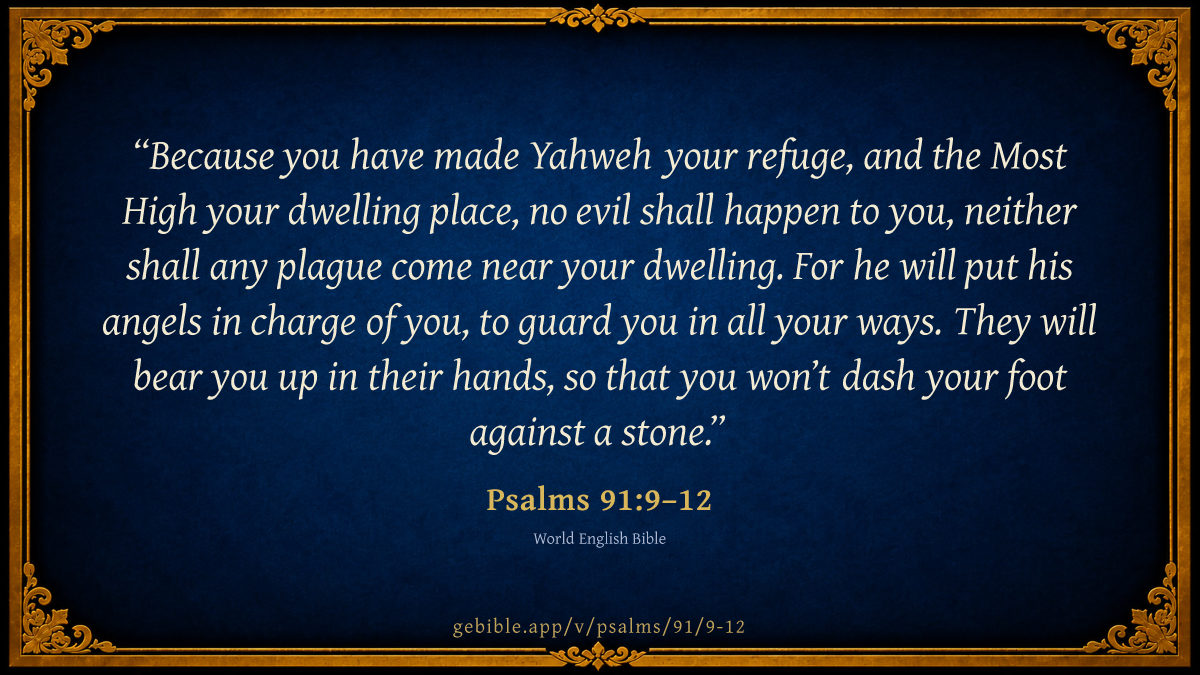
Because thou hast made the Lord, which is my refuge, even the most High, thy habitation; there shall no evil befall thee, neither shall any plague come nigh thy dwelling. The effect upon my heart was immediate. Faith appropriated the passage as her own. I felt secure, refreshed, girt with immortality. I went on with my visitation of the dying in a calm and peaceful spirit; I felt no fear of evil, and I suffered no harm. The providence which moved the tradesman to place those verses in his window I gratefully acknowledge, and in the remembrance of its marvellous power I adore the Lord my God.
Read full note →
The psalmist in these verses assures the man who dwells in God that he shall be secure. Though faith claims no merit of its own, yet the Lord rewards it wherever he sees it. He who makes God his refuge shall find him a refuge; he who dwells in God shall find his dwelling protected. We must make the Lord our habitation by choosing him for our trust and rest, and then we shall receive immunity from harm; no evil shall touch us personally, and no stroke of judgment shall assail our household. The dwelling here intended by the original was only a tent, yet the frail covering would prove to be a sufficient shelter from harm of all sorts. It matters little whether our abode be a gypsy's hut or a monarch's palace if the soul has made the Most High its habitation. Get into God and you dwell in all good, and ill is banished far away. It is not because we are perfect or highly esteemed among men that we can hope for shelter in the day of evil, but because our refuge is the Eternal God, and our faith has learned to hide beneath his sheltering wing.
"For this no ill thy cause shall daunt,
No scourge thy tabernacle haunt."
It is impossible that any ill should happen to the man who is beloved of the Lord; the most crushing calamities can only shorten his journey and hasten him to his reward. Ill to him is no ill, but only good in a mysterious form. Losses enrich him, sickness is his medicine, reproach is his honour, death is his gain. No evil in the strict sense of the word can happen to him, for everything is overruled for good. Happy is he who is in such a case. He is secure where others are in peril, he lives where others die.
Ver. 9. Here commences the second half of the Psalm. And it is as though the Psalmist feared lest (as is too often the case with us) we should, in dwelling on the promises and blessings of God, and applying them to ourselves, forget the condition to which they are annexed the character of those who are to receive them. He therefore pauses here to remind us of the opening verses of the Psalm, by repeating again their substance. Mary B. M. Duncan.
Ver. 9. Because thou hast made the Lord, etc. What faith is this, what trust is that which God hath promised protection and deliverance to in the time of a plague? What act of faith is it? What faith is it? I answer first, there is a faith of persuasion, called faith, whereby men are persuaded and verily believe that they shall not die, nor fall by the hand of the plague. This is well; but I do not find in the 91st Psalm that this protection is entailed upon this persuasion, neither do I find this faith here mentioned.
There is also a faith of reliance, whereby a man doth rely upon God for salvation; this is a justifying faith, true justifying faith; this is true faith indeed; but I do not find in this Psalm, that this promise of protection and deliverance in the time of a plague is entailed upon this, nor that this is here mentioned.
But again, there is a faith, I may call it a faith of recourse unto God, whereby a man doth betake himself unto God for shelter, for protection as to his habitation; when other men do run one this way, another that way, to their hiding places: in the time of a plague for a man then to betake himself to God, as to his habitation, I think this is the faith here spoken of in this 91st Psalm: for do but mark the words of the Psalm: at Ps 91:1, "He that dwelleth in the secret place of the most High, "in the hiding place of the Most High: as if he should say, "When others run from the plague and pestilence and run to their hiding places, ""He that dwelleth in the secret place of the Most High, "that betakes himself to God as his Hiding place and his habitation, he shall abide under the shadow of the Almighty, shall be protected; and so at Ps 91:9, "Because thou hast made the Lord which is my refuge, even the Most High thy habitation, there shall no evil befall thee, neither shall any plague come nigh thy dwelling; "as if he should say to us, In time of a plague men are running and looking out for habitations and hiding places; but because thou hast made the Lord thy habitation and hast recourse to him as thy habitation, "no evil shall befall thee, neither shall the plague come nigh thy dwelling:" and again at Ps 91:11 it is said, "He shall give his angels charge over thee to keep thee in all thy ways, "the ways of thy calling; as if he should say, In the time of a plague men will be very apt to leave station and calling, and so run away from the plague and pestilence; but saith he, "He shall give his angels charge over thee, to keep thee in all thy ways, "the ways of thy calling and place; that is, look when a man in the time of a plague shall conscientiously keep his station and place, and betake himself to God as his habitation; this is the faith that is here spoken of, and this is the faith that God hath promised protection to, here in the 91st Psalm... This promise of protection and deliverance is not made to a believer as a believer, but as acting and exercising faith; for though a man be a believer, if he do not act and exercise his faith, this promise will not reach him, therefore if a believer die, not exercising faith and trusting in God, it is no disparagement to the promise. William Bridge.
Ver. 9. No man can have two homes two places of constant resort. And if the Lord be truly "our habitation, " we can have no other refuge for our souls, no other resting place for our hearts. Mary B. M. Duncan.
Ver. 9-10. There is a threefold preservation which the church and the members of it may look for from divine providence. One from, another in, and a third by, dangers. First, from dangers, according to the promise in one of the Psalms, "Because thou hast made the Lord who is my refuge, even the Most High thy habitation: there shall no evil befall thee, neither shall any plague come nigh thy dwelling." Austin had appointed to go to a certain town to visit the Christians there, and to give them a sermon or more. The day and place were known to his enemies, who set armed men to lie in wait for him by the way which he was to pass, and kill him. As God would have it, the guide whom the people had sent with him to prevent his going out of the right way mistook, and led him into a bypath, yet brought him at last to his journey's end. Which when the people understood, as also the adversaries' disappointment, they adored the providence of God, and gave him thanks for that great deliverance. (Agnoscunt omnes miram Dei providentiam, cui ut liberatori gratias merito egerunt. Possidonius in vita August, chap. 12.)
II. In dangers. So in Job 5:19-20. "He shall deliver thee in six troubles, yea in seven there shall no evil touch thee. In famine he shall redeem thee from death: and in war from the power of the sword." In time of famine the widow of Sarepta's store was made to hold out. The providence of God was with Daniel in the lions' den, shutting up the mouths of those furious beasts: and with the men in the fiery furnace, giving a prohibition to the fire that it should not burn, when they were in the jaws of danger, yea of death. The church hath always been a lily among thorns, yet flourishes still. This bush is yet far from a consumption, although it has seldom or never been out of the fire.
III. By danger. There is a preservation from greater evils by less. No poison but Providence knoweth how to make an antidote; so Jonah was swallowed by a whale, and by that danger kept alive. Joseph thrown into a pit, and afterwards sold into Egypt, and by these hazards brought to be a nursing father to the church. Chrysostom excellently, Fides in periculis secura est, in securitate periclitatur. (Homil. 26, operis imperf in Matt.) Faith is endangered by security, but secure in the midst of danger, as Esther's was when she said, "If I perish I perish." God preserveth us, not as we do fruits that are to last but for a year, in sugar; but as flesh for a long voyage in salt: we must expect in this life much brine and pickle, because our heavenly Father preserveth us as those whom he resolves to keep for ever, in and by dangers themselves. Paul's thorn in the flesh, which had much of danger and trouble in it, was given him on purpose to prevent pride, which was a great evil. "Lest I, "said he, "should be exalted above measure through abundance of revelations, there was given me a thorn in the flesh, the messenger of Satan to buffet me, lest I should be exalted above measure." Elsewhere having commemorated Alexander the coppersmith's withstanding and doing him much evil, yea Nero's opening his mouth as a lion against him, and the Lord's delivering of him thence, he concludes as more than a conqueror. "And the Lord shall deliver me from every evil work, and will preserve me unto his heavenly kingdom; to whom be glory for ever and ever, Amen." 2Ti 4:14-15, 17-18. John, Arrowsmith, (1602-1659).
Ver. 9-14. Dependence on Christ is not the cause of his hiding us, but it is the qualification of the person that shall be hid. Ralph Robinson.
Ver. 9-10.
1. God our spiritual habitation.
2. God the keeper of our earthly habitation.
3. General truth that the spiritual blesses the temporal.
Psalms 91:10*
Charles H. Spurgeon's The Treasury of David (1869–1885) — public domain. Psalms only. Text from a community e-Sword/MySword module.
The Biblical Illustrator1887 · Public DomainOn vv10–12Neither shall any plague come nigh thy dwelling.
Psa_91:10
Neither shall any plague come nigh thy dwelling.
Read full note →
Immunity from disease
That wealthy promise has not become exhausted by the lapse of time. Rather has the promise acquired a new and deeper significance, and it now embraces in its generous charge the interests of the soul. We move amid moral pestilences. Plague-stricken people are all about us--men and women afflicted with moral and spiritual diseases which carry the germs of perilous contagion. How are we to escape them? The Maser went into the very precincts of the plague, and yet was immune in the foul contagion. Disease demands prepared conditions. If the conditions are absent the contagion is impotent. What, then, was our Lords condition when he entered into fellowship with men and women who were smitten by the plague of sin? The prince of this world cometh, and hath nothing in me. How different it all was in the life of Judas Iscariot! The devil put it into the heart of Judas! The germs fell in the prepared conditions; they found a congenial lodgment, and they bore their issues in an evil life.
1. One of the primary pre-disposing conditions of disease is physical exhaustion. The natural forces are reduced. The energy is spent. The army is driven away from the walls, the gates are left undefended, and the enemy has an open way. Our physical defences are found in the natural resistances of the body. Let these be impoverished, and our security is gone. Let me change the analogy. In the life of the body we are only safe when our income exceeds our expenditure. How is it with the soul? The strength of the soul depends upon the quality of its resistances. If the soul is strong and powerful, the Pharisaic germ of hypocrisy or the microbe of actual vice will gain no foothold. But the soul can become faint. Its defences can be straitened, and the stronghold may then be easily taken at the first besiegement of sin. Now, how does a soul become exhausted? We can use our previous figure: the expenditure has exceeded the income. We have broken correspondencies with our resources. We have ignored the land of rest. Men easily capitulate to the evil one when, by neglect of prayer, they have reduced themselves to spiritual exhaustion.
2. Another of the predisposing conditions to disease is bad food. Diet is not altogether a matter of indifference when we are considering the advance of disease. Some foods are the friends of hostile microbes; they are the forerunners of disease; they prepare the way, arranging congenial conditions. How is it with the soul? Is diet of any moment? With what kind of food are we feeding the mind? Is it a food which predisposes the mind to offer hospitality to the foe? How about our reading? Let us subject ourselves to a rigorous self-investigation. Can we honestly expect our minds to be healthy with the kind of food we give them? Thoughts are foodstuff. Where, then, shall we gather them? He gave them bread from heaven to eat! The Lords bread will make us immune against disease. This is the bread, of which, if a man eat, he shall not die.
3. Another predisposing condition to disease is undisciplined emotion. The bacteriologist has told us that excessive grief and fretfulness open the doors to the invading army of disease. It is not so much some commanding emotional passion which exhausts the body; little frets can do it. We can lose a pound quite as effectually by dropping two hundred and forty pennies as by losing a sovereign. The great point to remember is, that all these dispositions lower the strength and quality of our physical defences. How is it with the soul? Undisciplined emotion is a condition against which we must be on our guard. How easily some people can be stirred into violent emotion! Now, all unharnessed emotion impoverishes the spiritual defences. The devil likes nothing better than to get our emotions well stirred, to make us satisfied with these pleasurable feelings, and then behind our satisfaction to carry on his nefarious work. Emotionalism is the forerunner of evil contagion, and provides conditions for the microbe which will end at last in the bondage of an eradical disease. Let me mention one other predisposing condition of moral and spiritual disease.
4. Our bacteriologists tell us that one of the greatest discoveries of the last generation has been the absolute necessity of scrupulous cleanliness in all surgical work. Our doctors are now vigilant to the last degree in closing every door against the entrance of dirt. Operations are performed with sterilized instruments under the most exacting conditions of cleanliness. The smallest remnant of uncleanliness affords a foothold for disease. How is it with the soul? Is there any need of the same scrupulousness? Are we as vigilant in maintaining the purity of our spirits as the surgeon is in maintaining the cleanliness of His work? Do we not rather treat small scruples lightly, and do we not laugh at the morally painstaking, and label them faddy or puritanical? We retain a dirty little prejudice, or some spirit of undue severity, or some little policy which we persuade ourselves cannot be called wrong, but only expedient; and these retained uncleannesses afford the occasion an opportunity to the enemy of our souls; and through the entrance thus obtained he leads all the forces of darkness and the strong black battalions of hell. If we are to defeat him we shall have to attend to the scruple. One grain of dirt can afford sustenance to a host of microbes. Now, let me recall the glorious promise with which I began. Neither shall any plague come nigh thy dwelling. It is possible for us to be in the world and yet not of it, to mix with sinners and yet be separate from them, to be perfectly pure and yet to go and be their minister and guest. Our only security is in God. In Him we have all-sufficient defences. (J. H. Jowett, M.A.)
Safety from disease
In 1854, when Mr. Spurgeon had scarcely been twelve months in London, there was raging there a fearful epidemic of Asiatic cholera. With all his youthful ardour he plunged at once into the work of relieving the sick and the suffering and the dying, and of burying the dead. Weary and worn with much work, he one day came back from a funeral service feeling as though he himself were a prey to the awful judgment and scourge of God. He was passing along a certain street, and he observed in the window of a shoemakers shop a paper wafered to a pane of glass, and on which were inscribed in large characters the 9th and 10th verses of the 91st psalm--Because thou hast made the Lord, which is my refuge, even the Most High, thy habitation; there shall no evil befall thee, neither shall any plague come nigh thy dwelling. Mr. Spurgeon said, That was Gods message to me. I at once took heart, and from that moment I neither felt any fear of the cholera myself nor did I suffer any harm from repeated ministries upon the sick and the dying.
The Biblical Illustrator, edited by Joseph S. Exell (c. 1880s–1900s) — public domain. Text from a community e-Sword module.
Alexander MacLaren1905 · Public DomainOn v9Psa 91:9 - Psa 91:10.
Psalms
THE HABITATION OF THE SOUL
Read full note →
Psa 91:9 - Psa 91:10.
It requires a good deal of piecing to make out from the Hebrew the translation of our Authorised Version here. The simple, literal rendering of the first words of these verses is, ‘Surely, Thou, O Lord! art my Refuge’; and I do not suppose that any of the expedients which have been adopted to modify that translation would have been adopted, but that these words seem to cut in two the long series of rich promises and blessings which occupy the rest of the psalm. But it is precisely this interruption of the flow of the promises which puts us on the right track for understanding the words in question, because it leads us to take them as the voice of the devout man, to whom the promises are addressed, responding to them by the expression of his own faith.
The Revised Version is much better here than our Authorised Version, for it has recognised this breach of continuity of sequence in the promises, and translated as I have suggested; making the first words of my text, ‘Thou, O Lord! art my Refuge,’ the voice of one singer, and ‘Because thou hast made the Most High thy habitation, there shall no evil befall thee, neither shall any evil come nigh thy dwelling,’ the voice of another.
Whether or no it be that in the Liturgical service of the Temple this psalm was sung by two choirs which answered one another, does not matter for our purpose. Whether or no we regard the first clause as the voice of the Psalmist speaking to God, and the other as the same man speaking to himself, does not matter. The point is that, first, there is an exclamation of personal faith, and that then that is followed and answered, as it were, by the further promise of continual blessings. One voice says, ‘Thou, Lord! art my Refuge,’ and then another voice-not God’s, because that speaks in majesty at the end of the psalm-replies to that burst of confidence, ‘Thou hast made the Lord thy habitation’ {as thou hast done by this confession of faith}, ‘there shall no evil come nigh thy dwelling.’
I. We have here the cry of the devout soul.
I observed that it seems to cut in two the stream of promised blessings, and that fact is significant. The psalm begins with the deep truth that ‘He that dwelleth in the secret place of the Most High shall abide under the shadow of the Almighty.’ Then a single voice speaks, ‘I will say of the Lord, He is my Refuge and my Fortress, my God, in Him will I trust.’ Then that voice, which thus responds to the general statement of the first verse, is answered by a stream of promises. The first part of our text comes in as the second speech of the same voice, repeating substantially the same thing as it said at first.
Now, notice that this cry of the soul, recognising God as its Asylum and Home, comes in response to a revelation of God’s blessing, and to large words of promise. There is no true refuge nor any peace and rest for a man unless in grasping the articulate word of God, and building his assurance upon that. Anything else is not confidence, but folly; anything else is building upon sand, and not upon the Rock. If I trust my own or my brother’s conception of the divine nature, if I build upon any thoughts of my own, I am building upon what will yield and give. For all peaceful casting of my soul into the arms of God there must be, first, a plain stretching out of the hands of God to catch me when I drop. So the words of my text, ‘Thou art my Refuge,’ are the best answer of the devout soul to the plain words of divine promise. How abundant these are we all know, how full of manifold insight and adaptation to our circumstances and our nature we may all experience, if we care to prove them.
But let us be sure that we are hearkening to the voice with which He speaks through our daily circumstances as well as by the unmistakable revelation of His will and heart in Jesus Christ. And then let us be sure that no word of His, that comes fluttering down from the heavens, meaning a benediction and enclosing a promise, falls at our feet ungathered and unregarded, or is trodden into the dust by our careless heels. The manna lies all about us; let us see that we gather it. ‘When Thou saidst, Seek ye My Face, my heart said unto Thee, Thy Face, Lord, will I seek.’ When Thou saidst, ‘I will be thy Strength and thy Righteousness,’ have I said, ‘Surely, O Jehovah! Thou art my Refuge’? Turn His promises into your creed, and whatever He has declared in the sweet thunder of His voice, loud as the voice of many waters, and melodious as ‘harpers harping with their harps,’ do you take for your profession of faith in the faithful promises of your God.
Still further, this cry of the devout soul suggests to me that our response ought to be the establishment of a close personal relation between us and God. ‘Thou, O Lord! art my Refuge.’ The Psalmist did not content himself with saying ‘Lord! Thou hast been our Dwelling-place in all generations,’ or as one of the other psalmists has it, ‘God is our Refuge and our Strength.’ That thought was blessed, but it was not enough for the Psalmist’s present need, and it is never enough for the deepest necessities of any soul. We must isolate ourselves and stand, God and we, alone together-at heart-grips-we grasping His hand, and He giving Himself to us-if the promises which are sent down into the world for all who will make them theirs can become ours. They are made payable to your order; you must put your name on the back before you get the proceeds. There must be what our good old Puritan forefathers used to call, in somewhat hard language, ‘the appropriating act of faith,’ in order that God’s richest blessings may be of any use to us. Put out your hand to grasp them, and say, ‘Mine,’ not ‘Ours.’ The thought of others as sharing in them will come afterwards, for he who has once realised the absolute isolation of the soul and has been alone with God, and in solitude has taken God’s gifts as his very own, is he who will feel fellowship and brotherhood with all who are partakers of like precious faith and blessings. The ‘ours’ will come; but you must begin with the ‘mine’-’my Lord and my God.’ ‘He loved me, and gave Himself for me.’
Just as when the Israelites gathered on the banks of the Red Sea, and Miriam and the maidens came out with songs and timbrels, though their hearts throbbed with joy, and music rang from their lips for national deliverance, their hymn made the whole deliverance the property of each, and each of the chorus sang, ‘The Lord is my Strength and my Song, He also is become my Salvation,’ so we must individualise the common blessing. Every poor soul has a right to the whole of God, and unless a man claims all the divine nature as his, he has little chance of possessing the promised blessings. The response of the individual to the worldwide promises and revelations of the Father is, ‘Thou, O Lord! art my Refuge.’
Further, note how this cry of the devout soul recognises God as He to whom we must go because we need a refuge. The word ‘refuge’ here gives the picture of some stronghold, or fortified place, in which men may find security from all sorts of dangers, invasions by surrounding foes, storm and tempest, rising flood, or anything else that threatens. Only he who knows himself to be in danger bethinks himself of a refuge. It is only when we know our danger and defencelessness that God, as the Refuge of our souls, becomes precious to us. So, underlying, and an essential part of, all our confidence in God, is the clear recognition of our own necessity. The sense of our own emptiness must precede our grasp of His fulness. The conviction of our own insufficiency and sinfulness must precede our casting ourselves on His mercy and righteousness. In all regions the consciousness of human want must go before the recognition of the divine supply.
II. Now, note the still more abundant answer which that cry evokes.
I said that the words on which I have been commenting thus far, seem to break in two the continuity of the stream of blessings and promises. But there may be observed a certain distinction of tone between those promises which precede and those which follow the cry. Those that follow have a certain elevation and depth, completeness and fulness, beyond those that precede. This enhancing of the promises, following on the faithful grasp of previous promises, suggests the thought that, when God is giving, and His servant thankfully accepts and garners up His gifts, He opens His hand wider and gives more. When He pours His rain upon the unthankful and the evil, and they let the precious, fertilising drops run to waste, there comes after a while a diminution of the blessing; but they who store in patient and thankful hearts the faithful promises of God, have taken a sure way to make His gifts still larger and His promises still sweeter, and their fulfilment more faithful and precious.
But now notice the remarkable language in which this answer is couched. ‘Thou hast made the Most High thy Habitation, there shall no evil befall thee, neither shall any plague come nigh thy dwelling.’
Did you ever notice that there are two dwelling-places spoken of in this verse? ‘Thou hast made the Most High thy Habitation’; ‘There shall no plague come nigh thy dwelling.’ The reference of the latter word to the former one is even more striking if you observe that, literally translated, as in the Revised Version, it means a particular kind of abode-namely, a tent. ‘Thou hast made the Most High thy habitation.’ The same word is employed in the 90th Psalm: ‘Lord, Thou hast been our Dwelling-place in all generations.’ Beside that venerable and ancient abode, that has stood fresh, strong, incorruptible, and unaffected by the lapse of millenniums, there stands the little transitory canvas tent in which our earthly lives are spent. We have two dwelling-places. By the body we are brought into connection with this frail, evanescent, illusory outer world, and we try to make our homes out of shifting cloud-wrack, and dream that we can compel mutability to become immutable, that we may dwell secure. But fate is too strong for us, and although we say that we will make our nest in the rocks, and shall never be moved, the home that is visible and linked with the material passes and melts as a cloud. We need a better dwelling-place than earth and that which holds to earth. We have God Himself for our true Home. Never mind what becomes of the tent, as long as the mansion stands firm. Do not let us be saddened, though we know that it is canvas, and that the walls will soon rot and must some day be folded up and borne away, if we have the Rock of Ages for our dwelling-place.
Let us abide in the Eternal God by the devotion of our hearts, by the affiance of our faith, by the submission of our wills, by the aspiration of our yearnings, by the conformity of our conduct to His will. Let us abide in the Eternal God, that ‘when the earthly house of this tabernacle is dissolved,’ we may enter into two buildings ‘eternal in the heavens’-the one the spiritual body which knows no corruption, and the other the bosom of the Eternal God Himself. ‘Because thou hast made Him thy Habitation,’ that Dwelling shall suffer no evil to come near it or its tenant.
Still further, notice the scope of this great promise. I suppose there is some reference in the form of it to the old story of Israel’s exemption from the Egyptian plagues, and a hint that that might be taken as a parable and prophetic picture of what will be true about every man who puts his trust in God. But the wide scope and the paradoxical completeness of the promise itself, instead of being a difficulty, point the way to its true interpretation. ‘There shall no plague come nigh thy dwelling’-and yet we are smitten down by all the woes that afflict humanity. ‘No evil shall befall thee’-and yet ‘all the ills that flesh is heir to’ are dealt out sometimes with a more liberal hand to them who abide in God than to them who dwell only in the tent upon earth. What then? Is God true, or is He not? Did this psalmist mean to promise the very questionable blessing of escape from all the good of the discipline of sorrow? Is it true, in the unconditional sense in which it is often asserted, that ‘prosperity is the blessing of the Old Testament, and adversity of the New’? I think not, and I am sure that this psalmist, when he said, ‘there shall no evil befall thee, nor any plague come nigh thy dwelling,’ was thinking exactly the same thing which Paul had in his mind when he said, ‘All things work together for good to them that love God, to them that are called according to His purpose.’ If I make God my Refuge, I shall get something a great deal better than escape from outward sorrow-namely, an amulet which will turn the outward sorrow into joy. The bitter water will still be given me to drink, but it will be filtered water, out of which God will strain all the poison, though He leaves plenty of the bitterness in it; for bitterness is a tonic. The evil that is in the evil will be taken out of it, in the measure in which we make God our Refuge, and ‘all will be right that seems most wrong’ when we recognise it to be ‘His sweet will.’
Dear brother! the secret of exemption from every evil lies in no peculiar Providence, ordering in some special manner our outward circumstances, but in the submission of our wills to that which the good hand of the Lord our God sends us for our good; and in cleaving close to Him as our Refuge. Nothing can be ‘evil’ which knits me more closely to God; and whatever tempest drives me to His breast, though all the four winds of the heavens strive on the surface of the sea, it will be better for me than calm weather that entices me to stray farther away from Him.
We shall know that some day. Let us be sure of it now, and explain by it our earthly experience, even as we shall know it when we get up yonder and ‘see all the way by which the Lord our God has led us.’
Alexander MacLaren, Expositions of Holy Scripture (1904–1910) — public domain. Text from a community e-Sword module.
C. I. Scofield1917 · Public DomainOn v11(See Scofield "Heb 1:4").
angels
(See Scofield "Heb 1:4").
The Scofield Reference Bible (1917 edition), notes by C. I. Scofield — public domain. Text from a community e-Sword module.
unfoldingWord translationNotes2017 · CC BY-SA 4.0On vv10, 12No evil will overtake you
No evil will overtake you
The writer speaks of a person experiencing bad or evil things as if evil were a person who overtakes another person. AT: "Nothing evil will happen to you" (See: Metaphor and Personification)
Read full note →
no affliction will come near your home
The psalmist speaks of people who afflict others as though they were the harm they cause. AT: "no one will be able to harm your family" (See: Personification and Metonymy)
For he will direct
"Yahweh will command"
in all your ways
The psalmist speaks of the way a person lives his life as if it were a path down which the person walked. AT: "in everything you do" or "at all times" (See: Metaphor)

John Calvin 1540 · Public Domain On vv9, 11, 12 9 Because thou, Jehovah, art my protection. He dwells…
9 Because thou, Jehovah, art my protection. He dwells at this length in commendation of the providence of God, as knowing how slow men naturally are to resort to God in a right manner; and how much they need to be stimulated to this duty, and to be driven from those false and worldly refuges in which they confide. There is a change of person frequently throughout this psalm: thus, in the first verse, he addresses God, and afterwards addresses himself. God he styles his protection, — in this manner, by his own example, recommending others to have recourse to God as their help. So, afterwards, he addresses himself, that he may be the better persuaded of the sincerity of his inward affection. The true method of testing our faith is to turn our thoughts inward upon ourselves, and, when no human eye sees us, to search our own spirits. If, not content with having to do with God only, we turn our eyes to men, it is almost impossible to prevent pride from insinuating itself into the room of faith. He speaks of accounting God to be his house or refuge, because he defends us from every evil, as in Psalm 90:1. This verse may be considered as connected with that which follows, and as stating the cause or reason of what is there asserted; for it is added, There shall no evil befall thee. And how are coming evils averted, but just by our resting with confidence in the protection of God? Troubles, it is true, of various kinds assail the believer as well as others, but the Psalmist means that God stands between him and the violence of every assault, so as to preserve him from being overwhelmed. The Divine guardianship is represented as extending to the whole household of the righteous; and we know that God comprehends under his love the children of such as he has adopted into his fatherly favor. Or, perhaps, the term may be taken in its simpler sense, and nothing more be intended than that those who choose God for their refuge will dwell safely in their houses.
John Calvin's Commentaries (1540-1563) — public domain. Text from the Calvin Translation Society English edition (1840s-50s) via the Christian Classics Ethereal Library (ccel.org). Calvin's coverage is partial (roughly two-thirds of the Bible); uncommented books and verses are honest gaps, never fabricated. The 19th-century editor's footnotes and remarks are omitted so the notes are faithfully Calvin's own voice.
Geneva Bible translators 1599 · Public Domain On v11 God hath not appointed every man one Angel, but…
God hath not appointed every man one Angel, but many to be ministers of his providence to keep his, and defend them in their vocation, which is the way to walk in without tempting God.
Geneva Bible (1599) marginal notes — public domain.
John Trapp 1656 · Public Domain On vv9–12 Psa 91:9 Because thou hast made the LORD, [which…
Psa 91:9 Because thou hast made the LORD, [which is] my refuge, [even] the most High, thy habitation;
Ver. 9. Because thou hast made the Lord, which is my refuge, &c.] Because thou hast done as I do, thou shalt speed as I have sped; for God is rich in mercy to all his.
Read full note →
Even the Most High thy habitation] See Psa 90:1.
John Trapp, A Commentary or Exposition upon All the Books of the Old and New Testament (1647–1656) — public domain. Text from a community e-Sword module.
Matthew Poole 1685 · Public Domain On vv9–12 Or, as the words lie in the Hebrew, and…
Or, as the words lie in the Hebrew, and others render them, Because thou, O Lord, are my refuge, thou, O my soul, (which is easily understood out of the foregoing words, and to which David oft suddenly turneth his speech,) hast made the Most High thine habitation; which is the only ground and reason of that safety last mentioned. As for the variation of persons, that he sometimes speaketh to and of others, and sometimes to and of himself, nothing is more frequent in this book; nor doth it make any alteration in the sense.
Matthew Poole's English Annotations on the Holy Bible (1683–1685) — public domain. Text from a community e-Sword/MySword module.
Matthew Henry 1710 · Public Domain On v9 Here are more promises to the same purport with…
Here are more promises to the same purport with those in the foregoing verses, and they are exceedingly great and precious, and sure to all the seed.
I. The psalmist assures believers of divine protection, from his own experience; and that which he says is the word of God, and what we may rely upon. Observe, 1. The character of those who shall have the benefit and comfort of these promises; it is much the same with that, Psa 91:1. They are such as make the Most High their habitation (Psa 91:9), as are continually with God and rest in him, as make his name both their temple and their strong tower, as dwell in love and so dwell in God. It is our duty to be at home in God, to make our choice of him, and then to live our life in him as our habitation, to converse with him, and delight in him, and depend upon him; and then it shall be our privilege to be at home in God; we shall be welcome to him as a man to his own habitation, without any let, hindrance, or molestation, from the arrests of the law or the clamours of conscience; then too we shall be safe in him, shall be kept in perfect peace, Isa 26:3. To encourage us to make the Lord our habitation, and to hope for safety and satisfaction in him, the psalmist intimates the comfort he had had in doing so: "He whom thou makest thy habitation is my refuge; and I have found him firm and faithful, and in him there is room enough, and shelter enough, both for thee and me." In my father's house there are many mansions, one needs not crowd another, much less crowd out another. 2. The promises that are sure to all those who have thus made the Most High their habitation. (1.) That, whatever happens to them, nothing shall hurt them (Psa 91:10): "There shall no evil befal thee; though trouble or affliction befal thee, yet there shall be no real evil in it, for it shall come from the love of God and shall be sanctified; it shall come, not for thy hurt, but for thy good; and though, for the present, it be not joyous but grievous, yet, in the end, it shall yield so well that thou thyself shalt own no evil befel thee. It is not an evil, an only evil, but there is a mixture of good in it and a product of good by it. Nay, not thy person only, but thy dwelling, shall be taken under the divine protection: There shall no plague come nigh that, nothing to do thee or thine any damage." Nihil accidere bono viro mali potest - No evil can befal a good man. Seneca De Providentia. (2.) That the angels of light shall be serviceable to them, Psa 91:11, Psa 91:12. This is a precious promise, and speaks a great deal both of honour and comfort to the saints, nor is it ever the worse for being quoted and abused by the devil in tempting Christ, Mat 4:6. Observe, [1.] The charge given to the angels concerning the saints. He who is the Lord of the angels, who gave them their being and gives laws to them, whose they are and whom they were made to serve, he shall give his angels a charge over thee, not only over the church in general, but over every particular believer. The angels keep the charge of the Lord their God; and this is the charge they receive from him. It denotes the great care God takes of the saints, in that the angels themselves shall be charged with them, and employed for them. The charge is to keep thee in all thy ways; here is a limitation of the promise: They shall keep thee in thy ways, that is, "as long as thou keepest in the way of thy duty;" those that go out of that way put themselves out of God's protection. This word the devil left out when he quoted the promise to enforce a temptation, knowing how much it made against him. But observe the extent of the promise; it is to keep thee in all thy ways: even where there is no apparent danger yet we need it, and where there is the most imminent danger we shall have it. Wherever the saints go the angels are charged with them, as the servants are with the children. [2.] The care which the angels take of the saints, pursuant to this charge: They shall bear thee up in their hands, which denotes both their great ability and their great affection. They are able to bear up the saints out of the reach of danger, and they do it with all the tenderness and affection wherewith the nurse carries the little child about in her arms; it speaks us helpless and them helpful. They are condescending in their ministrations; they keep the feet of the saints, lest they dash them against a stone, lest they stumble and fall into sin and into trouble. [3.] That the powers of darkness shall be triumphed over by them (Psa 91:13): Thou shalt tread upon the lion and adder. The devil is called a roaring lion, the old serpent, the red dragon; so that to this promise the apostle seems to refer in that (Rom 16:20), The God of peace shall tread Satan under your feet. Christ has broken the serpent's head, spoiled our spiritual enemies (Col 2:15), and through him we are more than conquerors; for Christ calls us, as Joshua called the captains of Israel, to come and set our feet on the necks of vanquished enemies. Some think that this promise had its full accomplishment in Christ, and the miraculous power which he had over the whole creation, healing the sick, casting out devils, and particularly putting it into his disciples' commission that they should take up serpents, Mar 16:18. It may be applied to that care of the divine Providence by which we are preserved from ravenous noxious creatures (the wild beasts of the field shall be at peace with thee, Job 5:23); nay, and have ways and means of taming them, Jam 3:7.
Read full note →
II. He brings in God himself speaking words of comfort to the saints, and declaring the mercy he had in store for them, Psa 91:14-16. Some make this to be spoken to the angels as the reason of the charge given them concerning the saints, as if he had said, "Take care of them, for they are dear to me, and I have a tender concern for them." And now, as before, we must observe,
1. To whom these promises do belong; they are described by three characters: - (1.) They are such as know God's name. His nature we cannot fully know; but by his name he has made himself known, and with that we must acquaint ourselves. (2.) They are such as have set their love upon him; and those who rightly know him will love him, will place their love upon him as the only adequate object of it, will let out their love towards him with pleasure and enlargement, and will fix their love upon him with a resolution never to remove it to any rival. (3.) They are such as call upon him, as by prayer keep up a constant correspondence with him, and in every difficult case refer themselves to him.
2. What the promises are which God makes to the saints. (1.) That he will, in due time, deliver them out of trouble: I will deliver him (Psa 91:14 and again Psa 91:15), denoting a double deliverance, living and dying, a deliverance in trouble and a deliverance out of trouble. If God proportions the degree and continuance of our troubles to our strength, if he keeps us from offending him in our troubles, and makes our death our discharge, at length, from all our troubles, then this promise is fulfilled. See Psa 34:19; Ti2 3:11; Ti2 4:18. (2.) That he will, in the mean time, be with them in trouble, Psa 91:15. If he does not immediately put a period to their afflictions, yet they shall have his gracious presence with them in their troubles; he will take notice of their sorrows, and know their souls in adversity, will visit them graciously by his word and Spirit, and converse with them, will take their part, will support and comfort them, and sanctify their afflictions to them, which will be the surest token of his presence with them in their troubles. (3.) That herein he will answer their prayers: He shall call upon me; I will pour upon him the spirit of prayer, and then I will answer, answer by promises (Psa 85:8), answer by providences, bringing in seasonable relief, and answer by graces, strengthening them with strength in their souls (Psa 138:3); thus he answered Paul with grace sufficient, Co2 12:9. (4.) That he will exalt and dignify them: I will set him on high, out of the reach of trouble, above the stormy region, on a rock above the waves, Isa 33:16. They shall be enabled, by the grace of God, to look down upon the things of this world with a holy contempt and indifference, to look up to the things of the other world with a holy ambition and concern; and then they are set on high. I will honour him; those are truly honourable whom God puts honour upon by taking them into covenant and communion with himself and designing them for his kingdom and glory, Joh 12:26. (5.) That they shall have a sufficiency of life in this world (Psa 91:16): With length of days will I satisfy him; that is, [1.] They shall live long enough: they shall be continued in this world till they have done the work they were sent into this world for and are ready for heaven, and that is long enough. Who would wish to live a day longer than God has some work to do, either by him or upon him? [2.] They shall think it long enough; for God by his grace shall wean them from the world and make them willing to leave it. A man may die young, and yet die full of days, satur dierum - satisfied with living. A wicked worldly man is not satisfied, no, not with long life; he still cries, Give, give. But he that has his treasure and heart in another world has soon enough of this; he would not live always. (6.) That they shall have an eternal life in the other world. This crowns the blessedness: I will show him my salvation, show him the Messiah (so some); good old Simeon was then satisfied with long life when he could say, My eyes have seen thy salvation, nor was there any greater joy to the Old Testament saints than to see Christ's day, though at a distance. It is more probably that the word refers to the better country, that is, the heavenly, which the patriarchs desired and sought: he will show him that, bring him to that blessed state, the felicity of which consists so much in seeing that face to face which we here see through a glass darkly; and, in the mean time, he will give him a prospect of it. All these promises, some think, point primarily at Christ, and had their accomplishment in his resurrection and exaltation.
Matthew Henry's Commentary on the Whole Bible (1708–1710) — public domain (CC PDM 1.0). Text via the HelloAO Bible API.
John Gill 1763 · Public Domain On vv9–12 Because thou hast made the Lord which is my…
Because thou hast made the Lord which is my refuge,.... So the words, according to Kimchi, also are directed to the good man; giving the reason of his safety, because he trusts in the Lord, and puts himself under his protection: but they should rather be rendered, and the accents require such a reading, "because thou, Lord, art my refuge" (t); and so are either the words of the good man that trusts in the Lord; or rather of the psalmist himself, seeing his safety in the midst of danger, and ascribing it to the Lord; whose providence was in a peculiar manner over him, whose power protected him, and he was as an asylum or city of refuge to him; so that nothing could hurt him:
even the most High, thy habitation; it should be rendered, "thou hast made the most High thy habitation"; being an apostrophe of the psalmist to his own soul, observing the ground of his security; the most high God being made and used by him as his habitation, or dwelling place, where he dwelt, as every good man does, safely, quietly, comfortably, pleasantly, and continually: the Targum makes them to be the words of Solomon, paraphrasing them thus,
Read full note →
"Solomon answered, and thus he said, thou thyself, O Lord, art my confidence; in an high habitation thou hast put the house of thy majesty.''
(t) "quniam tu Domine spes mea", Pagninus, Montanus, Musculus; "nam tu O Jehova es receptus meus", Cocceius; so Piscator; "quia tu Domine, es perfugium meum", De Dieu, Gejerus.
John Gill's Exposition of the Whole Bible (1746–1763) — public domain (CC PDM 1.0). Text via the HelloAO Bible API.
John Wesley 1765 · Public Domain On v12 Bear thee - Sustain or uphold thee in thy…
Bear thee - Sustain or uphold thee in thy goings, as we do a child.
John Wesley, Explanatory Notes Upon the Whole Bible (1754–1765) — public domain. Text via the GEBible commentary corpus.
Adam Clarke 1810 · Public Domain On vv9, 11, 12 Verse 9. Because thou hast made the Lord] Seeing…
Verse 9. Because thou hast made the Lord] Seeing thou hast taken Jehovah, the Most High, for thy portion and thy refuge, no evil shall come nigh thy dwelling; thou shalt be safe in thy soul, body, household, and property, Ps 91:10. Every pious man may expect such protection from his God and Father.
Adam Clarke's Commentary on the Bible (1810–1826) — public domain. Text from a community e-Sword/MySword module.
Joseph Benson 1811 · Public Domain On v9 Psa 91:9-12. Because thou hast made the Most High…
Psa 91:9-12. Because thou hast made the Most High thy habitation — Which is the only ground and reason of that safety here mentioned; there shall no evil befall thee — Namely, so as to destroy or really hurt thee. Though affliction befall thee, yet there shall be no real evil in it; for it shall come from the love of God, and shall be sanctified; it shall come, not for thy hurt, but for thy good; and though for the present it be not joyous but grievous, yet, in the end, it shall yield so well that thou thyself shalt own no evil befell thee. Neither shall any plague come nigh thy dwelling — This promise is not made to all that dwell nigh a righteous man, as, suppose, to his children, servants, and neighbours, who may, possibly, be wicked persons, and so strangers from God’s covenant and promises. How far it secures his own person, see on Psa 91:7. For he shall give his angels charge over thee — Those blessed, powerful, and watchful spirits, whom God hath appointed to minister to, and take care of, the heirs of salvation. To keep thee in all thy ways — In the whole course of thy life, and in all thy lawful undertakings. They shall bear thee up in their hands — Sustain or uphold thee in thy goings, as we do a child or a weakly man, especially in uneven or dangerous paths; lest thou dash thy foot against a stone — So as to hurt it, or to cause thee to fall. Satan, it is well known, tempted Christ to cast himself from a pinnacle of the temple upon the presumption of this promise, which he quoted, implying, that angels should guard and support him in all dangers whatever. “But Christ, in answer, at once detected and exposed the sophistry of the grand deceiver, by showing that the promise belonged only to those who fell unavoidably into danger, in the course of duty; such might hope for the help and protection of Heaven; but that he who should wantonly and absurdly throw himself into peril, merely to try whether Providence would bring him out of it, must expect to perish for his pains.’” — Horne.
Joseph Benson's Commentary on the Old and New Testaments (1811–1818) — public domain. Text from a community e-Sword module.
Albert Barnes 1834 · Public Domain On vv9–12 Because thou hast made the Lord, which is my…
Because thou hast made the Lord, which is my refuge - literally, “For thou, O Jehovah, (art) my refuge.” The Chaldee Paraphrase regards this as the language of Solomon, who, according to that version, is one of the speakers in the psalm: “Solomon answered and said, ‘Since thou, O Lord, art my refuge,’” etc. Tholuck regards this as the response of the choir. But this is unnecessary. The idea is, that the psalmist “himself” had made Yahweh his refuge, or his defense. The language is an expression of his own feeling - of his own experience - in having made God his refuge, and is designed here to be a ground of exhortation to others to do the same thing. He could say that he had made God his refuge; he could say that God was now his refuge; and he could appeal to this - to his own experience - when he exhorted others to do the same, and gave them assurance of safety in doing it.
Even the Most High thy habitation - literally, “The Most High hast thou made thy habitation;” or, thy home. On the word habitation, see the notes at Psa 90:1. The idea is, that he had, as it were, chosen to abide with God, or to dwell with him - to find his home with him as in a father’s house. The consequence of this, or the security which would follow, he states in the following verses.
Albert Barnes' Notes on the Bible (1834–1885) — public domain. Text from a community e-Sword/MySword module.
Daniel D. Whedon 1874 · Public Domain On vv9–11 9. The Lord… my refuge—On the person speaking here…
9. The Lord… my refuge—On the person speaking here see note on Psa_91:2-3
Daniel D. Whedon (gen. ed.), Commentary on the Old and New Testaments (1874–1909) — public domain. Text from a community e-Sword module.
The Cambridge Bible for Schools and Colleges 1878 · Public Domain On vv9–12 9. For thou, Jehovah, art my refuge!
9. For thou, Jehovah, art my refuge!
Thou hast made the Most High thy habitation.
Read full note →
So we must render. The A.V. is an attempt to escape from the difficulties of the verse, but it involves an intolerably harsh construction. As the text stands, the Psalmist begins the second division of the Psalm by repeating the profession of Psa_91:2, and then, as before, addresses Israel as a whole, or the godly Israelite. Psa_91:9 b is virtually a protasis;—If or since thou hast made … there shall no evil befall thee.
Here too some critics would cut the knot of the change of persons by emending, Because thou hast said, Jehovah is my refuge, and hast made the Most High thy habitation; or, For as for thee, Jehovah is thy refuge. But the change is unnecessary. The word for habitation is the same as that rendered dwelling-place in Psa_90:1. The rendering of the P.B.V., “thou hast set thine house of defence very high,” is probably a misunderstanding of the Vulg. altissimum posuisti refugium tuum, which, as the LXX, τὸν ὕψιστον ἔθου καταφυγήν σου, shews, means, Thou hast made the Most High thy refuge. It is supported by the Targum (see note [52] p. 554), but in view of the use of ‘Most High’ in Psa_91:1 and Psa_92:1 can hardly be right.
[52] The Targum recognises the idea of a plurality of speakers, explaining the Ps. as a dialogue between David and Solomon. Psa_91:2-3, “David said, ‘I will say to Jehovah,’ &c. ‘For He shall deliver thee, Solomon my son,’ &c.” Psa_91:9, “Solomon answered and said thus, ‘For thou Jehovah art my refuge, in a lofty dwelling hast Thou placed the abode of Thy Majesty’ (Shechinah).” Psa_91:10, “The Lord of the world answered and said thus, ‘There shall no evil befall thee,’ &c.”
9–16. Renewed assurances of Divine protection, ratified by a Divine promise.
The Cambridge Bible for Schools and Colleges (gen. ed. J. J. S. Perowne; Cambridge University Press, 1878–1918) — public domain. Text from a community e-Sword module.
Ellicott's Commentary for English Readers 1878 · Public Domain On vv9–12 (9) Thou . . . my.—The difficulty of the…
(9) Thou . . . my.—The difficulty of the change of person is avoided by the Authorised Version, but only with violence to the text, which runs, “For thou, Jehovah, my refuge; thou hast made the Most High thy habitation.” It is best to take the first line as a kind of under-soliloquy. The poet is assuring himself of the protection which will be afforded one who trusts in God; and he interrupts his soliloquy, as it were, with a comment upon it: “Yes, this is true of myself, for Thou Jehovah art indeed my refuge.” (For the Most High as a dwelling place, see Psa_90:1.)
A Bible Commentary for English Readers, edited by Charles John Ellicott (1878–1897) — public domain. Text from a community e-Sword module.
The Pulpit Commentary 1880 · Public Domain On vv9–12 Because thou hast made the Lord, which is my…
Because thou hast made the Lord, which is my Refuge, even the Most High, thy Habitation; literally, for thou, O Lord, art my Refuge; thou hast made the Most High thy Dwelling place, which can scarcely be made to yield a tolerable sense. It is supposed that a word Trma has dropped out, and that the verse originally ran thus: "Because thou hast said, Jehovah is my Refuge, and hast made the Most High thy Dwelling place" (comp. vers. l, 2). The second speaker for a second time addresses the first.
HOMILIES BY C. SHORT Vers. 9, 10, 11. The security of the saints.
Read full note →
I THE DWELLING PLACE OF THE GOOD MAN GOD. In such an abode we find:
1. Shelter, protection. (Joh_14:23)
2. Nutriment.
3. Rest.
4. Companionship.
II THE SAFETY OF THIS ABODE.
1. Omnipotent love encompasses him.
2. The power of the good man to convert all things to his welfare. "All things are yours.
III THE GUARDS AND SERVANTS OF THE GOOD MAN. The angels are God"s messengers and ministers.
1. God employs innumerable invisible ministries to serve us. Angels and unseen powers "that walk the earth both when we wake and when we sleep.
2. Innumerable visible ministries. "More servants wait on man than he"ll take notice of" (see George Herbert"s poem). S.
The Pulpit Commentary (1880–1919), ed. H.D.M. Spence-Jones & Joseph S. Exell — public domain. Text from a community e-Sword module.
Charles H. Spurgeon 1885 · Public Domain On vv9–12 Ver. 9-10. Before expounding these verses I cannot refrain…
Ver. 9-10. Before expounding these verses I cannot refrain from recording a personal incident illustrating their power to soothe the heart, when they are applied by the Holy Spirit. In the year 1854, when I had scarcely been in London twelve months, the neighbourhood in which I laboured was visited by Asiatic cholera, and my congregation suffered from its inroads. Family after family summoned me to the bedside of the smitten, and almost every day I was called to visit the grave. I gave myself up with youthful ardour to the visitation of the sick, and was sent for from all corners of the district by persons of all ranks and religions. I became weary in body and sick at heart. My friends seemed falling one by one, and I felt or fancied that I was sickening like those around me. A little more work and weeping would have laid me low among the rest; I felt that my burden was heavier than I could bear, and I was ready to sink under it. As God would have it, I was returning mournfully home from a funeral, when my curiosity led me to read a paper which was wafered up in a shoemaker's window in the Dover Road. It did not look like a trade announcement, nor was it, for it bore in a good bold handwriting these words:
Because thou hast made the Lord, which is my refuge, even the most High, thy habitation; there shall no evil befall thee, neither shall any plague come nigh thy dwelling. The effect upon my heart was immediate. Faith appropriated the passage as her own. I felt secure, refreshed, girt with immortality. I went on with my visitation of the dying in a calm and peaceful spirit; I felt no fear of evil, and I suffered no harm. The providence which moved the tradesman to place those verses in his window I gratefully acknowledge, and in the remembrance of its marvellous power I adore the Lord my God.
Read full note →
The psalmist in these verses assures the man who dwells in God that he shall be secure. Though faith claims no merit of its own, yet the Lord rewards it wherever he sees it. He who makes God his refuge shall find him a refuge; he who dwells in God shall find his dwelling protected. We must make the Lord our habitation by choosing him for our trust and rest, and then we shall receive immunity from harm; no evil shall touch us personally, and no stroke of judgment shall assail our household. The dwelling here intended by the original was only a tent, yet the frail covering would prove to be a sufficient shelter from harm of all sorts. It matters little whether our abode be a gypsy's hut or a monarch's palace if the soul has made the Most High its habitation. Get into God and you dwell in all good, and ill is banished far away. It is not because we are perfect or highly esteemed among men that we can hope for shelter in the day of evil, but because our refuge is the Eternal God, and our faith has learned to hide beneath his sheltering wing.
"For this no ill thy cause shall daunt,
No scourge thy tabernacle haunt."
It is impossible that any ill should happen to the man who is beloved of the Lord; the most crushing calamities can only shorten his journey and hasten him to his reward. Ill to him is no ill, but only good in a mysterious form. Losses enrich him, sickness is his medicine, reproach is his honour, death is his gain. No evil in the strict sense of the word can happen to him, for everything is overruled for good. Happy is he who is in such a case. He is secure where others are in peril, he lives where others die.
Ver. 9. Here commences the second half of the Psalm. And it is as though the Psalmist feared lest (as is too often the case with us) we should, in dwelling on the promises and blessings of God, and applying them to ourselves, forget the condition to which they are annexed the character of those who are to receive them. He therefore pauses here to remind us of the opening verses of the Psalm, by repeating again their substance. Mary B. M. Duncan.
Ver. 9. Because thou hast made the Lord, etc. What faith is this, what trust is that which God hath promised protection and deliverance to in the time of a plague? What act of faith is it? What faith is it? I answer first, there is a faith of persuasion, called faith, whereby men are persuaded and verily believe that they shall not die, nor fall by the hand of the plague. This is well; but I do not find in the 91st Psalm that this protection is entailed upon this persuasion, neither do I find this faith here mentioned.
There is also a faith of reliance, whereby a man doth rely upon God for salvation; this is a justifying faith, true justifying faith; this is true faith indeed; but I do not find in this Psalm, that this promise of protection and deliverance in the time of a plague is entailed upon this, nor that this is here mentioned.
But again, there is a faith, I may call it a faith of recourse unto God, whereby a man doth betake himself unto God for shelter, for protection as to his habitation; when other men do run one this way, another that way, to their hiding places: in the time of a plague for a man then to betake himself to God, as to his habitation, I think this is the faith here spoken of in this 91st Psalm: for do but mark the words of the Psalm: at Ps 91:1, "He that dwelleth in the secret place of the most High, "in the hiding place of the Most High: as if he should say, "When others run from the plague and pestilence and run to their hiding places, ""He that dwelleth in the secret place of the Most High, "that betakes himself to God as his Hiding place and his habitation, he shall abide under the shadow of the Almighty, shall be protected; and so at Ps 91:9, "Because thou hast made the Lord which is my refuge, even the Most High thy habitation, there shall no evil befall thee, neither shall any plague come nigh thy dwelling; "as if he should say to us, In time of a plague men are running and looking out for habitations and hiding places; but because thou hast made the Lord thy habitation and hast recourse to him as thy habitation, "no evil shall befall thee, neither shall the plague come nigh thy dwelling:" and again at Ps 91:11 it is said, "He shall give his angels charge over thee to keep thee in all thy ways, "the ways of thy calling; as if he should say, In the time of a plague men will be very apt to leave station and calling, and so run away from the plague and pestilence; but saith he, "He shall give his angels charge over thee, to keep thee in all thy ways, "the ways of thy calling and place; that is, look when a man in the time of a plague shall conscientiously keep his station and place, and betake himself to God as his habitation; this is the faith that is here spoken of, and this is the faith that God hath promised protection to, here in the 91st Psalm... This promise of protection and deliverance is not made to a believer as a believer, but as acting and exercising faith; for though a man be a believer, if he do not act and exercise his faith, this promise will not reach him, therefore if a believer die, not exercising faith and trusting in God, it is no disparagement to the promise. William Bridge.
Ver. 9. No man can have two homes two places of constant resort. And if the Lord be truly "our habitation, " we can have no other refuge for our souls, no other resting place for our hearts. Mary B. M. Duncan.
Ver. 9-10. There is a threefold preservation which the church and the members of it may look for from divine providence. One from, another in, and a third by, dangers. First, from dangers, according to the promise in one of the Psalms, "Because thou hast made the Lord who is my refuge, even the Most High thy habitation: there shall no evil befall thee, neither shall any plague come nigh thy dwelling." Austin had appointed to go to a certain town to visit the Christians there, and to give them a sermon or more. The day and place were known to his enemies, who set armed men to lie in wait for him by the way which he was to pass, and kill him. As God would have it, the guide whom the people had sent with him to prevent his going out of the right way mistook, and led him into a bypath, yet brought him at last to his journey's end. Which when the people understood, as also the adversaries' disappointment, they adored the providence of God, and gave him thanks for that great deliverance. (Agnoscunt omnes miram Dei providentiam, cui ut liberatori gratias merito egerunt. Possidonius in vita August, chap. 12.)
II. In dangers. So in Job 5:19-20. "He shall deliver thee in six troubles, yea in seven there shall no evil touch thee. In famine he shall redeem thee from death: and in war from the power of the sword." In time of famine the widow of Sarepta's store was made to hold out. The providence of God was with Daniel in the lions' den, shutting up the mouths of those furious beasts: and with the men in the fiery furnace, giving a prohibition to the fire that it should not burn, when they were in the jaws of danger, yea of death. The church hath always been a lily among thorns, yet flourishes still. This bush is yet far from a consumption, although it has seldom or never been out of the fire.
III. By danger. There is a preservation from greater evils by less. No poison but Providence knoweth how to make an antidote; so Jonah was swallowed by a whale, and by that danger kept alive. Joseph thrown into a pit, and afterwards sold into Egypt, and by these hazards brought to be a nursing father to the church. Chrysostom excellently, Fides in periculis secura est, in securitate periclitatur. (Homil. 26, operis imperf in Matt.) Faith is endangered by security, but secure in the midst of danger, as Esther's was when she said, "If I perish I perish." God preserveth us, not as we do fruits that are to last but for a year, in sugar; but as flesh for a long voyage in salt: we must expect in this life much brine and pickle, because our heavenly Father preserveth us as those whom he resolves to keep for ever, in and by dangers themselves. Paul's thorn in the flesh, which had much of danger and trouble in it, was given him on purpose to prevent pride, which was a great evil. "Lest I, "said he, "should be exalted above measure through abundance of revelations, there was given me a thorn in the flesh, the messenger of Satan to buffet me, lest I should be exalted above measure." Elsewhere having commemorated Alexander the coppersmith's withstanding and doing him much evil, yea Nero's opening his mouth as a lion against him, and the Lord's delivering of him thence, he concludes as more than a conqueror. "And the Lord shall deliver me from every evil work, and will preserve me unto his heavenly kingdom; to whom be glory for ever and ever, Amen." 2Ti 4:14-15, 17-18. John, Arrowsmith, (1602-1659).
Ver. 9-14. Dependence on Christ is not the cause of his hiding us, but it is the qualification of the person that shall be hid. Ralph Robinson.
Ver. 9-10.
1. God our spiritual habitation.
2. God the keeper of our earthly habitation.
3. General truth that the spiritual blesses the temporal.
Psalms 91:10*
Charles H. Spurgeon's The Treasury of David (1869–1885) — public domain. Psalms only. Text from a community e-Sword/MySword module.
The Biblical Illustrator 1887 · Public Domain On vv10–12 Neither shall any plague come nigh thy dwelling.
Psa_91:10
Neither shall any plague come nigh thy dwelling.
Read full note →
Immunity from disease
That wealthy promise has not become exhausted by the lapse of time. Rather has the promise acquired a new and deeper significance, and it now embraces in its generous charge the interests of the soul. We move amid moral pestilences. Plague-stricken people are all about us--men and women afflicted with moral and spiritual diseases which carry the germs of perilous contagion. How are we to escape them? The Maser went into the very precincts of the plague, and yet was immune in the foul contagion. Disease demands prepared conditions. If the conditions are absent the contagion is impotent. What, then, was our Lords condition when he entered into fellowship with men and women who were smitten by the plague of sin? The prince of this world cometh, and hath nothing in me. How different it all was in the life of Judas Iscariot! The devil put it into the heart of Judas! The germs fell in the prepared conditions; they found a congenial lodgment, and they bore their issues in an evil life.
1. One of the primary pre-disposing conditions of disease is physical exhaustion. The natural forces are reduced. The energy is spent. The army is driven away from the walls, the gates are left undefended, and the enemy has an open way. Our physical defences are found in the natural resistances of the body. Let these be impoverished, and our security is gone. Let me change the analogy. In the life of the body we are only safe when our income exceeds our expenditure. How is it with the soul? The strength of the soul depends upon the quality of its resistances. If the soul is strong and powerful, the Pharisaic germ of hypocrisy or the microbe of actual vice will gain no foothold. But the soul can become faint. Its defences can be straitened, and the stronghold may then be easily taken at the first besiegement of sin. Now, how does a soul become exhausted? We can use our previous figure: the expenditure has exceeded the income. We have broken correspondencies with our resources. We have ignored the land of rest. Men easily capitulate to the evil one when, by neglect of prayer, they have reduced themselves to spiritual exhaustion.
2. Another of the predisposing conditions to disease is bad food. Diet is not altogether a matter of indifference when we are considering the advance of disease. Some foods are the friends of hostile microbes; they are the forerunners of disease; they prepare the way, arranging congenial conditions. How is it with the soul? Is diet of any moment? With what kind of food are we feeding the mind? Is it a food which predisposes the mind to offer hospitality to the foe? How about our reading? Let us subject ourselves to a rigorous self-investigation. Can we honestly expect our minds to be healthy with the kind of food we give them? Thoughts are foodstuff. Where, then, shall we gather them? He gave them bread from heaven to eat! The Lords bread will make us immune against disease. This is the bread, of which, if a man eat, he shall not die.
3. Another predisposing condition to disease is undisciplined emotion. The bacteriologist has told us that excessive grief and fretfulness open the doors to the invading army of disease. It is not so much some commanding emotional passion which exhausts the body; little frets can do it. We can lose a pound quite as effectually by dropping two hundred and forty pennies as by losing a sovereign. The great point to remember is, that all these dispositions lower the strength and quality of our physical defences. How is it with the soul? Undisciplined emotion is a condition against which we must be on our guard. How easily some people can be stirred into violent emotion! Now, all unharnessed emotion impoverishes the spiritual defences. The devil likes nothing better than to get our emotions well stirred, to make us satisfied with these pleasurable feelings, and then behind our satisfaction to carry on his nefarious work. Emotionalism is the forerunner of evil contagion, and provides conditions for the microbe which will end at last in the bondage of an eradical disease. Let me mention one other predisposing condition of moral and spiritual disease.
4. Our bacteriologists tell us that one of the greatest discoveries of the last generation has been the absolute necessity of scrupulous cleanliness in all surgical work. Our doctors are now vigilant to the last degree in closing every door against the entrance of dirt. Operations are performed with sterilized instruments under the most exacting conditions of cleanliness. The smallest remnant of uncleanliness affords a foothold for disease. How is it with the soul? Is there any need of the same scrupulousness? Are we as vigilant in maintaining the purity of our spirits as the surgeon is in maintaining the cleanliness of His work? Do we not rather treat small scruples lightly, and do we not laugh at the morally painstaking, and label them faddy or puritanical? We retain a dirty little prejudice, or some spirit of undue severity, or some little policy which we persuade ourselves cannot be called wrong, but only expedient; and these retained uncleannesses afford the occasion an opportunity to the enemy of our souls; and through the entrance thus obtained he leads all the forces of darkness and the strong black battalions of hell. If we are to defeat him we shall have to attend to the scruple. One grain of dirt can afford sustenance to a host of microbes. Now, let me recall the glorious promise with which I began. Neither shall any plague come nigh thy dwelling. It is possible for us to be in the world and yet not of it, to mix with sinners and yet be separate from them, to be perfectly pure and yet to go and be their minister and guest. Our only security is in God. In Him we have all-sufficient defences. (J. H. Jowett, M.A.)
Safety from disease
In 1854, when Mr. Spurgeon had scarcely been twelve months in London, there was raging there a fearful epidemic of Asiatic cholera. With all his youthful ardour he plunged at once into the work of relieving the sick and the suffering and the dying, and of burying the dead. Weary and worn with much work, he one day came back from a funeral service feeling as though he himself were a prey to the awful judgment and scourge of God. He was passing along a certain street, and he observed in the window of a shoemakers shop a paper wafered to a pane of glass, and on which were inscribed in large characters the 9th and 10th verses of the 91st psalm--Because thou hast made the Lord, which is my refuge, even the Most High, thy habitation; there shall no evil befall thee, neither shall any plague come nigh thy dwelling. Mr. Spurgeon said, That was Gods message to me. I at once took heart, and from that moment I neither felt any fear of the cholera myself nor did I suffer any harm from repeated ministries upon the sick and the dying.
The Biblical Illustrator, edited by Joseph S. Exell (c. 1880s–1900s) — public domain. Text from a community e-Sword module.
Alexander MacLaren 1905 · Public Domain On v9 Psa 91:9 - Psa 91:10.
Psalms
THE HABITATION OF THE SOUL
Read full note →
Psa 91:9 - Psa 91:10.
It requires a good deal of piecing to make out from the Hebrew the translation of our Authorised Version here. The simple, literal rendering of the first words of these verses is, ‘Surely, Thou, O Lord! art my Refuge’; and I do not suppose that any of the expedients which have been adopted to modify that translation would have been adopted, but that these words seem to cut in two the long series of rich promises and blessings which occupy the rest of the psalm. But it is precisely this interruption of the flow of the promises which puts us on the right track for understanding the words in question, because it leads us to take them as the voice of the devout man, to whom the promises are addressed, responding to them by the expression of his own faith.
The Revised Version is much better here than our Authorised Version, for it has recognised this breach of continuity of sequence in the promises, and translated as I have suggested; making the first words of my text, ‘Thou, O Lord! art my Refuge,’ the voice of one singer, and ‘Because thou hast made the Most High thy habitation, there shall no evil befall thee, neither shall any evil come nigh thy dwelling,’ the voice of another.
Whether or no it be that in the Liturgical service of the Temple this psalm was sung by two choirs which answered one another, does not matter for our purpose. Whether or no we regard the first clause as the voice of the Psalmist speaking to God, and the other as the same man speaking to himself, does not matter. The point is that, first, there is an exclamation of personal faith, and that then that is followed and answered, as it were, by the further promise of continual blessings. One voice says, ‘Thou, Lord! art my Refuge,’ and then another voice-not God’s, because that speaks in majesty at the end of the psalm-replies to that burst of confidence, ‘Thou hast made the Lord thy habitation’ {as thou hast done by this confession of faith}, ‘there shall no evil come nigh thy dwelling.’
I. We have here the cry of the devout soul.
I observed that it seems to cut in two the stream of promised blessings, and that fact is significant. The psalm begins with the deep truth that ‘He that dwelleth in the secret place of the Most High shall abide under the shadow of the Almighty.’ Then a single voice speaks, ‘I will say of the Lord, He is my Refuge and my Fortress, my God, in Him will I trust.’ Then that voice, which thus responds to the general statement of the first verse, is answered by a stream of promises. The first part of our text comes in as the second speech of the same voice, repeating substantially the same thing as it said at first.
Now, notice that this cry of the soul, recognising God as its Asylum and Home, comes in response to a revelation of God’s blessing, and to large words of promise. There is no true refuge nor any peace and rest for a man unless in grasping the articulate word of God, and building his assurance upon that. Anything else is not confidence, but folly; anything else is building upon sand, and not upon the Rock. If I trust my own or my brother’s conception of the divine nature, if I build upon any thoughts of my own, I am building upon what will yield and give. For all peaceful casting of my soul into the arms of God there must be, first, a plain stretching out of the hands of God to catch me when I drop. So the words of my text, ‘Thou art my Refuge,’ are the best answer of the devout soul to the plain words of divine promise. How abundant these are we all know, how full of manifold insight and adaptation to our circumstances and our nature we may all experience, if we care to prove them.
But let us be sure that we are hearkening to the voice with which He speaks through our daily circumstances as well as by the unmistakable revelation of His will and heart in Jesus Christ. And then let us be sure that no word of His, that comes fluttering down from the heavens, meaning a benediction and enclosing a promise, falls at our feet ungathered and unregarded, or is trodden into the dust by our careless heels. The manna lies all about us; let us see that we gather it. ‘When Thou saidst, Seek ye My Face, my heart said unto Thee, Thy Face, Lord, will I seek.’ When Thou saidst, ‘I will be thy Strength and thy Righteousness,’ have I said, ‘Surely, O Jehovah! Thou art my Refuge’? Turn His promises into your creed, and whatever He has declared in the sweet thunder of His voice, loud as the voice of many waters, and melodious as ‘harpers harping with their harps,’ do you take for your profession of faith in the faithful promises of your God.
Still further, this cry of the devout soul suggests to me that our response ought to be the establishment of a close personal relation between us and God. ‘Thou, O Lord! art my Refuge.’ The Psalmist did not content himself with saying ‘Lord! Thou hast been our Dwelling-place in all generations,’ or as one of the other psalmists has it, ‘God is our Refuge and our Strength.’ That thought was blessed, but it was not enough for the Psalmist’s present need, and it is never enough for the deepest necessities of any soul. We must isolate ourselves and stand, God and we, alone together-at heart-grips-we grasping His hand, and He giving Himself to us-if the promises which are sent down into the world for all who will make them theirs can become ours. They are made payable to your order; you must put your name on the back before you get the proceeds. There must be what our good old Puritan forefathers used to call, in somewhat hard language, ‘the appropriating act of faith,’ in order that God’s richest blessings may be of any use to us. Put out your hand to grasp them, and say, ‘Mine,’ not ‘Ours.’ The thought of others as sharing in them will come afterwards, for he who has once realised the absolute isolation of the soul and has been alone with God, and in solitude has taken God’s gifts as his very own, is he who will feel fellowship and brotherhood with all who are partakers of like precious faith and blessings. The ‘ours’ will come; but you must begin with the ‘mine’-’my Lord and my God.’ ‘He loved me, and gave Himself for me.’
Just as when the Israelites gathered on the banks of the Red Sea, and Miriam and the maidens came out with songs and timbrels, though their hearts throbbed with joy, and music rang from their lips for national deliverance, their hymn made the whole deliverance the property of each, and each of the chorus sang, ‘The Lord is my Strength and my Song, He also is become my Salvation,’ so we must individualise the common blessing. Every poor soul has a right to the whole of God, and unless a man claims all the divine nature as his, he has little chance of possessing the promised blessings. The response of the individual to the worldwide promises and revelations of the Father is, ‘Thou, O Lord! art my Refuge.’
Further, note how this cry of the devout soul recognises God as He to whom we must go because we need a refuge. The word ‘refuge’ here gives the picture of some stronghold, or fortified place, in which men may find security from all sorts of dangers, invasions by surrounding foes, storm and tempest, rising flood, or anything else that threatens. Only he who knows himself to be in danger bethinks himself of a refuge. It is only when we know our danger and defencelessness that God, as the Refuge of our souls, becomes precious to us. So, underlying, and an essential part of, all our confidence in God, is the clear recognition of our own necessity. The sense of our own emptiness must precede our grasp of His fulness. The conviction of our own insufficiency and sinfulness must precede our casting ourselves on His mercy and righteousness. In all regions the consciousness of human want must go before the recognition of the divine supply.
II. Now, note the still more abundant answer which that cry evokes.
I said that the words on which I have been commenting thus far, seem to break in two the continuity of the stream of blessings and promises. But there may be observed a certain distinction of tone between those promises which precede and those which follow the cry. Those that follow have a certain elevation and depth, completeness and fulness, beyond those that precede. This enhancing of the promises, following on the faithful grasp of previous promises, suggests the thought that, when God is giving, and His servant thankfully accepts and garners up His gifts, He opens His hand wider and gives more. When He pours His rain upon the unthankful and the evil, and they let the precious, fertilising drops run to waste, there comes after a while a diminution of the blessing; but they who store in patient and thankful hearts the faithful promises of God, have taken a sure way to make His gifts still larger and His promises still sweeter, and their fulfilment more faithful and precious.
But now notice the remarkable language in which this answer is couched. ‘Thou hast made the Most High thy Habitation, there shall no evil befall thee, neither shall any plague come nigh thy dwelling.’
Did you ever notice that there are two dwelling-places spoken of in this verse? ‘Thou hast made the Most High thy Habitation’; ‘There shall no plague come nigh thy dwelling.’ The reference of the latter word to the former one is even more striking if you observe that, literally translated, as in the Revised Version, it means a particular kind of abode-namely, a tent. ‘Thou hast made the Most High thy habitation.’ The same word is employed in the 90th Psalm: ‘Lord, Thou hast been our Dwelling-place in all generations.’ Beside that venerable and ancient abode, that has stood fresh, strong, incorruptible, and unaffected by the lapse of millenniums, there stands the little transitory canvas tent in which our earthly lives are spent. We have two dwelling-places. By the body we are brought into connection with this frail, evanescent, illusory outer world, and we try to make our homes out of shifting cloud-wrack, and dream that we can compel mutability to become immutable, that we may dwell secure. But fate is too strong for us, and although we say that we will make our nest in the rocks, and shall never be moved, the home that is visible and linked with the material passes and melts as a cloud. We need a better dwelling-place than earth and that which holds to earth. We have God Himself for our true Home. Never mind what becomes of the tent, as long as the mansion stands firm. Do not let us be saddened, though we know that it is canvas, and that the walls will soon rot and must some day be folded up and borne away, if we have the Rock of Ages for our dwelling-place.
Let us abide in the Eternal God by the devotion of our hearts, by the affiance of our faith, by the submission of our wills, by the aspiration of our yearnings, by the conformity of our conduct to His will. Let us abide in the Eternal God, that ‘when the earthly house of this tabernacle is dissolved,’ we may enter into two buildings ‘eternal in the heavens’-the one the spiritual body which knows no corruption, and the other the bosom of the Eternal God Himself. ‘Because thou hast made Him thy Habitation,’ that Dwelling shall suffer no evil to come near it or its tenant.
Still further, notice the scope of this great promise. I suppose there is some reference in the form of it to the old story of Israel’s exemption from the Egyptian plagues, and a hint that that might be taken as a parable and prophetic picture of what will be true about every man who puts his trust in God. But the wide scope and the paradoxical completeness of the promise itself, instead of being a difficulty, point the way to its true interpretation. ‘There shall no plague come nigh thy dwelling’-and yet we are smitten down by all the woes that afflict humanity. ‘No evil shall befall thee’-and yet ‘all the ills that flesh is heir to’ are dealt out sometimes with a more liberal hand to them who abide in God than to them who dwell only in the tent upon earth. What then? Is God true, or is He not? Did this psalmist mean to promise the very questionable blessing of escape from all the good of the discipline of sorrow? Is it true, in the unconditional sense in which it is often asserted, that ‘prosperity is the blessing of the Old Testament, and adversity of the New’? I think not, and I am sure that this psalmist, when he said, ‘there shall no evil befall thee, nor any plague come nigh thy dwelling,’ was thinking exactly the same thing which Paul had in his mind when he said, ‘All things work together for good to them that love God, to them that are called according to His purpose.’ If I make God my Refuge, I shall get something a great deal better than escape from outward sorrow-namely, an amulet which will turn the outward sorrow into joy. The bitter water will still be given me to drink, but it will be filtered water, out of which God will strain all the poison, though He leaves plenty of the bitterness in it; for bitterness is a tonic. The evil that is in the evil will be taken out of it, in the measure in which we make God our Refuge, and ‘all will be right that seems most wrong’ when we recognise it to be ‘His sweet will.’
Dear brother! the secret of exemption from every evil lies in no peculiar Providence, ordering in some special manner our outward circumstances, but in the submission of our wills to that which the good hand of the Lord our God sends us for our good; and in cleaving close to Him as our Refuge. Nothing can be ‘evil’ which knits me more closely to God; and whatever tempest drives me to His breast, though all the four winds of the heavens strive on the surface of the sea, it will be better for me than calm weather that entices me to stray farther away from Him.
We shall know that some day. Let us be sure of it now, and explain by it our earthly experience, even as we shall know it when we get up yonder and ‘see all the way by which the Lord our God has led us.’
Alexander MacLaren, Expositions of Holy Scripture (1904–1910) — public domain. Text from a community e-Sword module.
C. I. Scofield 1917 · Public Domain On v11 (See Scofield "Heb 1:4").
angels
(See Scofield "Heb 1:4").
The Scofield Reference Bible (1917 edition), notes by C. I. Scofield — public domain. Text from a community e-Sword module.
unfoldingWord translationNotes 2017 · CC BY-SA 4.0 On vv10, 12 No evil will overtake you
No evil will overtake you
The writer speaks of a person experiencing bad or evil things as if evil were a person who overtakes another person. AT: "Nothing evil will happen to you" (See: Metaphor and Personification)
Read full note →
no affliction will come near your home
The psalmist speaks of people who afflict others as though they were the harm they cause. AT: "no one will be able to harm your family" (See: Personification and Metonymy)
For he will direct
"Yahweh will command"
in all your ways
The psalmist speaks of the way a person lives his life as if it were a path down which the person walked. AT: "in everything you do" or "at all times" (See: Metaphor)
translationWords
evil
afflicted
angel
unfoldingWord translationNotes — © Distant Shores Media and the Door43 World Missions Community, licensed CC BY-SA 4.0. Source: git.door43.org/Door43/en_tn.
Tyndale Open Study Notes 2022 · CC BY-SA 4.0 On vv9, 11 91:9-13 The poet again invites the godly to seek…
91:9-13 The poet again invites the godly to seek refuge in the Lord and enjoy the benefits of divine protection.
Tyndale Open Study Notes — © Tyndale Open Resources, licensed CC BY-SA 4.0. Text via the HelloAO Bible API.