
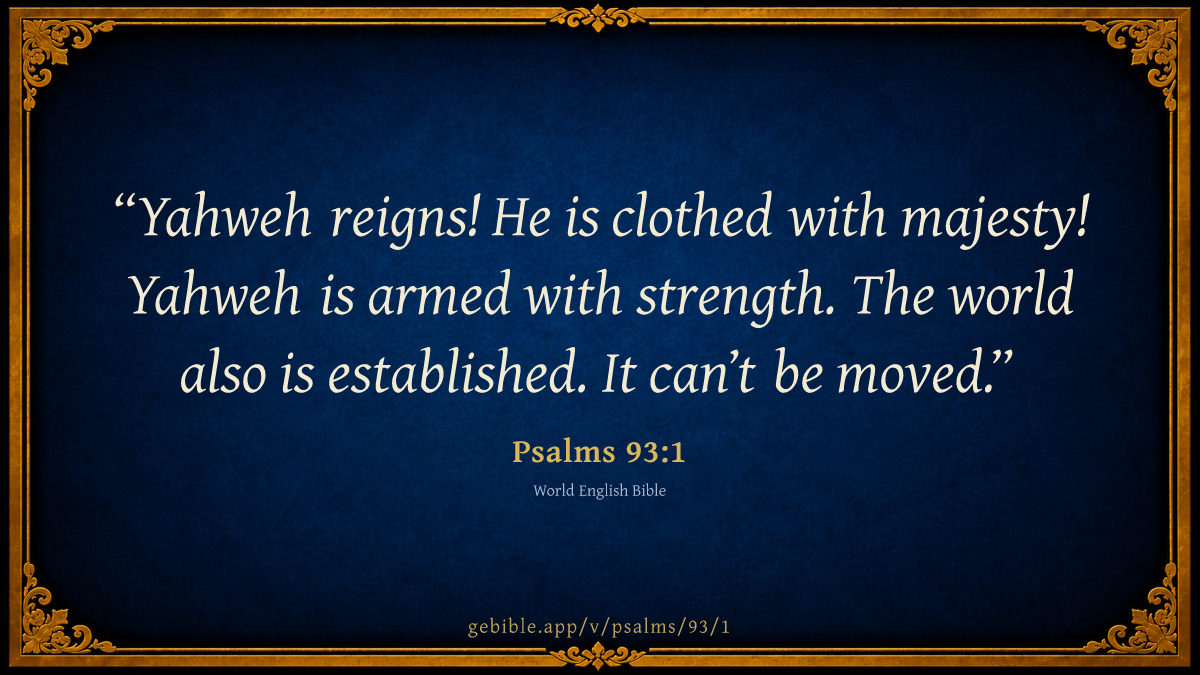
Yahweh reigns! He is clothed with majesty! Yahweh is armed with strength. The world also is established. It can’t be moved.
Parallel Translations
-
Yahweh reigns! He is clothed with majesty! Yahweh is armed with strength. The world also is established. It can’t be moved.
-
The LORD reigneth, he is clothed with majesty; the LORD is clothed with strength, wherewith he hath girded himself: the world also is stablished, that it cannot be moved.
-
The LORD reigneth; He is clothed in majesty; the LORD is clothed, He hath girded Himself with strength; yea, the world is established, that it cannot be moved.
Cross-references (27)
Passages linked to Psalms 93:1 in the Treasury of Scripture Knowledge, ordered by reader-vote popularity; verse text shown in World English Bible.
- Psalms 96:10 Say among the nations, “Yahweh reigns.” The world is also established. It can’t be moved. He will judge the peoples with equity.
- 1 Chronicles 29:12 Both riches and honor come from you, and you rule over all! In your hand is power and might! It is in your hand to make great, and to give strength to all!
- Psalms 99:1 Yahweh reigns! Let the peoples tremble. He sits enthroned among the cherubim. Let the earth be moved.
- Revelation 19:6 I heard something like the voice of a great multitude, and like the voice of many waters, and like the voice of mighty thunders, saying, “Hallelujah! For the Lord our God, the Almighty, reigns!
- Psalms 103:19 Yahweh has established his throne in the heavens. His kingdom rules over all.
- Psalms 65:6 By your power, you form the mountains, having armed yourself with strength.
- Psalms 18:32 the God who arms me with strength, and makes my way perfect?
- Psalms 59:13 Consume them in wrath. Consume them, and they will be no more. Let them know that God rules in Jacob, to the ends of the earth.
- Psalms 97:1 Yahweh reigns! Let the earth rejoice! Let the multitude of islands be glad!
- Psalms 104:1-2 Bless Yahweh, my soul. Yahweh, my God, you are very great. You are clothed with honor and majesty. He covers himself with light as with a garment. He stretches out the heavens like a curtain.
- Isaiah 45:12 I have made the earth, and created man on it. I, even my hands, have stretched out the heavens. I have commanded all their army.
- Isaiah 45:18 For Yahweh who created the heavens, the God who formed the earth and made it, who established it and didn’t create it a waste, who formed it to be inhabited says: “I am Yahweh. There is no other.
- Daniel 4:32-34 You shall be driven from men; and your dwelling shall be with the animals of the field. You shall be made to eat grass as oxen. Seven times shall pass over you, until you know that the Most High rules in the kingdom of men, and gives it to whomever he will.’ ” This was fulfilled the same hour on Nebuchadnezzar. He was driven from men, and ate grass as oxen, and his body was wet with the dew of the sky, until his hair had grown like eagles’ feathers, and his nails like birds’ claws. At the end of the days I, Nebuchadnezzar, lifted up my eyes to heaven, and my understanding returned to me, and I blessed the Most High, and I praised and honored him who lives forever; for his dominion is an everlasting dominion, and his kingdom from generation to generation.
- Job 40:10 “Now deck yourself with excellency and dignity. Array yourself with honor and majesty.
- Psalms 145:13 Your kingdom is an everlasting kingdom. Your dominion endures throughout all generations. Yahweh is faithful in all his words, and loving in all his deeds.
- Isaiah 11:5 Righteousness will be the belt of his waist, and faithfulness the belt of his waist.
- Isaiah 49:8 Yahweh says, “I have answered you in an acceptable time. I have helped you in a day of salvation. I will preserve you and give you for a covenant of the people, to raise up the land, to make them inherit the desolate heritage,
- Isaiah 59:17 He put on righteousness as a breastplate, and a helmet of salvation on his head. He put on garments of vengeance for clothing, and was clad with zeal as a mantle.
- Hebrews 1:8 But of the Son he says, “Your throne, O God, is forever and ever. The scepter of uprightness is the scepter of your Kingdom.
- Matthew 6:13 Bring us not into temptation, but deliver us from the evil one. For yours is the Kingdom, the power, and the glory forever. Amen.’
- Revelation 11:15-17 The seventh angel sounded, and great voices in heaven followed, saying, “The kingdom of the world has become the Kingdom of our Lord, and of his Christ. He will reign forever and ever!” The twenty-four elders, who sit on their thrones before God’s throne, fell on their faces and worshiped God, saying: “We give you thanks, Lord God, the Almighty, the one who is and who was; because you have taken your great power and reigned.
- Isaiah 52:7 How beautiful on the mountains are the feet of him who brings good news, who publishes peace, who brings good news, who proclaims salvation, who says to Zion, “Your God reigns!”
- Isaiah 63:1 Who is this who comes from Edom, with dyed garments from Bozrah? Who is this who is glorious in his clothing, marching in the greatness of his strength? “It is I who speak in righteousness, mighty to save.”
- Hebrews 1:2-3 has at the end of these days spoken to us by his Son, whom he appointed heir of all things, through whom also he made the worlds. His Son is the radiance of his glory, the very image of his substance, and upholding all things by the word of his power, who, when he had by himself purified us of our sins, sat down on the right hand of the Majesty on high,
- Psalms 75:3 The earth and all its inhabitants quake. I firmly hold its pillars.
- Isaiah 51:9 Awake, awake, put on strength, arm of Yahweh! Awake, as in the days of old, the generations of ancient times. Isn’t it you who cut Rahab in pieces, who pierced the monster?
- Isaiah 51:16 I have put my words in your mouth and have covered you in the shadow of my hand, that I may plant the heavens, and lay the foundations of the earth, and tell Zion, ‘You are my people.’ ”
Cross-references from openbible.info (CC BY 4.0)
Explain this verse (25 sources)
Historical commentary, presented as a primary source — not an endorsement.
Private notes
Saved on this device only — never synced or sent anywhere.
John Calvin 1540 · Public Domain 1 Jehovah hath reigned We here see what I…
1 Jehovah hath reigned We here see what I have lately adverted to, that in the power of God there is exhibited to us matter of confidence; for our not investing God with the power which belongs to him, as we ought to do, and thus wickedly despoiling him of his authority, is the source of that fear and trembling which we very often experience. This, it is true, we dare not do openly, but were we well persuaded of his invincible power, that would be to us an invincible support against all the assaults of temptation. All admit in word what the prophet here teaches, That God reigns; but how few are there who oppose this shield to the hostile powers of the world, as it becomes them to do, that they may fear nothing however terrible? In this then consists the glory of God, that he governs mankind according to his will. It is said that he clothes himself with majesty and strength; not that we ought to imagine that there is any thing in him which is derived from another, but it is intended by the effect and indubitable experience to show his wisdom and righteousness in the government of mankind. The Psalmist proves that God will not neglect or abandon the world, from the fact that he created it. A simple survey of the world should of itself suffice to attest a Divine Providence. The heavens revolve daily, and, immense as is their fabric, and inconceivable the rapidity of their revolutions, we experience no concussion — no disturbance in the harmony of their motion. The sun, though varying its course every diurnal revolution, returns annually to the same point. The planets, in all their wanderings, maintain their respective positions. How could the earth hang suspended in the air were it not upheld by God’s hand? By what means could it maintain itself unmoved, while the heavens above are in constant rapid motion, did not its Divine Maker fix and establish it? Accordingly the particle אף, aph, denoting emphasis, is introduced — Yea, he hath established it.
John Calvin's Commentaries (1540-1563) — public domain. Text from the Calvin Translation Society English edition (1840s-50s) via the Christian Classics Ethereal Library (ccel.org). Calvin's coverage is partial (roughly two-thirds of the Bible); uncommented books and verses are honest gaps, never fabricated. The 19th-century editor's footnotes and remarks are omitted so the notes are faithfully Calvin's own voice.
Geneva Bible translators 1599 · Public Domain As God by his power and wisdom hath made…
As God by his power and wisdom hath made and governeth the world: so must the same be our defense against all enemies and dangers.
Geneva Bible (1599) marginal notes — public domain.
John Trapp 1656 · Public Domain Psa 93:1 The LORD reigneth, he is clothed with…
Psa 93:1 The LORD reigneth, he is clothed with majesty; the LORD is clothed with strength, [wherewith] he hath girded himself: the world also is stablished, that it cannot be moved.
Ver. 1. The Lord reigneth] i.e. The Lord Christ. Kimchi here noteth that all the following psalms till the hundred and first are de diebus Christi, of the days of Christ. Here we have his empire and regality asserted, first, by his works; secondly, by his word, Psa 93:5. See the like Psa 19:1-2; Psa 19:7-8, &c., and that manifestation of himself by his word far preferred.
Read full note →
He is clothed with majesty] He hath now put off his arms, and put on his robes, he will henceforth rule all wisely and righteously.
The Lord is clothed with strength] For the battle, in case his enemies stir, to attempt against him, Ezr 8:22.
The world also is established] The earth, though it hang like a ball in the air, without a basis, Ponderibus librat a suis, yet is unmoveable; how much more the Church!
John Trapp, A Commentary or Exposition upon All the Books of the Old and New Testament (1647–1656) — public domain. Text from a community e-Sword module.
Matthew Poole 1685 · Public Domain The Lord reigneth: he is the King and Governor,…
The Lord reigneth: he is the King and Governor, not only of Israel, but of the whole world, as the last clause of the verse expounds it; and accordingly he will in his due time set up his empire over all nations, in the hands of his Son the Messias.
Is clothed with strength: that majesty and strength which he always had in himself, he now hath, and will shortly much more show it forth in the eyes of all people. The effect of God’s government of the world shall be this, that he will order and overrule all the confusions, and divisions, and hostilities in the world, so as they shall end in an orderly, peaceable, and happy settlement, and in the erection of that kingdom of the Messias which can never be moved.
Matthew Poole's English Annotations on the Holy Bible (1683–1685) — public domain. Text from a community e-Sword/MySword module.
Matthew Henry 1710 · Public Domain Next to the being of God there is nothing…
Next to the being of God there is nothing that we are more concerned to believe and consider than God's dominion, that Jehovah is God, and that this God reigns (Psa 93:1), not only that he is King of right, and is the owner and proprietor of all persons and things, but that he is King in fact, and does direct and dispose of all the creatures and all their actions according to the counsel of his own will. This is celebrated here, and in many other psalms: The Lord reigns. It is the song of the gospel church, of the glorified church (Rev 19:6), Hallelujah; the Lord God omnipotent reigns. Here we are told how he reigns.
I. The Lord reigns gloriously: He is clothed with majesty. The majesty of earthly princes, compared with God's terrible majesty, is but like the glimmerings of a glow-worm compared with the brightness of the sun when he goes forth in his strength. Are the enemies of God's kingdom great and formidable? Yet let us not fear them, for God's majesty will eclipse theirs.
Read full note →
II. He reigns powerfully. He is not only clothed with majesty, as a prince in his court, but he is clothed with strength, as a general in the camp. He has wherewithal to support his greatness and to make it truly formidable. See him not only clad in robes, but clad in armour. Both strength and honour are his clothing. He can do every thing, and with him nothing is impossible. 1. With this power he has girded himself; it is not derived from any other, nor does the executing of it depend upon any other, but he has it of himself and with it does whatsoever he pleases. Let us not fear the power of man, which is borrowed and bounded, but fear him who has power to kill and cast into hell. 2. To this power it is owing that the world stands to this day. The world also is established; it was so at first, by the creating power of God, when he founded it upon the seas; it is so still, by that providence which upholds all things and is a continued creation; it is so established that though he has hanged the earth upon nothing (Job 26:7) yet it cannot be moved; all things continue to this day, according to his ordinance. Note, The preserving of the powers of nature and the course of nature is what the God of nature must have the glory of; and we who have the benefit thereof daily are very careless and ungrateful if we give him not the glory of it. Though God clothes himself with majesty, yet he condescends to take care of this lower world and to settle its affairs; and, if he established the world, much more will he establish his church, that it cannot be moved.
III. He reigns eternally (Psa 93:2): Thy throne is established of old. 1. God's right to rule the world is founded in his making it; he that gave being to it, no doubt, may give law to it, and so his title to the government is incontestable: Thy throne is established; it is a title without a flaw in it. And it is ancient: it is established of old, from the beginning of time, before any other rule, principality, or power was erected, as it will continue when all other rule, principality, and power shall be put down, Co1 15:24. 2. The whole administration of his government was settled in his eternal counsels before all worlds; for he does all according to the purpose which he purposed in himself; The chariots of Providence came down from between the mountains of brass, from those decrees which are fixed as the everlasting mountains (Zac 6:1): Thou art from everlasting, and therefore thy throne is established of old; because God himself was from everlasting, his throne and all the determinations of it were so too; for in an eternal mind there could not but be eternal thoughts.
IV. He reigns triumphantly, Psa 93:3, Psa 93:4. We have here, 1. A threatening storm supposed: The floods have lifted up, O Lord! (to God himself the remonstrance is made) the floods have lifted up their voice, which speaks terror; nay, they have lifted up their waves, which speaks real danger. It alludes to a tempestuous sea, such as the wicked are compared to, Isa 57:20. The heathen rage (Psa 2:1) and think to ruin the church, to overwhelm it like a deluge, to sink it like a ship at sea. The church is said to be tossed with tempests (Isa 54:11), and the floods of ungodly men make the saints afraid, Psa 18:4. We may apply it to the tumults that are sometimes in our own bosoms, through prevailing passions and frights, which put the soul into disorder, and are ready to overthrow its graces and comforts; but, if the Lord reign there, even the winds and seas shall obey him. 2. An immovable anchor cast in this storm (Psa 93:4): The Lord himself is mightier. Let this keep our minds fixed, (1.) That God is on high, above them, which denotes his safety (they cannot reach him, Psa 29:10) and his sovereignty; they are ruled by him, they are overruled, and, wherein they rebel, overcome, Exo 18:11. (2.) That he is mightier, does more wondrous things than the noise of many waters; they cannot disturb his rest or rule; they cannot defeat his designs and purposes. Observe, The power of the church's enemies is but as the noise of many waters; there is more of sound than substance in it. Pharaoh king of Egypt is but a noise, Jer 46:17. The church's friends are commonly more frightened than hurt. God is mightier than this noise; he is mighty to preserve his people's interests from being ruined by these many waters and his people's spirits from being terrified by the noise of them. He can, when he pleases, command peace to the church (Psa 65:7), peace in the soul, Isa 26:3. Note, The unlimited sovereignty and irresistible power of the great Jehovah are very encouraging to the people of God, in reference to all the noises and hurries they meet with in this world, Psa 46:1, Psa 46:2.
V. He reigns in truth and holiness, Psa 93:5. 1. All his promises are inviolably faithful: Thy testimonies are very sure. As God is able to protect his church, so he is true to the promises he has made of its safety and victory. His word is passed, and all the saints may rely upon it. Whatever was foretold concerning the kingdom of the Messiah would certainly have its accomplishment in due time. Those testimonies upon which the faith and hope of the Old Testament saints were built were very sure, and would not fail them. 2. All his people ought to be conscientiously pure: Holiness becomes thy house, O Lord! for ever. God's church is his house; it is a holy house, cleansed from sin, consecrated by God, and employed in his service. The holiness of it is its beauty (nothing better becomes the saints than conformity to God's image and an entire devotedness to his honour), and it is its strength and safety; it is the holiness of God's house that secures it against the many waters and their noise. Where there is purity there shall be peace. Fashions change, and that which is becoming at one time is not so at another; but holiness always becomes God's house and family, and those who belong to it; it is perpetually decent; and nothing so ill becomes the worshippers of the holy God as unholiness.
Matthew Henry's Commentary on the Whole Bible (1708–1710) — public domain (CC PDM 1.0). Text via the HelloAO Bible API.
John Gill 1763 · Public Domain The Lord reigneth,.... The King Messiah, the Lord Jesus…
The Lord reigneth,.... The King Messiah, the Lord Jesus Christ, who is the true Jehovah. God over all, the Lord God omnipotent: he has reigned, he was set up as King from everlasting; he reigned throughout the whole Old Testament dispensation; he was promised, and prophesied of, as a King; he came as such, in human nature, into the world, though his kingdom was not with observation; when he ascended to heaven, he was made or declared Lord and Christ, and was crowned with glory and honour; he now reigns in the hearts of his people, by his Spirit and grace; and, ere long, he will take to himself his great power, and reign more manifestly; when the kingdoms of this world shall become his, and he shall be King over all the earth; and this his government will be still more apparent when he shall come in person, and reign with his saints on earth a thousand years; and, after that, for ever and ever, in heaven:
he is clothed with majesty; with all the regalia and ensigns of royalty; seated on a throne of glory, with a crown of pure gold on his head, a sceptre of righteousness in his hand, and arrayed with robes of honour and majesty; so that his appearance at his kingdom will be very splendid, Psa 104:1,
Read full note →
the Lord is clothed with strength, wherewith he hath girded himself; as he was, when he came here on earth, travelling in the greatness of his strength, and mighty to save; bearing the sins of his people, conflicting with and spoiling principalities and powers, and obtaining eternal redemption; and which also appeared in carrying the Gospel into the Gentile world, and succeeding it, against all the opposition made unto it; and making his way into the hearts of sinners at conversion, binding the strong man armed, and dispossessing him, and taking his place; in strengthening them with strength in the inward man, against him and all enemies; and keeping them by his power, through faith, unto salvation: and which will be further manifest in the destruction of antichrist, and in the ruin of all the antichristian states, which will make way for his spiritual reign; and especially this will be seen, at his personal coming, by raising the dead in Christ, causing the heavens and earth to pass away, and making new ones; and binding Satan for a thousand years, that he may give no disturbance to his subjects during that time:
the world also is established, that it cannot be moved; the world to come, of which Christ is the Father; that which is not put into subjection to angels, Isa 9:6, the Gospel dispensation, the church state in it; which, though it has been unsettled, the church has been tossed about with tempests, and has been moved from place to place, and obliged to fly into the wilderness; yet, in the latter day, it will be established on the top of the mountains: this is one of the glorious things that are spoken of it, and for the accomplishment of which we should earnestly pray, and give the Lord no rest until it is; after which it shall never be moved again; it shall be a tabernacle that shall never be taken down; there will be no enemies to attack it; all will be vanquished and destroyed; the beast, the false prophet, and the old serpent the devil, Psa 87:3.
(a) T. Bab. Roshhashanah, fol. 31. 1. & Tamid, fol. 33. 2.
John Gill's Exposition of the Whole Bible (1746–1763) — public domain (CC PDM 1.0). Text via the HelloAO Bible API.
John Wesley 1765 · Public Domain This and the six following psalms, according to the…
This and the six following psalms, according to the opinion of the Hebrew doctors, belong to the times of the Messiah. The glory of God's kingdom, both of providence and glory, ver. 1-6.
Clothed - That majesty and strength which he always had, he will shew in the eyes of all people. Moved - He will overrule all the confusions in the world, so that they shall end in the erection of that kingdom of the Messiah, which can never be moved.
John Wesley, Explanatory Notes Upon the Whole Bible (1754–1765) — public domain. Text via the GEBible commentary corpus.
Adam Clarke 1810 · Public Domain The universal government of God, 1, 2;
PSALM XCIII
The universal government of God, 1, 2;
Read full note →
the opposition to that government, 3, 4;
the truth of God's testimonies, 5.
NOTES ON PSALM XCIII
This Psalm has no title either in the Hebrew or Chaldee. The Vulgate, Septuagint, AEthiopic, and Arabic, state it to be "A song of praise of David for the day preceding the Sabbath, when the earth was founded;" but in such a title there is no information on which any man can rely. This Psalm is written as a part of the preceding in twelve of Kennicott's and De Rossi's MSS. It was probably written at the close of the captivity by the Levites, descendants of Moses.
Verse 1. The Lord reigneth] He continues to govern every thing he has created; and he is every way qualified to govern all things, for he is clothed with majesty and with strength-dominion is his, and he has supreme power to exercise it; and he has so established the world that nothing can be driven out of order; all is ruled by him. Nature is his agent: or rather, nature is the sum of the laws of his government; the operations carried on by the Divine energy, and the effects resulting from those operations.
He hath girded himself] The girding with strength refers to the girding in order to strengthen the loins, arms, knees, &c. When a Hindoo is about to set off on a journey, to lift a burden, or to do something that requires exertion, he binds firmly his loose upper garment round his loins.-WARD.
Adam Clarke's Commentary on the Bible (1810–1826) — public domain. Text from a community e-Sword/MySword module.
Joseph Benson 1811 · Public Domain Psa 93:1. The Lord reigneth — He is the…
Psa 93:1. The Lord reigneth — He is the king and governor, not only of Israel, but of the whole world, as the last clause of the verse expounds it; and accordingly he will, in his due time, set up his empire over all nations, in the hands of his Son the Messiah. It was the psalmist’s glory and confidence that, though the nations boasted of the power and splendour of their kings, and trusted to their military preparations, yet the Lord, the great Jehovah, the God of Israel, still reigned. He is clothed with majesty, &c. — As kings are with their royal ornaments, and is girded with almighty strength, as warriors are with the sword: that majesty and strength, which he always had in himself, he now hath, and will shortly much more show forth in the eyes of all people. The world also is established that it cannot be moved — The effect of God’s government of the world shall be this, that he will order and overrule all the confusions, and divisions, and hostilities in it, so as they shall end in an orderly, peaceable, and happy settlement, and in the erection of that kingdom of the Messiah which can never be moved.
Joseph Benson's Commentary on the Old and New Testaments (1811–1818) — public domain. Text from a community e-Sword module.
Albert Barnes 1834 · Public Domain The Lord reigneth - The same commencement of a…
The Lord reigneth - The same commencement of a psalm occurs in Psa 97:1-12; Psa 99:1-9. The same idea is often found in the Scriptures. 1Ch 16:31; Psa 47:8; Isa 52:7; Rev 19:6. The thought seems abrupt here. It would appear as if the psalmist had been meditating on the dark things which occur in the world; the mysteries which abound; the things which seem irreconcilable with the idea that there is a just government over the world, and that suddenly the idea occurs, as a flash of lightning in a storm, that Yahweh reigns over all, and that all must be right. Amidst all these things God sits upon the throne; he orders all events; he sways his scepter over all; he orders all things according to his own will; he secures the accomplishment of his own purposes.
He is clothed with majesty - That is, he puts on, or wears this; he appears in this as a garb, or robe. The word rendered “majesty” means properly “loftiness,” and is applied to the swelling of the sea Psa 89:9, or to a column of smoke, Isa 9:18. The idea here is, that God is exalted; and that he appears in such a manner as to indicate his proper dignity. See the notes at Isa 6:1.
Read full note →
The Lord is clothed with strength, wherewith he hath girded himself - There is an allusion here to the mode of dress among the Orientals - the custom of girding the loins when one labored, or walked, or ran. See the notes at Mat 5:38-41.
The world also is stablished - Is firm; is on a solid foundation. It cannot be shaken or destroyed by natural convulsions, or by the power of man.
That it cannot be moved - Moved out of its place; overthrown; destroyed. This seems to have been spoken in view of some impending calamity, as if everything were to be swept away. The psalmist consoles himself with the thought that the world was firmly established; that no storm or tempest could be so violent as to remove it out of its place. The ground of consolation is the essential stability of what God has ordained.
Albert Barnes' Notes on the Bible (1834–1885) — public domain. Text from a community e-Sword/MySword module.
Lange's Commentary on the Holy Scriptures 1864 · Public Domain Psalms 93
Psalms 93
1 The Lord reigneth, he is clothed with majesty;
Read full note →
The Lord is clothed with strength, wherewith he hath girded himself:
The world also is stablished, that it cannot be moved.
2 Thy throne is established of old:
Thou art from everlasting.
3 The floods have lifted up, O Lord,
The floods have lifted up their voice;
The floods lift up their waves.
4 The Lord on high is mightier
Than the noise of many waters,
Yea, than the mighty waves of the sea.
5 Thy testimonies are very sure:
Holiness becometh thine house,
O Lord, for ever.
EXEGETICAL AND CRITICAL
Contents and Composition.—The superscription in the Septuagint: “For the day before the Sabbath, when the earth had been peopled; song of praise of David,” arises in the first portion from the tradition, according to which this Psalm was the Psalm for the sixth day of the week in the Temple-liturgy: “because God had finished His work on the sixth day, and had begun to rule over it,” (Rosh-ha-shana 31 a., cited by Delitzsch). But the truth is that it is the beginning of God’s ruling in history, and not in the kingdom of nature, that is referred to in the Psalm. For the lifting up of the waters is only an image of the raging of rebellious bodies of men. And it is Jehovah, the God of revelation, who is the subject, of the Psalm, who has manifested in history His kingly glory, surpassing all the powers of the world, in the defence of His people and the preservation of His temple from desecration. By this He at the same time has proved Himself to be the King of that people, according to His revealed testimony, and has strengthened the hopes founded upon that testimony. The interchange of perfects and imperfects corresponds to this view which the Psalmist held as to the workings of God, a view based upon special manifestations of His power. It is not expressed as a doxology (Hupfeld), still less is it refined away in general expressions and to abstract truths, but presents in the concrete the history of the kingdom of God, and contemplates it from the prophetical stand-point. It is of the highest importance for the understanding of many Psalms, to distinguish between the theocratic Psalms, which begin with the motto: מָלַך יְהוָֹה (after Psa_47:9), and the Messianic Psalm, as two series of prophecies of the time of consummation running parallel to one another (Delitzsch). “The one class has as its central theme the Anointed of Jehovah, who rules out of Zion over all nations; the other, Jehovah sitting above the Cherubim, to whom the whole earth does homage. These two series converge, indeed, in the Old Testament, but do not meet. The history of their fulfilment alone makes clear what had only glimmered forth before from some lofty heights of prophecy and poetry, (see in Psa_45:7), that the Parusia of the Anointed and that of Jehovah, are one and the same” (Del.). Accordingly this motto could express the feelings of God’s people at quite different periods, and find its application in quite distinct events, which had brought about a victory of the Theocracy, especially as the figure of the raging waters is based upon an allusion to the Red Sea, which, in the poetic recital of the famous events preceding the founding of the Theocracy, is described by the epithet: אדיר (Exo_15:10), elsewhere applied to Jehovah (Isa_10:34; Psa_93:4) and His people (Psa_16:3). Since we cannot assign the composition of the Psalm to the period whose features are described in Deu_33:4, we have presented for our choice the age of David (the ancients), the Assyrian period (Hengst.), the times succeeding the exile (Del.), the Maccabæan period (Venema, Olsh., Hitzig). The position of the Psalm along with the related ones is especially favorable to the age following the Exile. [Hitzig remarks that the substance of the Psalm is contained in Psa_94:8 of the preceding. Hence its position.—J. F. M.]
Psa_94:1-2. Jehovah shows Himself King, [E.V., the Lord reigneth.] The emphasis does not lie restrictively upon Jehovah (Geier, and others), as the eternal King upon an everlasting throne, as contrasted with earthly rulers over ephemeral kingdoms, but just as strongly upon the manifestations of that relation, by which disturbances that have shaken the earth and threatened the kingdom of God have been quelled. The usual term for ascending the throne (2Sa_15:10; 1Ki_1:11; 1Ki_1:13; 2Ki_9:13) is chosen. It is also applied in Isa_24:23; Isa_52:7, and finally Rev_11:17; Rev_19:6, as in Psa_96:10; Psa_97:1; Psa_99:1, to the coming of the Lord in His kingdom, Oba_1:21, Zec_14:9. Then follow the declarations that Jehovah clothes Himself (Isa_51:9; Psalms 104.) with exaltation (Isa_12:5; Isa_26:10; Psa_68:35), and girds Himself with strength like a warrior (Isa_8:9; Isa_59:17; Isa_63:1; Dan_7:9), to assert His sovereign sway, and thereby to establish the earth shaken to its foundations and disturbed in its order (Psa_75:4).
Psa_94:3-5. The Nile (Jer_46:7), the Euphrates (Isa_8:7), and the Tigris (Isa_27:1) are particularly employed, among streams, as emblems of the kingdoms of the world. The sea (Psa_46:4; Psa_89:10), and especially the Red Sea, subdued by Jehovah’s voice and might (Hab_3:8; Hab_3:10; Psa_74:15; Psa_77:17 f.; Psa_114:3), are used as an emblem of the outbreak of the forces of nature and of hostile kingdoms,—.מִך in Psa_94:4 is not causal (Geier) but comparative.—The testimonies (Psa_94:5) are those of revelation, especially of the law (Psa_19:8; Psa_25:10; Psa_111:7). [Perowne: “The transition is abrupt, from the majesty of God as seen in His dominion in the world of nature, to His revelation of Himself in His word. At the same time there is a connection between the two, as in Psalms 19.; God, who rules the world, whose are the kingdom and the power and the glory for ever, has given His testimonies to His people, a sure and faithful word, and has Himself come to dwell with them, making His house and His people holy.”—J. F. M.]
DOCTRINAL AND ETHICAL
1. Jehovah can as little cease to be God, as His power over all things can come to an end. But two things are to be observed in this connection: First, there are times in which God veils His majesty and restrains the exercise of His power, followed by times in which He displays His kingly glory, eternal and exalted over all; Secondly, there is a radical difference between God’s government of the world which He has created, and of the Church which He has established upon the earth, and yet both kingdoms are not only kept, by their common King, in existence and order, but are fixed by Him in their mutual relations, and carried forward to their several destinies.
2. God, by His might, preserves, first of all, the world in its physical existence, so that the outbreak of the elements cannot destroy it, but proves them to be powerless before the throne of the Almighty, whose voice in the clouds drowns the thunder of their raging, and at whose nod all their proud waves are stilled. But God rules the whole world also by His might, and defends His people who are in it, by controlling the agitations in the life of its nations, and directing the current of history according to His will. These reflections should strengthen our trust, and, in serious crises, enliven our courage and confirm our patience. “All acknowledge with the mouth what the prophet here teaches, but how few there are who oppose this shield, as they ought, to the hostile might of the world, so that they fear nothing, be it ever so terrible!” (Calvin).
3. But, besides, Jehovah is not merely a God of might and of faithfulness, upon whom we can rely. He is the God who has revealed His salvation in the world, and for this reason He will not only preserve His people, in whom is His earthly dwelling, but distinguish them as His own inheritance. For this end He has made known to them His will, and given testimony that it is good and gracious, that it is the will of the Holy God, who has impressed this character of holiness, which is peculiar to His nature and His word, upon His house as becoming to it, and will make it clearly manifest in His people and kingdom. By keeping ever before them this claim of holiness, on which the continuance of the moral order of the world depends, God’s people are encouraged to the obedience of faith, and at the same time, by reflecting upon the credibility of these testimonies, are comforted by the infallible promises of His word.
HOMILETICAL AND PRACTICAL
The immovableness of God’s kingly throne in the midst of the commotions of the world: (1) as a token of the incomparable exaltation of this throne over all the royal seats of the world; (2) as security for the inviolable faithfulness of such a King, who from this throne preserves and rules the world and the Church; (3) as a reason why the citizens of earthly kingdoms must yield themselves up to the service of this King and His throne.—The firmness of God’s throne answers to the reliability of His word; does the same relation exist between our belief and our faithfulness?—When God’s glory is concealed from us, let us only be the more mindful of His holiness.—No one need or can rely upon the power of God, who is not willing to rely upon His testimonies, or to seek after the holiness of His house.—Three fundamental reasons for the preservation of the Church of God: (1) the immovableness of God’s throne; (2) the truth of His word; (3) the holiness of His house.
Starke: Christ is King over the whole world , O let us take delight in lying at His feet and worshipping Him! We are blessed, if we become subjects of His kingdom of power, and kingdom of grace.—Where Christ is, there the world rages; no one can endure His presence.—Our duty is not performed if we merely beautify the house of God with gold and silver and precious stones; we give it its true adorning, if we resort to it attired in the holy robe of faith.—Menzel: We must esteem God’s word as our greatest ornament and noblest treasure.—Frisch: Be not anxious, no matter how great cause of anxiety there be in the world. The world must bear the kingdom of the heavenly King, even if it should break beneath it.—Berlenburger Bible: The testimonies of God are well worthy of human belief, and yet men trust them not.—Tholuck: God has established in its whole extent that world, over whose several countries the kings of the earth rule. Behold in this a proof of His power. He who alone has given it existence has never received it, but holds it as an eternal possession. Behold in this a proof of His exaltation.
[Scott: We should carefully inquire whether Christ’s kingdom has indeed been set up in our hearts. This will best be decided by examining whether we so believe His testimonies and depend on Him for salvation, as to be led to love and follow after that holiness which His precepts command and His example displays, and which becomes all who profess the truth.
Barnes: Attendance in a place of public worship is calculated to make the heart pure, and to banish unholy thoughts and purposes from the soul. A man who feels that he is in the presence of a Holy God will not be likely to welcome into his soul polluted images and unholy desires.
Wordsworth: The walking of Christ on the waves of the sea was a prophetical foreshadowing of the ease and majesty, with which He shall one day tread the swelling waves of all human pride and earthly power, and make their tumultuous billows a pavement for His feet.—J. F. M.]
Lange's Commentary on the Holy Scriptures (Critical, Doctrinal, and Homiletical), ed. John Peter Lange, English translation edited by Philip Schaff (1864–1880) — public domain. Text from a community e-Sword module.
Daniel D. Whedon 1874 · Public Domain 1. The Lord reigneth—The usual proclamation at the beginning…
1. The Lord reigneth—The usual proclamation at the beginning of the reign of a new sovereign. Thus: “Absalom reigneth,” (2Sa_15:10;) and, “Jehu reigneth,” 2Ki_9:13. Delitzsch: “The allusion makes it plain that the language does not apply to the constant government of God, but to a new, glorious manifestation of his dominion—as it were, a new ascent to the throne—as at the overthrow of Sennacherib.” See Psa_96:10; Psa_97:1; Psa_99:1.
Girded himself—To denote that he is ready for action; (Jer_1:17; Luk_12:25;) also a symbol of strength. (Psa_18:39; Isa_45:5.)
Read full note →
The world also is stablished—And as securely has he founded his Church against the tumult and rage of her enemies.
Mat_16:18. This original “establishment of the world” proves God’s right and ability to govern it.
Daniel D. Whedon (gen. ed.), Commentary on the Old and New Testaments (1874–1909) — public domain. Text from a community e-Sword module.
The Cambridge Bible for Schools and Colleges 1878 · Public Domain 1. Jehovah hath proclaimed himself king; he hath robed…
1. Jehovah hath proclaimed himself king; he hath robed himself with majesty;
Jehovah hath robed himself, hath girded himself with strength.
Read full note →
The verbs in the perfect tense express not merely a fact (Jehovah reigneth) but an act. For a time, while His city was in ruins and His people in exile, He seemed to have divested Himself of the insignia of royalty and abdicated His throne. The ancient promise of Exo_15:18 seemed to have failed. But now He has once more vindicated His sovereignty by the deliverance of His people and the judgement of their enemies. The prophet’s prayer (Isa_51:9) is answered, his vision (Isa_52:7) is fulfilled. Jehovah has proclaimed Himself King, put on His royal robes, girded Himself like a warrior for action (Exo_15:3; Psa_65:6; Isa_59:17) with that strength which is His inalienable attribute (Exo_15:13; Psa_29:1; Psa_68:34). For majesty cp. the use of the cognate verb in Exo_15:1; Exo_15:21 (“hath triumphed gloriously”); and Isa_12:5 (“excellent things”); Psa_26:10.
“Jehovah has proclaimed Himself king” is the key-note of this group of Psalms of the Restoration (Psa_96:10; Psa_97:1; Psa_99:1; cp. Psa_103:19). Cp. also Psa_47:7-8.
the world also is stablished &c.] Yea, the world shall be stablished that it be not shaken. This is the consequence of Jehovah’s once more assuming His sovereignty. The moral order of the world which seemed tottering to its fall is reestablished. Cp. Psa_82:5. Here and in Psa_96:10, where the words recur, some critics would follow the Ancient Versions in reading tiqqçn for tiqqôn; Yea, he has adjusted, or, ordered, the world. Cp. the use of the same word in Psa_75:3. This reading appears in the P.B.V., “He hath made the round world so sure,” which follows the Vulg., etenim firmavit orbem terrae. But the advantage of the change is doubtful. See note on Psa_93:2.
1, 2. Jehovah’s new proclamation of His eternal sovereignty.
The Cambridge Bible for Schools and Colleges (gen. ed. J. J. S. Perowne; Cambridge University Press, 1878–1918) — public domain. Text from a community e-Sword module.
Ellicott's Commentary for English Readers 1878 · Public Domain (1) The Lord reigneth.—Comp. Psa_97:1; Psa_99:1. Better, Jehovah has…
(1) The Lord reigneth.—Comp. Psa_97:1; Psa_99:1. Better, Jehovah has become king: the usual term for ascending the throne (2Sa_15:10; 1Ki_1:11; 1Ki_1:13; 2Ki_9:13); used in Isaiah of the re-establishment of the State after the Captivity (Isa_24:23; Isa_52:7); and by the latest of Israel’s poets, in that prophetic strain which looks beyond time and this world (Rev_19:6). The robing and girding with the sword were part of the ceremony of inauguration of a monarch’s reign. (See Note, Psa_45:3.)
The Lord is clothed . . .—These clauses run better: majesty he has put on: Jehovah has put (it) on: with strength has girded himself.
Read full note →
For the same representation of Jehovah as a warrior arranging himself for battle, compare Isa_59:17; Isa_63:1; or as a monarch robed in splendour, Psa_104:1.
The world also is established.—This would better begin Psa_93:3. That the earth should be solidly seated in its hidden foundation, is itself a marvel; but this wonder is mentioned only to bring into greater relief the thought of the next verse, that the throne of God, to which the earth is only as a footstool (Isa_66:1), has its foundation firm and everlasting, free from the vicissitudes which beset earthly monarchies.
A Bible Commentary for English Readers, edited by Charles John Ellicott (1878–1897) — public domain. Text from a community e-Sword module.
The Pulpit Commentary 1880 · Public Domain Line the preceding, a psalm of praise. Jehovah is…
Line the preceding, a psalm of praise. Jehovah is set forth as manifesting himself in the character of King. He robes himself in majesty, and reigns openly. The world, unstable as it may seem, is in reality fixed under his sway. His throne, i.e. his rule, has been established from everlasting (vers. 1, 2). Yet there is resistance to his sway. The waters toss themselves; i.e. the powers of the world array themselves in opposition to God (ver. 3). Vainly, however: God in heaven is mightier than they (ver. 4). His might is especially shown in his "house" and in his "testimonies." The latter are "sure," the former is inviolate.
The Lord reigneth; rather, is become King (ebasileusen , LXX); comp. Psa_10:16 Psa_47:6 Psa_96:10 Psa_97:1, etc. God is regarded as having for a time laid aside, or hidden, his sovereignty, but as now at length coming forward and inaugurating the theocracy. The writer may have in his mind some recent manifestation of Divine power, or he may be anticipating the final establishment of the reign of Messiah. He is clothed with majesty; or, he hath robed himself in majesty" (Cheyne). The Lord is clothed with strength, wherewith he hath girded himself; literally, the Lord is clothed, he hath girded himself, with strength (comp. "Awake, awake, put on strength, O arm of the Lord," Isa_51:9). The world also is stablished, that it cannot be moved. When God "takes his kingdom," he firmly establishes his sway over the earth, with its inhabitants, in such sort that "it cannot be moved it can suffer no violent agitation or disturbance.
Read full note →
HOMILIES BY S. CONWAY Vers. 1-5. "The Lord reigneth.
Note
I THE PROPOSITION TO BE PROVED that "the Lord reigneth." The psalmist describes:
1. The royal robes. "He hath clothed himself with majesty." The sacred writers seem to have drawn their ideas of the regal splendour of God, not so much from the magnificence of Oriental potentates, as from the gorgeous glow of the heavens the sun by day, the moon and stars by night. Further, "he hath girded himself with strength." This seen in the steady march of the heavenly bodies, never breaking rank, never failing to appear in due course, never wearying by long continuance.
2. The permanence of his rule. "The world established, that it cannot be moved." The order of his universe cannot be broken. And so it has ever been, "from everlasting.
II THE PROOF. The psalmist likens the wild tumult of the peoples in rebellion against God to the fury of a storm at sea. The roar of the breakers dashing against the rooks, the thunder of the surf upon the shore, the fierce agitation of the storm-tossed waves as they lift themselves on high, all this is the vivid picture which suggests to the mind the worse, because the wicked, rage of a rebellious people or of a rebellious soul. And how terribly true the likeness is! The souls of men setting themselves against God, in wrath and rage against him, and scornfully rejecting and renouncing his authority! But as he hushes the storm so that there is a great calm, in like manner doth he still the wrath of man, and makes it to praise him (ver. 4). How often he has done this!
III THE DEDUCTION. It is twofold.
1. That God is faithful. Men may utterly rely upon his word. Fools that we are, we often fail thus to trust him, and follow instead the miserable maxims of men of the world. But, nevertheless, God remaineth true.
2. That holy obedience is our wisdom. We cannot have God on our side if we wander from his ways it is impossible. Let us, then, be on the side of God. Wisdom, gratitude, duty, love for our fellow men, all urge this. S.C.
"Is God dead?
Mrs. Beecher Stowe relates an incident which once gave to a speech which Frederick Douglas was delivering a startling and almost overwhelming power. Douglas was descanting, in his usual impassioned manner, upon the wrongs and miseries of the negro race. Warming with his subject, and waxing more and more indignant with their persecutors, he seemed to lose all patience, and at last said that they must henceforth trust in the strength of their own right arms, seeing that it was in vain otherwise to hope for deliverance. At this moment there arose a tall, aged negress, who, while perfect silence reigned in the hall, said, in a voice not loud, but deep, "Frederick, is God dead? S.C.
The God of vengeance.
To many it seems a strange prayer that God should show himself in this character. Therefore consider
I WHAT VENGEANCE IS.
1. It is not the same as revenge, a human, an evil, and often unjust thing. Revenge is what men delight in when they have received some injury at the hands of their fellow men, and hence is never right, but ever condemned of God. But:
2. Vengeance is the avenging of public wrong, the upholding of justice and righteousness, and essential to the preservation of society and of all human well being. Therefore it may well be prayed for. See Milton"s appeal, "Avenge, O Lord, thy slaughtered saints," etc. Wow, concerning this vengeance of God, note further
II ITS REALITY. The history of mankind is marked by it. Again and again has God thus visited guilty men. The Bible, secular history, personal observation, experience, all attest it. Therefore when in the future life the Scriptures warn us of like vengeance, how can any dare so regard it as impossible?
III ITS ONE AND ONLY EXCITING CAUSE Human sin. Not a man"s circumstances nor anything that he cannot help, but only his sin, conscious, wilful, persisted in sin. In this psalm there are set forth some of these sins, which cry to God for vengeance.
IV ITS RIGHTEOUSNESS. We confess this now when we see men who have steeped themselves in crime brought to judgment, and just doom passed upon them. And in the future there will be no vengeance that does not command the heartfelt confession from all beholders, that God is righteous who judgeth so.
V ITS TERRIBLENESS. "Fools make a mock at sin;" did they know its doom, their mockery would soon cease. Even in this world the vengeance of God often utterly overwhelms the sinner. Well may the psalmist ask, (Psa_90:11) "Who knoweth the power of thine anger?" etc. It is immeasurable.
VI ITS CERTAINTY. It may be delayed, and for a long while seemingly evaded, hut sooner or later it surely comes.
VII ITS CHOSEN HIGHWAY. It is along the path of little sins. The ungodly falleth by little and little. The mere cobwebs of separate single sins become at length twisted and transformed by the law of habit into the strenuous ligaments which bind the soul over to eternal sin.
VIII ITS ARREST. Let the sinner repent and flee for shelter to Christ. S.C.
HOMILIES BY R. TUCK Ver. 1. The King figure for God.
Prayer book Version, "The Lord is King." The sentence would be more precisely rendered "has become King," for some particular manifestation of Jehovah"s kingly rule was then occupying the psalmist"s attention; but what that manifestation was cannot be discovered. Some associate the psalm with the returned captives, who, in some sense at least, re-established the theocracy. It represents the religious joy of the people in the setting up of Jehovah"s kingdom, and the realized presence of Jehovah as the spiritual King; but the setting is that of a poet, who has a wider sphere from which to draw his figures than the religious man has. It needs attention that the King figure for God is not altogether satisfactory, because kingship is not a natural relation; it cannot be either a permanent or universal relation. Kingship represents a human expediency. God made families; these naturally organize into tribes. For families and tribes the rulers are fathers and patriarchs. Men made cities and nations, and invented kingships to centralize the governmental systems which they designed. The figure of king should therefore always be applied to God, and to the Messiah, with great care and caution. The actual kings who have ruled over nations, though they may, in some things, fitly represent God, in other things are wholly unworthy of him. And an ideal king is difficult to create mentally. It was the peculiarity of the Jew, that he had no earthly, visible king. Jehovah unseen yet ever present, was to the nation of Israel, all, and more than all, that human kings were to the nations around them. But this high view of the Divine Kingship Israel proved unable to maintain. It is that spiritual theocracy which the Lord Jesus came to restore.
I THE KING FIGURE FOR GOD DECLARES HIS AUGUST POWER. Take the Eastern, rather than Western, idea of the king. In the East kings are regarded as the embodiment of all kinds of power. At first they were chosen because of bodily size and strength, as was king Saul. Notions of Divine power were connected with them. So Israel"s God was thought of as the Omnipotent, All-controlling One.
II THE KING FIGURE FOR GOD DECLARES HIS ABIDING PRESENCE. A king absent from his kingdom is inconceivable. If he is away, some one must take his place. So God as King is with his people.
III THE KING FIGURE FOR GOD DECLARES HIS GRACIOUS PURPOSE. For a king ought to be the "father of his people;" supremely concerned for their highest well being. And God reigns with a view to securing righteousness, which is, for man, the supreme blessing. R.T.
The completeness of Divine Creation.
"The world also is established, that it cannot be moved." It is a remarkable illustration of the mistakes made in explaining the poetical figures of God"s Word, that Calvin appealed to this passage as proving that the earth is motionless, which it is not. What the psalmist rejoices in is the completeness of the Divine creation. It needed no one to put to it a finishing touch. Man"s handiwork always needs finishing off. We may illustrate by the complicated machine which man may make. However complete it may be, no one thinks of its going alone, without any supervision and attention; and no one thinks of doubting its completeness because it receives such attention. Yet men so often persist that if God"s creation is perfect, it must be independent; it must need no attention and no repair, even if self-willed men do interfere with it.
I COMPLETENESS MEANS THAT THE THINGS MADE ARE PERFECT AND SUFFICIENT. We may not think that God made all he could make. What he made was relative to the particular moral beings he designed. They were to be beings with five senses, and creation was to be fitted to those five senses. Of everything God made it was declared that it was good, not necessarily the best possible to God"s thought, but the best possible for God"s purpose. Show that man, in all the ages, has never of himself been able to improve a single thing God has made. He has only improved things by bringing out the latent possibilities God put in the things. As with developed flowers, roses, etc.
II COMPLETENESS MEANS THAT THE LAWS RULING THE RELATIONS OF THINGS ARE ONCE FOR ALL FIXED AND DEFINED. Much is made of the fixity and certainty of the "laws of nature." Too much cannot be made of it. "The law of the Lord," in creation, "is perfect." But in every set of laws it will be found that law qualifies, and limits, and even crosses, law in actual working. It is so with the laws of nature. And the best perfection is seen in the fact that the laws will work with each other harmoniously. Illustrate how the laws of life and of death work into each other throughout creation.
III COMPLETENESS MEANS THAT A LIVING WILL PRESIDES OVER ALL THINGS AND THE WORKING OF ALL LAWS. Nothing can be moved, in the sense of being changed; but everything is within the Divine adjustment, and the confidence of the psalmist arises from the conviction of the actual present Divine rule. R.T.
HOMILIES BY C. SHORT Vers. 1-5. The psalm celebrates the majesty of Jehovah as Creator and Ruler of the universe.
Three principal thoughts
I GOD IS ABLE TO OVERCOME THE FIERCEST OPPOSITION OF HIS FOES. The "floods" and "many waters" and "mighty waves" are figures denoting the angry and turbulent opposition of his foes. But he is mightier than and high above them all.
1. He is actual King, and reigns over the whole universe. (Ver. 1) He hath girded himself with strength for the subjugation of his enemies.
2. He created man and nature. (Ver. 1) "The world is established, that it cannot be moved." It stands fast by his will and power.
3. His righteous sway and government are of eternal duration. (Vers. 2, 4) And cannot be overthrown by the utmost power of man.
II GOD IS NOT ONLY ABLE BUT FAITHFUL TO FULFIL THE PROMISES HE HAS MADE. (Ver. 5) Promises of deliverance from captivity, and of safety and salvation.
III BECAUSE GOD IS MIGHTY AND FAITHFUL AND HOLY, HE WILL PRESERVE HIS CHURCH INVIOLATE. (Ver. 5) God dwells with his Church and people, and is the guarantee of their holiness and perfection. S.
The Pulpit Commentary (1880–1919), ed. H.D.M. Spence-Jones & Joseph S. Exell — public domain. Text from a community e-Sword module.
Charles H. Spurgeon 1885 · Public Domain This brief Psalm is without title or name of…
This brief Psalm is without title or name of author, but its subject is obvious enough, being stated in the very first line. It is the Psalm of Omnipotent Sovereignty: Jehovah, despite all opposition, reigns supreme. Possibly at the time this sacred ode was written, the nation was in danger from its enemies, and the hopes of the people of God were encouraged by remembering that the Lord was still King. What sweeter and surer consolation could they desire?
Ver. 1. The LORD reigneth, or Jehovah reigns. Whatever opposition may arise, his throne is unmoved; he has reigned, does reign, and will reign for ever and ever. Whatever turmoil and rebellion there may be beneath the clouds, the eternal King sits above all in supreme serenity; and everywhere he is really Master, let his foes rage as they may. All things are ordered according to his eternal purposes, and his will is done. In the verse before us it would seem as if the Lord had for a while appeared to vacate the throne, but on a sudden he puts on his regal apparel and ascends his lofty seat, while his happy people proclaim him with new joy, shouting "The Lord reigneth." What can give greater joy to a loyal subject than a sight of the king in his beauty? Let us repeat the proclamation, "the Lord reigneth, " whispering it in the ears of the desponding, and publishing it in the face of the foe.
Read full note →
He is clothed with majesty. Not with emblems of majesty, but with majesty itself: everything which surrounds him is majestic. His is not the semblance but the reality of sovereignty. In nature, providence, and salvation the Lord is infinite in majesty. Happy are the people among whom the Lord appears in all the glory of his grace, conquering their enemies, and subduing all things unto himself; then indeed is he seen to be clothed with majesty.
The LORD is clothed with strength. His garments of glory are not his only array, he wears strength also as his girdle. He is always strong, but sometimes he displays his power in a special manner, and may therefore be said to be clothed with it; just as he is always majestic essentially, but yet there are seasons when he reveals his glory, and so wears his majesty, or shows himself in it. May the Lord appear in his church, in our day in manifest majesty and might, saving sinners, slaying errors, and honouring his own name. O for a day of the Son of man, in which the King Immortal and Almighty shall stand upon his glorious high throne, to be feared in the great congregation, and admired by all them that believe.
Wherewith he hath girded himself. As men gird up their loins for running or working, so the Lord appears in the eyes of his people to be preparing for action, girt with his omnipotence. Strength always dwells in the Lord Jehovah, but he hides his power full often, until, in answer to his children's cries, he puts on strength, assumes the throne, and defends his own. It should be a constant theme for prayer, that in our day the reign of the Lord may be conspicuous, and his power displayed in his church and on her behalf. "Thy kingdom come" should be our daily prayer: that the Lord Jesus does actually reign should be our daily praise.
The world also is stablished, that it cannot be moved. Because Jehovah reigns terrestrial things for a while are stable. We could not be sure of anything if we were not sure that he has dominion. When he withdraws his manifest presence from among men all things are out of order; blasphemers rave, persecutors rage, the profane grow bold, and the licentious increase in wantonness; but when the divine power and glory are again manifested order is restored, and the poor distracted world is at peace again. Society would be the football of the basest of mankind if God did not establish it, and even the globe itself would fly through space, like thistle down across the common, if the Lord did not hold it in its appointed orbit. That there is any stability, either in the world or in the church, is the Lord's doings, and he is to be adored for it. Atheism is the mother of anarchy; the reigning power of God exhibited in true religion is the only security for the human commonwealth. A belief in God is the foundation and cornerstone of a well ordered state.
Whole Psalm. This is one of those magnificent psalms which describe Jehovah's reign. Even Jewish interpreters say of them: "these all treat of the things which will take place in the times of Messiah." Throughout it reads like a commentary and application of the great fundamental truth, "Jehovah reigneth." Already he hath laid the foundations of his kingdom in his Church, and anon shall he in his faithfulness and power establish it. Those elements which have hitherto resisted shall not be allowed to continue. Right royally he manifests himself. "He is clothed with majesty; clothed is Jehovah, might hath he girt about him." The present state of things is connected with Christ's humiliation. But when he puts on his royal mantle of majesty, and girds about him the sword of his might: "thus the world shall be established; it cannot be moved." And yet, though seemingly the enemy has long prevailed, "Thy throne is established of old: thou art from everlasting." The establishment of his throne is the ground and the pledge of the establishment of the world and of his kingdom. "Jesus Christ, the same yesterday, and today, and for ever." In view of all this the Church stands a wondering spectator, first struck with awe, and then filled with adoring, gratitude. "The floods have lifted up, 0 Jehovah, they have lifted up their roaring; the floods are lifting up their dashing noise." The latter term refers to the sound of the waves as they break, and in connexion with it the change of tense is very marked. The enemies of God and his kingdom have risen like the floods or waves of the sea, lashed by the storm; with roaring noise have they advanced; but as they near the vessel which bears the King, their noise is that of waves dashing into foam. Their utmost nearness is to their destruction; their utmost noise isin breaking. And even now, and in the height of the storm also far overtopping not only all danger, but even its threatening noise, is Jehovah. "Jehovah on high" (even there) "is mightier than the roaring of many waters and mighty, than the breaking waves of the sea" (the word here rendered "breaking waves" being literally a derivative from the verb to break). What a picture this of our safety; what an epitome of the history of God's government and of his church! Thus the calming of the storm on the lake of Galilee was not only a parabolic representation of the history of the Kingdom of God, but also typical of the final consummation of all things; a summary of the past, a prophecy of the future, a type of the end. And what applies to the Church as a whole, holds equally true of individual believers. Let us ever remember that the noise is that of the breaking wave. Our greatest dangers are only breaking waves; waves which break at his feet. The same expression is also sometimes applied to the waves of God's wrath or judgments threatening to engulf the believer, as in Ps 42:7 88:7. These also, blessed be his name, are only breaking waves. Meanwhile, while waiting for the manifestation of his majesty and might, "we have the more sure word of prophecy." "Thy testimonies are very sure" (very reliable, literally very Amen-ed): and, so far as we are concerned, our faith and patience are tried and proved: "Holiness becometh thine house, 0 LORD, for ever."
Thus we have here the history of the Church of God deduced from the text, "Jehovah reigneth." Those words are to us as "a light that shineth in a dark place, until the day dawn and the daystar arise in our hearts." So long as they are left us, all that threatens us from without is only like the noise of the breaking wave. The unspeakable comfort conveyed in this assurance is ever tested in the experience of God's people. There is no truth more precious to the heart of the Christian than that "the LORD reigneth." The conviction of this must carry us far above all cares and fears. A personal God, a living God, a reigning Godalike in the armies of heaven and among the inhabitants of the earthand this God the Father of our Lord and Saviour Jesus Christ, such are the steps by which we reach a height, where, far removed from the turmoil of men, we gain a comprehensive and clear view of earth and its concerns. I would not exchange the assurance which these two words, "Jehovah reigneth, "convey, for all the wisdom, combined with all the power, of this world. Received into my heart, they are the solution of every difficulty, the end of all perplexity. It seems to me as if, after puzzling over the cross writing and hieroglyphics of men, I turned a fresh leaf, on the top of which stood these words, as the text to be preached out in all history, whether of the individual, the family, or the nation, the Church or the world. It seems as if, after revolving sorrowfully and helplessly all the difficulties and wants which distress my heart, I were at once rising above those floating clouds into clear atmosphere: as if all at once I were unburdened; as if I had reached a haven of rest; as if I had found a firm foundation, an ultimate principle. After all, in every real trial there is but this one final and full comfort. What matters the opinion of men, who may be for and who against me; who may be with me, or who may leave me. Who would speak of prospects or probabilities, of the support to be derived from wealth or power, or of the defections of friends on whose sympathy and help we had counted? "Jehovah reigneth!" There is light here across my every path, provided I follow Christ, walking in the narrow way. Only let me be sure that, in any and every respect, I am on the Lord's side and in the Lord's way, and I ask no more. My God has all the silver and all the gold in his own hand. He holdeth the hearts of all men at his disposal; he directeth all events, from the least to the greatest. If I want power with God or with men, let me pray; for, Jehovah reigneth. Nor let me think that special interpositions are either impossible or rare. They are constant. The course of God's providence is one of constant interposition; for "all things work together for good to them that love God." Only these interpositions are not violent, and therefore not noticed by the superficial observer; they are the interpositions of all wise and almighty God, not of poor, weak man; they are the interpositions, not interferences; they are the working of the machinery by the Mastermind which designed, and the Master hand which framed it. They are not the stoppage, but the working of the machinery, whereby its real object is wrought out.
Lastly, let me note in the Psalm these three things:
In creation and nature:preestablished law along with continuous, personal government, not as opposed to, but as presupposing one another (Ps 93:1-2). In Providence:"The LORD on high is mightier than the noise of many waters" which would otherwise strike terror, even as their swelling would threaten constant danger. And in grace:"His testimonies are very sure." I can rest on them. Not one tittle or iota shall fall to the ground. Wherever I have a word of promise, I can safely plant my steps. The conclusion and inference from the whole matter is that "holiness" not fear nor man serving, but separation unto the Lord"becometh, "or is the right, wise, and proper attitude of his house and people. Alfred Edersheim, in "The Golden Diary of Heart Converse with Jesus in the Book of Psalms, "1866.
Whole Psalm. It is mentioned in the Babylonian Talmud that it was the custom of the Jews to sing this psalm on the sixth day of the week, to which it is well suited as celebrating the reestablishing and founding again of the world in the new creation (Ps 93:1): which is confirmed by a title given to it in the Septuagint"On the day before the Sabbath, when the earth was founded: A Psalm of thanksgiving to (or for) David" adopted by the Vulgate and the Oriental Version in general. And thus is this Psalm identified in subject with the preceding: as also Hengstenberg observes"The reference, which it is impossible not to notice, in which `The Lord on high is mightier, 'here (Ps 93:4) stands to `But Thou, Lord, art most high for evermore' (Ps 92:8) the kernel and middle point of the whole psalmhas already led commentators to notice a near connexion between these two psalms... which is decidedly favoured by the contents; both psalms minister consolation to the Church, exposed to danger by the might of the world." He might have addedin the promise they give of "the rest the Sabbatism that remains to the people of God, "when both shall be fulfilled. W. De Burgh.
Ver. 1. The LORD reigneth. It is a kind of proclamation in which God's people are invited to declare before men and angels that the Lord is King, He and He only. It is the response of the Church to the preaching of the gospelso rapturously hailed in Isaiahthe preaching of the messenger "that bringeth good tidings, that publisheth peace; that bringeth good tidings of good, that publisheth salvation; that saith unto Zion, Thy God reigneth!" William Binnie.
Ver. 1. The LORD. He describes God by the name Jehovah, partly, to lead us to think of the God of Israel, accustomed by this name to be distinguished from the gods of the nations; partly, to call to mind the virtues of veracity, grace and justice, comprehended by this name, and now clearly made known... When he says, Jehovah reigns, without adding any restriction, or mentioning any people, it would seem that the Kingdom of Jehovah is to be taken absolutely and generally, with equal reference to the government of the world and the church. In the former sense Jehovah may be said to reign, not as if He then at last begun to reign, but because He proved himself to be the King of the world in an extraordinary way, by giving public and manifest signs; by which it was clearly established that Jehovah is the true God, the Creator of heaven and earth, the Lord and Ruler of the whole universe, and a just and equitable judge, in inflicting notable judgements upon sinners, in casting down the idols, and vindicating the cause of true religion and virtue. This meaning I regard as contained in the general proposition: yet directly in its primary signification I understand the Kingdom of God in His Church, partly, because God is here said to vindicate the cause of religion, and of his people; partly, he is said, in Ps 99:1 to show himself exalted in Zion, and there to undertake the Kingdom, Isa 24:23, and often elsewhere in the Prophetic word; and lastly, because Jehovah, the King of his people, he himself who reigns, is set forth as the ruler of the universe. He is the King therefore of his people, He has his Kingdom in their midst, but to Him all things in heaven and earth are subject as well.
In this latter sense, therefore, the phrase, Jehovah has reigned, will stand for, He has undertaken the Kingdom, He is become King, as it is often used in the histories of the Kings of Judah and Israel; so also in Isa 28:23, and elsewhere... When He is said to have taken the Kingdom in the midst of his people, it must not be understood absolutely, but in a restricted sense, in reference partly to the manner and form of rule, being more or less theocratic;partly, to the displays of the Divine Majesty, being more or less conspicuous; and partly, to the servile or afflicted state of his people, as extending from the Babylonish exile to the time of the Maccabees. In which times God is said to have taken the Kingdom, in many other prophecies beside this, Isa 24:21-23, Obad., ult. Mic 4:6-8. Venema.
Ver. 1. The LORD reigneth. These are the initial words of Ps 97:1 and Ps 99:1 also. Perhaps a threefold manner of reigning is suggested, namely, over things subjected to God by a natural necessity, over those that resist his will and as far as in them lies withdraw themselves from his dominion, and over those who spontaneously and freely obey. For in this place the Kingdom is declared to be coextensive with the foundation of the world: in Ps 97:1 it is hinted at for the exultation of the earth, and for the gladness of the isles; in Ps 99:1 God is said to reign, although the people are angry, and the earth is filled with commotion. Zorinus.
Ver. 1. The LORD reigneth. Having considered in all quarters the worldly rule of idols, and earthly deities or kings, the Psalmist at last bursts forth into the words which attribute supreme government to none other, but to Jehovah the true God. Let it be granted that the monarchs of Assyria, the kings of Egypt, and the masters of other nations, extend their empire far and wide; let it be allowed that royal majesty is ascribed to the idols by their worshippers; yet all these are as nothing to the kingdom and majesty of Jehovah. Martin Geier.
Ver. 1. The LORD reigneth, i.e., the Lord has become King (Ps 96:10 97:1 99:1). The formula proclaimed at the accession of earthly sovereigns (2Sa 15:10 1Ki 1:11, 13; margin, 2Ki 9:13, "Jehu reigneth"). The reference is not to the ordinary and constant government of God, but to his assuming a new and glorious kingdom. The arrogant proclamation of the world power was virtually "the Assyrian reigneth"; the overthrow of him was God's counter proclamation: "The Lord (Jehovah) reigneth." The antitypical sense is, the world powers under Antichrist, energized by Satan (Re 16:14 17: 12-14, 17), shall make one last desperate stroke, seemingly for the moment successful, for the dominion of the earth, in defiance of the Lord, (2Th 2:3-12) But Christ will take his great power and reign as King of kings and Lord of lords, having overthrown utterly the antichristian enemy. (Isa 24:23 Ob 1:21; Zec 14:9 Re 11:15, 17 19:6.) A. R. Fausset.
Ver. 1. The LORD reigneth. The very first words of this psalm seem to indicate a morning of calm repose after a night of storm, a day of stillness after the tumult of battle. "The LORD reigneth." "He hath put all enemies under his feet." Barton Bouchier.
Ver. 1. The world also is established. The word world is properly taken for the habitable globe, and metonymically for the inhabitants of the earth. This is clear from Ps 24:1-2 89:12 9:9; Ps 96:1, 3 98:9. In this passage the former signification seems to obtain, because this majestic King has fortified no tower or palace strongly, but the whole world, by the word of his power, that therein there might be a constant habitation for the men who worship Him, even to the destined day of the last judgment. Martin Geier.
Whole Psalm. Revivals of religion described.
1. God reigns.
2. His power is felt.
3. His kingdom is established.
4. Opposition is overcome.
5. The word is valued.
6. Holiness is cultivated.
Ver. 1-2. The prophet in the first verse describes our King:
1. From his office. (a) He "reigns." He is the great and chief Monarch; he is no idle spectator of things below; but wisely, and justly, and powerfully administers all things. (b) He is a glorious King: "He is clothed with majesty." (c) He is a potent King: "The Lord is clothed with strength." (d) He is a warlike King: "He hath girded himself, " buckled his sword upon his armour; for offence towards his enemies, for defence of his kingdom.
2. From his kingdom.
(a) It is universal: "The world."
(b) It is fixed, firm, and stable: "The world also is
stablished, and cannot be moved."
(c) It is an everlasting kingdom: "From everlasting to
everlasting; thy throne is established of old; thou
art from everlasting." Adam Clarke.
Ver. 1-2. Shew,
1. The royal proclamation.
2. The imperial robe.
3. The stable kingdom.
4. The ancient throne.
5. The Eternal King. C.A.D.
Ver. 1-2.
1. Make the great proclamation. The right, stability, antiquity, extent, perpetuity of the Lord's dominion.
2. Note the different emotions it inspires. In the rebellious, condemned, loyal, &c.
3. Negotiate for submission to the King. C. A. D.
Psalms 93:2*
Charles H. Spurgeon's The Treasury of David (1869–1885) — public domain. Psalms only. Text from a community e-Sword/MySword module.
The Biblical Illustrator 1887 · Public Domain The Lord reigneth; He is clothed with majesty.
Psa_93:1-5
The Lord reigneth; He is clothed with majesty.
Read full note →
The Supreme Ruler of the world
The psalm teaches the following things concerning the rule of God over the world:--
I. It is all-glorious. God clothed! Poetry has represented the universe as the costume of the mighty Maker. How inexpressibly magnificent is that costume! But His clothing is of no material fabric. His moral character is His garment, and that character is transcendently grand--glorious in holiness.
II. It is all-mighty. The Lord is clothed with strength. How strong in might must He be who sustains and manages the stupendous universe! How strong in intellect, to arrange and plan and balance the countless globes of space! How strong in purpose! No swerving from the original plan; the same from age to age.
III. It is all-enduring (Psa_93:2). Under His Government all past generations of men lived and died, and all coming ones, down to the last, will be the subjects of His Almighty rule.
IV. It is all-victorious (Psa_93:3-4). What within the whole range of human vision or experience is more sublimely awful than the sea when the tempest has lashed it into fury, when its waters rise like lofty mountains, and fight and foam like maddened lions? But these floods are only emblems of floods more terrible and dangerous--the floods of the wicked passions of wicked souls. But He is above those floods.
V. It is all-holy (Psa_93:5). This house--where is it? Everywhere. (Homilist.)
The Eternal Sovereign
I. The king.
1. Supreme in authority--none higher, greater; the primal source of law.
2. Infinite in wisdom--omniscient, unerring.
3. Holy in character (Psa_93:5) knowing nothing of prejudice, partiality, connivance at wrongdoing: hence, righteous in administration, consistent, and beautiful in all.
4. Glorious in apparel--clothed with majesty, clothed with strength (His attributes are His royal robes) (Psa_93:1).
5. Excellent in laws (Psa_93:5)--thy testimonies are very sure, in rewarding obedience, in punishing transgression--they are just, perfect, good, can never fail.
6. Almighty in power (Psa_93:3-4)--tumults and wars are all under His sovereign control.
II. The Kingdom.
1. Creation.
2. Providence.
3. Grace.
4. Everywhere. From eternity unto eternity.
III. The lessons.
1. We must first know Him as Saviour before we can obey Him as Sovereign.
2. Despite the most furious storms that may rage around the Christian or the Church, we have nothing to fear while The Lord reigneth. He is mightier than natures mightiest forces, and stronger than the Strong man armed. We are in His hand; nor earth nor hell can pluck us thence (J. O. Keen, D.D.)
The Divine Kingship
I. In relation to creation. Life has no intelligible meaning, there is no satisfactory explanation of anything apart from the belief, The Lord reigneth. To find laws, yet to deny the Lawmaker; to admit processes, yet to negative the mind which started and controls the processes; to gaze on astounding effects, and yet ignore the only adequate cause; to talk of kingdoms, and yet reject the reigning Sovereign, is, to all intents and purposes, the climax of folly, and a gross violation of all correct logical principles. Worlds are but signs of His presence, systems are but His initials in bold type, and the universe but His flaming superscription. All the activities displayed are but a faint symbol of the unlimited and ceaseless movements of the King. They are but bubbles on the rushing torrent of His onward sweep, sprays from the cataracts of His operations, wavelets upon the fathomless ocean of His activity.
II. In the sphere and mysteries of Providence. In all the dramas of life--individual life, family life, national life, Church life--we must rise in thought and faith from secondary causes to the great First Cause: from mere caprice to Eternal Sovereignty: from the seeming accidental to the actual Divinity, which governs every life, evolves every history, and works all things after the counsel of His own Will. His march is in mystery--through the shadowed avenues of His Hidings, the very emblems of His Majesty being the robes of His concealment. What can we know of the interlacings of life with life? of the mysterious and untraceable effects of blood relationship? of hereditary and transmitted evil, disease, influence, and so forth, down through the vast chain of human life and history? Here, the highest created intellect must pause in adoring wonder, and say, Just and true are Thy ways, O King of saints. Are any of you troubled and dismayed about the outcome of events, complicated and strange in your eyes, relative to the Church? The Lord reigneth. We have nothing to fear.
III. In the history and progress of Christianity. Christianity does not rest on such side-issues as the miracles of Christ, but on Christ Himself, and its culminating fact--the miracle of His Resurrection. He is its grand historic Reality, its abiding supernatural fact. How came it to be a history, if it is not true? How came it to be first reported, and then to be written, if it were wholly or in part false? The magnetism of Christianity was never greater among the nations than it is to-day. Think of the undermining process that has been slowly but surely going on in the hoary systems of idolatry, and how the old mythologies have been transfixed by rays of light from Bethlehem and Tabor. Brahma and Vishnu are quaking on their precarious thrones, and Buddha lies sprawling on the rivers of China. Add to this the fact that the Christian religion is making in our day a vast impression on society, and enters more deeply than ever into the thoughts and life of the world. It is leavening all literature. Essays, poems, treatises, biographies, and even novels are almost as full of it as sermons are. It affects legislation, sweetening the Statute-book, and purifying the fountains of justice. It is never weary of erecting hospitals, asylums, orphanages, homes, colleges, and other monuments of beneficence whose name is legion. Do these look like the symptoms of an exhausted force or a dying cause? (J. O. Keen, D. D.)
The stability of Gods throne
I. The stability of God presented to us in the Scripture consists in His fixed character and purposes, backed by unlimited power. It is not law--regular and uniform sequence, dependent on the necessity of things--to which the Bible refers the order of nature. There is a will above law, and a character of infinite wisdom and goodness behind will, which is the support of the universe. But this wisdom and moral excellence could not sit upon a throne, God could not be a king without power equal to His wisdom. Separate the two, conceive of wisdom without power, or power without wisdom, and there could be no stability in the system of things. Power alone would be ever fashioning and destroying; wisdom would be ever contriving without accomplishing, or else would confine itself to the field of its own limited resources, because, it would be unwise to push further. Gods majesty and strength as a ruler is, in fact, the union of His perfect attributes.
II. The stability of the world results from the stability of God. It is the place where He unfolds His fixed but progressive system. The world is established that it cannot be moved. This stability is an emanation of the wisdom and power of God--of wisdom which has contrived it as the theatre where He is carrying forward His great plan, and which must be kept in its place as long as the plan demands, and of power which deals with unyielding matter, as easily as the potter with the clay.
III. The psalmist proceeds to speak of forces natural, and perhaps moral or human, whose violence seems for the time to obstruct the plan of God and to endanger the stability of the system.
1. Casting our eyes first upon the seemingly irregular forces of nature, with what awe we behold the great deep agitated by tempests, etc. These are wild, convulsionary forces, but others wear away or alter the earth in silence. In a course of ages what vast effects are produced by moisture, by heat and cold, by the soil descending with the currents of rivers, by melting snow and the decay of vegetable matter. But notwithstanding all these powers, violent or quiet, the world is established that it cannot be moved. The agitated sea and air, the flood and the lightning, do their work, and that on the whole a beneficent work according to Gods laws, without endangering the safety of the system.
2. But violence in the moral world, the fury and wild force of nations, as of individuals, is not only against moral order but also against the original conception of the system. The fact of sin, then, the impetuous rage of sin on the great scale, looks as if finite beings were getting the better of God, as if they were disappointing Him, and marring somewhat the majesty of His throne, when they lift up their waves against Him. But it is far otherwise: the Lord on high is in the end shown to be mightier than the noise of many waters, yea than the mighty waves of the sea.
(1) The law of retribution is continually coming into play, when nations commit great crimes. The blind force of finite minds punishes itself, and thus clothes God before the eyes of His creatures with majesty, and establishes His throne.
(2) God draws good out of evil.
IV. The psalmist passes on by an easy sequence to teach us that Gods testimonies or precepts are sure, that is, are true, permanent, and to be relied upon. If the swelling waters that lift up their voice are symbols of disorder among nations as well as in nature, the transition is yet more smooth; for from the majesty and power of God as displayed against rebellious nations we go directly to His precepts which they have violated and which He upholds by His judgments. The great system of righteousness must take a permanent place in a mind of boundless wisdom, which has no biasses and needs no experience. And not only this, but the moral in Gods sight must have a far higher value than the physical; righteousness is the stability of His throne; it were better for heaven and earth to pass away than that He should favour or sanction one jot of injustice. If so, His precepts are sure, they can never be abrogated, never be made light of. They are the reliance of all who love righteousness, individuals or nations. And thus holiness becomes His house for ever. Having a character of holiness which will never alter, He demands a like disposition from those who worship Him.
1. Whatever adds to the strength of the conviction that God and His precepts are immovable, adds also to the power of the righteous in the world.
2. Times of natural and moral convulsion are preeminently times calculated to bring God before the mind. They bring Him from behind the cloud, He seems to show His face, and to those who humble themselves before Him He speaks words of encouragement and hope.
3. How glorious the system of God will appear to those who shall see it in its oneness and completion. God will not seem slow or slack then, but majestic, almighty, all-wise, one and the same through the whole drama. We look upon some vast mountain of solid rock; we call to mind that it has defied the elements for ages; the flood rose and fell leaving it as it was, the rains and snows have scarcely made an impression on its surface; it has outlasted all human works and will stand until the doom. Such, to illustrate great things by small, will the stability of Gods system appear, when surveyed and traced out from the heights of Heaven. But even in this world we may expect that at some future time there will be a most profound impression pervading mankind of the stability and oneness of Gods counsels; general history will one day be more wrought out than now, and will be brought into harmony with revelation. When such a time shall come, the world will appear to be one more than now, and the race one, and the counsels of God one from their germ to their perfect fulfilment. (T. D. Woolsey.)
The Biblical Illustrator, edited by Joseph S. Exell (c. 1880s–1900s) — public domain. Text from a community e-Sword module.
The Expositor's Bible 1887 · Public Domain Psalms 93
Psalms 93
THIS is the first of a group of psalms celebrating Jehovah as King. It is followed by one which somewhat interrupts the unity of subject in the group, but may be brought into connection with them by being regarded as hymning Jehovahs kingly and judicial providence, as manifested in the subjugation of rebels against His throne. The remaining psalms of the group (Psalms 95-100) rise to a height of lyric exultation in meditating on the reign of Jehovah. Psalms 93 and 94 are followed by two {Psalms 95 and 96} beginning with ringing calls for new songs to hail the new manifestation of Himself, by which Jehovah has, as it were, inaugurated a new stage in His visible reign on earth. Psalms 97, again breaks out into the joyful proclamation "Jehovah is King," which is followed, as if by a chorus, with a repeated summons for a new song. {Psalms 98} Once more the proclamation "Jehovah is King" is sounded out in Psalms 99, and then the group, is closed by Psalms 100, with its call to all lands to crowd round Jehovahs throne with "tumult of acclaim." Probably the historical fact underlying this new conviction of, and triumph in, the Kingdom of Jehovah is the return from exile. But the tone of prophetic anticipation in these exuberant hymns of confident joy can scarcely fail of recognition. The psalmists sang of an ideal state to which their most glorious experiences but remotely approximated. They saw "not yet all things put under Him," but they were sure that He is King, and they were as sure. though with the certitude of faith fixed on His word and not with that of sight, that His universal dominion would one day be universally recognised and rejoiced in.
Read full note →
This short psalm but strikes the keynote for the group. It is overture to the oratorio, prelude of the symphony. Jehovahs reign, the stability of His throne, the consequent fixity of the natural order, His supremacy over all noisy rage of opposition and lawlessness, either in Nature or among men, are set forth with magnificent energy and brevity. But the King of the world is not a mere Nature-compelling Jove. He has spoken to men, and the stability of the natural order but faintly shadows the firmness of His "testimonies," which are worthy of absolute reliance, and which make the souls that do rely on them stable as the firm earth, and steadfast with a steadfastness derived from Jehovahs throne. He not only reigns over, but dwells among, men, and His power keeps His dwelling place inviolate and lasting as His reign.
Psa_93:1 describes an act rather than a state. "Jehovah has become King" by some specific manifestation of His sovereignty. Not as though He had not been King before, as Psa_93:2 immediately goes on to point out, but that He has shown the world, by a recent deed, the eternal truth that He reigns. His coronation has beet, by His own hands. No others have arrayed Him in His royal robes. The psalmist dwells with emphatic reiteration on the thought that Jehovah has clothed Himself with majesty and girded Himself with strength. All the stability of Nature is a consequence of His self-created and self-manifested power. That Strength holds a reeling world steady. The psalmist knew nothing about the fixity of natural law, but his thought goes down below that fixity, and finds its reason in the constant forth-putting of Divine power. Psa_93:2 goes far back as well as deep down or high up, when it travels into the dim, unbounded past, and sees there, amidst its mists, one shining, solid substance, Jehovahs throne, which stood firm before every "then." The Word rendered from of yore is literally "from then," as if to express the priority of that throne to every period of defined time. And even that grand thought can be capped by a grander climax: "From eternity art Thou." Therefore the world stands firm.
But there are things in the firm "world that are not firm. There are "streams" or perhaps "floods," which seem to own no control, in their hoarse dash and devastating rush. The sea is ever the symbol of rebellious opposition and of ungoverned force. Here both the natural and symbolic meanings are present. And the picture is superbly painted. The sound of the blows of the breakers against the rocks, or as they clash with each other, is vividly repeated in the word rendered "tumult," which means rather a blow or collision, and here seems to express the thud of the waves against an obstacle.
Psa_93:4 is difficult to construe. The word rendered "mighty" is according to the accentuation, attached to "breakers," but stands in an unusual position if it is to be so taken. It seems better to disregard the accents, and to take "mighty" as a second adjective belonging to "waters." These will then be described as both multitudinous and proud in their strength, while "ocean breakers" will stand in apposition to waters. Jehovahs might is compared with these. It would be but a poor measure of it to say that it was more than they; but the comparison means that He subdues the floods and proves His power by taming and calming them. Evidently we are to see shining through the nature picture Jehovahs triumphant subjugation of rebellious men, which is one manifestation of His kingly power. That dominion is not such as to make opposition impossible. Antagonism of the wildest sort neither casts doubt on its reality nor impinges a hairs breadth on its sovereignty. All such futile rebellion will be subdued. The shriek of the storm, the dash of the breakers, will be hushed when He says "Peace," and the highest toss of their spray does not wet, much less shake, His stable throne. Such was the psalmists faith as he looked out over a revolted world. Such may well be ours, who "hear a deeper voice across the storm."
That sweet closing verse comes by its very abruptness with singular impressiveness. We pass from wild commotion into calm. Jehovah speaks, and His words are witnesses both of what He is and of what men should and may be. Power is not an object for trust to fasten on, unless it is gracious, and gives men account of its motives and ends. Words are not objects for trust to fasten on, unless they have power for fulfilment behind them. But if the King, who sets fast earth and bridles seas, speaks to us, we may utterly confide in His word, and, if we do, we shall share in His stable being, in so far as man is capable of resemblance to the changeless God. Trust in firm promises is the secret of firmness. Jehovah has not only given Israel His word, but His house, and His kingly power preserves His dwelling place from wrong.
"Holiness" in Psa_93:5 expresses an attribute of Jehovahs house, not a quality of the worshippers therein. It cannot but be preserved from assault, since He dwells there. A king who cannot keep his own palace safe from invaders can have little power. If this psalm is, as it evidently is, post-exilic, how could the singer, remembering the destruction of the Temple, speak thus? Because he had learned the lesson of that destruction, that the earthly house in which Jehovah dwelt among men had ceased to be His, by reason of the sins of its frequenters. Therefore, it was "burned with fire." The profaned house is no longer Jehovahs but, as Jesus said with strong emphasis on the first word, "Your house is left unto you desolate." The Kingship of Jehovah is proclaimed eloquently and tragically by the desolated shrine.
William Robertson Nicoll, ed., The Expositor's Bible (London: Hodder & Stoughton, 1887–1910) — public domain. 65 of 66 books (1 Corinthians is not separately keyed, as that volume carries no machine-parseable verse references); section-level commentary keyed to the opening verse. Introductory and overview sections not keyed to a specific passage are excluded.
The Preacher's Complete Homiletical Commentary 1892 · Public Domain The author of this Psalm and the occasion on…
INTRODUCTION
The author of this Psalm and the occasion on which it was written are unknown.
Read full note →
“The sum and substance of this Psalm,” says Perowne, “is contained in the eighth verse of the preceding Psalm. It celebrates the majesty of Jehovah as Ruler of the universe. He is Creator of the world. He has been its King from everlasting: it rests upon Him and is stayed by His might. All the powers of nature obey Him, however lawless they may seem, as all the swelling and rage of men, of which those are but a figure, must obey Him. But His majesty and His glory are seen, not only in controlling the powers of nature and whatsoever exalteth and opposeth itself against Him, but in the faithfulness of His word, and in the holiness of His house.”
As to the date of the composition it appears from Psa_93:5 that it was composed after the building of the Temple, and probably before its destruction by the Chaldeans.
JEHOVAH THE KING
The opening words of the Psalm, as Hengstenberg has pointed out, do not refer to the constant government of God, but to a new and glorious manifestation of His dominion. “The Lord reigneth” is a similar form of expression to that which the Jews used to announce the ascent to the throne of a new sovereign (2Sa_15:10; 2Ki_9:13). It refers to the coming of the Lord in His kingdom; and might have been used with great propriety at the destruction of Babylon and the emancipation of Israel. But when His glory and sovereignty shall be fully displayed and acknowledged, the expression shall be used with an emphasis and fulness of meaning unknown before. (See Rev_11:15; Rev_11:17; Rev_19:6.) The Poet seta before us—
I. The majesty of the King. “The Lord reigneth, He is clothed with majesty.” The glory with which Jehovah clothes Himself forms the opposition to the pomp and pride of earthly kings, and is an antidote against the fear of them. The glory of earthly sovereigns is as nothing in comparison with His. His is the majesty of meekness, the glory of grace, the beauty of holiness. He reigns in righteousness and love to bless and save men. Yet He is terrible to His foes. Let not His loyal subjects fear the pomp and glory of their enemies; for He has but to manifest His majesty, and theirs shall vanish.
II. The might of the King. “The Lord is clothed with strength,” &c. Perowne: “ ‘Jehovah hath clothed, He hath girded Himself with strength.’ In the second member of the verse, the verb is rythmically repeated, and the noun ‘strength’ really belongs to both verbs.” The strength of the king is manifested—
1. In the stability of the world. “The world also is established that it cannot be moved.” The stability of the world is regarded as the effect of the Divine rule and power. The same power which created the world sustains it in its regularity and stability. The “sure and firm set earth” is an emblem of the moral government of God in its firmness and security. So in the time of peril and opposition the people of God need not fear, for no violence can shake His throne. “That there is any stability, either in the world or in the Church, is the Lord’s doings, and He is to be adored for it.”
2. In the subjugation of His enemies. “The floods have lifted up, O Lord, the floods have lifted up their voice,” &c. (Psa_93:3-4). We have here
(1) The tumultuous opposers of His reign. “The floods” are introduced as the symbol of the tumultuous nations and peoples which lift themselves up against the government of God. Like angry waves of the sea men have raged against the anointed King. As the breakers roar in thunder and dash in fury against the shore, so devils and men have hurled defiance at the throne of God. The heathen still rage against the Lord and against His Anointed and against His Church.
(2) The calm Sovereign. “The Lord on high is mightier than the noise of many waters, yea, than the mighty waves of the sea.” The construction of the fourth verse is not very clear. Perowne has a valuable critical note on it. The translation which he adopts is: “More than the voices of many waters, the glorious breakers of the sea, Jehovah on high is glorious.” Hengstenberg: “Than the voice of many waters, than the glorious waves of the sea, more glorious in the height is the Lord.” However we construe the verse the main idea is the same. As the furious waves dash against the rocky shore and fall back spent, while the shore remains calm and unmoved, so Jehovah is unmoved by all the fierce opposition of all the rebels against His government. He is greater, stronger, more glorious than all the powers arrayed against Him and His Church. The Lord is calm in His assured right to reign. He has no misgivings as to the authority by which He governs. Earthly sovereigns may doubt the validity of their authority, but Jehovah never can do so. The Lord is calm in His assured power to reign. With infinite ease He can control and, if He see fit, entirely quell every storm in His universe. Let not the Church, then, fear the might of the world. High over it all, ruling it as He pleases, is the Lord omnipotent and all-glorious.
III. The eternity of the King and of His kingdom. “Thy throne is established of old; Thou art from everlasting.” Margin: “Thy throne is established from then.” Hengstenberg: “The throne of wickedness has no ‘then’; it is of yesterday, like a mushroom sprung out of the earth.” God’s throne is eternal. In earthly kingdoms and empires the throne is frequently shaken to its base. By the death of kings, or of their wise advisers, or because of the attacks of foes, earthly governments and dynasties are sometimes overthrown. But the throne of God is from everlasting to everlasting. The King also is eternal. “Thou art from everlasting.” This eternity includes omnipotence. He who is “from everlasting” is also “to everlasting.” When human crowns and thrones have crumbled into dust He shall reign in glory. (See remark on Psa_90:2.)
IV. The truth of His testimonies. “Thy testimonies are very sure.” Perowne: “The transition is abrupt, from the majesty of God as seen in His dominion in the world of nature, to His revelation of Himself in His Word. At the same time there is a connection between the two, as in Psalms 19. God who rules the world, He whose are the kingdom, and the power, and the glory for ever, has given His testimonies to His people, a sure and faithful word.” His testimonies in this place are especially His promises of salvation and victory to His people. The promises of so majestic and mighty a Sovereign cannot fail. “The testimony of the Lord is sure.” The truth of His testimonies is.
1. A rebuke to the unbelief of His subjects.
2. An encouragement to their faith.
3. A warning to rebels against His government.
V. The purity of His court. “Holiness becometh Thine house, O Lord, for ever.” The King has Himself come to dwell among His people, making them and His house holy. The Church of God should be cleansed from all sin and fully consecrated to Him. In His heavenly court the purity is perfect and perpetual; and ultimately the earthly court will be absorbed into the heavenly, which will abide for ever.
CONCLUSION.—
1. Let the people of God trust and rejoice in their King. He reigns securely, gloriously, eternally, for their salvation.
2. Let His enemies submit themselves to Him. “Kiss the Son, lest He be angry,” &c.
The Preacher's Complete Homiletical Commentary (gen. ed. Joseph S. Exell; Funk & Wagnalls, c. 1892) — public domain (pre-1929). A full-Bible homiletical/sermon-outline anthology covering 65 of 66 books (2 John is absent from the source module). Text from a community e-Sword module.
F. W. Grant 1903 · Public Domain The creature in the creature place.
The creature in the creature place.
And now in a short psalm of five verses we are made to see the kingdom of the Lord on earth: which is only to say, the creature in its place as such. Then God will be in His: of course, reigning.
Read full note →
Then there will be seen the majesty with which He clothes Himself, -the might which would be but destruction for those away from Him. Now it is only stability for everything, and the world is established, so that it cannot be moved. Yet it is the Throne established of old: nothing new, in that sense. Men have been blind to it, and now it is revealed.
2. There has been opposition: strange strife has been permitted: the floods have lifted up not merely their voice, but their dashing waves, against the Rock of Ages. No details of the strife are needful: one has only to compare the parties in it: "Jehovah is mightier than the sound of many waters! than the mighty breakers of the sea!"
What is the lesson of this strife? Only the lesson of God’s holiness and truth. Holiness becomes then His dwelling-place, -the place of His rest, -for ever. So the first series of the psalms of this book ends.
F. W. Grant, The Numerical Bible (4th ed., 1903) — public domain. Text from a community e-Sword module.
J. R. Dummelow 1909 · Public Domain This Ps., along with Psalms 95-100, celebrates God as…
This Ps., along with Psalms 95-100, celebrates God as King. The thought which is common to this whole group seems to have been awakened by a national deliverance, which was probably the return from the Babylonian captivity. The present Ps. is brief, and speaks of God's sovereign rule, His majesty and strength (Psa_93:1), the eternity and steadfastness of His royal throne (Psa_93:2), His supremacy above the waves of the sea (Psa_93:3-4), and the holiness of His Temple (Psa_93:5).
1. The world.. is (or, 'shall be') stablished] see Psa_75:3; Psa_82:5. God's rule is the security of all moral order in the world.
Read full note →
3, 4. The floods and waves are emblems of the heathen nations.
4. Noise] RV 'voices.'
J. R. Dummelow, A Commentary on the Holy Bible (Macmillan, 1909) — public domain. Text from a community e-Sword module.
Arno C. Gaebelein 1922 · Public Domain Psalm 93
Psalm 93
Jehovah Reigneth
Read full note →
This is a kingdom Psalm by an unknown author. The Lord reigneth in majesty. And under His reign the world is established; He is above all the floods of many waters, none can withstand Him. Rev 11:15-18 may be read in connection with this brief kingdom Psalm. The angry nations mentioned in this passage correspond with the floods of waters mentioned in the Psalm.
Arno C. Gaebelein, The Annotated Bible (1913–1922) — public domain. Text from a community e-Sword module.
Paul E. Kretzmann 1924 · Public Domain The Eternal Majesty of the Messiah.
The Eternal Majesty of the Messiah.
Even the Jewish commentators applied this psalm to the times of the Messiah. It is a glorious song of praise to Jehovah, the second person of the Godhead, and to the majesty of His kingdom.
Read full note →
v. 1. The Lord reigneth, He is King from everlasting to everlasting; He is clothed with majesty; according to His human nature He has been clothed with the majesty which was His, according to His divine nature, from eternity. The Lord is clothed with strength, almighty power, wherewith He hath girded Himself, the full possession of omnipotence being imparted to Him, to His humanity, and He, at the same time, girding Himself therewith; the world also is stablished that it cannot be moved. In His state of humiliation Christ did not always and not fully use the divine attributes communicated to Him, but with His exaltation came the establishment of His throne which made Him, true man, the Ruler of the universe, never to be moved from that exalted position.
v. 2. Thy throne is established of old, literally, "from that time," since He was exalted to the right hand of the Father; and at the same time He, according to His divine nature, is from eternity; Thou art from everlasting. The two natures of Christ, the divine and the human, in His work of redemption, in His exaltation, are here referred to.
v. 3. The floods have lifted up, O Lord, the streams of His adversaries have arisen, the floods have lifted up their voice; the floods lift up their waves, the enmity of all Christ’s opponents being compared to the raging of swollen streams, to the rush of the mighty ocean as it pounds against the shore.
v. 4. The Lord on high is mightier than the noise of many waters, yea, than the mighty waves of the sea, on His height, the undisturbed Ruler, sits Jehovah, Messiah, who reigns forever, in whose eyes the wild efforts of the mightiest enemies are but puny struggles of pygmies; He has them all in derision with their attempts to dethrone Him.
v. 5. Thy testimonies are very sure, altogether trustworthy, they are the sure basis and foundation of the faith and security of the believers, the witness of God’s eternal Word, of the Gospel of our salvation, sustains us; holiness becometh Thine house, O Lord, forever, this ornament and glory of Jehovah’s house becoming the garment of every believer. Every one who places his trust in Jesus as the promised Messiah, the Redeemer of the world, is cleansed by virtue of the righteousness imparted to him by faith, has received the holiness of the Savior as his own, and stands before the Lord as a perfect child of His good pleasure through all eternity, assured of the fullness of heavenly blessings.
Paul E. Kretzmann, Popular Commentary of the Bible (1921–1924) — public domain. Text from a community e-Sword module.
unfoldingWord translationNotes 2017 · CC BY-SA 4.0 General Information:
General Information:
Parallelism is common in Hebrew poetry. (See: Poetry and Parallelism)
Read full note →
he is robed in majesty; Yahweh has clothed and girded himself with strength
The psalmist speaks of Yahweh's strength and majesty as if they were things Yahweh wears. AT: "he shows everyone that he is a powerful king" or "his majesty is there for all to see, like the robe a king wears; everything about Yahweh shows that he is strong and he is ready to do great work" (See: Metaphor and Simile)
majesty
the power of a king and the way a king acts
girded himself
put on a belt—a band of leather or another material that a person wears around his waist—to prepare for work or battle
The world is firmly established
This can be stated in active form. AT: "You have firmly established the world" (See: Active or Passive)
it cannot be moved
This can be stated in active form. AT: "no one will ever move it" (See: Active or Passive)
Your throne is established from ancient times
This can be stated in active form. AT: "You established your throne in ancient times" (See: Active or Passive)
you are from everlasting
"you have always existed"
translationWords
Yahweh
reign
majesty
clothe
world
throne
time
eternity
unfoldingWord translationNotes — © Distant Shores Media and the Door43 World Missions Community, licensed CC BY-SA 4.0. Source: git.door43.org/Door43/en_tn.
Tyndale Open Study Notes 2022 · CC BY-SA 4.0 Pss 93–100 These psalms challenge the doubts created by…
Pss 93–100 These psalms challenge the doubts created by the Exile (see Ps 89) and answer the questions asked in 90:11, 13. The Lord has established a kingdom (Ps 93) that is characterized by the punishment of the wicked (Ps 94), reverent obedience among his people (Ps 95), justice for the poor (Ps 96), celebration in Zion (Ps 97), salvation for Israel (Ps 98), holiness (Ps 99), and praise (Ps 100).
Ps 93 The everlasting Lord gloriously establishes his kingship (cp. Pss 47, 99–100).
Read full note →
93:1 robed in majesty: The Lord stands victorious both before and after battle (see 45:3).
Tyndale Open Study Notes — © Tyndale Open Resources, licensed CC BY-SA 4.0. Text via the HelloAO Bible API.