
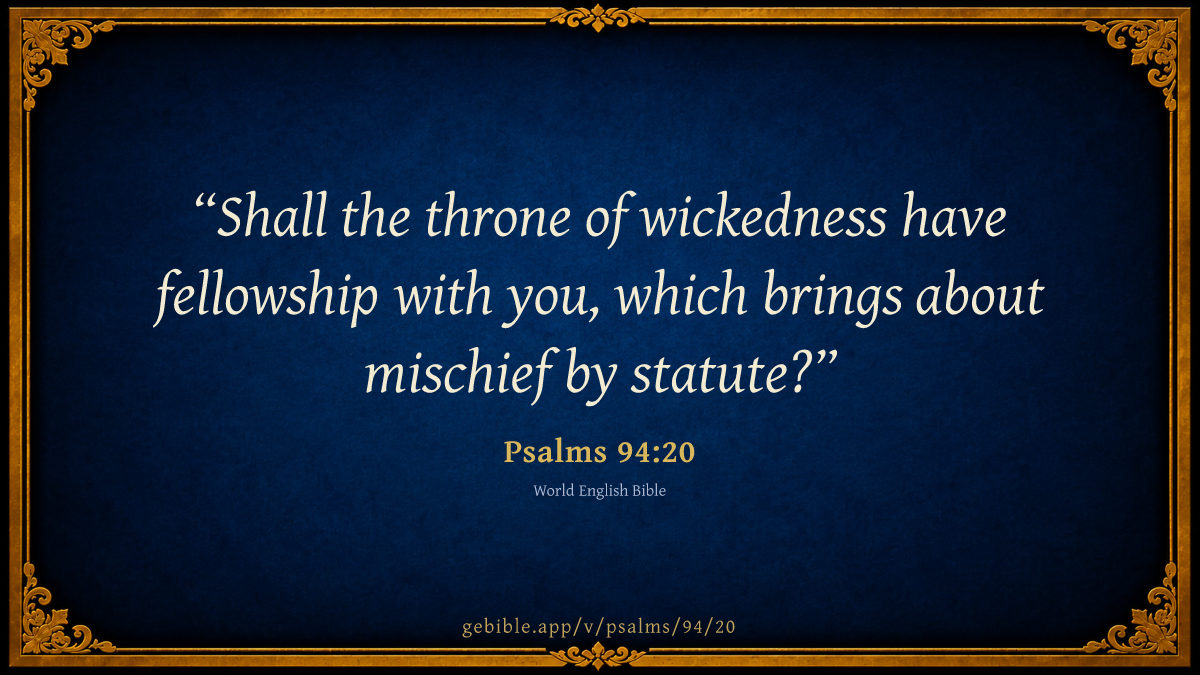
Shall the throne of wickedness have fellowship with you, which brings about mischief by statute?
Parallel Translations
-
Shall the throne of wickedness have fellowship with you, which brings about mischief by statute?
-
Shall the throne of iniquity have fellowship with thee, which frameth mischief by a law?
-
Shall the seat of wickedness have fellowship with Thee, which frameth mischief by statute?
Cross-references (21)
Passages linked to Psalms 94:20 in the Treasury of Scripture Knowledge, ordered by reader-vote popularity; verse text shown in World English Bible.
- Psalms 58:2 No, in your heart you plot injustice. You measure out the violence of your hands in the earth.
- Isaiah 10:1 Woe to those who decree unrighteous decrees, and to the writers who write oppressive decrees;
- Ecclesiastes 3:16 Moreover I saw under the sun, in the place of justice, that wickedness was there; and in the place of righteousness, that wickedness was there.
- John 11:57 Now the chief priests and the Pharisees had commanded that if anyone knew where he was, he should report it, that they might seize him.
- Revelation 13:15-17 It was given to him to give breath to it, to the image of the beast, that the image of the beast should both speak, and cause as many as wouldn’t worship the image of the beast to be killed. He causes all, the small and the great, the rich and the poor, and the free and the slave, to be given marks on their right hands, or on their foreheads; and that no one would be able to buy or to sell, unless he has that mark, which is the name of the beast or the number of his name.
- Esther 3:6-12 But he scorned the thought of laying hands on Mordecai alone, for they had made known to him Mordecai’s people. Therefore Haman sought to destroy all the Jews who were throughout the whole kingdom of Ahasuerus, even Mordecai’s people. In the first month, which is the month Nisan, in the twelfth year of King Ahasuerus, they cast Pur, that is, the lot, before Haman from day to day, and from month to month, and chose the twelfth month, which is the month Adar. Haman said to King Ahasuerus, “There is a certain people scattered abroad and dispersed among the peoples in all the provinces of your kingdom, and their laws are different from other people’s. They don’t keep the king’s laws. Therefore it is not for the king’s profit to allow them to remain. If it pleases the king, let it be written that they be destroyed; and I will pay ten thousand talents of silver into the hands of those who are in charge of the king’s business, to bring it into the king’s treasuries.” The king took his ring from his hand, and gave it to Haman the son of Hammedatha the Agagite, the Jews’ enemy. The king said to Haman, “The silver is given to you, the people also, to do with them as it seems good to you.” Then the king’s scribes were called in on the first month, on the thirteenth day of the month; and all that Haman commanded was written to the king’s local governors, and to the governors who were over every province, and to the princes of every people, to every province according to its writing, and to every people in their language. It was written in the name of King Ahasuerus, and it was sealed with the king’s ring.
- Daniel 3:4-7 Then the herald cried aloud, “To you it is commanded, peoples, nations, and languages, that whenever you hear the sound of the horn, flute, zither, lyre, harp, pipe, and all kinds of music, you fall down and worship the golden image that Nebuchadnezzar the king has set up. Whoever doesn’t fall down and worship shall be cast into the middle of a burning fiery furnace the same hour.” Therefore at that time, when all the peoples heard the sound of the horn, flute, zither, lyre, harp, pipe, and all kinds of music, all the peoples, the nations, and the languages, fell down and worshiped the golden image that Nebuchadnezzar the king had set up.
- Daniel 6:7-9 All the presidents of the kingdom, the deputies and the local governors, the counselors and the governors, have consulted together to establish a royal statute, and to make a strong decree, that whoever asks a petition of any god or man for thirty days, except of you, O king, he shall be cast into the den of lions. Now, O king, establish the decree, and sign the writing, that it not be changed, according to the law of the Medes and Persians, which doesn’t alter.” Therefore king Darius signed the writing and the decree.
- Amos 6:3 Those who put far away the evil day, and cause the seat of violence to come near;
- Micah 6:16 For the statutes of Omri are kept, and all the works of Ahab’s house. You walk in their counsels, that I may make you a ruin, and her inhabitants a hissing; And you will bear the reproach of my people.”
- Psalms 50:16 But to the wicked God says, “What right do you have to declare my statutes, that you have taken my covenant on your lips,
- Ecclesiastes 5:8 If you see the oppression of the poor, and the violent taking away of justice and righteousness in a district, don’t marvel at the matter, for one official is eyed by a higher one, and there are officials over them.
- Isaiah 1:11-20 “What are the multitude of your sacrifices to me?”, says Yahweh. “I have had enough of the burnt offerings of rams and the fat of fed animals. I don’t delight in the blood of bulls, or of lambs, or of male goats. When you come to appear before me, who has required this at your hand, to trample my courts? Bring no more vain offerings. Incense is an abomination to me. New moons, Sabbaths, and convocations: I can’t stand evil assemblies. My soul hates your New Moons and your appointed feasts. They are a burden to me. I am weary of bearing them. When you spread out your hands, I will hide my eyes from you. Yes, when you make many prayers, I will not hear. Your hands are full of blood. Wash yourselves. Make yourself clean. Put away the evil of your doings from before my eyes. Cease to do evil. Learn to do well. Seek justice. Relieve the oppressed. Defend the fatherless. Plead for the widow.” “Come now, and let’s reason together,” says Yahweh: “Though your sins are as scarlet, they shall be as white as snow. Though they are red like crimson, they shall be as wool. If you are willing and obedient, you will eat the good of the land; but if you refuse and rebel, you will be devoured with the sword; for the mouth of Yahweh has spoken it.”
- Jeremiah 7:4-11 Don’t trust in lying words, saying, ‘Yahweh’s temple, Yahweh’s temple, Yahweh’s temple, are these.’ For if you thoroughly amend your ways and your doings, if you thoroughly execute justice between a man and his neighbor; if you don’t oppress the foreigner, the fatherless, and the widow, and don’t shed innocent blood in this place, and don’t walk after other gods to your own hurt; then I will cause you to dwell in this place, in the land that I gave to your fathers, from of old even forever more. Behold, you trust in lying words that can’t profit. Will you steal, murder, commit adultery, swear falsely, burn incense to Baal, and walk after other gods that you have not known, then come and stand before me in this house, which is called by my name, and say, ‘We are delivered,’ that you may do all these abominations? Has this house, which is called by my name, become a den of robbers in your eyes? Behold, I myself have seen it,” says Yahweh.
- John 9:22 His parents said these things because they feared the Jews; for the Jews had already agreed that if any man would confess him as Christ, he would be put out of the synagogue.
- 1 Kings 12:32 Jeroboam ordained a feast in the eighth month, on the fifteenth day of the month, like the feast that is in Judah, and he went up to the altar. He did so in Bethel, sacrificing to the calves that he had made, and he placed in Bethel the priests of the high places that he had made.
- 2 Chronicles 6:14-16 and he said, “Yahweh, the God of Israel, there is no God like you in heaven or on earth; you who keep covenant and loving kindness with your servants who walk before you with all their heart; who have kept with your servant David my father that which you promised him. Yes, you spoke with your mouth, and have fulfilled it with your hand, as it is today. “Now therefore, Yahweh, the God of Israel, keep with your servant David my father that which you have promised him, saying, ‘There shall not fail you a man in my sight to sit on the throne of Israel, if only your children take heed to their way, to walk in my law as you have walked before me.’
- Psalms 52:1 Why do you boast of mischief, mighty man? God’s loving kindness endures continually.
- John 18:28 They led Jesus therefore from Caiaphas into the Praetorium. It was early, and they themselves didn’t enter into the Praetorium, that they might not be defiled, but might eat the Passover.
- 1 John 1:5-6 This is the message which we have heard from him and announce to you, that God is light, and in him is no darkness at all. If we say that we have fellowship with him and walk in the darkness, we lie, and don’t tell the truth.
- Psalms 82:1 God presides in the great assembly. He judges among the gods.
Cross-references from openbible.info (CC BY 4.0)
Explain this verse (16 sources)
Historical commentary, presented as a primary source — not an endorsement.
Private notes
Saved on this device only — never synced or sent anywhere.
John Calvin 1540 · Public Domain 20 Shall the throne of iniquities have fellowship with…
20 Shall the throne of iniquities have fellowship with thee? He again derives an argument for confidence from the nature of God, it being impossible that he should show favor to the wicked, or sanction their evil devices. With God for their enemy, how could they escape being destroyed? The words have greater force from being thrown into the form of a question, to show how completely opposed all sin is to the divine nature. The term throne is used, because those against whom the present charge is brought were not common robbers or assassins, who are universally recognized as infamous, but tyrants who persecuted the Lord’s people under color of law. These, although occupying the throne which has been consecrated to God, have stained and polluted it with their crimes, and therefore have nothing in common with it. The meaning is brought out more clearly in the subsequent clause of the verse, where they are declared to be persons utterly estranged from God, who frame molestation for law, or, as the Hebrew word חק, chok, signifies, decree of law, or statute order. The Psalmist aims at those profligate judges who, under pretense of pursuing the strict course of office, perpetrate the worst species of enormities. Judges of this abandoned character, as we know, with no other view than to retain possession of a specious name for integrity, invent various excuses to defend their infamous oppressions. The meaning of the Psalmist is apparent then; and it is this, that honorable as a throne may be, so far as the name goes, it ceases to have any worth or estimation with God when abused by wicked men; for iniquity can never meet with his approbation.
John Calvin's Commentaries (1540-1563) — public domain. Text from the Calvin Translation Society English edition (1840s-50s) via the Christian Classics Ethereal Library (ccel.org). Calvin's coverage is partial (roughly two-thirds of the Bible); uncommented books and verses are honest gaps, never fabricated. The 19th-century editor's footnotes and remarks are omitted so the notes are faithfully Calvin's own voice.
Geneva Bible translators 1599 · Public Domain Though the wicked judges pretend justice in oppressing the…
Though the wicked judges pretend justice in oppressing the Church, yet they have not that authority of God.
Geneva Bible (1599) marginal notes — public domain.
John Trapp 1656 · Public Domain Psa 94:20 Shall the throne of iniquity have fellowship…
Psa 94:20 Shall the throne of iniquity have fellowship with thee, which frameth mischief by a law?
Ver. 20. Shall the throne of iniquity have fellowship with thee] Shall tyrants and oppressors (who do exercise regiment without righteousness) entitle thee to their wicked proceedings, and go unpunished? See Isa 36:10; Isa 37:36; the throne or tribunal is called, The holy place, Ecc 8:10; woe, then, to those that pollute it!
Read full note →
Which frameth mischief by a law?] As did the primitive persecutors, with their bloody edicts against Christians; and the Popish bishops, of whose laws that of Politian was verified,
Inventum Actiae dicuntur iura Draconis:
Vera est fama nimis, nil nisi virus habent.
Some render it Procter, vel contra legem, beside or against law.
John Trapp, A Commentary or Exposition upon All the Books of the Old and New Testament (1647–1656) — public domain. Text from a community e-Sword module.
Matthew Poole 1685 · Public Domain Wilt thou take part with the unrighteous powers of…
Wilt thou take part with the unrighteous powers of the world, who oppress thy people? It is true, they partake of thy name, being called gods, Psa 82:1, but I know thou wilt not afford them thy protection and patronage, but wilt manifest thy justice and displeasure against them. This seems to have been one of those comfortable thoughts wherewith the psalmist delighted his soul, as he now said.
Which frameth mischief; who devise wicked devices, and lay heavy burdens upon men that are more righteous than themselves.
Read full note →
By a law; either by virtue of those unrighteous decrees which they have made in form of laws; or by false pretences of law. Or, against law; against all right, and the laws both of God and men.
Matthew Poole's English Annotations on the Holy Bible (1683–1685) — public domain. Text from a community e-Sword/MySword module.
John Gill 1763 · Public Domain Shall the throne of iniquity have fellowship with thee,....…
Shall the throne of iniquity have fellowship with thee,.... Or "be joined with thee", be "partner with thee" (f), as antichrist affects to be; who may well be called "the throne of iniquity", since the dragon, the old serpent, and Satan, gave him his power, seat, or throne, and great authority: his coming is after the working of Satan, with all deceivableness of unrighteousness; he sits and enacts, practices and countenances, all manner of iniquity; he sits in the temple of God, showing himself as if he was God; he claims all power in heaven and in earth; takes upon him to dispense with the laws of God and men, and makes new laws, and binds the consciences of men with them; presumes to forgive sin, which none but God can do; and to open the gates of heaven to whom he pleases; see Rev 13:2, but can these things be allowed of shall not such pride and arrogance, and horrible iniquity be punished with the utmost severity? doubtless it will:
which frameth mischief by a law? does all manner of mischief to men, without control, as if he had a law for doing it; or makes a law that all men shall worship him, or receive his mark in their right hand, or forehead; or else shall not buy or sell, yea, be killed; see Rev 13:15, or "against law" (g); against the laws of God and man; for antichrist is , "the lawless one", spoken of in Th2 2:8.
Read full note →
(f) "an sociabitur tibi?" Cocceius, Gejerus; "num consociabitur?" Michaelis. (g) "praeter statutum", Piscator, Cocceius; "contra statutum", Gejerus; "contra legem tuam", Arab.
John Gill's Exposition of the Whole Bible (1746–1763) — public domain (CC PDM 1.0). Text via the HelloAO Bible API.
John Wesley 1765 · Public Domain Shall - Wilt thou take part with the unrighteous…
Shall - Wilt thou take part with the unrighteous powers of the world who oppress thy people. A law - By virtue of those unrighteous decrees which they have made.
John Wesley, Explanatory Notes Upon the Whole Bible (1754–1765) — public domain. Text via the GEBible commentary corpus.
Adam Clarke 1810 · Public Domain Verse 20. Shall the throne of iniquity] No wicked…
Verse 20. Shall the throne of iniquity] No wicked king, judge, or magistrate shall ever stand in thy presence. No countenance shall such have from thy grace or providence.
Which frameth mischief] Devise, plan, and execute, as if they acted by a positive law, and were strictly enjoined to do what they so much delighted in.
Adam Clarke's Commentary on the Bible (1810–1826) — public domain. Text from a community e-Sword/MySword module.
Joseph Benson 1811 · Public Domain Psa 94:20. Shall the throne of iniquity have fellowship…
Psa 94:20. Shall the throne of iniquity have fellowship with thee? — Wilt thou take part with the unrighteous powers of the world, who oppress thy people? Wilt thou countenance and support these tyrants in their wickedness? We know thou wilt not; but wilt manifest thy justice and displeasure against them. A throne has fellowship with God, when it is a throne of justice, and answers the end of its being erected; for by him kings reign; and when they reign for him their judgments are his, and he owns them as his ministers; and whoever resist them, or rise up against them, shall receive to themselves condemnation; but when it becomes a throne of iniquity, it has no longer fellowship with God. Far be it from the just and holy God that he should be the patron of unrighteousness, even in princes and those that sit on thrones; yea, though they be the thrones of the house of David. Which frameth mischief by a law — Who devise wicked devices, and lay heavy burdens upon men by virtue of those unrighteous decrees which they have made in form of laws; or by false pretences of law. Or, against law, against all right, and the laws, both of God and men.
Joseph Benson's Commentary on the Old and New Testaments (1811–1818) — public domain. Text from a community e-Sword module.
Albert Barnes 1834 · Public Domain Shall the throne of iniquity - The throne established…
Shall the throne of iniquity - The throne established in iniquity; or, sustaining iniquity. The allusion is probably to what was referred to in the former part of the psalm - the powers that were spreading desolation through the land - wicked princes or rulers, Psa 94:3-7. Their thrones were established on evil; they defended wickedness and wrong by their authority; they abused their power, and employed it to overthrow the rights of others. The “phrase” would be applicable to any unjust government, or to any laws that are designed to uphold that which is wrong. Such are all the laws which authorize or uphold slavery, gaming, lotteries, the traffic in intoxicating drinks, etc.
Have fellowship with thee - With God. Shall they be united with thee; be sustained by thee; be regarded as a part of thine administration? Wilt thou sanction them? Wilt thou give to them thy patronage, as if they met with thine approbation? The Hebrew word means to be associated with, or allied to, and would be properly applied to a partnership, or anything where there is fellowship or alliance. The interrogative form here strongly implies that this “cannot be.” Such laws - such purposes - “cannot” be in accordance with the laws and authority of God; or, in other words, God does not sit on the same throne with those who authorize and by law sustain slavery, intemperance, and gambling. There can be no partnership here.
Read full note →
Which frameth mischief by a law - The word rendered “mischief” usually means labor, toil; and then, trouble, vexation, sorrow. It may, however, be used to denote evil of any kind - crime, or wrong. The word rendered frameth means to form, to fashion, to make, as a potter does clay; Gen 2:7-8, Gen 2:19; or as a workman does statues, Isa 44:9-10, Isa 44:12; or as one makes weapons, Isa 54:17. It is often applied to God as the Creator. See the notes at Psa 94:9 : “he that formed the eye.” The word law here means a rule or statute; and the idea is, that the iniquity referred to was not the result of an irregular and fitful impulse; or of passion; of sudden excitement; or of mere “will” in a particular case; but was reduced to statute, and sustained by law. The expression would apply to all those cases where evil is upheld by the government or by civil authority, or where those who are engaged in it can plead in their defense the sanction of law. The statement here is, that such acts “cannot” have fellowship with God, or receive his approval. It is an insult to God to suppose that he has ever appointed legislators or magistrates for the purpose of making or upholding such enactments. Yet there are many such laws in the world; and a main reason why it is so difficult to remove such evils as have been above referred to is the fact that they are sustained by law, and that they who hold slaves, or open gambling-houses, or sell intoxicating drinks, can plead the authority of the law; or, in other words, that the laws have done all they can to place such things on a level with those which “ought” to be protected by statute. Many a man in his business looks no further than to the laws of the land, and if he has their sanction, in vain is the attempt to induce him to abandon a business that leads to oppression, or that scatters woe and sorrow through a community.
Albert Barnes' Notes on the Bible (1834–1885) — public domain. Text from a community e-Sword/MySword module.
Daniel D. Whedon 1874 · Public Domain 20. Throne of iniquity—The miseries which these “evil doers”…
20. Throne of iniquity—The miseries which these “evil doers” cause thy people to suffer, are not the doings of a few individuals, nor a few exceptional outbursts of violence, but the settled policy of government, which, by giving its high sanction to deeds of injustice and violence upon the rights of citizenship and of conscience, forgets its divine right of authority, and becomes “the throne of iniquity,” or “the throne of Satan, (ο θρονος του Σατανα,) Rev_2:13. And just so far as government arrays its authority against private right and the divine law, it merits this appellation. See Psa_94:21
Daniel D. Whedon (gen. ed.), Commentary on the Old and New Testaments (1874–1909) — public domain. Text from a community e-Sword module.
The Cambridge Bible for Schools and Colleges 1878 · Public Domain 20. Though He may tolerate them for a time,…
20. Though He may tolerate them for a time, it is inconceivable that Jehovah should let these rapacious judges shelter themselves under His authority. Cp. Psa_50:21. The throne or tribunal of destruction (Psa_91:3, note) denotes the rulers or judges who were ready like a yawning gulf to swallow up the innocent. They contrive wrong by statute, inflict injury and misery under the shelter of legal forms. Cp. Isa_10:1-2.
20–23. The doom of tyrants and the deliverance of their victims.
The Cambridge Bible for Schools and Colleges (gen. ed. J. J. S. Perowne; Cambridge University Press, 1878–1918) — public domain. Text from a community e-Sword module.
Ellicott's Commentary for English Readers 1878 · Public Domain (20) Throne of iniquity.—This is an apt expression for…
(20) Throne of iniquity.—This is an apt expression for an oppressive and unjust government. The word rendered “iniquity” might mean “calamity” or “destruction” (see Psa_57:1, and comp. Psa_91:3 : “noisome”), but in Pro_10:3 it seems to mean “lawless desire,” which best suits this passage.
Have fellowship—i.e., be associated in the government. Could the theocracy admit to a share in it, not merely imperfect instruments of justice, but even those who perverted justice to evil ends?
Read full note →
Which frameth mischief by a law?—i.e., making legislation a means of wrong. Others, however, render, “against the law.” But the former explanation best suits the next verse.
A Bible Commentary for English Readers, edited by Charles John Ellicott (1878–1897) — public domain. Text from a community e-Sword module.
The Pulpit Commentary 1880 · Public Domain Vers. 20-23. The destruction of the evil doers. There…
Vers. 20-23. The destruction of the evil doers. There can be no fellowship between light and darkness between God and evildoers, especially those who carry out their wicked purposes under the forms of law (ver. 20), and go the length of condemning innocent blood (ver. 21). Such persons God, who defends the righteous (ver. 22), will assuredly bring to utter destruction (ver. 23).
Shall the throne of iniquity have fellowship with thee? The interrogative is here, as so often, an emphatic negative. By "the throne of iniquity" is meant iniquity in high places, wickedness enthroned upon the judgment seat, and thence delivering its unjust sentences. Oppressors in Israel made a large use of the machinery of the law to crush and ruin their victims. (see Isa_1:23 Isa_10:1, 2 Amo_5:7 Amo_6:12, etc.) Which frameth mischief by a law; i.e. which effects its mischievous purposes by means of the decrees of courts. (comp. 1Ki_21:10-13)
Read full note →
Man"s rival law.
"Frameth mischief by a law." "Making legislation a means of wrong." The idea is that, in the psalmist"s time, the courts of justice were corrupt; and man"s law, instead of being in harmony with God"s Law, and its expression, had become a rival. It had come to do what God"s Law never does. It worked towards injustice and unrighteousness. God"s Law is "holy, and the commandment holy and just and good." The thing that seemed so unbearable to the psalmist was, that the tyrants of his day claimed to be acting according to law, seeking to hide their unrighteousness by a holy name.
I SUBMISSION TO LAWFUL AUTHORITY IS A PRIMARY RELIGIOUS DUTY. Inculcated by Old Testament and New. Felt to be the right thing. Necessary to the individual and nation well being.
II RESISTANCE TO UNLAWFUL AUTHORITY IS A PRIMARY RELIGIOUS DUTY. Unlawful authority is that which conflicts with the authority of God. All law that has claims on men is the translation, for particular relations, of the Law of God. Unless we can be sure that a thing can stand the Divine Law test, we are not bound to render obedience.
III The case of the text is, however, more subtle than this. It brings before us lawful authority abused, and Divine Law dishonoured in its applications. And it may be difficult for men to see what is their duty in such a case. The psalmist seems to see his way clearly. He suggests that we should submit to the injustice, and cry mightily to God, that he would turn the hearts of the rulers. And he is right. To right law wrongly administered we should present submission, for history abundantly proves that through suffering the wrong doing of rulers is best revealed. But submission would be wrong if men had not the profound conviction that God rules the rulers, and is the Avenger of all the persecuted and oppressed. R.T.
The Pulpit Commentary (1880–1919), ed. H.D.M. Spence-Jones & Joseph S. Exell — public domain. Text from a community e-Sword module.
Charles H. Spurgeon 1885 · Public Domain Ver. 20. Shall the throne of iniquity have fellowship…
Ver. 20. Shall the throne of iniquity have fellowship with thee? Such thrones there are, and they plead a right divine, but their claim is groundless, a fraud upon mankind and a blasphemy of heaven. God enters into no alliance with unjust authority, he gives no sanction to unrighteous legislation.
Which frameth mischief by a law? They legalise robbery and violence, and then plead that it is the law of the land; and so indeed it may be, but it is a wickedness for all that. With great care men prepare enactments intended to put down all protests, so as to render wrong-doing a permanent institution, but one element is necessary to true Conservatism, viz., righteousness; and lacking that, all their arrangements of the holders of power must come to an end, and all their decrees must in process of time be wiped out of the statute book. Nothing can last for ever but impartial right. No injustice can be permanent, for God will not set his seal upon it, nor have any fellowship with it, and therefore down it must come, and happy shall be the day which sees it fall.
Read full note →
Ver. 20. The throne of iniquity... which frameth mischief by a law. The first pretext of wicked men to colour their proceedings against innocent men is their throne; the second is the law; and the third is their council. What tyrant could ask more? But God has prepared an awful hell for impenitent tyrants, and they will be in it long before they now expect to leave the world. William Nicholson.
Ver. 20. The throne of iniquity... which frameth mischief by a law. If there never had been such thrones in the world, there would not have been that mention made of them in the Scripture. But such there have been. That of Jeroboam was one, who would not suffer the people, according to the divine command, to go up to Jerusalem to worship God, who had there placed his name; but spread, for them that went, nets upon Mizpah, and set snares upon Mount Tabor. (Ho 5:1) And such thrones there have been since, too many of them. Well saith the Psalmist, Shall they have fellowship with thee? No, no; God keeps his distance from them. Those that we call "stinking dunghills" are not so offensive to God as thrones of iniquity are, which shall neither be approved by him nor secured. Stay a while, Christians, and "in patience possess your souls; "for the world shall see that in due time he will overturn them all. Samuel Slater, in "The Morning Exercises."
Ver. 20. Which frameth mischief by a law, i.e., frame wicked laws, or under the colour of law and justice, oppress the innocent. Summum jus, summa injuria, the higher the law, the greater the injustice, and injuries may and are too often done ex prava interpretatione legis, from a wicked interpretation of the law. With those who do injustice with the sword of justice, God will have no fellowship. William Nicholson.
Ver. 20. "It is the law of the land, you know, "the limit of this authority both in temporal and spiritual matters.
Ver. 20.
1. God can have no fellowship with the wicked.
2. The wicked can have no fellowship with God. G. R.
Ver. 20. Divine politics.
1. There are thrones erected in opposition to the throne of God, "thrones of iniquity, "e.g. which trespass on civil liberty, which infringe religious equality, which derive revenue from evil commerce, etc.
2. Such thrones, whatever their pretensions, are excluded from divine fellowship; between them and God a great gulf is fixed. C.A.D.
Psalms 94:21*
Charles H. Spurgeon's The Treasury of David (1869–1885) — public domain. Psalms only. Text from a community e-Sword/MySword module.
The Biblical Illustrator 1887 · Public Domain Shall the throne of iniquity have fellowship with Thee,…
Psa_94:20
Shall the throne of iniquity have fellowship with Thee, which frameth mischief by a law?
Read full note →
Wrong legalized
I. Iniquity has a throne on earth. It is a ruling power, it has the sway everywhere. Wrong is an imperial power.
II. The throne of iniquity is incompatible with God. Shall the throne of iniquity have fellowship with Thee? Impossible. It is eternally antagonistic to the Divine nature, law, and procedure.
III. The throne of iniquity legalizes wrong. Which frameth mischief by a law. In England wrong is legalized. What is war but legalized murder, monopoly but legalized dishonesty, unrestrained accumulation of wealth but legalized greed? What wrongs, alas, our fathers have legalized, from which we are suffering to-day. (Homilist.)
A startling inquiry
I. What is the throne of iniquity? Any government that upholds and protects wrong-doing, or that does not protect the people from the workers of iniquity, is a throne of iniquity. It frames mischief into law:--
1. When it protects that which is morally wrong by legal enactments, and enables men to defend their bad conduct by saying, I have a government licence.
2. When it patronizes that which is evil by using it as a source of revenue.
II. Such a throne has no fellowship with God.
1. Because Gods throne, Gods government, is upright, righteous.
2. He never makes a law to protect that which is wrong, nor to regulate evil.
3. He condemns, denounces, and prohibits all evil, both in the person and the state. He has no fellowship with the workers of iniquity.
III. Apply this to the liquor-traffic.
1. The manufacture, importation, exportation, transportation, and traffic in intoxicating liquors, for drinking purposes, is a great wrong.
2. Those who pass enactments to regulate or protect such an evil frame mischief into law.
3. To vote for such laws, or to suffer them to exist if we can prevent it, is to sustain the throne of iniquity.
4. Licence laws do not make the liquor-traffic right, but they do make those who enact them accomplices in the crime of the liquor-seller. (D. C. Babcock.)
.
Psa_95:1-11
The Biblical Illustrator, edited by Joseph S. Exell (c. 1880s–1900s) — public domain. Text from a community e-Sword module.
unfoldingWord translationNotes 2017 · CC BY-SA 4.0 Can a throne of destruction be allied with you,…
Can a throne of destruction be allied with you, one who creates injustice by statute?
This rhetorical question is used to make a point. It can be translated as a statement. AT: "A wicked ruler who makes unjust laws is not your friend" (See: Rhetorical Question)
Read full note →
a throne of destruction
Here the metonym "throne" refers to a king or ruler. AT: "a wicked ruler" or "corrupt judge" (See: Metonymy)
conspire
secretly plan with a person something harmful or illegal
take the life of
This is an idiom which means to kill someone. (See: Idiom)
translationWords
rule
create
just
statute
righteous
condemn
innocent
die
unfoldingWord translationNotes — © Distant Shores Media and the Door43 World Missions Community, licensed CC BY-SA 4.0. Source: git.door43.org/Door43/en_tn.