Revelation 19:1(v7)After these things I heard something like a loud voice of a great multitude in heaven, saying, “Hallelujah! Salvation, power, and glory…
Psalms 100:4(v8)Enter into his gates with thanksgiving, and into his courts with praise. Give thanks to him, and bless his name.
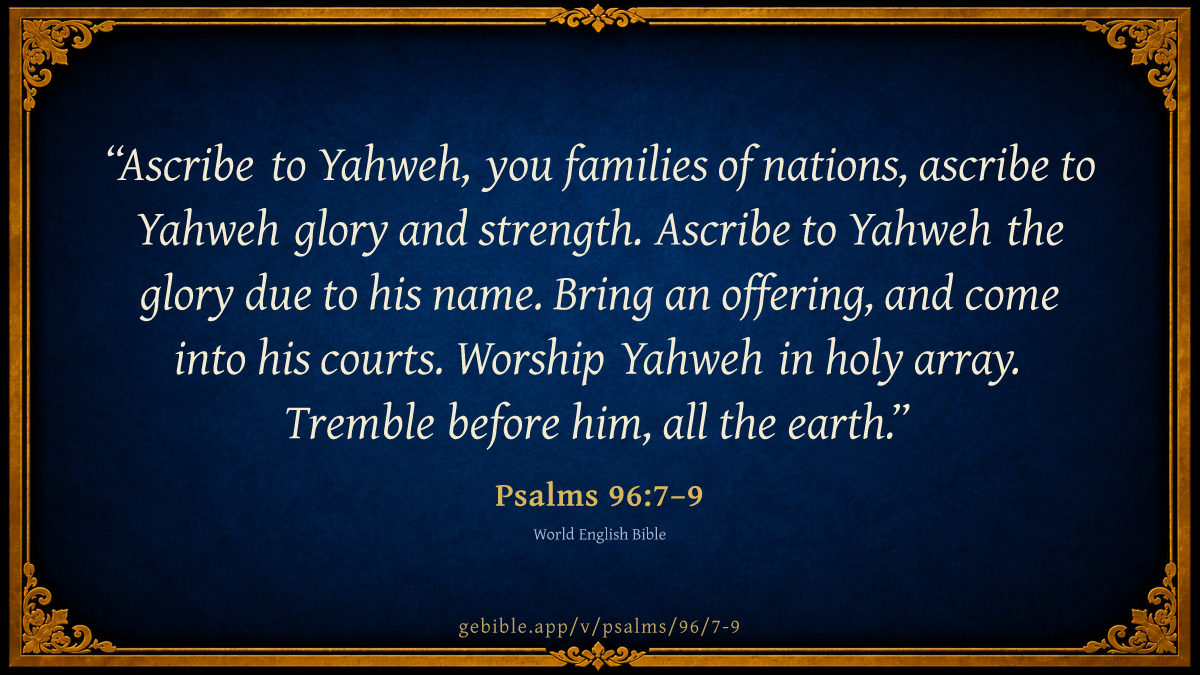
Psalms 29:2(v9)Ascribe to Yahweh the glory due to his name. Worship Yahweh in holy array.
Matthew 6:13(v7)Bring us not into temptation, but deliver us from the evil one. For yours is the Kingdom, the power, and the glory forever. Amen.’
1 Chronicles 29:11-13(v7)Yours, Yahweh, is the greatness, the power, the glory, the victory, and the majesty! For all that is in the heavens and in the earth is…
Show all 45 cross-references
Revelation 5:9(v7)They sang a new song, saying, “You are worthy to take the book and to open its seals: for you were killed, and bought us for God with your…
Psalms 22:27(v7)All the ends of the earth shall remember and turn to Yahweh. All the relatives of the nations shall worship before you.
Romans 12:1(v8)Therefore I urge you, brothers, by the mercies of God, to present your bodies a living sacrifice, holy, acceptable to God, which is your…
Revelation 7:12(v7)saying, “Amen! Blessing, glory, wisdom, thanksgiving, honor, power, and might, be to our God forever and ever! Amen.”
Exodus 34:5-9(v8)Yahweh descended in the cloud, and stood with him there, and proclaimed Yahweh’s name. Yahweh passed by before him, and proclaimed,…
Psalms 114:7(v9)Tremble, you earth, at the presence of the Lord, at the presence of the God of Jacob,
Psalms 110:3(v9)Your people offer themselves willingly in the day of your power, in holy array. Out of the womb of the morning, you have the dew of your…
Daniel 11:45(v9)He will plant the tents of his palace between the sea and the glorious holy mountain; yet he will come to his end, and no one will help him.
Hebrews 13:15-16(v8)Through him, then, let’s offer up a sacrifice of praise to God continually, that is, the fruit of lips which proclaim allegiance to his…
Jude 1:24-25(v7)Now to him who is able to keep them from stumbling, and to present you faultless before the presence of his glory in great joy, to God our…
Psalms 29:1-2(v7)Ascribe to Yahweh, you sons of the mighty, ascribe to Yahweh glory and strength. Ascribe to Yahweh the glory due to his name. Worship…
Psalms 33:8(v9)Let all the earth fear Yahweh. Let all the inhabitants of the world stand in awe of him.
Psalms 45:12(v8)The daughter of Tyre comes with a gift. The rich among the people entreat your favor.
Psalms 72:10(v8)The kings of Tarshish and of the islands will bring tribute. The kings of Sheba and Seba shall offer gifts.
Psalms 108:3-5(v8)I will give thanks to you, Yahweh, among the nations. I will sing praises to you among the peoples. For your loving kindness is great above…
Malachi 1:11(v8)For from the rising of the sun even to its going down, my name is great among the nations, and in every place incense will be offered to my…
Revelation 5:13(v7)I heard every created thing which is in heaven, on the earth, under the earth, on the sea, and everything in them, saying, “To him who sits…
Ezra 7:27(v9)Blessed be Yahweh, the God of our fathers, who has put such a thing as this in the king’s heart, to beautify Yahweh’s house which is in…
Psalms 67:3-4(v7)let the peoples praise you, God. Let all the peoples praise you. Oh let the nations be glad and sing for joy, for you will judge the…
Psalms 68:32-34(v7)Sing to God, you kingdoms of the earth! Sing praises to the Lord! To him who rides on the heaven of heavens, which are of old; behold, he…
Psalms 76:11(v9)Make vows to Yahweh your God, and fulfill them! Let all of his neighbors bring presents to him who is to be feared.
Psalms 111:9(v8)He has sent redemption to his people. He has ordained his covenant forever. His name is holy and awesome!
Psalms 148:13-14(v8)let them praise Yahweh’s name, for his name alone is exalted. His glory is above the earth and the heavens. He has lifted up the horn of…
Isaiah 60:6-7(v8)A multitude of camels will cover you, the dromedaries of Midian and Ephah. All from Sheba will come. They will bring gold and frankincense,…
Ezekiel 7:20(v9)As for the beauty of his ornament, he set it in majesty; but they made the images of their abominations and their detestable things…
Luke 2:14(v7)“Glory to God in the highest, on earth peace, good will toward men.”
Luke 21:5-6(v9)As some were talking about the temple and how it was decorated with beautiful stones and gifts, he said, “As for these things which you…
Romans 15:9-10(v7)and that the Gentiles might glorify God for his mercy. As it is written, “Therefore I will give praise to you among the Gentiles and sing…
Romans 15:16(v8)that I should be a servant of Christ Jesus to the Gentiles, serving as a priest of the Good News of God, that the offering up of the…
Philippians 2:17(v8)Yes, and if I am poured out on the sacrifice and service of your faith, I rejoice, and rejoice with you all.
Philippians 4:18(v8)But I have all things and abound. I am filled, having received from Epaphroditus the things that came from you, a sweet-smelling fragrance,…
Hebrews 13:13(v8)Let’s therefore go out to him outside of the camp, bearing his reproach.
1 Peter 2:5(v8)You also, as living stones, are built up as a spiritual house, to be a holy priesthood, to offer up spiritual sacrifices, acceptable to God…
1 Peter 5:11(v7)To him be the glory and the power forever and ever. Amen.
Revelation 8:3-4(v8)Another angel came and stood over the altar, having a golden censer. Much incense was given to him, that he should add it to the prayers of…
Revelation 14:7(v7)He said with a loud voice, “Fear the Lord, and give him glory; for the hour of his judgment has come. Worship him who made the heaven, the…
Revelation 15:4(v8)Who wouldn’t fear you, Lord, and glorify your name? For you only are holy. For all the nations will come and worship before you. For your…
Revelation 19:6(v7)I heard something like the voice of a great multitude, and like the voice of many waters, and like the voice of mighty thunders, saying,…
Psalms 66:1-2(v7)Make a joyful shout to God, all the earth! Sing to the glory of his name! Offer glory and praise!
Psalms 76:7(v9)You, even you, are to be feared. Who can stand in your sight when you are angry?
Cross-references from openbible.info (CC BY 4.0)
Explain this passage (17 sources)
Historical commentary, presented as a primary source — not an endorsement.
John Calvin1540 · Public DomainOn vv7, 97 Give to Jehovah, etc. Since praise waited for…
7 Give to Jehovah, etc. Since praise waited for God in Zion, (Psalm 65:1,) and that was the place devoted to the celebration of his worship, and the posterity of Abraham were alone invested with the privilege of priesthood, we cannot doubt that the Psalmist refers here to that great change which was to take place in the Church upon the advent of Christ. An opposition or distinction is intended between God’s ancient people and the Gentile tribes, which were to be afterwards adopted into the same fellowship. To declare his glory and strength, is the same with declaring the glory of his strength And to show that man can boast nothing of his own, and in refusing to celebrate God, impiously despoils him of his just honors, he subjoins, Give unto the Lord the glory of his name; an expression which denotes that God borrows nothing from without, but comprehends all that is worthy of praise in himself. He calls upon the Gentile nations in so many words to render unto God the same worship which the Jews did; not that we must worship God now according to the outward ritual which was prescribed under the Law, but he signifies that there would be one rule and form of religion in which all nations should accord. Now, unless the middle wall of partition had been broken down, the Gentiles could not have entered along with God’s children into the courts of the sanctuary. So that we have here a clear prediction of the calling of the Gentiles, who needed to have their uncleanness taken away before they could be brought into the holy assembly. The mincha, or oblation, was only one kind of sacrifice, but it is here taken to denote the whole worship of God, because it was a part of divine service more ordinarily practiced. We see from this, and other passages, that the inspired penmen describe the inward worship of God under symbols common in the age when they lived. God would not have meat-offerings presented to him after Christ had come; but the words which the Psalmist employs intimate that the doors of the temple, once shut, were now to be opened for the admission of the Gentiles. The Apostle, in his Epistle to the Hebrews, (Hebrews 13:15) tells us what are those sacrifices with which God will now be worshipped. Hence the absurdity of the Papists, who would adduce such passages in support of the mass and their other fooleries. We may very properly learn from the words, however, that we ought not to come empty-handed into the presence of God, enjoined as we are to present ourselves and all that we have as a reasonable service unto Him, (Romans 12:1; 1 Peter 2:5.)
John Calvin's Commentaries (1540-1563) — public domain. Text from the Calvin Translation Society English edition (1840s-50s) via the Christian Classics Ethereal Library (ccel.org). Calvin's coverage is partial (roughly two-thirds of the Bible); uncommented books and verses are honest gaps, never fabricated. The 19th-century editor's footnotes and remarks are omitted so the notes are faithfully Calvin's own voice.
Geneva Bible translators1599 · Public DomainOn vv7–8As by experience ye see that it is only…
As by experience ye see that it is only due unto him.
Geneva Bible (1599) marginal notes — public domain.
John Trapp1656 · Public DomainOn vv7–9Psa 96:7 Give unto the LORD, O ye kindreds…
Psa 96:7 Give unto the LORD, O ye kindreds of the people, give unto the LORD glory and strength.
Ver. 7. Give unto the Lord] See Psa 29:1-2. One rendereth it, Tribuite ponderose, unde יהב onus pondus portate; to show that our praises of God should be ponderous and substantial.
John Trapp, A Commentary or Exposition upon All the Books of the Old and New Testament (1647–1656) — public domain. Text from a community e-Sword module.
Matthew Poole1685 · Public DomainOn vv7–9O ye kindreds of the people; or, O ye…
O ye kindreds of the people; or, O ye families of the people of the world. And the word families may be understood either,
1. Strictly and properly; and so it may be intimated that this great blessing of salvation by Christ should not be imparted to whole nations, but only to some persons taken out of every people and nation, as it is expressed, Rev 5:9. Or,
Read full note →
2. More largely for nations, as it is taken, Gen 12:3; Jer 25:9; Zec 14:18; and so it may be implied that not only some few of the heathen people should be brought to the acknowledgment and worship of the true God, as was usual in the times of the Old Testament, but that whole nations should come in to the church of God together.
Give unto the Lord; ascribe to him, or acknowledge to be in him.
Matthew Poole's English Annotations on the Holy Bible (1683–1685) — public domain. Text from a community e-Sword/MySword module.
John Gill1763 · Public DomainOn vv7–9Give unto the Lord, O ye kindreds of the…
Give unto the Lord, O ye kindreds of the people,.... Or families (p): the Targum is,
"give unto the Lord a song, ye families of the people;''
Read full note →
by whom are meant not the tribes and families of the people of Israel, but the Gentiles, the nations of the world, who were to be blessed in the seed of Abraham, the family of Egypt, and others; see Amo 3:2, Zac 14:17, even such as were chosen of them, taken out from among them for a people to his name; who were redeemed out of every kindred, tongue, people, and nation; and were taken, one of a city, and two of a family, and brought to Zion: give unto the Lord glory and strength; See Gill on Psa 29:1.
John Gill's Exposition of the Whole Bible (1746–1763) — public domain (CC PDM 1.0). Text via the HelloAO Bible API.
John Wesley1765 · Public DomainOn v9Beauty - Cloathed with all the gifts and graces,…
Beauty - Cloathed with all the gifts and graces, which are necessary in God's worship.
John Wesley, Explanatory Notes Upon the Whole Bible (1754–1765) — public domain. Text via the GEBible commentary corpus.
Adam Clarke1810 · Public DomainOn vv7–9Verse 7. Ye kindreds of the people] Ye families,…
Verse 7. Ye kindreds of the people] Ye families, all the tribes of Israel in your respective divisions.
Adam Clarke's Commentary on the Bible (1810–1826) — public domain. Text from a community e-Sword/MySword module.
Joseph Benson1811 · Public DomainOn v7Psa 96:7-9. Give unto the Lord, O ye kindreds…
Psa 96:7-9. Give unto the Lord, O ye kindreds of the people — O ye people, from whatsoever family ye come, or, O ye nations of the world, Give unto the Lord glory and strength — Ascribe to Jehovah that incomparable majesty, and supreme dominion and authority, which you have been wont to give to your imaginary gods. Give unto the Lord the glory due unto his name — Renouncing all your idols, acknowledge Jehovah alone to be the omnipotent king of all the world, and do him honour suitable to the excellence of his majesty. Bring an offering, and come into his courts — The courts of his house. Bring him an oblation, in token of your subjection to him; and humbly worship him in his temple. He speaks of the worship of the New Testament under the expressions of the Jewish worship, as the prophets elsewhere do: see Mal 1:11. O worship the Lord — O come and cast yourselves down before the Lord, in the beauty of holiness — In his sanctuary, where he hath fixed his glorious residence among us; or, rather, being clothed with all those holy ornaments, those gifts and graces, which are necessary and required in God’s worship. Fear before him, all the earth — Let all the people approach his presence with a holy fear and sacred reverence, standing in awe of, and dreading to offend, their sovereign Lord and King.
Joseph Benson's Commentary on the Old and New Testaments (1811–1818) — public domain. Text from a community e-Sword module.
Albert Barnes1834 · Public DomainOn vv7–9Give unto the Lord - Ascribe unto the Lord…
Give unto the Lord - Ascribe unto the Lord - to Yahweh. This is extracted literally from 1Ch 16:28.
O ye kindreds of the people - Hebrew, “Families” of the people: people, as united by family ties. The idea is that of worship not merely as individuals, nor as a mere “aggregate” of individuals united by no common bonds, but as those united by strong ties; bound by blood and affection; constituted into communities. It is a call on such to worship God in their capacity as thus bound together; to come as families and to worship God. In other words, it is a call on families “as such” to acknowledge God. A family is a proper place where to honor God. When the same joy pervades all hearts in prosperity, and when all are alike made sorrowful in adversity, there is an evident fitness that all should unite in the same worship of God; and that, as in all other things they have common interests, sympathies, and affections, so they should have in religion - in the service of their Creator.
Read full note →
Give unto the Lord glory and strength - That is, Proclaim that these belong to God; or, worship him as a God of glory and power.
Albert Barnes' Notes on the Bible (1834–1885) — public domain. Text from a community e-Sword/MySword module.
Daniel D. Whedon1874 · Public DomainOn vv7–97. Give… ye—The “give,” or ascribe, is uttered thrice,…
7. Give… ye—The “give,” or ascribe, is uttered thrice, corresponding to “sing,” thrice repeated, (Psa_96:1-2,) expressive of the earnestness of the speaker. See Psa_29:1-2. The Chaldee has it, “Bring a new song to God.”
Kindreds of the people—Hebrew, Families of the nations. This accords with the breadth of the covenant. Compare “families of the earth,” (Gen_12:3; Gen_28:14,) which is the basis of the New Testament Church, as the family organization is also of the nation. The tendency of modern civilization and nationality is to restore the nations, according to the most ancient law, on the line of language and blood, see Gen_10:5; Gen_10:20; Gen_10:31-32, against the arbitrary combinations of ambition and conquest. Europe gives an example of this.
Daniel D. Whedon (gen. ed.), Commentary on the Old and New Testaments (1874–1909) — public domain. Text from a community e-Sword module.
The Cambridge Bible for Schools and Colleges1878 · Public DomainOn vv7–97. O ye kindreds of the people] Ye families…
7. O ye kindreds of the people] Ye families of the peoples. Cp. Psa_22:27; Amo_3:2.
7–9. An appeal to the nations to acknowledge Jehovah. These verses are a free imitation of Psa_29:1-2.
The Cambridge Bible for Schools and Colleges (gen. ed. J. J. S. Perowne; Cambridge University Press, 1878–1918) — public domain. Text from a community e-Sword module.
Ellicott's Commentary for English Readers1878 · Public DomainOn vv7–9(7-9) These verses are a relic of Psa_29:1-2, where…
(7-9) These verses are a relic of Psa_29:1-2, where see Notes, but instead of being addressed to the angels it is, in accordance with the world of new ideas and feelings in which Israel lived after the Captivity, addressed to all the people of the world. A truly Messianic character is thus impressed on the psalm.
A Bible Commentary for English Readers, edited by Charles John Ellicott (1878–1897) — public domain. Text from a community e-Sword module.
The Pulpit Commentary1880 · Public DomainOn vv7–9Give unto the Lord, O ye kindreds of the…
Give unto the Lord, O ye kindreds of the people; rather, O ye fatuities of the peoples. A renewed appeal to the heathen to join in the song of praise (comp. ver. 1). Give unto the Lord glory and strength. "Give" must be understood in the sense of "ascribe" (see Professor Cheyne"s translation, and compare the Prayer book Version). Both this and the next verse are echoes of Psa_29:1, Psa_29:2.
The Pulpit Commentary (1880–1919), ed. H.D.M. Spence-Jones & Joseph S. Exell — public domain. Text from a community e-Sword module.
Charles H. Spurgeon1885 · Public DomainOn vv7–9Ver. 7. The first six verses commenced with an…
Ver. 7. The first six verses commenced with an exhortation to sing, three times repeated, with the name of the Lord thrice mentioned; here we meet with the expression
Give unto the Lord, used in the same triple manner. This is after the manner of those poets whose flaming sonnets have best won the ear of, the people, they reiterate choice words till they penetrate the soul and fire the heart. The invocation of the sweet singer is still addressed to all mankind, to whom he speaks as
Read full note →
Ye kindreds of the people. Divided into tribes and families, we are called in our courses and order to appear before him and ascribe to him all honour. "All worship be to God only, "is the motto of one of our City companies, and it may well be the motto of all the families upon earth. Family worship is peculiarly pleasing unto him who is the God of all the families of Israel.
Give unto the LORD glory and strength, that is to say, recognise the glory and power of Jehovah, and ascribe them unto him in your solemn hymns. Who is glorious but the Lord? Who is strong, save our God? Ye great nations who count yourselves both famous and mighty, cease your boastings! Ye monarchs, who are styled imperial and puissant, humble yourselves in the dust before the only Potentate. Glory and strength are nowhere to be found, save with the Lord, all others possess but the semblance thereof. Well did Massilion declare, "God alone is great."
Ver. 7 Ye kindreds of the people. There is a peculiar force, observes an early commentator Cassiodorus, in this phrase, "kindreds of the people, "much more than if we had the word "peoples" alone; for in every nation there are at all times strangers, aliens, sojourners abiding permanently or for a time, but not reckoned among the natives; while the phrase here includes all such, and provides that none shall be shut out because of his origin. Neale and Littledale.
Ver. 7. Ye kindreds of the people. He calls upon them to come in kindreds or families, in allusion to the Jewish custom of families coming by themselves, on the several festival days to worship in Jerusalem; and the Holy Ghost gives us here to understand that such custom was to serve as a model for Christians, whose families should unite in coming to the church to give glory and honour to God for all the wonderful things he accomplished in the redemption of man; for it was not by our own industry, or by our merits, that we have come to grace, and to be the adopted children of God, but through God's mercy, to whom, therefore, is due all honour and glory. Bellarmine.
Psalms 96:8*
Charles H. Spurgeon's The Treasury of David (1869–1885) — public domain. Psalms only. Text from a community e-Sword/MySword module.
The Biblical Illustrator1887 · Public DomainOn v8Give unto the Lord the glory due unto His…
Psa_96:8-9
Give unto the Lord the glory due unto His name: bring an offering, and come into His courts.
Read full note →
Public worship
I. Prayer. As we all have religious feelings to express, sins to acknowledge, mercies temporal and spiritual for which to give thanks, evils to feel or fear, with regard to ourselves and others, it highly becomes us to join together, and to lift up our hearts with one accord, in a public and social manner, to the hearer of prayer, and thus to offer unto Him our united homage and supplication with thanksgiving. Prayer is not only a duty, it is a high privilege and honour; the nearest approach to God, and the highest enjoyment of Him which we are capable of in this world.
II. Praise. The saints on high, and the angels around the throne, praise God in the highest, and well does it become men upon earth to join their humble notes of praise to the anthem of the heavenly choirs, in exalting together His great and glorious name. All the works of God praise Him, from the heights of heaven to the depths of the earth; the angels around the throne praise Him; the sun, and moon, and stars of light praise Him in their courses; the mountains, and valleys, and woods, and fields, and seas, and streams of water praise Him; the elements of nature praise Him and obey His Word.
III. The preaching and hearing of the word. Both the ministers and the hearers of the Word should watch over themselves, that they may have singleness of eye and heart to the glory of God, more desirous of the Divine approbation than of human applause, avoiding all vain and vexatious questions, which profit not, but engender strife and ungodliness, and which violate that heavenly charity without which all our services are hateful in the sight of God.
IV. The giving and receiving of the Sacrament of the Lords Supper. We should consider the nature and design of the Lords Supper, the dispositions which are required for an acceptable participation, and the graces which it is calculated to cherish. The Lords Supper thus observed would be attended with the happiest and most beneficial effects on our hearts and lives, in confirming our faith, enlivening our hope and charity, and in promoting our progress in holiness, and in meetness for the pure and perfect service of heaven. (J. Wightman, D. D.)
Worship
Worship may be called the flower of the religious life. It will be absent where there is no religion at all; it will be scanty or poor when ones religion is feeble; it blossoms into beauty and perfection only when godliness is assiduously cultivated in daily practice and the soul is accustomed to dwell habitually under the shadow of the Almighty. Here, then, you have a very useful test by which to judge of your real religious condition. Is worship irksome? Do you find your affections generally cold, your desires languid, or your thoughts wandering when you come to church? Search within for the cause; see if there be not a negligent state of the soul behind this undevout frame of yours; inquire into your daily habits of obedience, your vigilance against known sin, your study of Gods will and mind, your practice of repentance, and of faith in the Saviour. As a Christian lives well or ill so will he worship. Again, his worship, if it be hearty and constant, must feed and purify his spiritual life. And here let me speak a little on the utterances which the devout mind finds for its feelings towards God; because it should be recollected that although worship begins in a state of the heart it does not stop there--to feel penitence, or gratitude, or adoration is not just the same thing as to worship; worship or homage begins when the hidden emotions of a devout mind, stirred up at the thought of God, run out into some form of utterance. The utterance may, no doubt, be secret and silent--no voice--hardly even the lips moving, like pious Hannahs, the soul talking only to its God. This is how people commonly worship when they are alone. No matter; there is none the less real outflow and utterance of the man. An outflow of the heart towards the Most High there must be, perfectly well understood by Him whether discernible to men or not--then the soul worships. Now, of what nature is this outflow from the religious heart? Briefly, it is of the nature of an offering of a sacrifice. Foremost of all, that of which it is expressly said, The sacrifices of God are a broken spirit, etc. Next comes the offering of our grateful and joyous praise for Him who hath been sent among us to heal the broken-hearted; I mean the words of our lips giving thanks to His name in song and audible confession of His mercy, for with such sacrifices, likewise, God is well pleased. One other offering alone I shall name which we ought to bring within His courts--it is that which the apostle has described as a service reasonable on our part and acceptable to God--I mean the dedication to His service of ourselves. Christian homage to the Redeemer finds its supreme utterance here in the recognition of the fact that we are no longer our own, at our own bidding and disposal, but are His who bought us with a price, willingly devoted, separated of our own choice, to the service and honour of our Redeemer, living and dying body and soul the Lords. (J. O. Dykes, D. D.)
The duty of prayer
1. The primary foundation of this duty is the souls relation to God. Every consideration by which we commend filial piety towards earthly parents holds still more forcibly in reference to our heavenly Father. How unnatural the child that never asked his father for anything, that never made his mother the confidante of his troubles and difficulties, that could drink the cup of enjoyment and success, and never ask his parents to share it, or that never poured into their hungering ears the expressions of affection and honour. What opportunities the wants, troubles, and enjoyments of childhood afford for intercourse between parent and child, for the moulding influence of the parent to exert itself upon the childs character, for the play of mutual affection and delight. Judging from human analogy, it would seem quite sufficient reason for Gods making the bestowment of His best blessings to depend upon their being sought in prayer, that communications concerning giving and receiving send themselves so directly to the expression and strengthening of love.
2. Prayer is a duty we owe to Gods name, an offering which we ought to make to His blessedness. God is love, and love has its expectations, its satisfactions, its dues, its delights. Will a man rob God? the prophet asks. Ah, we have robbed Him of dearer treasure than tithes and offerings. Where is the husband or wife, the father or daughter, who would not account the withholding of the affection that was their just expectation a more grievous wrong than any passing injury or lapse of material gifts? Our obligation as Christians to live in communion with God is all the stronger that in these last days He hath spoken unto us by His Son.
3. Public worship is a duty we owe to God as witnesses to His existence, authority, and grace. The maintenance of this testimony is a most efficient means of advancing His kingdom in the world. When we render it, we are doing in a humble way the work of such men as Elijah and Daniel. This is one important use of public worship. Such worship, by uniting many suppliants in one request, calls forth more abundant praise when it is granted: it provides, also, a fuller expression of adoration than the individual soul can compass, and therefore intensifies and exalts its feeling; further, it exhibits the sympathy and concord of human beings in the loftiest employment of their powers; but beyond all this, it lifts up a clear and striking testimony to the reality of Gods authority and grace, and bids men everywhere bow down before their Maker.
4. The neglect of prayer indicates a general indifference to duty. Since we are really dependent upon the inspiration and guidance of God for the power to serve Him acceptably, to neglect the means of obtaining these is to be careless where we ought to be most careful. If out of the heart are the issues of life, and prayer is the chief instrument of heart culture, how blamable our want of diligence in it. To neglect prayer is to leave our loyalty open to every hostile temptation, to burn our lamp and make no provision to replace the exhausted oil. (E. W. Shalders, B.A.)
Worship the Lord in the beauty of holiness.
The Churchs worship in the beauty of holiness
Slightly changing the order of the psalmists biddings, I will invite you to lend to him your attentive ears, first, as he says to you and to all, Worship the Lord, and that in the beauty of holiness; and then, as he summons you to one duty, or rather one privilege, more, Bring presents, and come into His courts. And first, as he says to you, Worship the Lord, this house being first and chiefly a house of prayer, according to that word of the prophet, afterwards made His own by Christ the Lord, My house shall be called a house of prayer. Seek ye My face, He says to each that enters its gates. They only enter those gates with profit, they only carry away a blessing, who make answer from the heart, Thy face, Lord, will we seek. But this worship, how shall it be offered, and with what accompaniments? In the beauty of holiness. Other beauty is good in its place and its degree; has its worth, although that altogether a subordinate worth. The outward apparel of the kings daughter may be of wrought gold (and who would grudge her this, where it may be fitly had?) but she must be all glorious within, glorious with the inward graces of faith and love, humility and holiness, if that Lord for whom she adorns herself is indeed to delight Himself in her or to behold any beauty in her, that He should desire it. But how worship Him in the beauty of holiness? We unholy, we defiled, our souls not beautiful, but ugly with sin, how shall we fulfil the condition which the psalmist requires? First, then, I reply, or rather the Word of God replies, he only who has his conscience purged from dead works through the blood of sprinkling can do this. And the second condition is like to it, that we, as the true Israel, worship God in the spirit, praying in the Holy Ghost. But what else does the psalmist say? Bring presents, and come into His courts. And first, lest there should be any mistake here, let me remind you of that without which every other present will be worthless in the sight of Him who does not weigh what we give, but with what spirit we give it. See, then, that you offer first and chiefly yourselves, your souls and bodies, acceptable through Christ, washed with His blood, sanctified by His Spirit. Give, and that without keeping anything back, yourselves to God. But, this done, bring other presents, other gifts; they will all, indeed, have been included in this all-embracing one, to Him. If you have leisure, leave not your clergy to cope single-handed with the ignorance, the vice, and the misery around them; range yourselves among their helpers; give them some of that lay assistance which is so invaluable to them. If you have means, suffer not the Churchs charities at home, her missions abroad, to be starved and stunted through contributions by you withholden altogether, or doled out with a niggard hand. If you have any special talent, see if it cannot be enlisted in the service of God, and find its highest consecration there. (Abp. Trench.)
Worship
I. Its nature. It consists in devout exercises of the soul, whether in meditation, adoration, admiration, or supplication. It is the spirit disentangled from the sensuous and engaged in fellowship with the Invisible and Divine.
1. Worship is a necessity of mans nature. He is no mere machine, or thinker, or theorist; he is pre-eminently a worshipper, distinctively moral in his make, religious in his proclivities, akin in the great spiritual invisibilities of his nature to the all-glorious Creator.
2. Worship is an evidence of mans greatness. The existence of moral intuitions amid the sad wreck of the soul by sin proclaims a fallen nobility, a crownless royalty: yea, tells it even now to be--Sublime in ruins and grand in woe.
3. In worship man finds his native element. Like the bird which has been encaged for weary months, that breaks through the wires of its prison and escapes on swift wing, pealing forth its song of freedom as it finds its native element, so the believer, escaping from the din and turmoil of the world, or of business, and entering into the hallowed retreat of the closet, or the holy place of the tabernacle of the Most High, hears amid its hush and stillness angelic voices whispering, The Lord is in His holy Temple, and finds in His presence the society for which he was made, and the fellowship for which he pants. There is a kinship of soul, an affinity of sympathy, a unity of will, a oneness of spirit, a reciprocity of affection.
II. Its object. Worship the Lord.
1. He should be worshipped in His sovereign and paternal relationship to us.
2. He should be worshipped in the Tri-unity of His nature. Though it be impossible to give a positive definition of the distinction between Father, and Son, and Holy Spirit, yet this is no sufficient reason for denying the distinction itself, of which the Bible assures us; for reason, when left to herself, sets before us objects concerning which we, indeed, know that they exist, but concerning whose nature we have no positive knowledge. We can only distinguish between them and some false representations, or determine what they are net; but of their intrinsic nature, how they are we have not the slightest knowledge.
3. Man becomes assimilated to the object of his worship. How vastly important, then, that our knowledge of God should be intelligent, correct, scriptural, and true.
III. Its spirit. In the beauty of holiness.
1. Reality.
2. Simplicity. (J. O. Keen, D.D.)
Beauty o/ soul
Why do we think that nature is beautiful? Because it is the external world formed by the same hand that made us. We, partakers of the likeness of God, naturally admire our Fathers works. We see beauty and divinity in them, and if He hath made the external world beautiful He hath made the human soul also, and devised that it shall be beautiful, like a great and beautiful temple, full of costly and beautiful things, a soul in harmony with itself, a soul in harmony with other souls that seek with it to do Gods will, a soul filled with purity, light, gladness, charity, a soul overflowing with the love of God, with love of our fellow men, with the earnest desire to do always the things that are pure and virtuous. Look into such a soul and see how beautiful it is, the marvellous symmetry in the human soul, the marvellous colours, divinely gifted, in the human soul, the marvellous possibilities in the human soul. It is Gods wonderful picture, His wonderful dream. God made the human soul, and the beauty of God, the beauty of the Divine conception that was in Gods mind is expressed there. What a wonder is a beautiful soul! The soul that has been recognized in this world as transcendently beautiful is the soul of Jesus Christ. It has drawn other souls that had been contaminated with sin, drawn them to itself and transformed them to the glorious image; it has influenced more than anything else that we know the whole mind, the whole movement of the human family. The beauty of the soul of Christ--transcendent, heavenly, bewitching--we gaze upon it, and we say, whatever divinity may be we cannot tell, but this is divine enough, it is the summation of divinest ideals for us. And gazing thus on the beautiful soul of the Christ, we are drawn up and beautified, filled with His love, transformed to His likeness, made more and more divine in the excellence of that grace which He gives to those souls that seek, for His sweet sake, that love to forsake evil, to put away the deformity, the debasement and the ugliness of vice, and to lay a herd of the Divine ideal, the beauty of Christ, and to worship God through Him and in His likeness, laying our noblest and our best, our best thoughts and our best feelings, and our noblest actions on the high altar of dedication to Him who has invited us in the old words of the psalm to worship Him in the beauty of holiness. (A. Bennie, B.D.)
Holiness
What is this holiness which is so beautiful? It is not justice--though it must include justice and have its root in strong integrity. It is not charity--though it must make man charitable with that finer love which not so much denies itself as simply forgets itself. It is not purity, but it is only in the pure soul that holiness can live; and purity which may be as cold as marble, touched by holiness takes on a glow as warm and radiant as the light of heaven. And it is no fancy of mine to make holiness include these things. Do you remember that holiness in its original derivation is simply wholeness, though the words have grown so curiously out of likeness in the spelling? Wholeness--the wholeness and completeness of character! Do you note the great, far-reaching meaning of this? I might figure the complete whole of human character as a pyramid: broad based in bodily power and aptitudes of strength or skill for lifes basal work; then, above this the various grades of intellectual faculty; above these, again, the moral with the lofty sense of conscience and right, and, still in these higher reaches of character, those human affections which give a tenderer grace to mere rigid morality; and, then, rising highest of all, capping and crowning all, the apex to the pyramid--religion. As a fact, holiness has come to mean, not all this wholeness, but especially that crowning and completing religious element which makes life whole at the higher end of it. And I do not want it taken away from that meaning, but it does want recognizing that the other is included, that for real holiness there must be wholeness; that holiness is not just a little religious element up in the heights of soul, and which may have nothing underneath it, but that it must have strong, full manliness or womanliness underneath it. The holiness that is not based on manly wholeness is not what the world wants. Mans being, in this common work-a-day world, has to be based on capable manhood; man has to have his feet firm on the solid earth. But now the other side of all this wants recognizing also. For that strong manly wholeness to come to any fine worth, there has to be this crowning element of holiness. The manhood that stops at strength, ability, or even intel-lect; the manhood that is not adding to these some crowning grace of earnest religiousness, is a poor truncated manhood. That is the most common trouble to-day. Men--men especially--are too content in lifes lower levels. They are strong, busy, capable there, but there they are content to stop. Life never was stronger at its base, but there is too little effort to build it up towards that finest manhood which is made whole by genuine, unashamed religion. And life loses immeasurably by this. It loses its highest outlook, its loftiest hopes, and all its noblest spring and power. Life wants to be made whole at the top. (B. Herford, D.D.)
The Biblical Illustrator, edited by Joseph S. Exell (c. 1880s–1900s) — public domain. Text from a community e-Sword module.
unfoldingWord translationNotes2017 · CC BY-SA 4.0On vv7, 9Ascribe to Yahweh ... ascribe praise to Yahweh for…
Ascribe to Yahweh ... ascribe praise to Yahweh for his glory and strength
This can be restated to removed the abstract nouns "praise," "glory," and "strength." See how these words are translated in Psalms 29:1. AT: "Praise Yahweh ... praise Yahweh because he is glorious and strong" (See: Abstract Nouns)
Read full note →
Give to Yahweh the glory that his name deserves
The abstract noun "glory" can be stated as a verb or adjective. See how these words are translated in Psalms 29:2. AT: "Honor Yahweh just as his name deserves" or "Proclaim that Yahweh is glorious just as his name deserves" (See: Abstract Nouns)
his name deserves
Here "name" refers to the person of God. AT: "he deserves" (See: Metonymy)
his courts
the temple courtyard where the priests sacrificed animals to Yahweh
Tyndale Open Study Notes2022 · CC BY-SA 4.0On vv7–996:7 nations of the world (literally families of the…
96:7 nations of the world (literally families of the nations): Families and clans represent subdivisions of the nations (see Gen 12:3). • The nations must respond to the Lord’s glory (Pss 8:1; 19:1-4; 24:7).
 GEBible — Godless Engineer's Bible App
John Calvin 1540 · Public Domain On vv7, 9 7 Give to Jehovah, etc. Since praise waited for…
7 Give to Jehovah, etc. Since praise waited for God in Zion, (Psalm 65:1,) and that was the place devoted to the celebration of his worship, and the posterity of Abraham were alone invested with the privilege of priesthood, we cannot doubt that the Psalmist refers here to that great change which was to take place in the Church upon the advent of Christ. An opposition or distinction is intended between God’s ancient people and the Gentile tribes, which were to be afterwards adopted into the same fellowship. To declare his glory and strength, is the same with declaring the glory of his strength And to show that man can boast nothing of his own, and in refusing to celebrate God, impiously despoils him of his just honors, he subjoins, Give unto the Lord the glory of his name; an expression which denotes that God borrows nothing from without, but comprehends all that is worthy of praise in himself. He calls upon the Gentile nations in so many words to render unto God the same worship which the Jews did; not that we must worship God now according to the outward ritual which was prescribed under the Law, but he signifies that there would be one rule and form of religion in which all nations should accord. Now, unless the middle wall of partition had been broken down, the Gentiles could not have entered along with God’s children into the courts of the sanctuary. So that we have here a clear prediction of the calling of the Gentiles, who needed to have their uncleanness taken away before they could be brought into the holy assembly. The mincha, or oblation, was only one kind of sacrifice, but it is here taken to denote the whole worship of God, because it was a part of divine service more ordinarily practiced. We see from this, and other passages, that the inspired penmen describe the inward worship of God under symbols common in the age when they lived. God would not have meat-offerings presented to him after Christ had come; but the words which the Psalmist employs intimate that the doors of the temple, once shut, were now to be opened for the admission of the Gentiles. The Apostle, in his Epistle to the Hebrews, (Hebrews 13:15) tells us what are those sacrifices with which God will now be worshipped. Hence the absurdity of the Papists, who would adduce such passages in support of the mass and their other fooleries. We may very properly learn from the words, however, that we ought not to come empty-handed into the presence of God, enjoined as we are to present ourselves and all that we have as a reasonable service unto Him, (Romans 12:1; 1 Peter 2:5.)
John Calvin's Commentaries (1540-1563) — public domain. Text from the Calvin Translation Society English edition (1840s-50s) via the Christian Classics Ethereal Library (ccel.org). Calvin's coverage is partial (roughly two-thirds of the Bible); uncommented books and verses are honest gaps, never fabricated. The 19th-century editor's footnotes and remarks are omitted so the notes are faithfully Calvin's own voice.
Geneva Bible translators 1599 · Public Domain On vv7–8 As by experience ye see that it is only…
As by experience ye see that it is only due unto him.
Geneva Bible (1599) marginal notes — public domain.
John Trapp 1656 · Public Domain On vv7–9 Psa 96:7 Give unto the LORD, O ye kindreds…
Psa 96:7 Give unto the LORD, O ye kindreds of the people, give unto the LORD glory and strength.
Ver. 7. Give unto the Lord] See Psa 29:1-2. One rendereth it, Tribuite ponderose, unde יהב onus pondus portate; to show that our praises of God should be ponderous and substantial.
John Trapp, A Commentary or Exposition upon All the Books of the Old and New Testament (1647–1656) — public domain. Text from a community e-Sword module.
Matthew Poole 1685 · Public Domain On vv7–9 O ye kindreds of the people; or, O ye…
O ye kindreds of the people; or, O ye families of the people of the world. And the word families may be understood either,
1. Strictly and properly; and so it may be intimated that this great blessing of salvation by Christ should not be imparted to whole nations, but only to some persons taken out of every people and nation, as it is expressed, Rev 5:9. Or,
Read full note →
2. More largely for nations, as it is taken, Gen 12:3; Jer 25:9; Zec 14:18; and so it may be implied that not only some few of the heathen people should be brought to the acknowledgment and worship of the true God, as was usual in the times of the Old Testament, but that whole nations should come in to the church of God together.
Give unto the Lord; ascribe to him, or acknowledge to be in him.
Matthew Poole's English Annotations on the Holy Bible (1683–1685) — public domain. Text from a community e-Sword/MySword module.
John Gill 1763 · Public Domain On vv7–9 Give unto the Lord, O ye kindreds of the…
Give unto the Lord, O ye kindreds of the people,.... Or families (p): the Targum is,
"give unto the Lord a song, ye families of the people;''
Read full note →
by whom are meant not the tribes and families of the people of Israel, but the Gentiles, the nations of the world, who were to be blessed in the seed of Abraham, the family of Egypt, and others; see Amo 3:2, Zac 14:17, even such as were chosen of them, taken out from among them for a people to his name; who were redeemed out of every kindred, tongue, people, and nation; and were taken, one of a city, and two of a family, and brought to Zion: give unto the Lord glory and strength; See Gill on Psa 29:1.
(p) "familiae", Pagninus, Montanus, Junius & Tremellius, Piscator, &c.
John Gill's Exposition of the Whole Bible (1746–1763) — public domain (CC PDM 1.0). Text via the HelloAO Bible API.
John Wesley 1765 · Public Domain On v9 Beauty - Cloathed with all the gifts and graces,…
Beauty - Cloathed with all the gifts and graces, which are necessary in God's worship.
John Wesley, Explanatory Notes Upon the Whole Bible (1754–1765) — public domain. Text via the GEBible commentary corpus.
Adam Clarke 1810 · Public Domain On vv7–9 Verse 7. Ye kindreds of the people] Ye families,…
Verse 7. Ye kindreds of the people] Ye families, all the tribes of Israel in your respective divisions.
Adam Clarke's Commentary on the Bible (1810–1826) — public domain. Text from a community e-Sword/MySword module.
Joseph Benson 1811 · Public Domain On v7 Psa 96:7-9. Give unto the Lord, O ye kindreds…
Psa 96:7-9. Give unto the Lord, O ye kindreds of the people — O ye people, from whatsoever family ye come, or, O ye nations of the world, Give unto the Lord glory and strength — Ascribe to Jehovah that incomparable majesty, and supreme dominion and authority, which you have been wont to give to your imaginary gods. Give unto the Lord the glory due unto his name — Renouncing all your idols, acknowledge Jehovah alone to be the omnipotent king of all the world, and do him honour suitable to the excellence of his majesty. Bring an offering, and come into his courts — The courts of his house. Bring him an oblation, in token of your subjection to him; and humbly worship him in his temple. He speaks of the worship of the New Testament under the expressions of the Jewish worship, as the prophets elsewhere do: see Mal 1:11. O worship the Lord — O come and cast yourselves down before the Lord, in the beauty of holiness — In his sanctuary, where he hath fixed his glorious residence among us; or, rather, being clothed with all those holy ornaments, those gifts and graces, which are necessary and required in God’s worship. Fear before him, all the earth — Let all the people approach his presence with a holy fear and sacred reverence, standing in awe of, and dreading to offend, their sovereign Lord and King.
Joseph Benson's Commentary on the Old and New Testaments (1811–1818) — public domain. Text from a community e-Sword module.
Albert Barnes 1834 · Public Domain On vv7–9 Give unto the Lord - Ascribe unto the Lord…
Give unto the Lord - Ascribe unto the Lord - to Yahweh. This is extracted literally from 1Ch 16:28.
O ye kindreds of the people - Hebrew, “Families” of the people: people, as united by family ties. The idea is that of worship not merely as individuals, nor as a mere “aggregate” of individuals united by no common bonds, but as those united by strong ties; bound by blood and affection; constituted into communities. It is a call on such to worship God in their capacity as thus bound together; to come as families and to worship God. In other words, it is a call on families “as such” to acknowledge God. A family is a proper place where to honor God. When the same joy pervades all hearts in prosperity, and when all are alike made sorrowful in adversity, there is an evident fitness that all should unite in the same worship of God; and that, as in all other things they have common interests, sympathies, and affections, so they should have in religion - in the service of their Creator.
Read full note →
Give unto the Lord glory and strength - That is, Proclaim that these belong to God; or, worship him as a God of glory and power.
Albert Barnes' Notes on the Bible (1834–1885) — public domain. Text from a community e-Sword/MySword module.
Daniel D. Whedon 1874 · Public Domain On vv7–9 7. Give… ye—The “give,” or ascribe, is uttered thrice,…
7. Give… ye—The “give,” or ascribe, is uttered thrice, corresponding to “sing,” thrice repeated, (Psa_96:1-2,) expressive of the earnestness of the speaker. See Psa_29:1-2. The Chaldee has it, “Bring a new song to God.”
Kindreds of the people—Hebrew, Families of the nations. This accords with the breadth of the covenant. Compare “families of the earth,” (Gen_12:3; Gen_28:14,) which is the basis of the New Testament Church, as the family organization is also of the nation. The tendency of modern civilization and nationality is to restore the nations, according to the most ancient law, on the line of language and blood, see Gen_10:5; Gen_10:20; Gen_10:31-32, against the arbitrary combinations of ambition and conquest. Europe gives an example of this.
Daniel D. Whedon (gen. ed.), Commentary on the Old and New Testaments (1874–1909) — public domain. Text from a community e-Sword module.
The Cambridge Bible for Schools and Colleges 1878 · Public Domain On vv7–9 7. O ye kindreds of the people] Ye families…
7. O ye kindreds of the people] Ye families of the peoples. Cp. Psa_22:27; Amo_3:2.
7–9. An appeal to the nations to acknowledge Jehovah. These verses are a free imitation of Psa_29:1-2.
The Cambridge Bible for Schools and Colleges (gen. ed. J. J. S. Perowne; Cambridge University Press, 1878–1918) — public domain. Text from a community e-Sword module.
Ellicott's Commentary for English Readers 1878 · Public Domain On vv7–9 (7-9) These verses are a relic of Psa_29:1-2, where…
(7-9) These verses are a relic of Psa_29:1-2, where see Notes, but instead of being addressed to the angels it is, in accordance with the world of new ideas and feelings in which Israel lived after the Captivity, addressed to all the people of the world. A truly Messianic character is thus impressed on the psalm.
A Bible Commentary for English Readers, edited by Charles John Ellicott (1878–1897) — public domain. Text from a community e-Sword module.
The Pulpit Commentary 1880 · Public Domain On vv7–9 Give unto the Lord, O ye kindreds of the…
Give unto the Lord, O ye kindreds of the people; rather, O ye fatuities of the peoples. A renewed appeal to the heathen to join in the song of praise (comp. ver. 1). Give unto the Lord glory and strength. "Give" must be understood in the sense of "ascribe" (see Professor Cheyne"s translation, and compare the Prayer book Version). Both this and the next verse are echoes of Psa_29:1, Psa_29:2.
The Pulpit Commentary (1880–1919), ed. H.D.M. Spence-Jones & Joseph S. Exell — public domain. Text from a community e-Sword module.
Charles H. Spurgeon 1885 · Public Domain On vv7–9 Ver. 7. The first six verses commenced with an…
Ver. 7. The first six verses commenced with an exhortation to sing, three times repeated, with the name of the Lord thrice mentioned; here we meet with the expression
Give unto the Lord, used in the same triple manner. This is after the manner of those poets whose flaming sonnets have best won the ear of, the people, they reiterate choice words till they penetrate the soul and fire the heart. The invocation of the sweet singer is still addressed to all mankind, to whom he speaks as
Read full note →
Ye kindreds of the people. Divided into tribes and families, we are called in our courses and order to appear before him and ascribe to him all honour. "All worship be to God only, "is the motto of one of our City companies, and it may well be the motto of all the families upon earth. Family worship is peculiarly pleasing unto him who is the God of all the families of Israel.
Give unto the LORD glory and strength, that is to say, recognise the glory and power of Jehovah, and ascribe them unto him in your solemn hymns. Who is glorious but the Lord? Who is strong, save our God? Ye great nations who count yourselves both famous and mighty, cease your boastings! Ye monarchs, who are styled imperial and puissant, humble yourselves in the dust before the only Potentate. Glory and strength are nowhere to be found, save with the Lord, all others possess but the semblance thereof. Well did Massilion declare, "God alone is great."
Ver. 7 Ye kindreds of the people. There is a peculiar force, observes an early commentator Cassiodorus, in this phrase, "kindreds of the people, "much more than if we had the word "peoples" alone; for in every nation there are at all times strangers, aliens, sojourners abiding permanently or for a time, but not reckoned among the natives; while the phrase here includes all such, and provides that none shall be shut out because of his origin. Neale and Littledale.
Ver. 7. Ye kindreds of the people. He calls upon them to come in kindreds or families, in allusion to the Jewish custom of families coming by themselves, on the several festival days to worship in Jerusalem; and the Holy Ghost gives us here to understand that such custom was to serve as a model for Christians, whose families should unite in coming to the church to give glory and honour to God for all the wonderful things he accomplished in the redemption of man; for it was not by our own industry, or by our merits, that we have come to grace, and to be the adopted children of God, but through God's mercy, to whom, therefore, is due all honour and glory. Bellarmine.
Psalms 96:8*
Charles H. Spurgeon's The Treasury of David (1869–1885) — public domain. Psalms only. Text from a community e-Sword/MySword module.
The Biblical Illustrator 1887 · Public Domain On v8 Give unto the Lord the glory due unto His…
Psa_96:8-9
Give unto the Lord the glory due unto His name: bring an offering, and come into His courts.
Read full note →
Public worship
I. Prayer. As we all have religious feelings to express, sins to acknowledge, mercies temporal and spiritual for which to give thanks, evils to feel or fear, with regard to ourselves and others, it highly becomes us to join together, and to lift up our hearts with one accord, in a public and social manner, to the hearer of prayer, and thus to offer unto Him our united homage and supplication with thanksgiving. Prayer is not only a duty, it is a high privilege and honour; the nearest approach to God, and the highest enjoyment of Him which we are capable of in this world.
II. Praise. The saints on high, and the angels around the throne, praise God in the highest, and well does it become men upon earth to join their humble notes of praise to the anthem of the heavenly choirs, in exalting together His great and glorious name. All the works of God praise Him, from the heights of heaven to the depths of the earth; the angels around the throne praise Him; the sun, and moon, and stars of light praise Him in their courses; the mountains, and valleys, and woods, and fields, and seas, and streams of water praise Him; the elements of nature praise Him and obey His Word.
III. The preaching and hearing of the word. Both the ministers and the hearers of the Word should watch over themselves, that they may have singleness of eye and heart to the glory of God, more desirous of the Divine approbation than of human applause, avoiding all vain and vexatious questions, which profit not, but engender strife and ungodliness, and which violate that heavenly charity without which all our services are hateful in the sight of God.
IV. The giving and receiving of the Sacrament of the Lords Supper. We should consider the nature and design of the Lords Supper, the dispositions which are required for an acceptable participation, and the graces which it is calculated to cherish. The Lords Supper thus observed would be attended with the happiest and most beneficial effects on our hearts and lives, in confirming our faith, enlivening our hope and charity, and in promoting our progress in holiness, and in meetness for the pure and perfect service of heaven. (J. Wightman, D. D.)
Worship
Worship may be called the flower of the religious life. It will be absent where there is no religion at all; it will be scanty or poor when ones religion is feeble; it blossoms into beauty and perfection only when godliness is assiduously cultivated in daily practice and the soul is accustomed to dwell habitually under the shadow of the Almighty. Here, then, you have a very useful test by which to judge of your real religious condition. Is worship irksome? Do you find your affections generally cold, your desires languid, or your thoughts wandering when you come to church? Search within for the cause; see if there be not a negligent state of the soul behind this undevout frame of yours; inquire into your daily habits of obedience, your vigilance against known sin, your study of Gods will and mind, your practice of repentance, and of faith in the Saviour. As a Christian lives well or ill so will he worship. Again, his worship, if it be hearty and constant, must feed and purify his spiritual life. And here let me speak a little on the utterances which the devout mind finds for its feelings towards God; because it should be recollected that although worship begins in a state of the heart it does not stop there--to feel penitence, or gratitude, or adoration is not just the same thing as to worship; worship or homage begins when the hidden emotions of a devout mind, stirred up at the thought of God, run out into some form of utterance. The utterance may, no doubt, be secret and silent--no voice--hardly even the lips moving, like pious Hannahs, the soul talking only to its God. This is how people commonly worship when they are alone. No matter; there is none the less real outflow and utterance of the man. An outflow of the heart towards the Most High there must be, perfectly well understood by Him whether discernible to men or not--then the soul worships. Now, of what nature is this outflow from the religious heart? Briefly, it is of the nature of an offering of a sacrifice. Foremost of all, that of which it is expressly said, The sacrifices of God are a broken spirit, etc. Next comes the offering of our grateful and joyous praise for Him who hath been sent among us to heal the broken-hearted; I mean the words of our lips giving thanks to His name in song and audible confession of His mercy, for with such sacrifices, likewise, God is well pleased. One other offering alone I shall name which we ought to bring within His courts--it is that which the apostle has described as a service reasonable on our part and acceptable to God--I mean the dedication to His service of ourselves. Christian homage to the Redeemer finds its supreme utterance here in the recognition of the fact that we are no longer our own, at our own bidding and disposal, but are His who bought us with a price, willingly devoted, separated of our own choice, to the service and honour of our Redeemer, living and dying body and soul the Lords. (J. O. Dykes, D. D.)
The duty of prayer
1. The primary foundation of this duty is the souls relation to God. Every consideration by which we commend filial piety towards earthly parents holds still more forcibly in reference to our heavenly Father. How unnatural the child that never asked his father for anything, that never made his mother the confidante of his troubles and difficulties, that could drink the cup of enjoyment and success, and never ask his parents to share it, or that never poured into their hungering ears the expressions of affection and honour. What opportunities the wants, troubles, and enjoyments of childhood afford for intercourse between parent and child, for the moulding influence of the parent to exert itself upon the childs character, for the play of mutual affection and delight. Judging from human analogy, it would seem quite sufficient reason for Gods making the bestowment of His best blessings to depend upon their being sought in prayer, that communications concerning giving and receiving send themselves so directly to the expression and strengthening of love.
2. Prayer is a duty we owe to Gods name, an offering which we ought to make to His blessedness. God is love, and love has its expectations, its satisfactions, its dues, its delights. Will a man rob God? the prophet asks. Ah, we have robbed Him of dearer treasure than tithes and offerings. Where is the husband or wife, the father or daughter, who would not account the withholding of the affection that was their just expectation a more grievous wrong than any passing injury or lapse of material gifts? Our obligation as Christians to live in communion with God is all the stronger that in these last days He hath spoken unto us by His Son.
3. Public worship is a duty we owe to God as witnesses to His existence, authority, and grace. The maintenance of this testimony is a most efficient means of advancing His kingdom in the world. When we render it, we are doing in a humble way the work of such men as Elijah and Daniel. This is one important use of public worship. Such worship, by uniting many suppliants in one request, calls forth more abundant praise when it is granted: it provides, also, a fuller expression of adoration than the individual soul can compass, and therefore intensifies and exalts its feeling; further, it exhibits the sympathy and concord of human beings in the loftiest employment of their powers; but beyond all this, it lifts up a clear and striking testimony to the reality of Gods authority and grace, and bids men everywhere bow down before their Maker.
4. The neglect of prayer indicates a general indifference to duty. Since we are really dependent upon the inspiration and guidance of God for the power to serve Him acceptably, to neglect the means of obtaining these is to be careless where we ought to be most careful. If out of the heart are the issues of life, and prayer is the chief instrument of heart culture, how blamable our want of diligence in it. To neglect prayer is to leave our loyalty open to every hostile temptation, to burn our lamp and make no provision to replace the exhausted oil. (E. W. Shalders, B.A.)
Worship the Lord in the beauty of holiness.
The Churchs worship in the beauty of holiness
Slightly changing the order of the psalmists biddings, I will invite you to lend to him your attentive ears, first, as he says to you and to all, Worship the Lord, and that in the beauty of holiness; and then, as he summons you to one duty, or rather one privilege, more, Bring presents, and come into His courts. And first, as he says to you, Worship the Lord, this house being first and chiefly a house of prayer, according to that word of the prophet, afterwards made His own by Christ the Lord, My house shall be called a house of prayer. Seek ye My face, He says to each that enters its gates. They only enter those gates with profit, they only carry away a blessing, who make answer from the heart, Thy face, Lord, will we seek. But this worship, how shall it be offered, and with what accompaniments? In the beauty of holiness. Other beauty is good in its place and its degree; has its worth, although that altogether a subordinate worth. The outward apparel of the kings daughter may be of wrought gold (and who would grudge her this, where it may be fitly had?) but she must be all glorious within, glorious with the inward graces of faith and love, humility and holiness, if that Lord for whom she adorns herself is indeed to delight Himself in her or to behold any beauty in her, that He should desire it. But how worship Him in the beauty of holiness? We unholy, we defiled, our souls not beautiful, but ugly with sin, how shall we fulfil the condition which the psalmist requires? First, then, I reply, or rather the Word of God replies, he only who has his conscience purged from dead works through the blood of sprinkling can do this. And the second condition is like to it, that we, as the true Israel, worship God in the spirit, praying in the Holy Ghost. But what else does the psalmist say? Bring presents, and come into His courts. And first, lest there should be any mistake here, let me remind you of that without which every other present will be worthless in the sight of Him who does not weigh what we give, but with what spirit we give it. See, then, that you offer first and chiefly yourselves, your souls and bodies, acceptable through Christ, washed with His blood, sanctified by His Spirit. Give, and that without keeping anything back, yourselves to God. But, this done, bring other presents, other gifts; they will all, indeed, have been included in this all-embracing one, to Him. If you have leisure, leave not your clergy to cope single-handed with the ignorance, the vice, and the misery around them; range yourselves among their helpers; give them some of that lay assistance which is so invaluable to them. If you have means, suffer not the Churchs charities at home, her missions abroad, to be starved and stunted through contributions by you withholden altogether, or doled out with a niggard hand. If you have any special talent, see if it cannot be enlisted in the service of God, and find its highest consecration there. (Abp. Trench.)
Worship
I. Its nature. It consists in devout exercises of the soul, whether in meditation, adoration, admiration, or supplication. It is the spirit disentangled from the sensuous and engaged in fellowship with the Invisible and Divine.
1. Worship is a necessity of mans nature. He is no mere machine, or thinker, or theorist; he is pre-eminently a worshipper, distinctively moral in his make, religious in his proclivities, akin in the great spiritual invisibilities of his nature to the all-glorious Creator.
2. Worship is an evidence of mans greatness. The existence of moral intuitions amid the sad wreck of the soul by sin proclaims a fallen nobility, a crownless royalty: yea, tells it even now to be--Sublime in ruins and grand in woe.
3. In worship man finds his native element. Like the bird which has been encaged for weary months, that breaks through the wires of its prison and escapes on swift wing, pealing forth its song of freedom as it finds its native element, so the believer, escaping from the din and turmoil of the world, or of business, and entering into the hallowed retreat of the closet, or the holy place of the tabernacle of the Most High, hears amid its hush and stillness angelic voices whispering, The Lord is in His holy Temple, and finds in His presence the society for which he was made, and the fellowship for which he pants. There is a kinship of soul, an affinity of sympathy, a unity of will, a oneness of spirit, a reciprocity of affection.
II. Its object. Worship the Lord.
1. He should be worshipped in His sovereign and paternal relationship to us.
2. He should be worshipped in the Tri-unity of His nature. Though it be impossible to give a positive definition of the distinction between Father, and Son, and Holy Spirit, yet this is no sufficient reason for denying the distinction itself, of which the Bible assures us; for reason, when left to herself, sets before us objects concerning which we, indeed, know that they exist, but concerning whose nature we have no positive knowledge. We can only distinguish between them and some false representations, or determine what they are net; but of their intrinsic nature, how they are we have not the slightest knowledge.
3. Man becomes assimilated to the object of his worship. How vastly important, then, that our knowledge of God should be intelligent, correct, scriptural, and true.
III. Its spirit. In the beauty of holiness.
1. Reality.
2. Simplicity. (J. O. Keen, D.D.)
Beauty o/ soul
Why do we think that nature is beautiful? Because it is the external world formed by the same hand that made us. We, partakers of the likeness of God, naturally admire our Fathers works. We see beauty and divinity in them, and if He hath made the external world beautiful He hath made the human soul also, and devised that it shall be beautiful, like a great and beautiful temple, full of costly and beautiful things, a soul in harmony with itself, a soul in harmony with other souls that seek with it to do Gods will, a soul filled with purity, light, gladness, charity, a soul overflowing with the love of God, with love of our fellow men, with the earnest desire to do always the things that are pure and virtuous. Look into such a soul and see how beautiful it is, the marvellous symmetry in the human soul, the marvellous colours, divinely gifted, in the human soul, the marvellous possibilities in the human soul. It is Gods wonderful picture, His wonderful dream. God made the human soul, and the beauty of God, the beauty of the Divine conception that was in Gods mind is expressed there. What a wonder is a beautiful soul! The soul that has been recognized in this world as transcendently beautiful is the soul of Jesus Christ. It has drawn other souls that had been contaminated with sin, drawn them to itself and transformed them to the glorious image; it has influenced more than anything else that we know the whole mind, the whole movement of the human family. The beauty of the soul of Christ--transcendent, heavenly, bewitching--we gaze upon it, and we say, whatever divinity may be we cannot tell, but this is divine enough, it is the summation of divinest ideals for us. And gazing thus on the beautiful soul of the Christ, we are drawn up and beautified, filled with His love, transformed to His likeness, made more and more divine in the excellence of that grace which He gives to those souls that seek, for His sweet sake, that love to forsake evil, to put away the deformity, the debasement and the ugliness of vice, and to lay a herd of the Divine ideal, the beauty of Christ, and to worship God through Him and in His likeness, laying our noblest and our best, our best thoughts and our best feelings, and our noblest actions on the high altar of dedication to Him who has invited us in the old words of the psalm to worship Him in the beauty of holiness. (A. Bennie, B.D.)
Holiness
What is this holiness which is so beautiful? It is not justice--though it must include justice and have its root in strong integrity. It is not charity--though it must make man charitable with that finer love which not so much denies itself as simply forgets itself. It is not purity, but it is only in the pure soul that holiness can live; and purity which may be as cold as marble, touched by holiness takes on a glow as warm and radiant as the light of heaven. And it is no fancy of mine to make holiness include these things. Do you remember that holiness in its original derivation is simply wholeness, though the words have grown so curiously out of likeness in the spelling? Wholeness--the wholeness and completeness of character! Do you note the great, far-reaching meaning of this? I might figure the complete whole of human character as a pyramid: broad based in bodily power and aptitudes of strength or skill for lifes basal work; then, above this the various grades of intellectual faculty; above these, again, the moral with the lofty sense of conscience and right, and, still in these higher reaches of character, those human affections which give a tenderer grace to mere rigid morality; and, then, rising highest of all, capping and crowning all, the apex to the pyramid--religion. As a fact, holiness has come to mean, not all this wholeness, but especially that crowning and completing religious element which makes life whole at the higher end of it. And I do not want it taken away from that meaning, but it does want recognizing that the other is included, that for real holiness there must be wholeness; that holiness is not just a little religious element up in the heights of soul, and which may have nothing underneath it, but that it must have strong, full manliness or womanliness underneath it. The holiness that is not based on manly wholeness is not what the world wants. Mans being, in this common work-a-day world, has to be based on capable manhood; man has to have his feet firm on the solid earth. But now the other side of all this wants recognizing also. For that strong manly wholeness to come to any fine worth, there has to be this crowning element of holiness. The manhood that stops at strength, ability, or even intel-lect; the manhood that is not adding to these some crowning grace of earnest religiousness, is a poor truncated manhood. That is the most common trouble to-day. Men--men especially--are too content in lifes lower levels. They are strong, busy, capable there, but there they are content to stop. Life never was stronger at its base, but there is too little effort to build it up towards that finest manhood which is made whole by genuine, unashamed religion. And life loses immeasurably by this. It loses its highest outlook, its loftiest hopes, and all its noblest spring and power. Life wants to be made whole at the top. (B. Herford, D.D.)
The Biblical Illustrator, edited by Joseph S. Exell (c. 1880s–1900s) — public domain. Text from a community e-Sword module.
unfoldingWord translationNotes 2017 · CC BY-SA 4.0 On vv7, 9 Ascribe to Yahweh ... ascribe praise to Yahweh for…
Ascribe to Yahweh ... ascribe praise to Yahweh for his glory and strength
This can be restated to removed the abstract nouns "praise," "glory," and "strength." See how these words are translated in Psalms 29:1. AT: "Praise Yahweh ... praise Yahweh because he is glorious and strong" (See: Abstract Nouns)
Read full note →
Give to Yahweh the glory that his name deserves
The abstract noun "glory" can be stated as a verb or adjective. See how these words are translated in Psalms 29:2. AT: "Honor Yahweh just as his name deserves" or "Proclaim that Yahweh is glorious just as his name deserves" (See: Abstract Nouns)
his name deserves
Here "name" refers to the person of God. AT: "he deserves" (See: Metonymy)
his courts
the temple courtyard where the priests sacrificed animals to Yahweh
translationWords
clan
people group
glory
name
sacrifice
court
unfoldingWord translationNotes — © Distant Shores Media and the Door43 World Missions Community, licensed CC BY-SA 4.0. Source: git.door43.org/Door43/en_tn.
Tyndale Open Study Notes 2022 · CC BY-SA 4.0 On vv7–9 96:7 nations of the world (literally families of the…
96:7 nations of the world (literally families of the nations): Families and clans represent subdivisions of the nations (see Gen 12:3). • The nations must respond to the Lord’s glory (Pss 8:1; 19:1-4; 24:7).
Tyndale Open Study Notes — © Tyndale Open Resources, licensed CC BY-SA 4.0. Text via the HelloAO Bible API.