
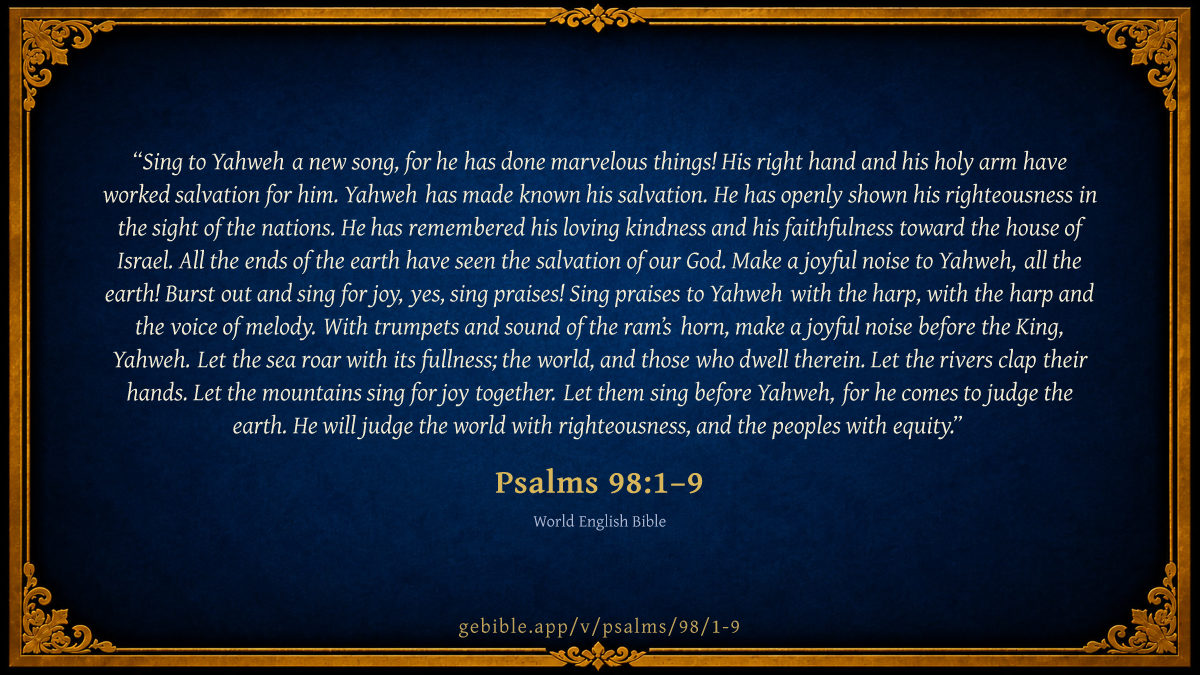
Sing to Yahweh a new song, for he has done marvelous things! His right hand and his holy arm have worked salvation for him.
Yahweh has made known his salvation. He has openly shown his righteousness in the sight of the nations.
He has remembered his loving kindness and his faithfulness toward the house of Israel. All the ends of the earth have seen the salvation of our God.
Make a joyful noise to Yahweh, all the earth! Burst out and sing for joy, yes, sing praises!
Sing praises to Yahweh with the harp, with the harp and the voice of melody.
With trumpets and sound of the ram’s horn, make a joyful noise before the King, Yahweh.
Let the sea roar with its fullness; the world, and those who dwell therein.
Let the rivers clap their hands. Let the mountains sing for joy together.
Let them sing before Yahweh, for he comes to judge the earth. He will judge the world with righteousness, and the peoples with equity.
John Calvin 1540 · Public Domain On vv1, 3, 4 1 Sing unto Jehovah a new song I have…
1 Sing unto Jehovah a new song I have already remarked, that the expression here used denotes an extraordinary, not a common, ascription of praise. This appears from the reason assigned for it, That God had manifested his salvation in a singular and incredible manner. For having spoken of marvelous things, he represents this as the sum of all, that God had procured salvation with his own right hand; that is, not by human means, or in an ordinary way, but delivering his Church in an unprecedented manner. Isaiah enlarges upon this miracle of God’s power:
“The Lord looked if there were any to help, and wondered that there was no intercessor: therefore his own arm brought salvation, and his righteousness sustained him,” (Isaiah 59:16)
Read full note →
In both passages the arm of God stands opposed to ordinary means, which although when employed they derogate nothing from the glory of God, yet prevent us from so fully discovering his presence as we might otherwise do. The language of the Psalmist amounts to a declaration that God would not save the world by means of an ordinary kind, but would come forth himself and show that he was the author of a salvation in every respect so singular. He reasonably infers that mercy of such a wonderful, and, to us, incomprehensible kind, should be celebrated by no ordinary measures of praise. This is brought out still more clearly in the verse which follows, where it is said that his salvation and righteousness are shown to the nations What could have been less looked for than that light should have arisen upon these dark and benighted places, and that righteousness should have appeared in the habitations of desperate wickedness? Salvation is mentioned first, although it is, properly speaking, the effect of righteousness. Such an inversion of the natural order is often observed in stating divine benefits; nor is it surprising that what is the means, and should be mentioned first, is sometimes set last, and follows by way of explanation. I may add, that the righteousness of God, which is the source of salvation, does not consist in his recompensing men according to their works, but is just the illustration of his mercy, grace, and faithfulness.
John Calvin's Commentaries (1540-1563) — public domain. Text from the Calvin Translation Society English edition (1840s-50s) via the Christian Classics Ethereal Library (ccel.org). Calvin's coverage is partial (roughly two-thirds of the Bible); uncommented books and verses are honest gaps, never fabricated. The 19th-century editor's footnotes and remarks are omitted so the notes are faithfully Calvin's own voice.
Geneva Bible translators 1599 · Public Domain On vv1, 2, 3, 6 That is, some song newly made in token of…
That is, some song newly made in token of their wonderful deliverance by Christ.
He preserveth his Church miraculously.
Geneva Bible (1599) marginal notes — public domain.
John Trapp 1656 · Public Domain On vv1–9 Psa 98:1 « A Psalm. » O sing unto…
Psa 98:1 « A Psalm. » O sing unto the LORD a new song; for he hath done marvellous things: his right hand, and his holy arm, hath gotten him the victory.
A Psalm] The Greek addeth, of David. A man might think it were rather of John Baptist pointing out Christ, and his kingdom, as if already come, with the great good thereby accruing to the saints.
Read full note →
Ver. 1. O sing unto the Lord a new song] See Psa 96:1, and observe how the compiler of the psalms hath hereabout set together sundry psalms of the same subject.
His right hand and his holy arm] His is emphatic, and exclusive; q.d. Christ alone hath done the deed, he is our sole Saviour, Isa 59:16; Isa 63:5. In the justification of a sinner Christ and faith are alone, saith Luther, Tanquam sponsus et sponsa in thalamo. As wax and water cannot meet together, so neither can Christ and anything else in this work. Away, then, with that devilish doctrine of the saints’ merits, Quibuscunque tandem pigmentis illita obtrudatur. If any commend or go after any other way to salvation besides Christ, he doth according to the Greek proverb, draw mischiefs to himself; as the wind Caecius doth clouds, Kακα εφ εαυτον ελκει ως ο Kαικιας νεφος, (Aristot. in Meteor.).
John Trapp, A Commentary or Exposition upon All the Books of the Old and New Testament (1647–1656) — public domain. Text from a community e-Sword module.
Matthew Poole 1685 · Public Domain On vv1, 2, 3, 4, 5, 7 God by his own only power hath overcome all…
God by his own only power hath overcome all difficulties and enemies, and hath in spite of all set Christ upon his throne, and propagated his kingdom in the world.
Matthew Poole's English Annotations on the Holy Bible (1683–1685) — public domain. Text from a community e-Sword/MySword module.
Matthew Henry 1710 · Public Domain On vv1, 4 We are here called upon again to sing unto…
We are here called upon again to sing unto the Lord a new song, as before, Psa 96:1. "Sing a most excellent song, the best song you have." Let the song of Christ's love be like Solomon's on that subject, a song of songs. A song of praise for redeeming love is a new song, such a song as had not been sung before; for this is a mystery which was hidden from ages and generations. Converts sing a new song, very different from what they had sung; they change their wonder and change their joy, and therefore change their note. If the grace of God put a new heart into our breasts, it will therewith put a new song into our mouths. In the new Jerusalem there will be new songs sung, that will be new to eternity, and never wax old. Let this new song be sung to the praise of God, in consideration of these four things: -
I. The wonders he has wrought: He has done marvellous things, Psa 98:1. Note, The work of our salvation by Christ is a work of wonder. If we take a view of all the steps of it from the contrivance of it, and the counsels of God concerning it before all time, to the consummation of it, and its everlasting consequences when time shall be no more, we shall say, God has in it done marvellous things; it is all his doing and it is marvellous in our eyes. The more it is known the more it will be admired.
Read full note →
II. The conquests he has won: His right hand and his holy arm have gotten him the victory. Our Redeemer has surmounted all the difficulties that lay in the way of our redemption, has broken through them all, and was not discouraged by the services or sufferings appointed him. He has subdued all the enemies that opposed it, has gotten the victory over Satan, disarmed him, and cast him out of his strong-holds, has spoiled principalities and powers (Col 2:15), has taken the prey from the mighty (Isa 49:24), and given death his death's wound. He has gotten a clear and complete victory, not only for himself, but for us also, for we through him are more than conquerors. He got this victory by his own power; there was none to help, none to uphold, none that durst venture into the service; but his right hand and his holy arm, which are always stretched out with good success, because they are never stretched out but in a good cause, these have gotten him the victory, have brought him relief or deliverance. God's power and faithfulness, called here his right hand and his holy arm, brought relief to the Lord Jesus, in raising him from the dead, and exalting him personally to the right hand of God; so Dr. Hammond.
III. The discoveries he has made to the world of the work of redemption. What he has wrought for us he has revealed to us, and both by his Son; the gospel-revelation is that on which the gospel-kingdom is founded - the word which God sent, Act 10:36. The opening of the sealed book is that which is to be celebrated with songs of praise (Rev 5:8), because by it was brought to light the mystery which had long been hid in God. Observe, 1. The subject of this discovery - his salvation and his righteousness, Psa 98:3. Righteousness and salvation are often put together; as Isa 61:10; Isa 46:13; Isa 51:5, Isa 51:6, Isa 51:8. Salvation denotes the redemption itself, and righteousness the way in which it was wrought, by the righteousness of Christ. Or the salvation includes all our gospel-privileges and the righteousness all our gospel-duties; both are made known, for God has joined them together, and we must not separate them. Or righteousness is here put for the way of our justification by Christ, which is revealed in the gospel to be by faith, Rom 1:17. 2. The plainness of this discovery. He has openly shown it, not in types and figures as under the law, but it is written as with a sunbeam, that he that runs may read it. Ministers are appointed to preach it with all plainness of speech. 3. The extent of this discovery. It is made in the sight of the heathen, and not of the Jews only: All the ends of the earth have seen the salvation of our God; for to the Gentiles was the word of salvation sent.
IV. The accomplishment of the prophecies and promises of the Old Testament, in this (Psa 98:3): He has remembered his mercy and his truth towards the house of Israel. God had mercy in store for the seed of Abraham, and had given them many and great assurances of the kindness he designed them in the latter days; and it was in pursuance of all those that he raised up his Son Jesus to be not only a light to lighten the Gentiles, but the glory of his people Israel; for he sent him, in the first place, to bless them. God is said, in sending Christ, to perform the mercy promised to our fathers, and to remember the holy covenant, Luk 1:72. It was in consideration of that, and not of their merit.
Matthew Henry's Commentary on the Whole Bible (1708–1710) — public domain (CC PDM 1.0). Text via the HelloAO Bible API.
John Gill 1763 · Public Domain On vv1–9 O sing unto the Lord a new song,.... An…
O sing unto the Lord a new song,.... An excellent one unto the Lord Christ, on account of the great work of redemption and salvation wrought out by him; and because of the new and living way opened by him, and because of the new dispensation of the Gospel, which takes place through him, and for the reasons next mentioned; See Gill on Psa 96:1,
for he hath done marvellous things; by assuming human nature, in that he, being God, became man, took flesh of a virgin, even pure and uncorrupted, a clean thing out of an unclean; which he took into personal union with himself, and that for the sake of sinful creatures: a most marvellous affair this! which calls for a new song from men, as it had from the angels. In this nature he taught wonderful doctrines, at which his hearers were astonished, wondering from whence he had his wisdom; and in it he did many miraculous works, which filled them with amazement above measure; and especially in it he performed the amazing and surprising work of man's redemption, an instance of the marvellous lovingkindness and astonishing wisdom of God; performed in a manner quite stupendous, through Christ's being made under the law both the precept and penalty of it; through his being made sin and a curse for men, even for the ungodly, sinners and enemies; a redemption which is of the souls of men from sin, Satan, and the law; a complete and plenteous one, which includes and secures all the blessings of grace and glory, justification, pardon, adoption, and eternal life. To which may be added the resurrection of himself from the dead, his ascension to heaven, the effusion of the extraordinary gifts of the Spirit on the apostles, the wonderful success of the Gospel in the Gentile world, the support of his interest against all the powers on earth, the destruction of the man of sin, the calling of the Jews, and the bringing in of the fulness of the Gentiles in the latter day; all which marvellous events require a new song of praise: another reason of which follows:
Read full note →
his right hand and his holy arm hath gotten him the victory: over sin, Satan, the world, death, and hell, in which he has made his people sharers, yea, more than conquerors; and therefore may well sing the new triumphant song to him: the words may be rendered, "hath brought salvation to him" (b); as in Isa 59:16; to him personally, he raising himself from the dead, as a triumphant Conqueror; to him mystically, his body the church, to whom he is the author of salvation; or to him, that is, to his Father, in obedience to whose will he wrought out salvation for his people, and for the honour of his name, and for the glorifying of his perfections. This was done by him alone, by his right hand of power, by the mighty arm of his strength, and which no mere creature could ever have performed: and this he did in a way of holiness; his holy arm did it in a way that maintains and secures the glory of divine holiness and justice.
(b) "salutem attulit ei", Junius & Tremellius, Piscator; so Tigurine version, Munster, Cocceius, Gejerus, Michaelis.
John Gill's Exposition of the Whole Bible (1746–1763) — public domain (CC PDM 1.0). Text via the HelloAO Bible API.
John Wesley 1765 · Public Domain On vv1–2 This psalm sets forth the glory of the Redeemer,…
This psalm sets forth the glory of the Redeemer, ver. 1-3. And the joy of the redeemed, ver. 4-9. A psalm.
John Wesley, Explanatory Notes Upon the Whole Bible (1754–1765) — public domain. Text via the GEBible commentary corpus.
Adam Clarke 1810 · Public Domain On vv1, 2, 3, 5, 6, 7, 8, 9 God is celebrated for his wondrous works, 1, 2;
PSALM XCVIII
God is celebrated for his wondrous works, 1, 2;
Read full note →
for the exact fulfilment of his gracious promises, 3.
The manner in which he is to be praised, 4-6.
Inanimate creation called to bear a part in this concert, 7, 8.
The justice of his judgments, 9.
NOTES ON PSALM XCVIII
In the Hebrew this is simply termed מזמור mizmor, a Psalm. In the Chaldee, A prophetic Psalm. In the Vulgate, Septuagint, AEthiopic, A Psalm of David. In the Syriac it is attributed to David, and stated to be composed concerning the "Restoration of the Israelites from Egypt; but is to be understood spiritually of the advent of the Messiah, and the vocation of the Gentiles to the Christian faith."
The Psalm in its subject is very like the ninety-sixth. It was probably written to celebrate the deliverance from the Babylonish captivity; but is to be understood prophetically of the redemption of the world by Jesus Christ.
Verse 1. A new song] A song of excellence. Give him the highest praise. See on Ps 96:1.
Hath done marvellous things] נפלאות niphlaoth, "miracles, " the same word as in Ps 96:3, where we translate it wonders.
His holy arm] His Almighty power, -
Hath gotten him the victory.] הושיעה לו hoshiah llo, "hath made salvation to himself."
Adam Clarke's Commentary on the Bible (1810–1826) — public domain. Text from a community e-Sword/MySword module.
Joseph Benson 1811 · Public Domain On vv1, 2, 4 Psa 98:1. O sing unto the Lord a new…
Psa 98:1. O sing unto the Lord a new song — See on Psa 96:1. For he hath done marvellous things — The work of our redemption and salvation by Christ is a work of wonder. If we take a view of all the steps of it, from the contrivance of it before all time to the consummation of it, and its everlasting consequences when time shall be no more, we shall say, God has in it done marvellous things; it is all his doing, and it is marvellous in our eyes. His right hand, &c., hath gotten him the victory — God, by his own only power, hath overcome all difficulties and enemies, and hath, in spite of all opposition, raised Christ from the dead, and set him upon his throne, and propagated his kingdom in the world.
Joseph Benson's Commentary on the Old and New Testaments (1811–1818) — public domain. Text from a community e-Sword module.
Albert Barnes 1834 · Public Domain On vv1–9 O sing unto the Lord a new song -…
O sing unto the Lord a new song - Compare Psa 33:3; Psa 96:1. “For he hath done marvelous things.” Things suited to excite wonder, or to fill the mind with astonishment. See Psa 77:14; Psa 86:10.
His right hand - The instrument by which we execute any purpose. Compare Isa 59:16; Isa 63:5.
Read full note →
And his holy arm - The arm of his holiness; that is, his arm put forth in a righteous cause, or vindicating that which is right.
Hath gotten him the victory - literally, “has worked salvation for him:” for himself, or in his own cause. The victory - the salvation - was really in defense of his own government; in maintaining his own authority against those who set themselves in opposition to it. What is here said may be applied to all that God does. It is really in his own cause, in order to maintain the principles of his own administration.
Albert Barnes' Notes on the Bible (1834–1885) — public domain. Text from a community e-Sword/MySword module.
Lange's Commentary on the Holy Scriptures 1864 · Public Domain On v1 Psalms 98
Psalms 98
A Psalm
Read full note →
O sing unto the Lord a new song;
For he hath done marvellous things:
His right hand, and his holy arm, hath gotten him the victory.
2 The Lord hath made known his salvation:
His righteousness hath he openly shewed in the sight of the heathen.
3 He hath remembered his mercy and his truth toward the house of Israel:
All the ends of the earth have seen the salvation of our God.
4 Make a joyful noise unto the Lord, all the earth:
Make a loud noise, and rejoice, and sing praise.
5 Sing unto the Lord with the harp;
With the harp, and the voice of a psalm.
6 With trumpets and the sound of cornet
Make a joyful noise before the Lord, the King.
7 Let the sea roar, and the fulness thereof;
The world, and they that dwell therein.
8 Let the floods clap their hands:
Let the hills be joyful together
9 Before the Lord; for he cometh to judge the earth:
With righteousness shall he judge the world,
And the people with equity.
EXEGETICAL AND CRITICAL
Contents and Composition.—This Psalm is furnished merely with the superscription: mizmor, and is ascribed by the Sept. and Syriac Versions to David. It agrees most closely with Psalms 96. Yet there is not an entire absence of peculiar expressions, to which, especially, Psa_98:1 c and 8 belong. The wonderful deeds of God in behalf of His people, in the sight of all the nations, for the display to the world of His righteousness, mercy, and truth towards the house of Israel, are cited here also in order to justify the call sent forth for the praise of Jehovah. This points to the modes of expression characteristic of the second part of Isaiah, with reference to the restoration of the people after the judgment decreed upon Babylon. There is nothing to indicate decisively a later period, whether a victory over the Persians (De Wette), or that Purim-festival which was celebrated after the victory (2Ma_15:26), to which the other Psalms are supposed to relate as triumphal songs (Hitzig). For the clapping of the hands by boys at the Purim-feast, whenever Haman was named, is something quite different from the clapping of the hands figuratively applied in Psa_98:8 to streams, in order to set forth the joy at the appearance of God, as King in Zion, before the whole world—a joy universally felt. The reference to the song of the Israelites after their departure from Egypt (Syriac version) was occasioned merely by the mention of the sea, which is called upon to join in the praise of God for His wonderful deliverance of Israel, accomplished before the eyes of the heathen. The division is simple and natural. In the first strophe the call is justified by pointing to the deeds of Jehovah, and in the second it is addressed specially to the people, the Levites, and the priests, in the third it is presented in its relations to the world in general.
Psa_98:1 ff. His right hand hath helped Him [E. V.: His right hand … hath gotten Him the victory]. This means that God Himself has intervened, and that decisively, by His immediate miraculous interference (Isa_59:16; Isa_63:5) and by His holy arm (Isa_52:10). [Perowne prefers to render: “have gotten Him salvation,” on account of the recurrence of a noun from the same root in Psa_98:2-3, where this is the most suitable translation.—J. F. M.] The remembering in Psa_98:3, expresses more than retaining in the memory, as contrasted with forgetting (1Sa_1:11). It alludes to the fulfilment of promises given, or to the execution of resolutions taken, as contrasted with their abandonment (Gen_24:27). [On Psa_98:7 Hengstenberg: “The roaring suits the fulness of the sea as well as the sea itself; it is used in Job_39:25 of the loud shout of the human voice.”—J. F. M.] The clapping of the hands is employed as a token of applause and an expression of joy at the ascension of kings (2Ki_11:12; Psa_47:2). The waves of the sea exalting themselves are represented also in Hab_3:10 as hands stretched forth on high.
DOCTRINAL AND ETHICAL
1. The Church can be helped only through the Lord its God. But there is a difference between the ordinary means of grace and extraordinary help. Since God employs both according as circumstances require, so must the Church, while awaiting the latter, not neglect the former. She is, by such a course, strengthened in hope as well as in patient waiting, and is both rendered better fitted to praise God’s wonders, and encouraged to engage in such praise.
2. The wonders of God among His people are primarily designed for them, and earnestly directed to their deliverance. But they are not to be restricted to that nation, nor to be turned to the account of selfishness. And therefore some of them are performed before the eyes of the whole world, and are also to be made known to the heathen, in order that they may redound to the good of the world, and that God may be praised among all nations, when He shall have changed the desolated earth by righteousness and justice into an abode of salvation and joy.
HOMILETICAL AND PRACTICAL
What God does is not merely done rightly; what He has done in Zion must promote also the good of the whole world.—The renovation of the earth by God’s coming, so as to be changed into the seat of His kingdom.—Why is it that the songs in praise of God are ever becoming less frequent among us? Great and special blessings deserve great, special, and most fitting thanks.—The victory which Christ has gained, and the deliverance which He sought to achieve, will be blessings to us, if we believe in Him, since it was for our sakes that He undertook this war.—Christ has gained the victory with His own arm; therefore all merit on the part of the Church and all her own good works are excluded.—Where Christ’s kingdom breaks forth mightily in praise, it requires a very strong influence to make it cease.
[Matt. Henry: Converts sing a new song, very different from what they had sung; they change their wonder and change their joy, and therefore change their note. If the grace of God put a new heart into our breast, it will therewith put a new song into our mouths.
Barnes: One cannot read this Psalm without being a happier man; without lofty views of God; without feeling that He is worthy of universal praise; without recognizing that he is in a world where the mind should be joyful; that he is under the dominion of a God whose reign should fill the mind with gladness.—J. F. M.]
Lange's Commentary on the Holy Scriptures (Critical, Doctrinal, and Homiletical), ed. John Peter Lange, English translation edited by Philip Schaff (1864–1880) — public domain. Text from a community e-Sword module.
Daniel D. Whedon 1874 · Public Domain On vv1, 2, 3, 4, 6, 7, 8 1. A new song—See note on Psa_96:1.
1. A new song—See note on Psa_96:1.
His right hand, and his holy arm—Symbols of his most excellent power and majesty.
Read full note →
Hath gotten him the victory—The form of expression denotes, that as the cause was God’s, so he achieved deliverance in a manner to signalize his own name. The description is parallel to Isa_52:10; Isa_59:16; and applies, prophetically, to Christ, his resurrection, and his victory over his enemies.
Daniel D. Whedon (gen. ed.), Commentary on the Old and New Testaments (1874–1909) — public domain. Text from a community e-Sword module.
The Cambridge Bible for Schools and Colleges 1878 · Public Domain On vv1–9 1. O sing unto the Lord a new song]…
1. O sing unto the Lord a new song] So Psa_96:1 a. marvellous things] Cp. Psa_96:3 b.
his own right hand, and his holy arm, hath wrought salvation for him] He needed no help: His own might was all-sufficient to deliver Israel from Babylon. Cp. Isa_52:10; Isa_59:16; Isa_63:5; Psa_44:3. The restoration from the Exile was a second Exodus, and this ‘new song’ is an echo of the ancient ‘Song of Moses.’ Cp. Exo_15:2; Exo_15:6; Exo_15:11-12.
Read full note →
1–3. Praise Jehovah for the glorious salvation which He has wrought.
The Cambridge Bible for Schools and Colleges (gen. ed. J. J. S. Perowne; Cambridge University Press, 1878–1918) — public domain. Text from a community e-Sword module.
Ellicott's Commentary for English Readers 1878 · Public Domain On vv1, 4, 5, 6, 7, 8, 9 (1) Victory.—The word more commonly rendered “salvation,” as, indeed,…
(1) Victory.—The word more commonly rendered “salvation,” as, indeed, in next verse.
A Bible Commentary for English Readers, edited by Charles John Ellicott (1878–1897) — public domain. Text from a community e-Sword module.
The Pulpit Commentary 1880 · Public Domain On vv1–9 ANOTHER psalm of joy on the coming of God…
ANOTHER psalm of joy on the coming of God to judge the earth (ver. 9). It is entitled simply "a psalm," and has no very peculiar features. Metrically, it is best viewed as composed of three strophes of three verses each. The first strophe gives the grounds of praise (vers. 1-3); the next describes the method of praise (vers. 4-6); the third contains a call on all nature to join in the praise (vers. 7-9).
O sing unto the Lord a new song. (comp. Ps 96, which opens similarly) The faithful and wise steward is ever bringing out of his treasures things which are at once old and "new." For he hath done marvellous things. The "marvellous things" which God has done for man constitute the first ground for praising him. These marvels may be either those of his ordinary providence, or special interpositions and deliverances. His right hand, and his holy arm, hath gotten him the victory; rather, hath wrought salvation for him. (see the Revised Version; and comp. Isa_59:16 Isa_63:5)
Read full note →
HOMILIES BY S. CONWAY Ver. 1. Jehovah"s victories.
This psalm is almost an echo of Ps 96, and, like that, tells of the triumphant issue of the Lord"s great battle. No doubt the psalmist had some special event in the history of God"s people in his mind some glorious victory given to them; but his words here bring to our thoughts God"s spiritual victories, far larger and wider triumphs than any that Israel ever knew. Consider, therefore
I THE VICTORIES OF THE LORD WHICH THIS PSALM REMINDS US OF.
1. There is that of the past for humanity generally, for the whole world. Mankind was in sore distress; and he had no help in himself, he had become the devil"s prey. But how was this to be remedied? The Incarnation, the Atonement, the gift of the Holy Ghost, were the answer. And so now for every child of man who will avail himself of it, there is full salvation provided. The guilt of our sin, our corrupt nature, and the holy Law of God, were all against us; but in this great victory of the Lord, guilt was put away, man"s evil nature subdued, and the Law honoured as it had never been or could be before. Well may we say with St. Paul, "Thanks be to God, who giveth us the victory through our Lord Jesus Christ". (1Co_15:57)
2. There is that of the present that which the individual believer rejoices in for himself. The sense of condemnation is gone, the power of sin is broken, the tyranny of the devil trampled on, the might of sorrow and care gone, the fear of death vanished, and eternal life won that is the victory which is given now to many a believing soul, to every soul who will have it.
3. That of the future that of the Church triumphant, when every foe is vanquished, when all that have tried and troubled us is no more, and when we are presented "faultless before the presence of the Lord"s glory with exceeding joy.
II WHAT IS HERE SAID OF THEM.
1. They are marvellous. Are they not so? Think of what stood in the way of each.
2. They are all of God. "His right hand, and his holy arm, hath," etc. How evident this is! Did ever any hear of a really saved soul saying aught else than this? And:
3. They are victories of believers. Not of mere compassion, still less of mere power, but it was "his holy arm "that triumphed. The law of righteousness and truth was maintained.
4. They demand a new song. And they have it, and will forevermore. Let us be in that choir. S.C.
HOMILIES BY R. TUCK Ver. 1. The Lord"s victory.
"His right hand, and his holy arm, hath gotten him the victory." This is to be treated as a joy song of the returned Exiles, who regarded themselves as delivered and restored, because their God had fought for them, overcome all their foes, and mastered all their hindrances and difficulties. It was not their right hand that had gotten them the victory. It was God"s right hand that had gotten him the victory, of which they were permitted to reap the full benefit. This victory quickened thought, and brought to mind the assurances of the Prophet Isaiah, e.g. "The Lord hath made bare his holy arm in the eyes of all the nations; and all the ends of the earth shall see the salvation of our God". (Isa_52:10) And the victory brought to view the older Israelite history, from the great Red Sea victory and onward. It was plain enough that God had been always getting the victory, always redeeming, always recovering, rescuing, and restoring, always the Saviour. The type of the Divine relations with the people is given in the redemption from Egypt, and then Israel lifted a joy song, acknowledging concerning Jehovah, "Thy right hand, O Lord, is become glorious in power; thy right hand, O Lord, hath dashed in pieces thine enemy." For a chorus to their song the women sang, "Sing ye to the Lord, for he hath triumphed gloriously; the horse and his rider hath he thrown into the sea.
I THE VICTORIES WHICH THE LORD HAS WON. Illustrate:
1. Those won in the older ages, and kept on record in the Old Testament.
2. Those won in the times of Christ, and kept on record in the New Testament.
3. Those won in the ages of the Christian Church, especially in the missionary ages.
4. Those of which we have personal experience, as bearing relation to our past distresses.
II THE FIGHT IN WHICH THE LORD IS NOW ENGAGED. It is not enough to say that it is with evil in all its forms; it is also with the consequences of evil in all their varieties: as these affect the race, the nation, the society, the family, or the individual. We recognize the fight, we do not always see that it is the Lord fighting the Lord with us in the fight.
III THE VICTORIES WHICH THE LORD WILL WIN. "His bow ever abides in strength;" "He goeth forth conquering and to conquer." He will conquer in the one. He will conquer in the many. One day the final Victor over all evil will "deliver up the kingdom to the Father, and God shall be all in all. R.T.
HOMILIES BY C. SHORT Vers. 1-9. Universal salvation.
"The last great revelation, the final victory of God, when his salvation and his righteousness, the revelation of which he has promised to the house of Israel, shall be manifested both to his own people and to all the nations of the earth.
I GOD HAS REVEALED A GREAT SALVATION FOR THE WORLD. (Vers. 1-3) Distinguished by three great things.
1. Righteousness. (Ver. 2) Reveals his righteousness in and by means of Christ in order to secure our righteousness. Righteousness the most comprehensive description of the Divine character and work.
2. Mercy, or loving kindness. (Ver. 3) Loving kindness towards the sinful and unworthy. Mercy and righteousness compatible mercy a part of righteousness.
3. Truth, or faithfulness. (Ver. 3) "Loving kindness and faithfulness, the two attributes expressive of God"s covenant relationship to his people." He fulfils all the promises, and more than all the promises, which his mercy has made.
II THE JOY WHICH THIS SALVATION SHOULD CREATE. (Vers. 4-9)
1. The intensity of this joy. (Vers. 4-6) To be uttered by all possible means and instruments. "A joyful noise." The human voice is to be aided and supplemented by instrumental music to give more intense expression to it.
2. The extent of the joy. (Vers. 7-9) The sea is to take up the song; and the floods all to clap their bands; and the mountains are to rejoice together. The whole earth is to rejoice, because God comes to bring it from sin and sorrow into a state of salvation and joy. The poet projects himself into the grandest material objects, and they become sympathetic with his joys and sorrows. S.
The Pulpit Commentary (1880–1919), ed. H.D.M. Spence-Jones & Joseph S. Exell — public domain. Text from a community e-Sword module.
Charles H. Spurgeon 1885 · Public Domain On vv1–9 This sacred ode, which bears simply the title of…
This sacred ode, which bears simply the title of "A Psalm, "follows fitly upon the last, and is evidently an integral part of the series of royal psalms. If Ps 97:1-12 described the publication of the gospel, and so the setting up of the kingdom of heaven, the present Psalm is a sort of Coronation Hymn, officially proclaiming the conquering Messiah as Monarch over the nations, with blast of trumpets, clapping of hands, and celebration of triumphs. It is a singularly bold and lively song. The critics have fully established the fact that similar expressions occur in Isaiah, but we see no force in the inference that therefore it was written by him; on this principle half the books in the English language might be attributed to Shakespeare. The fact is that these associated Psalms make up a mosaic, in which each one of them has an appropriate place, and is necessary to the completeness of the whole, and therefore we believe them, to be each and all the work of one and the same mind. Paul, if we understand him aright, ascribes Ps 95:1-11 to David, and as we believe that the same writer must have written the whole group, we ascribe this also to the son of Jesse. Whoever that may be, the song is worthy to rank among the most devout and soul stirring of sacred lyrics.
We have here three stanzas of three verses each. In the first, Ps 98:1-3, the subject of praise is announced, in the second, Ps 98:4-6, the manner of that praise is prescribed; and in the third, Ps 98:7-9, the universal extent of it is proclaimed.
Read full note →
Ver. 1. O sing unto the LORD a new song; for he hath done marvellous things. We had a new song before (Ps 96:1-13) because the Lord was coming, but now we have another new song because he has come, and seen and conquered. Jesus, our King, has lived a marvellous life, died a marvellous death, risen by a marvellous resurrection, and ascended marvellously into heaven. By his divine power he has sent forth the Holy Spirit doing marvels, and by that sacred energy his disciples have also wrought marvellous things and astonished all the earth. Idols have fallen, superstitions have withered, systems of error have fled, and empires of cruelty have perished. For all this he deserves the highest praise. His acts have proved his Deity, Jesus is Jehovah, and therefore we sing unto him as the LORD.
His right hand, and his holy arm, hath gotten him the victory; not by the aid of others, but by his own unweaponed hand his marvellous conquests have been achieved. Sin, death, and hell fell beneath his solitary prowess, and the idols and the errors of mankind have been overthrown and smitten by his hand alone. The victories of Jesus among men are all the more wonderful because they are accomplished by means to all appearance most inadequate; they are due not to physical but to moral powerthe energy of goodness, justice, truth; in a word, to the power of his holy arm. His holy influence has been the sole cause of success. Jesus never stoops to use policy, or brute force; his unsullied perfections secure to him a real and lasting victory over all the powers of evil, and that victory will lie gained as dexterously and easily as when a warrior strikes his adversary with his right hand and stretches him prone upon the earth. Glory be unto the Conqueror, let new songs be chanted to his praise. Stirred by contemplating his triumphs, our pen could not forbear to praise him in the following hymn:
Forth to the battle rides our King;
He climbs his conquering ear;
He tits his arrows to the string,
And smites his foes afar.
Convictions pierce the stoutest hearts,
They bleed, they faint, they die;
Slain by Immanuel's well aligned darts,
In helpless heaps they lie.
Behold, he bares his two edged sword,
And deals almighty blows,
His all revealing, killing word
Mixed with joint and marrow goes.
Anon arrayed in robes of grace
He rides the trampled plain,
With pity beaming from his face,
And mercy in his train.
Mighty to save he now appears,
Mighty to raise the dead,
Mighty to stanch the bleeding wound,
And lift the fallen head.
Victor alike in love and arms,
Myriads before him bend:
Such are the Conqueror's matchless charms.
Each foe becomes his friend.
They crown him on the battle field
Of all the nations King;
With trumpets and with cornets loud
They make the welkin ring.
The salvation which Jesus has accomplished is wrought out with wonderful wisdom, hence it is ascribed to his right hand; it meets the requirements of justice, hence we read of his holy arm; it is his own unaided work, hence all the glory is ascribed to him; and it is marvellous beyond degree, hence it deserves a new song.
Title. The inscription of the psalm in Hebrew is only the single word rwmzm Mizmor, "Psalm" (whence probably the title "orphan Mizmor" in the Talmudic treatise Avodah Zara). J.J.S. Perowne.
Title. Hengstenberg remarks, "This is the only psalm which is entitled simply `a psalm.' This common name of all the psalms cannot be employed here in its general sense, but must have a peculiar meaning." He considers that it indicates that this is the lyric accompaniment of the more decidedly prophetical psalm which precedes it, in fact, the psalm of that prophecy. He also notes that in the original we have in Ps 98:5-6 words akin to the title brought into great prominence, and perhaps this may have suggested it.
Title. It is at least interesting to notice that a song Of Zion which so exults in the king's arrival should be called preeminently rwmzm, Mizrnor; as if the Psalm of Psalms were that which celebrates Israel, and the earth at large, blessed in Messiah's Advent. Andrew A. Bonar.
Whole Psalm. A noble, spirit stirring psalm. It may have been written on the occasion of a great national triumph at the time; but may, perhaps, afterwards be taken up at the period of the great millennial restoration of all things. The victory here celebrated may be in prophetic vision, and that at Armageddon. Then will salvation and righteousness be openly manifested in the sight of the hostile nations. Israel will be exalted; and the blessed conjunction of mercy and truth will gladden and assure the hearts of all who at that time are Israelites indeed. Godliness will form the reigning characteristic of the whole earth. Thomas Chalmers.
Whole Psalm. The subject of the Psalm is the praise of Jehovah. It consists of three strophes of three verses each. The first strophe shows why, the second how Jehovah is to be praised; and the third who are to praise him. Frederick Fysh.
Whole Psalm. This psalm is an evident prophecy of Christ's coming to save the world; and what is here foretold by David is, in the Blessed Virgin's Song chanted forth as being accomplished. David is the Voice, and Mary is the Echo.
1. DAVID. "O sing unto the Lord a new song." (The Voice.) MARY. "My soul doth magnify the Lord." (The Echo.)
2. DAVID. "He hath done marvellous things." (The Voice.) MARY. "He that is mighty hath done great things." (The Echo.)
3. DAVID. "With his own right hand and holy arm hath he gotten himself the victory." (The Voice.) MARY. "He hath showed strength with his arm, and scattered the proud in the imagination of their hearts." (The Echo.)
4. DAVID. "The Lord hath made known his salvation; his righteousness hath he openly showed, "&c. (The Voice.) MARY. "His mercy is on them that fear him, from generation to generation." (The Echo.)
5. DAVID. "He hath remembered his mercy and his truth toward the house of Israel." (The Voice.) MARY. "He hath holpen his servant Israel, in remembrance of his mercy." (The Echo.)
These parallels are very striking; and it seems as if Mary had this psalm in her eye when she composed her song of triumph. And this is a farther argument that the whole psalm, whether it record the deliverance of Israel from Egypt, or the Jews from the Babylonish captivity, is yet to be ultimately understood of the redemption of the world by Jesus Christ, and the proclamation of his gospel through all the nations of the earth: and taken in this view, no language can be too strong, nor poetic imagery too high, to point out the unsearchable riches of Christ. Adam Clarke.
Ver. 1. 0 sing unto the LORD a new song. This is man's end, to seek God in this life, to see God in the next; to be a subjection the kingdom of grace, and a saint in the kingdom of glory. Whatsoever in this world befalleth us, we must sing: be thankful for weal, for woe: songs ought always to be in our mouth, and sometimes a new song: for so David here, "sing a new song:" that is, let us put off the old man, and become new men, new creatures in Christ: for the old man sings old songs: only the new man sings a new song; he speaketh with a new tongue, and walks in new ways, and therefore doth new things, and sings new songs; his language is not of Babylon or Egypt, but of Canaan; his communication doth edify men, his song glorify God. Or a new song, that is, a fresh song, nova res, novum canticum, new for a new benefit. Eph 5:20: "Give thanks always for all things." It is very gross to think God only in gross, and not in parcel. Hast thou been sick and now made whole? praise God with the leper, Lu 17:11-19: sing a new song for this new salve. Dost thou hunger and thirst after righteousness, whereas heretofore thou couldest not endure the words of exhortation and doctrine? sing a new song for this new grace. Doth Almighty God give thee a true sense of thy sin, whereas heretofore thou didst draw iniquity with cords of vanity, and sin as it were with cart ropes, and wast given over to work all uncleanness with greediness? 0 sing, sing, sing, a new song for this new mercy.
Or new, that is, no common or ordinary song; but as God's mercy toward us is exceeding marvellous and extraordinary, so our thanks ought to be most exquisite, and more than ordinary: not new in regard of the matter, for we may not pray to God or praise God otherwise than he hath prescribed in his word, which is the old way, but new in respect of the manner and making, that as occasion is offered, we may bear our wits after the best fashion to be thankful.
Or, because this Psalm is prophetical, a new song, that is, the song of the glorious angels at Christ's birth, "Glory to God in the highest, and on earth peace, good will toward men, "(Lu 2:14); a song which the world never heard before: that the seed of the woman should bruise the serpent's head is an old song, the first that ever was sung; but this was no plain song, till Christ did manifest himself in the flesh. In the Old Testament there were many old songs, but in the New Testament, a new song. That "unto us is born a Saviour, which is Christ the Lord, "is in many respects a new song;for whereas Christ was but shadowed in the Law, he is showed in the Gospel; and new, because sung of new men, of all men. For the sound of the Gospel is gone through all the earth, unto the ends of the world (Ro 10:18); whereas in old time God's old songs were sung in Jewry: "His name is great in Israel. In Salem also is his tabernacle, and his dwelling place in Zion, "Ps 76:1-2. John Boys.
Ver. 1. A new song. O ye who are new in Christ, though formerly old in the Old Adam, sing ye to the Lord. Psalter of Peter Lombard, 1474.
Ver. 1. He hath done marvellous things. He has opened his greatness and goodness in the work of redemption. What marvels has not Christ done? 1, He was conceived by the Holy Ghost. 2. Born of a virgin. 3. Healed all manner of diseases. 4. Fed thousands with a few loaves and fishes. 5. Raised the dead. 6. And what was more marvellous, died himself. 7. Rose again by his own power. 8. Ascended to heaven. 9. Sent down the Holy Ghost. 10. And made his apostles and their testimony the instruments of enlightening, and ultimately converting, the world. Adam Clarke.
Ver. 1. His right hand. Since the Psalmist says, that Christ hath gotten him the victory by his right hand and his arm, it is not only a demonstration of his divine and infinite power, but also excludes all other means, as the merits of saints and their meretricious works. Martin Luther.
Ver. 1. Holy arm. The creation was the work of God's fingers: "When I consider thy heavens, the work of thy fingers, "Ps 8:3; redemption a work of his arm; "His holy arm hath gotten him the victory"; yea, it was a work of his heart, even that bled to death to accomplish it. Thomas Adams.
Ver. 1. A clergyman in the county of Tyrone had, for some weeks, observed a little ragged boy come every Sunday, and place himself in the centre of the aisle, directly opposite the pulpit, where he seemed exceedingly attentive to the services. He was desirous of knowing who the child was, and for this purpose hastened out, after the sermon, several times, but never could see him, as he vanished the moment service was over, and no one knew whence he came or anything about him. At length the boy was missed from his usual situation in the church for some weeks. At this time a man called on the minister, and told him a person very ill was desirous of seeing him; but added, "I am really ashamed to ask you to go so far; but it is a child of mine, and he refuses to have any one but you; he is altogether an extraordinary boy, and talks a great deal about things that I do not understand." The clergyman promised to go, and went, though the rain poured down in torrents, and he had six miles of rugged mountain country to pass. On arriving where he was directed, he saw a most wretched cabin indeed, and the man he had seen in the morning was waiting at the door. He was shown in, and found the inside of the hovel as miserable as the outside. In a corner, on a little straw, he beheld a person stretched out, whom he recognised as the little boy who had so regularly attended his church. As he approached the wretched bed the child raised himself up, and, stretching forth his arms, said, "His own right hand and his holy arm hath gotten him the victory, "and immediately he expired. K. Arvine.
Ver. 1. A new song. The duty, beauty, and benefit of maintaining freshness in piety, service, and worship.
Ver. 1. He hath done marvellous things.
1. He hath created a marvellous universe.
2. He has established a marvellous government.
3. He hath bestowed a marvellous gift.
4. He hath provided a marvellous redemption.
5. He hath inspired a marvellous book.
6. He hath opened a marvellous fulness.
7. He hath effected a marvellous transformation. W. Jackson.
Ver. 1. The victory. The victories of God in judgment, and in mercy: especially the triumphs of Christ on the cross, and by his Spirit in the heart, and in and by the church at large.
Psalms 98:2*
Charles H. Spurgeon's The Treasury of David (1869–1885) — public domain. Psalms only. Text from a community e-Sword/MySword module.
The Biblical Illustrator 1887 · Public Domain On vv1, 2, 7 O sing unto the Lord a new song.
Psa_98:1-9
O sing unto the Lord a new song.
Read full note →
Genuine praise
I. Genuine praise is founded on the strongest reason (Psa_98:1-2). Why should man be so urgently called on to praise God?
1. Because of the extraordinary deliverance which was vouchsafed to him--from the bondage of ignorance, carnality, prejudice, and guilt. Unfallen angels should always sing praises unto the Lord, and they always do; but we have no reason to believe that they have such deliverances to celebrate as we have.
2. Because all the extraordinary deliverances vouchsafed to him originated in the mind of God. His mercy, His truth, . . . His righteousness. As transgressors of His laws and rebels against His government, men, instead of having any just reason for expecting deliverance, have the strongest reasons to apprehend eternal bondage. It was of His free love and compassion that He interposed. Therefore sing unto the Lord a new song.
II. Genuine praise should be rendered by all with rapturous enthusiasm.
1. By all. This means all mankind. Praise should be as wide as the race. Its spirit, like the tide in ocean, should heave and swell, and rule the mighty mass.
2. By all with joy. True praise is not a ceremonial service, not an irksome duty, still less a moan of sadness, it is the soul breaking out into the transports of delight.
3. By all with enthusiastic rapture. (Homilist.)
Christianitys most joyous fact
These words, this Easter Sunday, will find an echo in every Christian heart and congregation. The hymns of Lent, and the passion songs, are beautiful, and touch the heart; but if they were not to be followed by any Easter hymns our condition would indeed be sad. It would be a night without a morning. But today, everywhere, the Church resounds with this song, O sing unto the Lord a new song! For the great Easter message is--
I. A most assured word.
1. It bears the bloodstained seals of many witnesses. See the Gospel histories, listen to the impassioned arguments of St. Paul, who brands himself as a false witness if his message be not true.
2. Upon it rests the massive building of the entire Church of Christ. If it had been founded upon imposture or falsehood, would it be standing now?
3. And if this also testifies the heartfelt experience of all true Christians, in themselves they have the realized presence of Christ. He speaks to them, they to Him. They know He is with them.
II. It is a most precious word. For it enables us to believe properly, to live godly, and to die happily. (Charles Von Gerok, D. D.)
A summons to song
According to the language of the royal singer, Gods great cathedral of nature is full of magnificent harmonies. The heavens rejoice; the earth sings; the sea and the fulness thereof roar in deep-toned bass; the fields with all they contain, and the trees of the woodland with their ten thousand tongues, peal forth melodies. This chorus we have in creation; and the laziest in the song is man, who should be loudest, noblest, heartiest. Oh, it is time for us to be roused to duty by an inspired voice! We have been musicless too long, prosaic too long, dormant and mute too long, ungrateful and selfish too long. We want the summons to song, to action, to thankfulness. O sing unto the Lord a new song, etc. And why a new song? Because new mercies, new deliverances, new gifts, new triumphs demand new songs. Gods marvellous things, or doings, are many and multiform. They are to be seen in creation, in providence, in redemption, in grace, in the world, in the Church, in nations, in families, in individuals. Everywhere in His theatre of action are His wonders manifest. It is impossible for us to be praiseless, if we only pause and recount our Fathers gracious dealings, and manifold mercies, and wondrous goodness towards us. But interpreters of the Scripture refer this psalm to Jesus Christ. Its prophetic finger points to Him who was not only marvellous in doing, but likewise marvellous in person. From the manger to the ascension-mount, the cloud of mystery enveloped Him. At times He seemed near, intimately near as a brother-man--at other times distant, infinitely measured off as the awful and the mighty God. Every privilege, every blessing, every gift, every enjoyment, every mercy crowded into our daily lives, flows to us through that Divinity which, blending with humanity, satisfied the claims of holiness, and instituted peace between heaven and earth, God and man. Have we, then, no song to sing unto Him who has done such marvellous things? Yes, thank Heaven, we have a song; and while the redeemed on high chant it, we join in the chorus, saying, Worthy is the Lamb. Once more, not only are we called upon to break forth into joyful song because of the doings of marvellous things, but also because of the achievement of splendid victory. His right hand and holy arm hath gotten Him the victory. This unquestionably has specific reference to the sternest battle and grandest conquest ever fought and won on the worlds great carnage-field. Through Christs victory we shall be victorious. Our life in grace is a prolonged battle--a succession of engagements. We are on the winning side, and shall be more than conquerors through Him that hath loved us. Awaiting us, in the not far-distant heaven, is the crown, the palm, the robe, the kingdom, and the welcome song! Let our onward march be brightened by the music of martial songs and celebrations of our Captains praise, whose right hand and holy arm will assuredly secure for us the victory. (J. O. Keen, D. D.)
The Biblical Illustrator, edited by Joseph S. Exell (c. 1880s–1900s) — public domain. Text from a community e-Sword module.
The Expositor's Bible 1887 · Public Domain On v1 Psalms 98
Psalms 98
THE two preceding psalms correspond in number and division of verses. The first begins with a summons to sing to Jehovah; the second, with a proclamation that He is King. A precisely similar connection exists between this and the following psalm. Psalms 98 is an echo of Psalms 96 and Psalms 99 or Psalms 97. The number of verses in each of the second pair is nine, and in each there is a threefold division. The general theme of both pairs is the same, but with considerable modifications. The abundant allusions to older passages continue here, and the second part of Isaiah is especially familiar to the singer.
Read full note →
The first strophe (Psa_98:1-3), though modelled on the first of Psalms 96, presents the theme in a different fashion. Instead of reiterating through three verses the summons to Israel to praise Jehovah, and declare His glory to the nations, this psalm passes at once from the summons to praise, in order to set forth the Divine deed which evokes the praise, and which the psalmist thinks, will shine by its own lustre to "the ends of the earth," whether it has human voices to celebrate it or not. This psalmist speaks more definitely of Jehovahs wonders of deliverance. Israel appears rather as the recipient than as the celebrator of Gods lovingkindness. The sun shines to all nations, whether any voices say "Look," or no. Psa_98:1 a-is from Psa_96:1; Psa_96:1 c-3 weave together snatches of various passages in the second part of Isaiah, especially Isa_52:10; Isa_59:16; Isa_63:5. The remarkable expression "brought salvation to Him" (from the second passage in Isaiah) is rendered by many "helped Him," and that rendering gives the sense but obliterates the connection with "salvation," emphatically repeated in the two following verses. The return from Babylon is naturally suggested as best corresponding to the psalmists words. That was "the salvation of our God," who seemed to have forgotten His people, as Isa_49:2 represents Israel as complaining, but now, before "the eyes of all nations," has shown how. well He remembers and faithfully keeps His covenant obligations. Israel is, indeed, Jehovahs witness, and should ring out her grateful joy; but Jehovahs deed speaks more loudly than Israels proclamation of it can ever do.
The second strophe (Psa_98:4-6) corresponds to the third of Psalms 96; but whereas there the Gentiles were summoned to bring offerings into the courts of Jehovah, here it is rather the glad tumult of vocal praise, mingled with the twang of harps, and the blare of trumpets and horns, which is present to the singers imagination. He hears the swelling chorus echoing through the courts. which are conceived as wide enough to hold "all the earth." He has some inkling of the great thought that the upshot of Gods redeeming self-manifestation will be glad music from a redeemed world. His call to mankind throbs with emotion, and sounds like a prelude to the melodious commingling of voice and instrument which he at once enjoins and foretells. His words are largely echoes of Isaiah. Compare Isa_44:23; Isa_49:13; Isa_52:9, for "break forth into," and Isa_51:3 for "voice of melody."
The final strophe is almost identical with that of Psalms 96, but, in accordance with the variation found in Psa_98:1-3, omits the summons to Israel to proclaim Gods Kinghood among the nations. It also inverts the order of clauses in Psa_98:7, and in Psa_98:7 b quotes from Psa_24:1, where also "the fulness of it" precedes, with the result of having no verb expressed which suits the nouns, since "the world and the dwellers therein" cannot well be called on to "thunder." Instead of the "plain" and "trees of the forest" in the original, Psa_98:8 substitutes streams and mountains. The bold figure of the streams clapping hands, in token of homage to the King {2Ki_11:12 Psa_47:1} occurs in Isa_55:12. The meeting waves are conceived of as striking against each other, with a sound resembling that of applauding palms. Psa_98:9 is quoted from Psalms 96, with the omission of the second "He cometh" (which many versions of the LXX retain), and the substitution of "equity" for "His faithfulness."
William Robertson Nicoll, ed., The Expositor's Bible (London: Hodder & Stoughton, 1887–1910) — public domain. 65 of 66 books (1 Corinthians is not separately keyed, as that volume carries no machine-parseable verse references); section-level commentary keyed to the opening verse. Introductory and overview sections not keyed to a specific passage are excluded.
The Preacher's Complete Homiletical Commentary 1892 · Public Domain On v1 “This Psalm is little more than an echo of…
INTRODUCTION
“This Psalm is little more than an echo of Psalms 96. Its subject is the last great revelation, the final victory of God, when His salvation and His righteousness, the revelation of which He has promised to the house of Israel, shall be manifested both to His own people, and to all the nations of the earth. The inscription of the Psalm in the Hebrew is only the single word Mizmor, ‘Psalm.’ Both the beginning and end of the Psalm are taken from Psalms 96. The rest of it is drawn chiefly from the latter portion of Isaiah.”—Perowne. “In the first strophe, Psa_98:1-3, after a short exhortation to praise the Lord, the object of the praise is given—the Lord has redeemed His people in a wonderful manner. The second strophe, Psa_98:4-6, shows how this praise is to be rendered: all means which, in every place, are within reach, ought to be employed for the purpose. The third stanza says by whom the praise should be given: by the whole earth.”—Hengstenberg.
Read full note →
AN EXULTANT HYMN
We have here—
I. Exultation for the most excellent reasons. Regarding the Psalm as a prophecy of the Messiah and His glorious salvation, we have here an exhortation to praise Him because—
1. His works are wonderful. “He hath done marvellous things.” The life and work of our Lord upon earth were marked by the most wonderful features. His life was marvellous in its spiritual beauty and power. His character had no flaw in it, it was perfect. His words were marvellous. “Never man spake like this man.” His works were marvellous. Nature in her wildest moods obeyed His word. At the expression of His will diseases fled. At the utterance of His command the dead started into life again. How marvellous were His death, resurrection, and ascension! And the salvation which He has wrought, in its design, in its accomplishment, and in its results, is gloriously wonderful. “His name shall be called Wonderful.”
2. The Lord’s works are benevolent. His works are designed not to surprise and startle men, but to save them. “The Lord hath made known His salvation, His righteousness hath He openly showed in the sight of the heathen.” “ ‘Righteousness’ parallel with ‘salvation,’ as so frequently in the latter portion of Isaiah.”—Perowne. “For the people of the Lord, ‘salvation’ is the expression of ‘His righteousness,’ which gives to every one His own: He has promised them salvation.”—Hengstenberg. The great object of our Lord’s mission was to save men from sin. “The Son of Man is come to seek and to save that which was lost.” “Christ Jesus came into the world to save sinners.” He imparts pardon to the guilty, peace to the troubled, holiness to the sinful, life to the dead, joy to the miserable. He is the Saviour. He “hath made known His salvation” and “openly showed His righteousness.” Not only has He proclaimed His salvation, but gloriously displayed it. He has proved Himself “mighty to save.” The triumphs of the Gospel are countless in number, gracious in character, surprising in their magnitude, and ever growing in extent.
3. The Lord’s works are accomplished by Himself alone. “His right hand and His holy arm hath gotten Him the victory.” Literally: “Hath wrought salvation for Him.” Hengstenberg: “Have helped Him.” Perowne: “ ‘Hath gotten Him salvation,’ or ‘the victory,’ as in E. V. (Comp. Psa_44:4; Isa_59:16; Isa_63:5.) I have preferred here the former rendering, because in the next verse the noun occurs from the same root, and there the rendering ‘salvation’ is, I think, preferable to ‘victory.’ ” Christ Jesus our Lord alone accomplished salvation for us. He alone effected the atonement. He alone saves the sinner. In the pursuit of holiness He supplies the motive and imparts the power. From beginning to end salvation is His sole work; and to Him alone be all the praise.
4. The Lord’s works are accomplished in accordance with His covenant. “He hath remembered His mercy and His truth toward the house of Israel,” “ ‘Loving-kindness … faithfulness,’ the two attributes expressive of God’s covenant relation to His people.”—Perowne. The salvation wrought by the Lord is in fulfilment of His gracious purposes and promises. His word cannot fail. His promises are gloriously reliable. He promises to save “whosoever believeth,” and He will do so. He has covenanted “to save them to the uttermost that come unto God by Him,” and He will keep His covenant for ever.
5. The Lord’s works are accomplished for the good of the whole human race. “All the ends of the earth have seen the salvation of our God.” Not for the Jews alone is salvation wrought, but for all peoples. Christ “died for all.” Salvation is suited to the needs of all men; our Lord commissioned His Church to proclaim it to all; and it is free for all. Salvation is for man as man, without distinction of nationality or race, &c.
Here, then, we have surely the most excellent reasons for exultation.
II. Exultation with the fullest expression. Psa_98:4-6. The expression should be—
1. Joyful. “Make a joyful noise unto the Lord, and rejoice.” Salvation is a source of joy, and should be celebrated in glad songs.
2. Hearty. “Make a loud noise.” “The word here used is expressive of irrepressible joy.” Our praise for salvation should be the full-toned utterance of thankful and rejoicing hearts.
3. Religious. “Sing praise, sing unto the Lord … with the voice of a Psalm … before the Lord, the King.” The praise is to God; the exultation is because of His wondrous works; the song is sacred as well as triumphant, reverent as well as loud.
4. With all suitable aids. “With the harp, with trumpets and sound of cornet.” “Trumpets,” Chatzotzeroth, the straight trumpets used by the priests for giving signals (Num_10:2-10; 1Ch_15:24-28). “Cornet,” shophar, a loud sounding instrument, made of the horn of a ram or of a chamois (sometimes of an ox), and used by the Jews for announcing the Jubilee (Lev_25:9), for proclaiming the new year, for the purposes of war (Jer_4:5-19), and for the sentinels at the watch towers to give notice of the approach of an enemy (Eze_33:4-5). The joy of salvation is so great that words and human voices are inadequate to express it, and so various musical instruments were used as aids in its expression. Our celebration of the great things which the Lord hath done for us should be with such intense and ardent affection that all means will seem inadequate duly to express that affection.
III. Exultation in the widest extent. Psa_98:7-9. In Psa_98:7-8 the Psalmist calls for universal praise; and in Psa_98:9 he gives the reason for it. (See remarks on Psa_96:11-13). “As the whole creation, both animate and inanimate, has groaned beneath the weight of the curse, so shall the whole creation partake of the great deliverance,” and unite in the exultant celebration. “The Psalm,” says Barnes, “calls for universal praise. The very reading of the Psalm, so joyous, so jubilant, so animated, so exalting, is fitted to awaken the mind to praise; to rouse it to thankfulness; to fill it with joy. One cannot read the Psalm without being a happier man; without being lifted above the world; without lofty views of God; without a feeling that He is worthy of this universal praise; without recognising that we are in a world where the mind should be joyful; that we are under the dominion of a God whose reign should fill the mind with gladness.”
CONCLUSION.—
1. Are we by faith personally interested in the salvation which Christ has wrought? Do we know Him as our Saviour?
2. Are we REJOICING in His salvation? Salvation should fill our hearts with music and our mouths with Song of Solomon 3. Are we doing all in our power to diffuse throughout the world the knowledge of the Lord Christ and His salvation? Let us never cease from our evangelistic efforts till “all the ends of the earth have seen the salvation of our God.”
The Preacher's Complete Homiletical Commentary (gen. ed. Joseph S. Exell; Funk & Wagnalls, c. 1892) — public domain (pre-1929). A full-Bible homiletical/sermon-outline anthology covering 65 of 66 books (2 John is absent from the source module). Text from a community e-Sword module.
F. W. Grant 1903 · Public Domain On v1 God with man.
God with man.
A psalm.
Read full note →
The ninety-eighth psalm, like the ninety-sixth, calls for the new song; and the close of it is also very similar. But the salvation He has wrought, and His remembrance of His people Israel are here before us, and the praise exhorted to is correspondingly more distinctly from (though not confined to) Israel themselves. The same thing is true of the next psalm, as compared with the ninety-seventh, though not so fully; and the verses of the present two psalms are nine each, as those of the former two are thirteen. This is not accident, although its meaning may not be clear to us.
1. The new song itself -the material of it -is, in the first section. Jehovah has done wonderful things, -deeds of power by which He has wrought salvation. This has spoken for Him among the nations, and manifested His righteousness: He has remembered His loving-kindness and truth toward the house of Israel, and the ends of the earth have seen His salvation.
2. The praise for this is heard in widening circles. In this section Israel is in view; in the next, the world and all the dwellers in it. Yet in the three verses here, the order is reversed, and begins with the people of the whole land; then the Levite chorus; and then; as indicated by the trumpets and the presence of the divine King, the priestly innermost circle. Jehovah is their King, and the accompaniment is heard with Israel’s praise.
3. The full praise joins together the sea and the stable land; then the ministries of blessing, for which the rivers and the hills, their sources, seem both to stand. The rivers are manifestly this, the types of refreshment, which the hills distribute. One cannot help thinking of the waters flowing from the temple-throne in the Jerusalem to be on earth: the type of those in the New Jerusalem above; the "hills" speaking elsewhere also of authorities, and as ministering blessing thus (in Psa 72:3). The last verse reminds us once more of that supreme rule in righteousness which is the great ministry, and from which the other ministries derive their being. All these, like the cherubim of the throne, celebrate Him from whom they have their origin; and proclaim His goodness who has come once more into a world which is His own. Man is with God, and in fullness of blessing.
F. W. Grant, The Numerical Bible (4th ed., 1903) — public domain. Text from a community e-Sword module.
J. R. Dummelow 1909 · Public Domain On v1 This Ps. closely resembles Psalms 96, especially in its…
This Ps. closely resembles Psalms 96, especially in its beginning and ending, and is to be referred to the same occasion. It celebrates a deliverance which God has wrought for Israel in the sight of all the earth (Psa_98:1-3), 'summons all men (Psa_98:4-6), and all nature (Psa_98:7-9) to praise Him. Psa_98:6 proclaims Him as King, and Psa_98:9 anticipates with gladness His coming to judge the world.
2. Heathen] RV 'nations.'
Read full note →
5. A Psalm] RV 'melody': see Isa_51:3.
9. People] RV 'peoples': see Psa_96:13.
J. R. Dummelow, A Commentary on the Holy Bible (Macmillan, 1909) — public domain. Text from a community e-Sword module.
Arno C. Gaebelein 1922 · Public Domain On v1 Psalm 98
Psalm 98
The New Song
Read full note →
1. The call to sing (Psa 98:1-3)
2. The response (Psa 98:4-6)
3. The praise of all (Psa 98:7-9)
The Lord by His coming has done wonderful things. He has brought salvation and victory; He has made known His salvation, His righteousness in judgment was seen by the nations. He has also remembered the house of Israel in His mercy and all the ends of the earth have seen the salvation of God. And therefore the call to sing the new song. And the world and creation will Join in.
Arno C. Gaebelein, The Annotated Bible (1913–1922) — public domain. Text from a community e-Sword module.
Paul E. Kretzmann 1924 · Public Domain On v1 Admonition to Praise the Messiah.
Admonition to Praise the Messiah.
This is the only hymn in the Psalter which simply bears the superscription, A psalm. In view of the wonders of God’s grace and righteousness, as revealed in the coming and in the work of the Messiah, the whole creation is invited to unite in praise to Jehovah.
Read full note →
v. 1. O sing unto the Lord a new song, one of the newness of all things in consequence of the redemption of mankind through the work of the Messiah; for He hath done marvelous things, the miracles of His grace in bringing salvation to the world; His right hand, emblem of His almighty power, and His holy arm, upheld in the sinlessness of His perfection, hath gotten Him the victory, bringing help and salvation to men. God Himself intervened in favor of men; it was His miraculous interference through Him who is called Wonderful that brought deliverance to those who sat in the shadow and darkness of death.
v. 2. The Lord hath made known His salvation, by the proclamation of the Gospel, both before and after the coming of the Messiah; His righteousness, that which found a way of bringing salvation by imputing the righteousness of the Redeemer to fallen mankind, hath He openly showed in the sight of the heathen, publicly displaying it before all men by having the Gospel-message proclaimed throughout the earth.
v. 3. He hath remembered His mercy and His truth, His grace and faithfulness, the two divine attributes which were so conspicuously active in the work of salvation, toward the house of Israel, that is, the spiritual Israel, the believers of all times; all the ends of the earth have seen the salvation of our God, for it was gained for the whole world, Joh 3:16. These facts having been set forth, the urgent admonition to praise follows.
v. 4. Make a joyful noise unto the Lord, in exultant jubilation, all the earth; make a loud noise, in unrestrained happy shouting, and rejoice, and sing praise.
v. 5. Sing unto the Lord with the harp, with the accompaniment of the zither, with the harp and the voice of a psalm, both vocal and instrumental music being placed in the service of Jehovah’s praise.
v. 6. With trumpets and sound of cornet, the horns used so frequently in divine worship, make a joyful noise before the Lord, the King, hailing the Messiah as their Sovereign.
v. 7. Let the sea roar and the fullness thereof, the roaring suiting the fullness of the sea, expressing the great volume of joyful sound which should arise in honor of Jehovah; the world, and they that dwell therein, organic and inorganic, animate and inanimate creatures uniting in the praise of the Messiah.
v. 8. Let the floods clap their hands, as a token of applause, an expression of joy used at the accession of kings; let the hills be joyful together, all these figures being purposely extravagant to denote the unbounded joy possessing the hearts of the believers,
v. 9. before the Lord; for He cometh to judge the earth, in His great Messianic visitation; with righteousness shall He judge the world and the people with equity, in the uprightness and soundness of His principles of right. Whosoever accepts His righteousness in faith will be saved; he that believeth not will be damned, on account of his unbelief. Therefore let all believers rally to His banners with their faithful hymns of praise.
Paul E. Kretzmann, Popular Commentary of the Bible (1921–1924) — public domain. Text from a community e-Sword module.
unfoldingWord translationNotes 2017 · CC BY-SA 4.0 On vv1, 3, 5, 7 General Information:
General Information:
Parallelism is common in Hebrew poetry. (See: Poetry and Parallelism)
Read full note →
a new song
a song no one has ever sung before. See how this is translated in Psalms 96:1.
his right hand and his holy arm have
The words "right hand" and "holy arm" refer to Yahweh's strength. Together they emphasize how great his strength is. AT: "his very great power has" (See: Metonymy and Doublet)
right hand
the more powerful and skilled hand
holy arm
Here "arm" is a metonym for power. AT: "the power that is his alone" (See: Metonymy)
have given him victory
This can be restated to remove the abstract noun "victory." AT: "have enabled him to be victorious over his enemies" or "has enabled him to defeat his enemies" (See: Abstract Nouns)
made known his salvation
The abstract noun "salvation" can be translated using the verb "save." AT: "showed people that he saves his people" (See: Abstract Nouns)
showed his justice to all the nations
The abstract noun "justice" can be translated using the adjective "just." The word "nations" is a metonym for "the people who live in all the nations." AT: "showed the people who live in all the nations that he is just" (See: Abstract Nouns)
translationWords
psalm
Yahweh
amazed
right hand
holy
know
save
just
nation
unfoldingWord translationNotes — © Distant Shores Media and the Door43 World Missions Community, licensed CC BY-SA 4.0. Source: git.door43.org/Door43/en_tn.
Tyndale Open Study Notes 2022 · CC BY-SA 4.0 On vv1, 2, 4, 6, 7 Ps 98 This psalm celebrates the Lord’s kingship. The…
Ps 98 This psalm celebrates the Lord’s kingship. The Lord is Israel’s true King, its champion and savior. His people sing a new song celebrating his victorious power and faithfulness to them. The Lord displays his righteous rule to all the nations throughout the earth, which will culminate in a worldwide kingdom of justice (98:2, 9). Consequently, all the earth must worship and rejoice together because the Lord is coming (98:4-6).
Tyndale Open Study Notes — © Tyndale Open Resources, licensed CC BY-SA 4.0. Text via the HelloAO Bible API.