
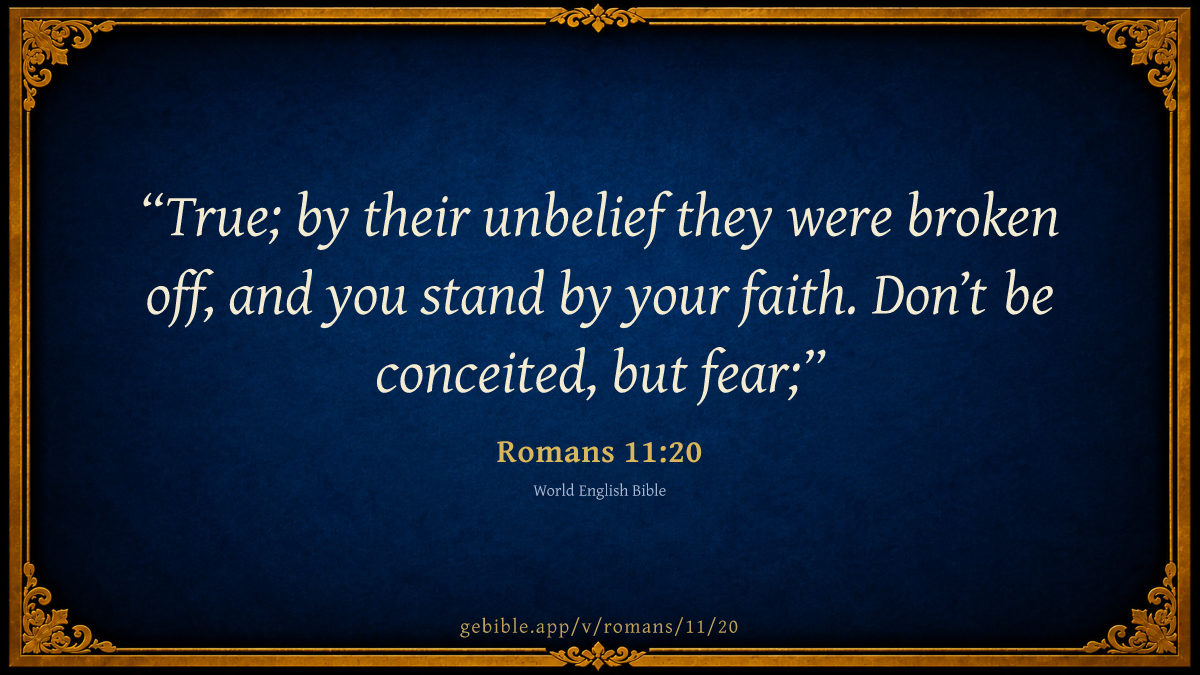
True; by their unbelief they were broken off, and you stand by your faith. Don’t be conceited, but fear;
Parallel Translations
-
True; by their unbelief they were broken off, and you stand by your faith. Don’t be conceited, but fear;
-
Thou sayest well: because of vnbeleve they are broken of and thou stondest stedfast in fayth. Be not hye mynded but feare
-
Well: through vnbeliefe they are broken off, and thou standest by faith: bee not hie minded, but feare.
Cross-references (39)
Passages linked to Romans 11:20 in the Treasury of Scripture Knowledge, ordered by reader-vote popularity; verse text shown in World English Bible.
- Romans 12:16 Be of the same mind one toward another. Don’t set your mind on high things, but associate with the humble. Don’t be wise in your own conceits.
- 2 Corinthians 1:24 We don’t control your faith, but are fellow workers with you for your joy. For you stand firm in faith.
- 1 Corinthians 10:12 Therefore let him who thinks he stands be careful that he doesn’t fall.
- Philippians 2:12 So then, my beloved, even as you have always obeyed, not only in my presence, but now much more in my absence, work out your own salvation with fear and trembling.
- 1 Peter 1:17 If you call on him as Father, who without respect of persons judges according to each man’s work, pass the time of your living as foreigners here in reverent fear,
- Habakkuk 2:4 Behold, his soul is puffed up. It is not upright in him, but the righteous will live by his faith.
- Romans 5:1-2 Being therefore justified by faith, we have peace with God through our Lord Jesus Christ; through whom we also have our access by faith into this grace in which we stand. We rejoice in hope of the glory of God.
- Romans 11:18 don’t boast over the branches. But if you boast, it is not you who support the root, but the root supports you.
- Colossians 2:7 rooted and built up in him, and established in the faith, even as you were taught, abounding in it in thanksgiving.
- 1 Timothy 6:17 Charge those who are rich in this present world that they not be arrogant, nor have their hope set on the uncertainty of riches, but on the living God, who richly provides us with everything to enjoy;
- Hebrews 3:12 Beware, brothers, lest perhaps there might be in any one of you an evil heart of unbelief, in falling away from the living God;
- Proverbs 28:14 Blessed is the man who always fears; but one who hardens his heart falls into trouble.
- Isaiah 66:2 For my hand has made all these things, and so all these things came to be,” says Yahweh: “but I will look to this man, even to he who is poor and of a contrite spirit, and who trembles at my word.
- 2 Corinthians 10:5 throwing down imaginations and every high thing that is exalted against the knowledge of God and bringing every thought into captivity to the obedience of Christ,
- 2 Timothy 3:3-5 without natural affection, unforgiving, slanderers, without self-control, fierce, not lovers of good, traitors, headstrong, conceited, lovers of pleasure rather than lovers of God, holding a form of godliness, but having denied its power. Turn away from these, also.
- Psalms 138:6 For though Yahweh is high, yet he looks after the lowly; but he knows the proud from afar.
- Proverbs 28:26 One who trusts in himself is a fool; but one who walks in wisdom is kept safe.
- Isaiah 2:11 The lofty looks of man will be brought low, the arrogance of men will be bowed down, and Yahweh alone will be exalted in that day.
- Isaiah 2:17 The loftiness of man shall be bowed down, and the arrogance of men shall be brought low; and Yahweh alone shall be exalted in that day.
- Isaiah 7:9 The head of Ephraim is Samaria, and the head of Samaria is Remaliah’s son. If you will not believe, surely you shall not be established.’ ”
- Zephaniah 3:11 In that day you will not be disappointed for all your doings, in which you have transgressed against me; for then I will take away out from among you your proudly exulting ones, and you will no more be arrogant in my holy mountain.
- Luke 18:14 I tell you, this man went down to his house justified rather than the other; for everyone who exalts himself will be humbled, but he who humbles himself will be exalted.”
- John 4:17-18 The woman answered, “I have no husband.” Jesus said to her, “You said well, ‘I have no husband,’ for you have had five husbands; and he whom you now have is not your husband. This you have said truly.”
- Acts 13:46-47 Paul and Barnabas spoke out boldly, and said, “It was necessary that God’s word should be spoken to you first. Since indeed you thrust it from yourselves, and judge yourselves unworthy of eternal life, behold, we turn to the Gentiles. For so has the Lord commanded us, saying, ‘I have set you as a light for the Gentiles, that you should bring salvation to the uttermost parts of the earth.’ ”
- Acts 18:6 When they opposed him and blasphemed, he shook out his clothing and said to them, “Your blood be on your own heads! I am clean. From now on, I will go to the Gentiles!”
- Romans 3:3 For what if some were without faith? Will their lack of faith nullify the faithfulness of God?
- 1 Corinthians 16:13 Watch! Stand firm in the faith! Be courageous! Be strong!
- 2 Thessalonians 2:4 he who opposes and exalts himself against all that is called God or that is worshiped, so that he sits as God in the temple of God, setting himself up as God.
- Hebrews 3:19–4:1 We see that they weren’t able to enter in because of unbelief. Let’s fear therefore, lest perhaps anyone of you should seem to have come short of a promise of entering into his rest.
- Hebrews 4:6 Seeing therefore it remains that some should enter into it, and they to whom the good news was preached before failed to enter in because of disobedience,
- Hebrews 4:11 Let’s therefore give diligence to enter into that rest, lest anyone fall after the same example of disobedience.
- James 4:6 But he gives more grace. Therefore it says, “God resists the proud, but gives grace to the humble.”
- 1 Peter 5:5-6 Likewise, you younger ones, be subject to the elder. Yes, all of you clothe yourselves with humility, to subject yourselves to one another; for “God resists the proud, but gives grace to the humble.” Humble yourselves therefore under the mighty hand of God, that he may exalt you in due time,
- 1 Peter 5:9 Withstand him steadfast in your faith, knowing that your brothers who are in the world are undergoing the same sufferings.
- 1 Peter 5:12 Through Silvanus, our faithful brother, as I consider him, I have written to you briefly, exhorting, and testifying that this is the true grace of God in which you stand.
- Revelation 3:17 Because you say, ‘I am rich, and have gotten riches, and have need of nothing;’ and don’t know that you are the wretched one, miserable, poor, blind, and naked;
- Revelation 18:7 However much she glorified herself, and grew wanton, so much give her of torment and mourning. For she says in her heart, ‘I sit a queen, and am no widow, and will in no way see mourning.’
- 2 Chronicles 20:20 They rose early in the morning, and went out into the wilderness of Tekoa. As they went out, Jehoshaphat stood and said, “Listen to me, Judah, and you inhabitants of Jerusalem! Believe in Yahweh your God, so you will be established! Believe his prophets, so you will prosper.”
- James 2:19 You believe that God is one. You do well. The demons also believe, and shudder.
Cross-references from openbible.info (CC BY 4.0)
Explain this verse (13 sources)
Historical commentary, presented as a primary source — not an endorsement.
Private notes
Saved on this device only — never synced or sent anywhere.
Geneva Bible translators 1599 · Public Domain See that thou stand in awe of God modestly…
See that thou stand in awe of God modestly and carefully.
Geneva Bible (1599) marginal notes — public domain.
John Trapp 1656 · Public Domain 20 Well; because of unbelief they were broken off,…
20 Well; because of unbelief they were broken off, and thou standest by faith. Be not highminded, but fear:
Ver. 20. Be not high-minded, but fear] Alterius perditio tun sit cautio, saith one. Ruina maiorum sit cautela minorum, saith another. Seest thou thy brother shipwrecked? look well to thy tackling.
John Trapp, A Commentary or Exposition upon All the Books of the Old and New Testament (1647–1656) — public domain. Text from a community e-Sword module.
John Gill 1763 · Public Domain Well,.... To this the apostle answers, by approving and…
Well,.... To this the apostle answers, by approving and granting in, part what was said, that the unbelieving Jews were broken off and rejected, and that the Gentiles that believed in Christ were grafted in among the Jews that professed his name; but then he tacitly denies that it was for their sakes, and their account, they were broken off, but for their own incredulity:
because of unbelief they were broken off; because of their unbelief and contempt of the Messiah, they were rejected of God, and died in their sins; that which excluded their forefathers from the land of Canaan, shut them out of the Gospel church state, and the kingdom of heaven:
Read full note →
and thou standest by faith; which is not of a man's self, but the gift of God; so that it was not by their merits, and better deservings, but by the grace of God that they were in the situation they were; they were blessed with faith in Christ, and having made a profession of it were admitted to Gospel ordinances, and into a Gospel church; and being helped hitherto to hold the profession of their faith in a becoming manner they stood their ground, and continued in their church relation; and therefore ought not to give way to a vain boasting spirit, but to be humble, modest, and dependent; wherefore he gives them this proper pertinent, and wholesome advice,
be not highminded, but fear. The apostle would have them not be elated with their gifts, privileges, and enjoyments, and look over others, or down upon them with contempt and disdain, considering that all they had and enjoyed were owing to the goodness of God, and not to any deserts of theirs; and therefore should fear the Lord and his goodness; for not a fear of hell and damnation, or a distrust of the grace of God, is here meant; but a fear of offending him, and that not from a dread of punishment, but from a sense of his grace and goodness; and also designs humility of soul, in opposition to pride, haughtiness, and elation of mind, a lowly carriage and behaviour to others, and an humble dependence on grace and strength from above, to enable to persevere and hold out to the end; for "let him that thinks he stands take heed lest he fall" into sin, Co1 10:12; so as to dishonour God and Christ grieve the Holy Spirit, wound his own conscience, and bring himself under the censure of the church, and to be cut off from the good olive tree, the root and fatness of which he now partakes.
John Gill's Exposition of the Whole Bible (1746–1763) — public domain (CC PDM 1.0). Text via the HelloAO Bible API.
John Wesley 1765 · Public Domain They were broken off for unbelief, and thou standest…
They were broken off for unbelief, and thou standest by faith - Both conditionally, not absolutely: if absolutely, there might have been room to boast. By faith - The free gift of God, which therefore ought to humble thee.
John Wesley, Explanatory Notes Upon the Whole Bible (1754–1765) — public domain. Text via the GEBible commentary corpus.
Adam Clarke 1810 · Public Domain Verse 20. Well; because of unbelief, c.] This statement…
Verse 20. Well; because of unbelief, c.] This statement is all true but then, consider, why is it that they were cast out? Was it not because of their unbelief? And you stand by faith: you were made partakers of these blessings by faith; be not high-minded; let this humble, not exalt you in your own estimation; for if the blessings were received by faith, consequently not by works; and if not by works, you have no merit; and what you have received is through the mere mercy of God. They once stood by faith; they gave place to unbelief, and fell: you stand now by faith; but it is as possible for you to be unfaithful as it was for them, and consequently you may fall under the Divine displeasure, as they have done; be not high-minded, but fear; watch over yourselves with godly jealousy.
Adam Clarke's Commentary on the Bible (1810–1826) — public domain. Text from a community e-Sword/MySword module.
Albert Barnes 1834 · Public Domain Well - True. It is true they were broken…
Well - True. It is true they were broken off; but in order to show that there was no occasion for boasting, he adds that they were not rejected in order to admit others, but because of their unbelief, and that their fate should have a salutary impression on those who had no occasion for boasting, but who might be rejected for the same cause. This is an instance of remarkable tact and delicacy in an argument, admitting the main force of the remark, but giving it a slight change in accordance with the truth, so as to parry its force, and give it a practical bearing on the very point which he wished to enforce.
Thou standest by faith - The continuance of these mercies to you depends on your fidelity. If you are faithful, they will be preserved; if, like the Jews, you become unbelieving and unfruitful, like them you will be also rejected. This fact should repress boasting, and excite to anxiety and caution.
Read full note →
Be not high-minded - Do not be elated in the conception of your privileges, so as to produce vain self-confidence and boasting.
But fear - This fear stands opposed to the spirit of boasting and self-confidence, against which he was exhorting them. It does not mean terror or horror, but it denotes humility, watchfulness, and solicitude to abide in the faith. Do not be haughty and high-minded against the Jew, who has been cast off, but “demean yourself as a humble believer, and one who has need to be continually on his guard, and to fear lest he may fall through unbelief, and be cast off.” (Stuart.) We may here learn,
That there is danger lest those who are raised to eminent privileges should become unduly exalted in their own estimation, and despise others.
(2)The tendency of faith is to promote humility and a sense of our dependence on God.
(3)The system of salvation by faith produces that solicitude, and careful guarding, and watchfulness, which is necessary to preserve us from apostasy and ruin.
Albert Barnes' Notes on the Bible (1834–1885) — public domain. Text from a community e-Sword/MySword module.
Robert Jamieson, A. R. Fausset & David Brown 1871 · Public Domain Well--"Be it so, but remember that"
Well--"Be it so, but remember that"
because of unbelief they were broken off, and thou standest--not as a Gentile, but solely
Read full note →
by faith--But as faith cannot live in those "whose soul is lifted up" (Hab 2:4).
Be not high-minded, but fear-- (Pro 28:14; Phi 2:12):
Jamieson, Fausset & Brown — Commentary Critical and Explanatory on the Whole Bible (1871) — public domain (CC PDM 1.0). Text via the HelloAO Bible API.
Daniel D. Whedon 1874 · Public Domain 20. Unbelief… faith—These two words, expressing the conditions, negative…
20. Unbelief… faith—These two words, expressing the conditions, negative and positive, in regard to salvation, explain why either the Jew or Gentile is called.
Daniel D. Whedon (gen. ed.), Commentary on the Old and New Testaments (1874–1909) — public domain. Text from a community e-Sword module.
The Cambridge Bible for Schools and Colleges 1878 · Public Domain 20. Well] i.e. Well said. There is, of course,…
20. Well] i.e. Well said. There is, of course, a solemn and earnest irony in the word. In terms, the Gentile Pharisee (if we may use the expression) spoke truth; for in the mysterious adjustments of the Divine Plan the rejection of Messiah by Israel was to precede, and even in a certain sense to occasion, the call of the Gentiles. But in the spirit of the words there was deep untruth; for their own sin was the actual cause of Israel’s fall, and Gentile believers were admitted into covenant on just the same terms of mere mercy as their Jewish brethren—i.e. for the sole sake of Messiah the Propitiation; “by faith.”
because of unbelief—by faith] The construction in the two phrases is identical in the Gr. On the statement of fact here, see last note.
Read full note →
thou standest] See on ch. Rom_5:2.
The Cambridge Bible for Schools and Colleges (gen. ed. J. J. S. Perowne; Cambridge University Press, 1878–1918) — public domain. Text from a community e-Sword module.
The Pulpit Commentary 1880 · Public Domain Vers. 20, 21. Well the fact of the case…
Vers. 20, 21. Well the fact of the case is as you say; but why?because of unbelief they were broken off; and thou standest by faith. Be not high-minded, but fear: for if God spared not the natural branches, neither will he spare thee. (So, rather than as in the Authorized Version, according to the best-supported readings.) Thou art on thy trial, as they were, and alike liable to be broken off for the like cause; their present rejection should inspire in thee, not boast-fullness, but fear. The question has been raised whether St. Paul (using, as he does, the terms su and tinev twv kladwn) has now the election and final salvation of individuals in view, or still only the calling to a state of salvation of races or communities of men of the Jewish race on the one hand, and Gentile Churches on the other. The whole purport of this section of the Epistle (ch. 9, 10, 11) seems to demand the latter view. (As to su , see on ver. 17) Besides, if by the broken-off branches were meant simply individual unbelievers, how could we explain their being "grafted in again" (vers. 23, 24), seeing that the contemplated restoration is regarded in vers. 25, 26 as something that is to take place in the possibly distant future, after "the fulness of the Gentiles" has come in? Thus this passage is really irrelevant to any doctrines about individual election and salvation that may have been built upon it. It is, however, important as confirming the general view of Divine election not being irrespective of the conditions of human faith and perseverance.
Vers. 20, 21. Spiritual pride rebuked.
Read full note →
The pride of man is a bladder easily inflated, and the apostle performed a salutary service when he showed how readily it might be pricked. The throwing open to the Gentile world, with additional advantages, of the religious privileges formerly confined to the Jews, begot in many converts an undue elation. Christianity inspires men with such expansive hopes that there is a danger of overweening vanity and presumption leading to a neglect of the conditions under which alone these hopes can be realized. The mercy of God may be illegitimately strained; the consciousness of spiritual freedom has often degenerated into licence of behaviour, and the "goodness" of God has made men unmindful of his "severity." Hence the useful caution of the text. Distinguish, however, between "fear" and "dread." Reverential, humble fear is quite compatible with gladness of soul and with unwavering trust in the promise of a free and full salvation. Let us adduce considerations that justify the caution of these verses.
I WE HAVE AN IMPARTIAL GOD TO DEAL WITH. An arbitrary capricious monarch may select favourites, and dispense his gifts without regard to the moral worth of the recipients. Gentiles receiving an account of the river of Divine love abandoning its previous channel and inundating with a flood of blessing the surrounding parched lands, might be lapped into a false security, as if this blessing once granted could not again be withheld, no matter what the use made of the fertilizing influences vouchsafed. This would be to overlook the fact that it was for reasons the Jews were stripped of their exclusive advantages, and that the same reasons of abuse and ingratitude might cause the story to be repeated in the case of Christians, boastful of their position of knowledge and close access to God, and omitting to cultivate the appropriate graces and duties.
II THE LAW AND AIM OF GOD"S GOVERNMENT IS RIGHTEOUSNESS. Here we ascend to that essential attribute of God which is the guide and end of his dealings with his creatures. Well-being cannot be separated from well-doing. In no other way can the Almighty make his people happy than by inducing them to practise what is "lovely and of good report." Christ died to save men from their sins. His offering frees men from the overwhelming burden of their past enormities, wipes off the score against them, but requires the pursuit of holiness as the consequence and token of their forgiveness. The bearing of good fruit is the sure criterion of the improved condition of the tree. The rose which blooms not tells not of proper grafting. Faith in Christ admits to his kingdom, and continued faith showing itself by works of obedience keeps us united to the source of prosperity and progress. Heaven needs a prepared people to enter into its bliss and service. Greatly do men err, therefore, who plume themselves on their conversion and go not on unto sanctification of life.
III HISTORY TEACHES US HUMILITY. History is God in action. The facts of history are naught apart from the revelation of a Divine order they bring to the illumined mind. The fate of Israel is a tablet whose letters of fire should brand themselves on the memory as a declaration of the forbearing goodness of God to the faithful, and his ultimate severity to the disobedient. God changes not; what he has done he may do again. If "the natural branches" were not spared, why should he spare the objects of his after-clemency when they too turn aside to rebel counsels? The story of the antediluvians swept away by a torrent of righteous indignation; of the inhabitants of Sodom smitten in their pride and idleness; of the Canaanites "spued out" of the laud for their wickedness; of Babylon and Nineveh, where civilization was a hot-bed of vice, its riot and fumes extinguished by the desert sands; of Judas, who by transgression fell from his apostleship; of the temple at Jerusalem profaned by its guardians and then given over to the flames; of the candlesticks removed when the Churches of Asia "lost their first love; all these are so many voices echoing the warning of the text, "Be not high-minded, but fear." God spares long, but at last the thunderbolt falls. Sin marches to its destined grave.
IV THE DECEITFULNESS OF OUR HEARTS CALLS FOR CONSTANT VIGILANCE. Human nature remains true to itself, brings forth the same fruit in all ages. Even in the renewed nature of the Christian, "the flesh lusteth against the Spirit." The serpent of evil is scotched, not killed. Our environment exposes us to unceasing attacks. At any moment of relaxed tension, the foe may assault and carry the fortress. "Let him that thinketh he standeth take heed lest he fall." The Saviour emphasized the caution, "What I say unto you, I say unto all, Watch!" Children are often reckless because they perceive not the danger; wise men neglect no precautions. Our safest course is to be intent on "the things that accompany salvation," to fill the hands with beneficent activities, to engage the thoughts on noblest themes. Press toward the goal, and no enchanted meadow shall beguile our steps. Like earnest competitors, read the rules carefully and sedulously conform to them. Prayerful meditation on the Scriptures, humble confidence in God, and the opening of the heart to the sway of the blessed Spirit, will correct any wrong attitude, and enable us to persevere to the end. "Let us therefore fear, lest a promise being left us," etc. S.R.A.
The Pulpit Commentary (1880–1919), ed. H.D.M. Spence-Jones & Joseph S. Exell — public domain. Text from a community e-Sword module.
B. W. Johnson 1891 · Public Domain 20. It is not. Because of unbelief they were…
20. It is not. Because of unbelief they were broken off. Had they believed, they would have remained. The Gentile is grafted in when he believes. Thou standest by faith. Unbelief would cut off the Gentile branch as well as the Jew.
B. W. Johnson's The People's New Testament with Notes (1889–1891) — public domain. Electronic text from the Christian Classics Ethereal Library (CCEL) ThML edition.
J. W. McGarvey 1914 · Public Domain Well [A form of partial and often ironical assent:…
Well [A form of partial and often ironical assent: equal to, very true, grant it, etc. It was not strictly true that God had cast off the Jew to make room for the Gentile, for there was room for both. The marriage supper shows the truth very clearly. The refusal of the Jew was the reason why he was cast off, not because there was lack of room, or partial favor on God's part, or superior merit on the part of the Gentiles-- Luk_14:15-24 ]; by their unbelief they were broken off, and thou standest by thy faith [not merit]. Be not highminded, but fear :
J. W. McGarvey (with Philip Y. Pendleton), Commentaries on the New Testament (The Fourfold Gospel, 1914; Acts; and the epistles) — public domain. Text from a community e-Sword/MySword module.
Tyndale Open Study Notes 2022 · CC BY-SA 4.0 11:20 fear what could happen: In Scripture, fear often…
11:20 fear what could happen: In Scripture, fear often means a reverential awe of God that includes the recognition that we must one day stand before him in judgment (see 2 Cor 5:11; 7:1, 11, 15; Phil 2:12; Col 3:22).
Tyndale Open Study Notes — © Tyndale Open Resources, licensed CC BY-SA 4.0. Text via the HelloAO Bible API.