
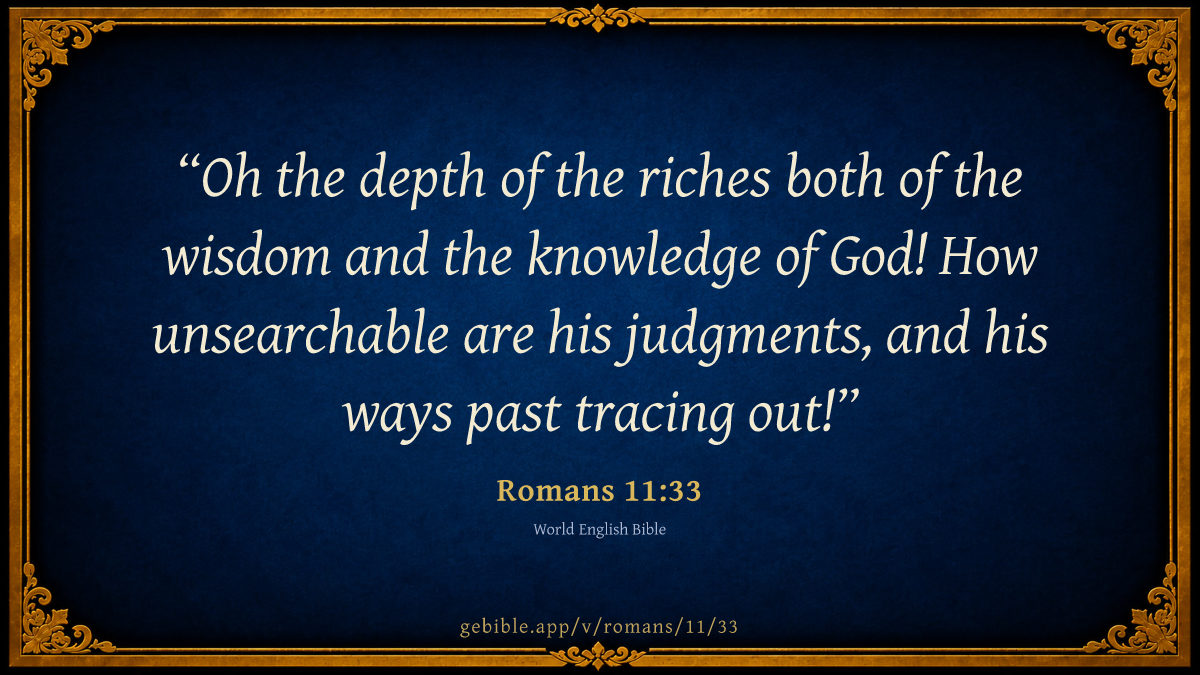
Oh the depth of the riches both of the wisdom and the knowledge of God! How unsearchable are his judgments, and his ways past tracing out!
Parallel Translations
-
Oh the depth of the riches both of the wisdom and the knowledge of God! How unsearchable are his judgments, and his ways past tracing out!
-
O the depnes of the aboundaunt wysdome and knowledge of God: how vnserchable are his iudgementes and his wayes past findyng out.
-
O the deepenesse of the riches, both of the wisdome, and knowledge of God! howe vnsearcheable are his iudgements, and his wayes past finding out!
Cross-references (26)
Passages linked to Romans 11:33 in the Treasury of Scripture Knowledge, ordered by reader-vote popularity; verse text shown in World English Bible.
- Job 5:9 who does great things that can’t be fathomed, marvelous things without number;
- Job 11:7-9 “Can you fathom the mystery of God? Or can you probe the limits of the Almighty? They are high as heaven. What can you do? They are deeper than Sheol. What can you know? Its measure is longer than the earth, and broader than the sea.
- Psalms 92:5 How great are your works, Yahweh! Your thoughts are very deep.
- Colossians 2:2-3 that their hearts may be comforted, they being knit together in love, and gaining all riches of the full assurance of understanding, that they may know the mystery of God, both of the Father and of Christ, in whom all the treasures of wisdom and knowledge are hidden.
- Romans 2:4 Or do you despise the riches of his goodness, forbearance, and patience, not knowing that the goodness of God leads you to repentance?
- Job 37:23 We can’t reach the Almighty. He is exalted in power. In justice and great righteousness, he will not oppress.
- Ephesians 1:7 in whom we have our redemption through his blood, the forgiveness of our trespasses, according to the riches of his grace,
- Ephesians 3:10 to the intent that now through the assembly the manifold wisdom of God might be made known to the principalities and the powers in the heavenly places,
- Ecclesiastes 3:11 He has made everything beautiful in its time. He has also set eternity in their hearts, yet so that man can’t find out the work that God has done from the beginning even to the end.
- Job 26:14 Behold, these are but the outskirts of his ways. How small a whisper do we hear of him! But the thunder of his power who can understand?”
- Psalms 36:6 Your righteousness is like the mountains of God. Your judgments are like a great deep. Yahweh, you preserve man and animal.
- Romans 9:23 and that he might make known the riches of his glory on vessels of mercy, which he prepared beforehand for glory,
- Psalms 77:19 Your way was through the sea; your paths through the great waters. Your footsteps were not known.
- Ephesians 2:7 that in the ages to come he might show the exceeding riches of his grace in kindness toward us in Christ Jesus;
- Colossians 1:27 to whom God was pleased to make known what are the riches of the glory of this mystery among the Gentiles, which is Christ in you, the hope of glory.
- Psalms 40:5 Many, Yahweh, my God, are the wonderful works which you have done, and your thoughts which are toward us. They can’t be declared back to you. If I would declare and speak of them, they are more than can be counted.
- Psalms 97:2 Clouds and darkness are around him. Righteousness and justice are the foundation of his throne.
- Daniel 4:35 All the inhabitants of the earth are reputed as nothing; and he does according to his will in the army of heaven, and among the inhabitants of the earth; and no one can stop his hand, or ask him, “What are you doing?”
- Job 9:10 He does great things past finding out; yes, marvelous things without number.
- Ephesians 3:16 that he would grant you, according to the riches of his glory, that you may be strengthened with power through his Spirit in the inner person,
- Ephesians 3:8 To me, the very least of all saints, was this grace given, to preach to the Gentiles the unsearchable riches of Christ,
- Psalms 107:8-43 Let them praise Yahweh for his loving kindness, for his wonderful deeds to the children of men! For he satisfies the longing soul. He fills the hungry soul with good. Some sat in darkness and in the shadow of death, being bound in affliction and iron, because they rebelled against the words of God, and condemned the counsel of the Most High. Therefore he brought down their heart with labor. They fell down, and there was no one to help. Then they cried to Yahweh in their trouble, and he saved them out of their distresses. He brought them out of darkness and the shadow of death, and broke away their chains. Let them praise Yahweh for his loving kindness, for his wonderful deeds to the children of men! For he has broken the gates of bronze, and cut through bars of iron. Fools are afflicted because of their disobedience, and because of their iniquities. Their soul abhors all kinds of food. They draw near to the gates of death. Then they cry to Yahweh in their trouble, he saves them out of their distresses. He sends his word, and heals them, and delivers them from their graves. Let them praise Yahweh for his loving kindness, for his wonderful deeds to the children of men! Let them offer the sacrifices of thanksgiving, and declare his deeds with singing. Those who go down to the sea in ships, who do business in great waters; These see Yahweh’s deeds, and his wonders in the deep. For he commands, and raises the stormy wind, which lifts up its waves. They mount up to the sky; they go down again to the depths. Their soul melts away because of trouble. They reel back and forth, and stagger like a drunken man, and are at their wits’ end. Then they cry to Yahweh in their trouble, and he brings them out of their distress. He makes the storm a calm, so that its waves are still. Then they are glad because it is calm, so he brings them to their desired haven. Let them praise Yahweh for his loving kindness, for his wonderful deeds for the children of men! Let them exalt him also in the assembly of the people, and praise him in the seat of the elders. He turns rivers into a desert, water springs into a thirsty ground, and a fruitful land into a salt waste, for the wickedness of those who dwell in it. He turns a desert into a pool of water, and a dry land into water springs. There he makes the hungry live, that they may prepare a city to live in, sow fields, plant vineyards, and reap the fruits of increase. He blesses them also, so that they are multiplied greatly. He doesn’t allow their livestock to decrease. Again, they are diminished and bowed down through oppression, trouble, and sorrow. He pours contempt on princes, and causes them to wander in a trackless waste. Yet he lifts the needy out of their affliction, and increases their families like a flock. The upright will see it, and be glad. All the wicked will shut their mouths. Whoever is wise will pay attention to these things. They will consider the loving kindnesses of Yahweh.
- Proverbs 25:3 As the heavens for height, and the earth for depth, so the hearts of kings are unsearchable.
- Ephesians 3:18 may be strengthened to comprehend with all the saints what is the width and length and height and depth,
- Job 33:13 Why do you strive against him, because he doesn’t give account of any of his matters?
- Job 37:19 Teach us what we will tell him, for we can’t make our case by reason of darkness.
Cross-references from openbible.info (CC BY 4.0)
Explain this verse (23 sources)
Historical commentary, presented as a primary source — not an endorsement.
Private notes
Saved on this device only — never synced or sent anywhere.
John Calvin 1540 · Public Domain 33. Oh! the depth, etc. Here first the Apostle…
33. Oh! the depth, etc. Here first the Apostle bursts into an exclamation, which arose spontaneously from a devout consideration of God’s dealings with the faithful; then in passing he checks the boldness of impiety, which is wont to clamor against the judgments of God. When therefore we hear, Oh! the depth, this expression of wonder ought greatly to avail to the beating down of the presumption of our flesh; for after having spoken from the word and by the Spirit of the Lord, being at length overcome by the sublimity of so great a mystery, he could not do otherwise than wonder and exclaim, that, the riches of God’s wisdom are deeper than our reason can penetrate to. Whenever then we enter on a discourse respecting the eternal counsels of God, let a bridle be always set on our thoughts and tongue, so that after having spoken soberly and within the limits of God’s word, our reasoning may at last end in admiration. Nor ought we to be ashamed, that if we are not wiser than he, who, having been taken into the third heaven, saw mysteries to man ineffable, and who yet could find in this instance no other end designed but that he should thus humble himself.
Some render the words of Paul thus, “Oh! the deep riches, and wisdom, and knowledge of God!” as though the word βάθος was an adjective; and they take riches for abundance, but this seems to me strained, and I have therefore no doubt but that he extols God’s deep riches of wisdom and knowledge.
Read full note →
How incomprehensible, etc. By different words, according to a practice common in Hebrew, he expresses the same thing. For he speaks of judgments, then he subjoins ways, which mean appointments or the mode of acting, or the manner of ruling. But he still continues his exclamation, and thus the more he elevates the height of the divine mystery, the more he deters us from the curiosity of investigating it. Let us then learn to make no searchings respecting the Lord, except as far as he has revealed himself in the Scriptures; for otherwise we shall enter a labyrinth, from which the retreat is not easy. It must however be noticed, that he speaks not here of all God’s mysteries, but of those which are hid with God himself, and ought to be only admired and adored by us.
John Calvin's Commentaries (1540-1563) — public domain. Text from the Calvin Translation Society English edition (1840s-50s) via the Christian Classics Ethereal Library (ccel.org). Calvin's coverage is partial (roughly two-thirds of the Bible); uncommented books and verses are honest gaps, never fabricated. The 19th-century editor's footnotes and remarks are omitted so the notes are faithfully Calvin's own voice.
Geneva Bible translators 1599 · Public Domain The course that he holdeth in governing all things…
The course that he holdeth in governing all things both generally and particularly.
The Apostle crieth not as astonished with this wonderful wisdom of God, which he teacheth us, ought to be religiously reverenced, and not curiously and profanely to be searched beyond the compass of that that God hath revealed unto us.
Read full note →
The order of his counsels and doings.
Geneva Bible (1599) marginal notes — public domain.
John Trapp 1656 · Public Domain 33 O the depth of the riches both of…
33 O the depth of the riches both of the wisdom and knowledge of God! how unsearchable are his judgments, and his ways past finding out!
Ver. 33. O the depth of the riches] The Romans dedicated a certain lake, the depth whereof they knew not, to Victory; so should we admire the unsearchable counsels of God, being subdued to that which we cannot subdue to our understandings. God, saith one, is like the pool Polycritus writeth of, which in compass at first scarcely seemed to exceed the breadth of a shield, but if any went into it to wash, it extended itself more and more. (Aristot. de Mirab. Auscult.) And Chrysostom speaking of the love of God in Christ, Oh, saith he, I am like a man digging in a deep spring; I stand here, and the water riseth up upon me; and I stand there, and still the water riseth upon me. Oh, dive we not into this deep; for here (as in the salt waters), the deeper, the sweeter.
Read full note →
Past finding out] It is with us here as with hounds at a loss, having neither footsteps nor scent left of the game they pursue (ανεξιχνιαστοι). Let it satisfy us for present, that at the last day of judgment we shall see a harmony in this discord of things; and that the reason of God’s ways, now hidden, shall then be made manifest. In the meantime know, that Arcana Dei, Arca Dei (Augustine), secrets of God and the ark of God, of pry not into it, lest ye perish; but hold this for certain, God’s judgments are sometimes secret, always just.
John Trapp, A Commentary or Exposition upon All the Books of the Old and New Testament (1647–1656) — public domain. Text from a community e-Sword module.
Matthew Poole 1685 · Public Domain In this and the following verses is the conclusion…
In this and the following verses is the conclusion of all that he had delivered, especially in this and the two preceding chapters. He had spoken of many profound mysteries, and answered many critical questions; and here he makes a pause, and falls into an admiration of God, his abundant wisdom and knowledge. He seems here to be like a man that wades into the waters, till he begins to feel no bottom, and then he cries out:
Oh the depth! and goes no farther.
Read full note →
Oh the depth of the riches both of the wisdom and knowledge of God! i.e. the unmeasurable, inconceivable abundance of his wisdom and knowledge. Some distinguish these two; others take them for the same: see Col 2:3.
How unsearchable are his judgments, and his ways past finding out! Some distinguish betwixt the judgments and ways of God; by the former, understanding his decrees and purposes concerning nations or persons; by the latter, the methods of his providence in his dealings with them: others think the same thing is meant, by an ingemination, which is familiar amongst the Hebrews. He says of God’s judgments, that they are unsearchable; therefore not to be complained of, censured, or to be narrowly pried into; and of his ways, that they are past finding out; the same in sense with unsearchable: it is a metaphor from hounds, that have no footstep or scent of the game which they pursue: nor can men trace the Lord, or find out the reason of his doings; as none can line out the way of a ship in the sea, or an eagle in the air, &c. Some restrain the sense to the ways of God in disposing and ordering the election and rejection of men.
Matthew Poole's English Annotations on the Holy Bible (1683–1685) — public domain. Text from a community e-Sword/MySword module.
William Burkitt 1703 · Public Domain Here the apostle concludes the chapter with an awful…
Here the apostle concludes the chapter with an awful admiration at the depth of the abundant grace and goodness of God in bearing with the infidelity of the Jews, and the obstinacy of the Gentiles; as also of his unsearchable wisdom in making first the rejection of the Jews a mean of calling the Gentiles, and then working upon the obstinate Jews by his mercy unto the Gentiles.
By judgments here, some understand the degrees and determinations of God’s will; by ways, the administration of his providence, in order to the execution of those decrees: both which are secret, unsearchable, and unfathomable. There are mysteries of providence, as well as mysteries of faith, and both of them transcend our human understanding.
William Burkitt's Expository Notes on the New Testament (1700–1703) — public domain. Text from a community e-Sword module.
Matthew Henry 1710 · Public Domain The apostle having insisted so largely, through the greatest…
The apostle having insisted so largely, through the greatest part of this chapter, upon reconciling the rejection of the Jews with the divine goodness, he concludes here with the acknowledgment and admiration of the divine wisdom and sovereignty in all this. Here the apostle does with great affection and awe adore,
I. The secrecy of the divine counsels: O the depth! in these proceedings towards the Jews and Gentiles; or, in general, the whole mystery of the gospel, which we cannot fully comprehend. - The riches of the wisdom and knowledge of God, the abundant instances of his wisdom and knowledge in contriving and carrying on the work of our redemption by Christ, a depth which the angels pry into, Pe1 1:12. Much more may it puzzle any human understanding to give an account of the methods, and reasons, and designs, and compass of it. Paul was as well acquainted with the mysteries of the kingdom of God as ever any mere man was; and yet he confesses himself at a loss in the contemplation, and, despairing to find the bottom, he humbly sits down at the brink, and adores the depth. Those that know most in this state of imperfection cannot but be most sensible of their own weakness and short-sightedness, and that after all their researches, and all their attainments in those researches, while they are here they cannot order their speech by reason of darkness. Praise is silent to thee, Psa 65:1. - The depth of the riches. Men's riches of all kinds are shallow, you may soon see the bottom; but God's riches are deep (Psa 36:6): Thy judgments are a great deep. There is not only depth in the divine counsels, but riches too, which denotes an abundance of that which is precious and valuable, so complete are the dimensions of the divine counsels; they have not only depth and height, but breadth and length (Eph 3:18), and that passing knowledge, v. 19. - Riches of the wisdom and knowledge of God. His seeing all things by one clear, and certain, and infallible view - all things that are, or ever were, or ever shall be, - that all is naked and open before him: there is his knowledge. His ruling and ordering all things, directing and disposing them to his own glory, and bringing about his own purposes and counsels in all; this is his wisdom. And the vast extent of both these is such a depth as is past our fathoming, and we may soon lose ourselves in the contemplation of them. Such knowledge is too wonderful for me, Psa 139:6. Compare Psa 139:17, Psa 139:18. - How unsearchable are his judgments! that is, his counsels and purposes: and his ways, that is, the execution of these counsels and purposes. We know not what he designs. When the wheels are set in motion, and Providence has begun to work, yet we know not what he has in view; it is past finding out. This does not only overturn all our positive conclusions about the divine counsels, but it also checks all our curious enquiries. Secret things belong not to us, Deu 29:29. God's way is in the sea, Psa 77:19. Compare Job 23:8, Job 23:9; Psa 97:2. What he does we know not now, Joh 13:7. We cannot give a reason of God's proceedings, nor by searching find out God. See Job 5:9; Job 9:10. The judgments of his mouth, and the way of our duty, blessed be God, are plain and easy, it is a high-way; but the judgments of his hands, and the ways of his providence, are dark and mysterious, which therefore we must not pry into, but silently adore and acquiesce in. The apostle speaks this especially with reference to that strange turn, the casting off of the Jews and the entertainment of the Gentiles, with a purpose to take in the Jews again in due time; these were strange proceedings, the choosing of some, the refusing of others, and neither according to the probabilities of human conjecture. Even so, Father, because it seemed good in thing eyes. These are methods unaccountable, concerning which we must say, O the depth! - Past finding out, anexichniastoi - cannot be traced. God leaves no prints nor footsteps behind him, does not make a path to shine after him; but his paths of providence are new every morning. He does not go the same way so often as to make a track of it. How little a portion is heard of him! Job 26:14. It follows (Rom 11:34), For who hath known the mind of the Lord? Is there any creature made of his cabinet-council, or laid, as Christ was, in the bosom of the Father? Is there any to whom he has imparted his counsels, or that is able, upon the view of his providences, to know the way that he takes? There is so vast a distance and disproportion between God and man, between the Creator and the creature, as for ever excludes the thought of such an intimacy and familiarity. The apostle makes the same challenge (Co1 2:16): For who hath known the mind of the Lord? And yet there he adds, But we have the mind of Christ, which intimates that through Christ true believers, who have his Spirit, know so much of the mind of God as is necessary to their happiness. He that knew the mind of the Lord has declared him, Joh 1:18. And so, though we know not the mind of the Lord, yet, if we have the mind of Christ, we have enough. The secret of the Lord is with those that fear him, Psa 25:14. Shall I hide from Abraham the thing which I do? See Joh 15:15. - Or who has been his counsellor? He needs no counsellor, for he is infinitely wise; nor is any creature capable of being his counsellor; this would be like lighting a candle to the sun. This seems to refer to that scripture (Isa 40:13, Isa 40:14), Who hath directed the Spirit of the Lord, or, being his counsellor, hath taught him? With whom took he counsel? etc. It is the substance of God's challenge to Job concerning the work of creation (Job 38), and is applicable to all the methods of his providence. It is nonsense for any man to prescribe to God, or to teach him how to govern the world.
Read full note →
II. The sovereignty of the divine counsels. In all these things God acts as a free agent, does what he will, because he will, and gives not account of any of his matters (Job 23:13; Job 33:13), and yet there is no unrighteousness with him. To clear which,
1. He challenges any to prove God a debtor to him (Rom 11:35): Who hath first given to him? Who is there of all the creatures that can prove God is beholden to him? Whatever we do for him, or devote to him, it must be with that acknowledgment, which is for ever a bar to such demands (Ch1 29:14): Of thine own we have given thee. All the duties we can perform are not requitals, but rather restitutions. If any can prove that God is his debtor, the apostle here stands bound for the payment, and proclaims, in God's name, that payment is ready: It shall be recompensed to him again. It is certain God will let nobody lose by him; but never any one yet durst make a demand of this kind, or attempt to prove it. This is here suggested, (1.) To silence the clamours of the Jews. When God took away their visible church-privileges from them, he did but take his own: and may he not do what he will with his own - give or withhold his grace where and when he pleases? (2.) To silence the insultings of the Gentiles. When God sent the gospel among them, and gave so many of them grace and wisdom to accept of it, it was not because he owed them so much favour, or that they could challenge it as a debt, but of his own good pleasure.
2. He resolves all into the sovereignty of God (Rom 11:36): For of him, and through him, and to him, are all things, that is, God is all in all. All things in heaven and earth (especially those things which relate to our salvation, the things which belong to our peace) are of him by way of creation, through him by way of providential influence, that they may be to him in their final tendency and result. Of God as the spring and fountain of all, through Christ, God - man, as the conveyance, to God as the ultimate end. These three include, in general, all God's causal relations to his creatures: of him as the first efficient cause, through him as the supreme directing cause, to him as the ultimate final cause; for the Lord hath made all for himself, Rev 4:11. If all be of him and through him, there is all the reason in the world that all should be to him and for him. It is a necessary circulation; if the rivers received their waters from the sea, they return them to the sea again, Ecc 1:7. To do all to the glory of God is to make a virtue of necessity; for all shall in the end be to him, whether we will or no. And so he concludes with a short doxology: To whom be glory for ever, Amen. God's universal agency as the first cause, the sovereign ruler, and the last end, ought to be the matter of our adoration. Thus all his works do praise him objectively; but his saints do bless him actively; they hand that praise to him which all the creatures do minister matter for, Psa 145:10. Paul had been discoursing at large of the counsels of God concerning man, sifting the point with a great deal of accuracy; but, after all, he concludes with the acknowledgment of the divine sovereignty, as that into which all these things must be ultimately resolved, and in which alone the mind can safely and sweetly rest. This is, if not the scholastic way, yet the Christian way, of disputation. Whatever are the premises, let god's glory be the conclusion; especially when we come to talk of the divine counsels and actings, it is best for us to turn our arguments into awful and serious adorations. The glorified saints, that see furthest into these mysteries, never dispute, but praise to eternity.
Matthew Henry's Commentary on the Whole Bible (1708–1710) — public domain (CC PDM 1.0). Text via the HelloAO Bible API.
John Gill 1763 · Public Domain O the depth of the riches, both of the…
O the depth of the riches, both of the wisdom and knowledge of God,.... These words are the epilogue, or conclusion of the doctrinal part of this epistle, and relate to what is said throughout the whole of it hitherto; particularly to the doctrines of salvation by Christ, justification by his righteousness, predestination, the calling of the Gentiles, the rejection of the Jews, and their restoration in the latter day; upon the whole of which, the apostle breaks forth into this pathetic exclamation; the design of which is to show, how much of the wisdom and knowledge of God is displayed in these doctrines, and how small a part of it is known by the best of men, and therefore ought not to be cavilled at and objected to, because of some difficulties attending them, but to be received upon the testimony of divine revelation: and if there was a depth in these things unsearchable and past finding out by so great a man as the apostle, who had by revelation such knowledge in the mysteries of grace, and who had been caught up into the third heaven, and heard things unutterable, how much less is it to be fathomed by others, and therefore should be silent: by "the wisdom and knowledge of God", one and the same thing is meant; and design not so much the perfections of the divine nature, which are infinite and unsearchable, the understanding of which is too high for creatures, and not be attained to by them; nor the display of them in the works of creation and providence, in which there are most glorious and amazing instances; but rather the effects of them, the counsels and decrees of God; which are so wisely formed and laid, as not to fail of their accomplishment, or to be frustrated of their end; and the doctrines of grace relating to them, in which are treasures, riches, that is, an abundance of wisdom and knowledge; and a depth, not to be reached to the bottom of, in this imperfect state, and in which the knowledge and wisdom of God are wonderfully displayed: thus in the doctrine of redemption and salvation by Christ, wherein God has abounded in all wisdom and prudence; in the person fixed upon to be the Saviour, his own Son; who by the assumption of human nature, being God and man in one person, was very fit and proper to be a Mediator between God and man, to transact the affair of salvation; was every way qualified for it, and able to do it: so likewise in the manner in which it is accomplished, being done in a way which glorifies all the divine perfections; in which the rights of God's justice and the honour of his holiness are secured, as well as his love, grace, and mercy, displayed; in which Satan is most mortified, sin condemned, and the sinner saved; and also in the persons, the subjects of it, ungodly sinners, enemies, the chief of sinners, whereby the grace of God is the more illustrated, and all boasting in the creature excluded. The wisdom of God manifestly appears, in the doctrine of a sinner's justification; which though it proceeds from grace, yet upon the foot of redemption and satisfaction, in a way of strict justice; so that God is just, whilst he is the justifier; it is of persons ungodly, and without a righteousness in themselves, and yet by a perfect and complete righteousness, answerable to all the demands of law and justice; and the grace of faith is wisely made the recipient of this blessing, that it might appear to be of free grace, and not of works, and that the justified ones might have solid peace, joy, and comfort, from it. The doctrine of predestination is full of the wisdom and knowledge of God; his choice of some to everlasting life in his Son, through sanctification of the Spirit, and belief of the truth, for the glorifying of his grace and mercy, in a way of righteousness; and his passing by others, leaving them to themselves, and in their sins, justly to perish for them, for the glorifying of his justice, are acts of the highest wisdom, and done according to the counsel of his will. The account just given of the call of the Gentiles, and the rejection of the Jews, is an astonishing scheme of infinite wisdom; that, on the one hand salvation should come to the Gentiles, through the fall of the Jews, and they should obtain mercy through their unbelief; and on the other hand that the restoration of the Jews should be as life from the dead to the Gentiles; and the Jews, through their mercy, obtain mercy; and that both, in their turns, should be shut up in unbelief by God, that he might have mercy on them all, "O the depth", &c. To which is added,
how unsearchable are his judgments! which are not to be understood of his awful judgments on wicked men in particular, nor of the administrations of his providence in general; though these are a great deep, and in many instances are unsearchable, and cannot be counted for in the present state, but will hereafter be made manifest; nor of the commands of God, sometimes called his judgments, which are all plain, and may be easily searched out in his word; but rather of the counsels and purposes of God, and the doctrines of grace relating thereunto; which are the deep things of God, and are only searched out by the Spirit of God, who reveals them to us:
Read full note →
and his ways past finding out! not the methods and course of his providence, though his way in this respect is often in the deep, his footsteps are not to be known, discerned, and traced, by finite creatures; but rather the goings forth and steps of his wisdom from everlasting, in his purposes and decrees, council and covenant, which are higher than the ways of men, even as the heavens are higher than the earth; and which are all mercy and truth to his chosen people, and strict justice to others, and not to be found out by any; particularly his ways and methods, and dealings, with both Jews and Gentiles; that he should for so many hundred years leave the Gentiles in blindness and unbelief; and now for as many years his favourite people the Jews in the same, and yet gather in his elect out of them both; these are things out of our reach and comprehension.
John Gill's Exposition of the Whole Bible (1746–1763) — public domain (CC PDM 1.0). Text via the HelloAO Bible API.
John Wesley 1765 · Public Domain O the depth of the riches, and wisdom, and…
O the depth of the riches, and wisdom, and knowledge of God - In the ninth chapter, St. Paul had sailed but in a narrow sea: now he is in the ocean. The depth of the riches is described, ver. 35; the depth of wisdom, ver. 34; the depth of knowledge, in the latter part of this verse. Wisdom directs all things to the best end; knowledge sees that end. How unsearchable are his judgments - With regard to unbelievers. His ways - With regard to believers. His ways are more upon a level; His judgments "a great deep." But even his ways we cannot trace.
John Wesley, Explanatory Notes Upon the Whole Bible (1754–1765) — public domain. Text via the GEBible commentary corpus.
Adam Clarke 1810 · Public Domain Verse 33. O the depth of the riches both…
Verse 33. O the depth of the riches both of the wisdom and knowledge of God!] This is a very proper conclusion of the whole preceding discourse. Wisdom may here refer to the designs of God; knowledge, to the means which he employs to accomplish these designs. The designs are the offspring of infinite wisdom, and therefore they are all right; the means are the most proper, as being the choice of an infinite knowledge that cannot err; we may safely credit the goodness of the design, founded in infinite wisdom; we may rely on the due accomplishment of the end, because the means are chosen and applied by infinite knowledge and skill.
Adam Clarke's Commentary on the Bible (1810–1826) — public domain. Text from a community e-Sword/MySword module.
Joseph Benson 1811 · Public Domain Rom 11:33-36. O the depth — The unsearchable, inconceivable…
Rom 11:33-36. O the depth — The unsearchable, inconceivable abundance; of the riches, &c. — In the ninth chapter, Paul had sailed but in a narrow sea, now he is in the immense ocean: of the wisdom and knowledge of God — The depth of his knowledge is described in the latter part of this verse; the depth of wisdom in Rom 11:34. Wisdom directs all things to the best end; knowledge sees that end, and the way that leads to it. Or, the divine wisdom was exercised in contriving and ordering these dispensations, and knowledge in foreseeing the effects which they would produce. By applying the word depth to the riches of the wisdom and knowledge of God, the apostle represents those perfections as forming a vast ocean. How unsearchable are his judgments — With regard to unbelievers; and his ways — With regard to believers; are past finding out — Or being traced. The word ανεξιχνιαστοι comes from ιχνιον, which signifies the mark of a foot. The metaphor is taken from animals which pursue and find out their prey by tracing their footsteps. By judgments here, Macknight understands God’s determinations, or “methods of directing and governing all things, both generally and particularly. Agreeably to which interpretation of κριματα, judgments, the apostle adds, and his ways are past finding out. Men are not capable of penetrating into the depths of the divine wisdom, because revelation hath made known only what God hath willed, and said, and done, without disclosing the reasons either of his general or his particular conduct. The knowledge of whatever is above our present childish conceptions is to be sought for, not here, but in the future state.” The apostle, in this part of the conclusion of his discourse, as Locke observes, “had an especial regard to the Jews, whom, in an elegant but inoffensive manner, he rebuked for their presumption in finding fault with the divine dispensations; as if God had done them an injury in admitting the Gentiles into his covenant and church.” For who hath known the mind of the Lord — Before, or any further than he has revealed it; or who hath known what he intends to do, or hath comprehended all the reasons of his determinations or proceedings, so as to be able to judge of them? Or who hath been his counsellor? — Who hath given him advice respecting either the planning or managing of the affairs of the universe? Or, who hath first given to him either wisdom or power, or any thing, or conferred any obligation upon him? Let him show the obligation, and make out the claim, and we may answer for it that it shall be exactly repaid him again. “The apostle here very properly asks the Jews, if God was in their debt for any obligation they had conferred on him? Or, if he was, let them say for what, and they should have an ample remuneration made to them.” For of him — As the Creator; through him — As the Preserver; to him — As the ultimate end, are all things: to whom be — Η δοξα, the glory, of his power, knowledge, wisdom, and of the effects thereof, the creation, preservation, and government of the universe, and the redemption and salvation of mankind, for ever. Amen — A concluding word, in which the affection of the apostle, when it is come to the height, shuts up all.
Joseph Benson's Commentary on the Old and New Testaments (1811–1818) — public domain. Text from a community e-Sword module.
Albert Barnes 1834 · Public Domain O the depth ... - This passage should have…
O the depth ... - This passage should have been translated “O the depth of the riches, and of the wisdom, and of the knowledge of God.” The apostle has three subjects of admiration. Our translation, by the word “both” introduced here, confines it to two. The apostle wishes to express his admiration of the riches and the wisdom, and the knowledge of God. So the Syriac, Arabic, etc. Our translation has followed the Latin Vulgate. The word “depth” is applied in the Scriptures to anything vast and incomprehensible. As the abyss or the ocean is unfathomable, so the word comes to denote what words cannot express, or what we cannot comprehend; Psa 36:6, “Thy judgments are a great deep;” 1Co 2:10,” The Spirit searcheth ...the deep things of God;” Rev 2:24, “The depths of Satan” - the deep, profound, cunning, and wicked plans of Satan.
Riches - See the note at Rom 11:12. The word denotes the abundant blessings and mercies which had been conferred on sinful people by the gospel. These were vast and wonderful. The pardon of sin; the atonement; the hope of heaven; the peace of the gospel; all bestowed on the sinful, the poor, the wretched, and the dying; all bespeak the great mercy and rich grace of God. So every pardoned sinner may still exclaim. The grace of God which pardons him is felt to be indeed wonderful, and past comprehension. It is beyond the power of language to express; and all that the Christian can do, is to follow the example of the apostle, and sit down in profound admiration of the rich grace of God. The expression “the depth of the riches” is a Hebraism, meaning the deep or profound riches.
Read full note →
The wisdom - Wisdom is the choice of the best means to accomplish the best ends. The end or design which God had in view was to bestow mercy on all; i. e., to save people by grace, and not by their own works; Rom 11:32. He intended to establish a glorious system that should present his mercy as the prominent attribute, standing out in living colors in all the scheme of salvation. This was to be alike shown in relation to Jews and Gentiles. The wonderful wisdom with which this was done, is the object of the apostle’s profound admiration. This wisdom was seen,
(1) In adapting the plan to the condition of man. All were sinners. The apostle in this Epistle has fully shown that all had come short of the glory of God. Man had no power to save himself by his own wisdom. The Jews and Gentiles in different ways had sought to justify themselves, and had both failed God had suffered both to make the experiment in the most favorable circumstances. He had left the world for four thousand years to make the trial, and then introduced the plan of divine wisdom, just so as to meet the manifest wants and woes of people.
(2) This was shown in his making the Jews the occasion of spreading the system among the Gentiles. They were cast off, and rejected; but the God of wisdom had made even this an occasion of spreading his truth.
(3) The same wisdom was yet to be seen in his appointing the Gentiles to carry the gospel back to the Jews. Thus, they were to be mutual aids; until all their interests should be blended, and the entire race should be united in the love of the same gospel, and the service of the same God and Saviour. When, therefore, this profound and wonderful plan is contemplated, and its history traced from the commencement to the end of time, no wonder that the apostle was fixed in admiration at the amazing wisdom of him who devised it, and who has made all events subservient to its establishment and spread among people.
And knowledge - That is, foreknowledge, or omniscience. This knowledge was manifest,
In the profound view of man, and acquaintance with all his wants and woes.
(2)In a view of the precise scheme that would be suited to recover and save.
(3)In a view of the time and circumstances in which it would be best to introduce the scheme.
(4)In a discernment of the effect of the rejection of the Jews, and of the preaching of the gospel among the Gentiles.
Who but God could see that such effects would follow the rejection of the Jews? Who but he could know that the gospel should yet prevail among all the nations? We have only to think of the changes in human affairs; the obstacles to the gospel; the difficulties to be surmounted; and the vast work yet to be done, to be amazed at the knowledge which can adapt such a scheme to people, and which can certainly predict its complete and final spread among all the families of man.
How unsearchable - The word “unsearchable” means what cannot be investigated or fully understood.
His judgments - This word in this place evidently means his arrangement, his plan, or proceeding. It sometimes refers to laws; at other times to the decision or determination of God; at others to the inflictions of his justice. In this last sense it is now commonly used. But in the case before us, it means his arrangements for conferring the gospel on people compare Psa 36:7,” His judgments are a great deep.”
His ways - The word rendered “ways” properly denotes a path, or road on which one travels. Hence, it comes also to denote the course or manner of life in which one moves; or his principles, or morals; his doctrine, or teaching, etc. Applied to God, it denotes his mode or manner of doing things; the order, etc. of his divine Providence; his movements, in his great plans, through the universe; Act 13:10, “Wilt thou not cease to pervert the right ways of the Lord?” to oppose, or to render vain, his plan of guiding and saving man; Heb 3:10,” They have not known my ways;” Psa 77:19, “Thy way is in the sea, thy footsteps are not known.” Here it refers particularly to his way or plan of bringing all nations within the reach of his mercy in the gospel.
Past finding out - Literally, which cannot be tracked or traced out. The footsteps cannot be followed. As if his path were in the sea Psa 77:19, and the waves closed immediately, leaving no track, it cannot be followed or sought out. It is known that he has passed, but there is no way of tracing his goings. This is a beautiful and striking figure. It denotes that God’s plans are deep, and beyond our comprehension. We can see the proofs that he is everywhere; but how it is, we cannot comprehend. We are permitted to see the vast movements around us; but the invisible hand we cannot see, nor trace the footsteps of that mighty God who performs his wonders on the ocean and on the land,
Albert Barnes' Notes on the Bible (1834–1885) — public domain. Text from a community e-Sword/MySword module.
Haydock's Catholic Bible Commentary 1859 · Public Domain O the depth, &c. After he hath spoken of…
O the depth, &c. After he hath spoken of the mysteries of God’s grace and predestination, of his mercy and justice, which we must not pretend to dive into, he concludes this part of his epistle, by an exclamation, to teach us submission of our judgment, as to the secrets of his providence, which we cannot comprehend. --- How incomprehensible are his judgments, &c. --- Who hath first given to him, and recompense shall be made him? That is, no one, by any merit on his part, can first deserve God’s favours and mercy, by which he prevents us. --- For of him, from God, or from Jesus Christ, as God, and by him, who made, preserves, and governs all things, and in him, is our continual dependance: for in him we live, we move, and exist. In the Greek, it is unto him,[3] to signify he is also our last end. See the notes, John chap. i. (Witham) --- All things are from God, as their first cause and creator; all things are by God, as the ruler and governor of the universe; and all things are in God, or (as the Greek has it) for God, because they are all directed to his honour and glory. For the hath made all things for himself. (Psalm xvi; St. Basil, lib. de Spiritu sto. chap. 5.)
George Leo Haydock (1774–1849), Haydock's Catholic Family Bible and Commentary, 1859 edition — public domain. Excludes Psalms (Douay-Rheims chapter numbering differs from Protestant) and Deuterocanonical books (Catholic canon only).
Robert Jamieson, A. R. Fausset & David Brown 1871 · Public Domain Oh, the depth, &c.--The apostle now yields himself up…
Oh, the depth, &c.--The apostle now yields himself up to the admiring contemplation of the grandeur of that divine plan which he had sketched out.
of the riches both of the wisdom and knowledge of God--Many able expositors render this, "of the riches and wisdom and knowledge," &c. [ERASMUS, GROTIUS, BENGEL, MEYER, DE WETTE, THOLUCK, OLSHAUSEN, FRITZSCHE, PHILIPPI, ALFORD, Revised Version]. The words will certainly bear this sense, "the depth of God's riches." But "the riches of God" is a much rarer expression with our apostle than the riches of this or that perfection of God; and the words immediately following limit our attention to the unsearchableness of God's "judgments," which probably means His decrees or plans (Psa 119:75), and of "His ways," or the method by which He carries these into effect. (So LUTHER, CALVIN, BEZA, HODGE, &c.). Besides, all that follows to the end of the chapter seems to show that while the Grace of God to guilty men in Christ Jesus is presupposed to be the whole theme of this chapter, that which called forth the special admiration of the apostle, after sketching at some length the divine purposes and methods in the bestowment of this grace, was "the depth of the riches of God's wisdom and knowledge" in these purposes and methods. The "knowledge," then, points probably to the vast sweep of divine comprehension herein displayed; the "wisdom" to that fitness to accomplish the ends intended, which is stamped on all this procedure.
Jamieson, Fausset & Brown — Commentary Critical and Explanatory on the Whole Bible (1871) — public domain (CC PDM 1.0). Text via the HelloAO Bible API.
Daniel D. Whedon 1874 · Public Domain 4. The Doxology closing the Argument.
4. The Doxology closing the Argument.
33. Riches—Tholuck and others, including Alford, hold riches, wisdom, and knowledge to be three coordinates, dependent upon depth. It would then read, “O the depth of the riches, and wisdom, and knowledge of God!” Riches would then imply affluence of goodness and blessing; as rich in Rom_10:12, and riches, Php_4:19. That this is the true sense is probable from the parallelisms (well shown by Dr. Forbes) which follow. (See our Introduction to Romans.)
Read full note →
This passage is at once a sublime, rapturous apostrophe, and a rich commentary by the apostle on his whole previous argument. But it is plain that Paul is not a Calvinistic commentator. When Calvin surveyed his own scheme his shuddering comment was, “A horrible decree, I confess!” When Paul surveys this his own grand argument he exultantly exclaims, “O the depth of God’s bounty and wisdom!”
Riches—Both from its own force and from the parallel passages, to be taken as meaning God’s infinite resources for good to his creatures. His is a deep, yea, a bottomless treasury, pouring forth its streams of perpetual bounty. His wisdom is absolute skill in planning, as his knowledge is absolute accuracy in perceiving. As God’s knowledge foresees and comprehends all the possibilities of all possible things and courses, so his wisdom devises from himself the best course of all possible courses; and from the riches of his power and goodness he carries that course into perfect and glorious execution.
Judgments—Not so much his judicial is all his providential decisions as his ways are his modes of executing them.
Daniel D. Whedon (gen. ed.), Commentary on the Old and New Testaments (1874–1909) — public domain. Text from a community e-Sword module.
The Cambridge Bible for Schools and Colleges 1878 · Public Domain 33–36. Doxology to the Eternal Sovereign
33–36. Doxology to the Eternal Sovereign
33. O the depth] Here, at the close of this discussion of the case of Israel,—in which he has held up for our submission the unfathomable mystery of electing sovereignty, and also the strange ways by which Divine judgment is often made the instrument of Divine mercy,—the Apostle turns to the Supreme Object of his thought and love, and utters his ascription of worship and praise to the All-Wise and Almighty. Such a doxology is perfectly in the manner of Scripture, in which the ultimate aim ever is not the glory, nor even the happiness, of Man, (dear as his happiness is to God and His messengers,) but the Glory of God.
Read full note →
depth] Cp. Psa_36:6, “Thy judgments are a great deep.”
riches] See on Rom_2:4.
wisdom and knowledge] Scarcely, in such a passage as this, to be minutely distinguished. They blend into one idea—omniscience acting in eternal righteousness and love.
unsearchable] It is well to weigh, and accept, this word at the close of such an argument. In his very act of praise the Apostle confesses the inability of even his own inspired thought to explain the Divine mercies and judgments, in the sense of clearing all difficulties. “Who art thou that repliest against God?” “Clouds and darkness are round about Him;” and, in certain respects, it is only the intelligent but profound submission of faith that can say, in view of those clouds, “Righteousness and judgment are the habitation of His throne.” (Psa_97:2.)
past finding out] Same word as Eph_3:8, (E. V. “unsearchable,” lit. “not to be tracked by footprints,”) an instructive parallel passage.
The Cambridge Bible for Schools and Colleges (gen. ed. J. J. S. Perowne; Cambridge University Press, 1878–1918) — public domain. Text from a community e-Sword module.
Ellicott's Commentary for English Readers 1878 · Public Domain (33) Riches.—The two substantives which follow may be taken…
(33) Riches.—The two substantives which follow may be taken as dependent upon “riches.” This is the construction adopted in the Authorised version, and is expressed by the use of the word “both.” Or all three substantives may be independent, O the depth of the riches, and of the wisdom and knowledge of God! In either case, “riches” means “inexhaustible resources,” implying either that the wisdom and knowledge of God are inexhaustible, or that the materials at their command are inexhaustible. By means of these infinite resources God is able to bring good even out of evil.
Judgments.—Decisions, such as that by which Israel was excluded and the Gentiles admitted.
Read full note →
(33-36) This grand and comprehensive view of the divine purposes makes so deep an impression upon the Apostle that he breaks out into an impassioned ascription of praise, with which the first (doctrinal) portion of the Epistle is brought to a close.
A Bible Commentary for English Readers, edited by Charles John Ellicott (1878–1897) — public domain. Text from a community e-Sword module.
The Pulpit Commentary 1880 · Public Domain Vers. 33-35. O the depth of the riches both…
Vers. 33-35. O the depth of the riches both of the wisdom and knowledge (or, of the riches and wisdom and knowledge) of God! By gnwsewv is signified God"s omniscience; by sofiav , his wisdom in ordering events; by ploutou , if it be taken as a co-ordinate substantive, the abundance of his goodness. (cf. Rom_2:4, ploutov thv crhstothtov ; Eph_1:7, toritov autou . Coordination of the three substantives is suggested by the kai before sofiav ; but St. Paul"s prevailing usage may rather commend the dependence of sofiav and gnwsewv or ploutou , as in the Authorized Version) How unsearchable are his judgments, and his ways past finding (rather, tracing) out! (cf. Psa_26:6 Job_9:10 Job_11:7) For who hath known the mind of the Lord? or who hath been his counsellor? (Isa_40:13, quoted accurately from the LXX) Or who hath first given to him, and it shall be recompensed unto him again?, (cf. Job_41:11 Revised Version) where the Hebrew has, "Who hath first given unto me, that I should repay him?" The LXX (Job_41:2) gives an entirely different sense of the passage; and it would thus appear, as may be seen also in other eases, that St. Paul, though usually quoting more or less freely from the LXX, was familiar also with the Hebrew text, and exercised judgment in his citations.
Vers. 33-36. The unsearchable things of God.
Read full note →
These words may be taken as a fitting conclusion to the doctrinal or argumentative part of the Epistle. As we see how the apostle shows first of all, in the condition of both the heathen and the Jewish world, that all have sinned, and that all needed a Divine Saviour; and how he then unfolds the great doctrine of justification by faith and its results; as we see also the great privileges for time and eternity which are bestowed upon the Children of God; may we not also exclaim, "Oh the depth of the riches both of the wisdom and knowledge of God! how unsearchable are his judgments, and his ways past finding out!
I HIS UNSEARCHABLE WISDOM. "Oh the depth of the riches of the wisdom of God!" says the apostle (ver. 33); and again he asks, "Who hath been his counsellor?" (ver. 34). Beyond all human wisdom is the wisdom of God a wisdom self-sufficient; derived from no other source; a wisdom of which, indeed, all human wisdom is but the faint reflection, the outcome and the overflow. Take the very wisest of men men like Socrates, Plato, Seneca, or Bacon: how foolish were some of their thoughts, their proposals, or their actions! Take the very wisest man whom you know, and he will be glad sometimes to take counsel of some one else. Indeed, in this the wise man shows his wisdom. It is fools who despise reproof, and who will not take advice. But God needs no advice. He makes no mistakes. This thought of the unsearchable wisdom of God teaches us a lesson of faith and trust. God"s dealings are often mysterious to us, but there is an infinite wisdom behind them all. He doeth all things well. It teaches us also a lesson of obedience. God"s way is always wisest, safest, best, happiest. It might be said to us as Moses said to the children of Israel, "Behold, I have taught you statutes and judgments, even as the Lord my God commanded me. Keep therefore and do them, for this is your wisdom and your understanding in the sight of the nations, which shall hear all these statutes, and say, Surely this great nation is a wise and understanding people.
II HIS UNSEARCHABLE KNOWLEDGE. We have made much progress in scientific knowledge in this nineteenth century, and yet how very limited, after all, is human knowledge! How many things in chemistry, in geology, in astronomy, are still unrevealed! Even of a single science no man can say that he knows all about it, though he may have given a lifetime to the study of it. And then few men are masters of more than one branch of knowledge. Life is too short to do more than touch the surface of things. But the knowledge of God is unsearchable. "Oh the depth of the riches of the knowledge of God!... Who hath known the mind of the Lord?" (vers. 33, 34). Nothing is hidden from him. Every part and path of the universe is known to him. Every nation is known to him its national history, its national sins. Every family is known to him. The joys and sorrows of every home, he knows them all. The secret thoughts, the secret motives, the secret plans of every life, he knows them all. This thought carries with it great comfort. "Your heavenly Father knoweth what things ye have need of, before ye ask him." He knows all our difficulties and all our wants. And as we look forward to the future, to the judgment-seat, is there not a comfort in feeling that God"s judgment upon us will be a perfectly fair one, because it will be based upon a complete and accurate and perfect knowledge of our lives? Our motives may be misunderstood by men; but God knows all about them. "Then shall the righteous shine forth as the sun in the kingdom of their Father." It carries with it also solemn warning. If God knows all about me, how careful I should be to live as in his sight! How careful I should be to live as in the presence of the judgment-seat! "For there is nothing covered, that shall not be revealed; nor hid, that shall not be known.
III HIS UNSEARCHABLE MERCY. "For God hath concluded them all in unbelief, that he might have mercy upon all. Oh the depth of the riches both of the wisdom and knowledge of God!" Here God"s unsearchable wisdom and knowledge are represented as co-operating in his plan of universal mercy. Here again what depths there are that we cannot fathom! How very unmerciful men are at the best! How harsh the judgments even of professing Christians! and how limited and narrow are sometimes their views as to the possibility of the salvation of others! But the mercy of God is wider than all our creeds, and broader than the judgments of individual Christians. What a depth, what a breadth of mercy is revealed in those words of Christ, "God so loved the world, that he gave his only begotten Son, that whosoever believeth on him should not perish, but have everlasting life"! Whosoever! In that word there is hope for the guiltiest of sinners who will repent of his sin, and believe on the Lord Jesus Christ. So, while we speak of the unsearchable things of God, we do not take the agnostic position. We do not say that God is unknown and unknowable. We do not know the depth of his wisdom and knowledge and mercy; but we do know that he possesses and manifests all these sublime qualities in his dealings with men. There are mysteries in God"s providences, but there is one great truth which will bring peace to every soul that acts upon it; which will bring every soul that acts upon it into the eternal presence and fellowship of God: "Believe on the Lord Jesus Christ, and thou shalt be saved." There are thoughts that are unsearchable about God, and yet they are thoughts that we can feel within our spirits as the very power of God unto salvation, even as we can feel the warm sunshine on our faces though we cannot walk along the bright pathway by which it comes. Jesus Christ is God"s "unspeakable Gift;" yet many can say of him," I know whom I have believed, and am persuaded that he is able to keep that which I have committed unto him against that day." The love of God is called "the love of God, that passeth knowledge;" and yet many have experienced its power in their hearts. The peace of God is a peace "that passeth all understanding;" yet many have known how, in a time of disquietude or trial, that peace, like a sentinel, has kept our hearts and minds in quiet confidence and calm security. "Now we know in part; but then shall we know even as also we are known. C.H.I.
Vers. 33-36. A hymn of praise.
The apostle has reached the height of his great argument, and now he will take one eagle glance at the whole way by which he has led his readers nay, at in the ways of God. We may not coldly dissect such glowing words as these, but pause with reverence to listen to his adoring wonder, his challenge, and his ascription of praise.
I He has shown forth the belief and unbelief of man, and the marvellous way in which God, foreknowing all, has yet woven the web of history so that the wrath of man shall praise him. But man is lost in awe and wonder in presence of such knowledge and wisdom as are here"A vast, unfathomable sea, Where all our thoughts are drowned.
The judgments by which God manifests his knowledge, and the ways by which his wisdom marches on to the accomplishment of his designs, are beyond our searching and tracing out. We may know the fact, but not always the cause; we may discern somewhat of the tendency and drift of his dispensations, but not all their force. And when the end breaks upon us at last, in the time of the accomplishment of all things, we shall see that what we formerly discerned was but a part of his ways, and our intensified astonishment must still exclaim, "O the depth of the riches!
II Man, then, has not had, cannot have, fellowship with God in the working out of such a high history. Man may indeed have worked, but God has overworked. And even man"s wickedness has been caught up into the general procession of God"s designs. But man has neither known his Maker"s mind, nor certainly has he counselled him with wisdom. And yet did the arrogant Israelite think to have merited aught from God? as though he had given him, forsooth, by his vain services, that it must be recompensed him again? This was indeed to arrogate to himself that knowledge of God"s mind, and counsellorship of his ways, which were impossible, and to affect which was preposterous, and darkly like blasphemy. But the apostle has already cast these presumptions down, even to the dust.
III It only needs now that he reassert, once for all, the utter freedom of the actions of God, which he has argued, and at the same time the almightiness and goodness of his ways, as also previously set forth. "Of him." He is the primal Fount of creation and of history. All things proceed forth from him, therefore surely he may put down one and set up another. "Through him." The very sins of men are open to his prevision, and their folly and blindness, and the results therefore do not take him by surprise; but rather they are allowed for in the great plan of his world-kingdom, and therefore through him they may be said to work their way. "To him." The very sins which he allows, and their consequences, adverse as they may seem to be to his plans, he can so control that they shall work for ultimate good. To him? Yes, to The perfecting of his wise plans. And these plans of his wisdom? They are all in love. Therefore to him we will ascribe the glory evermore. Amen.
Oh how utterly we may trust him, if we will! For only our persistent sin can shut us out from the might of his marvellous love. "Here, then, I doubt no more, But in his pleasure rest, Whose wisdom, love, and truth, and power Engage to make me blest. T.F.L.
Vers. 33-36. God, his own last End in everything.
The apostle has been throwing a very clear providential light upon God"s dealings with his ancient people. He has shown how their unbelief and fall were permitted in order to the gathering in of the Gentiles; and that the Gentiles thus brought in are to gird themselves for the ingathering of the Jews. But he does not profess to have sounded the depths of the Divine wisdom and knowledge by these suggestions. Before that mighty ocean he stands in unfeigned humility. He may have picked up one or two pebbles on the strand, but he has not explored the caves of ocean that lie before him. Yet amid the unsearchable character of God"s judgments, he can see one supreme end in everything, and this is God himself; "For of him, and through him, and to him, are all things.
I WHILE GOD IS KNOWABLE, HE SURPASSES ALL OUR CONCEPTIONS IN HIS WISDOM AND HIS WAYS. (Ver. 33) While believing in the radical error which underlies the agnostic philosophy, we must at the same time admit that God"s wisdom and knowledge, his judgments and his ways, are past our comprehension. Just as a child may know, that is, be acquainted with, his parent, while at the same time he is utterly unable to follow him into the regions of pure mathematics, comprehend the differential or integral calculus, or the new department of quaternions; so a Christian may know God as he reveals himself in Christ, and yet stand in awe before his unsearchable judgments. It is God"s glory to conceal a thing. If we saw through the whole administration of God, if there were no mystery or perplexity in his dealings, we should be living by reason and not by faith. It is more consonant with our finiteness in its relation to the infinite God that we should be asked to trust God, even when we see no reason for his action, when clouds and darkness may be round about his throne. What we have to consider, therefore, is the proper attitude of the Christian before the profundities of God. It surely should be one of humility, of reverence, and of thankful praise. Now, the partiality of Paul"s revelation may be profitably contrasted with the fulness of revelation as claimed by Christ. For he claimed to have all that the Father doeth shown to him. (Joh_5:20) Nothing was or is concealed from Jesus. God"s ways were not unsearchable to him.
II MEN SHOULD NOT IN CONSEQUENCE DICTATE TO GOD, OR TRY TO BE BEFOREHAND WITH HIM. (Vers. 34, 35) Now, when the matter is put broadly in this way, it seems shocking presumption for men to set themselves up as superior persons, capable of dictating to the Eternal. Yet is this not the meaning of a large amount of the pessimistic literature of our time? If the pessimists had only been consulted, they could have planned a much better world than God has given us! His management has been, in their view, a mistake; and the only redeeming feature in the business is that he has somehow created the pessimists with judgments and powers superior to his own] It is time, surely, that these lamentations over a system of things so very imperfectly understood as yet should cease, and that creatures so finite should humble themselves before the Infinite, and acknowledge his superiority in all things.
III AT THE SAME TIME, THE APOSTLE CONCLUDES THAT GOD IS HIS OWN LAST END IN EVERYTHING. (Ver. 36) It seems a hard thing to take in, yet the more it is pondered the truer if appears. "The supreme Sun of the spiritual universe, the ultimate Reason of everything in the world and work of grace, is the glory of God. Whole systems of truth move in subordinate relation to this; this is subordinate to nothing. was nothing," wrote Robert Haldane to M. Cheneviere of Geneva, "brought under the consideration of the students which appeared to contribute so effectually to overthrow their false system of religion founded on philosophy and vain deceit, as the sublime view of the majesty of God, which is presented in these concluding verses of the first part of the Epistle, "Of him, and through him, and to him, are all things." Here God is described as his own last End in everything that he does. Judging of God as such a one as themselves, they were at first startled at the idea that he must love himself supremely, infinitely more than the whole universe, and consequently must prefer his own glory to everything besides. But when they were reminded that God in reality is infinitely more amiable and more valuable than the whole creation, and that consequently, if he views things as they really are, he must regard himself as infinitely worthy of being most valued and loved, they saw that this truth was incontrovertible. Their attention was at the same time turned to numerous passages of Scripture, which assert that the manifestation of the glory of God is the great end of creation; that he has himself chiefly in view in all his works and dispensations; and that it is a purpose in which he requires that all his intelligent creatures should acquiesce, and seek to promote as their first and paramount duty. Passages to this effect, both in the Old and New Testaments, far exceed in number what any one who has not examined the subject is at all aware of." Now, if our idea of God is high enough, we shall conclude that he stands in such perfect relations to his creatures that in seeking his own glory he is at the same time seeking their highest good. Of course, we have the power of resisting this claim of God, and setting ourselves in opposition to his glory; yet this will not defeat his purpose, but be overruled for his praise. It is not selfishness in the most high God to seek his own glory; he is so perfect in his love as to be incapable of selfishness. His glory conflicts with the real good of none of his creatures.
IV WE OUGHT IN CONSEQUENCE, LIKE THE APOSTLE, TO RAISE OUR DOXOLOGY. It is when from the heart we sing our doxology to this perfect Being that we are rising up into our spiritual birthright and joy. How different Paul"s doxology from the agnostic deliverances before the unknown God! It is possible to adore and praise a God whose judgments are unsearchable, because the guiding principle of his perfect nature is love. May we all be led to praise him! R.M.E.
The Pulpit Commentary (1880–1919), ed. H.D.M. Spence-Jones & Joseph S. Exell — public domain. Text from a community e-Sword module.
The Biblical Illustrator 1887 · Public Domain O the depth of the riches both of the…
Rom_11:33
O the depth of the riches both of the wisdom and knowledge of God!--Like a traveller who has reached the summit of an Alpine ascent, the apostle turns and contemplates.
Read full note →
Depths are at his feet; but waves of light illumine them, and then spreads all around an immense horizon which his eye commands. The plan of God in the government of mankind spreads out before him, and he expresses the feeling of admiration and gratitude with which the prospect fills his heart. (Prof. Godet.)
The depth of the divine wisdom
As a man wading into the sea, when he comes up to the neck and feels the water begin to heave him up and his feet to fail him, cries out, O the depth! and goes back, so it fares with Paul in this place, and it is as if he should have said thus: O you Romans and my countrymen the Jews, I have writ unto you these things as far as I can; for the rest I am swallowed up, being more unable to pass farther into this bottomless, than to wade through the depth of the sea. Cease, therefore, to put more questions, and admire with me the depth of the wisdom of God. (Elnathan Parr, B.D.)
The wisdom and knowledge of God
The true distinction between knowledge and wisdom is indicated by Theodoret. He foreknew these things from the beginning, and, having foreknown them, He arranged them wisely. Bishop Lightfoot says, While gnosis is simply intuitive, sophia is ratiocinative also. While gnosis applies chiefly to the apprehension of truths, sophia superadds the power of reasoning about them and tracing their relations. To complete the distinction, we must add that, while knowledge is theoretical, wisdom is practical; and while knowledge is purely intellectual, wisdom is also moral; and for that reason is both the most perfect of mental gifts (Aristotle, Nic. Eth. 6.10) and the queen of all the virtues (Cicero, De Off. 1.43). In the present context, gnosis seems to refer especially to Gods foreknowledge of the free determinations of mans will, both in individuals and nations; while sophia denotes the admirable skill with which He includes mans free actions in His plan, and transforms them into so many means for the accomplishment of His good purpose. (Archdeacon Gifford.)
The depths of the Godhead
I. How they stand revealed before us in His--
1. Nature.
2. Works.
3. Ways.
II. How we stand overwhelmed before them in--
1. Humility.
2. Faith.
3. Hope. (J. Lyth, D.D.)
The depth and wealth of Divine grace
I. Wisdom conceived the purpose.
II. Knowledge devised the plan.
III. Judgments prepare the way.
IV. Grace achieves the result. (J. Lyth, D. D.)
The unfathomable depth of redeeming love
I. Wisdom in the plan.
1. In the gift of His Son.
2. In the communication of His righteousness.
3. In the glory of the issue.
II. Mystery is the procedure.
1. With the world at large.
2. With individual believers. (J. Lyth, D. D.)
The depths of salvation
I. Christianity is a system of wonders.
1. The very proposal of salvation for sinners is a matter of wonder. God was not obliged to save. Man deserved to perish; and God could have filled his place instantly with better beings. Moreover, man is the solitary object of saving mercy. When sin broke out in heaven, God hurled the thunderbolt of a just vengeance. Certainly here is ground for amazement.
2. The incarnation of Christ was a miracle beyond any other miracle of God. Deity took upon Himself the form and nature of humanity. Among all Gods wonders, you can find no analogy for the person of Christ.
3. Our ordinary idea of the proceedings of justice is confounded by the sufferings of Christ. We connect suffering with sin; at least, we consider that an innocent being cannot justly be treated as a malefactor. Yet the sinless Son of God was a man of sorrows and died as a culprit, abandoned even by the Father whom He always pleased. Reason can only exclaim, O the depth! at this.
4. Amazement rises higher at the Bible representation that He suffered the just for the unjust, that He might bring us to God. How could justice be satisfied by the sufferings of an innocent One? How can it be a just thing that they should be accepted as a propitiation for our sins? God has taught us the fact, and hence we believe it; but the fact is a wonder. These are only examples. Things of the same marvellous nature run all through the system of redemption. Infidelity is confounded by these depths. But what confounds an infidel comforts a Christian.
II. Those wonders are reasons for our accepting it and being comforted by it.
1. They constitute a feature of our religion which comports with our experience on all other subjects. The facts which we have mentioned are all plainly revealed facts. There is no darkness or depth in them. The depth and darkness meet us only as we proceed to philosophise. The further we investigate the things of God anywhere the more deep and wonderful they become.
(1) The astronomer finds it so. His wonder grows as he passes the known suns and stars; and now, as he casts his keen eye out upon the illimitable space beyond him, he is compelled to feel that he has not yet passed the porch of the temple of God. All he can say is, O the depth!
(2) So in the ever-descending field of microscopic study.
(3) The providences of God, again, are full of wonders. What a marvel is human history!
2. There are many things of importance, but they are not all of equal value. Unorganised matter lies below the organisms of life. Brute life is of a lower rank than human. The mental kingdom, while superior to the vegetable and animal, is inferior to the moral. Now, we are limited creatures, and cannot have an equal understanding of all subjects, and must expect to meet with the highest wonders in the highest departments. An infidel tells us he meets with the most wonders in Christianity. For that reason he rejects it, and for that we glory in it. Consider two arguments here.
(1) God is glorious in everything, but not in everything of equal glory. His highest glory lies in His saving sinners. The angels knew this who sung over Bethlehem, Glory to God in the highest. Well, on that high field of wonders, where God is more glorious than anywhere else, shall we not expect Him to be more amazing than anywhere else?
(2) Consider the soul. It is immortal, and its capacities will expand for ever. It is to be saved or lost. When a soul is perilled, shall God for its salvation work no more wonders than He does about the petty interests of a world of matter and beasts, and threescore years and ten?
3. It is in these deep things of God only that we find provision for our deepest necessities. Reason cannot hope except before the amazing depths of Gods wisdom and mercy. As sinners, we need God to do for us just the wonders He has wrought. Had He not done them, we must have despaired. (I. S. Spencer, D.D.)
Our proper attitude towards the deep things of God
It remains for us dutifully and reverentially to adore that in the Divine counsels and ways which we do not, and, indeed, cannot, understand. There is no government that hath not its arcana; and it would be very foolish for us to imagine that there should be no secrets belonging to the Divine government. (John Howe.)
The contemplation of Gods redeeming purpose
should prompt--
I. Admiration of--
1. His wisdom.
2. His knowledge.
II. The confession of His unsearchableness in respect of--
1. His purpose and procedure.
2. His all-sufficiency.
III. The praise of His grace, which is--
1. Free.
2. Undeserved.
IV. The increase of His glory.
1. He is the end of all things.
2. To Him be glory for ever. (J. Lyth, D.D.)
Gods conduct in the salvation of mankind
This is the conclusion of Pauls argument on this subject. He seems to be overwhelmed with the sense of its unsearchableness. The depths of Gods wisdom and knowledge appear in--
I. The manifestation of His righteousness in the restoration of rebels. Human monarchs have shown their justice in crushing rebels, but God in restoring them.
II. The destruction of the spirit of rebellion in the restoration of rebels, Human monarchs may deliver rebels, but they cannot destroy the spirit of rebellion, God does this.
III. The augmentation of the force of moral government in the restoration of rebels. Human monarchs may weaken their government by saving rebels, but God strengthens the force of His moral administration by redeeming transgressors.
IV. The promotion of all the rights of His subjects in the restoration of rebels. Human monarchs, by delivering rebels, endanger the rights of loyal citizens God, in the restoration of rebels, promotes the rights of all.
V. The election of earth instead of hell as the scene for the restoration of rebels. (D. Thomas, D.D.)
Gods praise
I. Its theme.
1. His wisdom.
2. His knowledge.
3. His judgments and procedure.
II. Its expression.
1. Wonder.
2. Submission.
3. Love. (J. Lyth, D.D.)
Wisdom of God in redemption
No one can be said to meditate aright on redemption by Christ who does not behold Gods manifold wisdom, as well as His other perfections, displayed therein. As we conclude him a very unskilful observer of a curious picture or statue who only takes notice of its dimensions in general, or the matter of which it is composed, its colouring, or framework, without considering the symmetry and proportion of all its parts, the mind, the genius, and intelligence shown in its design--so it is unworthy and below a Christian to be able only to say that Christ is a Saviour, or to have a general idea of this scheme of mercy, without having his thoughts suitably affected with the wonders of love and grace which it contains, and the design of all, and the adaptation of every part, to set forth the glory of the triune Jehovah. (H. G. Salter.)
Incomplete presentations of the gospel
My best presentations of the gospel to you are so incomplete! Sometimes, when I am alone, I have such sweet and rapturous visions of the love of God and the truths of His Word, that I think if I could speak to you then I should move your hearts. I am like a child who, walking forth some sunny morning, sees grass and flowers all shining with drops of dew. Oh, he cries, Ill carry these beautiful things to my mother! and, eagerly plucking them, the dew drops into his little palm, and all the charm is gone. There is but grass in his hand, and no longer pearls. (H. W. Beecher.)
Limitation of human views
There is a striking passage in which a great philosopher, the famous Bishop Berkeley, describes the thought which occurred to him of the inscrutable schemes of Providence, as he saw, in St. Pauls Cathedral, a fly moving on one of the pillars. It requires, he says, some comprehension in the eye of an intelligent spectator to take in at one view the various parts of the building, in order to observe their harmony and design. But to the fly, whose prospect was confined to a little part of one of the stones of a single pillar, the joint beauty of the whole, or the distinct use of its parts, was inconspicuous. To that limited view, the small irregularities on the surface of the hewn stone seemed to be so many deformed rocks and precipices. That fly on the pillar, of which the philosopher spoke, is the likeness of each human being as he creeps along the vast pillars which support the universe. The sorrow which appears to us nothing but a yawning chasm or hideous precipice, may turn out to be but the joining or cement which binds together the fragments of our existence into a solid whole! That dark and crooked path, in which we have to grope our way in doubt and fear, may be but the curve which, in the full daylight of a brighter world, will appear to be the necessary finish of some choice ornament, the inevitable span of some majestic arch. (Dean Stanley.)
How unsearchable are His Judgments, and His ways past finding out!--
The unsearchableness of God
I. When we cannot understand His ways it is enough to be assured--
1. That He knows what He does.
2. That He needs no counsellor.
II. Therefore ought we to resign ourselves to His will, with--
1. Resignation.
2. Obedience. (J. Lyth, D.D.)
The unsearchableness of Gods judgments
These words are the close of St. Paul s disputation concerning God s providence towards His ancient people, in rejecting the greatest part of them, on their refusal to embrace Christianity, and in admitting the Gentiles to favour on their compliance; in which proceeding the Jews could not discern Gods hand, nor allow such a dispensation to be worthy of Him. The apostle, after an able vindication of it, winds up the contest with the modest intimation that in this and all such eases, for entire satisfaction, we should have recourse to the incomprehensible wisdom of God, who frequently orders things in methods beyond our ability to trace. Note--
I. Some causes and reasons of that incomprehensibility.
1. As the dealings of very wise men sometimes are founded on maxims, and admit justifications not obvious to nor penetrable by vulgar conceit, so may Gods. As there are natural modes of being and operation--such as Gods necessary subsistence, His eternity without succession, etc.
so there may be prudential and moral rules far above our reach (Isa_55:9). Some of these we may be incapable of knowing on account of our finite nature; others on account of our meanness and low rank among created beings. In such cases the absolute will, sovereign authority, and pure liberality of God, supply the place of reasons.
2. As the standing rules of Gods acting, so the occasional grounds thereof are commonly placed beyond the sphere of our apprehension. God is obliged to prosecute His own immutable decrees; working all things according to the counsel of His own will: which how can we anywise come to discover? God also has a perfect foresight of contingent events. He observes in what relation and degrees of comparison things stand towards each other; whereas we cannot tell what things to compare.
3. We are also incapable thoroughly to discern the ways of Providence, from our moral defects, in some measure common to all men; our stupidity, sloth, temerity, impatience, impurity, of heart, etc.
4. Again, the nature of those instruments which Divine Providence uses in administration of human affairs, hinders us from discerning it. The footsteps of Divine wisdom are far more conspicuous in the works of nature than in the management of our affairs, and while the one has confirmed faith, the other has bred doubt.
5. As in nature the influence of heaven and of inferior causes, so in the production of special events among men Divine and human agency are so combined, that it is not easy to discriminate what God performs by natural instruments, and what by superior efficacy.
(1) Not seeing the first, we are prone to ascribe too much to the last, which are most obvious.
(2) And this we are the more apt to do because the manner of Divine agency is ever soft and gentle. God so fashions the hearts of men, so manages their hands, so guides their steps, that even they who are most acted on by Him cannot feel the touch.
6. God, in His progress towards the achievement of any design, is not wont to go in the most direct and compendious ways, but commonly takes a large compass, enfolding several other coincident purposes; which moves our impatience, etc.
7. Like every wise agent, He is wont to act variously, according to the state and circumstances of things, or to the dispositions and capacities of persons.
8. There are different ends which Providence pursues in various order and measure, which we, by reason of our dim insight and short prospect, cannot descry.
(1) God permits things, bad in their own nature, having regard to their instrumental use and tendency.
(2) Also the expediency of things to be permitted or crossed, frequently consists, not in themselves singly taken, as particular acts or events, but in their conjunction with or reference to others, with which they may become subservient to a common end.
9. That Providence is sometimes obscure and intricate, may be attributed to the will of God, on many accounts designing it so. He will not glare forth in discoveries so bright as to dazzle or confound our weak sight.
(1) He meaneth thereby to improve and exalt our faith.
(2) It is fit also that He should thus in many things surpass our understanding, that He may appear to be God indeed.
(3) The obscurity of Providence conciliates an awful reverence towards it, as darkness raises a dread of invisible powers.
(4) It is also requisite that God should dispose many occurrences, cross to our notions, and offensive to our carnal sense, that we may thus be prompted to think of Him, and to seek Him.
(5) It is needful that the present course of Providence should not be perfectly clear and satisfactory, that we may be well assured concerning a future account, and forced in our thoughts to recur thither for a solution of our doubts and difficulties.
II. Some practical applications grounded on the foregoing reasons.
1. It should render us modest and sober in our judgment about providential occurrences, since it is plain arrogance or imposture to assume perfect skill in what passeth our capacity to learn.
2. It should make us cautious in passing judgment or censure on events, since it is temerity to give sentence on what is incapable of evidence.
3. It should repress wanton curiosity, which would only make us lose our time, etc.
4. It should keep us from conceit and confidence in our own wisdom.
5. It should preserve us from infidelity, and despair on account of any cross accidents.
6. It should prevent our taking offence at such.
7. It should guard us against security, or presuming on impunity for our miscarriages; for seeing that God does not always fully discover His mind, it is vain to suppose that, because He is now patient, He will always be so.
8. It should quicken our industry in observing and considering the works of Providence: the fainter our light is, the more attentive should we be in looking.
9. It should oblige us to be circumspect and wary in our conversation.
10. Also constantly to seek God, and to depend on Him for protection, and for the conduct of His grace, the only clue in this labyrinth.
11. In fine, it should cause us humbly to admire and adore that wisdom which governs the world in ways no less great and wonderful than just and holy. (L Barrow, D.D.)
Mans inability to find out Gods judgments
1. That which first brought both a present guilt, and entailed a future curse upon mankind, was an inordinate desire of knowledge. And from the fall to this very day, this fatal itch has stuck so close to our nature, that every one is eager to know where he is called only to adore and obey.
2. The Scripture is in nothing more full and frequent than in representing the transcendency of Gods ways above all created intellectuals (Psa_139:6; Psa_36:6; Psa_18:9; Psa_77:19). If we consult its reports, or those of our own experience, about the amazing events of Providence, we shall find the result of our most exact inquiries in the text. I shall demonstrate that the most advanced wisdom of man is incompetent to judge of--
I. The reason or cause of Gods ways. The causes men assign of the passages of Providence are--
1. For the most part false, as e.g.,
(1) That the prosperous are the objects of Gods love; and the miserable of His hatred. And all this in defiance of the Spirit of God Himself who (Ecc_9:1) assures us that no man knows either love or hatred by all that is before him; nor consequently can conclude himself in or out of favour with God by anything befalling him in this life. Otherwise Lazarus would have been in flames, and the rich man in Abrahams bosom. God sometimes curses men with prosperity, and casts His Jobs upon dunghills, and sells His beloved Josephs into slavery.
(2) That the good only must prosper and the bad suffer. A most absurd assertion, for how is it that the good suffer and the bad prosper?--a fact which staggered Asaph (Psa_73:2), and so confounded Jeremiah (Jer_12:1), that he could almost have offered to dispute the point with God Himself. And from the same topic it was that Jobs friends argued, until they were confounded by Gods verdict on the whole matter.
2. Always imperfect. Who would assign an adequate reason of anything which God does, must see as far into it as God sees. There is no action of God but there is a combination of impulsive causes concerned in it, one or two of which man may light upon, but the weakness of his discerning powers keeps him inevitably a stranger to far the greater part of them. God, by one and the same numerical lot of providence, may intend to punish one nation, to advance another; to plant the gospel in a third, and to let in trade into a fourth; likewise to make way for the happiness of one mans prosperity, and for the extinction of anothers; to reward the virtues of sober and industrious people, and to revenge the crimes of a vicious and rebellious; and we are no more able to search into these than we are to govern the world.
II. The issue and event of actions. Men usually prognosticate--
1. According to the measure of the wisdom of second agents. And it must be confessed that it is the best rule were it not controlled by two better, viz., Scripture and experience. The former of which brings in God laughing at the wisdom of the wise; taking and circumventing the crafty in their own wiles (Job_5:12-13). And for the latter, history so abounds with instances of the most artificially-spun contrivances dashed in pieces by some sudden and unforeseen accidents, that to ascertain the event of the most promising undertaking, if we trust but our own eyes, we shall have little Cause to trust anothers wisdom.
2. From success formerly gained under the same or less probable circumstances. But remember
(1) That it is hard, and perhaps scarce possible to repeat any action under perfectly the same circumstances.
(2) That in most actions there are still some circumstances not observed, which may have a surer and more immediate influence upon the event than those which, coming more into view, are more depended upon.
(3) That the success of every action depends more upon the secret hand of God than upon any causes or instruments visibly engaged in it.
3. According to the preparations made for it, and the power employed in it. And yet we find that it is not always the bigger weight, but sometimes the artificial hand managing the balance which turns the scale. And in like manner, when we have raised armies and manned our fleets, we are still in the hand of that Providence which sometimes sets the crown of victory upon the weak and the few, and disappoints the hopes and breaks the force of the confident and numerous Could anything look more invincible than the Spanish Armada? But we find that there is no commanding the sea without being able to command the winds too. And what a painful defence is multitude on the one side, where Omnipotence takes the other!
III. The use and improvement. We may infer--
1. The vanity of making the future event, or presumed success of any enterprise, the rule of our present actings about the same.
2. The absolute necessity of an entire, total, unreserved dependence upon Providence in the most hopeful and promising condition of our affairs.
3. The impossibility of a rational dependence upon Providence with comfort, but in the way of lawful, honest, and religious courses. (R. South, D. D.)
Plans of God not fully known
I should like to hear any man attempt to interpret to a worm what it is going to be when it is a butterfly. Where is there a foreshadowing analogy, or anything to indicate to it what it is coming to in its fuller form? And how can any one disclose what is to be evolved when Gods work is completed in this life? For, although we may know something, our knowledge is fragmentary and limited. And it is a glorious consolation to believe that sufferings forgotten are not less causes of good than those thus are remembered, and that sufferings which apparently leave but little trace are working out in us great and blessed results in the kingdom to which we are hastening. (H. W. Beecher.)
Gods ways inscrutable, but in accordance with the highest reason
Natural instincts, and even moral sense, are no safe guide upon a subject which soars so infinitely above our limited capacity. We are children; and in considering the means by which our Heavenly Father will save us, it is wisdom to accept simply His own instructions, desperate folly and presumption to criticise those instructions by our puerile instincts. E.g., a father, inured to life upon the Alpine mountains, is under the necessity of crossing a very perilous glacier with his children. The children are of such an age that the direction, Hold this, and keep at as great a distance from me as you possibly can, can just be made intelligible to them, while the grounds of it, viz., that the weight of the party may be distributed, and not bear on one particular spot, which might thus give way, are, it may be, out of the reach of a childs capacity. Let us suppose that the children, in fright, begin to reason about this counsel, and to judge of it by their natural instincts; conceive that one of them should think and say as follows: Can our father, who loves to have us close around him, say, Come not near me, child, at the peril of thy life? Say it he may, but I will not believe such to be his meaning, for it conflicts with all my natural instincts, which are to cling round him in the moment of danger. But shortly afterwards night falls, and the wearied children are irresistibly impelled to lie down without any covering, in which case death would overtake them. The father burrows in a snowdrift, and proposes that in the cavities so made the children shall lie, the cold snow piled over them, and only the smallest possible aperture allowed for the passage of the breath. Adults, of course, would be aware that this would be the only method of preserving the vital heat of the body; but not so the children. Snow, applied only to parts of the person, and not as a general wrapper, is bitterly cold; and the children, unable to understand, imagine cruelty in this arrangement. Now, the child who keeps at a distance from his father, and buries himself in the snow, is a wise child, because, renouncing the guidance of his instincts, he places faith in one manifestly his superior in capacity. The child who clings round his fathers neck upon the glacier and stretches his limbs beneath the open sky in distrust of his parents directions is a foolish child; for what is greater folly than to refuse to be guided by a recognised superior in wisdom? And it cannot be too strongly insisted upon, that one who, in investigating such a subject as the method of human salvation, follows the guidance of his natural instincts in preference to that of Revelation, is a weak person, not a man of bold and courageous thought. Simple dependence upon God, where God alone can teach, is the truest independence of mind. (Dean Goulburn.)
Secrets of God
Be not curious to search into the secrets of God; pick not the lock where He hath allowed no key. He that will be sifting every cloud may be smitten with a thunderbolt; and he that will be too familiar with Gods secrets may be overwhelmed in His judgments. Adam would curiously increase his knowledge; therefore Adam shamefully lost his goodness: the Bethshemites would needs pry into the ark of God; therefore the hand of God slew about fifty thousand of them. Therefore hover not about this flame, lest we scorch our wings. For my part, seeing God hath made me His secretary, I will carefully improve myself by what He has revealed, and not curiously inquire into or after what He hath reserved. (T. Adams.)
For who hath known the mind of the Lord? or who hath been His counsellor?--
God all in all
I. The challenge.
1. To human intellect.
2. To human merit.
II. The assertion. God is--
1. The source of all.
2. The agent in all.
3. The end of all.
III. The ascription.
1. To Him be glory.
2. On earth.
3. In heaven.
4. For ever. (J. Lyth, D.D.)
Gods counsels are
I. Deep.
1. Teaching us the feebleness of our understanding.
2. Checking our daring speculations.
II. True.
1. Inviting our confidence.
2. Commanding our submission.
III. Merciful.
1. Soliciting our love.
2. Inspiring our hope. (J. Lyth, D. D.)
Gods independence
Philo, the Jew, compares the great God to a tree, and all creatures to the leaves and fruits, which are all in the tree; but the metaphor is not complete, because you may remove fruit from the tree, but there can be no creature out of the power and will of God by which alone it can exist at all. If you remove the fruits from the tree the tree has at least lost something; but if all creatures were destroyed, yet still the Lord would be as infinitely God as He is now; if the creatures were multiplied, God were no more--and if diminished, He were no less. The creatures, may be likened to the waves, and God to the great sea; the waves cannot exist apart from the sea, nor the creatures apart from God: but no earthly figure of the Divine can be complete, for the waves are a portion of the sea, but the creatures are not God, nor do they contribute to His essence or attributes. The sea would be diminished if the waves were gone, but if you could take all creatures away, God would be no less God, nor less infinite than He is now. (C. H. Spurgeon.)
For of Him, and through Him, and to Him, are all things.--
God all in all
This is perhaps the most comprehensive account of the Deity in His relation to His works that is anywhere to be met with. All things are--
I. Of Him. He is of none. They originate in His will, and but for Him they would never have been.
II. By Him. He creates and sustains all.
III. To Him. All things are intended to manifest forth His glory, and will ultimately serve His purpose. He has made all things for Himself, and it is obviously meet that it should be so, that His will should be the law, His glory the end of the universe of which He is the Creator, the Supporter, and Proprietor. (J. Brown, D.D.)
God all in all
Of Him all things are as their Original Author and Creator; through Him, as the Giver and Conveyer of them to us; to Him, to His honour, for His use, and in His disposal; and no further or longer ours than He is pleased in mercy, not in justice, as a free gift, and not as a debt, to dispense them to us. (Bp. Sanderson.)
God must be all in all
I. Him first.
II. Him last.
III. Him midst.
IV. And without end. Amen. (J. Lyth, D.D.)
God the first cause and last end
I. The explication of the terms.
1. That God is the first cause, signifies--
(1) Negatively, that He had no cause, and is independent of every other being, and is eternally of Himself.
(2) Positively, that He is the cause and support of all things besides Himself (Joh_1:3).
2. The last end; i.e., that all things refer to Him; the aim of all things is the illustration of His glory, and the manifestation of His perfections.
II. The confirmation of the proposition.
1. By natural light.
(1) The notion of a God contains in it all possible perfection. Now the utmost perfection we can imagine is for a being to be always of itself, and to be the cause and support of all other things. From hence follows that all things must refer to Him as their last end. For every wise agent acts in order to an end. Now the end which is most worthy the attaining is the manifestation of Gods being and perfection, which is called Gods glory.
(2) These titles were discovered by the natural light of the heathens. Aristotle called God the first being, the first cause, and the first mover; and Plato calls God the author and parent of all things, the architect of the world, and of all creatures, the fountain and original of all things. Porphyry calls Him the first, from whence he reasons that He is the ultimate end, and that all things move towards God; that all motions centre in Him, because, saith he, it is most proper and natural for things to refer to their original, and to refer all to Him from whom they receive all. Antoninus, speaking of nature (which with the Stoics signifies God), had these words, Of Thee are all things, in Thee are all things, to Thee are all things.
2. From Scripture.
(1) Hither belong all those places where He declares Himself to be the first and the last (Isa_41:4; Isa_43:10; Isa_44:6; Isa_48:12-13; Rev_1:8).
(2) But more expressly, see 1Co_8:6; Act_17:24.
(3) Hither we may refer those texts which attribute the same to the Second Person in the Trinity {Joh_1:3; Joh_1:10; 1Co_8:6; Eph_3:9; Col_1:16-17; Heb_1:2-3).
III. The application of the doctrine.
1. If God be the first cause of all things, from hence let us learn--
(1) With humility and thankfulness to own, admire, and bless God as the author of our being and of all the blessings we enjoy (Rev_4:11; Psa_103:1-4). With patience and quietness to submit to all events that come upon us, as coming from Him (1Sa_3:18; Psa_39:9).
2. If God be the last end of all, let us make Him our last end, and refer all our actions to His glory (Mat_22:37; 1Co_10:31). (Abp. Tillotson.)
The Trinity
1. The Fathers love and purpose the origin of all things.
2. The Sons mediation and rule their continuance and direction.
3. The Spirits agency conducts all things to the end designed. All things of the Father, through the Son, by the Spirit (T. Robinson, D.D.)
Laus Deo
My text consists of monosyllables, but it contains the loftiest sublimities. Our great God alone can expound this verse, for He only can worthily set forth His own perfections. May He do so now! Consider--
I. The doctrine. All things are of Him as their source, through Him as their means, to Him as their end. They are of Him in the plan, through Him in the working, and to Him in the glory which they produce. Taking this general principle, you will find it apply to all things.
1. To the whole range of Gods works in creation and providence.
(1) There was a period when God inhabited eternity in His self-contained and solitary greatness. All things must be of Him in design, for there was no one with whom He could take counsel. Before His works of old, eternal wisdom brought forth the perfect plan of future creations, and every line must have been of the Lord alone. He might have made a different universe, and that He has made it what it is was because He saw fit to do so.
(2) When the plan was all laid down this was not enough; mere arrangement would not create. Through Him must all things be. There was no raw material ready, and there was none to help. He speaks, and the heavens leap into existence. He speaks again, and worlds are begotten with all the varied forms of life so fraught with Divine wisdom and matchless skill. Through Him were all things, from the archangel down to the insect. The same finger paints the rainbow and the wing of the butterfly. He who dyes the garments of evening in all the colours of heaven has covered the kingcup with gold, and lit up the glowworms lamp. Nature is as it is through the energy of the present God. Out upon those men who think that God has wound up the world like a clock, and left it to work for itself. Wherever thou art, thou art in Gods workshop, where every wheel is turned by His hand.
(3) But the great glory of all is that everything is to Him. God must have the highest motive, and there can be no higher motive than His own glory. When there was no being but Himself God could not have taken as a motive a creature which did not exist. The good of His creatures He considereth carefully, but even that is but a means to the main end. And the day shall come when even the fall will be seen not to have marred the Divine glory. His enemies shall bow their necks, whilst His people shall cheerfully extol Him.
2. To the grand work of Divine grace.
(1) Here everything is of God. The plan of salvation is no concoction of priests, but the offspring of a wisdom no less than Divine. None but God could have imagined a plan so just to God, so safe to man. And as the great plan is of Him, so the fillings up of the minutiae are of Him. God ordained the time and circumstances of the first promise, and the hour when the great promise-keeper should come, etc. Every stitch in the noble tapestry of salvation is of the Lord.
(2) Through Him. Through Him the Son of God is born of the Virgin Mary by the power of the Spirit. In the great redemption God alone is exalted. And as through Him the atonement, so through Him the application of the atonement. By the power of the Spirit the gospel is daily preached, and through Him men are called and saved.
(3) All is to Him; we have not a note of praise to spare for another.
3. To the case of every individual believer.
(1) Of whom comes my salvation? That which is born of the flesh is flesh.
(2) Did it not also come through God; through faith, which was the operation of the Holy Spirit? And what didst thou believe in but in Jesus the Lord?
(3) Is it not also to Him?
4. To Christian work.
(1) The power comes from God.
(2) The success comes through God.
(3) The honour is to God.
II. Devotion. To whom be glory for ever, Amen. This should be--
1. The single desire of the Christian. He may desire prosperity or to attain more gifts and graces, etc., but it should only be that to Him may be glory for ever.
2. Our constant desire at our work behind the counter, or in the exchange, or walking in the fields, etc.
3. Our earnest desire. Do not speak of Gods glory with cold words, nor think of it with chilly heart.
4. Our growing desire. You blessed Him in your youth; do not be content with such praises as you gave Him then.
5. Make this desire practical. Praise God by your patience in pain, your perseverance in duty, your generosity in His cause, your boldness in testimony, your consecration to His work. (C. H. Spurgeon.)
To whom be glory for ever. Amen.--As the rivers return again to the place whence they came, they all come from the sea, and they all run into the sea again; so all our store as it issued at first from the fountain of Gods grace, so should it fall at last into the ocean of His glory. (Bp. Sanderson.)
.
The Biblical Illustrator, edited by Joseph S. Exell (c. 1880s–1900s) — public domain. Text from a community e-Sword module.
B. W. Johnson 1891 · Public Domain 33–36. O the depth of the riches. The rest…
33–36. O the depth of the riches. The rest of the chapter is an outburst of wonder and praise. From a mountain height the apostle surveys the sublime plan of God, and his soul breaks out in a transport of delight. In this wonderful plan for the salvation of Jew and Gentile there is an unfathomable depth of riches, and wisdom, and knowledge. The depth of the knowledge is shown in the latter part of verse 33. The wisdom is described in verse 34, and the riches in verse 35.
B. W. Johnson's The People's New Testament with Notes (1889–1891) — public domain. Electronic text from the Christian Classics Ethereal Library (CCEL) ThML edition.
The Preacher's Complete Homiletical Commentary 1892 · Public Domain Rom_11:33.—Judgments are God’s decrees; and His ways are His…
CRITICAL NOTES
Rom_11:33.—Judgments are God’s decrees; and His ways are His ways of bringing them to pass. How just is Paul’s reflection upon the whole of his preceding remarks! God’s works in providence and grace are mysterious, and we may well exclaim, O the depth!
Read full note →
Rom_11:36.—God is the centre of all things; they come from Him. He is the universal Worker. All works contribute to His glory.
MAIN HOMILETICS OF THE PARAGRAPH.—Rom_11:33-36
A fathomless deep.—What sublime irony is contained in the two questions repeated from the Old Testament prophet! “Who hath known the mind of the Lord? or who hath been His counsellor?” Imagine the savage, the child of the wigwam and the forest, whose instinct—for it can scarcely be called reason—is little keener than the instinct of the animals he seeks to entrap; presuming to advise the president of the British Association, the savage may plead ignorance in extenuation of his presumption. What plea shall the modern savant advance as he presumes to advise and to arraign infinite Wisdom? The best of us only know in part. Shall men of very partial knowledge and very scanty wisdom arrogate to themselves the high prerogative of being the counsellors of Him the depth of the riches of whose wisdom and knowledge is fathomless?
I. Here is a deep which is unfathomable.—Modern man is a marvel. He can plumb the ocean’s depths and scale the mountains’ heights with surprising accuracy. Is there any height or depth, length or breadth, placed beyond the bounds of his ken? Modern man is great at material measurements. His scales are nicely adjusted for weighing material substances. What scales has he for moral measurements? What plumb-line can go down to the fathomless deep of infinite wisdom, knowledge, and goodness? He fails; and his failure is seen by his poor attempts at criticism.
II. A deep which is inexhaustible.—As soon think of emptying the ocean with a cockle-shell as think of exhausting the treasures of divine goodness, wisdom, and knowledge. God’s material riches in this one planet are wonderfully abundant in supply. The mansions of earth are many, and are marvellously full of material riches. Her ample storehouses have been worked for centuries, and yet there is abundance. The earth is as radiant with beauty, the stars shine as brilliantly, the sun pours forth his rays as plentifully, and the clouds send down their rains as copiously as they did for the benefit of primeval man. If God’s material riches are so vast, what must be the intellectual and moral riches of that Being from whom proceeds all the glorious wealth of time!
III. A deep which is incomprehensible.—The depth of the riches of God’s wisdom and knowledge cannot be proclaimed. Poets may sing, but the poet’s song falls short of the lofty theme. Pulpit orators may declaim, but too often they only darken knowledge by well-sounding words; and sometimes the more darkness which is raised by high-swelling phrases, the better pleased are the unthinking portions of the audience. Philosophers may dream and formulate theories, but they show no right comprehension of infinite riches. If the riches cannot be proclaimed, much less can they be comprehended. I cannot comprehend my own mind. How, then, can I comprehend the mind of the Infinite? I talk about reason, memory, and perception; but who shall tell me what it is that reasons, remembers, and perceives? Who shall settle the disputed point whether conscience be original or derived, whether it be a separate faculty or the resultant of several faculties? Whence comes inspiration? How is it that at some times thoughts flash and burn with lightning-like speed and brilliance, and at other times there are no visions? A man’s own mind is incomprehensible. What about the infinite mind? Can I follow the penetrating gaze of Him who seeth all the secret things of darkness? Can I understand the nature of that knowledge to which the words “new” and “old” cannot have a meaning in our human sense? Can I comprehend the plans that overarch the sweep of mighty time? Thank God, though we cannot know all, we may know some. Complete knowledge is excluded; partial knowledge is our blessed privilege. The riches of God’s goodness fill the soul with adoring thankfulness.
IV. The human mind cannot counsel the divine mind.—For we do not know the mind of the Lord. What is the meaning of mind? What is my mind? Is it a material or an immaterial force? What is the mind of a God? What is the νοῦν of the infinite Ruler? What are the blessed tendencies of the eternal Spirit? What are the purposes and dispositions of the Godhead looking, as we say, far down the stream of ages? I cannot counsel to good purpose even an earthly statesmen in a critical state of the country’s affairs. A vast assembly of senators deliberate, but they fail to give the proper counsel. Who, then, shall be God’s counsellor? Of all the prime ministers of earth, who is fit to be the prime minister of the universal King? Gabriel himself cannot counsel. God requires no counsellor; He will bring all things to successful and triumphant issues.
V. The human mind cannot enrich the divine mind.—We only give what we have received. God is no man’s debtor. Still, God does not spurn our gifts. If we do what we can, God will recompense. If we give to Him our hearts, He will give back the gifts vastly improved.
VI. The human mind can glorify the divine mind.—Not by making it more glorious, but by proclaiming God’s glory. Let us show forth His glory with our lives as well as our lips; let us believe that thanks-living is the true thanksgiving. Let the adoring song arise. For of Him, and through Him, and to Him are all things: of Him as the source; through Him as the channel, the directing agency; to Him as the great blissful centre of the whole system of things. To whom be glory for ever. Amen.
The splendour of the divine plan.—The apostle has been carrying on a very close and elaborate argument, in which, among other things, he proves that God’s intentions towards men are unchangeable. He then points out that if there appear to be any change, it is merely in detail and not in purpose; God has unchangeably adhered to His scheme of mercy for all. Paul then pauses to consider these things, and during that pause there rolls in upon him a sense of the splendour of the divine plan which he has been setting forth. Hence he is moved to exclaim, “O the depth,” etc. These verses suggest:—
I. The unbounded richness of God’s wisdom and knowledge.—One can almost imagine Paul unconsciously repeating parts of the old Scriptures to himself: such as Psa_36:5-6—“Thy lovingkindness, O Lord,” etc.; or passages such as Job_5:9—“Which doeth great things and unsearchable,” etc; Job_9:10—“Which doeth great things past finding out,” etc.; Job_36:22, etc. God’s richness in wisdom seen in all departments:
1. In nature.
2. In the method of His treatment of the helpless.
3. In His care for the dependent—the sparrow, the needy human creature. These all wait upon Him, and are not disappointed.
“Too wise to err, too good to be unkind.”
As we look around, or into experience, or into the Scriptures, it is all the same—there are indications of boundless mercy, infinite compassion, the most touching care for His creatures. The humblest hearer has a part in this care, can come in all his poverty, temporal or spiritual, and receive a gift. All can say, “O the depth,” etc.
II. On earth we shall never fully comprehend God.—For many reasons.
1. The depths of His riches are so great. Ten thousand mercies only take us a small way down into the sea of His goodness.
2. Our own sense of His tenderness of judgment will never be adequate to His dealings. To man on earth, however wise and far-seeing, the ways of God are beyond discovery—“past finding out.”
3. In the whole of man’s history none have succeeded in finding out the full mind of God, not even God’s “friends.” He reveals just enough of Himself to serve His purpose, and no more; with that we must be content. A Persian one said, “The face of the beloved of God is covered with a veil. Except He Himself remove it off, nothing can tear it from Him.” Another has said, “From below, out of our misery, no path leads upwards to God. He being all-sufficient in Himself, must descend if man is to know Him.”
III. If on earth we can never fully comprehend God, we can surely never fully recompense Him.—For:
1. We do not even know the fulness of our debt—“Now I know in part.”
2. What is finite can never reckon satisfactorily with the Infinite. In order to fully recompense we must have wealth equal to the largeness of the gift. And how could that be when we compare ourselves with God? To meet unlimited demands there must be unlimited supply; and only can He who owns all things do this.
IV. Contemplating all this, how can we suppose that we have any claim on God for His mercies?—Whatever comes from Him is a gift, pure and simple, without the shadow of a claim. How great, then, the mercy that unfolded the scheme of a free salvation—that blessed the world with forgiveness in return for rebellion—that gave Christ and Christianity, with all their blessings, even to those who had turned away to follow their own wills!
V. Praise, then, is natural when thoughts of God’s goodness come.—It is so in other matters. The promptings of the heart are to praise when one has done us a great kindness. Opinion seems to demand it. If one be slow to acknowledge kindness, the world says he is ungrateful and unworthy of any further share. And so in connection with God’s gifts and kind dealings. Some one has said, “The right contemplation of divine verities should lead to the ascription of praise. The scheme of the gospel, coldly viewed, paves the way for doubt and cavil, while such an apostrophe as is contained in these verses strengthens our faith. In a word, suppressed praise is perilous to the spiritual constitution.” “O Lord, we will praise Thee,” etc. Finally, service ought to accompany the praise: “Lord, what wilt Thou have me to do?”—Albert Lee.
God His own last end in everything.
I. While God is knowable, He surpasses all our conceptions in His wisdom and His ways.—While believing in the radical error which underlies the agnostic philosophy, we must at the same time admit that God’s wisdom and knowledge, His judgment and His ways, are past our comprehension. Just as a child may know, that is be acquainted with, his parent, while at the same time he is utterly unable to follow him into the regions of pure mathematics, comprehend the differential or integral calculus, or the new department of quaternions, so a Christian may know God as He reveals himself in Christ, and yet stand in awe before His unsearchable judgments. It is God’s glory to conceal a thing. If we saw through the whole administration of God, if there were no mystery or perplexity in His dealings, we should be living by reason, and not by faith. It is more consonant with our finiteness in its relation to the infinite God that we should be asked to trust God, even when we see no reason for His action, when clouds and darkness may be round about His throne. What we have to consider, therefore, is the proper attitude of the Christian before the profundities of God. It surely should be one of humility, of reverence, and of thankful praise. Now the partiality of Paul’s revelation may be profitably contrasted with the fulness of revelation as claimed by Christ. For He claimed to have all that the Father doeth shown to Him. Nothing was or is concealed from Jesus. God’s ways were not unsearchable to Him.
II. Men should not in consequence dictate to God or try to be beforehand with Him.—Now when the matter is put broadly in this way, it seems shocking presumption for men to set themselves up as superior persons, capable of dictating to the Eternal. Yet is this not the meaning of a large amount of the pessimistic literature of our time? If the pessimists had only been consulted, they could have planned a much better world than God has given us. His management has been, in their view, a mistake; and the only redeeming feature in the business is that He has somehow created the pessimists with judgments and powers superior to His own. It is time, surely, that these lamentations over a system of things so very imperfectly understood as yet should cease, and that creatures so finite should humble themselves before the Infinite and acknowledge His superiority in all things.
III. At the same time the apostle concludes that God is His own last end in everything.—It seems a hard thing to take in, yet the more it is pondered the truer it appears. “The supreme sun of the spiritual universe, the ultimate reason of everything in the world and work of grace, is the glory of God. Whole systems of truth move in subordinate relation to this; this is subordinate to nothing.” “There was nothing,” wrote Robert Haldane to M. Chenèviere of Geneva, “brought under the consideration of the students which appeared to contribute so effectually to overthrow their false system of religion founded on philosophy and vain deceit as the sublime view of the majesty of God which is presented in these concluding verses of the first part of the epistle: ‘Of Him, and through Him, and to Him are all things.’ Here God is described as His own last end in everything that He does. Judging of God as such a one as themselves, they were at first startled at the idea that He must love Himself supremely, infinitely more than the whole universe, and consequently must prefer His own glory to everything besides. But when they were reminded that God in reality is infinitely more amiable and more valuable than the whole creation, and that consequently, if He views things as they really are, He must regard Himself as infinitely worthy of being most valued and loved, they saw that this truth was incontrovertible. Their attention was at the same time turned to numerous passages of Scripture which assert that the manifestation of the glory of God is the great end of creation, that He has Himself chiefly in view in all His works and dispensations, and that it is a purpose in which He requires that all His intelligent creatures should acquiesce and seek to promote as their paramount duty. Passages to this effect, both in the Old and New Testament, far exceed in number what any one who has not examined the subject is at all aware of.” Now if our idea of God be high enough, we shall conclude that He stands in such perfect relations to His creatures that in seeking His own glory He is at the same time seeking their highest good. Of course we have the power of resisting this claim of God, and setting ourselves in opposition to His glory; yet this will not defeat His purpose, but be overruled for His praise. It is not selfishness in the most high God to seek His own glory; He is so perfect in His love as to be incapable of selfishness. His glory conflicts with the real good of none of His creatures.—R. M. E., in “Pulpit Commentary.”
A magnificent ascription of praise.—In this magnificent ascription of praise a long train of reasoning finds its climax. God’s redeeming plan has been traced from its conception in the eternal counsels, through its course in time in the believer’s call, justification, and sanctification, up to its culmination in the heavenly glory. The apostle has passed under review the relation in which both Jew and Gentile stood to the plan of salvation, arguing that there was no difference in the sight of the righteous law, that God had shut them all up into unbelief that He might have mercy on all. Then he bursts out in words of adoring wonder at the comprehensiveness and grandeur of the plan of divine mercy.
I. The riches of the divine perfections.—“O the depth of the riches both of the wisdom and knowledge of God.” This is a favourite mode of expression with St. Paul (cf. Rom_10:12; Eph_3:8; Php_4:19), and is meant to impress us with the wealth of the grace of God to guilty man. God’s riches are like a mine. The apostle has been digging in this mine, and when he comes to tell his fellowmen the treasures he has found, language seems to fail him, and he exclaims, “O the depth of the riches!” Like seams of unexhausted wealth in the bowels of the earth, so in the infinite heart of God are deep springs of love, riches of mercy and wisdom and knowledge, which no spiritual surveyor has yet touched. The apostle came back from his survey with a profound sense of the vastness of the field. Each attribute might furnish material for meditation. Knowledge and wisdom are here named, the one devising the plan and the other adapting the means to the end. The redeemed to all eternity will not exhaust the wealth of these attributes. Each new discovery will stir them to new songs of wonder and praise.
II. The unsearchableness of the divine methods.—“How unsearchable are His judgments, and His ways past finding out!” God’s “ways” are as inscrutable as His perfections. His plans and methods of working are mysterious. The mystery of the call of the Gentiles was kept hid since the foundation of the world, but now made known in His dealings with a lost world without respect of persons, Jew and Gentile alike being included in His all-embracing mercy. Think of His “ways” towards individuals—e.g., Moses, Abraham, Saul of Tarsus. And how graciously He has dealt with us personally! He has at His disposal an infinite wealth of appliances and means of leading erring men to Himself. “Bless the Lord, O my soul, and forget not all His benefits.”
III. The independence of the divine counsels.—“Who hath known the mind of the Lord? or who hath been His counsellor?” These quotations from the Old Testament show the apostle’s acquaintance with Scripture and agreement in doctrine. The glory of human redemption belongs to God alone. He did not share His secrets with any created intelligence. None could have known His mind till He was pleased to divulge it, for He held counsel with none. He had no instructor. The great thoughts that are gradually taking form throughout the ages owe their conception to His sovereign mind. “With whom took He counsel, and who instructed Him?” What a lofty view does this give us of God’s unaided wisdom and knowledge and sovereign will! No suggestion from man could improve or alter the divine procedure, or aid Him in working out His plans. Each generation has its little system which lives for a day and ceases to be; but God’s mighty plan lives on and develops from age to age. God is supreme, sovereign, independent of human wisdom or knowledge; and when His plan is complete, He alone shall bear the glory.
IV. The manifestation of the divine glory.—“For of Him, and to Him, and through Him, are all things: to whom be glory for ever.” The gracious purpose which runs through the ages will, when completed, show the glory of its Author. Revelation is essentially an unveiling of God, the manifesting of His perfections being the ultimate end of the scheme of grace. The glory of human redemption belongs to Him alone. This is the goal to which the whole creation moves. God will be all and in all.
1. “For of Him are all things.” He is the first cause, the fountain-head of the stream of grace that flows through time. It originated in His eternal love and purpose.
2. “Through Him are all things.” It is through His sole presiding agency that the purposes of His love and grace are brought about. He that began the good work will carry it on to perfection.
3. “To Him are all things.” The redemptive forces which He launched on the world will seek their source when their work is done. The stream of grace which broke out from beneath His throne will, after refreshing generations of weary men, return to Him in circular flow, bearing on its bosom all that is worth saving from the wreck of a ruined world. And so the end and the beginning will meet in the far-off divine event. All things will be redeemed and reconciled—things in heaven and things on earth. And throughout eternity a redeemed and reconciled universe, viewing the height and depth and length and breadth of the redeeming plan, will ascribe all the glory to Him who reigns, Jehovah God alone.—D. Merson, B.D.
SUGGESTED COMMENTS ON Rom_11:33-36
A vast survey of the world.—Like a traveller who has reached the summit of an alpine ascent, the apostle turns and contemplates. Depths are at his feet; but waves of light illumine them, and there spreads all around an immense horizon which his eye commands. The plan of God in the government of mankind spreads out before him, and he expresses the feelings of admiration and gratitude with which the prospect fills his heart. The word “to Him” does not refer to God’s personal satisfaction, an idea which might undoubtedly be supported; for, as Beck says, “the egoism of God is the life of the world.” But it is more natural to apply the term “to Him” to the accomplishment of His will, in which His own glory and the happiness of His sanctified creatures blend together as one and the same thing. It has been sometimes attempted to apply these three prepositional clauses to the three persons of the divine Trinity. Modern exegesis (Mey., Gess, Hofm.) has in general departed from this parallel, and rightly. When Paul speaks of “God,” absolutely considered, it is always the “God and Father” he intends, without of course excluding His revelation through Christ and His communication by the Holy Spirit. But this distinction is not raised here, and had no place in the context. What the apostle was concerned to say in closing was that all things proceeding from the creative will of God, advancing through His wisdom and terminating in the manifestation of His holiness, must one day celebrate His glory, and His glory only. Never was survey more vast taken of the divine plan of the world’s history. First, the epoch of primitive unity, in which the human family forms still only one unbroken whole; then the antagonism between the two religious portions of the race created by the special call of Abraham—the Jews continuing in the father’s house, but with a legal and servile spirit, the Gentiles walking in their own ways. At the close of this period, the manifestation of Christ determining the return of the latter to the domestic hearth, but at the same time the departure of the former. Finally, the Jews, yielding to the divine solicitations and to the spectacle of salvation enjoyed by the Gentiles as children of grace; and so the final universalism in which all previous discords are resolved, restoring in an infinitely higher form the original unity, and setting before the view of the universe the family of God fully constituted.—Godet.
ILLUSTRATIONS TO CHAPTER 11
Rom_11:33. Mysteries not to be pried into.—“Arriving in the city,” says the Rabbi Josuah, “I met a little boy carrying a covered dish. ‘What hast thou in that dish, child?’ demanded I. ‘My mother would not have covered it, master, had she wished its contents to be known,’ replied the little wit, and went on.”—From the Talmud.
The Preacher's Complete Homiletical Commentary (gen. ed. Joseph S. Exell; Funk & Wagnalls, c. 1892) — public domain (pre-1929). A full-Bible homiletical/sermon-outline anthology covering 65 of 66 books (2 John is absent from the source module). Text from a community e-Sword module.
J. W. McGarvey 1914 · Public Domain [Guided by the revelations imparted by the Holy Spirit,…
[Guided by the revelations imparted by the Holy Spirit, the apostle has made known many profound and blessed mysteries, and has satisfactorily answered many critical and perplexing questions, and has traced for his readers the course of the two branches of the human family, the Jew and the Gentile, from their beginning in the distant past, in a condition of unity, through the period of their separation by reason of the call of the Jews into a Theocracy, followed by a continuation of the separation, by the call of the Gentiles into a Theocracy, on into the future when both are to be again brought together in unity ( Mat_15:24 ; Joh_10:16 ). "Never," says Godet, "was survey more vast taken of the divine plan of the world's history." As the apostle surveyed it all, beheld its wisdom and grace, its justice and symmetry, he bursts forth in the ascriptions of praise which follow.] O the depth of the riches both of the wisdom and the knowledge of God! [We prefer the marginal reading, "O the depth of the riches and wisdom and knowledge," etc. Either of the readings is perfectly grammatical. It is objected against the marginal reading that the reading in the text is "simpler and more natural" (Dwight); that the context following says nothing about riches (Brown); that the notion of riches is too diverse in kind to be co-ordinated with knowledge and wisdom (Godet). To these it may be added (as suggested by Meyer) that the style of the apostle usually follows that of the text. Compare "riches of his grace" (Eph 1:7; Eph 2:7; Phil 4:19). Nevertheless, depth of riches and wisdom and knowledge is the best reading here, for riches, as we have just seen, imply, with reference to God, his wealth of grace, or some kindred virtue; as, goodness, forbearance, longsuffering, etc. (Rom 2:4; Rom 10:12; Eph 2:4). Now, in this instance the mercy of God was the thrice-repeated and last idea (in the Greek, the last word) dropping from the apostle's pen (Rom 11:31-32), and it is these riches of mercy and grace that move him to praise, and that give birth to the section before us. Moreover, these riches are the burden of what has gone before. See Rom 9:23 for "riches of glory upon vessels of mercy," and Rom 10:12 for "rich unto all," and Rom 8:35-39 for a description of the saints' wealth in God's love. As, therefore, the mercy or lovingkindness of God is uppermost in the apostle's thoughts, and as it is the main inspiration for all human praise (Psa 107, 118, 136), it is hard to conceive that Paul would turn from it in silence, and burst forth in raptures over God's wisdom and knowledge, for the wisdom and knowledge of God stir us to highest raptures only as we see them expended in merciful lovingkindness. "Depth" is a common Greek expression for inexhaustible fullness or superabundance. It is so used by Sophocles, Æschylus, Pindar and Plato (see references in Gifford). It is so used here, though, as employed by Bible writers, it generally means that which is so vast or intricate as to be incomprehensible to the common mind (Psa 36:6; 1 Cor 2:10; Rev 2:24). The superabundance of God's knowledge has been made apparent in this Epistle. It, as Plumer describes it, "is his perfect intelligence of all that ever is, ever was, or ever shall be, and of all that could now be, or could heretofore have been, or could hereafter be on any conceivable supposition." It enables God to grant perfect free will to man, and still foresee his every act, and empowers him to combine men of free will in endless social, political and commercial complications, and yet foresee results arising from myriads of combined free agencies, thus enabling him to discern the effects upon the Gentiles wrought by the rejection of the Jews, and the results, proximate and ultimate, wrought upon the Jew by the acceptance and rejection of the Gentiles. Such are samples of the knowledge of God exhibited in Romans. The wisdom of God enables him to design the best purposes, the most blessed and happy results, the most perfect and satisfactory ends, while his knowledge empowers him to choose the best means, employ the best methods or modes of procedure, devise the best plans, select the most perfect instruments, etc., for accomplishing of those holy and benevolent purposes. In short, the wisdom of God foresees the desired end, and his knowledge causes all things to work together for the accomplishment of it. Refraining, for the moment, from describing the riches of God, the apostle proceeds to give a parallel setting forth of the excellency of God's wisdom and knowledge, thus:] how unsearchable are his judgments, and his ways past tracing out! [ Job_5:9 ; Job_11:7 ]
J. W. McGarvey (with Philip Y. Pendleton), Commentaries on the New Testament (The Fourfold Gospel, 1914; Acts; and the epistles) — public domain. Text from a community e-Sword/MySword module.
Paul E. Kretzmann 1924 · Public Domain A concluding doxology:
A concluding doxology:
v. 33. O the depth of the riches both of the wisdom and knowledge of God! How unsearchable are His judgments, and His ways past finding out!
Read full note →
v. 34. For who hath known the mind of the Lord? or who hath been His counselor?
v. 35. Or who hath first given to Him, and it shall be recompensed to him again?
v. 36. For of Him and through Him and to Him are all things; to whom be glory forever! Amen.
The apostle has brought the historical part of his exposition to a close. And with all the miracles of God’s grace and mercy in mind as they appear in His dealing with both Jews and Gentiles, Paul feels constrained to break forth in a hymn of praise and thanksgiving. What depths, unplumbed and unknowable depths of His riches, both of wisdom and of knowledge, are here spread out before our eyes! His essential wisdom is such that He always knows how to reach His object, that He always chooses the proper means. The knowledge of God is so rich that no man can possibly grasp or measure it; His wisdom is so deep that no human reason can sound its depths. His judgments are beyond the investigation of men, and His ways beyond their comprehension. The judgments of God are principally His sentences of hardening and condemnation. The very fact that God permits obstinate sinners to be caught in the meshes of their own opposition and then turns their rejection in favor of the vessels of His mercy, exceeds our power of comprehension and leaves us in helpless bewilderment. The very fact that God’s providence upholds the world until He has carried His designs of mercy into execution with regard to the elect, shows such unsearchable, incomprehensible wisdom and mercy that we can only stand in adoring admiration; we cannot lift the veil that would uncover the wonder of these mysteries of God.
That the judgments and ways of God are unsearchable and incomprehensible the apostle now emphasizes in three questions, taken from Isa 40:13; Job 41:3. Whoever understood the mind of the Lord? Or who became His counselor? Or who first gave to Him, and it will be given back to him in return? Who has the knowledge of the mind and designs of God, and the reason of His decrees? Who, then, stood by His side to give Him advice as to the mode of their execution? How would it be possible for any man, for any creature, in fact, to place God under obligations? Only three cases could be conceived of in which a man might know what God has planned and how He intends to carry out His plans: If he had access to the mind, to the thoughts of God; if he had taken part in the planning; if he were able, from the merits of his own relation toward God, to figure out what he may expect of God in return. The creature has absolutely no merit with respect to God, for God is Himself all in all: From Him, and by Him, and to Him are all things. All things that happen in the world, particularly all circumstances connected with man’s salvation, have their origin in God, are put into execution by God, and serve the purposes of God. Instead, therefore, of trying to penetrate the mysteries of God and to uncover His unsearchable, incomprehensible wisdom, all men, and especially all believers, shall bow their knees in praise and adoration and say with the apostle: To Him be glory forever! Amen.
Summary
The apostle laments the fact that the Jews rejected their salvation, shows that the rejection of the Jews, in turn, served for the benefit of the heathen, as well as the saving of the remnant in Israel, the elect from both Jews and Gentiles finally making up the fullness of the spiritual Israel; he finally adds a prayer of wondering thankfulness to the wisdom of God.
Paul E. Kretzmann, Popular Commentary of the Bible (1921–1924) — public domain. Text from a community e-Sword module.
unfoldingWord translationNotes 2017 · CC BY-SA 4.0 Oh, the depth of the riches both of the…
Oh, the depth of the riches both of the wisdom and the knowledge of God!
Here "wisdom" and "knowledge" mean basically the same thing. AT: "How amazing are the many benefits of both God's wisdom and knowledge!" (See: Doublet)
Read full note →
How unsearchable are his judgments, and his ways beyond discovering
"We are completely unable to understand the things that he has decided and find out the ways in which he acts toward us"
For who has known the mind of the Lord or who has become his advisor?
Paul uses this question to emphasize that no one is as wise as the Lord. You can translate this as a statement. AT: "No one has ever known the mind of the Lord, and no one has become his advisor." (See: Rhetorical Question)
the mind of the Lord
Here "mind" is a metonym for knowing things or thinking about things. AT: "all that the Lord knows" or "what the Lord thinks about" (See: Metonymy)
translationWords
wise
know
judge
lord
unfoldingWord translationNotes — © Distant Shores Media and the Door43 World Missions Community, licensed CC BY-SA 4.0. Source: git.door43.org/Door43/en_tn.