
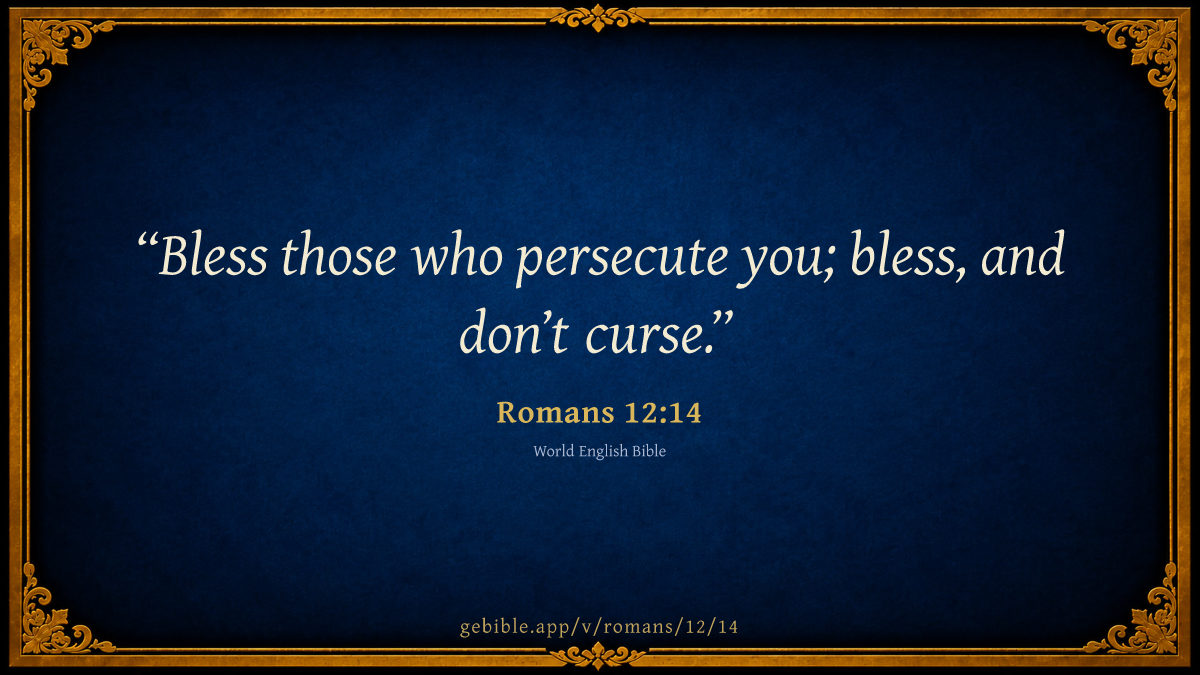
Bless those who persecute you; bless, and don’t curse.
Parallel Translations
-
Bless those who persecute you; bless, and don’t curse.
-
Blesse the which persecute you: blesse but course not.
-
Blesse them which persecute you: blesse, I say, and curse not.
Examined in Scripture Analysis
Contradictions (1)
Questions where the Bible appears to say two different things, with the passages on each side set together.
Cross-references (11)
Passages linked to Romans 12:14 in the Treasury of Scripture Knowledge, ordered by reader-vote popularity; verse text shown in World English Bible.
- 1 Peter 3:9 not rendering evil for evil, or insult for insult; but instead blessing, knowing that you were called to this, that you may inherit a blessing.
- Matthew 5:44 But I tell you, love your enemies, bless those who curse you, do good to those who hate you, and pray for those who mistreat you and persecute you,
- 1 Thessalonians 5:15 See that no one returns evil for evil to anyone, but always follow after that which is good for one another and for all.
- Romans 12:21 Don’t be overcome by evil, but overcome evil with good.
- 1 Corinthians 4:12-13 We toil, working with our own hands. When people curse us, we bless. Being persecuted, we endure. Being defamed, we entreat. We are made as the filth of the world, the dirt wiped off by all, even until now.
- Luke 6:28 bless those who curse you, and pray for those who mistreat you.
- James 3:10 Out of the same mouth comes blessing and cursing. My brothers, these things ought not to be so.
- Luke 23:34 Jesus said, “Father, forgive them, for they don’t know what they are doing.” Dividing his garments among them, they cast lots.
- Acts 7:60 He kneeled down, and cried with a loud voice, “Lord, don’t hold this sin against them!” When he had said this, he fell asleep.
- 1 Peter 2:21-23 For you were called to this, because Christ also suffered for us, leaving you an example, that you should follow his steps, who didn’t sin, “neither was deceit found in his mouth.” When he was cursed, he didn’t curse back. When he suffered, he didn’t threaten, but committed himself to him who judges righteously.
- Job 31:29-30 “If I have rejoiced at the destruction of him who hated me, or lifted up myself when evil found him (yes, I have not allowed my mouth to sin by asking his life with a curse);
Cross-references from openbible.info (CC BY 4.0)
Explain this verse (16 sources)
Historical commentary, presented as a primary source — not an endorsement.
Private notes
Saved on this device only — never synced or sent anywhere.
John Calvin 1540 · Public Domain 14. Bless them, etc. I wish, once for all,…
14. Bless them, etc. I wish, once for all, to remind the reader, that he is not scrupulously to seek a precise order as to the precepts here laid down, but must be content to have short precepts, unconnected, though suited to the formation of a holy life, and such as are deduced from the principle the Apostle laid down at the beginning of the chapter.
He will presently give direction respecting the retaliation of the injuries which we may suffer: but here he requires something even more difficult, — that we are not to imprecate evils on our enemies, but to wish and to pray God to render all things prosperous to them, how much soever they may harass and cruelly treat us: and this kindness, the more difficult it is to be practiced, so with the more intense desire we ought to strive for it; for the Lord commands nothing, with respect to which he does not require our obedience; nor is any excuse to be allowed, if we are destitute of that disposition, by which the Lord would have his people to differ from the ungodly and the children of this world.
Read full note →
Arduous is this, I admit, and wholly opposed to the nature of man; but there is nothing too arduous to be overcome by the power of God, which shall never be wanting to us, provided we neglect not to seek for it. And though you can hardly find one who has made such advances in the law of the Lord that he fulfills this precept, yet no one can claim to be the child of God or glory in the name of a Christian, who has not in part attained this mind, and who does not daily resist the opposite disposition.
I have said that this is more difficult than to let go revenge when any one is injured: for though some restrain their hands and are not led away by the passion of doing harm, they yet wish that some calamity or loss would in some way happen to their enemies; and even when they are so pacified that they wish no evil, there is yet hardly one in a hundred who wishes well to him from whom he has received an injury; nay, most men daringly burst forth into imprecations. But God by his word not only restrains our hands from doing evil, but also subdues the bitter feelings within; and not only so, but he would have us to be solicitous for the wellbeing of those who unjustly trouble us and seek our destruction.
Erasmus was mistaken in the meaning of the verb γεῖν to bless; for he did not perceive that it stands opposed to curses and maledictions: for Paul would have God in both instances to be a witness of our patience, and to see that we not only bridle in our prayers the violence of our wrath, but also show by praying for pardon that we grieve at the lot of our enemies when they willfully ruin themselves.
John Calvin's Commentaries (1540-1563) — public domain. Text from the Calvin Translation Society English edition (1840s-50s) via the Christian Classics Ethereal Library (ccel.org). Calvin's coverage is partial (roughly two-thirds of the Bible); uncommented books and verses are honest gaps, never fabricated. The 19th-century editor's footnotes and remarks are omitted so the notes are faithfully Calvin's own voice.
John Trapp 1656 · Public Domain 14 Bless them which persecute you: bless, and curse…
14 Bless them which persecute you: bless, and curse not.
Ver. 14. Bless them] {See Trapp on "Mat 5:44"}
John Trapp, A Commentary or Exposition upon All the Books of the Old and New Testament (1647–1656) — public domain. Text from a community e-Sword module.
Matthew Poole 1685 · Public Domain Bless them which persecute you; i.e. pray for them,…
Bless them which persecute you; i.e. pray for them, and wish well to them. This is borrowed from Mat 5:44; Luk 6:28; see the like in 1Pe 3:9. This is commended to us by the example of Christ himself, Isa 53:12; Luk 23:34; 1Pe 2:23; of Stephen, Act 7:60; of Paul, and the primitive Christians, 1Co 4:12.
Bless, and curse not: his doubling the exhortation shows the difficulty of the duty; it is contrary to corrupt nature: and it denotes the constancy of it; we must persevere therein. When he saith, curse not, he means, wish no evil to your enemies.
Read full note →
Objection. The prophets and apostles went contrary to this: see 2Ki 2:24; Psa 69:22,23; Ac 8:20; 13:10,11; 23:3.
Answer. These did it by a special vocation and instinct of the Spirit.
Matthew Poole's English Annotations on the Holy Bible (1683–1685) — public domain. Text from a community e-Sword/MySword module.
William Burkitt 1703 · Public Domain The apostle having taught us our duty to our…
The apostle having taught us our duty to our friends in the former verse, teacheth us our duty here towards our enemies. Bless them that persecute you: that is, pray for them, and wish well to them, whatever provocation you may have to the contrary.
Learn hence, 1. That good men must make account of, and prepare for, persecution; either the persecution of the tongue, or of the hand, or of both.
Read full note →
Learn, 2. That it is their duty ever to bless, never to curse, their persecutors and opposers; Bless, but curse not.
Where note, That the apootle doubles the exhortation, Bless your persecutors, bless and curse not. This doubling the exhortation, shows both the difficulty of the duty, how contrary it is to corrupt nature; and also the constancy of the duty, we must ever bless, and never curse: always wish well, never any ill, to the worst of men. Take we great heed of giving way to secret wishes of hurt to our enemy. God forbid we should hurt ourselves by sinful passion, because others hurt us by slander and false accusation. We are naturally prone to speak ill of others, and to wish ill to others, with delight; this sin persisted in, shuts out of heaven as well as murder.
William Burkitt's Expository Notes on the New Testament (1700–1703) — public domain. Text from a community e-Sword module.
John Gill 1763 · Public Domain Bless them which persecute you,.... It is the lot…
Bless them which persecute you,.... It is the lot of God's, people in this world to be persecuted by the men of it, in some shape or another, either by words or deeds; either by reviling and reproaching them, and speaking all manner of evil of them; or by hindering them the free exercise of religious worship, by confiscation of their goods, imprisonment of their persons, by violently torturing their bodies, and taking away their lives; under all which circumstances they are taught to
bless them; that is, to pray for them, that God would show them their evil, give repentance to them, and the remission of their sins; which is the order Christ gave to his disciples, Mat 5:44; and encouraged to an observance of, by his own example, Luk 23:34; and has been followed herein by his disciples and apostles, Act 7:60 Co1 4:12. Moreover, by "blessing" may be meant, giving them good words, mild and soft answers, "not rendering evil for evil, railing for railing", Pe1 3:9; but, on the contrary, blessing, in imitation of Christ, who, "when he was reviled, reviled not again", Pe1 2:23, "bless",
Read full note →
and curse not: to have a mouth full of cursing and bitterness, Rom 3:14, is the character of an unregenerate man, and what by no means suits one who names the name of Christ; for blessing and cursing to proceed out of the same mouth, is as absurd and unnatural, as if it should be supposed that a fountain should send forth sweet water and bitter, or salt and fresh, Jam 3:10. The imprecations upon wicked men, used by David and other good men, are no contradictions to this rule; since they were made under the inspiration of the Spirit of God, and were predictions of God's vengeance, which in righteous judgment should fall on them, and are not to be drawn into an example by us.
John Gill's Exposition of the Whole Bible (1746–1763) — public domain (CC PDM 1.0). Text via the HelloAO Bible API.
John Wesley 1765 · Public Domain Curse not - No, not in your heart.
Curse not - No, not in your heart.
John Wesley, Explanatory Notes Upon the Whole Bible (1754–1765) — public domain. Text via the GEBible commentary corpus.
Adam Clarke 1810 · Public Domain Verse 14. Bless them which persecute you] ευλογειτε, Give…
Verse 14. Bless them which persecute you] ευλογειτε, Give good words, or pray for them that give you bad words, καταρασθε, who make dire imprecations against you. Bless them, pray for them, and on no account curse them, whatever the provocation may be. Have the loving, forgiving mind that was in your Lord.
Adam Clarke's Commentary on the Bible (1810–1826) — public domain. Text from a community e-Sword/MySword module.
Albert Barnes 1834 · Public Domain Bless them ... - see the note at Mat…
Bless them ... - see the note at Mat 5:44; compare Luk 6:28.
Bless, and curse not - Bless only; or continue to bless, however long or aggravated may be the injury. Do not be provoked to anger, or to cursing, by any injury, persecution, or reviling. This is one of the most severe and difficult duties of the Christian religion; and it is a duty which nothing else but religion will enable people to perform. To curse denotes properly to devote to destruction. Where there is power to do it, it implies the destruction of the object. Thus, the fig-tree that was cursed by the Saviour soon withered away: Mar 11:21. Thus, those whom God curses will be certainly destroyed; Mat 25:41. Where there is not power to do it, to curse implies the invoking of the aid of God to devote to destruction. Hence, it means to imprecate; to implore a curse from God to rest on others; to pray that God would destroy them. In a larger sense still, it means to abuse by reproachful words; to calumniate; or to express oneself in a violent, profane, and outrageous manner. In this passage it seems to have special reference to this.
Albert Barnes' Notes on the Bible (1834–1885) — public domain. Text from a community e-Sword/MySword module.
Robert Jamieson, A. R. Fausset & David Brown 1871 · Public Domain Bless--that is, Call down by prayer a blessing on.
Bless--that is, Call down by prayer a blessing on.
them which persecute you, &c.--This is taken from the Sermon on the Mount (Mat 5:44), which, from the allusions made to it, seems to have been the storehouse of Christian morality among the churches.
Jamieson, Fausset & Brown — Commentary Critical and Explanatory on the Whole Bible (1871) — public domain (CC PDM 1.0). Text via the HelloAO Bible API.
The Cambridge Bible for Schools and Colleges 1878 · Public Domain 14. Bless them which persecute you] According to the…
14. Bless them which persecute you] According to the Lord’s own express precept; see Luk_6:28. See also His example, Luk_23:34.—The Roman Church was not at this time under special trial of persecution; so we seem to gather from the general tone of this Epistle. But soon the Neronian persecution was to break upon it; and meantime, in one form or another, persecution was always going on, if only on a private scale. Cp. 2Ti_3:12.
The Cambridge Bible for Schools and Colleges (gen. ed. J. J. S. Perowne; Cambridge University Press, 1878–1918) — public domain. Text from a community e-Sword module.
Ellicott's Commentary for English Readers 1878 · Public Domain (14) Bless them which persecute you.—Apparently with allusion to…
(14) Bless them which persecute you.—Apparently with allusion to Mat_5:44. It was probably just about the time that St. Paul was writing this Epistle, or at most a year or two later, that the series of compositions which ultimately took the shape of our present Gospels began. It is not, however, necessary to suppose that St. Paul had actually seen one of these. The record of our Lord’s teaching was no doubt at first preserved and circulated in the Church orally, and it would be in this form that St. Paul first became acquainted with the precept to which he here seems to allude. There is, perhaps, another reference to the Sermon on the Mount in 1Co_7:10. Such references occur (as we should expect) more frequently in the Epistle of St. James.
A Bible Commentary for English Readers, edited by Charles John Ellicott (1878–1897) — public domain. Text from a community e-Sword module.
B. W. Johnson 1891 · Public Domain 14–17. Bless them that persecute you. See Matt. 5:44.…
14–17. Bless them that persecute you. See Matt. 5:44. Thus did Christ on the cross, and the martyred Stephen. He who can obey this precept is a transformed man.
B. W. Johnson's The People's New Testament with Notes (1889–1891) — public domain. Electronic text from the Christian Classics Ethereal Library (CCEL) ThML edition.
William B. Godbey 1900 · Public Domain 14. “Bless them that persecute you, bless and scold…
14. “Bless them that persecute you, bless and scold not.” You must remember that this chapter is all addressed not simply to Christians, but to the sanctified, beautifully setting forth their attitude and deportment before the world. The word here does not mean to indulge in profanity, but to scold, which is utterly incompatible with the gospel standard of Christian living.
William B. Godbey, Commentary on the New Testament (1896–1900) — public domain. Text from a community e-Sword module.
J. W. McGarvey 1914 · Public Domain Bless them that persecute you; bless, and curse not…
Bless them that persecute you; bless, and curse not . ["Thus," says Johnson, "did Christ on the cross, and the martyred Stephen." The apostle here drops into the imperative because quoting from the Sermon on the Mount ( Mat_5:44 : Luk_6:28 ). We would expect to find this command classified among duties to persons entirely outside the church, but the apostle's life reminds us that cursings were apt to come from those inside as well as from those without ( 2Co_11:26 ). "This doubling of the exhortation (bless) shows both the difficulty of the duty, how contrary it is to corrupt nature, and also the constancy of the duty, we must ever bless and never curse" (Burkitt). Love must win this battle for our untrue brother's sake.]
J. W. McGarvey (with Philip Y. Pendleton), Commentaries on the New Testament (The Fourfold Gospel, 1914; Acts; and the epistles) — public domain. Text from a community e-Sword/MySword module.
unfoldingWord translationNotes 2017 · CC BY-SA 4.0 Be of the same mind toward one another
Be of the same mind toward one another
This is an idiom that means to live in unity. AT: "Agree with one another" or "Live in unity with each other" (See: Idiom)
Read full note →
Do not think in proud ways
"Do not think that you are more important than others"
accept lowly people
"welcome people who do not seem important"
Do not be wise in your own thoughts
"Do not think of yourselves as having more wisdom than everyone else"
translationWords
bless
persecute
curse
joy
proud
lowly
wise
unfoldingWord translationNotes — © Distant Shores Media and the Door43 World Missions Community, licensed CC BY-SA 4.0. Source: git.door43.org/Door43/en_tn.
Tyndale Open Study Notes 2022 · CC BY-SA 4.0 12:14 The exhortations in this verse closely resemble two…
12:14 The exhortations in this verse closely resemble two sayings of Jesus (Matt 5:44; Luke 6:27-28). Although Paul does not introduce the commands as a quotation, he is almost certainly alluding to these sayings of Christ. Perhaps the words were so well known that he did not need to specify the source. The teaching of Rom 12–13 has many parallels with the teaching of Jesus.
Tyndale Open Study Notes — © Tyndale Open Resources, licensed CC BY-SA 4.0. Text via the HelloAO Bible API.