
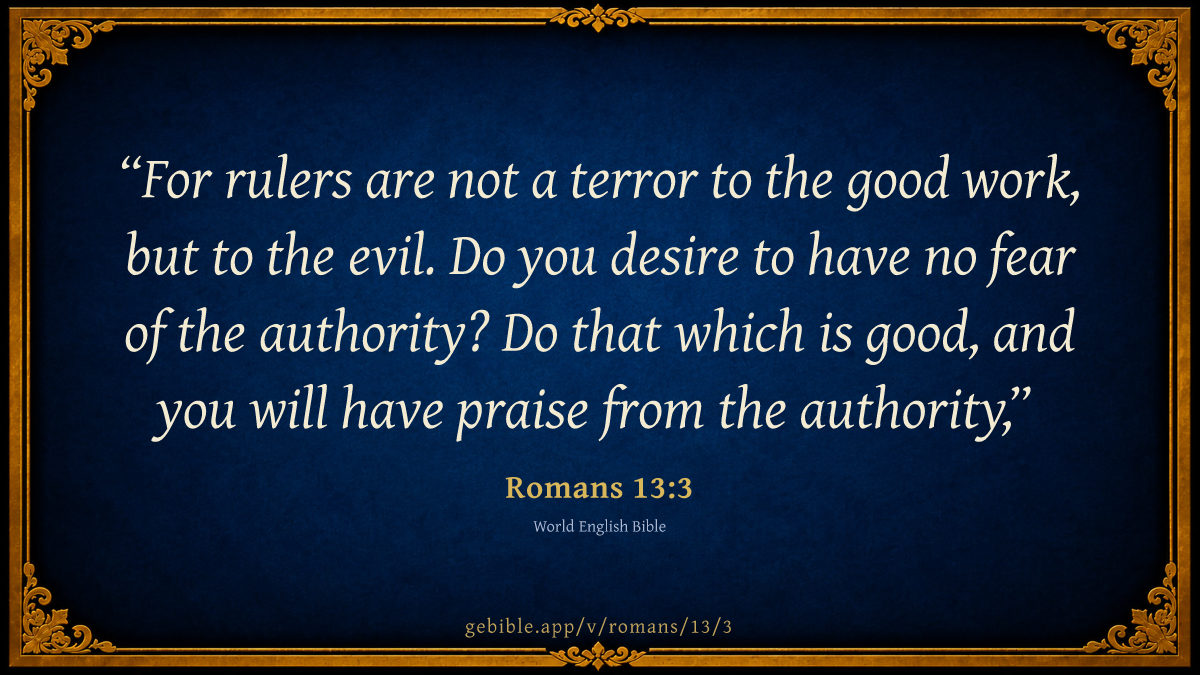
For rulers are not a terror to the good work, but to the evil. Do you desire to have no fear of the authority? Do that which is good, and you will have praise from the authority,
Parallel Translations
-
For rulers are not a terror to the good work, but to the evil. Do you desire to have no fear of the authority? Do that which is good, and you will have praise from the authority,
-
For rulars are not to be feared for good workes but for evyll. Wilt thou be with out feare of the power? Do well then: and so shalt thou be praysed of the same.
-
For Magistrates are not to be feared for good workes, but for euill. Wilt thou then bee without feare of the power? doe well: so shalt thou haue praise of the same.
Examined in Scripture Analysis
Contradictions (2)
Questions where the Bible appears to say two different things, with the passages on each side set together.
Cross-references (8)
Passages linked to Romans 13:3 in the Treasury of Scripture Knowledge, ordered by reader-vote popularity; verse text shown in World English Bible.
- Ecclesiastes 10:4-6 If the spirit of the ruler rises up against you, don’t leave your place; for gentleness lays great offenses to rest. There is an evil which I have seen under the sun, the sort of error which proceeds from the ruler. Folly is set in great dignity, and the rich sit in a low place.
- Proverbs 14:35 The king’s favor is toward a servant who deals wisely, but his wrath is toward one who causes shame.
- Proverbs 20:2 The terror of a king is like the roaring of a lion. He who provokes him to anger forfeits his own life.
- 1 Peter 2:13-14 Therefore subject yourselves to every ordinance of man for the Lord’s sake: whether to the king, as supreme; or to governors, as sent by him for vengeance on evildoers and for praise to those who do well.
- Deuteronomy 25:1 If there is a controversy between men, and they come to judgment and the judges judge them, then they shall justify the righteous and condemn the wicked.
- Jeremiah 22:15-18 “Should you reign, because you strive to excel in cedar? Didn’t your father eat and drink, and do justice and righteousness? Then it was well with him. He judged the cause of the poor and needy; so it was well, then. Wasn’t this to know me?” says Yahweh. But your eyes and your heart are only for your covetousness, for shedding innocent blood, for oppression, and for doing violence.” Therefore Yahweh says concerning Jehoiakim the son of Josiah, king of Judah: “They won’t lament for him, saying, ‘Ah my brother!’ or, ‘Ah sister!’ They won’t lament for him, saying ‘Ah lord!’ or, ‘Ah his glory!’
- 1 Peter 3:13-14 Now who will harm you if you become imitators of that which is good? But even if you should suffer for righteousness’ sake, you are blessed. “Don’t fear what they fear, neither be troubled.”
- Romans 13:4 for he is a servant of God to you for good. But if you do that which is evil, be afraid, for he doesn’t bear the sword in vain; for he is a servant of God, an avenger for wrath to him who does evil.
Cross-references from openbible.info (CC BY 4.0)
Explain this verse (19 sources)
Historical commentary, presented as a primary source — not an endorsement.
Private notes
Saved on this device only — never synced or sent anywhere.
John Calvin 1540 · Public Domain 3. For princes, etc. He now commends to us…
3. For princes, etc. He now commends to us obedience to princes on the ground of utility; for the causative γὰρ, for, is to be referred to the first proposition, and not to the last verse. Now, the utility is this, — that the Lord has designed in this way to provide for the tranquillity of the good, and to restrain the waywardness of the wicked; by which two things the safety of mankind is secured: for except the fury of the wicked be resisted, and the innocent be protected from their violence, all things would come to an entire confusion. Since then this is the only remedy by which mankind can be preserved from destruction, it ought to be carefully observed by us, unless we wish to avow ourselves as the public enemies of the human race.
And he adds, Wilt not thou then fear the power? Do good. By this he intimates, that there is no reason why we should dislike the magistrate, if indeed we are good; nay, that it is an implied proof of an evil conscience, and of one that is devising some mischief, when any one wishes to shake off or to remove from himself this yoke. But he speaks here of the true, and, as it were, of the native duty of the magistrate, from which however they who hold power often degenerate; yet the obedience due to princes ought to be rendered to them. For since a wicked prince is the Lord’s scourge to punish the sins of the people, let us remember, that it happens through our fault that this excellent blessing of God is turned into a curse.
Read full note →
Let us then continue to honor the good appointment of God, which may be easily done, provided we impute to ourselves whatever evil may accompany it. Hence he teaches us here the end for which magistrates are instituted by the Lord; the happy effects of which would always appear, were not so noble and salutary an institution marred through our fault. At the same time, princes do never so far abuse their power, by harassing the good and innocent, that they do not retain in their tyranny some kind of just government: there can then be no tyranny which does not in some respects assist in consolidating the society of men.
He has here noticed two things, which even philosophers have considered as making a part of a well-ordered administration of a commonwealth, that is, rewards for the good, and punishment for the wicked. The word praise has here, after the Hebrew manner, a wide meaning.
John Calvin's Commentaries (1540-1563) — public domain. Text from the Calvin Translation Society English edition (1840s-50s) via the Christian Classics Ethereal Library (ccel.org). Calvin's coverage is partial (roughly two-thirds of the Bible); uncommented books and verses are honest gaps, never fabricated. The 19th-century editor's footnotes and remarks are omitted so the notes are faithfully Calvin's own voice.
Geneva Bible translators 1599 · Public Domain An excellent way to bear this yoke, not only…
An excellent way to bear this yoke, not only without grief, but also with great profit.
The third argument taken from the end wherefore they were made, which is most profitable: for that God by this means preserveth the good and bridleth the wicked: by which words the Magistrates themselves are put in mind of that duty which they owe to their subjects.
Geneva Bible (1599) marginal notes — public domain.
John Trapp 1656 · Public Domain 3 For rulers are not a terror to good…
3 For rulers are not a terror to good works, but to the evil. Wilt thou then not be afraid of the power? do that which is good, and thou shalt have praise of the same:
Ver. 3. For rulers, are not, &c.] They should not be. But Jeroboam set a net on Mizpeh, and spread a snare upon Tabor, to watch who would go from him to Judah to worship, Hos 5:1.
Read full note →
A terror to good works, but to the evil] The sword of justice (saith one) must be furbished with the oil of mercy; yet there are cases wherein severity ought to cast the scale. Duresce, Duresce, o infaelix Lantgravie, Be sern, be stern oh unhappy Lantgrave, said the poor smith to the Landgrave of Thuring, more mild than was for his people’s good. Bonis nocet, qui malis parcit. He harms the good who spares the wicked. Edward the Confessor was held a bad prince, not by doing, but enduring ill.
John Trapp, A Commentary or Exposition upon All the Books of the Old and New Testament (1647–1656) — public domain. Text from a community e-Sword module.
Matthew Poole 1685 · Public Domain This verse contains a further argument for subjection to…
This verse contains a further argument for subjection to the higher powers, and it is taken from the benefit thereof, or from the end of magistracy, which is for the punishment of evil, and the encouragement of good works: see 1Pe 2:14. When he says, that
rulers are not a terror to good works, he means, they are not so ordinarily; or they were not ordained for that end, but the contrary. Or else, by are not understand they ought not, so to be.
Read full note →
Wilt thou then not be afraid of the power? do that which is good,
and thou shalt have praise of the same: q.d. Wouldst thou be free from fear of being punished by the magistrate? Do that which is good, and thou shalt not only be free from fear, but sure of praise and reward: see Pro 14:35; 16:13.
By good he means, not that which is so theologically. but morally: q. d. Live honestly, hurt no man in word or deed, give to every man his due, &c. This is good in the sight of all men, of heathens themselves.
Matthew Poole's English Annotations on the Holy Bible (1683–1685) — public domain. Text from a community e-Sword/MySword module.
William Burkitt 1703 · Public Domain Here we have a further argument for subjection to…
Here we have a further argument for subjection to rulers and governors, drawn from the end of the magistrate’s office, which is to punish vice, and to promote virtue: Rulers are not a terror to good works; that is, they ought not, and they ordinarily are not; they were not ordained for that end, and it is not their place so to be, namely, a terror to the good, but to the bad only; for God giveth no authority against himself, or his own righteous laws, which require the punishing of the bad, and the rewarding of the good.
Learn hence, 1. That magistrates, by virtue of their place, ought to be a terror, or exceeding terrible, to evil works, and evil workers.
Read full note →
Learn, 2. That magistrates are not terrible, but amiable, to good men; they fear rulers, but it is with a fear of reverence, not with a tormenting, servile fear: Do that which is good, and thou shalt not be afraid of the power.
William Burkitt's Expository Notes on the New Testament (1700–1703) — public domain. Text from a community e-Sword module.
John Gill 1763 · Public Domain For rulers are not a terror to good works,....…
For rulers are not a terror to good works,.... That is, to them that do good works in a civil sense; who behave well in the neighbourhoods, towns, cities, and countries where they dwell. The apostle seems to anticipate an objection made against governors, as if there was something very terrible and formidable in them; and which might be taken up from the last clause of the preceding verse; and which he removes by observing, that governors neither do, nor ought to inject terror into men that behave well, obey the laws, and keep a good decorum among their fellow subjects, not doing any injury to any man's person, property, and estate. The Jews (a) have a saying,
"that a governor that injects more fear into the people, than is for the honour of God, shall be punished, and shall not see his son a disciple of a wise man.''
Read full note →
But to the evil; to wicked men, who make no conscience of doing hurt to their fellow creatures, by abusing their persons, defrauding them of their substance, and by various illicit methods doing damage to them; to such, rulers are, and ought to be terrors; such are to be menaced, and threatened with inflicting upon them the penalty of the laws they break; and which ought to be inflicted on them by way of punishment to them, and for the terror of others. R. Chanina, the Sagan of the priests (b), used to say,
"pray for the peace of the kingdom, for if there was no "fear", (i.e. a magistrate to inject fear,) one man would devour another alive.''
Wilt thou not then be afraid of the power? of the civil magistrate, in power and authority, to oppose him, to refuse subjection to him, to break the laws, which, according to his office, he is to put in execution.
Do that which is good: in a civil sense, between man and man, by complying with the laws of the land, which are not contrary to the laws of God; for of doing good in a spiritual and religious sense he is no judge:
and thou shalt have praise of the same; shall be commended as a good neighbour, a good citizen, and a good commonwealth's man; an honest, quiet, peaceable man, that does not disturb the peace of civil society, but strengthens and increases it.
(a) T. Bab. Roshhashana, fol. 17. 1. Maimon. Hilch. Sanhedrin, c. 25. sect. 1. (b) Pirke Abot, c. 3. sect. 2.
John Gill's Exposition of the Whole Bible (1746–1763) — public domain (CC PDM 1.0). Text via the HelloAO Bible API.
John Wesley 1765 · Public Domain For rulers are - In the general, notwithstanding some…
For rulers are - In the general, notwithstanding some particular exceptions. A terror to evil works - Only. Wouldest thou then not be afraid - There is one fear which precedes evil actions, and deters from them: this should always remain. There is another fear which follows evil actions: they who do well are free from this.
John Wesley, Explanatory Notes Upon the Whole Bible (1754–1765) — public domain. Text via the GEBible commentary corpus.
Adam Clarke 1810 · Public Domain Verse 3. For rulers are not a terror to…
Verse 3. For rulers are not a terror to good works] Here the apostle shows the civil magistrate what he should be: he is clothed with great power, but that power is entrusted to him, not for the terror and oppression of the upright man, but to overawe and punish the wicked. It is, in a word, for the benefit of the community, and not for the aggrandizement of himself, that God has entrusted the supreme civil power to any man. If he should use this to wrong, rob, spoil, oppress, and persecute his subjects, he is not only a bad man, but also a bad prince. He infringes on the essential principles of law and equity. Should he persecute his obedient, loyal subjects, on any religious account, this is contrary to all law and right; and his doing so renders him unworthy of their confidence, and they must consider him not as a blessing but a plague. Yet, even in this case, though in our country it would be a breach of the constitution, which allows every man to worship God according to his conscience, the truly pious will not feel that even this would justify rebellion against the prince; they are to suffer patiently, and commend themselves and their cause to him that judgeth righteously. It is an awful thing to rebel, and the cases are extremely rare that can justify rebellion against the constituted authorities. See the doctrine on Ro 13:1.
Wilt thou then not be afraid of the power?] If thou wouldst not live in fear of the civil magistrate, live according to the laws; and thou mayest expect that he will rule according to the laws, and consequently instead of incurring blame thou wilt have praise. This is said on the supposition that the ruler is himself a good man: such the laws suppose him to be; and the apostle, on the general question of obedience and protection, assumes the point that the magistrate is such.
Adam Clarke's Commentary on the Bible (1810–1826) — public domain. Text from a community e-Sword/MySword module.
Joseph Benson 1811 · Public Domain Rom 13:3-5. For rulers — In general, notwithstanding some…
Rom 13:3-5. For rulers — In general, notwithstanding some particular exceptions; are not a terror to good works — Were not ordained, and do not use to punish those that do well, and conform to good laws; but to the evil — From which they deter people by punishing those who do them. Wilt thou — Wouldest thou then; not be afraid of the power — Of the high authority with which they are invested? Do that which is good — Carefully perform the good actions which they enjoin, and, according to the general course of administration, thou shalt have — Not only protection, but praise and respect from it. There is one fear that precedes evil actions, and deters from them: this should always remain. There is another which follows evil actions: they who do well are free from this. For he is — According to the original appointment, to be considered as elevated above his fellow-men, not for his own indulgence, dominion, and advantage, but that he might be to thee, and to all the rest of his subjects, as the minister of God for good — By maintaining all in their just possessions, and protecting them from all injury and violence. But if thou do that which is evil — And so makest thyself the enemy of that society of which he is the guardian; be afraid — Thou hast reason to be so. For he beareth not the sword in vain — Namely, the sword of justice, the instrument of capital punishment, which God hath put into his hands, and hath authorized him to use against malefactors. A revenger to execute wrath — Not his own personal resentment, but the wrath of a righteous Providence; upon him that doeth evil — In instances wherein it would be highly improper to leave that avenging power in the hands of private injured persons. Therefore a sense of duty to God, as well as prudence and human virtue, will teach you, that you must needs be subject, not only for fear of wrath — That is, punishment from man; but for conscience’ sake — Out of obedience to God. It must be well observed, that “the apostle did not mean that they were to be subject to the sinful laws of the countries where they lived, otherwise he made it necessary for the Roman brethren to join in the worship of idols, contrary to the superior obligation they were under of obeying God rather than man. Besides, by telling them they were to be subject on account of conscience, he intimated that the subjection which he enjoined did not extend to things sinful.”
Joseph Benson's Commentary on the Old and New Testaments (1811–1818) — public domain. Text from a community e-Sword module.
Albert Barnes 1834 · Public Domain For rulers - The apostle here speaks of rulers…
For rulers - The apostle here speaks of rulers “in general.” It may not be “universally” true that they are not a terror to good works, for many of them have “persecuted” the good; but it is generally true that they who are virtuous have nothing to fear from the laws. It is “universally” true that the design of their appointment by God was, not to injure and oppress the good, but to detect and punish the evil. Magistrates, “as such,” are not a terror to good works.
Are not a terror ... - Are not appointed to “punish the good.” Their appointment is not to inspire terror in those who are virtuous and peaceable citizens; compare 1Ti 1:9.
Read full note →
But to the evil - Appointed to detect and punish evildoers; and therefore an object of terror to them. The design of the apostle here is evidently to reconcile Christians to submission to the government, from its “utility.” It is appointed to protect the good against the evil; to restrain oppression, injustice, and fraud; to bring offenders to justice, and thus promote the peace and harmony of the community. As it is designed to promote order and happiness, it should be submitted to; and so long as “this” object is pursued, and obtained, government should receive the countenance and support of Christians. But if it departs from this principle, and becomes the protector of the evil and the oppressor of the good, the case is reversed, and the obligation to its support must cease.
Wilt thou not ... - If you do evil by resisting the laws, and in any other manner, will you not fear the power of the government? Fear is “one” of the means by which men are restrained from crime in a community. On many minds it operates with much more power than any other motive. And it is one which a magistrate must make use of to restrain men from evil.
Do that which is good - Be a virtuous and peaceable citizen; abstain from crime, and yield obedience to all the just laws of the land,
And thou shalt have praise of the same - Compare 1Pe 2:14-15. You shall be unmolested and uninjured, and shall receive the commendation of being peaceable and upright citizens. The prospect of that protection, and even of that reputation, is not an unworthy motive to yield obedience to the laws. Every Christian should desire the reputation of being a man seeking the welfare of his country, and the just execution of the laws.
Albert Barnes' Notes on the Bible (1834–1885) — public domain. Text from a community e-Sword/MySword module.
Robert Jamieson, A. R. Fausset & David Brown 1871 · Public Domain For rulers are not a terror to good works--"to…
For rulers are not a terror to good works--"to the good work," as the true reading appears to be
but to the evil.
Jamieson, Fausset & Brown — Commentary Critical and Explanatory on the Whole Bible (1871) — public domain (CC PDM 1.0). Text via the HelloAO Bible API.
Daniel D. Whedon 1874 · Public Domain 3. Not a terror to good—In its legitimate character,…
3. Not a terror to good—In its legitimate character, government is necessary to prevent evil and to secure peace. The very worst government is better than aimless anarchy.
Not be afraid—To fear the just penalty of law is a duty. So to fear the just penalty of the law of God is a duty.
Daniel D. Whedon (gen. ed.), Commentary on the Old and New Testaments (1874–1909) — public domain. Text from a community e-Sword module.
The Cambridge Bible for Schools and Colleges 1878 · Public Domain 3. The passage distinctly forbids revolutionary action in a…
3. The passage distinctly forbids revolutionary action in a Christian. Action within the limits of the existing constitution he may employ; for the constitution is, in fact, the “power that is,” be it good or bad. But he must not plot for its demolition, nor indeed act for its demolition in any way of “violence;” be it violence of deed or word, violence direct or indirect.
3. For rulers, &c.] St Paul enforces the certainty of “judgment” in this case by pointing out its manifest justice. “Rulers” (lit. the rulers, rulers as a class,) are, as a fact, an agency on the side of right and order; it is justly, then, a sin in the sight of God to resist their authority.—No doubt the statement here is never fully realized save where the rulers are personally just and the constitution equitable; (and by no means always, in detail, even then). But the statement is not to be limited to such cases. Civil authority, even in its most distorted forms, never systematically favours wrong as wrong and punishes right as right. Even when a Nero or a Decius persecuted the Church of Christ, the theory of persecution (apart from personal rancour) was the preservation of order; and meantime, in the innumerable details of the common life of the Roman world, the authority of a Nero or a Decius was a necessity and a providential blessing.
Read full note →
Wilt thou then not be afraid] With the fear of an enemy; the feeling of a weaker towards a stronger opponent.—“Then” is lit. but; and so better, perhaps: But wilt thou not, &c. Q. d., “But if, as a fact, they are a terror to thee, and thou willest to shake off that terror—the remedy is simple; be a good citizen and subject.”
praise] That at least of protection and security; the “good” referred to in the next clause.
The Cambridge Bible for Schools and Colleges (gen. ed. J. J. S. Perowne; Cambridge University Press, 1878–1918) — public domain. Text from a community e-Sword module.
Ellicott's Commentary for English Readers 1878 · Public Domain (3) To good works.—Literally, to the good work, as…
(3) To good works.—Literally, to the good work, as if it were personified. Human law can only take account of that which is actually done, not of the intention.
In this and the following verse it is clearly the ideal aspect of the magistracy that the Apostle has in view. So Bishop Butler, in the paragraph next to that just quoted, continues: “If it be objected that good actions, and such as are beneficial to society, are often punished, as in the case of persecution and in other cases, and that ill and mischievous actions are often rewarded, it may be answered distinctly: first, that this is in no sort necessary, and consequently not natural, in the sense in which it is necessary and therefore natural, that ill or mischievous actions should be punished; and in the next place, that good actions are never punished considered as beneficial to society, nor ill actions rewarded under the view of their being hurtful to it. So that it stands good . . . that the Author of Nature has as truly directed that vicious actions, considered as mischievous to society, should be punished, and put mankind under a necessity of punishing them, as He has directed and necessitated us to preserve our lives by food.” Occasional failures of justice on the part of the executive do not make the strict administration of justice any the less its proper duty and office.
A Bible Commentary for English Readers, edited by Charles John Ellicott (1878–1897) — public domain. Text from a community e-Sword module.
The Biblical Illustrator 1887 · Public Domain For rulers are not a terror to good works.
Rom_13:3-6
For rulers are not a terror to good works.
Read full note →
The duties of rulers and subjects
I. Of rulers.
1. To protect the good.
2. To restrain the evil.
3. To reward merit.
II. Of subjects.
1. To respect authority.
2. To do good.
3. And thereby merit praise. (J. Lyth, D.D.)
Do that which is good, and thou shall; have praise of the same.--
Conscientiousness
When the Emperor Nicholas was in England, in 1844, industry in Russia could hardly be said to exist, and the Czar was extremely anxious to introduce machinery of all sorts into his arsenals, so as to become independent of foreign makers. With this object he visited a number of large establishments in the Midland Counties and the North; and one Sunday morning Mr. James Nasmyth, the inventor of the steam hammer, and proprietor of large works at Patricroft, was much surprised at the appearance in his garden of an officer in a carriage and a gorgeous uniform, whose chasseur, still more gorgeous than his master, was sent up to disturb the old gentlemans Sabbath rest by loudly announcing, Prince K--. The prince himself walked in, smoking a cigarette, and informed Mr. Nasmyth in good English that the Czar intended to honour the Patricroft works with a visit on that afternoon. Indeed! replied their owner, I regret that his majesty will not see much, as it is Sunday. But it would be easy, rejoined the aide-de-camp, coolly helping himself to a bon-bon which his chasseur handed him out of a handsome box, to start the works for a few hours. Mr. Nasmyth might be sure of his majestys favour. Sir, replied Mr. Nasmyth, the favour of my God is more important to me than that of your master. And if I were inclined to break the Sabbath for him, my men would not. Would you not start the works for Queen Victoria on Sunday? asked the astonished aide-de-camp. Her Gracious Majesty, replied the old Briton, would never suggest such a thing. The Czar did not visit Patricroft.
For he is a minister of God to thee for good.--
The ministry of civil rulers
The civil ruler is--
I. A minister of God.
1. Paul does not say he ought to be so, or it would be well if he would consent to be so, but that he is. It is not in his pleasure not to be so. He must be so, if he rebel against it ever so fiercely. Neros will might be devilish; every power which he wielded was Divine. He had been appointed to rule the world which he tormented by Him who loved that world.
2. How would such a doctrine affect the Roman Christians? They could not confound vital power with those outside accidents of it which our vulgar nature prompts us to admire when they recollected from whom it came, and they must have hated every wanton exercise of it. The effect of regarding Nero as a minister of God was, no doubt, to make them patient under his government, and afraid to engage in any mad schemes for subverting it. But this faith gave strength to their cries that the earth might be delivered from all her oppressors, assured them that those cries would not be in vain, and made them welcome their own sufferings as steps towards the redemption.
3. Those who attempt to find apologies for tyranny in Scripture, sometimes ask, If Neros power was ordained by God, what subjects can pretend that the powers which are over them have some lower origin? I answer, Certainly none. And subjects would be most unwise if they wished otherwise. For it imports that every power is a trust, and implies responsibility to a judge whom the greatest criminal cannot escape. Read Roman history in the light of St. Pauls sentence. Every sting of conscience which visited Nero that night when he knew himself to be his mothers murderer was a message to him, Thou art Gods minister, and thou hast used His sword against thy own flesh and blood. The assassin by whom he fell at last was saying, Thou art Gods minister; and so am I, guilty like thyself, but ordained to call thee to His judgment-seat.
4. Surely, if rulers and people believed this, it would be something more than the notion that they may be brought to the bar of public opinion. But let those who confess the power of public opinion ask themselves whether it requires any more credulity to acknowledge the presence of a living, personal ruler?
II. A minister of God to thee.
1. A strange assertion! A minister of God to the Roman world the emperor might be, however little he fulfilled his ministry. But a minister of God to some individual member of the Roman Church, who must have counted it the best privilege of his obscurity that the emperor would never hear of him, never inquire after him, how could he be such to that man? In this way: When a man was taken into the Christian Church, he contracted affinities and obligations to Jew and Greek, barbarian and Scythian, bond and free. But he might easily forget these, and fancy that the Church was an isolated body. The fact of being under a common civil ruler deepened and expanded the doctrine. Nor was the benefit destroyed by the character of the ruler. If he was an oppressor, there was more necessity of falling back on the Source from which his authority proceeded, in prayer that His will might be done on earth as it is in heaven.
2. But I am far more desirous to assert the truth in reference to those rulers who confess their calling and try to fulfil it. So far as they contribute to the health and growth of the body politic, so far they must be ministers of God to each one of us personally. For are they not quickening our hearts and hopes, and enabling us to enter more truly the kingdom of God? It is impossible that all true human rule should not be like the Divine rule in this, that it is most minute when it is most comprehensive; that it calls for the most personal loyalty when it is most generally even and just.
III. A minister of God to thee for good.
1. St. Paul writes this to men who might, in a short time, be lighting the city as torches to cover the guilt of him who set it on fire. Well! and was he not, and was not Charles IX in France, and Philip II in the Netherlands? Were they not ministers of God for good to those whom they sent beyond the reach of their crimes, to cry beneath the altar for the day when the earth should no more conceal her blood or cover her slain? And it will be known, some day, to how many men, governments the most accursed have been ministers of good, by leading them from trifling to earnestness, by changing them from reckless plotters into self-denying patriots, by turning their atheism or devil-worship into a grounded faith in the God of Truth. Many such, I fear, will rise up in judgment against those who live in happier circumstances.
2. But the apostle was enabled to proclaim this principle on other grounds. As he believed Christ to be the King of men, he could not help believing that all human society was organised according to the law which He embodied. The Chief of all is the servant of all. He could not doubt that if the emperor believed this he would be a blessing to the world; that he was a curse to it because he thought the world was to minister to him, and not he to it. He could not doubt that every Christian ought to maintain the truth which Nero set at naught, and that if he did, it would prove itself in his case--Nero would be a minister of God for good to him.
3. How did the faith that there is a constitution for nations, which kings did not create, work itself into the heart of modern Europe? When a mediator between God and man is rejected, you must have an absolute caliph or sultan, and a government carried on by mere officials; you cannot have the confession of a relationship between the sovereign and his subjects, involving mutual obligation. This is involved in the faith of a Son of God and a Son of Man. Whatever has suffocated that faith--be it ecclesiastical pretension, or revolt against that pretension, be it the worship of money, or the worship of a tyrant instead of a father--undermines constitutional liberty. To bring forth that faith in its fulness before the nations which nominally confess it, is to help them to break their political fetters. (F. D. Maurice, M.A.)
The functions of the ruler
I. To maintain law and order.
1. As the minister of God.
2. For the benefit of man.
II. To punish crime.
1. For this purpose he is invested with the power of life and death.
2. Must use it righteously.
3. As responsible to God.
4. For the suppression of evil. (J. Lyth, D.D.)
The relative duties of rulers and subjects
I. The nature of civil government.
1. The events of the seventeenth century, which changed the form of government and placed its institutions on a new footing, naturally gave rise to searching inquiries into the origin of lawful authority.
(1) Filmer maintained that kings had a Divine hereditary right to their thrones in virtue of Adams absolute and arbitrary dominion over his offspring. But we read of no grant of any such dominion which, had it existed, would have rendered slavery coeval with the first human family, and would nullify the claims of all monarchs excepting the true heir of Adam, if he could be found.
(2) Sidney and Locke endeavoured to base the relation between rulers and subjects on the supposition that an agreement was originally entered into by the first founders of a state, which involved a tacit compact between all succeeding members of it. But we have no evidence of any such social compact having ever been made.
(3) It seems more satisfactory to regard government as arising from the nature of man, though still having its first elements in the relation between the head of a family and the children. The idea of authority on the one hand, and of submission on the other, thus gained, would easily prepare the way for the union of a number of families under one head.
2. Reason cannot fail to discern the importance cf civil government to save society from a disorder which must soon have issued in its dissolution, if not in the destruction of the very race itself. Accordingly, in the Scriptures, we find civil government very clearly recognised as a Divine institution; and the general obligation to obedience is enforced under penalty of the consequences of resisting an ordinance of God. But though God has given His own sanction to the institution we have no evidence that any one particular form has been prescribed, or even that uniformity in this respect would be a good. When it is said, the powers that be are ordained of God, the meaning is, that as government is designed for the security and happiness of society, every government, whatsoever its form, which in any particular country promotes this end, is agreeable to the will of God. Until Saul reigned, the human form of the theocratic government had been substantially a sort of republic. The monarchy, however, after it became established, received the Divine sanction.
II. The ties which severally attach to the governing power and the governed.
1. The duties of rulers.
(1) To remember their responsibility to God. He that ruleth over men must be just, ruling in the fear of God. When it is considered that the happiness of millions is entrusted to them, how deeply should they feel that they have a Master in heaven!
(2) To act exclusively for the public good. Not only does the text describe the civil ruler as a minister of God for good, but pagan sages; Aristotle defines a king as one who governs for the good and profit of his people, and not for his own ends. The doctrine that a ruler has a right to hold power merely for his own sake is a monstrous perversion of the useful principle of hereditary or vested right. Happily, this doctrine has been repudiated in our own country by the revolution of 1688. Memorable examples of the same principle have occurred in Trance and Belgium.
(3) To exercise their high function so as to make the civil government a moral power and influence. A military despotism may be obeyed because it cannot be resisted; a government which seeks to gain its ends chiefly by a system of espionage; bribing may be equally dreaded, but such governments will never be respected.
(4) To create the persuasion of general good and benevolent intention on their part. Rulers may often commit errors, but these will be viewed patiently if uprightness of intention is manifest; but not the most splendid talents nor even great services will compensate for the want of sincerity. Not, however, that a statesman may not modify his opinions from conviction; but how many pledges have been made on the hustings only to be broken when some prospect has dazzled the vision! Either let such pledges never be made, or let them be kept, or let those who cannot keep them retire from the scene. This uprightness of intention must be shown especially in appointments to places of trust and profit.
(5) To be well informed on the main topics with which they are called to deal. Want of enlarged views and ignorance of men and things may lead to reckless and sudden changes for which the mind of a nation is not prepared, and indeed has often produced revolutions.
(6) To see that the laws are impartial, and that they are impartially administered. It is the dictate, both of Scripture and of reason, that there should not be one law for the rich and another for the poor. The same principle of impartiality might be applied to the economy of trade, of education, and even of religion.
(7) To set a good example. If rulers are profligate, what readier way to the demoralisation of a people! The morals of the higher classes tend to become more and more an index to those of the people.
(8) To be patriotic. His country claims the statesmans highest aims and best services. He should be, then, a man of peace. Of all the calamities that can befal nations, war is by far the greatest. Peace furnishes upright and wise rulers the opportunity of domestic improvement.
2. The duties of subjects.
(1) To obey the laws, or else the very design of civil government and the plain injunctions of Scripture go for nothing. Of course we ought to obey God rather than men, but we should remember that this was said by those who, as inspired men, could not mistake as to what is obedience to God. Before, therefore, we resist the ordinance of man, let us be sure that it really does clash with the plain ordinance of God. The supremacy of the law implies that the subject surrenders the right of redressing his private wrongs to the political society of which he is a member, otherwise offences would often not be punished at all, for the aggressor might be the stronger; or, if not, the aggressor might be punished from revenge. Besides, one retaliation would lead to another, and there would be no end to this reciprocal brute force, but in the destruction of one or both of the parties. Still it must be admitted that if a robber or a murderer were to attack us we should certainly be justified in repelling him, in self-defence, because we cannot at the moment command the protection of society.
(2) To honour his rulers, but not by insincere flattery, and servile fawning for the sake of advantage. To reverence the Sovereign, in whom the dignity and power of the state is embodied, is a natural sentiment as well as a religious duty; while despising government is strongly condemned (2Pe_2:10). Still as it would be irrational to suppose that rulers are infallible, it cannot be wrong, on certain occasions, to find fault with their public acts. Our Saviour and the apostles did so, but censures should be tempered with the recollection that nothing is more easy than to sit in judgment on mens motives only because we ourselves may be of a different opinion. Much more has been effected towards the removal of bad laws by sober and persevering remonstrance than by unmeasured abuse. The Christian law of courtesy has as much claim to operation here as in any of the other intercourses of life.
(3) To pray for them. In thus doing we are praying for the community at large, and for the whole world, the interests of which are affected by the international measures of rulers, and especially of our own, whose policy is felt over the globe.
(4) To pay the taxes. The machine of government must always, in a state of society like our own, be expensive; but the complaint respecting taxation has too often been well- grounded in consequence of the self-interest and extravagance of rulers themselves. Again; a tax may have a wrong object, or it may be so levied as to bear disproportionably on the relative means of those who have to pay it. But still, when it is imposed constitutionally, it must be submitted to.
(5) To do all in their power to exert a salutary influence over their rulers, so as to render the machine of government as perfect an instrument as possible for promoting the freedom and happiness of the governed. If rulers ever forget this high and religious destination and enact tyrannical laws, and if no milder measures avail to remedy intolerable oppressions, subjects are justified in resisting these encroachments. But usually the best and most direct means of exercising a salutary influence on public affairs is the election of such men for members of parliament as are likely, from their character and principles, to seek the general good. Hence it is one of the most incumbent duties of subjects to use uprightly and with an enlightened mind the elective franchise. Few notions have less foundation in reason, or in Scripture, than that religion has nothing to do with politics. That a passion for party politics may injure the spirit of religion is not to be doubted; but this only proves that what is even obligatory may be engaged in with a wrong state of mind, and thus become evil. (J. Hoppus, LL.D.)
But if thou do that which is evil, be afraid; for he beareth not the sword in vain--
Duty of the magistrate
I. We must place the sword and fasten it, too, in its proper place, the hand of the magistrate.
1. God giveth the power, the magistrate hath it: God lendeth the sword, the magistrate bears it. And though ambition hath presented this power under divers forms of popularity, aristocracy, and monarchy, yet the commission and seal is still the same. The kings broad seal, what is it? The matter is wax; a small piece of money will buy a greater quantity: but having the image and superscription of my prince, it is either my pardon, or my liberty, or my charter, or my possessions. So the magistrate, what is he? My fellow, dust and ashes, nay, a sinful man. And yet, as the minister of God, he is sealed, and hath the image and superscription of the Deity.
2. But though God hath conveyed His power, yet He hath not done it to every man upon the same terms; not to Joab the captain as to David the king; not to Shaphan the chanceller as to Josiah on the throne; not to Gallio the deputy as to Caesar the emperor; not to the under-officers as to the judge; not to the judge as to the king. No private man may be a swordsman. If Peterer will be drawing to lop off an ear he must hear, They that use the sword, etc. (Mat_26:52).
3. As God hath given the sword to the magistrate, so hath He fastened it to his hand. No discontent shall move it, no argument stir it, no murmuring sheath it; no time, no calling, no liberty free or privilege from the power of it. Behold St. Paul here, upholding that sword which he was to feel, adoring that power he sunk under, and bowing to majesty when the throne was Neros.
II. We must now place the non frustra upon the sword. Wherefore the sword? wherefore authority? That we may lead a quiet and peaceable life in all godliness and honesty (1Ti_2:2); that every man may sit under his own vine, and under his own fig-tree; that the poor man may keep his lamb, and the jawbone of the oppressor be broken; that peace may shadow the commonwealth and plenty crown it. Authority is not only not in vain, but profitable and necessary. God could have governed us without a sword, but it was not good for men to be so governed. We love and fear at a distance. And as the object is either nigh or remote, so it either affects or frights us. We fear man more than God, and the shaking of his whip than the scorpions of a Deity.
1. The magistrate, like God Himself, governs us by that which is adverse to us, curbeth the transgressor by the execution of penal laws.
2. No magistrate doth simply will the affliction of the offender, or punish only to show his authority, but for the amendment of the offender and the peace of the commonwealth. You who are invested with this power remember the end. Remember you were placed with a sword to pursue the wicked, to run after the oppressor, and take the prey out of his mouth. And in doing this you defend and safeguard the innocent. The death of one murderer may save a thousand lives. The neglect hereof heaps injury upon injury.
(1) The first lights upon God Himself, of whose Divine power this power is a very beam. By injustice men undervalue Him, and put Him below His vassal, as if His omnipotency were weaker than man, His honour cheaper than a fee, heaven at a lower price than a bribe, and Christ Himself not worth forty pieces of silver.
(2) From God the injury descends to the commonwealth. It brings in that which it should cast out. Sin unpunished makes a greater breach than sin committed. For adultery, murder, drunkenness, deceit, may give the blow, but injustice wounds.
(3) Many times the injury falls upon the offender, whose greatest punishment it is that he is so much wronged as to be befriended, and so much favoured as to be unpunished.
(4) But the wrong rests and dwells in the magistrate, who in a manner abjures his office, degrades himself by his connivance, and makes the sword less terrible by not using it; the not executing the law upon the greatest working a secret and reserved contempt thereof in the meanest. (A. Farindon, D.D.)
Mistaken clemency in courts of justice
Mirabeau once said, We live in an age where wrong constantly triumphs over right, and where justice itself is a lie. There can be no greater curse to a nation than a corrupt judge and a perjured juror, and the Bible distinctly declares that God will call all such to a terrible account. It has ever been the case that where wholesome and just laws have failed to be strictly administered lawlessness and crime have abounded. Mercy to a great criminal often means cruelty and injustice to the people. This mistaken clemency leads to serious evils.
1. It confuses the public conscience as to the distinction between right and wrong.
2. It undermines respect for law and rulers.
3. It tends to anarchy, mob, and lynch law.
4. It jeopardises the securities and rights of society, and is subversive of morality and order. (Homiletic Monthly.)
The sword the symbol of righteous authority
The sword is not only the breaker, it is more constantly the preserver of national peace. Physical force in quiescence is like a sentinel, guarding our liberties and our laws. The magistrate, as well as the soldier, bears not the sword in vain. Though it be seldom drawn from its sheath, it is the commanding symbol of righteous authority. (E. Johnson, M.A.)
Wherefore ye must needs be subject … for conscience sake.--
The Christians subjection to the civil authority is
I. Necessary. Because--
1. It is a Divine ordinance.
2. Essential to the general good.
II. Obliging.
1. Not only for wrath,
2. But conscience sake.
III. Complete. Because it is--
1. Willing.
2. Sincere.
3. Conscientious. (J. Lyth, D.D.)
Subjection for conscience sake
Our notions about public duty are low altogether, because we often look upon civil society either as a matter of mutual convenience only between man and man, or else as an injustice and encroachment made by the rich and powerful on the rights and welfare of others. But as Christ has ennobled and sanctified the dearest of our domestic relations, that of marriage, by comparing it to the tender and affectionate care with which He watches over those who are united in one body to Him as the Head, so are our public relations raised by being equally connected with the service of our Lord. Laws and governments are His ordinance, just as marriage is His ordinance, or the relations between parents and their children. They are His ordinance, because He knew that without them we should be in a state hardly better than that of beasts; because He willed that some image of His own just government, however faint, should exist in the world; some power that should put down the most violent forms of evil, even though it could not touch those which lurk within the heart, nor reward the virtue of the good. And hence laws are entitled to our obedience, not only for wrath, but also for conscience sake; that is, not only because we may incur a penalty if we disobey them, but because, whether we do or no, we are certainly, by disobeying them, doing that which is displeasing in the sight of God. (T. Arnold, D.D.)
For this cause pay ye tribute also.
Why shall we pay taxes
?--Because--
1. Government must be supported.
2. The governor as well as the labourer is worthy of his hire.
3. The governor is Gods minister.
4. It is a conscientious duty. (J. Lyth, D.D.)
Render therefore to all their dues.--We owe--
I. To god--
1. Fear (Mat_10:28). By reason of--
(1) His sovereignty (Mal_1:6).
(2) His justice.
(3) His power (Jer_5:22).
2. Love (Deu_6:5); for--
(1) His excellency in Himself (Son_5:16).
(2) His love to us (1Jn_4:10-11).
3. Desires (Psa_73:25). Because He is--
(1) The ocean of happiness in Himself (Mat_19:17).
(2) The fountain of it to us (Psa_36:9).
4. Faith in what He saith (1Jn_5:10).
(1) Because of His own veracity (Heb_6:18).
(2) The certainty of the revelations confirmed by miracles (2Pe_1:18-19).
5. Trust on what He promises (Pro_3:5; Rom_4:20). Because of--
(1) His freedom in making them.
(2) His faithfulness in keeping them (Deu_7:9).
6. Thankfulness (1Th_5:18). Because--
(1) We are unworthy of any mercy (Gen_32:10).
(2) It is all we can return (Mic_6:8).
7. Obedience (1Sa_15:22).
(1) Which should be--
(a) Sincere (Rom_6:17).
(b) Universal (Luk_1:6; Psa_119:6).
(c) Constant (Luk_1:75).
(2) This we owe, by reason of our--
(a) Creation.
(b) Preservation (Act_17:28).
(c) Redemption (1Co_6:20).
(d) Vow in baptism.
(e) Our profession of the Christian religion (2Ti_2:19).
8. Honour and adoration (Mal_1:6).
(1) Of His wisdom (Rom_11:33).
(2) Omniscience (Psa_147:5).
(3). Omnipresence (Psa_139:5; Psa_139:7).
(4) Omnipotence (Mat_19:26).
(5) Mercy (Exo_34:6).
(6) Justice.
(7) Eternity (Exo_3:14).
9. Then render unto God His dues. Consider--
(1) Otherwise you rob God (Mal_3:8).
(2) You rob yourselves, your happiness consisting in obeying God. You rob yourselves--
(a) Of the comforts of a good conscience (2Co_1:12).
(b) Of joy in the Holy Ghost (Rom_14:17).
(c) Of the favour of God (Isa_59:2).
(d) Of a blessing here (Deu_28:1).
(e) Of happiness hereafter (Heb_7:14).
(3) By paying Him His due you secure yourselves--
(a) From present curses (Mal_2:2; chap. 8:28).
(b) Future torments (2Th_1:8-9).
(4) He will call you to account (2Co_5:10).
(5) Render His due, and He will render to you His promise in heaven (Mat_25:46).
II. To men.
1. Superiors, civil, ecclesiastical, economical.
(1) Subjection (Rom_5:1; Tit_3:1).
(2) Tribute (Mat_17:24-27).
(3) Custom.
(a) We ought to have a care of the public good.
(b) It is a debt of gratitude for the benefits we receive from the magistrate.
(c) A debt of justice for his trouble in the management of public affairs (Rom_13:6).
(4) Fear (Pro_24:21).
(5) Honour (1Pe_2:17).
(a) So as to acknowledge them to be ordained of God.
(b) Love them for their office sake.
(c) Be thankful for the benefits we receive from them.
(d) Fidelity and allegiance (2Sa_20:2).
(e) Entertain no ill thoughts of his person or actions (Ecc_10:20).
2. Inferiors (Job_31:13-15).
(1) Humility and respect (Php_2:3).
(2) Charity and relief (1Ti_6:17; Job_31:16-21). Consider--
(a) He that pities the poor, lends to God (Pro_19:17).
(b) This is the only way to lay up our treasures in heaven (Mat_6:19-20).
III. To all.
1. Love (verse 8).
(1) This is Christs special command (Joh_13:34).
(2) Without this we have no love for God (1Jn_4:20-21).
2. Honour (1Pe_2:17). Because--
(1) None but excel us in some things (Php_2:3).
(2) All are made in the image of God (Gen_1:26).
(3) We are all professors of the Christian religion (Mar_9:41; 1Pe_3:7).
3. Charitable thoughts (1Co_13:5).
(1) We know not others hearts (1Co_2:11).
(2) Nor Gods intentions towards them (Jam_4:12).
4. Do good to all (Gal_6:10).
(1) Hereby we imitate God (Mat_5:44-45).
(2) Give glory to God (Mat_5:16).
5. Speak well of all (Jam_4:11).
6. Pray for all (1Ti_2:1; Mat_5:44), for their--
(1) Temporal good.
(2) Spiritual (1Ti_2:4).
7. Be just and honest to all (Mat_7:12; 1Th_4:6); otherwise, if we defraud others, we can get no good by it (Pro_10:22), but much hurt (Hag_1:6).
8. Render to all their dues. Consider--
(1) Unless we render them to men we cannot to God.
(2) Unless we do this we sin against the very light of nature.
(3) God will bring us into judgment for all unjust dealings. (Bp. Beveridge.)
Our debts
It is one degree of thrift to bring our debts into as few hands as we can. Our debt here we cannot bring into fewer than these three:
I. Our debts to God. Consider them to be our sins, and we dare not come into reckoning with Him, but we discharge ourselves entirely on our Surety, Christ; but yet of that debt we must pay an acknowledgment, an interest, as it were, of praise for all we would have and prayer for all we would have.
II. Our debts to man. Our creditors are--
1. Persons above us. To these we owe in matter of substance, tribute, and custom; and in matter of ceremony, fear, and honour.
2. Persons below us to whom we owe counsel to direct them and relief in compassion of their sufferings.
III. Our debts to ourselves.
1. Some of these are to be tendered at noon, i.e., to be paid in our best strength and prosperity in the course of our lives.
2. Others are to be tendered at night at our deaths.
Conclusion: Render therefore to all their dues.
1. For your debt to God we bring you to Church. This is no place to arrest in, but yet the Spirit of God calls upon you for these debts. Praise Him in His holy place, and pray to Him in His house, which is the house of prayer.
2. For your debts to man we send you to court to pay those owing to superiors; to hospitals and prisons to pay those owing to inferiors. And though courts and prisons be illpaying places, yet pay your debts of substance and ceremony, of tribute and honour, at court; and your debts of counsel and relief to those who need them in the darkest corners.
3. For your debts to yourselves, make even with yourselves all the way in your lives, lest your payment prove too heavy, and you break, and your hearts break when you come to see that you cannot do that upon your death bed. (J. Donne, D.D.)
The rights of the ruler
are here--
I. Defined.
1. Support.
2. Submission.
3. Respect.
II. Enforced.
1. As due.
2. As recognised by God.
3. As imperative on all Christians. (J. Lyth, D.D.)
Tribute to whom tribute is due, custom to whom custom.--
Tribute and custom
There is some difficulty about the distinctive signification of φόρος (tribute), and τέλος (custom). By some the former is regarded as a tax upon land; by others, as upon property generally, whether movable or immovable. Those critics who give to φόρος the wider signification, limit τέλος to a capitation tax; and those who confine φόρος to a tax upon land give τέλος a larger meaning, as signifying a tax upon merchandise as well as upon persons. Judging from the apostles use of the word, φόρος was the general term for all contributions, and was used in the same way that the word taxes is sometimes largely used; and in its limited sense it applies to all burdens upon landed or personal property; while τέλος was a capitation tax which Christ told Peter to pay for himself and his Lord. (J. Knight.)
Honour to whom honour.--
Honour to whom honour is due
Lord Dartmouth is the person to whom Newtons Letters in the Cardiphonia to a Nobleman, are addressed, and to whom Cowper alludes, And one that wears a coronet and prays. It is said that after the prince came to the throne, on a public day Lord Dartmouth appeared at the levee, when one of the attendant noblemen said, Ill bet Dartmouth has been at prayer to-day. Yes, and please your majesty, said Lord Dartmouth, I thought it right first to pay my duty to my God and then to my king. Well said, Dartmouth, replied his majesty, and like yourself. (Scottish Christian Herald.)
The Biblical Illustrator, edited by Joseph S. Exell (c. 1880s–1900s) — public domain. Text from a community e-Sword module.
B. W. Johnson 1891 · Public Domain 3. For rulers are not a terror to the…
3. For rulers are not a terror to the good work. This is the general rule. Of course there have been occasional exceptions, when some human monster has been invested with absolute power, but the principle is true. It is not the law-abiding, but the lawless, who fear the law. Rulers as a class are a blessing. There was an exception a few years later when Nero developed his fiendish hate of all good.
B. W. Johnson's The People's New Testament with Notes (1889–1891) — public domain. Electronic text from the Christian Classics Ethereal Library (CCEL) ThML edition.
J. W. McGarvey 1914 · Public Domain For rulers are not a terror to the good…
For rulers are not a terror to the good work, but to the evil . ["For" explains why the punishment comes upon the rebel. It is because government exists to promote the good and suppress the evil ( 1Ti_2:1-2 ; 1Pe_2:13-17 ). If it does otherwise, "it," as Burkitt sagely remarks, "was not ordained for that end." A good man may suffer through misunderstanding, the machination of evil men, or even maladministration, but he can never suffer as a good man. Even Nero punished Christians as evil-doers ( 2Ti_2:9 ). History presents no instance where any government set itself to put down righteousness and exalt evil as such; though there are myriads of cases where human ignorance, prejudice and bigotry mistook the wrong for the right, and made havoc of the good, supposing it to be evil. Paul himself, as an executive of the Jewish Government, had been party to such an error ( Act_8:3 ; Act_9:1-2 ; 1Ti_1:13 ). Intentional punishment of the good and countenancing of the evil would be governmental insanity and suicide. When it becomes apparent to the populace that the government has fallen into this state of aberrance, revolution is inevitable; but till the information becomes general, the individual must submit, for slight mistakes do not justify momentous changes and vast social upheavals, and peace for the many may well be purchased at the discomfiture of the few. But if armed or physical resistance is forbidden, moral resistance is strictly and unequivocally enjoined. The government must exact nothing contrary to or inconsistent with Christian duty. If it does, we must obey God rather than men ( Act_4:18-20 ; Act_5:28-29 ); for under no circumstance can God's children be justified in doing wrong ( Mat_10:28 ; Rom_3:8 ). Allegiance ceases when the law of the land seeks to subvert the law of God; and Paul teaches nothing to the contrary. As the martyr Polycarp said to the governor who bade him denounce Christ, and swear by the fortunes of Cæsar: "We are taught to give honor to princes and potentates, but such honor as is not contrary to God's religion." "It was the student of Paul," says Moule, "who, alone before the great Diet, uttering no denunciation, temperate and respectful in his whole bearing, was yet found immovable by pope and emperor: 'I can not otherwise; so help me God.'"] And wouldest thou have no fear of the power? do that which is good, and thou shalt have praise from the same [comp. 1Pe_2:14 ]:
J. W. McGarvey (with Philip Y. Pendleton), Commentaries on the New Testament (The Fourfold Gospel, 1914; Acts; and the epistles) — public domain. Text from a community e-Sword/MySword module.
unfoldingWord translationNotes 2017 · CC BY-SA 4.0 Paul uses this word to begin his explanation of…
For
Paul uses this word to begin his explanation of Romans 13:2 and to tell about what will result if the government condemns a person.
Read full note →
rulers are not a terror
Rulers do not make good people afraid.
to good deeds ... to evil deeds
People are identified with their "good deeds" or "evil deeds."
Do you desire to be unafraid of the one in authority?
Paul uses this question to get people to think about what they need to do in order not to be afraid of rulers. AT: "Let me tell you how you can be unafraid of the ruler." (See: Rhetorical Question)
you will receive his approval
The government will say good things about people who do what is good.
he does not carry the sword for no reason
You can translate this in a positive form. AT: "he carries the sword for a very good reason" or "he has the power to punish people, and he will punish people" (See: Litotes)
carry the sword
Roman governors carried a short sword as a symbol of their authority. (See: Metonymy)
an avenger for wrath
Here "wrath" represents the punishment people receive when they do evil deeds. AT: "a person who punishes people as an expression of the government's anger against evil" (See: Metonymy)
not only because of the wrath, but also because of conscience
"not only so the government will not punish you, but also so you will have a clear conscience before God"
translationWords
rule
evil
fear
authority
good
praise
servant
God
avenge
wrath
obey
conscience
unfoldingWord translationNotes — © Distant Shores Media and the Door43 World Missions Community, licensed CC BY-SA 4.0. Source: git.door43.org/Door43/en_tn.
Tyndale Open Study Notes 2022 · CC BY-SA 4.0 13:3 the authorities do not strike fear in people…
13:3 the authorities do not strike fear in people who are doing right: Paul presents a positive picture of the governing authorities, describing them in terms of what God has appointed them to do. He does not touch on situations where leaders punish those who do good and reward those who do evil, although he was certainly aware of such situations from Old Testament and Jewish history, from the experience of Jesus and the other apostles, and from Greco-Roman affairs. Here, Paul confines himself to discussing the appropriate response to governing authorities who live according to their calling.
Tyndale Open Study Notes — © Tyndale Open Resources, licensed CC BY-SA 4.0. Text via the HelloAO Bible API.