Questions where the Bible appears to say two different things, with the passages on each side set together.
Should we fear God?The Torah, prophets, and Wisdom literature relentlessly command fear of YHWH — Deuteronomy 6:13, Ecclesiastes 12:13, Proverbs 9:10, Matthew 10:28, and Hebrews…
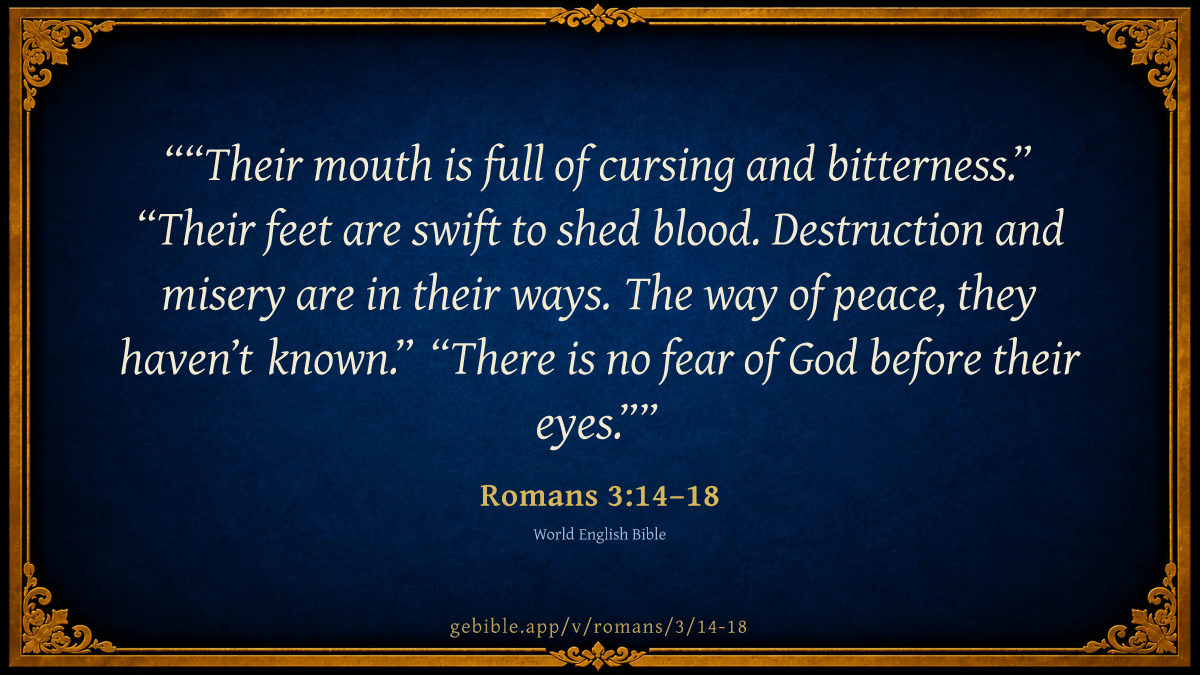
Psalms 10:7(v14)His mouth is full of cursing, deceit, and oppression. Under his tongue is mischief and iniquity.
Psalms 36:1(v18)A revelation is within my heart about the disobedience of the wicked: “There is no fear of God before his eyes.”
Isaiah 59:7-8(v15)Their feet run to evil, and they hurry to shed innocent blood. Their thoughts are thoughts of iniquity. Desolation and destruction are in…
Proverbs 1:16(v15)for their feet run to evil. They hurry to shed blood.
Isaiah 59:8(v17)They don’t know the way of peace; and there is no justice in their ways. They have made crooked paths for themselves; whoever goes in them…
Show all 19 cross-references
Proverbs 6:18(v15)a heart that devises wicked schemes, feet that are swift in running to mischief,
Romans 5:1(v17)Being therefore justified by faith, we have peace with God through our Lord Jesus Christ;
Psalms 109:17-18(v14)Yes, he loved cursing, and it came to him. He didn’t delight in blessing, and it was far from him. He clothed himself also with cursing as…
Proverbs 23:17(v18)Don’t let your heart envy sinners, but rather fear Yahweh all day long.
Psalms 59:12(v14)For the sin of their mouth, and the words of their lips, let them be caught in their pride, for the curses and lies which they utter.
Proverbs 16:6(v18)By mercy and truth iniquity is atoned for. By the fear of Yahweh men depart from evil.
Luke 1:79(v17)to shine on those who sit in darkness and the shadow of death; to guide our feet into the way of peace.”
Proverbs 8:13(v18)The fear of Yahweh is to hate evil. I hate pride, arrogance, the evil way, and the perverse mouth.
Genesis 20:11(v18)Abraham said, “Because I thought, ‘Surely the fear of God is not in this place. They will kill me for my wife’s sake.’
Matthew 7:14(v17)How narrow is the gate, and restricted is the way that leads to life! Few are those who find it.
Luke 23:40(v18)But the other answered, and rebuking him said, “Don’t you even fear God, seeing you are under the same condemnation?
James 3:10(v14)Out of the same mouth comes blessing and cursing. My brothers, these things ought not to be so.
Revelation 19:5(v18)A voice came from the throne, saying, “Give praise to our God, all you his servants, you who fear him, the small and the great!”
Isaiah 57:21(v17)“There is no peace”, says my God, “for the wicked.”
Cross-references from openbible.info (CC BY 4.0)
Explain this passage (17 sources)
Historical commentary, presented as a primary source — not an endorsement.
John Calvin1540 · Public DomainOn vv14, 16, 17, 1814. Then he says, that their mouth is full…
14. Then he says, that their mouth is full of cursing and bitterness — a vice of an opposite character to the former; but the meaning is, that they are in every way full of wickedness; for if they speak fair, they deceive and blend poison with their flatteries; but if they draw forth what they have in their hearts, bitterness and cursing stream out.
John Calvin's Commentaries (1540-1563) — public domain. Text from the Calvin Translation Society English edition (1840s-50s) via the Christian Classics Ethereal Library (ccel.org). Calvin's coverage is partial (roughly two-thirds of the Bible); uncommented books and verses are honest gaps, never fabricated. The 19th-century editor's footnotes and remarks are omitted so the notes are faithfully Calvin's own voice.
Geneva Bible translators1599 · Public DomainOn v17An innocent and peaceable life.
An innocent and peaceable life.
Geneva Bible (1599) marginal notes — public domain.
John Trapp1656 · Public DomainOn vv14–1814 Whose mouth is full of cursing and bitterness:
14 Whose mouth is full of cursing and bitterness:
Ver. 14. Full] Γεμει, As a ship that hath its full freight and lading.
John Trapp, A Commentary or Exposition upon All the Books of the Old and New Testament (1647–1656) — public domain. Text from a community e-Sword module.
Matthew Poole1685 · Public DomainOn vv14, 15, 16, 18This last and very plain expression of the corruption…
This last and very plain expression of the corruption of the tongue, is taken out of Psa 10:7; See Poole on "Psa 10:7".
Matthew Poole's English Annotations on the Holy Bible (1683–1685) — public domain. Text from a community e-Sword/MySword module.
John Gill1763 · Public DomainOn vv14–18Destruction and misery are in their ways. This passage…
Destruction and misery are in their ways. This passage also is to be found in Isa 59:7, and may be understood either actively thus: all the ways they take, and methods they pursue, are to make their fellow creatures miserable, to ruin and destroy them; or passively, that by their sinful ways and vicious course of life, they themselves are brought to destruction and misery: the way they are walking in is, "the broad way, that leadeth to destruction", Mat 7:13; the end of it, what it issues in, is eternal death, the destruction of the body and soul in hell, which will be attended with endless and inexpressible misery.
; the end of it, what it issues in, is eternal death, the destruction of the body and soul in hell, which will be attended with endless and inexpressible misery.
Read full note →
Romans 3:17
rom 3:17
rom 3:17
rom 3:17And the way of peace have they not known. This is a citation front Isa 59:8, and expresses the ignorance of mankind, with regard to true peace, and the way unto it: men are naturally ignorant of the way of peace with God; of the first step which God took towards it; of the council and covenant of peace, in which the scheme of it was drawn, and the method fixed; of Christ the peacemaker, and of the way in which he has made it; and of the Gospel, which reveals and publishes it. They are ignorant of the true way of enjoying peace of conscience; they have no true peace of mind, their consciences are often tortured; and though they may have a stupid and secure peace, yet nothing that is true, real, and solid; for they are without the Spirit, whose fruit is peace; and without faith in Christ, by which true peace only is enjoyed; nor are they spiritually minded, which is life and peace; nor have they any knowledge of the way to have it; they are ready to think it must be had by doing something of their own, and not that it is to be had only in Christ, in his blood and righteousness. They are ignorant of the paths of wisdom, which are peace; peace is enjoyed in them, they lead unto it, and issue in it: they know not the way to eternal peace; they imagine something done by the creature is the way; and are ignorant that Christ is the only way of salvation, the true way to eternal life, everlasting peace and happiness: yea, they know not the way of peace among men, and one another; nor will they do that which is just and right, in order to support and maintain it, but are unjust, deceitful, and quarrelsome; they do not study peace, but rather contention, which they like and approve of. The Jews talk (x) much of their good nature, affability, and condescension, and of their doing this and that, and the other thing, , "because of the ways of peace".
(x) Misn. Gittin, c. 5. sect. 8, 9. T. Hieros. Demai, fol. 24. 1. Maimon. Obede Cochabim, c. 10. sect. 5.
John Gill's Exposition of the Whole Bible (1746–1763) — public domain (CC PDM 1.0). Text via the HelloAO Bible API.
John Wesley1765 · Public DomainOn vv14, 15, 17, 18Cursing - Against God. Bitterness - Against their neighbour.…
Cursing - Against God. Bitterness - Against their neighbour. Psalm x, 7.
John Wesley, Explanatory Notes Upon the Whole Bible (1754–1765) — public domain. Text via the GEBible commentary corpus.
Adam Clarke1810 · Public DomainOn vv14–18Verse 14. Whose mouth is full of cursing, &c.]…
Verse 14. Whose mouth is full of cursing, &c.] They never speak but in profane oaths, blasphemies, and malice.
Adam Clarke's Commentary on the Bible (1810–1826) — public domain. Text from a community e-Sword/MySword module.
Albert Barnes1834 · Public DomainOn vv14–18Whose mouth - Psa 10:7. The apostle has not…
Whose mouth - Psa 10:7. The apostle has not quoted this literally, but has given the sense. David in the psalm is describing his bitter enemies.
Cursing - Reproachful and opprobrious language, such as Shimei used in relation to David; 2Sa 16:5, 2Sa 16:7-8.
Read full note →
Bitterness - In the psalm, deceits. The word “bitterness” is used to denote severity, harshness, cruelty; reproachful and malicious words.
Albert Barnes' Notes on the Bible (1834–1885) — public domain. Text from a community e-Sword/MySword module.
Haydock's Catholic Bible Commentary1859 · Public DomainOn v17St. Augustine says, that by the law of actions,…
St. Augustine says, that by the law of actions, is understood, that which teaches us what we have to do: by the law of faith, is meant faith itself, which obtains for us grace of performing what the law requires. The law of action, then, is the old law, which contains the precept; the law of faith is the new law, which gives assistance to fulfil the law. (De Spir. & Lit. chap. iv.)
George Leo Haydock (1774–1849), Haydock's Catholic Family Bible and Commentary, 1859 edition — public domain. Excludes Psalms (Douay-Rheims chapter numbering differs from Protestant) and Deuterocanonical books (Catholic canon only).
Robert Jamieson, A. R. Fausset & David Brown1871 · Public DomainOn vv14, 15, 16, 18Whose mouth, &c.-- (Psa 10:7): that is, "That mouth…
Whose mouth, &c.-- (Psa 10:7): that is, "That mouth which should be 'most sweet' (Sol 5:16), being 'set on fire of hell' (Jam 3:6), is filled with burning wrath against those whom it should only bless."
Jamieson, Fausset & Brown — Commentary Critical and Explanatory on the Whole Bible (1871) — public domain (CC PDM 1.0). Text via the HelloAO Bible API.
Daniel D. Whedon1874 · Public DomainOn vv15, 1715. Swift—Like the feet of a hotly pursuing murderer.
15. Swift—Like the feet of a hotly pursuing murderer.
Daniel D. Whedon (gen. ed.), Commentary on the Old and New Testaments (1874–1909) — public domain. Text from a community e-Sword module.
Ellicott's Commentary for English Readers1878 · Public DomainOn vv14, 18(14) Bitterness.—Malignity; from the notion that venom was contained…
(14) Bitterness.—Malignity; from the notion that venom was contained in the gall. (Comp. Act_8:23.)
A Bible Commentary for English Readers, edited by Charles John Ellicott (1878–1897) — public domain. Text from a community e-Sword module.
B. W. Johnson1891 · Public DomainOn vv15, 1815. Their feet are swift to shed blood. To…
15. Their feet are swift to shed blood. To carry their owners on a mission of murder.
B. W. Johnson's The People's New Testament with Notes (1889–1891) — public domain. Electronic text from the Christian Classics Ethereal Library (CCEL) ThML edition.
William B. Godbey1900 · Public DomainOn vv14–1814. “Whose mouth is full of cursing and bitterness.”…
14. “Whose mouth is full of cursing and bitterness.” The darkness continues to intensify as we proceed away from God.
William B. Godbey, Commentary on the New Testament (1896–1900) — public domain. Text from a community e-Sword module.
J. W. McGarvey1914 · Public DomainOn vv14–18Whose mouth is full of cursing and bitterness […
Whose mouth is full of cursing and bitterness [ Psa_10:7 ]:
J. W. McGarvey (with Philip Y. Pendleton), Commentaries on the New Testament (The Fourfold Gospel, 1914; Acts; and the epistles) — public domain. Text from a community e-Sword/MySword module.
unfoldingWord translationNotes2017 · CC BY-SA 4.0On v15Their ... their ... These people ... their
Their ... their ... These people ... their
These words refer to the Jews and Greeks in Romans 3:9.
Read full note →
Their feet are swift to pour out blood
Here "feet" is a synecdoche that represents the people themselves. The word "blood" is a metaphor that refers to killing people. AT: "They are in a hurry to harm and murder people" (See: Synecdoche and Metaphor)
Destruction and suffering are in their paths
Here "destruction and suffering" are metonyms that represent the harm that these people cause others to suffer. AT: "They try to destroy others and cause them to suffer" (See: Metonymy)
a way of peace
"how to live at peace with others." A "way" is a road or path.
There is no fear of God before their eyes
Here "fear" is a metonym that represents respect for God and willingness to honor him. AT: "Everyone refuses to give God the respect he deserves" (See: Synecdoche)
 GEBible — Godless Engineer's Bible App
John Calvin 1540 · Public Domain On vv14, 16, 17, 18 14. Then he says, that their mouth is full…
14. Then he says, that their mouth is full of cursing and bitterness — a vice of an opposite character to the former; but the meaning is, that they are in every way full of wickedness; for if they speak fair, they deceive and blend poison with their flatteries; but if they draw forth what they have in their hearts, bitterness and cursing stream out.
John Calvin's Commentaries (1540-1563) — public domain. Text from the Calvin Translation Society English edition (1840s-50s) via the Christian Classics Ethereal Library (ccel.org). Calvin's coverage is partial (roughly two-thirds of the Bible); uncommented books and verses are honest gaps, never fabricated. The 19th-century editor's footnotes and remarks are omitted so the notes are faithfully Calvin's own voice.
Geneva Bible translators 1599 · Public Domain On v17 An innocent and peaceable life.
An innocent and peaceable life.
Geneva Bible (1599) marginal notes — public domain.
John Trapp 1656 · Public Domain On vv14–18 14 Whose mouth is full of cursing and bitterness:
14 Whose mouth is full of cursing and bitterness:
Ver. 14. Full] Γεμει, As a ship that hath its full freight and lading.
John Trapp, A Commentary or Exposition upon All the Books of the Old and New Testament (1647–1656) — public domain. Text from a community e-Sword module.
Matthew Poole 1685 · Public Domain On vv14, 15, 16, 18 This last and very plain expression of the corruption…
This last and very plain expression of the corruption of the tongue, is taken out of Psa 10:7; See Poole on "Psa 10:7".
Matthew Poole's English Annotations on the Holy Bible (1683–1685) — public domain. Text from a community e-Sword/MySword module.
John Gill 1763 · Public Domain On vv14–18 Destruction and misery are in their ways. This passage…
Destruction and misery are in their ways. This passage also is to be found in Isa 59:7, and may be understood either actively thus: all the ways they take, and methods they pursue, are to make their fellow creatures miserable, to ruin and destroy them; or passively, that by their sinful ways and vicious course of life, they themselves are brought to destruction and misery: the way they are walking in is, "the broad way, that leadeth to destruction", Mat 7:13; the end of it, what it issues in, is eternal death, the destruction of the body and soul in hell, which will be attended with endless and inexpressible misery.
; the end of it, what it issues in, is eternal death, the destruction of the body and soul in hell, which will be attended with endless and inexpressible misery.
Read full note →
Romans 3:17
rom 3:17
rom 3:17
rom 3:17And the way of peace have they not known. This is a citation front Isa 59:8, and expresses the ignorance of mankind, with regard to true peace, and the way unto it: men are naturally ignorant of the way of peace with God; of the first step which God took towards it; of the council and covenant of peace, in which the scheme of it was drawn, and the method fixed; of Christ the peacemaker, and of the way in which he has made it; and of the Gospel, which reveals and publishes it. They are ignorant of the true way of enjoying peace of conscience; they have no true peace of mind, their consciences are often tortured; and though they may have a stupid and secure peace, yet nothing that is true, real, and solid; for they are without the Spirit, whose fruit is peace; and without faith in Christ, by which true peace only is enjoyed; nor are they spiritually minded, which is life and peace; nor have they any knowledge of the way to have it; they are ready to think it must be had by doing something of their own, and not that it is to be had only in Christ, in his blood and righteousness. They are ignorant of the paths of wisdom, which are peace; peace is enjoyed in them, they lead unto it, and issue in it: they know not the way to eternal peace; they imagine something done by the creature is the way; and are ignorant that Christ is the only way of salvation, the true way to eternal life, everlasting peace and happiness: yea, they know not the way of peace among men, and one another; nor will they do that which is just and right, in order to support and maintain it, but are unjust, deceitful, and quarrelsome; they do not study peace, but rather contention, which they like and approve of. The Jews talk (x) much of their good nature, affability, and condescension, and of their doing this and that, and the other thing, , "because of the ways of peace".
(x) Misn. Gittin, c. 5. sect. 8, 9. T. Hieros. Demai, fol. 24. 1. Maimon. Obede Cochabim, c. 10. sect. 5.
John Gill's Exposition of the Whole Bible (1746–1763) — public domain (CC PDM 1.0). Text via the HelloAO Bible API.
John Wesley 1765 · Public Domain On vv14, 15, 17, 18 Cursing - Against God. Bitterness - Against their neighbour.…
Cursing - Against God. Bitterness - Against their neighbour. Psalm x, 7.
John Wesley, Explanatory Notes Upon the Whole Bible (1754–1765) — public domain. Text via the GEBible commentary corpus.
Adam Clarke 1810 · Public Domain On vv14–18 Verse 14. Whose mouth is full of cursing, &c.]…
Verse 14. Whose mouth is full of cursing, &c.] They never speak but in profane oaths, blasphemies, and malice.
Adam Clarke's Commentary on the Bible (1810–1826) — public domain. Text from a community e-Sword/MySword module.
Albert Barnes 1834 · Public Domain On vv14–18 Whose mouth - Psa 10:7. The apostle has not…
Whose mouth - Psa 10:7. The apostle has not quoted this literally, but has given the sense. David in the psalm is describing his bitter enemies.
Cursing - Reproachful and opprobrious language, such as Shimei used in relation to David; 2Sa 16:5, 2Sa 16:7-8.
Read full note →
Bitterness - In the psalm, deceits. The word “bitterness” is used to denote severity, harshness, cruelty; reproachful and malicious words.
Albert Barnes' Notes on the Bible (1834–1885) — public domain. Text from a community e-Sword/MySword module.
Haydock's Catholic Bible Commentary 1859 · Public Domain On v17 St. Augustine says, that by the law of actions,…
St. Augustine says, that by the law of actions, is understood, that which teaches us what we have to do: by the law of faith, is meant faith itself, which obtains for us grace of performing what the law requires. The law of action, then, is the old law, which contains the precept; the law of faith is the new law, which gives assistance to fulfil the law. (De Spir. & Lit. chap. iv.)
George Leo Haydock (1774–1849), Haydock's Catholic Family Bible and Commentary, 1859 edition — public domain. Excludes Psalms (Douay-Rheims chapter numbering differs from Protestant) and Deuterocanonical books (Catholic canon only).
Robert Jamieson, A. R. Fausset & David Brown 1871 · Public Domain On vv14, 15, 16, 18 Whose mouth, &c.-- (Psa 10:7): that is, "That mouth…
Whose mouth, &c.-- (Psa 10:7): that is, "That mouth which should be 'most sweet' (Sol 5:16), being 'set on fire of hell' (Jam 3:6), is filled with burning wrath against those whom it should only bless."
Jamieson, Fausset & Brown — Commentary Critical and Explanatory on the Whole Bible (1871) — public domain (CC PDM 1.0). Text via the HelloAO Bible API.
Daniel D. Whedon 1874 · Public Domain On vv15, 17 15. Swift—Like the feet of a hotly pursuing murderer.
15. Swift—Like the feet of a hotly pursuing murderer.
Daniel D. Whedon (gen. ed.), Commentary on the Old and New Testaments (1874–1909) — public domain. Text from a community e-Sword module.
Ellicott's Commentary for English Readers 1878 · Public Domain On vv14, 18 (14) Bitterness.—Malignity; from the notion that venom was contained…
(14) Bitterness.—Malignity; from the notion that venom was contained in the gall. (Comp. Act_8:23.)
A Bible Commentary for English Readers, edited by Charles John Ellicott (1878–1897) — public domain. Text from a community e-Sword module.
B. W. Johnson 1891 · Public Domain On vv15, 18 15. Their feet are swift to shed blood. To…
15. Their feet are swift to shed blood. To carry their owners on a mission of murder.
B. W. Johnson's The People's New Testament with Notes (1889–1891) — public domain. Electronic text from the Christian Classics Ethereal Library (CCEL) ThML edition.
William B. Godbey 1900 · Public Domain On vv14–18 14. “Whose mouth is full of cursing and bitterness.”…
14. “Whose mouth is full of cursing and bitterness.” The darkness continues to intensify as we proceed away from God.
William B. Godbey, Commentary on the New Testament (1896–1900) — public domain. Text from a community e-Sword module.
J. W. McGarvey 1914 · Public Domain On vv14–18 Whose mouth is full of cursing and bitterness […
Whose mouth is full of cursing and bitterness [ Psa_10:7 ]:
J. W. McGarvey (with Philip Y. Pendleton), Commentaries on the New Testament (The Fourfold Gospel, 1914; Acts; and the epistles) — public domain. Text from a community e-Sword/MySword module.
unfoldingWord translationNotes 2017 · CC BY-SA 4.0 On v15 Their ... their ... These people ... their
Their ... their ... These people ... their
These words refer to the Jews and Greeks in Romans 3:9.
Read full note →
Their feet are swift to pour out blood
Here "feet" is a synecdoche that represents the people themselves. The word "blood" is a metaphor that refers to killing people. AT: "They are in a hurry to harm and murder people" (See: Synecdoche and Metaphor)
Destruction and suffering are in their paths
Here "destruction and suffering" are metonyms that represent the harm that these people cause others to suffer. AT: "They try to destroy others and cause them to suffer" (See: Metonymy)
a way of peace
"how to live at peace with others." A "way" is a road or path.
There is no fear of God before their eyes
Here "fear" is a metonym that represents respect for God and willingness to honor him. AT: "Everyone refuses to give God the respect he deserves" (See: Synecdoche)
translationWords
blood
suffer
peace
fear
God
unfoldingWord translationNotes — © Distant Shores Media and the Door43 World Missions Community, licensed CC BY-SA 4.0. Source: git.door43.org/Door43/en_tn.
Tyndale Open Study Notes 2022 · CC BY-SA 4.0 On vv15, 18 3:15-17 In this quotation from Isa 59:7-8, Paul addresses…
3:15-17 In this quotation from Isa 59:7-8, Paul addresses sins against others.
Tyndale Open Study Notes — © Tyndale Open Resources, licensed CC BY-SA 4.0. Text via the HelloAO Bible API.