Romans 8:14-18 sits inside this longer paragraph.
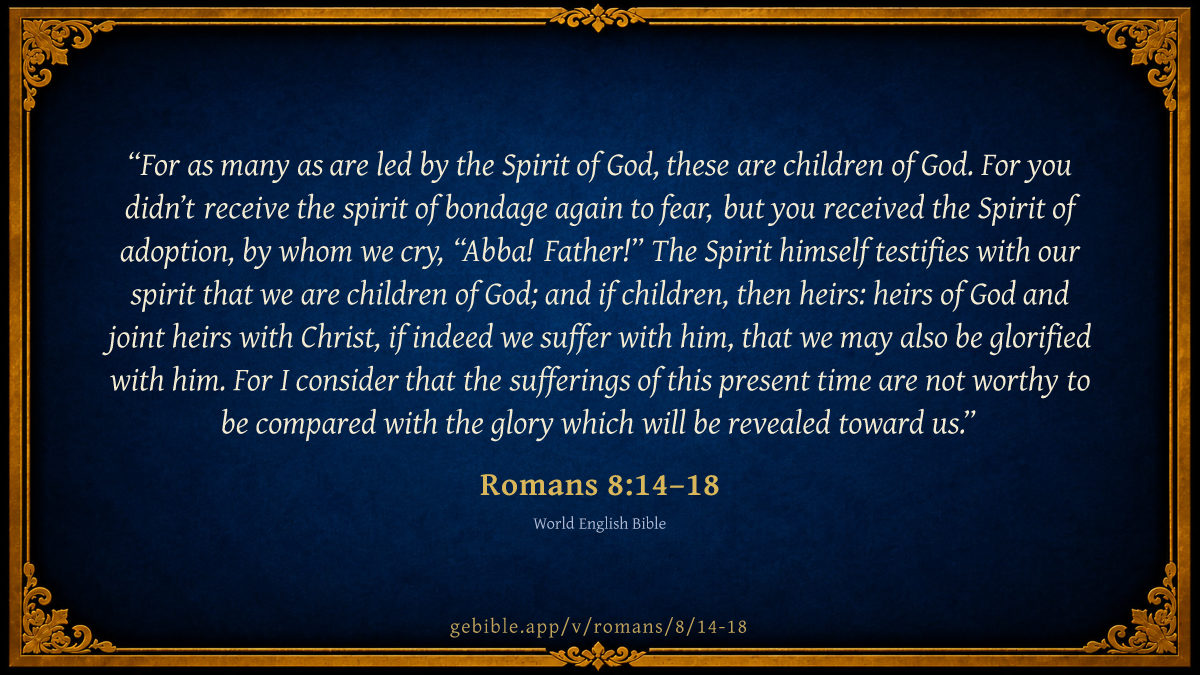
12So then, brothers, we are debtors, not to the flesh, to live after the flesh. 13For if you live after the flesh, you must die; but if by the Spirit you put to death the deeds of the body, you will live. 14For as many as are led by the Spirit of God, these are children of God. 15For you didn’t receive the spirit of bondage again to fear, but you received the Spirit of adoption, by whom we cry, “Abba! Father!”
16The Spirit himself testifies with our spirit that we are children of God; 17and if children, then heirs: heirs of God and joint heirs with Christ, if indeed we suffer with him, that we may also be glorified with him.
18For I consider that the sufferings of this present time are not worthy to be compared with the glory which will be revealed toward us. 19For the creation waits with eager expectation for the children of God to be revealed. 20For the creation was subjected to vanity, not of its own will, but because of him who subjected it, in hope 21that the creation itself also will be delivered from the bondage of decay into the liberty of the glory of the children of God. 22For we know that the whole creation groans and travails in pain together until now. 23Not only so, but ourselves also, who have the first fruits of the Spirit, even we ourselves groan within ourselves, waiting for adoption, the redemption of our body. 24For we were saved in hope, but hope that is seen is not hope. For who hopes for that which he sees? 25But if we hope for that which we don’t see, we wait for it with patience.

John Calvin 1540 · Public Domain On vv14–18 14. For whosoever are led by the Spirit of…
14. For whosoever are led by the Spirit of God, etc. This is a confirmation of what has immediately preceded; for he teaches us, that those only are deemed the sons of God who are ruled by his Spirit; for by this mark God acknowledges them as his own people. Thus the empty boasting of hypocrites is taken away, who without any reason assume the title; and the faithful are thus encouraged with unhesitating confidence to expect salvation. The import of the whole is this — “all those are the sons of God who are led by God’s Spirit; all the sons of God are heirs of eternal life: then all who are led by God’s Spirit ought to feel assured of eternal life. But the middle term or assumption is omitted, for it was indubitable.
But it is right to observe, that the working of the Spirit is various: for there is that which is universal, by which all creatures are sustained and preserved; there is that also which is peculiar to men, and varying in its character: but what he means here is sanctification, with which the Lord favors none but his own elect, and by which he separates them for sons to himself.
John Calvin's Commentaries (1540-1563) — public domain. Text from the Calvin Translation Society English edition (1840s-50s) via the Christian Classics Ethereal Library (ccel.org). Calvin's coverage is partial (roughly two-thirds of the Bible); uncommented books and verses are honest gaps, never fabricated. The 19th-century editor's footnotes and remarks are omitted so the notes are faithfully Calvin's own voice.
Geneva Bible translators 1599 · Public Domain On vv14, 15, 17, 18 A confirmation of this reason: they be the children…
A confirmation of this reason: they be the children of God, which are governed by his Spirit, therefore shall they have life everlasting.
Geneva Bible (1599) marginal notes — public domain.
John Trapp 1656 · Public Domain On vv14–18 14 For as many as are led by the…
14 For as many as are led by the Spirit of God, they are the sons of God.
Ver. 14. For as many as are led] As great men suffer their sons to go along with them, but set tutors to overlook and order them; so dealeth God by his; the Spirit leadeth them into all goodness, righteousness, and truth, Eph 5:9, and fetcheth them again in their wanderings.
John Trapp, A Commentary or Exposition upon All the Books of the Old and New Testament (1647–1656) — public domain. Text from a community e-Sword module.
Matthew Poole 1685 · Public Domain On vv14–18 This proves the latter part of the foregoing verse:…
This proves the latter part of the foregoing verse: Such as by the Spirit do mortify sin, shall live, for
they are the sons of God; and that appears, because they
Read full note →
are led by the Spirit of God. He doth not say, as many as live by the Spirit, but, as are led by the Spirit; to show (says one) that the Spirit must be the guide and ruler of our life, as the pilot is of the ship, and as a rider is of his horse. The phrase is borrowed (says another) either from those who are guided and directed as a blind man in his way; or from those who, wanting strength of their own, are borne and carried of others: so we are both ways led by the Spirit, for we can neither see our way, unless the Spirit direct us; nor have we strength to walk in it, unless the Spirit assist and draw us along. The Spirit leads and draws us irresistibly and necessarily, and yet not violently or against our wills; though we were unwilling before, yet we are made willing afterwards; so willing, that we desire and pray to be led by the Spirit. See Psa 25:5; 143:10; Son 1:4.
Matthew Poole's English Annotations on the Holy Bible (1683–1685) — public domain. Text from a community e-Sword/MySword module.
William Burkitt 1703 · Public Domain On vv14–18 Observe here, 1. A glorious privilege proclaimed, the being…
Observe here, 1. A glorious privilege proclaimed, the being the Sons of God.
2. A description of the persons to whom that privilege doth belong, they are such as are led by the spirit of God.
Read full note →
Learn, 1. That the Holy Spirit of God doth perform the office of a guide and leader to all the children of God, he gives life and motion to them, by infusing gracious habits, (Eze 36:26). by exiting the soul to act suitably thereunto, and by assisting it in acting; he gives directions and guidance to them, he directs their actions, by enlightening their understandings, by guiding their inclinations, by influencing and inclining their wills; and where he guides, he governs. A general that leads an army, orders its motions and marches; as Christ was, so the Holy Spirit is, a leader and commander to the people.
Learn, 2. That such as are thus led by the Spirit of God, may know and conclude themselves to be the sons of God, because holiness is a certain evidence of adoption. Such as are led by God’s Spirit, are undoubtedly God’s children; and such as are not his children, refuse to be led by his Spirit, but live under the uncontrolled activity of their own.
William Burkitt's Expository Notes on the New Testament (1700–1703) — public domain. Text from a community e-Sword module.
Matthew Henry 1710 · Public Domain On v17 In these words the apostle describes a fourth illustrious…
In these words the apostle describes a fourth illustrious branch of the happiness of believers, namely, a title to the future glory. This is fitly annexed to our sonship; for as the adoption of sons entitles us to that glory, so the disposition of sons fits and prepares us for it. If children, then heirs, Rom 8:17. In earthly inheritances this rule does not hold, only the first-born are heirs; but the church is a church of first-born, for they are all heirs. Heaven is an inheritance that all the saints are heirs to. They do not come to it as purchasers by any merit or procurement of their own; but as heirs, purely by the act of God; for God makes heirs. The saints are heirs though in this world they are heirs under age; see Gal 4:1, Gal 4:2. Their present state is a state of education and preparation for the inheritance. How comfortable should this be to all the children of God, how little soever they have in possession, that, being heirs, they have enough in reversion! But the honour and happiness of an heir lie in the value and worth of that which he is heir to: we read of those that inherit the wind; and therefore we have here an abstract of the premises. 1. Heirs of God. The Lord himself is the portion of the saints' inheritance (Psa 16:5), a goodly heritage, Psa 16:6. The saints are spiritual priests, that have the Lord for their inheritance, Num 18:20. The vision of God and the fruition of God make up the inheritance the saints are heirs to. God himself will be with them, and will be their God, Rev 21:3. 2. Joint-heirs with Christ. Christ, as Mediator, is said to be the heir of all things (Heb 1:2), and true believers, by virtue of their union with him, shall inherit all things, Rev 21:7. Those that now partake of the Spirit of Christ, as his brethren, shall, as his brethren, partake of his glory (Joh 17:24), shall sit down with him upon his throne, Rev 3:21. Lord, what is man, that thou shouldst thus magnify him! Now this future glory is further spoken of as the reward of present sufferings and as the accomplishment of present hopes.
I. As the reward of the saints' present sufferings; and it is a rich reward: If so be that we suffer with him (Rom 8:17), or forasmuch as we suffer with him. The state of the church in this world always is, but was then especially, an afflicted state; to be a Christian was certainly to be a sufferer. Now, to comfort them in reference to those sufferings, he tells them that they suffered with Christ - for his sake, for his honour, and for the testimony of a good conscience, and should be glorified with him. Those that suffered with David in his persecuted state were advanced by him and with him when he came to the crown; see Ti2 2:12. See the gains of suffering for Christ; though we may be losers for him, we shall not, we cannot, be losers by him in the end. This the gospel is filled with the assurances of. Now, that suffering saints may have strong supports and consolations from their hopes of heaven, he holds the balance (Rom 8:18), in a comparison between the two, which is observable. 1. In one scale he puts the sufferings of this present time. The sufferings of the saints are but sufferings of this present time, strike no deeper than the things of time, last no longer than the present time (Co2 4:17), light affliction, and but for a moment. So that on the sufferings he writes tekel, weighed in the balance and found light. 2. In the other scale he puts the glory, and finds that a weight, an exceeding and eternal weight: Glory that shall be revealed. In our present state we come short, not only in the enjoyment, but in the knowledge of that glory (Co1 2:9; Jo1 3:2): it shall be revealed. It surpasses all that we have yet seen and known: present vouchsafements are sweet and precious, very precious, very sweet; but there is something to come, something behind the curtain, that will outshine all. Shall be revealed in us; not only revealed to us, to be seen, but revealed in us, to be enjoyed. The kingdom of God is within you, and will be so to eternity. 3. He concludes the sufferings not worthy to be compared with the glory - ouk axia pros tēn doxan. They cannot merit that glory; and, if suffering for Christ will not merit, much less will doing. They should not at all deter and frighten us from the diligent and earnest pursuit of that glory. The sufferings are small and short, and concern the body only; but the glory is rich and great, and concerns the soul, and is eternal. This he reckons. I reckon - logizomai. It is not a rash and sudden determination, but the product of a very serious and deliberate consideration. he had reasoned the case within himself, weighed the arguments on both sides, and thus at last resolves the point. O how vastly different is the sentence of the word from the sentiment of the world concerning the sufferings of this present time! I reckon, as an arithmetician that is balancing an account. He first sums up what is disbursed for Christ in the sufferings of this present time, and finds they come to very little; he then sums up what is secured to us by Christ in the glory that shall be revealed, and this he finds to be an infinite sum, transcending all conception, the disbursement abundantly made up and the losses infinitely countervailed. And who would be afraid then to suffer for Christ, who as he is before-hand with us in suffering, so he will not be behind-hand with us in recompence? Now Paul was as competent a judge of this point as ever any mere man was. He could reckon not by art only, but by experience; for he knew both. He knew what the sufferings of this present time were; see Co2 11:23-28. He knew what the glory of heaven is; see Co2 12:3, Co2 12:4. And, upon the view of both, he gives this judgment here. There is nothing like a believing view of the glory which shall be revealed to support and bear up the spirit under all the sufferings of this present time. The reproach of Christ appears riches to those who have respect to the recompence of reward, Heb 11:26.
Read full note →
II. As the accomplishment of the saints' present hopes and expectations, Rom 8:19, etc. As the saints are suffering for it, so they are waiting for it. Heaven is therefore sure; for God by his Spirit would not raise and encourage those hopes only to defeat and disappoint them. He will establish that word unto his servants on which he has caused them to hope (Psa 119:49), and heaven is therefore sweet; for, if hope deferred makes the heart sick, surely when the desire comes it will be a tree of life, Pro 13:12. Now he observes an expectation of this glory,
1. In the creatures Rom 8:19-22. That must needs be a great, a transcendent glory, which all the creatures are so earnestly expecting and longing for. This observation in these verses has some difficulty in it, which puzzles interpreters a little; and the more because it is a remark not made in any other scripture, with which it might be compared. By the creature here we understand, not as some do the Gentile world, and their expectation of Christ and the gospel, which is an exposition very foreign and forced, but the whole frame of nature, especially that of this lower world - the whole creation, the compages of inanimate and sensible creatures, which, because of their harmony and mutual dependence, and because they all constitute and make up one world, are spoken of in the singular number as the creature. The sense of the apostle in these four verses we may take in the following observations: - (1.) That there is a present vanity to which the creature, by reason of the sin of man, is made subject, Rom 8:20. When man sinned, the ground was cursed for man's sake, and with it all the creatures (especially of this lower world, where our acquaintance lies) became subject to that curse, became mutable and mortal. Under the bondage of corruption, Rom 8:21. There is an impurity, deformity, and infirmity, which the creature has contracted by the fall of man: the creation is sullied and stained, much of the beauty of the world gone. There is an enmity of one creature to another; they are all subject to continual alteration and decay of the individuals, liable to the strokes of God's judgments upon man. When the world was drowned, and almost all the creatures in it, surely then it was subject to vanity indeed. The whole species of creatures is designed for, and is hastening to, a total dissolution by fire. And it is not the least part of their vanity and bondage that they are used, or abused rather, by men as instruments of sin. The creatures are often abused to the dishonour of their Creator, the hurt of his children, or the service of his enemies. When the creatures are made the food and fuel of our lusts, they are subject to vanity, they are captivated by the law of sin. And this not willingly, not of their own choice. All the creatures desire their own perfection and consummation; when they are made instruments of sin it is not willingly. Or, They are thus captivated, not for any sin of their own, which they had committed, but for man's sin: By reason of him who hath subjected the same. Adam did it meritoriously; the creatures being delivered to him, when he by sin delivered himself he delivered them likewise into the bondage of corruption. God did it judicially; he passed a sentence upon the creatures for the sin of man, by which they became subject. And this yoke (poor creatures) they bear in hope that it will not be so always. Ep' elpidi hoti kai, etc. - in hope that the creature itself; so many Greek copies join the words. We have reason to pity the poor creatures that for our sin have become subject to vanity. (2.) That the creatures groan and travail in pain together under this vanity and corruption, Rom 8:22. It is a figurative expression. Sin is a burden to the whole creation; the sin of the Jews, in crucifying Christ, set the earth a quaking under them. The idols were a burden to the weary beast, Isa 46:1. There is a general outcry of the whole creation against the sin of man: the stone crieth out of the wall (Hab 2:11), the land cries, Job 31:38. (3.) That the creature, that is now thus burdened, shall, at the time of the restitution of all things, be delivered from this bondage into the glorious liberty of the children of God (Rom 8:21) - they shall no more be subject to vanity and corruption, and the other fruits of the curse; but, on the contrary, this lower world shall be renewed: when there will be new heavens there will be a new earth (Pe2 3:13; Rev 21:1); and there shall be a glory conferred upon all the creatures, which shall be (in the proportion of their natures) as suitable and as great an advancement as the glory of the children of God shall be to them. The fire at the last day shall be a refining, not a destroying annihilating fire. What becomes of the souls of brutes, that go downwards, none can tell. But it should seem by the scripture that there will be some kind of restoration of them. And if it be objected, What use will they be of to glorified saints? we may suppose them of as much use as they were to Adam in innocency; and if it be only to illustrate the wisdom, power, and goodness of their Creator, that is enough. Compare with this Psa 96:10-13; Psa 98:7-9. Let the heavens rejoice before the Lord, for he cometh. (4.) That the creature doth therefore earnestly expect and wait for the manifestation of the children of God, Rom 8:19. Observe, At the second coming of Christ there will be a manifestation of the children of God. Now the saints are God's hidden ones, the wheat seems lost in a heap of chaff; but then they shall be manifested. It does not yet appear what we shall be (Jo1 3:2), but then the glory shall be revealed. The children of God shall appear in their own colours. And this redemption of the creature is reserved till then; for, as it was with man and for man that they fell under the curse, so with man and for man they shall be delivered. All the curse and filth that now adhere to the creature shall be done away then when those that have suffered with Christ upon earth shall reign with him upon the earth. This the whole creation looks and longs for; and it may serve as a reason why now a good man should be merciful to his beast.
2. In the saints, who are new creatures, Rom 8:23-25. Observe, (1.) The grounds of this expectation in the saints. It is our having received the first-fruits of the Spirit, which both quickens our desires and encourages our hopes, and both ways raises our expectations. The first-fruits did both sanctify and ensure the lump. Grace is the first-fruits of glory, it is glory begun. We, having received such clusters in this wilderness, cannot but long for the full vintage in the heavenly Canaan. Not only they - not only the creatures which are not capable of such a happiness as the first-fruits of the Spirit, but even we, who have such present rich receivings, cannot but long for something more and greater. In having the first-fruits of the Spirit we have that which is very precious, but we have not all we would have. We groan within ourselves, which denotes the strength and secrecy of these desires; not making a loud noise, as the hypocrites howling upon the bed for corn and wine, but with silent groans, which pierce heaven soonest of all. Or, We groan among ourselves. It is the unanimous vote, the joint desire, of the whole church, all agree in this: Come, Lord Jesus, come quickly. The groaning denotes a very earnest and importunate desire, the soul pained with the delay. Present receivings and comforts are consistent with a great many groans; not as the pangs of one dying, but as the throes of a woman in travail - groans that are symptoms of life, not of death. (2.) The object of this expectation. What is it we are thus desiring and waiting for? What would we have? The adoption, to wit, the redemption of our body. Though the soul be the principal part of the man, yet the Lord has declared himself for the body also, and has provided a great deal of honour and happiness for the body. The resurrection is here called the redemption of the body. It shall then be rescued from the power of death and the grave, and the bondage of corruption; and, though a vile body, yet it shall be refined and beautified, and made like that glorious body of Christ, Phi 3:21; Co1 15:42. This is called the adoption. [1.] It is the adoption manifested before all the world, angels and men. Now are we the sons of God, but it does not yet appear, the honour is now clouded; but then God will publicly own all his children. The deed of adoption, which is now written, signed, and sealed, will then be recognized, proclaimed, and published. As Christ was, so the saints will be, declared to be the sons of God with power, by the resurrection from the dead, Rom 1:4. It will then be put past dispute. [2.] It is the adoption perfected and completed. The children of God have bodies as well as souls; and, till those bodies are brought into the glorious liberty of the children of God, the adoption is not perfect. But then it will be complete, when the Captain of our salvation shall bring the many sons to glory, Heb 2:10. This is that which we expect, in hope of which our flesh rests, Psa 16:9, Psa 16:10. All the days of our appointed time we are waiting, till this change shall come, when he shall call, and we shall answer, and he will have a desire to the work of his hands, Job 14:14, Job 14:15. (3.) The agreeableness of this to our present state, Rom 8:24, Rom 8:25. Our happiness is not in present possession: We are saved by hope. In this, as in other things, God hath made our present state a state of trial and probation - that our reward is out of sight. Those that will deal with God must deal upon trust. It is acknowledged that one of the principal graces of a Christian is hope (Co1 13:13), which necessarily implies a good thing to come, which is the object of that hope. Faith respects the promise, hope the thing promised. Faith is the evidence, hope the expectation, of things not seen. Faith is the mother of hope. We do with patience wait. In hoping for this glory we have need of patience, to bear the sufferings we meet with in the way to it and the delays of it. Our way is rough and long; but he that shall come will come, and will not tarry; and therefore, though he seem to tarry, it becomes us to wait for him.
Matthew Henry's Commentary on the Whole Bible (1708–1710) — public domain (CC PDM 1.0). Text via the HelloAO Bible API.
John Gill 1763 · Public Domain On vv14–18 For as many as are led by the Spirit…
For as many as are led by the Spirit of God,.... Not by the spirit of the world, or of the devil, or by their own spirits: the act of leading ascribed to the Spirit is either in allusion to the leading of blind persons, or such who are in the dark; or rather to the leading of children and teaching them to go; which supposes life in those that are led, and some degree of strength, though a good deal of weakness; and is a display of powerful and efficacious grace, and is always for their good: the Spirit of God leads them from sin, and from a dependence on their own righteousness, in paths they formerly knew not, and in which they should go, in the paths of faith and truth, of righteousness and holiness, and in a right, though sometimes a rough way; he leads them to the person, blood, and righteousness of Christ, and to the fulness of grace in him; into the presence of God, to the house and ordinances of God; into the truths of the Gospel, from one degree of grace to another, and at last to glory; which he does gradually, by little and little he leads them to see the iniquity of their hearts and natures, to lay hold on Christ and salvation by him, into the doctrines of grace, and the love and favour of God, and proportionally to the strength he gives: now such persons,
they are the sons of God: not in so high a sense as Christ is; nor in so low a sense as Adam was, and angels are; much less in such sense as wicked magistrates be; nor merely as professors of religion in common; but by adoption, not national, such as that of the Jews, but special; and which has some agreement with civil adoption, it being of persons to an inheritance, which they have no legal right unto, and it is done freely: though there is a difference between the one and the other; for in divine adoption there is no need on the adopter's side; nor no worth on the side of the adopted; proper qualifications are conveyed to them for the enjoyment of the inheritance, and which is enjoyed, the father and firstborn being living, and is an inheritance which vastly exceeds all others: now this blessing of being the sons of God, is owing not to ourselves, nor to our earthly parents, but to God; to the Father, who predestinated to it, and fixed it in the covenant of grace; to Christ, it is by him, as the Son of God, it is through him, as the Mediator, and it is for him, it is for his glory; and also to the Spirit of God, who manifests it, works faith to receive it, witnesses to it, and seals up to the full enjoyment of it. This favour is an instance of surprising grace, exceeds other blessings, makes the saints honorourable, is attended with many privileges, and lasts for ever: such who are in this relation to God, ought to ascribe it to his grace, to require him with thankfulness, and a becoming conversation, to be followers of him, and to love, honour, and obey him.
John Gill's Exposition of the Whole Bible (1746–1763) — public domain (CC PDM 1.0). Text via the HelloAO Bible API.
John Wesley 1765 · Public Domain On vv14–18 For as many as are led by the Spirit…
For as many as are led by the Spirit of God - In all the ways of righteousness. They are the sons of God - Here St. Paul enters upon the description of those blessings which he comprises, ver. 30, in the word glorified; though, indeed, he does not describe mere glory, but that which is still mingled with the cross. The sum is, through sufferings to glory.
John Wesley, Explanatory Notes Upon the Whole Bible (1754–1765) — public domain. Text via the GEBible commentary corpus.
Adam Clarke 1810 · Public Domain On vv14–18 Verse 14. For as many as are led by…
Verse 14. For as many as are led by the Spirit, c.] No man who has not Divine assistance can either find the way to heaven, or walk in it when found. As Christ, by his sacrificial offering, has opened the kingdom of God to all believers and, as a mediator, transacts the concerns of their kingdom before the throne; so the Spirit of God is the great agent here below, to enlighten, quicken, strengthen, and guide the true disciples of Christ; and all that are born of this Spirit are led and guided by it; and none can pretend to be the children of God who are not thus guided.
Adam Clarke's Commentary on the Bible (1810–1826) — public domain. Text from a community e-Sword/MySword module.
Joseph Benson 1811 · Public Domain On vv14, 17 Rom 8:14-16. For as many as are led, guided…
Rom 8:14-16. For as many as are led, guided and governed, by the Spirit of God — As a Spirit of truth and grace, of wisdom and holiness; they are the sons of God — That is, they stand related to God, not merely as subjects to their king, or servants to their master, but as children to their father; they are unspeakably near and dear to God, being spiritually begotten of him, and partaking of his nature. See on Joh 1:12. For ye — Who are real Christians; have not — Since you believed on Christ with a living faith; received the spirit of bondage — A servile disposition, produced by the Spirit of God convincing you that you are in a state of guilt and wrath; again — Such as you had formerly, before your conversion; to fear — Condemnation and wrath from God, which you knew you had merited, and therefore to fear him with a servile fear, and death with a fear producing torment. But ye have received the Spirit of adoption — An assurance of your reconciliation with and filial relation to God, through the influence of the Spirit of Christ, Gal 4:6; producing in you such confidence toward God in approaching him, as dutiful children feel toward a loving father. Whereby — By which Spirit; we — All and every believer; cry — The word, χραζομεν, denotes a vehement speaking, with desire, confidence, constancy; Abba, Father — The latter word explains the former. By using both the Syro-Chaldaic and Greek words, the apostle seems to point out the joint cry both of the Jewish and Gentile believers; who, in consequence of that assurance of God’s favour, and adoption into his family, with which their minds were filled, since they had received the gospel, felt that disposition of reverence for, confidence in, and grateful love to God, which is here properly termed the Spirit of adoption: that is, the spirit of children. We may observe here, that both the spirit of bondage to fear, or servile spirit, and the Spirit of adoption, or filial spirit, as above explained, are produced by one and the same Spirit of God, manifesting itself in various operations, according to the various circumstances of the persons; first causing them to see and feel themselves to be in bondage to the guilt and power of sin, to the world, to Satan, and obnoxious to the wrath of God; and then assuring them of their deliverance therefrom, and of their reception into the favour and family of God, as his sons and daughters. The Spirit itself — Αυτο το Πνευμα, the self-same Spirit, whereby we cry. Abba, Father; beareth witness — Greek, συμμαρτυρει τω πνευματι ημων; witnesseth together with our spirit — Or our enlightened and renewed conscience, by his internal and gracious operation, giving us to know and feel with assurance, gratitude, and joy, that we are the children of God — By special adoption and regeneration. For it is by his influence, and his alone, that we can know the things that are freely given to us of God, namely, what they are, their nature and excellence, and that they are ours, 1Co 2:12. And hence this Spirit is said to be the seal of our sonship, and the earnest of our inheritance in our hearts, 2Co 1:22; Eph 1:13-14; Eph 4:30. Happy they who enjoy this testimony clear and constant! Some, by the testimony spoken of in this verse, understand the extraordinary or miraculous gifts of the Spirit. These undoubtedly were a divine testimony to the mission of Christ, and the truth of the gospel; but certainly (according to our Lord’s own declaration, that many, whom he never acknowledged to be his, would say to him in the day of judgment, that they had prophesied and cast out devils in his name, &c.) they are not a satisfactory proof of the truth of any one’s grace, the reality of his conversion, or of his being a child of God. Accordingly this apostle testifies, 1Co 13:2, If a man have the gift of prophecy, and understand all mysteries, and have such miracle-working faith, as to be able to remove mountains, that, with respect to real religion, he is nothing, if he have not love, namely, to God and man.
Joseph Benson's Commentary on the Old and New Testaments (1811–1818) — public domain. Text from a community e-Sword module.
Albert Barnes 1834 · Public Domain On vv14–18 For as many - Whosoever; all who are thus…
For as many - Whosoever; all who are thus led. This introduces a new topic, illustrating the benefits of the gospel, to wit, that it produces a spirit of adoption, Rom 8:14-17.
As are led - As submit to his influence and control. The Spirit is represented as influencing, suggesting, and controlling. One evidence of piety is, a willingness to yield to that influence, and submit to him. One decided evidence of the lack of piety is, where there is an unwillingness to submit to that influence, but where the Holy Spirit is grieved and resisted. All Christians submit to his influence; all sinners decidedly reject it and oppose it. The influence of the Spirit, if followed, would lead every man to heaven. But when neglected, rejected, or despised, man goes down to hell. The glory belongs to the conducting Spirit when man is saved; the fault is man’s when he is lost. The apostle here does not agitate the question how it is that the people of God are led by the Spirit, or why they yield to it when others resist it. His design is simply to state the fact, that they who are thus led are the sons of God, or have evidence of piety.
Read full note →
Are the sons of God - Are adopted into his family, and are his children. This is a name of endearment, meaning that they sustain to him this relation; that they are his friends, disciples, and imitators; that they are parts of the great family of the redeemed, of whom he is the Father and Protector. It is often applied to Christians in the Bible; Job 1:6; Joh 1:12; Phi 2:15; 1Jo 3:1-2; Mat 5:9, Mat 5:45; Luk 6:35. This is a test of piety which is easily applied.
(1) Are we conscious that an influence from above has been drawing us away from the corrupting passions and vanities of this world? This is the work of the Spirit.
(2) Are we conscious of a desire to yield to that influence, and to be conducted in the path of purity and life? This is an evidence that we are the sons of God.
(3) Do we offer no resistance; do we follow cheerfully, and obey this pure influence, leading us to mortify pride, subdue passion, destroy lust, humble ambition, and annihilate the love of wealth and of the world? If so, we are his children. God will not lead us astray; and our peace and happiness consists only in yielding ourselves to this influence entirely, and in being willing to be conducted by this unseen hand “beside the still waters of salvation.”
Albert Barnes' Notes on the Bible (1834–1885) — public domain. Text from a community e-Sword/MySword module.
Haydock's Catholic Bible Commentary 1859 · Public Domain On vv14–15 They are the sons of God, by this new…
They are the sons of God, by this new grace of adoption, by which also they call God, Abba; that is to say, Father, whereas under the former law of Moses, God rather governed his people by fear; there were his servants, we are his sons; and if sons, also the heirs of God, with the promise of an eternal inheritance in his kingdom, provided we suffer for Christ’s sake, as he suffered for us. And surely the short sufferings in this world have no proportion, nor can be put in balance with the future endless glory, which is promised and prepared for us in heaven. (Witham) --- Abba is a Syriac word, which signifies my father. This is properly the word of free and noble children; for amongst the Hebrews, the children of slaves were not allowed to cal their fathers Abba, nor their mothers Imma. This kind of expression was very rarely used under the old law. The Hebrews called the Almighty their Lord, their God, their Salvation, their King, their Protector, their Glory, &c. but seldom their father, scarcely ever, except in the case of Solomon, who was a particular figure of the Messias, the true Son of God. On this account God said to him: "He shall call me Father and God; and I will be to him a Father, and will treat as my first-born." But it is the property of the Christian to call the Almighty his Father with confidence indeed, yet tempered with a filial awe; remembering at the same time that he is his judge. (Calmet) --- Mat. Polus says that not any one of the just dared to call God, my Father, before the coming of Christ, as this favour was reserved for the time of the gospel. (In this location.) (Haydock) --- St. John Chrysostom[1] takes notice, that God was also called the Father of the Israelites, and they his children, in the Old Testament, when God rather governed his people by fear of punishments, and promises of temporal blessings, but not in that particular manner as in the new law. (Witham) --- The Spirit himself, &c. By the inward motions of divine love, and the peace of conscience, which the children of God experience, they have a kind of testimony of God’s favour; by which they are much strengthened in the hope of their justification and salvation; but yet not so as to pretend to an absolute assurance, which is not usually granted in this mortal life: during which we are taught to work out our salvation with fear and trembling. (Philippians ii. 12.) And that he who thinketh himself to stand, must take heed lest he fall. (1 Corinthians x. 12.) See also Romans xi. 20, 21, 22. (Challoner) --- He hath given to us, says St. John, (chap. i. 12.) the power, or dignity, of being the sons of God. Christ taught us to pray, and to begin our prayers with our Father, &c. (Matthew vi. 9.) (Witham)
George Leo Haydock (1774–1849), Haydock's Catholic Family Bible and Commentary, 1859 edition — public domain. Excludes Psalms (Douay-Rheims chapter numbering differs from Protestant) and Deuterocanonical books (Catholic canon only).
Lange's Commentary on the Holy Scriptures 1864 · Public Domain On v18 II. Life in the Spirit in connection with nature…
II. Life in the Spirit in connection with nature as the Resurrection-life, and the Spirit as security of glory
Rom_8:18-39
Read full note →
A. The present and subjective certainty of future glory, or the glorification of the body and of nature by the spirit (Rom_8:18-27)
18For I reckon that the sufferings of this present time are not worthy to be compared [insignificant in comparison] with the glory which shall be revealed in us [εἰς ήμᾶς].49 19For the earnest [patient] expectation of the creature [creation]50 waiteth [is waiting] for the manifestation [revelation] of the sons of God. 20For the creature [creation] was made subject51 to vanity, not willingly, but by reason of him who hath subjected the same [who subjected it,]52 in hope; [,]53 21Because [That] the creature [creation] itself also shall be delivered from the bondage of corruption into the glorious liberty [freedom of the glory] of the children of God. 22For we know that the whole creation groaneth [together] and travaileth in pain together until now. 23And not only they [so],54 but [but even we] ourselves also [omit also], which [though we] have the firstfruits of the Spirit, even we ourselves55 groan within ourselves, waiting for the adoption,56 to wit, [omit to wit,] the redemption of our body. 24For we are [were] saved by [in]57 hope: but [now] hope that is seen is not hope: for what a man seeth, why doth he yet [still]58 hope for? 25But if we hope for that we see not, then 26do we with patience wait for it [with patience we wait for it]. Likewise the Spirit also helpeth our infirmities [weakness]:59 for we know not what we should pray for60 as we ought: but the Spirit itself maketh intercession [intercedeth] 27for us [omit for us]61 with groanings which cannot be uttered. And [But] he that [who] searcheth the hearts knoweth what is the mind of the Spirit, because he maketh intercession [pleadeth] for the saints according to the will of God.
B. The future and objective certainty of glory (Rom_8:28-37)
28And we know that all things62 work together for good to them that [those who] love God, to them [those] who are the called according to his purpose. 29For whom he did foreknow [foreknew], he also did predestinate [predestinated] to be conformed to the image of his Son, that he might be the firstborn among30many brethren. Moreover, whom he did predestinate [predestinated], them he also called: and whom he called, them he also justified: and whom he justified,them he also glorified. 31What shall we then [What then shall we] say to these32things? If God be [is] for us, who can be [is] against us? He that [Who] spared not his own Son, but delivered him up for us all, how shall he not withhim also freely give us all things? 33Who shall lay any thing to the charge of34God’s elect? It is God that justifieth. [!]63 Who is he that condemneth? It is Christ [or, Christ is Jesus]64 that died, yea rather,65 that is risen again, who is even at the right hand of God, who also maketh intercession for us.35Who shall separate us from the love of Christ? shall tribulation, or distress,or persecution, or famine, or nakedness, or peril, or sword? 36As it is written,
For thy sake we are killed all the day long;
We are [were] accounted as sheep for the slaughter.
37Nay, in all these things we are more than conquerors through him that [who] loved66 us.
C. The unity of the subjective and objective certainty of future glory in the already attained glorious life of love, the Spirit of glory (Rom_8:38-39)
38For I am persuaded, that neither death, nor life, nor angels, nor principalities, nor powers, [omit nor powers,]67 nor things present, nor things to come, [insert norpowers.] 39Nor height, nor depth, nor any other creature [created thing],68 shall be able to separate us from the love of God, which is in Christ Jesus our Lord.
EXEGETICAL AND CRITICAL
Summary.—The witness of Divine adoption, imparted by the Holy Spirit to believers, comprises at the same time, according to Rom_8:17, the security that they will be heirs of future glory. Then, too, the physical body—which, in their spiritual life in this world, they mistrust, because of its enervation through sin, which they must strictly control by walking in the Spirit, but in which, even here, according to Rom_8:11, a germ of its glorification into the psychico-physical existence is formed—shall be transformed into the glory of the Spirit; and all nature, at present made partaker of corruption, yet groaning and travailing to be spiritualized, shall share in the glory also, as the transformed, illuminated, and appropriated organ of the kingdom of spirits. Rom_8:17 serves as a foundation for the section which now follows, as it terminates the previous section as a final inference.
A. The present and subjective certainty of future glory.
Believers, from their present and subjective sense of life, are certain of future glory; accordingly, all the sufferings of the present time are to them as birth-pangs for future glory. This holds good, first, in respect to the pressure toward development, and the longing and patient waiting of nature in its present state; and this pressure toward development corresponds with that of God’s kingdom. It holds good, secondly, in regard to the birth-pangs of God’s kingdom, as manifested, first, in the groanings, longings, and hopes of believers, and in the unutterable groanings of the Spirit, who intercedes for them. Although believers have the Spirit of adoption, it is because they have it that they still groan for its consummation (2Co_5:1). Their principial salvation is not their finished salvation; but the latter is testified by their hope and confirmed by their patience. But the Spirit proves himself in their hearts by unutterable groanings, as a vital pressure, which harmonizes in this life with the sense of the future exercise of God’s authority, and points to the future objective certainty of glory as founded in the will of God; Rom_8:18 (17)–27.
B. The future and objective certainty of glory.
The love for God by believers is the experience of God’s love for them. But therein lies the security of an omnipotent power for its completion—a power which nothing can oppose, but to which every thing must serve. The certainty of the decisive κλῆσις is the centre and climax of the life, from which the groundwork, as well as the future of life, is glorified. It points backward to God’s purpose, and forward to its consummation. The periods between the pre-temporal, eternal purpose of God, and its future, eternal consummation, are the periods of the order of salvation (Rom_8:29). That this way of salvation leads through suffering to glory, according to the image of Christ’s life, is secured by the omnipotent decision with which “God is for” (Rom_8:31) His children—a decision which is secured by the gift of Christ for them, by their justification, their reconciliation, redemption, and exaltation in Christ; in a word, by the love of Christ. This love leads them in triumph through all the temptations of the world, because it is the expression of Christ’s own conquest of the world (Rom_8:28-37).
C. The unity of the subjective and objective certainty of future glory in the glorious life of love already attained.
Life in the love of Christ is exalted above all the powers of the world (Rom_8:38-39).—Kindred sections: John 17.; 1 Corinthians 15., and others.
Tholuck: “This inheritance will far outweigh all suffering, and must be awaited with steadfast hope (Rom_8:18-27). But as far as we are concerned, we can suffer no more injury; the consciousness of God’s love in Christ rests upon so impregnable a foundation, that nothing in the whole universe can separate ‘him’ from it” (Rom_8:28-39).—Meyer finds, in Rom_8:18-31, “grounds of encouragement for the συμπάσχειν, ἲνα κσυνδοξ. To wit: 1. The future glory will far outweigh the present suffering (Rom_8:18-25). 2. The Holy Spirit supports us (Rom_8:26-27). 3. Every thing must work together for good to them that love God” (Rom_8:28-31). Undoubtedly these things are grounds of encouragement; yet the Apostle evidently designs to encourage by a copious and conclusive didactic exposition of the certainty of the Christian’s hope of future glory, in face of the great apparent contradictions of this hope—an exposition which, in itself, has great value.
[Alford (Rom_8:18-30): “The Apostle treats of the complete and glorious triumph of God’s elect, through sufferings and by hope, and the blessed renovation of all things in and by their glorification.” (Rom_8:31-39): “The Christian has no reason to fear, but all reason to hope; for nothing can separate him from God’s love in Christ.”—Hodge, making the theme of the chapter “the security of the believer,” finds, in Rom_8:18-28, a proof of this “from the fact that they are sustained by hope, and aided by the Spirit, under all their trials; so that every thing eventually works together, for their good.” In Rom_8:29-30, another proof “founded on the decree or purpose of God.” In Rom_8:31-39, yet another, founded “on His infinite and unchanging love.”—R.]
First Paragraph, Rom_8:18-27
Rom_8:18. For I reckon, &c. [λογίζομαι γἂρ, κ.τ.λ. Γάρ connects this verse with Rom_8:17, introducing a reason why the present sufferings should not discourage (De Wette, Philippi). Calvin: Neque vero molestum nobis debet, si ad cœlestem gloriam per varias afflictiones procedenoum est, quandoquidem, &c. Stuart prefers to join it to “glorified with Him;” “we shall be glorified with Christ, for all the sufferings and sorrows of the present state are only temporary.” The connection seems to be with the whole thought which precedes. The verb is thus expanded by Alford: “I myself am one who have embraced this course, being convinced that.” It is used as in Rom_3:28; see p. 136.—R.] Now by his view of the magnitude of future glory, as well as by his conviction of its certainty, he estimates the proportionate insignificance of the sufferings (certainly great when considered in themselves alone) of the present time, since they, as birth-throes, are the preliminary conditions of future glory.
Insignificant, οὐκ ἂξια, not of weight; a stronger expression for ἀνάξια. They are not synonymous.69 The νῦν καιρός is the final, decisive time of development, with which the αἰὼν οὗτος will terminate.
In comparison with the glory which shall be revealed [πρὸς τὴν μέλλουσαν δόξανἀποκαλυφθῆναι. On πρός after οὐκ ἂξια, in the sense of in relation to, in comparison with, see Tholuck, Philippi in loco.—R.] Τὴν μέλλουσαν is antecedent, with emphasis. [To this Alford objects]. That glory is ever approaching, and therefore ever near at hand, though Paul does not regard its presence near in the sense of Meyer, and others.—In us [see Textual Note1]. The εἰς ἡμᾶς does not mean, as the Vulgate and Beza have it, in nobis [so E. V.]; it is connected with the ἀποκαλυφθῆναι. If it is imparted through the inward life of believers and through nature, it nevertheless comes from the future and from above, as much as from within outwardly, and it is a Divine secret from eternity in time—therefore ἀποκἀλυψις.
Rom_8:19. For the patient expectation [ἡγὰρ ἀποκαρα δοκία. On ἀποκαραδοκία. comp. Php_1:20. The verb καραδοκεῖν means, literally, to expect with uplifted head; then, to expect. The noun, strengthened by ἀπό, refers to an expectation, which is constant and persistent until the time arrives. The idea of anxiety (Luther) is not prominent. (So Tholuck, Philippi, De Wette, Meyer.) See below also. Tholuck remarks, that the strengthening of the attributive notion into a substantive makes a double prosopopœia, “not only the creature, but the expectation of the creature waits.”—R.] The γὰρ introduces the first proof of his statement from the course of the whole κτίσις. It may be asked, Shall the future glory be shown in its grandeur (Chrysostom [Hodge, Alford], and most expositors), its certainty (Fritzsche, Meyer), its nearness (Reiche), or its futurity (Philippi)? Tholuck, in its grandeur and certainty.70 If both must combine in one idea, then it is the truth or the reality of the glory, as such. The elements of its grandeur, as of its certainty, are united in the fact that the developing pain of the external κτίσις, as of the inward life of believers—indeed, the groaning of the Divine spiritual life itself—labors for it and points toward it; that it will consist in the removal of all vanity and corruption in the whole natural sphere of mankind.
Of the creation, τῆς κτίσεως. The great question is, What is the κτίσις? Lexically, the word may mean the act of creation, as well as what is created, the creation;71 but actually, the question here can only be the creation in the broader or more limited sense. Tholuck: “κτίσις in the passive sense can mean the same as κτίσμα, the single creature; Rom_8:39; Heb_4:13. Ἡ κτίσις, Book of Wis_2:6; Wis_16:24; Heb_9:11; or even ὂλη ἡ κτίσις, Book of Wis_19:6; πᾶσα ἡ κτίσις, Jdt_16:17, the created world. But in that case, as also with ὂλος ὁ κόσμος (Joh_12:19), it is metonymically confined to the human world (Col_1:23; Mar_16:15; and also with the Rabbis, בְּרִיאָה כּל, &c.), or to irrational nature, exempting man.”
The explanations are divided into different groups:
1. The natural and spiritual world. The universe. Origen: Man as subject to corruption; souls of the stars. Theodoret: also the angels. Theodore of Mopsvestia, Olshausen: The whole of the universe. Köllner, Koppe, Rosenmüller(tota rerum universitas).
2. Inanimate creation. (Chrysostom, Theophylact, Calvin, Beza, Fritzsche: mundi machina.)
3. Animate creation. a. Humanity (Augustine, Turretine,72 &c.; Baumgarten-Crusius: still unbelieving men); b. unconverted heathen (Locke, Light-foot, and others). Rabbinical usage of language: the heathen: כְּרִיאָה; c. the Jewish people, because the Jews were called God’s creation (Cramer, and others); d. the Gentile Christians, because the proselytes were called new creatures (Clericus, Nösselt); e. Jewish Christians (Gockel; for the same reason as under c.); f. Christians in general (καινὴ κτίσις, Socinians and Arminians).—Evidently there is no reference, on one hand, to the mathematical or astronomical character of the heavenly bodies, nor, on the other, to the real rational or spiritual world, but to a creature-life, which can groan and earnestly expect.
4. Inanimate and animate nature, in contradistinction from humanity73 (Irenæus, Grotius, Calovius, Neander, Meyer, De Wette) [Hodge, Alford].—[Schubert: “Even in the things of the bodily world about us there is a life-element which, like that statue of Memnon, unconsciously sounds in accord when touched by the ray from on high.”—P. S.] But the distinction from mankind must be confined to the distinction from the spiritual life of renewed mankind; for sinful mankind is utterly dependent upon nature, and even believers have their natural side (2Co_5:1 ff.). Nor can the universe, in its merely natural side, be altogether meant, since the Holy Scriptures distinguish a region of glory from the region of humanity in this life.
5. Tholuck: “The material world surrounding man.” The Scriptures very plainly distinguish between an earthly natural world related to mankind, and a region of glory. (See the ascension; 1 Corinthians 15; Heb_9:11, &c.) The former alone is subject to vanity, and hence it alone can be intended. But there is no ground for making divisions in reference to this human natural world. The Apostle assumes, rather, that this creature-sphere is in a state of collective, painful striving for development, which expresses itself as sensation only proportionately to the sensational power of life, and hence is more definitely expressed, appears more frequently, and reaches its climax in living creatures and in the natural longing which mankind feels (2Co_5:1). The real personification of nature in man is the final ground for the poetical personification of nature.
[6. The whole creation, rational as well as irrational, not yet redeemed, but needing and capable of redemption, here opposed to the new creation in Christ and in the regenerate. The children of God appear, on the one side, as the first-fruits of the new creation, and the remaining creatures, on the other, as consciously or unconsciously longing after the same redemption and renewal. This explanation seems to be the most correct one. It most satisfactorily accounts for the expressions: expectation, waiting, groaning, not willingly (Rom_8:20), and the whole creation (Rom_8:22). The whole creation, then, looks forward to redemption; all natural birth, to the new birth. As all that is created proceeded from God, so it all, consciously or unconsciously, strives after Him as its final end. What shows itself in nature as a dim impulse, in the natural man, among the heathen, and yet more among the Jews, under the influence of the law, comes to distinct consciousness and manifests itself in that loud cry after deliverance (Rom_7:24), which Christ alone can satisfy; and then voices itself in happy gratitude for the actual redemption. Olshausen aptly says: “Paul contrasts Christ, and the new creation called forth by Him, to all the old creation, together with the unregenerate men, as the flower of this creation. The whole of this old creation has one life in itself, and this is yearning for redemption from the bonds which hold it, and hinder its glorification; this one yearning has forms different only according to the different degrees of life, and is naturally purer and stronger in unregenerate men than in plants and animals; in them, the creation has, as it were, its mouth, by which it can give vent to its collective feeling. Yet the most of these men know not what the yearning and seeking in them properly mean; they understand not the language of the Spirit in them; nay, they suppress it often, though it is, meanwhile, audible in their heart; and what they do not understand themselves, God understands, who listens even to prayers not understood. But however decided the contrast between the old and new creation, yet they may not be considered as separated thoroughly. Rather, as the new man, in all distinctness from the old, still is in the old, so is the new creation (Christ, and the new life proceeding from Him) in the old world. The old creation, therefore, is like an impregnate mother (comp. Rom_8:23), that bears a new world in her womb—a life which is not herself, neither springs from her, but which, by the overmastering power that dwells in it, draws her life, with which it is connected, on and on into itself, and changes it into its nature, so that the birth (the completion of the new world) is the mother’s death (the sinking of the old).”—P. S.]
[This last view seems to be that of Dr. Lange himself. It is ably defended by Forbes, pp. 310–330. The limitation to creation, as capable of redemption, implies that only so much of creation as is linked with the fall of man, and subject to the curse, should be included. Thus it differs from 1. Col_1:20, however, gives a hint as to the extent of this connection with man. The context renders such a limitation necessary. On the other hand, it differs from 4, in including man in his fallen condition. The reasons for excluding humanity have been given above. It will appear that, against this view, they are of comparatively little weight. Certainly the burden of proof rests with those who adopt 4; for man is the head of the creation, to which they apply κτὺσις; not merely as the final and crowning work of the repeated creative agency which brought it into being, but as the occasion of its present groaning condition. Besides, man, viewed on one side of his nature, is a part of this material and animal creation. It seems arbitrary to sunder him from it in this case. At all events, we may admit that his material body involuntarily shares in this expectation, to which his unregenerate soul responds with an indefinite longing. In this view the degradation of sin is fearfully manifest. Nature waits, but the natural man is indifferent or hostile. The very body which, in his blindness, he deems the source of sin, waits for glorification, while his soul uses its power over it to stifle the inarticulate desire. On the whole subject, see Usteri, Stud, und Krit., 1832, pp. 835 ff., Tholuck, Meyer in loco, Delitzsch, Bibl. Psych., pp. 57 ff. and pp. 476 ff. (a most profound and eloquent sermon on Rom_8:18-23). Comp. Doctr. Notes, and Dr. Lange, Das Land der Herrlichkeit.—R.]
For the earnest expectation of the creature. As the καραδοκεῖν means, strictly, to expect with raised head, it is very proper to regard the καραδοκία (intense expectation), and the ἀποκαραδοκία (Php_1:20) (intense longing, waiting for satisfaction), as an allusion to the conduct of irrational creatures in reference to the future transformation of the sphere of nature.
Is waiting [ἀπεκδέχεται. Here, also, the preposition implies the continuance of the waiting until the time arrives.—R.] Even the poor creatures, whose heads are bowed toward the ground, now seized by a higher impulse, by a supernatural anticipation and longing, seem to stretch out their heads and look forth spiritually for a spiritual object of their existence, which is now burdened by the law of corruption.74 Certainly this representation has the form of a poetical personification; but it cannot, on this account, be made equivalent, as Meyer holds (p. 255), to the usual prosopopœias in the Old Testament, although these declare, in a measure, the sympathy between the natural and human world. Meyer would exclude from the idea not only the angelic and demoniac kingdom, but also Christian and unchristian mankind. But how, then, would Paul have understood the groaning of the creature, without human sympathy?
The revelation of the sons (children) of God [τὴν ἀποκἀλυψιν τῶν υἱῶν τοῦ θεοῦ]. The children of God in the pregnant sense of His sons. The creature waits for its manifestation; that is, for the coming of its δόξα to full appearance (1Jn_3:2) with the coming of Christ (Mat_25:31), which will be the appearing of the δόξα of the great God (Tit_2:13); therefore the absolute ἀποκάλυψις itself,75 the fulfilment of all the typical prophecies of nature—and not only as complete restoration, but also as perfect development.
Rom_8:20. For the creation was made subject [ἡ κτίσις ὑπετάγη. Dr. Lange takes the verb as middle. It is the historical aorist, at the fall of man. See below. Comp. Gen_3:17-18.—R.]. God was the one who subjected (so say most expositors)—[This is evident from the curse, if the reference be to the time of the fall.—R.];—not Adam (Knachtb., Capellus); nor man (Chrysostom, Schneckenburger); nor the devil (Hammond).
To vanity. Ματαιότης. The Septuagint, instead of חֶכֶל, שָׁרְא, רִיק. The word does not occur in the profane Greek; it means the superficial, intangible, and therefore deceptive appearance; the perishable and doomed to destruction having the show of reality. Earlier expositors (Tertullian, Bucer, and others) have referred the word to the μἁταια = idols, understanding it as the deification of the creature. Yet the question here is a condition of the creature to which God has subjected it. Further on it is designated as δουλεία τῆς φθορᾶς. Therefore Fritzsche’s definition, perversitas (Adam’s sin), is totally untenable. But what do we understand by “subject to ματαιότης”? Explanations:
1. An original disposition of creation; the arrangement of the corruption of the creature. (Grotius, Krehl, De Wette. Theodoret holds that the original arrangement was made with a view to the fall.)
2. A result of the fall of man. (The Hebrew theology, Berechith Rabba, many Christian theologians: Œeumenius, Calvin, Meyer, and others). No. 1 is opposed by the ὑπετάγη, &c. [by οὐχ εκοῦσα, ἀλλά, which presupposes a different previous condition, and by the historical fact (Gen_1:31); Meyer.—R.]; and No. 2 by the originality of the arrangement between a first created and a second spiritual stage of the cosmos (1Co_15:47-48).
3. We must therefore hold, that Paul refers to the obscurity and disturbance of the first natural stage in the development of our cosmos produced by the fall.76 As, in redemption, the restoration occurred simultaneously with the furtherance of the normal development, so death entered, at the fall, as a deterioration of the original metamorphoses, into the corruption of transitoriness. Tholuck approaches this explanation by this remark: “As the Rabbinical theology expresses the thought that man, born sinless, would have passed into a better condition ‘by a kiss of the Highest,’ so, in all probability, has Paul regarded that ὰλλαγῆναι of which he speaks in 1Co_15:52 as the destination of the first man.” Yet Tholuck seems, in reality, to adhere to De Wette’s view.
Not willingly. The οὐχ ἑκοῦσα cannot mean merely the natural necessity peculiar to the creature-world; it applies rather to an opposition of ideal nature, in its ideal pressure toward development, to the decrees of death and of the curse of their real developing progress (Genesis 3; 2Co_5:1 ff.). Bucer: Contra quam fert ingenium eorum, a natura enim omnes res a corruptione abhorrent.
[But by reason of him who hath subjected it, ἀλλὰ διὰ τὸν ὑποτάξαντα. Dr. Lange renders: the creature-world subjected itself to vanity, not willingly, but on account of Him who subjected it, in hope. The force of διά with the accusative is on account of; but the E. V. is correct, indicating a moving cause—i. e., the will of God.—R.] This unwillingness is expressed, according to what follows, in the groaning of the whole creation. The translation: “it was made subject (ὑπετάγη, passive), by reason of Him who hath subjected the same,” is opposed to the logical conception. [The simplest grammatical as well as logical interpretation accepts the verb as passive, with a reference to God as “Him who subjected the same.” (So Meyer, Tholuck, Hodge, De Wette, Alford, and most commentators.)—R.] Moreover, the reference of the διὰ τὸν ὑποτάξαντα to man, to Adam,77 does not remove this logical difficulty, since, in that case, the ὑπετάγη would have to relate to another subject than the ὑποτάξαντα. We therefore find ourselves driven, with Fritzsche, to the middle construction of ὑπετάγη. Thereby we gain the idea, that even the disharmony which nature had suffered has become, in turn, a kind of order, since nature has been found in the service of corruption by virtue of its elasticity, relative dependence, plasticity, and pliability, and its absolute dependence upon God; and pious nature is all the dearer to God because it is subjected in hope. [So Hodge, accepting the middle sense: the creature submitted to the yoke of bondage in hope of ultimate deliverance.—R.]
[In hope, ἐπ’ ἐλπίδι. Not precisely in a state of, which would be expressed by ἐν, but resting on hope (De Wette: auf Hoffnung hin).—R.] This means not merely, “hope was left to it” (Tholuck), but it is also a motive of positive hope in suffering nature. Just as the fallen human world shall be led in its ἀποκατάστασις beyond its primitive paradisaical glory, so shall nature come through this humiliation to a richer elevation, namely, as the transformed organism of the glorified Christ and His joint-heirs. The ἐπ’ ἐλπίλδι must be joined with ὑπετάγη, not with διὰ τ. ὑποτ. (Vulgate, Luther, and others). [The question of connection is a difficult one. Of the two views here mentioned, Dr. Lange rightly prefers the former, since the latter would attribute the hope to the one subjecting, not the one subjected
(Alford). Ewald, making all that precedes in this verse parenthetical, joins in hope with Rom_8:19, and thus finds a reason for the emphatic repetition of κτίσις in Rom_8:21. See Textual Note78, where the view of Forbes is given. It seems to give greater clearness to the passage as a whole.—R.]
Rom_8:21. That the creation itself also [ὂτι καὶ αὑτὴ ἡ κτίσις. See Textual Note5. The current of exegesis sets strongly in favor of the view which connects ὂτι with ἐπ’ ἐλπίδι, in the sense of that. Alford, who, in his commentary, defends because, is one of the authors of a revision which adopts that. Meyer suggests that the purport of the hope must be given, in order to prove the expectation of the κτίσις as directed precisely toward the manifestation of the sons of God. Alford indeed objects, that this subjective signification of the clause would attribute “to the yearnings of creation, intelligence and rationality—consciousness of itself and of God;” but the same objection might be urged against the reference of κτίσις to inanimate creation, in Rom_8:19-20; Rom_8:22, as well as here. If the figurative idea of longing be admitted at all, it may be carried out to this extent with equal propriety. The repetition may be readily accounted for, either by considering Rom_8:20 parenthetical, or by regarding αὐτὴ ἡ κτίσις as emphatic.—R.] This explains the hope of the creature-world introduced in the preceding verse. With Chrysostom, Theophylact, and others, we regard the καὶ αὑτὴ as a higher degree, itself also, and not merely as an expression of equality, also it. Meyer says, that the context says nothing of gradation. But the gradation lies essentially in the fact that the creature-world constitutes a humiliation in opposition to spiritual life, especially for contemplating the old world.
Shall be delivered from the bondage of corruption [ἐλευθερωθήσεται ἀπὸ τῆς δουλείας τῆς φθορᾶς]. We do not hold (with Tholuck, Meyer, and others) that τῆς φθορᾶς is the genitive of apposition. For the question is, in the first place, concerning a bondage under vanity; so that the creature, even in its deliverance, will remain in a state of the δουλεία in relation to the children of God himself. The φθόρα is not altogether the same as ματαιότης, but its manifestation in the process of finite life in sickness, death, the pangs of death, and corruption; while the ματαιότης, as such, is veiled in the semblance of a blooming, incorruptible life. [There seems to be no good reason for objecting to the view of Tholuck, Meyer, Philippi, and others, that the bondage, which results from the vanity, and is borne not willingly (Rom_8:20), consists in corruption. This preserves the proper distinctions. The corruption is the consequence of the vanity; the unwilling subjection to a condition which is under vanity, and results in corruption, is well termed bondage.—R.] The alteration of the expression φθόρα into an adjective, “corruptible bondage” (Köllner), is as unwarranted as the translation of the ἐλευθερία τῆς δόξης by glorious liberty (Luther [E. V.]).
[Into the freedom of the glory of the children of God, εἰς τὴν ἐλευθερίαν τῆς δόξης τῶν τέκνων τοῦ θεοῦ. The construction is pregnant. (So Meyer: Aecht Griechische Prügnanz. See Winer, p. 577.) We may supply: καὶκατασταθήσεται, or είςαχθήσεται, shall be brought or introduced into, &c. The freedom is to consist in, or at least to result from a share in, the glory of the children of God. Hence the hendiadys of the E. V. (glorious liberty) is totally incorrect. It makes the most prominent idea of the whole clause a mere attributive. Besides, were the meaning that expressed by the E. V., we should find this form: εἰς τὴν δόξαν τῆς ἐλευθερίας τῶν τέκ. τ. θεοῦ.—R.] The εἰς τὴν ἐλευθερίαν can mean only the sharing in the liberty of God’s children by the organic appropriation on their part, and by the equality with the children of God produced by means of the transformation; but it cannot mean an independent state of liberty beside them. Their freedom will consist in its helping to constitute the glory, the spiritualized splendor of the manifestation of God’s children. As Christ is the manifestation of God’s glory because He is illuminated throughout by God, and the sons of God are the glory of Christ as lights from His light, so will nature be the glory of God’s sons as humanized and deified nature. Yet we would not therefore take the τῆς δόξης as the genitive of apposition, since the glory proceeds outwardly from within, and since it is here promised to nature as recompense, so to speak, in opposition to the corruption. It shall therefore share, in its way, in the glory belonging to God’s children. But why is not the ἀφθαρσία, incorruption, mentioned (1Co_15:45), in opposition to the φθόρα, corruption? Because the idea of corruption has been preceded by that of vanity. The real glory of the manifestation in which its inward incorruption shall hereafter be externally revealed, is contrasted with the deceptive, transitory glory of the manifestation in which the creature-world in this life appears subject to vanity. The elevation of the children of God themselves from the condition of corruption to the condition of glorification, constitutes the centre of the deliverance into this state of glory; but the creature is drawn upward in this elevation, in conformity with its dynamical dependence on the centre, and its organic connection with it.79
Rom_8:22. For we know that the whole creation [οἲδαμεν γὰρ ὂτι πᾶσα ἡ κτίσις]. The Apostle furnishes, in Rom_8:22, for we know, the proof of the declaration in Rom_8:21. Since he has proved the proposition of Rom_8:19 by Rom_8:20, and of Rom_8:20 by Rom_8:21, Meyer, without ground, goes back with this for to Rom_8:20 : ἐπ’ ἐλπίδι; De Wette [Philippi], to Rom_8:19. [If Rom_8:21 be taken as stating the purport of the hope, then Meyer’s view is the most tenable one. Philippi finds here a more general affirmation of the existence of the “patient expectation,” as an admitted truth.—R.]
Tholuck asks, Whence does the Apostle have this we know? and he opposes the view that it is an assumption of the universal human consciousness (according to most expositors), or rather, that the Apostle seems (according to Bucer, Brenz) to speak from the Jewish-Christian hope which rested on the prophets, as, even in Rom_2:2; Rom_3:19; Rom_7:14; Rom_8:28, the οἲδαμεν is understood best as the Christian consciousness.80 We must not subject the Apostle to the modern sense of nature. But we can still less reduce the Apostle’s knowledge to that of the prophets. The modern sense of nature, in its sound elements, is a fruit of apostolical Christianity; and as the harmony between spirit and nature has been essentially consummated in Christ, so, too, has the knowledge of the language (that is, the spiritual meaning) of nature been consummated in Him—a knowledge which was reproduced in the apostles as a fountain, and ready for enlargement. This knowledge is, indeed, universally human chiefly in elect souls alone, under the condition of Divine illumination.
Groaneth together and travaileth in pain together [συνστενάκει Ζαὶ συνωδίνει]. The συν in συνστενάζει and συνωδίνει has been referred, by Œeumenius, Calvin, and others, to the children of God; Köllner, and others, have viewed it as a mere strengthening of the simple word. Tholuck and Meyer explain it, in harmony with Theodore of Mopsvestia, as a collective disposition of the creature. The latter: βοῦλεται δὲ εἰπεῖν, ὂτι σύμφωνος ἐπιδείκνυται τοῦτο πᾶσα ἡ κτίσις. Estius: genitus et dolor communis inter se partium creaturœ. On the linguistic tenableness of this explanation, by accepting the presumed organization of nature in single parts, see Meyer, against Fritzsche. It is, indeed, against the reference of the συν to the groaning of Christians that this groaning is introduced further on as something special.
Reiche holds that συνωδίνει refers to the eschatological expectation of the Jews, the חֶכֶלֵי־הַמַּשֵיחַ, dolores messiœ; against which Meyer properly observes, that those dolores messiœ are special sufferings which were to precede the appearance of the Messiah; but the travailing of nature had taken place from the beginning, since Gen_3:17. Yet Tholuck remarks, with propriety, that the Apostle must have been acquainted with that term of Rabbinical theology. Likewise the developing suffering of nature will ascend toward the end to a decisive crisis (see the eschatological words of Jesus). But the “dolores messiœ” comprise also ethical conflicts. Therefore this continuous travailing of the world’s development is related to the dolores messiœ, as the preparation is to the fulfilment, or as the judgment of the world, immanent in the history of the world, is related to the final catastrophe. The ὠδίνειν denotes the birth-pangs of a woman in labor. The figure is happily chosen, not only because it announces a new birth and new form of the earth, but because it reflects in travailing Eve the fate of the travailing earth, and vice versâ. Tholuck: “By pain, it will wrest the new out of the old; perhaps στενάζειν has reference to bringing forth (comp. Jer_4:31), but better, as Luther explains the στεναγμοί, Rom_8:26, the groaning, earnest expectation, which is intensified by the being in travail which follows.” Yet the groaning also indicates the painful announcement of positive sufferings, which subsequently arise from the groaning of Christians for redemption (στενάζομεν βαρούμενοι, 2Co_5:4).
[Until now, ἂχρι τοῦ νῦν. Any reference to the future is forbidden by the use of οἲδαμεν, which refers to experience (Alford). While it is not necessary to insist upon an important distinction between μέχρι and ἂχρι (see p. 181), it would seem best to consider that the idea of duration81 is the prominent one here. If any point of time is emphasized, it must be that of the beginning of the groaning, when the curse of wearying labor and travail came upon man, and through him the curse upon nature.—R.]
Rom_8:23. And not only so, but even we ourselves [οὐ μόνον δέ, ὰλλὰ καὶ αὐτοί. See Textual Notes82 and7. The reading of the Vaticanusis followed here.] Meyer’s mode of stating the connection with the preceding verse is utterly incorrect: “Climax of the previous proof that the κτίσις in Rom_8:21 is correct in the ἐπ’ ἐλπίδι, ὂτι. Even we Christians would, indeed, do nothing less than unite in that groaning.” The principal thought is, not the deliverance of the κτίσις, Rom_8:20-21, but the future glory of the children of God, Rom_8:18. The first proof therefor is the groaning of nature; the second, which now follows, is the groaning of spiritual life. Therefore Christians do not unite in anywise in the groaning of creation, but vice versâ: the groaning of creation joins in the groaning of Christians. Consequently, we must not translate: “But also we (Christians) on our part,” &c., but: even we Christians ourselves—namely, we who are most intimately concerned. The expression καὶ αὐτοὶ ἐν ἑαυτοῖς brings out prominently the truth that these same Christians, who have the first-fruits of the Spirit, are also saved by hope, though at heart they must still groan and earnestly expect. Thus αὐτὸς ἐγὼ, in Rom_7:25, means: I, one and the same man, can be so different; with the mind I can serve the law of God, but with the flesh the law of sin. Tholuck: “The difference between the readings seems to have arisen rather from purposes of perspicuity or style.” Augustine, Chrysostom, and others, hold that the connection—in which the subject is Christians in general—is decidedly against the odd limitation of the αὐτοί to the apostles (Origen, Ambrose, Melanchthon, and Grotius. Reiche, and others: the Apostle Paul alone. Others: Paul, with the other apostles). The former expositors maintain that the second καὶ ἡμεῖς αὐτοί consists, in a more intense degree, of the apostles.83 But the addition is rather occasioned by the contrast presented: saved, and yet groaning (“the inward life of Christians shines”).
Though we have the first-fruits of the Spirit [τὴν ἀπαρχὴν τοῦ πνεύματος ἒχοντες. The participle may be taken as simply defining the subject: we ourselves, those who have (Luther, Calvin, Beza, Hodge); or be rendered: though we have, despite this privilege. The latter is more forcible; the former sense would require the article οἱ (Tholuck, Philippi, Meyer, Alford). Ἀπαρχή in itself occasions no difficulty; it means first-fruits, with the implied idea of a future harvest. Comp., however, Rom_11:16.—R.] The ὰπαρχὴ τοῦ πνεύμ. is differently interpreted.
1. The genitive is partitive, having this sense: the apostles (they alone, according to Origen, ?cumenius, Melanchthon, and Grotius), and the Christians of the apostolic period, have the first foretaste of a spiritual endowment, which, when complete, will extend to all future Christians (De Wette, Köllner, Olshausen, Meyer). But by this division the Apostle would not only have adjudged to later Christians the full harvest of the Spirit, which is contrary to the real fact, but he would also have obscured rather than strengthened his argument by a superfluous remark. For it is a fact, which will ever remain perfectly the same from the time of the apostles to the end of the world, that the life of Christians in the Spirit is related to their physical perfection and glorification, as the firstlings are to the harvest. But the following division has just as little force.
2. Our present reception of the Spirit is only preliminary, in contrast with the future complete outpouring in the kingdom of heaven (Chrysostom, and others; also Huther, Calvin, Beza, Tholuck, Philippi [Hodge, Alford, Stuart]). Apart from the fact that this view is not altogether apostolical, it adds nothing to the matter in question, and removes the point of view: the inference of the future δόξα from the present πνεῦμα.
3. Therefore the genitive of apposition.84 The Holy Spirit is himself the gift of the first-fruits, if the completion of Christian life is regarded as the harvest (Bengel, Winer, Rückert, and others). The Spirit is the earnest, ἀῤῥαβόιν, of the future perfection (2Co_1:22; 2Co_5:5; Gal_6:8). Eph_1:14; Eph_4:30; and 1Pe_4:14, τὸ πνεῦμα τῆς δόξης, are of special importance. Meyer’s only objection to this explanation is, that the Apostle’s expression would have been misunderstood, since the ἀπαρχἠ would have to be understood as a part of a similar whole. But the sheaves offered as first-fruits are not merely the first portions of the first sheaves collectively; they are the precious tokens and sure pledges of the full harvest, to which they constitute, if we may so speak, a harmonious antithesis. But the δόξα must be regarded as commensurate with the spiritual life; yet not as a new and higher outpouring of the Spirit, but as the perfect epiphany of the operation of the Spirit. Tholuck admits, at least, that this third explanation is also admissible with the second. On the singular explanations of Fritzsche and Schneckenburger, see Meyer.
Even we ourselves groan within ourselves [καὶ αὐτοὶ ἐν ἑαυτοῖς στενάζομεν. We, although we have the first-fruits, are far from being complete; despite this, we groan within ourselves. The inward, profound nature of the feeling is thus emphasized.—R.] Groaning is the expression of the longing which feels that it is delayed in its course toward its object; expression of the inclination contending immediately with its obstacles.
Waiting for the adoption [ἱοθεσίαν ἀπεκδεχόμενοι. Wait for, await, wait to the end of (Alford). The adoption is already ours (Rom_8:15) as an internal relation, but the outward condition does not yet correspond (Meyer). Alford paraphrases: awaiting the fulness of our adoption.—R.]. The object of the longing is the υἱοθεσία, which believers wait for in perfect patience. This is here identified with the redemption of our body. It is the perfect outward manifestation of the inward υίοθεσία; it is the soul’s inheritance of the glorified life which is attained on the perfect deliverance of the body from the bondage of the first state of nature, and from subjection to death and corruption; see 2Co_5:4. The Apostle’s addition of “the redemption of our body,” proves that he does not mean merely the entire υίοθεσὶα, but this υίοθεσία viewed specifically as complete.
[The redemption of our body, τὴν ἀπολύτρωσιν τοῦ σώματος ἡμῶν. Epexegetical clause.] Τοῦ σώματος is explained by Erasmus, Luther, and others (also Lutz, Bibl. Dogm.), as redemption from the body; but this is totally foreign to the connection, and also to the matter itself. [Were this the meaning, there would probably be some qualifying term added, as Php_3:21 (Meyer).—R.] Tholuck explains the redemption of the body as applying to its materiality; this is also the object of the earnest expectation of the κτίσις. Perhaps this is from Origen and Rothe; see, on the contrary, 1 Corinthians 15. Tholuck’s quotation from Augustine is better (De doctr. christ.): Quod nonnulli dicunt, malle se omnino esse sine corpore, omnino falluntur, non enim corpus suum sed corruptiones et pondus oderunt; Php_3:21; 1 Cor. xv; The most untenable view is: deliverance from the morally injurious influence of the body by death (Carpzov, and others). [It is so natural to refer this phrase to the glorification of the body at the coming of Christ, that it is unnecessary to state arguments in favor of this reference (comp. Php_3:21; 2Co_5:2 ff.; 1Co_15:42 ff.). The redemption is not complete until the body is redeemed. Any other view is not accordant with the grand current of thought in this chapter. The fact that even here, where the longing of Christians is described, so much stress should be laid on the redemption of the body, the material part of our complex nature, confirms the view of κτίσις, which takes it as including material existences. In fact, since “even we ourselves” are represented as waiting for an event, which shall redeem that part of our nature most akin to the creation (in the restricted sense of Meyer, and others), it would appear that the subject here is not necessarily in antithesis to “creation,” but rather a part of it; “subjected in hope,” like the whole creation, but also as having the first-fruits of the Spirit, “saved in hope” (Rom_8:24).—R.]
Rom_8:24. For we were saved. (ἐσώθημεν.) Delivered, and participating in salvation. The dative τῇ ἐλπίδι, in hope, does not describe the means, but the mode of the deliverance. [So Bengel, and many others. Comp. Winer, p. 203. The phrase is emphatically placed. Luther is excellent: we are indeed saved, yet in hope.—R.] Even if we were to admit that the Apostle understood faith to be the hope here mentioned (Chrysostom, De Wette, and others)—which, as Meyer correctly observes, is controverted by Paul’s definite distinction between faith and hope,85—the admission of the dative of instrument would be too strong. But even if we accept the dative as denoting modality, it does not denote “that to which the ἐσώθ is to be regarded as confined” (Meyer), but the condition: in hope of. Therefore the ἐσώθημεν must be here explained conformably to the conception of the υἱοθεσία in Rom_8:23, not as being the principial attainment of salvation in the Spirit—which is already complete there—but as being the perfect attainment of salvation in glory. This has become the portion of Christians, but in such a way that their faith is supplemented by their hope. They have the inward υἱοθεσία in the witness of the Spirit; but the υἱοθεσία of δόξα in the pledge of the Spirit.
Now hope that is seen is not hope [ἐλπὶς δὲ βλεπομένη οὐκ ἔστιν ἒλπίς]. Tholuck: the second ἐλπίς is concrete, the object of hope. [This usage is common in emphatic phrases in all languages (Philippi). Comp. Col_1:5; 1Ti_1:1; Heb_6:18, where ἐλπίς is objective.—R.] Luther: “The word hope is used in two ways. In one case it means great courage, which remains firm in all temptations; in the other, the finite salvation which hope shall get; here it may mean both.” Seeing means, here, the acquired presence of the object, which can be “grasped with the hands;” however, the beholding also may momentarily afford heavenly satisfaction; see 1 Cor. xiii.; 2Co_5:7.
For what a man seeth [ὂ γὰρ βλέπειτίς]. Thus the hope of believers proves that they are to expect a state of completion, but that they must wait for it perseveringly.
Why doth he still hope for? [τί καὶἐλπίζει; See Textual Note86. Adopting καί as well established, it seems best to take it as = etiam (Meyer). Why does he still hope, when there is no more ground for it? Comp. Hartung, Partikellehre, i. p. 137, on this use of Ζαί. Bengel: cum visione non est spe opus.—R.]
Rom_8:25. But if we hope for that, &c. Hope is no vain dreaming; it is proved as religious confidence in the ethical labor of patience. The ὑπομονή denotes perseverance amid obstacles; therefore always, also passiveness, or patience and steadfastness. But the connection here authorizes the predominance of the former idea. And though complete salvation comes from the future and from above, patience in this life must coöperate with its future—therefore: to persevere.87 Grotius; Spes ista non infructuosa est in nobis, sed egregiam virtutem operatur, malorum fortem tolerantiam.
Rom_8:26. Likewise the Spirit also [ὡσαὑτως δὲ kαὶ τὸ πνεῦμα. Likewise (ὡσαὑτως) introduces, as contemporaneous with the “waiting” (Rom_8:23), the divine assistance of the Holy Spirit (Tholuck).—R.] De Wette and Meyer explain: The Holy Spirit. The latter commentator appeals to Rom_8:16; Rom_8:23. But, in Rom_8:23, the new spiritual life is spoken of,88 which certainly consists in the fellowship of the human spirit with the Holy Spirit, but is, nevertheless, not the Holy Spirit itself. To say of the Holy Spirit in himself that He groans—indeed, that He gives vent to groanings which are unutterable by Him—is altogether inadmissible. Neither can we, with Nösselt, substitute the gospel; nor, with Morus, the Christian disposition; nor, with Köllner, the Christian element of life. According to the opposition of πνεῦμα and νοῦς in 1Co_14:14, it is the new basis of life, which constitutes to the conscious daily life an opposition of the life which, though apparently unconscious, is really the higher consciousness itself, the heavenly sense of the awakened soul. As, in the unconverted state, the influences of the unconscious basis of the soul invade the conscious daily life with demoniacal temptation, so vice versâ, does the unconscious spiritual life of the converted man come as a guardian spirit to the help of the daily life. Therefore the groaning of the spirit itself (see Rom_8:15) corresponds with the groaning of the consciousness in its natural feeling. [This position of Dr. Lange is not in accordance with the view of the best modern commentators. Tholuck, De Wette, Ewald, Stuart, Hodge, Philippi, Meyer, Alford, Wordsworth, Jowett, as well as the older commentators in general, all refer it to the objective, Holy Spirit. Olshausen, however, adopts the subjective sense. The proof must be very strong which will warrant us in referring it to any thing other than the Holy Spirit itself; for the Apostle uses τὸ πνεῦμα, as he has done in Rom_8:23; Rom_8:16, &c., where the Holy Spirit is meant. The only reason urged against such a meaning here is, that the “groaning,” &c., cannot be predicated of Him. But we have no right to depart from the obvious meaning, because, in the next clause, that is predicated which, we fancy, cannot be predicated of the Holy Spirit. The predicate in this clause cannot, with strict propriety, be referred to any spirit save the Holy Spirit. That Dr. Lange’s view weakens the thought, is also evident.—R.]
Helpeth our weakness [συναντιλαμβάνεται τῇ ἀσθενείᾳ ἡμῶν. See Textual Note89. On the verb, comp. Luk_10:40, where Martha asks that Mary be bidden to help her—i. e., take hold of in connection with. It requires a weakening of its force to make this applicable to the new spiritual life. The subjective side has been brought out in Rom_8:23-25. Hence a reference to the Holy Spirit accords with the progress of thought.—R.] Meyer urges, with Beza, the συν in συναντιλ: ad nos laborantes refertur. At all events, it would refer to only the conscious side of our effort. But it is clear, from the further definition, that ἀσθένεια is the only correct reading. Tholuck understands this ἀσθένεια as referring to occasions of invading faintness. But the Apostle speaks of a permanent relation of our weakness in this life, which certainly becomes more prominent in special temptations. This is the incongruity between the new principle and the old psychical and carnal life.
[The singular must be accepted as the true reading. It then refers to a state of weakness, already described (Rom_8:23). The dative, as in Luk_10:40, denotes not the burden which the. Spirit helps us bear (so Hodge, and many others), but that which it helps. (Alford: “helps our weakness—us who are weak, to bear the burden of Rom_8:23.” Meyer: “Er legt mit Hand an mit unserer Schwachheit .”) It should not be limited to weakness in prayer (Bengel), but is the general weakness in our waiting for final redemption.—R.]
For we know not what we should pray for as we ought [τὸ γὰρ τί προςευξώμεθα καθὸ δεῖ οὐκ οἲδαμεν. Τό belongs to the whole clause. Γάρ introduces an illustration of our weakness, and how it is helped. The aorist προςενξώμεθα, which we accept as the correct reading, is more usual than the future, but either is grammatically admissible. See Winer, p. 280.—R.] Tholuck holds that this not knowing refers to special states of obscure faith, and has a twofold meaning: ignorance of the object toward which prayer should be directed, and the language in which we should pray. But the supposition of special states is incorrect; otherwise the expression would be: we often do not know. But the language can by no means be under consideration, neither can a mere ignorance of the object be meant. Therefore De Wette and Meyer explain thus: we do not know what, under existing circumstances, it is necessary to pray for. We refer the καθὸ δεῖ as well to the heavenly clearness of the object of redemption as to the subjective purity, definiteness, and energy of desire corresponding to it.90 The conscious, verbal prayer is related to the spirit of prayer, as the fallible dictate of conscience is to the infallible conscience.
But the Spirit itself intercedeth [ἀλλ̓α̣ὐτὸ τὸ πνεῦμα ὑπερεντυγχάνει. On the omission of ὑπὲρ ἡμῶν (Rec.), which Meyer finds in the verb itself, see Textual Note91. The verb occurs only here. The simple verb means, to meet; then, compounded with ἐν, to approach in order to make supplication (Act_25:24, ἐντυγχάνειν); the ὑπερ seems to show that the supplication is in favor of the persons in question. Dr. Lange rejects this, in order to avoid a reference to the Holy Spirit.—Αὐτὸ τὸ πνεῦμα brings into prominence the Intercessor, who knows our wants (Tholuck, Alford).—R.] Since the ὑπερεντυγχάνει must be read without the addition of the Recepta, we refer the ὑπερ to our want in not knowing what to pray for, as it is proper for us, and in harmony with our destiny. Tholuck regards the ὑπερ as merely a higher degree, as in ὑπὲρπερισσεύειν; Meyer [so Philippi] sees here a ὑπὲρ ἡμω̄ν, according to the analogy of ὑπεραποκρίνομαι, &c.
With groanings which cannot be uttered [στεναγμοῖς ἀλαλήτοις]. Analogous to 1Co_14:14; against which Tholuck remarks, that there the subject in question is the human πνεῦμα. Meyer even declares that those explanations are rationalistic which do not interpret the πνεῦμα to be the Holy Spirit (Reiche: the Christian, sense; Köllner: the Spirit obtained in Christ). Chrysostom’s calling it the χάρισμα εὐχῆς, and Theodoret’s not understanding by the expression the ὑπόστασις of the Spirit, are declared to be an arbitrary alteration. Meyer does not accede to the opinion of Augustine, and most commentators, that the sense is, that man himself, stirred up by the Holy Ghost, utters groanings. It is rather the Holy Spirit himself; but certainly He needs the human organ for His groanings. He claims that the analogy, “that demons speak and cry out of men,” is adapted to this view. The analogy of demoniacal possession! Besides, Meyer, in his exposition of the ἀλαλήτοις, prefers the interpretation of most expositors, unutterable, to the opposite rendering, unuttered, dumb (Grotius, Fritzsche, and others), because it denotes greater intensity. But we get from this the result, that the Holy Spirit, the Spirit of God in His glory, not only groans, but also cannot utter His groans.
[Notwithstanding this attempt at a reductio ad absurdum, the view must still be held, that the Holy Spirit is here represented as interceding. To avoid this conclusion, Dr. Lange must first weaken the subject into the human spirit, and then the force of ὑπερ in the verb. It is far better to accept the obvious sense, and then explain it in a way which escapes the extreme conclusions of Meyer. The Holy Spirit is here spoken of as dwelling in us; in this indwelling He makes the intercession. This view presents no absurdity; it rather accepts the prominent thought of the previous part of the chapter (Rom_8:9; Rom_8:11; Rom_8:14; Rom_8:16), and implies not only that, by this indwelling, we are taught to pray what would otherwise be unutterable (Calvin, Beza), but that the Holy Ghost “himself pleads in our prayers, raising us to higher and holier desires than we can express in words, which can only find utterance in sighings and aspirations” (Alford). So Hodge, Stuart, De Wette, and most commentators.—R.]
On the threefold view of ἀλάλητοις (not utterable, not spoken, not speaking), see Tholuck.92
Rom_8:27. But he who searcheth the hearts [ὁ δὲ ἐρευνῶν τὰς καρδἱας. Δέ is slightly adversative: These groanings are unutterable, but He, &c. The ἐρευνῶν describes God according to the Old Testament phraseology (1Sa_16:7; Psa_7:10; Pro_15:11), as omniscient.—R.] In 1Co_2:10 it is said of the Holy Spirit that He searcheth all things; here, according to the just cited reference of the groaning Spirit to the Holy Spirit, this very Holy Spirit would be an object of the searching God. [This objection is of little weight, since the object of the all-searching God is the mind of the Spirit, hidden (even to us) in the unutterable sighings, &c.—R.]
The mind of the Spirit. His φρὁνημα; see Rom_8:6. His purely divine and ideal striving, but here as clear thought, denoting the excogitated sense of that language of groans. [If the reference to the Holy Spirit be accepted, then the sense not even excogitated by us is included.—R.]
Because he pleadeth for the saints [ὅτι. .. ἐντυγχνει ὑπὲρ ἁγίων.How can the human spirit, even when possessed by the Holy Spirit, be said to plead for the saints?—R.] The explanation of ὅτι by for [because], according to most expositors (De Wette, Philippi, &c.), is opposed by Meyer (in accordance with Grotius, Fritzsche, Tholuck, and others), who urges instead of it, that. A very idle thought: God knows the mind of the Holy Spirit, that He intercedes for the saints in a way well-pleasing to God. The οἶδε is perfectly plain in itself, even if not taken in the pregnant sense (with Calvin and Ruckert).93 He knows well that He, as the searcher of hearts (Psa_139:1) and as hearer, is conscious of the thought and pure purpose of these holy groans. Wherefore? Because it is well-pleasing to God.
[According to the will of God (χατὰθεόν) is the correct paraphrase of the E. V.—R.] Not, according to Deity (Origen); nor before God, nor with God (Reiche, Fritzsche); nor by God, by virtue of God (Tholuck.—How can we hold that the Holy Ghost should intercede because of God’s impulse?), but according to God, in harmony with the Divine will (Meyer).94 The Divine impulse is, indeed, indirectly implied here; but then it follows again, that the groaning Spirit cannot be identical with the Holy Spirit. [Not with the Holy Spirit as without us, but as within us.—R.]
Second Paragraph, Rom_8:28-37
Rom_8:28. And we know [οἴδαμεν δέ. Meyer, Philippi, and others, take δέ as introducing a general ground after the more special ones in Rom_8:26-27. Alford finds it slightly adversative, the antithesis being found in Rom_8:22. The former is preferable. Οἴδαμεν, Christian consciousness.—R.] The subjective assurance of the future consummation reaches its climax in the fact that believers are lovers of God. But in this form it indicates the objective certainty, which is its lowest foundation. However, instead of the most direct inference, that those who love God are previously beloved by Him, and are established on God’s love (an inference controlling this whole section; see Rom_8:29; Rom_8:31-32; Rom_8:35; Rom_8:39), the Apostle applies this inference to the condition of Christians in this world. The whole world seems to contradict their hope of future glory. All things visible, especially the hatred of the hostile world, seem to oppose and gainsay their faith. And yet this fearful appearance can have no force, since all things are subject to the omnipotent and wise administration of God, on whose loving counsel their confidence is established. Still more, if all things are subject to God’s supreme authority, and this authority is exhibited in the development of His loving counsel, they know, with the full certainty of faith, that all things work together for their good. This follows, first, from the decree, plan, and order of salvation (Rom_8:28-30). It follows, second, from God’s arrangement, act, and facts of salvation (Rom_8:31-34). It follows, third, from the experience proved in the Old Testament, that the Lord’s companions in salvation and the covenant are His companions in suffering, as His companions in conflict; but as His companions in suffering, they are also His companions in victory, for whose glorification all surmounted obstacles are transformed into means of advancement (Rom_8:35-37). The conclusion (Rom_8:38-39) expresses so strongly the subjective, and also the objective certainty of the future completion, that we believe it necessary to make it prominent as a special paragraph.
That all things, πάντα; not merely all events (Meyer), or all afflictions (Tholuck) [Calvin, Hodge, Stuart]; for, besides events (Rom_8:35), all the powers of the world are mentioned (Rom_8:38-39).—Work together, συνεργεῖ.95 The beautiful and correct term, serve for the good of, must nevertheless follow the more specific definition. For the principal factor of the completion of Christians is the central one: Christ over them and in them, the love of Christ or the Spirit of glory, the free and dominant impulse of their new life. With this first and central factor there now coöperates the second and peripherical one—that course of all things and all destinies about them which is placed under God’s authority and Christ’s power, and constitutes their guidance to glorification.
For good, εἰς ἀγαθόν. Strictly, for good. The article is wanting, for the Apostle has in mind the antithesis: not for evil, injurious, and destructive working; and because every thing shall be useful to them, and promotive, in a special way, of their good. For the good is, the promotion of life. Every good thing of this kind relates, indeed, to the realization of their eternal salvation, but it is not directly this itself (Reiche). [Bengel: In bonum ad glorificationem usque.—R.]
Those who love God [τοῖς ἀγαπῶσιν τὸν θεόν. Alford: “A stronger designation than any yet used for believers.” Comp. 1Co_2:9; Eph_6:24; Jam_1:12.—R.] The Apostle defines this expression more specifically with reference to its purpose, by the addition:
To those who are the called according to his purpose [τοῖς κατὰ πρόθεσιν χλητοῖς οὖσιν]. Yet the addition is not designed to furnish a definition for the explanation of the name, those who love God (Meyer); nor did the Apostle wish thereby to qualify the preceding clause (Rückert), but to represent more clearly the foundation of the life of those who love God, &c. (Tholuck, Fritzsche, Philippi, and others). The intention or purpose of God is the rock of their salvation, and the same purpose directs all things. The love of believers for God is therefore not the ground of their confidence, but the sign and security that they were first loved by God. But the Apostle uses for this another expression, which indicates as well the evidence as the firmness of the love which has gone out for them. The evidence of their salvation lies in the fact that they are called by God to salvation (in the operative κλῆσις with which the gospel has pervaded their hearts). This evidence refers to the firmness of their salvation in the purpose of God; the genuine χλῆσις of true Christians depends upon the πρόθεσις, and testifies of it. See Doctr. Notes.96
Rom_8:29-30. In the following grand and glorious exposition, the Apostle represents God’s purpose as being unfolded and realized in its single elements. It is developed as the ante-mundane and eternal foundation of the historical order of salvation in the two parts, foreknowing and predestinating, with reference to the eternal limit, the glory. It is then historically realized in the saving acts of the calling and the justifying. It is finally completed in the glorifying of believers. The foreknowing proceeds, in truth, from eternity to eternity; the predestinating passes from eternity over into time; and finally, the glorifying passes from time over into post-temporal eternity, while in the calling and justifying the two eternities are linked together, and reveal eternity in time.
For whom he foreknew, he also predestinated [ὅτι οὓς προἐγνω, χαὶ προώρισεν]. The twice-repeated πρό comes under the treatment before the examination of the single elements. Tholuck: “According to a later view of Meyer, the πρό expresses only precedence before the call; but it is against the analogy of προγινώσχω in Rom_11:2; 1Pe_1:20; and of προορἰζω in 1Co_2:7; Eph_1:5; Eph_1:11.” It is certainly clear that the Apostle will here establish the eternal end, the δὀξα, upon an eternal beginning (ἀρχή).
First element: Whom he foreknew. Tholuck says, that “προγινὡσκενιν has been explained in four different ways, and in such a manner that each of the accepted meanings has its predestinarian as well as its anti-predestinarian advocates.” These four definitions are: 1. To know beforehand; 2. To acknowledge beforehand, approbare; 3. To select, or choose beforehand; 4. To determine beforehand, decernere, prœdestinare.
The knowing beforehand was understood by the Greek and Arminian expositors in an anti-predestinarian sense as the foresight of faith; and by the Lutheran exegetical writers as the foresight of perseverance in the bestowed faith. Meyer: Foreknowledge of those destined for salvation. A knowing of the predestinated beforehand, as, according to Tholuck, was accepted by Augustine in later life, and by Zwingli, is very tautological.97 But this view passes over, in reality, into a second: approbavit; and we then have Tholuck’s arrangement, by which eight antitheses—four predestinarian and four anti-predestinarian—must be limited, yet not carried out. The approbavit is, indeed, defended in both an Augustinian and an Arminian sense. But, in the former, it coincides with the third view, elegit (Calvin, and others). But if the decernere is also understood in a predestinarian sense, to determine concerning a person, it is only a stronger expression for the elegit in the predestinarian sense. With respect to further treatment of this point, we must refer to the well-known commentaries.
If we turn away from the verbal explanation, there are really but two constructions of this passage, the predestinarian and the anti-predestinarian; in addition to these, there comes at most only the germ, or intimation of the possibility, of a third. The predestinarian explanation of the word προγινώσχειν by “to acknowledge,” approbare (Beza, and others), or by decernere, “to determine” (Luther: “ordained,” not foreseen), is linguistically untenable; but it is linguistically tenable when explained by to elect beforehand, to choose (Calvin, Rückert, De Wette);98 and now means predestination as a doctrinal truth, now as a temporary Pauline view, and now, in the most universal sense possible, the general election for salvation (De Wette, and others).
The anti-predestinarian interpretation of the expression is also varied: the seeing or knowing beforehand of those who are worthy through faith, of those endowed with faith, &c.; and again, in the sense of loving or approbans beforehand (Grotius, and others).
As far as a third exposition is concerned, the observation has been made that God’s foreknowledge is a loving knowledge (see Tholuck, p. 449), or a creative knowledge, a being placed in the idea of Christ (Neander, Apost. Zeitalter, p. 822).99 Yet Neander’s explanation does not go to the bottom of the matter. It is this: “Those whom God, in His eternal view, has known as belonging to Him, through Christ, have been predestinated thereto by Him.” We are, indeed, in want of a term which definitely expresses the truth that the loving or fixing knowledge is an absolutely original one, which determines the idea of the one to be perceived, but does not predetermine it.100 Meyer’s reminder, that προχγινώσχειν, in the classical sense, never means any thing but foreknowledge, has no weight here, where we have to do with an ἅπαξ λεγόμενον in the centre of the Christian doctrine of salvation. [See Meyer’s note.] The one collective Hebrew term for knowing, loving, being present at, and begetting (Gen_4:1), is only a modification of the theocratic thought that God calls by name those who do not yet exist, as if He would be, and in order that He may be, their God (Jer_31:3; Psa_132:9; Psa_148:6). “To call by name” (Isa_43:1), “to grave upon the hands” (Isa_49:16), and similar expressions, denote figuratively the unity of that knowing and loving which fix in idea the subject in its peculiarity (certainly in Christ), in order that, in consequence of the idea, they may be called into existence. The distinction of prescience and predestination in the first foundation of the world, is connected with a defective comprehension of the peculiar character of personal life. (See the Doctr. Notes.)
Second element: He also predestinated. The προορἰζειν presupposes God’s first determination of man,101 which establishes his individuality in relation to other individualities, and to Christ, the centre. Here the question is the predetermination of the historical destiny of the individual, the establishment of the historical guidance to salvation, just as all kindred definitions, together with προορἰζειν in Act_4:28; 1Co_2:7; Eph_1:5-11; ἀφορἰζειν in Rom_1:1; Gal_1:15; and ὁρἰζειν in Act_10:42; Act_17:26 (where we have ὁροθεσία also), are determined by the fundamental thought of the ὅρος, which is the limitation and condition in time and space, that are identical with the destiny in its relation to salvation, the object of man—a relation which reaches its climax in the τάσσειν (Act_13:48). Therefore the Apostle also adds here the destination to conformity to the image of God’s Son, undoubtedly with reference to the definite conformity of the historical way of life—through sufferings to glory (Rom_6:4 ff.; 2Ti_2:11; Heb_2:9-11), and to historical confirmation and completion (Php_2:5-11, and elsewhere).
[To be conformed to the image of his Son, συμμόρφονς τῆς εἰχόνος τοῦ υἱοῦ υἱοῦ αὐτοῦ. The word σύμμορφος is followed by the genitive here; by the dative, Php_3:21. Hence Stuart thinks it is to be taken as a substantive in this case; but Alford remarks that it is like σύμφυτος (Rom_6:5), in being followed by either. Comp. Kühner, ii. p. 172. It is the accusative of the predicate; see Winer, p. 214.—R.] Evidently, we have to deal here with a specifically new ordination on God’s part, though it is in harmony with the previous one. The meaning of μορφή comes into consideration in order to explain more definitely the συμμόρφους (to which we need not supply an εἶναι, because the predestination involves a predescription). Tholuck: “The term μορφή means frequently, but not invariably, the phase of the human form, as well as the form in general, and even the μορφὴ ἐπίων (see Plato, Phœd., pp. 103, 104). Aristotle distinguishes εἶδος, the inward forming power; μορφή, the phenomenal form; and ἐνέργεια, its concrete reality, &c., and συμμορφοῦσθαι, from the conformity of appearance or situation.”
The further definition, conformably to the image, or conformity of the image, which is still stronger, brings the idea of the phenomenal form still more strongly into the light. Therefore Theodoret, Augustine, Fritzsche, and Meyer, would confine the expression merely to a share in the glorified corporealness of Christ (Php_3:21), or to the δόξα (Rom_8:10). Meyer and De Wette maintain, contrary to Calvin, Grotius, Calovius, and others, that “fellowship of suffering is here remote;” against which view Tholuck observes, that the object is expressed by the subsequent ἐδόξασε. Tholuck, p. 450, says, in speaking of συμμόρφους, “that the grand thought of Christ, as the prototype of all humanity, elevated through sufferings to the δόξα and to the συμβασιλεύειν τῷ θεῷ, occurs in the Scriptures in interchangeable forms; Joh_12:26; Joh_17:22-24; Rom_8:17 (Eph_4:13); 2Ti_2:12; 1Jn_3:3; Rev_3:21.” He also says, on p. Rom 451: “Since mention was made of the sufferings of Christians, many expositors (Calvin, and others) have been led, by reference to Heb_2:10, to suppose a conformity to the glory to be obtained through sufferings; but, as Cocceius remarks, this declaration of gradation is justified neither by the expression, nor by the Apostle’s purpose.” These two statements do not harmonize well. But the predestination of the suffering life, and of the end to be attained, is here a collective idea. The end is historical confirmation (“the Lamb that was slain,” Rev_5:12; “these are they which came out of great tribulation,” Rev_7:14), and the way thither is nothing else than the following of Christ crucified (comp. Heb_2:10-11). A sundering of the two elements thus destroys the specific character of the determination. As doubts in regard to the apparent conformation of believers with Christ himself have been raised into prominence, and attempts have been made to solve them, they will disappear of themselves, if we adhere closely to the idea of the συμμόρφους (see Tholuck, p. 451; Chrysostom: “Οπερ γὰρ ὁ μονογενὴς ἦνφύσει, τοῦτο καὶ αὐτοὶ γεγόνασι κατὰ χὰριν, &c.).
[The word σύμμορφος occurs only here and in Php_3:21, where the reference is to the body of Christ. (The cognate verb is found in Php_3:10, in connection with the death of Christ.) The view which restricts the meaning to the glorified corporealness of Christ (Meyer, De Wette), seems scarcely in keeping with the context. Doubtless this is included. We may then choose between the reference to “that entire form, of glorification in body and sanctification in spirit, of which Christ is the perfect pattern, and all His people shall be partakers” (Alford; so Philippi); or may extend it also to the present partaking in sufferings and moral character like His (Stuart, Hodge, Webster and Wilkinson, following Calvin, &c.). There seems to be no objection to this wide reference; in fact, the immediate context rather favors it, but the latter idea (moral character) has perhaps gained too great prominence, in the effort to justify thereby the fact of predestination, as predestination to holiness. The thought of sufferings is not so “remote,” as, besides being the keynote of the section (Rom_8:18), it is implied in Rom_8:28, and recurs in Rom_8:31, to be the prominent thought throughout the rest of the chapter.—R.]
That he might be the first-born among many brethren. The εἰς τὸ εἶναι αὐτὸνπρωτότοτον ἐν πολλοῖς ἀδελφοῖς is, at all events, a clause not merely of result, but of purpose. [The reference in the aorists to the past decree of redemption requires us to take this clause as telic.—R.] According to De Wette, the principal thought is, that He, the first-born, might be among many brethren; according to Meyer, that He might be the first-born among many brethren. Tholuck: The chief thought is, the share of the ἀδελφοί in the possession of the First-born. The πρωτότοκος (Col_1:15-17) implies not merely the element of time and rank (Tholuck), but also that of causal priority; and this element cannot be wanting in the present passage.102 The expression therefore denotes, according to the prominence given to His conformity with believers, also his elevation above them; but it is an elevation which is in harmony with inward uniformity, a true fraternization.
We do not think it advisable to lay stress on either the many brethren or on the first-born. The real aim, after all, is Christ (for him, Col_1:16), but Christ as the first-born (not merely the μονογενής of God) among many brethren; therefore the people of His kingdom, a choir of brethren, are to be with Christ, and all around Him. [The end of the foreknowing and predestining is the glorification of Christ in us, His people. The ideas become as inseparable as the glorified brethren themselves are.—R.]
Rom_8:30. Them he also called [τοὑτουοκαὶ ἐκὰλεσεν]. The καλεῖν, like the κλῆσις, is without suffix, since the idea, prepared by the Old Testament להַקִ, is generally known and elucidated; in addition to this, there is a still greater New Testament fundamental conception. The sense is this: called to the community of Christ as to the communion of salvation, to the Supper of the Lord, to life, &c. But as election comprises a twofold idea, a historical (Joh_6:70) and a mystical or transcendental one, so does κλῆσνς also comprise a twofold conception (Mat_22:14). Evidently, we have here to deal with the idea of an inward χλῆσις; that is, a κλῆσις become inward from a merely external one. Meyer denies that this κλῆσις relates to the inward operations of grace, but holds that the effects of the call result from the relation of preaching to the existing qualification of men. But such an effect is hardly conceivable without the operation of grace. Tholuck opposes any distinction between a vocatio externa and interna, between a vocatio inefficax and efficax. The idea may have been represented one-sidedly by predestinarian theologians; but the fact of the distinction is continually corroborated in every village church where the gospel is preached. We gain no clearer view by the remark, that the spirit of Plato is contained in the Platonic writings, for thousands have not found the Platonic spirit in them. This remark applies only to such spiritualists as, on the one hand, place the “dead” word without the spirit, or, on the other, the spirit without the word. We may enlarge by saying, that if the κλῆσις stands midway between προορίξειν and the δικαιοῖν, the specific idea necessarily becomes apparent. The καλεῖν is that effect of God’s word completed in the gospel, which is divided into illumination and awakening. It is prepared by the effect of the προορἰζειν: Laboriousness and burdensomeness (Mat_11:28); it unites with these, and, by conversion through penitence and by believing confidence, prepares the δικίωσις for saving faith.103 But, of course, if the question is concerning the χλητοῖς, the χλῆσι also comprises the διχαίωσι, and even the beginnings of the δοξάζειν.—In that case, also the idea of the δικαιοῦν between καλεῖν and δοξάζειν results in the most definite way (see chap. iii.).
[Them he also justified, τούτους καὶ ἐδικαίωσεν. See the exhaustive notes of Dr. Schaff, pp. 130 ff., 138 ff.—R.]
And whom he justified, them he also glorified [οὓς δὲ ἐδικαίωσεν, τουτους καὶἐδόξασεν]. The exegetical writers begin here to wonder at the aorist, while their surprise ought to have begun at least with the ἐκάλεσεν. For, at the time when the Apostle wrote these words, only a very few of the whole future body of believers were really called. Therefore the aorist ἐδόξασε cannot stand here for the future (according to Vorstius and Glass), nor for the present (according to Köllner), nor in the sense of taking care of (according to Flatt). Meyer holds that the Apostle here describes the actually certain future glorification as so necessary and certain, that it is the same as if it had already taken place.104 Tholuck regards the aorist here as the prophetic preterite. [So Stuart.]
We will now consider more particularly the antithesis which Meyer calls special attention to—that Grotius, and others, have regarded the act of δοξάζειν as having only happened in the purpose of God,105 but that Chrysostom, and others, on the contrary, have referred the δόξα to the gift of grace in this world. The Apostle’s starting-point is evidently his present time, the fellowship of the κλητοί and of the δικαιούμενοι in which he stands. This is even literally established, in a certain relation, by the expression, καὶ ἐδόξασεν. For δοξάζειν means not merely to invest one with δόξα at the end of time, but to lead gradually by the πνεῖματῆς δόξης (1Pe_4:14) to glory. The whole guidance of believers is δοξασμός in the biblical sense. This δοξασμός had therefore already begun for the companions of the Apostle, and, in his believing confidence, it was just as good as completed (see Rom_8:38-39).106 But if the Apostle had merely wished to describe this standpoint of the Christians of that day—that is, merely the standpoint of experience—he would have had to commence with the οὓς ἐκάλεσεν, and return from the οὓς ἐδικαίωσεν to προώρισεν, and finally to προέγνω. But he has changed the statement of his experience of that period into a doctrinal statement for all time, in order to exhibit the πρόθεσις of God in its full splendor. His sorites has then chiefly a historical meaning. Many had already completely passed over this stationed way; for example, Stephen, and James the Elder. In the same manner this way had, and will always have, to many, a distinguishing meaning; that is, it applies to the secure developing progress of the elect in a special sense. It has, finally, for all: a. a methodological meaning; that is, they experience here the final consequence of God’s saving acts in the ordo salutis; b. the meaning of evangelical promise. If they stand in the circle of the κλῆσις and δικαίωσις, they can be certain, retrospectively, of their election and foreordination (historical determination), and prospectively certain of their guidance to glory. Paul assumes throughout the ethical facts and conditions that correspond to these acts of God; but he does not name them here, because the connection requires that the superiority of the Divine ground of salvation to human weakness should alone be glorified107 (see Doctr. Notes).
Rom_8:31. What then shall we say to these things? [Τί οὖν ἐροῦμεν πρὸς ταῦτα; On τί οὖν ἐροῦμεν, comp. Rom_3:5; Rom_4:1; Rom_6:1; Rom_7:7; Rom_9:14, where it introduces a false conclusion; here, and Rom_9:30, a correct one; De Wette.—R.] Tholuck: “Τί ἐροῦμεν is used here, contrary to the Apostle’s custom, in a conclusion which has not a doubtful character.” But the apparently doubtful element lies in the conclusion which might be drawn, that the Christian can have no opposition. He has, indeed, says Paul, no veritable opposition; all the opposition that he really has, only helps him. What follows from the fact that God has so securely established our salvation through all its stages?108 The conclusion is this:
If God is for us, who is against us? [Εἰὁ θεὸς ὐπὲρ ἡμῶν, τίς καθ’ ἡμῶν;] (Psa_91:1-7). Every thing which is against us, in an earthly sense, must, in a heavenly sense, promote our welfare through God’s sovereignty. [How God is for us, has been set forth; the question therefore implies, not doubt, but joyous certainty. Hence the E. V. is not strong enough.—R.] This confidence of the Apostle, in opposition to the hostile forces of the world, assumes a bold and almost challenging tone. Tholuck: “There begins with this expression a series of victorious questions and triumphant answers, in reference to which Erasmus exclaims: ‘Quid unquam Cicero dixit grandiloquentius? ’ Just such a triumphant acclamation is found in 1Co_15:54.”
[Philippi: “In fact, as Rom_8:19-23 may be called a sacred elegy, so we may term Rom_8:31-39 a sacred ode; that is as tender and fervent as this is bold and exalted in matter and in manner; that, an amplification of ‘we do groan, being burdened’ (2Co_5:4); this, a commentary on 'this is the victory that overcometh the world' (1Jn_5:4). Augustine, De doctr. christi, iv. 20, cites Rom_8:31 as an example of the grande dicendi genus, quod non tam verborum ornatibus cerutum est, quam violentum animi affectibus.—Satis enim est ei propter quod agitur, ut verba congruentia, non oris eligantur industria, sed pectores sequantur ardorem. Nam si aurato gemmatoque ferro vir fortis armetur, intentissimus pugnœ, agit quidem illis armis quod agit, non quia pretiosa, sed quia arma sunt.”—R.]
Rom_8:32. He who spared not his own Son [ὅς γε τοῦ ἰδίου υἱοῦ οῦκ ἐφείσατο. Meyer, and others, take this as an interrogative answer to the preceding question. It does indeed answer it, but is, at the same time, an advance (see below). The enclitic γε has the force of even, quippe qui, but Alford is not justified in saying that this takes “one act as a notable example out of all;” for this is the crowning proof of love, including all the others, and hence establishing the main clause: how shall he not, &c.—R.] After the Apostle has described negatively, in Rom_8:31, the elevation of God’s children above the hostile world, he portrays it positively in Rom_8:32. The logical construction is as follows: God, who has already established our δόξα; is for us, with the whole energy of His purpose. a. He is for us in person as our protector, and therefore no person and no thing can be against us; b. He is for us to such a degree that He gave His Son109 for us. Οὐκ ἐφείσατο involves here two ideas: He did not save Him (Bengel: paterno suo amori quasi vim adhibuit), and, He did not spare Him.
But delivered him up for us all [ὰλλὰὑπὲρ ἡμῶν πάντων παρέδωκεν αὐτόν. On the verb, comp. Rom_4:25. On the preposition ὑπἑρ, in behalf of, comp. Rom_5:6.—R.]. Deliverance to death for us, for our redemption.110 The notion which would explain Joh_3:16 as a “deliverance to finiteness” (mentioned by Tholuck on p. 455), belongs rather to the philosophy of Schelling in his early period, than to the christological standpoint.
[Freely give us all things? τὰ πάνταἡμῖν χαρίσεαι; A question a majori ad minus (Meyer). Philippi and Meyer join καί with πῶς οὐχί, not with σὺν αὐτῷ. It is perhaps more grammatical, but the thought is still the same: that with Christ, and because of Christ, all else shall come.—R.] Τὰ πάντα. Tholuck: “Every thing which we need.” This is against Brenz, who explains thus: “All the blessings comprised in Christ.” But why not simply, every thing, in harmony with Rom_8:17 and 1Co_3:22? For, after all, we “need” every thing, and the “blessings comprised in Christ” are the whole universe. Therefore the σύν is not merely based on the idea of the προζθὴκη.
Rom_8:33-35. Two lines of the certainty of salvation have been drawn from the one fundamental idea of the λησις χατὰ πρόθεσιν; that is, of the assurance of salvation. There is, first, the line of the certainty of individual, inward, and personal salvation (Rom_8:28; Rom_8:30); the causa principalis: grace. Then we have, second, the line of historical salvation, which corresponds with the first line as the causa mediatrix. This latter appears as the almighty gift of salvation, in opposition to the contradiction of the world. As the Apostle looks at the fearful appearance of this contradiction, he now presents throughout the negative character of the historical salvation. That is, he develops the thought placed at the outset—that nothing can be against us, because God is for us; so very much for us, that He delivered even His Son for us. But the Apostle then brings out the fact, though more indirectly, that God will, with Him, also freely give us all things. Thus there is, first of all, the exalted mediation of salvation. “Who shall lay any thing to the charge of God’s elect?”
Different constructions of the following three verses (Rom_8:33-35):
a. Rom_8:33-34 are antitheses which must be read as question and answer, according to our translation. [So E. V.] (See Luther, Castalio, Beza, Calvin, Fritzsche, Philippi [Stuart, Hodge), and others.)
b. The three answers also stand in the form of questions, thus: Who shall lay any thing to the charge of God’s elect? Will God, who justifieth, do it? Who is He that condemneth? Will Christ, who died for us, do it? (This is the view of Augustine, Ambrose, Koppe, Reiche, Olshausen, De Wette [Alford, Webster and Wilkinson, Jowett], and others.)
c. An altered form of presenting the antitheses: 1. Who shall lay any thing to the charge? Answer: It is God that justifieth; who, therefore, is He that condemneth? 2. Answer: It is Christ that died, &c., who also maketh intercession for us; who, therefore, shall separate us from the love of Christ? This construction of the antithesis, which was laid down by Origen, Chrysostom, and Theodoret, has been neglected by nearly all recent expositors, but is urgently recommended by Meyer. [Wordsworth follows it in his text, but is impressively silent on the subject in his notes. See Meyer, not only in defence of his own view, but for a resumé of other opinions.—R.]
Tholuck very properly remarks, in opposition to this third combination of sentences, as follows: “It can be le‘, satisfactory of all; for, if we adopt it, that rhetorical conformity of the sentences is lost which is apparent in the other constructions,” &c. But this construction not merely obliterates the grand simplicity of the antitheses, but also obscures their real order. The question, Who shall lay any thing to the charge? remains totally unanswered. But, on the contrary, the question, Who is He that condemneth? would receive two answers: first, the expression, “it is God that justifieth,” and afterward, “it is Christ that died,” &c. In addition to this, the clear thoughts, justification, in Rom_8:33, the atonement, in Rom_8:34, and holiness or glorification, in Rom_8:35-37, would be totally confused.
The second construction appears to be favored by the fact, that the third question, “Who shall separate us from the love of Christ?” seems, in turn, to be answered by a rhetorical question (tribulation, or distress, &c.?). But the third question is continued through Rom_8:35-36, and the answer to it follows in a positive declaration in Rom_8:37.
Thus elegance of both form and matter pronounces in favor of the antithesis of three questions and three answers. If it be objected, that the answers would be still strengthened by the form of rhetorical questions, we might reply, that they would indeed be strengthened even to overstraining and obscurity. For there are, indeed, accusers and condemners enough against believers, which is plain from what follows: tribulation, distress, persecution, &c. But the principal thing is, that they stand as accusers against the justifying God himself, and as condemners of the future Judge of the world, Christ the Messiah, who is the Saviour of believers; and therefore, that their charge and condemnation are not only impotent, but must even advance the glory of believers, just as tribulation, distress, persecution, &c., are not only unable to separate them from the love of Christ, but must establish them in His love as decided victors. But Paul could hardly have expressed, even in the form of a rhetorical question, the thought that God could be the accuser of believers, and Christ could be their condemner, even if we consider the question apart from the fact that he would thereby have destroyed the antithesis: if God be for us, who can be against us? Meyer remarks, against the former construction, that θεὸς ὁ δικαίῶν and τίς ὁ κατακρἱνων would be essentially correlative. This is altogether incorrect. The δικαίωσις removes the charge of condemnation; the atonement made by Christ abolishes the condemnation itself. That Paul did not write τίς κατακρινεῖ to correspond with the τὶς ἐγκαλέσει, is not only unimportant, but is based upon the supposition that there could be many accusers, but that there could be only one condemner at the tribunal. Meyer holds that, by the first construction, Christ must have been represented as Judge, in harmony with the ὁ κατακρίνων in Rom_8:34. But apart from the consideration that Christ opposes all the worldly condemnations of men pronounced on unbelievers, by interceding for them at God’s right hand, we hold that the reading Χριστὸς Ἰησοῦς (the Sinaiticus favors the same), which seems to have been early given up from a misconception, serves as a satisfactory explanation. As, therefore, the first sentence is: God is the justifier, the second is this: Christ the Messiah, the expected Judge of the world, is Ἰησοῦς ὁ ἀποθανών. The article before Ἰησοῦς is given with the adjective designations.111 Tholuck has declined to decide concerning the punctuation.
[The pointing adopted in the E. V. has been so fully defended by Dr. Lange, that the following remarks will suffice in addition. (1) Even the most rhetorical style would scarcely indulge in seventeen successive questions, without an answer, as view b. would maintain. (2) View c. disturbs the flow of the passage, without adding to this force. (3) The grand thought of the certainty of salvation seems to be even more fully established by accepting three questions and three answers following each in turn, while there is no reasonable objection to the correspondence thus claimed between each question and its answer.—R.]
Rom_8:33. Who shall lay any thing to the charge of God’s elect? [τίς ἐγκαλέσεικατὰ ἐκλεκτῶν θεοῦ; The verb is usually followed by the dative, only here with κατά. The article is omitted with ἐκλεκτῶν, giving prominence to the attribute of the persons (Meyer). That it refers to the persons under discussion throughout, is obvious.—R.] The idea of the ἐκλέγεσθαι theocratically resting on the Old Testament יחַבִּ, corresponds with that of the προγινώσκειν; but in the concrete name of the ἐκλεκτοί, it denotes the deepest establishment of the whole character of believers in the εὐδοκία of God (see Doctr. Notes).
It is God that justifieth! [θεὸς ὁ δικαιῶν! The expression is more energetic than θεὸς δικαιοῦ; comp. Mat_10:20 (Philippi). The θεον͂, occurring immediately after θεοῦ, has a rhetorical emphasis (Meyer).—R.] According to Tholuck, the question really is the intercessor in opposition to the charge, and, on the other hand, the δικαιοῦν in opposition to the κατακρίνειν. But this would not correspond with the connection. As the authorized accusers, the law and the conscience, are silenced in the δικαίωσις, which God himself executes, we must here have in mind principally the weakness of the unauthorized accusers, at whose head stands Satan, κατὴγορος (Origen), who opposes Christians not only in heathen adversaries (Photius, Theophylact, Grotius), but also in Jewish adversaries. The δικαιωῦν has evidently here also a forensic meaning. Tholuck: “Luther excellently says, in harmony with the sense, ‘God is here.’ ”
Rom_8:34. Who is he that condemneth? The ὁ κατακρίνων declares, that in an authorized form there can only be one, the Messiah, but it is just He who is their propitiator and intercessor.
It is Christ, &c. [Χριστὸς ἀποθανώςν, χ.τ.λ.] The Apostle expresses complete deliverance from condemnation in four essential elements of Christ’s redeeming work. In the two elements of His death and resurrection there is comprised full deliverance from the real guilt of condemnation (see Rom_4:25); and in His sitting at the right hand of God, and in His intercession, there is comprised His protection against the unauthorized accusers from without, and the condemnatory results of the injury of the new life from within.—Meyer: “μᾶλλον δὲ χαι,112 a higher degree of importance: immo adeo. The ὃς χαὶ has a somewhat festive sound.”
Rom_8:35. Who shall separate us from the love of Christ? [τίς ἡμᾶς χωρίσει ἀπὸτῆς ἀγάπης τοῦ Χριστοῦ;] The reading τοῦ θεοῦ is but weakly supported. Meyer, with Tholuck, De Wette, Philippi, and others, properly says in favor of the construction Χριστοῦ, that it is the genitive subjective; and, therefore, that it denotes Christ’s love toward His followers (see Rom_8:37; Rom_8:39). But when he says that this forbids the interpretation of others who understand it to be love for Christ (Origen, Köllner [see Forbes, p. 332, on this view], and others), his remark is only correct in form; for, in reality, confidence in love on Christ’s part for His children cannot be separated from love for Him (see Rom_8:28).113 The afflictions which now follow are personified by τίς [instead of τί, which we might expect].
But how is the possibility of this separation to be regarded? Meyer: A possible sundering of men from the influx of Christ’s love by intervening hindrances. De Wette: The joyous sense of being beloved by Christ. Philippi: Afflictions can seem to us to be an indication of Divine wrath, and thus mislead us into unbelief in Divine love. Tholuck: The firmness of the consciousness of this Divine relation of love. The sense of the question is this: Can an affliction lead us to fall from the operation and experience of Christ’s love? By answering in the negative, there is assumed not merely the Divine purpose of grace according to the predestinarian view, and also not merely the purity and perseverance of faith according to the Arminian view, but the connection between the two, the new bond which is secured by the recognition of tribulation, distress, &c., as powers overcome by Christ, and made serviceable to His love itself.
Shall tribulation, &c. [θλῖψις, κ.τ.λ.] The forms of affliction are in harmony with the relations of Christians at that time, and especially of the Apostle; there is the apparently fearful number seven, but the seventh leads to the triumphant conclusion in martyrdom. First of all, believers are pressed into anxiety by the world. [On θλῖψις and στενοχωρία, see ii. 9, p. 99, the former external, the latter internal.—R.] Then there comes persecution itself, which drives them out to famine and nakedness; the end is peril, the danger of death, and sword, death itself.
Rom_8:36. As it is written [καθὼς γέγραπται ὅτι. Ὅτι is the usual quotation-mark.] Psa_44:22, according to the Septuagint.114 This Psalm contains a description of the sufferings which God’s people had to suffer for the Lord’s sake, and is therefore correctly regarded by Paul as a typical and prophetical prelude to the sufferings of the New-Testament people of God for God’s sake. De Wette does not regard the passage as a prophecy (Tholuck),115 but thinks that Paul probably cites it as prophecy. But even Tholuck’s expression, “a real parallel to the conflicts of God’s ancient people,” is by no means sufficient for the idea of typical prophecy, for the type is much more than a parallel.
Rom_8:37. Nay, in all these things we are more than conquerors [ἀλλ’ ἐν τούτοιςπᾶσιν, κ.τ.λ . Some connect this with Rom_8:35, and hence Rom_8:36 has been made parenthetical; but there is no necessity for this, since the course of thought is unbroken, and this verse is antithetical to both Rom_8:35-36.—R.] That is, far beyond the necessary measure (ὑπερνιχᾷν). Recollection of prayers for persecutors (Stephen), hymns of praise in prison (Paul and Silas), and the joyous spirit of the martyrs.
Through him who loved us [διὰ τοῦἀγαπήσαντος ἡμᾶς. See Textual Note116.] Meyer refers the aorist to “the distinguished act of love which Christ has performed by the offering of His own life.” Though this reference is undoubtedly correct, there is something inadequate in the translation, loved. The aorist ἐπίστευσαν does not merely affirm that they believed, but that they became believers (see Joh_10:42); and thus the act of our Lord’s only revelation of love also involves here the continuation of that relation: who has proved and bestowed His love.—Through him. The reading διὰ τόν (Semler, Koppe: propter) is a smoother exegetical interpretation.117 Chrysostom, Theodoret, Bengel, and Fritzsche, refer the expression ἀγαπήσας to God: but on account of Rom_8:39, Rückert, De Wette, Tholuck, Meyer, and Philippi, on the contrary, refer it to Christ. This latter view is favored by the relation of the present passage to τοῦ Χριστοῦ in Rom_8:35, as the aorist serves as an intimation of the historical fact of redemption. The expression, “through Him that loved us,” denotes not only Christ’s assistance in general, but the power of His victory. As His death is principially our death, and His resurrection is our resurrection, so is His victory also our victory through faith (1Jn_5:4). But the power of this victory is divided into the subjective principle of victory in the heart of believers, and the objective victorious principle of Christ’s rule at the right hand of God. Nevertheless, the Apostle does not say, “through Him who hath conquered for us,” because Christ’s love shall be manifested as the permanent motive of the free and ethical loving life of Christians in their faith.
Third Paragraph, Rom_8:38-39
Tholuck: “Ἔνθεος γενὀμενος, as Chrysostom says, embraces the whole world—who can rob him of his consciousness of the love of God?” But he has here passed beyond the consciousness of opposition which he had uttered in Rom_8:33-35. He rather proclaims here the absolute subjection of all the powers of the world to the consciousness, or rather conscious being, of God’s love in Christ.
The Apostle declares the immovableness of his confidence, first of all by the decided πέπεισμαι, I am persuaded. He follows this up by portraying the powers of the world in great antitheses, which not only describe the victorious career of the individual Apostle through the world and through time, but, in prophetic sublimity, comprise the whole victorious career of God’s people until the end of the world.
Tholuck distinguishes the antitheses thus: 1. Human events (death and life); 2. Superhuman spheres (angels, principalities; afterwards δυνάμεις); 3. Time (things present, things to come), in which he thinks that the δυναμεις belonging here, according to A. B. C., &c., disturbs the sense; 4. Space (height and depth). The more general form of this description in relation to the oppositions represented above, appears especially in the fact that here the question is evidently not merely concerning threatening or hostile powers, but also such as can exert a seductive, misleading, and relaxing influence. Accordingly, we have not merely to regard an objective influence of these forces, but also the possibility of the subjective misconstruction of their operations.
[Neither death, nor life, οὔτε θάνατος, οὔτε ζώή]. If we look closely at the possibilities above referred to, we shall see that, first of all, with death there is connected the fear of death and the darkness of the kingdom of death; and, with life, that there is connected the charm of life and the love of life, or even the apparent distance from the Lord (Heb_2:14; Joh_16:33; 2Co_5:5-6). On death and life, see Rom_14:8. Grotius: metus mortis, spes vitœ, which Meyer objects to; but his objection to Koppe’s interpretation, which is as follows, is more appropriate: quidquid est in rerum natura: aut vivat, aut vita careat.
Nor angels, nor principalities, οὔτε ἄγγελοι, οὔτε ὰρχαί. See Textual Note118, and below.] As far as the second category is concerned, the Apostle could not think that God’s angels should desire to separate him from the love of Christ, but, according to Colossians 2 :, the Gnostic Jews soon opposed a morbid adoration of angels to a pure and full resignation to Christ as their head; and even Pharisaic Jewish Christians would have been quite capable of adulterating the pure gospel, according to Gal_1:8, by an appeal to angelic revelation. But it is well known how the subsequent worship of angels really led to an obscuring of the sun of Christ’s love.
The threat of the powers of the Gentile world then takes its place beside the Jewish angelic visions. It is plain enough that the ἀρχαί named with the ἄγγελοι cannot again mean “angelic powers” (Meyer). The Apostle had to deal more and more with the powers of the Gentile world (2Ti_4:17). The ἄγγελοι are interpreted by Chrysostom, Theophylact, Beza, Meyer, and others, as good angels, “because the evil angels are never called ἄγγελοι without some qualifying expression.” Meyer opposes the objection of Reiche, and others, that good angels could not make such an attempt to separate Christians from God, by saying that Paul, in Gal_1:8, did not believe this possibility, but only presented it hypothetically. According to Clement of Alexandria, Grotius [Stuart], and others, the ἄγγελοι denote evil angels; but according to Bucer, Bengel [Hodge], and others, good and evil angels. Melanchthon has interpreted the ἀρχαί as human tyrants, because he correctly saw that they, being placed beside ἄγγελοι, could not themselves be angels.
[The difficulty in deciding the meaning of the word ἀρχαί arises from the fact that it is used in the New Testament in all the senses given above. The prevailing reference is undoubtedly to superhuman creatures (Eph_3:10; Eph_6:12; Col_1:16; Col_2:10; Col_2:15). It seems more natural to take δυνάμεις (in its separate position) as “earthly powers,” especially as that meaning here gives an anti-climax. The disposition to insert δυνάμενς immediately after, shows that a classification of angels was assumed here (comp. Eph_1:21; Col_1:16). Whether we should understand good angels, or bad, or both, is more difficult to determine. To take “angels” as referring to the former, and “principalities” to the latter, gives an abrupt antithesis; to refer both to good angels, leaves evil spirits out of view in this extended catalogue, unless we find them named in δυνάμεις; to refer both words to both classes (Bengel, Hodge), is perhaps least objectionable, yet with this view the absence of any attribute is remarkable. Still, we infer from other passages that both good and bad angels were classified somewhat in this manner, ἀρχαί denoting a superior order. Comp. Lange’s Comm., Colossians, i. 16, p. 22.—R.]
The δυνάμεις, which Melanchthon interprets as the warlike hosts of tyrants, do not belong here, and therefore still less in the category of angels. They belong in the third category: Nor things present, nor things to come, nor powers [οὔτεἐνεστῶτα, οὔτε μέλλοντα,119 οὔτε δυνάμεις]. (See 1Co_3:22.) The present time was so grievous to Paul and the believers of his period, that they earnestly longed for the second coming of our Lord (1 Thess.); but even the future had a gloomy aspect, for our Lord’s coming was to be preceded by the apostasy, and by the appearance of Antichrist (2 Thessalonians 2 :). But with this appearance there were to come just these gloomy, seductive, and Satanic forces (ἐν πάσῃ δυνάμει καὶ σημείοις καὶ τέρασι ψεύδοις). We thereby hold that Tholuck’s objection, that the δυνάμεις120 would here “disturb the sense in a threefold way,” is removed (p. 463). The one objection, that it would disturb the bipartite rhythm, is removed by Meyer’s observation, that the Apostle first arranges by couples, and then combines the three parts twice more. According to Tholuck, the δυνάμεις would be first introduced, and then removed. Meyer urges that ἐνεστ. does not mean things present, but things standing before—those which are about to enter. Thus things present are distinguished from things to come. De Wette opposes to Glöckler’s interpretation of δυνάμεις as miracles, that of powers.
Fourth category: [Nor height, nor depth, οὔτε ὕψωμα, οὔτε βάθος.] The Apostle looks down from the height of an inspired sense of life, many times elevated to heaven (2Co_12:2), which could well have become to him a temptation (2Co_12:7), into the depth of the demoniacal kingdom, with which he had to fight a spiritual conflict with his contemporaries (Eph_6:12), as well as into the depth of the realm of the dead in which he had, at all events, to pass through a painful unclothing (2Co_5:4); but he saw in the future altogether new forms of the world arise, whose strangeness and splendor, by their attractiveness, could be regarded as dissipating his view from Christ, the centre.
Tholuck: “ὕψωμα, βάθος. Explanations: Heaven and hell (Theodoret, and others; Bengel, Baumgarten-Crusius); heaven and earth (Theophylact, Fritzsche); happiness and unhappiness (Koppe); honor and shame (Grotius); lofty and lowly (Olearius); higher and lower evil spirits (Origen). Sapientia hœreticorum et communes υulgi furores (Melanchthon).” [The generic idea here is that of space. If a more specific definition is required, heaven and hell is the simplest explanation, though this cannot be insisted on as the precise meaning.—R.]
Nor any other created thing. In connection with the great antithesis of height and depth, the κτίσις ἑτέρα can hardly mean merely “any thing else created” (Meyer), or a creature in general (Luther, Tholuck).
Shall be able love of God which is in Christ Jesus our Lord. The love of God in Christ, or Christ himself, is now perceived by believers as the all-prevailing principle, and is therefore spiritually appropriated by them (Eph. i.).—The absolute δύναμις is for them also in the ethical sense. It is the completed revelation of the love of God in Christ, overcoming the world and bringing it into their service, by which believers are embraced, and which they in turn have embraced (Rom_5:8).
[Alford: “God’s love to us in Christ; to us, as we are in Christ; to us, manifested in and by Christ.” Stuart thus sums up: “This is indeed ‘an anchor sure and steadfast, entering into that within the vail;’—a blessed, cheering, glorious hope, which only the gospel and atoning blood can inspire.”—On the parallelism between chaps. Romans 5 : and Romans 8 :, see Forbes, pp. 333 ff.—R.]
DOCTRINAL AND ETHICAL
First paragraph, Rom_8:18-27
A. The groaning of the creature121 (Rom_8:18-22).
1. The Scriptures ascribe to the whole universe, even to the heavenly regions, the necessity of the renewal of created being by transformation (Psa_102:26-28; Isa_51:6; Rev_21:5); but they distinguish between the regions of glory, which are renewed, and the present form of the world, which must be renewed by passing through corruption and the destruction of the world (2 Peter 3:10, 23). The throne of God, the ascension of Christ. Even astronomy recognizes this great contrast between the regions of prevalent growth and of prevalent completed existence in the nature of light (see my work, Das Land der Herrlichkeit, pp. 42 ff.). But also in reference to the sphere of humanity, which does not embrace merely the earth (also Sheol), we must distinguish between the pure condition of nature in its antithesis to perfection (1Co_15:47 ff.), and the obscurity which nature has experienced in consequence of sin; see the present passage. According to the nature of the ἄνθρωπος κοïχός, his whole sphere stood in need of development—in need of a metamorphosis (2Co_5:1 ff.; 1Co_15:50); but this development has become abnormal through sin; and the metamorphosis has, by a metastasis, become death in the pregnant sense, φθορά, corruption. But from this correspondence of nature with the human world in the state of fall and decay, there also follows an expectation of their correspondence in the delivering restoration which will be also the completion of the normal development.
2. The Holy Scriptures everywhere render prominent the coherence and correspondence between the spiritual and natural world. There must be a heaven, because there are heavenly objects—because there is a God—because there are angels and saints. There must be a hell, because there are devils. Thus Paradise corresponded with Adam in his state of innocence; the cursed ground, with fallen man; the Promised Land, as the type of the future Paradise, with the typical people of God; a darkening and desolation of the land with every religious and moral decline of the people (Deu_28:15 ff.; Isa_24:17; Joel 2 :; Zep_1:14, &c.), and with every spiritual period of salvation an exaltation of nature (Deu_28:8 ff.; Psalms 72 :; Isa_25:6 ff.; Isaiah 35 :; Hos_2:21, &c.); and thus the sun was darkened at the death of Christ, and the renewal of the earth was announced by the earthquake at His death. Now this parallelism extends in a more intense degree through the New Testament period, both as to the overthrow of the old form of the world, and the sufferings preceding it (Luk_16:25; 2Pe_3:10; Rev_16:1 ff.), and as to the renewal succeeding it (Isa_11:6; Revelation 20-22).
3. It corresponds to the connection of the impersonal creature-world with the personal life of man, that the former participates in the anxious expectation of believing humanity for perfection. As nature in space aspired beyond itself, in so far as it received the impress of man’s nature, so also does it aspire, even in time, beyond itself, in so far as it shares with man his progress toward the change or transformation into the super-terrestrial and glorified form. The waiting of the creature for that perfection, as with erect head, just as it is with the human outlook, may be called prosopopœia; the fundamental thought itself, namely, its suffering, its sense of the impulse toward development—an impulse confined and disturbed by the abnormal condition—is a real relation, an actual course of conduct. We do not include herein the normal forms of death in the brute world. The fundamental idea of this appearance of death is no selfish struggle for existence, but the idea of sacrificing love. The weaker beast, which becomes a prey to the stronger, cannot and should not voluntarily offer itself upon the altar of life, even though it be only a beast; but when the beast in a torpid state pays to the stronger, as though in a dream, its tribute for the joy of its existence, there is reflected the voluntary deliverance to death in a higher region. The most apparent phenomena of the sufferings of the creature, next to the innumerable sufferings of human nature in subjection to diseases, wars, battles, pestilences, are the sufferings of the brute world as they appear to be immersed in the fate of the human world, and are represented in the noblest form in the sacrifice of the brute, and in the grossest form in the pangs of the brute. Yet not only over the brute world, but also over the whole realm of vegetable life, there has extended, with the morbid tendency of the human centre of the world, a morbid development of the most subordinate forms, such as we find in parasites and dwarfs, together with the rapid increase of the common and lowest forms above the more noble, and, in fact, an increase of degenerations of all kinds. But the apostolical, as well as the modern Christian and humane apprehension of nature, extends still beyond the perception of the real groaning of brutes and the degeneration of vegetable life. The sense of the most profound life perceives a groaning of the creature in the most general sense, first, as a longing, developing impulse of the creature-world toward perfection and to the second higher form of existence, and secondly, as a painful suffering under the law of an abnormal and more intense corruptibleness, and thirdly, as a mournful concert, a harmony of all the keynotes of the χόσμος in its homesickness for a new paradise. These keynotes were heard by the prophets (see No. 2, above); Christ has definitely characterized them in His eschatological discourse (Mat_25:29, and the parallels in Mark and Luke); and Paul sketches them here in brief outline, while the Book of Revelation speaks of them in great figures. Through all the periods of the Church there extends a profound sense of this earnest connection between the moral and physical decline of the human world, and we notice its rëecho in the voices of the poets (Shakespeare, for example), down to the Romanticists of recent date (Fr. von Schlegel, Bettina). But in the department of the most recent literature, in which the sense of this anxious expectation and sadness is blunted, there has arisen on the side of the degenerating extreme a fantastical and gloomy view of the “battle for existence,” and it would not be surprising if even this materialism should, in turn, degenerate into dualism. Moreover, the expectation of the l‘ catasrophe refers back to the catasrophes underlying the creation of the world, and whose reflection in the Deluge is still proved by our recollection of the most remote antiquity.
4. The Apostle has described the δόξα in 1Co_15:54 as ἀφθαρσία. Peter speaks of an inheritance incorruptible, undefiled, and that fadeth not away (Rom_1:4). Here the δόξα means, on the one hand, the deliverance of the body, and, on the other, the freedom of God’s children. The body, therefore, in its new form, shall be exempted from the natural necessity of physical life; for, as the real body, it has put off, at death, the old bodily form with its sinful propensities. In this life it has become, in many ways, a source of temptation and hindrance to the inward life; but in its higher form it shall become the perfect outward expression of the inward life. To be wholly adapted to the spirit, and therefore not only exempt from the corruption, but also the constraint of nature, and to be wholly an organ, an expression, and an image of the spirit—these are the individual characteristics of the glorification in which nature also shall participate, since it is rendered free to share in the freedom of the glory of God’s children. In general, the conception of real ideality is the object to which they shall be raised; that is, an ideality in which its idea shall not only be delivered from all deformity, but shall even be elevated above the symbolism of the beautiful splendor in which poetry involuntarily becomes prophecy, into the real nature of the beautiful appearance. We shall find an analogue to the representation of the new form of things, if we compare the present form of the earth and of the creature-world with the rough forms of the earth and the gross forms of the creature, which, according to the testimony of paleontology, have preceded the present form of our cosmos (see my Land der Herrlichkeit; Vermischte Schriften, vol. ii.).
5. The different eschatologies of antiquity here come in for consideration. As for the relation of the Persian to the Jewish eschatology, it seems, after all, demonstrable that the originality of the theocratic eschatology is reflected in Parsism (Vendidad, Bundehesh), just as the Christian eschatology is reflected in the old German Edda. On the development of the Old Testament eschatology, see Tholuck, note on p. 422; Psalms 72.; Isa_11:6; Isa_25:8; Isa. 45:66; Hos_2:21 ff.; Amo_9:13; Zephaniah, &c.; and on the Jewish-Rabbinical eschatology, see Tholuck again, p. 423. It is noteworthy that Rabbinical Judaism has even assimilated itself to heathendom, in that its expectation has become chiefly retrospective, like the longing of the heathen for the golden age (that is, an expectation of the grotesque restoration of sensuous glory), while the Old Testament anticipation of Israel, the “people of the future,” has been consummated in the eschatology of the New Testament. On the eschatology of the New Testament, we must refer to biblical and dogmatic theology (see Commentary on Matthew, pp. 418–434; 1 Corinthians 15.; 2 Peter, pp. 46 ff.). For remarks on ecclesiastical eschatology, especially on Luther’s discourses concerning the future form of the world; on the question de duratione brutorum; on the distortion of the end of the world into the gross representation of an utter destruction of the world by the Lutheran doctrinal writers of the seventeenth century; and on the restriction of the Apostle’s entire description to mere human relations, &c., see Tholuck, pp. 425–428.—It is a beautiful idea of Theodore of Mopsvestia, that “things visible and invisible” constitute a κόσμος, for the comprehension of which (consisting, as it does, of all created things together), in one pledge of love, man (consisting, as he does, of both worlds) was created; that, after his fall, the higher spirits alienated themselves from him; but at the prospect of his restoration, they dedicated themselves to his service, and now rejoice in his restoration, &c. This idea is more in place in the passage relating to the original founding of the new world in the absolute atonement (Col_2:20), than in the present passage, relating to the glorification of the present world.—We can avoid all fanciful ideas in regard to the question de duratione brutorum, and apply Christian principles only, by treating it in brief allusions:
(1) The morbid sundering of types analogous to the formation of human heathendom. The opposite must therefore be a return of nature to collective fundamental types.
(2) The morbid increase of individuals, analogous to the extravagant generation of the human proletarian. The opposite is the preponderance of constant existence over an excited growth.
(3) The rise of a preponderance, of the most subordinate forms, of parasites, of forms doomed to decay. The opposite is the dynamical dominion of pure forms, the negation of parasites.
(4) The reflexive formation of the morbid form of death in original, ideal forms.
(5) The absolute connection of the creature thus idealized with man, and its appropriation by man.
Here, as well as to the following paragraph, belong Psalms 72.; Isa. 45:66; John Walther’s hymn, “It makes one heartily rejoice;” G. Arnould’s hymn, “O Breaker of all bonds;” Schiller’s poem, “Oh, from this valley’s depths;” and expressions of Fr. von Schlegel, Bettina, and others, on the anxious expectation of nature.
6. The most prominent views on eschatology may be distinguished thus: (1) The Gnostic-dualistic view, with which we must also unite the recent theosophic views in general; (2) The Positivist, which holds to an absolute catastrophe without interpositions; (3) The Rationalistic, which does not get beyond the notion of a gradual idyllic improvement of nature and humanity; (4) The christologico-dynamical, which defines eschatology from the centre (which operates as a principle), of the death, the resurrection, and the glorification of Christ. This is also essentially the patristic view. To modern philosophical unbelief the beginning of the world, as well as its end, is sunk in mist and night, because to it the centre of the world—the historical Christ—is sunk in mist and night.
The christological and dynamical view stands in particular need, at the present time, of a vigorous development. It appears everywhere throughout the Scriptures, and is strongly expressed in Eph_1:19, and also in Php_3:21. Tholuck: “It is noteworthy that in Php_3:21 the same ὑποτάσσειν, which here expresses subjection to matter, denotes the operation of Divine power through which matter shall be glorified.”
B. The groaning of believers themselves (Rom_8:23-25).
1. The Apostle speaks of a twofold testimony of the language of groans, which is further divided into a threefold one. The creature groans in its painful struggle for perfection; the life of believers groans. But as believers groan in their consciousness and conscious sense of life, so also does the spirit, in its ethical struggle, groan in the ground of its life.
2. The groaning is related to tears, as labor is to rest. Tears relieve the passive resignation of the soul to God’s counsel amid its conflict with the hindrances of life; the groaner labors in his recourse to God’s act in heaven against the power of hindrances. Tears flow from this opposition, since they come from God; the groaner protests against the opposition by appealing to God. Both are twin children of the ὑπομονή, which now proves itself as patience and now as steadfastness. Compare the history of the groans and tears of Christ. On the great power and importance which tears and groans have as signals of the most extreme distress of the invisible world in conflict with the visible, and of the higher in conflict with the lower, compare the evidences of the Holy Scriptures by the aid of a concordance. Herder: “The smoke from the burning forest does not rise so high heavenward as does the burdened man’s groan” (see Jam_5:9).
3. The idea of the ἀπαρχή denotes not merely the first beginning—harvest, for example—and not only the most excellent, but also the pledge and representation of the future totality which is assured in the successful beginning. But so is God’s Spirit the pledge of glory. See the Exeg. Note.
4. Without a comprehension (which is often very defective) of the relation between the principial Christian life and the same life in its broadest completion—which is suggested even by the development of every grain of wheat—it must appear a wonderful thing that the believer already possesses adoption, according to Rom_8:16, and that, according to Rom_8:23, he first expects the adoption with groaning; that he has righteousness, and yet must strive after righteousness (2Ti_4:8); that he is truly delivered and saved, and yet is only delivered and saved in hope. The grand and mysterious elaboration of this development renders its comprehension more difficult, and therefore many speak of an ideal possession, and the like. The principial possession is, indeed, also an ideal one, in so far as the idea of perfection is, contained in the principle, and always appears more grand from it, but the realization of the idea is only begun in it; it perfectly exists as a foundation in the germ. On the variety of such antitheses as βασιλεία, σωτηρία, and ἀπολύτρωσις, see Tholuck, p. 436. Theodoret has even perverted the antithesis into that of ὄνομα and πρᾶγμα; the Socinians distinguished tenere fide and frui, Tholuck speaks, with De Wette, of a “partial definition of the idea of υἱοθεσία;” and Luther translated thus: “We patiently wait for the adoption, and expect,” &c. The Codd. D. F. G., in surprise at the expectation of the adoption, leave out the υἱοθεσίαν.
5. No grander and more glorious thing can be said of the original state of the human body, than that its full deliverance (from sinfulness, misery, death, decay, and perishableness) shall be its transformation to the glorious freedom of the children of God. That the resurrection of the flesh is also declared with the glorification of the body, comp. my Vermischte Schriften, vol. ii. pp. 232 ff.
C. The groaning of the Spirit imparted to believers (Rom_8:26-27).
1. On the contradictions arising from the identification of the groaning spirit with the Holy Spirit itself, comp. the Exeg. Notes. We are led here to the antithesis which the Apostle brings out in 1Co_14:15. It is the Christian, religious-ethical formation of an antithesis, whose physical foundation is the twofold form of consciousness originally peculiar to the present human life.122 Compare, on this point, Deutsche Zeitschrift für christliche Wissenschaft, &c., 1851, p. 242.
2. According to Tholuck’s view (p. 438), when the believer is in the greatest distress, he knows least of all how to find a verbal expression of his prayer. But, according to the Psalms, necessity teaches how to pray; the greatest distress becomes prophetical when recourse is had to God. But it is just in the calmest states that the believer needs most of all the interceding Spirit. Indeed, distress gives to prayer a strong expression of human feeling, and in so far Tholuck’s view is applicable to the prayer of distress in a more special sense. The intercession of the Spirit denotes the more direct access which God’s children, in their inmost heart, have gained to the Father through Christ, according to Joh_16:26. For the real Advocate with the Father is Christ (1Jn_2:1); the Holy Spirit, as such, is the present Comforter of believers, in opposition to the world (Joh_14:16).123
3. The real nature of true prayer is the union of the human and divine Spirit, prompted by God’s Spirit. Hence the prophetical confidence of the Amen. This union, according to which God is not only the author and finisher, but also the disposer of prayer, is represented most of all in the mystical adoration of a spirit absorbed in communion with God. On this point, see the expression of Jelaleddin, in Tholuck, p. 443.
4. On the groaning of the creature, see Bucer’s beautiful expression, in Tholuck, p. 440.
Second Paragraph, Rom_8:28-37
A. The certainty of salvation in the saving purpose of Divine grace, as the causa primaria (efficiens) of salvation (Rom_8:28-30).
1. The certainty of salvation is divided into two lines, one of inward and individual life, and the other of external relations. Both have three starting-points in common: a. The causa primaria, the purpose of God (Rom_8:29); b. The causa meritoria, the gift of His Son (Rom_8:32); c. The causa apprehendens, or organica, faith in its development into the life of love (Rom_8:28). Believers are here called those who love God, because, in their love for God, the reflection of God’s love has become manifested in them. The progress of the expectation and joyfulness of personal life toward the dark and concealed ground of life, as to the absolute and spiritually clear personality, which is one with love itself, is not the ground, but the sign and evidence that our personal life has been appointed and called into being by God’s eternal counsel of love and grace. In our love for God there is revealed His love for us, and in our personality there shines the reflection of His personality. But with this there appears the dynamical central line of life—that of the Divine determinations of the persons allied to God—to which the whole succession and course of things is made subservient.
2. The divine πρόθεσις denotes the eternal relation of God to the course of the world called into being by Him, but also called to free self-development under His authority; just as is the case with the two terms βουλή and εὐδοκία. All these definitions denote God’s eternal thought and plan of the world; but they denote it in different relations. The εὐδοκία designates the central point of the Divine purpose, its anticipating love, the ideal perception and contemplation of the personal kingdom. Beside it there stands, on the one hand, the βουλή, God’s going to himself for counsel, the look of His intelligence at the necessities of the free development of the world; and, on the other hand, there stands the πρόθεσις, as the establishment of His government over the beginning, the middle, and the ultimate object of His institution of love. The εὑδοχία settles the children of salvation; the βουλή perceives the conditions of salvation; and the πρόθεσις determines the stages of salvation. But that this is not the decree of fate, but rather qualified and communicated according to the stages of the free spiritual kingdom, is plain from the very term used to describe Christians: that they are called according to the purpose—called, not compelled. Tholuck: “πρόθεσις. The πρό is not the temporal before, as in προέγνω, which Beza and Pareus hold, but as the prefix in προτίθεσθαι. Yet they are not merely nude, called according to a Divine decree, but according to one whose stages to the ultimate object of the ἐδόξασε are laid down.” But the idea of the χλῆσις appears here in a narrower sense as a definition of God’s children, characterized by penitence and faith, baptism and confession; the more general idea, on the contrary, appears in Rom_8:28.
3. All things and events must be subordinate and subservient to, and promotive of, the highest purposes of God—the realization of His kingdom of love, and therefore the salvation of His elect. Augustine: Deus est adeo bonus, quod nihil mali esse permitteret, nisi adeo esset potens, ut ex quolibet malo possit elicere aliquod bonum (Tholuck, p. 444).
4. And we know (Rom_8:28). We know not what we should pray for as we ought; but God knows the meaning of the groaning of our spirit, and we know, too, that all things work together for good to them that love God. This knowledge is not merely a direct confidence of the spirit, but is based upon the most certain argument: a. In our love for God, His love for us appears; b. But God reigns omnipotently, and disposes all things according to the counsel of His love; c. Consequently, all things must become providences of the loving God.
5. We hold that the passage in Rom_8:29-30 contains the whole Divine plan of salvation, from the first foundation to the ultimate object, and we have repeatedly treated it from this point of view (see my Positive Dogmatik, p. 956). We remark first of all, exegetically, that the passage in Eph_1:4-14 is an explanatory parallel to the present passage. As the foreknowing here precedes the predestinating, so there the choosing (Rom_8:4) precedes the predestinating (Rom_8:5); from which it follows that both the foreknowing and the electing mean essentially the same thing—an act preceding the predestination. To καλεῖν or κλῆσις in the present passage there corresponds in that passage ἐκαρίτωσεν, accepting, &c., in Rom_8:6, which the Apostle resumes in Rom_8:11, and specially elaborates. To the justifying here, there then corresponds there the following: “in whom we have redemption,” &c, in Rom_8:7. But finally, the glorifying here is reflected in the “wherein he hath abounded toward us in all wisdom,” &c. But Paul also there refers all these individual parts to the “good pleasure which he hath purposed in himself” (in Rom_8:9). So that it plainly follows there that the “predestinating” relates specifically to the “purpose,” while the “purpose” appears to be qualified by the βουλή, “counsel,” as this latter is qualified by the “good pleasure.” But we learn, in reference to the first act, the “choosing” in the Epistle to the Ephesians, that election took place in Christ before the foundation of the world (see John 17.), just as we learn that the glorifying or guidance of believers to “glory” will be identical with being led “to the praise of his glory,” according to the idea that the beholding of the glory of God will constitute the glory of believers, and that the former will be revealed in the latter (1Jn_3:2).—We may further observe, that a real difference exists between election and foreordination, or predestination, and that the προγινώσκειν cannot possibly mean foreknowledge, in God’s idea, of subjects already present (for whence would they have come into God’s idea?), but that it can only mean the loving and creative sight, in God’s intuitive vision, of human personalities for a preliminary ideal existence. The doctrine of predestination of Augustine, of the Middle Ages, and of the Reformers, could not reach this idea of election intellectually (Christian faith has always reached it in spirit), because the distinction between the idea of the individual personality of man and the idea of the “specimen of every kind” had not yet been definitely attained. It is now clear that such a “foreknowing” of God in relation to all human individuals must be accepted, because man is an individual thought of God; and that the same must hold good of “electing,” in so far as each individual is distinct in his solitary separation from all other individuals, and has a solitary call (see Rev_2:17). But it follows from this that the foreknowing of the “elect,” when it has become manifest, must be accepted in the most emphatic sense, analogously to the fact that Abraham is, in God’s typical kingdom, the elect κατ’ ἐξοκήν, and that Christ is the elect in God’s real kingdom in the absolute sense, so that all His followers are chosen together with Him as organic members, according to their organic relations (Ephesians 1.). From both propositions it follows, further, that election does not constitute an infinite opposition between such as are ordained to salvation and such as are ordained to condemnation, but an infinite difference of destinations for glory; which difference, however, can be the basis of an actual opposition (see Mat_25:24), and therefore is also combined with this. As the foreknowing expresses the collective foundation, the godlike spiritual nature of the elect as the product and object of Divine love, there is comprised in the electing not only their election from the mass of the world, but also the distinguishing feature of their καρίσματα and characters. In addition to the earlier perversions of this doctrine of the eternal foundation of personal essence—a doctrine of the highest importance to our times—we may add the recent assertion of Hofmann (Schriftbeweis, vol. i. p. 227), that the ἐκλέγεσθαι relates not merely to individuals, but to the entire body, and, accordingly, to individuals as members of the body. The Apostle says οὕς four times, and τούτους three times. After the ideal determinations of personalities themselves, there can now follow the predestination of their ὅρος in time and space, their whole lot (including the previously determined permission and control of the fall). For the foundation of the world corresponds to the history of the world. But the fate of each individual is designed to mature him, under gratia prœveniens, for conversion, and when this object is reached, it is his turn; he is τεταγμένος (Act_13:48). From this it now follows that the “calling,” in a special sense, first makes its appearance with the theocratical and evangelical revelation and its preaching of salvation. Those in whom the outward call of God has become an inward one, are “called” in the specific sense; yet the typical “call” first becomes perfectly real in the New Testament. As the life-sphere of election is the spiritual kingdom, and the life-sphere of foreordination is the history of the world, so is the Church the life-sphere of the call. But if godly sorrow leadeth to salvation, and germinating faith to saving faith, the justifying will be realized. This becomes decided by the Spirit of “adoption,” which spirit, however, now begins to operate also as πνεῦμα τῆς δόξης, and in reciprocal action with it even the whole historical experience of God’s children becomes a δοξάζεσθαι, a guidance to glory. On the modes of this guidance, which have been but little developed doctrinally, see my Positive Dogmatik, p. 1064.
As far as the five divine saving acts are concerned, five human elements must correspond with them, according to the sphere of love and freedom. According to the christological idea, the Divine acts and human elements should come together in five points of union, somewhat as follows:
Election.Ordination.Call (as awakening and illumination).Justification.Glorification.Religious Foundation.Destiny.Conversion.Faith.Holiness.Determination to salvation.Pilgrimage, or striving.Life of Prayer.Peace, Adoption.Godly life of Love.If we reduce the five elements to three: foundation, execution, end (ἀρχή, τρόπος, τέλος), the two elements of execution—call and justification—denote the incipient and decided new birth (from water and the Spirit). The δόξα denotes regeneration in the sense of completion (Mat_19:28). The sum of all the Divine operations taken together is grace; the sum of all the human elements is the growing freedom of God’s children; and the sum of all points of union is eternal life.
It is only from the standpoint of the call and of justification that man can look retrospectively at his ordination and election in the light of God’s love, and prospectively at his object, the δόξα. But if, on the other hand, he would infer his own justification from his assumed election, this would be a standpoint of self-deception, and he would make his own justification out of the fragmentary work of holiness, and this would become self-torment or self-righteousness. The believing sinking into the image and righteousness of Christ, is a sinking into the fountain of eternal life, which then sinks thereby, as though unobserved, into the heart.124
B. The certainty of salvation in its historical gift and establishment in Christ, in opposition to historical contradiction in persecutions (Rom_8:31-37).
1. The thesis of the perfect historical securities of the salvation of Christians. Rom_8:31 says: If God be for us, all the hindrances and restrictions to our salvation are nullified as such. Nothing can harm us. Rom_8:32 : Since God did not spare His own Son for us, He has given us already every thing in principle, in order to give it to us in His own time in reality; all the aids for our salvation are given to us; every thing contributes to our good.
2. The Apostle represents, in four distinct elements, the complete security of our perfect salvation in Christ. His death removes our deserved condemnation. His resurrection raises us above the sense of condemnation into the confidence and spiritual life of adoption. His sitting at the right hand of God protects us against all condemning powers, and is the pledge of our acquittal at the judgment. His intercession abolishes the last remains of condemnation in our life, and secures us against relapse. On the dissensus between the Reformed and Lutheran theology in reference to Christ’s sitting at the right hand of God, see Tholuck, p. 458. Tholuck decides in favor of the view that the right hand of God is ubique, and the sitting at the right hand of God indicates the Saviour’s entrance into, absolute freedom from all restraint. But if we will not regard the “absolute freedom from all restraint” in a purely negative sense, we are driven with this freedom itself to the positiveness of an absolute situation and standpoint in glory. On the views relating to the intercessio, see Tholuck, p. 459. According to Tholuck, the intercessio must be strictly regarded only with reference to Heb_7:25; Heb_9:24; 1Jn_2:1; according to Meyer, it is vocalis et oralis. But it may be asked, Is it analytical, or synthetical? The glorified Christ, in His eternal purpose of love, is himself, as the personal and complete Word, the personified intercession. He appears in the presence of the Father for us (Heb_9:24). For statements relating to this subject, see Tholuck, p. 461.
C. Conclusion.
1. The Apostle has enumerated seven oppositions that can operate against us as temptations to relapse. There are seven, from the beginning of labor to rest. He here enumerates the forces which can oppose us in our fellowship of love with the Lord; these are ten in number. But this is the number of the finished course of the world. By height we might have in mind the ὕψωμα, in the sense of 2Co_10:5; and by depth, Rev_2:24. Yet both terms are essentially the same, and we prefer the explanation given in the Exeg. Notes.
2. The assumption that different classes of angels are spoken of in this passage, has resulted in various changes of the text. Also in Eph_1:21, the Apostle has chosen expressions which comprise as well present powers of the world as future spiritual powers. The same holds good in reference to Col_1:16. Paul has given no ground for a definite hierarchy of angels; neither has Peter done so in 1Pe_3:22. On Tholuck’s discussion concerning angelic classes, see pp. 461 ff.
3. There is a special need, in our day, of bringing forward the absolutely dynamical view of the world in opposition to a groundless and illimitable atomistic one. But the vital way to bring about this view, is the experience and developed perception of the absolute operation of the love of God in Christ Jesus our Lord.
4. Thus chap. 8. advances from the certainty of freedom from condemnation, in Rom_8:1, to the certainty of eternal salvation, in Rom_8:39.
HOMILETICAL AND PRACTICAL
Rom_8:18-23. The groaning of the creature. 1. What are we to understand by “creature” here? 2. Why does it groan? 3. For what does it groan? (Rom_8:18-23.)—The magnitude of the future glory of God’s children. 1. It makes us forget all the sufferings of this present time; 2. It satisfies not only our expectation, but also the anxious expectation of the whole creation (Rom_8:18-23).—Why are the sufferings of this present time not worthy to be compared to the future glory? 1. Because our sufferings, however great, come to an end with this present time; 2. The glory, on the contrary, will continue forever (Rom_8:18).—Comparison of the sufferings of this present time with the glory which shall be revealed in us: 1. The former bring pain, cares, and tears; 2. The latter brings eternal health, peace, and joy (Rom_8:18).—The revelation of God’s children is a revelation of their life (concealed with Christ in God) of courageous faith, fervent love, and calm hope; Col_3:3 (Rom_8:19).—The creature in the service of corruption (Rom_8:21).—The creature transformed to glory (Rom_8:21).—Believers in the possession of not only the first-fruits of the Spirit (faith, knowledge, love, patience, chastity, &c.), but also in the possession of God’s full adoption, since the body also will be delivered from the bondage of corruption (Rom_8:23).
Luther: God will not only make the earth, but also heaven, more beautiful. This present time is His working garb; afterward He will put on an Easter coat and a Pentecostal robe (Rom_8:18-23).
Starke: Wonder and rejoice, ye cross-bearers, for your heavy and wearisome sufferings are only a drop compared with the boundless sea of joys, and as a grain of sand in the balance against hundreds of thousands of pounds (2Co_4:17). “Non sunt condignœ passiones hujus sœculi ad prœteritam culpam, quœ remittitur; ad prœsentem consolationis gratiam quœ immittitur; ad futuram gloriam quœ promittitur;” Bernh., De Convers. ad cleric, c. 30 (Rom_8:18). The creature will not be utterly annihilated, but renewed, and placed in a more glorious state (Rom_8:21).—Hedinger: Woe to those who revile, torment, and abuse God’s creatures! (Rom_8:19.)
Spener: What would not a soldier suffer, if he knew that he should become a General? But here is a glory succeeding suffering, beside which all the glory of the greatest emperors and kings is only a shadow (Rom_8:18).—Roos: The sufferings of this present time are infinitely small compared with this infinite weight of glory (Rom_8:18).—The glory is contrasted with the corruption, and freedom with bondage. That which is glorious will last eternally; and that which is free may indeed be used and enjoyed by others, but is not in a state of bondage or slavery (Rom_8:20-21).—What is spiritual, will become completely spiritual, and, consequently, will be revealed in great glory. Paul calls this state of glory the state of adoption, because God’s children will then completely show their honor in themselves, fully enjoy their Father’s love—in a word, will be heirs of God and joint-heirs with Christ (Rom_8:22-23).
Gerlach: As the mother in travail delivers the living child, as it were, from death, so does nature, groaning under the power of death, struggle to bring forth from itself a new and incorruptible creation. “Not you alone, but what is much lower than you are, and without reason and conscience, shall share with you your blessings. The creation will be free from the bondage of corruption; that is, it will no more be corruptible, but will keep pace with the glorification of your body. For as it became corruptible when you did, so will it again follow you when you become immortal. As a nurse who fostered a king’s son will herself enjoy his possessions as soon as he attains his father’s throne, so will it be with creation. Do you see how man everywhere goes ahead, and every thing happens for his sake? Do you see how the Apostle comforts the struggling one, and points him to the unutterable love of God? But he does not merely comfort; he also shows the certainty of what he says. For if the creature which was created for your sake has hope, how much more do you have hope for whose sake the creature shall enjoy all these blessings! Thus, when the son appears in his glory, shall men clothe their servants in more glorious robes to the honor of the son;” Chrysostom (Rom_8:18-23).
Lisco: The magnitude and universality of the future perfection (Rom_8:18-23).—All the sufferings of this present time, both physical and spiritual, which we must endure on the way to our future glorification, bear no comparison to this perfection. The proof of this is, that the creature, the whole creation, both irrational creation and every thing which is still outside of fellowship with Christ, is anxiously waiting for the revelation of the still concealed glory of God’s children, the truly new-born; in which glorification the whole creation will participate, for it is universal and great. The ground of this anxious expectation of the whole creation is partially owing to the subjection of the latter to vanity, and in part to the hope that it shall be delivered from that state which is subject to vanity, and shall participate in the glorious freedom of God’s children (Rom_8:18-21).
Heubner: “Temporal sufferings are a differential of the future glory which shall be revealed; that is, they are so infinitely small that they have no value compared with the future glory” (Silberschlag, Dreieinigkeit, vol. iv. p. 138).—The sufferings of this present time are not worthy to be compared with the glory which shall be revealed in us: 1. In respect to duration; 2. Quantity; and 3. Quality.—The sufferings are a mote, the glory is a hundred-weight; the former are but a drop, the latter a sea (Rom_8:18).—Paul designs to show: 1. The certainty of this future in opposition to doubters, as in 2Pe_3:4, who say that all things continue as they were; he answers, by saying: No; nature does not remain unchangeable; nature itself has a tendency to transformation and completion; 2. The magnitude of salvation, for it is the object and limit of the whole creation; it must therefore be exceedingly abundant.—Revelation of the children of God. What will then be revealed? 1. The inmost and deepest nature of their hearts; 2. The distinguished grace of God toward them, which is the glorious destination to which God elevates them. To whom will the revelation be made? To themselves, to the angels, to the believing children of God, to the world, and to all devils (Rom_8:19).—The vanity to which the creature is subject is manifested specifically as follows: 1. The creation has lost its original charm, its beauty, its durableness, and its uniformity; 2. It has become corrupted by much that is injurious or useless; 3. It is now given over to abuse (Rom_8:20-21).—How is the self-anxiety of nature to be regarded? We must suppose nature to have a consciousness, a feeling, and that it would say: “What must I suffer! how must I be abused!” Supposing particular objects to speak, the sun would say: “How must I shine upon the wicked works of men! how am I compelled to see every thing!” The earth: “What must I bear! what blood must I absorb!” The gardens and fields: “How are we wasted in excess!” Gold and silver: “How are we perverted into idols!” Beasts: “How are we tormented and abused!” If the Almighty were to open the mouths of many beasts of burden, how would the irrational brutes complain against rational man! (Rom_8:22.)—The Christian is l’homme de désir (St. Martin), a man of longings.
Besser: The martyrdom of the creature is twofold, and its coronation will also be twofold: 1. It suffers death, under whose pains the elephant groans and the worm writhes; 2. It suffers violence and injustice from the ungrateful and malicious; and it suffers involuntarily, for it is subject to these through God’s authority (Rom_8:19). The glory of God’s children is freedom—freedom from sin and death—freedom from the tyranny of the devil and the world (Rom_8:21).—The Apostle says: We are waiting for the adoption. It is the mystery of Christianity, that we wait for what we already have, or that we are and at the same time are not what we shall be. We are righteous and sinful; we are holy and impure; we are kings and slaves; we are free and bond; we are living and dead; we are saved and condemned;—we are all the former, apart from ourselves, in Christ; we are all of the latter in ourselves, apart from Christ (Rom_8:23).
Rom_8:24-28. The salvation of Christians in the present life is a salvation: 1. In hope; 2. In patience; 3. In prayer (Rom_8:24-28).—The one Christian hope in distinction from the many worldly hopes. 1. It has a good ground—Christ, on whom we can build; 2. A certain object—eternal salvation (Rom_8:24).—What a man seeth he cannot hope for; if we therefore hope, the object of our hope must be invisible (Rom_8:24-25).—Christian patience: 1. In what does it consist? 2. In whom is it found? (Rom_8:25).—Intercession for us by the Spirit of God. 1. How does it take place? 2. With what results? (Rom_8:26-27).—It is only when we perceive our infirmities that God’s Spirit intercedes for us with unutterable groans (Rom_8:26).—A glance at the inmost life of prayer of God’s saints. We here perceive: 1. Our great weakness; 2. The comforting intercession by the Spirit of God; 3. God’s friendly hearkening to our prayer (Rom_8:26-28).—Praise God for His compassion shown in the Spirit’s helping us in our infirmities (Rom_8:26).—The unutterable groanings of the Spirit (Rom_8:26).—God knoweth the heart (Rom_8:27).—Are we also saints? Does God’s Spirit also intercede for us? Can we also hope that our prayer will be answered? (Rom_8:26-27).—Under what circumstances do we, too, know that all things work together for our good? 1. When we love God; 2. When we are conscious of our call (Rom_8:28).—The Christian view of human destiny (Rom_8:28).—How many men are still very far from knowing that all things must work together for good to them that love God! 1. Proof that such is the case; 2. Statement of the grounds of this phenomenon.
Starke: Impatience in distress arises from want of hope; 2Ki_6:29; 2Ki_6:31 (Rom_8:25).—Spener: We do not know what would always be useful to us, and, if left completely to our own choice, would often pray for things which might be injurious, rather than useful. We also do not understand how prayer should be best formed, and in such a way as most likely to be heard, especially in seasons when necessity is great, and the heart is perplexed; but the Spirit intercedes for us in the best way, with unutterable groanings (Rom_8:26).—We, in whom there are such groans, often do not ourselves understand what we pray for, for the anxiety of the heart is so great that it can express nothing more than a sorrowful but confident desire for the grace of God; but the remaining prayer is shaped by the Holy Spirit, and brought before God’s throne (Rom_8:27).—Roos: Here (Rom_8:27) the Holy Spirit intercedes for us as a wise father intercedes for his child, who does not know how to address a great nobleman as he should, when he puts into his mouth refined language and a fitting compliment.
Bengel: In this purpose of God lie concealed the very first roots of the justification and glorification of believers (Rom_8:28).
Gerlach: The personality of man is no passing show, and does not pass away into universal life; but it only lives truly a life of the spirit when the personal Spirit of God is the soul of its life—when God is in it—when the Spirit of the eternal fellowship of the Father and of the Son, of God and of His creation, is in it (Rom_8:26). By this means the prayer of the believing Christian first receives a strong and sure ground that the Spirit prays out of him; and by this means it becomes clear how such great petitions as the first three of the Lord’s Prayer are placed by the Lord in the mouth of the weakest believer (Rom_8:27).—It is God who worketh all in all for our salvation (Php_2:13); therefore all things, His creatures who live, move, and have their being in Him, coöperate for the same end; not with Him, or beyond Him, but in Him and through Him. Even all the evil that takes place on the earth coöperates for good; for the will of the creature, which tears itself asunder from its Creator, is evil, and the evil continues to exist in this will; but the evil that results as the work of this will is, in so far as it interferes with God’s order of the world, God’s own work, is overruled by Him for good. If a child or friend of ours is struck by lightning, or killed by a murderer, it is God’s work in both cases, so far as the matter concerns us; even God’s own retributive judgments, which requite the evil deed with evil, become a blessing to him who learns to love Him under the blows of His rod, so that then His penal justice is no more revealed therein, but purifying love and grace (Rom_8:28).
Lisco: Patience waits; it is established on hope, which is the direction of the spirit toward a future good. Hope is established on faith, which is the grasping of the promise that holds out the blessing; this promise, which is contained in God’s word, is the ground of faith; God’s word is therefore the ground of all (Rom_8:25).
Heubner: Hope is advanced faith (Rom_8:24).—To hope, and to act in hope, are the strength of the soul (Rom_8:25).—The heart of the Christian is a sanctuary, a dwelling-place of the Holy Spirit (Rom_8:26).—Divine omniscience has a very comforting side. God knows the inmost faithfulness of the Christian’s heart. The true Christian desires to be searched, and to have his heart seen; the false Christian fears this (Rom_8:27).—“Deus nihil mali sinit accidere, ex quo non aliquid boni possit et velit elicere;”
Augustine (Rom_8:28).
Rom_8:29-39. Summary of the Christian order of salvation. 1. Election; 2. Ordination; 3. Call; 4. Justification; 5. Glorification (Rom_8:29-30).—The Only-begotten of the Father is at the same time the first-born among many brethren (Rom_8:29).—Let us never forget that we should be brethren of our Lord Jesus Christ (Rom_8:29).—The call, justification, and glorification correspond to the threefold office of Christ (Rom_8:29-30).—Why do we, as Christians, not need to fear? 1. Because God, who delivered His only Son for us, and with Him will also freely give us all things, is for us; 2. Because Christ is here, who has finished His work for us; 3. Because we ourselves, for the sake of Him who hath loved us, are able to endure every danger, and to allow nothing to separate us from the love of God which is in Christ Jesus our Lord (Rom_8:31-39).—If God be for us, who can be against us? Or, God’s protection bids defiance to our enemies (in times of war) (Rom_8:31).—If God be for us, who can be against us? 1. Ask whether God is for us; 2. Look at the enemies (Rom_8:31).—The gracious gift of God’s Son (Rom_8:32).—Four believing and joyous questions of the Apostle, with the same number of answers evincing certainty of triumph (Rom_8:31-39).
Starke: The precious chain of the blessings of salvation, which far excels all golden chains and jewels (1Jn_3:1-2) (Rom_8:30).—Even the smallest child of God can defy the whole world; therefore, what a great privilege all the children of God have! O man, be converted, and this day become a child of God! (Rom_8:31.)—Though the whole world condemn you, and cry out against you: “Crucify him! crucify him! away with him!” smile at it; for if God justifies you, nothing can condemn you (Rom_8:33).—“Hoc habet proprium ecclesia: dum persecutionem patitur, floret; dum opprimitur, crescit; dum contemnitur, proficit; dum lœditur, vincit; dum arguitur, intelligit; tune stat, cum superari videtur;” Hilarius, 1. 8, De Trinit. (Rom_8:37).—Strong heroic faith, which will allow nothing to separate from the love of God in Christ. Oh, Almighty God, arm us with the same sense, in order that we may remain true to death! 2Ti_4:8 (Rom_8:39).—Lange: What will it help you, poor man, if you have many great, rich, and mighty men in the world, and even a partial judge at the judgment? If God and your own conscience be against you, how soon will the table be turned against you? Job_9:4 (Rom_8:31).—Osiander: Even though Satan should make a row against our sins before God’s judgment-seat, he will not be able to accomplish any thing, but will be compelled to pack off to hellish fire with his charge (Rom_8:33).
Spener: It is the order of Divine beneficence that foreknowledge and foreordination take place in eternity, but the call, justification, and glorification occur in time (Rom_8:30).—He who has not hesitated to give the greatest blessing, will also not be sparing of smaller ones (Rom_8:32).
Roos: Many would be against us, but they are nothing against God (Rom_8:32).—Paul had previously spoken (Rom_8:32-34) of judicial charges, but now he speaks of hostile powers that would violently snatch us away, and separate us from the love of Christ, which he afterward calls the love of God in Christ Jesus our Lord (Rom_8:35-39).
Gerlach: The Apostle has now, in spirit, reached the top of the mount of glorification, and looks back once more at the transitory hindrances, and the victory of believers, in the midst of their unfinished conflicts. That which here disturbs the peace of believers, and threatens to deprive them of their comfort, is of a twofold character: it is inward and outward. Inwardly it is sin, outwardly it is tribulation; in part it is the necessity of life in general, and in part it is the temptations specially appointed for the Christian (Rom_8:31-39).
Lisco: The blessed certainty of the grace of their God strengthens believers to conquer all temptations and embarrassments (Rom_8:31-34).—As Abraham’s love of God strengthened him for the greatest and sorest sacrifice, so is the greatest expression of God’s love for us the gift of His Son; it is an act of love which infinitely exceeds all else that God has done for us as Creator, Preserver, and Ruler (Rom_8:32).—With the strongly established conviction of God’s grace toward us Christians, temporal sufferings, still less than those temptations (Rom_8:33-34), cannot lead us astray in our certainty of salvation and glorification (Rom_8:35-39).
Heubner: Christ is the true and real Ideal of human virtue, to whom we should be conformed, and to whom we are appointed as Christians to be conformed. The higher we think of Christ, the higher must we think of ourselves (Rom_8:29).—The Christian is a brother of Jesus Christ (Rom_8:29).—”Faith,” says Luther, “puts such courage into a man, that he can say, ‘Though all devils should pounce upon me, and all kings, emperors, heaven, and earth, were against me, I nevertheless know that I shall be sustained.’ He who has faith is in the Lord, and although he dies immediately, he must live again” (Rom_8:31).—Compare also Paul Gerhard’s excellent hymn, “If God be for me, I tread on all against me” (Rom_8:31).—The power of the Christian reaches further than his trials; his strength will never be wholly exhausted. And this strength is called love through Him who hath loved us; He, whose love raises us above all sufferings, strengthens us (1Co_15:57; 2Co_2:14; 1Jn_4:4; 1Jn_5:4).
Besser: The triumph of faith (Rom_8:31-39).
The Pericope for the 4th Sunday after Trinity, Rom_8:18-23.
Heubner: How the Christian regards the evils and imperfections of this world—the future rejuvenation of the earth.—The history of the earth. 1. What was the earth? A scene of God’s glory. 2. What has it become? A scene of sin and death. 3. What shall it become? Renewed, glorified, and a part of heaven. 4. Who will live on it? Mat_5:5.—The comfort which the gospel gives the suffering Christian.—Appuhn: The connection of the creation with man: 1. The creature has fallen with man; 2. It serves him against its will; 3. It bears his image in itself: as men contend and fight together, so is it among the lower orders of creation; 4. It anxiously expects deliverance with man.—Genzken: The token of future glory: 1. The anxious expectation of the creature; 2. The expectation of believers.—Kapff: The deliverance of the groaning creature: 1. In nature; 2. In humanity in general; 3. In believers.—Ranke: The hope which Christians have of their future glory: 1. What is implied in this hope; 2. Its connection with the life of the Christian; 3. Its blessings.
The New Rhenish Pericopes: 1. Rom_8:24-30, for New- Year’s Day. Deichert: The great privilege of God’s children, to be able constantly to hope for the best. 1. It is only God’s children who know what is best; 2. It is only they who hope for it in a proper way; 3. Their hope rests upon the strongest grounds.
2. Rom_8:31-39, for the 13th Sunday after Trinity. Deichert: The blessedness of God’s child, who lies in His bosom in full faith of eternal love. 1. Such a child of God has every thing which can truly benefit him; 2. He is no more afraid that any thing can harm him; 3. He continues unseparated from eternal love.
On Rom_8:28. Schleiermacher: On improving occasions of public calamity. 1. They appeal to us to know ourselves; 2. They greatly benefit us by making us better acquainted with God himself. (Delivered in Halle soon after the French occupation.)
Lange: Christians, as God’s children, are heirs of future glory. 1. The right of inheritance established on the New Testament; 2. Anxious waiting for the decision; 3. Its eternal institution; 4. The opponents of the right of inheritance; 5. Its assurance; 6. The infinite value of the inheritance.—The anxious expectation of the creature, as contrasted with man without this expectation in our day, is the same picture on a large scale which Balaam’s ass presents on a small one. The Spirit in nature in opposition to the worldly-mindedness of skeptical natural philosophy.—Unspirituality in the garb of pretended natural philosophy, judged by its declarations: 1. Nature was not called into being by the Spirit of the Lord; 2. It does not testify to the dominion of the Spirit; 3. It does not strive for the revelation of the glory of the Spirit.—The true meaning of the groans: 1. Of the creature; 2. Of believers; 3. Of the Divine Spirit in their new life.—How does the case stand in reference to the battle of your life? 1. If God is not for you, every thing is against you, though every thing seems to be for you. 2. If God be for you, nothing is against you, though every thing seems to be against you. Nothing can harm us, for nothing can separate us.—Our fortress of rock: God’s love in Jesus Christ our Lord.
[Burkitt: How will God’s adopted children be made manifest? 1. In their persons; 2. In their actions; 3. In their condition.—The Holy Spirit intercedes for us: 1. By assisting us in duty; 2. By quickening our affections; 3. By enlarging our desires; 4. By setting us to groaning after the Lord.—Groaning denotes the strength and ardency of desire, which, through its fervency, puts the soul to pain and to a holy impatience till it is heard. If we want words, let us not want groans; Lord, let Thy Spirit help us to groan out a prayer when we want ability to utter it; for silent groans, proceeding from Thy Spirit, shall be heard in Thine ears when the loudest cries shall not be heard without it.
[Henry: Though the soul be the principal part of man, yet the Lord has declared himself for the body also, and has provided for it a great deal of honor and happiness. The future adoption of God’s children is: 1. The adoption manifested before the world, angels, and men. Their honor is now clouded, but God will then publicly own all His children. The deed of adoption is now written, signed, and sealed; then it will be recognized, proclaimed, and published. 2. It is the adoption perfected and completed. The children of God have bodies as well as souls, and the adoption is not perfect until those bodies are brought into the glorious liberty promised the children of God.—Difference between faith and hope: 1. Faith has regard to the promise; hope, the thing promised. 2. Faith is the evidence of things not seen; hope is the expectation of them. 3. Faith is the mother; hope is the daughter.—Scott: All that we owe to the flesh is a holy revenge for the injuries already done, and the hindrances continually given us; and instead of rendering our state doubtful, by living after it in any degree, we should, by the Spirit, continually endeavor more and more to mortify it, and repress all its actions.—Sin has filled the world with suffering, yea, with unspeakable disorder and misery; all creatures seem to proclaim man’s fatal apostasy, and to recommend the inestimably precious salvation of Christ. But the gospel opens a brighter prospect; a glorious crisis approaches, of which all things seem in anxious expectation.—Clarke: Fluency in prayer is not essential to praying; a man may pray most powerfully in the estimation of God, who is not able to utter even one word. The unutterable groan is big with meaning, and God understands it, because it contains the language of His own Spirit. Some desires are too mighty to be expressed; there is no language expressive enough to give them proper form and distinct vocal sound. Such desires show that they came from God; and as they came from Him, so they express what God is disposed to do, and what He has purposed to do (Rom_8:27).
[Hodge: Observe, 1. As there is a dreadful pressure of sin and misery on the whole creation, we should not regard the world as our home; 2. It is a characteristic of genuine piety to have exalted conceptions of future blessedness, and earnest longings after it; 3. The reason why all things work together for the good of God’s children is, that all things are under His control; 4. The plan of redemption, while it leaves no room for despondency, affords no pretence for assumption; 5. As there is a beautiful harmony and necessary connection between the several doctrines of grace, so must there be a like harmony in the character of the Christian.—The gospel is: 1. Wonderful; 2. Glorious; 3. Secure.—Barnes: Reasons why we are continued here in this state of vanity: 1. Christians are subjected to this state to do good to others; 2. Their remaining here shows the power of the gospel in overcoming sin, and in thus furnishing living evidence to the world of the power and excellence of that gospel; 3. It furnishes occasion for interesting exhibitions of character, and for increasing and progressive excellence; 4. It is a proper training for heaven.—Reasons why Christians do not know what to pray for: 1. They do not know what would be really best for them; 2. They do not know what God might be willing to grant them; 3. They are, to a great extent, ignorant of the character of God, the reason of His dealings, the principles of His government, and their own actual wants; 4. They are often in real and deep perplexity; and, if left alone, would neither be able to bear their own trials, nor know what to ask at the hand of God.—J. F. H.]
[Homiletical Literature on the Whole .—The homiletical literature on this chapter is very voluminous; we select the following, as being most important.—Bishop Cowper, Heaven Opened, &c., Works, 11 (1619); E. Philips, Certaine Godly Sermons, 243; Edw. Elton, Triumph of a True Christian Described (Three Excellent and Pious Treatises, 1653); H. Binning, The Sinner’s Sanctuary, &c.; being Forty-eight Sermons on the 8th Chapter of Romans, Works, 1, 257; T. Jacomb, Sermons Preached on the Whole 8th Chapter of the Epistle to the Romans (only the sermons on the first four verses have been published, 1672); T. Horton, Forty-six Sermons upon the Whole 8th Chapter of the Epistle of the Apostle Paul to the Romans (1674); T. Manton, Forty-seven Sermons, Works, 2; J. Mestrezat, Sermons sur la 8e chap. de l’Epitre aux Romains (1702); T. Bryson, A Comprehensive View of the Real Christian’s Character, Privileges, and Obligations (1794); A. Short, The Witness of the Spirit with our spirit, Illustrated from the 8th Chapter of St. Paul’s Epistle to the Romans (Bampton Lectures, 1846); O. Winslow, No Condemnation in Christ Jesus, as unfolded in the 8th Chapter of the Epistle to the Romans (new ed., 1857).—Homiletical Literature on the Carnal Mind and Man’s Enmity to God.—C. Simeon, Works, 15, 195; Bishop Stillingfleet, Serm., 3, 294; B. Ibbot, Disc., 1, 365; J. Evans, Disc., 1, 93; J. Drysdale, Serm., 1, 213; R. Graves, Works, 4, 159; The Carnal and the Spiritual, Village Preacher, 1, 181; C. Simeon, Works, 15, 199; G. T. Noel, Serm., 2, 452; S. Charnock, Works, 9, 175; Archbishop Leighton, Serm., Works, 3, 195; J. Jamieson, Serm. (4) on the Heart, 2, 263, 381, 439, 465; G. Burder, Village Serm., 5; J. Venn, Serm., 3, 56; T. Dwight, Theology, 4, 441; C. Scholl, Serm., 158; E. Cooper, Pract. Serm., 5, 17; T. Chalmers, Works, 9, 66; H. Caulfield, Irish Pulpit, 2, 263; J. Cooper, Serm., 28; C. Simeon, Works, 15, 202; E. Blencowe, Plain Sermons, 2, 362; J. Fenn, Serm., 52.
[Homiletical Literature on Life after the Spirit (Rom_8:13-14), and on the Spirit of Bondage and Adoption.—S. Clarke, Serm., 8, 23; Bishop Hall, Serm., Works, 5, 527; T. Jacomb, Morning Exerc., 3, 585; R. South, Serm., 5, 293, 326; T. Wilson, Serm., 1, 389; L. Atterbury, S. Clapham, Serm., selected, 2, 173; M. Hole, On the Church Cat., 1, 55; N. Carter, Serm., 155; I. Pearse, Serm., 219; D. Waterland, Serm., Works, 9, 325; R. Robinson, Village Serm., 267; T. Belshum, Disc., 1, 72; T. Biddulph, Plain Serm., 3, 168; H. Draper, On the Collects, 2, 275; C. Simeon, Works, 15, 270; Bishop Heber, Parish Serm., 1, 443; S. F. Surtees, Serm.; T. Knowles, Disc., 3, 267; A. W. Hare, Serm., 1, 77; W. G. G. Cookesley, Serm., 2, 254; C. Neat, Disc., 223; A. B. Evans, Serm., 230; H. E. Manning, Serm., 4, 27; A. Watson, Serm. (1843), 134; N. Meeres, Serm., 329; Bishop Wilberforce, Serm., 39; W. Howorth, Serm., 32; Bishop J. Jackson, Witness of the Spirit, 145; I. Williams, Serm., 2, 145; C. J. Vaughan, Serm. (1847), 77; C. Bullen, Serm., 43; H. Alford, Serm., 3, 309; J. J. Blunt, Plain Serm., 56; W. Gresley, Parochial Serm., 365; C. E. Kennaway, Serm. at Brighton, 1, 222; Bishop W. Nicholson, On the Apostles’ Creed, 99; J. Cameron, Opera, 536; J. Wallis, Serm., 153; E. Beeston, Serm., 375; J. Evans, Disc., 1, 350; J. Wesley, Serm., Works, 5, 98; B. Beddome, Short Disc., 8, 151; S. E. Pierce, Essay, &c., 149; C. Simeon, Works, 15, 276; J. H. Stewart, Serm., 189; G. T. Noel, Serm., 2, 471; W. Muir, On the Holy Spirit, 144; T. Ainger, Parochial Serm., 134; C. Neat, Disc., 239.
[Homiletical Literature on the Witness of the Spirit.—J. Donne, Works, 2, 42; I. Watts, Evang. Disc., Works, 2, 292, 302; P. Doddridge, Serm., 2, 378; 3, 1; Archbishop J. Sharp, Works, 5, 1; W. Stephens, Serm., 1, 287; Bishop Sherlock, Disc., Works, 1, 153; Archbishop Secker, Serm., 7, 221; T. Randolph, The Witness of the Spirit (1768); A View, &c., 2, 223; J. Wesley, Serm., Works, 5, 111; J. Dickinson, Sermons and Tracts; W. Hey, Tracis, 487; C. Simeon, Works, 15, 283; W. L. Bowles, Paulus, &c., 103; Bishop Philpotts, Orig. Fam. Serm., 2, 237; E. Cooper, Pract. Serm., 7, 380; C. W. Le Bas, Serm., 3, 89; S. Clarke, Serm., 2, 73; Forty Sermons, 205; J. Penn, Serm., 2, 125.—Homiletical Literature on the Groaning and Travail of Creation.—N. Homes, Resurrection Revealed, Raised above Doubts; C. E. Kennaway, Serm. at Brighton, 2, 34; J. H. Gurney, Serm., 173; J. H. B. Mountain, Serm., 95; A. Leger, Nouveaux Serm., 2, 168; H. Grove, Posth. Works, 2, 109; J. Wesley, Serm., Works, 6, 241; R. Balmer, Lect., 2, 507; H. Stowell, Serm. (1845); J. Cumming, Voices of the Night, 131; J. C. Dannhawerus, Crit. Sac. Theo., 2, 503; E. W. Goulburn, Bampton Lect., 269; A. Horneck, Serm. (1677); A. Townson, Disc., 224; F. H. Hutton, Serm., 306; W. Vickers, Serm., 233; J. Slade, Plain Serm., 7, 76; H. Hughes, Serm., 107; W. Cadman, Bloomsbury Lect., 10, 31; W. Fenner, Works, 1, 295; T. Boston, Works, 9, 263, 286; W. Cruden, Serm.; J. Martin, Remains; J. Garbett, Serm., 2, 187; Bishop Wilberforce, Serm. on Sev. Occ., 1; W. Richardson, Serm., 2, 146; T. Arnold, Serm., 1, 139; C. Marriott, Serm., 1, 179; R. Montgomery, God and Man, 311; E. B. Pusey, Serm., 2, 304.—J. F. H.]
Footnotes:
[49]Rom_8:2.—[The weighty MSS., א. B. F. G., and some fathers, read σε; but this might readily be repeated from the preceding syllable, -σεν. A. C. D. K. L., most versions, give με, now generally adopted. There is slight authority for ημᾶς. Freed me, is literal, and to be preferred to hath made me free, set me free. It refers to a definite past act (aorist).
[50]Rom_8:4.—[The E. V. uses righteousness, very indefinitely, to translate several words of kindred meaning. Here it is obviously incorrect, as δικαίωμα means, literally, a righteous decree, ordinance, statute, act (see pp. 74, 184); and in this case refers to the summing up of all the requirements of the law, as fulfilled by Christ. Lange: Gerechtsein, requirement, is not strictly exact, but is adopted by Alford, Amer. Bible Union. Version of five English clergymen: righteous demand. See Exeg. Notes.
[51]Rom_8:4.—[According to, is the phrase which now best expresses the meaning of κατά, though after (German, nach) is literal. It is becoming unusual in this sense.
[52]Rom_8:6.—[The E. V., with its usual fondness for hendiadys, has departed from a literal rendering in Rom_8:6-7, at the expense of both accuracy and force.
[53]Rom_8:6.—[Is not subject (E. V.), is correct, but the above emendation brings out the middle force of ὑποτάσσεται.
[54]Rom_8:8.—[So then, is a gloss, rather than a translation. It is a difficult matter to reproduce all the delicate shades of antithetical force expressed by the frequently recurring δέ. Some alterations in the verses immediately succeeding have been made with this in view.
[55]Rom_8:9.—[Have is conditional, but hath is preferable, as intimating more decidedly that the state of things really exists. For the same reason, dwelleth is preferable to dwell, in Rom_8:11.
[56]Rom_8:11.—[The better supported reading is Ἰησοῦν; the article is inserted in some MSS., as also before Χριστόν. There is also the usual number of variations, so common when these words occur in the text.
[57]Rom_8:11.—[Will, to express the simple future in the third person. The E. V. seems to prefer shall in such cases, and, indeed, some still defend it. The usage of the present time is undoubtedly against it.
[58]Rom_8:11.—[Here two readings present themselves, supported by authorities of equal weight. The genitive: διὰ τοῦ ἐνοικοῦν τοῦ πνεύματος is found in Rec., א. A. C., many versions and fathers, as is adopted by Lachmann, De Wette, Krehl. The accusative: διὰ τὸ ἐνοικοῦν αὐτοῦ πνεῦμα, is supported by B. D. E. F. K. L., many cursives and fathers, by Griesbach, Scholz, Fritzsche, Mill, Bengel, Tischendorf (in later editions), Meyer (who cites Lachmann also in its favor), Tholuck, Rückert, Alford, Wordsworth, Tregelles, Lange. It will be seen that a majority of critical editors adopt the latter reading. The reasons which have determined this decision seem to be, that two such readings could not have existed without one being a premeditated corruption. The question then arises, Which reading would best serve a polemic purpose, and hence be most likely to have been the corrupted one? That question is answered by the controversy between the Macedonians and Orthodox (latter part of the fourth century) respecting the Divinity of the Holy Spirit. The Macedonians charged the Orthodox with an alteration of the text into the genitive. The genitive can only mean, by means of His Spirit, &c.; while the accusative may include that idea of agency in connection with the thought, on account of His Spirit, &c. It is plain that the Macedonians had less motive to alter the text than the Orthodox. Alford thinks the variation dates back of this controversy, and is not due to either of the then disputant parties; but the same reason would hold good at a previous point of theological discussion. Lange well remarks, that, in any case, “the raising act of God is distinguished in this verse from the working of the Spirit.” Hodge sums up the internal evidence in favor of the common reading; but all his remarks only prove that the other is a more unusual reading, and hence likely to have been altered. It is better to follow the current of criticism, and adopt the accusative.
[59]Rom_8:13.—[The simple dative πνεύματι is best rendered, by the Spirit. Through should be reserved as a translation of διά.
[60]Rom_8:13.—[D. E. F. G., many fathers, have τοῦ σάρκος; but τοῦ σώματος is supported by א. A. B. C. K. L., and nearly all modem editors. The former was probably a correction, arising out of a misunderstanding of the passage.
[61]Rom_8:14.—[Rec., K. L., have εἰσιν υἱοὶ θεοῦ; א. A. C. D., υἱοὶ θεοῦ εἰσιν; B. F. G., υἱοί εἰσινθεοῦ. The last reading is adopted by Lachmann, Tischendorf, Meyer, Alford, Wordsworth, Tregelles. It is supported by the majority of the fathers, and the variations are more readily accounted for on the supposition that it is the original reading; εἰσιν, if once passed over, would be inserted at the beginning or end (Meyer).
[62]Rom_8:15.—[The aorist ἐλάβετε refers to a definite past time; hence, did not receive, received.
[63]Rom_8:16.—[See Exeg. Notes.
[64]Rom_8:17.—[With him, is as proper here as in the preceding clause. See Exeg. Notes.—R.]
[65][It seems doubtful whether Dr. Lange means the Holy Spirit here; but as he certainly insists that the Holy Spirit is the agent producing this life, it is better to indicate it by printing this word with a capital letter.—R.]
[66][Alford thus heads the section: “Although the flesh is still subject to the law of sin, the Christian, serving not the flesh, but walking according to the Spirit, shall not come into condemnation, but to glory with Christ.” Hodge, making the theme of the Apostle “the security of believers,” gives the first verse a wide reference, both present and future, and considers the whole chapter a series of proofs of this proposition.—R.]
[67][Dr. John Brown renders γάρ, moreover, or would connect it with the thanksgiving in Rom_8:25. He refers this verse to sanctification, and Rom_8:1 to justification; hence would avoid making the former the ground of the latter.—R.]
[68][The absence of the article is not decisive against this connection, though it favors more the connection with ζωῆς. Still, the parallelism strongly supports that view which joins it with the verb.—R.]
[69][Law is here to be taken in the wide sense as = norm, principle, ruling power (comp. Rom_3:27; Rom_7:21-23).—P. S.]
[70][Dr. Hodge, following Witsius, takes the law of the spirit of life as = the gospel. His objections to the other views arise mainly from a too exclusive reference of Rom_8:1 to the forensic idea of justification. It certainly confuses anew the meaning of the word law, to adopt this interpretation. Even should it mean gospel, it must mean the gospel in its life-giving aspect, as wrought by the Spirit; or Paul would not have chosen such terms. If in Christ Jesus be joined with freed, then the reference to the objective ground of justification is implied in the statement of our subjective possession of it in Christ Jesus. (See Lange, above.) Agreeing with Calvin, in the main, we interpret: “The power of the life-giving Spirit delivered me in Christ Jesus (in virtue of union to Him the fulfiller of the law and the deliverer from the law) from the law of sin and death.”—R.]
[71][Alford paraphrases: all claim of sin on him is at an end—he is acquitted; but, as he admits, “we are on higher ground now.”—R.]
[72][The simplest explanation is that of Meyer and Philippi: “God condemned sin in the flesh—a thing which was impossible on the side of the law.” This takes it as nominative absolute, passing judgment in advance on what God did, so as to give prominence to the inability of the law, as well as a reason why God did it. On the grammatical objections to taking it as accusative absolute, see Meyer. Ἀδύνατον may be either active, = ἡ ἀδυνμία, or passive, = what was impossible. Tholuck urges the genitive in favor of the former, while Meyer contends that usage supports the latter.—R.]
[73][Wordsworth finds in our phrase an argument against the dogma of the Immaculate Conception.—R.]
[74][This interpretation, adopted by Hodge and Stuart, is rejected by every German commentator of note, even by Philippi and Alford. The passages in the New Testament (Heb_10:6; Heb_10:8; Heb_10:18; Heb_13:11; Gal_1:4) which seem to favor it, all contain a distinct reference to sacrifices, independently of περὶ ἁμαρ. In Gal_1:4 (see in loco p. 13), the “gave himself” introduces the same thought. The wider meaning, of course, implies such an expiation; but it is not brought prominently forward in this expression. (Philippi: um die Sünde sühnend zu tilgend; to which Meyer unnecessarily objects, since his own view includes this.)—R.]
[75][See Philippi’s view below. Hodge is decided in his preference for this interpretation, regarding all others as arbitrary, and contrary to the context.—R.]
[76][So Alford, Schaff. Stuart makes this antithesis with Rom_8:1 : “There is now no κατάκριμα for Christians; but there is a κατάκριμα of their carnal appetites and desires.” This he justifies by finding here “a paranomasial use of words;” but this mode of interpretation is of doubtful propriety.—R.]
[77][So Wordsworth, Webster and Wilkinson, Forbes. This view is, indeed, open to the charge of indefiniteness; but as the clause sets forth both what the law could not do, and what God did do in sending Jesus Christ, there can be little objection to a wide manning here, provided Rom_8:4 be applied definitely to the work of sanctification. Dr. Lange himself in the next paragraph reaches the same point.—R.]
[78][Wordsworth: “Sin had tyrannized over us in our flesh, as the seat of its empire; and by our flesh, as its instrument and weapon. But God used our flesh as an instrument for our deliverance, and for the condemnation of sin, and for the establishment of his own empire in us.”—R.]
[79][This seems doubtful. It is true that this is a condition of the final fulfilment, a condition which implies the Divine Spiritual power as its cause; but this is not the idea which is prominent here. The method is now introduced, so as to point out, in what follows, the difference between the workings of the law of the Spirit of life, and the law of sin and death, which find their corresponding expressions in the phrases: according to the Spirit, according to the flesh.—R.]
[80][It were better to say that it is the same idea under a different aspect. In Rom_8:4, with reference to the outward life; here, with reference to the actual state.—R.]
[81][In 4th ed., Meyer agrees with Tholuck, taking this second γάρ as explicative, according to classical usage. So Rückert, Stuart, Hodge. (De Wette, Alford, follow the view attributed to Meyer above.) The contrast, already indicated in Rom_8:4, is continued here.—R.]
[82][Φρόνημα (Lange: Gesinnung; Bengel: sentiment, in the French) means the disposition, which manifests itself in the Φρονεῖν (Rom_8:5). The E. V. is therefore correct in thought, though not in form.—R.]
[83][Meyer, who, as usual, limits “death” to eternal death, must define “life” in the same way. Life is the direct antithesis to death; but a subjective characteristic is added, as Bengel suggests, to prepare the way for the following description of enmity.—R.]
[84][It is easy to construct this inference: The mind of the flesh = death; because the mind of the flesh = enmity against God: therefore, enmity against God = death.—R.]
[85][For fuller discussions, see Tholuck, Meyer, and De Wette in loco.—R.]
[86][Accepting δικ. as implanted righteousness, we paraphrase as follows: But if Christ be in you, (though) your body indeed is dead (having in it the seeds of death, and about to die) on account of sin (whose effects are not yet totally removed), but your spirit (permeated by the Holy Spirit) is life (already and to be yet more truly so) on account of righteousness (implanted in you by the Holy Spirit, in virtue of your union to Christ).—R.]
[87][As Alford suggests: non solum de ultima resurrectione, would be more correct. For a very full discussion, both of the textual variations and the exegetical opinions, see Meyer in loco. He defends the exclusive reference to the resurrection of the body.—R.]
[88][Stuart follows Winer, p. 306, in governing the genitive by ὀφειλέται (so Fritzsche). This is harsh, and most commentators take the genitive as that of design or result, according to a very common usage.—R.]
[89][The most comprehensive idea of death seems to be demanded by the context. Granting that the antithesis is ζωῄ (Rom_8:10), the present and spiritual reference is still required. Rom_8:6 forms the best guide to the meaning of the terms here (so Tholuck).—R.]
[90][The New Testament uses the word generally in malam partem; and so here, whether in a more or less restricted sense. It does not refer to the definite acts so strictly as ἔργα, but includes the general conduct, &c. (Philippi).—R.]
[91][Dr. Lange does not seem to determine definitely in favor of either view. But his objection here is based on the assumption that our spirit is = self-consciousness. Is there not in Christians, during this time of witness-bearing, such a division still remaining, as to justify the interpretation which accepts a twofold witness? The witness is to the man as self-conscious, needing such testimony and borne both by the Holy Spirit, and the renewed nature, over against the remaining sinful nature. With our view of Rom_8:15, it is necessary that a new witness of this kind be introduced here. Philippi accepts the twofold witnessing here, claiming, however, that the other sense is possible only in case the reference in Rom_8:15 be to a filial spirit.—R.]
[92][On the witness of the Spirit, see Doctr. Note13, and the works referred to in the list of Homiletical Literature on this section.—R.]
[93][In Galatians, polemic necessity occasions a fuller and somewhat modified statement of this idea; see Lange’s Comm. in loco.—R.]
[94][The Jewish law gave a double portion to the eldest son; the Roman law made all children (adopted ones also) equal. (So the Attic law.) The point of this controversy about the reference to Jewish or Roman law of inheritance, is, that the former presents believers as heritors, sharing through the grace of Christ, the chief Heir, the latter, in in virtue of their sonship. Philippi calls the latter “profane, far-fetched, incongruous.” Meyer and Tholuck think it appropriate in an Epistle to the Romans, and say that the only legal basis for the illustration is the Roman law. On the other hand, the genitive Χριστοῦ, where the dative might properly be used, may be urged in favor of the other view. In any case, the right of the adopted children is through the mediation of Christ. The context points to fellowship with him, so that heirship in him is an appropriate thought. Schmoller (Galatians, p. 98) deems the whole controversy pedantic—R.]
[95][In Col_1:24, such sufferings are termed “the afflictions of Christ;” so intimate is the fellowship of Christ and his body, the Church. See also Heb_2:10.—R.]
[96]Rom_8:18.—[It is difficult to render εἰς ἡμᾶς literally. In us (E. V.) implies that we are the subjects of the revelation, and this is the main thought. Alford renders: with regard to us; Lange: auf und an uns.
[97]Rom_8:19.—[ Κτίσις occurs four times in Rom_8:19-22, with the same meaning. In Rom_8:22 it is best to render it creation, and in the other cases it should conform. Lange: die Kreatürliche Welt, Kreatur-Welt. On the various limitations of meaning, see Exeg. Notes.
[98]Rom_8:20.—[Lange renders ὑποτάγη, unterwarf sich, adopting the middle sense; but as this sense is doubtful, the English text has not been altered.
[99]Rom_8:20.—[In hope is not to be joined with what immediately precedes, hence a comma must be inserted. Griesbach and Knapp make οὐκ. . . ὑποτάξαντα parenthetical, but without sufficient reason. Amer. Bible Union also makes a parenthetical clause: but by reason of him who made it subject; yet this only seems to add confusion. See the next note.
[100]
Rom_8:20.—[Lange puts a full stop after hope. Meyer, and many others, a comma, connecting the next verse: that the creation, &c. (the purport of the hope). Forbes gives the parallelism thus:
19. a. Ἠγὰρ ἀποκαραδοκία τἦς κτίσεως
b. τὴν ἀποκάλυψιν τῶν υἱῶν τοῦ θεοῦ ἀπεκδέχεται,
20. τῇ γὰρ ματαιότητι ἡ κτίσις ὑποτάγη,
ουκ ἑκοῦσα ἀλλὰ διὰ τὸν ὑποτάξαντα,
21. a. ἐπ’ ἐλπίδι ὅτι καὶ αὐτὴ ἡ κτίσις ἐλευθερθήσεται ἀπὸ τῆς δουλείας τῆς φθορᾶς
b. εἰς τὴν ἐλευθερίαν τῆς δόξης τῶν τέκνων τοῦ θεοῦ.
19. a. For the earnest expectation of the creation
b. Is waiting for the revelation of the sons of God,
20. For the creation was made subject to vanity,
Not willingly, but by reason of Him who subjected it,
21. a. In hope, that the creature itself shall also be delivered from the bondage of corruption,
b. Into the liberty of the glory of the children of God.
This makes the whole of Rom_8:20, except in hope, parenthetical, and connects Rom_8:21 with that phrase, as giving the purport of the hope. On this last view, Forbes does not insist, however. In hope is thus made to refer to both lines of the parenthesis, yet with a main reference to ἀπεκδέχεται, is waiting. The two lines of Rom_8:19 find their parallels in Rom_8:21, while a. a. refer to the expectation or hope that animates creation; b. b. to the final consummation to which it points. At the beginning of Rom_8:21, Lange reads denn, Alford, because, but Tholuck, Phillippi, Meyer, Amer. Bible Union, Noyes, five Anglican clergymen, &c., favor that, introducing the purport of the hope.
[101]Rom_8:23.—[So, or this should be supplied; the meaning is: Not only it this so. The E. V. is therefore inexact. The latest revisions adopt so.
[102]Rom_8:23.—[There is considerable variation in the text here, not affecting the sense, however. B. reads κα ὶαὐτοὶ τὴν ἀπαρχὴν τοῦ πνεύματος ἔχοντες καὶ αὐτοί; adopted by Tischendorf, Meyer, Lange, Tregelles. The Rec. inserts ἡμεῖς after the second καί; א. A. C, Lachmann, Alford before it, so Tregelles, in brackets; while D. F. G., Fritzsche insert the same after the first καί. The original reading was probably that of B.; ἡμεῖς being inserted as an explanatory gloss, hence the variation in position (Meyer). As καί αὐτοί is repeated, it is better to render even we ourselves in both cases.
[103]Rom_8:23.—[D. F. G. omit υἱοθεσίαν, which is strongly attested, however. The omission may have arisen from the thought that the word meant something already possessed, and hence was inappropriate here.
[104]Rom_8:24—[The dative, τῇ ἐλπίδι, is not instrumental. Now is the better rendering of the logical δέ, which follows.
[105]Rom_8:24.—[ א. A. C. K. L., read τί καί (Rec., Meyer, Wordsworth, Lange); B. D. F. omit καί (Lachmann, Alford. Tregelles). The latter reading gives the sense: Why doth he hope (at all)? the former, which is preferable: Why doth he still hope for? καί = etiam.
[106]Rom_8:26.—[Instead of ταῖ ς. ἀσθενείαις (Rec., K. L.), which was probably a marginal gloss, א. A. B. C. D., most cursives, versions, and fathers, read τῇ ἀσθενίᾳ; adopted by most editors.
[107]Rom_8:26.—[ א. A. B. C., Lachmann, Alford, Wordsworth, Tregelles, read προσευξώμεθα (aorist); D. K. L., Griesbach, Tischendorf, προσευξ ό μεθα. Both are grammatical, either may have been original; but the former is slightly better attested.
[108]Rom_8:26.—[Ὑπὲρ ἡμῶν (Rec. א3. C. K. L.) is omitted by Lachmann, Tischendorf, Meyer, Alford, Wordsworth, Lange, Tregelles, on the authority of א1. A. B. D. F. G. Probably added for closer definition.
[109]Rom_8:28.—[א. A. B. insert ὸ θεός (as subject) after συνεργεῖ. It is omitted in C. D. F. K. L., and rejected by most editors. The seeming necessity of some such subject led to its insertion, which was rendered easier by the presence of θεόν (immediately before). Lachmann, who retains it, inserts τὸ before ἀγαθόν, on insufficient authority.
[110]Rom_8:33.—[In Rom_8:33-35, Lange adopts the punctuation followed in the E. V., except in this trifling particular. Very many, however, place an interrogation point after each clause. (See Alford, who incorrectly quotes Meyer as favoring this view.) Tischendorf and Meyer place a colon after δικαιῶν, and also after ὑπὲρ η̇͂ μῶν (Rom_8:34). Tregelles a comma after the former, a colon after the latter. The relation of the clauses, which involves the punctuation, is discussed in the Exeg. Notes.
[111]Rom_8:34.—[After Χριστός, א. A. C. F. L. insert Ἰησούς (adopted by Lange). It is omitted in B. D. Κ., by Tischendorf, Meyer, Alford, Tregelles, and most editors. Hence the rendering of Lange (bracketed in the text) is doubly doubtful: first, on account of the dubious reading; second, as a somewhat forced exegesis. See Exeg. Notes.
[112]Rom_8:34.—[Μᾶλλον δὲ καί (Rec.) is supported by D. F. K. L.; καί is omitted in א. A. B. C. (by Lachmann, Tregelles, bracketted by Alford), but, as Meyer suggests, was easily overlooked between δΕ and Εγ.
[113]Rom_8:37.—[Instead of the well-supported τοῦ ἁγαπήσαντος, D. E. F. G., and many Latin fathers, read: τὸνἀγαπήσαντα; objectionable on both critical and exegetical grounds.
[114]Rom_8:38.—[The order in א. A. B. C. D. F. is οὕ τεένεσ τῶτα, οὔ τεμέλλοντα, οὔ τεδυνάμεις; adopted by Griesbach, Lachmann, Tischendorf, Meyer, Alford, Tregelles, and critical editors generally. The Recepta puts οὔ τεδυνάμεις first (K. L., some versions). This may readily be accounted for; δύναμις is associated with ἅγγελοι or ἀρχή in Eph_1:21; 1Co_15:24; 1Pe_3:22, hence the seeming necessity for a closer connection here. In Col_2:15, δυνάμεις is omitted, but in all the passages cited, ἐξουσία is found; hence we find it as a variation here, but very slightly attested.
[115]Rom_8:39—[Τὶςκτίσις cannot, of course, mean creation here.—R.]
[116]On the controversy between the Protestant and Catholic theologians in regard to the meritum condigni, as connected with this passage, see Tholuck, p. 421. [Comp. Philippi on both meritum condigni and meritum congrui. Also Calvin. As Dr. Hodge remarks, the idea of merit “is altogether foreign to the context.”—R.]
[117][The primary reference seems to be to its greatness; but a secondary reference to its certainty and futurity would necessarily be implied in “the patient expectation.”—R.]
[118][The English word creation has precisely the same twofold sense; but it always has a general reference when used in the passive sense. Κτίσις undoubtedly has a more special reference in many cases, but it would seem that the more general signification preceded the more special one, and hence that the limitation of meaning must always be derived from the context.—R.]
[119][This is the view adopted and defended at some length by Professor Stuart in an Excursus on this verse. Notwithstanding his able argument, the interpretation is entirely too restricted to meet with general acceptance. An instinct of immortality is assumed, and pressed as the main thought. Comp. Hodge, in opposition to Stuart’s view—R.]
[120][The reasons for excluding man are: 1. Believers are distinguished here from the κτίσις (Rom_8:23). 2. Such an expectation does not exist in mankind as a whole. 3. Rom_8:20 represents the subjection to vanity as unwilling, which is not true of man. 4. Rom_8:21 implies that deliverance shall take place, and we have no evidence that this is true of humanity as a whole. If Rom_8:21 gives the purport of the “hope” (Rom_8:20), then this reason is of little weight.—R.]
[121][Comp. the analogous Old Testament expressions: Deu_32:1; Job_12:7; Job_12:9; Psa_19:2; Psa_68:17; Psa_98:8; Isa_1:2; Isa_14:8; Isa_55:12; Isa_65:17; Eze_31:15; Hab_2:11. Also Revelation 21; 2Pe_3:13; Act_3:21.—R.]
[122][The reference to this event is undoubted. It is a new expression of the deep-seated consciousness of fellowship with Christ, which leads the Apostle to call this “the revelation of the sons of God,” not of the Son of God. It should be remarked, that our Lord calls it the coming of the Son of Man. The event is throughout regarded in a strictly soteriological aspect.—R.]
[123][The difference between 2 and 3 is slight. Both point to an actual curse at the fall; the latter only adds the thought, that the previous condition was not, after all, the final one, thus preparing the way for an explanation of “not willingly.” Both should, it seems, include the thought that the glorification to ensue will transcend both the original state and that which could be attained by a normal development.—R.]
[124][The objection to this reference is well stated by Alford: (1) The verb implies a conscious act of intentional subjugation. (2) The accusative (indicating the moving, rather than the efficient cause) is in keeping with the Apostle’s reverence; thus removing the supreme will of God to a wider distance from corruption and vanity. Meyer suggests that the absence of any explanatory cause presupposes a well-known subject; God had subjected it. Jowett makes Christ the subject: “on account of whose special work the creature was made subject to vanity.” This is novel, so, much so, that it seems far-fetched.—R.]
Lange's Commentary on the Holy Scriptures (Critical, Doctrinal, and Homiletical), ed. John Peter Lange, English translation edited by Philip Schaff (1864–1880) — public domain. Text from a community e-Sword module.
Robert Jamieson, A. R. Fausset & David Brown 1871 · Public Domain On vv14–18 For as many as are led by the Spirit…
For as many as are led by the Spirit of God, they are the sons of God, they, &c.--"these are sons of God." Hitherto the apostle has spoken of the Spirit simply as a power through which believers mortify sin: now he speaks of Him as a gracious, loving Guide, whose "leading"--enjoyed by all in whom is the Spirit of God's dear Son--shows that they also are "sons of God."
Jamieson, Fausset & Brown — Commentary Critical and Explanatory on the Whole Bible (1871) — public domain (CC PDM 1.0). Text via the HelloAO Bible API.
Daniel D. Whedon 1874 · Public Domain On vv14–18 14. Sons—In a noble and maturer sense than children.…
14. Sons—In a noble and maturer sense than children. Christ is son, but never child (τεκνον) of God.
Daniel D. Whedon (gen. ed.), Commentary on the Old and New Testaments (1874–1909) — public domain. Text from a community e-Sword module.
The Cambridge Bible for Schools and Colleges 1878 · Public Domain On vv14–18 14. For] This word points back to “through the…
14. For] This word points back to “through the Spirit” in Rom_8:13. That brief reference to the Divine Helper of the soul suggests and brings in the marvellous passage now following, down to Rom_8:27, in which the Holy Spirit’s work is the primary subject throughout.
as many as are led, &c.] The emphasis in this ver. is about equal on each clause; on the condition, (spirituality of will,) and the privilege, (son-ship). Only the spiritual are children of God; and the spiritual are nothing less than children of God.
Read full note →
led] As by their ruling principle. For illustration of the truth here referred to, see Joh_16:13, and Gal_5:18; Gal_5:22-23. The phrase is exactly parallel to “walk after the Spirit.” The Galatian passage is enough to shew that St Paul intends not enthusiastic exaltation, but heart-subjection to the pure rule of God’s will, in thought, word, and work; a subjection on the one hand perfectly voluntary in man, on the other hand perfectly due to the Divine Agent and Teacher.
sons] On this sacred word, as used here, cp. Joh_1:12-13; 2Co_6:16-18; Gal_3:26; Php_2:15; 1Jn_3:1-2; 1Jn_5:1; 1Jn_5:4-5; and below.
14–39. Security of the Justified: the Holy Spirit’s aid given to them: Eternal Glory prepared for them: the Divine purpose leads them thither
The Cambridge Bible for Schools and Colleges (gen. ed. J. J. S. Perowne; Cambridge University Press, 1878–1918) — public domain. Text from a community e-Sword module.
Ellicott's Commentary for English Readers 1878 · Public Domain On vv14–18 (14-17) This life in the Spirit implies a special…
(14-17) This life in the Spirit implies a special relation to God—that of sons. I say of sons; for when you first received the Holy Ghost it was no spirit of bondage and reign of terror to which you were admitted, but rather the closest filial relation to God. This filial relation is attested by the Divine Spirit endorsing the evidence of our own consciousness, and it includes all that such a relation would naturally include—sonship, heirship, nay, a joint-heirship in the glory of Christ, who is Himself pre-eminently the Son.
This idea of “sonship” is also worked out in the Epistle to the Galatians (Gal_3:25; Gal_4:1-7). It is the Christian transformation of the old theocratic idea. The Israelite, quâ Israelite, had stood in this special relation to God; now it is open to the spiritual Israel of whatever race they may be. The idea itself, too, is largely widened and deepened by the additional doctrines of the continued agency of the Spirit and of the Messiahship of Jesus. The sense of sonship is awakened and kept alive by the Spirit; and of all those in whom it is found, the Messiah Himself stands at the head, ensuring for them a share in His own glory.
A Bible Commentary for English Readers, edited by Charles John Ellicott (1878–1897) — public domain. Text from a community e-Sword module.
The Pulpit Commentary 1880 · Public Domain On vv14, 15, 18 Vers. 14-17. For as many as are led by…
Vers. 14-17. For as many as are led by the Spirit of God, these are sons of God. For ye received not the spirit of bondage again unto fear; but ye received the Spirit of adoption, wherein we cry, Abba, Father. The Spirit itself beareth witness with our spirit, that we are children of God: and if children, then heirs; heirs of God, and joint-heirs with Christ; if so be that we suffer with him, that we may be also glorified with him. In ver. 14 is introduced a further ground for the assertion in ver. 13, zhsesye ; viz. the felt sonship to God of those who have so received his Spirit as to be led (i.e. practically actuated) by it. We say "felt" because, though in this verse the sonship is alleged as a fact, yet, in the following verses (15, 16) the inward experience of true Christians is appealed to as evidence of such sonship. Then, in ver. 17, the thought is carried out, that sonship implies inheritance, and hence a share in the glorified eternal life of Christ. (This conclusion makes further evident what was meant to be implied above in the expression zhsesye) "When, after your conversion," the apostle would say, "ye received the Spirit, it did not inspire you with the fear of slaves, but with filial love and trust. And this you know also is the feeling that we give vent to in the congregation, when we cry out krazomen , denoting emotional utterance, Abba, Father." This last expression is given by St. Mark as our Lord"s own in the garden of Gethsemane. (Mar_14:36) We may conclude that the Aramaic word abba was the one used by him, and heard by St. Peter, who is said to have been St. Mark"s informant in the composition of his Gospel; the equivalent Greek word, o pathr , having been added originally by the evangelist in explanation. (cf. Mar_5:41 and Mar_7:34 for similar instances of St. Mark giving Christ"s own expressions, with their Greek equivalents) Afterwards it may be further supposed that the Greek-speaking Christians came to use the whole phrase, as it had been delivered to them, in their own devotions, as representing our Lord"s own mode of addressing the Father, and so as expressing peculiarly their union with Christ, and their filial relation to God in him. It is probable also, from the way St. Paul here introduces the expression (krazomen , changing from the second to the first person plural), that it was in customary use, perhaps at some special parts of the service, in congregational worship. It occurs once more in a passage closely corresponding with the one before us, and which should be studied in connection with it. (Gal_4:6) It is to be observed how, in ver. 17, the idea of our sonship now, and consequently of our being joint-heirs with Christ, leads up to a resumption of the now prevailing thought of our present condition in the mortal body being no bar to our final inheritance of life. It is our being as yet in these mortal bodies that is the cause of our present suffering; but he also was in the body, and he also so suffered; and our sharing in his sufferings really unites us the more to him, and the more ensures our final inheritance with him. (cf. 2Co_1:5, 7 Php_3:10)
The apostle introduces next a deep and suggestive view, both in explanation of our now being subject to suffering, and in confirmation of our expectation of future glory notwithstanding. He points to nature generally, to God"s whole creation, so far as it is under our view in this mundane sphere, as being at present "subject to vanity," and, as it were, groaning under some power of evil, which is at variance with our ideal of what it should be, and from which there is a general and instinctive yearning for deliverance. Our present sufferings all those drawbacks to the full enjoyment of our spiritual life are due to our being at present in the body, and so forming part of the present system of things. But that general yearning is in itself significant of a deliverance; and so the sympathetic witness of nature confirms the hope of our higher spiritual yearnings, and encourages us to endure and wait. Such is the general drift of the passage, continued to the end of ver. 25. Particular thoughts and expressions will be noticed in the course of it.
Read full note →
Vers. 14-17. For the Spirit you received when you became Christians was one of sonship; our habitual earnest cry of "Abba, Father," expresses our feeling of it; the Spirit still witnesses with our spirit that we are God"s children; and sonship implies heirship heirship with Christ, through our union with whom we feel ourselves to be sons; and, if we have to share in his sufferings now, this only unites us the more to him, and fits us the more for our inheritance of eternal life with him.
The Pulpit Commentary (1880–1919), ed. H.D.M. Spence-Jones & Joseph S. Exell — public domain. Text from a community e-Sword module.
The Biblical Illustrator 1887 · Public Domain On vv14–18 For as many as are led by the Spirit…
Rom_8:14
For as many as are led by the Spirit of God, they are the sons of God.
Read full note →
The leading of the Spirit
We are led not as brute beasts, but as reasonable creatures; not as though we do nothing, but lest we should do no good thing. Neither are we led against our will, but in the leading made willing to be led; so willing, that when God hath once breathed His grace unto us, we cannot resist, but earnestly desire to be led. And yet is not the nature of the will Overthrown. But as orators by their eloquence do rule in the mind of their auditors, so God much more effectually draws us to desire Christ, and affect the gospel. If a covetous man were offered to take what he would of a heap of gold, no man doubts but he would gladly embrace such occasion, though simply and absolutely it were in his power to refuse it. So our Heavenly Father doth so commodiously show us the riches of His grace, so lovingly doth He invite us to receive it, and so aptly doth He exhort us, that He doth persuade us, without any impairing of our wills; so a beast with provender, children with nuts, and every one is led or drawn by his pleasure. (Elnathan Parr, B.D.)
The leading of the Spirit
I. It leads the willing.
1. Led. Not drawn by rope, not hauled, but led.
2. Yea, more--gladly led. It is not the leading of the sulky horse behind the dray, pulling and being pulled, but of one following along with dangling halter. It is not the picture of him who says, my name is down on the church-book--that is enough, but of him who says, Here am I, Lord; send me. This is the test of our discipleship--if we go gladly.
II. Leadership of the Spirit is possible. There are those who doubt this. They say, How can God influence us this way or that? Well, look at the things that do influence us. Sometimes we are all down with the blues. It is not that we are weaker than usual, but some influence from the outside world is moving upon us. The market has gone wrong, politicians are sending the country to ruin, etc. At other times other influences come to us. The silent trees swaying gently in the wind, or the smooth surface of some quiet lake soothes us; and if the things of nature can so affect us, cannot the Creator? Then surrender to Him. Open your heart, and He will come in and reign.
III. God will lead His children. The other night you heard a faint knock at the door, and when it was opened there stood a timid little beggar girl with a pinched, wan face, and as you looked down at her she said something about bread. By and by the door burst open and in came a great big boy. He bounded across the room, jumped upon your knee, flung his arm around your neck and, plunging his hand into your pocket, helped himself. So we who are led by the Spirit do not go to God as beggars, but as His own sons, whom He receiveth as a father receiveth his children. Conclusion:
1. Led by the Spirit! So let us live, work, believe, enjoy and triumph by the Spirit.
2. He comes into our hearts as the old warriors used to go into a city. When they had broken through the wall they marched straight for the citadel. Merchants, when they entered, went about, this way and that, through the streets. But the conqueror went first to the citadel, and, when he had taken that, he sent one platoon down this street to clear out the enemy there, and another down that street to drive out that body, until all were driven out; then he had the city in his grasp, and he ruled over it. So when the Spirit comes into our hearts it goes straight to the conscience and lays hold on that, then it sends a truth down this way to drive out this passion, and another that way to subdue that jealousy, and another that other way to quell that rebellion. Then, when all is driven out, He makes His abode in that heart, and becomes its counsellor, guide and ruler for ever. (C. H. Fowler, D.D.)
The leading of the Holy Spirit
I. The nature of the act.
1. Distinctions premised.
(1) It is either common or peculiar. There is a leading which extends to all creatures. For all of them, by His Divine power, are to the glory of the Creator and the good of the universe. This also may be said to extend to all men; as He, the first Cause and Sovereign (Act_17:28), in a common and providential way, orders all their several actions. Now, most certainly, this is not that leading in the text, for many are thus led by the Spirit who yet are far from being the sons of God! The leading here intended is, therefore, peculiar to Gods people.
(2) The special leading of the Spirit is extraordinary or ordinary. Prophets and apostles were led by the Spirit as they were immediately inspired and guided by Him in their work (2Pe_1:21). But this was extraordinary, and so limited and temporary. The latter leading appertains to all Gods children, and at all times.
(3) This act of the Spirit may be considered either as it is exerted at conversion or after. He leads at and in order to conversion; as He irradiates the mind, inclines the will, spiritualises the affections, and so leads the whole soul to God and Christ. Then He leads all along in the whole course of a Christians life.
(4) There is the having of the Spirit, and the leading of the Spirit (Rom_8:9). Now, although these be inseparable, yet they are distinct. To have the Spirit is to be made a possessor of Him in His indwelling in us; to be led by the Spirit is our partaking of His directive influence, after we are made possessors of Him.
2. The special acts included in the Spirits leading.
(1) Something on the Spirits part.
(a) His special guidance (Isa_30:21; Isa_48:17; Isa_58:11; Isa_61:8; Psa_25:5; Psa_37:23; Psa_83:24; Psa_143:10). What the cloud was to the Israelites, what the guide is to the traveller who knows not his way, that the Spirit of God is to believers.
(b) His powerful inclination. He leads not only by a naked guidance or directive light (Col_1:9; Eph_5:10), but also by the efficacious inclining of the heart, the bowing and bending of the will, the overpowering of the affections, to close with and follow His guidance in the doing of what is good, and in the shunning of what is evil (Psa_119:35-36).
(c) His co-operation and corroboration. When one leads another both have their proper action and motion, and both unite and concur therein (Isa_26:12; Php_2:12-13). So His leading resembles the mothers or nurses leading the child. They take it by the hand, hold it up, join their strength with its weakness; and so they enable it to go (Rom_8:26; Eph_3:16).
(d) His Agency. Where He governs, there He leads. It is like a general leading an army: they are subject to his will, steered by him in their motions, as the ship is by the pilot, or the chariot by him that drives it.
(2) Something on the creatures part. And that is their yielding up of themselves to this guidance. Without this, it is not leading; for that imports motion after something that goes before. And that motion must be voluntary, or else it is being dragged, not led (Isa_2:3; Son_1:4).
3. Four things opened about the Spirits leading.
(1) What the Spirit leads unto--truth and holiness (Joh_16:13; Eph_5:9; Psa_23:3). This holiness includes holy affections, the exercise of the several graces (2Th_3:5), and the avoiding and mortifying of sin (Rom_8:13).
(2) The rule by which He leads--the written Word (Pro_6:22-23; Psa_119:105; Psa_119:133; Mic_6:8), which is the Christian compass by which he must steer his course, the star that must direct him in all his motions (Isa_8:20). The Spirit gives light and life to the Word; and the Word gives evidence that the guidance is from the Spirit.
(3) The manner of His leading.
(a) With power and efficacy. The person led shall certainly follow Him (Eze_26:27; Jer_31:18).
(b) With all sweetness and gentleness. The will is determined, but so as that not the least violence is done to it, to the infringing of its liberty (Psa_110:3; Hos_2:14).
(4) The extent of His leading.
(a) In regard of the subject or person led. It extends to the whole man; first to the soul, understanding, will, and affections, and then to the body, yea, to the whole conversation.
(b) In regard of the object or matter that the Spirit leads unto. The whole duty of a Christian; to all that he is to know, believe, and do.
(c) In regard of the degree and measure of it. All have the thing in the necessary and substantial part of it, yet some have more and some less.
II. Some practical inquiries about it.
1. What inducements are there to excite men to attain and live under this leading?
(1) The excellency of the thing. The person leading, the great Spirit of God; the act, Divine and supernatural leading; the object, the loving of God, delighting in God, conformity to God.
(2) The necessity of it. What becomes of the blind man that has none to guide him? of the weak child that has none to uphold it?
(3) As the natural guide is defective and insufficient, so there are other guides which are destructive and damnable. Such as Satan, depraved nature, indwelling sin, the flesh, the world.
(4) Weigh the way and manner of the Spirits leading--
(a) With great exactness and wisdom (Isa_11:2; Psa_32:8).
(b) With infinite truth and faithfulness (Pro_4:11; Gen_24:27; Gen_24:48; Psa_107:7).
(c) Safely, in reference both to the way and to the end (Psa_78:53).
(5) The blessings that result from this leading.
(a) Inward peace and comfort.
(b) A readiness to all duties of holiness.
(c) Sonship to God.
(d) The glory and blessedness of heaven (Psa_73:24).
2. How may this leading of the Spirit be attained?
(1) There must be the having of the Spirit before there can be the leading of the Spirit. Therefore attend upon the gospel, by which He is conveyed.
(2) The first leading of the Spirit must be had before the secondary leading. He must first lead you to God by conversion.
(3) Be willing to follow the motions of the Spirit.
(4) Let your dependence be upon God and His Spirit for guidance (Psa_25:9; Pro_3:5-6; Job_18:7; Pro_20:24).
(5) Pray much for this grace of the Spirit (Psa_143:10).
3. What duties are incumbent upon those who are led by the Spirit?
(1) They should more and more follow the leadings of the Spirit.
(a) More exactly (Num_9:18; Num_9:21).
(b) More fully (Num_16:24).
(c) More uniformly and constantly.
(d) More readily and freely.
(e) So as to make further progress in the way.
(f) With stronger resolution and purpose of heart.
(2) Let it be your great and constant care and endeavour to get the Spirits leading continued to you.
(3) Labour after the having of the leading of the Spirit in a higher degree and measure.
(4) So live as that it may appear to others that you are led by this Spirit.
(5) Be very thankful for this glorious mercy.
4. May such who are led by the Spirit fetch comfort from it? Undoubtedly--
(1) It is a clear evidence, a deciding argument, of your being the sons of God.
(2) As it is certain evidence of sonship here, so it is a certain pledge of heaven and salvation hereafter. (J. Jacomb, D.D.)
Leadings of the Holy Spirit
(Isa_42:16, and text):--Both Isaiah and St. Paul affirm the reality of a very intimate and tender connection between good men and God. There is a leading and a being led--with a privilege mysteriously grand, growing out of that relation. So far the two writers agree. What is it, then, that distinguishes them?
I. Isaiah represents that more advanced culture, in the elder Church, where the original meaning of the revelation at Sinai had begun to come out into a clearness approaching that of the gospel-day. More confiding impressions of the unseen Father were certainly stealing into the soul Hence comes the promise of Divine guidance, personal and gentle.
1. There is no one that has not found out by rough experience that there are crooked things in his life which need to be made straight, and dark places which need to be made light. This common need of heavenly leading puts us into one company with those Hebrews, and makes us prize the promise that was so comforting to them.
2. This instinct which desires and follows leadership is nearly universal, and religion employs it to train our best attachments and confidences up to heaven. With all his self-reliance and self-will man likes to trust and follow a leader. It appears among bands of youth, in exploring parties in political combinations and social reforms, and especially in the military spirit.
3. The next step shows us this guiding love of the Heavenly Father as independent of anything that we think, or do, or feel. It leads us in paths that we had not known. It deals with us as a mother handles her child just beginning to know only her face or her voice (see Isa_45:5). We were too infantile in the childhood of our spiritual life to know God when He took us up. Who of us cannot recall some trying time when the utter dismay came over him of not knowing what way to take--the sun gone down, human helpers away or feeble, human advisers indifferent or undecided? But God was there before us, and when we waited on Him we found He was waiting for us; and then, very often, the one path which, of all those that opened, was the least inviting was the one into which He led our unwilling feet.
4. God goes invisibly before His child, like the good shepherd of the Eastern pastures, to reassure the alarmed and doubting, to take the briers and stones and to scare the beasts out of the way, to straighten what is crooked, to hold a lamp over the dark passages among the rocks, to lead those that have faith enough to be willing to be led in paths that they have not known.
II. From this promise we pass over to that given us by St Paul.
1. We see at once that there is an advance into another plane of religious thought. Instead of Jehovah we are told of the Spirit. Then, instead of being taught of a mere outward change wrought by this leading, there is a transformation of our whole interior nature and condition. They who were before merely creatures and servants, or children only as by creation, become children in a new and profounder way. Nothing is taken away that Isaiah had said, only much is added.
2. What is signified by being led by the Spirit? In the Greek there are two terms for leading. The one signifies a violent and rather irregular act of propelling a body--a driving or pushing on as by winds or waves. This St. Peter uses when he speaks of the moving of the minds of the Old Testament saints by the mind of God. The other, employed in the text, refers to an even, constant, unbroken force, acting not less powerfully because it acts gently and steadily; the leading of a Spirit who abides, always at His gracious work on the heart, in His chamber within it, and does not come and go. You can illustrate this by any mother walking with a little child or shepherd with sheep. The hireling, who only follows after, and, when the charge wanders or falls into danger, hurries up and catches hold irregularly, pushing the body here and there over a hollow or through a thicket, does not lead as that blessed Comforter leads. He shall abide with you for ever, even the Spirit of Truth, etc.
3. What, then, is the peculiar privilege of those who are so led? They are the sons of God. How can it be? There is one only-begotten Son of God, becoming also the Son of man, born of Mary, our humanity being for ever taken up into His Divinity and glorified by it. It is only by our spiritual union with Him, that we, in a secondary sense, yet a most vital and precious one, are made also sons of God. Hence the expressions Spirit of God and Spirit of Christ and Holy Spirit are often used as equivalent. Christ gives the Comforter. When He is received into the heart a new nature is born; a Son of God, in the image of Christ. Here the Spirit is not a mere influence exerted on character as by a foreign benefactor; it is an inwrought and essential principle of the believers life. He is a new creature, a son. And as there are two New Testament terms in the original, to signify two kinds of leading, so there are two to signify children. One has reference to mere natural descent or begetting, irrespective of any tender, filial feeling, The other, used when sons of God in Christ are intended, includes an affectionate and sacred dependence, or lovingness of the childs and the parents heart. The tree may take an influence from the sun, and that foreign influence tends to make the tree tall, vigorous, green, and fruitful. But the tree is not the child of the sun.
4. With this comes a special characteristic of our service to Christ. It is not a service of compulsion or restraint, rendered grudgingly or of necessity. It is labour in a free and joyous spirit, such as befits the thankful receivers of an unspeakable gift in its true character. Wise employers always select workmen that love their work. This distinction between sonship and servantship runs through all that pertains to a Christians obedience. (Bp. Huntington.)
Led by the Spirit
I. What is it to be led by the Spirit?
1. Our answer must depend on our idea of the nature of the Spirit of God and His relations to us. Men speak of the Spirit as a mere influence, an effect of the outgoing of Divine energy. But, according to the New Testament, the Spirit of God is God, regarded especially as within us and in communion with our spirits. His presence is not discerned by mystic signs: we do not see it in a burning bush or in cloven tongues of fire, we do not hear it in a mighty rushing wind, or in a still small voice; but as we do not sea the air above us, nor even hear it in the calm of summer, yet we perceive its existence by the gentle stirring of the trees, the strong flight of birds, the slow sailing of great clouds; so the unseen and silent Spirit reveals His presence by the life He brings, the influence He exerts.
2. The leadership of the Spirit must be regarded as the influence which is thus exerted over the souls of men, and freely yielded to by them. All who choose to follow are led. It depends upon our will and action (verse 13). It implies following the Spirit--
(1) As a guide for the intellect--seeking light in prayer, and humbly searching the inspired Scriptures.
(2) As a leader for the will, and yielding self-will to the voice of God in the conscience and in revealed law.
(3) As the loving presence of God, with the over-ruling of earthly passion by the love of God.
II. The privileges of Divine sonship to which the leadership of the Spirit introduces us. By nature we are all Gods children, and cannot cease to be so. Yet we may be practically orphans when we wander far from our Father and live in rebellion against Him. To be reconciled to God is practically to be made sons again in a fuller sense than that in which unfallen man was a son in the ignorance and tutelage of childhood. St. Paul regards this as an adoption (verse 15), St. John as a second birth (Joh_1:12). The effects of this are many and great.
1. Liberty in deliverance--
(1) From the bondage of sin,
(2) From the slave-like obedience of the subjects of mere law (2Co_3:17).
2. Security from fear, either--
(1) Of God as an avenging judge, or--
(2) of any evil in life, since now we are safe in our Fathers care (verse 15).
3. Restoration of the love of God in our hearts. We now cry, Abba, Father. This restoration is the source of our deepest joy.
4. Heirship of glory (verse 17). The son is not simply saved, he is honoured. The returned prodigal is not treated as a hired servant, but as a privileged child (Luk_15:22-23). (W. F. Adeney, M.A.)
The guidance of the Spirit
Man is a traveller to the eternal world. Left to self-guidance he possesses vast and uncontrollable powers of self-destruction. What is he without a guide in the wilderness, a pilot on the ocean? Some recognise no other spirit, and are guided by no other spirit, than the spirit of the world--i.e., by the god of this world.
I. The qualifications of the Spirit for this guidance.
1. He knows the path to heaven--all its intricacies and dangers: the sunken rock, the treacherous quicksand, the concealed pit, the subtle snare, the windings, and intricacy, and straitness of the way. It is utterly impossible, then, that He should mislead.
2. He knows His own work in the soul All its light and shade, its depressions and revivings, its assaults and victories, are vivid to His eye. Dwelling in that heart He knows where wisely to supply a cheek, or gently to administer a rebuke, or tenderly to whisper a promise, or sympathetically, to soothe a sorrow, or effectually to aid an incipient resolve, or strengthen a wavering purpose, or confirm a fluctuating hope.
II. What is it to be led by the Spirit?
1. It assumes--
(1) The existence of spiritual life in those He leads. He does not undertake to lead a spiritual corpse, a soul dead in sins, The leading of the Spirit, then, is His acting upon His own life in the soul.
(2) Entire inability to lead themselves. What can we see of truth, of providence, of Gods mind and will, of ourselves?
2. It involves leading as--
(1) From ourselves--from all reliance on our own righteousness, and strength. But this divorce from the principle of self is the work of a life. And who but this Divine Spirit could so lead us away from self, in all its forms, as to constrain us to trample all our own glory in the dust? But more: He leads us from an opposite extreme of self--from a despairing view of our personal sinfulness. How many walk in painful and humiliating bondage from not having thus been sufficiently led out of themselves! Thus from sinful self, as from righteous self, the Spirit leads us--
(2) To Christ. Are we guilty?--the Spirit leads us to the blood of Jesus. Are we weary?--the Spirit leads us to abide in Jesus. Are we sorrowful?--the Spirit leads us to the sympathy of Jesus. Are we tempted?--the Spirit leads us to the protection of Jesus. Are we sad and desolate?--the Spirit leads us to the tender love of Jesus. Are we poor, empty, and helpless?--the Spirit leads us to the fulness of Jesus. The holy Spirit is our Comforter, but the holy Jesus is our comfort.
(3) To truth--He shall guide you into all truth. Though many claim Him as their Teacher, He disowns them as His disciples. Tossed from opinion to opinion, perplexed by conflicting creeds, are you anxiously inquiring, What is truth? commit yourself to the guidance of the Spirit. He can harmonise apparent contradictions, reconcile alleged discrepancies, clear away overshadowing mists, and place each doctrine, precept, and institution clear before your mind.
(4) To all holiness. As the Spirit of holiness, it is his aim to deepen the impress of the restored image of God in the soul, to increase our happiness by making us more holy, and to advance our holiness by making us more like God. All His unfoldings of Christ, views of God, rebukes, joys, have this for their object--the perfection of us in holiness.
(5) To all comfort. If sorrows abound, consolation much more abounds, since the Comforter is the Holy Ghost. He comforts by applying the promises--by leading to Christ--by bending the will in deep submission to God--and by unveiling to faiths far-seeing eye the glories of a sorrowless, tearless, sinless world.
(6) To glory. There He matures the kingdom, and perfects the building, and completes the temple He commenced and occupied on earth. In conclusion: Beware of being guided by any other than the Spirit of God. The temptation is strong of being biassed by the profound research, the distinguished talents, the exalted piety, and admired example of men. But this must not be. It is inconsistent with the honour that belongs, and with the love that we owe, to the Spirit. Thou shalt guide me by Thy counsel, and afterwards receive me to glory. (O. Winslow, D.D.)
The leading of the Spirit an evidence of Divine sonship
I. The work of the Spirit. He--
1. Leads and instructs in the way of salvation (Joh_16:7-10). He is infinitely wise, powerful, good, etc., and therefore His guidance will be perfect.
2. To a perception of our lost and ruined condition. The methods are various--meditation, personal affliction, the prayers of Christians, some sermon, etc.
3. To contrition. Sin now appears in all its hateful qualities and effects; as that which has offended God, which condemns, curses, and defiles the soul. The Spirit leads to godly sorrow, which worketh repentance unto salvation, etc.
4. To a discovery of Christ as the Saviour (Joh_16:13-14). He removes the veil on the heart, dispels prejudice, and affords that inward and Divine light by which alone Christ is perceived for saving purposes (Gal_1:16).
(1) Christs greatness and dignity. Sinners have very mean thoughts of Christ.
(2) The power of Christ to save, as the end of the law for righteousness, the great atonement, our Wisdom, righteousness, sanctification, and redemption.
5. To the exercise of saving faith in Christ.
6. So He renovates the mind, deadens the soul to sin, and disposes it to holy obedience and love (Tit_3:4-5).
II. The privilege of Gods people: They are the sons of God. Consider--
1. The names by which they are distinguished--sons and children of God, a chosen generation, a royal priesthood, kings and priests unto God.
2. Their liberty. They were under the dominion of sin, the tyranny of Satan, the curse of the law, and consequently the sting of death.
3. All things are theirs.
4. Christ is engaged to protect and defend them.
5. They have free and certain access to God as their Father (Rom_5:2; Eph_3:12).
6. They enjoy a title to an everlasting inheritance (Gal_3:29 : Rom_8:17; 1Jn_3:1-2).
III. The people of God cherish and enjoy the influence of the Spirit, and thereby evidence that they are the sons of God. By the Spirit sinners not merely become children of God, but followers.
1. They are sensible of their ignorance and weakness, and recognise the enlightening and strengthening energy of the Spirit.
2. They are careful not to quench or grieve the Spirit (1Th_5:19; Eph_4:30).
3. They pray for that influence.
4. In the discharge of all their duties they seek His aid.
5. They have the inward witness of the Spirit (verse 16), and the fruits of the Spirit (Gal_5:22). (J. J. S. Bird, B.A.)
The leading of the Spirit the secret token of the sons of God
I. Whither does the Spirit of God lead the sons of God?
1. To repentance.
2. He leads them, while they think little of themselves, to think much of Jesus. If the Holy Ghost has never made Christ precious to you, you know nothing about Him.
3. When the Spirit has glorified Jesus He leads us to know other truths. He leads the sons of God into all truth. On the other hand, truth is like a closed chamber to the unregenerate man.
4. The children of God are led not only into knowledge, but into love. The Spirit causes every true-born son of God to burn with love to the rest of the family. We know that we have passed from death unto life, because we love the brethren. And not only so, but He leads us into intense love for the souls of sinners. If any man shall say, It is no business of mine whether men are lost or saved, the Spirit of God never led him into such inhumanity.
5. The Spirit leads the sons of God into holiness. If you are proud, covetous, lustful after worldly gain, false in your statements, and unjust in your actions, the Holy Ghost never led you there. If I find a child of God mixing with the ungodly, using their speech, and doing their actions, I am persuaded the Holy Ghost never led him there. But if I see a man devout before God, and full of integrity before men, I know that the Spirit of God is his leader. The fruit of the Spirit is love, joy, peace.
6. Into vital godliness--the mystic essence of spiritual life. For instance, the Holy Ghost leads the saints to prayer, which is the vital breath of their souls.
7. Into usefulness, some in one path, and some in another, while a few are conducted into very eminent service. II you are doing nothing for Jesus the Spirit of God has never led you into this idleness.
II. How does the Spirit lead the sons of God?
1. We cannot explain His mode of operation, but probably it is somewhat in the same way in which our spirits operate upon other mens spirits. We act upon matter by machinery, but upon mind by argument, by instruction, and so we endeavour to fashion men as we desire.
(1) One great instrument which the Holy Ghost uses upon the mind is the Word of God. Quote chapter and verse for an action, and, unless you have wrested the passage, you may rest assured you have acted rightly.
(2) The Spirit also speaks through His ministers. The Word preached is often blest, as well as the Word written, but this can only be the case when the Word preached is in conformity with the Word written.
(3) He directly, apart from the Word, speaks in the hearts of the saints. There are inward monitions which are to be devoutly obeyed, guidances mysterious, which must be implicitly followed. There will come to you sometimes, you know not why, certain inward checks, such as Paul received when he essayed to go into Mysia, but the Spirit suffered him not. At another time a proper thing comes upon you strongly that it is to be done at once, and for some reason you cannot shake off the impression. Do no violence to that impulse.
2. Note that the Spirit leads. The text does not say, As many as are driven by the Spirit of God. No, the devil is a driver. Whenever you see a man fanatical and wild, whatever spirit is in him it is not the Spirit of Christ.
III. When does the Spirit lead the sons of God?
1. He would always lead them, but, alas, there are times when they will not be led. They are wilful and headstrong, and start aside.
2. The healthy condition of a child of God is to be always led by the Spirit of God. Not on Sundays only, nor alone at periods set apart for prayer, but during every minute of every hour of every day. We ought to be led by the Spirit in little things as well as in great. If only one action apart from the Spirit were suffered to run to its full results, it would ruin us. A pilot who only occasionally directs the ship is very little better than none. Child of God, the Spirit must lead you in everything.
3. Well, but, say you, will He? Yes. When you are in difficulties, consult the Holy Spirit in the Word. If no light comes from thence kneel down and pray. Cast yourself upon the Divine guidance, and you shall make no mistake. The Lord will never let a vessel be dashed upon the rocks whose tiller has been given into His hands. Conclusion: Use the text--
1. As a test. Am I a child of God? If so, I am led by the Spirit.
2. As a consolation. If you are a child of God you will be led by the Spirit.
3. As an assurance. If you are led by the Spirit of God then you are most certainly a son of God. (C. H. Spurgeon.)
The sons of God led by the Spirit of God
The Spirit is everywhere present. He controls all the operations of nature. He operates on the minds of men, endowing and controlling them. He specially operates on the children of God--
1. In renewing them.
2. In imbuing them continually with a new life.
3. In determining their inward and outward life.
I. What is meant by being led by the Spirit? It is not by blind suggestions or impulses. It is not by a miraculous or abnormal operation, directing what text the eye shall fall upon. The Spirit is the determining principle of the life, and His leading--
1. Is consistent with our rational nature, liberty, and responsibility.
2. Mingles with our consciousness, and determines it, but cannot be distinguished from it.
3. Is not always irresistible. Hence men are said to resist, grieve, quench the Holy Spirit.
II. The result of it.
1. The knowledge of the truth--not by inspiration or revelation, but illumination.
2. The love of truth, or the conformity of our hearts to the standard of Gods will.
3. The conformity of our outward life to the will of God.
(1) It leads to the government of the tongue, the control of the passions, the ordering of the conduct.
(2) It gives right views and motives to determine us in all emergencies.
(3) It enables us to choose that Christian work for which we are best qualified.
III. Why are those who are led by the Spirit the sons of God.
1. What is meant by the sons of God? Those who--
(1) Partake of His nature by regeneration.
(2) Are adopted into His family and made the objects of His parental care and heirs of His kingdom.
(3) Governed by a filial as opposed to a slavish spirit.
2. Why are such led by the Spirit? Because
(1) Submission to the spirit of our whole inward and outward life is the only evidence of our sonship.
(2) The Holy Spirit is in His nature the Spirit of adoption. He is not a servile Spirit, but the Spirit of the Son, and therefore sent into sons. Those only who are actuated by this filial Spirit are the sons of God, i.e., are such in their inward character and temper.
(3) In so far as sonship involves the idea of exaltation, power, blessing, etc., the indwelling of the Spirit is the immediate source of all these distinctions.
IV. The necessary conditions on our part in order to this guidance.
1. We must renounce our own guidance and that of others, whether of the world, Church, or individuals.
2. We must submit to, and have full faith in, the guidance of the Spirit. (C. Hodge, D.D.)
The sons of God led by the Spirit of God
I. A privilege--to be the sons of God. The glory of children is their fathers (Pro_17:6); but the privilege is not only of honour but of profit (verse 17). All Gods children are heirs, as all are partakers of the Divine nature. They have--
1. A spiritual right to all the creatures--All things are yours.
2. An interest in God Himself, and in His promises, mercies, etc.
3. Right to guardianship of angels (Psa_91:11; Mat_18:10; Heb_1:14). What a safeguard against the powers of darkness!
4. A claim to eternal glory (Col_1:12; Mat_25:34). In comparison with this how poor the thoughts of men! How may I get a good bargain, enjoy myself, be revenged on my enemy? rather than, How shall I become a child of God?
II. The qualification. So many as are led, etc. It is not enough to be the sons of God, unless we know ourselves to be so.
1. How shall we know ourselves to be the sons of God? There are many signs besides the one here mentioned, as--
(1) Every child is like His Father, It is not so in carnal generation always. But you must try your spiritual sonship by this rule--your Heavenly Father is holy (1Pe_1:15-16), merciful, righteous, slow to anger, abhors all manner of evil; are we like that, or the reverse?
(2) Bears a filial love to His Father. His love to us is infinite (Psa_103:13); what return do we make? We can perhaps talk largely of our love, but if we loved Him could we estrange ourselves from His interest, hear His sacred name blasphemed, etc.
(3) Reverence Him.
(a) As for his actions, he dares not do anything wilfully that would displease Him (Mal_1:6).
(b) As for his sufferings, he receives them submissively as corrections.
(4) Depends on His provision, expecting such patrimony as He shall bestow upon him, and waiting for it patiently.
(5) Is led by His Spirit; which brings us to--
2. What it is to be led by the Spirit of God. In leading there must be a hand to guide and a foot to follow; good motions on Gods part, and motions to good on ours. Every man is led by some spirit; one by a spirit of error (1Ti_4:1), another by the spirit of giddiness (Isa_19:14), another by the spirit of bondage, another by the spirit of the world (1Co_2:12), and all, besides, by the unclean spirit. Let us see, then, how a man may know that he is led by the Spirit of God. He leads--
(1) In a right way, the way of Gods commandments. All other ways are crooked, as deviating from the straight line of righteousness.
(2) By a just rule--the Word of truth. Uncertain and variable traditions, private and ungrounded revelations which cross this recorded will of God, are the deceitful guides of the spirit of error.
(3) Sweetly and gently. Those who are carried with furious impetuousness are not led by the spirit of meekness.
(4) Progressively, from grace to grace and virtue to virtue, whereas passion goes by sudden flashes.
(5) To life, whereas other spirits, the flesh included, lead to death.
III. The connection of this qualification with the privilege. How far does the leading of Gods Spirit evince our sonship. If we would have a comfortable assurance we must be led by the Spirit in--
1. Judgment (Joh_16:13), i.e., into all saving and necessary truths; so as to free us from gross ignorance and error.
2. Disposition. If the Spirit have wrought our hearts to be right with God in all our affections we may be assured that we are His sons.
3. Practice (Eze_36:27). (Bp. Hall.)
The sons of God led by the Spirit of God
I. What is meant by being led by the Spirit? It is as if a blind man had asked the way to a certain city, and one had not only told him of it, but taken him by the hand to lead him therein. Or it is as if a little child in the dark had not only asked direction from his father, but had seized that fathers hand, so to trust implicitly to his guidance (see also Psa_23:2-4; Psa_143:10). This leading by the Spirit is--
1. A practical thing. If the Spirit leads us it is to govern and control our Words and actions (Tit_2:10-15; Isa_48:17-18; Gal_5:16-25; 1Jn_3:1-10).
2. A work of inward influence and sweet secret suasion of all our moral being. True, there is a law, but it is a law of liberty--a commandment which love delights to obey, Where the Spirit of the Lord is there is liberty, not licentiousness; that liberty which consists not of freedom from moral obligation, but of disposition to comply with such obligation (Psa_119:32).
3. Thorough and perfect, steadily and continuously maintained. Do not confound with it transient emotions, occasional convictions, fitful resolutions, and short-lived periods of a reformation of life.
4. According to the Scriptures, and is maintained through the habit and exercise of prayer. Here is nothing mystical, fanciful, fanatical. All is sober and rational, as it is sacred and solemn.
II. The high privilege of those who are led by the Spirit of God. They are the sons of God (2Co_6:18). God is our Father--
1. Nominally. He calls us His children, and we may call Him our Father. A formal act and covenant of adoption is entered into, whereby our Maker assumes in our favour a parental position and name, and we are permitted to believe in His paternal relation to us, to talk about it, and to act upon it (Joh_1:12-13; Gal_4:4-5; 1Jn_3:1).
2. Really God does more than call us children. He makes us so. We are His by regeneration as well as adoption, by a new birth as well as by a new title. Just as children resemble their parents in physical form and feature, and so prove themselves partakers of their nature, so do the sons of God resemble Him in moral lineaments, in spirit and disposition, and thus prove themselves partakers of His nature.
3. Effectively. Our Father treats us as His sons. He feels a parents sympathy for us, and He fulfils all a parents duty. He provides for us, defends us, extricates us out of our difficulties, instructs us, corrects us, makes us privy to His plans, and will eventually take us home to Himself, that we may dwell for ever in our Fathers house.
Conclusion:
1. If led by Gods Spirit, rejoice in the thought of your Divine sonship.
2. As Gods children let us evermore seek to be led by His Spirit. (T. G. Horton.)
First, to take notice of the property itself here mentioned which is to be led by the Spirit of God, where we may observe that there is such a thing indeed in the world as this is, which some persons are partakers of. There is a twofold leading by the Spirit; the one is common and ordinary, the other is special and peculiar. Now this is considerable with a double reference, either first of all to our first conversion; or, secondly, to our following conversation. There is the leading and guiding of the Spirit, which is requisite and necessary for Christians in each of these conditions. First, to look upon it in order to our first and primitive conversion. The children of God they are led on by His spirit in this. And there are three things which do make up this unto us. First, information, or discovery of such and such truths in the proposition. Secondly, illumination, or enabling of the mind to conceive and apprehend those truths which are thus discovered. Thirdly, inclination, or bowing of the will and affections to close and comply with such truths and motions which are apprehended. The Spirit of God does all these three in the work of conversion. The second is the communication of this property to a diversity and plurality of persons--As many as are led. From whence we may observe this much, that this being led and acted and guided by the Spirit of God, it is not only the property of one or two particular persons, who are singular and alone by themselves, but it is the condition of a whole society and generation of men. There are many of them that are thus led (Joh_1:12; Act_9:42; Gal_6:16; Php_3:15). There is a variety and diversity of such persons as are thus guided and carried. First, in a succession of times, in one age after another. There have been always men guided by Gods Spirit, and still are, and always will be. There were so in the times of the prophets, and there were so in the times of the apostles, and there are so still in ours, and will be further to the end of the world. And secondly, for one and the same time. There are many that go the same way and are in the like manner inclined. That as some thrive in wickedness, so others should thrive in goodness; and as Satan enlarges his kingdom, so the Lord also should increase His. This may therefore take off the slander which is cast upon religion as a private and singular business, as the invention only of some few persons, which they take up to themselves. No, it is no such matter; there are multitudes and varieties of them. The third is the consent or correspondency of this conduct in this variety, where many and different persons are intimated to be guided by one and the selfsame Spirit. Grace is one and the same for substance in all sorts of Christians, and they are led by the same Spirit of God, which is the worker and preserver of it in them there where it is wrought. We having the same Spirit of faith, according as it is written (2Co_4:13). By one Spirit we are all baptized into one body, and have been made all to drink into one Spirit (1Co_12:13). This appears to be so in regard of the same effects, which it works in several persons. Where we find the same operations we may conclude there are the same principles. Again, they are not neither after one and the same manner. Grace, though it be in all one for substance, yet it is not in all one for modification, for the ordering and disposing of it. And lastly, it should very much persuade and prevail with Christians to mutual love and charity to one another, forasmuch as they are all led by the same common Spirit. The second is the predicate, or consequent, in the privilege belonging to these persons. It may further be cleared to us upon these considerations. First, such as are led by the Spirit they are undoubtedly the children of God, because they have the seed of God remaining in them, as the apostle John declares it of them (1Jn_3:9). Secondly, those that are led by the Spirit, they are made conformable and like unto God, and have His image stamped upon them. Thirdly, they are members of Christ. Whosoever belong to Christ, who is the natural Son of God, they are consequently themselves the adopted sons of God. And this are they which are led by His Spirit. Now for a further clearing of this point still unto us, we may moreover take notice of it in a twofold illustration; the one as holding indefinitely, and the other as holding exclusively. Indefinitely, if they be led by Gods Spirit, they are His children, let them be who they will be. Exclusively, if they be not led by His Spirit, whatever they be else they are none of His children. First, take it indefinitely. If they are such as are led by Gods Spirit they are His children, let them be who they will. And that again in a twofold explication. First, in the indefiniteness of nations; and secondly, in the indefiniteness of conditions. This word, as many, it carries each of these latitudes in it. This teaches us likewise to own religion wheresoever we find it, let the persons in other respects be what they will be. The second is as it may be taken, exclusively. If they be not led by His Spirit, whatever they be else, they are none of His children. This proposition here before us is to be understood convertibly and by way of reciprocation. As many as are led by the Spirit of God, they are the children of God. And again, as many as are Gods children, they are such as are led by Gods Spirit. Whosoever are none of the former they are none of the latter. Theres nothing less than the conduct of Gods Spirit which will entitle one to a state of adoption. And here again two more. First, who are led by a different spirit, and they are excluded as defective. Secondly, as are led by an opposite spirit, and they are excluded as destructive. Now this being led of the Spirit of God may be very much judged of by us from these observations. First, by our delight in the Word of God, and our conformity and agreeableness to that. Secondly, by the goodness of the ways themselves in which we converse, we find these two joined together (Eze_36:27-28). Thirdly, by our cheerfulness and activity in the ways of God. And then lastly, as a concomitant, and that which is annexed hereunto. If we be led by the Spirit we shall be tender of grieving the Spirit, and doing anything which may be offensive to Him. There is no wise man who would offend his guide whom he depends upon for safety and direction. (Thomas Horton, D.D.)
The nature and tokens of the Spirits operation
I. What it is to be led by the Spirit; or what it is that the Holy Spirit does for the furthering our salvation. Our Lord, taking His leave of His disciples, consigned them, as it were, over to the care and guidance of the Holy Ghost (Joh_16:13), who would guide them into all truth, and abide with them and the Church for ever (Joh_14:16; Act_1:5-8). This, however, is not to be so understood, as if the Holy Ghost were now our sole conducter, exclusive of the other two Divine Persons (Joh_14:23; Mat_28:20). Such guidance (which often goes under the name of grace) is ascribed to the Father, to the Son, and to the Holy Ghost, as it is the common work of all. And yet the Holy Ghost is emphatically styled the Spirit of Grace, as being more immediately concerned in the work of grace. He gives--
1. Illuminating or enlightening grace, inasmuch as He instils good thoughts and salutary instructions; opening the understanding to receive them (Psa_19:13; Act_16:14).
2. Sanctifying grace, when He rectifies the heart, inclines the will, and meliorates the affections (Php_3:13). This is distinguished into preventing, assisting, perfecting; being considered, first, as laying the early seeds of that spiritual life; next, as contributing to its growth; and lastly, as adding the finishing hand to it.
3. The grace of true devotion, attended with deep compunction of heart (verse 26).
II. In what manner does He operate and effectuate what He does.
1. Ordinarily in a gentle, moral, insinuating way, and not by mechanical, irresistible impulses, such as would take away human liberty, or reduce men to intelligent clockwork, or reasoning machines. For upon that supposition every good work, word, or thought, would be so entirely Gods, that no part of it would be ours. The operations of Gods Holy Spirit, then, only prepare us for godliness, or incite us and enable us thereto; the rest must come from ourselves. Accordingly, men are capable of resisting, grieving, and even quenching the Holy Spirit.
2. To be a little more particular, the Holy Spirit works upon the mind by proper applications to the reason and conscience, the hopes and fears; suggesting what is right and good, and laying before men, in a strong light, the happiness to be obtained by obedience, and the misery consequent upon disobedience. And one very considerable article of Divine wisdom and goodness lies in the providential ordering affairs so as to serve the purposes of grace; not exempting good men altogether from temptations, but so restraining, limiting, and governing the temptations, that they shall not press harder, or continue longer, than may best answer the design of Gods permitting them.
III. By what marks we may discern when the Holy Spirit operates upon us, and when we are led by Him.
1. These appear chiefly either in checks of conscience dissuading us from evil, or in godly motions, inciting us to what is right and good. For though what passes within us of that kind is not distinguishable by the manner of it from the natural workings of our own minds, yet revelation, in conjunction with our enlightened reason, assures us that every good thought, counsel, and desire, cometh from above.
2. But before we draw such conclusion with respect to any particular thought, special care should be taken that we proceed upon sure grounds; otherwise we may be apt to ascribe the rovings of fancy, or mere dreams of our own, to the Holy Spirit of God. Some very good men have been observed to make it a rule in cases of perplexity to lean to that side wherein they find most ease to their own minds. But sometimes it happens that a person may be under the influence of unperceived prejudices, or passions, which warp him to a side. And therefore there is no safe and certain rule to go by in such cases, but a strict examination into the nature and quality of the action. And if, upon reflection, we find that what we are inwardly dissuaded from is really evil, or what we are inwardly prompted to is really good, then may we safely and justly ascribe such motions to the Holy Spirit of God. As to our judging of our whole conduct, and whether, or how far we are conducted by the Holy Spirit, we have a safe rule to go by--Gods commandments (1Jn_3:24; Gal_5:22-25).
IV. The use and improvement to be made of the whole.
1. To be ever mindful of the world of spirits whereunto we belong; and particularly of that blessed Spirit who presides over us, and whose temple we are, while we behave as becomes us.
2. To pray that the Spirit of God may alway dwell with us, and to take care to avoid all such practices as may offend the Holy Spirit.
3. Since the benefit of all depends upon our own willing compliance and hearty endeavours, let us make it our constant resolution to attend the motions, and to obey the suggestions of Gods Holy Spirit, and so to work out our own salvation with fear and trembling. (D. Waterland, D.D.)
Sons of God
By nature we are children of God, but we do not occupy the place of children. The prodigal was still the child of his father, but he was away from his father.
I. The nature of this sonship.
1. A renovated heart.
2. Leading by the Spirit of God.
(1) To clear views of the truth.
(a) By understanding the Bible.
(b) By comprehending the meaning of Divine providences.
(2) To safety. He who is led does not lead. Some Christians think themselves wise enough to instruct God as to the experiences through which they should pass.
3. Peculiar love. Say what we will about universal charity, we love our children with a special love.
4. Heirship with Christ; sharers of His glory.
II. Its duties.
1. Reverence.
2. Trust.
3. Obedience.
4. Maintenance of the family honour.
5. Resignation. A true son will let God have His way.
III. How are we to become sons of god. By our natural birth? By hearing His Word? By admission into His Church? No; John gives us the answer (Joh_1:12). Conclusion:
1. To all those who come home the door is open.
2. God takes great delight in being loved.
3. We come to God through prayer, then find provision, then protection. (T. L. Cuyler, D.D.)
The sons of God
I. The description. We might almost have called it a picture. We are all travellers, and every step of our journey is under the guidance of influences which never cease to operate upon our character. Some are guided by the spirit of the world, some by the spirit of self-dependence, some by the spirit of superstition; but the children of God are led by the Spirit of God.
1. Why does the Spirit lead them? Because
(1) They need guidance. Neither in thought nor action are we competent to take a single step by ourselves; and yet every step we take brings us nearer to God or takes us farther from Him.
(2) Other guides are ready to lead astray.
2. Where does the Spirit lead them? Not in the paths where the garments will be defiled; not into the scenes of worldly dissipation and amusement, but often through many obstacles--
(1) To the Cross, where they find rest to their souls.
(2) To the closet, where they may find communion with their heavenly Friend.
(3) To the house of God
(4) To the Lords table.
(5) To duty.
(6) To conflict.
(7) To heaven.
3. How does He guide them? By an inward impulse and by an outward ministry, and by these conjointly.
II. The privilege. The sons of God. This privilege--
1. Commences with adoption. Adoption is the taking and treating a stranger as ones own child. It is a mere act of grace.
2. Is effectuated by regeneration. For it is in nature as well as in name that believers become the children of God.
3. Is sustained by Divine nourishment. There is milk for babes, and meat for strong men.
4. Is confirmed by Divine instruction. The world is converted into a vast school for the benefit of the Church, as the wilderness was when God brought His people out of Egypt (Deu_4:36; Deu_32:10).
5. Is manifested by Divine resemblance.
6. Is witnessed by the Divine Spirit.
7. It is the pledge of the highest glory. (P. Strutt.)
Sons of God
I. The condition on which we are sons of God.
1. Not mere creatureship. The stars, the birds, the flowers, are Gods creatures.
2. Not mere resemblance. Even fallen men are made in the image of God, and have a potential likeness to Him.
3. But filial disposition. Men are the special creation of God; may have a special resemblance to Him; may have affection, not fear; may cry Abba, Father.
II. The evidence that we are sons of God. There is--
1. The witness of Gods Spirit.
2. The testimony of the spirit of man.
III. The results of our being sons of god.
1. We are heirs of God.
2. We are joint-heirs with Christ. (U. R. Thomas.)
The sons of God
I. Their spirit is--
1. Obedient.
2. Confident.
3. Loving.
II. Their assurance is--
1. Divine.
2. Unquestionable.
III. Their prospects.
1. Glorious.
2. Certain. (J. Lyth, D.D.)
The condition and privilege of a son of God
I. His present condition. He is led by the Spirit of God.
1. There are two things which may render it necessary for a person to be led, defect of vision or circumstances of peril. A blind man is under the necessity of being led, in order that he may be preserved from the dangers into which he would be otherwise betrayed.
2. Or a man may be exposed to such perils that it is necessary that he should put himself under the guidance of some one who may enable him to detect and overcome the danger. Both these, in a moral point of view, coalesce in the case of every one by nature.
(1) Our moral eyesight is blinded. The reason of man is perverted; it is clouded by prejudice; it attaches undue weight to things that are of no importance, and overlooks the things which are of first-rate importance. Spiritual truth we are utterly unable to perceive. The various sciences have distinct nomenclatures which they who are not initiated do not understand. Now, gospel truth is just as unintelligible to one who has not been renewed by the Spirit of God. Mr. Pitt was once taken by Wilberforce to hear William Cecil; that statesman listened attentively, and when he was retiring, upon being asked by his friend how he liked the statements he had heard, the honest answer was, that he could not understand one single sentence. Why? Not that the preacher had clothed the truth in unintelligible language, but in the language of Scripture, inspired by the Spirit of God, and therefore in a language which that statesman was unable to comprehend because it was to be spiritually discerned.
(2) And our way is encompassed with peril.
(a) We are treading, as it were, upon the margin of eternity, and in an instant we might be summoned to stand before the bar of judgment.
(b) We are surrounded with a host of spiritual beings, who are continually operating against our safety.
(c) The world around us is continually placing temptation in our way.
(d) We have a traitor within. Now, if all this be the case we need a leader such as the Spirit of God.
2. How is it that the Spirit of God leads?
(1) By unfolding the meaning of the written Word. That Word is our great sheet-anchor in the present day, and we have an infallible interpreter thereof in the Spirit who indited it.
(2) By the various providences of which Christians are the subjects in their passage through life. He who will watch for providences shall never want a providence to watch. It is true that we have not a visible pillar of cloud and of fire; yet if we will only attentively listen to the voice of Gods providence often we shall find it true--Thine ear shall hear a word behind thee, saying, This is the way, walk ye in it, when ye turn to the right hand or to the left.
3. How is it to be known whether a person is led of the Spirit? The marks are--
(1) Separation from the world.
(2) Obedience to Gods will.
(3) A single eye to Gods glory.
II. His privilege.
1. As relating to the present life.
(1) He may look up to God as his reconciled Father in Jesus.
(2) Trials may befall him; but he knows that all things work together for good to them that love God. God loves him too well not to try him. Thus he can look upon his trials with thankfulness, believing that they shall work out for him, a far more exceeding and eternal weight of glory.
(3) He may come to God with the confidence of a child.
(4) As his course draws nearer and nearer to eternity it grows brighter and brighter.
2. And as for his privileges in eternity, Eye hath not seen etc., (Bp. R. Bickersteth.)
The happiness of the sons of God
1. They are led by His Spirit.
2. They bear the name of children (verses 14, 16).
3. They speak the language of children (verse 15).
4. They render the obedience of children.
5. They feel the confidence of children.
6. They participate in the inheritance of children. (J. Lyth, D.D.)
The character and privileges of true Christians
I. Their character. They are led by the Spirit of God. This implies--
1. An active and progressive, not a passive and stationary life.
2. Something altogether different from abandonment to natural impulses.
3. A contrast with the leading of the spirit of the world, which conducts so many astray.
4. Guidance by means of the revealed Word of God, yet due to a Divine and supernatural influence.
5. Issues in progress in the way of holiness and obedience which leads to life eternal.
II. Their privileges. They are regarded and treated by God as His sons. This involves--
1. Their regeneration and adoption by Divine grace.
2. Participation in the Divine character and likeness.
3. Favour and fellowship.
4. Heirship. They are joint heirs with Christ, and the time shall come when they shall enter upon a heavenly and immortal inheritance. (Clerical World.)
Four important questions
1. How may I became a child of God?
2. How can I know that I am a child of God?
3. How must I prove that I am a child of God?
4. What advantage have I as a child of God? (J. Lyth, D.D.)
The Biblical Illustrator, edited by Joseph S. Exell (c. 1880s–1900s) — public domain. Text from a community e-Sword module.
B. W. Johnson 1891 · Public Domain On vv14–18 14. For as many as are led by the…
14. For as many as are led by the Spirit. Those who “through the Spirit mortify the deeds of the body” are led by the Spirit. They obey it rather than the flesh. The presence of the Spirit in leading them shows that they are sons of God. How are they led? (1) They have given up their own wills to do God's will, and seek to obey him in all things. (2) To them the Spirit is given as a helper of their weakness (verse 26 below), and by its aid they overcome the flesh. Sons of God. We become sons of God when we are born again, born of water and the Spirit (John 3:5), and we maintain the sonship by being led by the Spirit.
B. W. Johnson's The People's New Testament with Notes (1889–1891) — public domain. Electronic text from the Christian Classics Ethereal Library (CCEL) ThML edition.
The Preacher's Complete Homiletical Commentary 1892 · Public Domain On vv14, 15, 18 MAIN HOMILETICS OF THE PARAGRAPH.—Rom_8:14
MAIN HOMILETICS OF THE PARAGRAPH.—Rom_8:14
Marks of God’s sons.—Led, and not driven. Led as the scholar by his teacher, the traveller by his guide, the soldier by his captain. So the Son of God is led by the Spirit of God. The Son of God is not driven by brute force, not treated as a mere machine or as a beast of burden, but as a reasonable creature. As the man is led by patriotic feelings, by devotion to truth, by force of lofty and stirring thoughts, so and much more is the Son of God led. His soul is open to and receptive of divine influence. There is the inner world of his spiritual nature acted upon and moving in harmony with the outer force of the Spirit of God. Oh what a word led us in this connection!—led out of sin’s darkness and chaos into truth’s light and order, just as the new-made world was led; out of the hunger and wretchedness of guilty wanderings into the fulness and happiness of the Father’s house, just as the prodigal was led; out of the world’s trouble and tossing fevers into the rest of the Saviour’s, as Zacchæus was led; out of the darkness and blindness of self-love into the light and clear vision of Christ-love, as Saul was led,—led onwards and upwards along the pathway of ever-increasing knowledge of the love of God in Jesus,—led from the shifting scenes of earth, through the dark valley of death, to the paradise of God, as the redeemed through all ages have been and shall continue to be led to the very close of this dispensation. Oh to yield ourselves up to divine leading!
Read full note →
I. God’s sons have a family likeness.—In natural families there are likenesses. There are certain resemblances by which we know that they constitute part of the same family. The form of the features, the general build, tell us of a certain similarity. So in God’s great spiritual family there is a general likeness. The botanist, by a certain similarity, declares that the plant belongs to such an order. The geologist says that such a fossil belongs to a certain stratum. The physiologist declares in the same manner that such an animal belongs to such a species. And so by certain tokens we declare that the man belongs to God’s family. The one general feature by which we know the sons of God is this, that they “are led by the Spirit of God.” So that it is not an outward but an inward resemblance. Thus it sometimes happens in natural families. It is not always by the mere outward features, but by the inward tastes and feelings. God’s sons may be and often are outwardly different. They vary in outward form, in social circumstances, in gifts, faculties, and endowments. They may appear like Joseph, the second ruler in Egypt, swaying and managing the destinies of a mighty empire, or like the poor Jew Mordecai, sitting despised at the king’s gate. They may appear like Solomon arrayed in all his glory, surrounded with luxury and girded by power; or like Lazarus, clothed in rags, dying of starvation. They may appear like St. Paul, mighty in intellect, and capable of using the pen of eloquence; or like Moses, who was slow in speech. Still, through all differences there runs the common bond of likeness. They are influenced by the Holy Spirit of God. And this common likeness is only to be seen by the man of spiritual vision and spiritual enlightenment. Only the botanist can tell to what order the plant belongs. Only the man well acquainted with the family can tell when he meets a member. Only the spiritually enlightened can mark out one of God’s sons. He sees that the Son of God is led, not from beneath, but from above. He marks an unseen and yet most effective force shaping the whole of the man’s nature and destiny. As a strong under current may propel the vessel along the waters, so the strong current of the Holy Spirit guides the Son of God through the troubled waters of this world.
II. God’s sons have family greatness.—Man is highest in the scale of being. He possesses more powers and faculties than any other animal, and is capable of being acted upon in a way in which no other animal can be. Man, simply considered as a creature of this world, stands at a height far removed from all other beings. His nature stretches out and touches realms unknown to any other living force. The spiritual man—the Son of God, i.e.—stands still higher in the scale of being. He is acted upon by a force unknown to any other. The mere physical creature lives only in a material realm. It never rises above matter. The intellectual being lives in the realm of mind. He dwells in the region of thoughts and ideas. He is touched and moved by the thoughts of others. But the Son of God is touched and moved by the thoughts of God, He is pervaded and influenced by the Spirit of God, His soul is acted upon by the Unseen in a way which others are not, and is great in the highest sense. The greatness of God’s family is here brought out in another aspect. The members of God’s family are not mere children, but sons noble and stalwart. There was a time in which they were mere children, and requiring to be fed with milk, loving only childish things, and following childish sports and practices. In one sense God’s family on earth will always be children; requiring to be taught, corrected, guided, and disciplined like children. In the light of the eternal ideal of manhood we speak only and understand only as children. Still, in the view of the rest of humanity the members of God’s family are sons, noblest and grandest of the sons of men. Jesus Christ is by pre-eminence the Son of God, begotten before all time, “being the brightness of the Father’s glory, and the express image of His person.” Christians are the sons of God next in order, and yet allied unto Jesus Christ the elder brother. Their greatness is plain from this connection. Sons of God, brothers of the one great Son of God. Sons of God, in whom dwells and works the Holy Spirit of God. Are we the sons of God? Do we feel and appreciate our greatness? Do we conduct ourselves as God’s sons?
III. God’s sons have a family heritage.—Great families have their possessions. There is for each one of them a heritage. They have their lands, their houses, their money, and their position. God’s family is a great family, and has its possessions. There is for each one a heritage. That blessed heritage is the precious one of the Holy Spirit to lead. The Holy Spirit leads aright. Human possession leads astray to misery and to destruction. Human reason is too often a blind guide. Boasted philosophy cannot lead the soul in the right path. The Holy Spirit of God alone can lead in a pathway of safety. How are we to know that we are being led by the Holy Spirit? We know this much, that the Spirit never leads contrary to the Bible. The Spirit never influences to go against truth, honesty, candour, uprightness, and goodness. The Holy Spirit leads to peace, to plenty, to joy, to spiritual prosperity. The Holy Spirit leads to bright realms of spiritual beauty and fulness on earth, and to the brightest land of all, even to the paradise of God. The Holy Spirit’s leading and indwelling is the type and pledge of our dwelling for ever in God’s blessed presence in heaven.
IV. God’s sons have a family bias.—They all incline in the same direction. Their tendency is upward and onward. The vessels at sea have the needle which points to the pole. Wherever the vessels sail, in whatever part of the world they may be, the needles all point to the pole, and centre there as it were. So the sons of God, wherever they may dwell on earth their hearts point to the city of God. The Holy Spirit within them the foretaste of heaven. Thus heaven is in them before they are in heaven. When slaves were escaping from slavery, their eyes were fixed on the north star as the guide to the land of freedom. The Holy Spirit within is better than the north star guiding to Jerusalem above, which is free, and which is the mother of us all. The hearts of God’s sons turn to the spiritual Jerusalem, to the city of the living God. They seek a city out of sight, and thus declare that they are strangers and pilgrims on the earth. By this we may know that we are being led—by this we may know that we are the sons of God, that we are earnestly and prayerfully seeking heaven through Jesus Christ, who is the way, the truth, and the life.
Rom_8:15. Led by the Spirit.—Every gift with the possibility of which man was endowed, and every noble quality which made him beautiful and good for the eyes of God to see, all came from that one and the selfsame Spirit, moving in man’s soul as He had moved from all ages in the laws of nature, and was still moving their divine uniformities. For God is the essence and source of all goodness and excellence whatsoever.
I. Degraded humanity.—We know, alas! only too well that through misuse of the gift of freewill we have encouraged that within us which loveth darkness better than light. Whole races have become so degraded that, even in the best members of them, the patient lamp of the omnipresent Spirit could shine with but a feeble flame. Clearly do our own hearts remind us what it is to have sinned, to feel that God has hidden His face from us, and to be almost ashamed to lift up our souls in prayer.
II. The Spirit in pagan philosophy.—But though the poor human creature had thus miserably come short of the glory of God, and the freshness and purity of the early light which had come with him from the divine Being who was “his home” had now faded into the “light of common day,” yet all the time God was not far from any of His children. Socrates said that there was a spirit in him, not himself, which guided him all the way of his life. “As many as are led by the Spirit of God, they are the sons of God.” Thus did the Spirit work in the hearts and minds of men. “No man was ever great,” said Cicero, “without a divine afflatus.” “This I say,” wrote Seneca to his friend Lucilius, “that a Holy Spirit dwelleth within us, of our good and evil works the observer and the guardian. As we treat Him, so He treateth us; and no man is good except God be with him.” Do you not see Him in every page of history, making the virtues triumph? Do you not read Him in the general expectancy of the world at the time of the coming of the Saviour, that attitude of suspense and hope which Tacitus and Suetonius have described, of which one of Virgil’s most beautiful poems is an example, and which taught the Eastern sages to watch for the dawn of that great light which led them to the cradle of Bethlehem?
III. Jesus the Light.—For mankind was not to be left for ever to grope their way in the darkness for the Lord, if haply they might feel after Him and find Him. The star which led the patient Magi through the desert was the herald of a more glorious birth than when the sons of God shouted for joy on the first morning of the world. He came and returned that the Spirit of God might come in a way in which it had never been possible for Him to come before. Christ lifted up the veil, and from that time all who came unto Him were open to all the divine influences of the Holiest of holies. As soon as He came, even before the outpouring of the day of Pentecost, the Holy Spirit was given with abundant and startling effect. The kingdom of the Spirit was already begun when the Lord of life and glory was preaching and teaching.
IV. The purpose of the Spirit.—As Luther wrote: “He imposeth a limit and measure to the preaching of the Holy Ghost Himself: He is to preach nothing new, nothing other than Christ and His word, to the end that we might have a sure sign, a certain test, whereby to judge false spirits.” Thus the Spirit is conditioned by the Son, as the Son is by the Father. The office of the Spirit was to bring to remembrance, to interpret.
V. Transformation to Christ’s image.—The world may say it is content to be as Socrates was, that it desires not to rise above the aspirations of Plato, that it cares not to be juster than Aristides. Philosophic sceptics may pronounce that Christianity is only one of the many forms of this world’s religions, and that Buddhism is older, as interesting, and accepted by a far larger number of the human race. Others may say that they are content to follow the faith of Christ because it has achieved great things, because it is wrapped up in the history of England, because it has founded a higher morality, a nobler chivalry, a more complete virtue, than any other creed. But by such inadequate conceptions of the relation between God and the human soul they show that they see not the Spirit, neither know Him. They recognise, perhaps, that God made man in His own image and capable of partaking in His divine nature. They recognise that man, by seeking after God, brings himself nearer to Him. They do not recognise that by gazing at the glory of the only begotten Son we become transformed after His image; they have no idea that to know of the divine personality of the Holy Spirit of Christ and of the Father is to be able to address Him, to approach Him, to talk with Him as friend talks with friend.—Ven. W. Sinclair, D.D.
Sons of God.
I. The condition on which we are “sons of God.”—Not mere creatureship. The stars, the birds, the flowers, are God’s creatures. Not mere resemblance. Even fallen men are made in the image of God, and have a potential likeness to Him. But filial disposition. Men are the special creation of God; may have a special resemblance to Him; may have affection, not fear; may cry, “Abba, Father.”
II. The evidence that we are “sons of God.”—
1. There is the witness of God’s Spirit;
2. There is the testimony of the spirit of man.
III. The results of our being “sons of God.”—
1. We are “heirs of God”;
2. We are “joint-heirs with Christ.”—Dr. Thomas.
SUGGESTIVE COMMENTS ON Rom_8:14
Sonship a connection of relation and nature.—First, it is a connection of relation. God’s Spirit dwells not in any and leads none who are not His children by faith in Jesus Christ. Their guidance by the Spirit of God therefore manifests them to be His children. By an act of divine grace, which in all its aspects and gifts is marvellous and infinite, the sinner who believes is adopted by God and numbered among His children. He is separated from the family of Satan, and joined to the sons and daughters of the Lord God Almighty. This relation to God and His family begins with his faith, continues during life, and is perpetuated during eternity. It is also a connection of nature. I do not mean that they are partakers of God’s essence, but of the character or image of God, such as is competent to a creature. “Whereby,” says the apostle Peter, “are given unto us exceeding great and precious promises, that by these ye might be partakers of the divine nature, having escaped the corruption that is in the world through lust.” The connection between this new, regenerated, or divine nature, and heaven, is obvious. Without it none could enjoy heaven, though admitted to it; for it is a holy place, a holy society, and a holy inheritance. Finally, it is a connection of love. I speak not of your love of God, which is so weak and faint, derived from grace and dependent on grace, and accompanied with so many imperfections, further than to say that its sincerity is inseparably connected with grace and glory. But the love of God to you is the grand security of your eternal life—that love which is from everlasting, and has drawn you to Himself—that love which is to everlasting on them that fear Him—that love which is commended in giving and not in sparing His own Son for you when enemies, that you might be the children of God. Live more and more by faith on the Son of God. Follow more closely the guidance of the Spirit of God, and seek more earnestly His supplies. Thus live worthy of your name and prospects as the children of a King, as the children of God.—Parlane.
The Preacher's Complete Homiletical Commentary (gen. ed. Joseph S. Exell; Funk & Wagnalls, c. 1892) — public domain (pre-1929). A full-Bible homiletical/sermon-outline anthology covering 65 of 66 books (2 John is absent from the source module). Text from a community e-Sword module.
William B. Godbey 1900 · Public Domain On vv14–18 14. “For so many as are led by the…
ENTIRE SANCTIFICATION PECULIARIZED BY THE DIVINE LEADERSHIP AND ATTESTED BY THE CLEAR WITNESS OF THE HOLY SPIRIT
14. “For so many as are led by the Spirit of God, the same are the sons of God.” The Holy Spirit leads the human spirit by direct and immediate illumination, revelation and inspiration. He leads our intelligent minds by the Word, which He wonderfully lights up to our lucid apprehension, while He leads our bodies by His gracious Providence. Hence, if true to this divine leadership, we will never go astray. However, it is exceedingly pertinent that we heed this leadership in its triple aspect. If you follow the Spirit alone Without due appreciation of Word and Providence, you open the door for an evil spirit, passing himself for the Holy Ghost, to come in, deceive, side-track and ruin you. If you follow the Word alone without a due appreciation of God’s Spirit and Providence, you will run into dead formality and lose your soul. If you follow Providence alone, regardless of the Word and Spirit, you will apostatize into rationalistic infidelity and make your bed in hell. The true policy is to keep your eye on Jesus, whom no evil spirit can counterfeit, because the devils have no incarnation. Though the innumerable demons which throng the atmosphere can assume the form of an angel of light, thus counterfeiting the Holy Ghost and deceiving millions, yet none of them can counterfeit Jesus, from the fact that they have no incarnation. Therefore we are everywhere commanded to follow Jesus, meanwhile recognizing the Holy Ghost as our infallible Guide, not only personally, but through His Word and Providence.
William B. Godbey, Commentary on the New Testament (1896–1900) — public domain. Text from a community e-Sword module.
Alexander MacLaren 1905 · Public Domain On vv16–17
Romans
THE WITNESS OF THE SPIRIT
Read full note →
Rom 8:16.
The sin of the world is a false confidence, a careless, complacent taking for granted that a man is a Christian when he is not. The fault, and sorrow, and weakness of the Church is a false diffidence, an anxious fear whether a man be a Christian when he is. There are none so far away from false confidence as those who tremble lest they be cherishing it. There are none so inextricably caught in its toils as those who are all unconscious of its existence and of their danger. The two things, the false confidence and the false diffidence, are perhaps more akin to one another than they look at first sight. Their opposites, at all events-the true confidence, which is faith in Christ; and the true diffidence, which is utter distrust of myself-are identical. But there may sometimes be, and there often is, the combination of a real confidence and a false diffidence, the presence of faith, and the doubt whether it be present. Many Christians go through life with this as the prevailing temper of their minds-a doubt sometimes arising almost to agony, and sometimes dying down into passive patient acceptance of the condition as inevitable-a doubt whether, after all, they be not, as they say, ‘deceiving themselves’; and in the perverse ingenuity with which that state of mind is constantly marked, they manage to distil for themselves a bitter vinegar of self-accusation out of grand words in the Bible, that were meant to afford them but the wine of gladness and of consolation.
Now this great text which I have ventured to take-not with the idea that I can exalt it or say anything worthy of it, but simply in the hope of clearing away some misapprehensions-is one that has often and often tortured the mind of Christians. They say of themselves, ‘I know nothing of any such evidence: I am not conscious of any Spirit bearing witness with my spirit.’ Instead of looking to other sources to answer the question whether they are Christians or not-and then, having answered it, thinking thus, ‘That text asserts that all Christians have this witness, therefore certainly I have it in some shape or other,’ they say to themselves, ‘I do not feel anything that corresponds with my idea of what such a grand, supernatural voice as the witness of God’s Spirit in my spirit must needs be; and therefore I doubt whether I am a Christian at all.’ I should be thankful if the attempt I make now to set before you what seems to me to be the true teaching of the passage, should be, with God’s help, the means of lifting some little part of the burden from some hearts that are right, and that only long to know that they are, in order to be at rest.
‘The Spirit itself beareth witness with our spirit, that we are the children of God.’ The general course of thought which I wish to leave with you may be summed up thus: Our cry ‘Father’ is the witness that we are sons. That cry is not simply ours, but it is the voice of God’s Spirit. The divine Witness in our spirits is subject to the ordinary influences which affect our spirits.
Let us take these three thoughts, and dwell on them for a little while.
I. Our cry ‘Father’ is the witness that we are sons.
Mark the terms of the passage: ‘The Spirit itself beareth witness with our spirit-.’ It is not so much a revelation made to my spirit, considered as the recipient of the testimony, as a revelation made in or with my spirit considered as co-operating in the testimony. It is not that my spirit says one thing, bears witness that I am a child of God; and that the Spirit of God comes in by a distinguishable process, with a separate evidence, to say Amen to my persuasion; but it is that there is one testimony which has a conjoint origin-the origin from the Spirit of God as true source, and the origin from my own soul as recipient and co-operant in that testimony. From the teaching of this passage, or from any of the language which Scripture uses with regard to the inner witness, it is not to be inferred that there will rise up in a Christian’s heart, from some origin consciously beyond the sphere of his own nature, a voice with which he has nothing to do; which at once, by its own character, by something peculiar and distinguishable about it, by something strange in its nature, or out of the ordinary course of human thinking, shall certify itself to be not his voice at all, but God’s voice. That is not the direction in which you are to look for the witness of God’s Spirit. It is evidence borne, indeed, by the Spirit of God; but it is evidence borne not only to our spirit, but through it, with it. The testimony is one, the testimony of a man’s own emotion, and own conviction, and own desire, the cry, Abba, Father! So far, then, as the form of the evidence goes, you are not to look for it in anything ecstatic, arbitrary, parted off from your own experience by a broad line of demarcation; but you are to look into the experience which at first sight you would claim most exclusively for your own, and to try and find out whether there there be not working with your soul, working through it, working beneath it, distinct from it but not distinguishable from it by anything but its consequences and its fruitfulness-a deeper voice than yours-a ‘still small voice,’-no whirlwind, nor fire, nor earthquake-but the voice of God speaking in secret, taking the voice and tones of your own heart and your own consciousness, and saying to you, ‘Thou art my child, inasmuch as, operated by My grace, and Mine inspiration alone, there rises, tremblingly but truly, in thine own soul the cry, Abba, Father.’
So much, then, for the form of this evidence-my own conviction. Then with regard to the substance of it: conviction of what? The text itself does not tell us what is the evidence which the Spirit bears, and by reason of which we have a right to conclude that we are the children of God. The previous verse tells us. I have partially anticipated what I have to say on that point, but it will bear a little further expansion. ‘Ye have not received the spirit of bondage again to fear; but ye have received the Spirit of adoption, whereby we cry Abba, Father.’ ‘The Spirit itself,’ by this means of our cry, Abba, Father, ‘beareth witness with our spirit, that we are the children of God.’ The substance, then, of the conviction which is lodged in the human spirit by the testimony of the Spirit of God is not primarily directed to our relation or feelings to God, but to a far grander thing than that-to God’s feelings and relation to us. Now I want you to think for one moment, before I pass on, how entirely different the whole aspect of this witness of the Spirit of which Christian men speak so much, and sometimes with so little understanding, becomes according as you regard it mistakenly as being the direct testimony to you that you are a child of God, or rightly as being the direct testimony to you that God is your Father. The two things seem to be the same, but they are not. In the one case, the false case, the mistaken interpretation, we are left to this, that a man has no deeper certainty of his condition, no better foundation for his hope, than what is to be drawn from the presence or absence of certain emotions within his own heart. In the other case, we are admitted into this ‘wide place,’ that all which is our own is second and not first, and that the true basis of all our confidence lies not in the thought of what we are and feel to God, but in the thought of what God is and feels to us. And instead, therefore, of being left to labour for ourselves, painfully to search amongst the dust and rubbish of our own hearts, we are taught to sweep away all that crumbled, rotten surface, and to go down to the living rock that lies beneath it; we are taught to say, in the words of the book of Isaiah, ‘Doubtless Thou art our Father-we are all an unclean thing; our iniquities, like the wind, have carried us away’; there is nothing stable in us; our own resolutions, they are swept away like the chaff of the summer threshing-floor, by the first gust of temptation; but what of that?-’in those is continuance, and we shall be saved!’ Ah, brethren! expand this thought of the conviction that God is my Father, as being the basis of all my confidence that I am His child, into its widest and grandest form, and it leads us up to the blessed old conviction, I am nothing, my holiness is nothing, my resolutions are nothing, my faith is nothing, my energies are nothing; I stand stripped, and barren, and naked of everything, and I fling myself out of myself into the merciful arms of my Father in heaven! There is all the difference in the world between searching for evidence of my sonship, and seeking to get the conviction of God’s Fatherhood. The one is an endless, profitless, self-tormenting task; the other is the light and liberty, the glorious liberty, of the children of God.
And so the substance of the Spirit’s evidence is the direct conviction based on the revelation of God’s infinite love and fatherhood in Christ the Son, that God is my Father; from which direct conviction I come to the conclusion, the inference, the second thought, Then I may trust that I am His son. But why? Because of anything in me? No: because of Him. The very emblem of fatherhood and sonship might teach us that that depends upon the Father’s will and the Father’s heart. The Spirit’s testimony has for form my own conviction: and for substance my humble cry, ‘Oh Thou, my Father in heaven!’ Brethren, is not that a far truer and nobler kind of thing to preach than saying, Look into your own heart for strange, extraordinary, distinguishable signs which shall mark you out as God’s child-and which are proved to be His Spirit’s, because they are separated from the ordinary human consciousness? Is it not far more blessed for us, and more honouring to Him who works the sign, when we say, that it is to be found in no out-of-rule, miraculous evidence, but in the natural {which is in reality supernatural} working of His Spirit in the heart which is its recipient, breeding there the conviction that God is my Father? And oh, if I am speaking to any to whom that text, with all its light and glory, has seemed to lift them up into an atmosphere too rare and a height too lofty for their heavy wings and unused feet, if I am speaking to any Christian man to whom this word has been like the cherubim and flaming sword, bright and beautiful, but threatening and repellent when it speaks of a Spirit that bears witness with our spirit-I ask you simply to take the passage for yourself, and carefully and patiently to examine it, and see if it be not true what I have been saying, that your trembling conviction-sister and akin as it is to your deepest distrust and sharpest sense of sin and unworthiness-that your trembling conviction of a love mightier than your own, everlasting and all-faithful, is indeed the selectest sign that God can give you that you are His child. Oh, brethren and sisters! be confident; for it is not false confidence: be confident if up from the depths of that dark well of your own sinful heart there rises sometimes, through all the bitter waters, unpolluted and separate, a sweet conviction, forcing itself upward, that God hath love in His heart, and that God is my Father. Be confident; ‘the Spirit itself beareth witness with your spirit.’
II. And now, secondly, That cry is not simply ours, but it is the voice of God’s Spirit.
Our own convictions are ours because they are God’s. Our own souls possess these emotions of love and tender desire going out to God-our own spirits possess them; but our own spirits did not originate them. They are ours by property; they are His by source. The spirit of a Christian man has no good thought in it, no true thought, no perception of the grace of God’s Gospel, no holy desire, no pure resolution, which is not stamped with the sign of a higher origin, and is not the witness of God’s Spirit in his spirit. The passage before us tells us that the sense of Fatherhood which is in the Christian’s heart, and becomes his cry, comes from God’s Spirit. This passage, and that in the Epistle to the Galatians which is almost parallel, put this truth very forcibly, when taken in connection. ‘Ye have received,’ says the text before us, ‘the Spirit of adoption, whereby we cry, Abba, Father.’ The variation in the Epistle to the Galatians is this: ‘Because ye are sons, God hath sent forth the Spirit of His Son into your hearts, crying {the Spirit crying}, Abba, Father.’ So in the one text, the cry is regarded as the voice of the believing heart; and in the other the same cry is regarded as the voice of God’s Spirit. And these two things are both true; the one would want its foundation if it were not for the other; the cry of the Spirit is nothing for me unless it be appropriated by me. I do not need to plunge here into metaphysical speculation of any sort, but simply to dwell upon the plain practical teaching of the Bible-a teaching verified, I believe, by every Christian’s experience, if he will search into it-that everything in him which makes the Christian life, is not his, but is God’s by origin, and his only by gift and inspiration. And the whole doctrine of my text is built on this one thought-without the Spirit of God in your heart, you never can recognise God as your Father. That in us which runs, with love, and childlike faith, and reverence, to the place ‘where His honour dwelleth,’ that in us which says ‘Father,’ is kindred with God, and is not the simple, unhelped, unsanctified human nature. There is no ascent of human desires above their source. And wherever in a heart there springs up heavenward a thought, a wish, a prayer, a trembling confidence, it is because that came down first from heaven, and rises to seek its level again. All that is divine in man comes from God. All that tends towards God in man is God’s voice in the human heart; and were it not for the possession and operation, the sanctifying and quickening, of a living divine Spirit granted to us, our souls would for ever cleave to the dust and dwell upon earth, nor ever rise to God and live in the light of His presence. Every Christian, then, may be sure of this, that howsoever feeble may be the thought and conviction in his heart of God’s Fatherhood, he did not work it, he received it only, cherished it, thought of it, watched over it, was careful not to quench it; but in origin it was God’s, and it is now and ever the voice of the Divine Spirit in the child’s heart.
But, my friends, if this principle be true, it does not apply only to this one single attitude of the believing soul when it cries, Abba, Father; it must be widened out to comprehend the whole of a Christian’s life, outward and inward, which is not sinful and darkened with actual transgression. To all the rest of his being, to everything in heart and life which is right and pure, the same truth applies. ‘The Spirit itself beareth witness with our spirit’ in every perception of God’s word which is granted, in every revelation of His counsel which dawns upon our darkness, in every aspiration after Him which lifts us above the smoke and dust of this dim spot, in every holy resolution, in every thrill and throb of love and desire. Each of these is mine-inasmuch as in my heart it is experienced and transacted; it is mine, inasmuch as I am not a mere dead piece of matter, the passive recipient of a magical and supernatural grace; but it is God’s; and therefore, and therefore only, has it come to be mine!
And if it be objected, that this opens a wide door to all manner of delusion, and that there is no more dangerous thing than for a man to confound his own thoughts with the operations of God’s Spirit, let me just give you {following the context before us} the one guarantee and test which the Apostle lays down. He says, ‘There is a witness from God in your spirits.’ You may say, That witness, if it come in the form of these convictions in my own heart, I may mistake and falsely read. Well, then, here is an outward guarantee. ‘As many as are led by the Spirit of God, they are the sons of God’; and so, on the regions both of heart and of life the consecrating thought,-God’s work, and God’s Spirit’s work-is stamped. The heart with its love, the head with its understanding, the conscience with its quick response to the law of duty, the will with its resolutions,-these are all, as sanctified by Him, the witness of His Spirit; and the life with its strenuous obedience, with its struggles against sin and temptation, with its patient persistence in the quiet path of ordinary duty, as well as with the times when it rises into heroic stature of resignation or allegiance, the martyrdom of death and the martyrdom of life, this too is all {in so far as it is pure and right} the work of that same Spirit. The test of the inward conviction is the outward life; and they that have the witness of the Spirit within them have the light of their life lit by the Spirit of God, whereby they may read the handwriting on the heart, and be sure that it is God’s and not their own.
III. And now, lastly, this divine Witness in our spirits is subject to the ordinary influences which affect our spirits.
The notion often prevails that if there be in the heart this divine witness of God’s Spirit, it must needs be perfect, clearly indicating its origin by an exemption from all that besets ordinary human feelings, that it must be a strong, uniform, never flickering, never darkening, and perpetual light, a kind of vestal fire burning always on the altar of the heart! The passage before us, and all others that speak about the matter, give us the directly opposite notion. The Divine Spirit, when it enters into the narrow room of the human spirit, condescends to submit itself, not wholly, but to such an extent as practically for our present purpose is wholly to submit itself to the ordinary laws and conditions and contingencies which befall and regulate our own human nature. Christ came into the world divine: He was ‘found in fashion as a man,’ in form a servant; the humanity that He wore limited {if you like}, regulated, modified, the manifestation of the divinity that dwelt in it. And not otherwise is the operation of God’s Holy Spirit when it comes to dwell in a human heart. There too, working through man, it ‘is found in fashion as a man’; and though the origin of the conviction be of God, and though the voice in my heart be not only my voice, but God’s voice there, it will obey those same laws which make human thoughts and emotions vary, and fluctuate, flicker and flame up again, burn bright and burn low, according to a thousand circumstances. The witness of the Spirit, if it were yonder in heaven, would shine like a perpetual star; the witness of the Spirit, here in the heart on earth, burns like a flickering flame, never to be extinguished, but still not always bright, wanting to be trimmed, and needing to be guarded from rude blasts. Else, brother, what does an Apostle mean when he says to you and me, ‘Quench not the Spirit’ ? what does he mean when he says to us, ‘Grieve not the Spirit’ ? What does the whole teaching which enjoins on us, ‘Let your loins be girded about, and your lights burning,’ and ‘What I say to you, I say to all, Watch!’ mean, unless it means this, that God-given as {God be thanked!} that conviction of Fatherhood is, it is not given in such a way as that, irrespective of our carefulness, irrespective of our watching, it shall burn on-the same and unchangeable? The Spirit’s witness comes from God, therefore it is veracious, divine, omnipotent; but the Spirit’s witness from God is in man, therefore it may be wrongly read, it may be checked, it may for a time be kept down, and prevented from showing itself to be what it is.
And the practical conclusion that comes from all this, is just the simple advice to you all: Do not wonder, in the first place, if that evidence of which we speak, vary and change in its clearness and force in your own hearts. ‘The flesh lusteth against the spirit, and the spirit against the flesh.’ Do not think that it cannot be genuine, because it is changeful. There is a sun in the heavens, but there are heavenly lights too that wax and wane; they are lights, they are in the heavens though they change. You have no reason, Christian man, to be discouraged, cast down, still less despondent, because you find that the witness of the Spirit changes and varies in your heart. Do not despond because it does; watch it, and guard it, lest it do; live in the contemplation of the Person and the fact that calls it forth, that it may not. You will never ‘brighten your evidences’ by polishing at them. To polish the mirror ever so assiduously does not secure the image of the sun on its surface. The only way to do that is to carry the poor bit of glass out into the sunshine. It will shine then, never fear. It is weary work to labour at self-improvement with the hope of drawing from our own characters evidences that we are the sons of God. To have the heart filled with the light of Christ’s love to us is the only way to have the whole being full of light. If you would have clear and irrefragable, for a perpetual joy, a glory and a defence, the unwavering confidence, ‘I am Thy child,’ go to God’s throne, and lie down at the foot of it, and let the first thought be, ‘My Father in heaven,’ and that will brighten, that will stablish, that will make omnipotent in your life the witness of the Spirit that you are the child of God.
Alexander MacLaren, Expositions of Holy Scripture (1904–1910) — public domain. Text from a community e-Sword module.
J. W. McGarvey 1914 · Public Domain On vv14–18 For as many as are led by the Spirit…
For as many as are led by the Spirit of God, these are the sons of God . [To mortify the flesh is to be led of the Spirit, and to be led of the Spirit is to be a son of God; for, though all in the church claim this sonship, the claim is only demonstrated to be genuine in the case of those who are led of the Spirit. The Spirit leads both externally and internally. Externally, the Spirit supplies the gospel truth as set forth in the New Testament, and the rules and precepts therein found are for the instruction and guidance of God's children. Internally, the Spirit aids by ministering strength and comfort to the disciple in his effort to conform to the revealed truth and will of God.]
J. W. McGarvey (with Philip Y. Pendleton), Commentaries on the New Testament (The Fourfold Gospel, 1914; Acts; and the epistles) — public domain. Text from a community e-Sword/MySword module.
C. I. Scofield 1917 · Public Domain On v16 (Greek - τέκνον, "one born," a child (and so…
children
(Greek - τέκνον, "one born," a child (and so in Rom 8:17; Rom 8:21); not, as in Rom 8:14, "sons" (gr. huios). See Gal 4:1; Gal 4:7 where babyhood and sonhood are contrasted. Also "Adoption"; Rom 8:15; Rom 8:23; Eph 1:5.
The Scofield Reference Bible (1917 edition), notes by C. I. Scofield — public domain. Text from a community e-Sword module.
Paul E. Kretzmann 1924 · Public Domain On v18 Comfort in the Manifold Afflictions of this Life.
Comfort in the Manifold Afflictions of this Life.
The sighing of creation:
Read full note →
v. 18. For I reckon that the sufferings of this present time are not worthy to be compared with the glory which shall be revealed in us.
v. 19. For the earnest expectation of the creature waiteth for the manifestation of the sons of God.
v. 20. For the creature was made subject to vanity, not willingly, but by reason of Him who hath subjected the same in hope.
v. 21. Because the creature itself also shall be delivered from the bondage of corruption into the glorious liberty of the children of God.
v. 22. For we know that the whole creation groaneth and travaileth in pain together until now.
In v. 18 the apostle briefly states the topic of the second part of this chapter: For I consider; he gives it as an expression of his strongest assurance, not as an uncertain opinion or the dubious result of conjecture. Not worthy are the sufferings of the present time, that pertain to this life only and come to an end with the close of this world-period, in comparison with the glory which is to be revealed to us. All the distress, all the afflictions, all the persecutions, all the sorrow that comes upon the Christians for the sake of Jesus, is a matter of but a moment’s duration, as time is reckoned before God, and in addition is so outweighed by the glory which the saints are to inherit that it cannot properly come into consideration. "Behold how he turns his back to the world and fixes his face toward the future revelation, just as though he nowhere on earth saw misfortune or woe, on the contrary, nothing but joy. Truly, even if we are in bad straits, he says, what is our suffering in comparison with the ineffable joy and glory which shall be revealed in us? It is not worthy to be compared or to be called a suffering."
Having thus stated the leading thought of this entire section, Paul now emphasizes the greatness of the glory which shall be revealed in us by describing the coming deliverance of the creation in general, which, with all its blessings, is immeasurably greater than all the suffering of the present state could be. The earnest expectation, the watching with outstretched head, the eager, anxious longing of creation, of the sum total of organic and inorganic created matter, especially the brute creatures, awaits patiently, expectantly, the revelation of the children of God. In this world the sons of God usually do not appear to advantage in the eyes of the world, they are not manifested: it does not appear openly what a great and glorious thing it is to be a child of God, what wonderful blessings the Lord has provided for them that love Him. But the time will come when they shall be manifested, when the glory of heaven shall be revealed to them and be made their own in the sight of all men. And for that day the entire brute creation, all nature, is eagerly waiting. For now creation, this sum total of God’s creatures about us, which we commonly call nature, is subjected to vanity, not willingly, but because of Him that subjected it, because God in His wisdom willed it. As the universe and all the visible objects about us came into existence out of the hand of God, it had the power of life in itself. But with the fall of man and the subsequent curse came the subjection of nature to the vanity, the unprofitableness, the uselessness of man’s sinful desires and intentions. As Luther says, sun, moon, and stars, heaven and earth, the grain that we eat, the water or wine that we drink, oxen, cows, sheep, and everything that men use, is lamenting and crying over the fact of its subjection to vanity, to the service of sin in the hands of man. But God, in including creation in general in His curse upon sin, at the same time had a future change of this lamentable condition in mind, according to which the suffering creation may hope for a deliverance from this condition of unwilling subjection; for creation itself, all nature about us, will be set free from the bondage of corruption, the slavery that has resulted from the corruption due to sin, to the glorious liberty of the children of God, to the freedom from the vanity and corruption of sin and its consequences. The Day of Judgment will bring deliverance to the brute creation, to all organic and inorganic matter, from the tyranny of man that uses the creatures of God for purposes of vanity and sin. When heaven and earth shall pass away, when the earth and the works therein shall be burned up, 2Pe 3:10, that will mean the end of unwilling slavery throughout the world. And as the believers will then look for new heavens and a new earth wherein dwelleth righteousness, 2Pe 3:13, so all the substances of the old earth, having thrown off the tyranny of sin, will enjoy that freedom for which the Lord created them in the beginning. In the mean time we know that the entire creation is groaning with us believers and feeling the most vehement pains to the present time. And in this way the entire creation is suffering and waiting, as Luther says; and for what? "For the glorious liberty of the children of God, when she will not only be set free from her service, that she will no more serve any scoundrel, but shall also be free, and much more beautiful than she is now, and serve only the children of God, no longer be captive under the devil, as she is now captive."
Paul E. Kretzmann, Popular Commentary of the Bible (1921–1924) — public domain. Text from a community e-Sword module.
unfoldingWord translationNotes 2017 · CC BY-SA 4.0 On vv14, 16, 18 For as many as are led by the Spirit…
For as many as are led by the Spirit of God
You can translate this in an active form. AT: "For all the people whom the Spirit of God leads" (See: Active or Passive)
Read full note →
sons of God
Here this means all believers in Jesus and is often translated as "children of God."
by which we cry
"who causes us to cry out"
Abba, Father
"Abba" is "Father" in the Aramaic language. (See: Translate Unknowns and How to Translate Names)
translationWords
Holy Spirit
sons of God
enslave
fear
adoption
God the Father
unfoldingWord translationNotes — © Distant Shores Media and the Door43 World Missions Community, licensed CC BY-SA 4.0. Source: git.door43.org/Door43/en_tn.
Tyndale Open Study Notes 2022 · CC BY-SA 4.0 On vv14, 15, 17 8:14 children of God: In the Old Testament, this…
8:14 children of God: In the Old Testament, this phrase referred to Israel, the people God called to be his own (see especially Exod 4:22; Jer 3:19; 31:9; Hos 11:1). Paul uses it to remind believers that they enjoy an intimate relationship with God and that they will inherit many of the promises and blessings given to Israel. Christians are no longer minors or slaves, but mature children with full rights (see Gal 4:1-7).
Tyndale Open Study Notes — © Tyndale Open Resources, licensed CC BY-SA 4.0. Text via the HelloAO Bible API.