
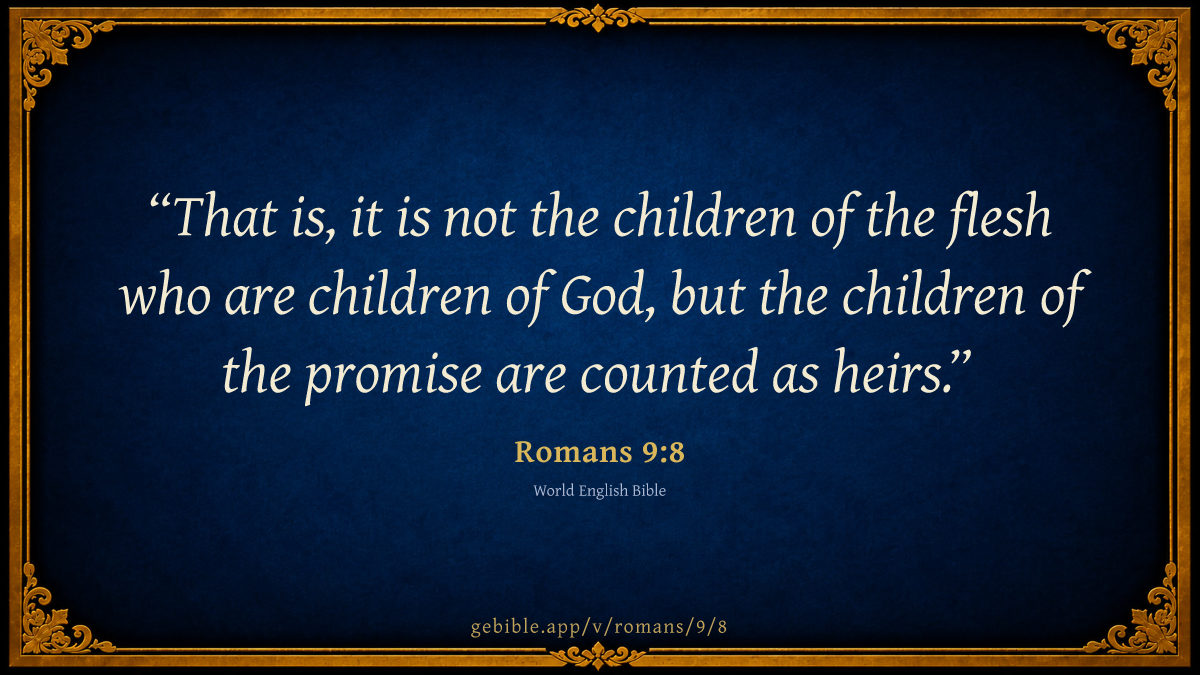
That is, it is not the children of the flesh who are children of God, but the children of the promise are counted as heirs.
Parallel Translations
-
That is, it is not the children of the flesh who are children of God, but the children of the promise are counted as heirs.
-
that is to saye they which are the chyldren of the flesshe are not the chyldren of god. But the chyldren of promes are counted the seede.
-
That is, they which are the children of the flesh, are not the children of God: but the children of the promise, are counted for the seede.
Cross-references (9)
Passages linked to Romans 9:8 in the Treasury of Scripture Knowledge, ordered by reader-vote popularity; verse text shown in World English Bible.
- John 1:13 who were born not of blood, nor of the will of the flesh, nor of the will of man, but of God.
- Romans 4:11-16 He received the sign of circumcision, a seal of the righteousness of the faith which he had while he was in uncircumcision, that he might be the father of all those who believe, though they might be in uncircumcision, that righteousness might also be accounted to them. He is the father of circumcision to those who not only are of the circumcision, but who also walk in the steps of that faith of our father Abraham, which he had in uncircumcision. For the promise to Abraham and to his offspring that he should be heir of the world wasn’t through the law, but through the righteousness of faith. For if those who are of the law are heirs, faith is made void, and the promise is made of no effect. For the law produces wrath, for where there is no law, neither is there disobedience. For this cause it is of faith, that it may be according to grace, to the end that the promise may be sure to all the offspring, not to that only which is of the law, but to that also which is of the faith of Abraham, who is the father of us all.
- Galatians 3:26-29 For you are all children of God, through faith in Christ Jesus. For as many of you as were baptized into Christ have put on Christ. There is neither Jew nor Greek, there is neither slave nor free man, there is neither male nor female; for you are all one in Christ Jesus. If you are Christ’s, then you are Abraham’s offspring and heirs according to promise.
- Romans 8:14 For as many as are led by the Spirit of God, these are children of God.
- Galatians 4:22-31 For it is written that Abraham had two sons, one by the servant, and one by the free woman. However, the son by the servant was born according to the flesh, but the son by the free woman was born through promise. These things contain an allegory, for these are two covenants. One is from Mount Sinai, bearing children to bondage, which is Hagar. For this Hagar is Mount Sinai in Arabia, and answers to the Jerusalem that exists now, for she is in bondage with her children. But the Jerusalem that is above is free, which is the mother of us all. For it is written, “Rejoice, you barren who don’t bear. Break out and shout, you who don’t travail. For the desolate have more children than her who has a husband.” Now we, brothers, as Isaac was, are children of promise. But as then, he who was born according to the flesh persecuted him who was born according to the Spirit, so also it is now. However what does the Scripture say? “Throw out the servant and her son, for the son of the servant will not inherit with the son of the free woman.” So then, brothers, we are not children of a servant, but of the free woman.
- 1 John 3:1-2 See how great a love the Father has given to us, that we should be called children of God! For this cause the world doesn’t know us, because it didn’t know him. Beloved, now we are children of God. It is not yet revealed what we will be; but we know that when he is revealed, we will be like him; for we will see him just as he is.
- Psalms 87:6 Yahweh will count, when he writes up the peoples, “This one was born there.”
- Genesis 31:15 Aren’t we considered as foreigners by him? For he has sold us, and has also used up our money.
- Psalms 22:30 Posterity shall serve him. Future generations shall be told about the Lord.
Cross-references from openbible.info (CC BY 4.0)
Explain this verse (16 sources)
Historical commentary, presented as a primary source — not an endorsement.
Private notes
Saved on this device only — never synced or sent anywhere.
John Calvin 1540 · Public Domain 8. That is, They are not, etc. He now…
8. That is, They are not, etc. He now gathers from God’s answer a proposition, which includes the whole of what he had in view. For if Isaac, and not Ishmael, was the seed, though the one as well as the other was Abraham’s son, it must be that all natural sons are not to be regarded as the seed, but that the promise is specially fulfilled only in some, and that it does not belong commonly and equally to all. He calls those the children of the flesh, who have nothing superior to a natural descent; as they are the children of the promise, who are peculiarly selected by the Lord.
John Calvin's Commentaries (1540-1563) — public domain. Text from the Calvin Translation Society English edition (1840s-50s) via the Christian Classics Ethereal Library (ccel.org). Calvin's coverage is partial (roughly two-thirds of the Bible); uncommented books and verses are honest gaps, never fabricated. The 19th-century editor's footnotes and remarks are omitted so the notes are faithfully Calvin's own voice.
Geneva Bible translators 1599 · Public Domain A general application of the former proof or example.
A general application of the former proof or example.
Which are born of Abraham by the course of nature.
Read full note →
Which are born by virtue of the promise.
Geneva Bible (1599) marginal notes — public domain.
John Trapp 1656 · Public Domain 8 That is, They which are the children of…
8 That is, They which are the children of the flesh, these are not the children of God: but the children of the promise are counted for the seed.
Ver. 8. The children of the promise] Abraham by believing God’s promise, begat, after a sort, all believers, yea, Christ himself, the head of his seed, his Son according to the flesh, but more according to the faith.
John Trapp, A Commentary or Exposition upon All the Books of the Old and New Testament (1647–1656) — public domain. Text from a community e-Sword module.
Matthew Poole 1685 · Public Domain q.d. That I may speak more plainly, all those…
q.d. That I may speak more plainly, all those that are the children of Abraham according to the flesh, are not therefore the adopted children of God; it is not their blood, but their faith, must make them such. There are some of Abraham’s seed, that are selected from the rest, to whom the promise was made, who are therefore called
children of the promise; and of this sort are all they who are born after the Spirit, ( as Isaac is said to be, Gal 4:29), whether Jews or Gentiles. The sense of this verse is fully expressed, Gal 3:8,14,29; see Gal 4:28.
Matthew Poole's English Annotations on the Holy Bible (1683–1685) — public domain. Text from a community e-Sword/MySword module.
John Gill 1763 · Public Domain For this is the word of promise,.... The following…
For this is the word of promise,.... The following passage is the Scripture, which contains the promise concerning the birth of Isaac; which was the produce, not of nature, but of divine grace and power; and was typical of the regeneration of God's elect, who "as Isaac was, are the children of promise", Gal 4:28, for as Ishmael was a type of them that are born after the flesh, and are carnal men, so Isaac was a type of those, who are born after the Spirit, and are spiritual men: the promise is,
at this time will I come, and Sarah shall have a son; the passage referred to is in Gen 18:10; which there stands thus, "I will certainly return unto thee, according to the time of life, and lo, Sarah thy wife shall have a son": some difference there is between the words as cited by the apostle, and as they stand in the original text; the word "lo", is omitted by the apostle, nor was there any necessity to repeat it, since it was used only to excite Abraham's faith, attention, and wonder; also the phrase "thy wife", is neglected, the reason is, because the words in Genesis are an address to Abraham, here the substance of the promise to him is produced; besides it was not only well known in the apostle's time, that Sarah was the wife of Abraham, but that as such she brought forth Isaac, wherefore it was not so very necessary it should be mentioned here; add to this, that it is not repeated in Gen 18:14, which will justify our apostle in the omission of it: but the greater seeming difference is, that what in Genesis is rendered, "according to the time of life", is by the apostle, "at this time": some think, that there may be an emendation of the present original text, and suppose a various reading, and that the apostle, instead of "life", read "this", but there is no occasion for such a supposition, or to make this amendment: for the phrase "the time of life", signifies the present time, the "nunc stans"; so R. Levi ben Gerson (f), understands this phrase, "according to the time of life", , "according to this time which is now standing and abiding" and adds, rightly is this said, because neither time past nor to come are to be found, only the present time, the "nunc stans" and afterwards more than once explains it, of this present time, the next year: and so both R. Solomon Jarchi, and R. Aben Ezra (g), expound it, , "according to this time", the year following; that is, exactly according to this present time next year, or this time twelve month; besides, in Gen 17:21 it is said, "at this set time", and in Gen 18:14, "at the appointed time"; all which support the apostle in his version.
Read full note →
(f) Perush in Gen. fol. 26. 4. & 27. 2, 3. Vid. in 2 Reg. iv. 16. (g) In Gen. xviii. 10.
John Gill's Exposition of the Whole Bible (1746–1763) — public domain (CC PDM 1.0). Text via the HelloAO Bible API.
John Wesley 1765 · Public Domain That is, Not the children, &c. - As if…
That is, Not the children, &c. - As if he had said, This is a clear type of things to come; showing us, that in all succeeding generations, not the children of the flesh, the lineal descendants of Abraham, but the children of the promise, they to whom the promise is made, that is, believers, are the children of God. Gen. xxi, 12
John Wesley, Explanatory Notes Upon the Whole Bible (1754–1765) — public domain. Text via the GEBible commentary corpus.
Adam Clarke 1810 · Public Domain Verse 8. That is, They which are the children…
Verse 8. That is, They which are the children of the flesh] Whence it appears that not the children who descend from Abraham's loins, nor those who were circumcised as he was, nor even those whom he might expect and desire, are therefore the Church and people of God; but those who are made children by the good pleasure and promise of God, as Isaac was, are alone to be accounted for the seed with whom the covenant was established.
Adam Clarke's Commentary on the Bible (1810–1826) — public domain. Text from a community e-Sword/MySword module.
Albert Barnes 1834 · Public Domain They which are the children of the flesh -…
They which are the children of the flesh - The natural descendants.
These are not the children of God - Are not of necessity the adopted children of God; or are not so in virtue of their descent merely. This was in opposition to one of the most settled and deeply cherished opinions of the Jews. They supposed that the mere fact of being a Jew, entitled a man to the blessings of the covenant, and to be regarded as a child of God. But the apostle shows them that it was not by their natural descent that these spiritual privileges were granted; that they were not conferred on people simply from the fact that they were Jews; and that consequently those who were not Jews might become interested in those spiritual blessings.
Read full note →
But the children of the promise - The descendants of Abraham on whom the promised blessings would be bestowed. The sense is, that God at first contemplated a distinction among the descendants of Abraham, and intended to confine his blessings to such as he chose; that is, to those to whom the promise particularly appertained, to the descendants of Isaac. The argument of the apostle is, that “the principle” was thus established that a distinction might be made among those who were Jews; and as that distinction had been made in former times, so it might be under the Messiah.
Are counted - Are regarded, or reckoned. God reckons things as they are; and therefore designed that they should be his true children.
As the seed - The spiritual children of God; the partakers of his mercy and salvation. This refers, doubtless, to spiritual privileges and to salvation; and therefore has relation not to nations as such, but to individuals.
Albert Barnes' Notes on the Bible (1834–1885) — public domain. Text from a community e-Sword/MySword module.
Daniel D. Whedon 1874 · Public Domain 8. That is—The apostle now reads into the literal…
8. That is—The apostle now reads into the literal words In Isaac shall thy seed be called their higher spiritual import.
Children of the flesh… of God… of the promise—This threefold classification of children must be carefully analyzed. Children of the flesh does not mean, as Barnes defines it, merely “the natural descendants;” but all are children of the flesh who depend upon the flesh, that is, upon fleshy descent or circumcision (including all ritual and natural merit-works,) for justification. As all their regeneration is of the flesh, so they are children of the flesh. So our Lord says, Joh_3:6, That which is born of the flesh is flesh; (see note;) that is, is carnal. But those here specified by Paul are not the unregenerate simply, but the falsely regenerate through fleshly lineage, and what he calls (Heb_9:10) fleshly ordinances. But the conclusive proof-text is, Gal_4:29, “But as then he that was born after the flesh persecuted him that was born of the Spirit, even so it is now.” The now demonstrates that the Judaizers of Paul’s own day are by him held to be children of the flesh after the type of Ishmael of old, because they trusted in fleshly lineage and merit-works for justification. And so in Rom_4:1-12, (where see note,) justification by works and according to the flesh is the same thing.
Read full note →
On the contrary, the true believers “are the circumcision, and have no confidence in the flesh.” (Php_3:3.) That the phrase children of the flesh here has this meaning is made sure by its opposed phrases children of God, children of the promise. Forced by his creed, Professor Stuart would define children of God, “such children as God, according to the special promise to Abraham, would raise up for his posterity”! It is perfectly inadmissible, without some forcible reason, to make the phrase mean anything else than its ordinary sense in the New Testament, regenerate children of God, that is, by faith. That by children of the promise he means the regenerate by faith appears from Gal_3:29 : “If ye be Christ’s, then are ye Abraham’s seed, and heirs according to the promise.” And again, (Gal_4:28,) “We, brethren, as Isaac was, are the children of the promise.” And the whole passage (Gal_4:21-31) affirms just this: The faith by which Abraham and Sarah so believed in God’s promise that Isaac was generated a child of the promise is typical of that faith by which every true believer is regenerated, and so becomes also an heir of the promise. (See notes on Rom_4:17-22.) Isaac was heir of the external prerogatives of the great Abrahamic-Messianic line by physical birth, and of its internal blessings by faith; true believers, now that the external prerogatives are abolished, are, with Isaac and “in Isaac,” the “seed called” to the internal blessings by like faith. And it is this meaning that the inspired apostle reads into the words, “In Isaac shall thy seed be called.”
Daniel D. Whedon (gen. ed.), Commentary on the Old and New Testaments (1874–1909) — public domain. Text from a community e-Sword module.
The Cambridge Bible for Schools and Colleges 1878 · Public Domain 8. That is, &c.] We may paraphrase this verse,…
8. That is, &c.] We may paraphrase this verse, after the Gr.; “That is,” (in view of both the Rom_9:6-7,) “the children of God” (it being implied in the Promise that Abraham’s children should be also His,) “are not the mere bodily offspring of Abraham, no more and no fewer; rather, the children defined by special promise are taken to be the whole posterity in question.”
children of the promise] Perhaps in this phrase the Promise is quasi-personified; so St Chrysostom in Meyer. But see Luk_20:36 for a somewhat similar case. There the phrase “children of the resurrection” must mean “persons who partake resurrection glory;” but the special form of words is modified by the phrase “children of God” just preceding. So probably here the phrase “children of the promise,” for “persons defined by the promise,” is suggested by “children of the flesh” just preceding.
The Cambridge Bible for Schools and Colleges (gen. ed. J. J. S. Perowne; Cambridge University Press, 1878–1918) — public domain. Text from a community e-Sword module.
Ellicott's Commentary for English Readers 1878 · Public Domain (8) They which are the children.—The Apostle explains this…
(8) They which are the children.—The Apostle explains this restriction in a spiritual sense. Mere natural descent gives no claim to membership in the theocracy.
Of the promise—i.e., not merely “promised children,” but “children born through the miraculous agency of the promise;” the promise is regarded as being possessed of creative power. (Comp. Rom_4:18-20.)
A Bible Commentary for English Readers, edited by Charles John Ellicott (1878–1897) — public domain. Text from a community e-Sword module.
The Pulpit Commentary 1880 · Public Domain Vers. 8, 9. That is, They which are the…
Vers. 8, 9. That is, They which are the children of the flesh, these are not the children of God: but the children of the promise are counted for seed. For the word of promise is this, At this time will I come, and Sarah shall have a son. (Gen_18:10) In other words, it is not in virtue of mere carnal descent, but of the promise, that any are so counted; mere carnal descent establishes no claim. It is to be observed that in the first recorded promises to Abraham (Gen_13:15 Gen_15:5 Gen_17:7) there was no restriction; and so through Ishmael, who is also called Abraham"s seed, (Gen_21:13) as well as through Isaac, the fulfilment might have been. But the subsequent promise (Gen_17:19, 21 18:10, 14) limited it to Isaac; which limiting promise is, therefore, in ver. 9, referred to. With tekna tou Yeou in ver. 8 Compare h uioyesiaa (ver. 4), and also Isa_63:16. The apostle may have been led to use the expression here in view of the spiritual sonship to God of Christianswhich (cf. Rom_8:15, etc.) was typified and prepared for by the uioyesia of the chosen seed. A still further limitation of "the children of the promise" is next referred to; and one still more telling for the apostle"s argument. It might be said that Ishmael was not, even carnally, the true seed, as being born, not of the with, but of the bondwoman; or perhaps that he had forfeited any claim he might have had by his proved unworthiness. (Gen_21:9, etc.) But Esau and Jacob were twin children, not only of the same patriarch (ex enov), but also of the same wedded wife; and yet one was chosen and the other rejected, and this even before birth; so that, as the selection was not due to carnal descent, so neither could it be due to proved desert. Thus by this second consideration is disposed of the Jew"s assertion of an indefeasible claim to inheritance of the promises on the ground of his boasted works, as by the other is disposed of his claim on the ground of his race. St. Paul"s argument to the Jews of his own day would be You cannot set up a claim to be all of you the necessary inheritors of the promises for all time on the ground either of your carnal descent or of your works, since the selection of Israel himself did not depend on either of these grounds; nor can you say that my position (viz. that Christian believers, to the exclusion of most of you, are now the true inheritors of the promises) implies unfaithfulness in God to his ancient promises; for it is in accordance with the principle on which, according to your own Scriptures, he fulfilled of old his promises to the patriarchs. St. Paul, however, is not to be understood here as writing with a direct polemical intention, but rather as discussing a problem which had at one time perplexed himself, and which seemed to him to call for solution.
The Pulpit Commentary (1880–1919), ed. H.D.M. Spence-Jones & Joseph S. Exell — public domain. Text from a community e-Sword module.
The Biblical Illustrator 1887 · Public Domain For I could wish that myself were accursed from…
Rom_9:8
For I could wish that myself were accursed from Christ for my brethren.
Read full note →
St. Pauls wish
A considerable group of expositors have regarded the first moiety of this verse as parenthetical, I have great heaviness and sorrow of heart (for I myself used to wish to be accursed from the Messiah) for my brethren, etc. The apostle is supposed to be referring to his own infatuation during the time of his antagonism to Christ and Christianity, for the purpose of obliquely depicting, from the standpoint of his own experience, the lamentable condition of his countrymen, and of thus accounting for the overwhelming sorrow under which he was suffering. Others, without the mechanical parenthetical expedient, give substantially the same interpretation, I was wishing, viz., at a former period, not now. But it is impossible that the apostle was speaking historically. The expression is a Greek idiom meaning, I could pray or wish to God--an idiom which grew out of the imperfect or incomplete tense, I was praying. If it were wished to represent the act as completed some other tense would be required. Take another instance (Gal_4:20). I could wish (for reasons obvious enough, and if my ether engagements did not forbid) to be once more in the midst of you. Or (Act_25:22) Agrippa said to Festus, I also could wish to hear the man myself (viz., if it were not, O Festus, trespassing too far on your indulgence). So in the case before us I could wish to God to be vicariously an anathema for my kinsmen, if my conceptions of my duty on the one hand, and of Gods wisdom and will on the other, would allow me to carry forth into completion such a desire and such a prayer. The apostle did not actually desire to be an anathema. He knew that such a desire would never be Divinely fulfilled, and hence he did not cherish it. A wise man keeps his desires under control. A pious man takes Gods desires and purposes into account, and does not entertain any desire which he knows to be at variance with the Divine will, or with the arrangements that are dependent on the Divine will. Hence it is that the apostle does not say, I desire, but only I could desire. So far as he was concerned, he was ready for the self-sacrifice, provided it was legitimate, and could be efficacious. It would not, however, have been of avail, and hence the wish was never fully formed. The potential did not pass into the actual. It is true that the potential translation of the verb, though doubtless the only correct one under the circumstances, is nevertheless an imperfect reflection of the original imperfect tense. The tense is a time, not a potency; but it is a past tense incomplete. Hence the real idea of the word is I was desiring. The desire rose up in the apostles heart, and to a certain extent he allowed it, yet only to a certain extent, for a higher desire struck in and controlled it--the desire to be in perfect accord with Gods desire and will. Hence it hung suspended, and remained imperfect. It was conditional, and the condition that would have brought it to maturity was never forthcoming. Thus the embryo desire was in reality but a potency. It may now be further noticed that the word means properly I could pray. The word is so rendered in 2Co_13:7; Jam_5:16, and has really that meaning in 2Co_13:9; 3Jn_1:2; Act_27:29. In the last text they lifted up their desires to their gods and prayed for the break of day. The word only occurs elsewhere in Act_26:29. If I might venture to use the liberty of openly expressing the fulness of my feeling, I would audibly lift up my prayer to God. Hence our text is admirably expressed in our idiomatic I could wish to God. It is impossible to believe that St. Paul ever presented such a prayer. The utmost stretch of conceivability extends no farther than this--that the apostle felt, time after time, the incompleted uprising of an impulse to pray that if it were compatible with all great interests, permission might be given him to be, by the sacrifice of his own happiness, the means of rescuing his infatuated countrymen from their doom. Such sacrifice he would gladly make, if it were among the moral possibilities. (J. Morison, D.D.)
Pauls wish
The word accursed often signifies no more than being devoted to temporal death, or being made a sacrifice of (Deu_21:23, cf. Gal_3:16), and the words from Christ may signify after Christ, i.e., after His example (2Ti_1:3). The verse then would read thus: I could be content, nay, I should rejoice to be made a sacrifice myself, as Christ has been before me, for my brethren. (D. Waterland, D.D.)
Accursed from Christ
The solutions that have been offered of this difficult text group themselves under one or other of the three following alternatives.
I. If his Jewish kinsmen could only thereby be saved, Paul could himself sublimely consent to be finally damned. Many have so understood him, and applauded the sentiment as the climax of the morally sublime, as exhibiting a love stronger than death, because stronger than even hell. But is this a Christ-like love? When did Christ consent to be made a curse in a sense so vile, or incur a doom so final? For me to wish myself accursed from Christ for any end whatever, would be to wish not only doom, but sin. So far from glorifying God, it would but dishonour and contradict Him, for it would be to choose as a means of good what God brands as the very quintessence of evil.
II. A qualified and softened sense that falls short of final doom.
1. Some have taken the phrase, accursed from Christ, to mean temporal death, in proof of which appeal is made to the prayer of Moses in Exo_32:32. But Moses expression for temporal death presents no parallelism whatever to the apostles expression. Moreover, if Paul meant temporal death, what could he mean by from Christ? Temporal death, so far from separating the believer from Christ, cuts short all seeming separation. Anathema originally denoted the act of depositing gifts in temples, and also the votive offerings themselves. These were of course sacred and irrevocable. When the gift was a living creature, beast or man, the life was devoted in sacrifice. Hence devoted stands for doomed. In the spiritual sphere the doom thus expressed was utter and final. As anathema from Christ the life, what less could it be? This we find to be its intensity of meaning in all the other places in which the word occurs in the New Testament (Act_23:14 1Co_12:3; 1Co_16:22; Gal_1:8-9). Thus the words accursed from Christ refuse to be softened down. Whatever final damnation may mean, all that they mean. Nor will it in the least help the matter to resort to the forms of Jewish excommunication, for in its milder form of expulsion from the synagogue, the phrase before us is far too strong, and is never once so employed: while in its direr form of thorough Jewish malediction, it embraced all the terrors of eternal judgment.
2. Turn we now to the opening expression I could wish. The tense in the original is the imperfect: and the explanation given is I was wishing, only it was no use. But if Paul wished, in any degree and for any reason, to be accursed from Christ, he wished what was wrong. If he wished, or professed to wish, an acknowledged impossibility, he simply trifled with his readers, and with his tragic theme. And if he did not really wish at all, then his words reduce themselves at best to a simple extravagance. That be far from our apostle (see verse 1).
III. The historical interpretation remains.
1. The tense used is the imperfect, and the most literal rendering would be, I wished. In Gal_1:13 the same tense occurs, and that, too, in an affirmation very parallel to the one before us. Had our translators rendered that imperfect tense there as they have done here we should have had, I could persecute.
2. Again note that the word myself stands connected with the word wished. For I myself used to wish to be accursed from Christ. This makes it clear that he takes us back to his unconverted past. It is as if he had said, I myself used to hurl those curses which you are now launching at the Nazarene. I, even I, once dared the doom you now defy, and it is because I once did so, and now see the terrible doom I incurred, that I feel such sorrow for my kinsmen.
3. But how Paul could be said to wish this dreadful anathema for his brethrens sake? Granting that the connection is the true one the answer would be, Paul did all this as a zealous Jew, devotedly attached to his nation, and thinking that he was doing them, as well as God, service by those dreadful maledictions. But the clause is clearly parenthetical. The sorrow, not the wish, is for his brethren.
4. But if the words accursed from Christ mean nothing less than final doom, how, even in his unconverted state, could Paul have wished that? The answer is that the Jewish anathema was double-edged. It might be launched directly at Jesus, and doubtless it often was by Paul amid his breathings of threatening and slaughter. But it might also take the more indirect form of imprecating direst anathemas upon himself if he espoused the cause of the Nazarene.
5. But while recalling the past he cannot forget the present. To his unbelieving sense the anathemas at that past period meant one thing. To his now Christianised sense they are seen to have meant infinitely direr things than he then conceived. He now saw that the Nazarene was no false Messiah, but the true; hence the significant use of the article in the original, accursed from the Christ. He wished, and willed, that rejection of Christ which leads to the curse of utter and irremediable woe.
IV. Conclusion.
1. Let the reckless dealer in common oaths beware. His lightly uttered blasphemies may have more momentum than he thinks. Your oaths may fasten on your soul a lasting curse.
2. Be not hasty in your conclusions. Paul once allowed himself to be borne away by the current. He had need to save himself from that untoward generation. So have we from ours. We may have to breast the current that would else float us past Christ, and drift us to ruin.
3. See how remote Christianity is from Pharisaism. The Pharisees scowled on Jesus because He was the friend of sinners. They cared for no mans soul. Now, if we want a picture the very opposite of that, we may behold it here in Paul. But that same Paul was himself once a Pharisee. And lo! here he stands stripped of the last shred of his Pharisaic cloak, and dissolved in tender tears for the souls of his fellows!
4. We have here a splendid example of love to our deadly foes. This word anathema may remind us of what dire anathemas those very Jews pronounced over this same Paul (Act_23:14). And how does he repay them? By returning blessing. So well had he caught the spirit and conned the lesson of his Master (Mat_5:44-45).
5. We have also here a spirit-stirring example of love to souls as souls. It was the spiritual condition and prospects of his Jewish kinsmen that wrung his heart; but Gentiles drew forth this tender concern no less than Jews.
6. How solemn is human life! How tragic is human ruin! How saddening to reflect that such tragedies are hourly enacting themselves under all the sheet-lightning play of laughter and shallow merry-makings of the world! Life is real, life is earnest.
7. How vitally indispensable is the gospel; for is it not implied in our apostles statement that there is life only in Christ? Separation from Christ is here assumed to be separation from bliss, and to be identical with curse.
8. And how free is that gospel! No reprobating decree; else these tears of Paul, if tears of sympathy for men were tears of antipathy and even treachery in relation to God. The grace of God that hath appeared brings salvation unto all men. It is brought to our very door. It is pressed upon us, but not forced. The issue rests with our own free will. Paul the persecutor acted out his wish, or choice; and so with equal freedom did Paul the preacher (Deu_30:19-20). (J. Guthrie, M.A.)
Anathema
The word was originally employed to denote what was by way of consecration put up in a temple. The anathema might be an offering of gratitude for deliverance or some other blessing; or it might be, in the ages of spiritual darkness, a kind of sacred bribe presented to the deity. But whatever it was it would, if of convenient shape and bulk, be hung up on a pillar, or suspended on the wall of the shrine. It thenceforward belonged to the god, and it would have been not only theft but sacrilege for any one, even a priest, to have appropriated it. When the term was adopted by the Greek-speaking Hebrews it was used in exchange for the Hebrew cherem, which had for its radical import the idea of severance. Whatever was by Divine arrangement utterly cut off from any mans enjoyment was cherem to that man. God reserved its use. It was His cherem. If it were a thing that still continued fit for human use, God might assign it to His peculiar servants for their benefit (Lev_27:21; Num_18:14; Eze_44:29), or if that were not desirable He might put it entirely out of the way, or doom it to destruction (1Ki_20:42). Such devotement to destruction is often desirable in a world such as ours, so polluted, perverted, abused. There are things which cannot be turned to better account than to be utterly destroyed. There are moral nuisances which can only be swept away by the besom of destruction. Among these moral nuisances are morally leprous and festering men, who will not be healed of their contagious sores. These and their infected rookeries must be swept away. The sooner the better for society at large. God will be glorified in the work of destruction. Hence anathema, which at first meant something valuable devoted to a god, came, when applied within the sphere of the moral government of the living and true God, to denote objects which had become irreclaimably corrupt, and which consequently He wisely doomed to be destroyed. The apostle disintegrating one particular line of Hebrew thought from amid the complexity of ideas that were woven around the word felt at times that, if the ethical element were eliminated from the case, he could submit to be himself destroyed, even from the presence of his Lord, if thereby his kinsmen could be constituted heirs of everlasting life and bliss. The destruction of which he thought was thus the annihilation, not of his being, but of substantial elements and factors of well-being. (J. Morison, D.D.)
Anathema from Christ
St. Paul closes the previous chapter with the triumphant confidence that neither death nor life, etc., should be able to separate him from the love of God which is in Christ. The inventory of possible separating forces is comprehensive enough, but it is not exhaustive. The apostle omitted one potentiality which, alas! is constantly separating men from the love of Christ--self. The citadel which can resist any combination of external adversaries may fall through the voluntary act of the garrison within. The gate which cannot be battered down can be opened. Men cannot be driven from Christ, but they can go away. But in his rush of inspired feeling St. Paul would not entertain the thought of himself as withdrawing from the love of Christ, and naturally so. He knew himself too well to admit for one moment the likelihood of a guilty abandonment of One who was his life. There was no possibility of spiritual murder, nor probability of spiritual suicide. But the rush of feeling over he now in cool thought recollects that separation from Christ and His love was not only conceivable and possible, but, in certain circumstances, even desirable; and not from a sinfully selfish motive, but for one Divinely philanthropic. His hearts desire and prayer to God for Israel is that they might be saved (Rom_10:1). How much depended upon the gratification of that desire in relation to the Jews themselves, to the kingdom of Christ, and Christ Himself, he goes on to show. How was this devoutly wished for consummation to be reached? He had used every means within his power, and had sacrificed every interest but one--his interest in Christ. Could the salvation of his countrymen be accomplished by the sacrifice of this? Would a self-devotion paralleled only by that which extorted the My God, My God, why hast Thou forsaken Me? suffice? If so he asked to drink of the same cup, and be baptized with the same baptism--knowing, unlike the sons of Zebedee, what he asked. To secure the worlds redemption the Master did not shrink from the Divine abandonment; to secure the effectual application of that redemption to his kinsmen the servant would not shrink from the abandonment of his Master. The greatness of the issue overshadowed the magnirude of the personal sacrifice. Let us ponder--
I. The wonderful wish. What did it mean?
1. Dismissal from the work of Christ. This was the apostles joy, and not all the persecutions of this world nor all the allurements of the next could tempt him even to wish that he could abandon it. Yet anathema from Christ meant dismissal after all he had accomplished, and prohibition against attempting any more. The labourer was willing to set aside that another might continue and reap the fruits of his labour; the warrior was willing to resign the weapons of the warfare and the laurels of the victory to other hands.
2. Alienation from the friendship of Christ. What the friendship of Christ was to the apostle may be gathered from what he gave to win it, what he did to cherish it, his own testimony to its surpassing worth and the recorded instances of its tenderness and power. This was the effectual consolation of the lonely man in the strange city, in the presence of raging mobs amidst the perils of shipwreck, and at last in the Roman dungeon. Measure then what it must have been for Paul to perfect it. Dissolution of union with Christ. Review his own illustrations of what this oneness was: that between head and body, husband and wife, tree and branches, foundation and building, etc. Christ and Paul were one in life, one in mind, one in heart. Yet Paul was willing to be anathema from all this.
4. Eternal abandomnent by Christ. Life would have been unendurable but for Christ, yet Paul did not shrink from the prospect of eternity without Him.
II. The wonderful wish viewed in the light of its ultimate purpose. Many have become anathema from Christ, abandoned His work, renounced His friendship, sundered the union between them and gone away into everlasting destruction from His presence, for the lowest and most selfish motives. The labour has been felt to be too hard, the friendship too exacting, the union so self-crucifying, and the heaven so holy and so far away. Or association with Christ has barred the way of pleasure, riches, advancement, and renown. In Pauls case self was absolutely annihilated. Christ was all to him, he was willing to renounce that all if by that means others might have it. He was only one, his kindred were many. He was content that he, the unit, should be sacrificed so that the multitude might be blessed. His wish in this view of it was--
1. That his beloved work in other hands might be more successful. Hitherto he had only aroused the hatred of his kinsmen to his Lord. He wished, therefore, to stand aside if another agency could win their love.
2. That by his exclusion from it the circle of Christs friends might be indefinitely enlarged. If mere prejudice against himself were keeping his brethren away, he would gladly forego all the blessed privileges connected with Christs companionship, if his brethren would only come and accept them instead. He would, if possible, view with gratitude from a distance the unceasing spread of Christs influence, and the constantly augmenting number of Christs friends.
3. That the whole race of which he was but a solitary member might become one with Christ at his expense. He saw what this would mean for the world. A Christianised Judaism as a moral force would be irresistible. He, then, would not stand in the way of this.
4. That heaven might be now richly peopled by his exclusion. The thought of the great body of his kinsmen anathema from Christ for ever was so terrible that, if lawful, he would renounce his heavenly hopes that they, instead of himself, might be for ever with the Lord. Conclusion:
1. The wish marks the advance of Christianity beyond all the worlds conceptions of philanthropy. Many sublime sacrifices had been made, but where is the record of such a wish as this? Read it in the light of Rom_5:7-8.
2. The wish could not be gratified. Paul could have devoted himself without sin; but Christ could not have consented. Even such an end could not justify such a means. Christ loves the world, but He loves the individual, and such an individual as Paul could not be sacrificed for the world without the sacrifice of Christs own love and equity as well.
3. The carrying out of the wish is unthinkable. Anathema from Christ from such a motive would necessarily bind more closely to Him. The means of repulsion are the very means of attraction. Pauls wish is the very spirit of Christ; and for Christ to have allowed it would have been for Christ to deny Himself. (J. W. Burn.)
The vicariousness of gospel philanthropy
I. Its strong substitutionary craving. Paul wishes here to suffer for the sake of his brethren. All love is in a sense substitutionary. It suffers for others. The more love a being has in a world of suffering, the more vicarious agony he must endure. Love loads us with the infirmities and sorrows of all around. Christ came here with an infinite love for the whole world; and by an eternal law of sympathy He suffered for the world. But there is, moreover, a craving in love to suffer instead of its object. Does not the mother desire to suffer instead of the babe that lies on the bed of anguish? Substitution of this kind is the law of love.
II. Its self-sacrificing power. The apostle not only desired to suffer instead of his brethren, but to suffer the greatest evil, to sacrifice his all for them. He desired to be anathema from Christ. What does this involve? Terrible enough, says Dean Plumptre, would have been that word anathema if it had brought with it only the thoughts which a Jewish reader would have associated with it. To come under all the curses, dark and dread, which were written in the book of the law; to be cursed in waking and sleeping, going out and coming in, in buying and selling, in the city and in the field; to be shunned, hated as a Samaritan was hated, shut out from fellowship with all human society that had been most prized, from all kindly greeting of friends and neighbours. This was what he would have connected with the words as their least and lowest meaning. The Christian reader, possibly the Jewish also, would have gone yet further. The apostles own words would have taught him to see more. To be delivered unto Satan for the destruction of the flesh; to come under sharp pain of body, supernaturally inflicted, and to feel that that excruciating agony or loathsome plague was the deserved chastisement of a sin against truth and light, and to be shut out from all visible fellowship with the body of Christ, and therefore from all communication with Christ Himself; to be as in the outer darkness while the guests were feasting in the illumined chamber, here too to be shunned by those who had been friends and brothers. This would have been the Christians thoughts as to excommunication in the apostolic age. But beyond all this the apostle found a deeper gulf and a more terrible sentence. To be anathema from Christ, cut off for ever from that eternal life which he had known as the truest and highest blessed-ness, sentenced for ever to that outer darkness, the wailing and gnashing of teeth, this was what he prayed for if it might have for its result the salvation of his brethren. Gospel love involves self-abnegation. Self sinks as love rises. Christ is the highest example. He loved us, and He gave Himself for us. Here is the cause and the effect. Love is the high priest of the soul; it offers the whole self.
III. Its soul-saving aim. Why did Paul wish to sacrifice himself? What was the grand object he had in view? The spiritual salvation of his countrymen. The vicarious love of the gospel endures and craves sufferings, not merely or mainly to serve men materially and temporarily, but chiefly spiritually and eternally; to save their souls. It counts no perils too great, no sufferings too distressing, no sacrifices too exacting, in order to redeem immortal spirits from ignorance, selfishness, worldliness, guilt, misery, hell. (D. Thomas, D.D.)
The extravagance of holy love
One of my hearers used to keep puzzling himself fearfully with that passage in Scripture about Jesus weeping over Jerusalem. He went and looked at Dr. Gill about it, he went to Thomas Scott about it, and he went to Matthew Henry about it; and these good divines all puzzled him as much as they could, but they did not seem to clear up the matter. The good man could not understand how Jesus Christ could say as He did, How often would I have gathered thee, but thou wouldst not! One day he received more grace, and got to have a love for souls, and then the old skin of narrowmindedness which had been large enough for him once began to crack and break, and he went to the passage then, and said, I can understand it now; I do not know how it is consistent with such and such a doctrine, but it is very consistent with what I feel in my heart. And I feel just the same. I used to be puzzled by that passage where Paul says that he could wish himself accursed from God for his brethrens sake. Why, I have often felt the same, and now I understand how a man can say in the exuberance of his love to others, that he would be willing to perish himself if he might save them. Of course it never could be done, but such is the extravagance of a holy love for souls that it breaks through reason, and knows no bounds. Get the heart right and you get right upon many difficult points. (C. H. Spurgeon.)
Heroic devotion
For an example of heroic devotion let us go, not to our own sacred book, but to a heathen story in the Mahabharat. Have you read of Yodhishtera, the stainless king, who, on account of his pure life and tender pity for all that lives, is allowed to enter heaven without tasting death? But, arrived in the presence of the immortal gods, he misses the faces of brothers and friends whom he had loved and lost, and bliss is not blissful to him, and he cries, Show me those souls; I cannot tarry where I bare them not. Heaven is there where love and faith make heaven; let me go. I do desire, he said, that region, be it of the blest, as this, or of the sorrowful, some other where, where my dear brothers are. So where they have gone there will I surely go. He quits the heaven he has gained, and hellwards turns. But while he traverses the place of dread, again the angels invite his return. He answers, Go to those thou servest tell them I come not thither; say I stand here, in the throat of hell, and here will abide, nay, even perish, if my well-beloved may win ease and peace by any pain of mine. Are we going backward? Have we no passion for saving?--no sympathy with the them also I must bring?
Heaven is not heaven to one alone;
Save thou one soul, and thou mayest save thine own.
(Mrs. E. Campagnac.)
A passion for souls
All the great revivalists of the Church have had what has been Galled a passion for souls. John Smith, the mighty Wesleyan preacher, used to say, I am a broken-hearted man; not for myself, but on account of others. God has given me such a sight of the value of precious souls, that I cannot live if souls are not saved. Oh, give me souls, or else I die!
The Biblical Illustrator, edited by Joseph S. Exell (c. 1880s–1900s) — public domain. Text from a community e-Sword module.
B. W. Johnson 1891 · Public Domain 8. That is, not the children of the flesh,…
8. That is, not the children of the flesh, etc. Since Ishmael, born according to natural laws, was not of the chosen race, but Isaac, the child of promise, born contrary to natural law, because the chosen people, it follows that the children of God are not the children of the flesh, the mere fleshly descendants of Abraham, but the children of the promise; those who are of the seed according to the conditions of the promise. This argument is a reply to those who based all upon their fleshly relation to Abraham: “We have Abraham to our Father” (Matt. 3:9). In order to show this more fully Paul recalls the incidents recorded in Gen. 18:10–14.
B. W. Johnson's The People's New Testament with Notes (1889–1891) — public domain. Electronic text from the Christian Classics Ethereal Library (CCEL) ThML edition.
J. W. McGarvey 1914 · Public Domain That is, it is not the children of the…
That is, it is not the children of the flesh [of Abraham] that are [reckoned or accounted as] children of God; but the children of the promise are reckoned for a seed . [Are accounted the children of God through Abraham. Fleshly descent from Abraham, of itself and without more--i. e., without promise--never availed for any spiritual blessing ( Gal_4:23 ). "This," says Trapp, "profiteth them no more than it did Dives, that Abraham called him son" ( Luk_16:25 ). So flesh avails neither then nor now, but promise. Paul proceeds to show that Isaac was a son of promise, and whatever covenants or promises availed for his children came to them because they, through him, became symbolically sons of promise, Isaac typifying Christ, the real son of promise given to Abraham ( Gal_3:16 ), and Isaac's posterity typifying the real children of promise, the regenerated sons of God begotten unto Christ through the gospel ( Gal_4:28; Joh_1:12-13 ). So as Abraham had a fleshly seed according to the first promise, "In Isaac shall thy seed be called," these being Jews; so he had a spiritual seed according to the second promise, "In thee and in thy seed shall all the nations (Gentiles; but not excluding Jews) of the earth be blessed," these being Gentiles. Hence, if the two promises were each kept with the two parties to whom they were severally given, the word of God was not broken, and his promise had not failed. But such was indeed the case, for God kept his word with the fleshly seed, fulfilling to them the fleshly promise that Christ should be born of their stock ( Joh_4:22 ; Gal_3:16 ), and to the spiritual seed he was fulfilling the spiritual promise granting them eternal life through that faith in Christ which made them spiritual children of Abraham, the father of the faithful ( Gal_3:7-14 ). So it was not two promises to one seed, but two promises to two seeds, and each promise was kept of God to each promisee. And why, says Paul, do we call Isaac the son of promise? Because he was not born according to the natural law of the flesh, his mother being past bearing, but contrary to nature and by reason of the divine power, working to fulfill the promise of God, which promise is as follows]
J. W. McGarvey (with Philip Y. Pendleton), Commentaries on the New Testament (The Fourfold Gospel, 1914; Acts; and the epistles) — public domain. Text from a community e-Sword/MySword module.
unfoldingWord translationNotes 2017 · CC BY-SA 4.0 the children of the flesh are not
the children of the flesh are not
Here "children of the flesh" is a metonym that refers to the physical descendants of Abraham. AT: "not all of Abraham's descendants" (See: Metonymy)
Read full note →
children of God
This is a metaphor that refers to people who are spiritual descendants, those who have faith in Jesus. (See: Metaphor)
children of the promise
This refers to people who will inherit the promises that God gave to Abraham.
this is the word of promise
"these are the words God used when he made the promise"
a son will be given to Sarah
You can translate this in an active form to express that God will give a son to Sarah. AT: "I will give Sarah a son" (See: Active or Passive)
translationWords
children
son
Sarah
unfoldingWord translationNotes — © Distant Shores Media and the Door43 World Missions Community, licensed CC BY-SA 4.0. Source: git.door43.org/Door43/en_tn.