Psalms 45:3(v8)Strap your sword on your thigh, mighty one: your splendor and your majesty.
1 Samuel 8:16(v7)He will take your male servants, your female servants, your best young men, and your donkeys, and assign them to his own work.
1 Samuel 14:52(v7)There was severe war against the Philistines all the days of Saul; and when Saul saw any mighty man, or any valiant man, he took him into…
1 Samuel 28:2(v7)David said to Achish, “Therefore you will know what your servant can do.” Achish said to David, “Therefore I will make you my bodyguard…
1 Kings 9:22(v7)But of the children of Israel Solomon made no bondservants; but they were the men of war, his servants, his princes, his captains, and…
Show all 19 cross-references
1 Kings 14:27(v7)King Rehoboam made shields of bronze in their place, and committed them to the hands of the captains of the guard, who kept the door of the…
2 Kings 6:17(v7)Elisha prayed, and said, “Yahweh, please open his eyes, that he may see.” Yahweh opened the young man’s eyes; and he saw: and behold, the…
Nehemiah 4:21-22(v8)So we did the work. Half of the people held the spears from the rising of the morning until the stars appeared. Likewise at the same time I…
Psalms 91:5(v8)You shall not be afraid of the terror by night, nor of the arrow that flies by day,
Psalms 149:5-9(v8)Let the saints rejoice in honor. Let them sing for joy on their beds. May the high praises of God be in their mouths, and a two-edged sword…
Song of Solomon 1:16(v7)Behold, you are beautiful, my beloved, yes, pleasant; and our couch is verdant.
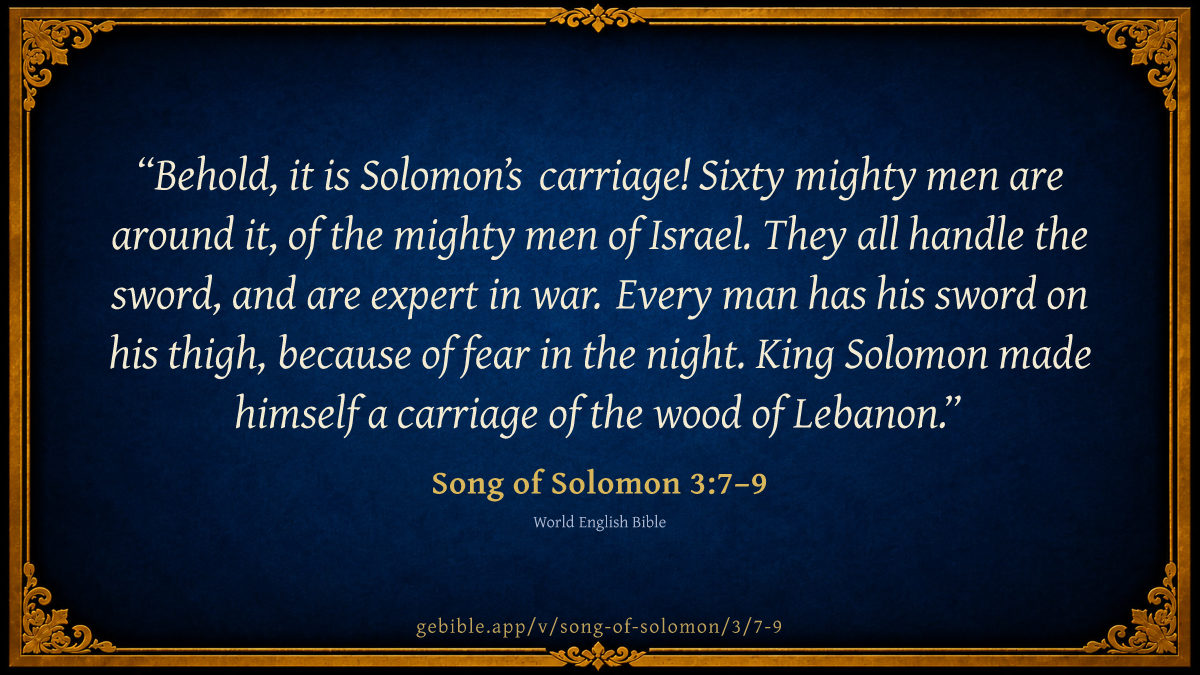
Song of Solomon 3:7(v9)Behold, it is Solomon’s carriage! Sixty mighty men are around it, of the mighty men of Israel.
Song of Solomon 3:9(v7)King Solomon made himself a carriage of the wood of Lebanon.
Isaiah 27:3(v8)I, Yahweh, am its keeper. I will water it every moment. Lest anyone damage it, I will keep it night and day.
Ephesians 6:16-18(v8)above all, taking up the shield of faith, with which you will be able to quench all the fiery darts of the evil one. And take the helmet of…
1 Thessalonians 5:6-8(v8)so then let’s not sleep, as the rest do, but let’s watch and be sober. For those who sleep, sleep in the night; and those who are drunk are…
Hebrews 1:14(v7)Aren’t they all serving spirits, sent out to do service for the sake of those who will inherit salvation?
2 Samuel 23:5(v9)Isn’t my house so with God? Yet he has made with me an everlasting covenant, ordered in all things, and sure, for it is all my salvation,…
Revelation 14:6(v9)I saw an angel flying in mid heaven, having an eternal Good News to proclaim to those who dwell on the earth, and to every nation, tribe,…
Cross-references from openbible.info (CC BY 4.0)
Explain this passage (14 sources)
Historical commentary, presented as a primary source — not an endorsement.
Geneva Bible translators1599 · Public DomainOn vv7–9By the bed is meant the Temple which Solomon…
By the bed is meant the Temple which Solomon made.
Geneva Bible (1599) marginal notes — public domain.
John Trapp1656 · Public DomainOn vv7–9Son 3:7 Behold his bed, which [is] Solomon’s; threescore…
Son 3:7 Behold his bed, which [is] Solomon’s; threescore valiant men [are] about it, of the valiant of Israel.
Ver. 7. Behold his bed, which is Solomon’s, &c.] Or, Behold the bed of Solomon, as the Greek, explaining the Hebrew, hath it. Solomon was a famous figure of Christ; of his bed we read nothing, but may well conceive it was, as everything else about him, stately and costly, and thereby is meant here heaven, say some, whither the Church is brought in ascending in the preceding verse, and by the valiant warders they understand the angels, those mighties. {Psa 103:20} But because they are said to be "valiant men of Israel," I rather assent to those that think the godly ministers are here meant by the "mighties," and the Church by Christ’s "bed," where he reposeth and "resteth in his love," {Zep 3:17} lodging "between her breasts." {Son 1:13} There is nothing more sure than that the blessed angels do watch over the Church. {Heb 1:14} What a guard by them had Jacob at Mehanaim, {Gen 32:1-2} where they made a lane for him, as the word imports, to provide for his safety! The like we may say of Elisha at Dothan, and various others. I doubt not, saith one, but as the angels waited at Christ’s sepulchre, so for his sake they watch also over our graves, called our beds. {Isa 57:2} Howbeit here understand we it of the ministers of the word that "watch for men’s souls," and are frequently called watchmen. Sixty of them they are said to be, because a great number, as the Levites were scattered up and down the tribes of Israel, as salt is strawed thick upon flesh to keep it from putrifying. Ye are the salt of the earth {Mat 5:13-16} And "valiant" they are said to be, for valour and courage invincible is necessary to a minister who shall be sure to be put hard to it, and therefore had need to be, as Athanasius was, an adamant for his resolute stout carriage, and to partake with the diamond in the high priest’s breastplate for hardness and hardiness in standing to and for the truth. Israelites also they ought to be Jews inwardly, not scoffing Ishmaelites, profane Edomites, false Philistines, but the valiants of Israel, such as David’s band of worthies was; {1Ch 11:10-47; 1Ch 12:1-37} faithful and godly patterns of piety such as will "take heed to themselves and to the flock," waiting upon the Lord’s work and "watching for men’s souls as they that must give account," &c. {Heb 13:17} It is a great matter to be of Christ’s bodyguard. Remember what David said of Abner. {1Sa 26:15}
John Trapp, A Commentary or Exposition upon All the Books of the Old and New Testament (1647–1656) — public domain. Text from a community e-Sword module.
Matthew Poole1685 · Public DomainOn vv7–9Behold his bed: these are the words either,
Behold his bed: these are the words either,
1. Of the bridemen, who spake Son 3:6, and here continue their speech, and from the admiration of the bride proceed to the admiration of the Bridegroom. Or,
Read full note →
2. Of the spouse, who being admired by the bridemen, turns their eyes and thoughts to the Bridegroom, and directs them to the study of his excellencies, and intimates that all her comfort and safety is from him. The bed, the place of rest and conjugal converse, seems to denote the church, which is comely through Christ’s beauty, and safe by his protection, in which Christ is glorified, and believers enjoy sweet fellowship with him, both here in the church militant, and especially hereafter in the church triumphant.
Which is Solomon’s; which is the bed, not of an ordinary man, but of a great King, whom Solomon represents or typifies, and who is greater than Solomon. Nor is it hard to understand the Messias under the name of Solomon, his type and progenitor, seeing he is, upon the same reason, called David, Jer 30:9; Eze 34:23, and elsewhere, especially considering that this whole book is by the confession both of Jewish and Christian interpreters to be mystically understood.
Threescore, i.e. very many, the certain number being put for an uncertain, as is frequent.
The valiant of Israel; he alludes to Solomon’s guard, or watchmen, whereby he designs all those creatures, whether angels, princes, ministers, or others, whose ministry God useth for the protection of his church.
Matthew Poole's English Annotations on the Holy Bible (1683–1685) — public domain. Text from a community e-Sword/MySword module.
John Wesley1765 · Public DomainOn vv7–9Behold - The bride-men continue their speech, and from…
Behold - The bride-men continue their speech, and from the admiration of the bride, proceed to the admiration of the bridegroom. Bed - The bed seems to denote the church, which is comely through Christ's beauty, and safe by his protection, in which Christ is glorified, and believers enjoy sweet fellowship with him. Solomon's - Which is the bed, not of an ordinary man, but of a great king, whom Solomon typifies, and who is greater than Solomon. Threescore - Very many, the certain number being put for an uncertain. He alludes to Solomon's guard, whereby he designs all those creatures, whether angels, princes, ministers, or others, whose ministry God uses for the protection of his church.
John Wesley, Explanatory Notes Upon the Whole Bible (1754–1765) — public domain. Text via the GEBible commentary corpus.
Adam Clarke1810 · Public DomainOn vv7–9Verse 7. Threescore valiant men] These were the guards…
Verse 7. Threescore valiant men] These were the guards about the pavilion of the bridegroom, who were placed there because of fear in the night. The security and state of the prince required such a guard as this, and the passage is to be literally understood.
Adam Clarke's Commentary on the Bible (1810–1826) — public domain. Text from a community e-Sword/MySword module.
Joseph Benson1811 · Public DomainOn vv7, 9Son 3:7-8. Behold — The bride-men continue their speech,…
Son 3:7-8. Behold — The bride-men continue their speech, and from the admiration of the bride, proceed to the admiration of the bridegroom: his bed — The bed seems to denote the church, which is comely through Christ’s beauty, and safe by his protection, in which Christ is glorified, and believers enjoy sweet fellowship with him. Solomon’s — Which is the bed, not of an ordinary man, but of a great king, whom Solomon typifies, and who is greater than Solomon. Threescore valiant men are about it — Very many, a certain number being put for an uncertain. He alludes to Solomon’s guard, whereby he designs all those creatures, whether angels, princes, ministers, or others, whose ministry God uses for the protection of his church. Every man hath his sword — Is prepared and ready to fight, to prevent those dangers which are frequent in the night season. The night may denote the whole time of this life, which may well be called night, in respect of that ignorance and error wherewith it is attended, (as the future life is compared to day,) this life being the only time wherein such a guard is necessary.
Joseph Benson's Commentary on the Old and New Testaments (1811–1818) — public domain. Text from a community e-Sword module.
Haydock's Catholic Bible Commentary1859 · Public DomainOn vv7, 9Bed. Being stationed at the door to prevent any…
Bed. Being stationed at the door to prevent any alarm, v. 8. (Calmet) --- In the Church Christ finds his repose, and daily produces the only heirs of heaven. (Ven. Bede) --- The angels, saints and pastors watch to defend it against the spirits of darkness. (Menochius)
George Leo Haydock (1774–1849), Haydock's Catholic Family Bible and Commentary, 1859 edition — public domain. Excludes Psalms (Douay-Rheims chapter numbering differs from Protestant) and Deuterocanonical books (Catholic canon only).
Daniel D. Whedon1874 · Public DomainOn vv7–97. Behold… bed — Better, That is the palanquin…
7. Behold… bed — Better, That is the palanquin of Solomon. A palanquin is a canopied couch used by men of rank for travelling. It is usually carried on men’s shoulders, is long enough for the person within to lie at full length, and, as it requires relays of bearers to accompany it, it is a more pretentious mode of conveyance than riding on horseback or even in a chariot. This verse is uttered by a second speaker from the throng of bystanders as a rejoinder to the first.
Daniel D. Whedon (gen. ed.), Commentary on the Old and New Testaments (1874–1909) — public domain. Text from a community e-Sword module.
The Cambridge Bible for Schools and Colleges1878 · Public DomainOn vv7–97. Behold his bed, which is Solomon’s] This is…
7. Behold his bed, which is Solomon’s] This is an answer to the question of the last verse, “Who or what is this which cometh up,” &c. It should be, Behold, it is Solomon’s palanquin, and it is spoken either by the same person who asks the question, or by another bystander. The word miṭṭâh, translated ‘bed’ by the A.V., has that meaning, but it is used also of couches at table, Est_1:6 (R.V.), of sofas, Amo_3:12, and of biers, 2Sa_3:31. Here it means a litter or palanquin. The A.V. rendering, his bed, which is Solomon’s, is simply a literal translation of a pleonastic way of expressing the genitive which is constant in Aramaic, and which may have been common in the popular speech of Northern Israel.
threescore valiant men are about it, of the valiant of Israel] Gibbôr, the word translated valiant man, is the intensive of geber = ‘a man,’ and denotes a strong, bold man, hence a hero in war. Solomon’s litter is surrounded by his bodyguard.
The Cambridge Bible for Schools and Colleges (gen. ed. J. J. S. Perowne; Cambridge University Press, 1878–1918) — public domain. Text from a community e-Sword module.
Ellicott's Commentary for English Readers1878 · Public DomainOn vv7–9(7) Bed.—Heb., mitta. Probably, from context, a litter.
(7) Bed.—Heb., mitta. Probably, from context, a litter.
A Bible Commentary for English Readers, edited by Charles John Ellicott (1878–1897) — public domain. Text from a community e-Sword module.
The Pulpit Commentary1880 · Public DomainOn vv7–9Behold, it is the litter of Solomon; three score…
Behold, it is the litter of Solomon; three score mighty men are about it, of the mighty men of Israel. The litter, or palanquin, is easily recognized. The word is mittah, which is literally "bed," or "litter," but in the ninth verse we have another word, appiryon, which is a more stately word. "the royal car." It is the bringing home of the bride which is described. In the forty-fifth psalm the idea seems to be that the bridegroom betook himself to the house of the parents and fetched his bride, or that she was brought to him in festal procession, and he went forth to meet her. (see RAPC 1Ma 9:39) That was the prevailing custom, as we see in the parable of the ten virgins. (Mat_25:1-13) In this case, however, there is a vast difference in rank between the bride and bridegroom, and she is brought to him. The long journey through the wilderness is implied in the mention of the bodyguard. (cf. Isa_4:6 Isa_25:4) The intention evidently is to show how dear the bride was to Solomon. His mighty men were chosen to defend her. So the Church is surrounded with armies of guardian attendants. Her Lord is the Lord of hosts. The description reminds us of the exquisite lines in Shakespeare"s "Antony and Cleopatra," in which he describes the lovely Egyptian in her barge "like a burnished throne," lying "in her pavilion (cloth of gold, of tissue)," with the smiling cupids on each side, while "... from the barge, A strange invisible perfume hits the sense Of the adjacent wharfs. (Act 2, sc. 2)
The word mittah, "a bed, or litter," comes from a root "to stretch out," and is also used of a bier. (see 2Sa_3:21) The idea is that of a portable bed, or sitting cushion, hung round with curtains, after the manner of the Indian palanquin, such as is still found in the Turkish caiques or the Venetian gondolas. It was, of course, royal, belonging to Solomon, not to any nobleman or private person; hence its magnificence. The bearers are not named. The bodyguard, consisting of sixty chosen men, forming an escort, were one tenth part of the whole royal guard, as we see from 1Sa_27:2 1Sa_30:9. Delitzsch suggests that in the mention of the number there may be a reference to the twelve tribes of Israel 60 being a multiple of 12. The term, "mighty men," is explained in the next verse as warriors, that is, men "held fast by the sword" (brj yizijua), i.e., according to Hebrew idiom, men practised in the use of the sword; so it is explained by some; but others take it as meaning that they "handle the sword;" hence our Revised Version.
The Pulpit Commentary (1880–1919), ed. H.D.M. Spence-Jones & Joseph S. Exell — public domain. Text from a community e-Sword module.
The Biblical Illustrator1887 · Public DomainOn v9King Solomon made himself a chariot of the wood…
Son_3:9-10
King Solomon made himself a chariot of the wood of Lebanon.
Read full note →
Solomons chariot
I. Solomon was a type of Jesus Christ.
1. In his offices he represented Jesus.
(1) He was, as you know full well, a king, and a very notable king, richer and wiser and more glorious than any of the kings of the earth. And what shall we say of Jesus, who, even when He was here in flesh and humiliation, was still a King? Now that He is exalted at the right hand of God, He seems to be yet more kingly; but He is destined to sit upon a still nobler throne, and to wield a still wider influence.
(2) But Solomon, in this passage, and, indeed, throughout this wonderful book, is seen as a bridegroom. Herein also he represents Jesus Christ. Christ, as the Head of the Church, calls us His precious and beloved bride. All He has we have. All that is Mine is thine, says Jesus, and the bonds that bind us to Him neither life, nor death, nor earth, nor hell, can ever break, or even stretch. Blessed be the name of Him who, while He is not ashamed to call us brethren, admits His people into still closer relationship, and calls them collectively, My sister, My spouse!
(3) Moreover, Solomon was distinguished as a great temple builder. Jesus Christ is the architect and builder of the Temple that shall never fade away. Solomons temple has long ago crumbled into dust, and its successors have passed away, but Jesus Christ has been engaged from all eternity erecting a Temple which abides, which will outlive the wreck of matter and the crash of worlds, which will shine in greater splendour as the everlasting ages come and go. He is at once the architect and the builder of it; He is also the foundation-stone, and the chief corner-stone of it.
2. But there are certain qualities that distinguished the king that shine resplendent in the King of kings.
(1) Solomon was the wisest of men; he was wise enough originally to ask for wisdom. Then God gave him not only wisdom, but riches and honour and power. But oh, how wise is Jesus! In Him are hid all the treasures of wisdom and of knowledge, and He is made unto us wisdom.
(2) If Solomon was wealthy, what shall we say of the Christ of God? The treasures of Solomons house, and the abundance of his table amazed all who visited his court, but think of the abundance of the wealth and fulness of Jesus Christ. He is the possessor of all things, He is Gods own Son and Heir.
(3) How glorious Solomon was, though indeed Christ said of the lilies that Solomon, in all his glory, was not arrayed like one of these. Yet it must be admitted that Solomons court was magnificent. Oriental splendour was at its grandest in his case, but oh, how Jesus outshines him, not with the same sort of glory, but with the glory that excelleth, the glory of His grace, the beauty of His holiness, the grandeur of His goodness! If the lilies outvied and excelled Solomon in all his glory, what shall be said of Jesus, who is at once the rose of Sharon and the lily of the valleys, the chiefest among ten thousand and the altogether lovely?
II. The kings chariot is a type of Christs covenant, and of the Gospel of the Grace of God. It was not a chariot really, but rather a travelling couch or palanquin, in which the king himself and his spouse were seated. It was the place of rest, in which these twain reclined at ease, while they came up from the wilderness towards the great and glorious city. Now such is the covenant to us.
1. Now notice concerning this so-called chariot that Solomon himself made it. King Solomon made himself a chariot. I do not mean that the royal hands were actually engaged in its construction--we can hardly suppose that--but he gave instructions for its construction, perhaps personally superintended the making of it I do say however, of the covenant of the Lord our God, that He Himself prepared it. As Noah built the ark, so God Himself has arranged the terms of the covenant. He Himself has signed it; Jesus Himself has sealed it with His own precious blood. Christ has built this chariot for Himself to ride in. You may be sure it is well and truly built, then; I have not the slightest fear in trusting myself on board that travelling couch, for I shall share it with Jesus.
2. Notice the materials of its construction. This royal litter is said to have been of cedar--the wood of Lebanon. That is the finest of all the woods, the most lasting and the most fragrant. It is as if to say that the covenant which God has made with Jesus Christ on behalf of all who love Him and trust Him, is a covenant that lasts, and which, while it lasts, is full of joy and fragrance. He made pillars thereof of silver. This represented Divine holiness and infinite purity. I notice that the floor or basis was of gold. It was constructed of this imperishable and unchangeable metal, because it was intended to set forth the immutable purpose and the unchanging decree of the infallible God. Over all was a purple canopy, with equally royal curtains hanging by the sides screening from the too-hot sun. Ah, here is sovereign grace, here is atoning blood: here is the doctrine of the substitution, for we can look through these purple curtains, even towards the sun of Gods holiness, and find the exceeding brightness bearable because Jesus Christ, the Days-Man, has come between us and Him. It was paved with love for the daughters of Jerusalem, or, as some think, the chariot was lined and upholstered with embroidered work, so that the daughters of Jerusalem should be glad at sight of it, and the bride herself be filled with joy.
3. What is the purpose of this covenant, and of this Gospel of His grace? A parallel purpose to that of Solomons chariot. Whereby believers are carried to heaven, says Cruden. The spouse shares the triumph to Zion as well as in it, while the daughters of Jerusalem go out to meet the cavalcade, and to share the joy. (T. Spurgeon.)
The saints palanquin
It seems no part of the mind of the Spirit that we should take this description to pieces, and try to allegorize the several parts. The intention is to represent to us the fact that the believer is carried onward to heaven in a conveyance as costly and glorious as that here described; that the materials are of the richest, choicest, most durable character; that the midst is paved or tessellated with love. The provision made, the means provided for bringing us to glory, are of a rare and splendid nature. After exhausting the things most valuable among men, making the pillars silver, the railing gold, the seat or couch purple, he adopts a feature in the description entirely new, and says the midst is curiously wrought with something more precious than silver or gold, even with love itself--showing that the saint, while thus passing through the wilderness between this world and heaven, between our state of guilt and our state of glory, is in a palanquin of the most costly make, borne up in the hands of angels, surrounded by an armed angelic guard, and reclining on a soft couch beautiful as purple, the most costly colour, with the midst of the litter formed of love--the many acts of Divine love from Father, Son and Holy Spirit, there combining underneath us like the different pieces in a beautiful mosaic, tessellated pavement. In the spirit of this passage, those who wait on the Lord are said to renew their strength; and He will give His angels charge concerning such, to bear them up in their hands, lest at any time they dash their foot against a stone (Isa_40:31; Psa_91:12). (G. Burrowes.)
The Biblical Illustrator, edited by Joseph S. Exell (c. 1880s–1900s) — public domain. Text from a community e-Sword module.
unfoldingWord translationNotes2017 · CC BY-SA 4.0On v8General Information:
General Information:
The description of sixty men carrying Solomon's bed up from the wilderness to Jerusalem, begun in Song of Songs 3:6, continues.
Read full note →
Connecting Statement:
A description of the bed itself begins in verse 9. You could use words in your language that show that this is background information. (See: Background Information)
are experienced in warfare
"can fight battles well"
armed against
"so that he can fight against"
terrors of the night
The abstract noun "terrors" is a metonym for evil people who frighten others by attacking them. AT: "evil people who attack others at night" (See: Abstract Nouns and Metonymy)
sedan chair
This is a chair or couch for important people to sit or lie on. It rests on long poles that people can use to carry it
Tyndale Open Study Notes2022 · CC BY-SA 4.0On v93:9-10 The materials out of which King Solomon’s carriage…
3:9-10 The materials out of which King Solomon’s carriage was made befit his wealth and power, including the same expensive Lebanese wood that was used in building the Temple (1 Kgs 5:5-6). • decorated with love by the young women of Jerusalem: Beyond all his splendor, Solomon was admired and served with love, even by his servants.

Geneva Bible translators 1599 · Public Domain On vv7–9 By the bed is meant the Temple which Solomon…
By the bed is meant the Temple which Solomon made.
Geneva Bible (1599) marginal notes — public domain.
John Trapp 1656 · Public Domain On vv7–9 Son 3:7 Behold his bed, which [is] Solomon’s; threescore…
Son 3:7 Behold his bed, which [is] Solomon’s; threescore valiant men [are] about it, of the valiant of Israel.
Ver. 7. Behold his bed, which is Solomon’s, &c.] Or, Behold the bed of Solomon, as the Greek, explaining the Hebrew, hath it. Solomon was a famous figure of Christ; of his bed we read nothing, but may well conceive it was, as everything else about him, stately and costly, and thereby is meant here heaven, say some, whither the Church is brought in ascending in the preceding verse, and by the valiant warders they understand the angels, those mighties. {Psa 103:20} But because they are said to be "valiant men of Israel," I rather assent to those that think the godly ministers are here meant by the "mighties," and the Church by Christ’s "bed," where he reposeth and "resteth in his love," {Zep 3:17} lodging "between her breasts." {Son 1:13} There is nothing more sure than that the blessed angels do watch over the Church. {Heb 1:14} What a guard by them had Jacob at Mehanaim, {Gen 32:1-2} where they made a lane for him, as the word imports, to provide for his safety! The like we may say of Elisha at Dothan, and various others. I doubt not, saith one, but as the angels waited at Christ’s sepulchre, so for his sake they watch also over our graves, called our beds. {Isa 57:2} Howbeit here understand we it of the ministers of the word that "watch for men’s souls," and are frequently called watchmen. Sixty of them they are said to be, because a great number, as the Levites were scattered up and down the tribes of Israel, as salt is strawed thick upon flesh to keep it from putrifying. Ye are the salt of the earth {Mat 5:13-16} And "valiant" they are said to be, for valour and courage invincible is necessary to a minister who shall be sure to be put hard to it, and therefore had need to be, as Athanasius was, an adamant for his resolute stout carriage, and to partake with the diamond in the high priest’s breastplate for hardness and hardiness in standing to and for the truth. Israelites also they ought to be Jews inwardly, not scoffing Ishmaelites, profane Edomites, false Philistines, but the valiants of Israel, such as David’s band of worthies was; {1Ch 11:10-47; 1Ch 12:1-37} faithful and godly patterns of piety such as will "take heed to themselves and to the flock," waiting upon the Lord’s work and "watching for men’s souls as they that must give account," &c. {Heb 13:17} It is a great matter to be of Christ’s bodyguard. Remember what David said of Abner. {1Sa 26:15}
John Trapp, A Commentary or Exposition upon All the Books of the Old and New Testament (1647–1656) — public domain. Text from a community e-Sword module.
Matthew Poole 1685 · Public Domain On vv7–9 Behold his bed: these are the words either,
Behold his bed: these are the words either,
1. Of the bridemen, who spake Son 3:6, and here continue their speech, and from the admiration of the bride proceed to the admiration of the Bridegroom. Or,
Read full note →
2. Of the spouse, who being admired by the bridemen, turns their eyes and thoughts to the Bridegroom, and directs them to the study of his excellencies, and intimates that all her comfort and safety is from him. The bed, the place of rest and conjugal converse, seems to denote the church, which is comely through Christ’s beauty, and safe by his protection, in which Christ is glorified, and believers enjoy sweet fellowship with him, both here in the church militant, and especially hereafter in the church triumphant.
Which is Solomon’s; which is the bed, not of an ordinary man, but of a great King, whom Solomon represents or typifies, and who is greater than Solomon. Nor is it hard to understand the Messias under the name of Solomon, his type and progenitor, seeing he is, upon the same reason, called David, Jer 30:9; Eze 34:23, and elsewhere, especially considering that this whole book is by the confession both of Jewish and Christian interpreters to be mystically understood.
Threescore, i.e. very many, the certain number being put for an uncertain, as is frequent.
The valiant of Israel; he alludes to Solomon’s guard, or watchmen, whereby he designs all those creatures, whether angels, princes, ministers, or others, whose ministry God useth for the protection of his church.
Matthew Poole's English Annotations on the Holy Bible (1683–1685) — public domain. Text from a community e-Sword/MySword module.
John Wesley 1765 · Public Domain On vv7–9 Behold - The bride-men continue their speech, and from…
Behold - The bride-men continue their speech, and from the admiration of the bride, proceed to the admiration of the bridegroom. Bed - The bed seems to denote the church, which is comely through Christ's beauty, and safe by his protection, in which Christ is glorified, and believers enjoy sweet fellowship with him. Solomon's - Which is the bed, not of an ordinary man, but of a great king, whom Solomon typifies, and who is greater than Solomon. Threescore - Very many, the certain number being put for an uncertain. He alludes to Solomon's guard, whereby he designs all those creatures, whether angels, princes, ministers, or others, whose ministry God uses for the protection of his church.
John Wesley, Explanatory Notes Upon the Whole Bible (1754–1765) — public domain. Text via the GEBible commentary corpus.
Adam Clarke 1810 · Public Domain On vv7–9 Verse 7. Threescore valiant men] These were the guards…
Verse 7. Threescore valiant men] These were the guards about the pavilion of the bridegroom, who were placed there because of fear in the night. The security and state of the prince required such a guard as this, and the passage is to be literally understood.
Adam Clarke's Commentary on the Bible (1810–1826) — public domain. Text from a community e-Sword/MySword module.
Joseph Benson 1811 · Public Domain On vv7, 9 Son 3:7-8. Behold — The bride-men continue their speech,…
Son 3:7-8. Behold — The bride-men continue their speech, and from the admiration of the bride, proceed to the admiration of the bridegroom: his bed — The bed seems to denote the church, which is comely through Christ’s beauty, and safe by his protection, in which Christ is glorified, and believers enjoy sweet fellowship with him. Solomon’s — Which is the bed, not of an ordinary man, but of a great king, whom Solomon typifies, and who is greater than Solomon. Threescore valiant men are about it — Very many, a certain number being put for an uncertain. He alludes to Solomon’s guard, whereby he designs all those creatures, whether angels, princes, ministers, or others, whose ministry God uses for the protection of his church. Every man hath his sword — Is prepared and ready to fight, to prevent those dangers which are frequent in the night season. The night may denote the whole time of this life, which may well be called night, in respect of that ignorance and error wherewith it is attended, (as the future life is compared to day,) this life being the only time wherein such a guard is necessary.
Joseph Benson's Commentary on the Old and New Testaments (1811–1818) — public domain. Text from a community e-Sword module.
Haydock's Catholic Bible Commentary 1859 · Public Domain On vv7, 9 Bed. Being stationed at the door to prevent any…
Bed. Being stationed at the door to prevent any alarm, v. 8. (Calmet) --- In the Church Christ finds his repose, and daily produces the only heirs of heaven. (Ven. Bede) --- The angels, saints and pastors watch to defend it against the spirits of darkness. (Menochius)
George Leo Haydock (1774–1849), Haydock's Catholic Family Bible and Commentary, 1859 edition — public domain. Excludes Psalms (Douay-Rheims chapter numbering differs from Protestant) and Deuterocanonical books (Catholic canon only).
Daniel D. Whedon 1874 · Public Domain On vv7–9 7. Behold… bed — Better, That is the palanquin…
7. Behold… bed — Better, That is the palanquin of Solomon. A palanquin is a canopied couch used by men of rank for travelling. It is usually carried on men’s shoulders, is long enough for the person within to lie at full length, and, as it requires relays of bearers to accompany it, it is a more pretentious mode of conveyance than riding on horseback or even in a chariot. This verse is uttered by a second speaker from the throng of bystanders as a rejoinder to the first.
Daniel D. Whedon (gen. ed.), Commentary on the Old and New Testaments (1874–1909) — public domain. Text from a community e-Sword module.
The Cambridge Bible for Schools and Colleges 1878 · Public Domain On vv7–9 7. Behold his bed, which is Solomon’s] This is…
7. Behold his bed, which is Solomon’s] This is an answer to the question of the last verse, “Who or what is this which cometh up,” &c. It should be, Behold, it is Solomon’s palanquin, and it is spoken either by the same person who asks the question, or by another bystander. The word miṭṭâh, translated ‘bed’ by the A.V., has that meaning, but it is used also of couches at table, Est_1:6 (R.V.), of sofas, Amo_3:12, and of biers, 2Sa_3:31. Here it means a litter or palanquin. The A.V. rendering, his bed, which is Solomon’s, is simply a literal translation of a pleonastic way of expressing the genitive which is constant in Aramaic, and which may have been common in the popular speech of Northern Israel.
threescore valiant men are about it, of the valiant of Israel] Gibbôr, the word translated valiant man, is the intensive of geber = ‘a man,’ and denotes a strong, bold man, hence a hero in war. Solomon’s litter is surrounded by his bodyguard.
The Cambridge Bible for Schools and Colleges (gen. ed. J. J. S. Perowne; Cambridge University Press, 1878–1918) — public domain. Text from a community e-Sword module.
Ellicott's Commentary for English Readers 1878 · Public Domain On vv7–9 (7) Bed.—Heb., mitta. Probably, from context, a litter.
(7) Bed.—Heb., mitta. Probably, from context, a litter.
A Bible Commentary for English Readers, edited by Charles John Ellicott (1878–1897) — public domain. Text from a community e-Sword module.
The Pulpit Commentary 1880 · Public Domain On vv7–9 Behold, it is the litter of Solomon; three score…
Behold, it is the litter of Solomon; three score mighty men are about it, of the mighty men of Israel. The litter, or palanquin, is easily recognized. The word is mittah, which is literally "bed," or "litter," but in the ninth verse we have another word, appiryon, which is a more stately word. "the royal car." It is the bringing home of the bride which is described. In the forty-fifth psalm the idea seems to be that the bridegroom betook himself to the house of the parents and fetched his bride, or that she was brought to him in festal procession, and he went forth to meet her. (see RAPC 1Ma 9:39) That was the prevailing custom, as we see in the parable of the ten virgins. (Mat_25:1-13) In this case, however, there is a vast difference in rank between the bride and bridegroom, and she is brought to him. The long journey through the wilderness is implied in the mention of the bodyguard. (cf. Isa_4:6 Isa_25:4) The intention evidently is to show how dear the bride was to Solomon. His mighty men were chosen to defend her. So the Church is surrounded with armies of guardian attendants. Her Lord is the Lord of hosts. The description reminds us of the exquisite lines in Shakespeare"s "Antony and Cleopatra," in which he describes the lovely Egyptian in her barge "like a burnished throne," lying "in her pavilion (cloth of gold, of tissue)," with the smiling cupids on each side, while "... from the barge, A strange invisible perfume hits the sense Of the adjacent wharfs. (Act 2, sc. 2)
The word mittah, "a bed, or litter," comes from a root "to stretch out," and is also used of a bier. (see 2Sa_3:21) The idea is that of a portable bed, or sitting cushion, hung round with curtains, after the manner of the Indian palanquin, such as is still found in the Turkish caiques or the Venetian gondolas. It was, of course, royal, belonging to Solomon, not to any nobleman or private person; hence its magnificence. The bearers are not named. The bodyguard, consisting of sixty chosen men, forming an escort, were one tenth part of the whole royal guard, as we see from 1Sa_27:2 1Sa_30:9. Delitzsch suggests that in the mention of the number there may be a reference to the twelve tribes of Israel 60 being a multiple of 12. The term, "mighty men," is explained in the next verse as warriors, that is, men "held fast by the sword" (brj yizijua), i.e., according to Hebrew idiom, men practised in the use of the sword; so it is explained by some; but others take it as meaning that they "handle the sword;" hence our Revised Version.
The Pulpit Commentary (1880–1919), ed. H.D.M. Spence-Jones & Joseph S. Exell — public domain. Text from a community e-Sword module.
The Biblical Illustrator 1887 · Public Domain On v9 King Solomon made himself a chariot of the wood…
Son_3:9-10
King Solomon made himself a chariot of the wood of Lebanon.
Read full note →
Solomons chariot
I. Solomon was a type of Jesus Christ.
1. In his offices he represented Jesus.
(1) He was, as you know full well, a king, and a very notable king, richer and wiser and more glorious than any of the kings of the earth. And what shall we say of Jesus, who, even when He was here in flesh and humiliation, was still a King? Now that He is exalted at the right hand of God, He seems to be yet more kingly; but He is destined to sit upon a still nobler throne, and to wield a still wider influence.
(2) But Solomon, in this passage, and, indeed, throughout this wonderful book, is seen as a bridegroom. Herein also he represents Jesus Christ. Christ, as the Head of the Church, calls us His precious and beloved bride. All He has we have. All that is Mine is thine, says Jesus, and the bonds that bind us to Him neither life, nor death, nor earth, nor hell, can ever break, or even stretch. Blessed be the name of Him who, while He is not ashamed to call us brethren, admits His people into still closer relationship, and calls them collectively, My sister, My spouse!
(3) Moreover, Solomon was distinguished as a great temple builder. Jesus Christ is the architect and builder of the Temple that shall never fade away. Solomons temple has long ago crumbled into dust, and its successors have passed away, but Jesus Christ has been engaged from all eternity erecting a Temple which abides, which will outlive the wreck of matter and the crash of worlds, which will shine in greater splendour as the everlasting ages come and go. He is at once the architect and the builder of it; He is also the foundation-stone, and the chief corner-stone of it.
2. But there are certain qualities that distinguished the king that shine resplendent in the King of kings.
(1) Solomon was the wisest of men; he was wise enough originally to ask for wisdom. Then God gave him not only wisdom, but riches and honour and power. But oh, how wise is Jesus! In Him are hid all the treasures of wisdom and of knowledge, and He is made unto us wisdom.
(2) If Solomon was wealthy, what shall we say of the Christ of God? The treasures of Solomons house, and the abundance of his table amazed all who visited his court, but think of the abundance of the wealth and fulness of Jesus Christ. He is the possessor of all things, He is Gods own Son and Heir.
(3) How glorious Solomon was, though indeed Christ said of the lilies that Solomon, in all his glory, was not arrayed like one of these. Yet it must be admitted that Solomons court was magnificent. Oriental splendour was at its grandest in his case, but oh, how Jesus outshines him, not with the same sort of glory, but with the glory that excelleth, the glory of His grace, the beauty of His holiness, the grandeur of His goodness! If the lilies outvied and excelled Solomon in all his glory, what shall be said of Jesus, who is at once the rose of Sharon and the lily of the valleys, the chiefest among ten thousand and the altogether lovely?
II. The kings chariot is a type of Christs covenant, and of the Gospel of the Grace of God. It was not a chariot really, but rather a travelling couch or palanquin, in which the king himself and his spouse were seated. It was the place of rest, in which these twain reclined at ease, while they came up from the wilderness towards the great and glorious city. Now such is the covenant to us.
1. Now notice concerning this so-called chariot that Solomon himself made it. King Solomon made himself a chariot. I do not mean that the royal hands were actually engaged in its construction--we can hardly suppose that--but he gave instructions for its construction, perhaps personally superintended the making of it I do say however, of the covenant of the Lord our God, that He Himself prepared it. As Noah built the ark, so God Himself has arranged the terms of the covenant. He Himself has signed it; Jesus Himself has sealed it with His own precious blood. Christ has built this chariot for Himself to ride in. You may be sure it is well and truly built, then; I have not the slightest fear in trusting myself on board that travelling couch, for I shall share it with Jesus.
2. Notice the materials of its construction. This royal litter is said to have been of cedar--the wood of Lebanon. That is the finest of all the woods, the most lasting and the most fragrant. It is as if to say that the covenant which God has made with Jesus Christ on behalf of all who love Him and trust Him, is a covenant that lasts, and which, while it lasts, is full of joy and fragrance. He made pillars thereof of silver. This represented Divine holiness and infinite purity. I notice that the floor or basis was of gold. It was constructed of this imperishable and unchangeable metal, because it was intended to set forth the immutable purpose and the unchanging decree of the infallible God. Over all was a purple canopy, with equally royal curtains hanging by the sides screening from the too-hot sun. Ah, here is sovereign grace, here is atoning blood: here is the doctrine of the substitution, for we can look through these purple curtains, even towards the sun of Gods holiness, and find the exceeding brightness bearable because Jesus Christ, the Days-Man, has come between us and Him. It was paved with love for the daughters of Jerusalem, or, as some think, the chariot was lined and upholstered with embroidered work, so that the daughters of Jerusalem should be glad at sight of it, and the bride herself be filled with joy.
3. What is the purpose of this covenant, and of this Gospel of His grace? A parallel purpose to that of Solomons chariot. Whereby believers are carried to heaven, says Cruden. The spouse shares the triumph to Zion as well as in it, while the daughters of Jerusalem go out to meet the cavalcade, and to share the joy. (T. Spurgeon.)
The saints palanquin
It seems no part of the mind of the Spirit that we should take this description to pieces, and try to allegorize the several parts. The intention is to represent to us the fact that the believer is carried onward to heaven in a conveyance as costly and glorious as that here described; that the materials are of the richest, choicest, most durable character; that the midst is paved or tessellated with love. The provision made, the means provided for bringing us to glory, are of a rare and splendid nature. After exhausting the things most valuable among men, making the pillars silver, the railing gold, the seat or couch purple, he adopts a feature in the description entirely new, and says the midst is curiously wrought with something more precious than silver or gold, even with love itself--showing that the saint, while thus passing through the wilderness between this world and heaven, between our state of guilt and our state of glory, is in a palanquin of the most costly make, borne up in the hands of angels, surrounded by an armed angelic guard, and reclining on a soft couch beautiful as purple, the most costly colour, with the midst of the litter formed of love--the many acts of Divine love from Father, Son and Holy Spirit, there combining underneath us like the different pieces in a beautiful mosaic, tessellated pavement. In the spirit of this passage, those who wait on the Lord are said to renew their strength; and He will give His angels charge concerning such, to bear them up in their hands, lest at any time they dash their foot against a stone (Isa_40:31; Psa_91:12). (G. Burrowes.)
The Biblical Illustrator, edited by Joseph S. Exell (c. 1880s–1900s) — public domain. Text from a community e-Sword module.
unfoldingWord translationNotes 2017 · CC BY-SA 4.0 On v8 General Information:
General Information:
The description of sixty men carrying Solomon's bed up from the wilderness to Jerusalem, begun in Song of Songs 3:6, continues.
Read full note →
Connecting Statement:
A description of the bed itself begins in verse 9. You could use words in your language that show that this is background information. (See: Background Information)
are experienced in warfare
"can fight battles well"
armed against
"so that he can fight against"
terrors of the night
The abstract noun "terrors" is a metonym for evil people who frighten others by attacking them. AT: "evil people who attack others at night" (See: Abstract Nouns and Metonymy)
sedan chair
This is a chair or couch for important people to sit or lie on. It rests on long poles that people can use to carry it
translationWords
sword
terror
king
Solomon
Lebanon
unfoldingWord translationNotes — © Distant Shores Media and the Door43 World Missions Community, licensed CC BY-SA 4.0. Source: git.door43.org/Door43/en_tn.
Tyndale Open Study Notes 2022 · CC BY-SA 4.0 On v9 3:9-10 The materials out of which King Solomon’s carriage…
3:9-10 The materials out of which King Solomon’s carriage was made befit his wealth and power, including the same expensive Lebanese wood that was used in building the Temple (1 Kgs 5:5-6). • decorated with love by the young women of Jerusalem: Beyond all his splendor, Solomon was admired and served with love, even by his servants.
Tyndale Open Study Notes — © Tyndale Open Resources, licensed CC BY-SA 4.0. Text via the HelloAO Bible API.