
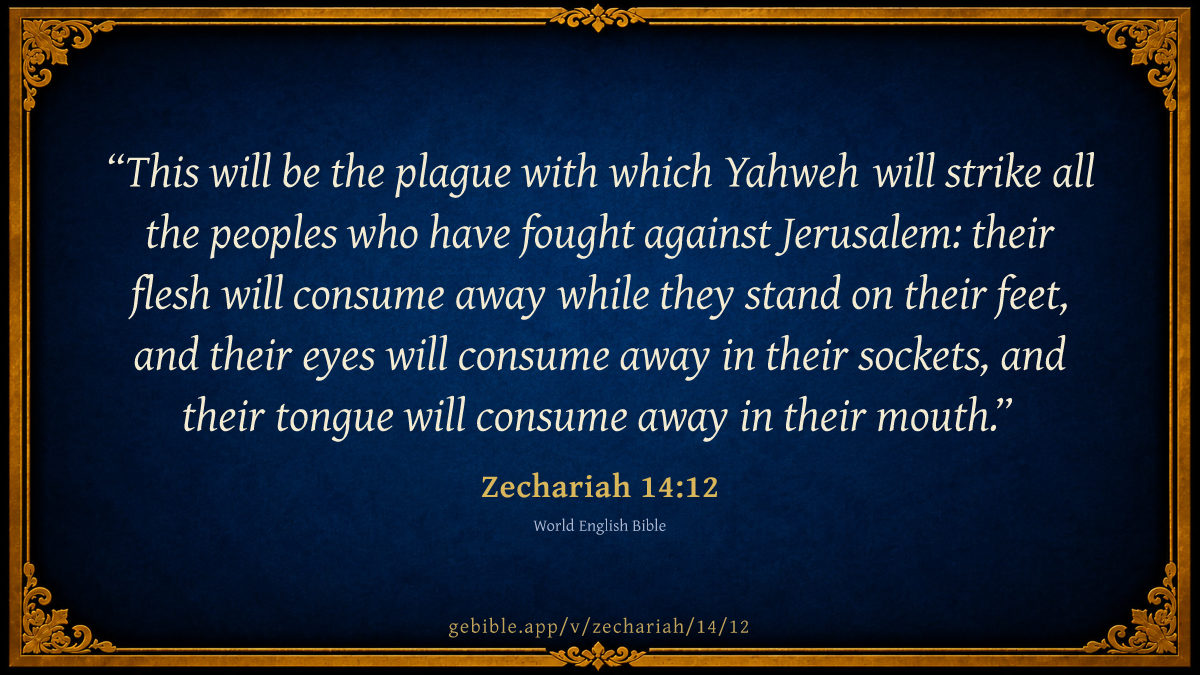
This will be the plague with which Yahweh will strike all the peoples who have fought against Jerusalem: their flesh will consume away while they stand on their feet, and their eyes will consume away in their sockets, and their tongue will consume away in their mouth.
Parallel Translations
-
This will be the plague with which Yahweh will strike all the peoples who have fought against Jerusalem: their flesh will consume away while they stand on their feet, and their eyes will consume away in their sockets, and their tongue will consume away in their mouth.
-
And this shall be the plague wherewith the LORD will smite all the people that have fought against Jerusalem; Their flesh shall consume away while they stand upon their feet, and their eyes shall consume away in their holes, and their tongue shall consume away in their mouth.
-
And this shall be the plague wherewith the LORD will smite all the peoples that have warred against Jerusalem: their flesh shall consume away while they stand upon their feet, and their eyes shall consume away in their sockets, and their tongue shall consume away in their mouth.
Cross-references (28)
Passages linked to Zechariah 14:12 in the Treasury of Scripture Knowledge, ordered by reader-vote popularity; verse text shown in World English Bible.
- Ezekiel 39:17-20 “You, son of man, the Lord Yahweh says: ‘Speak to the birds of every sort, and to every animal of the field, “Assemble yourselves, and come; gather yourselves on every side to my sacrifice that I sacrifice for you, even a great sacrifice on the mountains of Israel, that you may eat meat and drink blood. You shall eat the flesh of the mighty, and drink the blood of the princes of the earth, of rams, of lambs, and of goats, of bulls, all of them fatlings of Bashan. You shall eat fat until you are full, and drink blood until you are drunk, of my sacrifice which I have sacrificed for you. You shall be filled at my table with horses and chariots, with mighty men, and with all men of war,” says the Lord Yahweh.’
- Isaiah 66:15-16 For, behold, Yahweh will come with fire, and his chariots will be like the whirlwind; to render his anger with fierceness, and his rebuke with flames of fire. For Yahweh will execute judgment by fire and by his sword on all flesh; and those slain by Yahweh will be many.
- Micah 4:11-13 Now many nations have assembled against you, that say, “Let her be defiled, and let our eye gloat over Zion.” But they don’t know the thoughts of Yahweh, neither do they understand his counsel; for he has gathered them like the sheaves to the threshing floor. Arise and thresh, daughter of Zion; for I will make your horn iron, and I will make your hoofs bronze; and you will beat in pieces many peoples: and I will devote their gain to Yahweh, and their substance to the Lord of the whole earth.
- Psalms 90:11 Who knows the power of your anger, your wrath according to the fear that is due to you?
- Psalms 110:5-6 The Lord is at your right hand. He will crush kings in the day of his wrath. He will judge among the nations. He will heap up dead bodies. He will crush the ruler of the whole earth.
- Ezekiel 38:18-22 It will happen in that day, when Gog comes against the land of Israel,” says the Lord Yahweh, “that my wrath will come up into my nostrils. For in my jealousy and in the fire of my wrath I have spoken. Surely in that day there will be a great shaking in the land of Israel; so that the fish of the sea, the birds of the sky, the animals of the field, all creeping things who creep on the earth, and all the men who are on the surface of the earth will shake at my presence. Then the mountains will be thrown down, the steep places will fall, and every wall will fall to the ground. I will call for a sword against him to all my mountains,” says the Lord Yahweh. “Every man’s sword will be against his brother. I will enter into judgment with him with pestilence and with blood. I will rain on him, and on his hordes, and on the many peoples who are with him, an overflowing shower, with great hailstones, fire, and sulfur.
- Micah 7:16-17 The nations will see and be ashamed of all their might. They will lay their hand on their mouth. Their ears will be deaf. They will lick the dust like a serpent. Like crawling things of the earth they shall come trembling out of their dens. They will come with fear to Yahweh our God, and will be afraid because of you.
- Zechariah 12:9 It will happen in that day, that I will seek to destroy all the nations that come against Jerusalem.
- Leviticus 26:16 I also will do this to you: I will appoint terror over you, even consumption and fever, that shall consume the eyes, and make the soul to pine away. You will sow your seed in vain, for your enemies will eat it.
- Leviticus 26:21 “ ‘If you walk contrary to me, and won’t listen to me, then I will bring seven times more plagues on you according to your sins.
- Leviticus 26:24 then I will also walk contrary to you; and I will strike you, even I, seven times for your sins.
- Leviticus 26:28 then I will walk contrary to you in wrath. I will also chastise you seven times for your sins.
- Deuteronomy 28:22 Yahweh will strike you with consumption, with fever, with inflammation, with fiery heat, with the sword, with blight, and with mildew. They will pursue you until you perish.
- Deuteronomy 28:59 then Yahweh will make your plagues and the plagues of your offspring fearful, even great plagues, and of long duration, and severe sicknesses, and of long duration.
- 2 Chronicles 21:15 and you will have great sickness with a disease of your bowels, until your bowels fall out by reason of the sickness, day by day.’ ”
- 2 Chronicles 21:18-19 After all this Yahweh struck him in his bowels with an incurable disease. In process of time, at the end of two years, his bowels fell out by reason of his sickness, and he died of severe diseases. His people made no burning for him, like the burning of his fathers.
- Isaiah 34:1-17 Come near, you nations, to hear! Listen, you peoples. Let the earth and all it contains hear, the world, and everything that comes from it. For Yahweh is enraged against all the nations, and angry with all their armies. He has utterly destroyed them. He has given them over for slaughter. Their slain will also be cast out, and the stench of their dead bodies will come up. The mountains will melt in their blood. All of the army of the sky will be dissolved. The sky will be rolled up like a scroll, and all its armies will fade away, as a leaf fades from off a vine or a fig tree. For my sword has drunk its fill in the sky. Behold, it will come down on Edom, and on the people of my curse, for judgment. Yahweh’s sword is filled with blood. It is covered with fat, with the blood of lambs and goats, with the fat of the kidneys of rams; for Yahweh has a sacrifice in Bozrah, And a great slaughter in the land of Edom. The wild oxen will come down with them, and the young bulls with the mighty bulls; and their land will be drunken with blood, and their dust made greasy with fat. For Yahweh has a day of vengeance, a year of recompense for the cause of Zion. Its streams will be turned into pitch, its dust into sulfur, And its land will become burning pitch. It won’t be quenched night nor day. Its smoke will go up forever. From generation to generation, it will lie waste. No one will pass through it forever and ever. But the pelican and the porcupine will possess it. The owl and the raven will dwell in it. He will stretch the line of confusion over it, and the plumb line of emptiness. They shall call its nobles to the kingdom, but none shall be there; and all its princes shall be nothing. Thorns will come up in its palaces, nettles and thistles in its fortresses; and it will be a habitation of jackals, a court for ostriches. The wild animals of the desert will meet with the wolves, and the wild goat will cry to his fellow. Yes, the night creature shall settle there, and shall find herself a place of rest. The arrow snake will make her nest there, and lay, hatch, and gather under her shade. Yes, the kites will be gathered there, every one with her mate. Search in the book of Yahweh, and read: not one of these will be missing. None will lack her mate. For my mouth has commanded, and his Spirit has gathered them. He has cast the lot for them, and his hand has divided it to them with a measuring line. They shall possess it forever. From generation to generation they will dwell in it.
- Ezekiel 39:4-6 You will fall on the mountains of Israel, you, and all your hordes, and the peoples who are with you. I will give you to the ravenous birds of every sort, and to the animals of the field to be devoured. You will fall on the open field; for I have spoken it,” says the Lord Yahweh. “I will send a fire on Magog, and on those who dwell securely in the islands. Then they will know that I am Yahweh.
- Zechariah 14:3 Then Yahweh will go out and fight against those nations, as when he fought in the day of battle.
- Revelation 9:5-6 They were given power, not to kill them, but to torment them for five months. Their torment was like the torment of a scorpion when it strikes a person. In those days people will seek death, and will in no way find it. They will desire to die, and death will flee from them.
- Leviticus 26:18 “ ‘If you in spite of these things will not listen to me, then I will chastise you seven times more for your sins.
- Joel 3:1-2 “For, behold, in those days, and in that time, when I restore the fortunes of Judah and Jerusalem, I will gather all nations, and will bring them down into the valley of Jehoshaphat; and I will execute judgment on them there for my people, and for my heritage, Israel, whom they have scattered among the nations. They have divided my land,
- Micah 5:8-9 The remnant of Jacob will be among the nations, among many peoples, like a lion among the animals of the forest, like a young lion among the flocks of sheep; who, if he goes through, treads down and tears in pieces, and there is no one to deliver. Let your hand be lifted up above your adversaries, and let all of your enemies be cut off.
- Acts 12:23 Immediately an angel of the Lord struck him, because he didn’t give God the glory. Then he was eaten by worms and died.
- Revelation 16:1-21 I heard a loud voice out of the temple, saying to the seven angels, “Go and pour out the seven bowls of the wrath of God on the earth!” The first went, and poured out his bowl into the earth, and it became a harmful and evil sore on the people who had the mark of the beast, and who worshiped his image. The second angel poured out his bowl into the sea, and it became blood as of a dead man. Every living thing in the sea died. The third poured out his bowl into the rivers and springs of water, and they became blood. I heard the angel of the waters saying, “You are righteous, who are and who were, O Holy One, because you have judged these things. For they poured out the blood of saints and prophets, and you have given them blood to drink. They deserve this.” I heard the altar saying, “Yes, Lord God, the Almighty, true and righteous are your judgments.” The fourth poured out his bowl on the sun, and it was given to him to scorch men with fire. People were scorched with great heat, and people blasphemed the name of God who has the power over these plagues. They didn’t repent and give him glory. The fifth poured out his bowl on the throne of the beast, and his kingdom was darkened. They gnawed their tongues because of the pain, and they blasphemed the God of heaven because of their pains and their sores. They didn’t repent of their works. The sixth poured out his bowl on the great river, the Euphrates. Its water was dried up, that the way might be prepared for the kings that come from the sunrise. I saw coming out of the mouth of the dragon, and out of the mouth of the beast, and out of the mouth of the false prophet, three unclean spirits, something like frogs; for they are spirits of demons, performing signs; which go out to the kings of the whole inhabited earth, to gather them together for the war of that great day of God, the Almighty. “Behold, I come like a thief. Blessed is he who watches, and keeps his clothes, so that he doesn’t walk naked, and they see his shame.” He gathered them together into the place which is called in Hebrew, “Megiddo”. The seventh poured out his bowl into the air. A loud voice came out of the temple of heaven, from the throne, saying, “It is done!” There were lightnings, sounds, and thunders; and there was a great earthquake, such as has not happened since there were men on the earth, so great an earthquake, and so mighty. The great city was divided into three parts, and the cities of the nations fell. Babylon the great was remembered in the sight of God, to give to her the cup of the wine of the fierceness of his wrath. Every island fled away, and the mountains were not found. Great hailstones, about the weight of a talent, came down out of the sky on people. People blasphemed God because of the plague of the hail, for this plague is exceedingly severe.
- Revelation 17:16 The ten horns which you saw, and the beast, these will hate the prostitute, will make her desolate, will strip her naked, will eat her flesh, and will burn her utterly with fire.
- Revelation 18:6-8 Return to her just as she returned, and repay her double as she did, and according to her works. In the cup which she mixed, mix to her double. However much she glorified herself, and grew wanton, so much give her of torment and mourning. For she says in her heart, ‘I sit a queen, and am no widow, and will in no way see mourning.’ Therefore in one day her plagues will come: death, mourning, and famine; and she will be utterly burned with fire; for the Lord God who has judged her is strong.
- Revelation 19:17-21 I saw an angel standing in the sun. He cried with a loud voice, saying to all the birds that fly in the sky, “Come! Be gathered together to the great supper of God, that you may eat the flesh of kings, the flesh of captains, the flesh of mighty men, and the flesh of horses and of those who sit on them, and the flesh of all men, both free and slave, small and great.” I saw the beast, and the kings of the earth, and their armies, gathered together to make war against him who sat on the horse, and against his army. The beast was taken, and with him the false prophet who worked the signs in his sight, with which he deceived those who had received the mark of the beast and those who worshiped his image. These two were thrown alive into the lake of fire that burns with sulfur. The rest were killed with the sword of him who sat on the horse, the sword which came out of his mouth. All the birds were filled with their flesh.
Cross-references from openbible.info (CC BY 4.0)
Explain this verse (17 sources)
Historical commentary, presented as a primary source — not an endorsement.
Private notes
Saved on this device only — never synced or sent anywhere.
John Calvin 1540 · Public Domain The Prophet adds, that though there would not be…
The Prophet adds, that though there would not be wanting many ungodly men, who should distress the Church, and attempt many things for its destruction, yet God would be a defender and would inflict punishment, which would exhibit a clear and decided proof of that paternal favor which he manifests towards his Church. But these things do not seem to harmonise — that the people should dwell safely at Jerusalem, and yet that there would be enemies violently disturbing the city: but by saying, that they should dwell safely, he means not that there would be none anxious to do them harm; but that trusting in God’s protection they would continue safe in the greatest dangers, as they would feel persuaded that God, who promised to stand on their side, would be stronger than all. The habitation of the godly would then be secure, not because they dreaded no attacks of enemies, but because they firmly believed that they would be preserved by a power from above, though the devil excited many people on all sides against them, and also prepared and suborned many wicked men to contrive their ruin.
And to this power it behaves us to raise up our thoughts when various enemies rage against us, so that we may dwell in safety and wait with quiet minds until God shall deliver us; for our safety is concealed under the faithful protection of God, which is only made known to us by the word and promises. Let us, however, bear in mind what the Prophet teaches us here — that when God gives loose reins to enemies, his vengeance is near, so that he will visit with punishment all those wrongs and injuries which we patiently endure.
Read full note →
This, he says, shall be the plague with which Jehovah shall smite all people. He mentions all people again, lest a multitude of enemies should terrify the faithful, when they found themselves unequal to them, and almost overwhelmed by their vast number; they were not to doubt but that the hand of God would prevail. Then he adds, His flesh shall consume away, or melt away: there is a change of number, but the sense is not obscured; for he says, This shall be the plague with which Jehovah shall smite all people; his flesh shall melt away, as though he was speaking of one man; and then he immediately adds, while he shall stand on his feet; and his eyes shall melt away, and his tongue in their mouth We see how the Prophet changes the number three times; but there is in the subject itself nothing ambiguous. He means that it would be nothing to God, when resolved to punish the adversaries of his Church, whether they were many or few; for he can easily destroy them all, as though he had to do only with one man. But it seems also that Zechariah had another thing in view — that as God’s vengeance would regard each individual, no one of them would be safe, and that thus the vengeance of God would be universal, without any exception, and executed on all armies and on each individual.
We must now notice the kind of punishment which is here described — that God would destroy them all without the hand or the aid of men: his flesh, he says, shall melt away, or dissolve. In this case divine vengeance is more clearly seen, that is, then enemies, though no one fights with them, yet of themselves consume away: and then he adds, when they shall stand on their feet; and yet their flesh shall melt away. The Prophet no doubt alludes to the curses of the law, among which this is especially to be observed — that God in various ways consumes the wicked, so that they melt away when no cause appears. (Deuteronomy 28:21,22.)
The meaning then is, that God has various means by which he can reduce to nothing our enemies, though they may seek aid on every side. We are therefore taught by these words to cast all our cares on God; for when our enemies seem to be placed beyond the chance of danger, and confidently boast that nothing adverse can happen to them, yet in God’s hand is their death and life, so that they can be consumed by his breath only. There is then no reason for us to depend on earthly means, when we seek to be certain respecting the destruction of our enemies; for God can inwardly consume them; though they may seem to stand whole and sound, yet they will be dissolved, so that even their eyes shall melt away in their cavities, that is, they shall fail without any external force. We indeed know that eyes are well protected; being covered with their defences, they seem to be beyond the reach of harm. But the Prophet intimates that the hidden vengeance of God can penetrate into the bowels and marrow; in short, that there is nothing so safe that it can escape the vengeance of God. The tongue also, he says, shall melt away, or dissolve (it is the same verb) in their mouth. He afterwards adds —
John Calvin's Commentaries (1540-1563) — public domain. Text from the Calvin Translation Society English edition (1840s-50s) via the Christian Classics Ethereal Library (ccel.org). Calvin's coverage is partial (roughly two-thirds of the Bible); uncommented books and verses are honest gaps, never fabricated. The 19th-century editor's footnotes and remarks are omitted so the notes are faithfully Calvin's own voice.
John Trapp 1656 · Public Domain Zec 14:12 And this shall be the plague wherewith…
Zec 14:12 And this shall be the plague wherewith the LORD will smite all the people that have fought against Jerusalem; Their flesh shall consume away while they stand upon their feet, and their eyes shall consume away in their holes, and their tongue shall consume away in their mouth.
Ver. 12. And this shall be the plague wherewith the Lord will smite, &c.] The precedent promises that were so great and glorious, the prophet doth now further enlarge and illustrate in the following verses; and, first, the conquest of the enemies, Zec 14:12-15; next, the profession of Christ among all nations of the world, Zec 14:16-19; and lastly, the sanctity of the Church, Zec 14:20-21. The conquest of the enemies is set forth, first, by God’s strange judgments upon them, Zec 14:12; secondly, by the means, both they shall despatch one another; and Judah shall fight bravely against them, Zec 14:13-14; thirdly, their wealth and substance shall become a prey, Zec 14:14; fourthly, their horses of service, and all the beasts they bring with them, shall be as strangely plagued as the men themselves, Zec 14:15.
Read full note →
That have fought against Jerusalem] God will go forth and fight against them, Zec 14:3, so that they shall wish they had never meddled. Haec erit plaga qua plagabit. God hath a mighty hand, Jas 4:9, and it is a fearful thing to fall into it, Heb 10:31, for who knoweth the power of his wrath? Psa 90:11. One stroke of this hard and heavy hand broke the angels’ backs, and cast them into chains of darkness, to be reserved unto judgment, 2Pe 2:4. Job felt but his little finger, as it were, and yet cries out for help. "Have pity upon me, have pity upon me, O ye my friends; for the hand of God hath touched me," Job 19:21. It had but lightly touched him, and yet he was hardly able to endure it. Oh the bloody welts that God’s hand hath left upon the backs of his best children! Woe, then, to his enemies when he comes forth to fight against them.
Their flesh shall consume away while they stand upon their feet] They shall pine away in their iniquities, Lev 26:30; their beauty shall consume away like a moth, Psa 39:11; they shall melt as wax before the sun, or as the fat of lambs before the fire. God, if he be not unto them as a lion to tear the caul of their hearts in sunder, yet he will be as a moth, and as a worm, insensibly to consume them, Hos 5:12; Hos 5:14. If he break not their teeth in their mouths, by smiting them upon the cheekbone, yet he will make them to melt away as waters which run continually; as a snail which melteth, and as the untimely birth of a woman that never seeth the sun, Psa 58:6-8. God hath secret ways to waste his enemies, and to bring them on their knees when they are best underset. He can trip up their heels when they are standing upon their feet, and lay them low enough in the slimy valley where are many already like them, and more shall come after them, Job 21:31-32. God hath a Marasmus, an evil messenger for a malicious persecutor; as he had for Antiochus Epiphanes, 1Ma 6:8-13; for both the Herods; for Maximiuus, the tyrant; for Philip II of Spain, Charles IX of France, Queen Mary of England, Stephen Gardiner, Archbishop Arundel, Nestorius, Arius, and other odious heretics and enemies of the Church; among whom a Lapide, the Jesuit, reckons here Calvin, and saith, That like another Herod, he died a lousy loathsome death; and for his authority thinks it enough to say, uti refert Bolsecus in eius Vita. as Bolsecus reports in his history. But it must be understood that the lives of Calvin and Beza were spitefully written by this Bolsecus, their sworn enemy, that twice banished and thrice renegade friar (liar I might have said) and physician; for those names his often changes and hard chances have given him. This man, being requested by the Popish side, and it is likely hired by them, to write thus, is in all their writings alleged as canonical.
And their eyes shall consume away in their holes] Physicians tell us of 2000 diseases that annoy man’s body, 200 whereof affect the eyes. All these are part of God’s hosts, which are as much at God’s command as the centurion’s servants and soldiers were at his, when he said but Go, or Come, and they did accordingly, Mat 8:9. He can make men’s eyes drop and cease not, without any intermission, as Lam 3:49, till they melt out, as the Hebrew here hath it; even the very same word as before. He can smite men with sudden blindness (as he did the sinful Sodomites, that had eyes full of adultery), such as tormented their eyes, as if they had been pricked with thorns, as the Hebrew word signifieth, Gen 19:11. Failing of eyes and sorrow of mind is threatened as a judgment, Deu 28:65; yea, thou shalt be mad for the sight of thine eyes, which thou shalt see in another piece of the curse, Deu 28:34. See 1Sa 2:33.
And their tongue shall consume away in their mouth] As did the tongue of Nestorius, the heresiarch, eaten out of his mouth with worms. Tho. Arundel and Stephen Gardiner, two bloody persecutors, died of a like disease. Diodati understands all this to be a description of hell torments. Their flesh shall consume, yet never be consumed; for they still stand upon their feet, or subsist, that they may still suffer; having no end, that their pain may be endless. "Their eyes shall consume," that is, saith he, though they be alive and can see, yet shall they be deprived of light in infernal darkness; having neither eyes nor understanding, but only to see and judge of their extreme misery. "Their tongue shall consume away," &c., as did the rich glutton’s, Luk 16:24. Mr Calvin observeth here, that all is delivered in the singular number: his flesh shall consume; his eyes shall melt; his tongue, &c. (for so runs the original); to note that every one of Jerusalem’s enemies shall taste of God’s wrath, though some of them may haply hold themselves out of the reach of his rod. And, secondly, that God can as easily destroy them all as if he had to do but with one single man.
John Trapp, A Commentary or Exposition upon All the Books of the Old and New Testament (1647–1656) — public domain. Text from a community e-Sword module.
Matthew Poole 1685 · Public Domain That have fought against; maliciously to destroy, and waste,…
That have fought against; maliciously to destroy, and waste, and extirpate Jerusalem; the ringleaders, especially such as Antiochus, Herod, &c.
Their flesh shall consume away; when they are fat, fleshy, and strong, their flesh or strength shall utterly perish.
Read full note →
While they stand on their feet; either in arms ready to fight, or so suddenly they shall not have time to sit down; a very sudden death is threatened to them.
Their eyes shall consume away in their holes; a dreadful and exemplary blindness shall seize them.
Their tongue shall consume away in their mouth; in which member, by strange judgments on them, some persecutors also have felt God’s hand.
Matthew Poole's English Annotations on the Holy Bible (1683–1685) — public domain. Text from a community e-Sword/MySword module.
John Gill 1763 · Public Domain And this shall be the plagues,.... This respects one…
And this shall be the plagues,.... This respects one or more, or all, of the seven plagues, which will be inflicted on the antichristian states, mentioned in Rev 15:1,
wherewith the Lord will smite all the people that have fought against Jerusalem; who have been the enemies and persecutors of his church; and with which plague or plagues they shall be utterly consumed and destroyed:
Read full note →
their flesh shall consume away while they stand upon their feet; antichrist will be consumed with the breath of Christ's mouth; the flesh of the whore of Rome, which is her substance, shall be eaten and devoured by the kings of the earth; and her destruction will be in a moment, suddenly, and at unawares, as is here suggested; see Th2 2:8,
and their eyes shall consume away in their holes; the right eye of the idol shepherd shall be utterly dried up, and the kingdom of the beast will be full of darkness, Zac 11:17,
and their tongues shall consume away in their mouth; with which antichrist and his followers have blasphemed the name of God, his tabernacle, and his saints; and which they will gnaw for pain, when the plagues of God are inflicted on them, Rev 13:5.
John Gill's Exposition of the Whole Bible (1746–1763) — public domain (CC PDM 1.0). Text via the HelloAO Bible API.
Adam Clarke 1810 · Public Domain Verse 12. And this shall be the plague] All…
Verse 12. And this shall be the plague] All her enemies shall be destroyed.
Their flesh shall consume away] These are the effects of famine which are described in this verse.
Adam Clarke's Commentary on the Bible (1810–1826) — public domain. Text from a community e-Sword/MySword module.
Joseph Benson 1811 · Public Domain Zec 14:12-13. And this shall be the plague, &c.…
Zec 14:12-13. And this shall be the plague, &c. — Those that do not die in battle, nor fall by the hand of their brethren, shall be destroyed by famine, or consumption. Their flesh shall consume away while they stand upon their feet — They shall be miserably emaciated, even while they stand in arms ready to fight; or so suddenly, that they shall hardly have time to lie or sit down. And their eyes shall consume away in their holes — A dreadful and exemplary blindness shall seize them. A great tumult — That is, confusion; from the Lord — Hebrew, of the Lord, that is, one caused or permitted by him; shall be among them — Shall take place and prevail, as a punishment of their hostility to God’s church. Those that are confederated and combined against God and his people, will be justly separated, and set against one another; and their tumults raised against God will be avenged in tumult among themselves. And they shall lay hold every one on the hand of his neighbour — That is, they shall seek help from one another, but instead of helping they shall turn their arms against one another. And his hand shall rise up, &c. — The sum of the verse is, that intestine divisions and hostilities shall be added to the foregoing divine judgments.
Joseph Benson's Commentary on the Old and New Testaments (1811–1818) — public domain. Text from a community e-Sword module.
Albert Barnes 1834 · Public Domain Again, upon the restoration of His people follows the…
Again, upon the restoration of His people follows the destruction of His enemies. It shall, first and chiefly, be God’s doing, not man’s. “This shall be the plague.” The word is used of direct infliction by pestilence, “wherewith the Lord shall smite all the people (peoples) that fought against Jerusalem.” The awful description is of living corpses. Lap.: “The enemies of Jerusalem shall waste, not with fever or disease, but by a plague from God, so that, being sound, standing, living, in well-being, they should waste and consume away,” as Isaiah speaks of the “carcasses of the men, that have transgressed against Me; for their worm shall not die - and they shall be an abhorring unto all flesh” Isa 66:24.
Their flesh shall consume away - Rather, “wasting away the flesh of each one.” It is the act of God, in His individual justice to each one of all those multitudes gathered against Him. One by one, “their eyes,” of which they said, “let our eye look on Zion” Mic 4:11, that is, with joy at its desolation, “shall consume away in their holes, and their tongue,” wherewith they blasphemed God, “shall consume away in their mouths” (compare Psa 12:3; Isa 36:15, Isa 36:18; Isa 37:3-4, Isa 37:17, Isa 37:23, Isa 37:29). Appalling, horrible, picture! “standing on their feet,” yet their flesh mouldering away as in a grave-yard, their sightless balls decaying in their holes, the tongue putrefying in their mouth, a disgust to themselves and to others! Yet what, compared to the horrible inward decay of sin, whereby men “have a name that they live and are dead?” Rev 3:1. Jerome: “Let us read Ecclesiastical histories, what Valerian, Decius, Diocletian, Maximian, what the savagest of all, Maximin, and lately Julian suffered, and then we shall prove by deeds, that the truth of prophecy was fulfilled in the letter also.”
Albert Barnes' Notes on the Bible (1834–1885) — public domain. Text from a community e-Sword/MySword module.
Haydock's Catholic Bible Commentary 1859 · Public Domain Consume. Such judgments as these have often fallen upon…
Consume. Such judgments as these have often fallen upon the persecutors of God’s Church, as appears by many instances in history. (Challoner) --- This has partly been verified in persecuting emperors, (St. Jerome) and in others, and will befall the wicked when the day of judgment shall draw near. (Worthington) --- Herod, who made war on Christ, and Agrippa, who attacked his Church, (Calmet) were both devoured by worms. (Josephus, Antiquities xvii. 9., and xix. 7.) (Acts xii. 13.) --- Nero slew himself; Maximian was eaten to death by an inward ulcer; and his colleague’s (Maximinus) eyes fell from his head. (Eusebius in Constantine i. 57., and 59.) --- It would seem as if Zacharias beheld them. He may also speak of the attempts of God, and of Epiphanes, chap. ii. 8., and xii. 9.
George Leo Haydock (1774–1849), Haydock's Catholic Family Bible and Commentary, 1859 edition — public domain. Excludes Psalms (Douay-Rheims chapter numbering differs from Protestant) and Deuterocanonical books (Catholic canon only).
Robert Jamieson, A. R. Fausset & David Brown 1871 · Public Domain Punishment on the foe, the last Antichristian confederacy (Isa…
Punishment on the foe, the last Antichristian confederacy (Isa 59:18; Isa 66:24; Eze. 38:1-39:29; Rev 19:17-21). A living death: the corruption (Gal 6:8) of death combined in ghastly union with the conscious sensibility of life. Sin will be felt by the sinner in all its loathsomeness, inseparably clinging to him as a festering, putrid body.
Jamieson, Fausset & Brown — Commentary Critical and Explanatory on the Whole Bible (1871) — public domain (CC PDM 1.0). Text via the HelloAO Bible API.
Daniel D. Whedon 1874 · Public Domain Destruction of the hostile nations, 12-15.
Destruction of the hostile nations, 12-15.
While Jerusalem and the Jews will be exalted and glorified, Jehovah will utterly destroy all the nations that have dared to lift their hands against the holy city. Some will be destroyed by pestilence (Zec_14:12; Zec_14:15), some will be slain in the confusion that is produced among the hostile armies at the blows of Jehovah (Zec_14:13), some will be cut off by the inhabitants of Judah, who then will be enriched by the spoil. Zec_14:15 forms the natural continuation of Zec_14:12; therefore several recent commentators consider Zec_14:13-14 a later insertion. If they are original, a more logical order would be Zec_14:12; Zec_14:15; Zec_14:13-14. A disastrous pestilence strikes the camp (Zec_14:12; Zec_14:15), which produces panic and confusion (Zec_14:13); when this is seen by the Jews they rush against the enemies, cut them down, and take to themselves their possessions (Zec_14:14).
Read full note →
12. Plague — Or, pestilence. A word always used of a plague or punishment sent directly by Jehovah. The nature of the disease is described in the rest of the verse.
Fought against Jerusalem — See on Zec_14:1-2.
Their flesh shall consume away — Literally (G.-K., 113y), he (Jehovah) will cause their flesh to rot.
While they stand upon their feet — While they are still alive. To show further the terribleness of the plague the destruction of the eyes and tongue, important members of the human body, is specified. The prophet probably did not intend these expressions to be pressed too literally. He makes the description so vivid simply to indicate the awfulness of the calamity, whatever might be its exact character.
Daniel D. Whedon (gen. ed.), Commentary on the Old and New Testaments (1874–1909) — public domain. Text from a community e-Sword module.
The Cambridge Bible for Schools and Colleges 1878 · Public Domain 12. the people] Lit. peoples, as R. V., i.e.…
12. the people] Lit. peoples, as R. V., i.e. nations.
their flesh] Lit. his flesh, i.e. the flesh of each one of them; and so, his eyes, his tongue; though, to show that the plague is at once individual and universal, it is at the end of the verse, “in their mouth”.
Read full note →
while they stand upon their feet] Lit. and he standing upon his feet. The plague comes upon them in a moment, as they stand in serried ranks before the holy city. “Appalling, horrible picture! standing on their feet, yet their flesh mouldering away, as in a graveyard, their sightless balls decaying in their holes, the tongue putrefying in their mouth, a disgust to themselves and to others.” Pusey.
holes] sockets, R. V.
12–15. The Destruction of Hostile Nations
The deliverance and prosperity of Jerusalem shall be accomplished by a terrible plague sent upon those who fought against her, Zec_14:12; and by a panic which shall cause them to slay one another, Zec_14:13, and also by the courage and prowess of Judah. The wealth of their enemies shall be the spoil of the Jews, Zec_14:14; while the consuming pestilence shall extend to all the cattle in the hostile camp, Zec_14:15.
The Cambridge Bible for Schools and Colleges (gen. ed. J. J. S. Perowne; Cambridge University Press, 1878–1918) — public domain. Text from a community e-Sword module.
Ellicott's Commentary for English Readers 1878 · Public Domain (12, 13) In the description of the plague, and…
(12, 13) In the description of the plague, and confusion, and rout with which the hostile nations are to be smitten, the prophet had in mind several historical events: e.g., Exo_9:14; Psa_37:36; 1Sa_5:9; 1Sa_14:20; Isa_22:5.
A Bible Commentary for English Readers, edited by Charles John Ellicott (1878–1897) — public domain. Text from a community e-Sword module.
The Pulpit Commentary 1880 · Public Domain Vers. 12-15. Having noted the blessings on the true…
Vers. 12-15. Having noted the blessings on the true Israelites, the prophet gives further details concerning the destruction of the enemies: they shall perish by plague, by mutual slaughter, by the sword of Judah .
This shall be the plague. These are the instruments which the Lord uses when he fights against the nations (not the people, as in the Authorized Version), ver. 3. The plague, or smiting (maggephah), is some contagions affliction sent by God, as in Exo_9:14 Num_14:37 1Sa_6:4. Their. It is, in the Hebrew, "his flesh, his feet," etc., to show that the general plague extends to every individual. In the last clause the plural is used, "their mouth." With body, eye, and tongue they opposed the holy city, and took pleasure in its discomfiture: in all their members they shall suffer retributive punishment. While they stand upon their feet. The flesh of each shall putrefy and moulder away, while he is still alive and arrayed against the city of God. Holes; soakers. The eyes had spied out the weak places in the defence, and looked with malicious pleasure on the defeat and fall. Tongue. They had blasphemed God, and cried against his holy place, "Down with it, even to the ground!
Read full note →
Vers. 12-21. A regenerate world.
"And this shall be the plague wherewith the Lord will smite all the people that have fought against Jerusalem," etc. A regenerate man is not a man without disposition to sin, but a man in whose case that disposition is habitually overcome. In that regenerate world partially described in the previous verses, something very similar is to hold good. All the elements of evil are not then altogether to cease; but there shall be in operation then a new principle of action, which shall prevent them from raising their heads. How exceedingly different a condition of things the full establishment of such a rule will result in seems to be taught us, in these concluding verses, in three different ways; viz. in regard
(1) to those who shall hate Jerusalem;
(2) to these who shall despise it; and
(3) to those who shall inhabit it, in those days.
I THOSE WHO HATE IT. For such persons there will be, even at that time, as at all previous times, in existence. There will even be some in existence at any rate, at the very beginning of "that day who shall be bold enough to declare war against it. How will it be with such then? Not at all as it is with them now, when they seem so often and so mysteriously to have the "upper hand" (Psa_9:19, Prayer book Version) against God. On the contrary, partly
(1) by judgments within them, their very bodily organs, as it were, visibly withering away under God"s displeasure; partly
(2) by judgments among them, causing them, as in a kind of frenzy, to lay violent hands on one another; partly
(3) by judgments upon them, which shall turn their very endeavours to injure "Jerusalem" into means for enriching it; and partly
(4) by judgments around them, represented as coming even on the poor brutes they employ for their sakes; God will testify openly what are his feelings and purposes with regard to such doings. In such circumstances, if evil be sometimes desired, it will very seldom be deliberately attempted, and never achieved. How total a contrast, in every respect, to that which we read of in Ecc_8:11!
II THOSE WHO DESPISE IT. Besides that hostility which is open and active, there is that which is passive and half-concealed. Some men do not so much oppose religion as ignore its injunctions. Men disposed to act thus will not be lacking, even in that glorious "day." This illustrated here by a reference to that well known ancient "Feast of Tabernacles," in which the settled Israelites commemorated the fact of their having been wanderers once in the wilderness. (Lev_23:41-43) Something so far corresponding to this, at any rate, as to be fitly described by the same appellation, will be of universal obligation in the final settlement of that great sabbatical "day". (comp. Heb_4:1-9) How will things be with those who despise it and neglect to "come up" (ver. 17)? Not as now; (see Mat_5:45) but rather as it was in those days when Goshen was distinguished for Israel"s sake, as by a special command from Heaven, from all the rest of the land. Every such contemptuous nation or "family," whatever the peculiarity of their circumstances and ordinary climate, shall be made to feel then the open displeasure of him who commandeth the clouds. How widely different in those days the language of Heaven! How widely different the conduct, may we not expect, therefore, of the most callous of men!
III THOSE WHO INHABIT IT. These men shall find Jerusalem then "the holy city" indeed. Speaking here of the future, in language drawn from the usages of his own time; or possibly, as some have supposed, speaking so because there will be a certain measure of return to those usages in the future; there are three great changes which the prophet bids us expect in the "Jerusalem" of" that day." Its inhabitants will see:
1. The previously common" become holy." The very bells of the horses being outwardly marked for God"s service, like the high priest"s mitre was in ancient times. (Exo_28:36-38; see also Isa_23:17, Isa_23:18)
2. The previously holy made holier still, The ordinary temple "pits," only used of old days for "dressing the victims" (Pusey), being now regarded as like the sacrificial "bowls before the altar," containing the atoning blood itself; and even those vessels outside the "house," which were only so far holy before that they were found in "Jerusalem" (the holy city), or belonged to "Judah" (the holy people), shall now be regarded as tilt for employment in the temple worship itself.
3. The irreclaimably profane forever shut out. "The Canaanite," i.e., as representing those who, though not truly the children of promise, yet "would live" amongst them (Jud 1:35) through all the ages, being never seen there again. (comp. Isa_35:8 Joe_3:17; Ephesians Rev_21:27 Rev_22:15) "Not yet! not yet! The faultless flock, The field without a tare, Come last of all the blessing sought By centuries of prayer!
How fitting a close of the whole is this thought! How rightly does this chief prophet of the post-Captivity Jerusalem tell us thus, in conclusion, of that far more glorious Jerusalem which is some day to shine forth! It is much the same that the Prophet Daniel does at the end of his prophecy. It is the same also that "St. John the divine" does at the end of his song. They bring their message to an end when they have given us a glimpse of the end which God has in store. It is for us to take care that we are truly numbered with those for whom that "end" is prepared.
The Pulpit Commentary (1880–1919), ed. H.D.M. Spence-Jones & Joseph S. Exell — public domain. Text from a community e-Sword module.
The Biblical Illustrator 1887 · Public Domain And this shall be the plague
Zec_14:12-14
And this shall be the plague
Read full note →
The punishment of Gods enemies
This is a figurative description of the punishment of sin.
The first element of the punishment is corruption, which is set forth by the terrible image of a living death, a fearful anomalous state, in which the mouldy rottenness of death is combined in horrible union with the vivid, conscious sensibility of life. The soul of the sinner, in its future consciousness of sin, shall feel its loathsome corruption as vividly as now it would feel the slow putrefaction of the body that rotten piecemeal to the grave. The second element is--mutual hate and contention (Zec_14:13). The image is that of a panic-struck army, in which man clutches and strikes in frantic fury his nearest neighbour. Hell shall be hate, in its fiercest and hatefullest forms. Sin is now the cause of all the quarrels on earth; it shall be the cause of endless quarrels in hell. The third element is--loss of the blessings previously enjoyed (Zec_14:14). This is represented by the image of spoil. The wealth of the nations that besieged Jerusalem shall be taken by Judah and Jerusalem, which are here combined in the triumph, as they were combined in the struggle described in chap. 12. A fourth element is--the infectious nature of sin. It defiles all that it touches. It has defiled the earth and all it contains, so that it must be burned up; and it will hereafter transform the dwelling place of its possessors into a hell, and their companions into fiends, and make it necessary that the very instruments of enjoyment they have possessed in life should be taken from them and destroyed. Learn that the most fearful punishment of sinners is simply to leave them to themselves. Sin is but hell in embryo, hell is but sin in development. (T. V. Moore, D. D.)
The elements by which the Divine government punishes sin
I. Physical diseases. And this shall be the plague wherewith the Lord shall smite all the people that have fought against Jerusalem. Their flesh shall consume away while they stand upon their feet, and their eyes shall consume away in their holes, and their tongue shall consume away in their mouth. This description of the plague-stricken people, says a modern author, is shocking, but it is not more than what actually occurs. See Defoes Plague of London. Kingsley says, What so terrible as war? I will tell you what is ten times and ten thousand times more terrible than war, and that is outraged nature. Nature, insidious, inexpensive, silent, sends no roar of cannon, no glitter of arms to do her work: she gives no warning note of preparation Man has his courtesies of war and his chivalries of war, he does not strike the unarmed man, he spares the woman and the child. But nature . . . spares neither woman or child;. . .silently she strikes the sleeping child with as little remorse as she would strike the strong man with the musket or the pick axe in his hand. One could scarcely imagine a more revolting condition of humanity than is here presented, a living skeleton, nearly all the flesh gone, the eyes all but blotted out, the tongue withered. Physical disease has ever been one of the instruments by which God has punished men in this world, pestilences, plagues, epidemics, and so on. But it is not merely a plague amongst the people, but also amongst the cattle, as we see in Zec_14:15.
II. Mutual animosity. And it shall come to pass in that day, that a great tumult from the Lord shall be among them, and they shall lay hold everyone on the hand of his neighbour. The idea is, perhaps, that God would permit such circumstances to spring up amongst them as would generate in their minds mutual misunderstandings, malignities, quarrellings, and battlings. They shall lay hold every one on the hand of his neighbour. Every mans sword shall be against his brother. Sin punishes sin, bad passions not only work misery but are in themselves miseries. Another element of punishment here is--
III. Temporal losses. And Judah also shall fight at Jerusalem. Not against Jerusalem. And the wealth of all the heathen round about shall be gathered together, gold and silver, and apparel in abundance. Earthly property, men in their unrenewed state have always valued as the highest good. To attain it they devote all their powers with an unquenchable enthusiasm, and to hold it they are ever on the alert, and their grasp is unrelaxable and firm. To have it snatched from them is among their greatest calamities, and how often this occurs in society! (Homilist.)
The Biblical Illustrator, edited by Joseph S. Exell (c. 1880s–1900s) — public domain. Text from a community e-Sword module.
Paul E. Kretzmann 1924 · Public Domain The Remnant of the Nations Saved
The Remnant of the Nations Saved
v. 12. And this shall be the plague, the special infliction, wherewith the Lord will smite all the people that have fought against Jerusalem, those who oppose the Church and its work:. Their flesh shall consume away while they stand upon their feet, so that they would rot away in a living death, and their eyes shall consume away in their holes, and their tongue shall consume away in their mouth, all these punishments making them unfit for further attacks upon the city of God.
Read full note →
v. 13. And it shall come to pass in that day that a great tumult, a confusion and panic, from the Lord shall be among them; and they shall lay hold every one on the hand of his neighbor, and his hand shall rise up against the hand of his neighbor. It has always been a matter of good fortune, so far as the Church is concerned, that its enemies disagree among themselves and thus often frustrate their own evil intentions.
v. 14. And Judah also shall fight at Jerusalem, the Church itself taking part in the warfare against the enemies threatening her life; and the wealth of all the heathen round about shall be gathered together, the treasures of the enemy, their most precious possessions, being taken by the Church, gold and silver and apparel, In great abundance.
v. 15. And so shall be the plague of the horse, of the mule, of the camel, and of the ass, and of all the beasts that shall be in these tents, as this plague, so that the defeat of the enemy would be complete in every way. All the enemies of the Church of God who persist in their enmity will finally, inevitably, be destroyed.
v. 16. And it shall come to pass that every one that is left of all the nations which came against Jerusalem, after the destruction of the enemies that would not repent, shall even go up from year to year to worship the King, the Lord of hosts, and to keep the Feast of Tabernacles, to join with the Church in its adoration of the one true God.
v. 17. And it shall be that whoso will not come up of all the families of the earth unto Jerusalem to worship the King, the Lord of hosts, even upon them shall be no rain, the spiritual blessings of the Lord being withheld from them.
v. 18. And if the family of Egypt, representative of all the world-powers and enemies that have tried to oppress the Church of God throughout history, go not up and come not that have no rain, or, the lack of rain would be its plague or infliction; there shall be the plague wherewith the Lord will smite the heathen that come not up to keep the Feast of Tabernacles, refuse to be received into the Church and take part in its worship.
v. 19. This shall be the punishment of Egypt and the punishment of all nations that come not up to keep the Feast of Tabernacles. It is a fact borne out by history and experience that the enemies of the Lord, in opposing His Church and refusing to accept His Word, entrench themselves behind a wall of their own foolishness and shut themselves out from the highest spiritual blessings. Meanwhile the Lord is building up His Church to a state of glorious perfection.
v. 20. In that day shall there be upon the bells of the horses, those suspended from their harness, which tinkled as they marched forward in a triumphal procession, Holiness unto the Lord; and the pots in the Lord’s house, used for the seething of the sacrificial meat, shall be like the bowls before the altar, in which the blood of the sacrifices was kept. In other words, the difference between the sacred and profane would be entirely eliminated, everything used in the service of the Lord being equally sacred in His eyes. Cf 1Ti 4:4-5.
v. 21. Yea, every pot in Jerusalem and in Judah shall be holiness unto the Lord of hosts, all the distinctions of the Ceremonial Law being eliminated; and all they that sacrifice shall come and take of them and seethe therein, preparing for the sacrificial feasts without fear of contamination; and in that day there shall be no more the Canaanite in the house of the Lord of hosts, no openly godless people being permitted as members of the Church of God. The nearer the Church approaches its perfection, the clearer is shown the cleavage between those who are in truth the servants of the Lord and those who merely bear the name of His ministers; and the final revelation of those who in the accepted time, in the day of salvation, were for and against the Lord Jehovah will conic on the Last Day.
Paul E. Kretzmann, Popular Commentary of the Bible (1921–1924) — public domain. Text from a community e-Sword module.
unfoldingWord translationNotes 2017 · CC BY-SA 4.0 General Information:
General Information:
These verses continue the description of the final war for the city of Jerusalem and of how God will save her.
Read full note →
even as they are standing on their feet
"while they are still standing up." This emphasizes how quickly their flesh will rot away. They will not even have time to lie down.
that great fear from Yahweh will come among them
The abstract noun "fear" can be stated as "terrified." AT: "Yahweh will cause the people to be very terrified" (See: Abstract Nouns)
Each one will seize the hand of another, and the hand of one will be raised up against the hand of another
These are idioms that refer to being hostile towards another person. AT: "Each person will grab someone, and they will fight each other" (See: Idiom)
translationWords
plague
flesh
tongue
hand
neighbor
unfoldingWord translationNotes — © Distant Shores Media and the Door43 World Missions Community, licensed CC BY-SA 4.0. Source: git.door43.org/Door43/en_tn.
Tyndale Open Study Notes 2022 · CC BY-SA 4.0 14:12 As divine Judge, God strikes those who rebel…
14:12 As divine Judge, God strikes those who rebel against him with a sudden and deadly plague (see Exod 9:14; Num 14:36-37; 2 Sam 24:10-25; Jer 14:11-12).
Tyndale Open Study Notes — © Tyndale Open Resources, licensed CC BY-SA 4.0. Text via the HelloAO Bible API.