
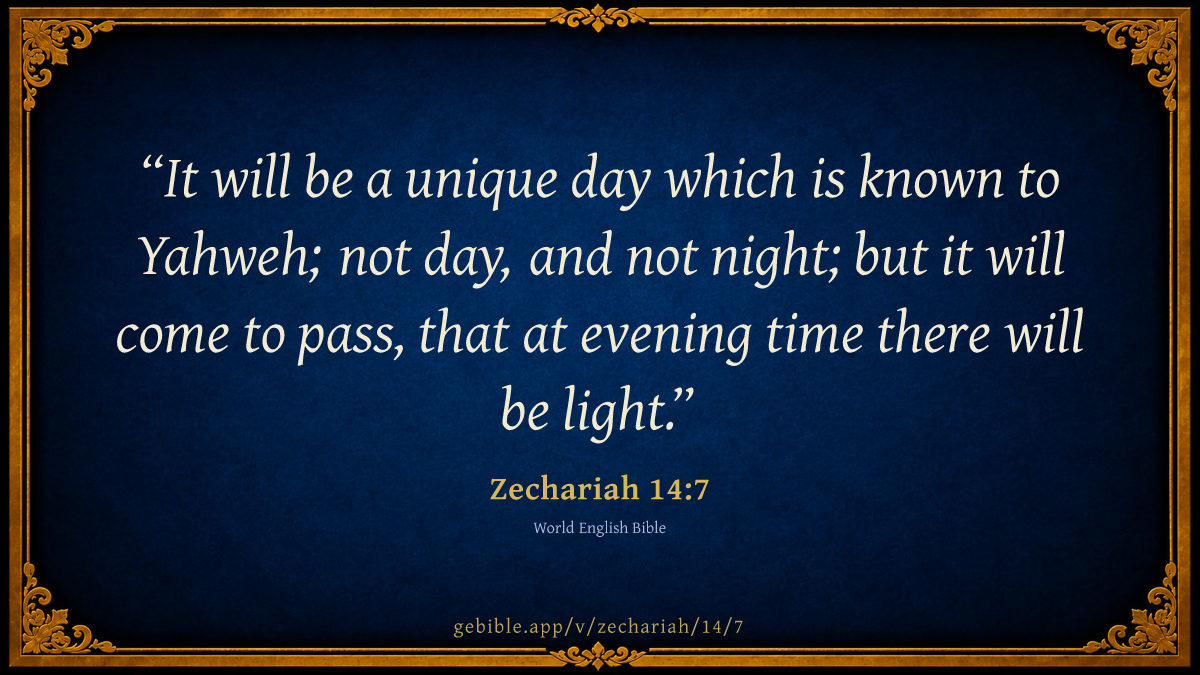
It will be a unique day which is known to Yahweh; not day, and not night; but it will come to pass, that at evening time there will be light.
Parallel Translations
-
It will be a unique day which is known to Yahweh; not day, and not night; but it will come to pass, that at evening time there will be light.
-
But it shall be one day which shall be known to the LORD, not day, nor night: but it shall come to pass, that at evening time it shall be light.
-
And there shall be one day which shall be known as the LORD'S, not day, and not night; but it shall come to pass, that at evening time there shall be light.
Examined in Scripture Analysis
Science (1)
Historical claims about the natural world, weighed against the scientific record.
Cross-references (22)
Passages linked to Zechariah 14:7 in the Treasury of Scripture Knowledge, ordered by reader-vote popularity; verse text shown in World English Bible.
- Revelation 22:5 There will be no night, and they need no lamp light or sun light; for the Lord God will illuminate them. They will reign forever and ever.
- Isaiah 30:26 Moreover the light of the moon will be like the light of the sun, and the light of the sun will be seven times brighter, like the light of seven days, in the day that Yahweh binds up the fracture of his people, and heals the wound they were struck with.
- Daniel 12:4 But you, Daniel, shut up the words, and seal the book, even to the time of the end. Many will run back and forth, and knowledge will be increased.”
- 1 Thessalonians 5:2 For you yourselves know well that the day of the Lord comes like a thief in the night.
- Revelation 21:23 The city has no need for the sun or moon to shine, for the very glory of God illuminated it, and its lamp is the Lamb.
- Psalms 37:18 Yahweh knows the days of the perfect. Their inheritance shall be forever.
- Isaiah 60:19-20 The sun will be no more your light by day; nor will the brightness of the moon give light to you, but Yahweh will be your everlasting light, and your God will be your glory. Your sun will not go down any more, nor will your moon withdraw itself; for Yahweh will be your everlasting light, and the days of your mourning will end.
- Jeremiah 30:7 Alas! for that day is great, so that none is like it. It is even the time of Jacob’s trouble; but he will be saved out of it.
- Matthew 24:36 But no one knows of that day and hour, not even the angels of heaven, but my Father only.
- Mark 13:32 But of that day or that hour no one knows, not even the angels in heaven, nor the Son, but only the Father.
- Acts 1:7 He said to them, “It isn’t for you to know times or seasons which the Father has set within his own authority.
- Acts 15:18 “All of God’s works are known to him from eternity.
- Acts 17:31 because he has appointed a day in which he will judge the world in righteousness by the man whom he has ordained; of which he has given assurance to all men, in that he has raised him from the dead.”
- Isaiah 9:7 Of the increase of his government and of peace there shall be no end, on David’s throne, and on his kingdom, to establish it, and to uphold it with justice and with righteousness from that time on, even forever. The zeal of Yahweh of Armies will perform this.
- Isaiah 11:9 They will not hurt nor destroy in all my holy mountain; for the earth will be full of the knowledge of Yahweh, as the waters cover the sea.
- Hosea 3:5 Afterward the children of Israel shall return, and seek Yahweh their God, and David their king, and shall come with trembling to Yahweh and to his blessings in the last days.
- Acts 17:26 He made from one blood every nation of men to dwell on all the surface of the earth, having determined appointed seasons, and the boundaries of their dwellings,
- Revelation 11:15 The seventh angel sounded, and great voices in heaven followed, saying, “The kingdom of the world has become the Kingdom of our Lord, and of his Christ. He will reign forever and ever!”
- Revelation 14:6 I saw an angel flying in mid heaven, having an eternal Good News to proclaim to those who dwell on the earth, and to every nation, tribe, language, and people.
- Revelation 20:2-4 He seized the dragon, the old serpent, which is the devil and Satan, who deceives the whole inhabited earth, and bound him for a thousand years, and cast him into the abyss, and shut it, and sealed it over him, that he should deceive the nations no more, until the thousand years were finished. After this, he must be freed for a short time. I saw thrones, and they sat on them, and judgment was given to them. I saw the souls of those who had been beheaded for the testimony of Jesus, and for the word of God, and such as didn’t worship the beast nor his image, and didn’t receive the mark on their forehead and on their hand. They lived and reigned with Christ for a thousand years.
- Revelation 21:3 I heard a loud voice out of heaven saying, “Behold, God’s dwelling is with people, and he will dwell with them, and they will be his people, and God himself will be with them as their God.
- Revelation 21:25 Its gates will in no way be shut by day (for there will be no night there),
Cross-references from openbible.info (CC BY 4.0)
Explain this verse (15 sources)
Historical commentary, presented as a primary source — not an endorsement.
Private notes
Saved on this device only — never synced or sent anywhere.
John Calvin 1540 · Public Domain Then he says, that this day is known to…
Then he says, that this day is known to Jehovah, in order that the faithful night depend on his good pleasure, and not too anxiously enquire about an event hidden from them and the whole world. The day then is known, says Zechariah, only to God, though he speaks of things well known, and which the Jews had at length to know by experience. But his object must be regarded, for his purpose was to restrain the godly, that they might not unnecessarily torment themselves, for we are wont to be too curious to know things: when God’s design is to calm us, and to make us rely on his providence, then many thoughts come across our minds, and toss us here and there, and thus we torment ourselves with anxiety. As then it is disease is innate in human nature, the Prophet supplies a seasonable remedy, — that the faithful are to allow themselves to be ruled by God, and to follow the example of their father Abraham, “The Lord will provide:” when he was in extremity and no escape was open he committed himself to God’s providence. So also Zechariah says, that it would be entirely dependent on the will of God alone, now to cover the heavens with darkness, and then to restore the sun, and also to blend darkness with light; and nothing is better for men than to check themselves, and not to enquire more than what is right, nor take away anything from God’s power, for whenever men murmur against God’s judgments, it is the same thing as though they wished to penetrate into heaven, and concede nothing to him except what they themselves think right. Then, in order to check this presumption, the Prophet says, that this day is known to Jehovah, so that the faithful might patiently wait until the ripened end should come, for our curiosity drives us here and there, so that we always wish to be certain about the end, “How long is this to endure?” and thus we complain against God; but when we are not able to subordinate our minds to his will, then we break forth as it were into a furious temper.
We hence see how useful a doctrine this clause contains, where the Prophet sets God as the judge and the arbitrator of all events, so that he afflicts the Church as long as it pleases him, sets bounds to adversities, and regulates all things as it seemeth good to him; and he also covers the heavens with thick clouds, and takes away the sight of the sun. All this then is what the Prophet would have us to know is in God’s power, and directed by his counsel. It now follows-
John Calvin's Commentaries (1540-1563) — public domain. Text from the Calvin Translation Society English edition (1840s-50s) via the Christian Classics Ethereal Library (ccel.org). Calvin's coverage is partial (roughly two-thirds of the Bible); uncommented books and verses are honest gaps, never fabricated. The 19th-century editor's footnotes and remarks are omitted so the notes are faithfully Calvin's own voice.
Geneva Bible translators 1599 · Public Domain Signifying, that there should be great troubles in the…
Signifying, that there should be great troubles in the Church, and that the time hereof is in the Lord’s hands, yet at length (which is here meant by the evening) God would send comfort.
Geneva Bible (1599) marginal notes — public domain.
John Trapp 1656 · Public Domain Zec 14:7 But it shall be one day which…
Zec 14:7 But it shall be one day which shall be known to the LORD, not day, nor night: but it shall come to pass, [that] at evening time it shall be light.
Ver. 7. Which shall be known to the Lord] And that should suffice us, without further curious inquiries, de re nobis et toti mundo abscondita (Calvin), concerning the set times and the seasons which the Father hath put in his own power, Act 1:7. The Muscovites use to say in a dark point, in a difficult question, God and our great duke know all this; and in other talk, all we enjoy health, and life, and all from our great duke; therefore let us leave all to him. Should not we much more to God? Time hath already confuted those learned men, who from Dan 12:11 pitched their calculation for the Jews’ restoration upon the year 1650. Those that shall live a few years longer shall see what will become of their confidence, who have undertaken to prove, out of Daniel and the Revelation, that the prophetical numbers come to an end with the year of our Lord 1655, because then the seventh trumpet shall sound; and then the six thousand years from the creation of the world do expire, as they compute.
John Trapp, A Commentary or Exposition upon All the Books of the Old and New Testament (1647–1656) — public domain. Text from a community e-Sword module.
Matthew Poole 1685 · Public Domain It shall be one day; one continued day, no…
It shall be one day; one continued day, no setting of the sun to make it quite night; God will always act in order to the full salvation of his spiritual Jerusalem.
Known unto the Lord; the Lord knows when it shall begin, how long last, and how and when it shall (not as other days, end in a night, but) end in glorious light; till then it is enough for us that our God knows this day that is mixed of trouble and of peace.
Read full note →
At evening time, when other days end,
it shall be light; this shall be all light and glory, Isa 58:8; Psa 97:11.
Matthew Poole's English Annotations on the Holy Bible (1683–1685) — public domain. Text from a community e-Sword/MySword module.
John Gill 1763 · Public Domain But it shall be one day,.... A very singular,…
But it shall be one day,.... A very singular, remarkable, and uncommon one; and it will be but one day; things will not continue long in such a position:
which shall be known to the Lord; all times and seasons are known unto the Lord, but this will come under his special notice and observation, and be under the direction of his special providence; it will only be taken notice of by him, and not by others; scarce any will observe it, or know what God is doing in it, or about to do:
Read full note →
not day, nor night; not clear and full day, as at noon; nor yet quite night or dark, as at midnight; See Gill on Zac 14:6,
but it shall come to pass, that at evening time it shall be light; after this day is over, which is neither clear nor dark, there will be an evening time; things will be worse with us than they are; the sun will be set; Christ will be withdrawn in the ministry of the word; his witnesses will be slain and silenced; great coldness and lukewarmness will seize upon professors; great darkness of error will spread itself everywhere; great sleepiness and security will fall upon all the virgins, and there will be great distress of nations; and, when it will be feared and expected that greater darkness and distress still are coming on, "light" will break forth; deliverance and salvation from Popish darkness and tyranny will be wrought; the light of the Gospel will break forth, and spread itself everywhere; the light of joy and gladness will arise to all the saints, and it will be a time of great spiritual peace, prosperity, and happiness. Vitringa on Isa 60:20, interprets it there shall be no vicissitude, or succession of day and night, but all day; at evening it shall be light; no calamity nor sorrow; Christ the light, and sun of righteousness, will break out in a glorious and spiritual manner.
John Gill's Exposition of the Whole Bible (1746–1763) — public domain (CC PDM 1.0). Text via the HelloAO Bible API.
John Wesley 1765 · Public Domain One day - One continued day, no setting of…
One day - One continued day, no setting of the sun to make it quite night: God will always act in order to the full salvation of his spiritual Jerusalem. Known unto the Lord - The Lord knows when it shall begin, and how, and when it shall end.
John Wesley, Explanatory Notes Upon the Whole Bible (1754–1765) — public domain. Text via the GEBible commentary corpus.
Adam Clarke 1810 · Public Domain Verse 7. At evening time it shall be light.]…
Verse 7. At evening time it shall be light.] At the close of this awful visitation, there shall be light. The light of the glorious Gospel shall go forth from Jerusalem; and next, from the Roman empire to every part of the earth.
Adam Clarke's Commentary on the Bible (1810–1826) — public domain. Text from a community e-Sword/MySword module.
Albert Barnes 1834 · Public Domain And it shall be one day: it shall be…
And it shall be one day: it shall be known unto the Lord: not day, and not night; and at the eventide it shall be light - “One” special “day; one,” unlike all beside; known unto God, and to Him alone. For God alone knows the day of the consummation of all things, as He saith, “Of that day and that hour knoweth no one, neither the angels in Heaven, nor the Son, (so as to reveal it) but the Father only” Mar 13:32. Neither wholly “day,” because overclouded with darkness; nor wholly “night,” for the streaks of light burst through the darkness chequered of both; but in “eventide,” when all seems ready to sink into the thickest night, “there shall be light.” Divine light always breaks in, when all seems darkness; but then the chequered condition of our mortality comes to an end, then comes the morning, which has no evening; the light which has no setting; “perpetual light, brightness infinite;” when “the light of the moon shall be as the light of the sun, and the light of the sun shall be sevenfold” Isa 30:26; and “the glory of God doth lighten” Rev 21:23 the eternal city, “and the Lamb is the light” thereof; and “in Thy light we shall see light” Psa 36:9. “Christ shall be to us eternal light, a long perpetual day.”
Albert Barnes' Notes on the Bible (1834–1885) — public domain. Text from a community e-Sword/MySword module.
Haydock's Catholic Bible Commentary 1859 · Public Domain In the time of the evening there shall be…
In the time of the evening there shall be light. An unexpected light shall arise by the means of the Machabees, when things shall seem to be at the worst. (Challoner) --- At one period of the last siege, it was dubious what would be the event, particularly (Calmet) when Titus was separated from almost all his attendants, and when the besieged burned the works of the enemy. (Josephus, Jewish Wars vi. 2., and 12.)
George Leo Haydock (1774–1849), Haydock's Catholic Family Bible and Commentary, 1859 edition — public domain. Excludes Psalms (Douay-Rheims chapter numbering differs from Protestant) and Deuterocanonical books (Catholic canon only).
Robert Jamieson, A. R. Fausset & David Brown 1871 · Public Domain one day--a day altogether unique, different from all others…
one day--a day altogether unique, different from all others [MAURER]. Compare "one," that is, unique (Sol 6:9; Jer 30:7). Not as HENDERSON explains, "One continuous day, without night" (Rev 22:5; Rev 21:25); the millennial period (Rev 20:3-7).
known to . . . Lord--This truth restrains man's curiosity and teaches us to wait the Lord's own time (Mat 24:36).
Read full note →
not day, nor night--answering to "not . . . clear nor . . . dark" (Zac 14:6); not altogether daylight, yet not the darkness of night.
at evening . . . shall be light--Towards the close of this twilight-like time of calamity, "light" shall spring up (Psa 97:11; Psa 112:4; Isa 30:26; Isa 60:19-20).
Jamieson, Fausset & Brown — Commentary Critical and Explanatory on the Whole Bible (1871) — public domain (CC PDM 1.0). Text via the HelloAO Bible API.
The Cambridge Bible for Schools and Colleges 1878 · Public Domain 7. one day] i.e. an unique day, unlike any…
7. one day] i.e. an unique day, unlike any other: prorsus singularis. Maurer. Comp. Eze_7:5, and for the idea Jer_30:7.
shall be known to the Lord] Rather, is known, R. V. Comp. Mar_13:32. “Quo temporis momento ingruet soli Deo est notum.” Maurer.
Read full note →
not day nor night] Neither wholly day nor wholly night, but a chequered mixture of both. The new creation shall be ushered in, as the first was, by a day of lurid gloom and “darkness visible,” which shall not, however, deepen into night, but brighten at its close into the everlasting dawn. “At evening time there shall be light.”
The Cambridge Bible for Schools and Colleges (gen. ed. J. J. S. Perowne; Cambridge University Press, 1878–1918) — public domain. Text from a community e-Sword module.
Ellicott's Commentary for English Readers 1878 · Public Domain (7) One day.—i.e., an extraordinary, unique day. (Comp. Eze_7:5.)…
(7) One day.—i.e., an extraordinary, unique day. (Comp. Eze_7:5.) “An evil, an only (literally, one) evil, behold, is come.” (Also Jer_30:7.)
Not day, nor night.—But a kind of murky gloom, such as accompanies a sand-storm in the deserts of the East.
Read full note →
It shall be.—Better, there shall be. As the darkest hour precedes the dawn, so the climax of man’s direst need is the precursor of the day-spring of God’s saving power. And so now, when “at evening time” they shall be expecting the gross darkness of night to set in, suddenly they shall be flooded with the light of God’s salvation. This second half of Zec_14:7 is to Zec_14:6-7 (a) what Zec_14:3 is to Zec_14:1-2. In each case the brightness of the Theophany dispels the darkness of despair.
A Bible Commentary for English Readers, edited by Charles John Ellicott (1878–1897) — public domain. Text from a community e-Sword module.
The Pulpit Commentary 1880 · Public Domain One day. A unique day, unparalleled. (comp. Son_6:9 Eze_7:5)…
One day. A unique day, unparalleled. (comp. Son_6:9 Eze_7:5) Which shall be (is) known to the Lord. Its peculiar character, and the moment of its arrival, are known to God, and God only. (Mat_24:36) Not day, nor night. It cannot be called truly the one or the other, because there is darkness in the day and light at night, as the following clause says. This is symbolically explained by St. Ephraem, "It will not be altogether consolation, nor altogether affliction." It is not full daylight, for calamity presses; it is not deep night, because there is hope amid the distress. At evening time it shall be light. In the midst of trouble and danger deliverance shall come. The whole section is a figurative description of the fortunes of the Church militant, even as Christ announced to his disciples: "In the world ye shall have tribulation: but be of good cheer, I have overcome the world"; (Joh_16:33) "If they have persecuted me, they will also persecute you"; (Joh_15:20) "Let not your heart be troubled, neither let it be afraid". (Joh_14:27)
The Pulpit Commentary (1880–1919), ed. H.D.M. Spence-Jones & Joseph S. Exell — public domain. Text from a community e-Sword module.
The Biblical Illustrator 1887 · Public Domain At evening time it shall be light
Zec_14:7
At evening time it shall be light
Read full note →
Aged peoples service
Natures sunset is beautiful, so beautiful that every painter strives in vain to catch it and give it permanence on his canvas.
But the sunset of life transcends it; as the reality always transcends the type, as the spiritual always transcends the material, as the heavenly always transcends the earthly. What is there more beautiful in itself, what more interesting to contemplate than snowy age sustained by a living faith, and moving on toward the end of lifes journey, calm, serene, cheerful, full of trust in God and the hope of heaven? But why picture a day of storms instead of a day of brightness and sunshine? Why a life of trials and sorrows and difficulties? Herein lies the chief beauty of the picture, the preciousness of the promise. Light is ever most glorious in contrast with darkness; peace most blessed by contrast with strife. A peaceful, trustful, calm old age in pleasing always. But best is the peace after strife, the trust after doubt, the rest after toil. Such an old age bespeaks completeness. It is the maturing of the human mind, the ripening of a Godlike character, the perfecting of an immortal soul. Those lines of strength and beauty, those tokens of ripened character, that quiet patience, that glowing faith and hope, that chastened joy--all have been imprinted upon the aged face by the hand of experience the most painful. Sanctified sorrow is an indispensable element of heavenly joy. Spiritual strength and maturity cannot be attained except through difficulties overcome by the grace of God. Without strife there can be no conquest, no triumph. The promise of light at evening time from its very nature implies something of storm during the day. But is there light? No; not always. Sometimes the promise seems to fail. Not every troubled and toil-worn life ends in peace and hope. Too often advancing years only bring increased darkness. Disappointment deepens into a perpetual bitterness of spirit. Old age is marked by peevishness, complaining, and discontent. It need not be so with any life. The promise is to all a Divine promise. Whence shall this light come? From the shining of the sun upon the clouds. And from the shining of Gods love upon our trials. It is the brightness of His love that transfigures life, and fills its closing years with light and promise. The glory of the evening light comes, not from the removal of all clouds of evil, but from their transformation. Apart from difficulty and trial, we could never know the infinitude of Gods love and power. So may it be with every soul that claims this promise; the darkness of the morning, and the storm of the noontide shall but enhance the glory of the evening light. If to any of you the evening time still seems dark and gloomy, let in this light unto your soul; let it stream through your life, and it will brighten and transform everything with the likeness of its own glory. (George H. Hubbard.)
The light of evening
Evening is the time for stillness, and low, quiet tones, and communion with things and persons far away. So deep is the peace, so sweet the refreshment of that hour to one who, having done his work as a true man, may rest with a good conscience. Enlarge the range of view. Such as is the evening hour after a day of honest toil, such ought to be the latter years in every good mans life. As comes the evening to each mortal day, so comes an evening, at last, to all our days together; and with it the evening light, better far than the growing brilliancy of the early hours, or the set glare of the noonday sun. When the day of life has been a good and useful day, not idly spent or wasted, but passed in the fear of God, in piety and honesty, and in the performance of duty, then must its ending be calm and still.
1. In what does the light of the evening hour consist? In the evening of life comes the final and distinct realisation of the little value of this world. A true man outgrows, step by step, what he was; at last, if he live long enough, he outgrows the world.
2. To pass from this life to that in front, will be to go from ignorance and imperfection unto a wider knowledge and a deeper wisdom. The evening brings the time when the servant of God shall see and know many of the secrets of the universe, and read through and through what had long been dark mysteries to him. How many things there are which we do not understand!
3. It must bring great peace at last, to look back upon the life, and consider its moral and its lesson. One thing comes clearer and clearer out; the steady, never failing presence and providence of God.
4. Many have feared lest they might, somehow, lose their faith. That is the darkest of all spectres to a Christian. How blessed then to know at last that, whatever mistakes are made, whatever sins are committed, we are saved from that gravest error, that heaviest and most hopeless sin, the denial of the Catholic faith. (Morgan Dix.)
Light at evening time
There are different evening times that happen to the Church and to Gods people, and as a rule we may rest quite certain that at evening time there shall be light. God very frequently acts in grace in such a manner that we can find a parallel in nature. The works of creation are very frequently the mirror of the works of grace. But sometimes God oversteps nature. In nature, after evening time, there cometh night. But God is pleased to send to His people times when the eye of reason expects to see no more day, but fears that the glorious landscape of Gods mercies will be shrouded in the darkness of His forgetfulness. But, instead, God overleapeth nature, and declares that at evening time, instead of darkness, there shall be light. Illustrate--
1. From the history of the Church at large. Especially the time of the Reformation.
2. This rule holds equally good in the little as well as in the great. We know that in nature the very same law that rules the atom, governs also the starry orbs. It is even so with the laws of grace. At evening time it shall be light to every individual. There are our bright days in temporal matters. After them we have had our sunsets. Times of trouble, but they passed into times of deliverance. If God prolong, thy sorrow, He shall multiply thy patience.
3. From the spiritual sorrows of Gods own people. Gods children have two kinds of trials, trials temporal and trials spiritual. Illustrate from the scene of Bunyans pilgrim meeting Apollyon.
4. To the sinner when coming to Christ this also is a truth.
5. We shall all get into the evening time of life. In a few more years the sere and yellow leaf will be the fit companion of every man and every woman. Is there anything melancholy in that? Did you ever notice how venerable grandsires when they write a letter fill it full of intelligence concerning their children? The grey-headed man thinks of his children and forgets all besides. If he has served God, he has another light to cheer him. He has the light of the remembrance of what good God has enabled him to do. (C. H. Spurgeon.)
Light at evening
It is when the day is drawing to its close that most men have their hour of leisure. We know, most of us, how nature looks at evening, better than we know how she seems in the busier hours of the day. In our evening leisure we have many a time had the opportunity of marking the suns gradual withdrawal, the shadows as they darkened upon the landscape, the mist stealing upward from the river, and its murmur deepening upon the ear, the leaves so motionless, the silent fields, the universal hush, and quiet. The one thing that makes evening is the gradual withdrawal of the light. It is the lessening light that makes the evening time. At the evening time there shall be light, that is, light shall come at a period when it is not natural, when in the common course of things it is not looked for. It would be no surprise that light should come at noonday. If when the twilight shadows were falling deeper and deeper, with a sudden burst the noonday light were to spread around,--that would be a surprise. To state the promise in the form of a general principle, great and signal blessing shall come just when it is least expected. This special light is promised at the end of a day which should be somewhat overcast and dreary; not one of unmingled serenity, nor yet of unrelieved gloominess. At the evening time there should be an end of the subdued twilight. Then there should be light at last. When the Christians little day has drawn to its close; when the Christians earthly sun has set, then there should be to him the beginning of a day whose sun shall never go down, and whose brightness shall be lessened by no intrusion of the dark.
1. In Gods dealings with His children, it very often happens that signal blessing and deliverance come just when they are needed most, but expected least. Show the prevalence of this law in the Almightys treatment of believers individually. How often the case has proved so as regards the collective Church. The least acquaintance with the history of the world will bring before us a host of instances in which the oppressed and persecuted, sometimes the cold and apathetic Church of God found better days dawn when they were least looked for, and so found the fulfilment of the promise, that at evening time there should be light. The humble Christians life is the best sermon upon this text, and his own memory the best preacher. Illustrate by times of conversion and renewal; seasons of great trial--losses, disappointments, bereavements. Or the time of death--as the evening advances, as the hours go on in which the light that had lasted through the day might naturally grow less, how often it is that that unwearied light does but beam brighter and clearer! It is not indeed always so. Such a thing has been known as a true Christian dying in absolute despair, but in such a case disease is unusual and the mind unhinged. Perhaps with many Christians the death is as the life was: the evening is what the day was, not clear nor dark. Is then the text not true? No, far from that. The light does come; and it comes at evening: but evening is the close of day; and the light may perhaps not beam forth until day has entirely closed. Not upon this side time may the blessed promise find its fulfilment. At evening time there shall be light, if not in this world, then in a better. (A. K. H. Boyd, D. D.)
Lux e Tenebris
This old promise has received a thousand fulfilments, is receiving fulfilments every day, and will to the end of time. Nations that have fallen under the shadows of evening have often realised this truth. When the foot of the conqueror was about stamping on their heart, and the night of despair was settling on them, deliverance has come, light has broken on the darkness. Churches that have passed into twilight, and about sinking into the night of extinction, have in unnumbered instances experienced the truth of the promise. The world at large had a grand fulfilment of it in the advent of Christ. Evening had settled on the pagan and Jewish world, the lights of the old philosophies and religions were all but quenched, when the Divine Logos rose like a sun into the heavens. But we may mention a few instances in individual life where fulfilments of the promise are abundant.
I. In the process of repentance. In passing through repentance, through the regions of a godly sorrow for sin, what darkness gathers around the soul. All the stars of hope, and the lights of self-righteousness are extinguished, and sometimes deep and horrible is the darkness that overcasts the heart. But then comes the light, Christ appears, thy sins are all forgiven.
II. In the events of life. How often the good man in passing through the world is brought into darkness purposes broken, plans frustrated, hopes blasted, and he knows not whither to look. Just when it is not only evening with him, but almost midnight, light breaks forth, his heart is cheered, his path is made clear, and his energies are renerved.
III. In the article of dissolution. Death is felt to be an evening with man. The valley of the shadow. Most look forward to it as a terrible night; but the Christly, when the evening has come and the shadows have fallen densely all around, have found the breaking of the night. It was so with Dr. Johnson, who through life, it would seem, looked forward to the last hour with horror and alarm; but when the evening came, light came, joy seized his withered veins, and one bright gleam shone all around his heart. All men wish to die in the light. Goethe cried out in dying, More light, more light; and all will have it the centre of whose soul is the light of the world. (Homilist.)
Light at eventide
What is true of the Church is true also of its individual members. In reference to the dark days which now and then fall to the believers lot in his earthly pilgrimage, the text suggests--
1. That the day of severe affliction shall be followed by an eventide of calm and renewed confidence in his Father-God. In our day of trial we are too prone to centre all our thoughts in the scene immediately around us, and forget that our greatest affliction may be the harbinger of the greatest blessing.
2. That the day of temptation shall be followed by an eventide of triumph and repose.
3. That the day of providential bereavement shall be followed by an eventide of submission. At such times how hard it is to say Thy will be done!
4. That the believer generally realises the fulfilment of this promise in the evening of life. (William Hurd.)
Light at sundown
While night, in all languages, is the symbol for gloom and suffering, it is often really cheerful, bright, and impressive. As the natural evening is often luminous, so it shall be light in the evening--
1. Of our Christian sorrows. The night-blooming assurances of Christs sympathy fill all the atmosphere with heaven.
2. In the time of old age. It is a grand thing to be young. Mid life and old age will be denied to many of us, but youth--we all know what that is. But youth will not always last. Blessed old age, if you let it come naturally, and if it be found in the way of righteousness.
3. In the latter days of the Church. It is early yet in the history of everything good. Civilisation and Christianity are just getting out of the cradle.
4. At the end of the Christians life. Life is a short winters day. Baptism and burial are near together. But thanks be to God, who giveth us the victory. At evening time it shall be light. (T. De Witt Talmage, D. D.)
Evensong
So saith the sailor, when tossed about on a rocky coast, and dark clouds cover the heavens from his view, and the lights of the shore are shrouded in mist. So saith the star-gazer, when a strange comet visits the heavens, exciting the fears of the ignorant, and evoking the wonder of the wise. So saith the man of business, as in the dim and dingy city office he pores over doubtful debts, or ponders upon bad bargains, sensitive stocks, dull markets, baffled speculations. We ought ever to keep a sharp lookout for stars of promise, as we sail over the ocean of chance and change to the undiscovered continent of certainty. Let us, by the joint light of revelation and experience, consider heavens cheering rays for earths darksome seasons. The promise of the text applies to every stage of Christian experience.
1. At the evening time of retrospect it shall be light. The Christian often looks back in his pilgrimage to the land whence he has come, not with feelings of regret at the step he has taken, but of thanksgiving that God has led him from the regions of death to the realms of life. These meditations on the past are sometimes disturbed by distressing doubts. But at evening time it shall be light.
2. At evening time of conviction it shall be light. Conviction is the wrestling of fact with feeling. We do not always feel equally convinced of our acceptance with God. But God has promised, if you wait patiently on Him, to renew the strength of your languishing convictions.
3. At evening time of anticipation it shall be light. The Christians home is not below, but above. The future is at best a land of shadows, the symbol of the uncertain and unreal. When the darkness grows deepest, the light begins to glow. The application of this balm of Gilead rests with each of you. (G. Victor Macdona.)
At evening time it shall be light
1. The primary application of these words. The chapter is eminently prophetic. It refers to Israel as a people, to Canaan as their land, Jerusalem as their capital, and our Lord Himself as their King. I believe in the literal restoration of Israel to their own land.
2. The figurative meaning we may attach to these words. The words evening and light are expressive of two states: they are opposite terms, meaning opposite things. Evening, or darkness, is figurative for woe or sorrow, while light stands for joy, prosperity. At the time when things seem to have come to their worst, then prosperity begins to dawn, and the dismal past be succeeded by a bright and happy future. This is exemplified politically and religiously in secular and sacred history. Illustrate from experience of Israel in Egypt. From the condition of England in the time of King John. That was the darkest moment of English history. The darkness of sin brought forth the light of redeeming love. Sin gave cause for a Saviour. When the Saviour came, did the brightness immediately shine forth? No. Again sin darkened the worlds light. The Saviours love only excited the sinners hatred, and He who loved the sinner was murdered by those whom He loved. But resurrection morn dispelled the darkness of crucifixion night. Learn that it is our duty to cheerfully expect the future to be happier than the present. (Campbell Fair.)
A surprising glory
The prophet refers to spiritual, not natural light; and his prophecy is, that in the experience of the believer in Christ, when, in the natural course of things he may expect spiritual darkness, behold light!
1. A long and fearful sickness overtakes the child of God. A fearful darkness gathers in his sick chamber. Wife and children are dependent upon him. As weeks and months painfully wear away the gloom deepens. Sun, moon and stars, one by one go out. When, in the course of nature, he faces death, suddenly the clouds disperse and the chastened soul rejoices in a light of peace and joy full of heaven, and goes forth, as it were, redeemed from the grave.
2. It is true of the whole discipline of life. The reference is to the end; at evening, etc. A long and weary pilgrimage may have to be taken; a severe and oft-repeated series of sorrows, losses, disappointments, first be endured. The light does not flash on him at the beginning; submission does not come with the first use of the rod. No; he must go through the scene--endure to the end. And, if he endure, just when the darkness seems to be settling down upon him, and the last ray of joy and hope seems about to be quenched, at the evening time it becomes light!
3. Millions of deathbeds bear glorious testimony to this truth. Instead of a great darkness, celestial radiance! Instead of dismay, a peace unspeakable! (Homiletic Review.)
Glorious endings
The sacred writers are always true to nature. They never contradict natural facts.
I. The ambiguousness of prophecy. Many of the prophecies have been literally fulfilled. But there is not a fulfilled prophecy on record which, prior to its accomplishment, was not more or less dark, obscure, or enigmatical in its meaning. What idea could the guilty pair in Eden form of their promised deliverer from sin and guilt? From the nature of prophecy it could have been but a sort of twilight knowledge of the Christ which ancient believers derived from it. The entire Old Testament dispensation was a day, known it is true to the Lord, but to His people it was not day nor night. But as with all other days of nature, providence, or grace, that also had an end. The clouds that had covered the horizon of the moral world for long centuries broke at last. The evening of the Old Testament day, which witnessed the coming of the Son of God, was the brightest period of time that the world had seen since the fall of man! Turn to unfulfilled prophecy. How will it be realised; and when? The twentieth chapter of the Apocalypse has given occasion to hundreds of conjectures and theories of the millennium. But the Gospel dispensation, in regard to unfulfilled prophecy, is neither clear nor dark,--it is not day nor night. But at evening time it shall be light. Presently all will be clear, and the Divine idea and purpose will be fully revealed.
II. Gods general administration of human affairs. It is often unintelligible. The government of an empire is too intricate to be understood by any but the emperor himself. We are confused and perplexed when we attempt to trace out and explain Gods government of the world from its beginning to the present day. We do not know often what He intends or means in His dealings with our race. The light is neither clear nor dark,--the light of providence. But the revolution of years is silently bringing nearer and nearer the evening time of the moral world. Then there will be adjustment of contrary things. Then we may well be patient, and trust in God. (W. H. Luckenbach.)
Light at evening tide
In recalling the incidents of his last years ministry at Walton, Mr. Pennefather often spoke of the fact that during that time he had been called to attend the dying beds of thirty of the most attached members of his flock, all in blessed hope of a joyful resurrection. Do you call it a dark valley? said one aged believer; it is a very sweet valley to me! All praise! all praise! It is one thing to speak of Jesus, said a dying woman, but it is another thing to have Him in full view.
Light at evening time
It is said that Mirabeau cried out frantically for music to soothe his last moments; that Hobbes, the deist, said as he gasped his last breath, I am taking a fearful leap into the dark; that Cardinal Beaufort said, What! is there no bribing death? Men with the Christian light have met death in another way. When Melanchthon was asked if there was anything he desired, he said, No, Luther, nothing but heaven. Dr. John Owen said at last, I am going to Him whom my soul loveth, or rather, who has loved me with an everlasting love. John Brown of Haddington could say, I am weak, but it is delightful to feel ones self in the everlasting arms. George Washington could say, It is all well. Walter Scott, as he sank in the slumber of death, Now I shall be myself again. Beethoven, as he could almost catch the melody of the mystic world, Now I shall hear. Wesley could cheerily meet death with the words, The best of all is God is with us. Locke, the Christian philosopher, exclaimed at dying, Oh, the depth of the riches of the goodness and knowledge of God! Stephen said, Lord Jesus, receive my spirit. Paul, having a desire to depart; and, to die is gain. (F. Hastings.)
The sunset glow
In the thought and in the speech of the world night is made the symbol of the dark experiences of human life. It is common to speak of the day of prosperity and of the night of adversity. Both of these symbols are frequently used in the Bible, the day standing for the bright experiences and the night standing for the dark experiences of life. But the Bible studs the night of darkness with stars of hope and suns of promise. At evening time it shall be light. That is grace overstepping and going beyond Nature. Natures evening time is darkness. When the evening time comes in the experiences of Gods people, and they fear that there shall be no more day, then God steps in, introduces a principle beyond Nature, and declares, It shall come to pass that at evening time it shall be light.
1. This is a promise for the evening time of the world. The morning of the world was a bright and glorious sunrise. In the beginning God said, Let there be light, and there was light. And when He had finished His wide and wise creation, God saw that it was good. But soon the dark cloud of mans sin overspread the earth. Light was shut out. Darkness reigned. Out of that darkness the world has been gradually emerging, until, through all the tears and tyrannies of the centuries, it has come into the noonday splendour of the Christian civilisation of our century. And it is distinctly Christian. It was the historian Froude who said: All that we call modern civilisation, in a sense which deserves that name, is the visible expression of the transfiguring power of the Gospel. Our highest literature is swayed by the purest influences of Christianity. The scientific spirit of research and investigation, so conspicuous a fact and so important a factor in our modern life, owes its stimulation to the encouragement of Christianity. Christianity has created the laboratory as well as the library. Christianity is the parent of education. It has founded schools, established colleges, endowed seminaries. To benighted lands and to blighted homes Christianity has sent the teacher with the preacher. Our civic liberties and our social order are based upon Christianity. Burn the Bible, proclaim there is no God, write over your cemetery gates Death is an eternal sleep, and there is no power in all this land that will stay the ravages of that beetle-browed hag--infidelitys twin sister in every age and in every land--Anarchism. I know that there are historians of discontent and prophets of calamity who cannot enjoy the splendour of the worlds midday, and who are ever telling us that the former times were better than these. They discount all inventions and all advancement by claiming that the morality of the present, if as strong, is no stronger than the morality of the past. They are right in holding that all advancements go for naught if the people are not better than they were. The test of the worlds advancement and strength is not that the grandson rides today in the Pullman ear, while the grandfather rode yesterday in the stage coach. The test is, Is the grandson a better man than the grandfather was? This world has not seen a brighter era since the gates of Eden were closed upon man than the last days of the nineteenth century. And the twentieth century will be better. Christ Jesus is to reign in this world. He has not yet ascended His throne. He is now on His Fathers throne. When He went into Heaven He sat down at His Fathers right hand, henceforth expecting till His enemies be made His footstool. When His enemies shall be subdued, then, rising upon them as upon His footstool, He shall ascend His throne and reign. And it shall come to pass that in the evening time of the world it shall be light.
2. The promise pertains to the Church of God. The Church of God has had two organisations in the world--the theocratic organisation of the Old Testament dispensation, and the spiritual organisation of the New Testament dispensation. Through all the Old Testament we can trace a gradual unfolding of the Churchs life and power. This unfolding was not in a continuous advance. The whole history of the Old Testament Church shows a succession of onward marches, and then of quick retreats--progressing, retrograding, standing still for a while, then progressing once more, and again falling back. But in no instance did she fall back as far as she had been, and so her history was, on the whole, one of advance and growth. So with the Church of the New Testament dispensation. The Church was born on Pentecost--that was the sunrise of the Church, and it was glorious. From Pentecost the disciples went forth to tell the story of Him who had been crucified, who rose and ascended into heaven, and as the story spread the Church grew. Then came opposition and hatred and persecution, but the Church advanced through all until she entered the darkness of the Dark Ages. The heavens were shut, and a black cloud of superstition spread over the earth. Rome sat upon her ebon throne and stretched her rod of cruelty across the nations. It seemed as if the evening time of the Church had come. In that time every lamp of prophecy had ceased to shine He who thundered in the streets of Rome had been burned at the stake, Savonarola had received the martyrs crown at Florence, the black clouds of ignorance, superstition, and vice shut out the sunlight of Gods love from the world. It was evening time, but God said, In the evening time it shall be light. He kindled a beacon in the soul of a young monk in the monastery at Erfurt. As the monk mused the fire burned, and out from Erfurt went Martin Luther to proclaim Gods message; and Rome shook, the Vatican trembled, the gates of brass were opened, the rod of cruelty was sundered, Germany was delivered, and civil and religious liberty were secured to the world. There came a time in England when religion became a formality, and when all good men trembled for the Church and longed for the mighty Puritans, who would crush the giant forces of evil beneath their onward progress. It was evening time, and God had said, It shall come to pass that at evening time it shall be light. Four young Oxford students--William Morgan, Robert Kentham, Charles and John Wesley--met for prayer and Bible study. They were called by their fellow students Bible Moths, the Holy Club, and Methodists, because they were so methodical in all studies and their work. One resistance after another the Church has overcome; at times pressed back, but ever pushing onward, multiplying her victories and extending her dominions. No more hospitals, for there are no more sick; no more asylums, for there are no orphans; no more prisons, for there are no criminals; no more almshouses, for there are no poor; no more tears, for there is no sorrow. The long dirge of the earths lamentations has come to an end in the triumphal march of the blessed redeemed Church; the New Jerusalem is with men, her children are gathered home, and across that city of a redeemed humanity earths grandest outburst of hope and welcome breaks antiphonal from wall to jasper wall. The sunset glow; the evening time of the Church, and at evening time it shall be light.
3. This promise is for all human experience. The great promises of God, which apply to the whole kingdom of the redeemed, may be appropriated by each individual member of that kingdom. In Nature the laws which control the great forces direct the minute elements. The law that rules the grain of sand on the seashore governs the planets in their course. It is so in the realm of grace. At evening time it shall be light to the Church; at evening time it shall be light to every individual believer. In the matter of the experience of the believer in Christian service it is true that in the evening time it shall be light. The majority of the men who have lived and laboured to make this world better have received the scorn and obloquy of the world. John Wesley was howled down by the mob to whom he preached; they threw bricks at him, they spat upon him, but where is there a more honoured name today? Light at evening time. Wendell Phillips was scorned and spurned for his advocacy of the slave. Boston would not hear him, but in less than a generation afterward Boston built a monument to his honour, and men who would not defile their lips with his name taught their children the pathway, to his tomb. At evening time, it shall be light.
4. The promise brings its helpful message to every believer in his season of adversity and trouble. Very few people in this world escape the time of adversity. The bright, sunshiny day of prosperity is pretty certain to have a nightfall. It was good that I have been afflicted, cries David. The Lord gave and the Lord hath taken away, exclaims Job. Sorrowful, yet always rejoicing, says Paul. And God shall wipe away all tears from their eyes, exclaims John in apocalyptic vision. At evening time it shall be light. Ten thousand saints of God have found it so in the evening time.
5. The text has a message for old age. Sometimes men look forward to it with trembling. It is a mistaken notion that youth is the time of gladness and old age the time of sadness. Americas beloved artist, Horatio Greenough, a few days before his death, said: I have found life to be a very cheerful thing, and not the dark and bitter thing with which my early days were clouded. At evening time it was light. At eighty years of age Albert Barnes stood in the pulpit of the First Presbyterian Church in Philadelphia, and said: The world is so attractive to me that I am very sorry I shall have to leave it so soon. Dr. Guthrie, past eighty, said: You must not think, that I am old because my hair is white; I never was so young as I am now. At evening time it was light. New lights shall burn when the old lights are quenched; new candles shall be lit when the lamps of life are dim. At the evening time of his life the Christian has many lights that he did not have before. There is the bright light of experience; the pleasing light of sweet memories; the cheering light of service done for God and humanity. The scientist tells us that no physical force is ever wasted. We whisper into the telephone, and the vibration, though it be less than one one-hundred-thousandth part of an inch, affects a diaphragm a thousand miles away, and our exact voice is heard by the listening ear in Chicago. So they tell us that the light from the farthest fixed star has been travelling steadily undiminished for more than a million years to greet our upturned eye tonight, and to reassure us that the hand that made it is Divine. If it be true of physical forces, how much more is it true of moral and spiritual forces, that they are never lost! What a halo of glory this casts about the old age of a man, out from whose life have poured forth the streams of holy and sacred influences! At evening time it shall be light. John Bunyan was right when he located Christian old age in the land of Beulah, in full sight of the ripe fruitage and the ravishing, prospects of the Celestial City. The infirmities of old age are only the land birds lighting on the sails, telling the weary mariner that he is nearing the haven. And it shall come to pass that at evening time it shall be light.
6. This promise is for the time of the death of the believer. It is a dark passage through which you are passing now, said a young man as he sat beside his dying mother. And her whole countenance lighted up as she said: Oh no, my son; there is too bright a light at the other end to have it dark, and she passed out, and up, and into the palm and to the crown and to the throne. At the evening time it was light. Paul drew near the end, and he said: The time for the weighing of the anchor has come. I have fought a good fight; I have finished my course; I have kept the faith; henceforth there is laid up for me a crown of righteousness which the Lord, the righteous Judge, shall give me at that day. Take the promise with you into the future. Remember that if sorrow camps with you overnight, joy cometh in the morning. (J. F. Carson, D. D.)
The Biblical Illustrator, edited by Joseph S. Exell (c. 1880s–1900s) — public domain. Text from a community e-Sword module.
Tyndale Open Study Notes 2022 · CC BY-SA 4.0 14:7 continuous day: The day of the Lord will…
14:7 continuous day: The day of the Lord will bring fundamental changes to the created order (see Isa 60:19-22; Rev 21:22-25). This promise emphasizes that the sun and moon are created by God and are not eternal deities—light does not originate with them.
Tyndale Open Study Notes — © Tyndale Open Resources, licensed CC BY-SA 4.0. Text via the HelloAO Bible API.