Jeremiah 49:23(v2)Of Damascus: “Hamath is confounded, and Arpad; for they have heard evil news. They have melted away. There is sorrow on the sea. It can’t…
Ezekiel 28:12(v2)“Son of man, take up a lamentation over the king of Tyre, and tell him, ‘The Lord Yahweh says: “You were the seal of full measure, full of…
Ezekiel 28:18(v4)By the multitude of your iniquities, in the unrighteousness of your commerce, you have profaned your sanctuaries. Therefore I have brought…
Joshua 19:29(v3)The border turned to Ramah, to the fortified city of Tyre; and the border turned to Hosah. It ended at the sea by the region of Achzib;
Job 27:16(v3)Though he heap up silver as the dust, and prepare clothing as the clay;
Show all 34 cross-references
Ezekiel 27:33(v3)When your wares went out of the seas, you filled many peoples. You enriched the kings of the earth with the multitude of your riches and of…
Ezekiel 28:4-5(v3)by your wisdom and by your understanding you have gotten yourself riches, and have gotten gold and silver into your treasures; by your…
2 Samuel 24:7(v3)and came to the stronghold of Tyre, and to all the cities of the Hivites, and of the Canaanites; and they went out to the south of Judah,…
Ezekiel 26:17(v4)They will take up a lamentation over you, and tell you, “How you are destroyed, who were inhabited by seafaring men, the renowned city, who…
Ezekiel 28:2-5(v2)“Son of man, tell the prince of Tyre, ‘The Lord Yahweh says: “Because your heart is lifted up, and you have said, ‘I am a god, I sit in the…
Amos 1:10(v4)but I will send a fire on the wall of Tyre, and it will devour its palaces.”
Numbers 13:21(v2)So they went up, and spied out the land from the wilderness of Zin to Rehob, to the entrance of Hamath.
1 Kings 10:27(v3)The king made silver as common as stones in Jerusalem, and cedars as common as the sycamore trees that are in the lowland.
1 Kings 17:9(v2)“Arise, go to Zarephath, which belongs to Sidon, and stay there. Behold, I have commanded a widow there to sustain you.”
2 Kings 23:33(v2)Pharaoh Necoh put him in bonds at Riblah in the land of Hamath, that he might not reign in Jerusalem; and put the land to a tribute of one…
2 Kings 25:21(v2)The king of Babylon attacked them, and put them to death at Riblah in the land of Hamath. So Judah was carried away captive out of his land.
Job 22:24(v3)Lay your treasure in the dust, the gold of Ophir among the stones of the brooks.
Proverbs 10:2(v4)Treasures of wickedness profit nothing, but righteousness delivers from death.
Proverbs 11:4(v4)Riches don’t profit in the day of wrath, but righteousness delivers from death.
Isaiah 23:1-7(v4)The burden of Tyre. Howl, you ships of Tarshish! For it is laid waste, so that there is no house, no entering in. From the land of Kittim…
Isaiah 23:1-18(v2)The burden of Tyre. Howl, you ships of Tarshish! For it is laid waste, so that there is no house, no entering in. From the land of Kittim…
Isaiah 23:8(v3)Who has planned this against Tyre, the giver of crowns, whose merchants are princes, whose traders are the honorable of the earth?
Ezekiel 26:1-21(v2)In the eleventh year, in the first of the month, Yahweh’s word came to me, saying, “Son of man, because Tyre has said against Jerusalem,…
Ezekiel 26:3-5(v4)therefore the Lord Yahweh says, ‘Behold, I am against you, Tyre, and will cause many nations to come up against you, as the sea causes its…
Ezekiel 27:26-36(v4)Your rowers have brought you into great waters. The east wind has broken you in the heart of the seas. Your riches, your wares, your…
Ezekiel 28:2(v4)“Son of man, tell the prince of Tyre, ‘The Lord Yahweh says: “Because your heart is lifted up, and you have said, ‘I am a god, I sit in the…
Ezekiel 28:8(v4)They will bring you down to the pit. You will die the death of those who are slain in the heart of the seas.
Ezekiel 28:16(v4)By the abundance of your commerce, your insides were filled with violence, and you have sinned. Therefore I have cast you as profane out of…
Ezekiel 28:21-26(v2)“Son of man, set your face toward Sidon, and prophesy against it, and say, ‘The Lord Yahweh says: “Behold, I am against you, Sidon. I will…
Joel 3:4-8(v2)“Yes, and what are you to me, Tyre, and Sidon, and all the regions of Philistia? Will you repay me? And if you repay me, I will swiftly and…
Joel 3:8(v4)and I will sell your sons and your daughters into the hands of the children of Judah, and they will sell them to the men of Sheba, to a…
Amos 1:9-10(v2)Yahweh says: “For three transgressions of Tyre, yes, for four, I will not turn away its punishment; because they delivered up the whole…
Amos 6:14(v2)For, behold, I will raise up against you a nation, house of Israel,” says Yahweh, the God of Armies; “and they will afflict you from the…
Obadiah 1:20(v2)The captives of this army of the children of Israel, who are among the Canaanites, will possess even to Zarephath; and the captives of…
Cross-references from openbible.info (CC BY 4.0)
Explain this passage (16 sources)
Historical commentary, presented as a primary source — not an endorsement.
John Calvin1540 · Public DomainOn vv2–4Zechariah goes on with the same subject: for he…
Zechariah goes on with the same subject: for he says now, that destruction was nigh all the nations who, being neighbors, harassed the people of God. Yesterday I briefly referred to what he had in view, which was to show, that God would so defend his Church as to execute vengeance on all the ungodly who had unjustly persecuted it; and he spoke of the kingdom of Syria, which was contiguous to Judea. But he now goes farther, — that the wrath of God would extend to the remoter parts of Syria: for Hamath is Antioch the great, and it gave a name to a part of Syria. Damascus was the metropolis of the Syrian empire. But as we have said elsewhere, this word is variously taken in Scripture, but generally for the whole country extending from Judea to the Euphrates and even beyond it. We now then see why Zechariah adds Antioch to Syria, as though he had said, that God would now be the avenger of his people, not only by rewarding bordering cities, but also those afar off. He then passes on to Tyrus and Simon, which were, as it is well known, cities on the sea-side, and were also nigh to the Jews; for there was no great distance between Galilee and Phoenicia. But as we said yesterday, destruction is denounced on all the nations who had been inimical to the chosen people.
He says that Hamath, or Antioch, would be in its border. All nearly with one consent apply this to Judea or to Jerusalem, but they are mistaken; and this whole chapter is misunderstood by all expositors, Jews and others. I indeed feel ashamed when I see how widely they have departed from the meaning of the Prophet, and it will be almost a trial to me wholly to reject their mistakes. But it will become plainly evident that none of them have understood what the Prophet means.
Read full note →
They thus explain the passage, that Antioch would be within the borders of Judea, as God would consecrate to himself the lands which were before heathen. But the Prophet no doubt says, as I have already stated, that Antioch would be within the borders of Syria whenever God should visit them all for their wickedness, as though he had said, “God will involve in the same punishment that part of Syria which derives its name from Antioch, because with united forces had all the Syrians assailed his chosen people; though then they are far distant from Judea, they shall yet partake of the same punishment, because they took up arms against his Church.” Hamath then, or Antioch, shall be in the borders of Damascus; that is, it shall not be exempt from the punishment which God will inflict on the bordering kingdom of and. And as we advance this view will become more clear.
He adds, Tyrus and Sidon, though it be very wise. The particle כי, ki, is used, which is properly causal; but we may gather from many parts of Scripture that it is taken as an adversative. Either meaning would not, however, be unsuitable, that God would take vengeance on the Sidonians and Syrians, because they were very crafty, or though they were cautious, and seemed skillful and cunning in managing their affairs: they were not however to escape God’s judgment. If the former meaning be approved, it was the Prophet’s object to show, that when men are extremely provident and labor to fortify themselves by crafty means, God is opposed to them; for it is his peculiar office to take the crafty by their own craftiness. As then too much cunning and craftiness displease God, it may suitably be said, that the Syrians and Sidonians were now summoned before God’s tribunal, because they were extremely crafty, as is commonly the case with merchants in wealthy and maritime cities; for they learn much cunning by the many frauds which they are almost compelled to use. Since then the Sidonians and Syrians were such, it was right to denounce vengeance on them. But the other view is equally suitable, that all the craft of Tyrus and Simon would not prevent God from executing his judgment. As to myself, I think that a reason is here given why God threatens ruin to the Syrians and Sidonians, even because they were given to crafty artifices, and thus circumvented all their neighbors.
But he uses a good word by way of concession; for all who intend to deceive cover their craft with the name of wisdom or prudence. “They wish to be cautious,” when yet they wickedly deceive others by their intrigues and frauds. A concession then is made as to the word wise: but the Prophet at the same time teaches us, that this kind of wisdom is hateful to God, when by the loss of others we increase our own wealth: for an explanation immediately follows —
John Calvin's Commentaries (1540-1563) — public domain. Text from the Calvin Translation Society English edition (1840s-50s) via the Christian Classics Ethereal Library (ccel.org). Calvin's coverage is partial (roughly two-thirds of the Bible); uncommented books and verses are honest gaps, never fabricated. The 19th-century editor's footnotes and remarks are omitted so the notes are faithfully Calvin's own voice.
Geneva Bible translators1599 · Public DomainOn vv2, 4He secretly showeth the cause of their destruction, because…
He secretly showeth the cause of their destruction, because they deceived all others by their craft and subtlety, which they cloaked with this name of wisdom.
That is, by Damascus: meaning, that Hamath or Antioch should be under the same rod and plague.
Geneva Bible (1599) marginal notes — public domain.
John Trapp1656 · Public DomainOn vv2–4Zec 9:2 And Hamath also shall border thereby; Tyrus,…
Zec 9:2 And Hamath also shall border thereby; Tyrus, and Zidon, though it be very wise.
Ver. 2. And Hamath also shall border thereby] i.e. Shall share in the same punishment with Damascus, and fare the worse for its neighbourhood.
Read full note →
Though it be very wise] And think to outwit the enemy, to be too hard for him that way, as Midian was for Israel, by his wiles rather than by his wars, Num 25:18. God taketh these wizards in their own craft, δρασσομενος, 1Co 3:19, πανουργια, as beasts in a toil, and makes very fools of them, notwithstanding their many fetches; specially when they boast of their wit, as Tyre did, Eze 28:3-4, &c., and trust in it, Pro 3:5. The Phoenicians and Tyrians were wont to boast that they first found out the use of letters, &c. Sure it is that by much trading by sea they were growing cunning and crafty merchants, to defraud others; and this they coloured with the name of wisdom. Wise they were in their generation, Luk 16:8; but so is the fox, the serpent, and the devil; who when he was but young outwitted our first parents. And we are still sensible of his sleights, and not ignorant of his wiles, his methods, and his stratagems.
John Trapp, A Commentary or Exposition upon All the Books of the Old and New Testament (1647–1656) — public domain. Text from a community e-Sword module.
Matthew Poole1685 · Public DomainOn vv2–4Hamath; a principal noted town of Syria, once called…
Hamath; a principal noted town of Syria, once called Epiphania; it was near neighbour to the Jews, for it was a boundary of the Land of Promise.
Shall border thereby; shall be so near to this storm which cometh, that they shall be the. worse for it. The country called by this name, in which Riblah was, and where the barbarous murder of many nobles of the Jews, the murder of Zedekiah’s children, and his eyes were put out; all which cruelty and such-like Hamath must suffer, for now God rides his circuit, and judgeth.
Read full note →
Tyrus; a famous mart as ever the world had, on which Ezekiel bestows his 26th, 27th, and 28th chapters, which see.
Zidon; another mart, and on the same sea, more ancient than Tyrus, and as much an enemy to the Jews; threatened, as here, so by Ezekiel, Eze 28, Tyrus, Eze 28:2, Zidon, Eze 28:21, which see.
Though it be very wise; each of them, i.e. the people, the governors, and counsellors of both these cities are subtle, and think by craft to save themselves, but this shall not be, God derides their wisdom, Eze 28:3.
Matthew Poole's English Annotations on the Holy Bible (1683–1685) — public domain. Text from a community e-Sword/MySword module.
John Gill1763 · Public DomainOn vv2–4And Hamath also shall border thereby,.... By the land…
And Hamath also shall border thereby,.... By the land of Hadrach, or by Damascus; and that it was near Damascus is clear from Isa 10:9 it is called Hamath the great in Amo 6:2 and according to Jerom (d), is the same with Antioch, which he says was so called by some; and the Targum of Jonathan ben Uzziel on Num 13:21, renders Hamath by Antioch: and, if so, here was the Lord's rest likewise; here the Gospel was preached, and many converted, and a church, consisting of Jews and Gentiles, was formed; and here the disciples were first called Christians, Act 11:26.
Tyrus and Zidon; these were famous cities of Phoenicia; upon the borders of these our Lord himself was, Mat 15:21 of the conversion of the inhabitants of these places the psalmist prophecies, Psa 45:12 here likewise the Lord had his resting place; we read of the disciples here, Act 21:3,
Read full note →
though it be very wise; particularly Tyre, which was famous for wisdom, Eze 28:3 which the Lord confounded by the preaching of the Gospel, and by the foolishness of that saved them that believe. Kimchi refers this to the times of the Messiah; his note is, she shall not trust in her wisdom in the time of the Messiah: so Ben Melech.
(d) Comment. in Amos, fol. 44. C. & Quaest. Hebr. in Genesim, fol. 67. B. So Cyril. in Amos, p. 312.
John Gill's Exposition of the Whole Bible (1746–1763) — public domain (CC PDM 1.0). Text via the HelloAO Bible API.
John Wesley1765 · Public DomainOn vv2, 4Hamath - A principal town of Syria. Shall border…
Hamath - A principal town of Syria. Shall border - Shall be so near the storm, that they shall not quite escape. Very wise - Each of them are subtle, and think by craft to save themselves, but God derides their wisdom.
John Wesley, Explanatory Notes Upon the Whole Bible (1754–1765) — public domain. Text via the GEBible commentary corpus.
Adam Clarke1810 · Public DomainOn vv2–4Verse 2. And Hamath also shall border thereby] Hamath…
Verse 2. And Hamath also shall border thereby] Hamath on the river Orontes; and Tyre and Sidon, notwithstanding their political wisdom, address, and cunning, shall have a part in the punishment.
These prophecies are more suitable to the days of Jeremiah than to those of Zechariah; for there is no evidence - although Alexander did take Damascus, but without bloodshed - that it was destroyed from the times of Zechariah to the advent of our Lord. And as Tyre and Sidon were lately destroyed by Nebuchadnezzar, it is not likely that they could soon undergo another devastation.
Adam Clarke's Commentary on the Bible (1810–1826) — public domain. Text from a community e-Sword/MySword module.
Joseph Benson1811 · Public DomainOn v2Zec 9:2-5. And Hamath also shall border there by…
Zec 9:2-5. And Hamath also shall border there by — Or, Hamath also shall be within its borders. That is, the borders of this prophecy. Hamath shall be involved in the calamities which this prophecy denounces. “I suppose,” says Newcome, “that Hamath on the river Orontes is meant.” It was the capital of one part of Syria, and formed, some time, an independent kingdom. See note on Jer 49:23. Tyrus and Zidon — These cities also, shall be reached by the judgments threatened in this prophecy; though it be very wise — Although Zidon prides itself so much for its skill and knowledge of things, and puts much confidence in its crafty counsels. Blayney renders the latter clause of this verse and the next, And Sidon, though she be very wise, and hath built Tyre, a fortress, for herself; and hath heaped up silver as the dust, and fine gold as the mire of the streets. Zidon was the capital of Phenicia, and mother of Tyre. For Justin informs us, (lib. 18. cap. 3,) that the Sidonians, when their city was taken by the king of Ascalon, betook themselves to their ships and built Tyre. Hence Tyre is called the daughter of Sidon, Isa 23:12. The Sidonians were famous all over the world for their knowledge and skill in arts and sciences, and for their great riches, acquired by their traffic: see notes on Isa 23:2; Isa 23:4; Isa 23:12; Eze 27:8; Eze 28:2.
Behold, the Lord will cast her out — Will cast out her inhabitants. And he will smite her power in the sea, &c. — The Sidonians, according to Diodorus Siculus, (lib. 16. p. 116;) on the approach of the army sent against them by Ochus, king of Persia, first of all destroyed their shipping at sea; and then retiring within the walls of the city, when they found they could hold out no longer, set fire to their houses, and burned themselves with all their families and effects together. Thus their wealth was effectually smitten, when by burning their ships, their commerce, the source of their riches, was annihilated; and this last act of desperation completely fulfilled the remaining part of the prophecy. No wonder if their neighbours, the Philistines, (as is signified in the next verse,) were struck with consternation at seeing the disastrous fate of those on whose assistance they depended. See Blayney. Probably also the destruction of Tyre by Alexander the Great may be predicted in these verses; of which see the places referred to above. Ashkelon shall fear; Gaza also be very sorrowful, and Ekron — These cities flattered themselves, that if Tyre could withstand Alexander, they also should be able to escape his hand; but Tyre being taken, all these hopes vanished. Alexander made himself master of Gaza immediately after the taking of Tyre; 10,000 of the inhabitants were slain, and the governor Betis dragged round the city wall till he was dead. King is a general word for any governor, in Hebrew, as has been before observed. Strabo, speaking of Gaza, lib. 16., says, “It was formerly a city of note, but was destroyed by Alexander the Great.” Or, according to Josephus, having suffered severely, upon being taken by Alexander, it was at length totally ruined and destroyed by Alexander Jannæus, one of the Asmonean kings of Judah. Hence we read, Act 8:26, Gaza which is desert. And Ashkelon shall not be inhabited — Blayney reads, shall not be established; literally, shall not sit. “Ashkelon, and the other cities of the Philistines, having been subjugated by Nebuchadnezzar, as foretold Jeremiah 47., never recovered their former independence, but, falling under the dominion of the great empires in succession, were almost continually involved in their wars, and suffered considerably, till by degrees they dwindled away, and at last sunk to nothing.”
Joseph Benson's Commentary on the Old and New Testaments (1811–1818) — public domain. Text from a community e-Sword module.
Albert Barnes1834 · Public DomainOn vv2–4And Hamath also shall border thereby - o. Near…
And Hamath also shall border thereby - o. Near to it in place and character, it shall share its subdual. After the betrayal of Damascus, Parmenio was set over all Syria. “The Syrians, not as yet tamed by the losses of war, despised the new empire, but, swiftly subdued, they did obediently what they were commanded.”
And Zidon - Zidon, although probably older than Tyre , is here spoken of parenthetically, as subordinate. Perhaps, owing to its situation, it was a wealthy , rather than a strong place. Its name is “Fishing-town;” in Joshua, it is called “the great” Jos 11:8; Jos 19:28, perhaps the metropolis; while Tyre is named from its strength Jos 19:29. It infected Israel with its idolatry Jdg 10:6, and is mentioned among the nations who oppressed them and from whom God delivered them on their prayers Jdg 10:12, probably under Jabin. In the time of the Judges, it, not Tyre, was looked to for protection Jdg 18:7, Jdg 18:28. In the times of Ezekiel it had become subordinate, furnishing “rowers” Eze 27:8 to Tyre; but Esarhaddon, about 80 years before, boasts that he had taken it, destroyed its inhabitants, and re-populated it with people from the East, building a new city which he called by his own name . Tyre too had been taken by Nebuchadnezzar . At the restoration from the captivity, Sidon had the first place, Ezr 3:7, which it retained in the time of Xerxes . But Artaxerxes Ochus gained possession of it by treachery, when all Phoenicia revolted from Persia, and, besides those crucified, 40,000 of its inhabitants perished by their own hands , twenty years before the invasion of Alexander, to whom it submitted willingly .
Read full note →
The prophet having named Tyre and Zidon together, yet continues as to Tyre alone, as being alone of account in the days of which he is speaking, those of Alexander.
Although - Rather, “because she is very wise.” Man’s own wisdom is his foolishness and destruction, “as the foolishness of God” is his wisdom and salvation. God “taketh the wise in their own craftiness” Job 5:13. “For after that, in the wisdom of God, the world by wisdom knew not God, it pleased God by the foolishness of preaching to save them that believe” 1Co 1:21. Of the Hagarenes it is said, they “seek wisdom upon earth; none of these know the way of wisdom, or remember her paths” (Baruch 3:23). The wisdom of Tyre was the source of her pride, and so of her destruction also. “Because thy heart is lifted up, and thou hast said, I am a god, I sit in the seat of God, in the midst of the seas; yet thou art a man and not God, though thou hast set thine heart as the heart of God; behold thou art wiser them Daniel, there is no secret that they can hide from thee. Therefore I will bring strangers upon thee - they shall bring thee down to the pit” Eze 28:2, Eze 28:8. So of Edom Obadiah says, “The pride of thy heart hath deceived thee, thou that dwellest in the clefts of the rock. Shall I not destroy the wise men out of Edom, and understanding out of the mount of Esau?” Oba 1:3, Oba 1:8.
Albert Barnes' Notes on the Bible (1834–1885) — public domain. Text from a community e-Sword/MySword module.
Haydock's Catholic Bible Commentary1859 · Public DomainOn v2Emath, or Emesa, not far from Damascus. (Calmet) ---…
Emath, or Emesa, not far from Damascus. (Calmet) --- It shall also fall a prey to Alexander. (Haydock) --- Tyre was become again very rich and strong, (Calmet) and gloried in its wisdom; yet was taken after a long and obstinate resistance (Haydock) of seven months, when the inhabitants were slain or sold, the city demolished, and the ships sunk. (Curtius iv.; Usher, the year of the world 3672.) --- Sidon made no resistance, as it hated the Persians. Yet Strabo was forced to resign the throne to Abdolonymus, (Arian ii.; Just. xi.) which indicates some opposition. (Calmet)
George Leo Haydock (1774–1849), Haydock's Catholic Family Bible and Commentary, 1859 edition — public domain. Excludes Psalms (Douay-Rheims chapter numbering differs from Protestant) and Deuterocanonical books (Catholic canon only).
Robert Jamieson, A. R. Fausset & David Brown1871 · Public DomainOn vv2–4Hamath--a Syrian kingdom with a capital of the same…
Hamath--a Syrian kingdom with a capital of the same name, north of Damascus.
shall border thereby--shall be joined to Damascus in treatment, as it is in position; shall share in the burden of wrath of which Damascus is the resting-place. MAURER understands "which"; "Hamath, which borders on Damascus, also shall be the resting-place of Jehovah's wrath" (the latter words being supplied from Zac 9:1). Riblah, the scene of the Jews' sufferings from their foe, was there: it therefore shall suffer (Kg2 23:33; Kg2 25:6-7, Kg2 25:20-21).
Read full note →
Tyrus . . . Zidon--lying in the conqueror's way on his march along the Mediterranean to Egypt (compare Isa. 23:1-18). Zidon, the older city, surrendered, and Abdolonymus was made its viceroy.
very wise--in her own eyes. Referring to Tyre: Zac 9:3 shows wherein her wisdom consisted, namely, in building a stronghold, and heaping up gold and silver (Eze 38:3, Eze 38:5, Eze 38:12, Eze 38:17). On Alexander's expressing his wish to sacrifice in Hercules' temple in New Tyre on the island, she showed her wisdom in sending a golden crown, and replying that the true and ancient temple of Hercules was at Old Tyre on the mainland. With all her wisdom she cannot avert her doom.
Jamieson, Fausset & Brown — Commentary Critical and Explanatory on the Whole Bible (1871) — public domain (CC PDM 1.0). Text via the HelloAO Bible API.
The Cambridge Bible for Schools and Colleges1878 · Public DomainOn vv2–42. shall border thereby] i.e. as it is near…
2. shall border thereby] i.e. as it is near Damascus in situation and like it in character, so shall it be the neighbour or companion of Damascus in the calamities which shall come upon it. The clause may, however, be rendered, And also Hamath, which borders by it (Damascus), shall be its rest, i.e. the rest of the burden of the Lord, as Damascus was said to be in the former verse. Which bordereth thereon, R. V.
though it be very wise] Or, because she is, R. V. This is best referred to Tyre, the words, “and Zidon,” being almost parenthetical, “Tyre with Zidon.” Though Sidon was the mother city it had long been eclipsed by Tyre, to which in the predictions of other prophets (Isaiah 23; Eze_27:28), as here (Zec_9:3-4), the chief place is assigned. The “wisdom” of Tyre is specially mentioned by Ezekiel, “Behold, thou art wiser than Daniel” (Eze_28:3), and as here (Zec_9:3) its practical application to the amassing of wealth is noted (Zec_9:4-5), and this is made the cause of the judgment that comes upon her (Zec_9:6-7).
The Cambridge Bible for Schools and Colleges (gen. ed. J. J. S. Perowne; Cambridge University Press, 1878–1918) — public domain. Text from a community e-Sword module.
Ellicott's Commentary for English Readers1878 · Public DomainOn v2(2) And Hamath . . . thereby.—Better, And even…
(2) And Hamath . . . thereby.—Better, And even upon Hamath, [which] borders on it: viz., on Damascus.
Thus far concerning Syria; now he speaks of Phœnicia. The terms of the denunciation of Syria are so general, that if they stood alone we should be at a loss to fix the era of their fulfilment. But the case is different with Tyre (Zec_9:2-4); for, though Tyre was besieged by Shalmanezer, and perhaps even taken by Nebuchadnezzar, it was certainly never “devoured with fire” until (B.C. 333) Alexander, “having slain all save those who fled to the temples, ordered the houses to be set on fire” (Q. Curtius). At the same time, though he attacked Phœnicia with the main body of his army, he sent a detachment under Parmenio to operate against Syria. To this date, then, we consider this prophecy to refer. (On the mention of these nations in particular, and the argument founded on the supposed similarity of Zec_1:1-8, and Amo_1:1 to Amo_2:6, see Introduction, B. 2.)
A Bible Commentary for English Readers, edited by Charles John Ellicott (1878–1897) — public domain. Text from a community e-Sword module.
The Pulpit Commentary1880 · Public DomainOn vv2–3And Hamath also shall border thereby; Revised Version, and…
And Hamath also shall border thereby; Revised Version, and Hamath also which bordereth thereon. Hamath, which is near unto Damascus, shall share in the Divine judgment. The Authorized Version probably means that Hamath shall be the companion of Damascus in punishment. (For Hamath, see note on Amo_6:2) These Syrian towns, as well as those below in Phoenicia and Philistia, shall be visited, because they were all once included in the territory promised to Israel. (see Gen_15:18 Exo_23:31 Num_34:2-12 Deu_11:25; and comp. 2Sa_8:6, etc.; 1Ki_4:21 1Ki_8:65 2Ki_14:25) The judgment was inflicted by Alexander the Great after the battle of Issus, B.C. 333, when Damascus was betrayed into his hands and plundered of all its enormous treasures. Tyrus and Zidon. Tyre was taken after a siege of seven months, its walls were demolished, its houses burnt, ten thousand of its defenders were massacred, the women and children sold as slaves; and it never rose to greatness again. Zidon, originally the chief city of the country, had long been eclipsed by its daughter, Tyre: it submitted to Alexander without a struggle. Though it be very wise; or, because she is very wise. The pronoun refers to Tyre, the mention of Zidon being, as it were, parenthetical. In spite of, or because of, its boasted wisdom, Tyre should suffer heavy punishment. The wisdom of Tyre is spoken of in Eze_28:3, Eze_28:4. Wright, as the LXX, makes the clause refer to both cities, "though they be very wise." Vulgate, Assum pserunt quippe sibi sapientiam valde.
The Pulpit Commentary (1880–1919), ed. H.D.M. Spence-Jones & Joseph S. Exell — public domain. Text from a community e-Sword module.
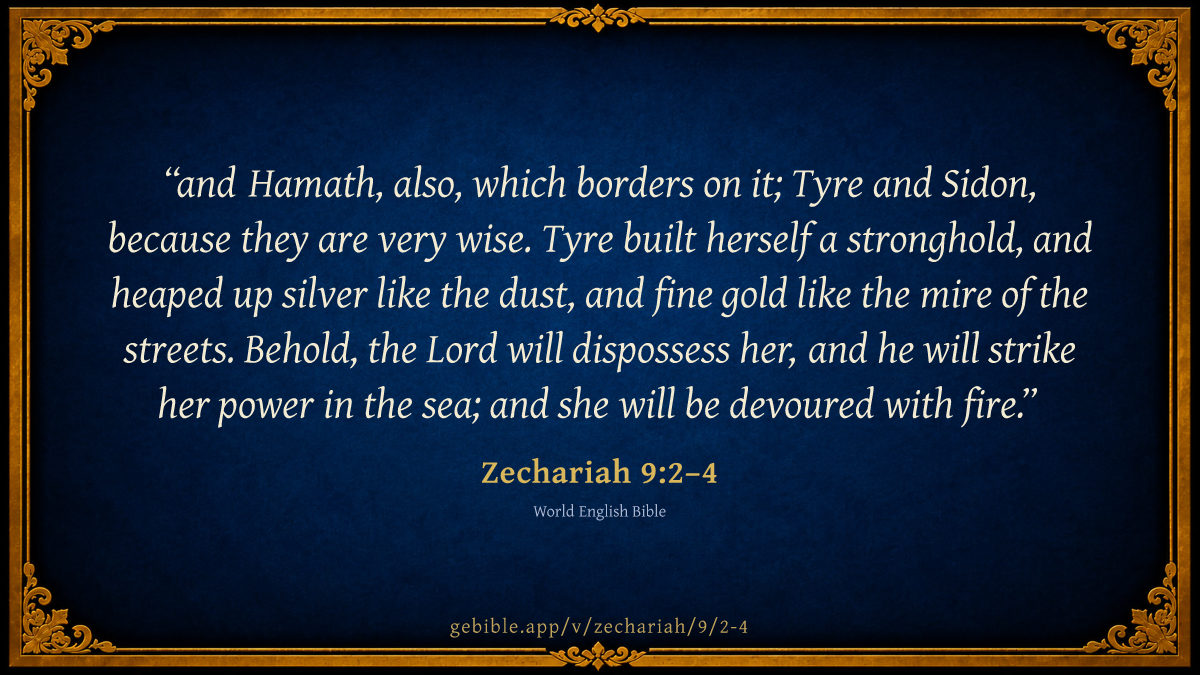
unfoldingWord translationNotes2017 · CC BY-SA 4.0On v3built herself a stronghold
built herself a stronghold
Here the city of Tyre is pictured as a woman. AT: "built a strong fortress" or "built a high wall" (See: Personification)
Read full note →
heaped up silver like dust and refined gold like mud in the streets
Yahweh exaggerates to emphasize how rich Tyre was. AT: "accumulated silver and gold as much as soil in the streets" (See: Hyperbole and Generalization)
Look! The Lord will dispossess her
Here "Look!" tells the reader to pay attention to the important statement that follows. AT: "Pay attention! The Lord will take away Tyre's possessions"
destroy her strength on the sea
Tyre's "strength on the sea" refers to the ships that were used for commerce and conquest. AT: "destroy Tyre's ships in which men fight on the sea" (See: Metonymy)
so she will be devoured by fire
This can be stated in active form. AT: "and enemies will burn the city to the ground" (See: Active or Passive)
Tyndale Open Study Notes2022 · CC BY-SA 4.0On vv2–39:2 Hamath, a fortress city on one of the…
9:2 Hamath, a fortress city on one of the southern trade routes from Asia Minor, was on the northern boundary of Israel (see Num 13:21; Josh 13:5). • The twin port cities of Tyre and Sidon were independent Phoenician kingdoms located on the Mediterranean coast north of Israel (modern-day Lebanon); they are often paired in biblical texts (e.g., Ezra 3:7; Joel 3:4; Luke 10:13-14). The cities were legendary for their maritime trade wealth, but Old Testament prophets condemned their pride and oppressive policies and predicted their destruction (Isa 23; Ezek 26:3-14; Amos 1:9-10).

John Calvin 1540 · Public Domain On vv2–4 Zechariah goes on with the same subject: for he…
Zechariah goes on with the same subject: for he says now, that destruction was nigh all the nations who, being neighbors, harassed the people of God. Yesterday I briefly referred to what he had in view, which was to show, that God would so defend his Church as to execute vengeance on all the ungodly who had unjustly persecuted it; and he spoke of the kingdom of Syria, which was contiguous to Judea. But he now goes farther, — that the wrath of God would extend to the remoter parts of Syria: for Hamath is Antioch the great, and it gave a name to a part of Syria. Damascus was the metropolis of the Syrian empire. But as we have said elsewhere, this word is variously taken in Scripture, but generally for the whole country extending from Judea to the Euphrates and even beyond it. We now then see why Zechariah adds Antioch to Syria, as though he had said, that God would now be the avenger of his people, not only by rewarding bordering cities, but also those afar off. He then passes on to Tyrus and Simon, which were, as it is well known, cities on the sea-side, and were also nigh to the Jews; for there was no great distance between Galilee and Phoenicia. But as we said yesterday, destruction is denounced on all the nations who had been inimical to the chosen people.
He says that Hamath, or Antioch, would be in its border. All nearly with one consent apply this to Judea or to Jerusalem, but they are mistaken; and this whole chapter is misunderstood by all expositors, Jews and others. I indeed feel ashamed when I see how widely they have departed from the meaning of the Prophet, and it will be almost a trial to me wholly to reject their mistakes. But it will become plainly evident that none of them have understood what the Prophet means.
Read full note →
They thus explain the passage, that Antioch would be within the borders of Judea, as God would consecrate to himself the lands which were before heathen. But the Prophet no doubt says, as I have already stated, that Antioch would be within the borders of Syria whenever God should visit them all for their wickedness, as though he had said, “God will involve in the same punishment that part of Syria which derives its name from Antioch, because with united forces had all the Syrians assailed his chosen people; though then they are far distant from Judea, they shall yet partake of the same punishment, because they took up arms against his Church.” Hamath then, or Antioch, shall be in the borders of Damascus; that is, it shall not be exempt from the punishment which God will inflict on the bordering kingdom of and. And as we advance this view will become more clear.
He adds, Tyrus and Sidon, though it be very wise. The particle כי, ki, is used, which is properly causal; but we may gather from many parts of Scripture that it is taken as an adversative. Either meaning would not, however, be unsuitable, that God would take vengeance on the Sidonians and Syrians, because they were very crafty, or though they were cautious, and seemed skillful and cunning in managing their affairs: they were not however to escape God’s judgment. If the former meaning be approved, it was the Prophet’s object to show, that when men are extremely provident and labor to fortify themselves by crafty means, God is opposed to them; for it is his peculiar office to take the crafty by their own craftiness. As then too much cunning and craftiness displease God, it may suitably be said, that the Syrians and Sidonians were now summoned before God’s tribunal, because they were extremely crafty, as is commonly the case with merchants in wealthy and maritime cities; for they learn much cunning by the many frauds which they are almost compelled to use. Since then the Sidonians and Syrians were such, it was right to denounce vengeance on them. But the other view is equally suitable, that all the craft of Tyrus and Simon would not prevent God from executing his judgment. As to myself, I think that a reason is here given why God threatens ruin to the Syrians and Sidonians, even because they were given to crafty artifices, and thus circumvented all their neighbors.
But he uses a good word by way of concession; for all who intend to deceive cover their craft with the name of wisdom or prudence. “They wish to be cautious,” when yet they wickedly deceive others by their intrigues and frauds. A concession then is made as to the word wise: but the Prophet at the same time teaches us, that this kind of wisdom is hateful to God, when by the loss of others we increase our own wealth: for an explanation immediately follows —
John Calvin's Commentaries (1540-1563) — public domain. Text from the Calvin Translation Society English edition (1840s-50s) via the Christian Classics Ethereal Library (ccel.org). Calvin's coverage is partial (roughly two-thirds of the Bible); uncommented books and verses are honest gaps, never fabricated. The 19th-century editor's footnotes and remarks are omitted so the notes are faithfully Calvin's own voice.
Geneva Bible translators 1599 · Public Domain On vv2, 4 He secretly showeth the cause of their destruction, because…
He secretly showeth the cause of their destruction, because they deceived all others by their craft and subtlety, which they cloaked with this name of wisdom.
That is, by Damascus: meaning, that Hamath or Antioch should be under the same rod and plague.
Geneva Bible (1599) marginal notes — public domain.
John Trapp 1656 · Public Domain On vv2–4 Zec 9:2 And Hamath also shall border thereby; Tyrus,…
Zec 9:2 And Hamath also shall border thereby; Tyrus, and Zidon, though it be very wise.
Ver. 2. And Hamath also shall border thereby] i.e. Shall share in the same punishment with Damascus, and fare the worse for its neighbourhood.
Read full note →
Though it be very wise] And think to outwit the enemy, to be too hard for him that way, as Midian was for Israel, by his wiles rather than by his wars, Num 25:18. God taketh these wizards in their own craft, δρασσομενος, 1Co 3:19, πανουργια, as beasts in a toil, and makes very fools of them, notwithstanding their many fetches; specially when they boast of their wit, as Tyre did, Eze 28:3-4, &c., and trust in it, Pro 3:5. The Phoenicians and Tyrians were wont to boast that they first found out the use of letters, &c. Sure it is that by much trading by sea they were growing cunning and crafty merchants, to defraud others; and this they coloured with the name of wisdom. Wise they were in their generation, Luk 16:8; but so is the fox, the serpent, and the devil; who when he was but young outwitted our first parents. And we are still sensible of his sleights, and not ignorant of his wiles, his methods, and his stratagems.
John Trapp, A Commentary or Exposition upon All the Books of the Old and New Testament (1647–1656) — public domain. Text from a community e-Sword module.
Matthew Poole 1685 · Public Domain On vv2–4 Hamath; a principal noted town of Syria, once called…
Hamath; a principal noted town of Syria, once called Epiphania; it was near neighbour to the Jews, for it was a boundary of the Land of Promise.
Shall border thereby; shall be so near to this storm which cometh, that they shall be the. worse for it. The country called by this name, in which Riblah was, and where the barbarous murder of many nobles of the Jews, the murder of Zedekiah’s children, and his eyes were put out; all which cruelty and such-like Hamath must suffer, for now God rides his circuit, and judgeth.
Read full note →
Tyrus; a famous mart as ever the world had, on which Ezekiel bestows his 26th, 27th, and 28th chapters, which see.
Zidon; another mart, and on the same sea, more ancient than Tyrus, and as much an enemy to the Jews; threatened, as here, so by Ezekiel, Eze 28, Tyrus, Eze 28:2, Zidon, Eze 28:21, which see.
Though it be very wise; each of them, i.e. the people, the governors, and counsellors of both these cities are subtle, and think by craft to save themselves, but this shall not be, God derides their wisdom, Eze 28:3.
Matthew Poole's English Annotations on the Holy Bible (1683–1685) — public domain. Text from a community e-Sword/MySword module.
John Gill 1763 · Public Domain On vv2–4 And Hamath also shall border thereby,.... By the land…
And Hamath also shall border thereby,.... By the land of Hadrach, or by Damascus; and that it was near Damascus is clear from Isa 10:9 it is called Hamath the great in Amo 6:2 and according to Jerom (d), is the same with Antioch, which he says was so called by some; and the Targum of Jonathan ben Uzziel on Num 13:21, renders Hamath by Antioch: and, if so, here was the Lord's rest likewise; here the Gospel was preached, and many converted, and a church, consisting of Jews and Gentiles, was formed; and here the disciples were first called Christians, Act 11:26.
Tyrus and Zidon; these were famous cities of Phoenicia; upon the borders of these our Lord himself was, Mat 15:21 of the conversion of the inhabitants of these places the psalmist prophecies, Psa 45:12 here likewise the Lord had his resting place; we read of the disciples here, Act 21:3,
Read full note →
though it be very wise; particularly Tyre, which was famous for wisdom, Eze 28:3 which the Lord confounded by the preaching of the Gospel, and by the foolishness of that saved them that believe. Kimchi refers this to the times of the Messiah; his note is, she shall not trust in her wisdom in the time of the Messiah: so Ben Melech.
(d) Comment. in Amos, fol. 44. C. & Quaest. Hebr. in Genesim, fol. 67. B. So Cyril. in Amos, p. 312.
John Gill's Exposition of the Whole Bible (1746–1763) — public domain (CC PDM 1.0). Text via the HelloAO Bible API.
John Wesley 1765 · Public Domain On vv2, 4 Hamath - A principal town of Syria. Shall border…
Hamath - A principal town of Syria. Shall border - Shall be so near the storm, that they shall not quite escape. Very wise - Each of them are subtle, and think by craft to save themselves, but God derides their wisdom.
John Wesley, Explanatory Notes Upon the Whole Bible (1754–1765) — public domain. Text via the GEBible commentary corpus.
Adam Clarke 1810 · Public Domain On vv2–4 Verse 2. And Hamath also shall border thereby] Hamath…
Verse 2. And Hamath also shall border thereby] Hamath on the river Orontes; and Tyre and Sidon, notwithstanding their political wisdom, address, and cunning, shall have a part in the punishment.
These prophecies are more suitable to the days of Jeremiah than to those of Zechariah; for there is no evidence - although Alexander did take Damascus, but without bloodshed - that it was destroyed from the times of Zechariah to the advent of our Lord. And as Tyre and Sidon were lately destroyed by Nebuchadnezzar, it is not likely that they could soon undergo another devastation.
Adam Clarke's Commentary on the Bible (1810–1826) — public domain. Text from a community e-Sword/MySword module.
Joseph Benson 1811 · Public Domain On v2 Zec 9:2-5. And Hamath also shall border there by…
Zec 9:2-5. And Hamath also shall border there by — Or, Hamath also shall be within its borders. That is, the borders of this prophecy. Hamath shall be involved in the calamities which this prophecy denounces. “I suppose,” says Newcome, “that Hamath on the river Orontes is meant.” It was the capital of one part of Syria, and formed, some time, an independent kingdom. See note on Jer 49:23. Tyrus and Zidon — These cities also, shall be reached by the judgments threatened in this prophecy; though it be very wise — Although Zidon prides itself so much for its skill and knowledge of things, and puts much confidence in its crafty counsels. Blayney renders the latter clause of this verse and the next, And Sidon, though she be very wise, and hath built Tyre, a fortress, for herself; and hath heaped up silver as the dust, and fine gold as the mire of the streets. Zidon was the capital of Phenicia, and mother of Tyre. For Justin informs us, (lib. 18. cap. 3,) that the Sidonians, when their city was taken by the king of Ascalon, betook themselves to their ships and built Tyre. Hence Tyre is called the daughter of Sidon, Isa 23:12. The Sidonians were famous all over the world for their knowledge and skill in arts and sciences, and for their great riches, acquired by their traffic: see notes on Isa 23:2; Isa 23:4; Isa 23:12; Eze 27:8; Eze 28:2.
Behold, the Lord will cast her out — Will cast out her inhabitants. And he will smite her power in the sea, &c. — The Sidonians, according to Diodorus Siculus, (lib. 16. p. 116;) on the approach of the army sent against them by Ochus, king of Persia, first of all destroyed their shipping at sea; and then retiring within the walls of the city, when they found they could hold out no longer, set fire to their houses, and burned themselves with all their families and effects together. Thus their wealth was effectually smitten, when by burning their ships, their commerce, the source of their riches, was annihilated; and this last act of desperation completely fulfilled the remaining part of the prophecy. No wonder if their neighbours, the Philistines, (as is signified in the next verse,) were struck with consternation at seeing the disastrous fate of those on whose assistance they depended. See Blayney. Probably also the destruction of Tyre by Alexander the Great may be predicted in these verses; of which see the places referred to above. Ashkelon shall fear; Gaza also be very sorrowful, and Ekron — These cities flattered themselves, that if Tyre could withstand Alexander, they also should be able to escape his hand; but Tyre being taken, all these hopes vanished. Alexander made himself master of Gaza immediately after the taking of Tyre; 10,000 of the inhabitants were slain, and the governor Betis dragged round the city wall till he was dead. King is a general word for any governor, in Hebrew, as has been before observed. Strabo, speaking of Gaza, lib. 16., says, “It was formerly a city of note, but was destroyed by Alexander the Great.” Or, according to Josephus, having suffered severely, upon being taken by Alexander, it was at length totally ruined and destroyed by Alexander Jannæus, one of the Asmonean kings of Judah. Hence we read, Act 8:26, Gaza which is desert. And Ashkelon shall not be inhabited — Blayney reads, shall not be established; literally, shall not sit. “Ashkelon, and the other cities of the Philistines, having been subjugated by Nebuchadnezzar, as foretold Jeremiah 47., never recovered their former independence, but, falling under the dominion of the great empires in succession, were almost continually involved in their wars, and suffered considerably, till by degrees they dwindled away, and at last sunk to nothing.”
Joseph Benson's Commentary on the Old and New Testaments (1811–1818) — public domain. Text from a community e-Sword module.
Albert Barnes 1834 · Public Domain On vv2–4 And Hamath also shall border thereby - o. Near…
And Hamath also shall border thereby - o. Near to it in place and character, it shall share its subdual. After the betrayal of Damascus, Parmenio was set over all Syria. “The Syrians, not as yet tamed by the losses of war, despised the new empire, but, swiftly subdued, they did obediently what they were commanded.”
And Zidon - Zidon, although probably older than Tyre , is here spoken of parenthetically, as subordinate. Perhaps, owing to its situation, it was a wealthy , rather than a strong place. Its name is “Fishing-town;” in Joshua, it is called “the great” Jos 11:8; Jos 19:28, perhaps the metropolis; while Tyre is named from its strength Jos 19:29. It infected Israel with its idolatry Jdg 10:6, and is mentioned among the nations who oppressed them and from whom God delivered them on their prayers Jdg 10:12, probably under Jabin. In the time of the Judges, it, not Tyre, was looked to for protection Jdg 18:7, Jdg 18:28. In the times of Ezekiel it had become subordinate, furnishing “rowers” Eze 27:8 to Tyre; but Esarhaddon, about 80 years before, boasts that he had taken it, destroyed its inhabitants, and re-populated it with people from the East, building a new city which he called by his own name . Tyre too had been taken by Nebuchadnezzar . At the restoration from the captivity, Sidon had the first place, Ezr 3:7, which it retained in the time of Xerxes . But Artaxerxes Ochus gained possession of it by treachery, when all Phoenicia revolted from Persia, and, besides those crucified, 40,000 of its inhabitants perished by their own hands , twenty years before the invasion of Alexander, to whom it submitted willingly .
Read full note →
The prophet having named Tyre and Zidon together, yet continues as to Tyre alone, as being alone of account in the days of which he is speaking, those of Alexander.
Although - Rather, “because she is very wise.” Man’s own wisdom is his foolishness and destruction, “as the foolishness of God” is his wisdom and salvation. God “taketh the wise in their own craftiness” Job 5:13. “For after that, in the wisdom of God, the world by wisdom knew not God, it pleased God by the foolishness of preaching to save them that believe” 1Co 1:21. Of the Hagarenes it is said, they “seek wisdom upon earth; none of these know the way of wisdom, or remember her paths” (Baruch 3:23). The wisdom of Tyre was the source of her pride, and so of her destruction also. “Because thy heart is lifted up, and thou hast said, I am a god, I sit in the seat of God, in the midst of the seas; yet thou art a man and not God, though thou hast set thine heart as the heart of God; behold thou art wiser them Daniel, there is no secret that they can hide from thee. Therefore I will bring strangers upon thee - they shall bring thee down to the pit” Eze 28:2, Eze 28:8. So of Edom Obadiah says, “The pride of thy heart hath deceived thee, thou that dwellest in the clefts of the rock. Shall I not destroy the wise men out of Edom, and understanding out of the mount of Esau?” Oba 1:3, Oba 1:8.
Albert Barnes' Notes on the Bible (1834–1885) — public domain. Text from a community e-Sword/MySword module.
Haydock's Catholic Bible Commentary 1859 · Public Domain On v2 Emath, or Emesa, not far from Damascus. (Calmet) ---…
Emath, or Emesa, not far from Damascus. (Calmet) --- It shall also fall a prey to Alexander. (Haydock) --- Tyre was become again very rich and strong, (Calmet) and gloried in its wisdom; yet was taken after a long and obstinate resistance (Haydock) of seven months, when the inhabitants were slain or sold, the city demolished, and the ships sunk. (Curtius iv.; Usher, the year of the world 3672.) --- Sidon made no resistance, as it hated the Persians. Yet Strabo was forced to resign the throne to Abdolonymus, (Arian ii.; Just. xi.) which indicates some opposition. (Calmet)
George Leo Haydock (1774–1849), Haydock's Catholic Family Bible and Commentary, 1859 edition — public domain. Excludes Psalms (Douay-Rheims chapter numbering differs from Protestant) and Deuterocanonical books (Catholic canon only).
Robert Jamieson, A. R. Fausset & David Brown 1871 · Public Domain On vv2–4 Hamath--a Syrian kingdom with a capital of the same…
Hamath--a Syrian kingdom with a capital of the same name, north of Damascus.
shall border thereby--shall be joined to Damascus in treatment, as it is in position; shall share in the burden of wrath of which Damascus is the resting-place. MAURER understands "which"; "Hamath, which borders on Damascus, also shall be the resting-place of Jehovah's wrath" (the latter words being supplied from Zac 9:1). Riblah, the scene of the Jews' sufferings from their foe, was there: it therefore shall suffer (Kg2 23:33; Kg2 25:6-7, Kg2 25:20-21).
Read full note →
Tyrus . . . Zidon--lying in the conqueror's way on his march along the Mediterranean to Egypt (compare Isa. 23:1-18). Zidon, the older city, surrendered, and Abdolonymus was made its viceroy.
very wise--in her own eyes. Referring to Tyre: Zac 9:3 shows wherein her wisdom consisted, namely, in building a stronghold, and heaping up gold and silver (Eze 38:3, Eze 38:5, Eze 38:12, Eze 38:17). On Alexander's expressing his wish to sacrifice in Hercules' temple in New Tyre on the island, she showed her wisdom in sending a golden crown, and replying that the true and ancient temple of Hercules was at Old Tyre on the mainland. With all her wisdom she cannot avert her doom.
Jamieson, Fausset & Brown — Commentary Critical and Explanatory on the Whole Bible (1871) — public domain (CC PDM 1.0). Text via the HelloAO Bible API.
The Cambridge Bible for Schools and Colleges 1878 · Public Domain On vv2–4 2. shall border thereby] i.e. as it is near…
2. shall border thereby] i.e. as it is near Damascus in situation and like it in character, so shall it be the neighbour or companion of Damascus in the calamities which shall come upon it. The clause may, however, be rendered, And also Hamath, which borders by it (Damascus), shall be its rest, i.e. the rest of the burden of the Lord, as Damascus was said to be in the former verse. Which bordereth thereon, R. V.
though it be very wise] Or, because she is, R. V. This is best referred to Tyre, the words, “and Zidon,” being almost parenthetical, “Tyre with Zidon.” Though Sidon was the mother city it had long been eclipsed by Tyre, to which in the predictions of other prophets (Isaiah 23; Eze_27:28), as here (Zec_9:3-4), the chief place is assigned. The “wisdom” of Tyre is specially mentioned by Ezekiel, “Behold, thou art wiser than Daniel” (Eze_28:3), and as here (Zec_9:3) its practical application to the amassing of wealth is noted (Zec_9:4-5), and this is made the cause of the judgment that comes upon her (Zec_9:6-7).
The Cambridge Bible for Schools and Colleges (gen. ed. J. J. S. Perowne; Cambridge University Press, 1878–1918) — public domain. Text from a community e-Sword module.
Ellicott's Commentary for English Readers 1878 · Public Domain On v2 (2) And Hamath . . . thereby.—Better, And even…
(2) And Hamath . . . thereby.—Better, And even upon Hamath, [which] borders on it: viz., on Damascus.
Thus far concerning Syria; now he speaks of Phœnicia. The terms of the denunciation of Syria are so general, that if they stood alone we should be at a loss to fix the era of their fulfilment. But the case is different with Tyre (Zec_9:2-4); for, though Tyre was besieged by Shalmanezer, and perhaps even taken by Nebuchadnezzar, it was certainly never “devoured with fire” until (B.C. 333) Alexander, “having slain all save those who fled to the temples, ordered the houses to be set on fire” (Q. Curtius). At the same time, though he attacked Phœnicia with the main body of his army, he sent a detachment under Parmenio to operate against Syria. To this date, then, we consider this prophecy to refer. (On the mention of these nations in particular, and the argument founded on the supposed similarity of Zec_1:1-8, and Amo_1:1 to Amo_2:6, see Introduction, B. 2.)
A Bible Commentary for English Readers, edited by Charles John Ellicott (1878–1897) — public domain. Text from a community e-Sword module.
The Pulpit Commentary 1880 · Public Domain On vv2–3 And Hamath also shall border thereby; Revised Version, and…
And Hamath also shall border thereby; Revised Version, and Hamath also which bordereth thereon. Hamath, which is near unto Damascus, shall share in the Divine judgment. The Authorized Version probably means that Hamath shall be the companion of Damascus in punishment. (For Hamath, see note on Amo_6:2) These Syrian towns, as well as those below in Phoenicia and Philistia, shall be visited, because they were all once included in the territory promised to Israel. (see Gen_15:18 Exo_23:31 Num_34:2-12 Deu_11:25; and comp. 2Sa_8:6, etc.; 1Ki_4:21 1Ki_8:65 2Ki_14:25) The judgment was inflicted by Alexander the Great after the battle of Issus, B.C. 333, when Damascus was betrayed into his hands and plundered of all its enormous treasures. Tyrus and Zidon. Tyre was taken after a siege of seven months, its walls were demolished, its houses burnt, ten thousand of its defenders were massacred, the women and children sold as slaves; and it never rose to greatness again. Zidon, originally the chief city of the country, had long been eclipsed by its daughter, Tyre: it submitted to Alexander without a struggle. Though it be very wise; or, because she is very wise. The pronoun refers to Tyre, the mention of Zidon being, as it were, parenthetical. In spite of, or because of, its boasted wisdom, Tyre should suffer heavy punishment. The wisdom of Tyre is spoken of in Eze_28:3, Eze_28:4. Wright, as the LXX, makes the clause refer to both cities, "though they be very wise." Vulgate, Assum pserunt quippe sibi sapientiam valde.
The Pulpit Commentary (1880–1919), ed. H.D.M. Spence-Jones & Joseph S. Exell — public domain. Text from a community e-Sword module.
unfoldingWord translationNotes 2017 · CC BY-SA 4.0 On v3 built herself a stronghold
built herself a stronghold
Here the city of Tyre is pictured as a woman. AT: "built a strong fortress" or "built a high wall" (See: Personification)
Read full note →
heaped up silver like dust and refined gold like mud in the streets
Yahweh exaggerates to emphasize how rich Tyre was. AT: "accumulated silver and gold as much as soil in the streets" (See: Hyperbole and Generalization)
Look! The Lord will dispossess her
Here "Look!" tells the reader to pay attention to the important statement that follows. AT: "Pay attention! The Lord will take away Tyre's possessions"
destroy her strength on the sea
Tyre's "strength on the sea" refers to the ships that were used for commerce and conquest. AT: "destroy Tyre's ships in which men fight on the sea" (See: Metonymy)
so she will be devoured by fire
This can be stated in active form. AT: "and enemies will burn the city to the ground" (See: Active or Passive)
translationWords
stronghold
silver
gold
lord
devour
fire
unfoldingWord translationNotes — © Distant Shores Media and the Door43 World Missions Community, licensed CC BY-SA 4.0. Source: git.door43.org/Door43/en_tn.
Tyndale Open Study Notes 2022 · CC BY-SA 4.0 On vv2–3 9:2 Hamath, a fortress city on one of the…
9:2 Hamath, a fortress city on one of the southern trade routes from Asia Minor, was on the northern boundary of Israel (see Num 13:21; Josh 13:5). • The twin port cities of Tyre and Sidon were independent Phoenician kingdoms located on the Mediterranean coast north of Israel (modern-day Lebanon); they are often paired in biblical texts (e.g., Ezra 3:7; Joel 3:4; Luke 10:13-14). The cities were legendary for their maritime trade wealth, but Old Testament prophets condemned their pride and oppressive policies and predicted their destruction (Isa 23; Ezek 26:3-14; Amos 1:9-10).
Tyndale Open Study Notes — © Tyndale Open Resources, licensed CC BY-SA 4.0. Text via the HelloAO Bible API.