Let me set the stage with a question that should bother anyone who uses the argument from prophecy: What happens to your messianic prophecy argument when the prophecy in question doesn't actually say what you think it says in the original language — and the version you're quoting is a Greek translation that diverged from the Hebrew? Because that's not a hypothetical. That's the actual state of affairs for several of the most important "prophecies fulfilled by Jesus" in the New Testament.
The Septuagint — the Greek translation of the Hebrew scriptures, typically abbreviated LXX — was the Bible of the early church. As Martin Hengel argues in The Septuagint as Christian Scripture, this Greek collection, not the Hebrew, became the functioning Old Testament of the first Christian communities. The New Testament authors were, by and large, quoting from it rather than from the Hebrew. And in several critical passages, the Septuagint says something meaningfully different from the Hebrew Masoretic Text. The New Testament writers built theological arguments on those divergences. And when you trace those arguments back to the original Hebrew, the foundation crumbles.
This is not some fringe skeptical talking point. Emanuel Tov, one of the foremost authorities on the text of the Hebrew Bible and editor-in-chief of the Dead Sea Scrolls publication project, has documented extensively in Textual Criticism of the Hebrew Bible how the Septuagint frequently represents a different textual tradition, paraphrases, or outright mistranslates the Hebrew Vorlage — the Hebrew text that the translators had in front of them. Karen Jobes and Moisés Silva, in their standard introduction Invitation to the Septuagint, make the same point with care and nuance: the LXX is an invaluable witness to the history of the biblical text, but it is not a transparent window onto the original Hebrew. It is a translation, with all the interpretive choices, errors, and theological tendencies that translations carry.
Here's the thing. When a fulfilled prophecy argument depends not on what the Hebrew prophet actually wrote, but on how it came to read in Greek centuries later, you don't have a prophecy. You have a post-hoc rationalization built on a Greek reading. Let me walk through the three most consequential cases.
Isaiah 7:14 — The Virgin Who Wasn't
This is the big one. Matthew 1:22–23 claims that the virgin birth of Jesus fulfilled Isaiah 7:14: "Behold, a virgin shall conceive, and bear a son, and shall call his name Immanuel" (KJV, the wording most English readers know). Matthew is quoting the Septuagint, which uses the Greek word parthenos — a word that, by the Hellenistic and especially New Testament period, typically connoted a virgin in the sexual sense, though in earlier Greek and in some Septuagint usage it could mean simply "young woman." But the Hebrew text of Isaiah 7:14 uses the word almah.
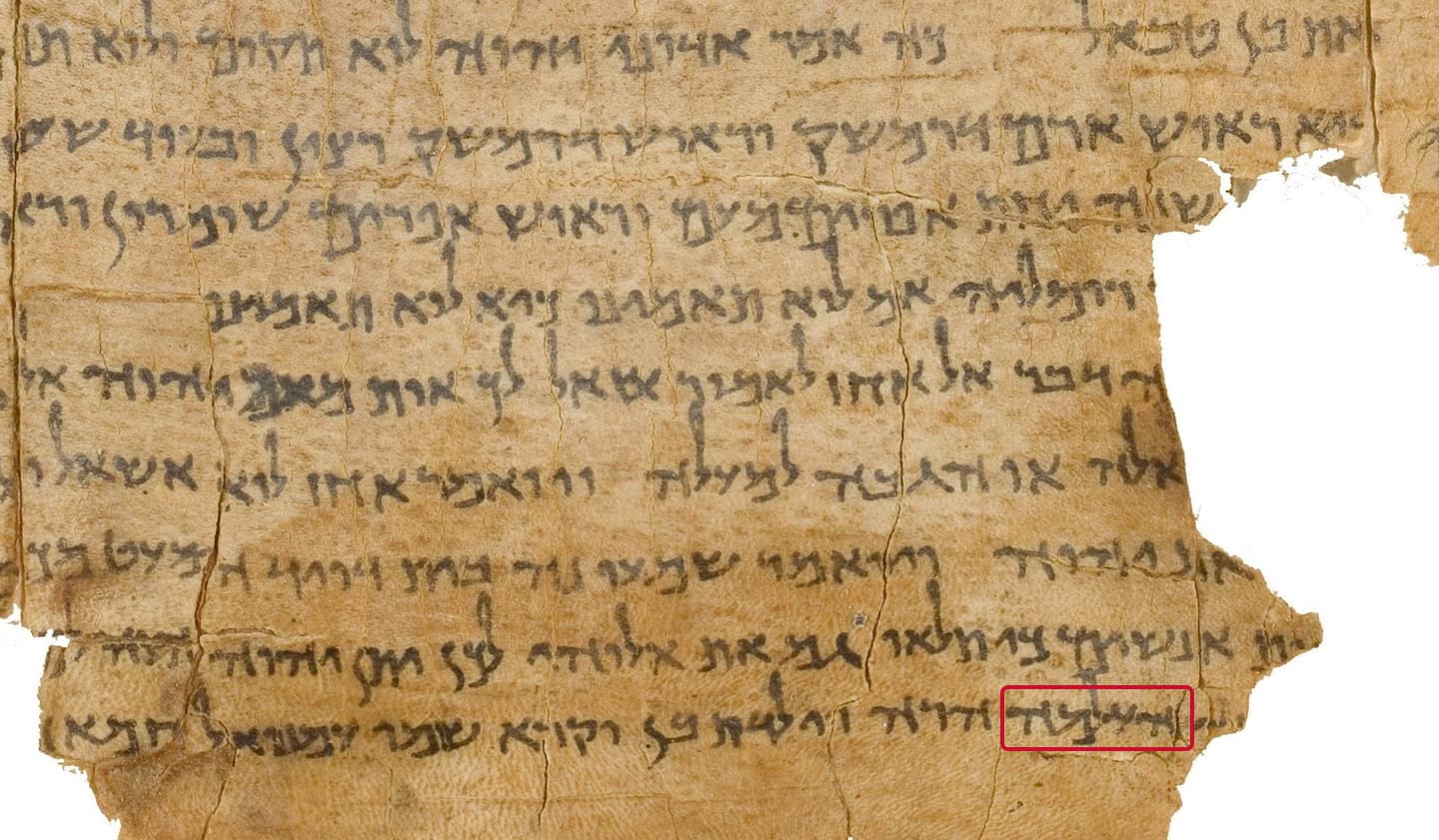
Isaiah 7:10–15 in column VI of the Great Isaiah Scroll (1QIsaᵃ) from Qumran, copied around 125 BCE. The outlined word on the last line is ha-'almah, "the young woman" (outline added).Source The Israel Museum, Jerusalem (Shrine of the Book); photograph by Ardon Bar-Hama, via Wikimedia Commons (Google Art Project); a faithful reproduction of a public-domain work. · Public domain · View original
And almah does not mean virgin.
The Hebrew word most often used when virginity is in view — a woman who has not had sexual intercourse — is betulah. That is the word in Deuteronomy 22:23 and in Judges 21:12. Even betulah is not perfectly unambiguous: in Joel 1:8 a betulah mourns the ba'al of her youth — her husband — and Genesis 24:16 has to add the gloss "No man had known her" (World English Bible) to make the virginity explicit. But it is the term that does the work when the authors want to specify virginity, and the crucial point is that Isaiah did not use it here. Almah simply means a young woman of marriageable age. It carries no specific claim about sexual status. The word occurs seven times in the Hebrew Bible, four in the singular and three in the plural alamot (nine if two musical headings are counted), and in none of those occurrences does the context require the meaning "virgin." In Genesis 24:43, Rebekah is called an almah — she is also called a betulah earlier in 24:16, which is where the actual assertion of virginity is made. If Isaiah had meant to prophesy a virginal conception — a biological miracle — he had a perfectly good Hebrew word available. He didn't use it.
The Septuagint translators chose parthenos to render almah. The Pentateuch was rendered into Greek in Alexandria around the middle of the 3rd century BCE, but the Prophets — including Isaiah — were translated later, in the 2nd century BCE; Emanuel Tov dates the Greek Isaiah to about 170–150 BCE on the basis of historical allusions in the text (Tov 2001, 137). Its provenance is also less secure than the Pentateuch's: while the vocabulary points to an Egyptian setting, the matter is not as settled as it is for the Greek Torah. Why parthenos? Jobes and Silva count the Greek Isaiah among the freer translations in the Septuagint, and the Greek word itself did not lock in the meaning "virgin." The decisive evidence is internal to the Septuagint: in Genesis 34:3 LXX, Dinah is still called a parthenos after she has been raped — which she plainly is not, in the sexual sense. The word could simply mean a young, unmarried woman. So the Isaiah rendering may not have been intended as a claim about virginity at all. But by the 1st century CE, parthenos had narrowed in meaning, and Matthew — reading the Septuagint — took it at face value.
The most capable defenders of the traditional reading no longer rest the case on almah. Michael Brown, in Answering Jewish Objections to Jesus, grants that "we cannot ... argue that Hebrew almah would have clearly and unequivocally conveyed the meaning of 'virgin'" to Isaiah's hearers. His case is contextual. The sign is addressed not to Ahaz alone but to the "house of David" (7:13), and the "you" who receives it in 7:14 is plural in Hebrew. The threat from Israel and Aram, Brown argues, "was that they would oust the Davidic king and put their own man on the throne." Read "in the larger context of Isaiah 7–11," the child of 7:14 belongs with the royal child of 9:6–7 and the shoot from the stump of Jesse in 11:1. The near-term clock, on this reading, is carried by Isaiah's own son in chapter 8, who "seems to take the place of the Immanuel prophecy in chapter 7 in terms of the immediate historical context." Immanuel himself points further off.
That is a serious argument, and the plural is real. But with the word itself largely conceded, the question is settled by the context, and the context is where the argument runs into trouble. Isaiah 7:14 is not a free-floating oracle about the distant future. It is embedded in a specific historical narrative. King Ahaz of Judah is facing a military crisis: the kings of Syria and Israel have allied against him, and he's terrified. The prophet Isaiah comes to him and tells him to ask God for a sign — any sign. Ahaz refuses. Isaiah, frustrated, turns to the whole royal house and gives a sign anyway: a young woman will conceive and bear a son, and before that child is old enough to tell right from wrong, the two kings threatening Ahaz will be gone. The clock is attached to this child, not to a brother in the next chapter. And when Isaiah names the deadline in 7:16, the Hebrew returns to the singular: the land "whose two kings you abhor" is Ahaz's land, and the "you" is Ahaz.
Read that again. The sign is given to Ahaz's court, in Ahaz's crisis. The child's growth is the clock by which the prophecy is measured. A child born 700 years later is useless as a sign to a king facing invasion next spring.
And the child belongs to Ahaz's own time. Isaiah 8:1–4 records the birth of Isaiah's own son, Maher-shalal-hash-baz, and attaches to him a closely parallel prophecy: before the child can say "my father" or "my mother," the wealth of Damascus and the spoil of Samaria will be carried away. The same crisis. The same timeline. The same kind of sign. Some interpreters identify the Immanuel child with Maher-shalal-hash-baz; others take him to be a son of Ahaz, or a child of the prophetic circle. The precise identification is still debated — Isaiah 8:8 addresses the land itself as "your land, Immanuel," which complicates any simple equation — but what is not seriously in dispute among critical scholars is that the child is a near-contemporary of Ahaz, not a figure seven centuries away. The "Immanuel" name is symbolic — "God is with us" — a reassurance to the king, not a proper name for a future messiah.
The royal-sequence reading runs into the same wall. Brown is right that chapters 7–11 are arranged as a sequence, and the later oracles of the royal child can be read as building on this one. But the sequence does not lift the first child out of his own century. When the Assyrian flood pours into Judah in 8:8, it fills "the width of your land, Immanuel." Whatever the later oracles promise, Immanuel is addressed inside the eighth-century crisis, not seven hundred years after it.
So what does Matthew's use of this passage actually demonstrate? It demonstrates that a 1st-century Jewish-Christian author, reading the Greek Septuagint, found a proof-text that fit his theological narrative. It does not demonstrate that Isaiah predicted a virgin birth. The prophecy, in its original language and context, is about something else entirely. That conclusion is mine — but the core reading is also the dominant one in critical scholarship: that Isaiah 7:14 is a sign directed to Ahaz, anchored in the eighth-century crisis, and not a prediction of a virginal conception. Joseph Blenkinsopp, in his Anchor Bible commentary on Isaiah 1–39, reads the oracle this way (pp. 233–239) — as a near-historical sign to the king — while noting that the child's exact identity cannot be fixed on the evidence we have. The near-historical sign is the settled point; the identification of the child is the part that remains open.
Psalm 22:16 — The Piercing That May Not Be There
Psalm 22 is the crown jewel of Christian crucifixion prophecy. Jesus himself is said to have quoted its opening line from the cross: "My God, my God, why have you forsaken me?" And verse 16 appears to contain an astonishingly specific prediction: "They have pierced my hands and feet."
Except the Hebrew Masoretic Text doesn't say that.
The MT of Psalm 22:17 (verse numbering differs) reads ka'ari yadai v'raglai — "like a lion, my hands and my feet." The phrase is admittedly awkward. "Like a lion my hands and feet" is not a smooth sentence, and scholars have debated for centuries what it means. Some suggest it's shorthand for "like a lion [they maul] my hands and feet." Others propose textual corruption. But the word on the page is ka'ari — "like a lion." Not "they pierced."
The Septuagint, however, reads ōryxan cheiras mou kai podas — "they dug/pierced my hands and feet." (The scholarly New English Translation of the Septuagint, the standard critical English rendering of the Greek, gives the verb here as "gouged" — that is, "dug" — not "pierced.") This is the reading most of the Christian tradition adopted, though Jerome, translating the Psalms afresh from the Hebrew, wrote vinxerunt, "they bound." And here is the critical question: which reading is original?
The apologetic case is best put by Michael Brown in Answering Jewish Objections to Jesus, and it stands on several legs, not one. The Septuagint, "the oldest existing Jewish translation of the Tanakh," read a verb here before there were any Christians, and the Syriac Peshitta followed it. The oldest surviving Hebrew copy of the psalm, a fragmentary first-century CE scroll from Nahal Hever designated 5/6HevPs, appears to read ka'aru — a verb, usually rendered "they dug" or "they bored" — where the MT has ka'ari. And Brown adds "about a dozen medieval Masoretic manuscripts" that read ka'aru or karu. On this view the verb is the older reading, and "like a lion" is the later one.
How much of that holds? First, the scroll, which deserves its due. The difference between ka'ari and ka'aru is a single letter, a yod against a vav. The official edition in Discoveries in the Judaean Desert judged the verbal reading "assured," with the two letters "clearly distinguishable in this hand" (DJD 38, 160–161, as quoted in Hopkin 2005, 167), and Peter Flint's survey of the Psalms scrolls records the word the same way (Flint 1997, 88). The dissent is real but narrower than skeptics often imply. Kristin Swenson, working from the published facsimile, judged the text too faded to read with confidence (Swenson 2004, 640–641 n. 12), and Rivka Ulmer sees the last letter as a somewhat elongated yod "almost appearing like" a vav, so that the word could be read either way (Ulmer 2011, 107). On the letter itself, the editors have the better of it.
Second, counting manuscripts settles nothing, in either direction. Tov states the principle plainly: "well-attested readings do not necessarily have more weight than singly attested readings" (Tov 2001, 39), because many copies can descend from a single ancestor. That cuts against Brown's dozen medieval manuscripts, and it cuts just as hard against the familiar skeptical reply that the MT's majority simply outvotes one early scroll. The case has to be made on the reading itself, which brings us to the verb.
Third — and this is the point that rarely gets mentioned in apologetic contexts — the verb ka'aru, if that's what it says, is not straightforwardly "they pierced." The root k-r-h means to dig, not to pierce. The Septuagint's ōryxan also means "they dug." Ulmer notes that the verb "is never used in the context of 'piercing' in the Hebrew Bible" (Ulmer 2011, 108).
That is also the answer to the Septuagint leg of Brown's case. A pre-Christian Jewish translator did read a verb here, and that should be conceded plainly. The Syriac Peshitta does say "they have pierced," but it is a later witness, from the late first or second century CE, and even Hopkin allows that its translators "in places" consulted the Septuagint (Hopkin 2005, 164), so it is not a second independent vote. But the ancient translators who read a verb do not agree on what it was. Aquila gave "they have disfigured" and, in a later revision, "they have bound"; Symmachus wrote "like those who seek to bind" (so Shon Hopkin, who himself defends "pierced," Hopkin 2005, 164–165); and Jerome, as noted, "they bound." Ulmer calls this "a major discrepancy in the renditions of the term" (108). Several translators reaching for several different verbs is what an obscure Hebrew word looks like. It is not a clear ancient witness to "pierced." In English Bibles, "they pierced" is an interpretive gloss that Christian translators have kept because it fits the crucifixion narrative. The psalm, read on its own terms, is a lament by a suffering individual — likely a king or other prominent figure — describing persecution by enemies using vivid animal metaphors: dogs, bulls, lions. "Like a lion, my hands and my feet" fits that pattern. "They have pierced my hands and feet" reads the psalm through the lens of crucifixion, which is precisely the kind of retrospective eisegesis we should expect from a community that believed its messiah had been crucified.
The single strongest apologetic detail in the crucifixion prophecy argument rests on a one-letter variant whose meaning, even if it is original, is "they dug," not "they pierced." That should give anyone pause.
Psalm 40:6 — The Body That Was Actually Ears
This one is less well-known among lay Christians, but it may be the most theologically consequential of the three, because it sits at the climax of the Epistle to the Hebrews' argument about the nature of Christ's sacrifice.
Hebrews 10:5–7 puts these words in the mouth of Christ: "You didn't desire sacrifice and offering, but you prepared a body for me. You had no pleasure in whole burnt offerings and sacrifices for sin. Then I said, 'Behold, I have come (in the scroll of the book it is written of me) to do your will, O God.'" The author of Hebrews is quoting Psalm 40:6–8 in Greek, in the form found in nearly every surviving Septuagint manuscript, and he builds his argument about the superiority of Christ's bodily sacrifice over the old animal sacrifices on the phrase "you prepared a body for me."
But the Hebrew of Psalm 40:6 says something completely different. The MT reads oznayim karita li — "ears you have dug/opened for me," where the WEB has "You have opened my ears." The verb karita comes from the same root, k-r-h, "to dig," that sits at the center of the Psalm 22 dispute. Not a body. Ears. The Hebrew text is about God opening the psalmist's ears — giving him the capacity to hear and obey — not about preparing a physical body for sacrifice. The image is of obedience, not incarnation.
How did "ears" become "a body"? The usual explanation is a part-for-the-whole reading: the God who hollows out the ears is the God who fashions the whole body. The harder question is who made the move, and here the Greek evidence is itself divided. No Hebrew manuscript reads "body." The Greek manuscripts of the Psalms read sōma, "a body," almost without exception. But Alfred Rahlfs's critical edition prints ōtia, "ears," on the strength of the Latin aures in the Gallican Psalter, and the NETS translation follows him: "but ears you fashioned for me." Karen Jobes and Moisés Silva observe in Invitation to the Septuagint that "virtually all commentators on Hebrews assume" the author found "body" in his Greek Psalter, and that New Testament commentators "either express surprise at Rahlfs's judgment or, more often, ignore it altogether." They side with Rahlfs, given "the generally literal character of OG Psalms," and argue that "it was the author of Hebrews rather than the Greek translator of Psalms who came up with the 'part for the whole' metonymy," a change that then "spread through nearly the whole OG tradition." They allow that he may instead have found sōma already in his text. Either way, the Hebrew says ears.
The author of Hebrews doesn't quote this passage in passing. He builds the climax of his argument on it. The point of Hebrews 10 is that the old sacrificial system was inadequate, that God never really wanted animal offerings, and that Christ came in a prepared body to offer the definitive sacrifice. A defender will reply that the author's own commentary in 10:8–9 turns on the other half of the quotation: "'Behold, I have come to do your will.' He takes away the first, that he may establish the second." That limb is in the Hebrew too, and Jobes and Silva themselves read the passage as being about Jesus's "sacrificial obedience" as well as his "one sacrificial body." The reply is fair as far as it goes. But the payoff comes in 10:10: "by which will we have been sanctified through the offering of the body of Jesus Christ once for all." The will is in the Hebrew. The body that carries it out is drawn from the one word the Hebrew does not contain. The Hebrew original — "ears you have opened for me" — supports a theology of obedience, not of incarnational sacrifice. It's a beautiful sentiment, but it's not the whole of what the author of Hebrews needed.
This means one of the most sophisticated christological arguments in the New Testament — one of its fullest arguments for Christ's bodily sacrifice — rests on a Greek wording that does not correspond to the Hebrew. The author of Hebrews was not reading the Hebrew Bible. He was reading Greek, and he built his theology on a Greek text's divergence from the original. If Jobes and Silva are right, he did not inherit that divergence. He made it.
What Does This All Mean?
The implications are worth stating plainly.
The messianic prophecy argument — the claim that the Hebrew scriptures contain specific predictions about Jesus that were fulfilled in precise detail — is the single most popular evidential argument for Christianity. It is the argument that convinced many converts in the ancient world, and it is the argument that apologists like Josh McDowell, Lee Strobel, and Michael Brown continue to press today.
But in case after case, when you go back to the original Hebrew and read the passages in their literary and historical context, the "prophecies" turn out to depend on Greek wording that the Hebrew does not bear out: a translator's word later read more narrowly than he may have meant it (Isaiah 7:14), an obscure Hebrew word that the Greek resolved one way among several (Psalm 22:16), and a Greek reading that may be the New Testament author's own (Psalm 40:6). The New Testament authors were not checking the Hebrew. They were reading the Septuagint, and they were reading it through the lens of their already-existing belief that Jesus was the messiah. They found what they were looking for because they were looking for it — and because the Greek they read, or the way they read it, said in several key places something the original did not.
This is not a conspiracy. It is not fraud. It is how religious communities have always interacted with sacred texts — through interpretation, reinterpretation, and creative reading. But it is also not prophecy fulfillment in any meaningful evidential sense. You cannot claim that God predicted an event in the Hebrew scriptures when your evidence for the prediction depends on Greek wording that the Hebrew does not support.
The parsimonious explanation is straightforward: early Christians, already convinced that Jesus was the messiah, searched their scriptures — in Greek — for passages that could be read as referring to him. They found them, sometimes by decontextualizing verses, sometimes by relying on translation divergences, sometimes by both. That is not foreknowledge. It is a community reading its scriptures in the light of what it already believed.
And there it is. If the prophecy only works in translation, it's not a prophecy. It's a reading strategy.
Sources
Blenkinsopp, Joseph. Isaiah 1–39: A New Translation with Introduction and Commentary. Anchor Bible, Vol. 19. New York: Doubleday, 2000.
Brown, Michael L. Answering Jewish Objections to Jesus, Vol. 3: Messianic Prophecy Objections. Grand Rapids: Baker Books, 2003. (Represents the apologetic counter-position.)
Charlesworth, James H., et al., eds. Miscellaneous Texts from the Judaean Desert. Discoveries in the Judaean Desert 38. Oxford: Clarendon, 2000.
Flint, Peter W. The Dead Sea Psalms Scrolls and the Book of Psalms. Studies on the Texts of the Desert of Judah 17. Leiden: Brill, 1997.
Hengel, Martin. The Septuagint as Christian Scripture: Its Prehistory and the Problem of Its Canon. Edinburgh: T&T Clark, 2002.
Hopkin, Shon. "The Psalm 22:16 Controversy: New Evidence from the Dead Sea Scrolls." BYU Studies 44, no. 3 (2005): 161–172. (Defends the "pierced" reading; cited for the ancient versions and for the wording of DJD 38.)
Jerome. Psalterium iuxta Hebraeos Hieronymi. Edited by Paul de Lagarde. Leipzig: Teubner, 1874.
Jobes, Karen H., and Moisés Silva. Invitation to the Septuagint. 2nd ed. Grand Rapids: Baker Academic, 2015.
Pietersma, Albert, and Benjamin G. Wright, eds. A New English Translation of the Septuagint. New York: Oxford University Press, 2007.
Swenson, Kristin M. "Psalm 22:17: Circling around the Problem Again." Journal of Biblical Literature 123, no. 4 (2004): 637–648.
Tov, Emanuel. Textual Criticism of the Hebrew Bible. 2nd rev. ed. Minneapolis: Fortress Press; Assen: Royal Van Gorcum, 2001.
Ulmer, Rivka. "Psalm 22 in Pesiqta Rabbati: The Suffering of the Jewish Messiah and Jesus." In The Jewish Jesus: Revelation, Reflection, Reclamation, edited by Zev Garber, 106–128. West Lafayette, IN: Purdue University Press, 2011.