
Then the channels of the sea appeared. The foundations of the world were laid bare by Yahweh’s rebuke, at the blast of the breath of his nostrils.
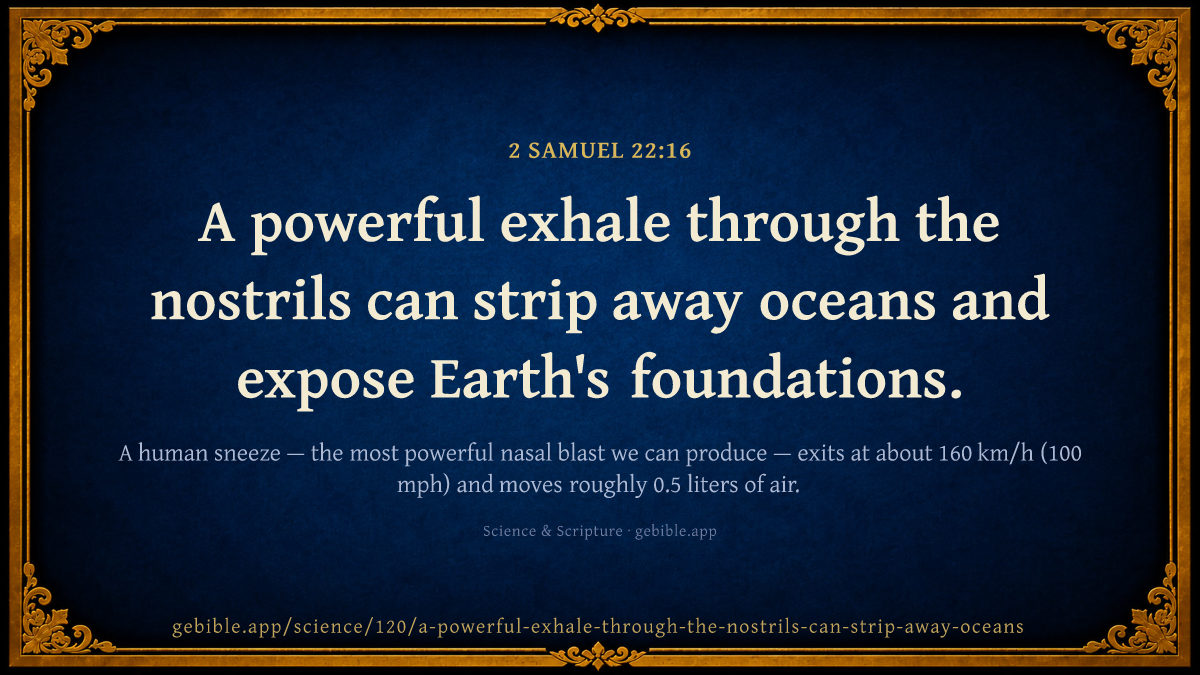
A powerful exhale through the nostrils can strip away oceans and expose Earth's foundations.
Geology
25
passages in this field
Show this passage in
The cited passage
What current science says
A human sneeze — the most powerful nasal blast we can produce — exits at about 160 km/h (100 mph) and moves roughly 0.5 liters of air. The oceans contain about 1.335 billion cubic kilometers of water. You'd need to sneeze continuously for longer than the current age of the universe to move even a tiny lake's worth of water. Also, Earth doesn't have exposed 'foundations' — it's layers of crust, mantle, and core all the way down.
What the text says
This comes from 2 Samuel 22:16. 'The foundations of the world were discovered at the blast of the breath of his nostrils' — a single nasal exhale allegedly revealed the bedrock of the planet.
Three honest ways to read this passage
-
As history
The text records how its authors understood the world with the knowledge they had. Read this way, a difference from modern science is a window into the ancient mind, not a failure.
-
As accommodation
The text speaks to its first audience in their own terms, to make a point that isn't mainly about physics or biology. Read this way, the scientific detail is the vehicle, not the cargo.
-
As contradiction
The text makes a claim about the physical world that modern findings dispute. Read this way, the difference is a genuine factual disagreement worth naming.
GEBible doesn't pick one of these for you. Each entry shows the passage, what it says, and what current science says — nothing more.