
“Can you hunt the prey for the lioness, or satisfy the appetite of the young lions, when they crouch in their dens, and lie in wait in the thicket? Who provides for the raven his prey, when his young ones cry to God, and wander for lack of food?
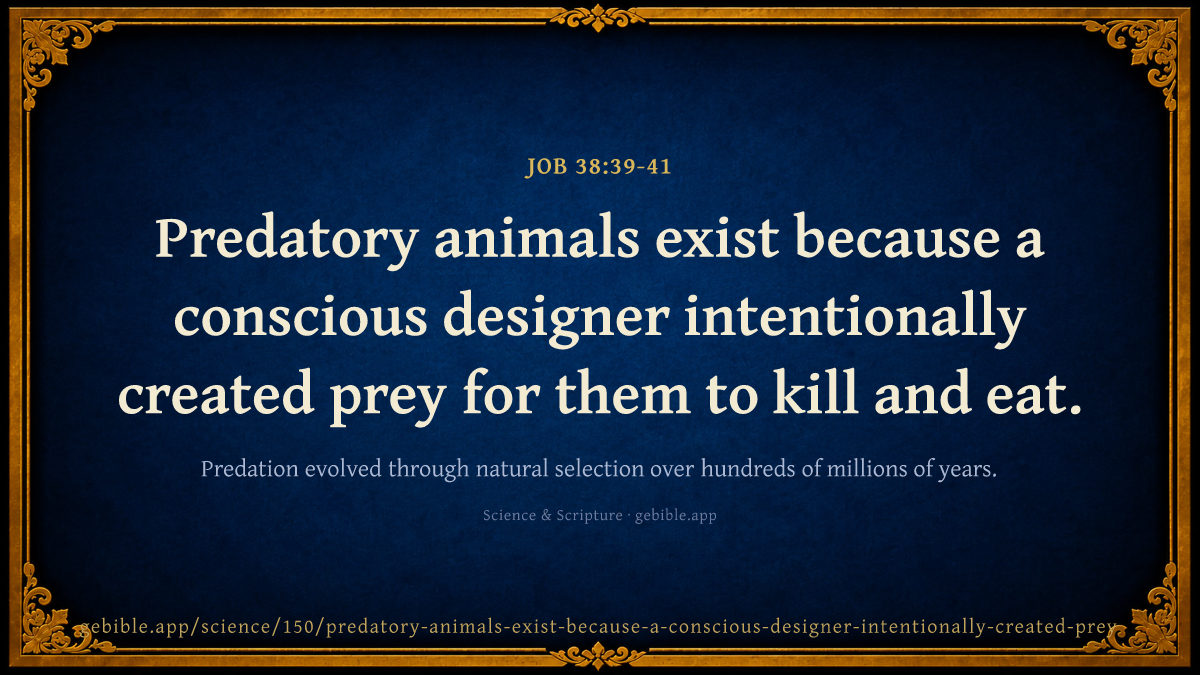
Predatory animals exist because a conscious designer intentionally created prey for them to kill and eat.
Biology
59
passages in this field
Show this passage in
The cited passage
What current science says
Predation evolved through natural selection over hundreds of millions of years. Predators and prey are locked in an evolutionary arms race — prey evolve faster legs, better camouflage, or sharper quills, and predators evolve to counter them. This process has no goal, no designer, and no intent. It's driven by differential survival and reproduction. The fossil record shows this arms race stretching back at least 500 million years to the Cambrian explosion, when the first predators appeared. Predation exists because organisms that ate other organisms survived and reproduced more successfully — not because someone planned a menu.
What the text says
This comes from Job 38:39-41. The text portrays predation as a divine feature, not a bug — boasting about providing prey for lions and food for ravens, as though a designer carefully engineered the food chain.
Three honest ways to read this passage
-
As history
The text records how its authors understood the world with the knowledge they had. Read this way, a difference from modern science is a window into the ancient mind, not a failure.
-
As accommodation
The text speaks to its first audience in their own terms, to make a point that isn't mainly about physics or biology. Read this way, the scientific detail is the vehicle, not the cargo.
-
As contradiction
The text makes a claim about the physical world that modern findings dispute. Read this way, the difference is a genuine factual disagreement worth naming.
GEBible doesn't pick one of these for you. Each entry shows the passage, what it says, and what current science says — nothing more.