
The young lions roar after their prey, and seek their food from God.
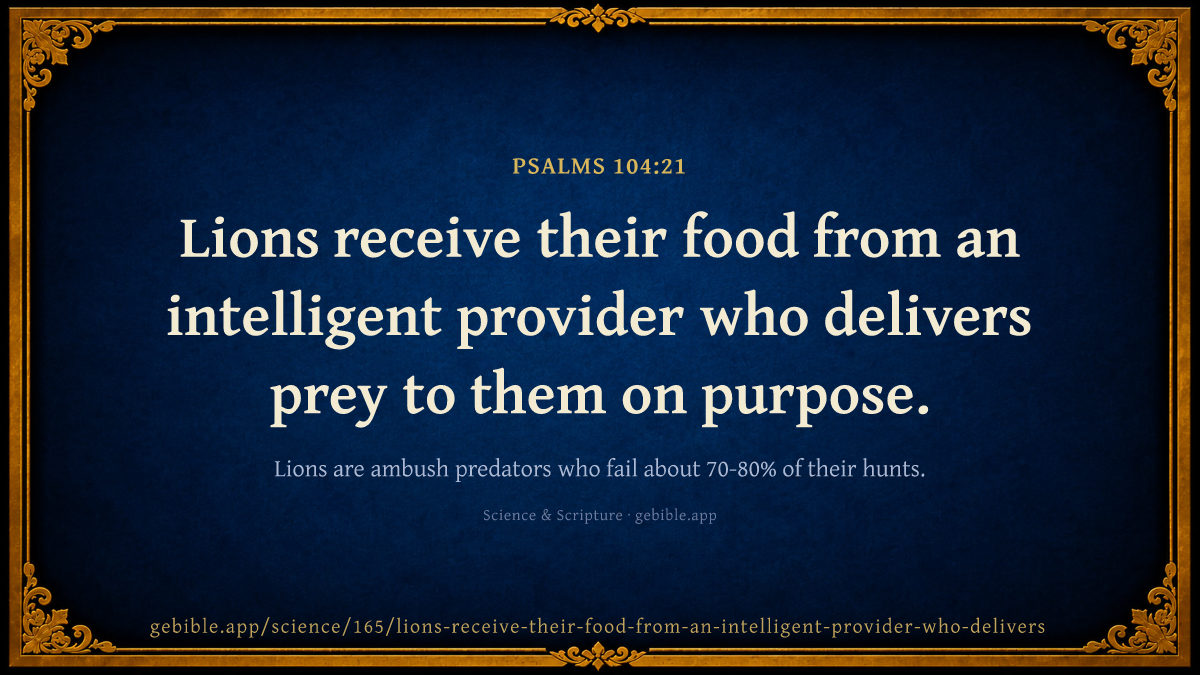
Lions receive their food from an intelligent provider who delivers prey to them on purpose.
Zoology
38
passages in this field
Show this passage in
The cited passage
What current science says
Lions are ambush predators who fail about 70-80% of their hunts. If someone were deliberately providing their meals, they're doing a terrible job. Lions succeed roughly once in every four to five attempts, and prides regularly go days without eating. Their hunting ability comes from millions of years of evolutionary adaptation — binocular vision, retractable claws, powerful jaw muscles, and cooperative hunting strategies. No external provider is involved. In fact, lion populations are crashing worldwide (down about 43% in the last 21 years) because habitat loss has reduced their prey — suggesting nobody's restocking the fridge.
What the text says
This comes from Psalms 104:21. 'The young lions roar after their prey, and seek their meat from God' — the text frames predation as a deliberate food-delivery service from a divine provider.
Three honest ways to read this passage
-
As history
The text records how its authors understood the world with the knowledge they had. Read this way, a difference from modern science is a window into the ancient mind, not a failure.
-
As accommodation
The text speaks to its first audience in their own terms, to make a point that isn't mainly about physics or biology. Read this way, the scientific detail is the vehicle, not the cargo.
-
As contradiction
The text makes a claim about the physical world that modern findings dispute. Read this way, the difference is a genuine factual disagreement worth naming.
GEBible doesn't pick one of these for you. Each entry shows the passage, what it says, and what current science says — nothing more.