
Now when Jesus was born in Bethlehem of Judea in the days of King Herod, behold, wise men from the east came to Jerusalem, saying,
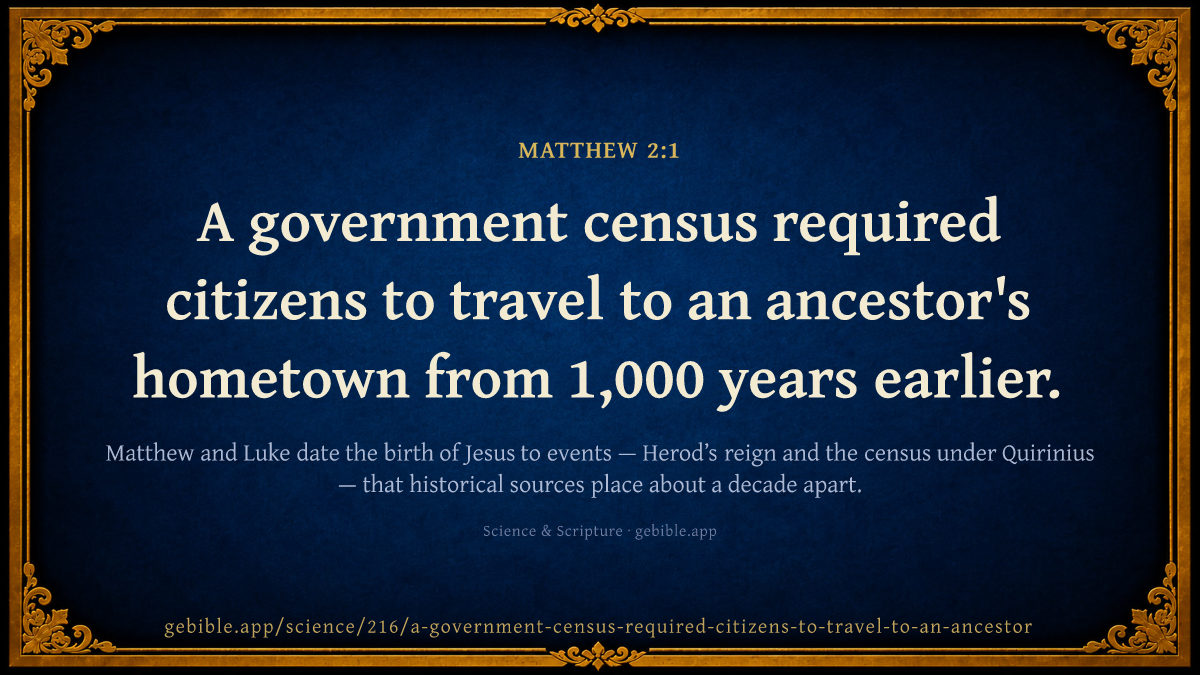
A government census required citizens to travel to an ancestor's hometown from 1,000 years earlier.
History/Archaeology
26
passages in this field
Show this passage in
The cited passage
Anatomy of the claim
- Documented Historical sources place the death of Herod the Great at about 4 BCE. Josephus, Jewish Antiquities
- Documented A census conducted under Quirinius, covering Judea, is recorded for about 6 CE. Josephus, Jewish Antiquities
- Documented Matthew anchors the birth to the reign of Herod, while Luke ties it to the census under Quirinius — placing the two accounts about a decade apart.
- Documented Roman censuses recorded people where they lived, for local taxation; no surviving record attests an empire-wide requirement to travel to an ancestral hometown. Encyclopaedia Britannica
- Debated Whether the divergence can be reconciled is debated: some read Luke as an earlier enrolment or a first term for Quirinius, while others hold that the census of 6 CE cannot fall within Herod’s reign. Sir William Ramsay (1915); Theodor Mommsen (d. 1903); Emil Schürer (d. 1910)
What the text says
This comes from Matthew 2:1 and Luke 2:1-2. Matthew places the birth during King Herod's reign (before 4 BCE), while Luke places it during a census by Quirinius, governor of Syria — which historically occurred in 6 CE, at least a decade later. Luke also claims the census required people to return to their ancestral hometowns.
Three honest ways to read this passage
-
As history
The text records how its authors understood the world with the knowledge they had. Read this way, a difference from modern science is a window into the ancient mind, not a failure.
-
As accommodation
The text speaks to its first audience in their own terms, to make a point that isn't mainly about physics or biology. Read this way, the scientific detail is the vehicle, not the cargo.
-
As contradiction
The text makes a claim about the physical world that modern findings dispute. Read this way, the difference is a genuine factual disagreement worth naming.
GEBible doesn't pick one of these for you. Each entry shows the passage, what it says, and what current science says — nothing more.