
Seeing them distressed in rowing, for the wind was contrary to them, about the fourth watch of the night he came to them, walking on the sea, and he would have passed by them, but they, when they saw him walking on the sea, supposed that it was a ghost, and cried out; for they all saw him, and were troubled. But he immediately spoke with them, and said to them, “Cheer up! It is I! Don’t be afraid.” He got into the boat with them; and the wind ceased, and they were very amazed among themselves, and marveled;
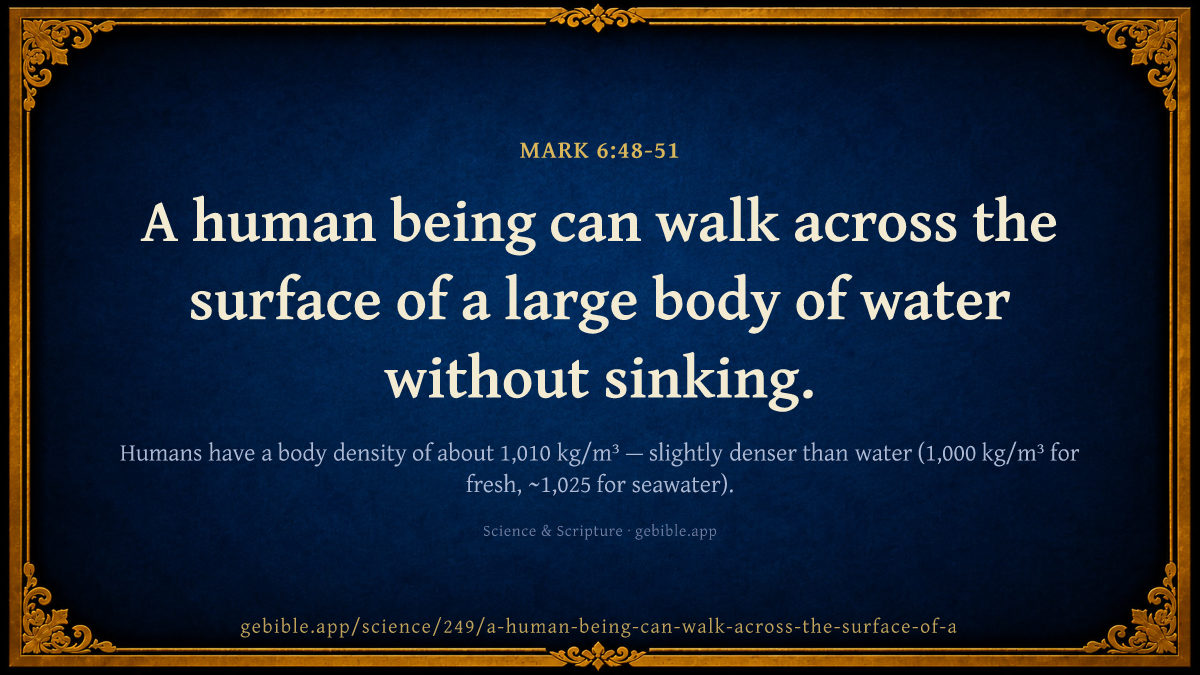
A human being can walk across the surface of a large body of water without sinking.
Physics
5
passages in this field
Show this passage in
The cited passage
What current science says
Humans have a body density of about 1,010 kg/m³ — slightly denser than water (1,000 kg/m³ for fresh, ~1,025 for seawater). To walk on water, you'd need to push down with enough force and speed to stay on the surface, like a basilisk lizard does. But a basilisk weighs about 200 grams. A 70 kg human would need to slap the water at roughly 30 meters per second with feet the size of kiddie pools. In short: physics says no, you're going swimming.
What the text says
This comes from Mark 6:48-51. The text describes a person walking on the sea during a storm and then calming the wind upon boarding a boat — violating both fluid dynamics and meteorology in one passage.
Three honest ways to read this passage
-
As history
The text records how its authors understood the world with the knowledge they had. Read this way, a difference from modern science is a window into the ancient mind, not a failure.
-
As accommodation
The text speaks to its first audience in their own terms, to make a point that isn't mainly about physics or biology. Read this way, the scientific detail is the vehicle, not the cargo.
-
As contradiction
The text makes a claim about the physical world that modern findings dispute. Read this way, the difference is a genuine factual disagreement worth naming.
GEBible doesn't pick one of these for you. Each entry shows the passage, what it says, and what current science says — nothing more.