
‘where their worm doesn’t die, and the fire is not quenched.’ ‘where their worm doesn’t die, and the fire is not quenched.’ ‘where their worm doesn’t die, and the fire is not quenched.’
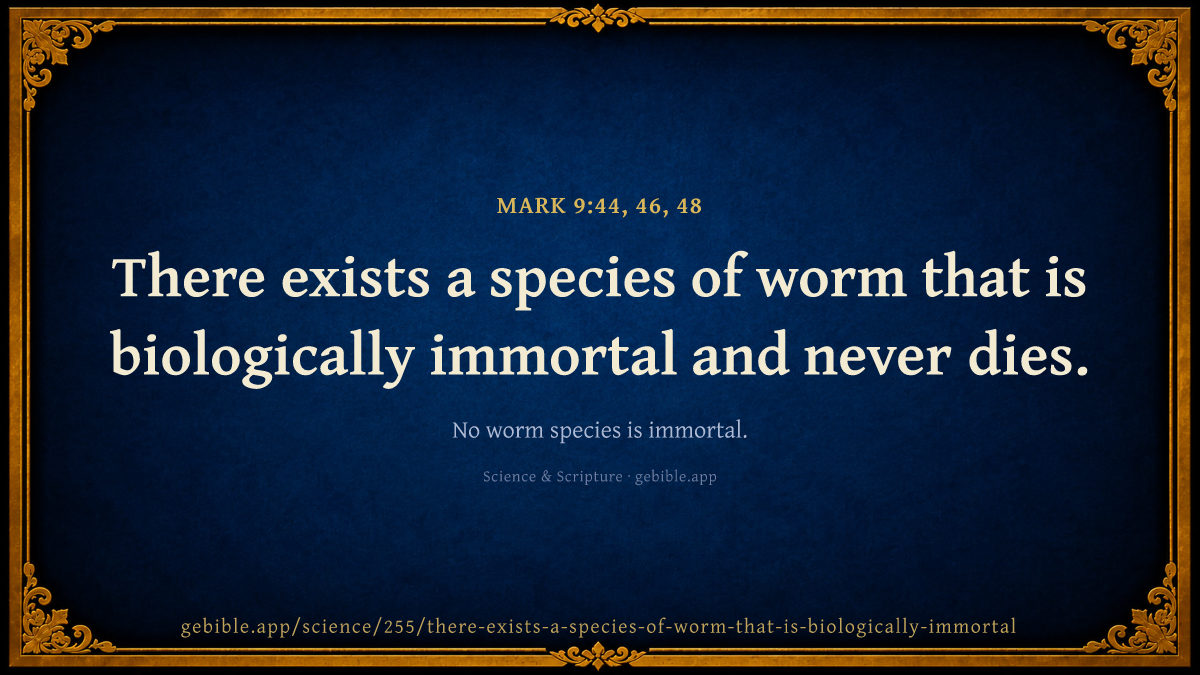
There exists a species of worm that is biologically immortal and never dies.
Zoology
38
passages in this field
Show this passage in
The cited passage
What current science says
No worm species is immortal. Most worms have quite short lifespans — earthworms live 4-8 years max, and many parasitic worms only survive weeks to months. The longest-lived worms we know of are certain deep-sea tube worms (Escarpia laminata) that may reach 250-300 years, which is impressive but very much not immortal. The only animal with a claim to biological immortality is the jellyfish Turritopsis dohrnii, which can revert to its juvenile stage — and that's a jellyfish, not a worm. Everything biological eventually dies; entropy always wins.
What the text says
This comes from Mark 9:44, 46, and 48, which three times repeats the phrase 'where their worm dieth not' — describing a place of punishment inhabited by undying worms that feed on the condemned forever.
Three honest ways to read this passage
-
As history
The text records how its authors understood the world with the knowledge they had. Read this way, a difference from modern science is a window into the ancient mind, not a failure.
-
As accommodation
The text speaks to its first audience in their own terms, to make a point that isn't mainly about physics or biology. Read this way, the scientific detail is the vehicle, not the cargo.
-
As contradiction
The text makes a claim about the physical world that modern findings dispute. Read this way, the difference is a genuine factual disagreement worth naming.
GEBible doesn't pick one of these for you. Each entry shows the passage, what it says, and what current science says — nothing more.