
For every kind of animal, bird, creeping thing, and sea creature, is tamed, and has been tamed by mankind;
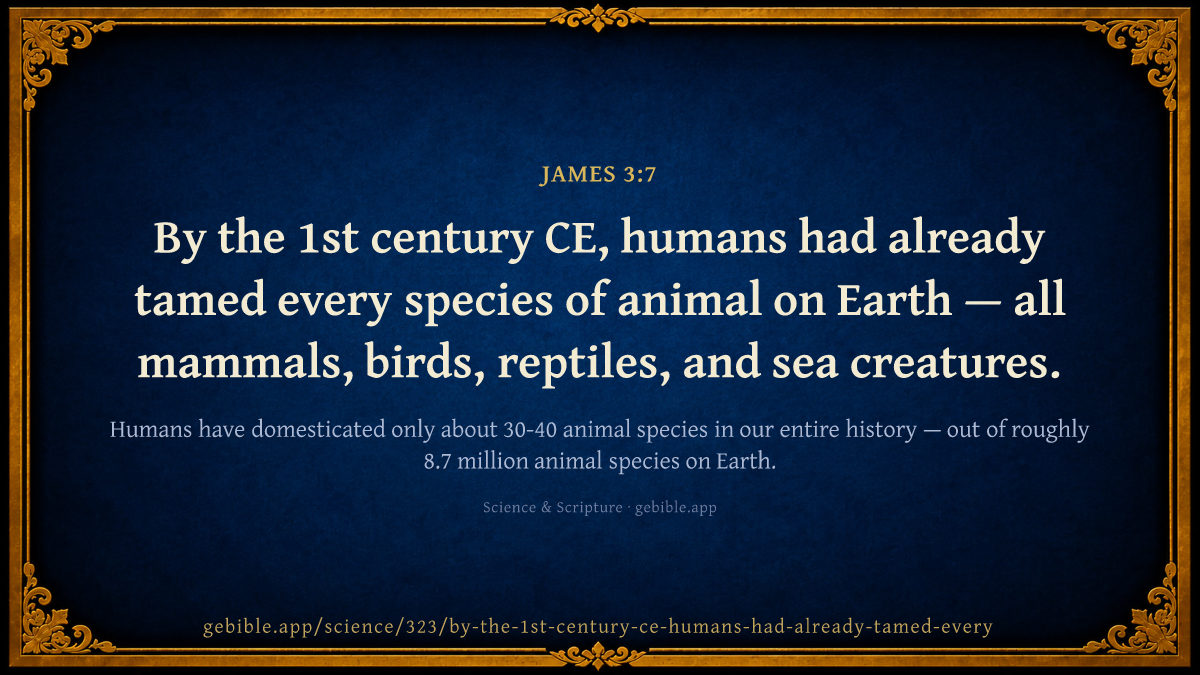
By the 1st century CE, humans had already tamed every species of animal on Earth — all mammals, birds, reptiles, and sea creatures.
Zoology
38
passages in this field
Show this passage in
The cited passage
What current science says
Humans have domesticated only about 30-40 animal species in our entire history — out of roughly 8.7 million animal species on Earth. That's a domestication rate of about 0.0004%. Most animals cannot be domesticated because they lack key traits: a manageable temperament, a social hierarchy humans can exploit, a fast growth rate, and willingness to breed in captivity. No one has tamed great white sharks, mosquitoes, polar bears, or deep-sea anglerfish. The blue whale — the largest animal that has ever lived — has never been tamed by anyone. Many species weren't even discovered by the 1st century, let alone tamed.
What the text says
This comes from James 3:7, which says 'every kind of beasts, and of birds, and of serpents, and of things in the sea, is tamed, and hath been tamed of mankind.' The text claims total domestication of all animal life was already accomplished in antiquity.
Three honest ways to read this passage
-
As history
The text records how its authors understood the world with the knowledge they had. Read this way, a difference from modern science is a window into the ancient mind, not a failure.
-
As accommodation
The text speaks to its first audience in their own terms, to make a point that isn't mainly about physics or biology. Read this way, the scientific detail is the vehicle, not the cargo.
-
As contradiction
The text makes a claim about the physical world that modern findings dispute. Read this way, the difference is a genuine factual disagreement worth naming.
GEBible doesn't pick one of these for you. Each entry shows the passage, what it says, and what current science says — nothing more.