
As the partridge that sits on eggs which she has not laid, so is he who gets riches, and not by right. In the middle of his days, they will leave him. At his end, he will be a fool.
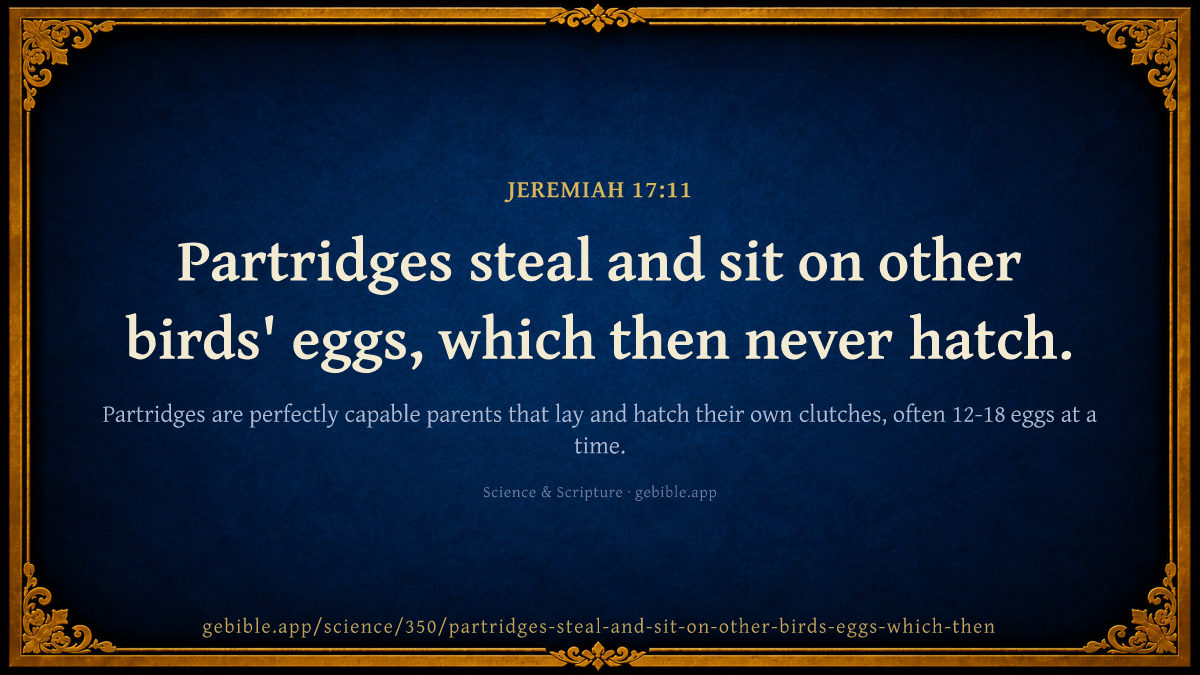
Partridges steal and sit on other birds' eggs, which then never hatch.
Zoology
38
passages in this field
Show this passage in
The cited passage
What current science says
Partridges are perfectly capable parents that lay and hatch their own clutches, often 12-18 eggs at a time. The old myth that they hoard rival birds' eggs comes from spotting their well-hidden ground nests, not from biology. Laying eggs in someone else's nest is the cuckoo's trick, not the partridge's — and even cuckoo eggs hatch just fine.
What the text says
This comes from Jeremiah 17:11. The partridge is pictured sitting on eggs it did not lay, only for them to come to nothing — an image for wealth gotten unjustly.
Three honest ways to read this passage
-
As history
The text records how its authors understood the world with the knowledge they had. Read this way, a difference from modern science is a window into the ancient mind, not a failure.
-
As accommodation
The text speaks to its first audience in their own terms, to make a point that isn't mainly about physics or biology. Read this way, the scientific detail is the vehicle, not the cargo.
-
As contradiction
The text makes a claim about the physical world that modern findings dispute. Read this way, the difference is a genuine factual disagreement worth naming.
GEBible doesn't pick one of these for you. Each entry shows the passage, what it says, and what current science says — nothing more.