
When I had gone up onto the mountain to receive the stone tablets, even the tablets of the covenant which Yahweh made with you, then I stayed on the mountain forty days and forty nights. I neither ate bread nor drank water.
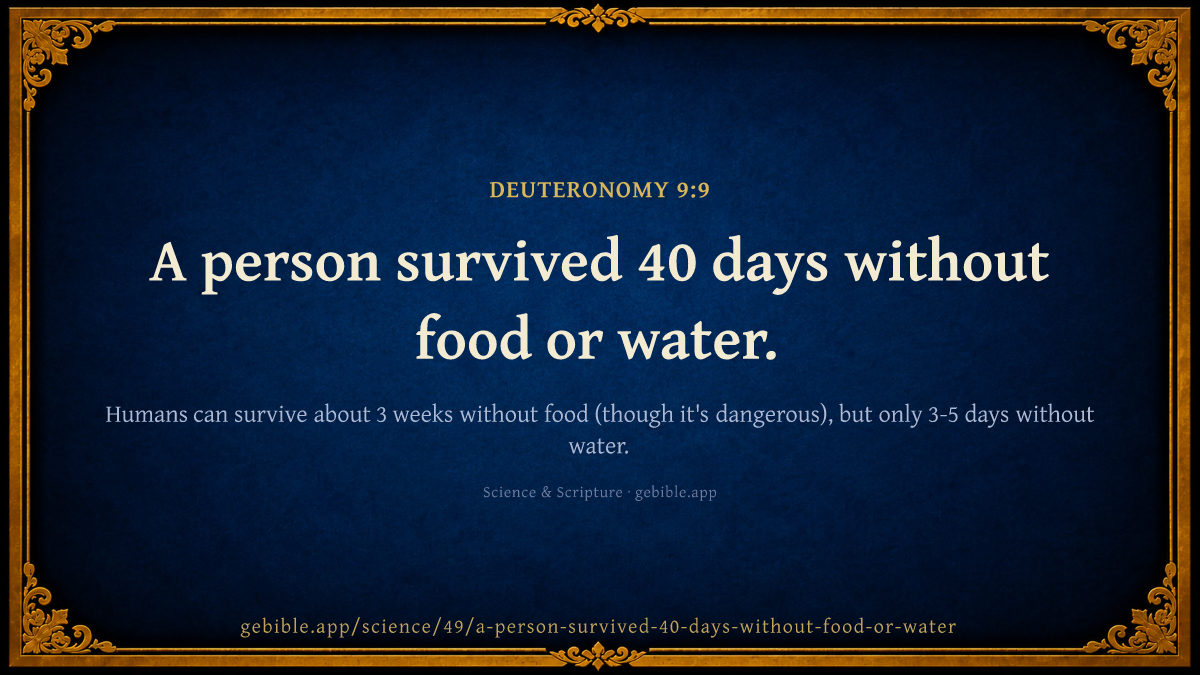
A person survived 40 days without food or water.
Medicine
97
passages in this field
Show this passage in
The cited passage
What current science says
Humans can survive about 3 weeks without food (though it's dangerous), but only 3-5 days without water. After that, dehydration causes organ failure and death. Surviving 40 days without any water is physically impossible for any human being.
What the text says
Deuteronomy 9:9 has Moses recount staying on the mountain to receive the stone tablets, where he "abode in the mount forty days and forty nights" and "neither did eat bread nor drink water" - describing survival for 40 days with no food or water.
Three honest ways to read this passage
-
As history
The text records how its authors understood the world with the knowledge they had. Read this way, a difference from modern science is a window into the ancient mind, not a failure.
-
As accommodation
The text speaks to its first audience in their own terms, to make a point that isn't mainly about physics or biology. Read this way, the scientific detail is the vehicle, not the cargo.
-
As contradiction
The text makes a claim about the physical world that modern findings dispute. Read this way, the difference is a genuine factual disagreement worth naming.
GEBible doesn't pick one of these for you. Each entry shows the passage, what it says, and what current science says — nothing more.