
As an eagle that stirs up her nest, that flutters over her young, he spread abroad his wings, he took them, he bore them on his feathers.
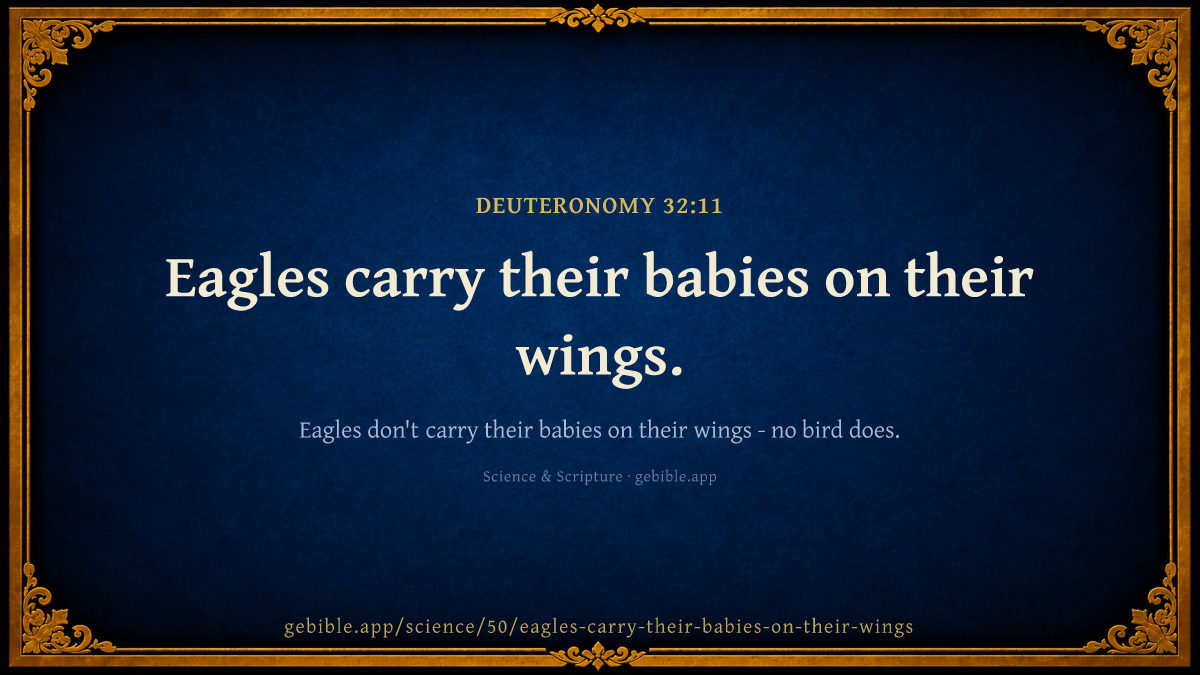
Eagles carry their babies on their wings.
Zoology
38
passages in this field
Show this passage in
The cited passage
What current science says
Eagles don't carry their babies on their wings - no bird does. Baby eagles (called eaglets) stay in the nest until their flight feathers grow. Parents bring food to the nest. When eaglets are ready, they practice flapping and eventually take their first flight themselves.
What the text says
Deuteronomy 32:11 compares God to an eagle that "beareth them on her wings," depicting an eagle carrying its young on its wings.
Three honest ways to read this passage
-
As history
The text records how its authors understood the world with the knowledge they had. Read this way, a difference from modern science is a window into the ancient mind, not a failure.
-
As accommodation
The text speaks to its first audience in their own terms, to make a point that isn't mainly about physics or biology. Read this way, the scientific detail is the vehicle, not the cargo.
-
As contradiction
The text makes a claim about the physical world that modern findings dispute. Read this way, the difference is a genuine factual disagreement worth naming.
GEBible doesn't pick one of these for you. Each entry shows the passage, what it says, and what current science says — nothing more.