
Even the jackals offer their breast. They nurse their young ones. But the daughter of my people has become cruel, like the ostriches in the wilderness.
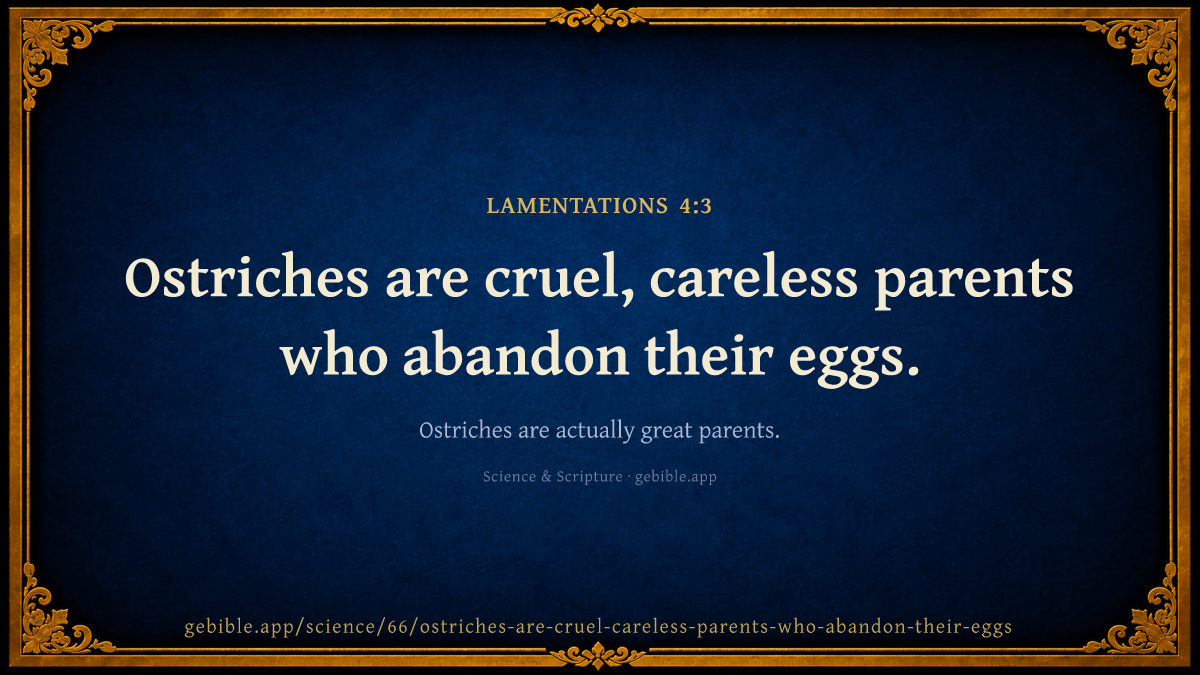
Ostriches are cruel, careless parents who abandon their eggs.
Zoology
38
passages in this field
Show this passage in
The cited passage
What current science says
Ostriches are actually great parents. The female sits on eggs during the hot day (her gray feathers blend with sand), and the male takes over at night (his black feathers hide him in darkness). After hatching, both parents fiercely protect their chicks for months.
What the text says
Lamentations 4:3 compares a cruel people to ostriches, saying 'the daughter of my people is become cruel, like the ostriches in the wilderness' - portraying ostriches as careless, neglectful parents toward their young.
Three honest ways to read this passage
-
As history
The text records how its authors understood the world with the knowledge they had. Read this way, a difference from modern science is a window into the ancient mind, not a failure.
-
As accommodation
The text speaks to its first audience in their own terms, to make a point that isn't mainly about physics or biology. Read this way, the scientific detail is the vehicle, not the cargo.
-
As contradiction
The text makes a claim about the physical world that modern findings dispute. Read this way, the difference is a genuine factual disagreement worth naming.
GEBible doesn't pick one of these for you. Each entry shows the passage, what it says, and what current science says — nothing more.