
Jacob took to himself rods of fresh poplar, almond, and plane tree, peeled white streaks in them, and made the white appear which was in the rods. He set the rods which he had peeled opposite the flocks in the watering troughs where the flocks came to drink. They conceived when they came to drink. The flocks conceived before the rods, and the flocks produced streaked, speckled, and spotted.
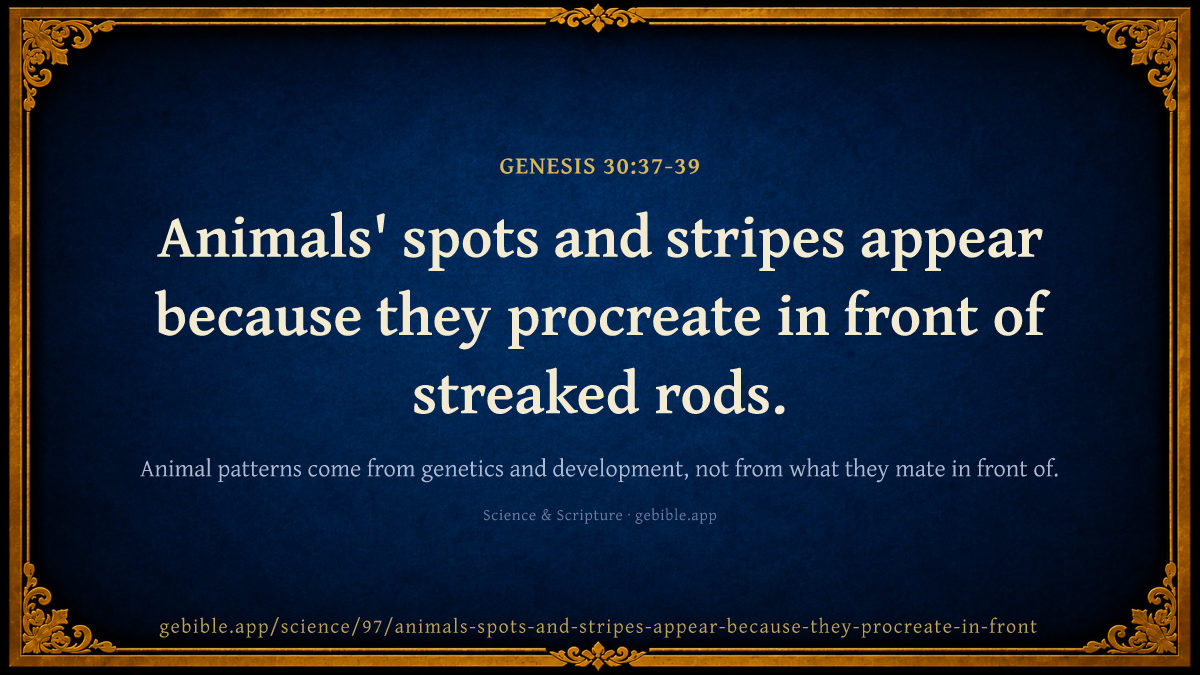
Animals' spots and stripes appear because they procreate in front of streaked rods.
Biology
59
passages in this field
Show this passage in
The cited passage
What current science says
Animal patterns come from genetics and development, not from what they mate in front of. As an embryo develops, genes regulate how pigment cells spread and switch on or off, creating stripes, spots, or plain coats. Chemical signals in the skin form repeating patterns (a process modeled by reaction‑diffusion equations in biology), so a zebra or leopard’s pattern is “pre‑programmed” in its DNA and early development, not painted on by the environment during sex.
What the text says
Jacob displays his (and God's) knowledge of biology by having goats copulate while looking at streaked rods. The result is streaked baby goats.
Three honest ways to read this passage
-
As history
The text records how its authors understood the world with the knowledge they had. Read this way, a difference from modern science is a window into the ancient mind, not a failure.
-
As accommodation
The text speaks to its first audience in their own terms, to make a point that isn't mainly about physics or biology. Read this way, the scientific detail is the vehicle, not the cargo.
-
As contradiction
The text makes a claim about the physical world that modern findings dispute. Read this way, the difference is a genuine factual disagreement worth naming.
GEBible doesn't pick one of these for you. Each entry shows the passage, what it says, and what current science says — nothing more.