
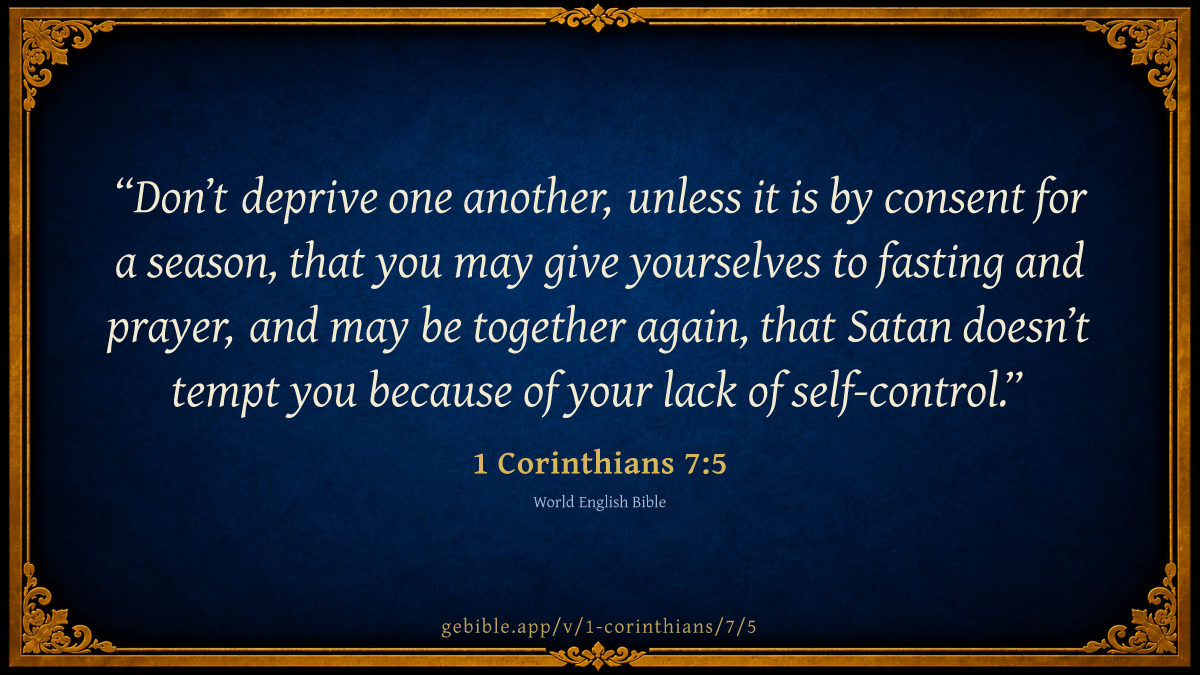
Don’t deprive one another, unless it is by consent for a season, that you may give yourselves to fasting and prayer, and may be together again, that Satan doesn’t tempt you because of your lack of self-control.
Parallel Translations
-
Don’t deprive one another, unless it is by consent for a season, that you may give yourselves to fasting and prayer, and may be together again, that Satan doesn’t tempt you because of your lack of self-control.
-
Withdrawe not youre selves one from another excepte it be with consent for a tyme for to geve youre selves to fastynge and prayer. And afterwarde come agayne to the same thynge lest Satan tempt you for youre incontinencye.
-
Defraude not one another, except it be with consent for a time, that ye may giue your selues to fasting and praier, and againe come together that Satan tempt you not for your incontinecie.
Cross-references (8)
Passages linked to 1 Corinthians 7:5 in the Treasury of Scripture Knowledge, ordered by reader-vote popularity; verse text shown in World English Bible.
- Exodus 19:15 He said to the people, “Be ready by the third day. Don’t have sexual relations with a woman.”
- Joel 2:16 Gather the people. Sanctify the assembly. Assemble the elders. Gather the children, and those who nurse from breasts. Let the bridegroom go out of his room, and the bride out of her room.
- 1 Samuel 21:4-5 The priest answered David, and said, “I have no common bread, but there is holy bread; if only the young men have kept themselves from women.” David answered the priest, and said to him, “Truly, women have been kept from us as usual these three days. When I came out, the vessels of the young men were holy, though it was only a common journey. How much more then today shall their vessels be holy?”
- Zechariah 12:12-14 The land will mourn, every family apart; the family of David’s house apart, and their wives apart; the family of the house of Nathan apart, and their wives apart; the family of the house of Levi apart, and their wives apart; the family of the Shimeites apart, and their wives apart; all the families who remain, every family apart, and their wives apart.
- Zechariah 7:3 and to speak to the priests of the house of Yahweh of Armies, and to the prophets, saying, “Should I weep in the fifth month, separating myself, as I have done these so many years?”
- Matthew 4:10 Then Jesus said to him, “Get behind me, Satan! For it is written, ‘You shall worship the Lord your God, and you shall serve him only.’ ”
- Matthew 19:11 But he said to them, “Not all men can receive this saying, but those to whom it is given.
- 1 Thessalonians 3:5 For this cause I also, when I couldn’t stand it any longer, sent that I might know your faith, for fear that by any means the tempter had tempted you, and our labor would have been in vain.
Cross-references from openbible.info (CC BY 4.0)
Explain this verse (19 sources)
Historical commentary, presented as a primary source — not an endorsement.
Private notes
Saved on this device only — never synced or sent anywhere.
John Calvin 1540 · Public Domain 5. Defraud ye not one the other Profane persons…
5. Defraud ye not one the other Profane persons might think that Paul does not act with sufficient modesty in discoursing in this manner as to the intercourse of a husband with his wife; or at least that it was unbecoming the dignity of an Apostle. If, however, we consider the reasons that influenced him, we shall find that he was under the necessity of speaking of these things. In the first place, he knew how much influence a false appearance of sanctity has in beguiling devout minds, as we ourselves know by experience. For Satan dazzles us with an appearance of what is right, that we may be led to imagine that we are polluted by intercourse with our wives, and leaving off our calling, may think of pursuing another kind of life. Farther, he knew how prone every one is to self-love, and devoted to his own gratification. From this it comes, that a husband, having had his desire gratified, treats his wife not merely with neglect, but even with disdain; and there are few that do not sometimes feel this disdain of their wives creep in upon them. It is for these reasons that he treats so carefully of the mutual obligations of the married life. “If at any time it comes into the minds of married persons to desire an unmarried life, as though it were holier, or if they are tempted by irregular desires, let them bear in mind that they are bound by a mutual connection.” The husband is but the one half of his body, and so is it, also, as to the wife. Hence they have not liberty of choice, but must on the contrary restrain themselves with such thoughts as these: “Because the one needed help from the other, the Lord has connected us together, that we may assist each other.” Let each then be helpful to each other’s necessity, and neither of them act as if at his or her own disposal.
Unless by mutual consent He requires mutual consent, in the first place, because the question is not as to the continency of one merely, but of two; and besides, he immediately adds two other exceptions. The first is, that it be done only for a time, as perpetual continency is not in their power, lest if they should venture to make an attempt beyond their power, they might fall before Satan’s stratagems. The second is, that they do not abstain from conjugal intercourse, on the ground of that abstinence being in itself a good and holy work, or as if it were the worship of God, but that they may be at leisure for better employments. Now though Paul had taken such pains in guarding this, yet Satan prevailed so far as to drive many to unlawful divorce, from a corrupt desire for an unmarried life. The husband, leaving his wife, fled to the desert, that he might please God better by living as a monk. The wife, against her husband’s will, put on the veil — the badge of celibacy. Meanwhile they did not consider that by violating their marriage engagement they broke the Lord’s covenant, and by loosing the marriage tie, they cast off the Lord’s yoke.
Read full note →
This vice, it is true, was corrected in some measure by the ancient canons; for they prohibited a husband from leaving his wife against her will, on pretense of continency; and in like manner a wife from refusing to her husband the use of her body. In this, however, they erred — that they permitted both together to live in perpetual celibacy, as if it were lawful for men to decree anything that is contrary to the Spirit of God. Paul expressly commands, that married persons do not defraud each other, except for a time The bishops give permission to leave off the use of marriage for ever. Who does not see the manifest contrariety? Let no one, therefore, be surprised, that we make free to dissent on this point from the ancients, who, it is evident, deviated from the clear statements of the word of God.
That ye may have leisure for fasting and prayer. We must take notice, that Paul does not speak here of every kind of fasting, or every kind of prayer. That sobriety and temperance, which ought to be habitual on the part of Christians, is a kind of fasting. Prayer, too, ought to be not merely daily, but even continual. He speaks, however, of that kind of fasting which is a solemn expression of penitence, with the view of deprecating God’s anger, or by which believers prepare themselves for prayer, when they are undertaking some important business. In like manner, the kind of prayer that he speaks of is such as requires a more intense affection of the mind. For it sometimes happens, that. we require (leaving off everything else) to fast and pray; as when any calamity is impending, if it appears to be a visitation of God’s wrath; or when we are involved in any difficult matter, or when we have something of great importance to do, as, for example, the ordaining of pastors. Now it is with propriety that the Apostle connects these two things, because fasting is a preparation for prayer, as Christ also connects them, when he says,
This kind of devils goeth not out but by fasting and prayer. (Matthew 17:21.)
When, therefore, Paul says, that ye may be at leisure, the meaning is, that having freed ourselves from all impediments, we may apply ourselves to this one thing. Now if any one objects, that the use of the marriage bed is an evil thing, inasmuch as it hinders prayer, the answer is easy — that it is not on that account worse than meat and drink, by which fasting is hindered. But it is the part of believers to consider wisely when it is time to eat and drink, and when to fast. It is also the part of the same wisdom to have intercourse with their wives when it is seasonable, and to refrain from that intercourse when they are called to be engaged otherwise.
And come together again, that Satan tempt you not Here he brings forward the reason, from ignorance of which the ancients have fallen into error, in rashly and inconsiderately approving of a vow of perpetual continency. For they reasoned in this manner: “If it is good for married persons sometimes to impose upon themselves for a time a voluntary continency with mutual consent, then, if they impose this upon themselves for ever, it will be so much the better.” But then, they did not consider how much danger was involved in this, for we give Satan an occasion for oppressing us, when we attempt anything beyond the measure of our weakness. “But we must resist Satan.” What if arms and shield be wanting? “They must be sought from the Lord,” say they. But in vain shall we beseech the Lord to assist us in a rash attempt. We must, therefore, carefully observe the clause — for your incontinency: for we are exposed to Satan’s temptations in consequence of the infirmity of our flesh. If we wish to shut them out, and keep them back, it becomes us to oppose them by the remedy, with which the Lord has furnished us. Those, therefore, act a rash part, who give up the use of the marriage bed. It is as if they had made an agreement with God as to perpetual strength.
John Calvin's Commentaries (1540-1563) — public domain. Text from the Calvin Translation Society English edition (1840s-50s) via the Christian Classics Ethereal Library (ccel.org). Calvin's coverage is partial (roughly two-thirds of the Bible); uncommented books and verses are honest gaps, never fabricated. The 19th-century editor's footnotes and remarks are omitted so the notes are faithfully Calvin's own voice.
Geneva Bible translators 1599 · Public Domain He addeth an exception: unless the one abstain from…
He addeth an exception: unless the one abstain from the other by mutual consent, that they may the better give themselves to prayer, wherein notwithstanding, he warneth them to consider what is expedient, lest by this long breaking off as it were from marriage, they bestirred up to incontinency.
Do nothing else.
Geneva Bible (1599) marginal notes — public domain.
John Trapp 1656 · Public Domain 5 Defraud ye not one the other, except it…
5 Defraud ye not one the other, except it be with consent for a time, that ye may give yourselves to fasting and prayer; and come together again, that Satan tempt you not for your incontinency.
Ver. 5. To fasting and prayer] Preces nobis ieiuniis alendum et quasi saginandum. Fasting days are soul fatting days: prayer is edged and winged thereby.
Read full note →
That Satan tempt you not] The temptation is strong to fornication, stronger to adultery. Watch therefore. Our nature is catching this way; and once in, it is not so easy to come off. This is a searing sin, Hos 4:11; Eph 4:19.
John Trapp, A Commentary or Exposition upon All the Books of the Old and New Testament (1647–1656) — public domain. Text from a community e-Sword module.
Matthew Poole 1685 · Public Domain Defraud not one the other; that is: Withhold not…
Defraud not one the other; that is: Withhold not yourselves one from another; which he rightly calls defrauding one another, because he had before declared it a debt; and further declared, that neither the husband nor the wife had a power over their own bodies, but the power of either of their bodies was in their correlate. He adds,
except it be with consent, mutual consent, and then it is indeed no defrauding; and
Read full note →
for a time, for a religious end,
that they might give themselves to fasting and prayer: not that this abstinence is necessary to us by any Divine precept, to prepare us for solemn prayer, (for such only is here spoken of), for then the apostle would not have made consent necessary in this case; but the Jews were commanded it, Exo 19:15, as a preparation to their hearing of the law; and it was a piece of the legal purification, as appeareth from 1Sa 21:4, as to which Christians were at liberty, and might observe or not observe it, as they agreed.
And come together again, that Satan tempt you not for your incontinency: then he requires, that they should return to their former course, not defrauding one another, lest the devil, observing their abstinence, should tempt them to unlawful mixtures, seeing their inability to contain themselves within the bounds of temperance and chastity.
Matthew Poole's English Annotations on the Holy Bible (1683–1685) — public domain. Text from a community e-Sword/MySword module.
John Gill 1763 · Public Domain Defraud ye not one the other,.... By withholding due…
Defraud ye not one the other,.... By withholding due benevolence, denying the use of the marriage bed, refusing to pay the conjugal debt, and which is called a "diminishing of her marriage duty", Exo 21:10 where the Septuagint use the same word "defraud", as the apostle does here; it is what both have a right to, and therefore, if either party is denied, it is a piece of injustice, it is properly a defrauding; though with proper conditions, such as follow, it may be lawful for married persons to lie apart, and abstain from the use of the bed, but then it should never be done,
except it be with consent: because they have a mutual power over each other's bodies, and therefore the abstinence must be voluntary on each side; otherwise injury is done to the person that does not consent, who is deprived against will of just right; but if there is agreement, then there is no defrauding, because each give up their right; and such a voluntary abstinence is commended by the Jews (z);
Read full note →
"everyone that lessens the use of the bed, lo, he, is praiseworthy; and he who does not make void, or, cause to cease the due benevolence, but , "by consent of his wife";''
i.e. he also is praiseworthy: another condition of this abstinence is that it be only for a time; which shall be agreed unto, and fixed by both parties; not for ever which would be contrary to the will of God; the institution and end of marriage, and of dangerous consequence to either party. The Jews allow of a vow of continency for a while; and which they limit to different persons; thus (a),
"if a man by a vow excludes, wife from the use of the bed, the school of Shammai say it is for the space of two weeks, the school of Hillell say one week; scholars go out to learn the law, without leave of their wives, thirty days, workmen one week;''
which vow, for such a limited time, they seem to allow of, without mutual consent; and herein they disagree with the rule the apostle gives; and who further observes, the end to be had in view by such a voluntary separation for a time,
that ye may give yourselves to fasting and prayer; not that this was necessary for the ordinary discharge of such service, as for private acts of devotion among themselves, and constant family prayer; but either when times of fasting and prayer on some emergent occasions were appointed by themselves, or by the church, or by the civil government on account of some extraordinary and momentous affairs; and this seems to be observed by the apostle, in agreement with the customs and rules of the Jewish nation, which forbid the use of the bed, as on their great and annual fast, the day of atonement (b), so on their fasts appointed by the sanhedrim for obtaining of rain (c): the word "fasting" is omitted in the Vulgate Latin and Ethiopic versions, and so it is in the Alexandrian copy, two of Stephens's; and others: the apostle adds,
and come together again; to the same bed, and the use of it, and that for this reason,
that Satan tempt you not for your incontinence; for not having the gift of continency, should they pretend to keep apart long: Satan, who knows the temperament and disposition of men and women, may tempt them not only to hatred of, and quarrels with one another, but to impure lusts and desires, to fornication, adultery, and all uncleanness; a very good reason why, though abstinence from the marriage bed for a short time, by the consent of both parties, for religious purposes, may be lawful, yet ought not to be continued; since Satan may hereby get an advantage over them, and draw them into the commission of scandalous enormities. The Jews have a notion of Satan's being a tempter, and of his tempting men to various sins, which they should guard against, as idolatry, &c. So say they (d),
"thou mayest not look after idolatry, according to Deu 4:19 and again, thou must take heed lest this be a cause of it to thee, , "and Satan tempt thee" to look after them, and do as they do:''
and again (e), frequently should a man think
"upon the unity of the blessed God, lest there should be anything above or below, before him or behind him, or by him, and so, , "Satan tempt him", and he come into heresy.''
(z) Maimon. Hilch. Ishot, c. 21. sect. 11. (a) Misn. Cetubot, c. 5. sect. 6. (b) Misn. Yoma, c. 8. sect. 1. (c) Misn. Taanith, c. 1. sect. 6. (d) Mosis Kotsensis Mitzvot Tora, pr. neg. 14. (e) Mosis Kotsensis Mitzvot Tora, pr. neg. 15.
John Gill's Exposition of the Whole Bible (1746–1763) — public domain (CC PDM 1.0). Text via the HelloAO Bible API.
John Wesley 1765 · Public Domain Unless it be by consent for a time -…
Unless it be by consent for a time - That on those special and solemn occasions ye may entirely give yourselves up to the exercises of devotion. Lest - If ye should long remain separate. Satan tempt you - To unclean thoughts, if not actions too.
John Wesley, Explanatory Notes Upon the Whole Bible (1754–1765) — public domain. Text via the GEBible commentary corpus.
Adam Clarke 1810 · Public Domain Verse 5. Defraud ye not one the other] What…
Verse 5. Defraud ye not one the other] What ye owe thus to each other never refuse paying, unless by mutual consent; and let that be only for a certain time, when prudence dictates the temporary separation, or when some extraordinary spiritual occasion may render it mutually agreeable, in order that ye may fast and pray, and derive the greatest possible benefit from these duties by being enabled to wait on the Lord without distraction.
That Satan tempt you not for your incontinency.] It is most evident that the separations permitted by the Apostle, for he enjoins none, are only for a season, on extraordinary occasions; and that the persons may come together again, lest Satan, taking advantage of their matrimonial abstinence, might tempt either party to illicit commerce.
Read full note →
There are a multitude of rules prescribed in such cases by the rabbins, and indeed even by heathen writers; for this was a matter in which common sense could always judge; and under the direction of experience, heathens, as well as those favoured with Divine revelation, could see what was proper in all such cases.
Incontinence, εικρασια, want of strength to regulate one's desires or appetites; from α, negative, and κρατος, strength. It is remarkable that the apostle supposes that even this temporary continence might produce incontinence; and universal observation confirms the supposition.
Adam Clarke's Commentary on the Bible (1810–1826) — public domain. Text from a community e-Sword/MySword module.
Joseph Benson 1811 · Public Domain 1Co 7:5-7. Defraud not — Or deprive not; one…
1Co 7:5-7. Defraud not — Or deprive not; one the other — Of this benevolence; or withdraw not from the company of each other; except it be with consent for a time, that — On those special and solemn occasions, you may entirely give yourselves up to the exercises of devotion. From this passage it appears, that, in the first age, when married persons parted for a time to employ themselves in the duties of devotion, they lived in separate habitations, or rather in different parts of their own house. For in the eastern countries the houses were so built, that the women had apartments allotted to themselves. And come together again — As usual, and do not continue the separation too long; that Satan tempt you not — To unclean thoughts, if not actions too, which he probably might do, if you should long remain separate from each other; for your incontinency — The word ακρασια, thus translated, properly signifies, the want of the government of one’s passions and appetites. It is properly observed here by Dr. Macknight, “that marriage being an affair of the greatest importance to society, it was absolutely necessary that its obligation and duties, as well as the obligation and duties of the other relations of life, should be declared by inspiration in the Scriptures. This passage, therefore, of the word of God ought to be read with due reverence, both because it was dictated by the Holy Spirit, and because throughout the whole of his discourse the apostle has used the greatest chastity and delicacy of expression.” But I speak this — That which I have said, for the preventing of incontinency, both in the unmarried, (1Co 7:2,) and married, (1Co 7:5,) by permission — From Christ, to leave you to your liberty therein, if you have the gift of continency. Or, as an advice, as some render κατα συγγνωμην. Bengelius says the word denotes an opinion, rightly suited to the state or disposition of another. And not of commandment — Not as an injunction. Or, as some commentators suppose, he may refer to what follows. For I would that all men — All the disciples of Christ who are unmarried, and can live chastely, were even as I myself — That is, would remain eunuchs for the kingdom of heaven’s sake; or, that they could as easily bear the restraints of a single life in present circumstances, and exercise as resolute a command over their natural desires. Paul, having tasted the sweetness of this liberty, wished others to enjoy it as well as himself. But every man hath his proper gift of God — According to our Lord’s declaration, All men cannot receive this saying, save they to whom it is given, Mat 19:11.
Joseph Benson's Commentary on the Old and New Testaments (1811–1818) — public domain. Text from a community e-Sword module.
Albert Barnes 1834 · Public Domain Defraud ye not ... - Of the right mentioned…
Defraud ye not ... - Of the right mentioned above. Withdraw not from the society of each other.
Except it be with consent - With a mutual understanding, that you may engage in the extraordinary duties of religion; compare Exo 19:15.
Read full note →
And come together again ... - Even by mutual consent, the apostle would not have this separation to be perpetual, since it would expose them to many of the evils which the marriage relation was designed to avoid.
That Satan ... - That Satan take not advantage of you, and throw you into temptation, and fill you with thoughts and passions which the marriage compact was designed to remedy.
Albert Barnes' Notes on the Bible (1834–1885) — public domain. Text from a community e-Sword/MySword module.
Haydock's Catholic Bible Commentary 1859 · Public Domain Ut vacetis orationi, Greek: ina scholazete te proseuche. St.…
===============================
[BIBLIOGRAPHY]
Read full note →
Ut vacetis orationi, Greek: ina scholazete te proseuche. St. John Chrysostom, Greek: ouk eipen aplos proseuchesthe.
George Leo Haydock (1774–1849), Haydock's Catholic Family Bible and Commentary, 1859 edition — public domain. Excludes Psalms (Douay-Rheims chapter numbering differs from Protestant) and Deuterocanonical books (Catholic canon only).
Robert Jamieson, A. R. Fausset & David Brown 1871 · Public Domain Defraud . . . not--namely, of the conjugal duty…
Defraud . . . not--namely, of the conjugal duty "due" (Co1 7:3; compare the Septuagint, Exo 21:10).
except it be--"unless perchance" [ALFORD].
Read full note →
give yourselves to--literally, "be at leisure for"; be free from interruptions for; namely, on some special "season," as the Greek for "time" means (compare Exo 19:15; Joe 2:16; Zac 7:3).
fasting and prayer--The oldest manuscripts omit "fasting and"; an interpolation, evidently, of ascetics.
come together--The oldest manuscripts read, "be together," namely, in the regular state of the married.
Satan--who often thrusts in his temptations to unholy thoughts amidst the holiest exercises.
for your incontinency--because of your inability to "contain" (Co1 7:9) your natural propensities, which Satan would take advantage of.
Jamieson, Fausset & Brown — Commentary Critical and Explanatory on the Whole Bible (1871) — public domain (CC PDM 1.0). Text via the HelloAO Bible API.
Daniel D. Whedon 1874 · Public Domain 5. Defraud—Deprive.
5. Defraud—Deprive.
Consent—Not by the sole will of one alone.
Read full note →
For a time—Says Olshausen, “Probably it was an early custom, previous to the festivals, especially before Easter, for people to devote a lengthened time to solitary prayer, in which beautiful custom originated Lent.”
Fasting— Omitted, according to the best authorities. Indeed, it is remarked by Stanley that this chapter has an unusually large number of false readings, interpolated by ascetics, to whom the apostle did not seem rigid enough.
Come together again—Greek, επι το αυτο ητε, be at the same ordinary habit of matrimony.
For your incontinency—Rather, through your incontinence, or incapability of self-control.
Daniel D. Whedon (gen. ed.), Commentary on the Old and New Testaments (1874–1909) — public domain. Text from a community e-Sword module.
The Cambridge Bible for Schools and Colleges 1878 · Public Domain 5. that ye may give yourselves to fasting and…
5. that ye may give yourselves to fasting and prayer] The best MSS., most of the Fathers, and many of the best versions, including the Vulgate, omit the word ‘fasting.’
Satan] Cf. 1Pe_5:8.
The Cambridge Bible for Schools and Colleges (gen. ed. J. J. S. Perowne; Cambridge University Press, 1878–1918) — public domain. Text from a community e-Sword module.
Ellicott's Commentary for English Readers 1878 · Public Domain (5) Except it be . . . that ye…
(5) Except it be . . . that ye may give yourselves—i.e., that ye may have leisure. Any such separation should be temporary, and with consent of both parties. Even then it must not be from mere caprice, but for some religious purpose, such as a special season of prayer. (See Exo_19:15; 1Sa_21:4.) The alteration in the Greek text of the word “give” into the present tense, so as to make the word “prayer” refer to daily devotions, and not to special and exceptional seasons, and the interpolation of the word “fasting”—not found in the older MSS.—are a striking example of how the ascetic tendencies of a particular ecclesiastical school of thought led to their “amending” the sacred text so as to make it be in harmony with their own views, instead of reverently regarding it as that by which those very views should be corrected.
And come together again.—Better (as in the best MSS.), and be together again. This is still an explanation of the purpose of the separation, not to be a lasting one, but that we may again return to the state of union. The text here bears further traces of having been altered so as to make it seem that the Apostle meant that the return to matrimonial life should be only to a temporary union, and not to a continuous state of life. The proper reading implies the latter, the word “be” being used as in Act_2:44.
Read full note →
For your incontinency.—Better, because of your incontinency; the reference being, as in 1Co_7:2, to the moral condition surrounding them, and to the influence to which a man thus separated would be subject. The Corinthian Christians are here solemnly reminded that this sin, as all sin, is from Satan—because the Corinthians at large did not regard it as sin at all, but even mingled sensuality with worship.
A Bible Commentary for English Readers, edited by Charles John Ellicott (1878–1897) — public domain. Text from a community e-Sword module.
The Pulpit Commentary 1880 · Public Domain Defraud ye not. St. Paul purposely leaves the expression…
Defraud ye not. St. Paul purposely leaves the expression general. Primarily he is thinking of "the due" or "the power" which each has over the other, as is shown by the next verse; but he does not confine the expression to this. Except it be; literally, unless by chance. The exception he regards as something possible, but not normal. For a time. By this and the next words he disparages, by anticipation, the celibate and separate married lives which, in a corrupt age, were so much and so unwisely admired in the ascetic saints of the Middle Ages. Temporary separation for special reasons had been recognized from the earliest times (Exo_19:15; 1Sa_21:4) Ye may give yourselves; rather, ye may have leisure. The verb is in the aorist, which shows that the "leisure" contemplated was for brief periods, not during continuous years. It was altered to the present by the officious copyists, who believed in external and mechanical rules of holiness. To fasting and prayer. "Fasting" is an ascetic interpolation, not found in a, A, B, C, D, F. On this interpolation, and perhaps on the analogy of the rule given by Moses at, (Exo_19:15) rose the practice of married persons living apart at Lent (Stanley). Come together again. The prepossessions of ascetic scribes have again tampered with the text. The true reading is, "be together again" (hte), not "come together" (sunerchsqe). For your incontinency; rather, because of. Their past lives and their present temptations were a warning that they could not lay on themselves burdens which God did not require. They should not strive
... to wind themsleves to high For sinful man beneath the sky.
Read full note →
Violent, unnatural, self tormenting, repressions beyond what God demands, and adopted without reference to the strength or the circumstances of individual natures, only tend, as all ascetics have confessed, to increase rather than to diminish the force of sensual temptations.
The Pulpit Commentary (1880–1919), ed. H.D.M. Spence-Jones & Joseph S. Exell — public domain. Text from a community e-Sword module.
B. W. Johnson 1891 · Public Domain 5. Defraud ye not one the other. The married…
5. Defraud ye not one the other. The married pair are not live apart, except by mutual agreement, and that only for a season, while devoting themselves to a period of prayer. In the East, the women have separate apartments, and during this season the husband would not enter the wife's apartments.
B. W. Johnson's The People's New Testament with Notes (1889–1891) — public domain. Electronic text from the Christian Classics Ethereal Library (CCEL) ThML edition.
William B. Godbey 1900 · Public Domain 5-6. “Defraud not one another except with consent for…
5-6. “Defraud not one another except with consent for a time, in order that you may give attention to prayer and come together again in order that Satan may not tempt you on account of your incontinence.” “Fasting” does not in this verse occur in the original. You see plainly that the Divine economy recognizes cohabitation in the bonds of holy wedlock. Parties united in matrimony are here advised to live together, unless they separate for the glory of God, that they may do gospel work. In that case the separation is not permanent, but temporary. “I speak this by way of allowance, and not according to a commandment.” Of course there is no intimation here that Paul was impeaching his own inspiration, but merely referring to the fact that our Lord had delivered no precept directly covering that ground.
William B. Godbey, Commentary on the New Testament (1896–1900) — public domain. Text from a community e-Sword module.
J. W. McGarvey 1914 · Public Domain Defraud [deprive] ye not one the other, except it…
Defraud [deprive] ye not one the other, except it be by consent for a season, that ye may give yourselves unto prayer, and may be together again, that Satan tempt you not because of your incontinency .
J. W. McGarvey (with Philip Y. Pendleton), Commentaries on the New Testament (The Fourfold Gospel, 1914; Acts; and the epistles) — public domain. Text from a community e-Sword/MySword module.
unfoldingWord translationNotes 2017 · CC BY-SA 4.0 Do not deprive each other
Do not deprive each other
The word "deprive" means to keep from someone something that the other person has the right to receive. "Do not refuse to have marital relations with your spouse" (See: Euphemism and Assumed Knowledge and Implicit Information)
Read full note →
so that you may devote yourselves to prayer
in order to have a period of especially deep prayer
devote yourselves
"commit yourselves"
come together again
"sleep together again"
because of your lack of self-control
"because after some days, your sexual desires will be harder to keep under control"
I say these things to you as a concession and not as a command
Possible meanings are Paul is telling the Corinthians that he is allowing them, but not commanding them, 1) to marry and sleep together or 2) to stop sleeping together for a time.
were as I am
Either Paul had never married or his wife had died. It is unlikely that he had been through a divorce.
But each one has his own gift from God. One has this kind of gift, and another that kind
"God enables people to do different things. He enables one person to do one thing and another person to do something different"
translationWords
pray
Satan
tempt
command
gift
God
unfoldingWord translationNotes — © Distant Shores Media and the Door43 World Missions Community, licensed CC BY-SA 4.0. Source: git.door43.org/Door43/en_tn.