
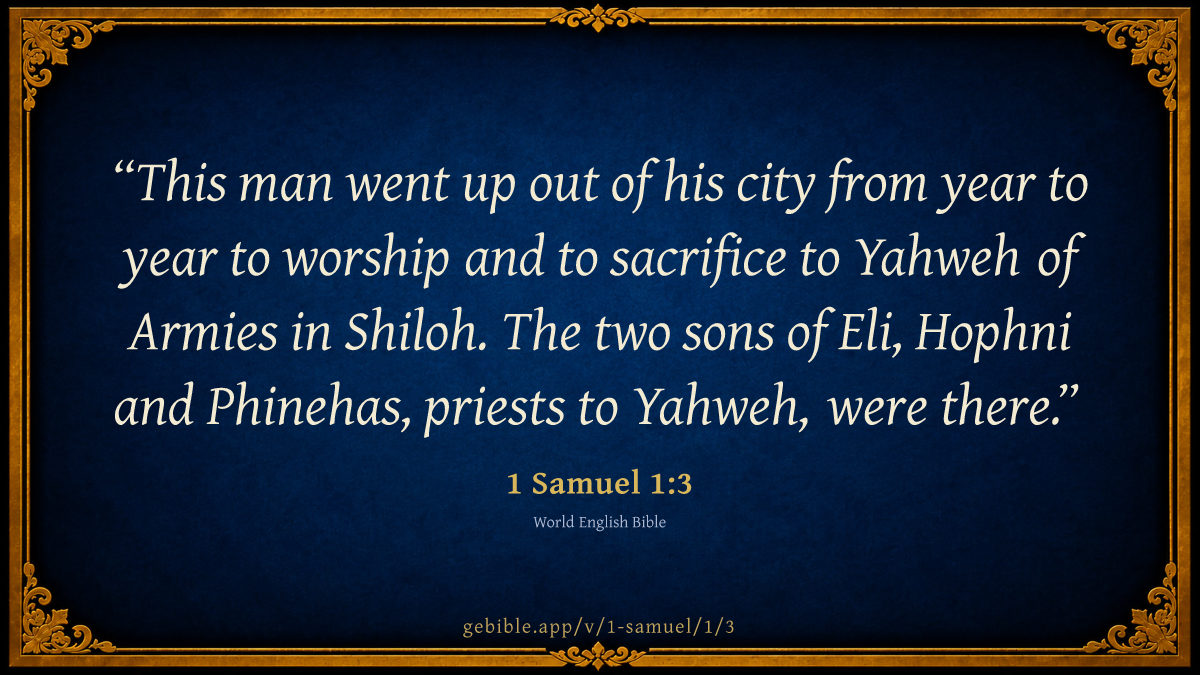
This man went up out of his city from year to year to worship and to sacrifice to Yahweh of Armies in Shiloh. The two sons of Eli, Hophni and Phinehas, priests to Yahweh, were there.
Parallel Translations
-
This man went up out of his city from year to year to worship and to sacrifice to Yahweh of Armies in Shiloh. The two sons of Eli, Hophni and Phinehas, priests to Yahweh, were there.
-
And this man went up out of his city yearly to worship and to sacrifice unto the LORD of hosts in Shiloh. And the two sons of Eli, Hophni and Phinehas, the priests of the LORD, were there.
-
And this man went up out of his city from year to year to worship and to sacrifice unto the LORD of hosts in Shiloh. And the two sons of Eli, Hophni and Phinehas, were there priests unto the LORD.
Cross-references (19)
Passages linked to 1 Samuel 1:3 in the Treasury of Scripture Knowledge, ordered by reader-vote popularity; verse text shown in World English Bible.
- Luke 2:41 His parents went every year to Jerusalem at the feast of the Passover.
- Deuteronomy 12:5-7 But to the place which Yahweh your God shall choose out of all your tribes, to put his name there, you shall seek his habitation, and you shall come there. You shall bring your burnt offerings, your sacrifices, your tithes, the wave offering of your hand, your vows, your free will offerings, and the firstborn of your herd and of your flock there. There you shall eat before Yahweh your God, and you shall rejoice in all that you put your hand to, you and your households, in which Yahweh your God has blessed you.
- Joshua 18:1 The whole congregation of the children of Israel assembled themselves together at Shiloh, and set up the Tent of Meeting there. The land was subdued before them.
- Exodus 23:14 “You shall observe a feast to me three times a year.
- Exodus 34:23 Three times in the year all your males shall appear before the Lord Yahweh, the God of Israel.
- Deuteronomy 16:16 Three times in a year all of your males shall appear before Yahweh your God in the place which he chooses: in the feast of unleavened bread, in the feast of weeks, and in the feast of booths. They shall not appear before Yahweh empty.
- 1 Samuel 1:9 So Hannah rose up after they had finished eating and drinking in Shiloh. Now Eli the priest was sitting on his seat by the doorpost of Yahweh’s temple.
- 1 Samuel 1:21 The man Elkanah, and all his house, went up to offer to Yahweh the yearly sacrifice and his vow.
- Judges 18:31 So they set up for themselves Micah’s engraved image which he made, and it remained all the time that God’s house was in Shiloh.
- Exodus 23:17 Three times in the year all your males shall appear before the Lord Yahweh.
- Deuteronomy 12:11-14 then it shall happen that to the place which Yahweh your God shall choose, to cause his name to dwell there, there you shall bring all that I command you: your burnt offerings, your sacrifices, your tithes, the wave offering of your hand, and all your choice vows which you vow to Yahweh. You shall rejoice before Yahweh your God—you, and your sons, your daughters, your male servants, your female servants, and the Levite who is within your gates, because he has no portion nor inheritance with you. Be careful that you don’t offer your burnt offerings in every place that you see; but in the place which Yahweh chooses in one of your tribes, there you shall offer your burnt offerings, and there you shall do all that I command you.
- 1 Samuel 2:12-17 Now the sons of Eli were wicked men. They didn’t know Yahweh. The custom of the priests with the people was that when anyone offered a sacrifice, the priest’s servant came while the meat was boiling, with a fork of three teeth in his hand; and he stabbed it into the pan, or kettle, or cauldron, or pot. The priest took all that the fork brought up for himself. They did this to all the Israelites who came there to Shiloh. Yes, before they burned the fat, the priest’s servant came, and said to the man who sacrificed, “Give meat to roast for the priest; for he will not accept boiled meat from you, but raw.” If the man said to him, “Let the fat be burned first, and then take as much as your soul desires;” then he would say, “No, but you shall give it to me now; and if not, I will take it by force.” The sin of the young men was very great before Yahweh; for the men despised Yahweh’s offering.
- 1 Samuel 2:34 This will be the sign to you that will come on your two sons, on Hophni and Phinehas: in one day they will both die.
- 1 Samuel 3:13 For I have told him that I will judge his house forever for the iniquity which he knew, because his sons brought a curse on themselves, and he didn’t restrain them.
- 1 Samuel 4:4 So the people sent to Shiloh, and they brought from there the ark of the covenant of Yahweh of Armies, who sits above the cherubim; and the two sons of Eli, Hophni and Phinehas, were there with the ark of the covenant of God.
- 1 Samuel 4:11 God’s ark was taken; and the two sons of Eli, Hophni and Phinehas, were slain.
- 1 Samuel 4:17-18 He who brought the news answered, “Israel has fled before the Philistines, and there has been also a great slaughter among the people. Your two sons also, Hophni and Phinehas, are dead, and God’s ark has been captured.” When he made mention of God’s ark, Eli fell from off his seat backward by the side of the gate; and his neck broke, and he died, for he was an old man and heavy. He had judged Israel forty years.
- Psalms 78:60 so that he abandoned the tent of Shiloh, the tent which he placed among men,
- Jeremiah 7:12-14 “But go now to my place which was in Shiloh, where I caused my name to dwell at the first, and see what I did to it for the wickedness of my people Israel. Now, because you have done all these works,” says Yahweh, “and I spoke to you, rising up early and speaking, but you didn’t hear; and I called you, but you didn’t answer; therefore I will do to the house which is called by my name, in which you trust, and to the place which I gave to you and to your fathers, as I did to Shiloh.
Cross-references from openbible.info (CC BY 4.0)
Explain this verse (18 sources)
Historical commentary, presented as a primary source — not an endorsement.
Private notes
Saved on this device only — never synced or sent anywhere.
Geneva Bible translators 1599 · Public Domain For the Ark was there at that time.
For the Ark was there at that time.
Geneva Bible (1599) marginal notes — public domain.
John Trapp 1656 · Public Domain 1Sa 1:3 And this man went up out of…
1Sa 1:3 And this man went up out of his city yearly to worship and to sacrifice unto the LORD of hosts in Shiloh. And the two sons of Eli, Hophni and Phinehas, the priests of the LORD, [were] there.
Ver. 3. To worship and to sacrifice,] viz., Peace offerings. The Rabbis here observe that to worship or pray is better than to sacrifice; because it is first named.
Read full note →
And the two sons of Eli … the priests of the Lord.] These were learned and lewd; Multi sacerdotes, pauci sacerdotes, saith Chrysostom: {a} There are many priest in name, but few that are right. I do not believe that there many priests, saith he, that shall be saved.
{a} Multi in nomine, pauci in opere. - Hom. 3, in Act.
John Trapp, A Commentary or Exposition upon All the Books of the Old and New Testament (1647–1656) — public domain. Text from a community e-Sword module.
Matthew Poole 1685 · Public Domain Yearly, to wit, at one of the solemn feasts,…
Yearly, to wit, at one of the solemn feasts, which probably was the passover, when he not only went up himself, but carried his wife and children with him. Compare 1Sa 1:7. Or, at the appointed days or times; Heb. from days to days; or, from time to time, i.e. at the three solemn feasts, when he, together with all other males, were obliged to go to worship God in the place appointed; and at other times, when he as a Levite was to go thither in his course.
To sacrifice; not in his own person, which the Levites could not do, but by the priests; in which sense David, and Solomon, and Absalom are said to offer sacrifices, 2Sa 15:8; 1Ki 8:63; 1Ch 21:26. In Shiloh; where the tabernacle had long been, and now was. See Jos 18:1; Jdg 18:31; 21:19.
Read full note →
The priests of the Lord were there, or, were the priests of the Lord there, to wit, under their father Eli, who is generally conceived to have been the high priest, but being very old and infirm, 1Sa 4:15, and unfit for service, his sons ministered in his stead, being as it were second priests. See 2Ki 25:18. And this clause seems to be added, to show that this good man did not run into that vulgar error, of neglecting his duty of offering to God for the wickedness of the priests; of which see 1Sa 2:17,24.
Matthew Poole's English Annotations on the Holy Bible (1683–1685) — public domain. Text from a community e-Sword/MySword module.
John Gill 1763 · Public Domain This man went up out of his city yearly,....…
This man went up out of his city yearly,.... From year to year; or, as the Targum, from the time of the solemn appointed feast to the solemn appointed feast, from one to another; there were three of them in the year, at which all the males in Israel were to appear at the tabernacle; and being a Levite, this man was the more careful to observe this rule. He is said to "go up" out of his city, which was Ramathaim or Ramah; for though it was built on an eminence, from whence it had its name, yet Shiloh, whither he went, was higher; that being, as Adrichomius says (a), on the highest mountain of all round about Jerusalem, and the highest of all the mountains of the holy land. So that as he first went down the hill from Ramah, he went up an high ascent to Shiloh, which is the place he went up to as follows:
to worship and to sacrifice unto the Lord of hosts in Shiloh; where the tabernacle was, the place of worship, and the altar of burnt offerings, on which sacrifices were offered. This place, according to Bunting (b), was twelve miles from Ramah, though others say it was not more than seven miles from it; hither he went to worship, or bow before the Lord; to pray unto him, as it is commonly interpreted; and being put before sacrifice, is said to be preferable to that, and more acceptable to God, and more eligible to be done in the tabernacle or temple than at home; see Luk 18:10 and though he is said to go up to sacrifice, it is not to be understood of his performing it himself, but by others, by the priest; for he himself was a Levite and could not offer sacrifices. This is the first time that mention is made of this title of Jehovah, Lord of hosts, of all the hosts and armies in heaven and in earth, the Lord of Sabaoth, as in Jam 5:4 from an "host", or army; and from hence the Heathens called some of their deities by the name of Sabazius, as Jupiter Sabazius (c); and the Phrygians and Thracians used to call Bacchus Sabazius, and other Grecians following them did the same (d):
Read full note →
and the two sons of Eli, Hophni and Phinehas the priests of the Lord, were there; Eli was the next judge of Israel after Samson, and who also was the high priest, as is generally supposed; but when and how the high priesthood came into his family is nowhere said, who was a descendant of Ithamar, the younger son of Aaron, in whose line it continued to the time of Solomon; and Josephus (e) places three between Phinehas and Eli, who were all of the line of Eleazar, whom he calls Abiezer, Bouci, and Ozis; but their Scripture names are Abishua, Bukki, and Uzzi, Ch1 6:50. And according to him, after Uzzi came Eli to be high priest, and therefore must be the first of the line of Ithamar that was in that office. His two sons are mentioned as officiating as priests in Shiloh, at the time Elkanah used to go yearly thither to worship and sacrifice; who were very wicked men, as appears by an after account of them; and it is generally thought that this is observed here, to show that the wickedness of these priests did not hinder this good man from doing his duty; nor did he make use of it as an excuse for not attending the worship of the sanctuary.
(a) Theatrum Terrae Sanct. p. 30. So Sandys's Travels, l. 3. p. 157. (b) Travels of the Patriarchs, &c. p. 122. (c) Valer. Maxim. l. 1. c. 3. Vid. D. Herbert de Cherbury de Relig. Gent. c. 3. p. 22. (d) Diodor. Sicul. Bibliothec. l. 3. p. 212. Harpocration in voce Lucian. Concil. deor. sect. 4. Cicero de legibus. l. 2. Aristophan vespae, v. 9, 10. Aves, 582. & Scholia in ib. Lysistrate, p. 860. & Scholia in ib. (e) Antiqu. l. 5. c. 11. sect. 5.
John Gill's Exposition of the Whole Bible (1746–1763) — public domain (CC PDM 1.0). Text via the HelloAO Bible API.
John Wesley 1765 · Public Domain Yearly - At the three solemn feasts, when he,…
Yearly - At the three solemn feasts, when he, together with all other males were obliged to go to worship God in the place appointed; and at other times, when he as a Levite, was to go thither in his course. To sacrifice - Not in his own person, which the Levites could not do, but by the priests. Were there - Or, were the priests of the Lord there, under their father Eli, who is generally conceived to have been the high-priest, but being very old and infirm, his sons ministered in his stead. This is the first time in scripture, that God is called the Lord of hosts or Armies. Probably Samuel was the first who used this title of God, for the comfort of Israel, at the time when their armies were few and feeble, and those of their enemies many and mighty.
John Wesley, Explanatory Notes Upon the Whole Bible (1754–1765) — public domain. Text via the GEBible commentary corpus.
Adam Clarke 1810 · Public Domain Verse 3. Went up out of his city yearly…
Verse 3. Went up out of his city yearly to worship] As the ark was at Shiloh, there was the temple of God, and thither all the males were bound by the law to go once a year, on each of the great national festivals: viz., the passover, pentecost, and feast of tabernacles.
The Lord of hosts] יהוה צבאות Yehovah tsebaoth, Jehovah of armies. As all the heavenly bodies were called the hosts of heaven, צבא השמים tseba hashshamayim, Jehovah being called Lord of this host showed that he was their Maker and Governor; and consequently He, not they, was the proper object of religious worship. The sun, moon, planets, and stars, were the highest objects of religious worship to the heathens in general. The Jewish religion, teaching the knowledge of a Being who was the Lord of all these, showed at once its superiority to all that heathenism could boast. This is the first place where Lord of hosts is mentioned in the Bible; and this is so much in the style of the prophets Isaiah, Jeremiah, &c., that it gives some weight to the supposition that this book was written by a person who lived in or after the times of these prophets. See the preface.
Adam Clarke's Commentary on the Bible (1810–1826) — public domain. Text from a community e-Sword/MySword module.
Joseph Benson 1811 · Public Domain 1Sa 1:3. To worship in Shiloh — Where the…
1Sa 1:3. To worship in Shiloh — Where the tabernacle now was, and where all sacrifices were to be offered. Hither all the males were bound to resort at the three great annual feasts, (Deu 16:16,) and not to appear before the Lord empty. Accordingly Elkanah not only worshipped God with prayers and thanksgivings, but offered such sacrifices as were suitable to the festival. Not that he sacrificed in his own person, which the Levites were not permitted to do, but by the priests. Hophni and Phinehas were there — Or, were the priests of the Lord there, under their father Eli, who is generally conceived to have been the high-priest, but being very old and infirm, his sons ministered in his stead. This is the first time in Scripture that God is called the Lord of hosts or armies. Probably Samuel was the first who used this title of God, for the comfort of Israel, at the time when their armies were few and feeble, and those of their enemies many and mighty.
Joseph Benson's Commentary on the Old and New Testaments (1811–1818) — public domain. Text from a community e-Sword module.
Albert Barnes 1834 · Public Domain It is likely that during the unsettled times of…
It is likely that during the unsettled times of the Judges Jdg 21:25 the attendance of Israelites at the three Festivals Exo 34:23; Deu 16:16 fell into desuetude or great irregularity, and this one feast (see the marginal reference), which may have coincided with the Feast of Pentecost or tabernacles, may have been substituted for them.
The Lord of Hosts - This title of Yahweh which, with some variations, is found upward of 260 times in the Old Testament, occurs here for the first time. The meaning of the word “hosts” is doubtless the same as that of “army” Dan 4:35 and includes all the myriads of holy Angels who people the celestial spheres 1Ki 22:19. It is probably with reference to the idolatrous worship of the Host of heaven that the title the “Lord of Hosts” was given to the true God, as asserting His universal supremacy (see Neh 9:6). In the New Testament the phrase only occurs once Jam 5:4.
Read full note →
And the two sons ... - It should be, “and there the two sons of Eli, Hophni and Phinehas, were priests to the Lord,” i. e. performed the functions of priests, in the old age of Eli 1Sa 4:18, who is represented 1Sa 1:9 as sitting on a seat in the temple. The reading of the Greek Version “Eli was there, and his two sons, Hophni and Phinehas, priests of the Lord,” is quite unnecessary, and indeed destroys the sense. The information here given concerning the sons of Eli is followed up in 1Sa 2:12 ff.
Albert Barnes' Notes on the Bible (1834–1885) — public domain. Text from a community e-Sword/MySword module.
Haydock's Catholic Bible Commentary 1859 · Public Domain Days, the three great festivals. His family accompanied him,…
Days, the three great festivals. His family accompanied him, though the law only lays an express injunction upon the males to attend. We find, however, that females did not neglect to come. (Calmet) --- Hosts. Hebrew (Tsebaoth) of "armies," both of angels and of Israel. God is attended by myriads of angels, and decides the fate of armies. (Haydock) --- This title has not appeared in the former books. The pagans took occasion from it to form their Jupiter Sabazius. (Calmet) --- Elcana might go up from the height of Ramatha to Silo, which was the highest mountain round Jerusalem of all in the holy land. (Adrichomius) (Tirinus)
George Leo Haydock (1774–1849), Haydock's Catholic Family Bible and Commentary, 1859 edition — public domain. Excludes Psalms (Douay-Rheims chapter numbering differs from Protestant) and Deuterocanonical books (Catholic canon only).
Robert Jamieson, A. R. Fausset & David Brown 1871 · Public Domain this man went up out of his city yearly…
this man went up out of his city yearly to worship in Shiloh--In that place was the "earth's one sanctuary," and thither he repaired at the three solemn feasts, accompanied by his family at one of them--probably the passover. Although a Levite, he could not personally offer a sacrifice--that was exclusively the office of the priests; and his piety in maintaining a regular attendance on the divine ordinances is the more worthy of notice because the character of the two priests who administered them was notoriously bad. But doubtless he believed, and acted on the belief, that the ordinances were "effectual means of salvation, not from any virtue in them, or in those who administered them, but from the grace of God being communicated through them."
Jamieson, Fausset & Brown — Commentary Critical and Explanatory on the Whole Bible (1871) — public domain (CC PDM 1.0). Text via the HelloAO Bible API.
Daniel D. Whedon 1874 · Public Domain 3. Went up… to worship… in Shiloh — Shiloh…
3. Went up… to worship… in Shiloh — Shiloh is situated thirteen miles north of Ramah. At this place the tabernacle was set up after the Israelites had subdued and driven out the inhabitants of the land, (Jos_18:1,) and here the tribes assembled “to worship and to sacrifice,” according to the commandment of Deu_12:5-7; Deu_16:16. Compare also Jdg_21:19. So it was the Jerusalem before Jerusalem.
Lord of hosts — The commonly used abbreviation of the fuller form LORD God of hosts, (Psa_89:8; Jer_5:14,) which ought everywhere to be rendered Jehovah God of Hosts, or Jehovah of Hosts. This expression occurs here for the first time, not being found in the earlier books; neither is it found in the books of Job or Ezekiel, nor in the writings of Solomon. It designates Jehovah as Ruler of the whole universe, (Gen_2:1; Psa_33:6,) who knows the number of the stars, ( Psa_147:4,) and guides them in their orbits, (Isa_40:26,) and whose army is composed of angels and saints in heaven and on earth. Gen_32:2; Exo_7:4; Deu_33:2. It is significant that this name first occurs at the beginning of those books which treat of the Monarchy of Israel, as if to teach: Though Israel become a kingdom, and have an earthly sovereign, yet by this name — JEHOVAH OF HOSTS — let them remember that the Most High has “an ever-lasting dominion, and his kingdom is from generation to generation; and all the inhabitants of the earth are reputed as nothing; and he doeth according to his will in the army of heaven and among the inhabitants of the earth.” Dan_4:35.
Read full note →
Hophni and Phinehas,… priests of the Lord — Eli was high priest, and held peculiar functions, (see on 1Sa_1:9;) but he was, probably, too old and infirm to attend to all the duties of his high office. These two sons were therefore associated with him, as the sons of Aaron were associated with their father, in the holy service.
Daniel D. Whedon (gen. ed.), Commentary on the Old and New Testaments (1874–1909) — public domain. Text from a community e-Sword module.
The Cambridge Bible for Schools and Colleges 1878 · Public Domain 3. yearly] The Law required every male to present…
3. yearly] The Law required every male to present himself “before Jehovah” at the central sanctuary of the nation at each of the three great Feasts (Exo_34:23; Deu_16:16), but there is no evidence that this command was ever strictly observed, and Elkanah’s practice was probably that of a pious Israelite of the time. “All his household” (1Sa_1:21) went with him, in obedience to the injunctions of Deu_12:10-12. To which of the Feasts he went up must remain a matter of conjecture. Our Lord’s parents went to Jerusalem every year at the Feast of the Passover (Luk_2:41).
the Lord of hosts] See Note I. p. 235, for a discussion of the meaning of this title.
Read full note →
in Shiloh] The position of Shiloh is defined with remarkable exactness in Jdg_21:19. It was in Ephraim, “on the north side of Bethel, on the east side of the highway that goeth up from Bethel to Shechem, and on the south of Lebonah.” This agrees perfectly with the situation of the modern Seilûn, which is about ten miles north of Bethel, and east of the main road. It is thus described by Lieut. Conder (Tent Work in Palestine, I. 82): “The ruins of a modern village occupy a sort of tell or mound. On the east and north the site is shut in by bare and lofty hills of grey limestone, dotted over with a few fig trees; on the south the plateau looks down on the plain just crossed. A deep valley runs behind the town on the north. Below the top of the hill there is a sort of irregular quadrangle. The rock has here been rudely hewn in two parallel scarps for over 400 feet, with a court between, 77 feet wide, and sunk 5 feet below the outer surface. Thus there would be sufficient room for the court of the Tabernacle in this area.”
Here in the territory of the most powerful tribe, in the heart of the promised land, the whole congregation of Israel met and set up the Tabernacle of the congregation, the last relic of their wanderings in the desert (Jos_18:1). The name is appropriate. Shiloh signifies “Rest.” Shiloh continued (with temporary exceptions, see e.g. Jdg_20:27) to be the religious centre of the nation, “the place which Jehovah had chosen to put his name there,” until after the loss of the Ark in the disastrous battle of Ebenezer. Possibly it was destroyed or occupied by the Philistines: at any rate it ceased to be the national sanctuary. Samuel sacrificed at Mizpeh, at Ramah, at Gilgal, never, so far as we read, at Shiloh. The tabernacle was removed to Nob (1 Samuel 21), and the once holy place was utterly desecrated. Jeremiah points to its desolation as the standing witness of God’s judgments. “Go ye now unto my place which was in Shiloh, where I set my name at the first, and see what I did to it for the wickedness of my people Israel” (Jer_7:12).
And the two sons] Better, And Eli’s two sons Hophni and Phinehas were there priests to Jehovah. They are mentioned rather than their father because in his old age he had resigned the active duties of his office to them. The name Hophni occurs nowhere else in the O. T.: for Phinehas it was reserved to sully the honour of one of the most illustrious names in Israel, borne by him whose bold act of judgment “was counted unto him for righteousness” (Psa_106:30-31).
The Cambridge Bible for Schools and Colleges (gen. ed. J. J. S. Perowne; Cambridge University Press, 1878–1918) — public domain. Text from a community e-Sword module.
Ellicott's Commentary for English Readers 1878 · Public Domain (3) Went up out of his city yearly.—The He…
(3) Went up out of his city yearly.—The He brew expression rendered yearly, is found in Exo_13:10, and there refers to the Feast of Unleavened Bread, the Passover. There is little doubt but that this great national festival is here referred to. It was the Passover that the whole family were accustomed to keep at the sanctuary of the Eternal. The writer places in strong contrast the piety and devotion which evidently still existed in the family life of many in Israel with the fearful disorders and crime which disfigured the priestly life in those days. There were not a few, doubtless, in Israel who, like Elkanah and his house, honoured the name of the Lord, while the recognised rulers and religious guides of the people, like the sons of Eli the high priest, too often lived in open and notorious sin.
Unto the Lord of hosts.—This is the first time in the Old Testament Book that we find the well-known appellation of the Eternal “Jehovah Sabaoth,” Lord of hosts.
Read full note →
It is computed that this title of God occurs 260 times in the Old Testament, but it is not found in any of the books written or compiled before this time. In the New Testament it is only once used (see Jas_5:4).
The glorious title, with which Isaiah, who uses it some sixty times, and Jeremiah some eighty times, have especially made us familiar, represented Jehovah, the Eternal One, as ruler over the heavenly hosts: that is, over the angels and the stars; the stars being conceived to be the dwelling-places of these deathless beings.
The idea of their invisible God-Friend being the sovereign Master of a host of those innumerable glorious beings usually known as angels, or messengers, was no strange one to Hebrew thought. For instance, already in the story of Jacob we find the patriarch calling the angels who appeared to him the “camp of God”(Gen_32:1-2).
In the blessing of Moses in the magnificent description of the giving of the law on Sinai (Deu_33:2), we read of “ten thousands of saints” (Kodesh). The glorious Angel who allowed Joshua to worship him under the towers of Jericho (Jos_5:14) speaks of himself as “captain or prince of the host of the Lord.” It is especially noteworthy that here in these Books of Samuel, which tell of the establishment of an earthly sovereignty over the tribes, this stately title of the real King in Israel, which afterwards became so general, first appears. It was the solemn protest of Samuel and his school against any eclipsing of the mighty but invisible sovereignty of the Eternal by the passing splendours and the outward pomp of an earthly monarchy set up over the people.
It told also the strange and the alien peoples that the God who loved Israel was, too, the star ruler, the Lord of the whole universe, visible and invisible.
In Shiloh.—That is, rest. This sacred city was situated in Ephraim. It became the sanctuary of Israel in the time of Joshua, who pitched the tent of the Tabernacle there. Shiloh, as the permanent seat of the Ark and the Tabernacle, was the religious centre of Israel during the whole period of the judges. On rare occasions the sacred tent, and all or part of the holy furniture, seems to have been temporarily moved to such places as Mizpah and Bethel, but its regular home was Shiloh. At the time of the birth of Samuel, and during his younger days, the high priest resided there, and the religious families of the people were in the habit of making an annual pilgrimage to this, the central sanctuary of the worship of Jehovah.
The priests of the Lord.—The mention of these two priests of the Lord by no means suggests that the ritual of the Tabernacle had become so meagre and deficient as only to require the services of two or three ministers: indeed, the contrary is signified by the description of one portion only of the ceremonies given in the next chapter. These two, Hophni and Phinehas, are here alluded to specially by name. First, on account of their rank and connection with the high priest Eli, to whose high dignity one of the brothers would probably succeed. Secondly, because these unhappy men figured in one of the great historical disasters of the people. Thirdly, the writer, out of many servants of the sanctuary, chose two prominent figures to illustrate the terrible state of corruption into which the priesthood had fallen. Bishop Wordsworth here draws a curious but suggestive lesson. “Although Hophni and Phinehas were among the priests, yet Elkanah and Hannah did not separate themselves from the service of the sanctuary when they ministered—a lesson against schism.”
A Bible Commentary for English Readers, edited by Charles John Ellicott (1878–1897) — public domain. Text from a community e-Sword module.
The Pulpit Commentary 1880 · Public Domain This man went up out of his city yearly.…
This man went up out of his city yearly. Once in the year Elkanah went up to offer sacrifice before the ark. The original command had required this thrice a year of all Israelites; but though a Levite and a religious man, Elkanah went up but once; and such apparently was the rule in our Lord"s time, (Luk_2:41) the season preferred being naturally the passover, while the other feasts gave opportunities for the performance of this duty to those unable to leave their homes at so early a period of the year. The ark was now at Shiloh, a town in Ephraim, about ten miles south of Shechem; for Joshua had removed it from Gilgal, (Jos_18:1) not merely because Shiloh occupied a more central position, but as marking the primary rank of his own tribe. (1Ch_5:1, 1Ch_5:2) Its destruction by the Philistines after the capture of the ark (1Sa_5:1) was so complete, and attended apparently by such barbarous cruelties, (Psa_78:60-64) that it never recovered its importance, and Jeroboam passed it by when seeking for places where to set up his calves.
To sacrifice unto the LORD of hosts. This title of the Deity, "LORD (in capitals, i.e. Jehovah) of Hosts," is a remarkable one. Fully it would be "Jehovah God of Hosts," and the omission of the word God shows that the phrase was one of long standing shortened down by constant use. And yet, though found 260 times in the Bible, this is the first place where it occurs. "Lord of Hosts" (Lord not in capitals, and meaning master ruler) occurs only once, in Isa_10:16. "God of Hosts," Elohim-Sabaoth, though rare, occurs four times in Psa_80:4, Psa_80:7, Psa_80:14, Psa_80:19. The word Sabaoth, hosts, does not mean armies, inasmuch as it refers to numbers, and not to order and arrangement.. It is usually employed of the heavenly bodies (Gen_2:1; Deu_4:19 Deu_17:3) which seem countless in multitude as they are spread over the vast expanse of an Oriental sky; (Gen_15:5) and as their worship was one of the oldest and most natural forms of idolatry (Deu_4:19; Job_31:26-28) so this title is a protest against it, and claims for the one God dominion over the world of stars as well as in this lower sphere. Its origin then is to be sought at some time when there was a struggle between the worship of the sun and stars and the pure monotheism of the Hebrews. Occasionally the angels are called "the host of heaven" (1Ki_22:19; Psa_103:21 Psa_148:2) whenever the allusion is to their number, but when the idea is that of orderly arrangement they are called God"s armies. (Gen_32:2)
Read full note →
The two sons of Eli... were there. The right translation of the Hebrew is, "And there (at Shiloh) the two sons of Eli... were priests." Eli apparently had devolved upon his sons his priestly functions, while he discharged the duties only of a judge. His position is remarkable. In the Book of Judges we find a state of anarchy. The people are rude, untutored, doing much as they pleased, committing often atrocious crimes, yet withal full of generous impulses, brave, and even heroic. There is little regular government among them, but whenever a great man stands forth, the people in his district submit themselves to him. The last judge, Samson, a man of pungent wit and vast personal prowess, seems to have been entirely destitute of all those qualities which make a man fit to be a ruler, but he kept the patriotism of the people alive and nerved them to resistance by the fame of his exploits. In Eli we find a ruler possessed of statesmanlike qualities. The country under him is prosperous; the Philistines, no longer dominant as in Samson"s time, have so felt his power that when they gain a victory the Israelites are astonished at it. (1Sa_4:3) Moreover, he is not only judge, he is also high priest; but instead of belonging to the family of Phinehas, the dominant house in the time of the Judges, he belongs to that of Ithamar. When, to solve the problem, we turn to the genealogies in the Chronicles, we find Eli"s house omitted, though, even after the massacres at Shiloh and Nob, his grandson Ahimelech was still powerful, (1Ch_24:3) and one of his descendants returned from Babylon as jointly high priest with a descendant of Phinehas. (Ezr_8:2) How long a space of time elapsed between the rude heroism of Samson"s days and Eli"s orderly government in Church and State we do not know, but the difference in the condition of things is vast. Igor do we know the steps by which Eli rose to power, but he must have been a man of no common ability. Warrior as well as statesman, he had delivered the people from the danger of becoming enslaved to the Philistines. In his own family alone he failed. His sons, allowed to riot in licentiousness, ruined the stately edifice of the father"s fortunes, and the Philistines, taking advantage of the general discontent caused by their vices, succeeded in once again putting the yoke on Israel"s neck.
Ver. 3. (SHILOH)
Public worship.
Worship is worship, the honour paid to superior worth; more especially it is the reverence and homage paid to God in religious exercises. Public worship (as distinguished from private and family worship) is designed to give an open expression, before men, of the praise and honour which are his due; (Psa_145:10-12) a purpose which is not fulfilled by those who neglect it, and is forgotten by those who observe it only as a means of obtaining their own spiritual benefit. It is often enjoined in the word of God, and is commended by the example of good men. The conduct of Elkanah is suggestive of useful hints concerning
I GOING TO WORSHIP. Persuaded of the obligation and privilege, "he went up out of his city" and home. He did "not forsake the house of the (Neh_10:39; Heb_10:25) Neither the distance, nor the trouble involved, prevented him; nor did the unworthy conduct of many of the worshippers keep him away. He took all his family with him, except when any of them were hindered by sickness or necessary duties (ver. 20). He thought of the purpose for which he went, and made the needful preparation for "worshipping and sacrificing unto the Lord." He was careful to be in time; and, doubtless, sought the blessing of God on his service, entertained the journey with profitable conversation, and came with reverence and self-restraint. (Ecc_5:1)
II THE OBJECT OF WORSHIP. "The Lord of hosts." He did not worship an "unknown God." Man must worship because he is a man; but he will worship a false or unworthy object, as well as in a wrong manner, unless he be Divinely taught, because he is a sinner. He "knew what he worshipped," even the living and true God, who had revealed himself to his people; Creator, Redeemer, Ruler; holy, just, and merciful. (Exo_34:6, Exo_34:7) Our knowledge of God is necessarily imperfect; (Job_11:7) but it may be true as far as it goes, and the true idea of God is "the root of all absolute grandeur, of all truth and moral perfection". (Joh_17:3)
III THE PLACE OF WORSHIP. He went to worship in Shiloh, (Deu_16:15) where the tabernacle, made in the wilderness, having been first pitched at Gilgal, had now been standing 300 years. It was the palace of the great King. Here his servants the priests ministered, and offerings were presented by his subjects at his altar in the outer court; (1Sa_2:33) the lamp of God, (1Sa_3:3) the altar of incense, (1Sa_2:28) and the table of shew bread (1Sa_21:4) stood in the holy place; and the ark of the covenant (1Sa_4:3) in the holiest of all. (Heb_9:25) These were symbols of spiritual truth and means of Divine communion (Exo_29:43; Deu_16:11) The ideas that underlay them are fully realised in Christ and his Church, and the symbols are no longer needed; nor is there any more one central and sacred spot "where men ought to worship". (Joh_4:20, Joh_4:23) God draws nigh to us, and we can call upon him "in every place." The presence of holy souls makes all places holy, in so far as any place can be so called.
What"s hallowed ground? "Tis what gives birth To sacred thoughts in souls of worth.
Common worship, however, renders necessary special places of worship, the declared purpose and holy associations of which make them dear to good men and helpful to their devotions, so that they are sometimes constrained to say with Jacob, "How dreadful is this place," etc. (Gen_28:17) "A fearful place, indeed, and worthy of all reverence, is that which saints inhabit, holy angels frequent, and God himself graces with his own presence.
IV THE TIME OF WORSHIP. "He went up yearly," or from year to year, and continued several days. The Law required that the tribes should assemble at the sanctuary three times a year; but in those unsettled times it appears to have been the custom for them to attend only once, probably at the passover. What acts of worship he performed, or what times he observed at Ramah, we are not told. The Sabbath (though not mentioned in the Books of Samuel) we may be sure was not neglected by him, nor should it be by us. The spirit of continual Sabbath keeping (Heb_4:9) is, indeed, of greater importance than the observance of one day in seven; but its observance, with reference to the higher truths which the first day of the week commemorates, is most needful and beneficial.
V THE MANNER OF WORSHIP. "He went up to worship and sacrifice." His worship consisted of adoration, confession, petition, thanksgiving. It was connected with and embodied in sacrifices of various kinds, and of different significance: expiatory (sin offerings), self-dedicatory (burnt offerings), and eucharistic (peace offerings). They had a real and deep relation to the sacrifice of Christ. From it they derived their worth, and by it they have been done away. Our worship demands spiritual sacrifices, the broken and contrite heart, the "presenting of our bodies as a living sacrifice," prayer, thanksgiving, holy and benevolent dispositions and conduct. "By him, therefore (who brings us nigh to God, and makes, us capable of serving him aright): let us offer the sacrifice of praise to God continually, etc. (Heb_13:16)
VI RETURNING FROM WORSHIP. After the sacred feast was over, he and his family "rose up in the morning early, and worshipped before the Lord, and returned". (1Sa_1:19) Morning is a most favourable season for devotion; (Psa_5:3) and those who are about to take a journey or enter on a new enterprise do well to rise up early and seek the Divine guidance and help. Elkanah showed that he was not weary of his devotions, but desired to avail himself to the utmost of the opportunities afforded him; and, by doing so, he obtained the greatest permanent benefit from his visit to the sanctuary. The manner in which we return from public worship greatly influences its permanent results (Mat_13:4, Mat_13:19; Luk_11:28) And our aim and endeavour, when we return, should be to sanctify all places, all times, all occupations by the spirit of unceasing prayer and thanksgiving, and so make the whole of life a preparation for the services of the heavenly temple. D.
Vers. 3, 11. (SHILOH.)
The Lord of hosts.
There is no subject more worthy of study than the nature and character of God. His perfections are often called his Name, and his Name is expressed by various words, all of which are significant. They are not merely designations, but also descriptions. The word God is commonly supposed to mean the Good One, but it probably denotes "he on whom one calls," or "he to whom one sacrifices; "the word Lord= Giver or Distributor of bread; Deity (Sanscrit, Dyaus)= the Resplendent, Light giving Heaven, the Shining One, showing the pure conception which the ancient Aryans (the ancestors of the Indo-European nations) entertained of the Divine Being. But the Bible mentions other names of God, which were either in common use among the Semitic nations, or given by special revelation to the Hebrews; and of these one of the most noteworthy is that of "the Lord of hosts" (Jehovah Sabaoth), which occurs no less than 260 times, this being the first instance of its use (see Max Muller, "Science of Language," p. 172; Fairbairn, "Studies in Philosophy;" Plumptre, "Biblical Studies"). Observe
I ITS HISTORICAL USE.
1. Founded on what had been previously known or revealed. JehovahSabaoth = Jehovah, Elohe (God of) Sabaoth (Keil; 2Sa_5:10) El (Beth-El, Isra-El, El-kanah, Samu-El) the Strong or Mighty One; used in the plural as "comprehending in himself the fulness of all power, and uniting in himself all the attributes which the heathen ascribe to their divinities." Jehovah (Yahveh) = he who is, or he who will be, the Being, the Absolute One, the Cause and Support of all other beings, the Eternal, the Unchangeable; employed with special reference to his personality, unity, his close relationship to his people, and his promise to be their God; the Proper Name of Israel"s God. (Exo_3:14 Exo_6:3) Sabaoth (hosts) =
2. the heaven and the earth (Gen_2:1; Deu_4:19) the angels (Gen_32:2, where, however, another word of similar import is used; Psa_103:21) and more commonly armies of men (Gen_21:22; Exo_6:26; Jos_5:14) The whole name =" Jehovah, the God of the armies of Israel, the Giver of the victory in battle, of the stars and of the angels.
3. First used when he was about to make a fresh display of his power andgrace to his people under their anointed king (1Sa_4:4 1Sa_17:45; 2Sa 6:26) By Hannah, the most spiritually minded person of that age (see Wordsworth"s "Com.").
1. "Rose into new prominence in proportion as the people came intocontact with the Assyrian and Chaldaean races, by whom the worship of the heavenly bodies was systematised into a national religion, and was therefore perpetually on the lips of Isaiah and Jeremiah as a protest against it" (Isa 6; Jer_46:18 Jer_48:15)
2. Most frequently used by the later prophets, "who doubtless sought tocounteract by this means the fear which the Jews, as a poor, despised people, had of the power of the Gentiles, and to prove to them that the God in whom they believed had hosts enough to protect them, though they should be devoid of all earthly might wherewith to defend themselves against their enemies" (Roos).
3. Only once employed, in direct statement, in the New Testament; (Jam_5:4) other and still higher revelations of his character being made by Jesus Christ.
II ITS SUBLIME IMPORT. "God alone is great.
1. His personality and unity, as opposed to "the gods many and lords many" worshipped by the heathen; the keystone of the faith of Israel being, "The Lord our God is one Lord." This is not contradictory to the Christian doctrine of the Trinity, which signifies a threefold distinction in the One God.
2. His supremacy. He is higher than the highest, the great King and Lawgiver, whose will all must obey (Psa_24:10; Mal_1:14)
3. His immensity. He fills all space; rules over sun, moon, and stars; myriads of angels; nations, families, and individual men. "All are thy servants.
4. His omnipotence. "Lord God Almighty." "Power belongeth unto God." "It is the flower of his crown imperial, which he will suffer none to usurp. If the proudest of creatures go beyond the bounds and limits of his present permission, he will send worms to eat them up, as he did Herod" (Owen). "Thine omnipotence is not far from us when we are far from thee" (Augustine), Other revelations have now been given. "God is spirit." "God is light." "God is love." "Our Father which art in heaven." But his name as the Lord of hosts ought often to be an object of devout contemplation.
III ITS PRACTICAL INFLUENCE. It is adapted
1. To correct error: atheism, polytheism, pantheism, positivism, scepticism, secularism, etc.
2. To elevate our conceptions of him, and fill us with humility, reverence, and adoration.
3. To encourage us to pray to him, with strong confidence that we shall be (1Sa_1:11; Zec_8:21; Mat_26:53; Eph_3:20)
4. To strengthen us in labour. "Work: for I am with you, saith the Lord of hosts". (Hag_2:4)
4. To incite us to contend against his foes, to "fight the good fight of faith." "I come to thee in the name of the Lord of hosts". (1Sa_17:45)
5. To console us in trouble. "The Lord will protect his own" (Isa_8:13) He is the Protector and Avenger of the oppressed. (Jam_5:4) "He calls God the Lord of hosts in order to strike terror into those who think that the poor have no protector" (Bede).
6. To warn all who disobey his voice, and set themselves in opposition to him and his people. "Beware, therefore. D.
The Pulpit Commentary (1880–1919), ed. H.D.M. Spence-Jones & Joseph S. Exell — public domain. Text from a community e-Sword module.
The Biblical Illustrator 1887 · Public Domain And this man went up out of his city…
1Sa_1:3
And this man went up out of his city yearly to worship.
Read full note →
--
The pilgrimage to Shiloh
Great personages are prepared for before they arrive. Our blessed Lord, the greatest of all personages who seer appeared on earth, was prepared for long before He came. In the first nineteen verses of this chapter we are told of the circumstances which prepared the way for Samuel, which led up to his birth. These preparations were made at a holy season, and in a holy place, These pilgrimages the men and boys among the Israelites were bidden in the law to make three times a year, at the great festivals. (Deu_16:16.) But the time of the Judges was a lawless and irregular time, and probably the custom then crept in of going up only once a year to worship at the tabernacle. These yearly journeys to the place of public worship were not without difficulties and dangers. The country had no regular roads through it, or, at all events, no roads like ours--nothing but tracks of caravans, or companies of travellers who bad gone that way before. It was not rid of wild beasts. Wolves and hymens prowled about at night, and lions had their lair in the jungle which lined part of the course of the, Jordan. Then there were robbers in the hill fastnesses, ever ready to pounce upon undefended travellers, and strip them of all they possessed, even to their clothes--a calamity which happened to the poor man in our Lords parable, who was afterwards relieved by the good Samaritan. These pilgrimages of the Israelites to the place of Gods worship ought to remind us of the pilgrimage on which we ourselves are, or ought to be, bound, and in which every day of our lives we ought to make some progress. We, too, are going up to Gods heavenly temple. We are going up thither through the wilderness of this world. There are great dangers and difficulties to be encountered on the road. We have two great helps and comforts on our way. One is the society of people who are going the same road, who have the same hope before them of reaching the heavenly temple. The other help is the public worship of God upon earth, which is intended to keep ever fresh and alive in us the thought and desire of His heavenly worship. Ask yourself continually, and force your conscience to answer the questions, Am I indeed going up to Gods heavenly temple? Have I reason to think year by year that I am getting any nearer to it? He who finds that he is not going up may assure himself that he is going down. (Dean Goulburn.)
The Biblical Illustrator, edited by Joseph S. Exell (c. 1880s–1900s) — public domain. Text from a community e-Sword module.
C. I. Scofield 1917 · Public Domain Lord of hosts
Lord of hosts
Jehovah (Lord) of Hosts, Heb. Jehovah Sabaoth. For the distinctive meanings of Jehovah, (See Scofield "Gen 2:4"). Sabaoth means simply host or hosts, but with especial reference to warfare or service. In use the two ideas are united; Jehovah is LORD of (warrior) hosts. It is the name, therefore, of Jehovah in manifestation of power. "The Lord of Hosts, He is the King of glory" Psa 24:10 and accordingly in the Old Testament Scripture this name is revealed in the time of Israel’s need. It is never found in the Pentateuch, nor directly in Joshua or Judges, and occurs but rarely in the Psalms; but Jeremiah, the prophet of approaching national judgment, uses the name about eighty times. Haggai in two chapters uses the name fourteen times, Zechariah in fourteen chapters calls upon the Lord of hosts about fifty times. In Malachi the name occurs about twenty five times. In the utmost extremity, the Psalmist twice comforts his heart with the assurance "the Lord of hosts is with us." Psa 46:7; Psa 46:11.
Read full note →
The meanings and uses of this name may thus be summarized:
(1) The "hosts" are heavenly. Primarily the angels are meant, but the name gathers into itself the idea of all divine or heavenly power as available for the need of God’s people Gen 32:1; Gen 32:2; Isa 6:1-5; 1Ki 22:19; Luk 2:13-15.
(2) In use this is the distinctive name of Deity for Israel’s help and comfort in the time of her division and failure 1Ki 18:15; 1Ki 19:14; Isa 1:9; Isa 8:11-14; Isa 9:13-19; Isa 10:24-27; Isa 31:4; Isa 31:5; Hag 2:4; Mal 3:16; Mal 3:17; Jas 5:4.
See other names of Deity, (See Scofield "Gen 1:1") See Scofield "Gen 2:4" Gen 2:7 See Scofield "Gen 14:18" See Scofield "Gen 15:2" See Scofield "Gen 17:1" See Scofield "Gen 21:33"
The Scofield Reference Bible (1917 edition), notes by C. I. Scofield — public domain. Text from a community e-Sword module.
unfoldingWord translationNotes 2017 · CC BY-SA 4.0 This man
This man
"This man" refers to Elkanah.
Read full note →
Yahweh
This is the name of God that he revealed to his people in the Old Testament. See the translationWord page about Yahweh concerning how to translate this.
Eli, Hophni and Phinehas
These are the names of men. (See: How to Translate Names)
translationWords
worship
sacrifice
Yahweh of hosts
Shiloh
Phinehas
priest
Yahweh
unfoldingWord translationNotes — © Distant Shores Media and the Door43 World Missions Community, licensed CC BY-SA 4.0. Source: git.door43.org/Door43/en_tn.
Tyndale Open Study Notes 2022 · CC BY-SA 4.0 1:3 Elkanah made this trip each year; the law…
1:3 Elkanah made this trip each year; the law required that people attend three annual festivals (Exod 23:14-17). • According to God’s law, Israelites were to sacrifice at God’s chosen sanctuary (Deut 12:1-28). From the days of Joshua (Josh 18:1) through Samuel’s era, God’s sanctuary—the Tabernacle—was at Shiloh, a town in Ephraim some 8.5 miles north of Bethel en route to Shechem. King David eventually moved it to Jerusalem (2 Sam 6). • the Lord of Heaven’s Armies: Throughout the Hebrew Old Testament, God is often referred to as Yahweh Tseba’oth or ’Elohim Tseba’oth. Traditionally, these titles have been translated “Lord of hosts” and “God of hosts.” The term “hosts” (Hebrew tseba’oth, traditionally “sabaoth”) usually means “armies.” It can refer to human armies, such as the armies of Israel (e.g., 1 Sam 17:45), or foreign armies sent to fulfill the Lord’s purposes (e.g., Isa 9:11-13). However, most often it refers to God’s angelic armies sent from heaven to do his bidding and wage war on earth (e.g., 2 Kgs 6:17). This designation anticipates God’s role as a mighty warrior in the episode involving the Ark of the Covenant and the Philistines (1 Sam 4–6).
Tyndale Open Study Notes — © Tyndale Open Resources, licensed CC BY-SA 4.0. Text via the HelloAO Bible API.