
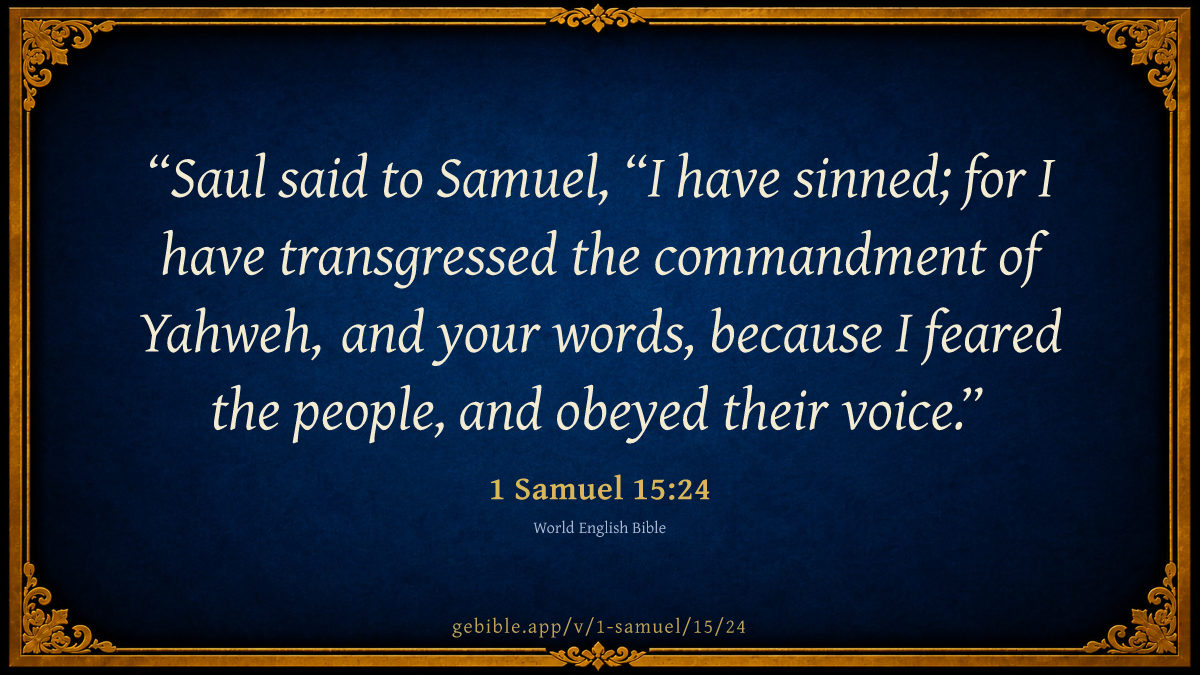
Saul said to Samuel, “I have sinned; for I have transgressed the commandment of Yahweh, and your words, because I feared the people, and obeyed their voice.
Parallel Translations
-
Saul said to Samuel, “I have sinned; for I have transgressed the commandment of Yahweh, and your words, because I feared the people, and obeyed their voice.
-
And Saul said unto Samuel, I have sinned: for I have transgressed the commandment of the LORD, and thy words: because I feared the people, and obeyed their voice.
-
And Saul said unto Samuel: 'I have sinned; for I have transgressed the commandment of the LORD, and thy words; because I feared the people, and hearkened to their voice.
Cross-references (19)
Passages linked to 1 Samuel 15:24 in the Treasury of Scripture Knowledge, ordered by reader-vote popularity; verse text shown in World English Bible.
- 2 Samuel 12:13 David said to Nathan, “I have sinned against Yahweh.” Nathan said to David, “Yahweh also has put away your sin. You will not die.
- Isaiah 51:12-13 “I, even I, am he who comforts you. Who are you, that you are afraid of man who shall die, and of the son of man who will be made as grass? Have you forgotten Yahweh your Maker, who stretched out the heavens, and laid the foundations of the earth? Do you live in fear continually all day because of the fury of the oppressor, when he prepares to destroy? Where is the fury of the oppressor?
- Numbers 22:34 Balaam said to Yahweh’s angel, “I have sinned; for I didn’t know that you stood in the way against me. Now therefore, if it displeases you, I will go back again.”
- Proverbs 29:25 The fear of man proves to be a snare, but whoever puts his trust in Yahweh is kept safe.
- Galatians 1:10 For am I now seeking the favor of men, or of God? Or am I striving to please men? For if I were still pleasing men, I wouldn’t be a servant of Christ.
- Exodus 9:27 Pharaoh sent and called for Moses and Aaron, and said to them, “I have sinned this time. Yahweh is righteous, and I and my people are wicked.
- Exodus 23:2 “You shall not follow a crowd to do evil. You shall not testify in court to side with a multitude to pervert justice.
- Matthew 27:4 saying, “I have sinned in that I betrayed innocent blood.” But they said, “What is that to us? You see to it.”
- Revelation 21:8 But for the cowardly, unbelieving, sinners, abominable, murderers, sexually immoral, sorcerers, idolaters, and all liars, their part is in the lake that burns with fire and sulfur, which is the second death.”
- Genesis 3:12 The man said, “The woman whom you gave to be with me, she gave me fruit from the tree, and I ate it.”
- Genesis 3:17 To Adam he said, “Because you have listened to your wife’s voice, and ate from the tree, about which I commanded you, saying, ‘You shall not eat of it,’ the ground is cursed for your sake. You will eat from it with much labor all the days of your life.
- Exodus 10:16 Then Pharaoh called for Moses and Aaron in haste, and he said, “I have sinned against Yahweh your God, and against you.
- 1 Samuel 2:29 Why do you kick at my sacrifice and at my offering, which I have commanded in my habitation, and honor your sons above me, to make yourselves fat with the best of all the offerings of Israel my people?’
- 1 Samuel 15:9 But Saul and the people spared Agag, and the best of the sheep, of the cattle, and of the fat calves, and the lambs, and all that was good, and were not willing to utterly destroy them; but everything that was vile and refuse, that they destroyed utterly.
- 1 Samuel 15:15 Saul said, “They have brought them from the Amalekites; for the people spared the best of the sheep and of the cattle, to sacrifice to Yahweh your God. We have utterly destroyed the rest.”
- 1 Samuel 15:30 Then he said, “I have sinned; yet please honor me now before the elders of my people, and before Israel, and come back with me, that I may worship Yahweh your God.”
- Job 31:34 because I feared the great multitude, and the contempt of families terrified me, so that I kept silence, and didn’t go out of the door—
- Jeremiah 38:5 Zedekiah the king said, “Behold, he is in your hand; for the king can’t do anything to oppose you.”
- Luke 23:20-25 Then Pilate spoke to them again, wanting to release Jesus, but they shouted, saying, “Crucify! Crucify him!” He said to them the third time, “Why? What evil has this man done? I have found no capital crime in him. I will therefore chastise him and release him.” But they were urgent with loud voices, asking that he might be crucified. Their voices and the voices of the chief priests prevailed. Pilate decreed that what they asked for should be done. He released him who had been thrown into prison for insurrection and murder, for whom they asked, but he delivered Jesus up to their will.
Cross-references from openbible.info (CC BY 4.0)
Explain this verse (19 sources)
Historical commentary, presented as a primary source — not an endorsement.
Private notes
Saved on this device only — never synced or sent anywhere.
John Trapp 1656 · Public Domain 1Sa 15:24 And Saul said unto Samuel, I have…
1Sa 15:24 And Saul said unto Samuel, I have sinned: for I have transgressed the commandment of the LORD, and thy words: because I feared the people, and obeyed their voice.
Ver. 24. I have sinned.] Tandem aliquando frigide ait Peccavi. When he could deny it no longer, at length he maketh a forced and feigned confession; drawn thereto, more by the danger and damage of his sin, than by the offence; mincing and making the best of an ill matter. Rupertus, making a comparison between the repentance of Saul and of David, observeth that they both cried Peccavi, sed magno discrimine, but with a great deal of difference. It was wrung from Saul, but it freely came from David. {2Sa 12:13} Saul sought his own glory; David, God’s. Saul saith, "I have sinned; yet honour me before the people": David saith, "Against thee, thee only, have I sinned; have mercy on me," &c.
Read full note →
Because I feared the people.] This was to excuse one sin with another. He should have trusted in God, done his duty, and not feared what man could do unto him.
John Trapp, A Commentary or Exposition upon All the Books of the Old and New Testament (1647–1656) — public domain. Text from a community e-Sword module.
Matthew Poole 1685 · Public Domain I have sinned; which confession proceeded not from true…
I have sinned; which confession proceeded not from true repentance, but from the sense of his great danger, and from a desire of recalling that dreadful sentence denounced against him.
The commandment of the Lord, and thy words, i.e. the commandment of the Lord delivered to me by thy words; another hendiadis. I feared the people; who, as thou knowest, are set upon mischief, and would probably have broken forth into a mutiny or rebellion, had I done otherwise. But how little he feared the people, may be seen by 1Sa 11:7; 14:24. But this was a false cause; nor doth he acknowledge the true cause, which was his covetousness, and because he did not fear God.
Matthew Poole's English Annotations on the Holy Bible (1683–1685) — public domain. Text from a community e-Sword/MySword module.
Matthew Henry 1710 · Public Domain Saul is at length brought to put himself into…
Saul is at length brought to put himself into the dress of the penitent; but it is too evident that he only acts the part of a penitent, and is not one indeed. Observe,
I. How poorly he expressed his repentance. It was with much ado that he was made sensible of his fault, and not till he was threatened with being deposed. This touched him in a tender part. Then he began to relent, and not till then. When Samuel told him he was rejected from being king, then he said, I have sinned, Sa1 15:24. His confession was not free nor ingenuous, but extorted by the rack, and forced from him. We observe here several bad signs of the hypocrisy of his repentance, and that it came short even of Ahab's. 1. He made his application to Samuel only, and seemed most solicitous to stand right in his opinion and to gain his favour. He makes a little god of him, only to preserve his reputation with the people, because they all knew Samuel to be a prophet, and the man that had been the instrument of his preferment. Thinking it would please Samuel, and be a sort of bribe to him, he puts it into his confession: I have transgressed the commandment of the Lord and thy word; as if he had been in God's stead, Sa1 15:24. David, though convinced by the ministry of Nathan, yet, in his confession, has his eye to God alone, not to Nathan. Psa 51:4 Against thee only have I sinned. But Saul, ignorantly enough, confesses his sin as a transgression of Samuel's word; whereas his word was no other than a declaration of the commandment of the Lord. He also applies to Samuel for forgiveness (Sa1 15:25): I pray thee, pardon my sin; as if any could forgive sin but God only. Those wretchedly deceive themselves who, when they have fallen into scandalous sin, think it enough to make their peace with the church and their ministers, by the show and plausible profession of repentance, without taking care to make their peace with God by the sincerity of it. The most charitable construction we can put upon this of Saul is to suppose that he looked upon Samuel as a sort of mediator between him and God, and intended an address to God in his application to him. However, it was very weak. 2. He excused his fault even in the confession of it, and that is never the fashion of a true penitent (Sa1 15:24): I did it because I feared the people, and obeyed their voice. We have reason enough to think that it was purely his own doing and not the people's; however, if they were forward to do it, it is plain, by what we have read before, that he knew how to keep up his authority among them and did not stand in any awe of them. So that the excuse was false and frivolous; whatever he pretended, he did not really fear the people. But it is common for sinners, in excusing their faults, to plead the thoughts and workings of their own minds, because those are things which, how groundless soever, no man can disprove; but they forget that God searchest the heart. 3. All his care was to save his credit, and preserve his interest in the people, lest they should revolt from him, or at least despise him. Therefore he courts Samuel with so much earnestness (Sa1 15:25) to turn again with him, and assist in a public thanksgiving for the victory. Very importunate he was in this matter when he laid hold on the skirt of his mantle to detain him (Sa1 15:27), not that he cared for Samuel, but he feared that if Samuel forsook him the people would do so too. Many seem zealously affected to good ministers and good people only for the sake of their own interest and reputation, while in heart they hate them. But his expression was very gross when he said (Sa1 15:30), I have sinned, yet honour me, I pray thee, before my people. Is this the language of a penitent? No, but the contrary: "I have sinned, shame me now, for to me belongs shame, and no man can loathe me so much as I loathe myself." Yet how often do we meet with the copies of this hypocrisy of Saul! It is very common for those who are convicted of sin to show themselves very solicitous to be honoured before the people. Whereas he that has lost the honour of an innocent can pretend to no other than that of a penitent, and it is the honour of a penitent to take shame to himself.
Read full note →
II. How little he got by these thin shows of repentance. What point did he gain by them? 1. Samuel repeated the sentence passed upon him, so far was he from giving any hopes of the repeal of it, Sa1 15:26, the same with Sa1 15:23. He that covers his sins shall never prosper, Pro 28:13. Samuel refused to turn back with him, but turned about to go away, Sa1 15:27. As the thing appeared to him upon the first view, he thought it altogether unfit for him so far to countenance one whom God had rejected as to join with him in giving thanks to God for a victory which was made to serve rather Saul's covetousness than God's glory. Yet afterwards he did turn again with him (Sa1 15:31), upon further thoughts, and probably by divine direction, either to prevent a mutiny among the people or perhaps not to do honour to Saul (for, though Saul worshipped the Lord, Sa1 15:31, it is not said Samuel presided in that worship), but to do justice on Agag, Sa1 15:32. 2. He illustrated the sentence by a sign, which Saul himself, by his rudeness, gave occasion for. When Samuel was turning from him he tore his clothes to detain him (Sa1 15:27), so loth was he to part with the prophet; but Samuel put a construction upon this accident which none but a prophet could do. He made it to signify the rending of the kingdom from him (Sa1 15:28), and that, like this, was his own doing. "He hath rent it from thee, and given it to a neighbour better than thou," namely, to David, who afterwards, upon occasion, cut off the skirt of Saul's robe (Sa1 24:4), upon which Saul said (Sa1 24:20), I know that thou shalt surely be king, perhaps remembering this sign, the tearing of the skirt of Samuel's mantle. 3. He ratified it by a solemn declaration of its being irreversible (Sa1 15:29): The Strength of Israel will not lie. The Eternity or Victory of Israel, so some read it; the holy One, so the Arabic; the most noble One, so the Syriac; the triumphant King of Israel, so bishop Patrick. "He is determined to depose thee, and he will not change his purpose. He is not a man that should repent." Men are fickle and alter their minds, feeble and cannot effect their purposes; something happens which they could not foresee, by which their measures are broken. But with God it is not so. God has sometimes repented of the evil which he thought to have done, repentance was hidden from Saul, and therefore hidden from God's eyes.
Matthew Henry's Commentary on the Whole Bible (1708–1710) — public domain (CC PDM 1.0). Text via the HelloAO Bible API.
John Gill 1763 · Public Domain And Saul said unto Samuel, I have sinned,.... This…
And Saul said unto Samuel, I have sinned,.... This confession of his sin does not appear to be ingenuous, cordial, and sincere, and was made chiefly for the sake of getting the sentence of rejecting him from being king reversed:
for I have transgressed the commandment of the Lord, and thy words; which last seems to be added to collogue with Samuel, and to ingratiate himself with him; and Abarbinel thinks that Saul suspected that Samuel had aggravated the matter of himself, and that he did not really transgress the words of the Lord, but as the words of Samuel; and therefore according to the words of Samuel he had sinned, but not according to the words of the Lord only:
Read full note →
because I feared the people; Doeg the Edomite, who was reckoned as all of them, Jarchi says: this was a mere excuse of Saul's, he stood in no fear of the people, he kept them in awe, and did as he would with them, as a sovereign prince:
and obeyed their voice; in sparing the best of the cattle; so be pretended, when it was his own will, and the effect of his covetousness.
John Gill's Exposition of the Whole Bible (1746–1763) — public domain (CC PDM 1.0). Text via the HelloAO Bible API.
John Wesley 1765 · Public Domain I have sinned - It does by no means…
I have sinned - It does by no means appear, that Saul acts the hypocrite herein, in assigning a false cause of his disobedience. Rather, he nakedly declares the thing as it was.
John Wesley, Explanatory Notes Upon the Whole Bible (1754–1765) — public domain. Text via the GEBible commentary corpus.
Adam Clarke 1810 · Public Domain Verse 24. I have sinned - because I feared…
Verse 24. I have sinned - because I feared the people] This was the best excuse he could make for himself; but had he feared GOD more, he need have feared the PEOPLE less.
Adam Clarke's Commentary on the Bible (1810–1826) — public domain. Text from a community e-Sword/MySword module.
Joseph Benson 1811 · Public Domain 1Sa 15:24-25. I have sinned — It does by…
1Sa 15:24-25. I have sinned — It does by no means appear that Saul acts the hypocrite herein, in assigning a false cause of his disobedience. Rather, he nakedly declares the thing as it was. Pardon my sin — Neither can it be proved that there was any hypocrisy in this. Rather, charity requires us to believe, that he sincerely desired pardon, both from God and man, as he now knew he had sinned against both.
Joseph Benson's Commentary on the Old and New Testaments (1811–1818) — public domain. Text from a community e-Sword module.
Albert Barnes 1834 · Public Domain I have sinned - Compare 1Sa 15:25, 1Sa 15:30.…
I have sinned - Compare 1Sa 15:25, 1Sa 15:30. How was it that these repeated confessions were unavailing to obtain forgiveness, when David’s was? (See the marginal reference.) Because Saul only shrank from the punishment of his sin. David shrank in abhorrence from the sin itself Psa 51:4.
Albert Barnes' Notes on the Bible (1834–1885) — public domain. Text from a community e-Sword/MySword module.
Haydock's Catholic Bible Commentary 1859 · Public Domain Voice: miserable excuse for a king, who ought to…
Voice: miserable excuse for a king, who ought to prevent the sins of his people! (Calmet) --- Saul’s transgression seems less than David’s; but the one repents, and the other proudly defends what he had done. (Du Hamel)
George Leo Haydock (1774–1849), Haydock's Catholic Family Bible and Commentary, 1859 edition — public domain. Excludes Psalms (Douay-Rheims chapter numbering differs from Protestant) and Deuterocanonical books (Catholic canon only).
Robert Jamieson, A. R. Fausset & David Brown 1871 · Public Domain I have sinned . . . turn again with…
I have sinned . . . turn again with me, that I may worship the Lord--The erring, but proud and obstinate monarch was now humbled. He was conscience-smitten for the moment, but his confession proceeded not from sincere repentance, but from a sense of danger and desire of averting the sentence denounced against him. For the sake of public appearance, he besought Samuel not to allow their serious differences to transpire, but to join with him in a public act of worship. Under the influence of his painfully agitated feelings, he designed to offer sacrifice, partly to express his gratitude for the recent victory, and partly to implore mercy and a reversal of his doom. It was, from another angle, a politic scheme, that Samuel might be betrayed into a countenancing of his design in reserving the cattle for sacrificing. Samuel declined to accompany him.
I feared the people, and obeyed their voice--This was a different reason from the former he had assigned. It was the language of a man driven to extremities, and even had it been true, the principles expounded by Samuel showed that it could have been no extenuation of the offense. The prophet then pronounced the irreversible sentence of the rejection of Saul and his family. He was judicially cut off for his disobedience.
Jamieson, Fausset & Brown — Commentary Critical and Explanatory on the Whole Bible (1871) — public domain (CC PDM 1.0). Text via the HelloAO Bible API.
Daniel D. Whedon 1874 · Public Domain 24. I have sinned — The announcement of his…
24. I have sinned — The announcement of his rejection suddenly subdues his haughty spirit, and brings him to the acknowledgment of his disobedience; but his palliating words, I feared the people, and obeyed their voice, show that his penitence was more the result of alarm over the thought of being rejected than of any deep consciousness of sin.
Daniel D. Whedon (gen. ed.), Commentary on the Old and New Testaments (1874–1909) — public domain. Text from a community e-Sword module.
The Cambridge Bible for Schools and Colleges 1878 · Public Domain 24–31. The rejection of Saul
24–31. The rejection of Saul
24. I have sinned] Though a formal confession of his sin is extorted from Saul, he does not humble himself before God in genuine penitence. He still tries to shift the blame on to the people, and his chief anxiety is lest the breach between Samuel and himself should become a public scandal and weaken his authority (1Sa_15:30). Contrast David’s heart-felt repentance (2Sa_12:13; Psa_51:4).
The Cambridge Bible for Schools and Colleges (gen. ed. J. J. S. Perowne; Cambridge University Press, 1878–1918) — public domain. Text from a community e-Sword module.
Ellicott's Commentary for English Readers 1878 · Public Domain (24) I have sinned.—The grave condemnation of the prophet…
(24) I have sinned.—The grave condemnation of the prophet appalled the king. The grounds of the Divine rejection evidently sank deep into Saul’s heart. Such a thought as that, in the eyes of the Invisible and Eternal, he ranked with the idolators and heathen sinners around, was, even for one sunk so low as Saul, terrible.
Because I feared the people.—He, with stammering lips, while deprecating the Divine sentence, still seeks to justify himself; but all that he could allege in excuse only more plainly marked out his unfitness for his high post. He could, after all, only plead that he loved the praise of men more than the approval of his God; that he preferred—as so many of earth’s great ones have since done—the sweets of transient popular applause to the solitary consciousness that he was a faithful servant of the Highest.
A Bible Commentary for English Readers, edited by Charles John Ellicott (1878–1897) — public domain. Text from a community e-Sword module.
The Pulpit Commentary 1880 · Public Domain SAUL"S PROFESSION OF REPENTANCE AND FINAL REJECTION (vers. 24-35).
SAUL"S PROFESSION OF REPENTANCE AND FINAL REJECTION (vers. 24-35).
The words of Samuel struck Saul with terror. The same authority which had first given him the kingdom now withdraws it from him, and pronounces his offence as equal in God"s sight to crimes which Saul himself held in great abhorrence. He humbles himself, therefore, before Samuel, acknowledges his sin, and frankly confesses that the cause of it had been his unwillingness to act in a manner contrary to the wishes of the people; and we must fairly conclude that the sparing of the spoil had been the people"s doing. But was it not the king"s duty to make the people obedient to Jehovah"s voice? As the theocratic king, he was Jehovah"s minister, and in preferring popularity to duty he showed himself unworthy of his position. Nor can we suppose that his confession of sin arose from penitence. It was the result simply of vexation at having his victory crossed by reproaches and disapproval from the only power capable of holding him in check. It seems, too, as if it were Samuel whom he feared more than Jehovah; for he speaks of thy words, and asks Samuel to pardon his sin, and to grant him the favour of his public presence with him at the sacrifice which was about to be celebrated in honour of their triumph.
Read full note →
Vers. 24-31.
Conviction of sin not repentance.
The facts are
1. Saul, alleging fear of the people, admits his sin, and seeks Samuel"spresence while he worships the Lord.
2. On Samuel refusing and turning away, Saul seizes and rends hisgarment, which circumstance is used as a sign that so the Lord had rent the kingdom from Saul and given it to another.
3. On being assured that God"s purpose was irrevocable. Saul entreats, forthe sake of his credit among the people that Samuel would join him in an act of worship, to which Samuel complies. The decisive language of the prophet, given in a tone which admitted of no mistake, aroused the slumbering conscience of Saul, and brought about his remarkable pleading for pity and help. We have here the case of a man guilty of a great sin, concerned for its forgiveness, but sternly assured that he shall not have it. The apparent severity of the prophet is not based on any arbitrary decree of God, nor on an unchangeableness in the "Strength of Israel" irrespective of human character and conduct, but upon God"s knowledge of Saul"s actual condition. The repentance which Saul thinks to be adequate, and which many men would recognise, is known by the Searcher of hearts not to be true repentance, but only a bare conviction of sin, attended with a consequent dread of the outward temporal consequences attached to it, as just indicated by Samuel. Bare conviction of sin is not true repentance. Consider
I ITS REAL NATURE. Conviction of sin is a matter only of an aroused conscience, brought about by the evidence of facts being set before the understanding and the presence of penalties consequent on the evidence. There was no resisting Samuel"s argument. The common understanding saw that a human will in opposition to a Divine was necessarily sin, and the uneasiness of conscience thus naturally aroused was aggravated by the emphatic announcement of a great penalty loss of the kingdom. The mental operation was that of a pure logical progression from admitted premises to an irresistible conclusion. Conscience does not disturb a man in working out a syllogism in formal logic or a demonstration in mathematics; but it does when the question reasoned on is the man"s own conduct. This is the general nature of the conviction of sin which many experience. Here, observe, is an absence of all that fine spiritual discernment which sees in sin essential unholiness, and that corresponding feeling which loathes it because of what it is in the sight of God. There is no change in the spirit towards sin itself, no detestation of the self-preference which rose against the supreme will.
II ITS MANIFESTATIONS. The manifestation of Saul"s conviction of sin is a remarkable illustration of the enormous difference between bare conviction and true repentance. The force of evidence and pressure of penalty extorted the admission, "I have sinned:" yet, owing to the lack of the spirit of repentance, the mere generality of that admission was revealed by the immediate palliation, "I feared the people." Pardon, consisting in the removal of penalty, was the only pardon cared for, and even this was sought by a superstitious trust in the prayers of another. A zealous and prompt observance of some outward act of worship was thought to be a sure means of recovering lost favour. The slightest movement of Samuel indicative of the non-reversal of the penalty only excited a spasmodic dread, without the slightest trace of any changed sentiment towards sin itself. And when no hope of avoiding the penalty remains, the only thought is to break his fall before his elders, and so save some civil advantage. This analysis, expressed in terms suitable to our times, will be found to hold good of multitudes whose conviction of sin is unattended with the spirit of a true repentance. How different the conviction that accompanies true repentance! Then, "I have sinned" has a deep, unutterable meaning. Forgiveness is then not the mere release of life from suffering and loss, but a restoration of the soul to the joy of personal reconciliation with a holy Father. No thought of excuse is ever entertained, but "against thee, and thee only, have I sinned and done this evil," is the sincere confession of a broken and contrite heart. The soul is so filled with self-loathing, and so agonised in being far from God, that it thinks not of punishment and position among men, and can only go direct to God and plead, "Create in me a clean heart, O God, and renew a right spirit within me." Contrast Simon Magus (Act_8:24) and Felix. (Act_24:25 Ps 51 Lu 15)
III ITS CONSEQUENCES. Saul, though convinced of sin, was practically an unchanged man. He was, after his pleading with Samuel, and after Samuel"s kindly act of consoling his poor blind heart by joining in worship, as fond of his own self-will as before. No spiritual change being wrought, no remission of penalty was ever possible. On his knowledge of what was Saul"s radical evil a heart out of all sympathy with God"s holiness and of its continuance, did God resolve to provide for Israel another king. The Strength of Israel is not dependent on existing arrangements or human beings for the maintenance of his authority and accomplishment of his purposes. Saul as a king was ruined. His defective conviction was of no avail. It should be urged on all that a mere admission of sin and effort to be free from its punishment are of no avail. Loss of all that is deemed precious must ensue. Only repentance of the heart will serve. This is sure to lead away from all false means of deliverance to him who is exalted to give remission of sins.
General lessons:
1. A spirit of blended firmness and kindness should influence us in thedischarge of unwelcome duties.
2. We should be careful not to encourage men in their self-delusions.
3. Respect for an office and consideration for social relations should enterinto our treatment of offenders.
Vers. 24-31. (GILGAL.)
Insincere confession of sin.
have sinned" (vers. 24, 30). On hearing the sentence of his rejection, Saul at length confesses his sin. The words of Samuel have some effect upon him, but not the full effect they should have had. For his confession does not proceed from a truly penitent heart, (see 1Sa_7:6) and it is not followed either by the reversal of his sentence or the forgiveness of his sin. It was like that of Pharaoh, (Exo_9:27) of Balaam, (Num_22:34) and of Judas (Mat_27:4) springing from "the sorrow of the world, which worketh death". (2Co_7:10) Notice
I ITS CHARACTERISTICS. It was made
1. Under the pressure of circumstances, rather than as the free expression of conviction. Confession comes too late when it is extorted by the demonstration of sin which can no longer be denied. Some men, like Saul, conceal their sin so long as they can, and confess it only when they are compelled.
2. From the fear of consequences (vers. 23, 26), and not from a sense of the essential evil of sin. This is the most common characteristic of insincerity. As Saul confessed his sin from the fear of losing his kingdom, so do multitudes from fear of death, and live to prove their insincerity by their return to disobedience. "There are two views of sin: in one it is looked upon as a wrong; in the other as producing loss loss, for example, of character. In such cases, if character could be preserved before the world, grief would not come; but the paroxysms of misery fall upon our proud spirit when our guilt is made public. The most distinct instance we have of this is in the life of Saul. In the midst of his apparent grief, the thing still uppermost was that he had forfeited his kingly character; almost the only longing was that Samuel should honour him before the people. And hence it comes to pass that often remorse and anguish only begin with exposure" (Robertson).
3. To the servant of God, and to gain his approval, and not to God, and to obtain his favour. "Thy words" (ver. 24). "Now therefore" (as if on the ground of his confession he could justly claim pardon), "I pray thee, pardon my sin" (ver. 25). Many confess their sin to men without confessing it to God, and attach to their confession a worth that does not belong to it.
4 . With an extenuation of guilt, rather than with a full acknowledgment of its enormity. "I feared the people, and obeyed their voice" (vers. 24, 15). He returns to his first excuse, which he puts in a different form. If what he said was true, what he had done was wrong. (Exo_23:2) There is a higher law than the clamour of a multitude. True penitents do not seek to palliate their sin, but make mention of its greatness as a plea for Divine. (Psa_25:11)
1. With an entreaty for public honour, rather than in deep humiliation before God and man. "Honour me now, I pray thee, before the elders of the people, and before Israel" (ver. 30) "If Saul had been really penitent, he would have prayed to be humbled rather than to be honoured" (Gregory).
2. With repeated promises of rendering worship before the Lord, rather than a serious purpose to obey his voice (vers. 25, 30). He does not seem even yet to have laid to heart the truth which had been declared by the prophet; and he probably looked upon public worship by sacrifice as something peculiarly praiseworthy, and sought, by urging Samuel to remain and offer it, to promote his own honour in the sight of the people, and not as the expression of penitence and the means of forgiveness "The most prominent feature in the character of Saul was his insincerity." And yet, in his repeated promises to worship the Lord, and his urgent entreaties of Samuel, there was doubtless an element of good that might not be despised. (1Ki_21:29)
The blackest night that veils the sky, Of beauty hath a share; The darkest heart hath signs to tell That God still lingers there.
II ITS CONSEQUENCES. In the language and conduct of Samuel there was
1. A reiteration of the sentence of rejection. Thrice it was declared that Jehovah had determined that Saul should no longer reign under his sanction and by his aid (vers. 26, 28). Although he may not have known all that the sentence involved, he felt that its import was alarming. An insincere confession of sin darkens the gathering cloud instead of dispersing it.
2. A confirmation of it by an impressive sign, the occasion of which is afforded by the sinner himself (ver. 27). Thereby it comes home to him with greater force.
3. An intimation of the transfer to a better man of the dignity which has been forfeited by sin. This was the second time that an announcement of a truly theocratic king was given; (1Sa_12:14) and whilst it showed that the Divine purpose could not be defeated, however it might be striven against, it must have been peculiarly painful to Saul. The dreadful secret was a constant burden to him, and when he recognised the man in whom the prediction was about to be fulfilled, it excited his envy and hatred toward him. When any one is not right with God, every favour shown to another fills him with grief and wrath. (Gen_4:5)
1. A declaration of the unchangeable purpose of God. "The Strength" (Prerpetuity, Confidence, Refuge, Victory) "of Israel will not lie nor repent," etc. (ver. 29). Saul evidently thought of him as capable of acting in an arbitrary, capricious, and inconstant manner, like himself; but, inasmuch
2. as he formed his purposes with.perfect knowledge, and acted on immutable principles, and there was no real change In the heart of the transgressor, there could be no reversal of his sentence. "He cannot deny himself". (2Ti_2:12) If in some things his purposes toward men appear to change because men alter their relative position toward him (as the sun appears to change by the rotation of the earth, causing day and night), in others they abide the same forever, and he who sets himself against them must be overthrown. It is now certain that he cannot again be a theocratic king; but his renewed importunity, in which, perchance, notwithstanding its apparent selfishness, the prophet sees a gleam of hope, is followed by
3. An indication of pity toward the foolish and fallen king. "And Samuel returned after Saul; and Saul worshipped Jehovah" (ver. 31). May he not even yet be led to true repentance? Although the birthright is given to another, there is a blessing for him who weeps and prays. (Gen_27:38-40) His request is granted. He has what he desires and is prepared to receive. He is still the king after the people"s heart. He shall continue such. The sentence shall not be published, nor any special effort be put forth for his dethronement. It would result in general confusion. The just and merciful purposes of God toward the people in giving him for their king are not yet fulfilled, and they will slowly ripen to their accomplishment.
4. An exhibition of judgment upon an obstinate offender (ver. 32). One of the reasons, doubtless, why Samuel "turned again after Saul" was that he might execute on Agag the Divine sentence which he had faithlessly remitted. "The terrible vengeanca executed on the fallen monarch by Samuel is a measure of Saul"s delinquency." It is also a solemn warning to him of the doom which sooner or later comes upon every impenitent and persistent transgressor.
Observations:
1. It is not confession of sin, but the spirit in which it is made, that renders it acceptable to God.
2. Sincerity is the foundation of a truly religious character.
3. Though mercy long lingers over the sinner, yet if it be despised doomcomes at last. D.
The Pulpit Commentary (1880–1919), ed. H.D.M. Spence-Jones & Joseph S. Exell — public domain. Text from a community e-Sword module.
The Biblical Illustrator 1887 · Public Domain I have sinned.
1Sa_15:24
I have sinned.
Read full note →
Temporary religious feeling
Some are frightened into a little religiousness in their straits and deep necessities, but it is poor work and superficial work. They are like an ice in thawing weather, soft at top and hard at bottom. They melt, but to no very great extent. It is upon the surface only that they yield to heavenly influences. This is a sorry state of things, for it generally ends in a harder frost than before, and the bonds of cold indifference bind the very soul. Let those in whom there are any meltings of holy feeling take heed, for their danger lies in being content with a partial subjection to gracious influences. Grace will be all or nothing: the ice must all melt, and the soul must flow like a riverse Jesus did not come to create temporary and partial religious feeling, but to make new creatures of us. He will have nothing to do with those Ephraimites who are as half-done cakes, which are black on one side with too much baking, but have never been turned so as to feel the fire on the other side. The centre of the heart must feel the warmth of Divine love, or nothing is done. (C. H. Spurgeon.)
I feared the people and obeyed their voice.
Sauls excuse for disobedience
Saul makes three excuses for his disobedience, but they all shift the responsibility for his sin. Observe:
1. Sauls excuses are identical with those urged by sinners today: I intended to give some of it to God. I was over persuaded. I was overborne by the influence of others. I did not sin wickedly and willfully. it was only a mistake under a good motive.
2. Saul confesses the flimsiness of his excuses. Some time or other we must all come face to face with ourselves and stop making excuses, and cry, Pardon my sin
3. Saul confessed too late. Our sins reach their bounds and meet their penalty.
4. Saul repented only because he feared punishment.
5. Every man should make at once an honest self-examination.
6. When convicted of sin, we should without delay confess our sin. (Homiletic Review.)
The Biblical Illustrator, edited by Joseph S. Exell (c. 1880s–1900s) — public domain. Text from a community e-Sword module.
The Preacher's Complete Homiletical Commentary 1892 · Public Domain 1Sa_15:25. “Pardon my sin.” “He offers this prayer to…
CRITICAL AND EXPOSITORY NOTES—
1Sa_15:25. “Pardon my sin.” “He offers this prayer to Samuel, not to God.” “Turn again with me.” “According to 1Sa_15:30, to show him honour before the elders of the people, and before Israel, that his rejection might not be known.” (Keil.)
Read full note →
1Sa_15:29. “The strength of Israel.” A phrase which occurs only here. It means glory, perpetuity, trust. “The Hebrew word, Netsah, signifies what is bright or shines continually, and therefore what may be relied upon—as the sun, or stars.” (Wordsworth.)
1Sa_15:31. “So Samuel turned again.” “Not, of course, to yield to his selfish opposition to God’s honour, but to preserve unimpaired in the eyes of the people the position of Saul’s kingdom, which, though theocratically rejected, yet still in fact by God’s will remained, and especially not to be wanting in the sacrifice of the people.” (Erdmann.)
1Sa_15:32. “And Agag came unto him delicately.” The phrase is obscure. The last word is derived from a verb, meaning to live daintily, softly. Wordsworth translates, ‘joyfully.’ Can it mean fawningly, flatteringly, with a view of appeasing Samuel?” (Biblical Commentary. “The bitterness of death is passed.” Some commentators see in these words of Agag a heroic contempt of death, and others an assumed courageousness. Most, however, think that Agag, not having been slain by Saul, felt sure that Samuel would spare his life.
1Sa_15:33. “As thy sword,” etc. “From these words it is very evident that Agag had carried on his wars with great cruelty, and had therefore forfeited his life according to the lex Talionis.” (Keil.) “Before the Lord,” i.e., before the altar of Jehovah there; for the slaying of Agag, being the execution of a ban, was an act performed for the glory of God.” (Keil.)
1Sa_15:35. “And Samuel came no more.” “The Hebrew is, “saw him no more,’ i.e., did not visit him, which does not contradict 1Sa_19:24.
MAIN HOMILETICS OF THE PARAGRAPH.—1Sa_15:24-35
SAUL’S CONFESSION
I. Saul’s confession of sin was satisfactory as to word. “I have sinned,” is the acknowledgement of responsibility and accountability. “I have transgressed the commandment of the Lord,” is an acknowledgment on the part of man that there is a Being who has a right to lay down laws for the guidance of His creatures. There are men in the world who deny that there is such a thing as sin—who affirm that they are creatures of necessity, and are therefore undeserving of blame for any action. But Saul here admits his personal responsibility, and allows that his negative sin—his non-observance of a plain command—was a positive transgression. True it is that he admits this with reluctance, and that he involves the people in the act of disobedience. But whether he speaks the truth or not in relation to them, he does not now attempt to palliate his sin by laying the blame directly on them. He acknowledges his own personal guilt in the same words as David used to express his deep and heartfelt repentance, and as the prodigal uttered when he came first to himself and then to his father’s home. So far as the language of the confession goes it leaves nothing to be desired.
II. It is possible to use words which express true repentance and yet lack the spirit of it. A dead body is complete so far as the form goes, no limb is wanting, and all the beauty of the most perfect symmetry of form may be there. But it is only a corpse notwithstanding, and because the living spirit is wanting even the form will vanish after a time. So a man may use a “form of sound words” (2Ti_1:13) which in language may leave nothing to be desired. He may acknowledge that he is a sinner, and that he merits punishment, and his language may be that of general humility, and yet the spirit of true repentance may be absent. But the wear and tear of human life will soon make apparent whether the outward form is inhabited by a living soul or whether it is only a lifeless body. If it is a true repentance the actions proper to it will follow, but if it is not, the very form will cease to exist, and the man who once had the form of repentance without the power will cease even to possess the form, and become more and more subject to the law of sin and death. Even Pharaoh said, “I have sinned” (Exo_9:27), but in his mouth the words were not the outcome of a sense of sin, and he soon became too hardened even for such a formal confession. So was it with Saul. We here see him preserving some outward form of godliness although he was “denying the power thereof” (2Ti_3:5), and later on in his life he repeats this confession (1Sa_26:21), but as on neither occasions it was dictated by the spirit of true and godly sorrow for sin, there came a time in his life when even the formal confession vanished from his lips. The words of repentance were not wanting, but there was no correspondence between the language and the deeds—it was left to another to carry into effect the Divine commandment which Saul here confesses he had transgressed, but which it does not appear that he now made any attempt to obey. It was left to Samuel to do the work of Saul, and thus to prove that there was one man in Israel who would carry out to the letter the bidding of Jehovah.
OUTLINES AND SUGGESTIVE COMMENTS
Beware of a Saul’s confession. That you may do this, it is necessary to know two things.
1. What a Saul’s confession is.
2. What a Saul’s confession works.—J. Disselhoff.
He confesseth not till the sin be wrung from his mouth; he seeks his peace out of himself, and relies more upon another’s virtue than upon his own penitence; he would cloak his guiltiness with the holiness of another’s presence; he is more tormented with the danger and damage of the sin than with the offence; he cares to hold in with men, in what terms soever he stands with God.—Bp. Hall.
1Sa_15:29. The heathen saw God as a passionate, capricious, changeable Being, who could be angered and appeased by men. The Jewish prophets saw Him as a God whose ways were equal, who was unchangeable, whose decrees were perpetual, who was not to be bought off by sacrifice, but by righteous dealing, and who would remove the punishment when the causes which brought it on were taken away. In their own words, when men repented, God would repent.… A boat rows against the stream, the current punishes it.… The boat turns and goes with the stream, the current assists it.… But the current is the same, it has not changed—only the boat has changed its relationship to the current. Neither does God change. We change, and the same law which executed itself in punishment now expresses itself in reward.—Brooke.
1Sa_15:30. If Saul had been really penitent, he would have prayed to be humbled rather than to be honoured.—St. Gregory.
Many men pass (i.e., care) so little for their consciences, yet stand so much upon their credit. As Saul, who using no diligence to regain the favour of God, was yet very solicitous that his honour might be preserved in the opinion of the people.—Bp. Sanderson.
The Preacher's Complete Homiletical Commentary (gen. ed. Joseph S. Exell; Funk & Wagnalls, c. 1892) — public domain (pre-1929). A full-Bible homiletical/sermon-outline anthology covering 65 of 66 books (2 John is absent from the source module). Text from a community e-Sword module.
Paul E. Kretzmann 1924 · Public Domain Saul’s Humiliation
Saul’s Humiliation
v. 24. And Saul said unto Samuel, I have sinned, this confession was extorted from him by fear, but was not an expression of true penitence; for I have transgressed the commandment of the Lord and thy words, because I feared the people and obeyed their voice, he had loved the honor and favor of men more than the favor and good will of God.
Read full note →
v. 25. Now, therefore, I pray thee, pardon my sin, and turn again with me that I may worship the Lord. He did not really acknowledge his guilt, but wanted the good will of Samuel again, lest he be publicly rejected and ousted from his position of king, a disgrace which he felt would be all the harder to bear since he had already been told that the position of king would not be hereditary in his family, 1Sa 13:14.
v. 26. And Samuel, who knew that even the repentance of Saul was feigned and insincere, said unto Saul, I will not return with thee; for thou hast rejected the word of the Lord, and the Lord hath rejected thee from being king over Israel, in the sight of God he no longer occupied that position.
v. 27. And as Samuel turned about to go away, he, Saul, laid hold upon the skirt of his mantle, evidently with the intention of holding him back by force, and it rent.
v. 28. And Samuel said unto him, The Lord hath rent the kingdom of Israel from thee this day and hath given it to a neighbor of thine that is better than thou. This much was even now decided in the counsel of the Lord, although even Samuel did not yet know who Saul’s successor would be.
v. 29. And also the Strength of Israel, the Lord, who is the Refuge, the Confidence of Israel, will not lie nor repent, He would not change this judicial sentence with the penalty of rejection; for He is not a man that He should repent, Num 23:19.
v. 30. Then he said, I have sinned, a hollow sound without true sorrow of heart; yet honor me now, I pray thee, before the elders of my people and before Israel, and turn again with me that I may worship the Lord, thy God. Saul was concerned chiefly about his own honor, for he had only one fear, namely, that his authority and influence would be lost in case the people would find out about the open breach between him and Samuel.
v. 31. So Samuel turned again after Saul, not only for the purpose of maintaining outward order in the nation and of preventing anarchy, but also to carry out the sentence of death upon Agag; and Saul worshiped the Lord, he observed this outward formality.
v. 32. Then said Samuel, Bring ye hither to me Agag, the king of the Amalekites. And Agag came unto him delicately, in a cheerful mood. And Agag said, Surely the bitterness of death is past, which may have been an attempt at heroism in the face of death, or a hope that Samuel would spare him.
v. 33. And Samuel said, As thy sword hath made women childless, so shall thy mother be childless among women; he was but receiving his just reward for his cruelties. And Samuel hewed Agag in pieces before the Lord in Gilgal, he carried out Jehovah’s sentence of destruction upon him.
v. 34. Then Samuel went to Ramah, to his home; and Saul went up to his house to Gibeah of Saul.
v. 35. And Samuel came no more to see Saul until the day of his death, all intercourse with the rejected king on his side ceased from now on; nevertheless, Samuel mourned for Saul; and the Lord repented that He had made Saul king over Israel. Although Samuel had loved Saul, yet, since the latter had now been rejected as king, he could do nothing to effect a change of heart in him. A feigned repentance is the climax of hypocrisy and only tends to confirm the Lord’s sentence of rejection.
Paul E. Kretzmann, Popular Commentary of the Bible (1921–1924) — public domain. Text from a community e-Sword module.
unfoldingWord translationNotes 2017 · CC BY-SA 4.0 I have broken Yahweh's commandment
I have broken Yahweh's commandment
This is an idiom that means he had disobeyed the commandment. AT: "I have disobeyed what Yahweh commanded" (See: Idiom)
Read full note →
because I was afraid of the people
This is the reason Saul gives for not obeying God. AT: "because I was afraid of the soldiers"
obeyed their voice
Here "voice" refers to what the soldiers asked Saul to do. AT: "did what they asked" (See: Metonymy)
return with me
Saul and Samuel were apparently talking in private away from the other people.
translationWords
command
fear
forgive
worship
unfoldingWord translationNotes — © Distant Shores Media and the Door43 World Missions Community, licensed CC BY-SA 4.0. Source: git.door43.org/Door43/en_tn.
Tyndale Open Study Notes 2022 · CC BY-SA 4.0 15:24-30 Saul finally confessed his sin. But it was…
15:24-30 Saul finally confessed his sin. But it was too little, too late—and still accompanied by excuses.
15:24 I was afraid of the people: Saul continued to blame others (see 15:15, 21). • what they demanded: There is no hint of such pressure in the chapter. Saul’s confession appears dishonest (cp. David, 2 Sam 12:13; Ps 51).
Tyndale Open Study Notes — © Tyndale Open Resources, licensed CC BY-SA 4.0. Text via the HelloAO Bible API.