
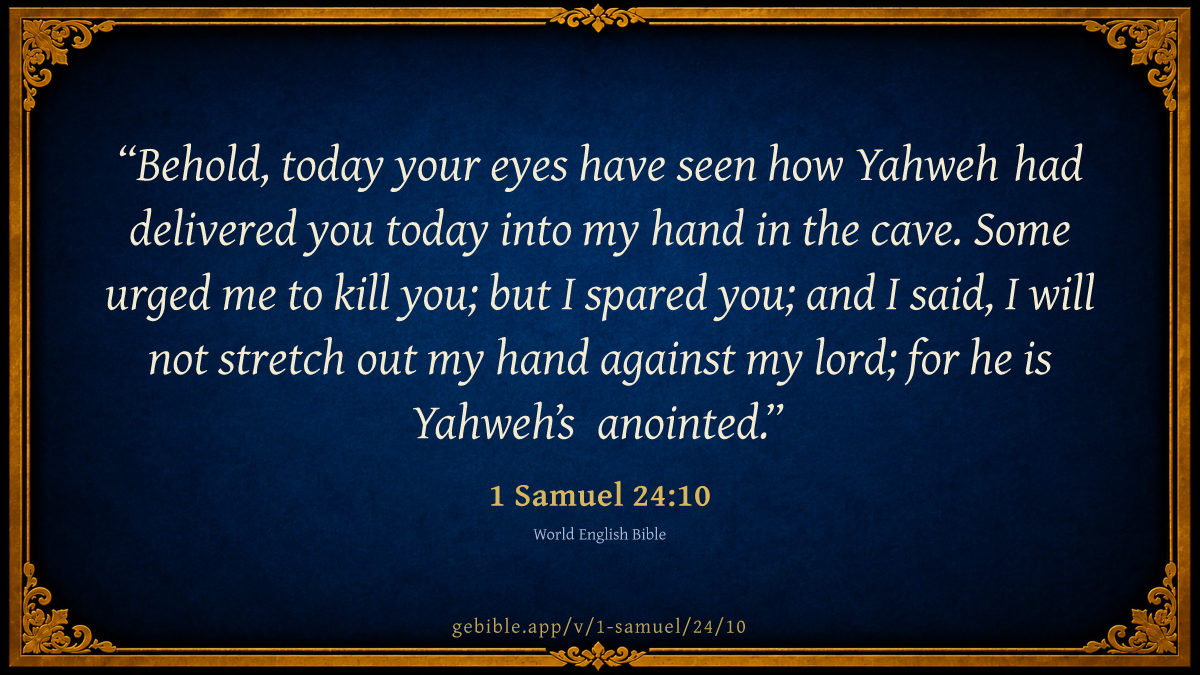
Behold, today your eyes have seen how Yahweh had delivered you today into my hand in the cave. Some urged me to kill you; but I spared you; and I said, I will not stretch out my hand against my lord; for he is Yahweh’s anointed.
Parallel Translations
-
Behold, today your eyes have seen how Yahweh had delivered you today into my hand in the cave. Some urged me to kill you; but I spared you; and I said, I will not stretch out my hand against my lord; for he is Yahweh’s anointed.
-
Behold, this day thine eyes have seen how that the LORD had delivered thee to day into mine hand in the cave: and some bade me kill thee: but mine eye spared thee; and I said, I will not put forth mine hand against my lord; for he is the LORD’s anointed.
-
(24-11) Behold, this day thine eyes have seen how that the LORD had delivered thee to-day into my hand in the cave; and some bade me kill thee; but mine eye spared thee; and I said: I will not put forth my hand against my lord; for he is the LORD'S anointed.
Cross-references (3)
Passages linked to 1 Samuel 24:10 in the Treasury of Scripture Knowledge, ordered by reader-vote popularity; verse text shown in World English Bible.
- 1 Samuel 24:4 David’s men said to him, “Behold, the day of which Yahweh said to you, ‘Behold, I will deliver your enemy into your hand, and you shall do to him as it shall seem good to you.’ ” Then David arose, and cut off the skirt of Saul’s robe secretly.
- Psalms 105:15 “Don’t touch my anointed ones! Do my prophets no harm!”
- 1 Samuel 26:8-9 Then Abishai said to David, “God has delivered up your enemy into your hand today. Now therefore please let me strike him with the spear to the earth at one stroke, and I will not strike him the second time.” David said to Abishai, “Don’t destroy him; for who can stretch out his hand against Yahweh’s anointed, and be guiltless?”
Cross-references from openbible.info (CC BY 4.0)
Explain this verse (8 sources)
Historical commentary, presented as a primary source — not an endorsement.
Private notes
Saved on this device only — never synced or sent anywhere.
Geneva Bible translators 1599 · Public Domain Contrary to the false report of them that said,…
Contrary to the false report of them that said, David was Saul’s enemy, he proveth himself to be his friend.
Geneva Bible (1599) marginal notes — public domain.
John Trapp 1656 · Public Domain 1Sa 24:10 Behold, this day thine eyes have seen…
1Sa 24:10 Behold, this day thine eyes have seen how that the LORD had delivered thee to day into mine hand in the cave: and [some] bade [me] kill thee: but [mine eye] spared thee; and I said, I will not put forth mine hand against my lord; for he [is] the LORD’S anointed.
Ver. 10. Behold, this day thine eyes have seen.] This is David’s defence; wherein each word hath its weight, each syllable its substance. We may lawfully, when wronged, clear our own innocence, so we do it, as here, with meekness and wisdom. Sed o quam hoc non est omnium.
John Trapp, A Commentary or Exposition upon All the Books of the Old and New Testament (1647–1656) — public domain. Text from a community e-Sword module.
Matthew Poole 1685 · Public Domain Mine eye; which words are easily understood both from…
Mine eye; which words are easily understood both from the nature of the thing, and from the use of this phrase in other scriptures, as Deu 7:16; 13:8. The eye is said to spare, because it affects the heart with pity, and moves a man to spare.
Matthew Poole's English Annotations on the Holy Bible (1683–1685) — public domain. Text from a community e-Sword/MySword module.
John Gill 1763 · Public Domain Behold, this day thine eyes have seen,.... Or may…
Behold, this day thine eyes have seen,.... Or may see; there is full proof and evidence of it, and which will be presently shown:
how that the Lord had delivered thee today into mine hand in the cave; from whence they were both just come:
Read full note →
and some bade me kill thee; some of the men that were with David, some of his officers or principal friends put him upon it, having a fair opportunity, and thinking it no evil, since he was his enemy, and sought his life; or "it said, kill thee"; my heart prompted me to it, that said so at first, as Ben Gersom interprets it; some refer it to God, who in his providence said so, or so it might be understood by David, as if Providence directed him to it, by giving film such an opportunity of doing it:
but mine eye spared thee; had pity on him, and notwithstanding the suggestions of friends, and of his own heart at first, or the seeming direction of Providence, yet he had mercy on him, and forbore slaying him:
and I said, I will not put forth my hand against my lord; and king, whose subject I am:
for he is the Lord's anointed; the Lord has raised him to this dignity; invested him with the office of a king, and as such I regard him, and therefore have refrained mine hand from him, from hurting him,
John Gill's Exposition of the Whole Bible (1746–1763) — public domain (CC PDM 1.0). Text via the HelloAO Bible API.
John Wesley 1765 · Public Domain Mine eye - The eye is said to spare,…
Mine eye - The eye is said to spare, because it affects the heart with pity, and moves a man to spare.
John Wesley, Explanatory Notes Upon the Whole Bible (1754–1765) — public domain. Text via the GEBible commentary corpus.
Joseph Benson 1811 · Public Domain 1Sa 24:10-12. Mine eye spared thee — A phrase…
1Sa 24:10-12. Mine eye spared thee — A phrase signifying the taking pity on those whom we have it in our power to hurt. The eye is said to spare, because it affects the heart, and induces a person to spare. Moreover, my father — Such he was through David’s marriage of his daughter. The Lord avenge me of thee — Rather, will avenge me; that is, vindicate and deliver me from thy violent and unjust persecution. For he does not, in these words, pray God to punish Saul for the injuries he had done him, but to justify, clear, and protect himself. But my hand shall not be upon thee — He was resolved not to return evil for evil, or to avenge himself, but to leave it to God to do him right.
Joseph Benson's Commentary on the Old and New Testaments (1811–1818) — public domain. Text from a community e-Sword module.
Ellicott's Commentary for English Readers 1878 · Public Domain (10) Thine eyes have seen.—David and a crowd of…
(10) Thine eyes have seen.—David and a crowd of armed men around him were standing at the entrance of the cave which King Saul had just left; thus the king’s eye had seen—nay, was seeing that very moment—that his life had been in his enemy David’s hand.
And some bade me kill thee.—The literal translation here would be Jehovah delivered thee to-day into mine hand in the cave, and bade [me] kill thee. And this rendering has been explained by assuming that God’s allowing Saul to choose the very cavern for his midday slumber where David and his company were lodging was tantamount to directing David to slay his bitter foe, thus given over helpless into his hands; but this is contrary to the spirit of the whole narrative. The English Version has followed the Syriac and Chaldee Versions here, and by supplying “some”—better, perhaps, one—before “bade me kill thee,” has given us the sense in which the Hebrews have always understood the passage. The Vulg. here, with a very slight change in the vowel points, renders “I thought to kill thee.”
Read full note →
But mine eye spared thee.—The English Version supplies an obvious subject in “mine eye.” Clericus suggests more happily, “my soul,” or “my hand,” before “spared thee.”
A Bible Commentary for English Readers, edited by Charles John Ellicott (1878–1897) — public domain. Text from a community e-Sword module.
unfoldingWord translationNotes 2017 · CC BY-SA 4.0 your eyes have seen
your eyes have seen
Here "your eyes" represent King Saul. AT: "you have seen with your own eyes" (See: Synecdoche)
Read full note →
put you into my hand
The word "hand" is a metonym for control. AT: "put you where I could kill you or allow you to live" (See: Metonymy)
my father
Saul was not David's real father. David calls him "father" to show that he respects Saul.
there is no evil or treason in my hand
David speaks as if evil and treason were physical objects he could hold in his hand. Here "hand" represents a person acting or doing something. AT: "I have done no evil deed against you, nor have I rebelled against you" (See: Metaphor and Metonymy)
translationWords
Yahweh
hand
Yahweh
ancestor
robe
evil
sin
life
unfoldingWord translationNotes — © Distant Shores Media and the Door43 World Missions Community, licensed CC BY-SA 4.0. Source: git.door43.org/Door43/en_tn.