
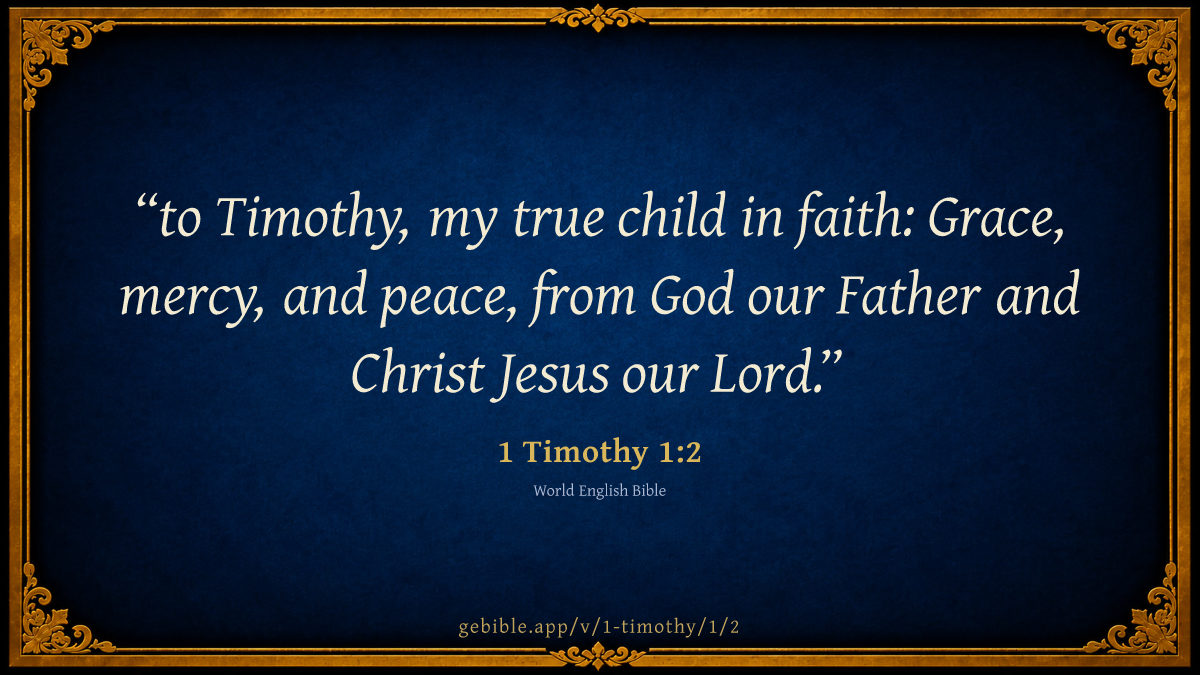
to Timothy, my true child in faith: Grace, mercy, and peace, from God our Father and Christ Jesus our Lord.
Parallel Translations
-
to Timothy, my true child in faith: Grace, mercy, and peace, from God our Father and Christ Jesus our Lord.
-
Vnto Timothe his naturall sonne in the fayth. Grace mercy and peace from God oure father and Lorde Iesus Christ oure Lorde.
-
Vnto Timotheus my naturall sonne in the faith: Grace, mercy, and peace from God our Father, and from Christ Iesus our Lord.
Cross-references (11)
Passages linked to 1 Timothy 1:2 in the Treasury of Scripture Knowledge, ordered by reader-vote popularity; verse text shown in World English Bible.
- Titus 1:4 to Titus, my true child according to a common faith: Grace, mercy, and peace from God the Father and the Lord Jesus Christ our Savior.
- 2 Timothy 1:2 to Timothy, my beloved child: Grace, mercy, and peace, from God the Father and Christ Jesus our Lord.
- 1 Corinthians 4:14-17 I don’t write these things to shame you, but to admonish you as my beloved children. For though you have ten thousand tutors in Christ, you don’t have many fathers. For in Christ Jesus, I became your father through the Good News. I beg you therefore, be imitators of me. Because of this I have sent Timothy to you, who is my beloved and faithful child in the Lord, who will remind you of my ways which are in Christ, even as I teach everywhere in every assembly.
- Philippians 2:19-22 But I hope in the Lord Jesus to send Timothy to you soon, that I also may be cheered up when I know how you are doing. For I have no one else like-minded, who will truly care about you. For they all seek their own, not the things of Jesus Christ. But you know the proof of him, that as a child serves a father, so he served with me in furtherance of the Good News.
- Acts 16:1-3 He came to Derbe and Lystra: and behold, a certain disciple was there, named Timothy, the son of a Jewess who believed; but his father was a Greek. The brothers who were at Lystra and Iconium gave a good testimony about him. Paul wanted to have him go out with him, and he took and circumcised him because of the Jews who were in those parts; for they all knew that his father was a Greek.
- Romans 1:7 to all who are in Rome, beloved of God, called to be saints: Grace to you and peace from God our Father and the Lord Jesus Christ.
- 2 Timothy 2:1 You therefore, my child, be strengthened in the grace that is in Christ Jesus.
- 1 Peter 1:2 according to the foreknowledge of God the Father, in sanctification of the Spirit, that you may obey Jesus Christ and be sprinkled with his blood: Grace to you and peace be multiplied.
- Galatians 1:3 Grace to you and peace from God the Father and our Lord Jesus Christ,
- 1 Timothy 1:18 I commit this instruction to you, my child Timothy, according to the prophecies which were given to you before, that by them you may wage the good warfare,
- 1 Thessalonians 3:2 and sent Timothy, our brother and God’s servant in the Good News of Christ, to establish you, and to comfort you concerning your faith,
Cross-references from openbible.info (CC BY 4.0)
Explain this verse (20 sources)
Historical commentary, presented as a primary source — not an endorsement.
Private notes
Saved on this device only — never synced or sent anywhere.
John Calvin 1540 · Public Domain 2 To Timothy my own son This commendation expresses…
2 To Timothy my own son This commendation expresses no small praise. Paul means by it, that he owns Timothy to be a true and not a bastard son, and wishes that others should acknowledge him to be such; and he even applauds Timothy in the same manner as if he were another Paul. But how does this agree with the injunction given by Christ, (Matthew 23:9,) “Call no man your father on the earth?”
Or how does it agree with the declaration of the Apostle,
Read full note →
“Though ye have many fathers according to the flesh, yet there is but One who is the Father of spirits.” (1 Corinthians 4:15; Hebrews 12:9.)
I reply, while Paul claims for himself the appellation of father, he does it in such a manner as not to take away or diminish the smallest portion of the honor which is due to God. (Hebrews 12:9.) It is a common proverb “That which is placed below another is not at variance with it.” The name father, applied to Paul, with reference to God, belongs to this class. God alone is the Father of all in faith, because he regenerates us all by his word, and by the power of his Spirit, and because none but he bestows faith. But they whom he is graciously pleased to employ as his ministers for that purpose, are likewise allowed to share with him in his honor, while, at the same time, He parts with nothing that belongs to himself. Thus God, and God alone, strictly speaking, was Timothy’s spiritual Father; but Paul, who was God’s minister in begetting Timothy, lays claim to this title, by what may be called a subordinate right.
Grace, mercy, peace. So far as relates to the word mercy, he has departed from his ordinary custom in introducing it, moved, perhaps, by his extraordinary affection for Timothy. Besides, he does not observe the exact order; for he places first what ought to have been last, namely, the grace which flows from mercy. For the reason why God at first receives us into favor and why he loves us is, that he is merciful. But it is not unusual to mention the cause after the effect, for the sake of explanation. As to the words grace and peace, we have spoken on other occasions.
John Calvin's Commentaries (1540-1563) — public domain. Text from the Calvin Translation Society English edition (1840s-50s) via the Christian Classics Ethereal Library (ccel.org). Calvin's coverage is partial (roughly two-thirds of the Bible); uncommented books and verses are honest gaps, never fabricated. The 19th-century editor's footnotes and remarks are omitted so the notes are faithfully Calvin's own voice.
Geneva Bible translators 1599 · Public Domain There is as much difference betwixt mercy and grace,…
There is as much difference betwixt mercy and grace, as is betwixt the effect, and the cause: For grace is that free good will of God, whereby he chose us in Christ, and mercy is that free justification which followeth it.
Geneva Bible (1599) marginal notes — public domain.
John Trapp 1656 · Public Domain 2 Unto Timothy, my own son in the faith:…
2 Unto Timothy, my own son in the faith: Grace, mercy, and peace, from God our Father and Jesus Christ our Lord.
Ver. 2. Mine own son] This the apostle speaketh απο πολλης φιλοστοργιας, "out of deep affection," as Chrysostom observeth.
Read full note →
Grace, mercy, and peace] Not only grace and peace, as to others. When we pray for ministers, we must be more than ordinarily earnest for them with God. These three are joined together only in the Epistles of Timothy and Titus; as Theophylact out of Chrysostom hath observed.
John Trapp, A Commentary or Exposition upon All the Books of the Old and New Testament (1647–1656) — public domain. Text from a community e-Sword module.
Matthew Poole 1685 · Public Domain He dignifies Timothy with the title of his son…
He dignifies Timothy with the title of his son in the faith; that is, being converted by him to Christianity, and begat to the Divine life: and by styling Timothy his
own son, he signifies his piety and virtue, that rendered him a worthy son of such a father, whom he imitated and honoured, and with whom he corresponded in a grateful, obedient affection. Having thus designated the person to whom he writes, he expresses his ardent desires of his complete felicity; which is included in
Read full note →
grace, mercy, and peace. By grace he means the free favour and good will of God, with all the spiritual gifts that proceed from it, either requisite for salvation, or the great work of the evangelical ministry. By mercy, his compassionate tender love, pardoning, relieving, supporting, and assisting us in our Christian course. By peace he signifies, principally, the peace of God, that divine calm of conscience, that tranquillity and rest of soul, which proceeds from the assurance that God is reconciled to us in Christ, and our freedom by the sanctifying Spirit from the tyranny of carnal lusts: this peace can never be to the wicked. And besides this principal peace, we may understand peace with man, that is, a quiet state, exempt from hatred and persecutions, that Timothy might more comfortably and successfully perform the work of his ministry. He prays for these blessings from God, who is the original Fountain of all good: and from Jesus Christ as the channel, by which all the gifts of God are conveyed to us; for without his mediation the Deity is as a sealed fountain, no grace would flow to us. He styles God our Father, because he has adopted us in his Son, and in that quality he communicates his grace, mercy, and peace to us: he styles Christ our Lord, who hath supreme power over us, as well by the right of creation as of redemption.
Matthew Poole's English Annotations on the Holy Bible (1683–1685) — public domain. Text from a community e-Sword/MySword module.
William Burkitt 1703 · Public Domain Observe here, 1. That endearing title which our apostle…
Observe here, 1. That endearing title which our apostle gives to Timothy, he calls him his son, his own son, his own son in the faith because, as some think, converted by him to the Christian faith; others, that he was more thooughly instructed, edified, and and encouraged, by St. Paul, but converted before; possibly also he may call him his son, because he was as assisting to him, as obsequious and observing of him, as a son is to a father, he being a young man, and the apostle now aged, or it may be he calls him his son, because he resembled him in faith and doctrine, preaching and conversation, as a son resembled a father in face and manners.
Consider Timothy as a spiritual son to St. Paul, begotten to the faith by him, and then the note is this, that the ministers of Christ cannot but bear a fervent and affectionate love to those that are their spiritual children, their sons in the faith, and converted to Christ by their ministry; consider him as an assistant to St. Paul, a co-worker and fellow-labourer with him in the work of the gospel, and thus affectionately beloved by him, and we may learn for our instruction, how fervently the ministers of Christ should love one another, speak respectfully of each other, secure the reputation one of another, strengthen each other’s hearts in the work of God. We have little, God knows, very little love from the world: Lord, how sad is it that we should yet have less one for another! See how the heart of St. Paul and his assistant Timothy were knit together in love like father and son, to the great reputation, as well as the successful furtherance of the gospel.
William Burkitt's Expository Notes on the New Testament (1700–1703) — public domain. Text from a community e-Sword module.
John Gill 1763 · Public Domain Unto Timothy my own son in the faith,.... Not…
Unto Timothy my own son in the faith,.... Not in the flesh, or by natural descent, but in a spiritual sense, in the faith of Christ; for Timothy was not related to the apostle according to the flesh, as some have thought, but the relation was spiritual; though the apostle was not properly his spiritual father, or the instrument of his conversion; for Timothy was a converted person, and a disciple of Christ, and well reported of by the brethren, when the apostle first met with him, Act 16:1 but he calls him his son, either because of his age, being a young man; or because of his affection for him, so the Vulgate Latin version reads, "a beloved son"; or rather, because he was instructed more largely by the apostle into the doctrine of faith; and as a son, with a father, served with him in the Gospel of Christ. It may be rendered "a true or genuine son in the faith", in distinction from nominal Christians, formal professors and hypocrites. Timothy was a real Christian, a true believer, and an hearty and upright professor and preacher of the faith of Christ, as well as truly regenerated by the Spirit of God,
Grace, mercy, and peace from God our Father, and Jesus Christ our Lord; the Arabic version reads, "and Lord Jesus Christ our Lord". The form of salutation is the same as in all the epistles of the apostle, only that "mercy" is here inserted; and when he wishes "grace" to Timothy, he may mean a fresh discovery of the love and free favour of God unto him, and an increase of grace in him, and of the gifts of the Spirit upon him; and by "mercy" he may intend a fresh application of the pardoning mercy of God, through Christ, and all assistance, and success in his work as a minister, and all succour and support under every trial and exercise, and mercy at the last day, or the mercy of our Lord Jesus Christ unto eternal life; and by "peace" he may design peace of conscience through the blood of Christ, and all prosperity, temporal, spiritual, and eternal. And all this being wished for equally from Christ, as from God the Father, is a proof of the proper deity of our Lord.
John Gill's Exposition of the Whole Bible (1746–1763) — public domain (CC PDM 1.0). Text via the HelloAO Bible API.
John Wesley 1765 · Public Domain Grace, mercy, peace - St. Paul wishes grace and…
Grace, mercy, peace - St. Paul wishes grace and peace in his epistles to the churches. To Timotheus he adds mercy, the most tender grace towards those who stand in need of it. The experience of this prepares a man to be a minister of the gospel.
John Wesley, Explanatory Notes Upon the Whole Bible (1754–1765) — public domain. Text via the GEBible commentary corpus.
Adam Clarke 1810 · Public Domain Verse 2. My own son in the faith] Brought…
Verse 2. My own son in the faith] Brought to salvation through Christ by my ministry alone. Probably the apostle speaks here according to this Jewish maxim: כל המלמר בן תכירו תורה מעלה עליו הכתוב כאלו ילרו He who teaches the law to his neighbour's son is considered by the Scripture as if he had begotten him; Sanhedrin, fol. xix. 2. And they quote Nu 3:1, as proving it: These are the generations of Aaron and Moses-and these are the names of the sons of Aaron. "Aaron," say they, "begot them, but Moses instructed them; therefore they are called by his name." See Schoettgen.
But γνησιω τεκνω may mean my beloved son; for in this sense το γνησιον is not unfrequently used.
Read full note →
In the faith] The word πιστις, faith, is taken here for the whole of the Christian religion, faith in Christ being its essential characteristic.
Grace, mercy, and peace] GRACE, the favour and approbation of God. MERCY, springing from that grace, pardoning, purifying, and supporting. PEACE, the consequence of this manifested mercy, peace of conscience, and peace with God; producing internal happiness, quietness, and assurance.
Adam Clarke's Commentary on the Bible (1810–1826) — public domain. Text from a community e-Sword/MySword module.
Albert Barnes 1834 · Public Domain Unto Timothy - For an account of Timothy, see…
Unto Timothy - For an account of Timothy, see Intro. Section 1.
My own son in the faith - Converted to the Christian faith by my instrumentality, and regarded by me with the affection of a father; see notes, 1Co 4:15. Paul had no children of his own, and he adopted Timothy as a son, and uniformly regarded and treated him as such. He had the same feeling also toward Titus; Tit 1:4; compare Gal 4:19 note; 1Th 2:7, 1Th 2:11 notes; and Phm 1:10 note.
Read full note →
Grace, mercy, and peace, ... - See the notes, Rom 1:7.
Albert Barnes' Notes on the Bible (1834–1885) — public domain. Text from a community e-Sword/MySword module.
Haydock's Catholic Bible Commentary 1859 · Public Domain To Timothy, my beloved son [1] in faith: not…
To Timothy, my beloved son [1] in faith: not that St. Paul first converted him, but that by his instructions he was settled in the principles of faith and of the Christian religion. (Witham)
===============================
Read full note →
[BIBLIOGRAPHY]
Dilecto, Greek: gnesio tekio. Some manuscripts, Greek: agapeto.
George Leo Haydock (1774–1849), Haydock's Catholic Family Bible and Commentary, 1859 edition — public domain. Excludes Psalms (Douay-Rheims chapter numbering differs from Protestant) and Deuterocanonical books (Catholic canon only).
Robert Jamieson, A. R. Fausset & David Brown 1871 · Public Domain my own son--literally, "a genuine son" (compare Act 16:1;…
my own son--literally, "a genuine son" (compare Act 16:1; Co1 4:14-17). See Introduction.
mercy--added here, in addressing Timothy, to the ordinary salutation, "Grace unto you (Rom 1:7; Co1 1:3, &c.), and peace." In Gal 6:16, "peace and mercy" occur. There are many similarities of style between the Epistle to the Galatians and the Pastoral Epistles (see Introduction); perhaps owing to his there, as here, having, as a leading object in writing, the correction of false teachers, especially as to the right and wrong use of the law (Ti1 1:9). If the earlier date be assigned to First Timothy, it will fall not long after, or before (according as the Epistle to the Galatians was written at Ephesus or at Corinth) the writing of the Epistle to the Galatians, which also would account for some similarity of style. "Mercy" is grace of a more tender kind, exercised towards the miserable, the experience of which in one's own case especially fits for the Gospel MINISTRY. Compare as to Paul himself (Ti1 1:14, Ti1 1:16; Co1 7:25; Co2 4:1; Heb 2:17) [BENGEL]. He did not use "mercy" as to the churches, because "mercy" in all its fulness already existed towards them; but in the case of an individual minister, fresh measures of it were continually needed. "Grace" has reference to the sins of men; "mercy" to their misery. God extends His grace to men as they are guilty; His "mercy" to them as they are miserable [TRENCH].
Read full note →
Jesus Christ--The oldest manuscripts read the order, "Christ Jesus." In the Pastoral Epistles "Christ" is often put before "Jesus," to give prominence to the fact that the Messianic promises of the Old Testament, well known to Timothy (Ti2 3:15), were fulfilled in Jesus.
Jamieson, Fausset & Brown — Commentary Critical and Explanatory on the Whole Bible (1871) — public domain (CC PDM 1.0). Text via the HelloAO Bible API.
Daniel D. Whedon 1874 · Public Domain 2. Own son—Literally, genuine son. Who has by his…
2. Own son—Literally, genuine son. Who has by his life of filial faithfulness attested the genuineness of his regeneration under Paul’s ministry. Though investing himself with his own full title, Paul gives no title to Timothy; such as, to the Lord Bishop of Ephesus. For Timothy’s present position in Ephesus there does not seem to have been any title. He was shortly afterwards requested to leave Ephesus and visit the apostle at Rome. Yet,
1. It is clear that he was placed over the entire Christian body, whether one congregation or more, in Ephesus, as Titus was over the entire Christian body in Crete. It is altogether certain that this was a supervision over a number of Churches, with their elders and deacons.
Read full note →
2. The entire epistle implies a permanent position. The opposers he has to encounter are described; described as having been predicted, 1Ti_4:1-3; and most solemn charges are given to do this work faithfully, persistently, and through an extended future, 1Ti_1:18-20; 1Ti_4:13-16 and 1Ti_6:14.
3. He possessed exclusive jurisdiction over the elders, and over the laying on of hands, 1Ti_5:19-22. All this is far from proving that such an arrangement is obligatory in all ages and all countries; but it does show that it is lawful when expedient. Episcopacy is permitted and exemplified, but not enjoined.
Grace, mercy, and peace—The old dual grace and peace of former epistles has here become a triad by the insertion of mercy. Long years of trial and sadness have impressed upon our venerable apostle our need of the tender attribute of divine mercy. Grace is the fountain; mercy is the outflow; and peace is in us the blessed result.
God our Father— Primal and parental source of all.
Jesus Christ our Lord—The embodiment of God’s mercy, to whom committing ourselves we are safe.
Daniel D. Whedon (gen. ed.), Commentary on the Old and New Testaments (1874–1909) — public domain. Text from a community e-Sword module.
The Cambridge Bible for Schools and Colleges 1878 · Public Domain 2. my own son in the faith] Better, my…
2. my own son in the faith] Better, my true child in faith with R.V.; child, because the word is used, as the Greek teknon is, (1) of specially tender affectionateness, (2) of the spiritual relationship of a disciple to a teacher; true, that is, shewing a real and marked resemblance in character to your ‘father in God’; in faith, or as we should say, spiritually; apparently by this time a recognised adverbial or adjectival phrase, as in Tit_3:15, ‘salute them that love us in faith,’ or, as we should say, ‘our Christian friends.’ The same argument from the growth of this abstract applies here; the earlier and more concrete ‘in the Lord’ (1Co_4:17), and ‘in the Gospel’ (1Th_3:2) gives place to ‘in faith,’ or as in Tit_1:4 ‘in communion of faith.’
Compare 2Jn_1:1, ‘whom I love in truth,’ St John’s corresponding word for spiritual Christianity, and the combination in ch. 1Ti_2:7.
Read full note →
Grace, mercy, and peace] ‘Mercy’ here and in 2Ti_1:2; while in Tit_1:4 according to the best mss. it is ‘grace and peace,’ as in the salutations of St Paul’s other epistles. ‘Why,’ asks Fairbairn, ‘is “mercy” specially needed for St Paul’s dear child of faith? The nearer he was in character to St Paul the more would he too feel himself “the chief of sinners,” and so appreciate a prayer so truly faithful and sympathising; a lesson,’ he adds, ‘for all future ministers of the Gospel which it well becomes them to ponder.’ St John’s private letter to the ‘Elect lady’ has the same salutation.
God our Father] Read God the Father, as in 2Ti_1:2 and Tit_1:4; ‘our Father’ was the usual form in the earlier epistles.
The Cambridge Bible for Schools and Colleges (gen. ed. J. J. S. Perowne; Cambridge University Press, 1878–1918) — public domain. Text from a community e-Sword module.
Ellicott's Commentary for English Readers 1878 · Public Domain (2) My own son in the faith.—Timothy was St.…
(2) My own son in the faith.—Timothy was St. Paul’s very own son. No fleshly relationship existed between the two, but a closer and far dearer connection. St. Paul had taken him while yet a very young man to be his companion and fellow-labourer (Act_16:3). He told the Philippian Church he had no one like-minded (with Timothy) who would care for their affairs. He wrote to the Corinthians how Timothy was his beloved and faithful son in the Lord, who would put them in remembrance of his ways in Christ.
Mercy.—Between the usual salutation “grace and peace,” in these Pastoral Epistles, he introduces “mercy.” The nearness of death, the weakness of old age, the dangers, ever increasing, which crowded round Paul, seem to have called forth from him deeper expressions of love and tender pity. Jesus Christ, his “hope,” burned before him, a guiding star her brighter and clearer; and the “mercy” of God, which the old man felt he had obtained, he longed to share with others.
A Bible Commentary for English Readers, edited by Charles John Ellicott (1878–1897) — public domain. Text from a community e-Sword module.
The Pulpit Commentary 1880 · Public Domain My true child in faith for my own son…
My true child in faith for my own son in the faith, A.V; peace for and peace, A.V; the Father for our Father, A.V and T.R.; Christ Jesus for Jesus Christ, A.V and T.R. My true child in faith. A most awkward phrase, which can only mean that Timothy was St. Paul"s true child because his faith was equal to St. Paul"s, which is not St. Paul"s meaning. Timothy was St. Paul"s own son, because he had begotten him in the gospel (1Co_4:14-16; Phm_1:10) his spiritual son. This is best expressed as in the A.V by "in the faith", (comp. Tit_1:4) where the same idea is expressed by kata koinhstin Grace, mercy, and peace. This varies from the blessing at the beginning of the Epistles to the Romans, Corinthians, Galatians, Ephesians, Philippians, Colossians, and Thessalonians, by the addition of the word "mercy," as in 2Ti_1:2 and Tit_1:4 in the T.R., and also in 2Jn_1:3 and Jud_1:2. It seems in St. Paul to connect itself with that deeper sense of the need and of the enjoyment of mercy which went with his deepening sense of sin as he drew towards his end, and harmonizes beautifully with what he says in vers. 12-16. The analogy of the other forms of blessing quoted above strongly favors the sense our Father rather than the Father. Whether we read hJmwn with the T.R. or omit it with the R.T., the idea of Father is contrasted, not with that of Son, but with that of Lord; the two words express the relation of the Persons of the Godhead, not to each other, but to the Church.
The Pulpit Commentary (1880–1919), ed. H.D.M. Spence-Jones & Joseph S. Exell — public domain. Text from a community e-Sword module.
The Biblical Illustrator 1887 · Public Domain Unto Timothy, my own son in the faith.
1Ti_1:2
Unto Timothy, my own son in the faith.
Read full note →
Spiritual paternity
A friend talked solid doctrine to a man who said, I am a father in Israel. I have been a child of God now, so many years; I have had such a deep experience that I am a father in Israel. My friend said to him, How many children have you? Well, he answered, I do not know. How many have you brought to Christ? How many have been converted by you? Well, I do not know that any have. Then dont you call yourself a father until you have got some children. (C. H. Spurgeon.)
The relations of Paul and Timothy
To understand this relationship think first of--
I. Timothys conversion. He had been prayerfully taught in the Jewish faith by his mother and grandmother, and was therefore, with them, prepared to receive the gospel.
II. Timothys setting apart for special work did not take place until seven years after this. God does not call us to high service until we have proved our fidelity in what is lower.
III. Now and then we get a glimpse at Timothys happy companionship with Paul, which was never afterwards broken for any length of time, and which was the more remarkable because of the difference between the ages of the two men. But it is good for the aged to keep the heart young by their association with youth; and it is even better for those who are in the spring-time of their life to yield reverence and love, and considerate kindness, to those who are older and more experienced than themselves; indeed it is an ill sign when there is resentment of home authority, repudiation of responsibility to the aged, and a wish to have only the companionship of those who live for the pleasures of this life. Conclusion: Those of us who, like Timothy, are teachers of others, may learn from the reception of this letter that we need continuous instruction in order to accomplish our ministry. It is not enough that we should begin our work with memories stored with truths, and with hearts consecrated to the Masters service. (A. Rowland, LL. B.)
The relation between older and younger workers
Few relations between men are more interesting than that of a man, who has for years been doing a work, with some younger man, to whom the work is to be given over to finish or to carry on. That work is to pass through new developments, and new circumstances which the man who is passing away may not be able to comprehend. But if there is true generosity in the mind of the older man, he always rejoices that the work is to go on after he has passed away. The older gives to the younger promises and opportunities. All that the older man has done is not going to perish with him. His work projects itself into the future. It is not stopped short by the wall of his own death. The younger man, looking back on the experience of the older teacher, which seems to have lasted longer than it really has lasted, gets some sort of background for his own work. That work is not something which he has started, thought out for himself. The older man gives to the younger a sense of a long-continued past; the younger gives to the older a sense of a long-continued future. (Phillips Brooks, D. D.)
Friendship complemental
In the relation of St. Paul to Timothy we have one of those beautiful friendships between an older and a younger man which are commonly so helpful to both. It is in such cases, rather than where the friends are equals in age, that each can be the real complement of the other. Each by his abundance can supply the others want, whereas men of equal age would have common wants and common supplies. In this respect the friendship between St. Paul and Timothy reminds us of that between St. Peter and St. John. In each ease the friend who took the lead was much older than the other; and (what is less in harmony with ordinary experience) in each case it was the older friend who had the impulse and the enthusiasm, the younger who had the reflectiveness and the reserve. These latter qualities are perhaps less marked in St. Timothy than in St. John, but nevertheless they are there, and they are among the leading traits of his character. St. Paul leans on him while he guides him, and relies upon his thoughtfulness and circumspection in cases requiring firmness, delicacy and tact. Of the affection with which he regarded Timothy we have evidence in the whole tone of the two letters to him. In the sphere of faith Timothy is his own true child (not merely adopted, still less supposititious), and his beloved child. (A. Plummer, D. D.)
Grace, mercy, and peace.
Grace, mercy, and peace
There is always some interest in the first or the last of anything--an interest in proportion to the importance of that which is begun or ended, A birth or a death, each creates a sensation peculiar to itself, distinct from any other event; they are the beginning and the ending of that most solemn mystery, life. Viewed in the light of eternity, there is something peculiarly altering in the first or the last act of a Christian ministry. This text presents in summary the leading doctrines of the gospel--Grace, mercy, and peace--grace as the origin, mercy as the development, and peace as the result of mans salvation.
I. There is, then, first of all, the grace that originates. Grace is the Alpha of all salvation. It is grace in the eternal counsel, grace in the Divine election, grace in the heavenly calling, grace in the individual conversion, grace in every gift of the Holy Ghost, grace in the conviction of sin that realizes its danger, in the godly repentance that mourns over it. It is grace that transplants the flower from the wilderness into the garden of the Lord, waters it with the clews of heaven, and makes it bud and bloom, and so shed its sweetness all around, that even in decay and death its scent survives imperishable. It is grace that gives the lowly man his humility, the loving man his kindly affections, the benevolent man his charity, the zealous man his ardour, the young Christian his spiritual strength, the old Christian his experience, the suffering Christian his patience, and the dying Christian his support. Thus the first practical inquiry, that enables us to ascertain our own state before God, is, Have we realized the truth, not as a mere point in theology, but as a point in personal feeling, that in me, that is, in my flesh, in my natural character or capacity, dwelleth no good thing that without Christ we are nothing, can do nothing?
II. There is, secondly, the mercy that developes the counsel of redemption. As grace is something that is given as a gratuity, that is neither merited, nor purchased, nor obtainable by other means, nor deserved, nor even desired, so mercy involves an absolute demerit--not merely a negation, but a disqualifying clause. Grace might be applicable to an order of beings to which mercy was not applicable. I say, mercy involves an absolute demerit. A judgment incurred, but respited--a forbearing stroke, where the blow was not only merited but provoked and challenged! Hence it is described by the terms, the longsuffering of God, the forbearance of God. And yet the word mercy still implies a victim. If no penalty of an earthly law, for instance, were ever inflicted upon any man, as was the case with some of our own laws till of late years, the suspension of such a law would be no mercy to any man, it would be practically disannulled, and the idea of mercy under such a statute would merge into repeal. It is when some men actually suffer the penalty from which others are exempted by the interposition of the sovereign, that the mercy is said to be shown to those who are exempted. When a criminal sees another man suffering the death to which his guilt had condemned himself, he understands then the royal prerogative of mercy. It is so with the sinner. Mercy is the great development of the love of God. It is not the exercise of a Divine attribute, which, like His power or wisdom, cost the Father nothing. God so loved the world, that He gave His only begotten Son, that all who believe in Him should not perish. This was the Fathers sacrifice, of which Abrahams was the figure, just as Isaacs self-submission was a type of the Sons. An act of mercy costs earthly princes nothing beyond the word pardon; ii cost the King of kings the immolation of His Son, whom He had appointed Heir of all things. Who is to wonder, then, at the magnificent things Which are said in Scripture about the mercy of God? Mercy gave birth to the Man of sorrows; mercy clothed the Heir of heaven in coarse Galilean raiment, as a poor man among the poor; mercy made Him toil, and hunger, and thirst, and travail, and suffer, and die; mercy rose with Him from the grave; mercy speaks by Him from the seat of intercession, and promises to come again in glory, to gather His elect, and to establish His kingdom. Mercy is the main element, the uniform ingredient, in every act of grace, It was mercy that fixed our own native lot in a land of light, and Christian ordinances, and social privileges, instead of among howling savages, with minds as dark and bare as their disfigured bodies; it was mercy that provided some of us with the goodly heritage of pious parents, however little we may have profited by their example and prayers; it was mercy, if our hearts were reached at last, if we turned to flee from the wrath to come, and to lay hold upon eternal life. It is mercy still, O Lord, that we are living this day to praise Thee, that health, reason, strength, apprehension, and multiplied opportunities, and means of grace, and channels of good works by which we shall glorify Thee, and benefit ourselves and others, are yet spared to us. It is mercy, in short, that meets us in the hour of sorrow, and whispers consolation. Hence the next practical test of our condition in the sight of God is--Have we felt our need of mercy? Have we realized our lost, wretched, forlorn condition without a Mediator?
III. Thus mercy, joining hands with grace, like the outstretched wings of the cherubim that met over the ark, crown and complete Gods covenant with His people; and finally they publish peace--peace between them. This was our closing proposition. The seal and consummation of the plan of redemption is peace. Have you remarked, that the angels singing from heaven called it peace on earth? that is, peace here, peace now; not simply that poetical peace in the grave, of which some men sing, or the peace in heaven to which the believer aspires, but something that he has in his heart at once; and that is called by the angels peace on earth--peace at once, peace with all men, peace with ourselves. Mark the perfect man, and behold the upright; the end of that man is peace. The external incidents of life no longer break the calm of the full assurance of faith, or hope, or understanding, in the life of the believer; but when a mans ways please the Lord, He maketh his enemies to be at peace with him. The God of peace beats down Satan under your feet shortly. The Son of peace is an abiding and delightful guest in your dwellings; your vision of peace is not like Jerusalems, hidden from your eyes, but fixes a distinct, lofty, lovely impression upon your minds--like an horizon that seems to fence in and shield us with the clouds of heaven, yet opens heaven itself to the far-seeing gaze of faith. The world in its own way is seeking for this peace; amid all its pleasures and cunning variations of pleasure and amusement it is seeking, over the wreck of every present enjoyment, the peace which it hopes to find in the future. It is seeking it where the poor disconsolate Elisha sought his master--in the wilderness, instead of looking up to heaven where he was gone. And hence the search is vain; men do not find it. (J. B. Owen, M. A.)
A Christian salutation
The salutation which Paul gives to his own son in the faith is an exquisite example of what a Christian greeting should be. It is no idle compliment, but an earnest prayer.
I. The manifestation of divine love desired on Timothys behalf is threefold, consisting of grace, mercy, and peace, for the sympathetic mind of Paul analyzed and displayed it, much as a prism will catch a ray of sunshine, and reveal more clearly the wonderful beauty that is latent in it.
1. Grace is the free favour of God, pouring itself forth upon the soul which is yearning for it, and filling it with gladness and praise. So that a prayer for Gods grace to be with us is really a prayer that our sins and doubts may be dispersed; for as with natures sunlight, it is not any alteration in the sun, but a change in the earths atmosphere, or in the earths attitude towards the sun, that brings brightness in the place of gloom, daylight in the stead of darkness.
2. The association of the idea of mercy with grace is striking, and is peculiar to these Epistles to Timothy and to the Second Epistle of John. But it was characteristic of Paul, who was profoundly conscious of his own need of mercy, to pray for it on behalf of his comrade, who was engaged in similar work. It is not to the erring Galatians nor to the backsliding Corinthians, but to this honoured servant of the Christian Church, that he prays for Gods mercy to be evermore extended; for from his own experience he knew how much that mercy is needed by those who are sensible that their character comes far short of their ideal, and that their work for Christ is marred by their faults and follies. We may occupy the highest position in the Church, yet instead of being thereby exalted above the need of mercy, we must the more humbly cast ourselves upon it. Nothing but the realization of the Divine forbearance will embolden us to continue in spiritual service, which is awful in its responsibilities, and likely to be ill done by us through our sinfulness and ignorance. The noblest saint falls back in life and death on Divine mercy as his one and only hope.
3. Peace flows from the grace and mercy of God. It is a sense of reconciliation with Him--of rest in Him, which will give calmness in hours of trouble and peril, and will spread a sacred and happy influence over those around us. As good Bishop Patrick says, Peace is the proper result of the Christian temper. It is the great kindness which our religion doth us, that it brings us to a settledness of mind and a consistency within ourselves.
II. The source of these blessings is pointed out in the assurance that they flow from God our Father and Jesus Christ our Lord.
1. If God is our Father we may surely expect such blessings, for they are just what in our lower sphere we fathers (whose fatherhood is but a broken reflection of His) would gladly give our children. We are not happy unless they are living in our favour; we are eager to show them mercy directly and whenever they come to us in penitential grief; and if there is one blessing we desire for them above others, it is that their minds may be at peace.
2. But grace, mercy, and peace, can only come to us through Jesus Christ our Lord, because we are undeserving and sinful. (A. Rowland, LL. B.)
The price of peace
The other day I was preaching in my own church upon this subject. I said that if a man wanted to have peace with God, he must be prepared to put away his sin. After the sermon a wealthy gentleman, a member of my own congregation, came up to me and said, You have broken me down to-day. For the last two or three months i have not been able to sleep. You know I have retired from business, but the fact of the matter is, I have been gambling on the Stock Exchange, though people did not know it. Whenever the funds go down I begin to tremble. Although I believe I gave my heart to God some years ago, I have been trying to serve two masters--gambling for money, and at the same time pretending to serve God. Now, I have made up my mind that I must destroy this sin. It will cost me £4,000, but I am determined to make a clean sweep of it altogether. The gentleman added, I think peace of mind is cheap at £4,000; and I think so too. (A. E. Stuart.)
The Biblical Illustrator, edited by Joseph S. Exell (c. 1880s–1900s) — public domain. Text from a community e-Sword module.
The Expositor's Bible 1887 · Public Domain Chapter 2
Chapter 2
1 Timothy
Read full note →
TIMOTHY THE BELOVED DISCIPLE OF ST. PAUL-HIS LIFE AND CHARACTER.- 1Ti_1:2; 2Ti_1:2
IN the relation of St. Paul to Timothy we have one of those beautiful friendships between an older and a younger man which are commonly so helpful to both. It is in such cases, rather than where the friends are equals in age, that each can be the real complement of the other. Each by his abundance can supply the others wants, whereas men of equal age would have common wants and common supplies. In this respect the friendship between St. Paul and Timothy reminds us of that between St. Peter and St. John. In each ease the friend who took the lead was much older than the other; and (what is less in harmony with ordinary experience) in each ease it was the older friend who had the impulse and the enthusiasm, the younger who had the reflectiveness and the reserve. These latter qualities are perhaps less marked in St. Timothy than in St. John, but nevertheless they are there, and they are among the leading traits of his character. St. Paul leans on him while he guides him, and relies upon his thoughtfulness and circumspection in cases requiring firmness, delicacy, and tact. Of the affection with which he regarded Timothy we have evidence in the whole tone of the two letters to him. In the sphere of faith Timothy is his "own true child" (not merely adopted, still less supposititions), and his "beloved child." St. Paul tells the Corinthians that as the best means of making them imitators of himself he has sent unto them "Timothy, who is my beloved and faithful child in the Lord, who shall put you in remembrance of my ways which be in Christ, even as I teach everywhere in every Church." {1Co_4:17} And a few years later he tells the Philippians that he hopes to send Timothy shortly unto them, that he may know how they fare. For he has no one like him, who will have a genuine anxiety about their welfare. The rest care only for their own interests. "But the proof of him ye know, that, as a child a father, so he slaved with me for the Gospel." {2Ti_2:22} Of all whom he ever converted to the faith Timothy seems to have been to St. Paul the disciple who was most beloved and most trusted. Following the example of the fourth Evangelist, Timothy might have called himself "The disciple whom Paul loved." He shared his spiritual fathers outward labors and most intimate thoughts. He was with him when the Apostle could not or would not have the companionship of others. He was sent on the most delicate and confidential missions. He had charge of the most important congregations. When the Apostle was in his last and almost lonely imprisonment it was Timothy whom he summoned to console him and receive his last injunctions.
There is another point in which the beloved disciple of the Pastoral Epistles resembles the beloved disciple of the Fourth Gospel. We are apt to think of both of them as always young. Christian art nearly invariably represents St. John as a man of youthful and almost feminine appearance. And, although in Timothys case, painters and sculptors have not done much to influence our imagination, yet the picture which we form for ourselves of him is very similar to that which we commonly receive of St. John. With strange logic this has actually been made an argument against the authenticity of the Pastoral Epistles. Myth, we are told, has given to this Christian Achilles the attributes of eternal youth. Timothy was a lad of about fifteen when St. Paul converted him at Lystra, in or near A.D. 45; and he was probably not yet thirty-five when St. Paul wrote the first Epistle to him. Even if he had been much older there would be nothing surprising in the tone of St. Pauls letters to him. It is one of the commonest experiences to find elderly parents speaking of their middle-aged children as if they were still boys and girls. This trait, as being so entirely natural, ought to count as a touch beyond the reach of a forger rather than as a circumstance that ought to rouse our suspicions, in the letters of "Paul the aged" to a friend who was thirty years younger than himself.
Once more, the notices of Timothy which have come down to us, like those which we have respecting the beloved disciple are very fragmentary; but they form a beautiful and consistent sketch of one whose full portrait we long to possess.
Timothy was a native, possibly of Derbe, but more probably of the neighboring town of Lystra, where he was piously brought up in a knowledge of the Jewish Scriptures by his grandmother Lois and his mother Eunice. It was probably during St. Pauls first visit to Lystra, on his first missionary journey, that he became the boys spiritual father, by converting him to the Christian faith. It was at Lystra that the Apostle was stoned by the mob and dragged outside the city as dead: and there is no improbability in the suggestion that, when he recovered consciousness and re-entered the town, it was in the home of Timothy that he found shelter. In any case Lystra was to the Apostle a place of strangely mixed associations; the brutality of the pagan multitude side by side with the tender friendship of the young Timothy. When St. Paul on his next missionary journey again visited Lystra he found Timothy already enjoying a good report among the Christians of that place and of Iconium for his zeal and devotion during the six or seven years which had elapsed since his first visit. Perhaps he had been engaged in missionary work in both places. The voices of the prophets had singled him out as one worthy of bearing office in the Church; and the Apostle, still grieving over the departure of Barnabas with John Mark, recognized in him one who with Silas could fill the double vacancy. The conduct of the Apostle of the Gentiles on this occasion has sometimes excited surprise. Previously to the ordination, Paul, the great proclaimer of the abrogation of the Law by the Gospel, circumcised the young evangelist. The inconsistency is more apparent than real. It was an instance of his becoming "all things to all men" for the salvation of souls, and of his sacrificing his own convictions in matters that were not essential, rather than cause others to offend. Timothys father had been a Gentile, and the son, though brought up in his mothers faith, had never been circumcised. To St. Paul circumcision was a worthless rite. The question was, whether it was a harmless one. This depended upon circumstances. If, as among the Galatians, it caused people to rely upon the Law and neglect the Gospel, it was a superstitious obstacle with which no compromise could be made. But if it was a passport whereby preachers, who would otherwise be excluded, might gain access to Jewish congregations, then it was not only a harmless, but a useful ceremony. In the synagogue Timothy as an uncircumcised Jew would have been an intolerable abomination, and would never have obtained a hearing. To free him from this crippling disadvantage, St. Paul subjected him to a rite which he himself knew to be obsolete. Then followed the ordination, performed with great solemnity by the laying on of the hands of all the elders of the congregation: and the newly ordained Evangelist forthwith set out to accompany Paul and Silas in their labors for the Gospel. Wherever they went they distributed copies of the decrees of the Apostolic Council at Jerusalem, which declared circumcision to be unnecessary for Gentiles. Their true position with regard to circumcision was thus made abundantly evident. For the sake of others they had abstained from availing themselves of the very liberty which they proclaimed.
In the Troad they met Luke the beloved physician (as indicated by the sudden use of the first person plural in the Acts), and took him on with them to Philippi. Here probably, as certainly afterwards at Beroea, Timothy was left behind by Paul and Silas to consolidate their work. He rejoined the Apostle at Athens, but was thence sent back on a mission to Thessalonica, and on his return found St. Paul at Corinth. The two Epistles written from Corinth to the Thessalonians are in the joint names of Paul and Timothy. At Corinth, as at Lystra, Iconium, and Philippi, Timothy became prominent for his zeal as an evangelist; and then for about five years we lose sight of him. We may think of him as generally at the side of St. Paul, and as always working with him; but of the details of the work we are ignorant. About A.D. 57 he was sent by St. Paul on a delicate mission to Corinth. This was before 1 Corinthians was written; for in that letter St. Paul states that he has sent Timothy to Corinth, but writes as if he expected that the letter would reach Corinth before him. He charges the Corinthians not to aggravate the young evangelists natural timidity, and not to let his youth prejudice them against him. When St. Paul wrote 2 Corinthians from Macedonia later in the year, Timothy was again with him, for his name is coupled with Pauls: and he is still with him when the Apostle wrote to the Romans from Corinth, for he joins in sending salutations to the Roman Christians. We find him still at St. Pauls side on his way back to Jerusalem through Philippi, the Troad, Tyre, and Caesarea. And here we once more lose trace of him for some years. We do not know what he was doing during St. Pauls two years imprisonment at Caesarea; but he joined him during the first imprisonment at Rome, for the Epistles to the Philippians, the Colossians, and Philemon are written in the names of Paul and Timothy. From the passage already quoted from Philippians we may conjecture that Timothy went to Philippi and returned again before the Apostle was released. At the close of the Epistle to the Hebrews we read, "Know ye that our brother Timothy hath been set at liberty." It is possible that the imprisonment to which this notice refers was contemporaneous with the first imprisonment of St. Paul, and that it is again referred to in 1 Timothy {1Ti_6:12} as "the good confession" which he "confessed in the sight of many witnesses."
The few additional facts respecting Timothy are given us in the two letters to him. Some time after St. Pauls release the two were together in Ephesus; and when the Apostle went on into Macedonia he left his companion behind him to warn and exhort certain holders of erroneous doctrine to desist from teaching it. There were tears, on the younger friends side at any rate, to which St. Paul alludes at the opening of the Second Epistle; and they were natural enough. The task imposed upon Timothy was no easy one; and after the dangers and sufferings to which the Apostle had been exposed, and which his increasing infirmities continually augmented, it was only too possible that the friends would never meet again. So far as we know, these gloomy apprehensions may have been realized. In his first letter, written from Macedonia, St. Paul expresses a hope of returning very soon to Timothy; but, like some other hopes expressed in St. Pauls Epistles, it was perhaps never fulfilled. The second letter, written from Rome, contains no allusion to any intermediate meeting. In this second letter he twice implores Timothy to do all he can to come to him without delay, for he is left almost alone in his imprisonment. But whether Timothy was able to comply with this wish we have no means of knowing. We like to think of the beloved disciple as comforting the last hours of his master; but, although the conjecture may be a right one, we must remember that it is conjecture and no more. With the Second Epistle to him ends all that we really know of Timothy. Tradition and ingenious guesswork add a little more which can be neither proved nor disproved. More than two hundred years after his death, Eusebius tells us that he is related to have held the office of overseer of the diocese of Ephesus; and five centuries later Nicephorus tells us, that he was beaten to death by the Ephesian mob for protesting against the licentiousness of their worship of Artemis. It has been conjectured that Timothy may be the "Angel" of the Church of Ephesus, who is partly praised and partly blamed in the Apocalypse, and parallels have been drawn between the words of blame in Rev_2:4-5, and the uneasiness which seems to underlie one or two passages in the Second Epistle to Timothy. But the resemblances are too slight to be relied upon. All we can say is, that even if the later date be taken for the Apocalypse, Timothy may have been overseer of the Church of Ephesus at the time when the book was written.
But of all the scattered memorials that have come down to us respecting this beautiful friendship between the great Apostle and his chief disciple, the two letters of the older friend to the younger are by far the chief. And there is so much in them that fits with exquisite nicety into "the known conditions of the case that it is hard" to imagine how any forger of the second century could so have thrown himself into the situation. Where else in that age have we evidence of any such literary and historical skill? The tenderness and affection, the anxiety and sadness, the tact and discretion, the strength and large-mindedness of St. Paul are all there; and his relation to his younger but much-trusted disciple is quite naturally sustained throughout. Against this it is not much to urge that there are some forty words and phrases in these Epistles which do not occur in the other Epistles of St. Paul. The explanation of that fact is easy. Partly they are words which in his other Epistles he had no need to use; partly they are words which the circumstances of these later letters suggested to him, and which those of the earlier letters did not. The vocabulary of every man of active mind who reads and mixes with other men, especially if he travels much, is perpetually changing. He comes across new metaphors, new figures of speech, remembers them, and uses them. The reading of such a work as Darwins "Origin of Species" gives a man command of a new sphere of thought and expression. The conversation of such a man as "Luke the beloved physician" would have a similar effect on St. Paul. We shall never know the minds or the circumstances which suggested to him the language which has now become our own possession; and it is unreasonable to suppose that the process of assimilation came to a dead stop in the Apostles mind when he finished the Epistles of the first imprisonment. The re-suit, therefore, of this brief survey of the life of Timothy is to confirm rather than to shake our belief that the letters which are addressed to him were really written by his friend St. Paul.
The friendship between these two men of different gifts and very different ages is full of interest. It is difficult to estimate which of the two friends gained most from the affection and devotion of the other. No doubt Timothys debt to St. Paul was immense: and which of us would not think himself amply paid for any amount of service, and sacrifice, in having the privilege of being the chosen friend of such a man as St. Paul? But, on the other hand, few men could have supplied the Apostles peculiar needs as Timothy did. That intense craving for sympathy which breathes so strongly throughout the writings of St. Paul, found its chief human satisfaction in Timothy. To be alone in a crowd is a trial to most men; and few men have felt the oppressiveness of it more keenly than St. Paul. To have some one, therefore, who loved and reverenced him, who knew his "ways" and could impress them on others, who cared for those for whom Paul cared and was ever willing to minister to them as his friends missioner and delegate all this and much more was inexpressibly comforting to St. Paul. It gave him strength in his weaknesses, hope in his many disappointments, and solid help in his daily burden of "anxiety for all the Churches." Specially consoling was the clinging affection of his young friend at those times when the Apostle was suffering from the coldness and neglect of others. At the time of his first imprisonment the respect or curiosity of the Roman Christians had moved many of them to come out thirty miles to meet him on his journey from Caesarea to Rome; yet as soon as he was safely lodged in the house of his jailor they almost ceased to minister to him. But the faithful disciple seems to have been ever at his side. And when the Romans treated Paul with similar indifference during his second imprisonment, it was this same disciple that he earnestly besought to come with all speed to comfort him. It was not merely that he loved and trusted Timothy as one upon whose devotion and discretion he could always rely: but Timothy was the one among his many disciples who had sacrificed everything for St. Paul and his Master. He had left a loving mother and a pleasant home in order to share with the Apostle a task which involved ceaseless labor, untold anxiety, not a little shame and obloquy, and at times even danger to life and limb. When he might have continued to live on as the favorite of his family, enjoying the respect of the presbyters and prophets of Lycaonia, he chose to wander abroad with the man to whom, humanly speaking, he owed his salvation, "in journeyings often," in perils of every kind from the powers of nature, and from the violence or treachery of man, and in all those countless afflictions and necessities of which St. Paul gives us such a touching summary in the second letter to the Corinthians. All this St. Paul knew, and he knew the value of it to himself and the Church; and hence the warm affection with which the Apostle always speaks of him and to him.
But what did not Timothy owe to his friend, his father in the faith, old enough to be his father in the flesh? Not merely his conversion and his building up in Christian doctrine, though that was much, and the chief item of his debt. But St. Paul had tenderly watched over him among the difficulties to which a person of his temperament would be specially exposed. Timothy was young, enthusiastic, sensitive, and at times showed signs of timidity. If his enthusiasm were not met with a generous sympathy, there was danger lest the sensitive nature would shrivel up on contact with an unfeeling world, and the enthusiasm driven in upon itself would be soured into a resentful cynicism. St. Paul not only himself gave to his young disciple the sympathy that he needed; he encouraged others also to do the same. "Now if Timothy come," he writes to the Corinthians, "see that he be with you without fear; for he worketh the work of the Lord, as I also do: let no man therefore despise him." He warned these factious and fastidious Greeks against chilling the generous impulses of a youthful evangelist by their sarcastic criticisms. Timothy might be wanting in the brilliant gifts which Corinthians adored: in knowledge of the world, in address, in oratory. But he was real. He was working Gods work with a single heart and with genuine fervor. It would be a cruel thing to mar that simplicity or quench that fervor, and thus turn a genuine enthusiast into a cold-blooded man of the world. On their treatment of him might depend whether he raised them to his own zeal for Christ, or they dragged him down to the level of their own paralyzing superciliousness.
The dangers from which St. Paul thus generously endeavored to shield Timothy, are those "which beset many an ardent spirit, especially in England at the present day." Everywhere there is a cynical disbelief in human nature and a cold contempt for all noble impulses, which throw a damp and chilling atmosphere over society. At school and at the university, in family life and in domestic service, young men and young women are encouraged to believe that there is no such thing as unselfishness or holiness, and that enthusiasm is always either silly or hypocritical. By sarcastic jests and contemptuous smiles they are taught the fatal lesson of speaking slightingly, and at last of thinking slightingly, of their own best feelings. To be dutiful and affectionate is supposed to be childish, while reverence and trust are regarded as mere ignorance of the world. The mischief is a grave one, for it poisons life at its very springs. Every young man and woman at times has aspirations which at first are only romantic and sentimental, and as such are neither right nor wrong. But they are natures material for higher and better things. They are capable of being developed into a zeal for God and for man such as will ennoble the characters of all who come under its influence. The sentimentalist may become an enthusiast, and the enthusiast a hero or a saint. Woe to him who gives to such precious material a wrong turn, and by offering cynicism instead of sympathy turns all its freshness sour. The loss does not end with the blight of an exuberant and earnest character. There are huge masses of evil in the world, which seem to defy the good influences that from time to time are brought to bear upon them. Humanly speaking, there seems to be only one hope of overcoming these strongholds of Satan, -and that is by the combined efforts of many enthusiasts. "This is the victory which overcometh the world, even our faith." It will be a grievous prospect for mankind, if faith in God, in ourselves, and in our fellowmen becomes so unfashionable as to be impossible. And this is the faith which makes enthusiasts. If we have not this faith ourselves, we can at least respect it in others. If we cannot play the part of Timothy, and go forth with glowing hearts to whatever difficult and distasteful work may be placed before us, we can at least avoid chilling and disheartening others; and sometimes at least we may so far follow in the footsteps of St. Paul as to protect from the worlds cynicism those who, with hearts more warm perhaps than wise, are laboring manfully to leave the world purer and happier than they found it.
Chapter 3
THE DOCTRINE CONDEMNED IN THE PASTORAL EPISTLES A JEWISH FORM OF GNOSTICISM-THE GNOSTICS PROBLEM. - 1Ti_1:2-3
THIS Epistle falls into two main divisions, of which the first continues down to the 13th verse of 1 Tim. 3. It treats of three different subjects: Christian doctrine; Christian worship; and the Christian ministry. The first of these three subjects is introduced in the words of the text, which in the original form an incomplete sentence. The last four words, "so do I now," are not expressed in the Greek. But something must be supplied to complete the sense; and it is more natural to understand with the Revisers "So do I now exhort thee," than with the A.V "So do thou tarry at Ephesus." But the question is not of great moment and cannot be decided with absolute certainty. It is of more importance to enquire what was the nature of the different doctrine which Timothy was to endeavor to counteract. And on this point we are not left in serious doubt. There are various expressions used respecting it in these two letters to Timothy which seem to point to two factors in the heterodoxy about which St. Paul is anxious. It is clear that the error is Jewish in origin; and it is almost equally clear that it is Gnostic as well. The evidence of the letter to Titus tends materially to confirm these conclusions.
(1) The heresy is Jewish in character. Its promoters "desire to be teachers of the law" (1Ti_1:7). Some of them are "they of the circumcision". {Tit_1:10} It consists in "Jewish fables". {Tit_1:14} The questions which it raises are "fightings about the Law". {Tit_3:9}
(2) Its Gnostic character is also indicated. We are told both in the text and in the Epistle to Titus {Tit_1:14; Tit_3:9} that it deals in "fables and genealogies." It is "empty talking" (1Ti_1:6), "disputes of words," {1Ti_6:4} and "profane babblings". {1Ti_6:20} It teaches an unscriptural and unnatural ascetism. {1Ti_4:3; 1Ti_4:8} It is "Gnosis falsely so called". {1Ti_6:20}
A heresy containing these two elements, Judaism and Gnosticism, meets us both before and after the period covered by the Pastoral Epistles: before in the Epistle to the Colossians; afterwards in the Epistle of Ignatius. The evidence gathered from these three sources is entirely in harmony with what we learn elsewhere-that the earliest forms of Christian Gnosticism were Jewish in character. It will be observed that this is indirect confirmation of the genuineness of the Pastoral Epistles. The Gnosticism condemned in them is Jewish; and any form of Gnosticism that was in existence in St. Pauls time would almost certainly be Jewish.
Professor Godet has pointed out how entirely the relation of Judaism to Christianity which is implied in these Epistles, fits in with their being the last group of Epistles written by St. Paul. At first, Judaism was entirely outside the Church, opposing and blaspheming. Then it entered the Church and tried to make the Church Jewish, by foisting the Mosaic Law upon it. Lastly, it becomes a fantastic heresy inside the Church, and sinks into profane frivolity. "Pretended revelations are given as to the names and genealogies of angels; absurd ascetic rules are laid down as counsels of perfection, while daring immorality defaces the actual life." This is the phase which is confronted in the Pastoral Epistles: and St. Paul meets it with a simple appeal to faith and morality.
It is quite possible that the "fables," or "myths," and "genealogies" ought to be transferred from the Gnostic to the Jewish side of the account. And thus Chrysostom interprets the passage. "By fables he does not mean the Law; far from it; but inventions and forgeries, and counterfeit doctrines. For, it seems, the Jews wasted their whole discourse on these unprofitable points. They numbered up their fathers and grandfathers, that they might have the reputation of historical knowledge and research." The "fables" then, may be understood to be those numerous legends which the Jews added to the Old Testament, specimens of which abound in the Talmud. But similar myths abound in Gnostic systems, and therefore "fables" may represent both elements of the heterodox teaching. So also with the "endless genealogies." These cannot well refer to the genealogies in Genesis, for they are not endless, each of them being arranged in tens. But it is quite possible that Jewish speculations about the genealogies of angels may be meant. Such things, being purely imaginary, would be endless. Or the Gnostic doctrine of emanations, in its earlier and cruder forms, may be intended. By genealogies in this sense early thinkers, especially in the East, tried to bridge the chasm between the Infinite and the Finite, between God and creation. In various systems it is assumed that matter is inherently evil. The material universe has been from the beginning not "very good" but very bad. How then can it be believed that the Supreme Being, infinite in goodness, would create such a thing? This is incredible: the world must be the creature of some inferior and perhaps evil being. But when this was conceded, the distance between this inferior power and the supreme God still remained to be bridged. This, it was supposed, might be done by an indefinite number of generations, each lower in dignity than the preceding one, until at last a being capable of creating the universe was found. From the Supreme God emanated an inferior deity, and from this lower power a third still more inferior; and so on, until the Creator of the world was reached. These ideas are found in the Jewish philosopher Philo; and it is to these that St. Paul probably alludes in the "endless genealogies which minister questionings rather than a dispensation of God." The idea that matter is evil dominates the whole philosophy of Philo. He endeavored to reconcile this with the Old Testament, by supposing that matter is eternal; and that it was out of pre-existing material that God, acting through His creative powers, made the world which He pronounced to be "very good." These powers are sometimes regarded as the angels, sometimes as existences scarcely personal. But they have no existence apart from their source, any more than a ray apart from the sun. They are now the instruments of Gods Providence, as formerly of His creative power.
St. Paul condemns such speculations on four grounds.
(1) They are fables, myths, mere imaginings of the human intellect in its attempt to account for the origin of the world and the origin of evil.
(2) They are endless and interminable. From the nature of things there is no limit to mere guesswork of this kind. Every new speculator may invent a fresh genealogy of emanations in his theory of creation, and may make it any length that he pleases. If hypotheses need never be verified, -need not even be capable of verification, -one may go on constructing them ad infinitum.
(3) As a natural consequence of this (αιτινες) they minister questionings and nothing better. It is all barren speculation and fruitless controversy. Where any one may assert without proof, any one else may contradict without proof; and nothing comes of this see-saw of affirmation and negation.
(4) Lastly, these vain imaginings are a different doctrine. They are not only empty, but untrue, and are a hindrance to the truth. They occupy the ground which ought to be filled with the dispensation of God which is in faith. Human minds are limited in their capacity, and, even if these empty hypotheses were innocent, minds that were filled with them would have little room left for the truth. But they are not innocent: and those who are attracted by them become disaffected towards the truth. It is impossible to love both, for the two are opposed to one another. These fables are baseless; they have no foundation either in revelation or in human life. Moreover they are vague, shifting, and incoherent. They ramble on without end. But the Gospel is based on a Divine Revelation, tested by human experience. It is an economy, a system, an organic whole, a dispensation of means to ends. Its sphere is not unbridled imagination or audacious curiosity, but faith.
The history of the next hundred and fifty years amply justifies the anxiety and severity of St. Paul. The germs of Gnostic error, which were in the air when Christianity was first preached, fructified with amazing rapidity. It would be hard to find a parallel in the history of philosophy to the speed with which Gnostic views spread in and around Christendom between A.D. 70 and 220. Eusebius tells us that, as soon as the Apostles and those who had listened "with their own ears to their inspired wisdom had passed away, then the conspiracy of godless error took its rise through the deceit of false teachers, who (now that none of the Apostles was any longer left) henceforth endeavored with brazen face to preach their knowledge falsely so called in opposition to the preaching of the truth." Throughout the Christian world, and especially in intellectual centers such as Ephesus, Alexandria, and Rome, there was perhaps not a single educated congregation which did not contain persons who were infected with some form of Gnosticism. Jeromes famous hyperbole respecting Arianism might be transferred to this earlier form of error, perhaps the most perilous that the Church has ever known: "The whole world groaned and was amazed to find itself Gnostic."
However severely we may condemn these speculations, we cannot but sympathize with the perplexities which produced them. The origin of the universe, and still more the origin of evil, still remain unsolved problems. No one in this life is ever likely to reach a complete solution of either. What is the origin of the material universe? To assume that it is not a creature, but that matter is eternal, is to make two first principles, one spiritual and one material; and this is perilously near making two Gods. But the belief that God made the world is by no means free from difficulty. What was His motive in making the world? Was His perfection increased by it? Then God was once not fully perfect. Was His perfection diminished by the act of creation? Then God is now not fully perfect; and how can we suppose that He would voluntarily surrender anything of His absolute perfection? Was God neither the better nor the worse for the creation of the universe? Then the original question returns with its full force: What induced Him to create it? We cannot suppose that creation was an act of caprice. No complete answer to this enigma is possible for us. One thing we know-that God is light and that God is love. And we may be sure that in exercising His creative power He was manifesting His perfect wisdom and His exhaustless affection.
But will the knowledge that God is light and that God is love help us to even a partial solution of that problem which has wrung the souls of countless saints and thinkers with anguish-the problem of the origin of evil? How could a God who is perfectly wise and perfectly good, make it possible for evil to arise, and allow it to continue after it had arisen? Once more the suggestion that there are two First Principles presents itself, but in a more terrible form. Before, it was the thought that there are two co-eternal Existences, God and Matter. Now, it is the suggestion that there are two co-eternal, and perhaps co-equal Powers, Good and Evil. This hypothesis, impossible for a Christian and rejected by John Stuart Mill, creates more difficulties than it solves. But, if this is the wrong answer, what is the right one? Cardinal Newman, in one of the most striking passages even in his Works, has told us how the problem presents itself to him.
Starting then with the being of God (which, as I have said, is as certain to me as the certainty of my own existence, though when I try to put the grounds of that certainty into logical shape, I find difficulty in doing so in mood and figure to my satisfaction), I look out of myself into the world of men, and there I see a sight which fills me with unspeakable distress. The world seems simply to give the lie to that great truth, of which my whole being is so full; and the effect upon me is, in consequence, as a matter of necessity, as confusing as if it denied that I am in existence myself. If I looked into a mirror, and did not see my face, I should have the sort of feeling which actually comes upon me, when I look into this living busy world and see no reflection of its Creator. This is, to me, one of the great difficulties of this absolute primary truth, to which I referred just now. Were it not for this voice, speaking so clearly in my conscience and my heart, I should be an atheist, or a pantheist, or a polytheist, when I looked into the world. I am speaking for myself only; and I am far from denying the real force of the arguments in proof of a God, drawn from the general facts of human society, but these do not warn me or enlighten me; they do not take away the winter of my desolation, or make the buds unfold and the leaves grow within me, and my moral being rejoice. The sight of the world is nothing else than the prophets scroll full of lamentations, and mourning, and woe What shall be said to this heartpiercing, reason-bewildering fact? I can only answer, that either there is no Creator, or this living society of men is in a true sense discarded from His presence. Did I see a boy of good make and mind, with the tokens on him of a refined nature, cast upon the world without provision, unable to say whence he came, his birthplace or his family connections, I should conclude that there was some mystery connected with his history, and that he was one, of whom, from one cause or other, his parents were ashamed. Thus only should I be able to account for the contrast between the promise and condition of his being. And so I argue about the world; - if there be a God, since there is a God, the human race is implicated in some terrible aboriginal calamity. It is out of joint with the purposes of its Creator. This is a fact, a fact as true as the fact of its existence; and thus the doctrine of what is theologically called original sin becomes to me almost as certain as that the world exists, and as the existence of God.
But this only carries us a short way towards a solution. Why did God allow the "aboriginal calamity" of sin to be possible? This was the Gnostics difficulty, and it is our difficulty still. Can we say more than this by way of an answer? God willed that angels and men should honor Him with a voluntary, and not a mechanical service. If they obeyed Him, it should be of their own free will, and not of necessity. It should be possible to them to refuse service and obedience. In short, God willed to be reverenced and worshipped, and not merely served and obeyed. A machine can render service; and a person under the influence of mesmerism may be forced to obey. But do we not all feel that the voluntary service of a conscious and willing agent, who prefers to render rather than to withhold his service, is a nobler thing, both for him who gives, and him who receives it? Compulsory labor is apt to turn the servant into a slave and the master into a tyrant. We see, therefore, a reason why the Creator in creating conscious beings made them also moral; made them capable of obeying Him of their own free will, and therefore also capable of disobeying Him. In other words, He made sin, with all its consequences, possible. Then it became merely a question of historical fact whether any angelic or human being would ever abuse his freedom by choosing to disobey. That "aboriginal calamity," we know, has taken place; and all the moral and physical evil which now exists in the world is the natural consequence of it.
This is, perhaps, the best solution that the human mind is likely to discover, respecting this primeval and terrible mystery. But it is only a partial solution; and the knowledge that we have still not attained to a complete answer to the question which perplexed the early Gnostics, ought to banish from our minds anything like arrogance or contempt, when we condemn their answer as unchristian and inadequate. "The end of the charge" which has been given to us is not the condemnation of others, but "love out of a pure heart and a good conscience and faith unfeigned."
William Robertson Nicoll, ed., The Expositor's Bible (London: Hodder & Stoughton, 1887–1910) — public domain. 65 of 66 books (1 Corinthians is not separately keyed, as that volume carries no machine-parseable verse references); section-level commentary keyed to the opening verse. Introductory and overview sections not keyed to a specific passage are excluded.
B. W. Johnson 1891 · Public Domain 2. Timothy, my own son in the faith. One…
2. Timothy, my own son in the faith. One of his converts. Compare Titus 1:4.
B. W. Johnson's The People's New Testament with Notes (1889–1891) — public domain. Electronic text from the Christian Classics Ethereal Library (CCEL) ThML edition.
William B. Godbey 1900 · Public Domain 2. “To Timothy, a beloved child in the faith.”…
2. “To Timothy, a beloved child in the faith.” Mark the parental tenderness of Paul; instead of calling him his son, he designates him a beloved child.
William B. Godbey, Commentary on the New Testament (1896–1900) — public domain. Text from a community e-Sword module.
Tyndale Open Study Notes 2022 · CC BY-SA 4.0 1:2 Timothy was currently in Ephesus as Paul’s delegate…
1:2 Timothy was currently in Ephesus as Paul’s delegate (see 1 Timothy Book Introduction, “Setting”). • Timothy was Paul’s true son in the faith (see Phil 2:20; cp. Titus 1:4), but probably not Paul’s direct convert (see Acts 16:1).
Tyndale Open Study Notes — © Tyndale Open Resources, licensed CC BY-SA 4.0. Text via the HelloAO Bible API.