
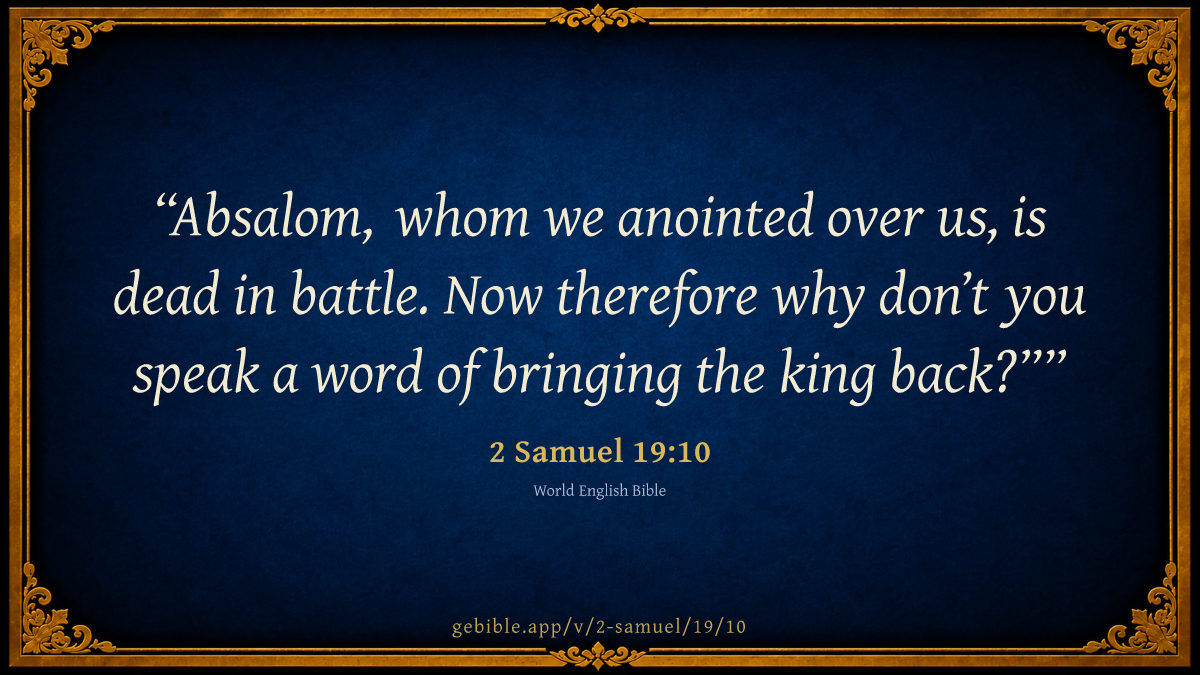
Absalom, whom we anointed over us, is dead in battle. Now therefore why don’t you speak a word of bringing the king back?”
Parallel Translations
-
Absalom, whom we anointed over us, is dead in battle. Now therefore why don’t you speak a word of bringing the king back?”
-
And Absalom, whom we anointed over us, is dead in battle. Now therefore why speak ye not a word of bringing the king back?
-
(19-11) And Absalom, whom we anointed over us, is dead in battle. Now, therefore, why speak ye not a word of bringing the king back?'
Cross-references (4)
Passages linked to 2 Samuel 19:10 in the Treasury of Scripture Knowledge, ordered by reader-vote popularity; verse text shown in World English Bible.
- Judges 18:9 They said, “Arise, and let’s go up against them; for we have seen the land, and behold, it is very good. Do you stand still? Don’t be slothful to go and to enter in to possess the land.
- 2 Samuel 15:12-13 Absalom sent for Ahithophel the Gilonite, David’s counselor, from his city, even from Giloh, while he was offering the sacrifices. The conspiracy was strong; for the people increased continually with Absalom. A messenger came to David, saying, “The hearts of the men of Israel are after Absalom.”
- 2 Samuel 18:14 Then Joab said, “I’m not going to wait like this with you.” He took three darts in his hand, and thrust them through the heart of Absalom, while he was yet alive in the middle of the oak.
- Hosea 8:4 They have set up kings, but not by me. They have made princes, and I didn’t approve. Of their silver and their gold they have made themselves idols, that they may be cut off.
Cross-references from openbible.info (CC BY 4.0)
Explain this verse (9 sources)
Historical commentary, presented as a primary source — not an endorsement.
Private notes
Saved on this device only — never synced or sent anywhere.
John Trapp 1656 · Public Domain 2Sa 19:10 And Absalom, whom we anointed over us,…
2Sa 19:10 And Absalom, whom we anointed over us, is dead in battle. Now therefore why speak ye not a word of bringing the king back?
Ver. 10. And Absalom … is dead.] By "the wrath of God revealed from heaven" against both him and us for so mad an attempt: and should we not now return to our right minds?
John Trapp, A Commentary or Exposition upon All the Books of the Old and New Testament (1647–1656) — public domain. Text from a community e-Sword module.
Matthew Poole 1685 · Public Domain Whom we anointed, i.e. caused to be anointed by…
Whom we anointed, i.e. caused to be anointed by Zadok or Abiathar, or some other of the priests, whom they persuaded or constrained to do this office: for this being a sacred ceremony, of a great reputation, and a likely means to gain the more authority and veneration from the people to Absalom, as one whom God by his vicegerent had constituted and set up; and this rite being usual upon all translations of the government from one person to another in an extraordinary way, as this confessedly was; it is not likely that they would now omit it; though otherwise anointing is frequently put for designing or constituting.
Is dead in battle; and therefore we have no obligation to him, and no hope of any thing from him.
Read full note →
Why speak ye not a word? the people of Israel speak thus to the elders of Israel, as appears by comparing this verse with the next. Seeing their designs for Absalom disappointed, they now repented of that undertaking, and were willing to testify so much by their forwardness to bring back David, and reestablish him.
Matthew Poole's English Annotations on the Holy Bible (1683–1685) — public domain. Text from a community e-Sword/MySword module.
John Gill 1763 · Public Domain And Absalom, whom we anointed over us,.... To be…
And Absalom, whom we anointed over us,.... To be king; which either was really done by Absalom's party, or in effect by proclaiming and appointing him king:
is dead in battle; which shows the thing was not of God, and by which means they were released from their oath of allegiance to him:
Read full note →
now therefore why speak ye not a word of bringing the king back? nobody speaks of it, gives the least hint of it, or shows any concern about it; but the greatest coldness and indifference, as if it was a matter of no importance.
John Gill's Exposition of the Whole Bible (1746–1763) — public domain (CC PDM 1.0). Text via the HelloAO Bible API.
John Wesley 1765 · Public Domain Now therefore - The people of Israel speak thus…
Now therefore - The people of Israel speak thus to the elders of Israel, as appears by comparing this verse with the next. Seeing their designs for Absalom disappointed, they now repented of that undertaking, and were willing to testify so much by their forwardness to bring back David, and re-establish him.
John Wesley, Explanatory Notes Upon the Whole Bible (1754–1765) — public domain. Text via the GEBible commentary corpus.
Haydock's Catholic Bible Commentary 1859 · Public Domain Silent; inactive and indifferent, as this word often denotes,…
Silent; inactive and indifferent, as this word often denotes, Josue x. 12. (Calmet)
George Leo Haydock (1774–1849), Haydock's Catholic Family Bible and Commentary, 1859 edition — public domain. Excludes Psalms (Douay-Rheims chapter numbering differs from Protestant) and Deuterocanonical books (Catholic canon only).
The Cambridge Bible for Schools and Colleges 1878 · Public Domain 9–15. Negotiations for David’s Restoration. His return
9–15. Negotiations for David’s Restoration. His return
10. whom we anointed] The anointing of Absalom is not elsewhere mentioned.
Read full note →
At the end of the verse the Sept. adds, “And the word of all Israel came to the king,” that is, either he heard of the movement for his restoration, or he actually received overtures from Israel. The clause is necessary to introduce 2Sa_19:11.
The Cambridge Bible for Schools and Colleges (gen. ed. J. J. S. Perowne; Cambridge University Press, 1878–1918) — public domain. Text from a community e-Sword module.
Ellicott's Commentary for English Readers 1878 · Public Domain (10) We anointed over us.—There is no other mention…
(10) We anointed over us.—There is no other mention of the anointing of Absalom, and it certainly would not have been performed by the high-priests. It may have been done by some prophet, or this may be a mere form of expression taken from the custom of anointing, and only mean “whom we appointed over us.”
Why speak ye not?—There was evidently a hesitation and delay, arising probably from a mere want of organisation, but yet of dangerous tendency. It is under these circumstances that David shows that politic power which had so often before stood him in good stead. The LXX. very unnecessarily places at the end of this verse the clause which is found at the end of 2Sa_19:11.
A Bible Commentary for English Readers, edited by Charles John Ellicott (1878–1897) — public domain. Text from a community e-Sword module.
The Pulpit Commentary 1880 · Public Domain Absalom, whom we anointed over us. It is evident…
Absalom, whom we anointed over us. It is evident from these words that there had been some solemn anointing and appointment of Absalom, and this accounts for the manner in which his partisans are always described as "Israel," while David"s men are simply "his servants." With this anointment there must also have been a formal renunciation of David"s rule, and, being thus dethroned, he does not attempt to return until the nation summons him back. As the flight of David narrated in ch. 16. was extremely hurried, the conspirators must have kept their counsel well, and whatever rumours reached him apparently he disregarded. But meanwhile representatives of the tribes secretly convened at Hebron had claimed to act in the name of Israel, and, chosen a new king. The words certainly imply that, had Absalom lived, the Israelites would have considered themselves bound to obey him.
The Pulpit Commentary (1880–1919), ed. H.D.M. Spence-Jones & Joseph S. Exell — public domain. Text from a community e-Sword module.
The Biblical Illustrator 1887 · Public Domain Now therefore why speak ye not a word of…
2Sa_19:10
Now therefore why speak ye not a word of bringing the king back?
Read full note →
Bringing the king back
I. Many have lost the comfortable presence of the Lord Jesus Christ. Some have long dwelt in the cold shade of suspended fellowship, and must be anxiously pining after its restoration. Now to such as these, who see no longer the bright and morning star, we say, Why speak ye not a word of bringing the king back? If your soul has been nipped with the frosts of a long and dreary winter, if the Sun of Righteousness do but cross the line and manifest his meridian splendour, your summer will return at once. Let the king come, and all his court will follow--all the graces display themselves where the Lord of grace is revealed. Always beware of any instruction or direction which would withdraw you from the cross as the sole and simple ground of your comfort. While your bark is tossed about at sea, it is very likely that she wants a new copper bottom, or the deck requires holy-stoning, or the rigging is out of repair, or the sails want overhauling, or fifty other things may be necessary; but if the wind is blowing great guns, and the vessel is drifting towards those white-crested breakers, the first business of the mariner is to make for the haven at once, to avoid the hurricane. When he is all snug in port, he can attend to hull and rigging: and all the odds and ends besides. So with you, child of God, one thing you must do, and I beseech you do it. Do not be looking to this, or to that, or to the other out of a thousand things that may be amiss, but steer straight for the cross of Christ, which is the haven for distressed spirits. Why speak ye not a word of bringing the king back?
1. Perhaps, you reply, We speak not a word of this because we are afraid that the king may have forgotten us. Oh, cruel thought concerning so kind a friend! Hear ye his own words, I am God; I change not; therefore ye sons of Jacob are not consumed.
2. But you say, How shall I return to him? I feel ashamed to come to him yet again. Recollect that, bad as you are, you are not now worse than when you first came to him. Why speak ye not a word of bringing the King back?
3. I hope the answer to that question is not that you have forgotten Him. Forgotten the man of Gethsemane, crimsoned with his own blood for you? Forgotten Him whose hands were pierced for you, who bore the crown of thorns, and bowed his head, and gave up the ghost for you? Forgotten that faithful lover who ever since he ascended above the stars has never ceased to intercede for you, and such as you? Oh, shame indeed!
II. Many professors do very little to bring Christ back to his kingdom in the world.
III. A large class are rebellious subjects of this King. The ox knoweth its owner, and the ass its masters crib, but you do not know, and you have lived all these years without considering. Is it not unjust? Does not conscience tell you that you do wrong to rebel against the God that made you? Christ is your lawful King, and you are a rebel against Him. (C. H. Spurgeon.)
David, a king and saviour in Israel
Joabs timely advice, followed by the suffering father. (Pro_14:28; Pro_16:15.)
I. Why did he not immediately go back?
1. Restoration of the kings presence must be sought by rebel subjects.
2. Because he would be king of their hearts, not of the land and city merely. So Christs sovereignty now must be voluntary. One day it will be obligatory, as was Solomons. (Php_2:10; Rev_2:27.) Christ will only rule over willing hearts in His kingdom of grace. Many Christians have their own way. Christ does not coerce; but they are slaves to self instead of being Christs freedmen. Observe the nature of Christs kingdom in the heart. (Rom_14:17; 1Jn_3:9, with Gal_3:16; Gal_4:19; Col_1:27 (Mat_2:3 --born king); 1Co_15:45-50; 1Co_15:24.) Christ waits to be invited as David did. He will not reign at Mahanaim, only at Jerusalem; but He sends messages. Davids message to rebellious Judah is really a pardon, and as such moved the hearts of the people. (verse 14.)
II. Pardon of shimei. Abishai was legally right (Exo_22:28; 1Sa_26:9), but was reminding David of that incident in his past life, and thus helping him to remain true to his own generous instincts. (1Sa_24:5.) The grand answer. I am King, because I can be a Saviour. (1Sa_11:12-13.) Christ might have been King in right of His election (Psa_2:6-8), and will be some day; but He willed to reign by right of His cross. (Psa_72:1-2; Psa_72:14.)
III. Mephibosheth, type of the true children of the bride-chamber. (Mar_2:19-20; Joh_16:20-22.)
IV. Barzillai, type of the truly weaned soul, content to do without temporal blessings and sensible comforts; satisfied with the certainty of the kings favour. Fruitful also, leaving those whom he has led to Christ to carry on his service. Chimham apparently received Davids own inheritance. (Jer_41:17; Joh_17:24; Rev_3:21; Rev_22:16; Rev_2:28. (R. E. Faulkner.)
The Biblical Illustrator, edited by Joseph S. Exell (c. 1880s–1900s) — public domain. Text from a community e-Sword module.