
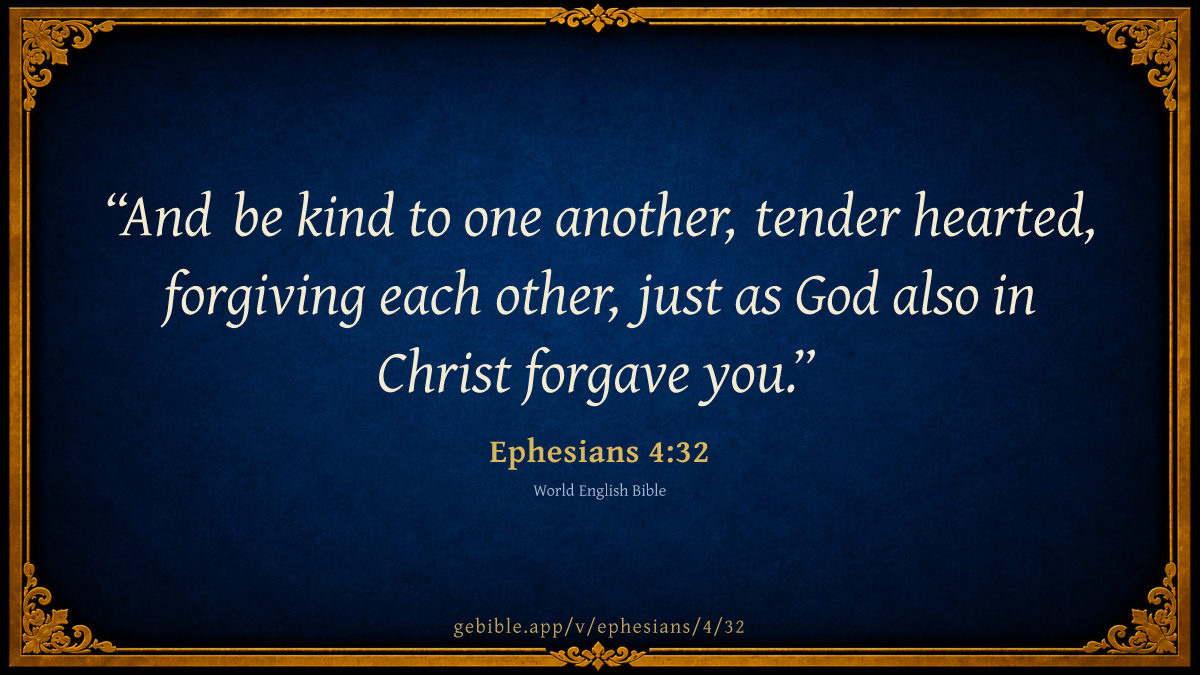
And be kind to one another, tender hearted, forgiving each other, just as God also in Christ forgave you.
Parallel Translations
-
And be kind to one another, tender hearted, forgiving each other, just as God also in Christ forgave you.
-
Be ye courteouse one to another and mercifull forgevynge one another even as god for Christes sake forgave you.
-
Be ye courteous one to another, and tender hearted, freely forgiuing one another, euen as God for Christes sake, freely forgaue you.
Cross-references (31)
Passages linked to Ephesians 4:32 in the Treasury of Scripture Knowledge, ordered by reader-vote popularity; verse text shown in World English Bible.
- Colossians 3:12-13 Put on therefore, as God’s chosen ones, holy and beloved, a heart of compassion, kindness, lowliness, humility, and perseverance; bearing with one another, and forgiving each other, if any man has a complaint against any; even as Christ forgave you, so you also do.
- Matthew 6:14-15 “For if you forgive men their trespasses, your heavenly Father will also forgive you. But if you don’t forgive men their trespasses, neither will your Father forgive your trespasses.
- Mark 11:25 Whenever you stand praying, forgive, if you have anything against anyone; so that your Father, who is in heaven, may also forgive you your transgressions.
- 1 Peter 3:8-9 Finally, all of you be like-minded, compassionate, loving as brothers, tenderhearted, courteous, not rendering evil for evil, or insult for insult; but instead blessing, knowing that you were called to this, that you may inherit a blessing.
- 2 Corinthians 2:10 Now I also forgive whomever you forgive anything. For if indeed I have forgiven anything, I have forgiven that one for your sakes in the presence of Christ,
- Ephesians 5:1 Be therefore imitators of God, as beloved children.
- Luke 6:35 But love your enemies, and do good, and lend, expecting nothing back; and your reward will be great, and you will be children of the Most High; for he is kind toward the unthankful and evil.
- Luke 6:37 Don’t judge, and you won’t be judged. Don’t condemn, and you won’t be condemned. Set free, and you will be set free.
- Matthew 6:12 Forgive us our debts, as we also forgive our debtors.
- Luke 17:4 If he sins against you seven times in the day, and seven times returns, saying, ‘I repent,’ you shall forgive him.”
- 1 Corinthians 13:4 Love is patient and is kind. Love doesn’t envy. Love doesn’t brag, is not proud,
- Psalms 145:9 Yahweh is good to all. His tender mercies are over all his works.
- Romans 12:10 In love of the brothers be tenderly affectionate to one another; in honor preferring one another;
- Romans 12:20-21 Therefore “If your enemy is hungry, feed him. If he is thirsty, give him a drink; for in doing so, you will heap coals of fire on his head.” Don’t be overcome by evil, but overcome evil with good.
- 1 John 2:12 I write to you, little children, because your sins are forgiven you for his name’s sake.
- Psalms 112:4-5 Light dawns in the darkness for the upright, gracious, merciful, and righteous. It is well with the man who deals graciously and lends. He will maintain his cause in judgment.
- Matthew 18:21-35 Then Peter came and said to him, “Lord, how often shall my brother sin against me, and I forgive him? Until seven times?” Jesus said to him, “I don’t tell you until seven times, but, until seventy times seven. Therefore the Kingdom of Heaven is like a certain king, who wanted to reconcile accounts with his servants. When he had begun to reconcile, one was brought to him who owed him ten thousand talents. But because he couldn’t pay, his lord commanded him to be sold, with his wife, his children, and all that he had, and payment to be made. The servant therefore fell down and knelt before him, saying, ‘Lord, have patience with me, and I will repay you all!’ The lord of that servant, being moved with compassion, released him, and forgave him the debt. “But that servant went out, and found one of his fellow servants, who owed him one hundred denarii, and he grabbed him, and took him by the throat, saying, ‘Pay me what you owe!’ “So his fellow servant fell down at his feet and begged him, saying, ‘Have patience with me, and I will repay you!’ He would not, but went and cast him into prison, until he should pay back that which was due. So when his fellow servants saw what was done, they were exceedingly sorry, and came and told their lord all that was done. Then his lord called him in, and said to him, ‘You wicked servant! I forgave you all that debt, because you begged me. Shouldn’t you also have had mercy on your fellow servant, even as I had mercy on you?’ His lord was angry, and delivered him to the tormentors, until he should pay all that was due to him. So my heavenly Father will also do to you, if you don’t each forgive your brother from your hearts for his misdeeds.”
- 1 John 1:9 If we confess our sins, he is faithful and righteous to forgive us the sins, and to cleanse us from all unrighteousness.
- 2 Corinthians 2:7 so that on the contrary you should rather forgive him and comfort him, lest by any means such a one should be swallowed up with his excessive sorrow.
- Genesis 50:17-18 ‘You shall tell Joseph, “Now please forgive the disobedience of your brothers, and their sin, because they did evil to you.” ’ Now, please forgive the disobedience of the servants of the God of your father.” Joseph wept when they spoke to him. His brothers also went and fell down before his face; and they said, “Behold, we are your servants.”
- James 5:11 Behold, we call them blessed who endured. You have heard of the perseverance of Job, and have seen the Lord in the outcome, and how the Lord is full of compassion and mercy.
- Proverbs 19:22 That which makes a man to be desired is his kindness. A poor man is better than a liar.
- Luke 1:78 because of the tender mercy of our God, by which the dawn from on high will visit us,
- Ruth 2:20 Naomi said to her daughter-in-law, “May he be blessed by Yahweh, who has not abandoned his kindness to the living and to the dead.” Naomi said to her, “The man is a close relative to us, one of our near kinsmen.”
- Psalms 112:9 He has dispersed, he has given to the poor. His righteousness endures forever. His horn will be exalted with honor.
- Proverbs 12:10 A righteous man respects the life of his animal, but the tender mercies of the wicked are cruel.
- Luke 11:4 Forgive us our sins, for we ourselves also forgive everyone who is indebted to us. Bring us not into temptation, but deliver us from the evil one.’ ”
- 2 Corinthians 6:6 in pureness, in knowledge, in perseverance, in kindness, in the Holy Spirit, in sincere love,
- Isaiah 57:1 The righteous perish, and no one lays it to heart. Merciful men are taken away, and no one considers that the righteous is taken away from the evil.
- Acts 28:2 The natives showed us uncommon kindness; for they kindled a fire and received us all, because of the present rain and because of the cold.
- 2 Peter 1:7 and in godliness brotherly affection; and in brotherly affection, love.
Cross-references from openbible.info (CC BY 4.0)
Explain this verse (13 sources)
Historical commentary, presented as a primary source — not an endorsement.
Private notes
Saved on this device only — never synced or sent anywhere.
John Calvin 1540 · Public Domain 32. And be ye kind one to another. With…
32. And be ye kind one to another. With bitterness he contrasts kindness, or gentleness of countenance, language, and manners. And as this virtue will never reign in us, unless attended by compassion, (ουμπάθεια,) he recommends to us to be tender-hearted This will lead us not only to sympathize with the distresses of our brethren, as if they were our own, but to cultivate that true humanity which is affected by everything that happens to them, in the same manner as if we were in their situation. The contrary of this is the cruelty of those iron-hearted, barbarous men, by whom the sufferings of others are beheld without any concern whatever.
Forgiving one another. The Greek word here rendered forgiving, (χαριζόμενοι ἑαυτοῖς,) is supposed by to mean beneficence. Erasmus, accordingly, renders it (largientes) bountiful. Though the word admits of that meaning, yet the context induces me to prefer the other view, that we should be ready to forgive It may sometimes happen, that men are kind and tender-hearted, and yet, when they receive improper treatment, do not so easily forgive injuries. That those whose kindness of heart in other respects disposes them to acts of humanity, may not fail in their duty through the ingratitude of men, he exhorts them to discover a readiness to lay aside resentment. To give his exhortation the greater weight, he holds out the example of God, who has forgiven to us, through Christ, far more than any mortal man can forgive to his brethren.
John Calvin's Commentaries (1540-1563) — public domain. Text from the Calvin Translation Society English edition (1840s-50s) via the Christian Classics Ethereal Library (ccel.org). Calvin's coverage is partial (roughly two-thirds of the Bible); uncommented books and verses are honest gaps, never fabricated. The 19th-century editor's footnotes and remarks are omitted so the notes are faithfully Calvin's own voice.
Geneva Bible translators 1599 · Public Domain An argument taken from the example of Christ, most…
An argument taken from the example of Christ, most grave and vehement, both for pardoning of those injuries which have been done unto us by our greatest enemies, and much more for having consideration of the miserable, and using moderation and gentle behavior towards all men.
Geneva Bible (1599) marginal notes — public domain.
John Trapp 1656 · Public Domain 32 And be ye kind one to another, tenderhearted,…
32 And be ye kind one to another, tenderhearted, forgiving one another, even as God for Christ’s sake hath forgiven you.
Ver. 32. And be ye kind] χρηστοι. Sweet natured, facile, and fair conditioned; as Cranmer, whose gentleness in pardoning wrongs was such, as it grew to a common proverb, Do my Lord of Canterbury a displeasure, and then you may be sure to have him your friend while he liveth. He never raged so far with any of his household servants, as once to call the meanest of them varlet or knave in anger, much less to reprove a stranger with any reproachful word. Homo Φιλοξενος, nec minus Φιλολογος, saith Tremelius of him, and much more in praise of his courtesy and piety.
John Trapp, A Commentary or Exposition upon All the Books of the Old and New Testament (1647–1656) — public domain. Text from a community e-Sword module.
Matthew Poole 1685 · Public Domain And be ye kind; sweet, amiable, facile in words…
And be ye kind; sweet, amiable, facile in words and conversation, Luk 6:35.
Tender-hearted; merciful, quickly moved to compassion: so we have bowels of mercies, Col 3:12.
Read full note →
Forgiving one another, even as God for Christ’s sake hath forgiven you; be placable, and ready to forgive, therein resembling God, who for Christ’s sake hath forgiven you more than you can forgive to one another.
Matthew Poole's English Annotations on the Holy Bible (1683–1685) — public domain. Text from a community e-Sword/MySword module.
John Wesley 1765 · Public Domain As God, showing himself kind and tenderhearted in the…
As God, showing himself kind and tenderhearted in the highest degree, hath forgiven you.
John Wesley, Explanatory Notes Upon the Whole Bible (1754–1765) — public domain. Text via the GEBible commentary corpus.
Adam Clarke 1810 · Public Domain Verse 32. Be ye kind one to another] γινεσθε…
Verse 32. Be ye kind one to another] γινεσθε χρηστοι. Be kind and obliging to each other; study good breeding and gentleness of manners. A Christian cannot be a savage, and he need not be a boor. Never put any person to needless pain.
Tender-hearted] ευσπλαγχνοι. Compassionate; having the bowels easily moved (as the word implies) to commiserate the state of the wretched and distressed.
Read full note →
Forgiving one another] Should you receive any injury from a brother, or from any man, be as ready to forgive him, on his repentance and acknowledgment, as God was, for Christ's sake, to forgive you when you repented of your sins, and took refuge in his mercy.
1. THE exhortations given in this chapter, if properly attended to, have the most direct tendency to secure the peace of the individual, the comfort of every family, and the welfare and unity of every Christian society. That God never prohibits any thing that is useful to us, is an unshaken truth. And that he never commands what has not the most pointed relation to our present and eternal welfare, is not less so. How is it, then, that we do not glory in his commandments and rejoice in his prohibitions? If the gratification of our fleshly propensities could do us good, that gratification had never been forbidden. God plants thorns in the way that would lead us to death and perdition.
2. From the provision which God has made for the soul's salvation, we may see the nature, and in some sense the extent, of the salvation provided. Much on this subject has been said in the preceding chapter, and the same subject is continued here. God requires that the Church shall be holy, so that it may be a proper habitation for himself; and he requires that each believer should be holy, and that he should, under the influences of his grace, arrive at the measure of the stature of the fulness of Christ! Eph 4:13. This is astonishing; but God is able to make all grace abound towards us.
3. It is the will of God that Christians should be well instructed; that they should become wise and intelligent; and have their understandings well cultivated and improved. Sound learning is of great worth, even in religion; the wisest and best instructed Christians are the most steady, and may be the most useful. If a man be a child in knowledge, he is likely to be tossed to and fro, and carried about with every wind of doctrine; and often lies at the mercy of interested, designing men: the more knowledge he has, the more safe is his state. If our circumstances be such that we have few means of improvement, we should turn them to the best account. "Partial knowledge is better than total ignorance; he who cannot get all he may wish, must take heed to acquire all that he can." If total ignorance be a bad and dangerous thing, every degree of knowledge lessens both the evil and the danger. It must never be forgotten that the Holy Scriptures themselves are capable of making men wise unto salvation, if read and studied with faith in Christ.
4. Union among the followers of Christ is strongly recommended. How can spiritual brethren fall out by the way? Have they not all one Father, all one Head? Do they not form one body, and are they not all members of each other? Would it not be monstrous to see the nails pulling out the eyes, the hands tearing off the flesh from the body, the teeth biting out the tongue, c., c.? And is it less so to see the members of a Christian society bite and devour each other, till they are consumed one of another? Every member of the mystical body of Christ should labour for the comfort and edification of the whole, and the honour of the Head. He that would live a quiet life, and keep the unity of the Spirit in the bond of peace, must be as backward to take offence as to give it. Would all act on this plan (and surely it is as rational as it is Christian) we should soon have glory to God in the highest, and on earth peace and good will among men.
5. A roughness of manners is to some unavoidable it is partly owing to the peculiar texture of their mind, and partly to their education. But there are others who glory in, and endeavour to cultivate, this ungentle disposition under this is often concealed a great degree of spiritual pride, and perhaps some malignity; for they think that this roughness gives them a right to say grating, harsh, and severe things. They should be taught another lesson; and if they will not demean themselves as they ought, they should be left to themselves, and no man should associate with them. They are not Christians, and they act beneath the character of men.
Adam Clarke's Commentary on the Bible (1810–1826) — public domain. Text from a community e-Sword/MySword module.
Albert Barnes 1834 · Public Domain And be ye kind one to another - Benignant,…
And be ye kind one to another - Benignant, mild, courteous, “polite” - χρηστοὶ chrēstoi. 1Pe 3:8. Christianity produces true courteousness, or politeness. It does not make one rough, crabby, or sour; nor does it dispose its followers to violate the proper rules of social contact. The secret of true politeness is “benevolence,” or a desire to make others happy; and a Christian should be the most polite of people. There is no religion in a sour, misanthropic temper; none in rudeness, stiffness, and repulsiveness; none in violating the rules of good breeding. There is a hollow-hearted politeness, indeed, which the Christian is not to aim at or copy. His politeness is to be based on “kindness;” Col 3:12. His courtesy is to be the result of love, good-will, and a desire of the happiness of all others; and this will prompt to the kind of conduct that will render his conversation. with others agreeable and profitable.
Tender-hearted - Having a heart disposed to pity and compassion, and especially disposed to show kindness to the faults of erring brethren; for so the connection demands.
Read full note →
Forgiving one another - see the notes on Mat 6:12.
As God for Christ’s sake hath forgiven you - As God, on account of what Christ has suffered and done, has pardoned you. He has done it:
(1) “freely” - without merit on your part - when we were confessedly in the wrong.
(2) “fully;” he has forgiven “every” offence.
(3) “Liberally;” he has forgiven “many” offences, for our sins have been innumerable.
This is to be the rule which we are to observe in forgiving others. We are to do it “freely, fully, liberally.” The forgiveness is to be entire, cordial, constant. We are not to “rake up” old offences, and charge them again upon them; we are to treat them as though they had not offended, for so God treats us Learn:
(1) That the forgiveness of an offending brother is a duty which we are not at liberty to neglect.
(2) The peace and happiness of the church depend on it. All are liable to offend their brethren, as all are liable to offend God; all need forgiveness of one another, as we all need it of God.
(3) There is no danger of carrying it too far. Let the rule be observed, “As God has forgiven you, so do you forgive others.” Let a man recollect his own sins and follies; let him look over his life, and see how often he has offended God; let him remember that all has been forgiven; and then, fresh with this feeling, let him go and meet an offending brother, and say, “My brother, I forgive you. I do it frankly, fully, wholly. So Christ has forgiven me; so I forgive you. The offence shall be no more remembered. It shall not be referred to in our contact to harrow up your feelings; it shall not diminish my love for you; it shall not prevent my uniting with you in doing good. Christ treats me, a poor sinner, as a friend; and so I will treat you.”
Albert Barnes' Notes on the Bible (1834–1885) — public domain. Text from a community e-Sword/MySword module.
Robert Jamieson, A. R. Fausset & David Brown 1871 · Public Domain (Luk 7:42; Col 3:12).
(Luk 7:42; Col 3:12).
even as--God hath shown Himself "kind, tender-hearted, and forgiving to you"; it is but just that you in turn shall be so to your fellow men, who have not erred against you in the degree that you have erred against God (Mat 18:33).
Read full note →
God for Christ's sake--rather as Greek, "God in Christ" (Co2 5:19). It is in Christ that God vouchsafes forgiveness to us. It cost God the death of His Son, as man, to forgive us. It costs us nothing to forgive our fellow man.
hath forgiven--rather as Greek, "forgave you." God has, once for all, forgiven sin in Christ, as a past historical fact.
Next: Ephesians Chapter 5
Jamieson, Fausset & Brown — Commentary Critical and Explanatory on the Whole Bible (1871) — public domain (CC PDM 1.0). Text via the HelloAO Bible API.
Daniel D. Whedon 1874 · Public Domain 32. The and shows that this verse, together with…
32. The and shows that this verse, together with Eph_5:1-2, is the completion of 31, as 30 is of 29. The therefore of the next verse, Eph_5:1, does not imply transition to a new paragraph.
Be ye— Rather, become ye. Thisdoes not imply, as Alford and Braune (Schaff’s Lange) imply, any particular late transgression in these respects by the Ephesian Christians, but only that their transition from Gentilism to a perfect Christianity was a perfecting process, a becoming.
Read full note →
Kind—The Greek word that so nearly resembled Christ (Chrestos) that pagans confounded it and Christians boasted it. Note on Act_18:2.
As God— All in common had been forgiven, and could, therefore, mutually forgive. And in the two following verses St. Paul carries out into striking detail this following our divine model, God.
Daniel D. Whedon (gen. ed.), Commentary on the Old and New Testaments (1874–1909) — public domain. Text from a community e-Sword module.
The Cambridge Bible for Schools and Colleges 1878 · Public Domain 32. be] Lit., become; shew yourselves, in the actions…
32. be] Lit., become; shew yourselves, in the actions and developments of life.
kind] The Gr. word (noun or adj.) occurs in similar contexts, Luk_6:35; Rom_2:4; Rom_11:22 (“goodness”); 2Co_6:6; Gal_5:22; Col_3:12. Its primitive meaning is “useful”; hence “helpful,” and so “kindly.”—It is the original of “easy” in Mat_11:30; the Lord’s “yoke” is a real yoke, but instinct with the lovingkindness of Him who imposes it.
Read full note →
tender-hearted] The same Gr. word as in 1Pe_3:8 (A.V., “pitiful”). It occurs nowhere else in N.T. Kind-hearted may perhaps be a better rendering, as somewhat wider. The word carries the idea of the previous word a little more into life and detail.
forgiving one another] Lit., “forgiving yourselves.” Usage and common sense alike fully justify the rendering of A.V. and R.V. (which reads, somewhat needlessly, “each other”). The “yourselves,” as a grammatical fact, indicates the solidarity of the body within which the reciprocity takes place; though this fine shade of meaning must not be exaggerated.
For a close parallel to the precept see Col_3:13. The holy duty of heartfelt forgiveness, entire and unreserved, is prominent in the Lord’s teaching; cp. especially the Lord’s Prayer (Mat_6:12; Luk_11:4); Mat_18:21, &c. No duty is more readily owned in the abstract, none more repugnant to the will in many a case in the concrete. But the law of Christ knows no exceptions, and grace is able to meet every demand for fulfilment.—It is humbling and instructive to see here, as in the Lord’s Prayer, that the abiding need for mutual forgiveness is assumed.
even as] The Divine pardon is at once supreme example and sacred motive. Cp. just below, ch. Eph_5:2.
God] The Father, “Fount of Deity,” and as such styled often simply God where Christ is also and distinctively named (Joh_17:3; 2Co_5:19; 2Co_13:13; Judges 21). The Son has also Deity, but as in the Stream, not in the Fountain. See Pearson, On the Creed, Art. 1.
for Christ’s sake] Lit. and better, in Christ. The reason of pardon, and the process of it, are alike summed up “in Christ,” “in” Whom the Father reveals Himself as God of Peace: “in” Whom resides the immediate atoning reason of Peace; and “in” Whom, by grace and faith, are the human objects of pardon, “very members incorporate” of Him Who is eternally the Accepted One of the Father.—Cp. Eph_1:7.
hath forgiven] Lit., and better, did forgive; ideally and in covenant, “before the world was”; historically, when the Son was accepted and glorified as the perfect Propitiation, raised from the dead; in individual experience, when each person believed (Rom_5:1, &c.) It is important to observe how the Apostle bids them deal with Divine forgiveness not as a hope but as a fact. Cp. 1Jn_2:12.
you] There is considerable, but not preponderating, evidence for a reading “us”. The question between the two readings is not of practical importance.
The Cambridge Bible for Schools and Colleges (gen. ed. J. J. S. Perowne; Cambridge University Press, 1878–1918) — public domain. Text from a community e-Sword module.
Ellicott's Commentary for English Readers 1878 · Public Domain (32) Kind . . . tenderhearted.—“Kindness” is gentleness in…
(32) Kind . . . tenderhearted.—“Kindness” is gentleness in bearing with wrong (Luk_6:35; Rom_11:22; Eph_2:7; 1Pe_2:3). “Tenderheartedness” (see 1Pe_3:8) is more positive warmth of sympathy and love. Both issue in free “forgiveness,” after the model of the universal and unfailing forgiveness “of God in Christ” to us—the only model we dare to follow, suggested by our Saviour Himself in the Lord’s Prayer, and expressly enjoined in Luk_6:36. It is a forgiveness which in us, as in Him, does not imply condonation of evil, or even the withholding of needful chastisement, but which absolutely ignores self, conquers man’s selfish anger, and knows no limit, even up to “seventy times seven.”
A Bible Commentary for English Readers, edited by Charles John Ellicott (1878–1897) — public domain. Text from a community e-Sword module.
The Pulpit Commentary 1880 · Public Domain But be ye kind one to another, tender-hearted, forgiving…
But be ye kind one to another, tender-hearted, forgiving one another (opposed to bitterness, wrath, anger; Bengel). Kind (crhstoi), sweet, amiable in disposition, subduing all that is harsh and hasty, encouraging all that is gentle and good; tender-hearted (eusplagcnoi), denoting a specially compassionate feeling, such as may arise from the thought of the infirmities, griefs, and miseries to which more or less all are subject; these emotional conditions to bear the practical fruit of forgiveness, and the forgiveness to be mutual (carizomenoi eJautoiv), as if under the feeling that what you give today you require to ask tomorrow, net being too hard on the faults of others, remembering that you have your own. Even as God in Christ also forgave you. The A.V rendering, "for Christ"s sake," is objectionable every way: it is not literal; it omits the characteristic feature of the Epistle, "in Christ," losing the force of the consideration that the forgiveness was dispensed by the Father, acting with or wholly one with the Son; and it gives a shade of countenance to the great error that the Father personally was not disposed to forgive till he was prevailed on to do so by the interposition of the Son. The aorist, forgave," is more literal and better than the perfect, "hath forgiven;" it points to a definite time when forgiveness was bestowed, viz. the moment of real belief in Christ, and hearty acceptance of his grace. The vague atmosphere in which many envelop the question of their forgiveness is very hurtful; it checks their thanksgivings, dulls their joy, quenches hope, and dilutes the great dynamic power of the gospel the power that impels us to forgive our brother, as well as to abound in the work of the Lord with a tender conscience, the sense of forgiveness urges to the most full and hearty doing of God"s will; but when hypocrites, with seared consciences claim to be forgiven, they steal what is not their own, and become more abandoned to wickedness.
The benevolent and forgiving temper.
Read full note →
Instead of bitterness, there ought to be kindness; instead of wrath, anger, clamor, and evil-speaking, there ought to be tender-heartedness; instead of malice, a loving and hearty forgiveness.
I KINDNESS. It is a suggestive idea that our English word "kind" is derived from kinned, as marking the affection of kindred.
1. Consider how it is to be manifested.
1. By desiring one another"s good; (1Ti_2:1)
2. by rejoicing in one another"s prosperity; (Rom_12:15)
3. by pitying one another"s miseries; (Rom_12:15)
4. by helping one another"s necessities. (1Jn_3:17, 1Jn_3:18)
1. The motives to kindness.
1. The example of God himself, who is said to be "kind to the unthankful and evil"; (Luk_6:35)
2. it is a commanded duty;
3. we are brethren both in the flesh and in the spirit. A kindly spirit without a touch of censoriousness or harshness greatly recommends true religion.
II TENDER-HEARTEDNESS. This expression is in the original closely allied to "bowels of mercy". (Col_3:12) It implies a compassionate sense of the miseries and infirmities of others. It is to interpret in the best sense the injunction of the apostle: "Look not every man on his own things, but every man also on the things of others". (Php_2:4) The ties of nature are not cancelled by Christianity, but strengthened by it. We ought to be ready at all times to soothe the sorrows, to remove the miseries, to solve the doubts, of our neighbors. It is a temper highly recommended in Scripture (Luk_6:36; 1Pe_3:8) An unmerciful spirit is declared to be inconsistent with the love of God in the soul: Whoso... shutteth his bowels of compassion ... how dwelleth the love of God in him?". (1Jn_3:17) We ought to follow the example of our heavenly Father, who is rich in mercy, and whose tender mercies are over all his works; and of his dear Son Jesus Christ, who was often moved with compassion, (Mat_9:36) and, as the High Priest of our profession, cannot but be touched with the feeling of our infirmities. (Heb_6:15)
III THE FORGIVING SPIRIT. "Forgiving one another, even as God also in Christ forgave you." These words imply:
1. That Christians will often do to one another much that needs forgiveness. They are "of like passions with other men," beset by infirmities of temper, or apt to come into collision with others either in a way of opinion or of interest. Faults will be committed, offence will be given.
2. That it is a Christian. duty to forgive others. Our Lord gave repeated injunctions respecting it (Mat_6:14; Luk_17:4)
3. Our forgiving our brethren must be a certain factor in our own prayer for Divine forgiveness.
4. The motive or measure of our forgiveness is to be the very forgiveness of God himself. Note:
(1) It is God who forgives; it is an act of his grace. (Eph_1:7)
(2) He does it in Christ, not merely for his sake, but in him as our Mediator.
(3) It is a past act. Believers are forgiven in Christ in the very moment of their conversion.
(4) How miserable we should be without it! God angry with us; hell under our feet; the very blessings of life a curse to us.
(5) How happy we are with this forgiveness! God will never condemn you nor remember your sins; all things will be blessed to you; the love of God the guarantee of your final glorification. T.C.
The Pulpit Commentary (1880–1919), ed. H.D.M. Spence-Jones & Joseph S. Exell — public domain. Text from a community e-Sword module.
Tyndale Open Study Notes 2022 · CC BY-SA 4.0 4:32 Forgiving fellow believers is a natural and good…
4:32 Forgiving fellow believers is a natural and good response to experiencing God’s forgiving grace in Christ (cp. Col 3:12-13; 1 Jn 4:19).
Tyndale Open Study Notes — © Tyndale Open Resources, licensed CC BY-SA 4.0. Text via the HelloAO Bible API.